Write your answer on paper. Then open the answer to check it.
Section A
Diagram 1 shows cosmetic products that provide a pleasant appearance and increase the confident level.
Medium5 marks- (a)
State the meaning of cosmetics.
[1] - (b)
State two types of basic ingredients in cosmetics production.
[2] - (c)(i)
Aida was diagnosed with kidney damage by a doctor due to the use of cosmetic products. Suggest one prohibited chemical substance in that cosmetic products.
[1] - (c)(ii)
State another one side effect of chemical uses in 1(c)(i).
[1]
Diagram 2 shows standard representation of elements in Group 17: ¹⁹₉F (fluorine), ³⁵₁₇Cl (chlorine), ⁸⁰₃₅Br (bromine), ¹²⁷₅₃I (iodine).
Medium5 marks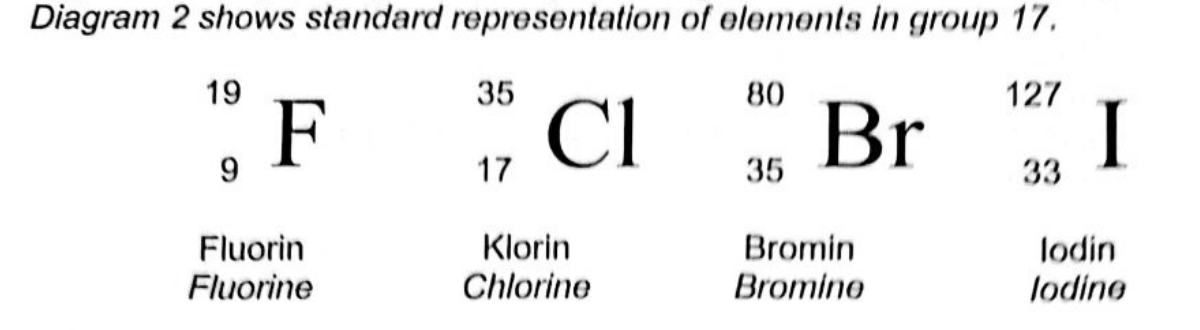
- (a)
What is the name of Group 17?
[1] - (b)
State the colour of chlorine gas.
[1] - (c)
Between the elements in Diagram 2, which is used as a material in fire extinguisher?
[1] - (d)
Fluorine atoms are smaller than chlorine atoms. Explain why fluorine forms a negative ion more easily than chlorine.
[2]
Table 1 shows the melting point and boiling point of three substances: P (80 °C, 218 °C); R (−101.0 °C, −35.0 °C); S (801.0 °C, 1413.0 °C).
Medium6 marks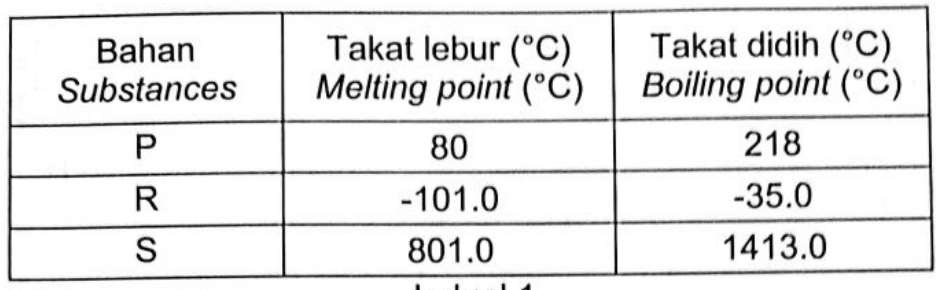
- (a)
What is meant by freezing point?
[1] - (b)
Name the substance that exists in the state of gas at 10 °C.
[1] - (c)(i)
Sketch the graph of temperature against time for substance P when it is cooled from 70 °C until it reaches a temperature of 30 °C.
[2] - (c)(ii)
Draw an apparatus set-up for cooling process of substance P.
[2]
Diagram 3 shows the flow chart of latex collected from the rubber tree and used to produce latex in solid and liquid forms (Process I: add ammonia solution gives liquid latex; Process II: add substance X gives solid latex). Natural rubber (latex) is natural polymer called polyisoprene. Table 2 shows two examples of plastic widely used in daily life: Plastic A (plastic bag) and Plastic B (bottle), both made from the synthetic polymer polyethylene and difficult to be decomposed by microorganisms.
Medium7 marks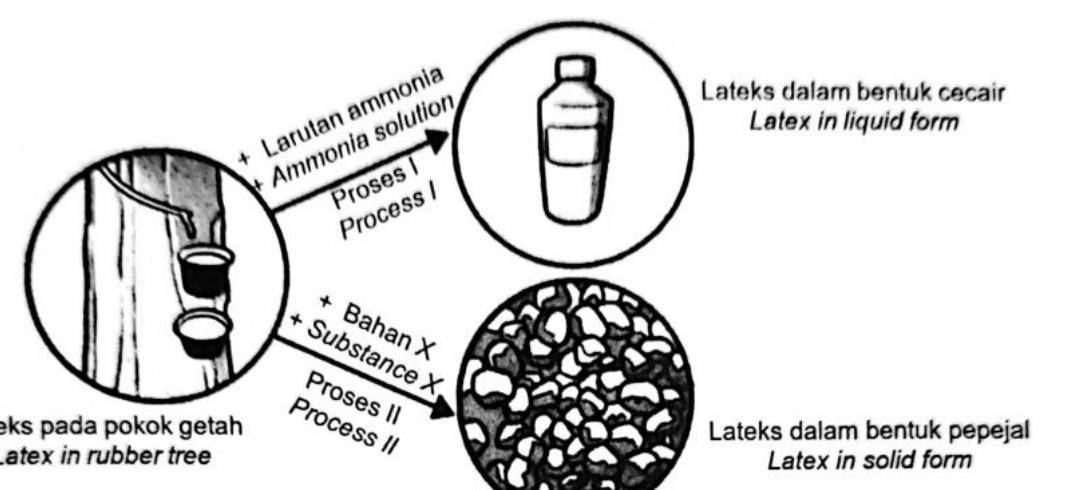
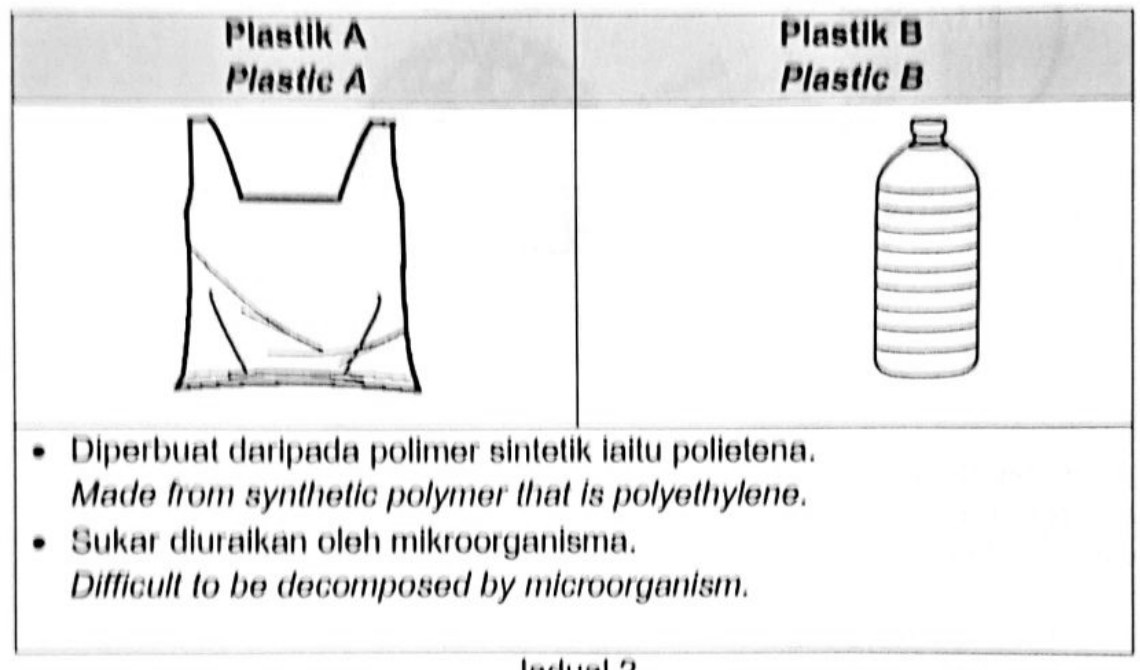
- (a)(i)
What is the meaning of polymer?
[1] - (a)(ii)
Name process II.
[1] - (a)(iii)
State one example of substance X.
[1] - (b)(i)
Write the chemical equation for the polymerization of ethene to form polyethylene.
[2] - (b)(ii)
Disposal of synthetic polymer such as plastic A and B can cause blockage of drainage systems and river and may result in flash floods. Suggest two ways to solve the pollution issue.
[2]
Diagram 5 shows the utensils used for washing dishes in the kitchen and made of alloy Y (a kitchen sink).
Medium8 marks- (a)
What is the meaning of alloy?
[1] - (b)
The main element of Y is iron. Name element which is added to form Y?
[1] - (c)
Draw atomic structure in alloy Y.
[2] - (d)
Azizul is a cyclist. He had trouble winning if the bike he was using was heavy. Suggest what needs to be done to his bike to win the bike race?
[2] - (e)
The information below relates to bronze alloys and brass alloys. Bronze consists of 90% copper and 10% tin. Brass consists of 70% copper and 10% [sic] zinc. Based on the information above, explain the differences in the content and properties of the two alloys.
[2]
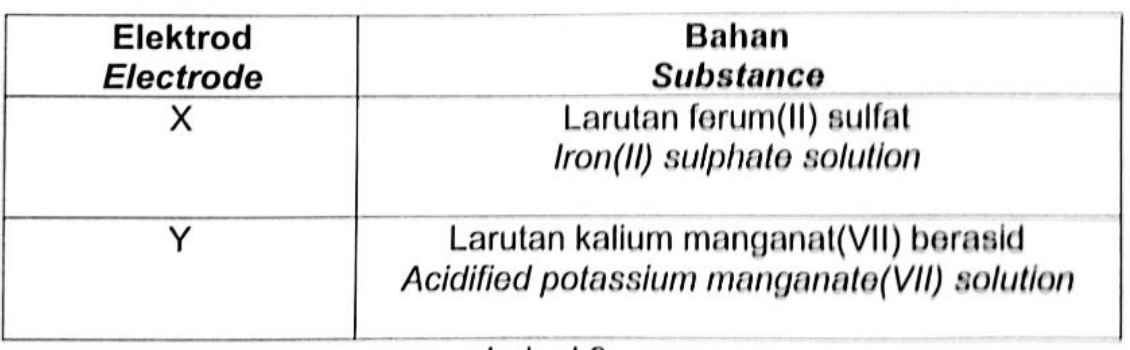
Diagram 6 shows the observation of the colour of the material found on both arms of the U-tube to study electron transfer over a distance carried out after 30 minutes (carbon electrodes X and Y in a U-tube of sulphuric acid, H₂SO₄, connected to a galvanometer; observation at X: brown; observation at Y: colourless). Table 3: electrode X contains iron(II) sulphate solution; electrode Y contains acidified potassium manganate(VII) solution.
Medium9 marks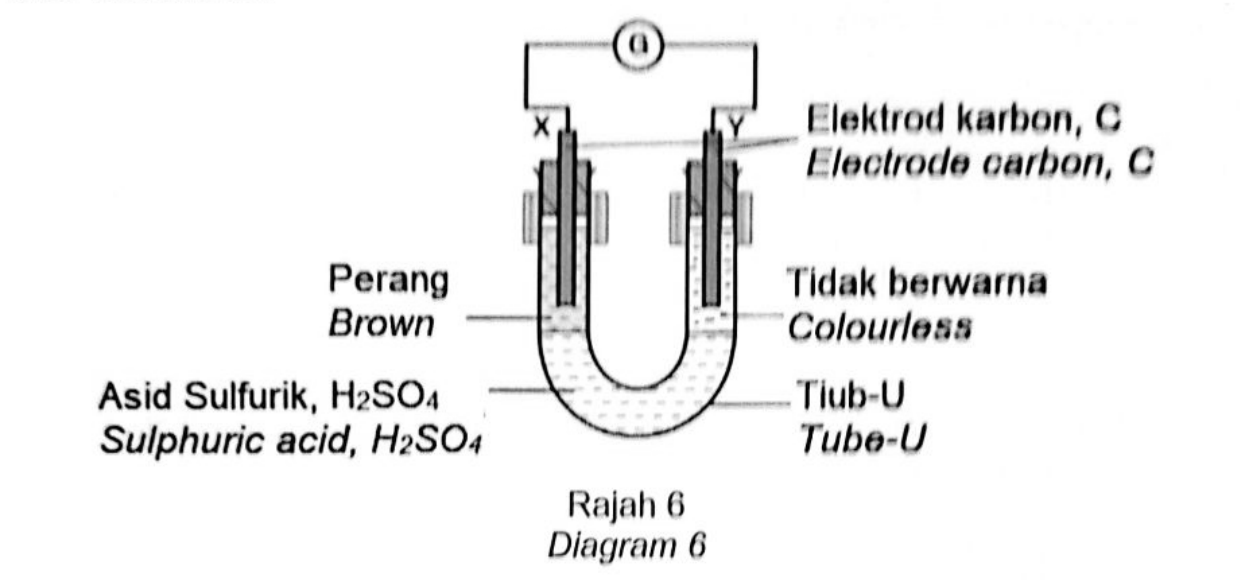
- (a)
State the colour of acidified potassium manganate(VII) solution.
[1] - (b)
State the observation that occur at electrode X.
[1] - (c)
Determine the oxidation number of manganese in MnO₄⁻ ion.
[2] - (d)
Write the ionic equation for the reaction that occurs at Y electrode.
[2] - (e)
Name other reagent that can be used to replace the iron(II) sulphate solution so that the same result can be produced at electrode X and write the overall ionic equation for the reaction.
[3]
Diagram 7 shows two reactions involving compound C₂H₅OH. Reaction I: C₂H₅OH → H₂O + CO₂. Reaction II: C₂H₅OH + acidified potassium manganate(VII) solution → compound X + H₂O. Compound X has a carboxyl group and changes blue litmus to red.
Medium10 marks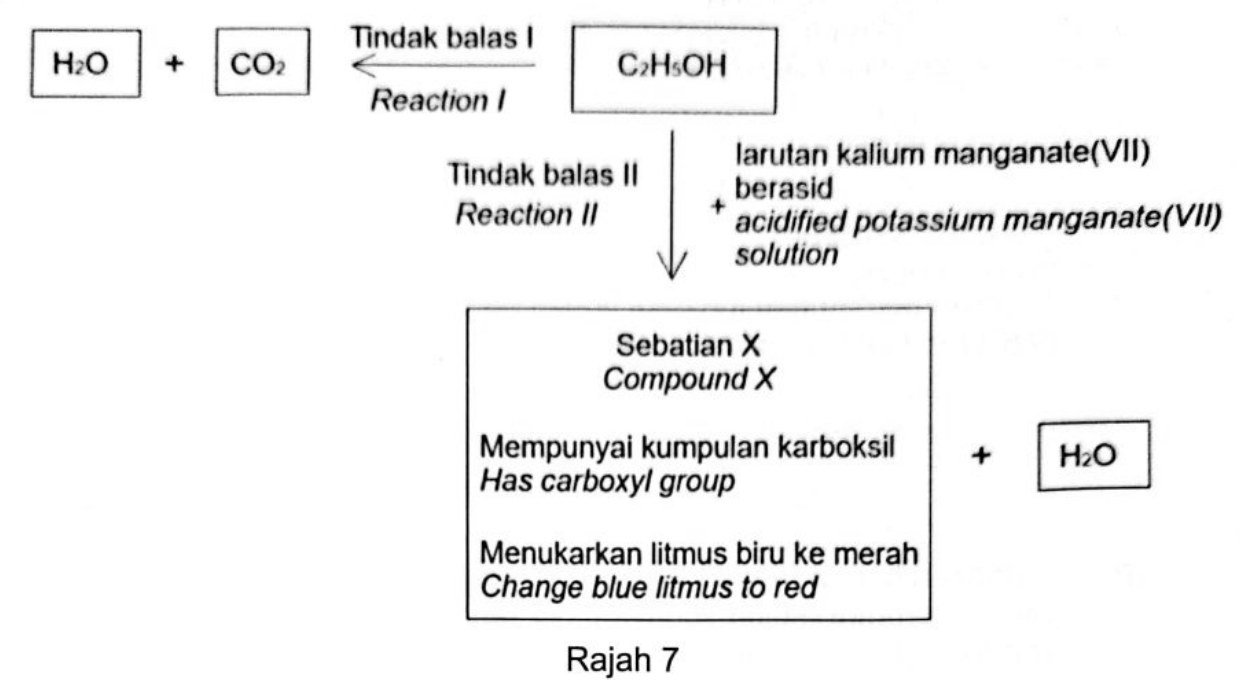
- (a)
State the functional group of C₂H₅OH.
[1] - (b)(i)
One of the uses of C₂H₅OH in reaction I is as fuels. Chemical equation for reaction I: C₂H₅OH(l) + 3O₂(g) → 2CO₂(g) + 3H₂O(l). Interpret the chemical equation quantitatively.
[1] - (b)(ii)
Calculate the volume of gas released when 3.68 g of C₂H₅OH burns completely in air. [Molar mass C₂H₅OH = 46 g mol⁻¹; 1 mol of gas occupied the volume of 24 dm³ at room condition]
[3] - (c)(i)
Based on reaction II, state the name of this reaction.
[1] - (c)(ii)
State one observation in this reaction.
[1] - (c)(iii)
Draw the structural formula of compound X.
[1] - (d)
Compound X is widely used in the manufacture of foods such as tomato sauce and mayonnaise. Justify the use of compound X in foods and give reason.
[2]
Diagram 8.1 shows a graph of the heat of combustion (kJ mol⁻¹) against the number of carbon atoms per molecule of several types of alcohol (a straight line rising from about 500 kJ mol⁻¹ at 1 carbon atom to about 2 700 kJ mol⁻¹ at 4 carbon atoms).
Medium10 marks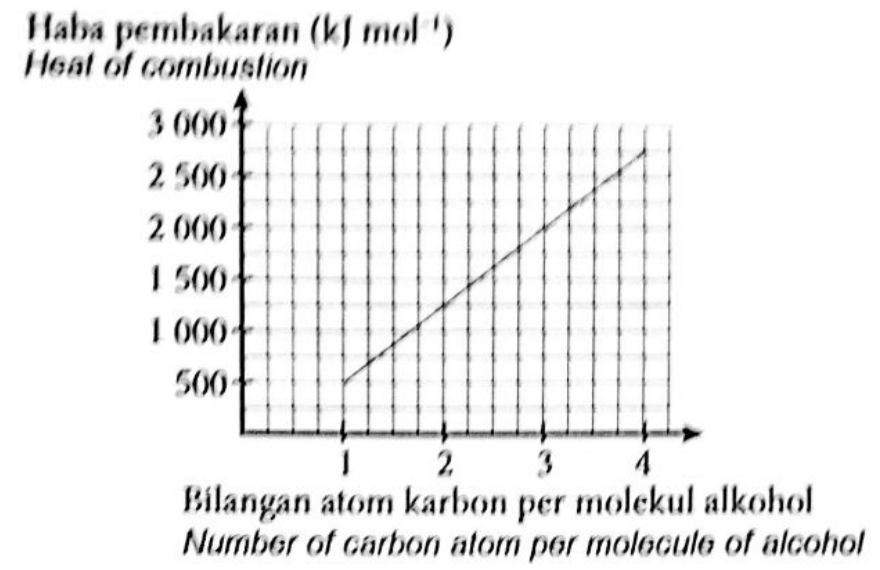
- (a)
What is the meaning of heat of combustion?
[1] - (b)
Based on Diagram 8.1, what is the heat value of combustion of ethanol?
[1] - (c)
Based on the information from (b), determine the temperature change of 2.3 g of ethanol that heats a copper tin containing 200 cm³ of distilled water. [Specific heat capacity of solution = 4.2 J g⁻¹ °C⁻¹; density of solution: 1 g cm⁻³; relative atomic mass: C = 12; H = 1; O = 16]
[3] - (d)
Based on the value in (c), compare the temperature changes of the same experiment conducted by Ali in his school laboratory and state the reason for the answer.
[2] - (e)
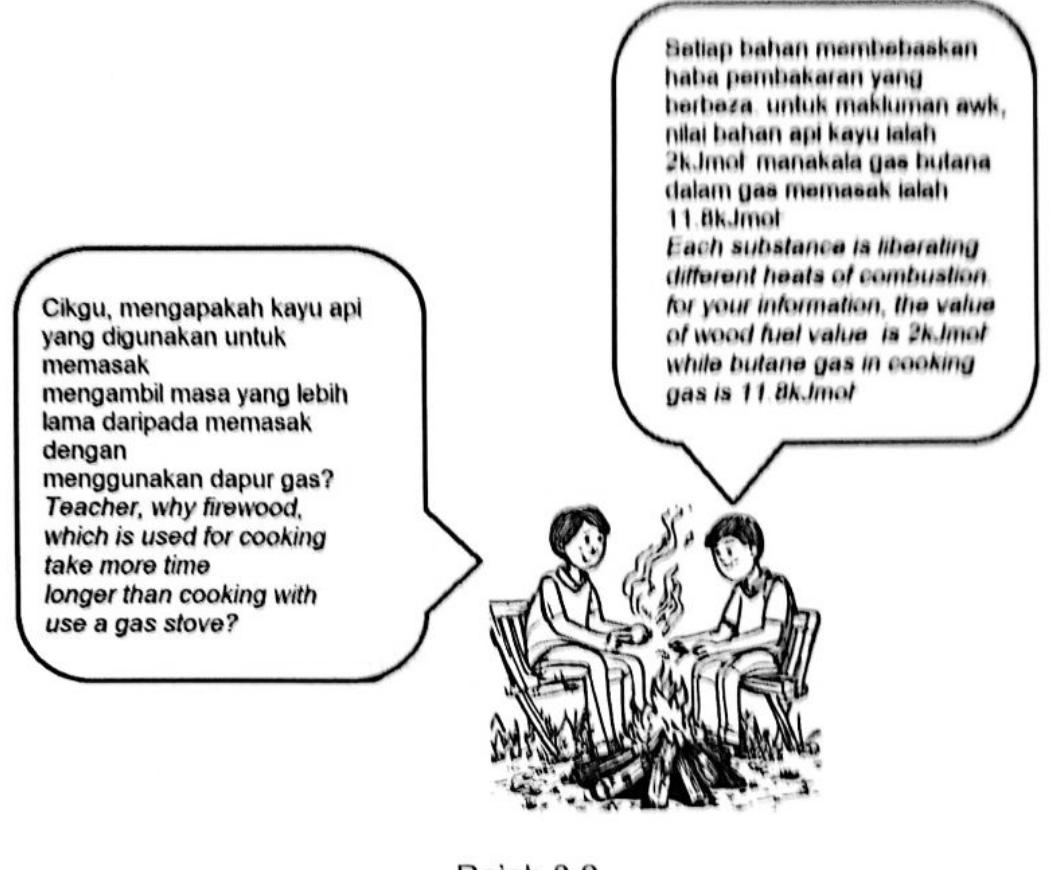
Diagram 8.2 shows a student's conversation with his teacher during the camp about the value of fuel. Teacher: each substance is liberating different heats of combustion; the fuel value of wood is 2 kJ mol⁻¹ while butane gas in cooking gas is 11.8 kJ mol⁻¹ [as printed]. The teacher uses butane gas in the cooking stove. Justify the use of butane gas in the cooking stove for food preparation of 80 pupils during camping. Explain your answer.
[3]
Section B
Section B: answer any one question. Diagram 9.1 shows standard representation of element X (¹²₆X). Table 4 shows the proton number of elements P, Q, R and S: P = 6, Q = 8, R = 19, S = 20.
Medium20 marks
- (a)
Element X reacts with oxygen to form a compound. The compound formed does not conduct electricity in all conditions. State the name of element X and the type of bond formed in the compound. Write a chemical equation for the reaction.
[4] - (b)
Based on Table 4, element Q can form a compound with element P and element S. Write the chemical equation for the reaction between elements S and Q and draw the electron arrangement diagram for the compound formed. Compare the physical characteristics of the compound formed between elements P and Q and elements Q and S.
[10] - (c)(i)
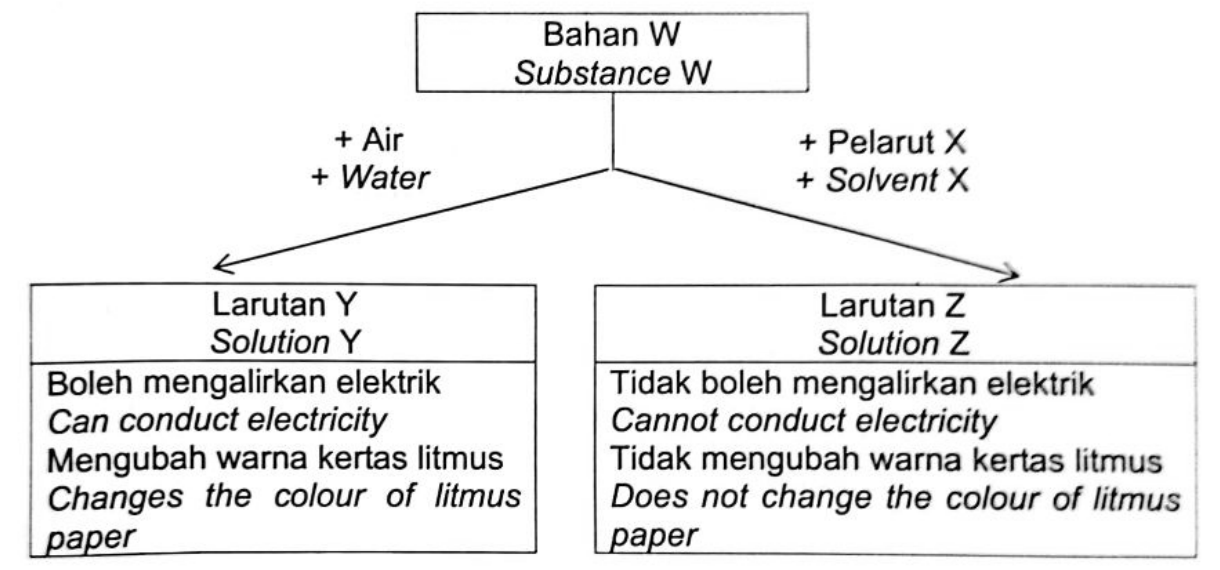
Diagram 9.2 shows a flow chart when substance W is dissolved in two different solvents, water and solvent X, and the properties of the solutions formed: solution Y (in water) can conduct electricity and changes the colour of litmus paper; solution Z (in solvent X) cannot conduct electricity and does not change the colour of litmus paper. Suggest substance W and solvent X.
[2] - (c)(ii)
Explain the differences in properties between solution Y and Z.
[4]
Section B: answer any one question. Three experiments, I, II and III are carried out to investigate the factors affecting the rate of reaction. Table 5: I: excess zinc + 50 cm³ of 0.5 mol dm⁻³ hydrochloric acid, room temperature; II: excess zinc + 50 cm³ of 0.5 mol dm⁻³ sulphuric acid, room temperature; III: excess zinc + 50 cm³ of 0.5 mol dm⁻³ sulphuric acid, 60 °C.
Hard20 marks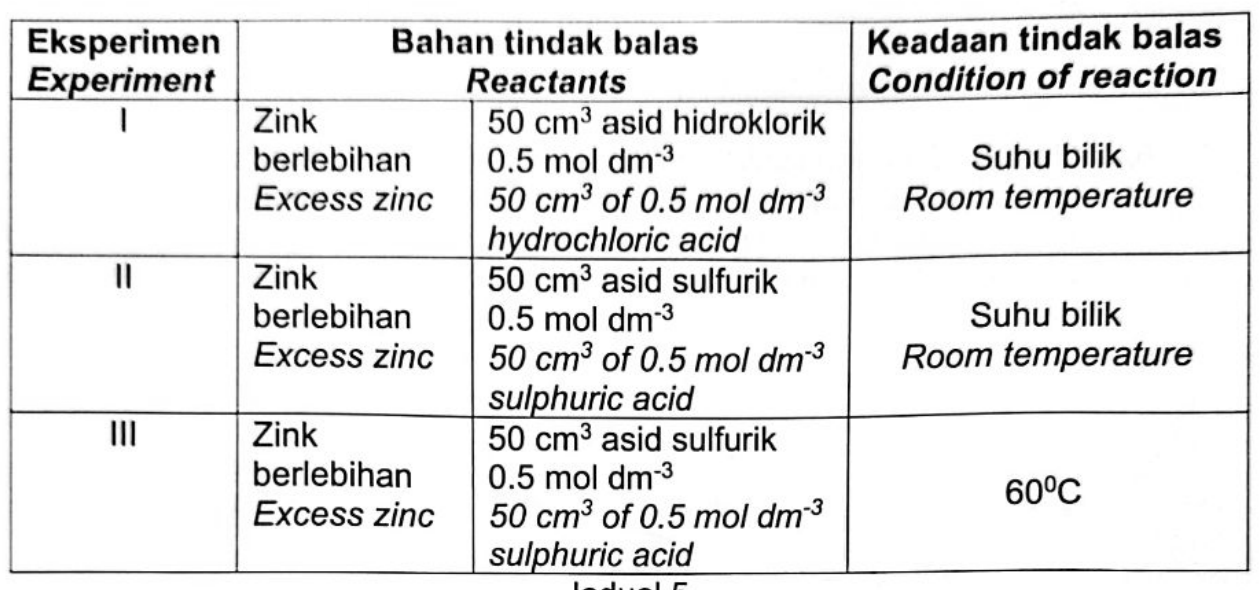
- (a)
State the meaning of rate of reaction and types of particles of zinc.
[2] - (b)
Write a chemical equation for the reaction in experiment I and calculate the mass of zinc chloride formed. [Relative atomic mass: Zn = 65; Cl = 35.5]
[6] - (c)(i)
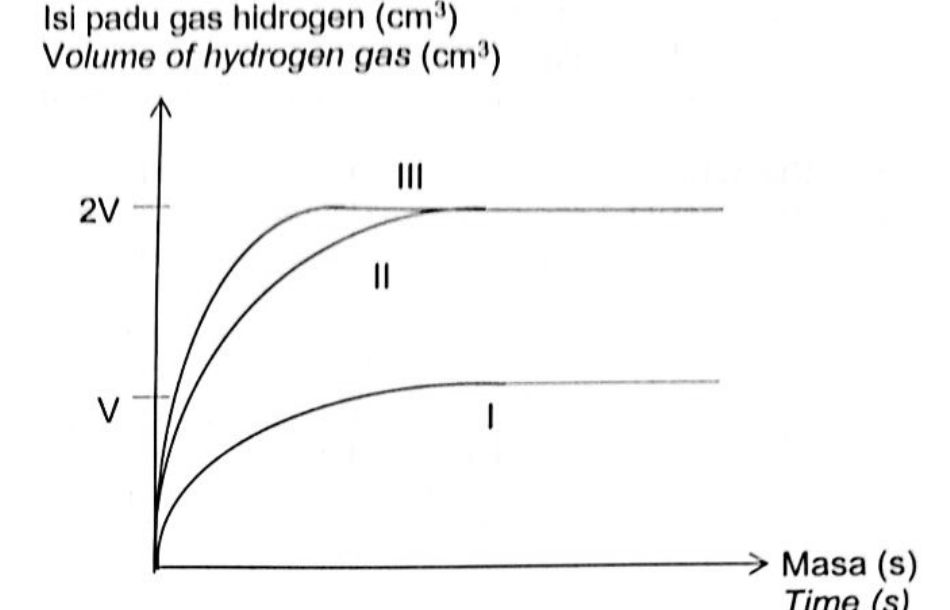
Diagram 10 shows the results of experiments I, II and III (graph of volume of hydrogen gas (cm³) against time (s): curves III and II reach 2V, curve I reaches V; III is the steepest). Compare the rate of reaction between experiment I and experiment II. Explain your answer using the Collision Theory.
[5] - (c)(ii)
Suggest one way to obtain curve III without changing the zinc, acid or temperature in experiment II. Explain your answer using the Collision Theory.
[5] - (c)(iii)
Explain why the total volume of hydrogen gas released in experiment II is double that of experiment I.
[2]
Section C
Diagram 11.1 shows the water treatment process by Syarikat Air Prasarana (alum added to water from Johor river; Step 1 settling reservoir; Step 2 filtering reservoir with sand and coal powder; Step 3 tank with chlorine gas; clean water pipe).
Medium20 marks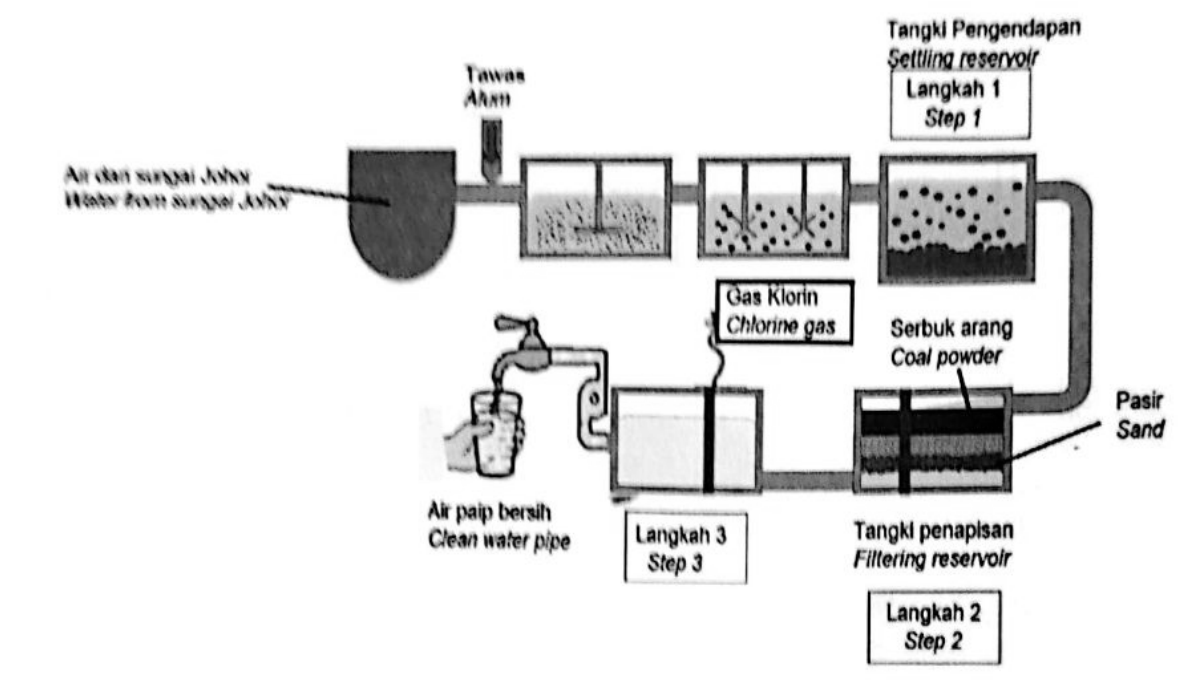
- (a)
The alum used in Step 1 is a type of salt. What is the meaning of salt?
[1] - (b)
State the result of the reaction when chlorine gas is added to the water in the tank in step 3 and what observations are obtained when litmus paper is dipped into the product of the reaction.
[2] - (c)(i)
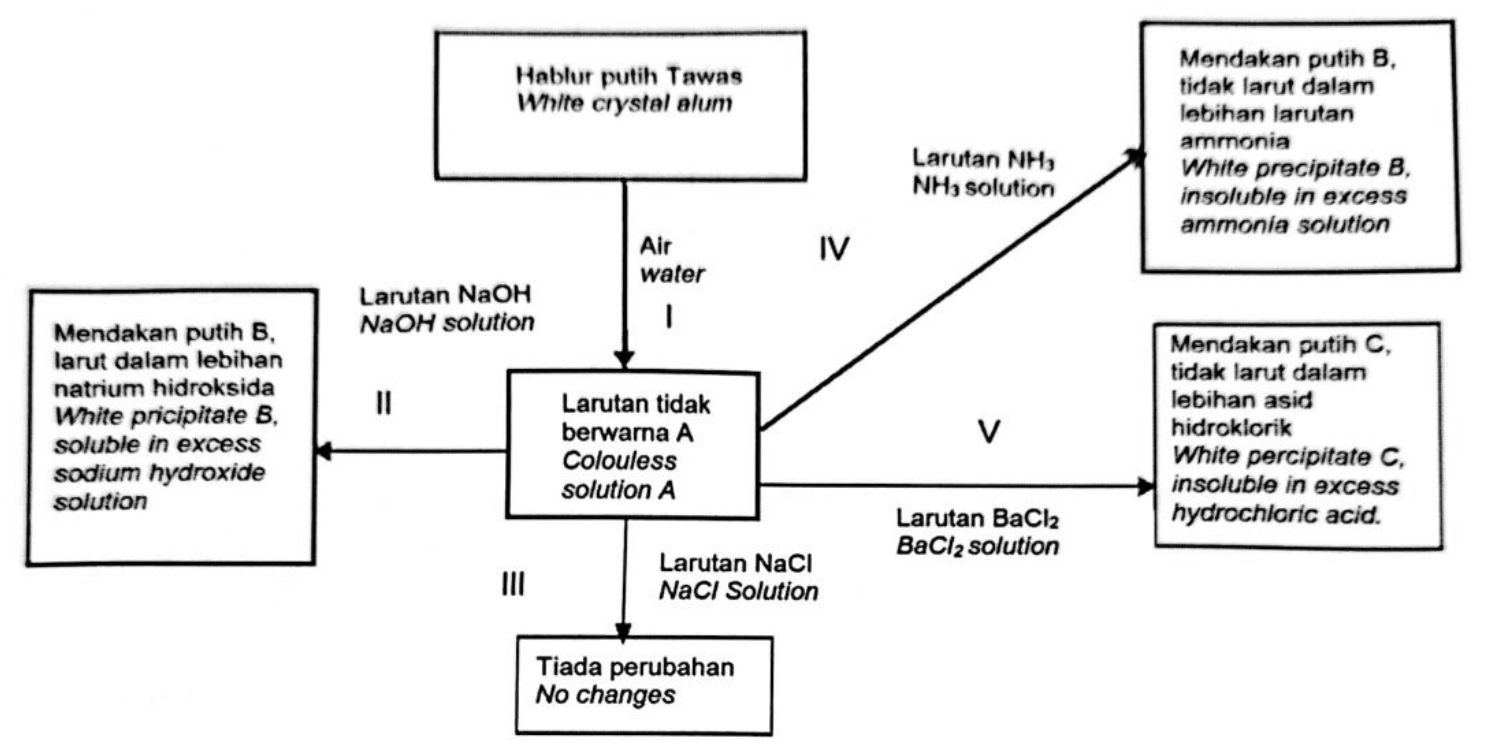
Diagram 11.2 shows the flow chart of the results of chemical tests on alum carried out in the chemistry laboratory of Cikgu Syam's school (alum dissolved in water gives colourless solution A; I water; II NaOH gives white precipitate B soluble in excess NaOH; III NaCl gives no changes; IV NH₃ solution gives white precipitate B insoluble in excess ammonia; V BaCl₂ gives white precipitate C insoluble in excess hydrochloric acid). Based on Tests I, II, III and IV, name the cation present and name the salt found in the alum.
[2] - (c)(ii)
Name B and C and state the purpose of test III and write the chemical equation for test II and V.
[7] - (d)
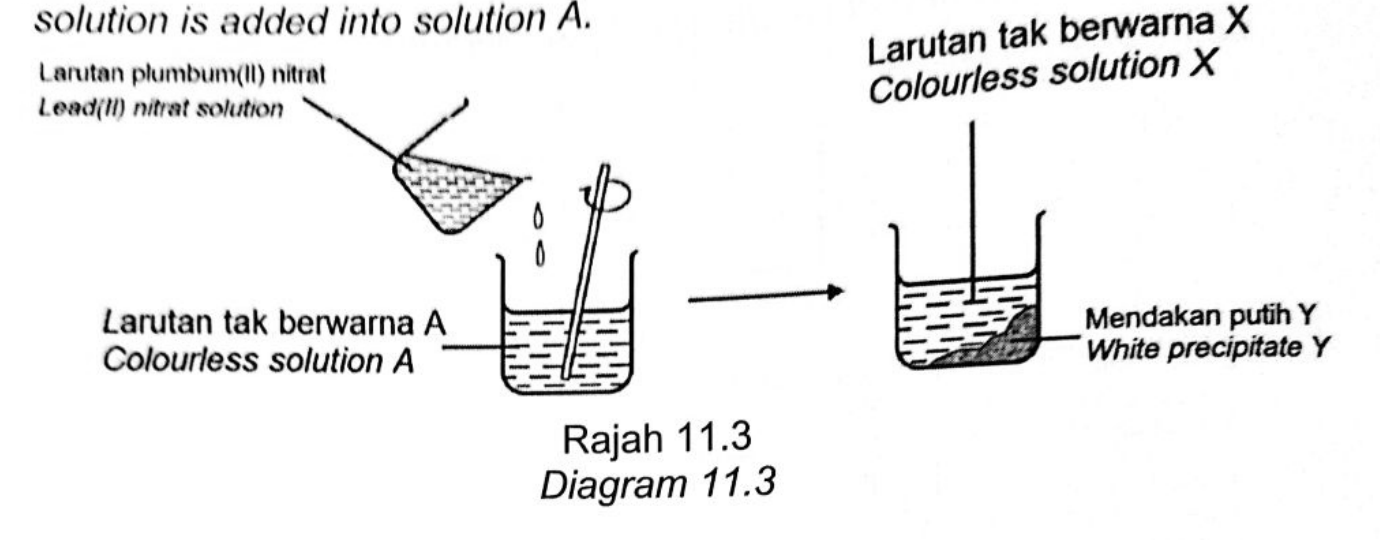
Diagram 11.3 shows the observation obtained when lead(II) nitrate solution is added into solution A (colourless solution A gives colourless solution X and white precipitate Y). Using your knowledge of chemistry, describe how to produce a white precipitate in the laboratory and write the ionic equation for the formation of the white precipitate.
[8]