Write your answer on paper. Then open the answer to check it.
Section A
Table 1 shows information of two different food additives, P and Q. P: added to sauces to thicken liquids. Q: added to pickled fruits to provide an acidic condition to slow down or inhibit the growth of microorganisms. Diagram 1 shows tamarind, usually used as a traditional medicine in Malaysia.
Medium5 marks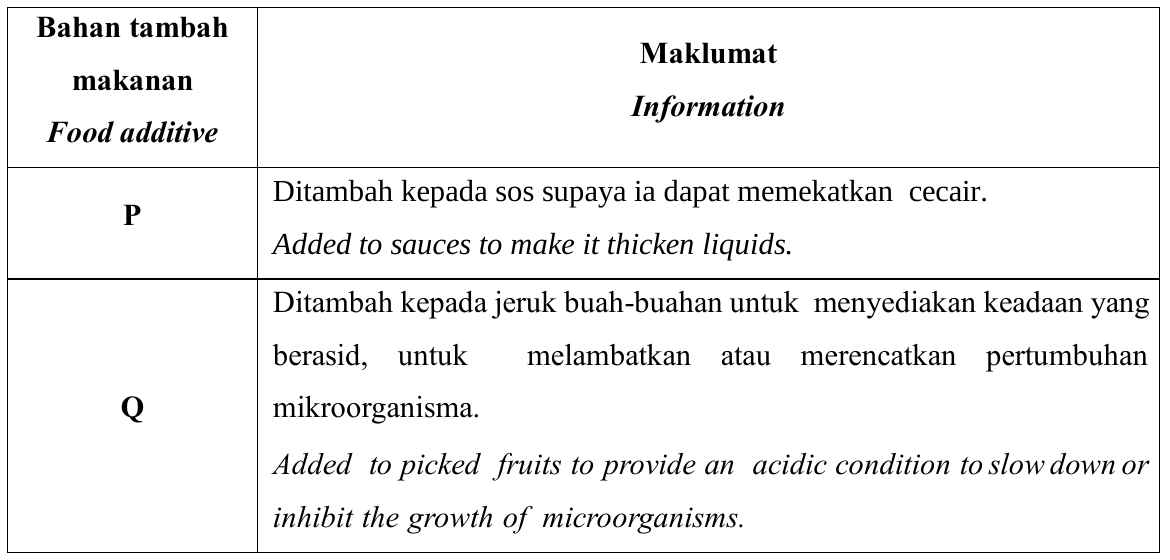
- (a)(i)
State one advantage of uses of food additives in daily life.
[1] - (a)(ii)
Suggest the name for example of food additives P and Q.
[2] - (a)(iii)
What will happen if food additive P is not added into the sauce?
[1] - (b)
State one use of this traditional medicine (tamarind).
[1]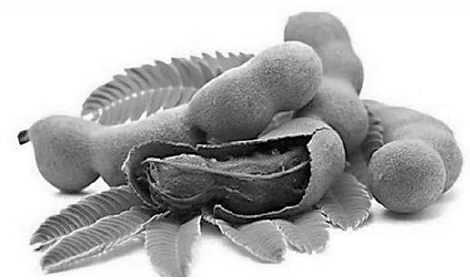
Diagram 2 shows the elements of Period 3 in the Periodic Table of Elements: Na, Mg, Al, Si, P, S, Cl, Ar.
Medium5 marks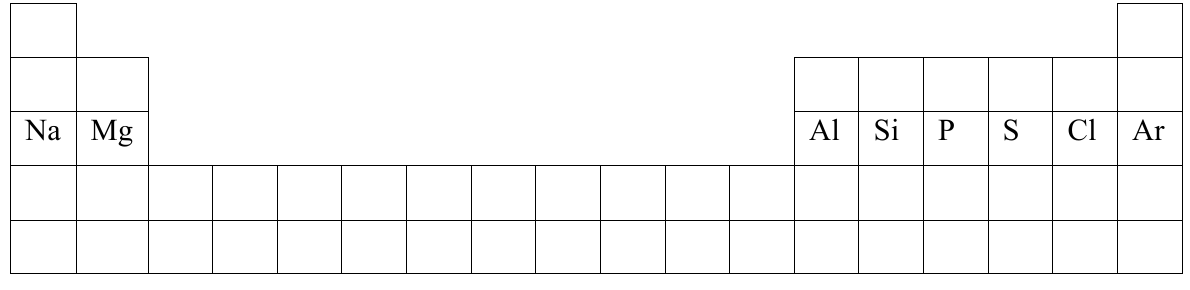
- (a)
What is meant by period?
[1] - (b)
Which element forms an amphoteric oxide?
[1] - (c)(i)
Between the elements Na and Cl, which has the smaller atomic size?
[1] - (c)(ii)
Explain your answer in (c)(i).
[2]
Diagram 3 shows the standard representation for atoms X, Y and Z: 23/11 X, 12/6 Y, 14/6 Z. The letters used are not the actual symbols of the atoms.
Medium6 marks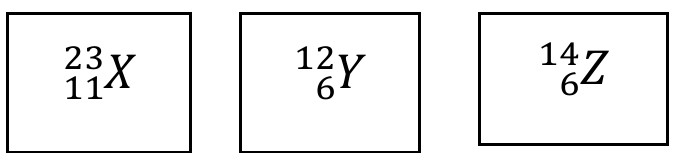
- (a)
State the meaning of proton number.
[1] - (b)
Write the electron arrangement of atom Y.
[1] - (c)(i)
Based on Diagram 3, which atoms have the same chemical properties? Explain your answer.
[2] - (c)(ii)
Draw the atomic structure of atom Z.
[2]
Diagram 4.1 shows the structural formula of a polymer (repeating unit -CH2-CH(CH3)-, i.e. polypropene). Diagram 4.2 shows the observations when solution L and solution M are added to latex: with L the latex coagulates; with M the latex does not coagulate after 30 minutes.
Medium7 marks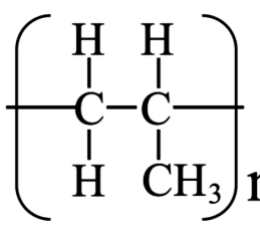
- (a)
What is meant by polymer?
[1] - (b)(i)
Draw the structural formula of the monomer.
[1] - (b)(ii)
Name the type of polymerisation reaction in the production of the polymer.
[1] - (b)(iii)
State one of the uses of the polymer.
[1] - (c)
Suggest solution L. Explain why there is a difference in the observation for each beaker after 30 minutes.
[3]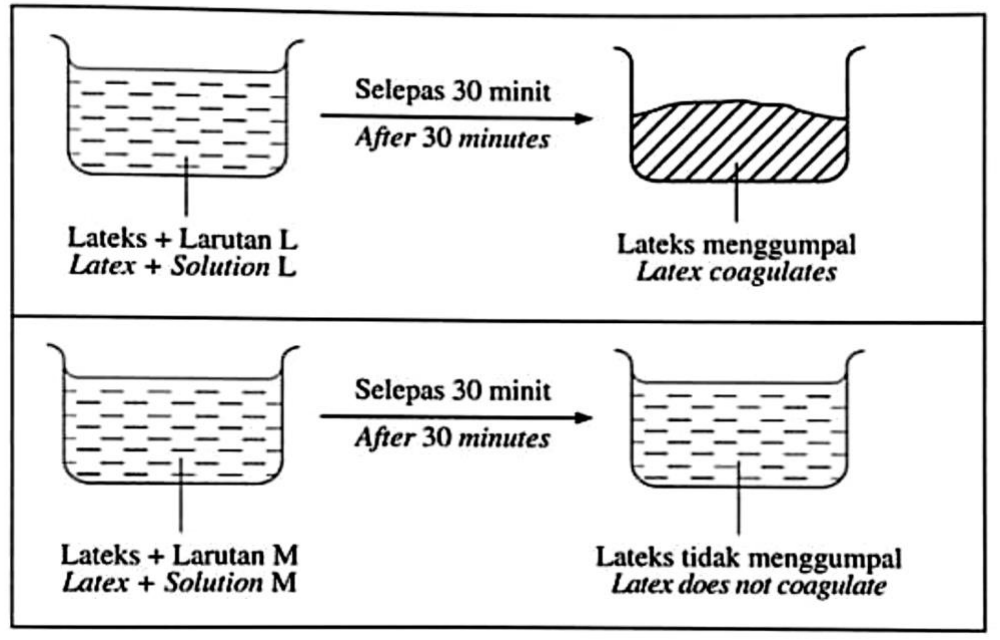
Diagram 5 shows the arrangement of atoms in alloy X (copper atoms with larger tin atoms) and pure copper (regular layers of copper atoms).
Medium8 marks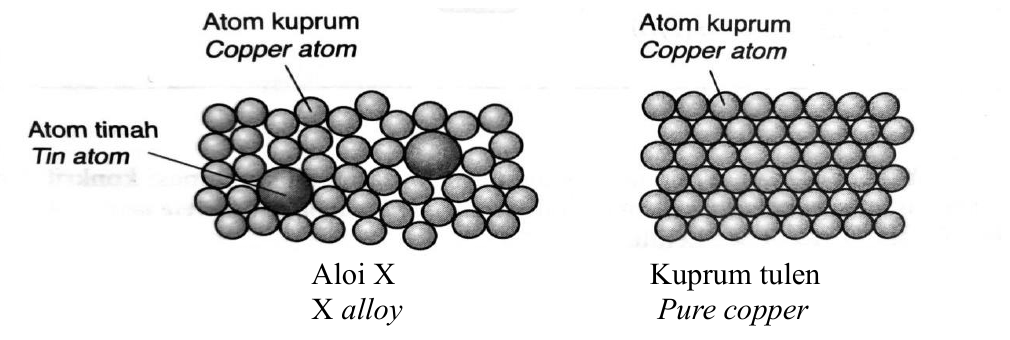
- (a)
State the meaning of alloy.
[1] - (b)
What is the characteristic of alloy X?
[1] - (c)
Based on Diagram 5, choose the material suitable to make swords. Explain why it is suitable in terms of the arrangement of atoms.
[4] - (d)
Complete Table 2 to show the differences between alloy X and pure copper: size of atoms; arrangement of atoms.
[2]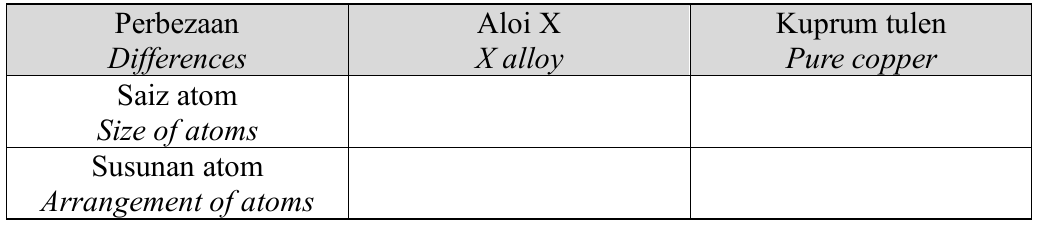
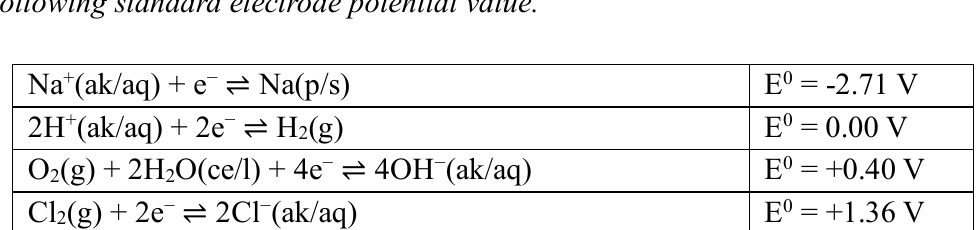
Diagram 6 shows the electrolysis of 1.0 mol dm-3 sodium chloride, NaCl (Cell I, electrodes P and Q) and 1.0 mol dm-3 sodium nitrate, NaNO3 (Cell II, electrodes R and S) using carbon electrodes. Standard electrode potentials: Na+/Na -2.71 V; 2H+/H2 0.00 V; O2/OH- +0.40 V; Cl2/Cl- +1.36 V; NO3-/NO +0.96 V. Table 3: iron wire in lead(II) nitrate gives a grey solid; copper wire in lead(II) nitrate gives no change.
Medium9 marks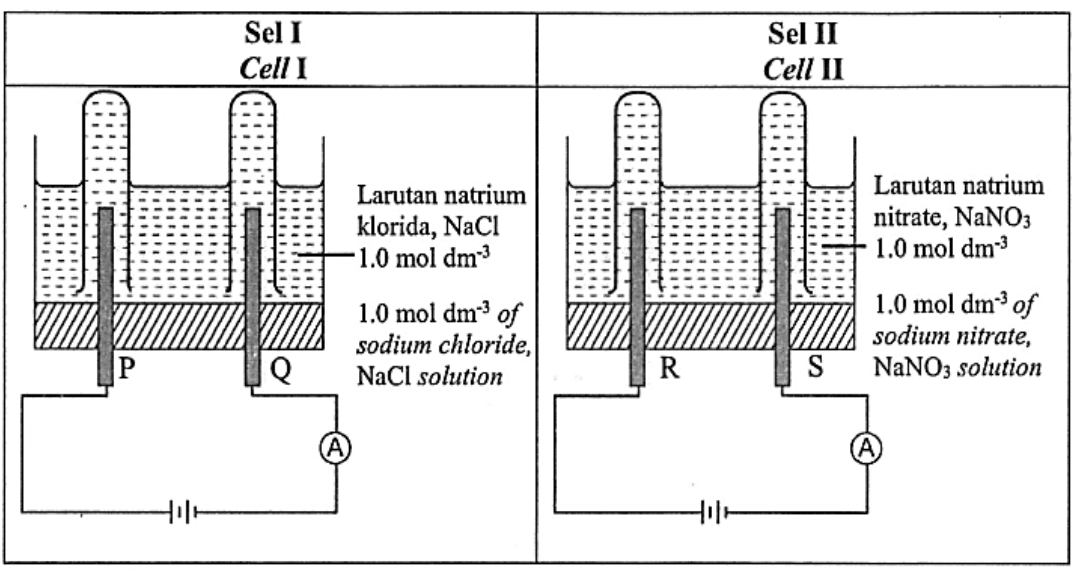
- (a)(i)
Based on Cell I, state all the anions present in sodium chloride, NaCl solution.
[1] - (a)(ii)
Name the product formed at electrode P.
[1] - (a)(iii)
Explain your answer in 6(a)(ii).
[1] - (a)(iv)
Describe a chemical test to verify the product formed at electrode P.
[2] - (b)
Write the half equation for oxidation in Cell II.
[1] - (c)
Based on Table 3, explain the difference in the observation above.
[3]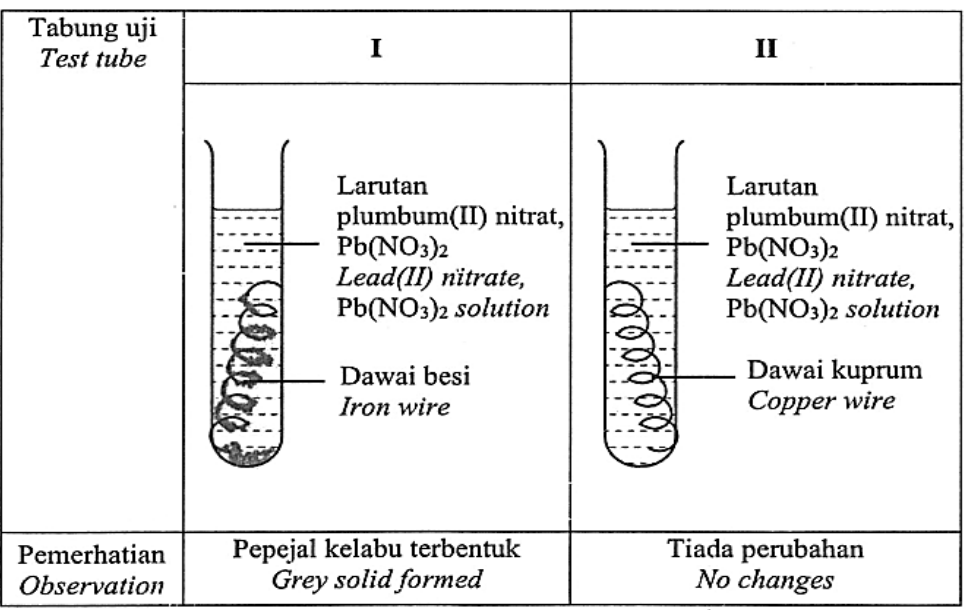
Diagram 7.1 shows the structural formula of carbon compound Z (CH3COOCH3). Diagram 7.2 is a flow chart: compound P (4 carbon atoms, functional group -OH) undergoes Reaction I (dehydration) to give compound Q; Q undergoes Reaction II (+H2O) back to P; Q undergoes Reaction III (+H2) to give compound R.
Medium10 marks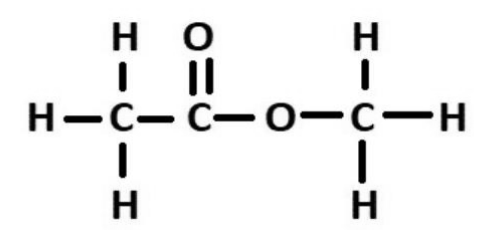
- (a)(i)
State the meaning of carbon compound.
[1] - (a)(ii)
State the functional group of carbon compound Z.
[1] - (a)(iii)
Compound Z can be produced by the reaction between carboxylic acid X and alcohol Y. Write the chemical equation for the reaction.
[2] - (b)(i)
Name the homologous series of compound P.
[1]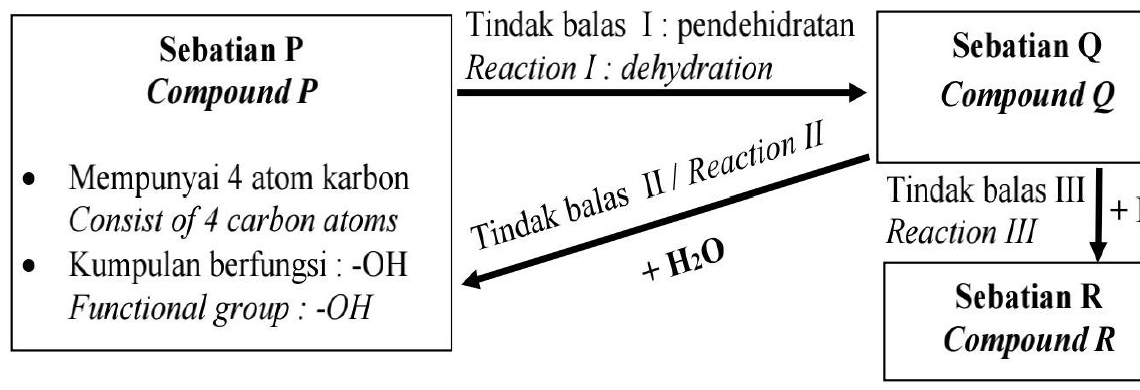
- (b)(ii)
State the general formula of compound Q.
[1] - (b)(iii)
Draw the structural formula of compound R.
[1] - (b)(iv)
Describe a chemical test to differentiate between compound Q and compound R.
[3]
The thermochemical equation AgNO3 + NaCl → AgCl + NaNO3, ΔH = -67.2 kJ mol-1 shows the precipitation reaction between 20 cm3 of 0.5 mol dm-3 sodium chloride solution and 20 cm3 of 0.5 mol dm-3 silver nitrate solution.
Medium10 marks- (a)
State the type of reaction in terms of heat change.
[1] - (b)
Name the insoluble salt produced.
[1] - (c)(i)
Calculate the number of moles of silver ions used in the experiment.
[1] - (c)(ii)
Calculate the heat change, in J, of the reaction.
[2] - (d)
Draw the energy level diagram for the reaction.
[2] - (e)
Table 4 shows the types of pack used to reduce pain from injuries: Pack E (hot pack) and Pack J (cold pack). Which pack is suitable to increase blood flow to help reduce joint or muscle pain? Suggest suitable chemical substances for the pack. Justify your suggestion.
[3]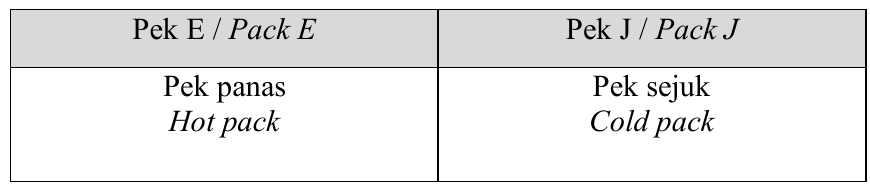
Section B
Table 5 shows two experiments on electrical conductivity of compound A (molten, carbon electrodes, bulb lights up) and compound B (molten, bulb does not light up). Diagram 8 shows the position of elements P (Group 1, Period 3), Q (Group 14, Period 2) and R (Group 17, Period 3) in the Periodic Table. Mrs. Chin, a hairdresser, found that after her client's hair was washed, the hair was sticky and difficult to comb.
Medium20 marks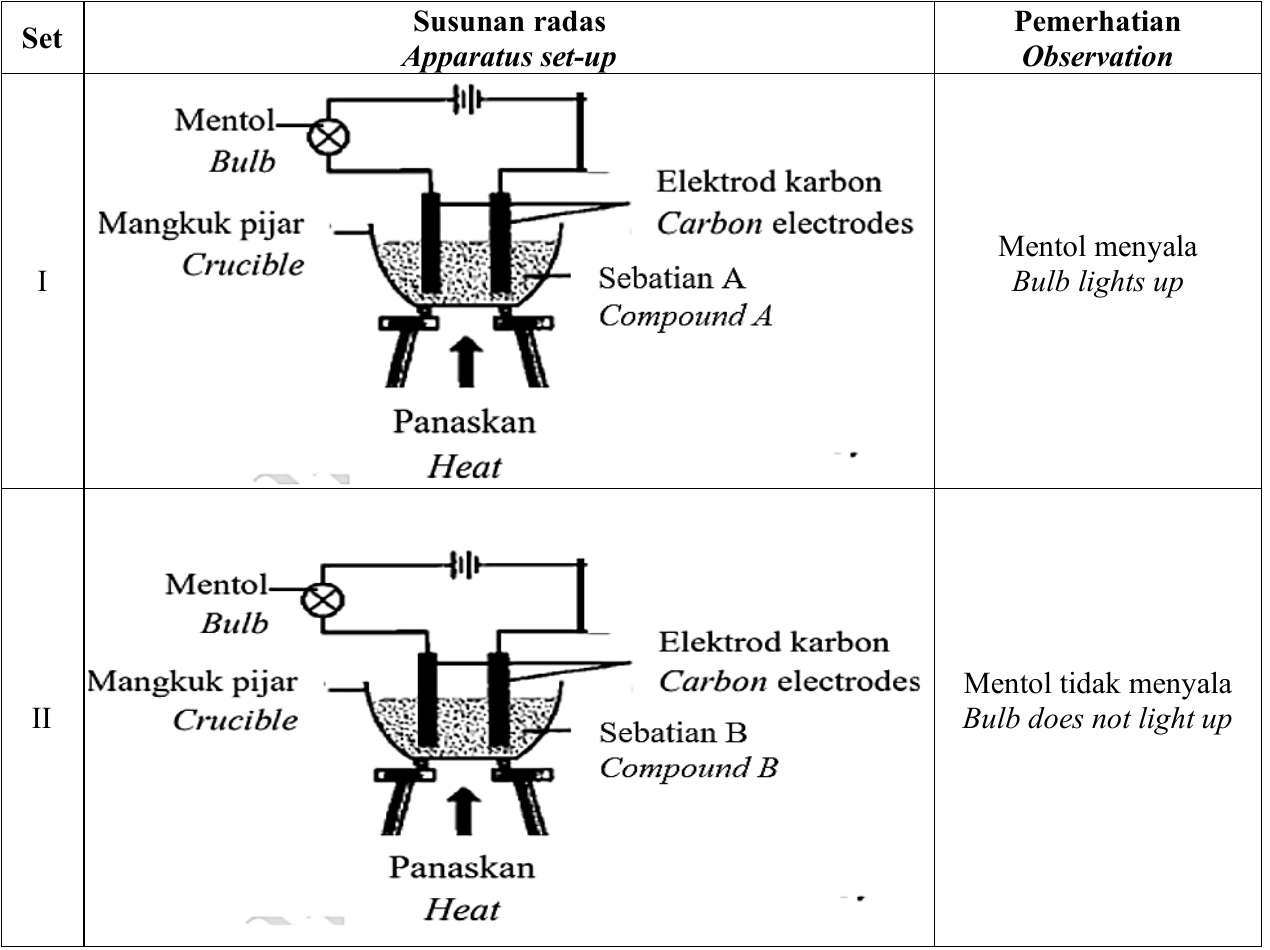
- (a)(i)
State the types of compounds A and B and the types of particles found in both compounds.
[4] - (a)(ii)
Compare the melting point of compound A and compound B. Explain your answer.
[4] - (a)(iii)
Based on Diagram 8, choose the elements that react to form compound A and compound B in Table 5. Write the chemical formula for compound A and compound B. Describe how bonds are formed in compound B.
[9]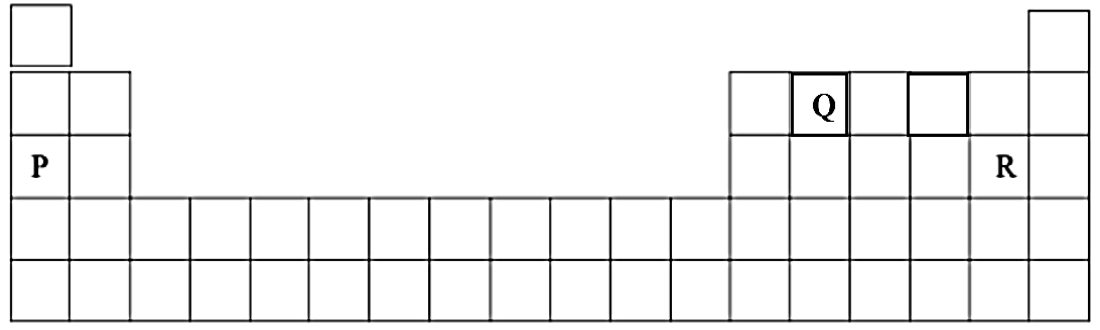
- (b)
State the name of the bond formed that causes the client's hair to be sticky. Explain the effect of the bond on the hair.
[3]
Diagram 9 shows satay and steak (meat cooked in different forms). Table 6: Set I: 25 cm3 of 0.2 mol dm-3 sulphuric acid + excess zinc powder, 33 s to collect 40 cm3 hydrogen; Set II: 25 cm3 of 0.2 mol dm-3 sulphuric acid + excess zinc granules, 45 s; Set III: 25 cm3 of 0.2 mol dm-3 sulphuric acid + excess zinc powder + copper(II) sulphate solution, 25 s.
Medium20 marks- (a)
Based on Diagram 9, which meat will cook faster? What factor affects this reaction?
[2]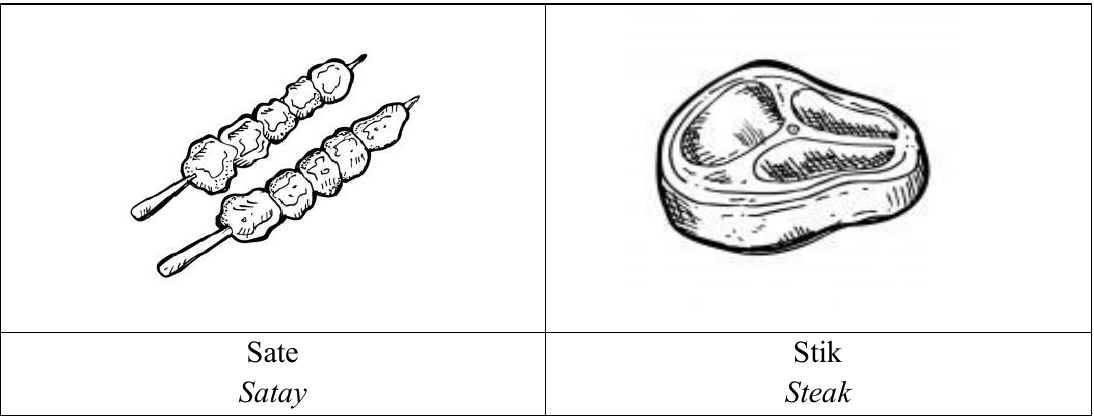
- (b)(i)
State the meaning of rate of reaction.
[1]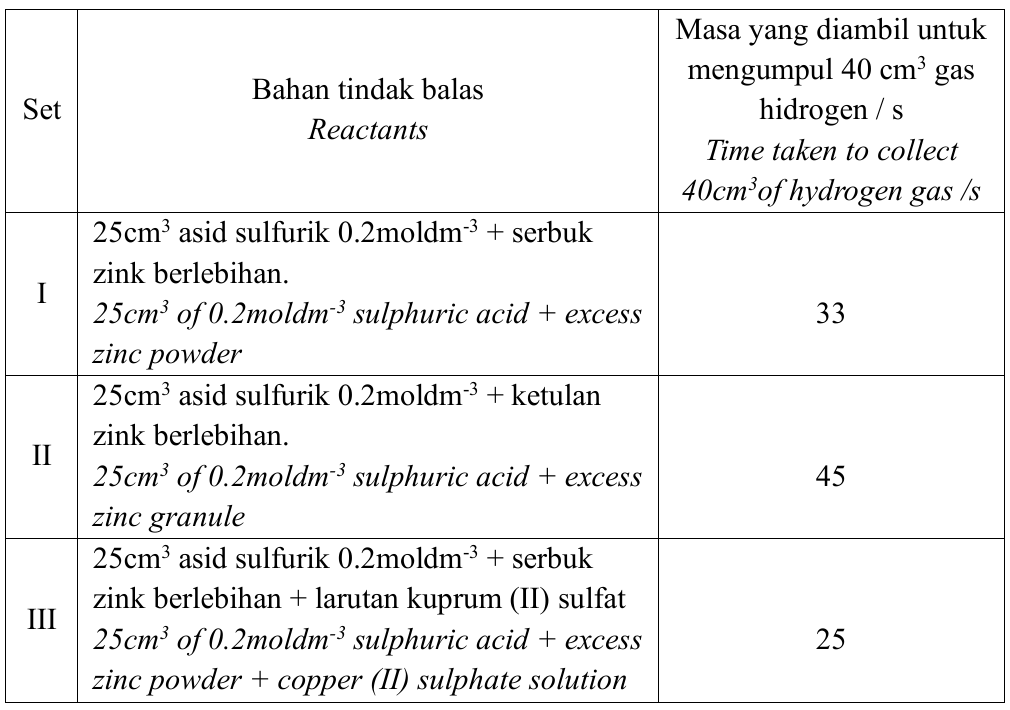
- (b)(ii)
What is the function of copper(II) sulphate solution in Set III?
[1] - (b)(iii)
Write the ionic equation for the reaction in Set I and calculate the rate of reaction in Set I and Set II. Draw the energy profile diagram for Set I and Set III on the same energy axis. Show and label the activation energy of Set I as Ea and Set III as Ea'.
[6] - (b)(iv)
Using the Collision Theory, compare the rate of reaction between: Set I and Set II; Set I and Set III.
[10]
Section C
Table 7: monoprotic acids J (0.1 mol dm-3, pH 2) and K (0.1 mol dm-3, pH 5). Diagram 10.1 shows heating zinc carbonate powder; the gas released turns lime water chalky. Diagram 10.2 shows two flavoured drinks (lemonade and orangeade) containing citric acid from lemon and orange fruit.
Medium20 marks- (a)(i)
What is the meaning of strong acid?
[1]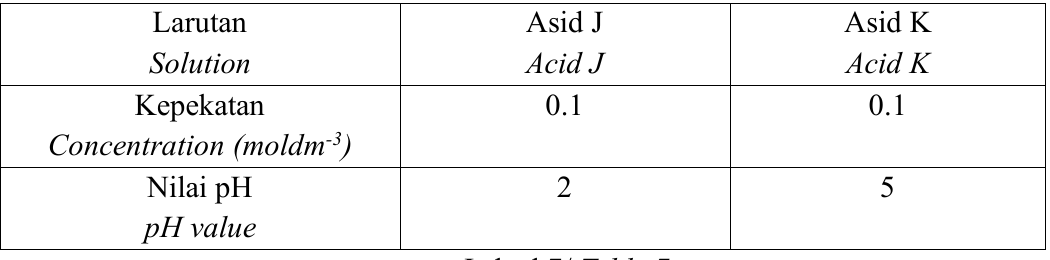
- (a)(ii)
Suggest acid J and acid K. Explain why these two solutions have different pH values.
[6] - (b)(i)
State two observations for this experiment (heating zinc carbonate, Diagram 10.1).
[2]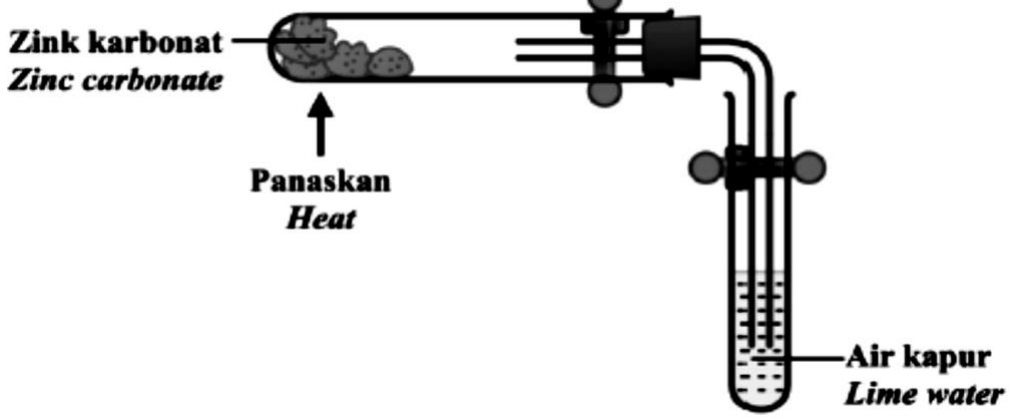
- (b)(ii)
Write the balanced chemical equation for the reaction.
[1] - (b)(iii)
25.0 g of zinc carbonate powder is heated in the experiment. Calculate the volume of gas released at room conditions. [Relative atomic mass: Zn = 65; C = 12; O = 16; 1 mol of gas occupies 24 dm3 at room conditions]
[3] - (c)(i)
Predict the electrical conductivity of the drinks in Diagram 10.2. Explain your answer.
[2]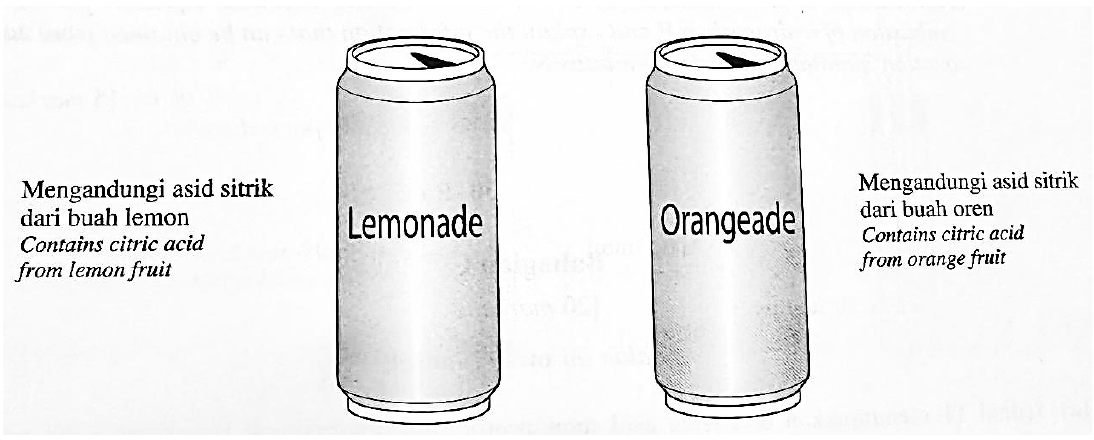
- (c)(ii)
Using laboratory apparatus and a suitable chemical substance, plan an investigation to show that the drinks contain acid. State the conclusion that could be obtained from the experiment.
[5]