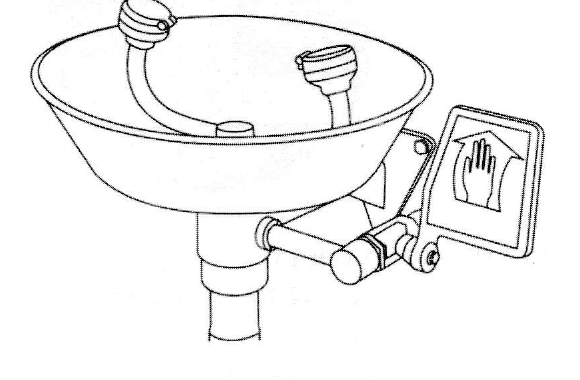
Diagram 1 shows a safety equipment in a laboratory. What is the function of the safety equipment?
Easy
What is the use of lead-210 isotope?
Easy
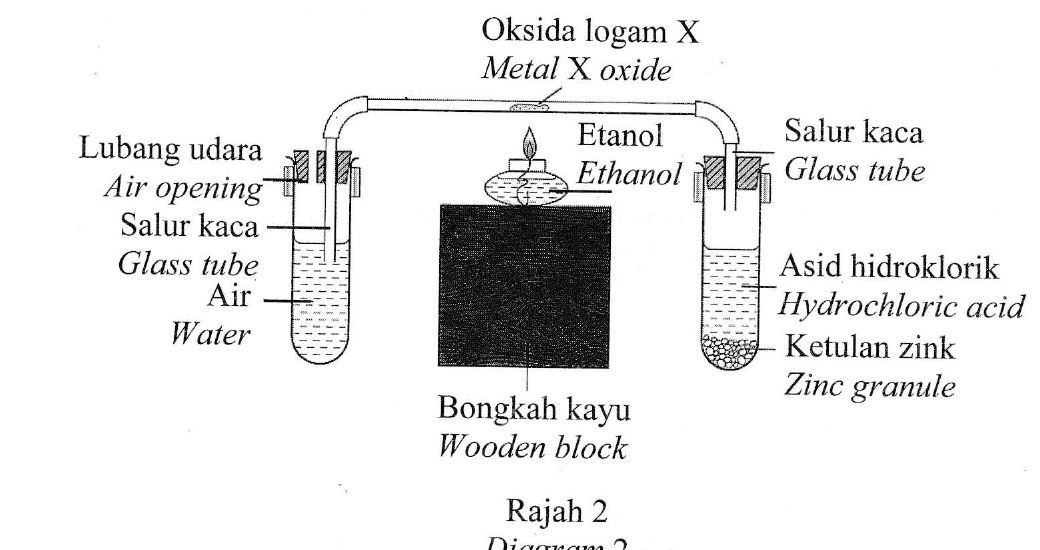
Diagram 2 shows the set-up of the apparatus used to determine the empirical formula of metal X oxide (metal X oxide heated in a glass tube while hydrogen from zinc granules and hydrochloric acid passes over it, ethanol burner; water in a tube on the left side). What is X?
Medium
Which of the following statements did Dmitri Mendeleev propose in the development of the Periodic Table of Elements?
Easy
Which of the following chemical bond is formed through the transfer of electron?
Easy
Which of the following statements is correct about a weak alkaline solution?
Medium
Which of the following units is correct for the rate of reaction?
Easy
The National Monument of Malaysia was built in 1966 using bronze. Which of the following shows the arrangement of the atoms in bronze?
Easy
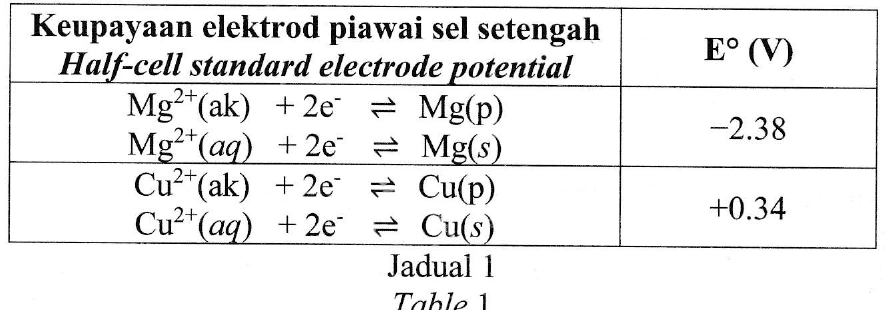
Table 1 shows the standard electrode potential values of half cells for two metals in a chemical reaction: Mg²⁺(aq) + 2e⁻ ⇌ Mg(s), E° = −2.38 V; Cu²⁺(aq) + 2e⁻ ⇌ Cu(s), E° = +0.34 V. Which of the following statements is correct for the reaction?
Medium
Which of the following compounds has its number of carbon atoms correctly matched?
Medium
Which of the following is an example of endothermic reaction?
Easy
Which of the following can change the latex from liquid to solid?
Medium
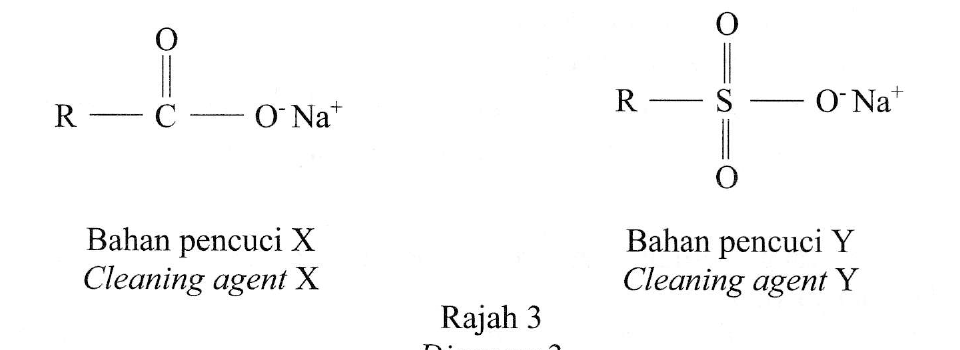
Diagram 3 shows the formulae for two different types of cleaning agent, X (R–COO⁻Na⁺) and Y (R–SO₃⁻Na⁺). Which of the following statements is correct about X and Y?
Medium
Which of the following processes involves the release of heat?
Medium
Which of the following ions will form compound XZ₂?
Medium
Which of the following represent changes of properties of elements when across Period 3? I Increase in atomic size; II Decrease in metallic properties; III Increase in electronegativity; IV Decrease in the number of valence electrons.
Medium
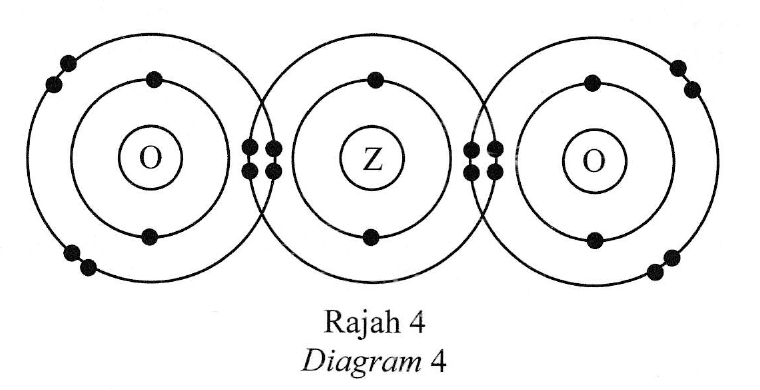
Diagram 4 shows a product formed between element Z and oxygen (electron arrangement diagram: Z shares two pairs of electrons with each of two oxygen atoms). What is Z?
Medium
Which of the following is correct about sulphuric acid? I pH value is less than 7; II Has higher degree of dissociation; III Turn red litmus paper to blue; IV Has lower concentration of hydrogen ions.
Medium
The following equation represents a chemical reaction: Ca(s) + 2H₂O(l) → Ca(OH)₂(aq) + H₂(g). Which of the following methods is correct to determine the rate of reaction?
Medium
Which of the following glass is used to make microscope lens?
Medium
Table 2 shows the standard electrode potential of half-cells of two metals: L²⁺ + 2e⁻ ⇌ L, E° = −1.20 V; M³⁺ + 3e⁻ ⇌ M, E° = −2.08 V. Which of the following is the strongest reducing agent?
Medium
Carbon compound M formed when ethanol reacts with acidified potassium manganate(VII) solution. What is the general formula for M?
Medium
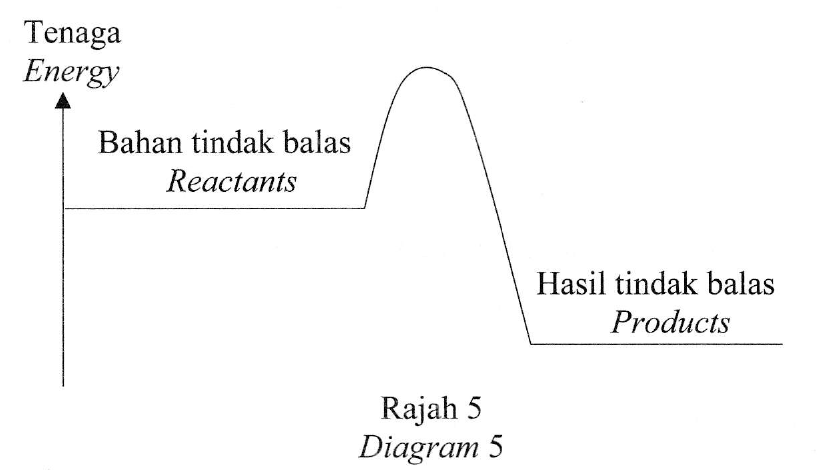
Diagram 5 shows the energy profile diagram for a reaction (products at a lower energy level than reactants). Which of the following are correct reactants and description about the reaction?
Medium
Which of the following polymers produced that involves at least two different types of monomers?
Medium
Chili sauce contains benzoic acid. Which of the following explains the function of benzoic acid?
Easy
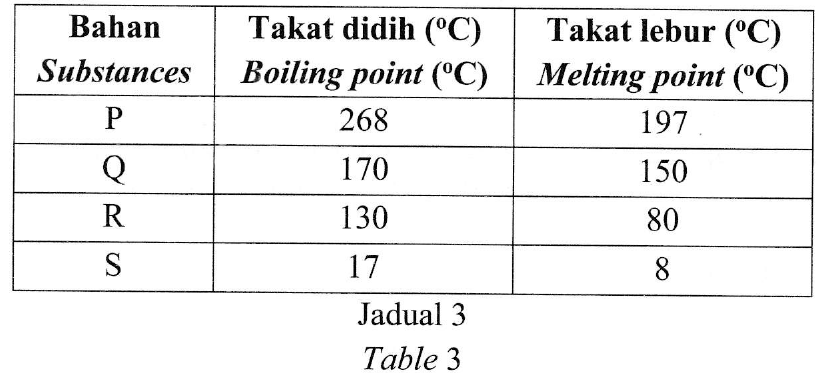
Table 3 shows the boiling point and melting point of substances P, Q, R and S: P 268 °C / 197 °C; Q 170 °C / 150 °C; R 130 °C / 80 °C; S 17 °C / 8 °C (boiling point / melting point). Which substance melts when put into a boiling water?
Medium
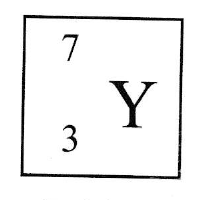
Diagram 6 shows the standard representation of element Y (nucleon number 7, proton number 3). What is the number of valence electrons in atom Y?
Medium
Which of the following statements is correct about 1 mol of substance?
Medium
Which of the following functional groups represent a non-hydrocarbon? I Single bond between carbon atoms; II Triple bond between carbon atoms; III Carboxyl; IV Carboxylate.
Medium
Z⁻ ion has an electron arrangement of 2.8. Which of the following is correct about element Z?
Medium
Element Q and R have proton numbers of 12 and 9 respectively. What is the relative formula mass of a compound formed between Q and R? [Relative atomic mass: Q = 24, R = 19]
Medium
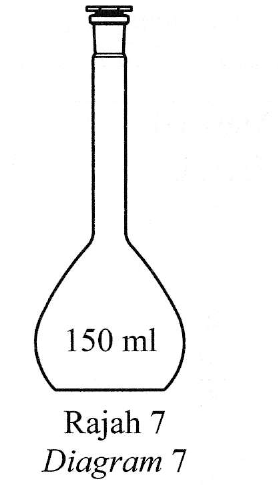
Diagram 7 shows an apparatus (150 ml volumetric flask) to prepare a standard solution of 0.2 mol dm⁻³ sodium chloride. What is the volume of 2.0 mol dm⁻³ sodium chloride solution needed to prepare the standard solution?
Medium
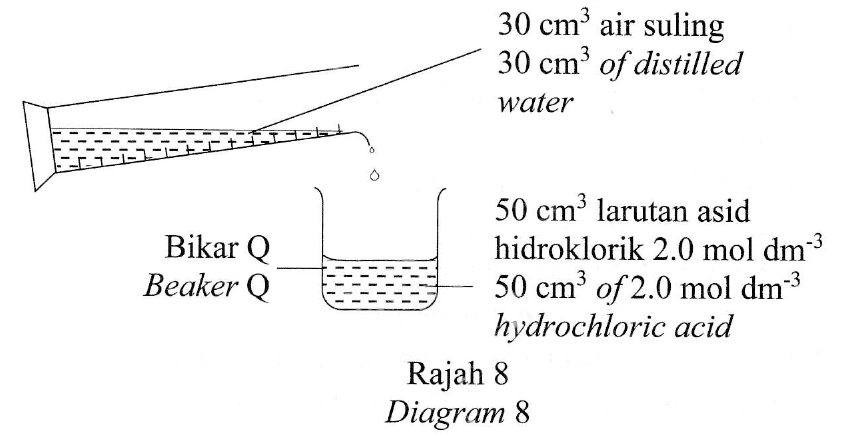
Diagram 8 shows the apparatus set-up to prepare hydrochloric acid solution (30 cm³ distilled water added to 50 cm³ of 2.0 mol dm⁻³ hydrochloric acid in beaker Q). Excess zinc powder is added into 40 cm³ of hydrochloric acid solution prepared in beaker Q. What is the maximum mass of salt formed at the end of the experiment? [Relative atomic mass: Cl = 35.5, Zn = 65]
Medium
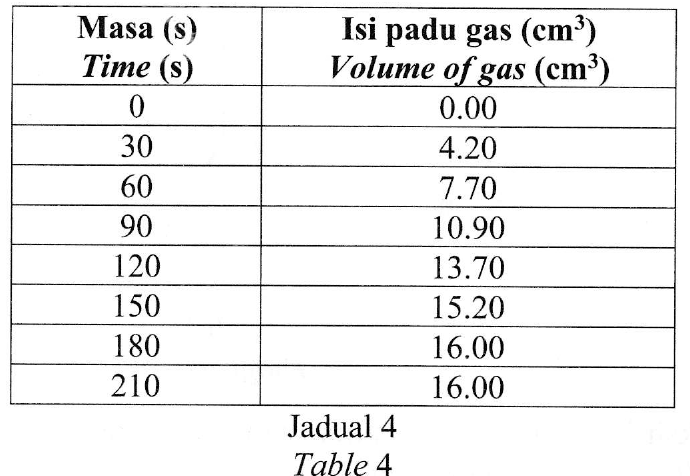
Table 4 shows the total volume of gas collected at a certain time interval for a reaction between calcium carbonate and hydrochloric acid: time (s) / volume (cm³): 0 / 0.00; 30 / 4.20; 60 / 7.70; 90 / 10.90; 120 / 13.70; 150 / 15.20; 180 / 16.00; 210 / 16.00. What is the average rate of reaction in the second minute?
Medium
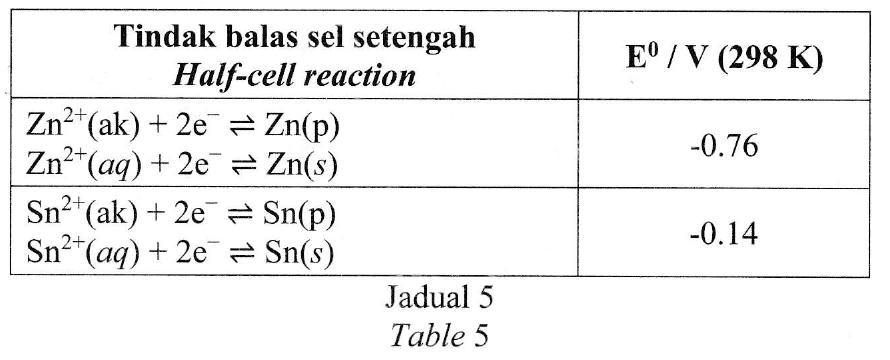
Table 5 shows half cells of two metals used to build a chemical cell: Zn²⁺(aq) + 2e⁻ ⇌ Zn(s), E° = −0.76 V; Sn²⁺(aq) + 2e⁻ ⇌ Sn(s), E° = −0.14 V. Which of the following cell notations represents the redox reaction taken place in the chemical cell?
Medium
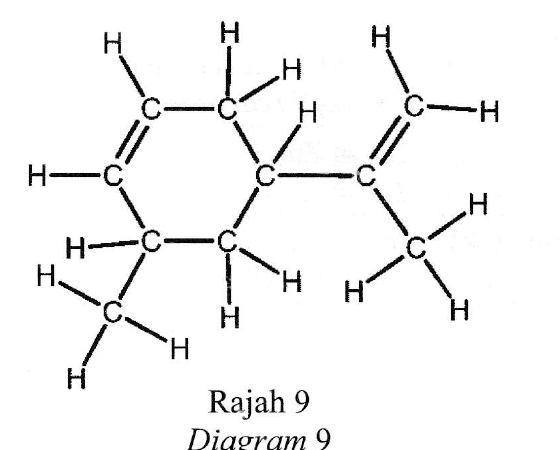
Diagram 9 shows the molecular structure of limonene (C₁₀H₁₆, with two C=C double bonds) which is extracted from oranges. What is the mass of the product when bromine molecules react completely with 1 mol of limonene during the addition reaction? [Relative atomic mass: H = 1, C = 12, Br = 80]
Medium
The following chemical equation shows the decomposition of zinc nitrate: 2Zn(NO₃)₂ → 2ZnO + 4NO₂ + O₂. What is the total volume of gas produced when 1.89 g zinc nitrate salt decomposes completely? [Relative atomic mass: Zn = 65, N = 14, O = 16; one mole of any gas occupies 24 dm³ at room condition]
Medium
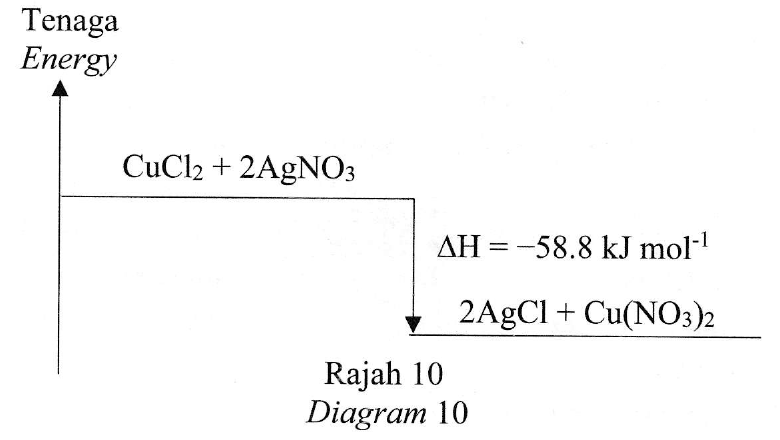
Diagram 10 shows the energy level diagram for the reaction between copper(II) chloride solution with silver nitrate solution (CuCl₂ + 2AgNO₃ → 2AgCl + Cu(NO₃)₂, ΔH = −58.8 kJ mol⁻¹). In an experiment, 50 cm³ of 1.0 mol dm⁻³ silver nitrate is added into a beaker containing 25 cm³ of 1.0 mol dm⁻³ copper(II) chloride solution. What is the temperature change in the reaction? [Specific heat capacity of solution = 4.2 J g⁻¹ °C⁻¹]
Medium
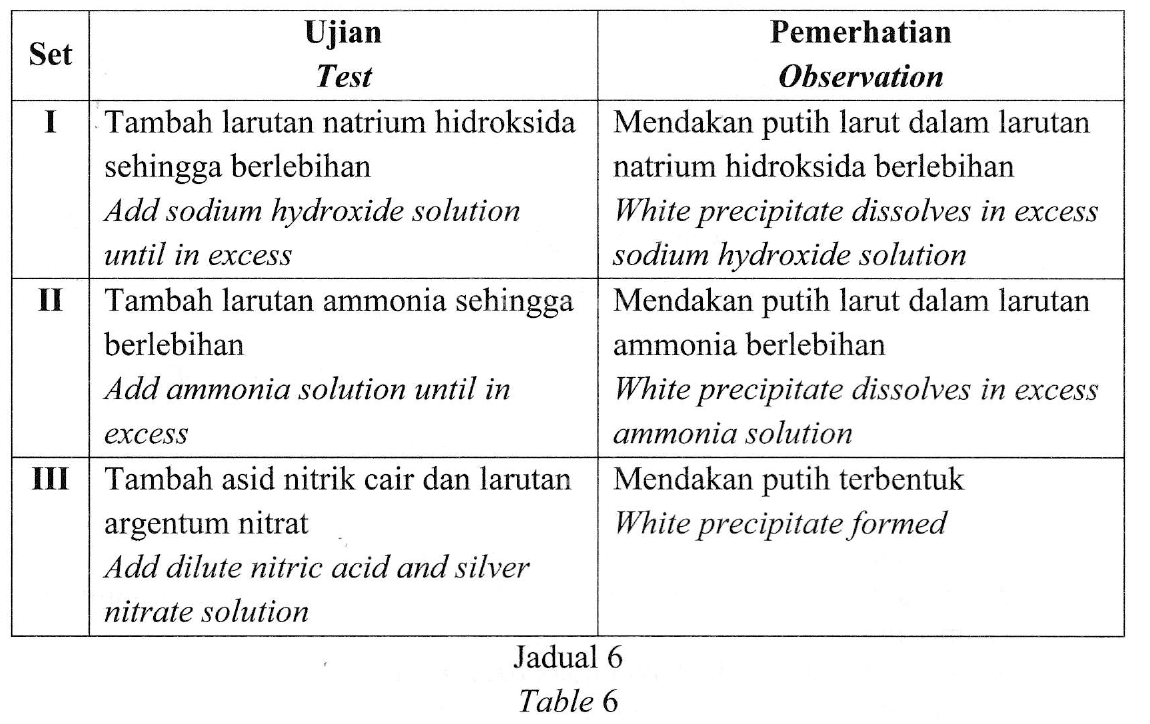
Table 6 shows the observations in three tests on solution G. Set I: add sodium hydroxide solution until in excess: white precipitate dissolves in excess. Set II: add ammonia solution until in excess: white precipitate dissolves in excess. Set III: add dilute nitric acid and silver nitrate solution: white precipitate formed. What is G?
Medium
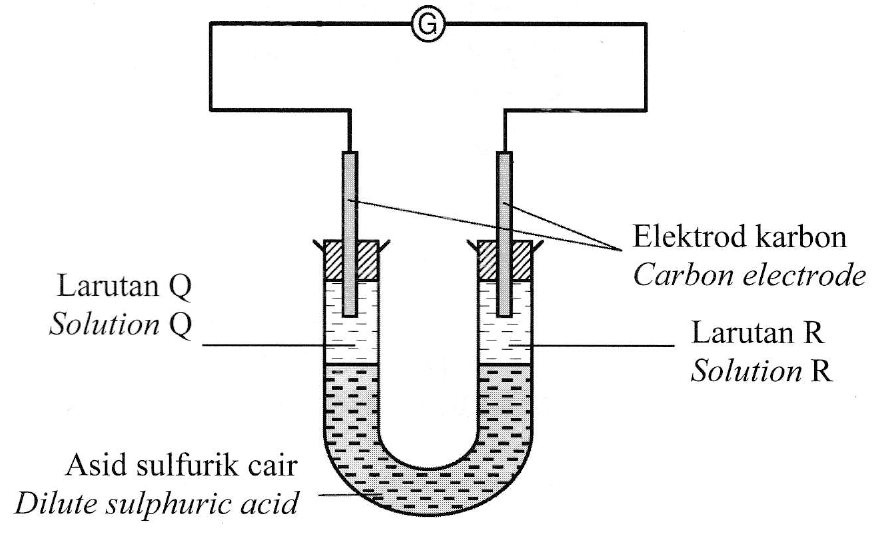
Diagram 11 shows the apparatus set-up (U-tube with dilute sulphuric acid, carbon electrodes, galvanometer) to study the transfer of electron at a distance. After 30 minutes: solution R turns from brown to colourless; needle of galvanometer deflects. What are Q and R?