Write your answer on paper. Then open the answer to check it.
Section A
Diagram 1 shows apparatus set-up to determine the melting point of naphthalene (naphthalene in a boiling tube placed in a beaker of water, thermometer in the naphthalene, heated by a burner).
Medium5 marks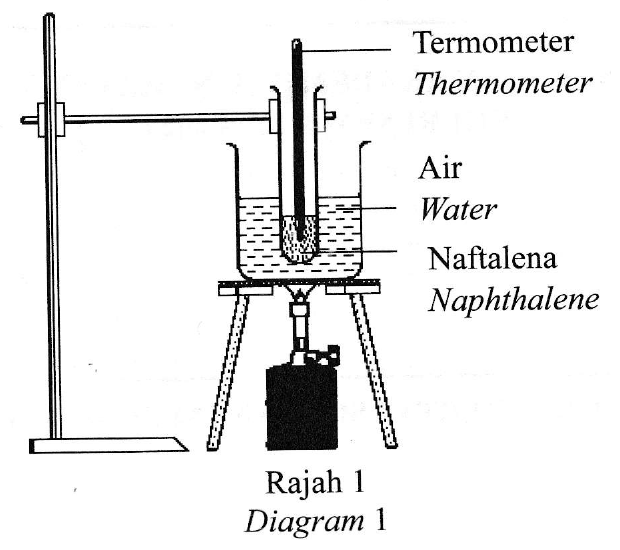
- (a)
State the meaning of melting point.
[1] - (b)
State the type of particle of naphthalene and its physical state after heating. (Type of particles; Physical state)
[2] - (c)
Based on Diagram 1, name the method of heating and explain why this method is used. (Method; Reason)
[2]
Diagram 2.1 shows set up of apparatus for the reaction between a type of halogen with iron wool (bromine gas passed over heated iron wool; soda lime at the exit).
Medium5 marks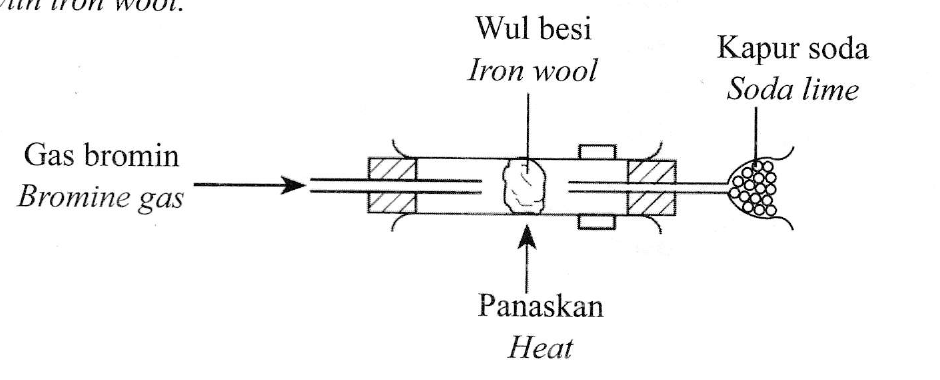
- (a)
What is the colour of bromine gas?
[1] - (b)
The reaction in Diagram 2.1 produces a brown colour compound. Name the compound formed and write the formula for the compound.
[2] - (c)(i)
Atomic size of chlorine is smaller than bromine atom. Compare the reactivity of chlorine and bromine when reacts with iron wool.
[1] - (c)(ii)
Explain your answer in 2(c)(i).
[1]
Diagram 3 shows the electron arrangement of sodium fluoride (Na⁺ ion with 2.8 and F⁻ ion with 2.8).
Medium6 marks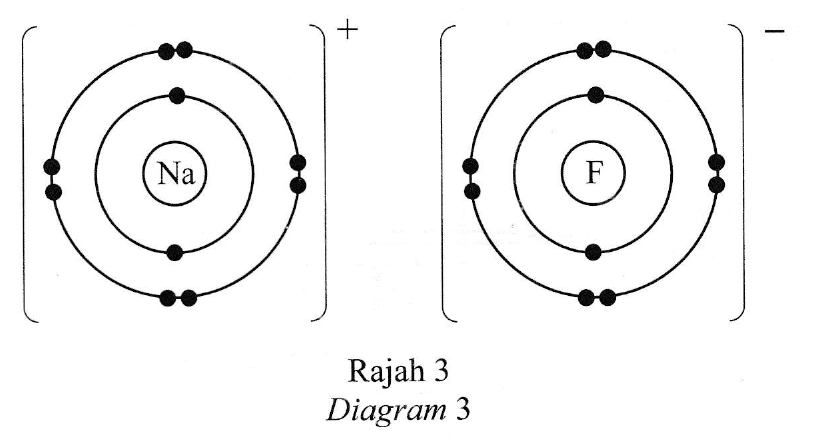
- (a)(i)
State the type of chemical bond in sodium fluoride.
[1] - (a)(ii)
Explain how the chemical bond in 3(a)(i) is formed.
[1] - (b)(i)
Sodium reacts with fluorine gas to form sodium fluoride. Write a chemical equation for the reaction taken place.
[2] - (b)(ii)
In the reaction in 3(b)(i), 0.03 mol sodium reacted with fluorine gas. Calculate the mass of sodium fluoride produced. [Relative atomic mass: F = 19, Na = 23]
[2]
Diagram 4.1 shows two products that is made up of a type of polymer, polymer Q (a surgical glove and rain boots).
Medium7 marks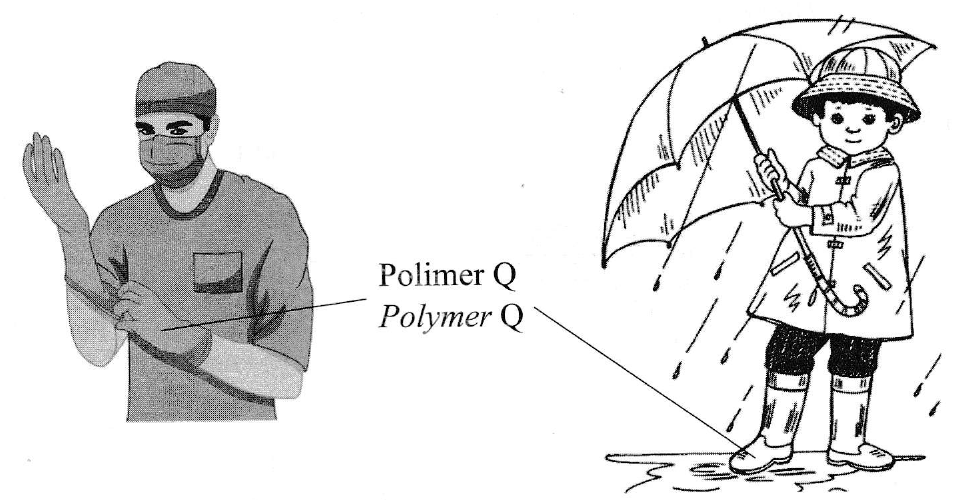
- (a)(i)
Polymer Q is a natural rubber and its monomer according to the IUPAC nomenclature is 2-methylbut-1,3-diene. What is the other name of the monomer?
[1] - (a)(ii)
Draw the structural formula for this monomer.
[1] - (b)
Latex is a type of colloid that contains polymer Q and water. Diagram 4.2 shows a situation for latex (latex turns into a white solid after a few hours). What should be done to prevent the situation in Diagram 4.2? Explain your answer.
[3]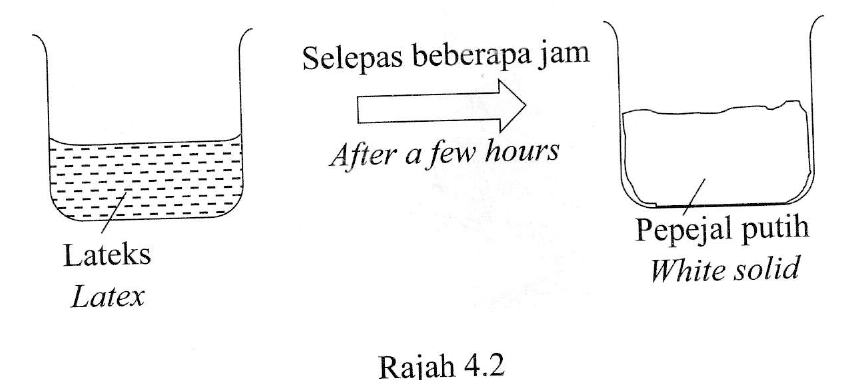
- (c)(i)
Diagram 4.3 shows a process on polymer Q to improve its characteristics (polymer Q chains + disulphur dichloride give chains linked by sulphur bridges). Name the process in Diagram 4.3.
[1]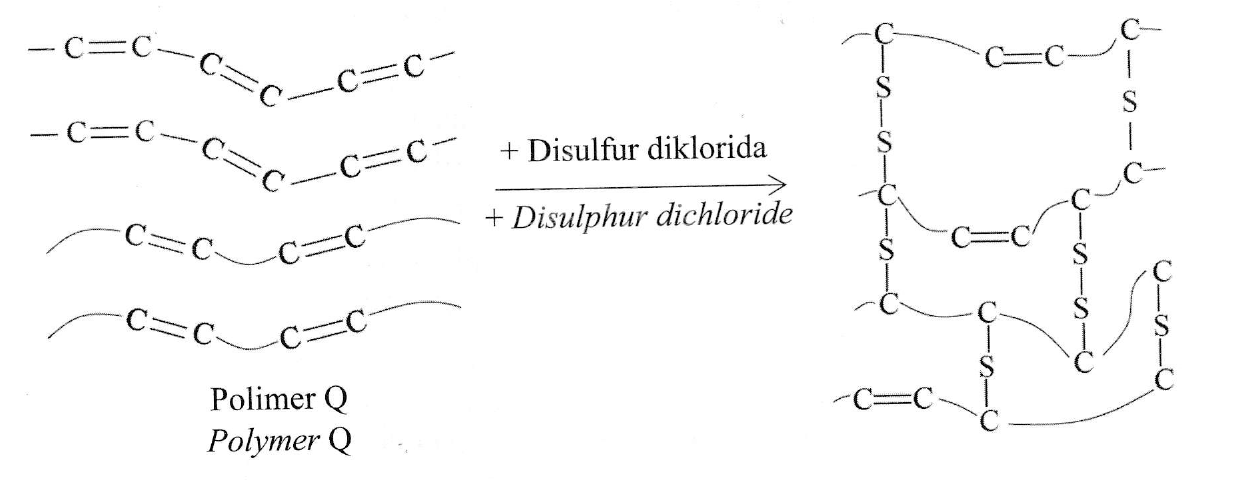
- (c)(ii)
What is the effect of the process in 4(c)(i) on the characteristic of polymer Q?
[1]
Questions on alloys (Table 1.1), hardness of alloy and pure metal (Table 1.2) and composite materials.
Medium8 marks- (a)(i)
Table 1.1 shows the composition and uses of three types of alloy: Stainless steel – 73% iron, 18% chromium, 8% nickel and 1% carbon; Brass – 70% copper and 30% metal R; Duralumin – 93% aluminium, 3% copper, 3% magnesium and 1% manganese. Based on Table 1.1, name metal R.
[1]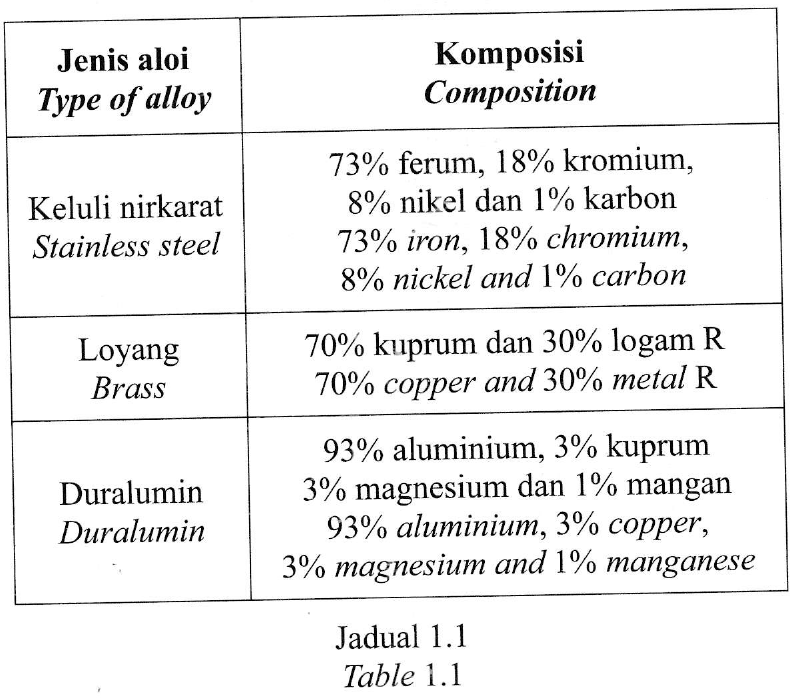
- (a)(ii)
State one use of stainless steel.
[1] - (a)(iii)
Suggest the type of alloy that is suitable to be used to manufacture the racing bicycle. Give your reason.
[2] - (b)
Table 1.2 shows the result of an experiment to study the hardness of alloy and pure metal: Material X – diameter of the dent 0.8 cm; Material Y – diameter of the dent 0.5 cm. Based on the diameter of dents, which material is suitable to build a bridge. Explain your answer.
[2]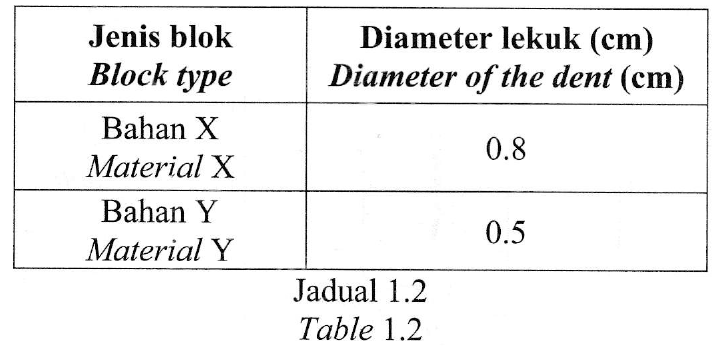
- (c)
A composite material is a material made from combining two or more non-homogeneous substances, that is matrix substance and strengthening substance. Ali wears glasses because he is farsighted. He felt pain in his eyes when exposed to sunlight. State a composite material that can help to overcome the problem. Explain your answer.
[2]
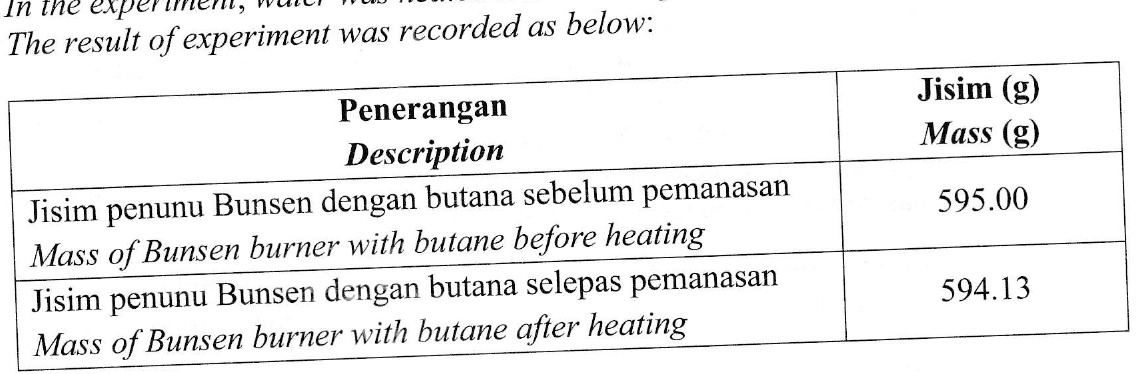
Diagram 6 shows the apparatus set-up to determine the heat of combustion of butane (250 cm³ distilled water in a copper can heated by a Bunsen burner filled with butane, windshield). In the experiment, water was heated until the temperature increased by 40 °C. The result: mass of Bunsen burner with butane before heating = 595.00 g; after heating = 594.13 g.
Medium9 marks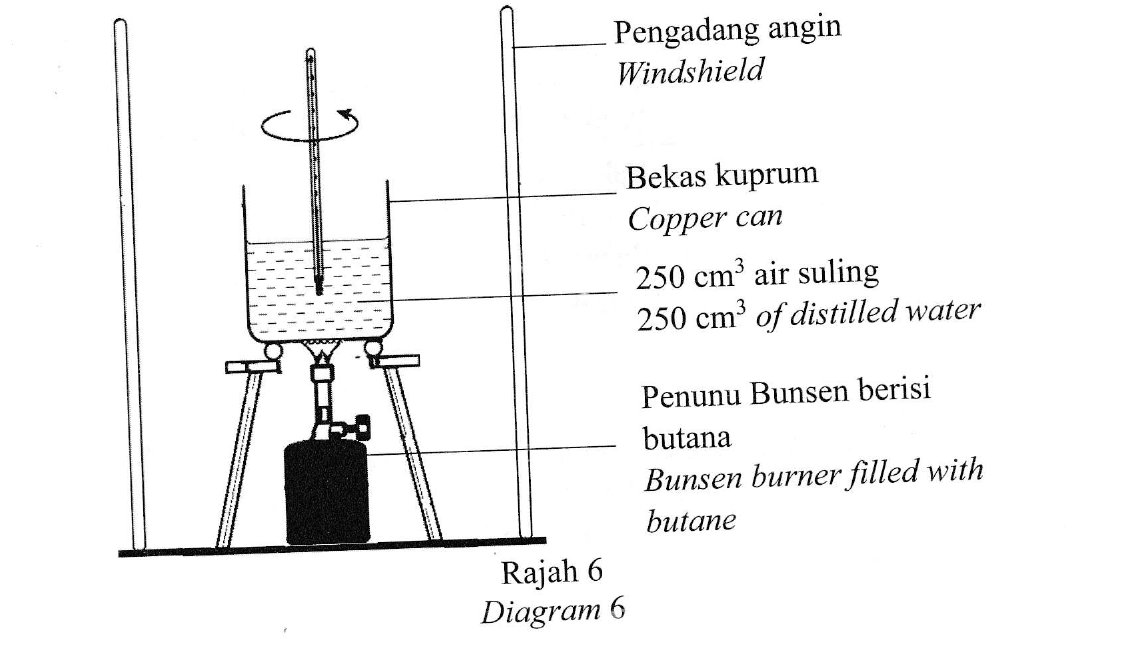
- (a)
State the meaning of heat of combustion.
[1] - (b)
State the type of reaction for combustion of butane.
[1] - (c)
Calculate the heat of combustion of butane. [Relative atomic mass: H = 1; C = 12; Specific heat capacity of water = 4.2 J g⁻¹ °C⁻¹; Density of water = 1 g cm⁻³]
[4] - (d)
Table 2 shows the heat of combustion for methanol (−726 kJ mol⁻¹) and propanol (−2021 kJ mol⁻¹). Compare the heat of combustion of methanol and propanol. Explain the difference.
[3]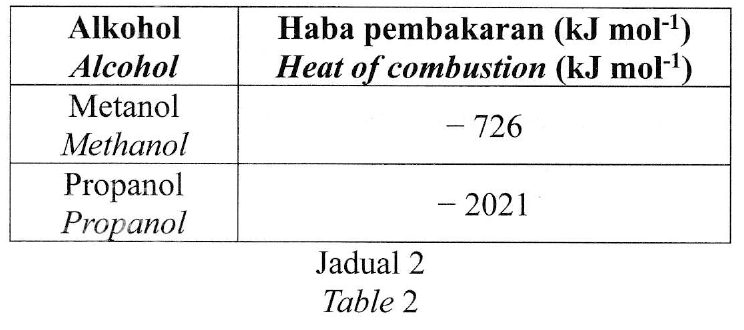
Questions on the preparation of a cleaning agent from palmitic acid, cosmetics and a food additive used as an emulsifier.
Medium10 marks- (a)(i)
Diagram 7.1 shows the reaction in producing a cleaning agent X by using palmitic acid (CH₃(CH₂)₁₄COOH + NaOH). State the type of fatty acid for palmitic acid.
[1]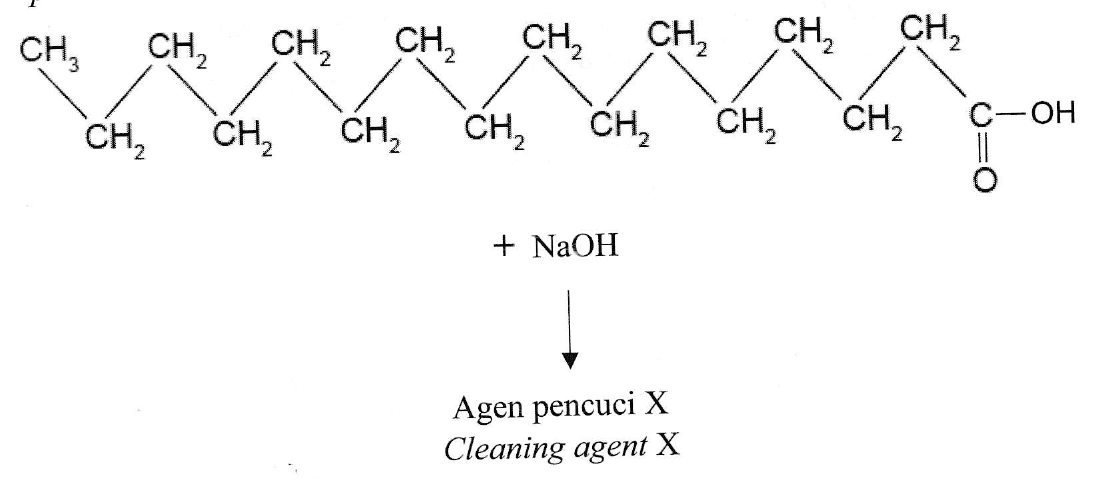
- (a)(ii)
Name the reaction.
[1] - (a)(iii)
Draw the structural formula for cleaning agent X.
[1] - (a)(iv)
Name the structure in 7(a)(iii).
[1] - (a)(v)
Explain the effectiveness of cleansing action of cleaning agent X in hard water.
[2] - (b)
Diagram 7.2 shows two types of cosmetics: P (100% homemade) and Q (produced in the factory). Justify the use of both cosmetics in helping a person's appearance.
[2]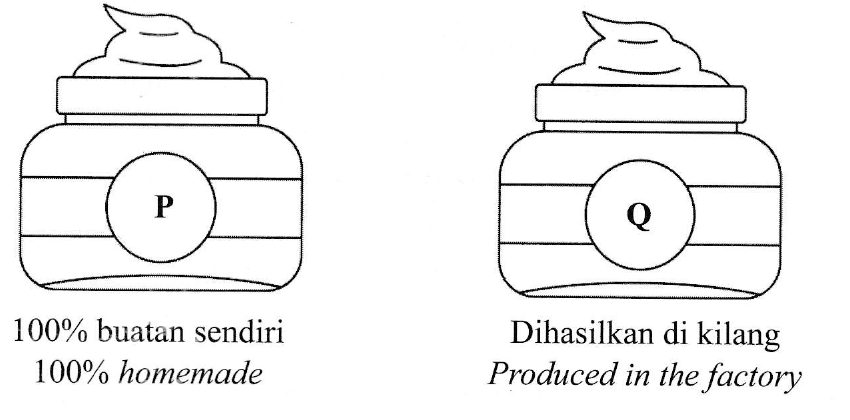
- (c)(i)
Diagram 7.3 shows a chemical reaction that occurs in producing of food when food additive Z is added (oil and water with Z, before and after shaking: a uniform mixture forms). State the changes that occur after shaking.
[1]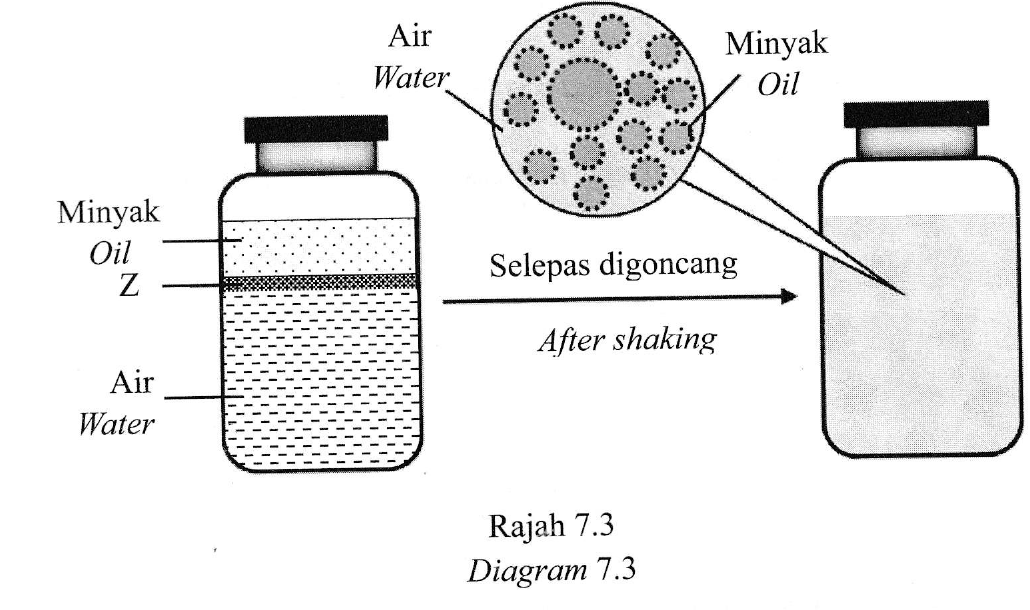
- (c)(ii)
If given a choice between pectin and lecithin, which additive would you choose to produce the change as in 7(c)(i)?
[1]
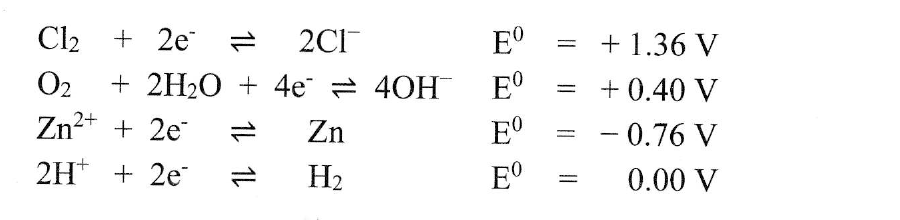
Diagram 8 shows electrolysis of two types of electrolytes: Cell I – 1.0 mol dm⁻³ zinc chloride solution with carbon electrodes S and T; Cell II – 1.0 mol dm⁻³ zinc sulphate solution with carbon electrodes U and V. Standard electrode potentials: Cl₂ + 2e⁻ ⇌ 2Cl⁻, E° = +1.36 V; O₂ + 2H₂O + 4e⁻ ⇌ 4OH⁻, E° = +0.40 V; Zn²⁺ + 2e⁻ ⇌ Zn, E° = −0.76 V; 2H⁺ + 2e⁻ ⇌ H₂, E° = 0.00 V.
Medium10 marks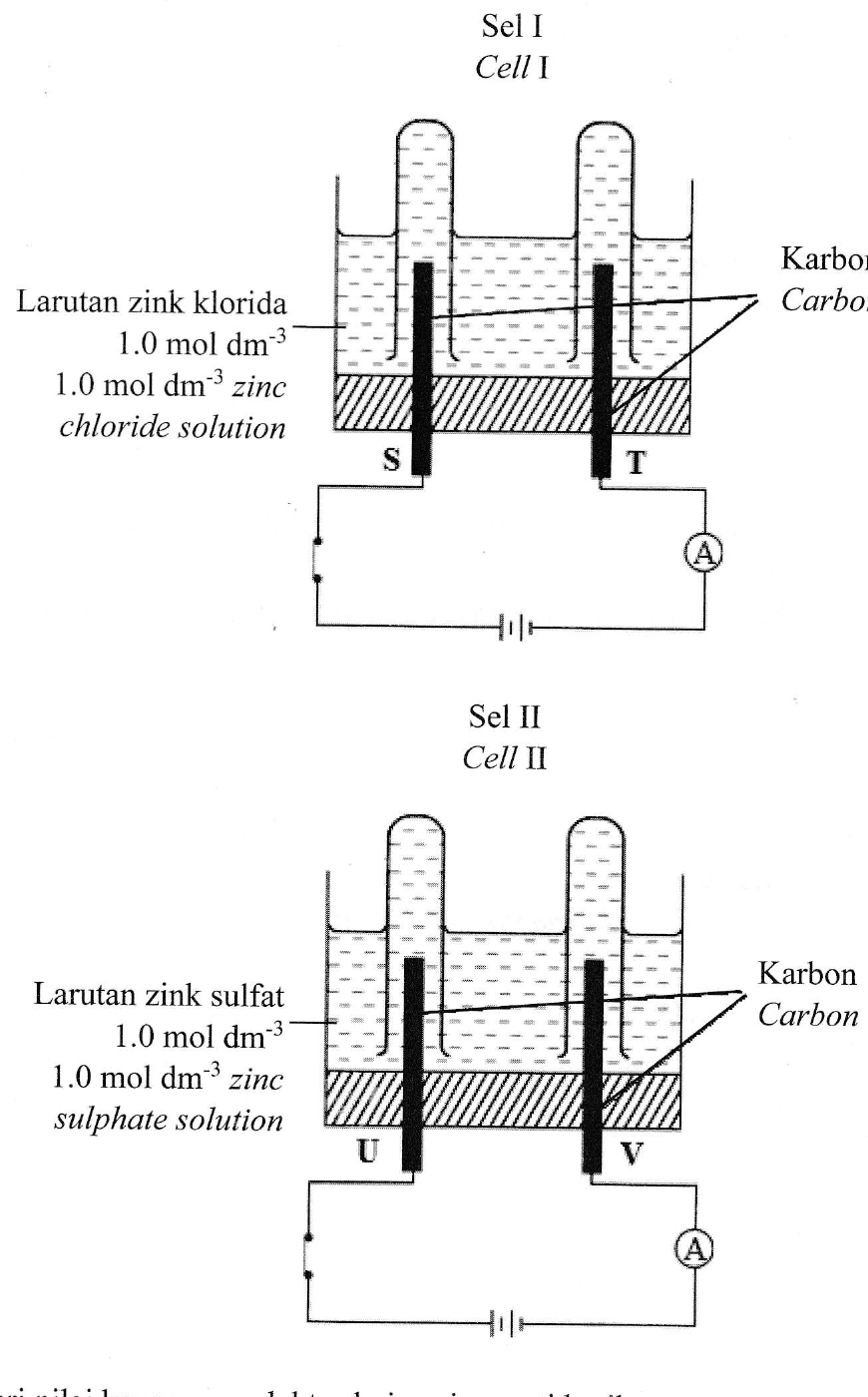
- (a)(i)
Name all anions present in zinc chloride solution.
[1] - (a)(ii)
Write the formula of the product formed at electrode S.
[1] - (a)(iii)
Explain your answer based on selection of ions to discharge in 8(a)(ii).
[1] - (a)(iv)
Describe a confirmatory test for the product formed at electrode U.
[2] - (b)(i)
Table 3 shows an experiment to determine the effect of other metals on rusting of iron nail. Set I: iron nail in contact with metal X in jelly solution + potassium hexacyanoferrate(III) solution + phenolphthalein – high intensity of pink colour; no dark blue spot. Set II: iron nail in contact with metal Y in the same jelly solution – high intensity of dark blue colour; low intensity of pink colour. Explain the difference in observation of Set I and Set II.
[2]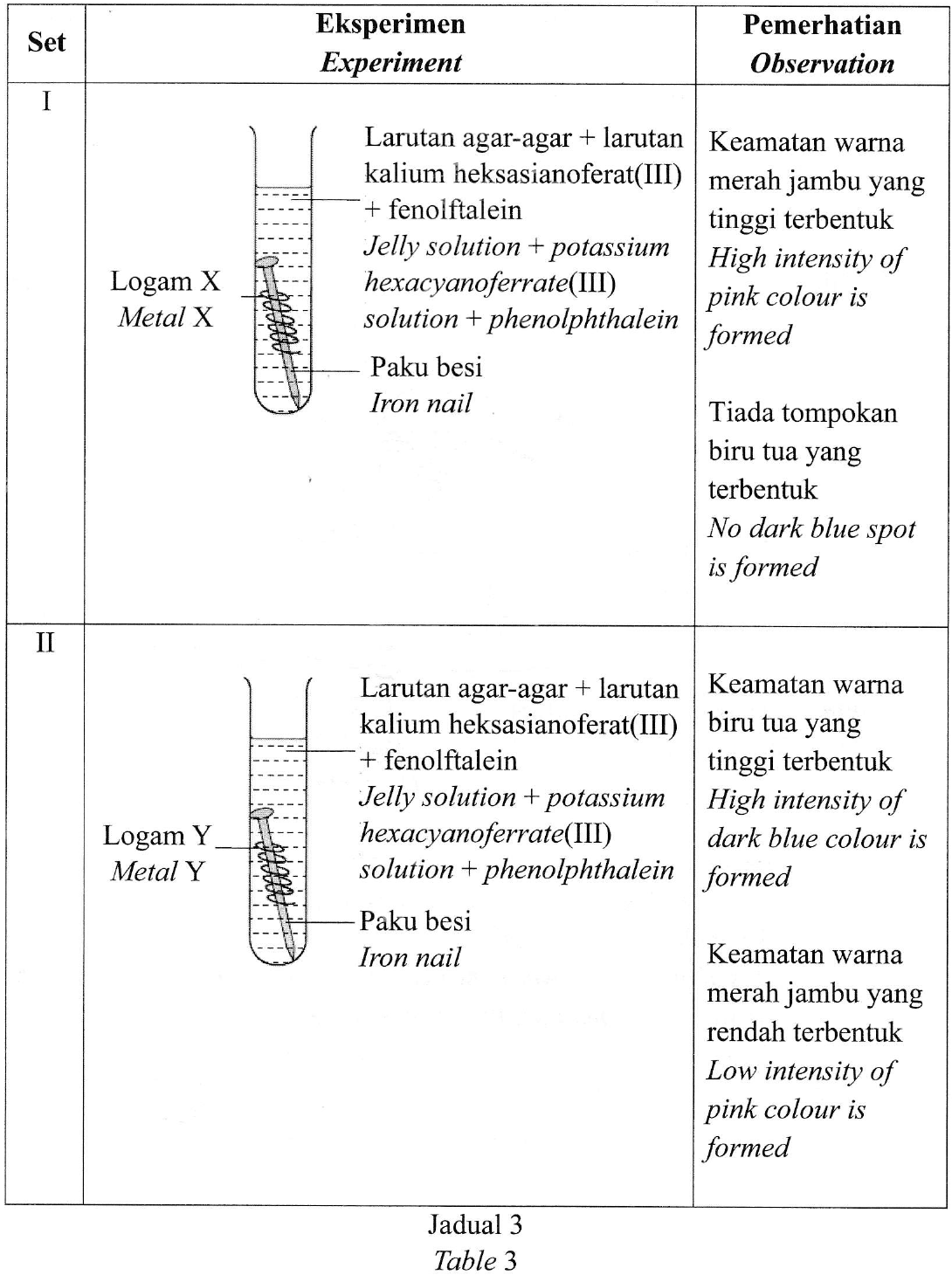
- (b)(ii)
Diagram 8 shows a sacrificial metal on the body of a ship. Based on your answer in 8(b)(i), choose a metal that suitable to be used as sacrificial metal on the body of a ship. Explain your answer.
[3]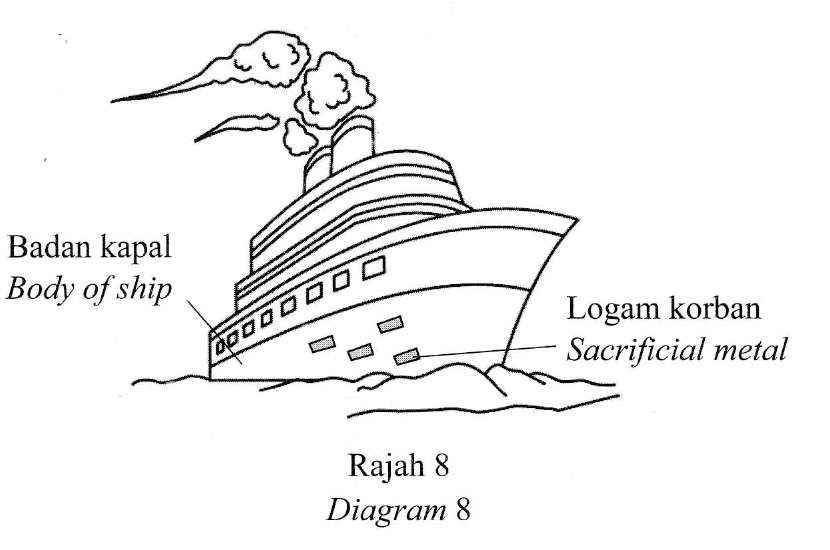
Section B
Table 9 shows three sets of experiment carried out to investigate the factors that affect the rate of reaction between zinc and hydrochloric acid. Experiment I: excess zinc powder + 25 cm³ of 0.5 mol dm⁻³ hydrochloric acid. Experiment II: excess zinc powder + 25 cm³ of 1.0 mol dm⁻³ hydrochloric acid. Experiment III: excess zinc powder + 25 cm³ of 1.0 mol dm⁻³ hydrochloric acid + 10 cm³ of 1.0 mol dm⁻³ copper(II) sulphate solution.
Medium20 marks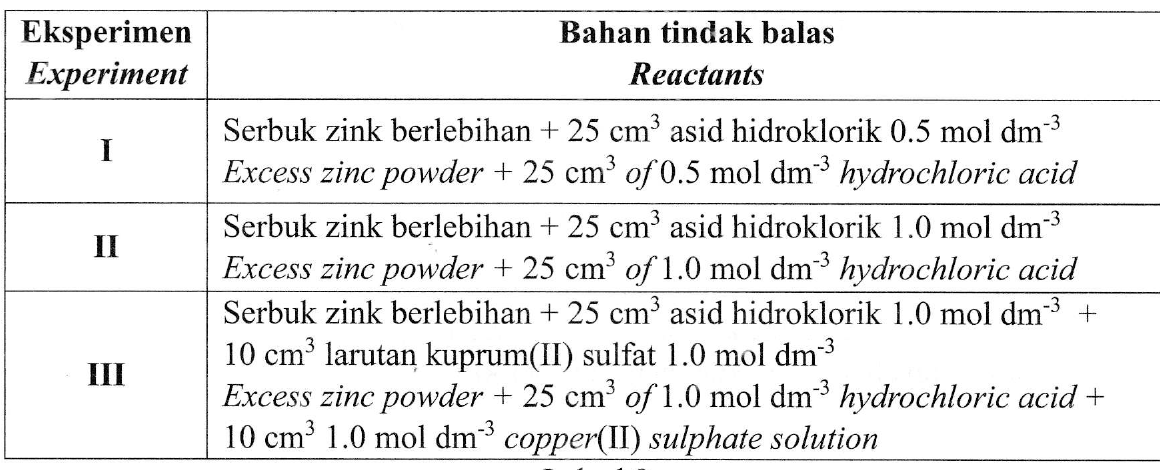
- (a)(i)
Based on the experiment, state the meaning of rate of reaction.
[1] - (a)(ii)
Write the chemical equation for the reaction that occurred between zinc and hydrochloric acid in Experiment I. Calculate the volume of gas released for the experiment. The experiment took 2 minutes to complete the reaction. Calculate the average rate of reaction in cm³ s⁻¹ for this reaction. [1 mol of gas occupies the volume of 24.0 dm³ at room condition]
[6] - (a)(iii)
On the same axis, sketch the graph of gas volume against time for Experiment I, II and III.
[4] - (a)(iv)
Compare the rate of reaction between Experiment II and III. Explain your answer based on Collision Theory.
[6] - (b)
Antacid tablets are used to treat gastric. Doctors advise patients to chew instead of swallowing. Give the reason.
[3]
Diagram 10 shows the flow chart for the reactions undergoes by compound P. Compound P is an unsaturated hydrocarbon that has four carbon atoms. P + H₂ gives compound Q; P + O₂ gives CO₂ + compound S; P gives compound R by process X (and R gives P when passed over hot porcelain chips); Q + Cl₂ in ultraviolet rays by process Y gives compound T; R + carboxylic acid V gives compound U.
Hard20 marks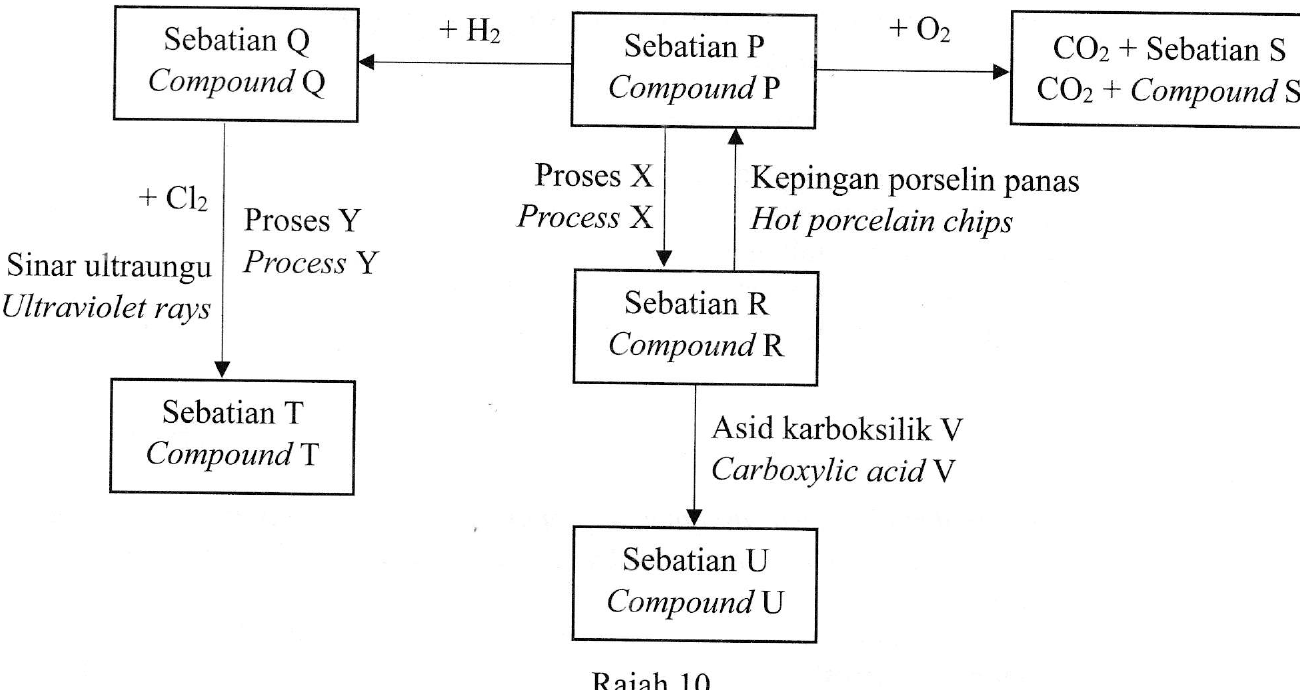
- (a)
What is meant by hydrocarbon? Give an example of a homologous series for unsaturated hydrocarbons.
[2] - (b)
Identify compounds Q, R and S. Name process X and Y. State functional group of compound U.
[6] - (c)
Draw and name two isomers of compound R. Compound P and Q exist as gas at room conditions. Describe how to distinguish compound P and Q that exist as gas in the laboratory.
[7] - (d)
A group of students was assigned to prepare a compound U that has a banana flavour which is butyl ethanoate. Suggest carboxylic acid V used to prepare compound U. Write the chemical equation for the preparation of compound U. Calculate the mass of compound R that will be used to obtain 2 g of compound U. [Relative atomic mass: H = 1; C = 12; O = 16]
[5]
Section C
Questions on sulphate salts that can be prepared in a laboratory (potassium sulphate, barium sulphate, calcium sulphate), identifying two colourless solutions (labelled MgSO₄ and Na₂SO₄) and a conversion chart of green solid W.
Medium20 marks- (a)(i)
The following are three examples of sulphate salts that can be prepared in a laboratory: potassium sulphate, barium sulphate, calcium sulphate. Classify these examples of salts into soluble and insoluble salts.
[2] - (a)(ii)
State the reactants for the preparation of the soluble salt in 11(a)(i).
[2] - (b)
Diagram 11.1 shows the condition of two bottles of colourless solution in a laboratory with peeled-off labels MgSO₄ and Na₂SO₄. A lab assistant wanted to paste the labels back to the bottles. He took 2 cm³ from each solution and tested both solutions with ammonia solution. Justify his action.
[3]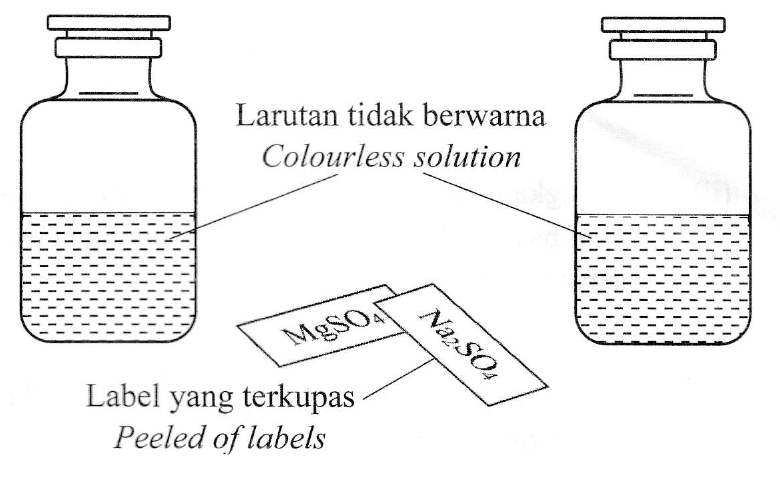
- (c)(i)
Diagram 11.2 shows the conversion of solid W to solution Y and solid Z (green solid W + acid X gives blue solution Y + gas V + water; heating W gives black solid Z + gas V). Identify substances V, W and Z.
[3]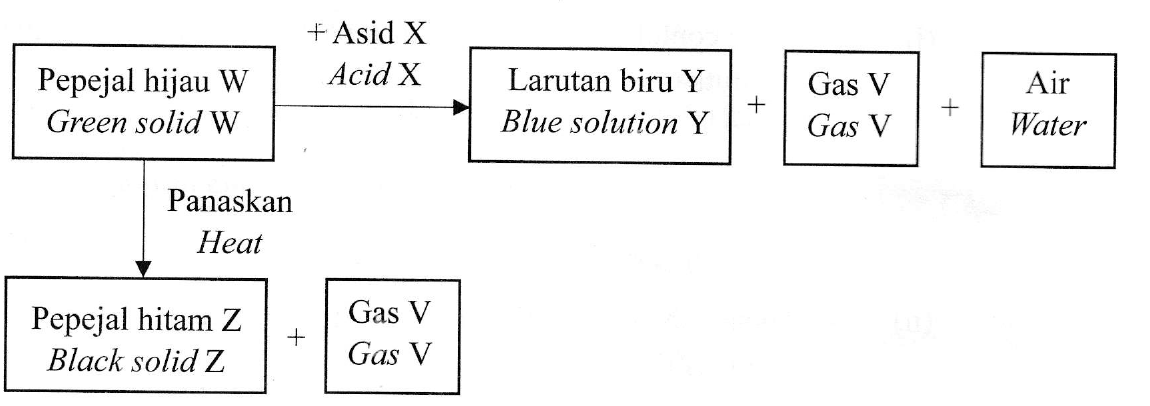
- (c)(ii)
Suggest acid X to prepare solution Y. Write the chemical equation for the reaction. Describe a laboratory experiment to prepare salt Y.
[10]