Write your answer on paper. Then open the answer to check it.
Section A
Table 1 shows two types of cosmetics M and N widely used by consumers. M: as skin moisturisers and facial masks. N: as deodorants and perfumes.
Medium5 marks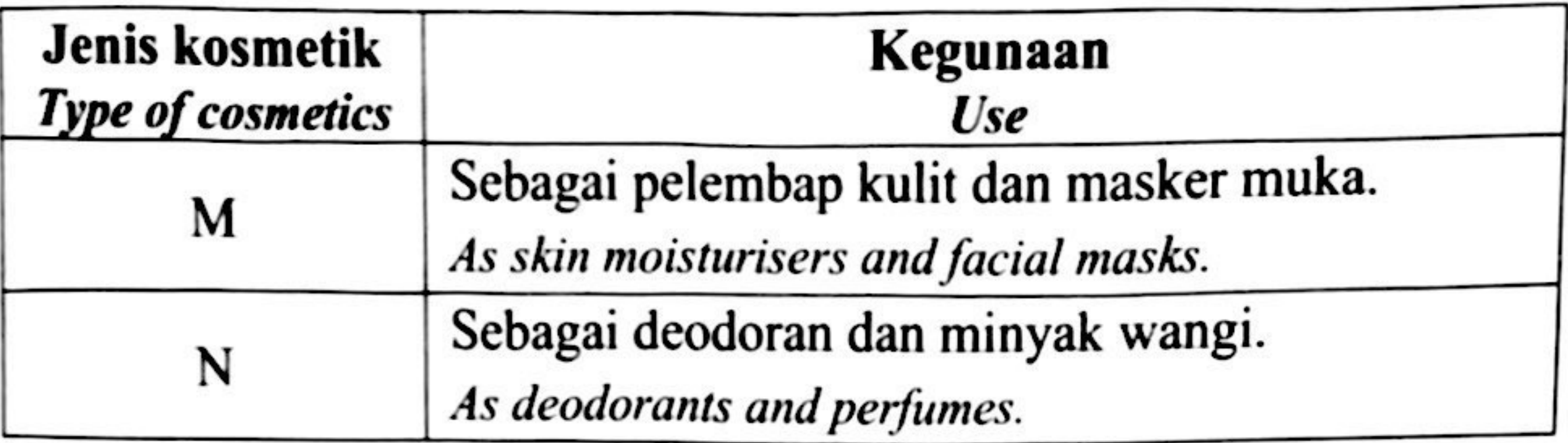
- (a)
What is meant by cosmetics?
[1] - (b)
Based on Table 1, identify type of cosmetics M and N.
[2] - (c)
Explain why nanotechnology is widely used in the manufacturing of cosmetics.
[2]
Table 2 shows some physical properties of Group 17 elements: Cl (mp -101 C, bp -34 C, atomic radius 0.099 nm); Br (mp -7 C, bp 59 C, 0.114 nm); I (mp 114 C, bp 184 C, 0.133 nm).
Medium5 marks
- (a)
State the other name for Group 17 elements.
[1] - (b)
State the change in atomic radius when going down Group 17. Explain.
[2] - (c)
Draw the arrangement of particles for bromine at room temperature.
[1]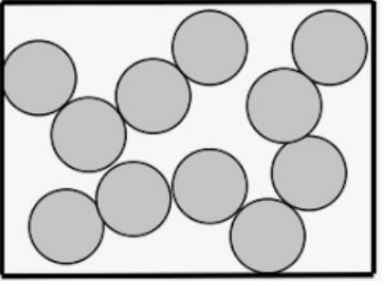
- (d)
State one safety step when handling chlorine and bromine in the laboratory.
[1]
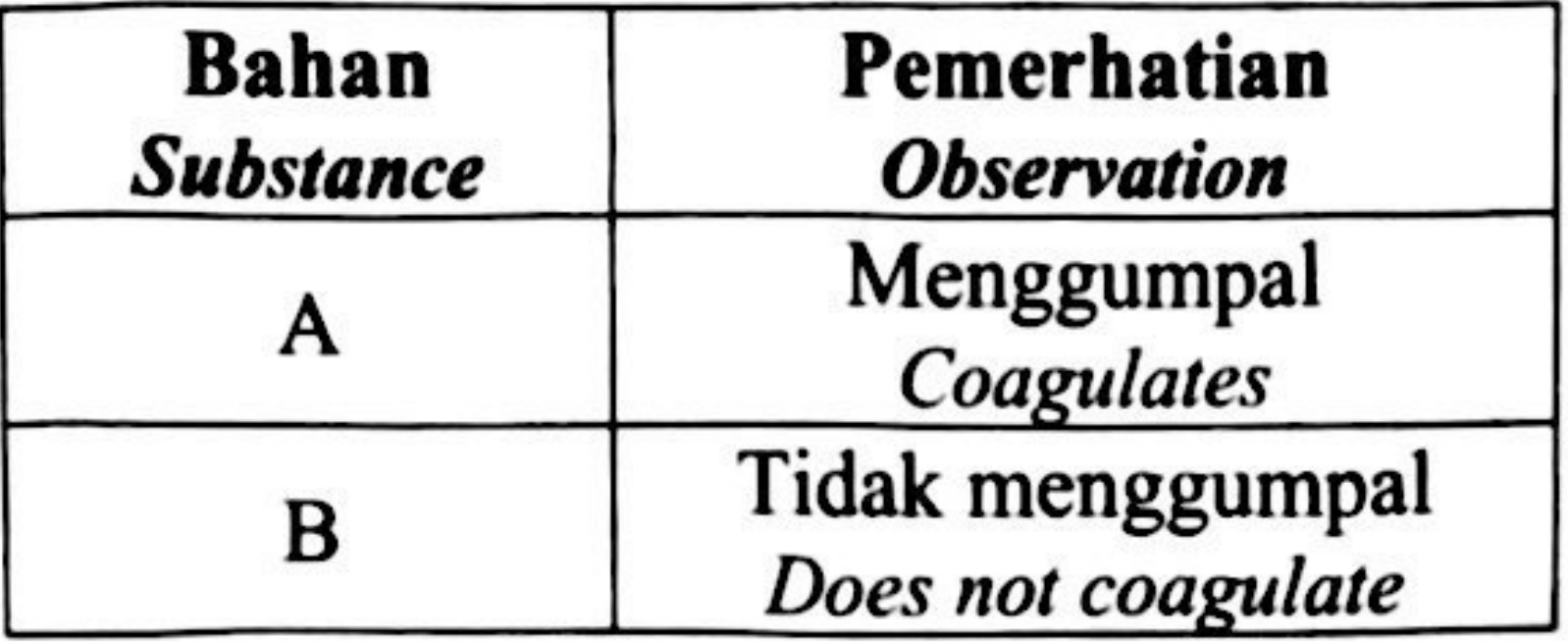
(a) Diagram 1 shows the structural formula of polymer X, used to make product Y (a hose): repeat unit -[CH2-CHCl]n-, i.e. poly(chloroethene). (b) Table 3: latex coagulates with substance A but does not coagulate with substance B.
Medium6 marks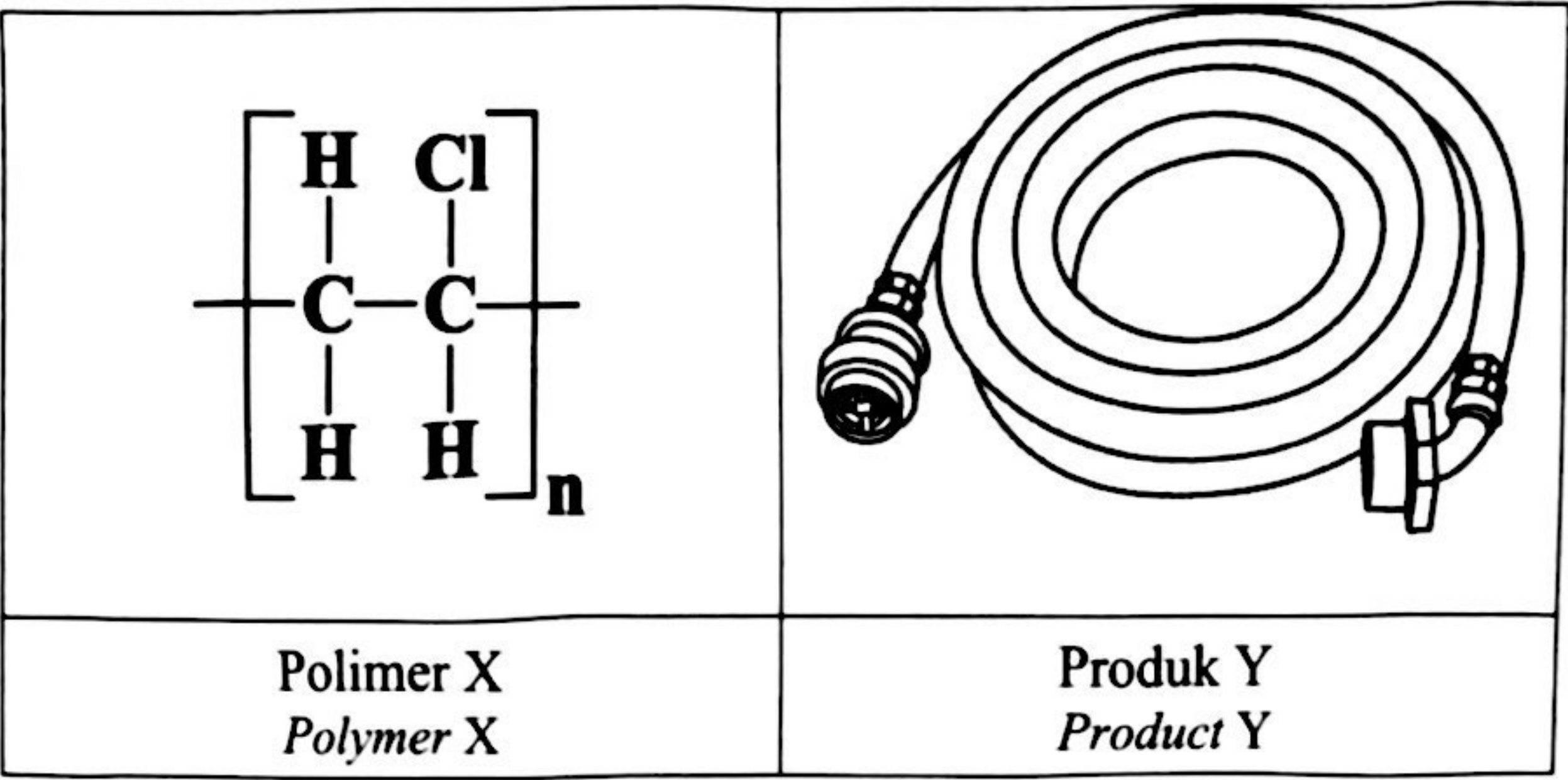
- (a)(i)
What is the meaning of polymer?
[1] - (a)(ii)
Draw the structural formula of the monomer that forms polymer X.
[1]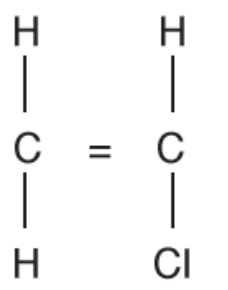
- (b)(i)
Name the substances that are added to the liquid latex: substance A and substance B.
[2] - (b)(ii)
Explain briefly the process of coagulation of latex that occurs after the latex is exposed to air for a few days.
[2]
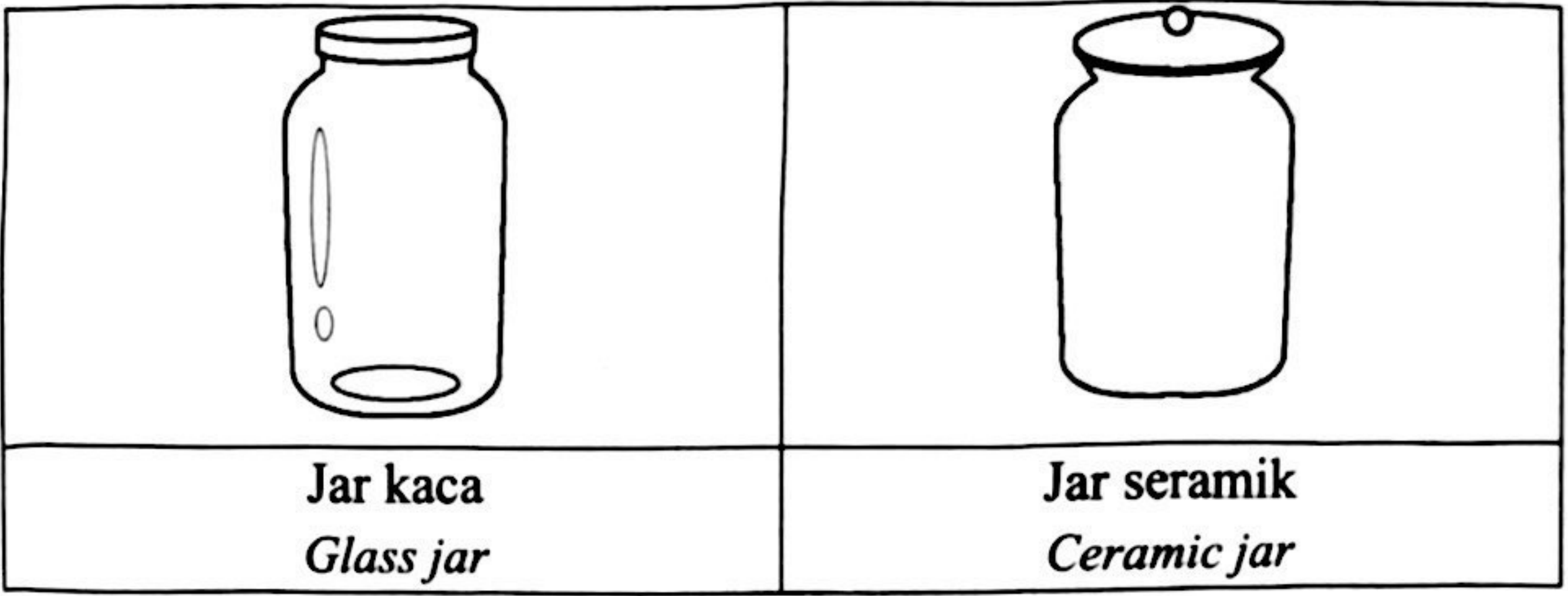
(a) Diagram 2.1 shows a tile cutter (with cutting part X) used by a construction worker to cut tiles. (b) Maya wants to choose a suitable container (glass jar or ceramic jar, Diagram 2.2) to keep fruit pickles.
Medium7 marks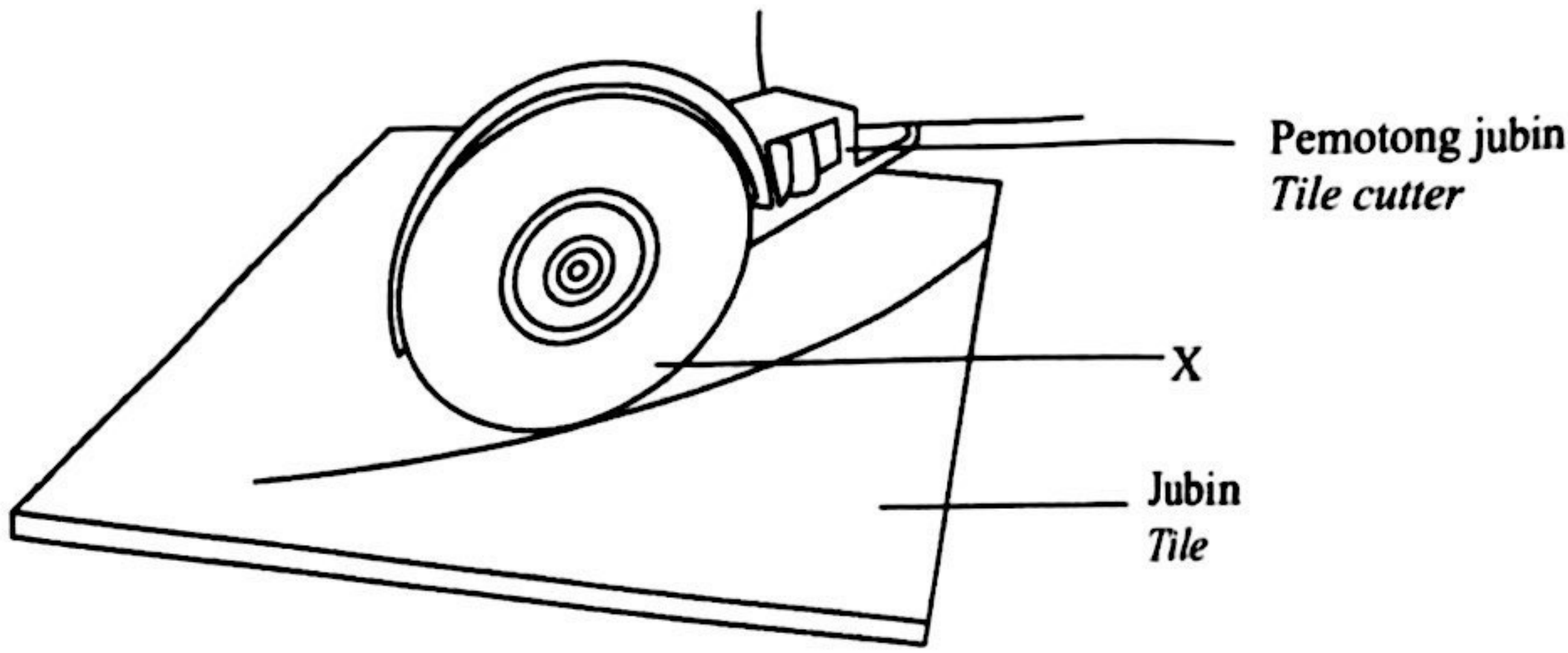
- (a)(i)
State the type of ceramic used to make tiles.
[1] - (a)(ii)
Based on Diagram 2.1, name X and state the property of X that makes it be used as tiles cutter.
[2] - (b)(i)
Which container is more suitable? Justify your answer.
[3] - (b)(ii)
State one disadvantage of the container, based on your answer in 4(b)(i).
[1]
Table 4: Method I: H2 + PO -> P + H2O. Method II: 2Q + O2 -> 2QO. The empirical formulae of P oxide and Q oxide are determined through Method I and Method II. (c) 4.5 g of element Q burns completely forming 7.5 g of oxide of Q. [Relative atomic mass: Q = 24, O = 16]
Medium8 marks
- (a)
What is meant by empirical formula?
[1] - (b)
Suggest name of metal Q.
[1] - (c)
What is the empirical formula of the metal oxide?
[4] - (d)
Which method is suitable to be used to determine the empirical formula of copper(II) oxide, CuO? Explain.
[2]
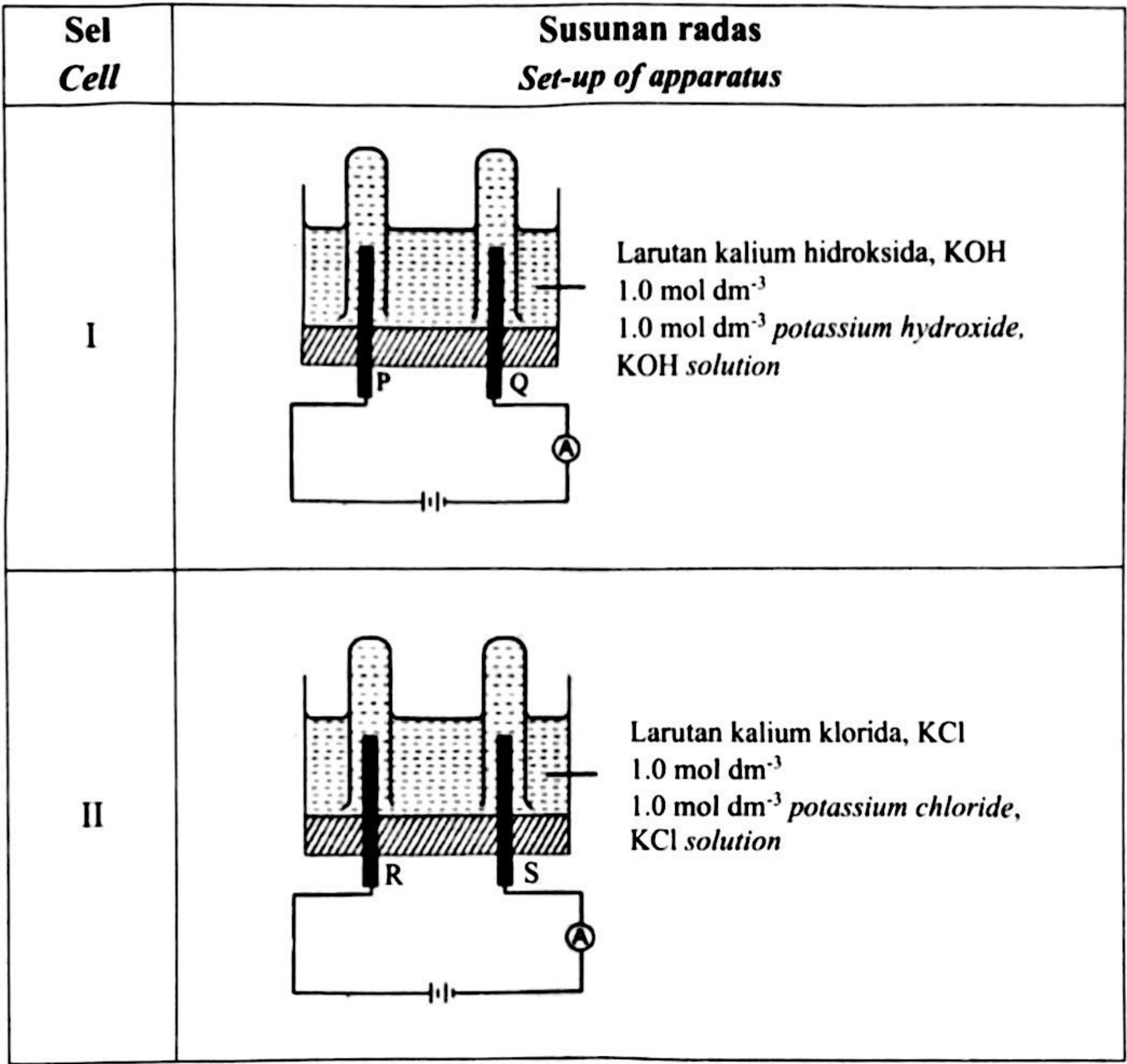
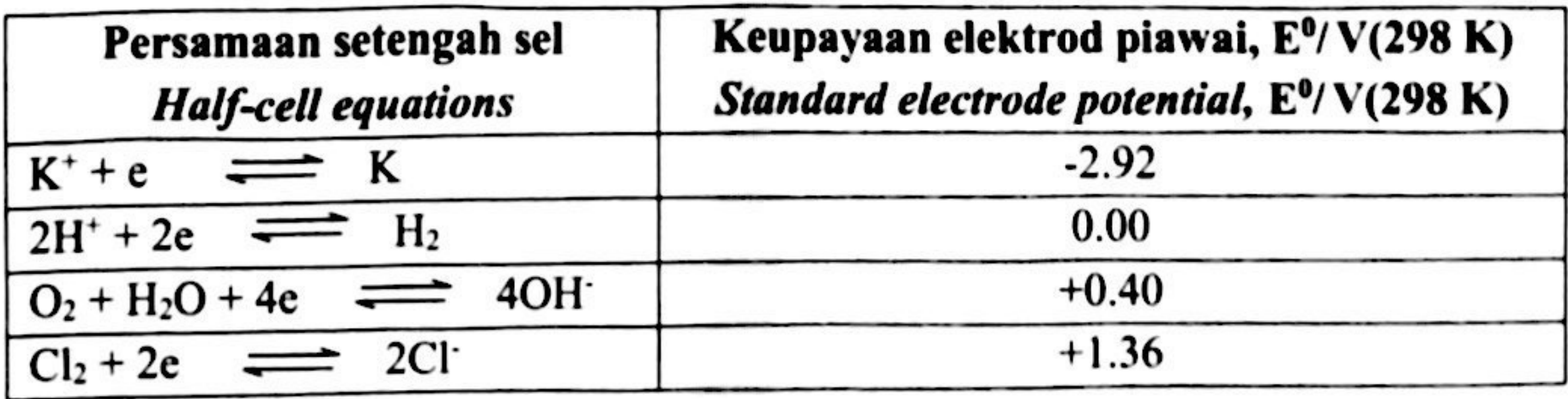
(a) Diagram 3 shows a model of apparatus set-up for the extraction of metal in industry (carbon electrodes, steel layer, molten aluminium oxide + substance X, molten aluminium). (b) Diagram 4 shows electrolysis of 1.0 mol dm-3 KOH solution (cell I, electrodes P, Q) and 1.0 mol dm-3 KCl solution (cell II, electrodes R, S) using carbon electrodes. Table 5 gives E0: K+ + e <=> K -2.92 V; 2H+ + 2e <=> H2 0.00 V; O2 + H2O + 4e <=> 4OH- +0.40 V; Cl2 + 2e <=> 2Cl- +1.36 V.
Medium9 marks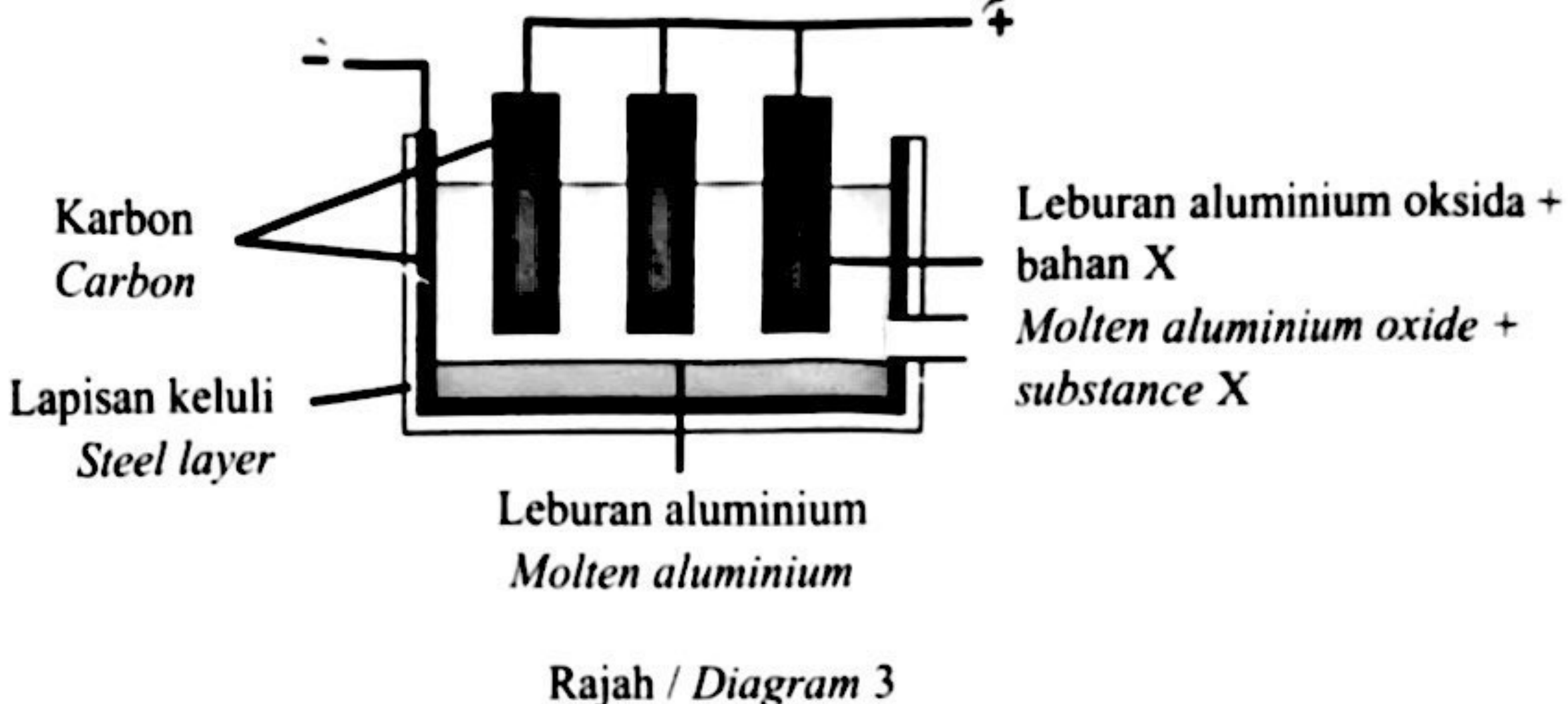
- (a)(i)
Name the process to extract the metal from its ore.
[1] - (a)(ii)
Substance X is added to lower the melting point of aluminium oxide. What is substance X?
[1] - (a)(iii)
State one use of the extracted metal.
[1] - (b)(i)
State all the cations that are present in both electrolytic cells.
[1] - (b)(ii)
Describe a chemical test to verify the product formed at electrode Q and S.
[2] - (b)(iii)
State the name of product formed at electrode R.
[1] - (b)(iv)
Explain your answer in 6(b)(iii).
[2]
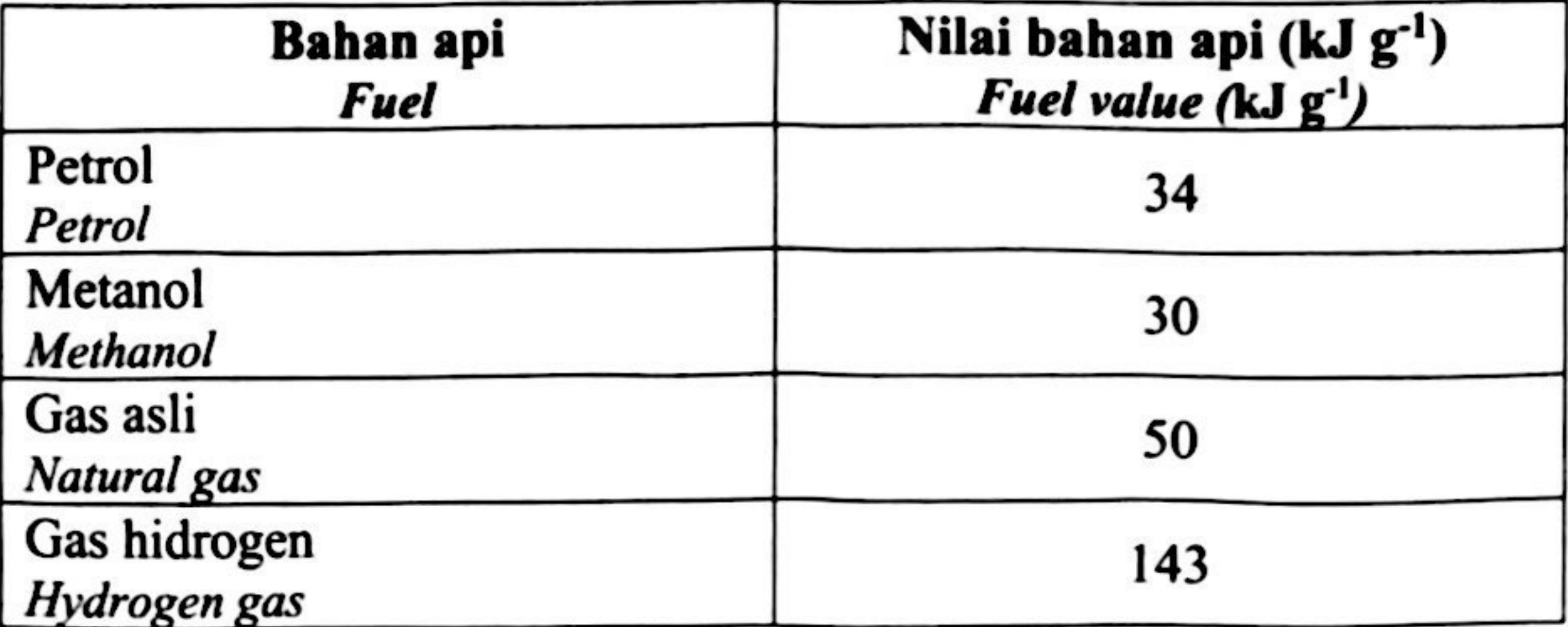
(a) Diagram 5: petrol (C8H18, heat of combustion = -5013 kJ mol-1) and diesel (C12H23, heat of combustion = -10124 kJ mol-1). (b) Table 6 fuel values (kJ g-1): petrol 34, methanol 30, natural gas 50, hydrogen gas 143. (c) Daziel and friends in a STEM camp must cook without fire; choose from food package, ammonium nitrate, water, calcium oxide, basin to create a heat pack.
Medium10 marks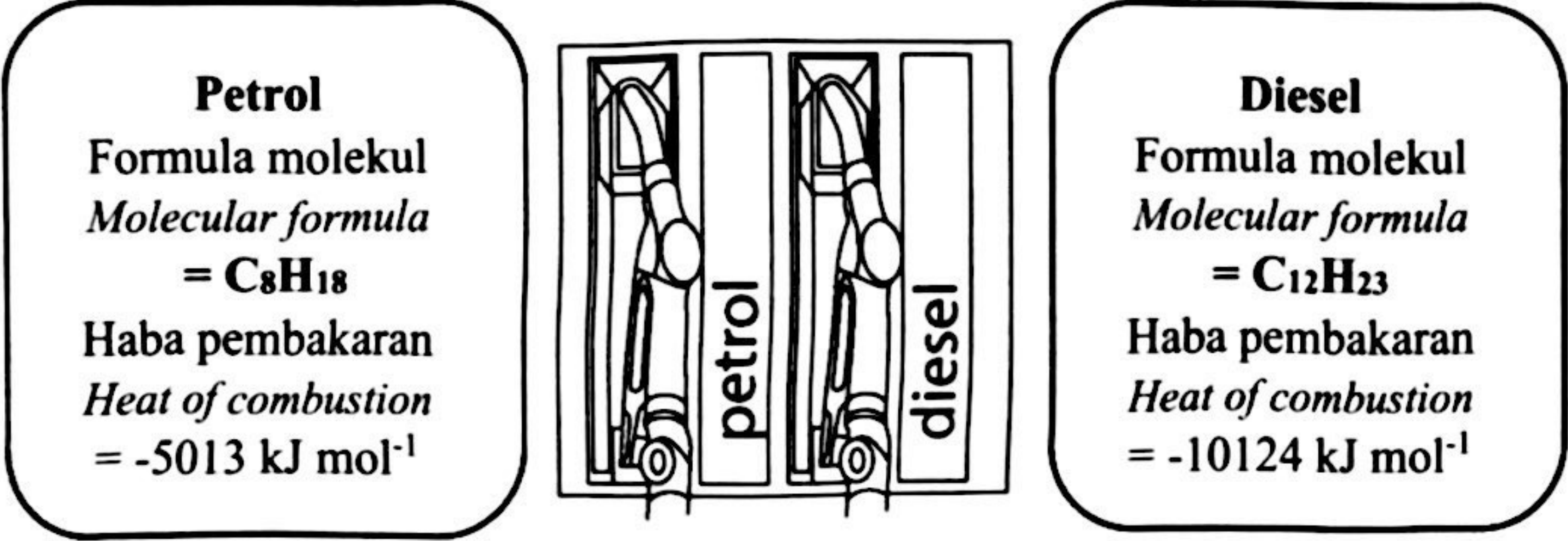
- (a)(i)
State the meaning of heat of combustion.
[1] - (a)(ii)
Compare the heat of combustion of petrol and diesel.
[1] - (a)(iii)
Vishantan filled 2.28 litres of petrol into his motorcycle tank. Calculate the heat liberated if petrol burns completely in excess oxygen. [Relative molecular mass of petrol = 114; assume 1 litre equals 1000 g]
[3] - (b)
Petrol has been widely used in our country. Based on Table 6, choose the appropriate fuel to replace petrol. Justify your choice.
[2] - (c)
Choose the appropriate ingredients and explain how the heat pack works.
[3]
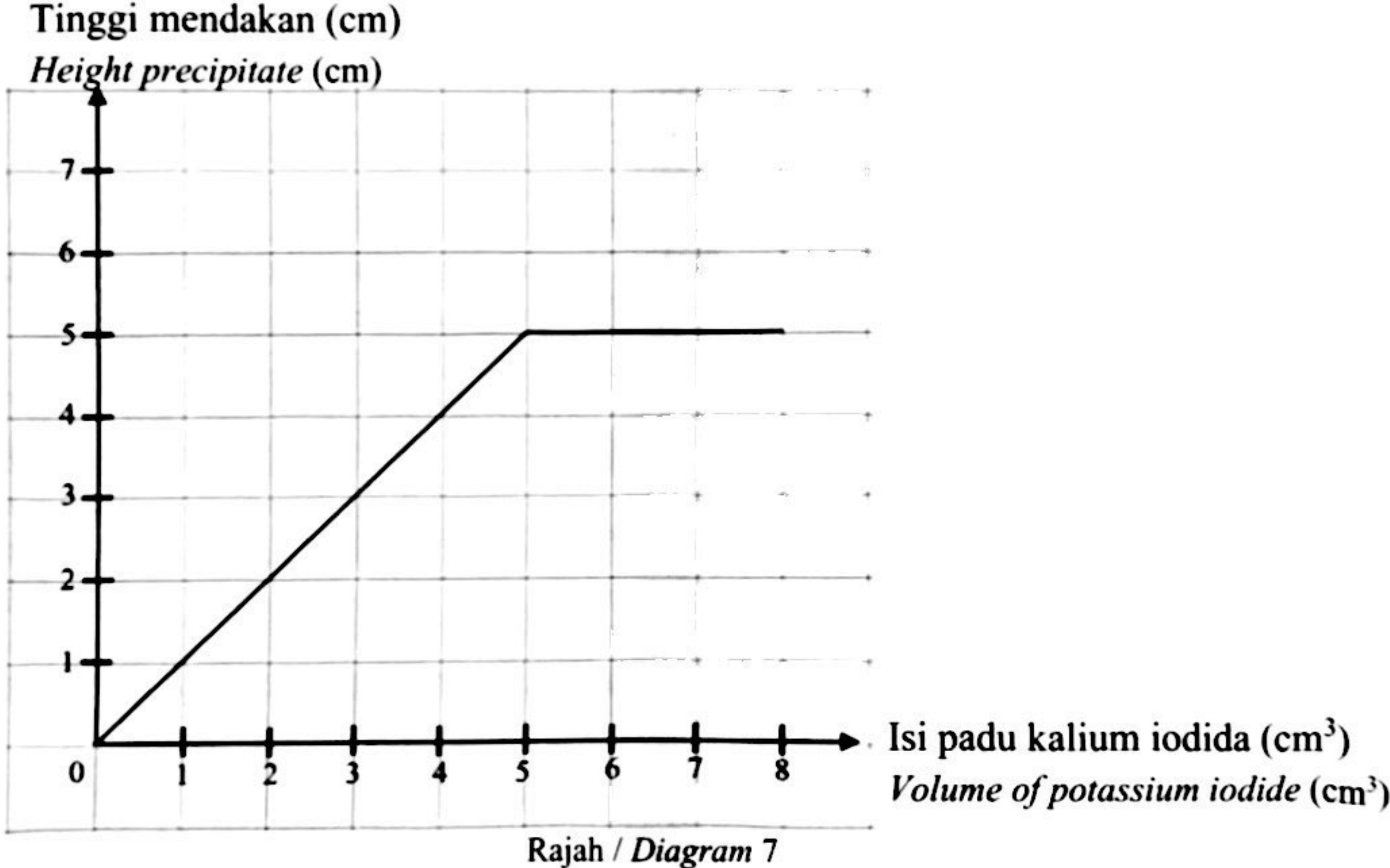
(a) Diagram 6 shows preparing barium sulphate: mix solutions X and Y to form the salt, filter and rinse, then dry. (b) A continuous variation experiment: 5.00 cm3 of 0.5 mol dm-3 Pb(NO3)2 is placed in each of 8 same-size test tubes; different volumes of 1.0 mol dm-3 KI are added. Diagram 7 is a graph of height of precipitate (cm) against volume of KI (cm3): a straight line from the origin to 5 cm at 5 cm3 KI, then constant at 5 cm.
Hard10 marks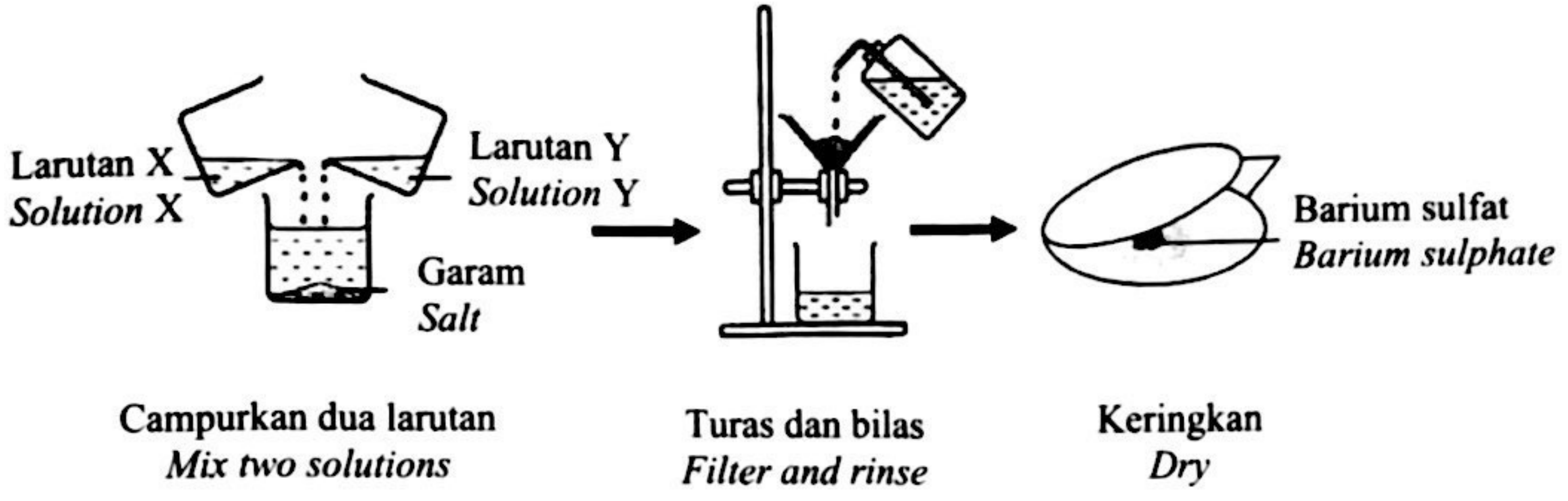
- (a)(i)
Name the type of reaction.
[1] - (a)(ii)
Suggest solution X and Y used in the reaction.
[2] - (a)(iii)
Write the chemical equation for the reaction.
[2] - (b)(i)
Based on Diagram 7, calculate the number of mole of iodide ion that reacts with 1 mole of lead(II) ion.
[3] - (b)(ii)
Based on the answer in 8(b)(i), construct an ionic equation for the formation of lead(II) iodide.
[1] - (b)(iii)
Explain why the eight test tubes used are the same size.
[1]
Section B
Diagram 8.1 shows the standard representation of three elements: W (nucleon number 1, proton number 1), X (16, 8), Y (24, 12). The letters are not the actual symbols. (c) Diagrams 8.2 and 8.3: conductivity and melting of solid and molten magnesium chloride and acetamide with carbon electrodes (bulb does not light for either solid; bulb lights only for molten magnesium chloride).
Medium20 marks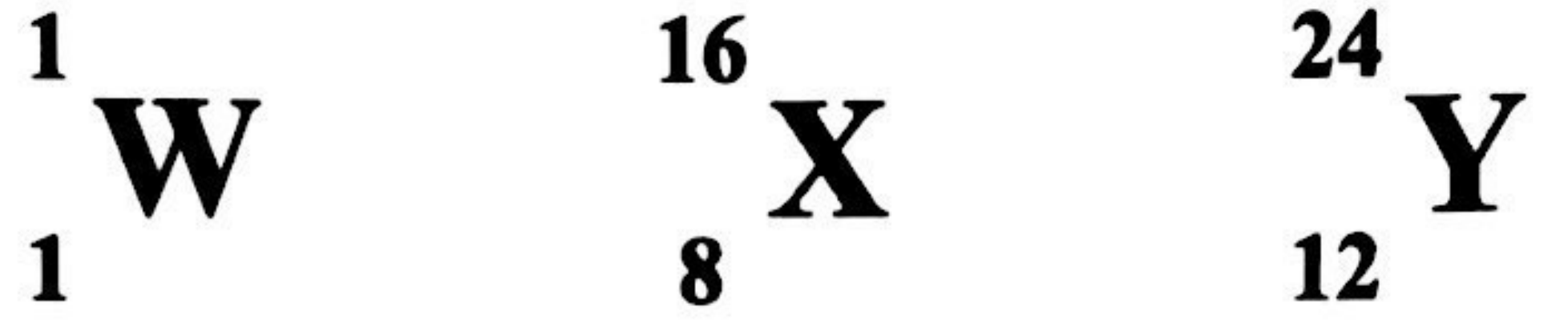
- (a)(i)
What is the meaning of covalent bond?
[1] - (a)(ii)
Based on Diagram 8.1, choose two different elements to form a covalent compound. Explain the formation of the compound, include the molecular formula and the electron arrangement diagram of the compound.
[7]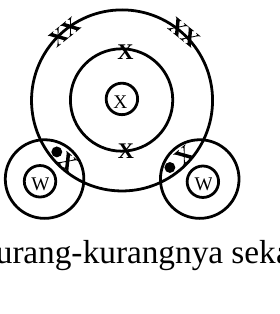
- (b)
Ammonia molecule can form dative bond with hydrogen ion. Draw the Lewis structure for the ion formed and label the dative bond.
[2]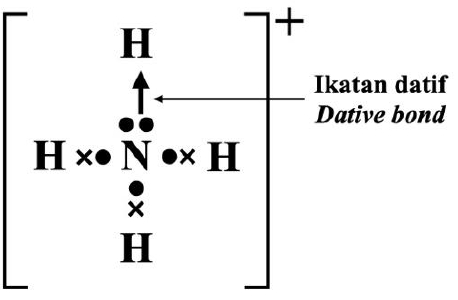
- (c)
Based on the observations in Diagram 8.2 and 8.3, state the type of compound for magnesium chloride and acetamide. Explain the difference in the observations for both compounds in terms of electrical conductivity and melting point.
[10]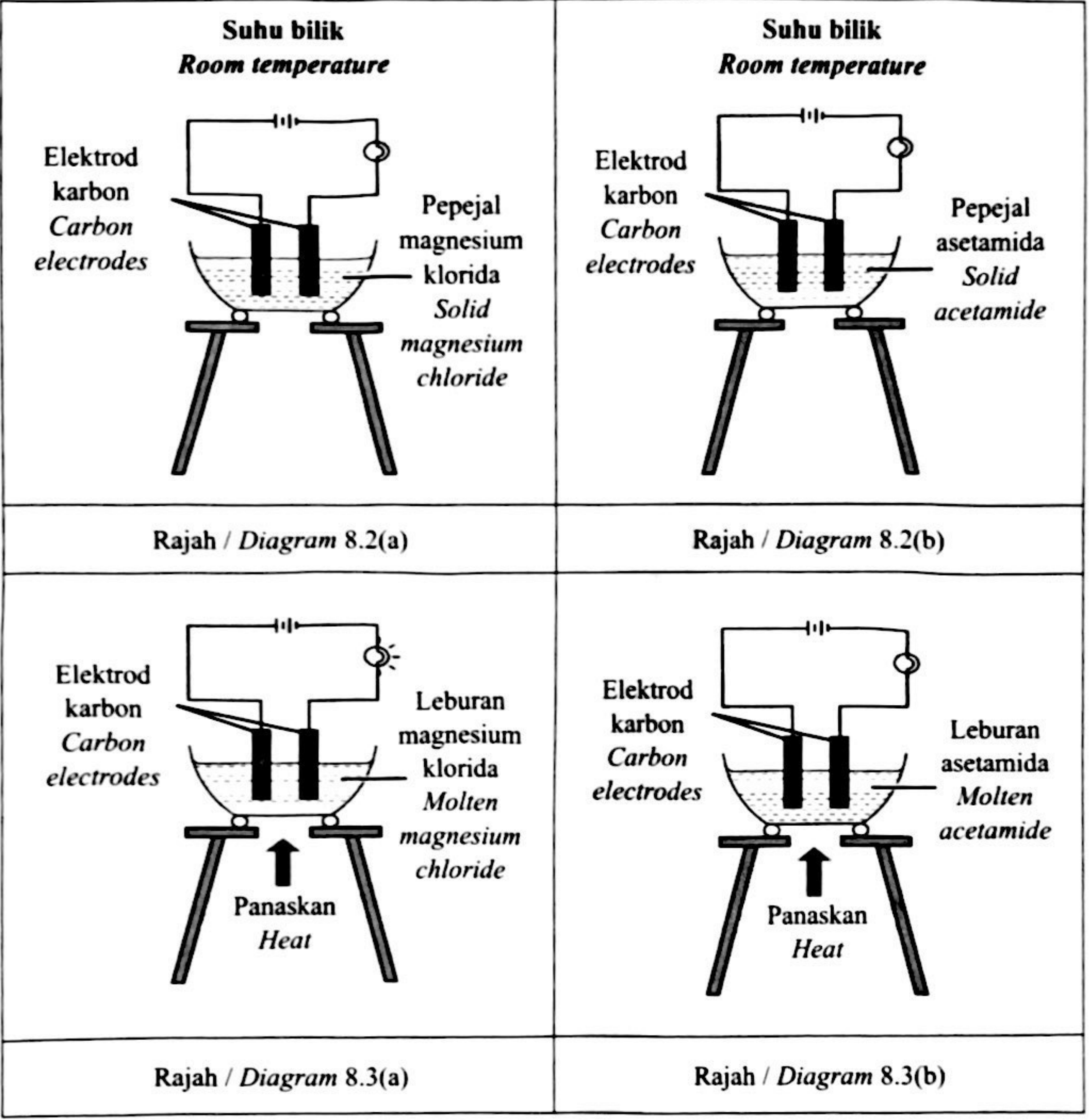
(a) Situation I: fine salt is easier to dissolve in hot water compared to cold water. Situation II: fine salt is easier to dissolve compared to coarse salt in cold water. (b) Table 7: Set I: 9 g zinc powder + 25 cm3 of 0.2 mol dm-3 nitric acid at 30 C. Set II: same reactants at 50 C. Set III: same reactants + copper(II) sulphate solution at 30 C.
Medium20 marks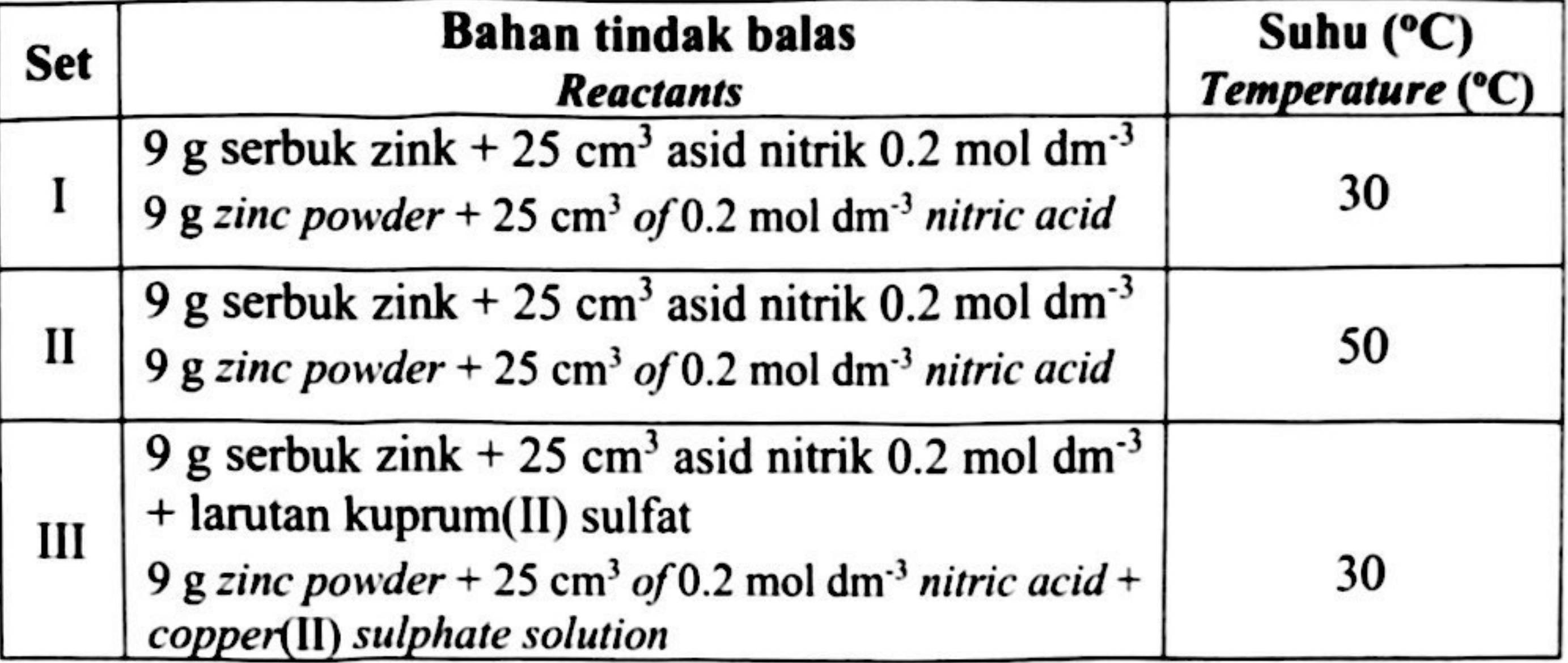
- (a)
Based on the situations, state the two factors involved. By choosing one of the situations, explain how the factor affects the solubility of salt.
[4] - (b)(i)
Write the chemical equation for the reaction between zinc and nitric acid. Calculate the maximum volume of gas produced in Set I. [Relative atomic mass: Zn = 65; molar volume of gas = 24 dm3 mol-1 at room condition]
[6] - (b)(ii)
Compare the rate of reaction for Set I and Set II, and Set I and Set III. Explain your answer based on Collision Theory.
[10]
Section C
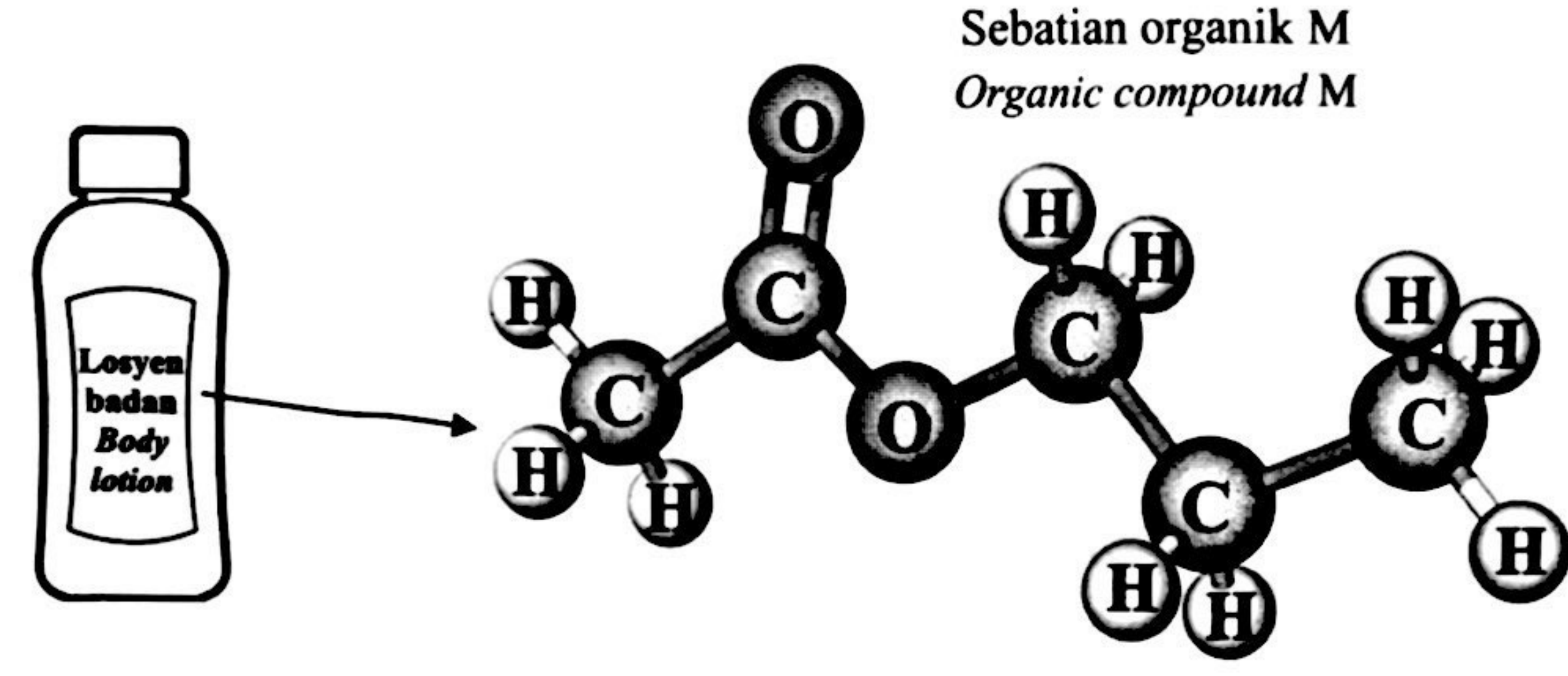
(a) Diagram 9.1: compound P (C4H10O) converts to compound Q by Reaction II over porcelain chips, and burns (combustion) to give carbon dioxide and water. (b) Diagram 9.2 shows the structural formula of organic compound M in a body lotion: CH3-COO-CH2CH2CH3 (propyl ethanoate).
Hard20 marks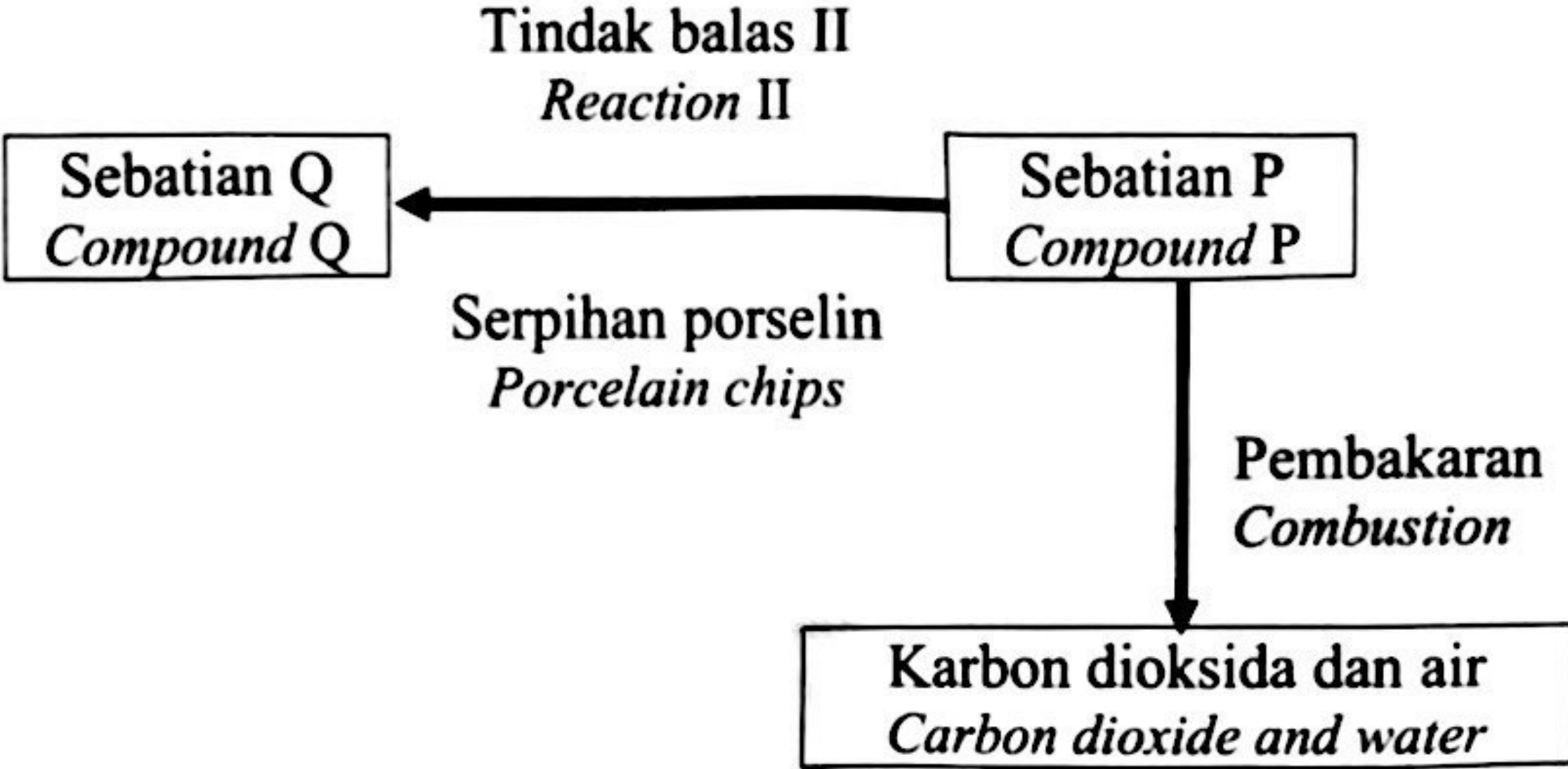
- (a)(i)
State the homologous series of compound P. Draw the structural formula of one isomer of P and name it by IUPAC. Name reaction II and draw a labelled diagram of the apparatus set-up to prepare compound Q in the laboratory.
[6]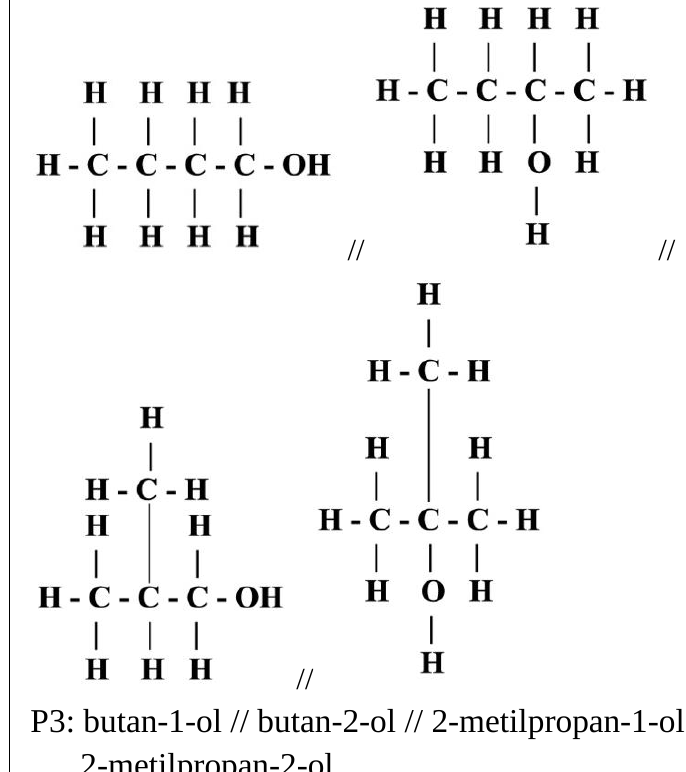
- (a)(ii)
Write a balanced chemical equation for the complete combustion of 2.1 g of compound P and calculate the volume of carbon dioxide gas released. [Relative atomic mass: H = 1, C = 12, O = 16; 1 mole of any gas occupies 24 dm3 at room conditions]
[5] - (b)
By using suitable materials and apparatus, describe the preparation of organic substance M in the laboratory. In your explanation, state the observation for the product formed and write the chemical equation for the reaction.
[9]