Write your answer on paper. Then open the answer to check it.
Section A
Table 1 shows the proton number and nucleon number of three particles V, W and Y: V (proton number 6, neutrons 6, nucleon number 12); W (proton number 11, neutrons blank, nucleon number 23); Y (proton number 11, neutrons 13, nucleon number 24).
Medium5 marks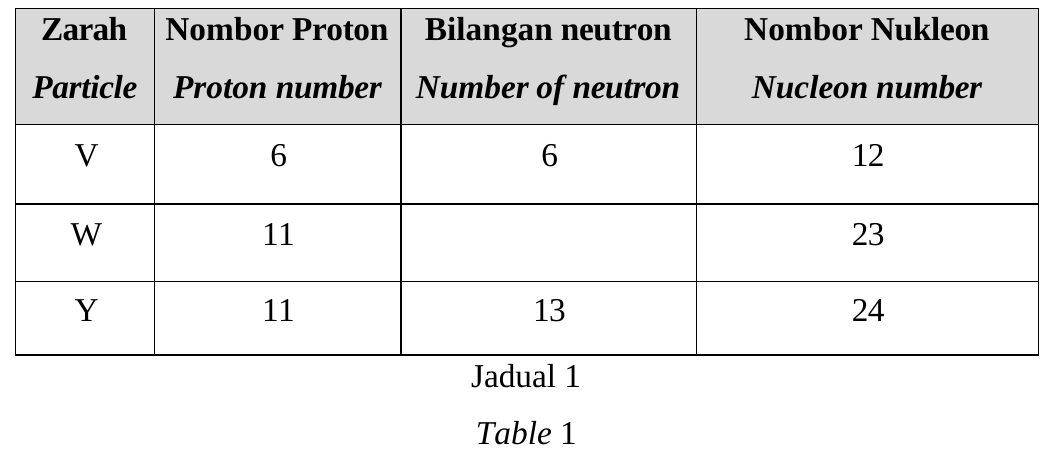
- (a)
Based on Table 1, state the number of neutrons of W.
[1] - (b)(i)
Define isotopes.
[1] - (b)(ii)
Identify two particles that are isotopes.
[1] - (c)(i)
Explain why isotopes show different physical properties.
[1] - (c)(ii)
Explain why isotopes show the same chemical properties.
[1]
Diagram 1 shows examples of alloy, glass and ceramic materials used in daily life: glass pot, pottery and coins.
Medium5 marks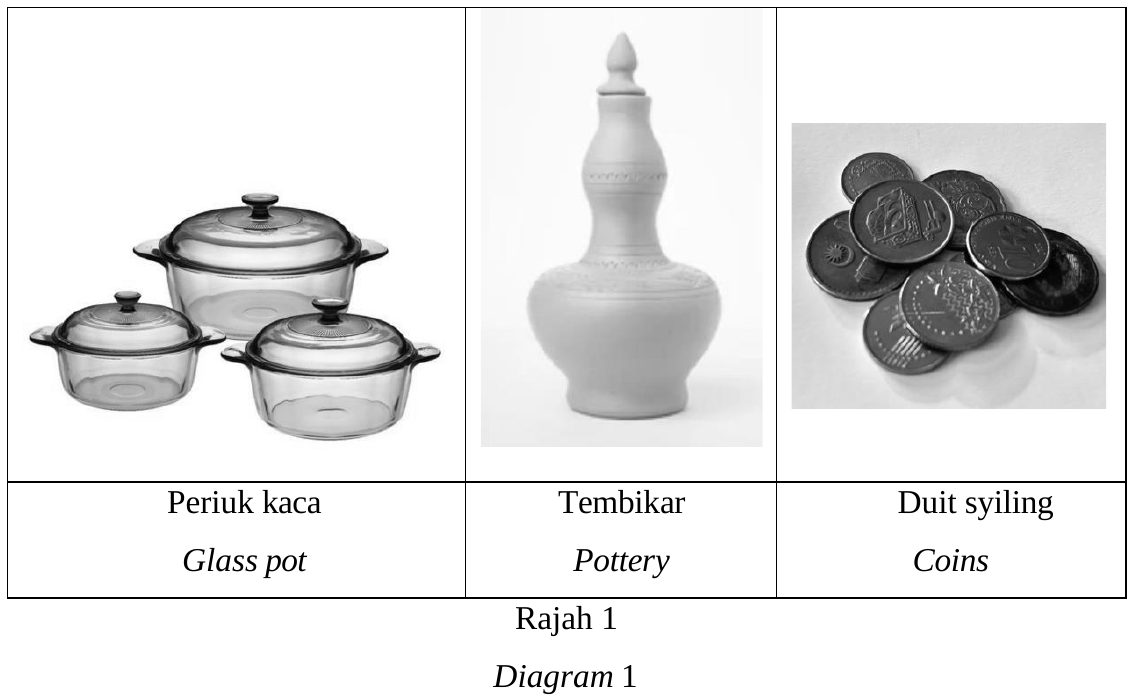
- (a)(i)
State the main component of glass.
[1] - (a)(ii)
Suggest one type of glass that is suitable to be used to make cooking utensils.
[1] - (b)(i)
Based on Diagram 1, state one similarity in physical properties of glass and ceramic.
[1] - (b)(ii)
Based on Diagram 1, state one difference in physical properties of glass and ceramic.
[1] - (c)
Coin is an example of the uses of alloy. State one advantage of using alloy in coin production compared to pure metal.
[1]
Diagram 2 shows a part of the Periodic Table of Elements with the elements F, Na, Al, Si, P, Cl and Ar marked (Na, Al, Si, P, Cl, Ar in Period 3; F above Cl).
Medium6 marks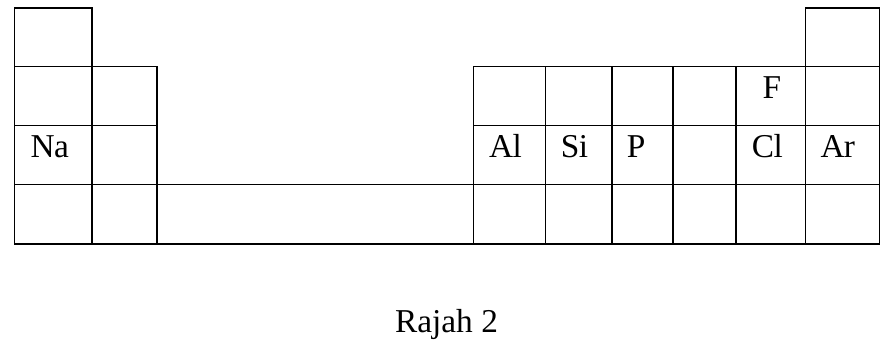
- (a)
What is the basic principle used in arrangement of elements in the Periodic Table of Elements?
[1] - (b)
One of the elements in Diagram 2 formed an oxide with the ability to react with acid and also with alkali to produce salt and water. State the term used to explain the properties of the oxide produced.
[1] - (c)(i)
Compare the atomic size of aluminium, Al atom to the chlorine, Cl atom.
[1] - (c)(ii)
Explain the difference in the atomic size of those atoms.
[2] - (c)(iii)
Arrange all elements in Diagram 2 according to increasing atomic size.
[1]
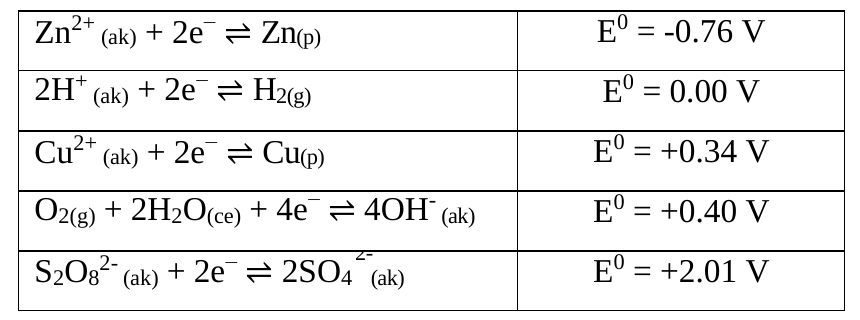
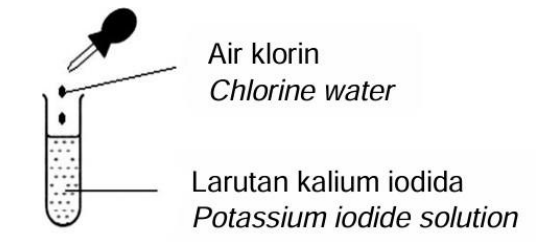
(a) Diagram 3.1 shows the apparatus setup to investigate redox reaction in Cell I and Cell II. Cell I is a chemical cell (zinc W and copper X in zinc nitrate / copper(II) sulphate solutions separated by a porous pot) and Cell II is an electrolysis cell (impure copper Y and pure copper Z in copper(II) sulphate solution). E° values: Zn2+ + 2e⁻ ⇌ Zn, -0.76 V; 2H+ + 2e⁻ ⇌ H2, 0.00 V; Cu2+ + 2e⁻ ⇌ Cu, +0.34 V; O2 + 2H2O + 4e⁻ ⇌ 4OH⁻, +0.40 V; S2O8²⁻ + 2e⁻ ⇌ 2SO4²⁻, +2.01 V. (b) Diagram 3.2 shows chlorine water being added to potassium iodide solution in a test tube.
Medium7 marks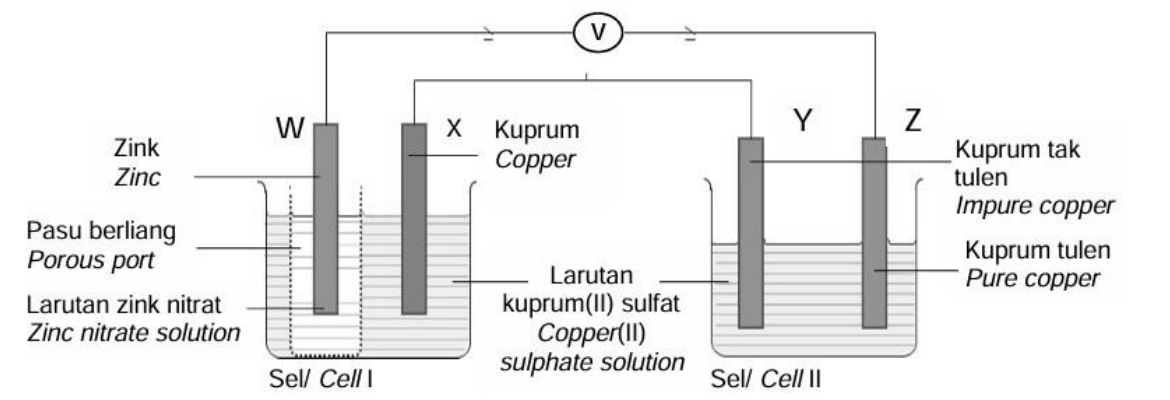
- (a)(i)
State the meaning for electrolyte.
[1] - (a)(ii)
Name the reducing agent for Cell I in Diagram 3.1.
[1] - (a)(iii)
Mark cathode and anode electrode for Cell II in Diagram 3.1.
[1] - (b)(i)
Write the half equation for the oxidation process and the reduction process.
[2] - (b)(ii)
Describe the chemical test for the product formed in the test tube.
[2]
(a) Table 2 shows the information of three different food additives: X is added to pineapple jam to make it sweeter; Y is added to a birthday cake to make the cake colourful and look attractive; Z is added to fresh meat to preserve it and to make it look fresh. (b) Diagram 4 shows a sunblock lotion that utilises nanotechnology.
Medium8 marks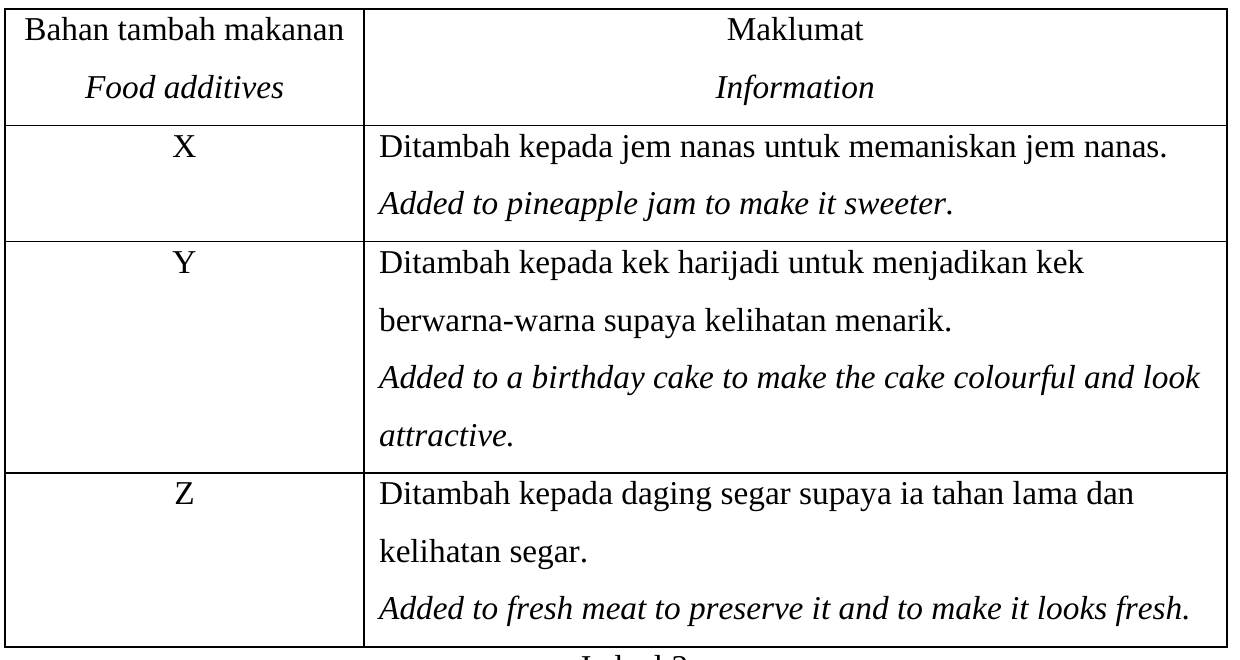

- (a)(i)
What is the meaning of food additives?
[1] - (a)(ii)
State the type of food additive Z.
[1] - (a)(iii)
Suggest the name for food additive X.
[1] - (a)(iv)
Siti plans to bake a birthday cake for her sister. Siti has two options: squeeze the water from ground pandan leaves, or add triphenyl compounds as dyes. Help Siti make the decision and explain your answer.
[2] - (b)(i)
Explain the advantage of nanotechnology application in sunblock lotions.
[2] - (b)(ii)
State one other use of nanotechnology in textiles.
[1]
Questions on the relationship between moles and particles, quantitative meaning of the equation 4Na + O2 → 2Na2O, and the reduction of copper(II) oxide by hydrogen.
Medium9 marks- (a)(i)
Write a formula to show the relationship between the number of moles and the number of particles for a substance. Number of moles =
[1] - (a)(ii)
Find the number of moles of atoms in a sample containing 9.03 × 10²⁰ atoms of zinc. [Avogadro constant is 6.02 × 10²³ mol⁻¹]
[1] - (a)(iii)
A tank contains 2 moles of sulphur trioxide gas. What is the number of oxygen atoms in the tank? [Molar volume of gas at room temperature is 24 dm3 mol⁻¹; Avogadro constant is 6.02 × 10²³ mol⁻¹]
[1] - (b)(i)
Based on the equation 4Na + O2 → 2Na2O, give the qualitative information.
[1] - (b)(ii)
Give the quantitative information based on basic entities.
[1] - (c)(i)
Copper(II) oxide is reduced by hydrogen gas to form water and copper. Write the equation of the reaction.
[1] - (c)(ii)
If 8 g of copper(II) oxide reacts completely with hydrogen gas, calculate the mass of copper produced. [Relative atomic mass: O = 16; Cu = 64]
[3]
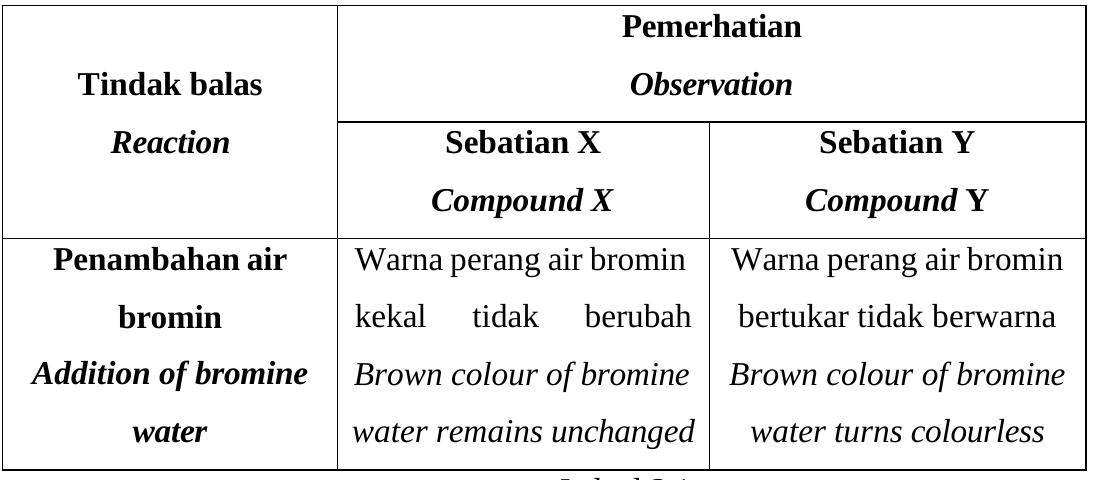
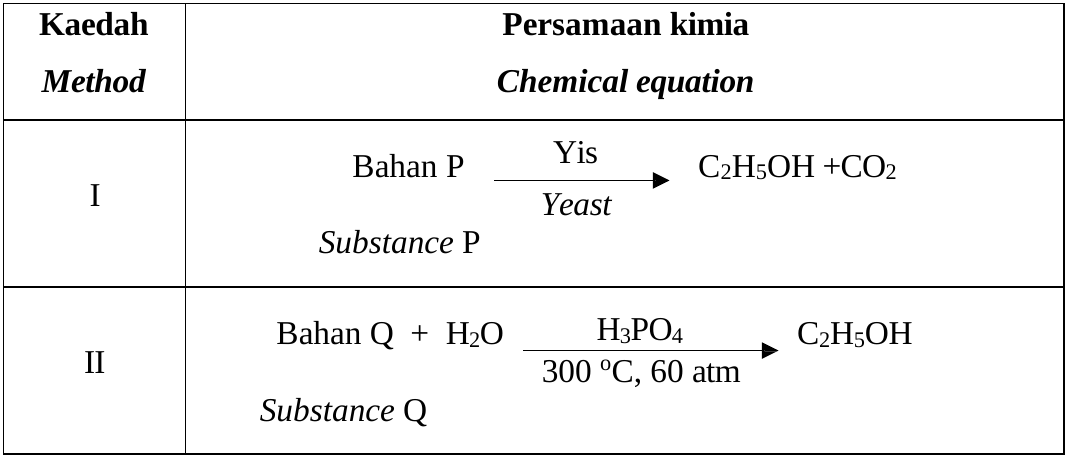
Diagram 5 shows the cracking of the hydrocarbon C7H16 over a catalyst (mixture of aluminium oxide and silicon(IV) oxide) into compound X (pentane, a saturated hydrocarbon with 5 carbon atoms) and compound Y (ethene, C2H4). Table 3.1 gives the bromine water test on X and Y; Table 3.2 gives two methods to prepare ethanol.
Medium10 marks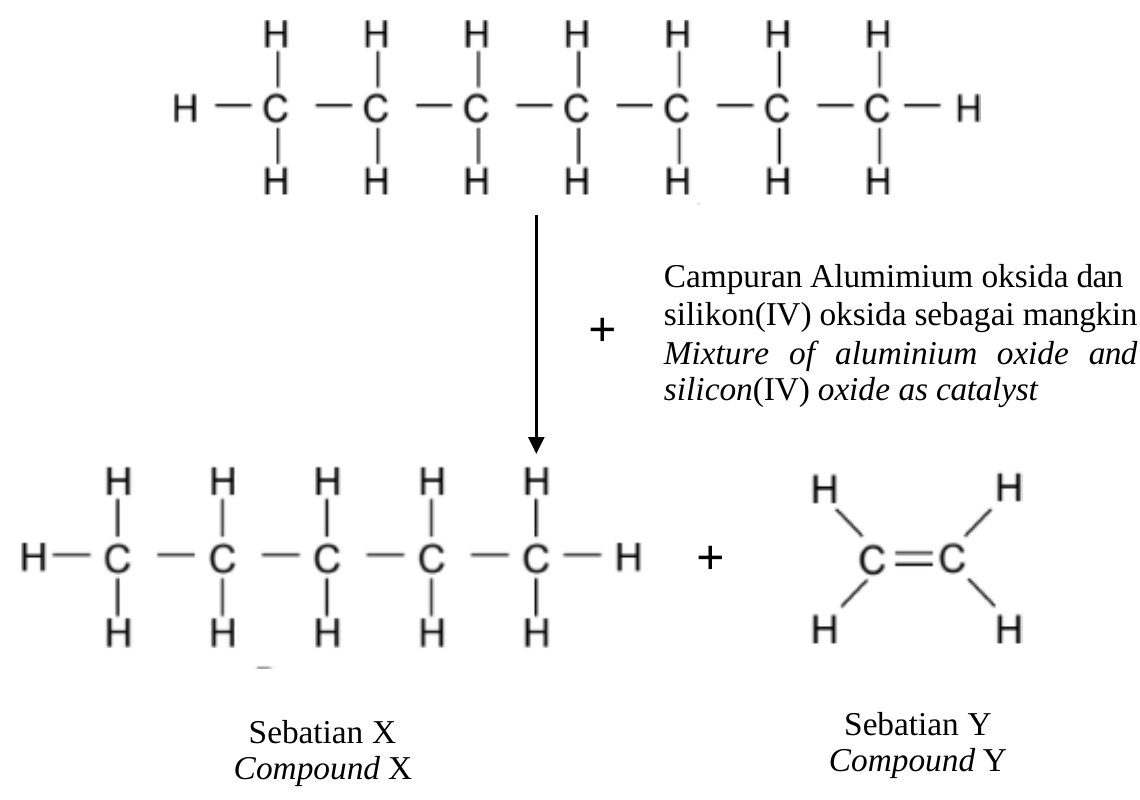
- (a)
What is meant by cracking process?
[1] - (b)(i)
Compound X is burnt completely in excess oxygen gas to produce carbon dioxide gas and water. Write the chemical equation for the combustion reaction.
[2] - (b)(ii)
If 0.2 mol of compound X is used in the reaction, calculate the volume of carbon dioxide gas produced. [1 mol of gas occupies 24 dm3 at room temperature]
[2] - (c)
Based on Table 3.1, explain why there are differences in the observations for the reaction. (Bromine water: compound X, brown colour remains unchanged; compound Y, turns colourless.)
[2] - (d)
Table 3.2 shows two methods to prepare ethanol: Method I, substance P with yeast gives C2H5OH + CO2; Method II, substance Q + H2O with H3PO4 at 300 °C, 60 atm gives C2H5OH. In your opinion, which method is more suitable to prepare ethanol? Give a reason. For the selected method, suggest substance P or Q.
[3]
Diagram 6.1 shows two sets of experiments: 3 g calcium carbonate with 50 cm3 of 1.0 mol dm⁻³ hydrochloric acid (Set I, 30 °C, 12.0 s to collect 50 cm3 CO2) and with 50 cm3 of 0.5 mol dm⁻³ hydrochloric acid (Set II, 30 °C, 30.0 s).
Medium10 marks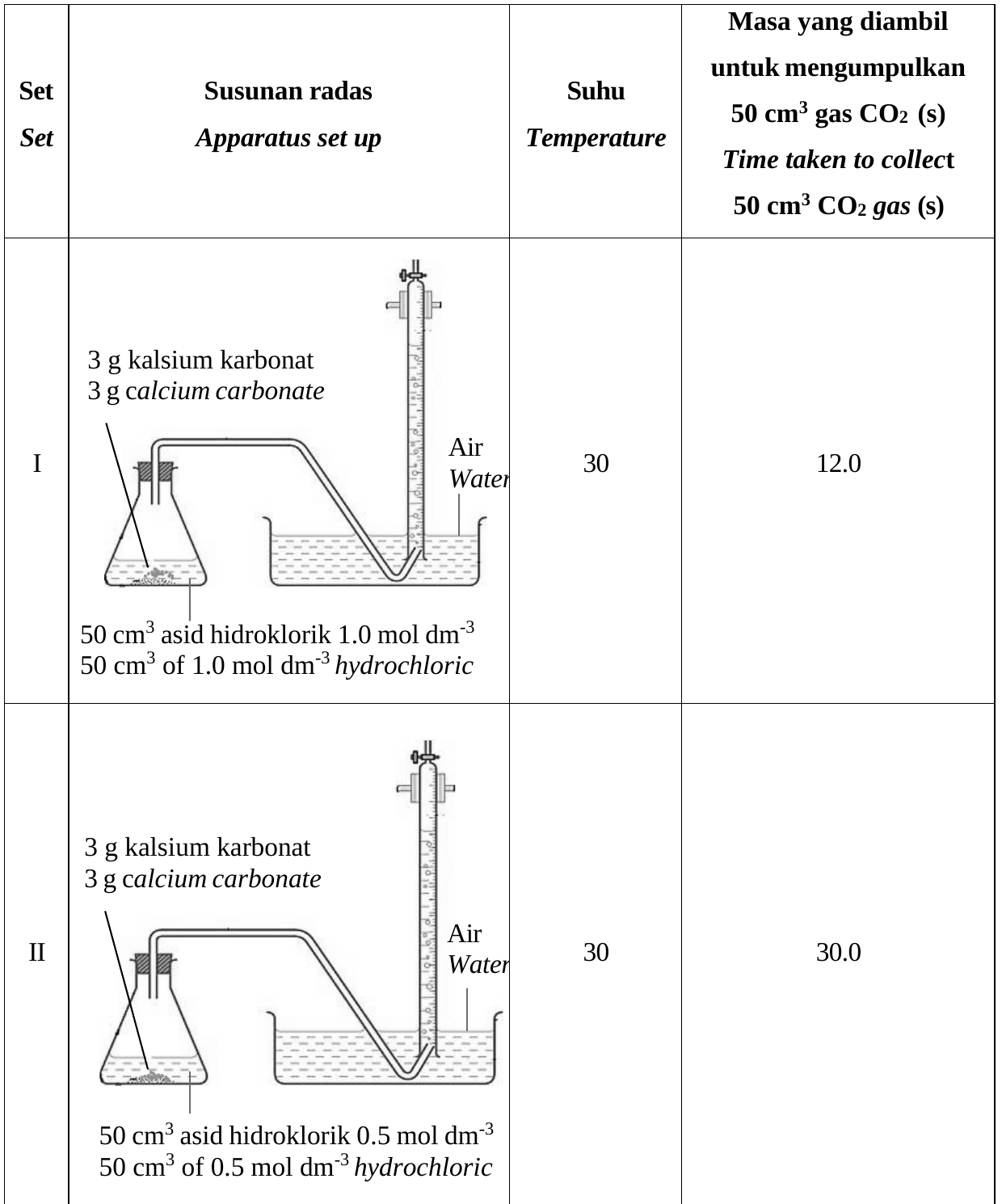
- (a)
Based on Diagram 6.1, identify the factor that affects the rate of reaction.
[1] - (b)
State the observation when carbon dioxide gas is tested using limewater.
[1] - (c)
The chemical equation is CaCO3 + 2HCl → CaCl2 + CO2 + H2O. Calculate the mass of calcium carbonate that did not react in Set I. [Molar mass of CaCO3 = 100 g mol⁻¹]
[4] - (d)
Diagram 6.2 shows curve III obtained by repeating experiment I with crushed solid calcium carbonate and the temperature doubled. Based on Diagram 6.1, sketch a graph of the volume of gas released against time for Set I and Set II on the same axes.
[2]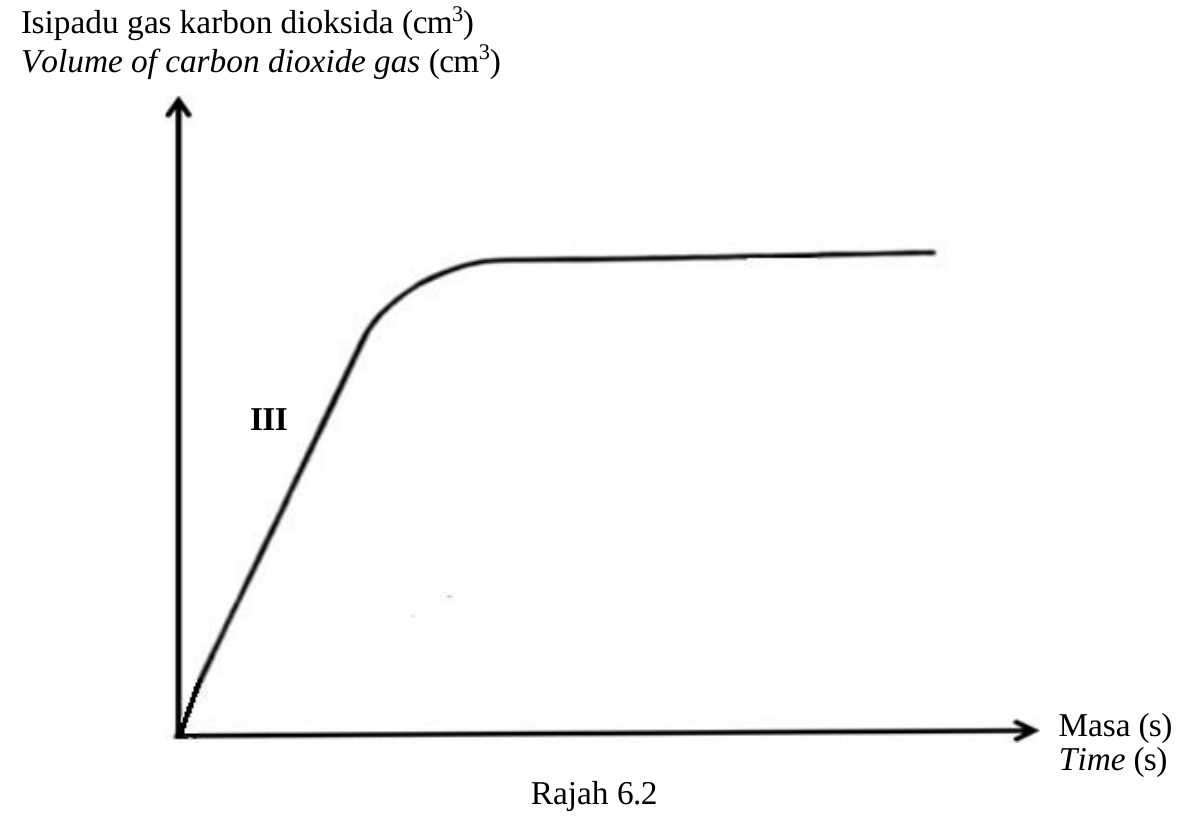
- (e)
Mr Faizal and his family had a picnic by the waterfall. He brings chicken, charcoal and a knife to prepare grilled chicken. Suggest a method that Mr Faizal can use and explain how the method helps the chicken cook quickly.
[2]
Section B
Diagram 7 shows 75 cm3 of 2.0 mol dm⁻³ nitric acid diluted to x mol dm⁻³ when 25 cm3 of distilled water is added. Answer any one question from Section B.
Medium20 marks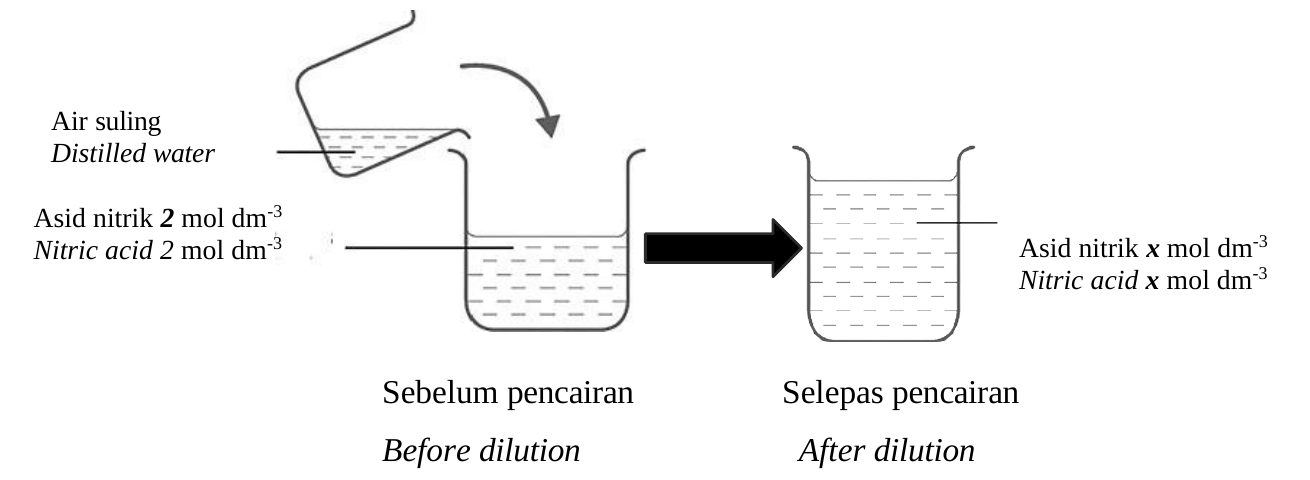
- (a)(i)
Define acid. State the colour change of the litmus paper to show acidic properties.
[2] - (a)(ii)
Calculate the value of x. Compare and explain the pH value of x mol dm⁻³ nitric acid with oxalic acid solution of the same concentration.
[4] - (b)
In another experiment, 25 cm3 of nitric acid reacts with 25 cm3 of 0.01 mol dm⁻³ potassium hydroxide solution. Write a chemical equation for the reaction and determine the concentration of nitric acid used.
[4] - (c)(i)
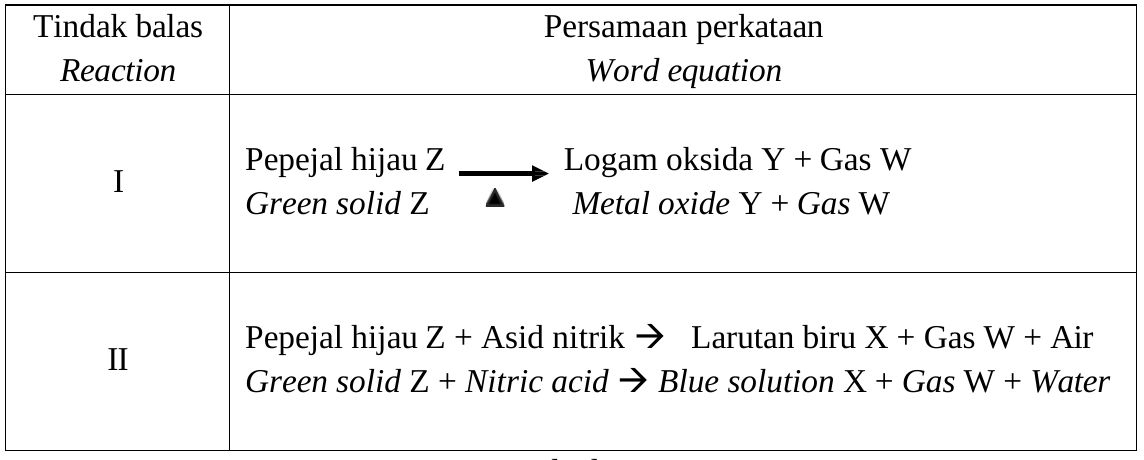
Table 4 shows word equations for two reactions involving solid Z to metal oxide Y and solution X: I, green solid Z (heat) → metal oxide Y + gas W; II, green solid Z + nitric acid → blue solution X + gas W + water. Identify substances W, X, Y and Z.
[4] - (c)(ii)
Describe chemical tests to determine the presence of cation and anion in solution X.
[6]
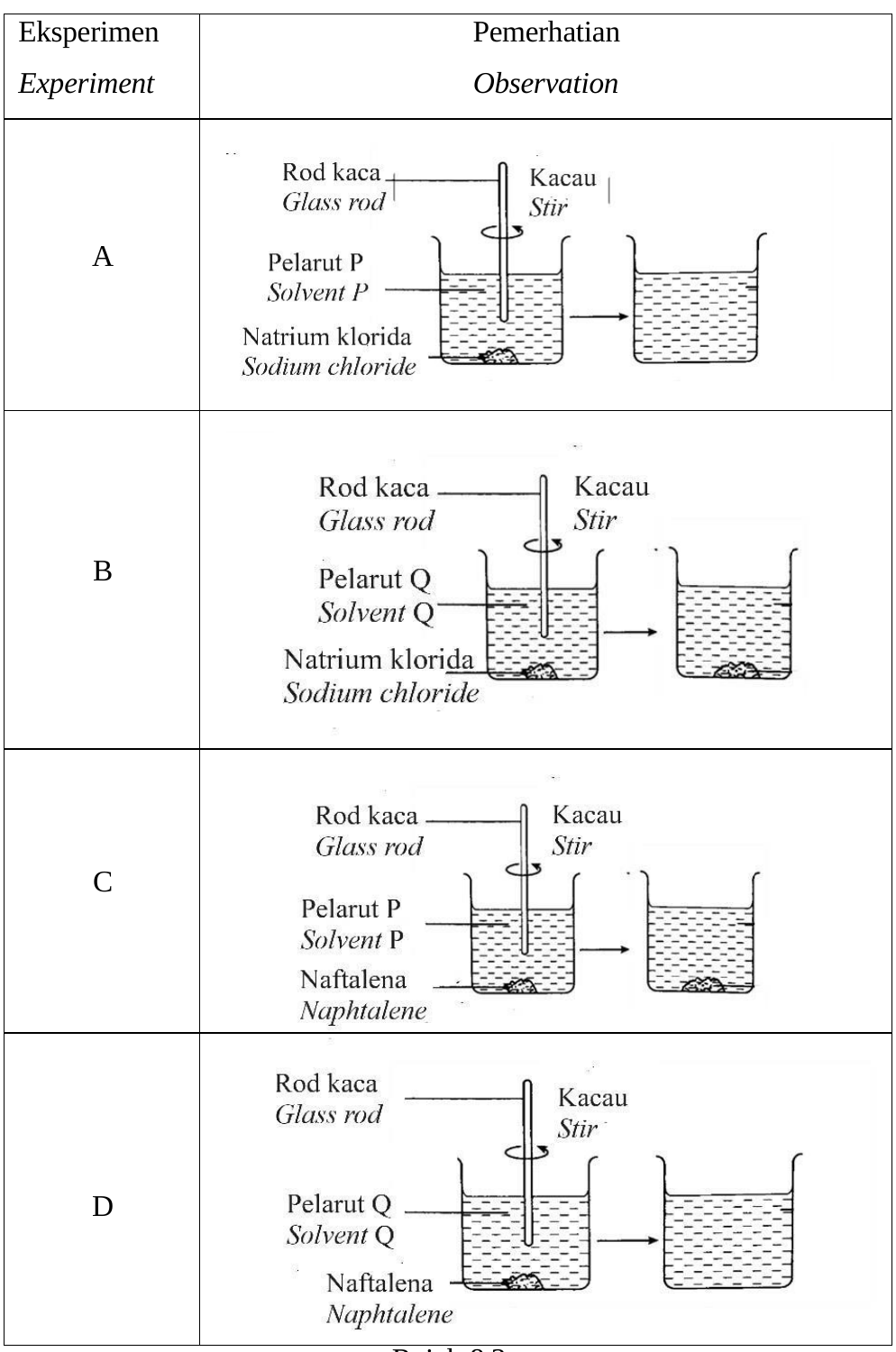
Question on the dative bond in the hydroxonium ion H3O+ (Diagram 8.1), the metallic bond in magnesium (Diagram 8.2) and the solubility of sodium chloride and naphthalene in solvents P and Q (Diagram 8.3). Answer any one question from Section B.
Medium20 marks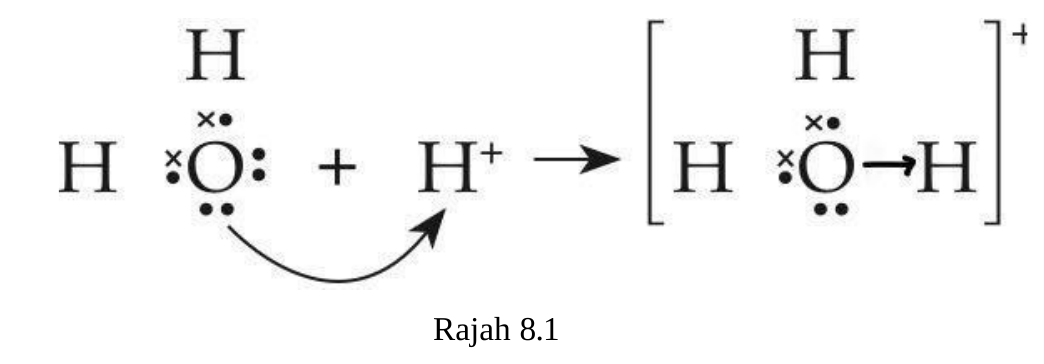
- (a)(i)
Diagram 8.1 shows the electron arrangement for formation of the dative bond of hydroxonium ion, H3O+ (water molecule + H+). What is meant by dative bond?
[1] - (a)(ii)
Based on the answer in 10(a)(i), describe the formation of the dative bond.
[4] - (a)(iii)
Suggest another compound that consists of dative bonds.
[1] - (b)(i)
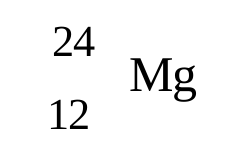
Diagram 8.2 shows the standard representation of magnesium metal atom (²⁴₁₂Mg). Valence electrons delocalise to form positive metal ions and a sea of electrons. Name the force formed between the sea of electrons and the positively-charged metal ions.
[1] - (b)(ii)
How can magnesium metal conduct electricity in solid state?
[3] - (c)(i)
Diagram 8.3 shows the observation for four experiments to determine the solubility of sodium chloride (A in solvent P, B in solvent Q) and naphthalene (C in solvent P, D in solvent Q). Suggest solvent P and Q.
[2] - (c)(ii)
What type of bonds exist in sodium chloride and naphthalene compounds?
[2] - (c)(iii)
Explain why there are differences in the observations for experiments A and B.
[6]
Section C
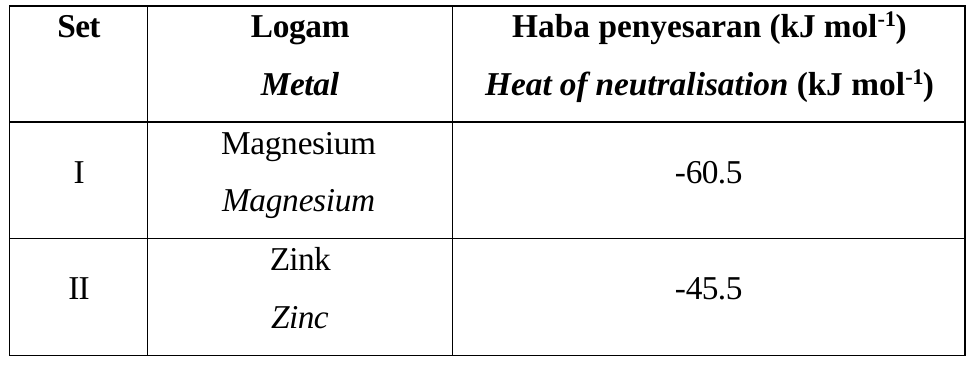
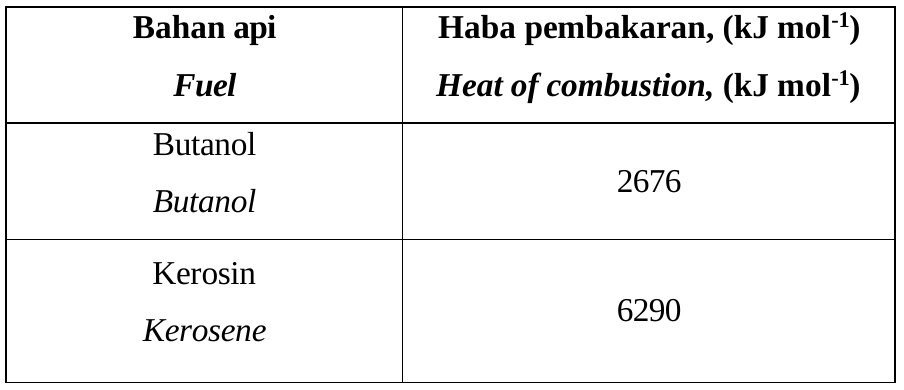
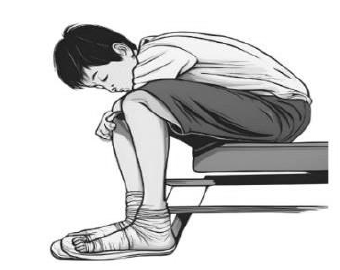
(a) Diagram 9.1 shows a polystyrene cup with 100.0 cm3 of 0.50 mol dm⁻³ silver nitrate solution at 29.0 °C; excess metal powder is added. Table 4.1: Set I magnesium, heat of displacement -60.5 kJ mol⁻¹; Set II zinc, -45.5 kJ mol⁻¹. (b) Table 4.2: heat of combustion of butanol 2676 kJ mol⁻¹ and kerosene 6290 kJ mol⁻¹. (c) Diagram 10 shows Iman with a sprained, swollen leg.
Hard20 marks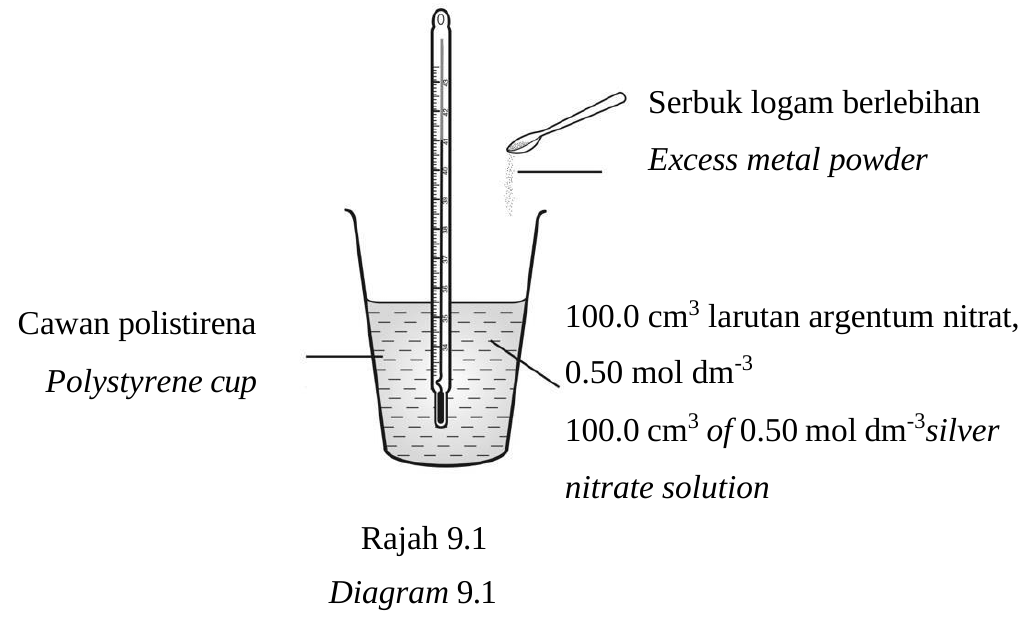
- (a)(i)
State the meaning of heat of displacement.
[1] - (a)(ii)
Calculate the highest temperature of the mixture in Set I. [Specific heat capacity of solution c = 4.2 J g⁻¹ °C⁻¹; density of solution = 1 g cm⁻³]
[4] - (a)(iii)
Draw the energy level diagram for Set II.
[2] - (b)
Based on Table 4.2, choose one fuel that is best in terms of (i) fuel value and (ii) effects on environment. Justify both of your choices. [Molar mass: butanol = 74 g mol⁻¹, kerosene = 170 g mol⁻¹; relative atomic mass: C = 12, H = 1]
[8] - (c)
Iman needs a cooling pack. As a Chemistry student, suggest suitable materials that are easy to obtain at home. Write the method to prepare the cooling pack and explain its function.
[5]