Which substance undergoes sublimation when heated?
Easy
Which of the following chemical name and chemical formulae are correctly matched?
A Sodium oxide - NaO
B Magnesium chloride - MgCl
C Ammonium phosphate - (NH4)3PO4
D Lead(II) bromide - Pb2Br
Medium
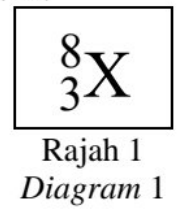
Diagram 1 shows the symbol of element X (nucleon number 8, proton number 3). Element X is placed at Group 1 and Period 2 in the Periodic Table of Elements. What are the factors that determine the position of element X in the Periodic Table of Elements? (Group / Period)
A Nucleon number / Proton number
B Proton number / Nucleon number
C Number of shells filled with electrons / Number of valence electrons
D Number of valence electrons / Number of shells filled with electrons
Medium
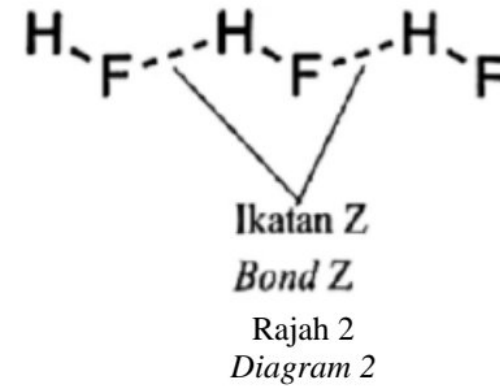
Diagram 2 shows the formation of bond Z (dotted bond between H and F of neighbouring HF molecules). What is bond Z?
Easy
Which of the following is a weak alkali?
Easy
Which of the following reactants produces the highest rate of reaction with zinc powder?
Medium
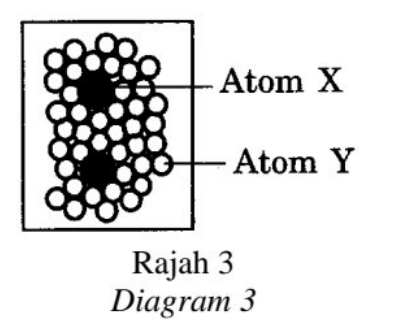
Diagram 3 shows the arrangement of atoms in brass (Atom X is the larger atom, Atom Y the smaller atom). Which of the following could be atoms X and Y? (X / Y)
A Zinc / Copper
B Copper / Zinc
C Iron / Carbon
D Copper / Tin
Medium
Which of the following chemical equation shows that copper is reduced?
A Cu + 2AgNO3 → Cu(NO3)2 + 2Ag
B 2Cu + O2 → 2CuO
C CuSO4 + Ba(NO3)2 → Cu(NO3)2 + BaSO4
D CuO + H2 → Cu + H2O
Medium
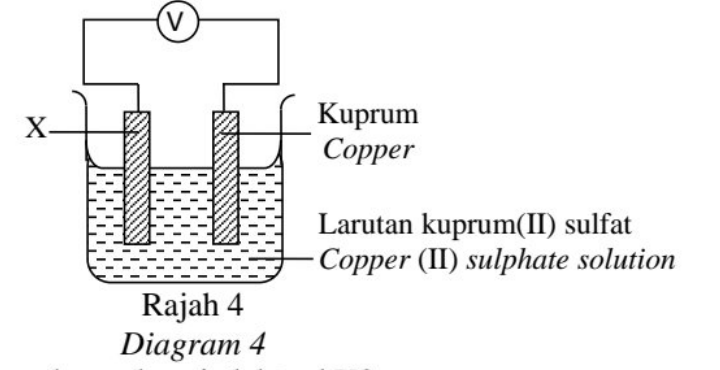
Diagram 4 shows a simple voltaic cell (electrode X and a copper electrode in copper(II) sulphate solution, connected to a voltmeter). Which material is suitable to be used as electrode X?
Medium
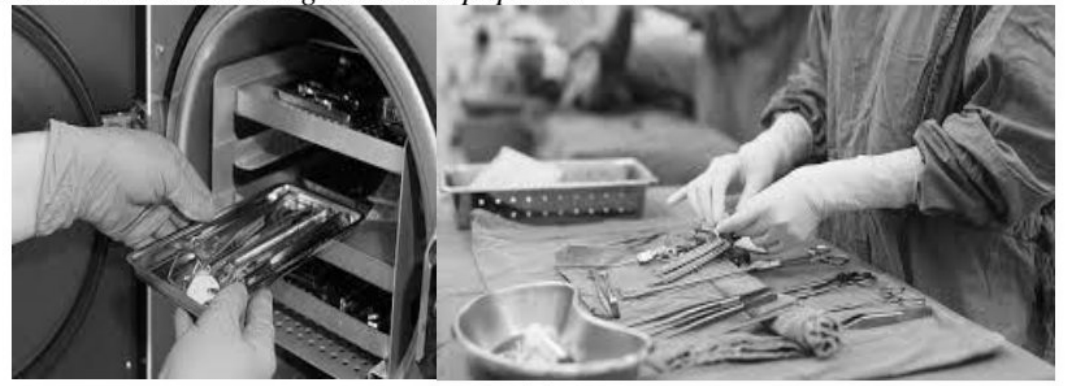
Diagram 5 shows sterilising medical equipment. Which of the following isotope is used to sterile medical equipment?
Easy
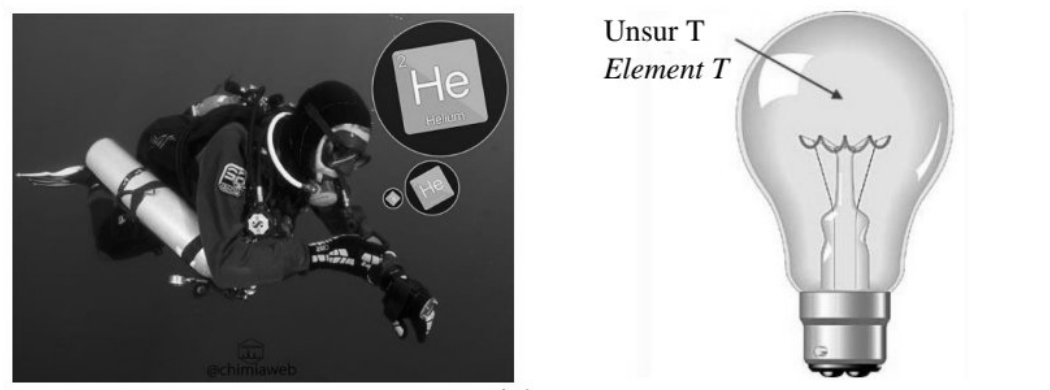
Element T and Helium are placed in the same group as in the Periodic Table of Elements. Diagram 6 shows the Helium gas used in the oxygen tanks of divers and gas of element T used to fill electric bulb. Which statement best explains why the atom T and atom Helium are suitable to be used for that purpose?
Medium
The electron arrangement of an atom of P is 2.8.1 and the electron arrangement of an atom of Q is 2.6. Element P and Q react to form a compound. Which of the following is true about the reaction?
Medium
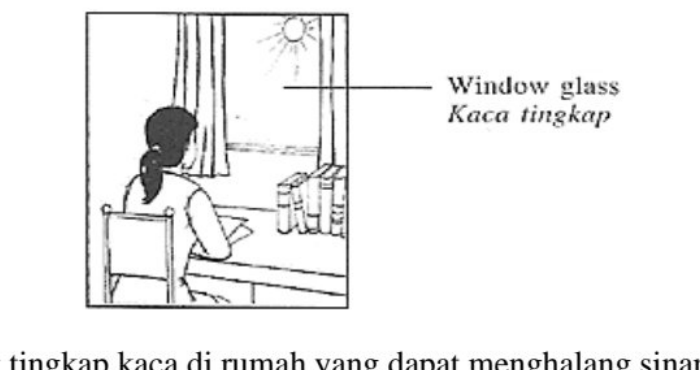
Siti wishes to install a glass window at her house that is able to block the ultraviolet rays. The window glass should contain substance P. What is substance P?
Easy
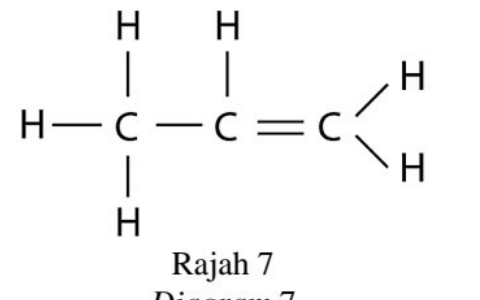
Diagram 7 shows the structural formula of compound P (propene, CH3-CH=CH2). Which of the following structural formula of product is correct after passing compound P and steam through concentrated phosphoric acid at 300 °C, 60 atm?
Medium
Diagram 8 shows a thermochemical equation for reaction between magnesium and sulphuric acid: Mg(s) + H2SO4(aq) → MgSO4(aq) + H2(g) ΔH = -467 kJ mol⁻¹. Which of the following statement is correct?
Medium
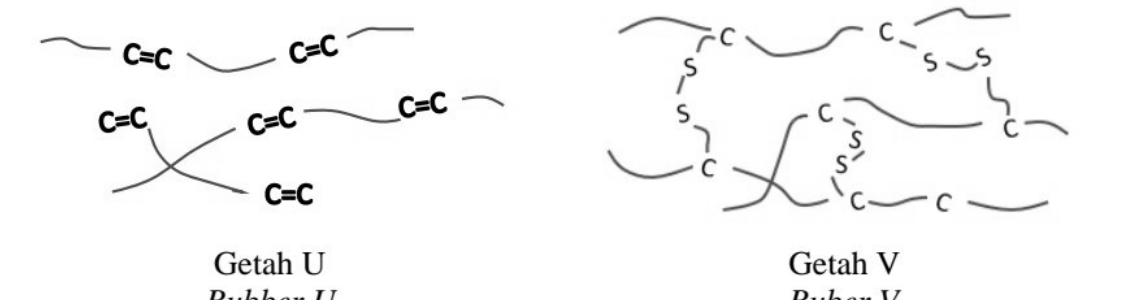
Diagram 9 shows the structure of Rubber U (separate polymer chains with C=C) and Rubber V (chains joined by S-S cross-links). Choose the correct match between Rubber U and Rubber V. (U / V)
Medium
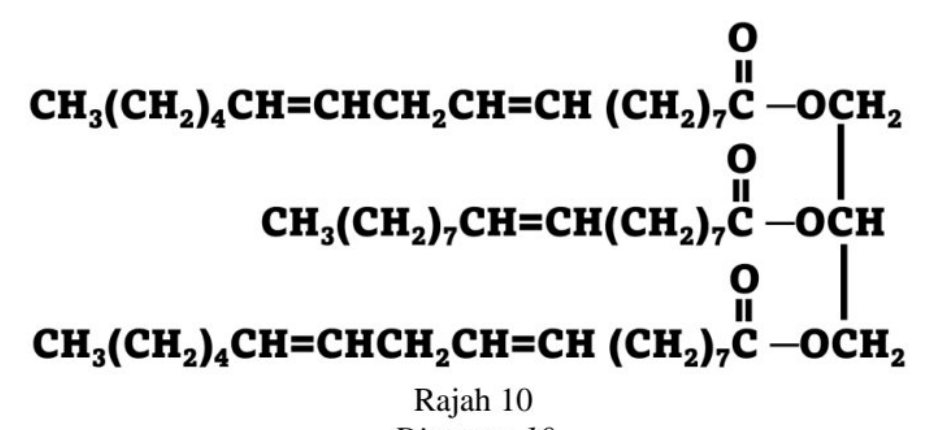
Diagram 10 shows the structural formula of palm oil molecule. Which of the following pair of reaction and its corresponding reactants can be used to convert palm oil into solid margarine? (Reaction / Reactant)
Medium
The joint of a student's leg is swollen and painful. What medicine is suitable to be given to the student?
Easy
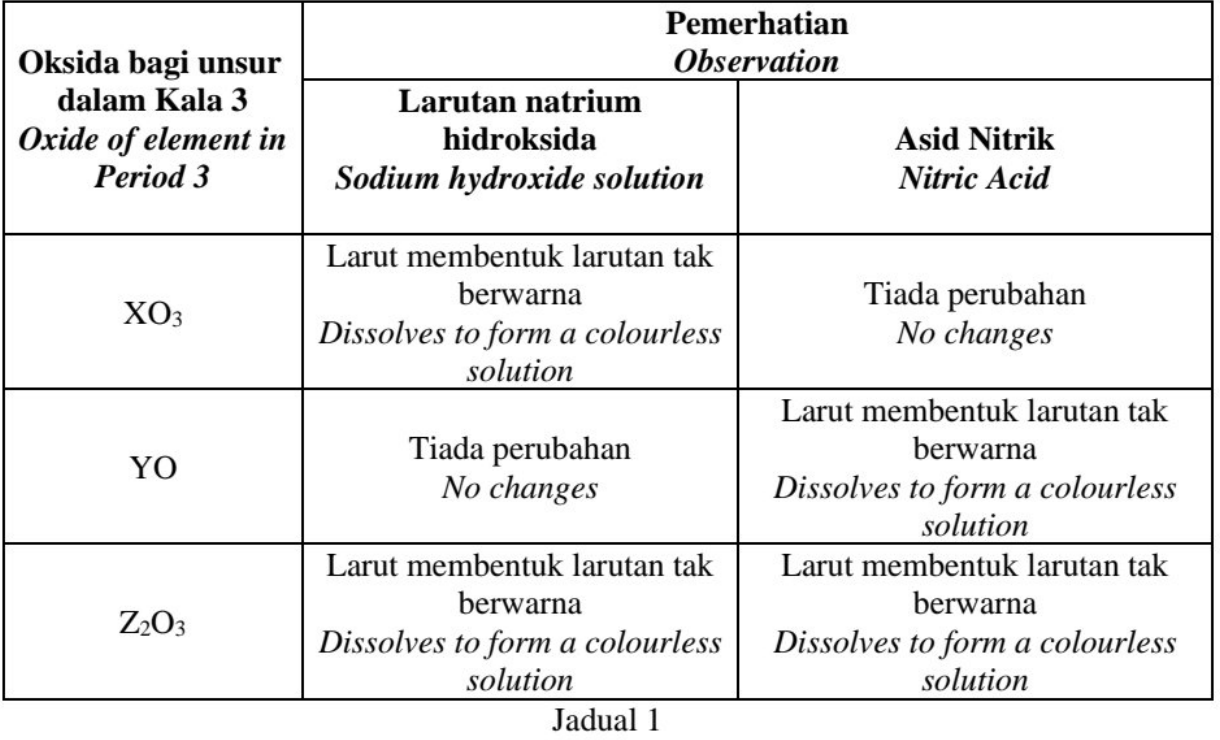
Table 1 shows the observation when oxides of elements in Period 3 of the Periodic Table is added to sodium hydroxide solution and nitric acid. X, Y and Z are not the actual symbols of the elements.
XO3: NaOH - dissolves to form a colourless solution; HNO3 - no changes.
YO: NaOH - no changes; HNO3 - dissolves to form a colourless solution.
Z2O3: NaOH - dissolves to form a colourless solution; HNO3 - dissolves to form a colourless solution.
What is the correct arrangement in increasing proton number of the elements?
Medium
Which of the following compounds contain dative bond?
Medium
Iron and iron(II) chloride solution conduct electricity. Which pair of bonds distinguish the electrical conductivity of iron and iron(II) chloride solution? (Each option is a diagram pair: iron | iron(II) chloride solution.)
Medium
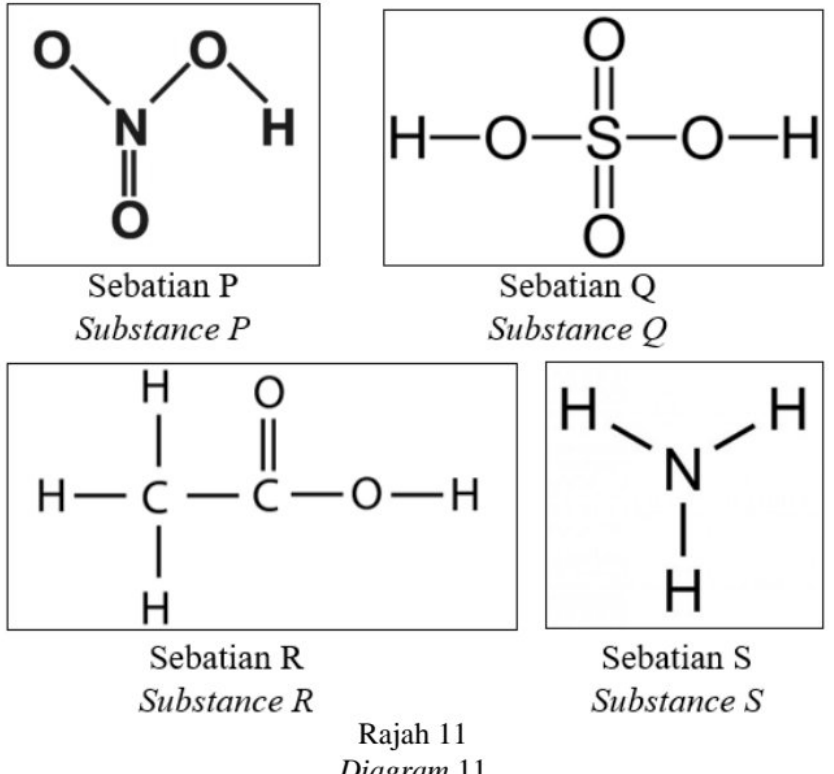
Diagram 11 shows the structural formulae of four chemical substances that can ionise in water to produce a solution containing free moving ions: P = HNO3, Q = H2SO4, R = CH3COOH, S = NH3. Which of the following is the order of the solution in ascending order of pH value?
Medium
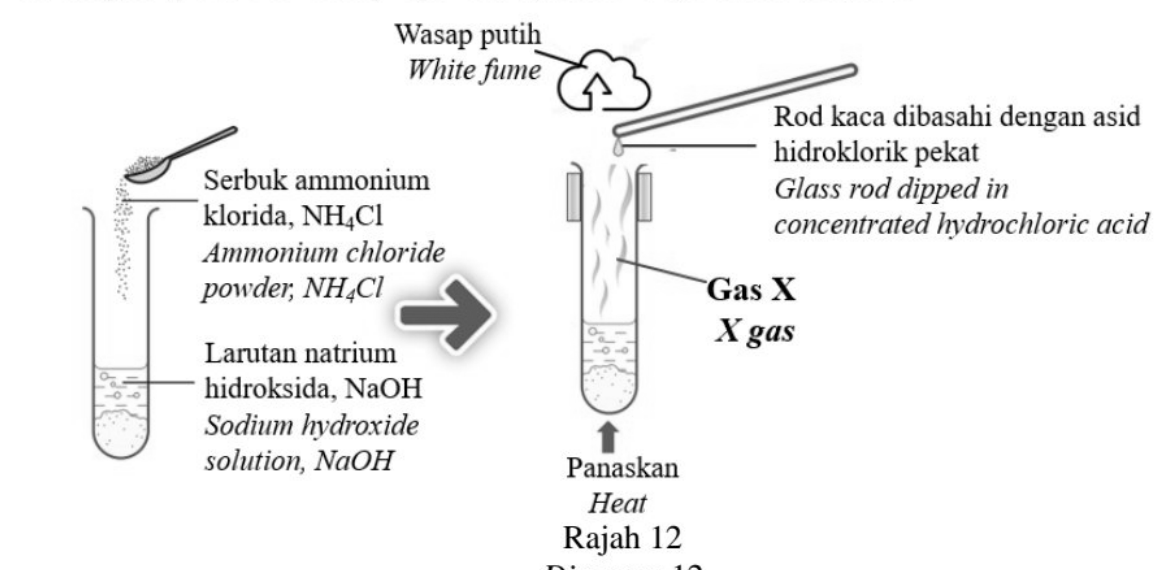
Diagram 12 shows the apparatus set-up used and observation obtained by a student when investigating the chemical properties of sodium hydroxide solution (ammonium chloride powder added to NaOH solution and heated; glass rod dipped in concentrated hydrochloric acid gives white fumes). What is the name of gas X released?
Easy
The following equation represents a neutralisation reaction: Acid + Base → Salt + water. Which pairs are reactants in neutralisation reaction?
I Sulphuric acid + Potassium hydroxide
II Hydrochloric acid + Solid copper(II) oxide
III Sulphuric acid + Solid calcium carbonate
IV Hydrochloric acid + Sodium carbonate solution
Medium
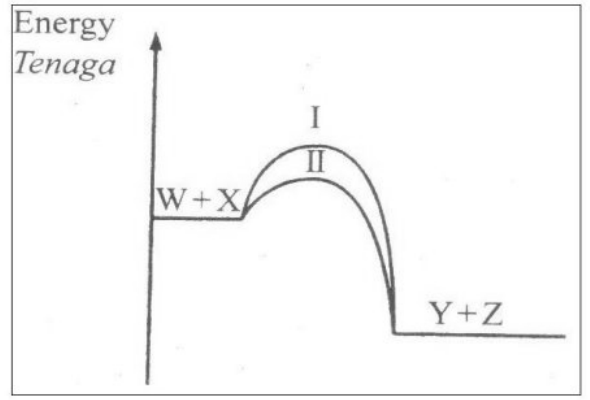
Diagram 13 shows the energy profile diagram of a reaction (curve II has a lower activation energy peak than curve I; reactants W + X, products Y + Z). Based on the Collision Theory, which statement explains the change of curve I to curve II?
Medium
Table 2 shows the E° value for half-cell equations:
R + e⁻ ⇌ R⁻ +0.83 V
S²⁺ + e⁻ ⇌ S⁺ -0.56 V
T³⁺ + e⁻ ⇌ T²⁺ -0.77 V
Which of the following is the strongest reducing agent?
Medium
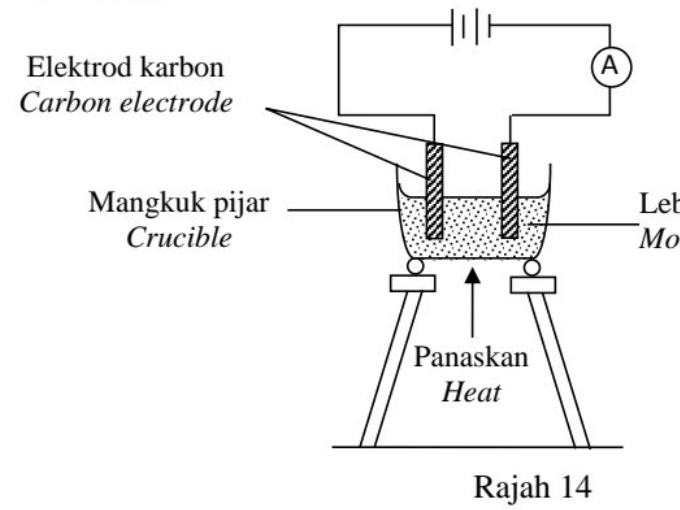
Diagram 14 shows the apparatus set-up for the electrolysis of molten lead(II) bromide using carbon electrodes. Which half-equation shows the reaction at the anode?
Medium
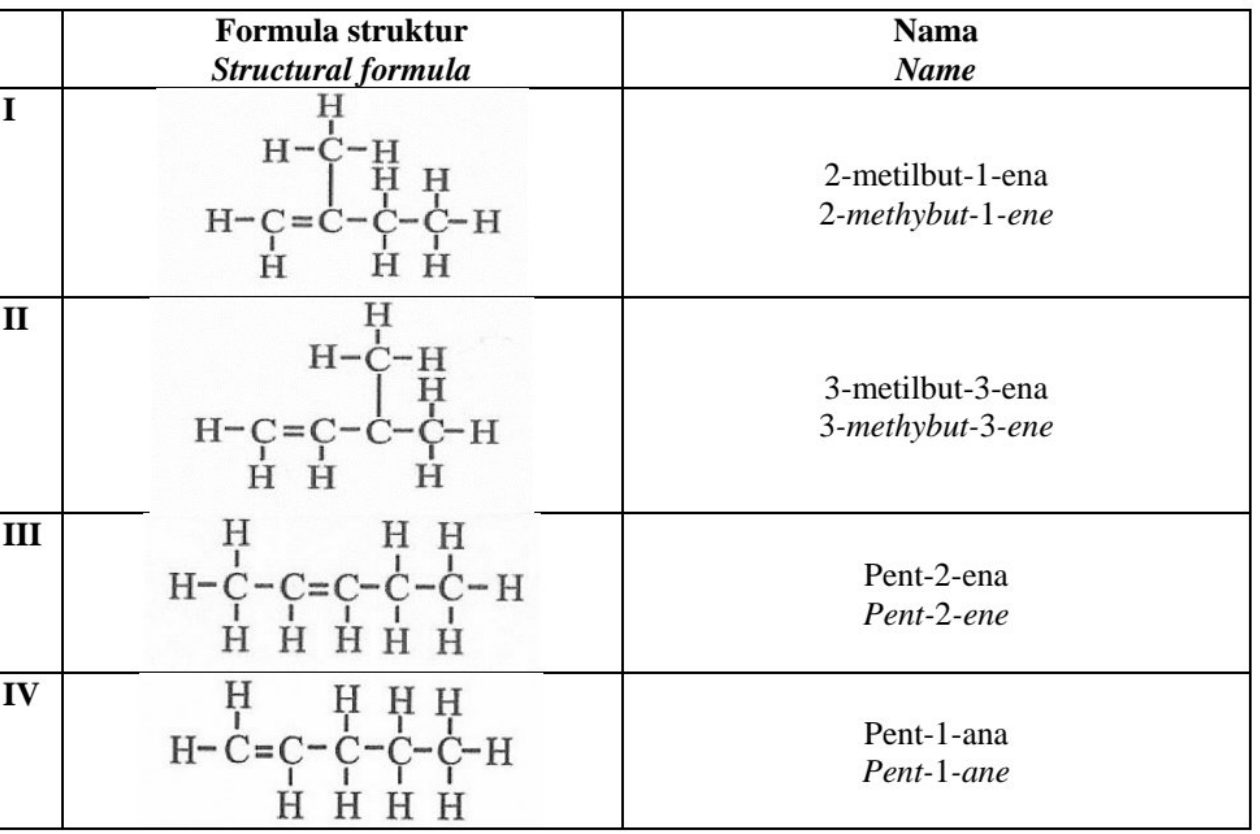
Which of the following is the correct structural formulae and its name for the isomer of C5H10? (Table of four structures I-IV: I 2-methylbut-1-ene, II 3-methylbut-3-ene, III Pent-2-ene, IV Pent-1-ane)
A I and II
B I and III
C II and IV
D III and IV
Medium
Ekoprena is a type of advanced rubber developed by the Malaysian Rubber Board. Ekoprena rubber is obtained from oxidation of latex from natural rubber; is a type of synthetic rubber categorised as green material; is mixed with nanofiller such as graphene and silica to manufacture tyre tread compound (Diagram 15 shows a vehicle using Ekoprena tyre). Which of the following statements correctly explain why Ekoprena rubber is classified as a synthetic rubber?
Medium
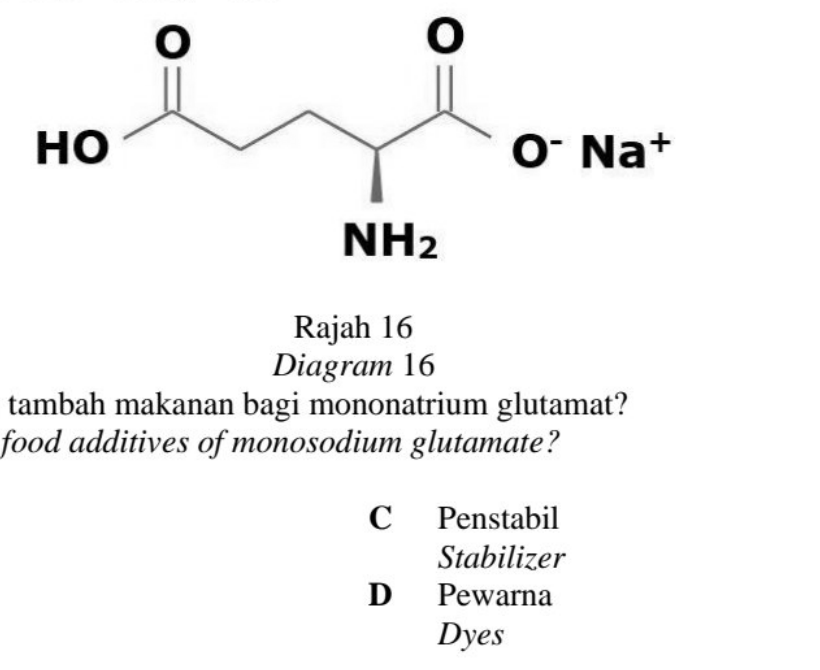
Monosodium glutamate, MSG was first prepared in 1908 by Japanese biochemist. Diagram 16 shows the structural formula of MSG. What is the type of food additives of monosodium glutamate?
Easy
Which of the following gases contains 0.6 mol of atoms at room temperature and pressure? [1 mol of gas occupies the volume of 24 dm³ at room temperature and pressure]
Medium
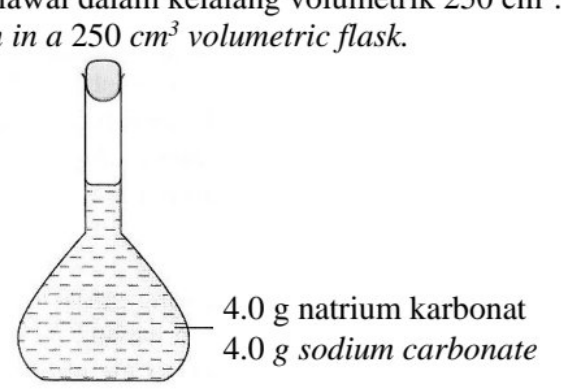
Diagram 17 shows a standard solution in a 250 cm³ volumetric flask containing 4.0 g sodium carbonate. What is the concentration of the standard solution produced? [Relative atomic mass: C=12; O=16; Na=23]
Medium
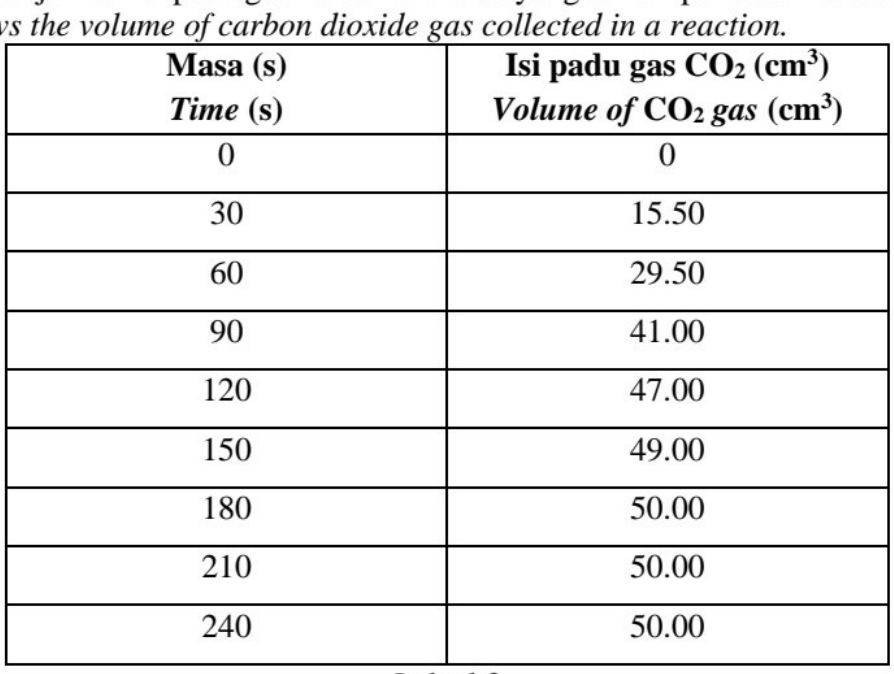
Table 3 shows the volume of carbon dioxide gas collected in a reaction (time/s: volume/cm³): 0:0; 30:15.50; 60:29.50; 90:41.00; 120:47.00; 150:49.00; 180:50.00; 210:50.00; 240:50.00. What is the average rate of reaction at the third minute?
Medium
Two half-cells which are connected under standard conditions are shown below.
MnO4⁻(aq) + 8H⁺(aq) + 5e⁻ ⇌ Mn²⁺(aq) + 4H2O(l) E° = +1.52 V
Fe³⁺(aq) + e⁻ ⇌ Fe²⁺(aq) E° = +0.77 V
Which of the following statements are true?
I The e.m.f. of the cell is +2.29 V
II Fe²⁺ is a stronger reducing agent than Mn²⁺
III The oxidation number of Fe changes from +3 to +2
IV The electrode in the MnO4⁻(aq)/Mn²⁺(aq) half-cell is the cathode
Medium
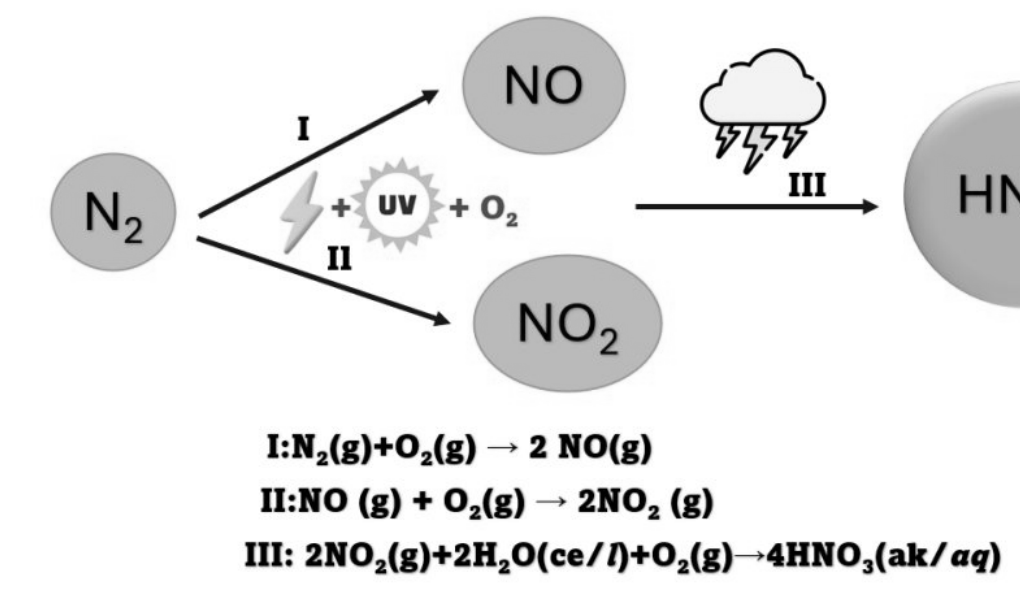
Diagram 18 shows a series of reactions: I: N2(g) + O2(g) → 2NO(g); II: 2NO(g) + O2(g) → 2NO2(g); III: 4NO2(g) + 2H2O(l) + O2(g) → 4HNO3(aq) (converting NO and NO2 into acid rain). Which of the following changes in oxidation number of nitrogen element in each reaction is correctly matched? (I / II / III)
Medium
The empirical formula of a compound is given as CH2O. If the molecular mass of the compound is 150, what is its molecular formula? [Relative atomic mass: H = 1, C = 12, O = 16]
Medium
The following equation represents the reaction between magnesium and hydrochloric acid: Mg(s) + 2HCl(aq) → MgCl2(aq) + H2(g). What is the volume of hydrogen gas produced when 2.4 g of magnesium reacts with 100 cm³ of 1 mol dm⁻³ hydrochloric acid at standard temperature and pressure (STP)? [Relative atomic mass: Mg = 24, H = 1; Molar volume of gas at STP = 22.4 dm³ mol⁻¹]
Medium
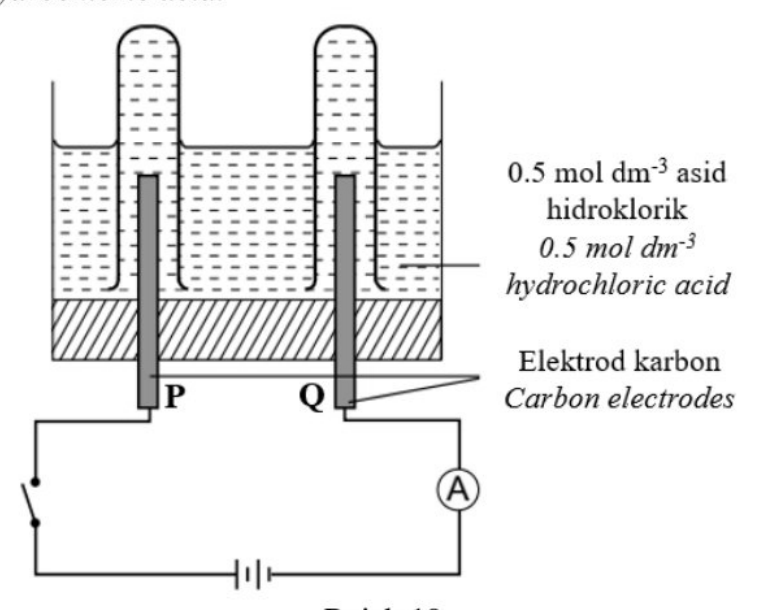
Diagram 19 shows an electrolytic cell used by a student to study the effect of electrolysis on the pH value of hydrochloric acid (0.5 mol dm⁻³ hydrochloric acid, carbon electrodes). The student poured 500 cm³ acid into the electrolytic cell and turned on the switch for 30 minutes. Given 0.075 mol of electrons had moved from electrode P to Q through the connecting wire. What is the pH value of the hydrochloric acid in the electrolytic cell after 30 minutes?
Medium
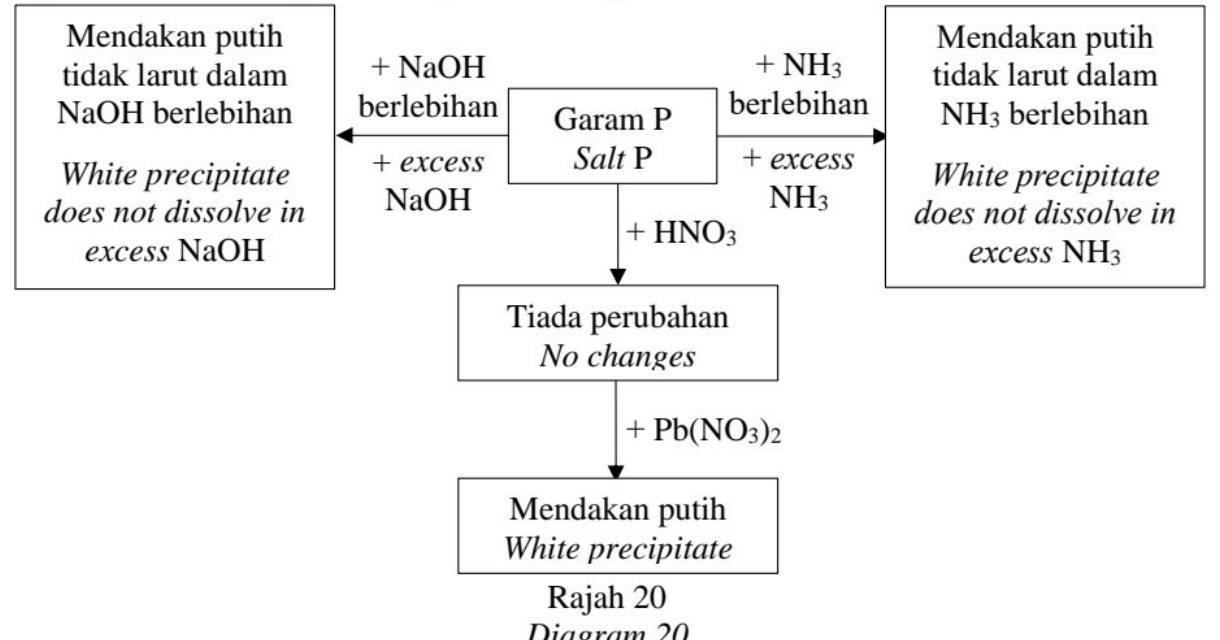
Diagram 20 shows the flow chart for a series of reaction on salt P: + excess NaOH gives white precipitate that does not dissolve in excess NaOH; + excess NH3 gives white precipitate that does not dissolve in excess NH3; + HNO3 no changes, then + Pb(NO3)2 gives white precipitate. Based on the results of the experiment, what is salt P?
Medium
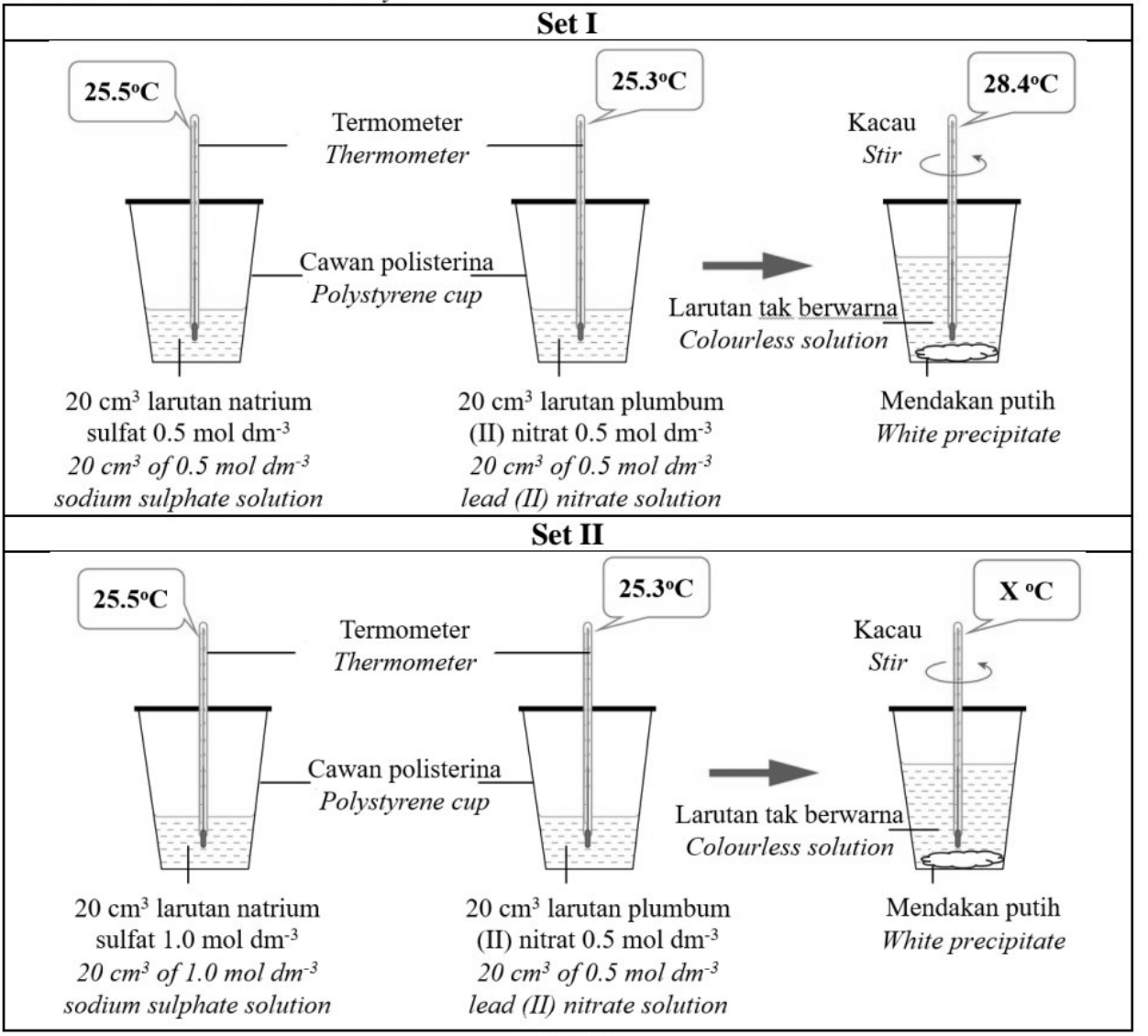
Diagram 21 shows the apparatus set-up and the observations of two experiments. Set I: 20 cm³ of 0.5 mol dm⁻³ sodium sulphate solution (25.5 °C) + 20 cm³ of 0.5 mol dm⁻³ lead(II) nitrate solution (25.3 °C) gives a white precipitate, highest temperature 28.4 °C. Set II: 20 cm³ of 1.0 mol dm⁻³ sodium sulphate solution (25.5 °C) + 20 cm³ of 0.5 mol dm⁻³ lead(II) nitrate solution (25.3 °C), highest temperature X °C. The experiment is repeated by changing the concentration of sodium sulphate solution to 1.0 mol dm⁻³. What is X? [Specific heat capacity = 4.2 J g⁻¹ °C⁻¹]