Write your answer on paper. Then open the answer to check it.
Section A
Diagram 1 shows a classification of modern medicine: W (Streptomycin), Psychotic drugs, X (Aspirin).
Medium5 marks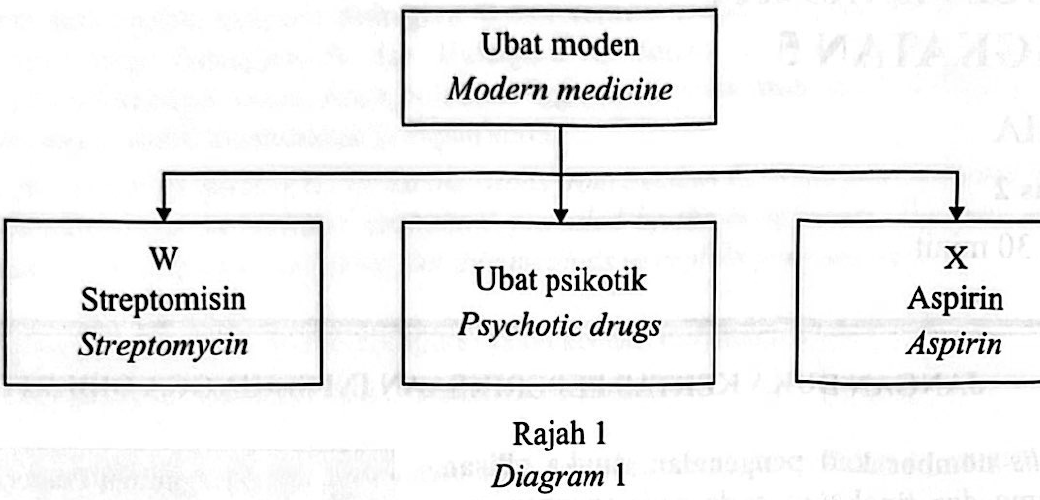
- (a)
State the type of medicine W and X.
[2] - (b)
What is the function of medicine W?
[1] - (c)
Give one example of psychotic drug.
[1] - (d)
What is the function of medicine X?
[1]
Diagram 2 shows the Periodic Table of Elements. The elements labelled (A to F) are not the actual symbol of the elements.
Medium5 marks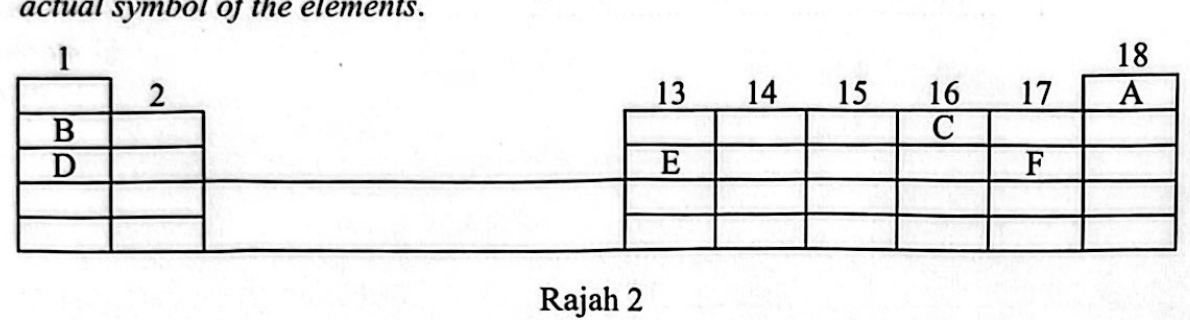
- (a)
State another name for Group 18.
[1] - (b)(i)
State the element that exist as monoatomic gas at room temperature. Give a reason for your answer.
[3] - (b)(ii)
Element X is a transition element. Mark its position in the Periodic Table of Elements in Diagram 2 with "X".
[1]
Table 1 shows the information on atoms P, Q, R and S (number of protons, number of neutrons): P 11, 12; Q 11, 13; R 17, 18; S 20, 20.
Medium6 marks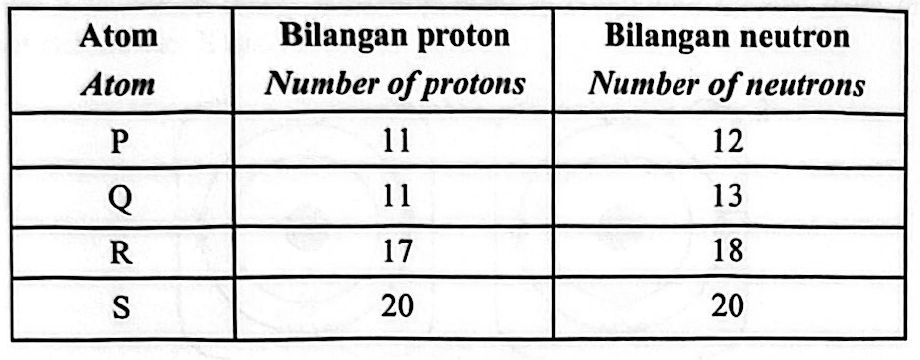
- (a)
State one subatomic particle present in the nucleus of an atom.
[1] - (b)
Which atoms are isotopes?
[1] - (c)
State the number of valence electron of atom S.
[1] - (d)(i)
Draw the electron arrangement of ion R.
[2] - (d)(ii)
Natural abundance is the percentage of isotopes exist in a sample of element naturally. Calculate the relative atomic mass of R in ³⁵R (75.8%) and ³⁷R (24.2%).
[1]
Diagram 3 shows an electron arrangement of compound formed from the reaction between substances X and Y: X²⁺ ion and Y²⁻ ion.
Medium7 marks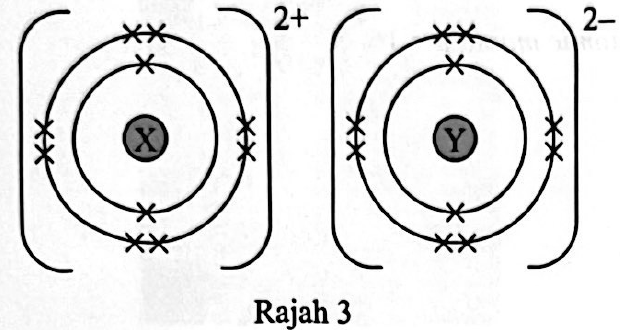
- (a)(i)
Write the electron arrangement of atom X.
[1] - (a)(ii)
State the type of forces of attraction between particles in the compound.
[1] - (a)(iii)
Write the chemical equation for the formation of the compound.
[2] - (a)(iv)
State one physical property of the compound formed.
[1] - (b)
Calculate the mass of compound produced when 0.1 mol of X react with excess Y. [Relative atomic mass: Y = 16, X = 24]
[2]
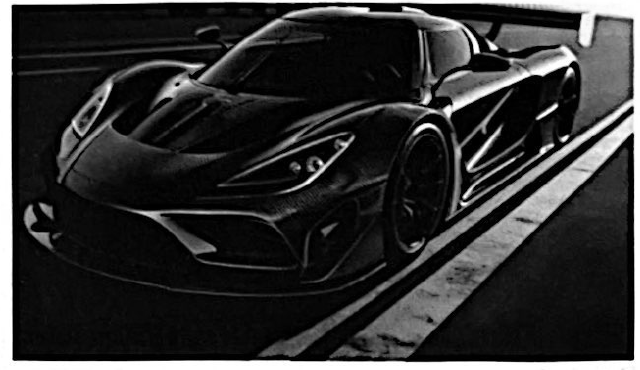
Diagram 4 shows a type of ceramic used to make a tandoori furnace. Diagram 5 shows a car design made from carbon fibre reinforced polymer (CFRP) where the matrix substance is polymer resin and substance Z is carbon fibre. Table 2 shows three types of composite materials and their components: P (concrete and steel); photochromic glass (glass, copper(I) chloride and Q); R (yttrium(III) carbonate, barium carbonate, copper(II) carbonate and oxygen).
Medium8 marks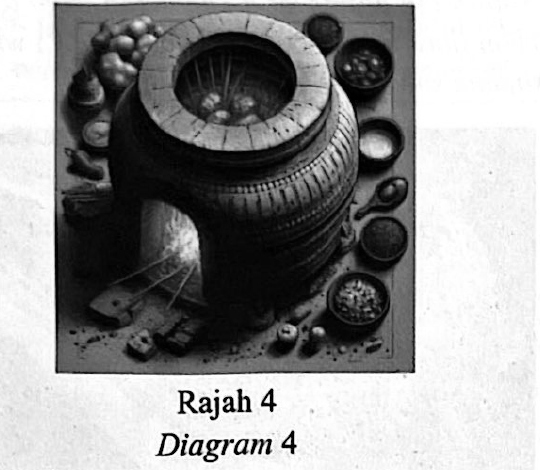
- (a)(i)
Based on Diagram 4, state the main material in ceramic.
[1] - (a)(ii)
State one property of ceramic.
[1] - (a)(iii)
State another type of ceramics.
[1] - (a)(iv)
State one use of the ceramic stated in 5(a)(iii).
[1] - (b)(i)
Identify substance Z.
[1] - (b)(ii)
Based on Table 2, identify the composite materials P, R and substance Q.
[3]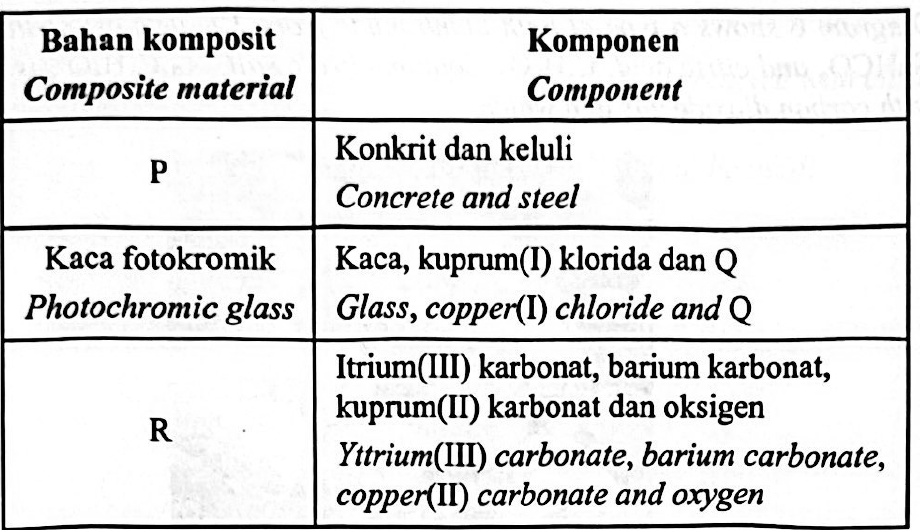
Diagram 6 shows a bath bomb made from sodium bicarbonate, NaHCO₃ and citric acid, C₆H₈O₇. Sodium citrate, Na₃C₆H₅O₇, is produced with carbon dioxide gas and water. Equation: __NaHCO₃ + __C₆H₈O₇ → __Na₃C₆H₅O₇ + __CO₂ + __H₂O
Medium9 marks- (a)
Balance the chemical equation in the boxes provided.
[2] - (b)
State qualitative information and quantitative information that can be obtained from the chemical equation.
[3] - (c)
Maira used 2.52 g of sodium bicarbonate, NaHCO₃ to be reacted with citric acid, C₆H₈O₇ to make the bath bomb. Calculate the mass of the citric acid, C₆H₈O₇, that needs to be used. [Relative atomic mass: H = 1, C = 12, O = 16, Na = 23]
[4]
Table 3 shows two sets of experiments to study the effect of other metals on rusting of iron. Set I: iron nail with metal P in jelly solution + potassium hexacyanoferrate(III) + phenolphthalein; observation: dark blue spots formed, low intensity of pink colour. Set II: iron nail with metal Q; observation: no dark blue spot, high intensity of pink colour. Diagram 7 shows a wired fence made of iron.
Medium10 marks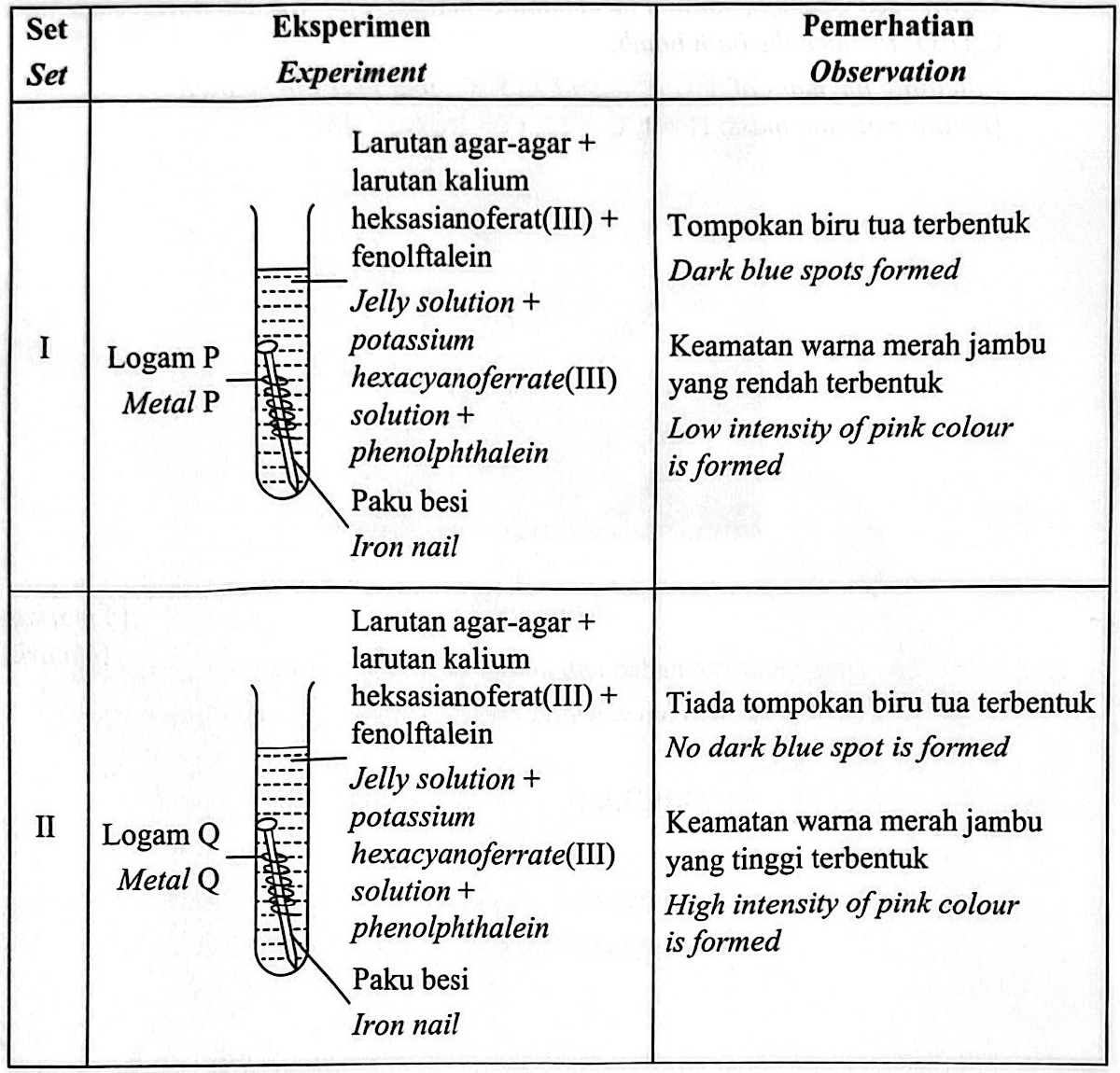
- (a)(i)
What is meant by metal corrosion?
[1] - (a)(ii)
State the name of metal P and metal Q.
[2] - (a)(iii)
Write the half equations for the oxidation and reduction in Set I and Set II.
[4] - (a)(iv)
Based on Table 3, iron nail in which Set rusted?
[1] - (b)
Suggest one way to slow down the rusting process on the wired fence. Explain your answer.
[2]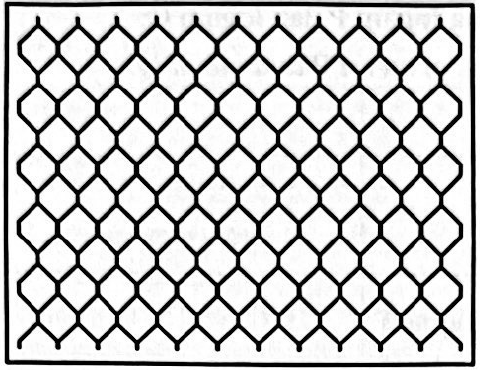
Diagram 8.1 shows the structural formulae of two hydrocarbons: A is butane (CH₃CH₂CH₂CH₃) and B has a C=C double bond between carbon 2 and carbon 3 of a four-carbon chain. Diagram 8.2 shows a pair of sports shoes used by a badminton player.
Medium10 marks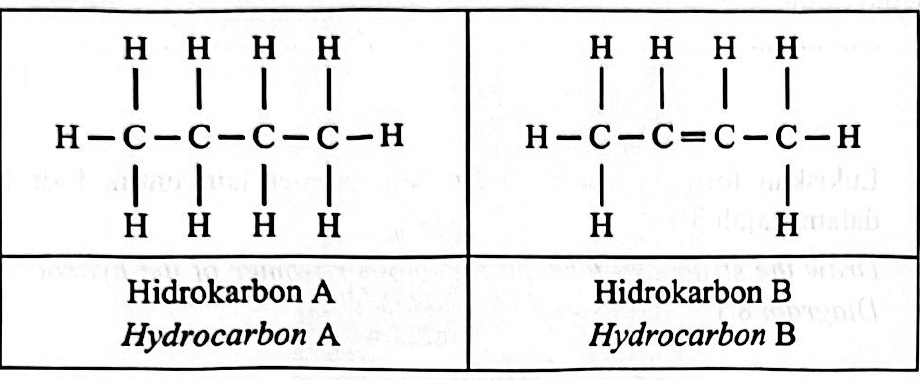
- (a)
Name hydrocarbon B according to IUPAC nomenclature.
[1] - (b)(i)
State the meaning of isomer.
[1] - (b)(ii)
Draw the structural formula for another isomer of the hydrocarbon A in Diagram 8.1.
[1] - (c)(i)
Hexane and hexene produce soot when burnt. Compare the sootiness of the combustion of hexane and hexene in excess oxygen gas.
[1] - (c)(ii)
Explain why there is a difference in the sootiness from the combustion of hexane and hexene. [Relative atomic mass: C = 12, H = 1]
[3] - (d)(i)
Name this type of synthetic rubber (sports shoes, Diagram 8.2).
[1]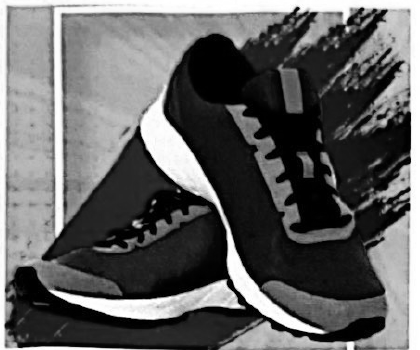
- (d)(ii)
Natural rubber and synthetic rubber can be used as the materials for the sports shoes sole. Choose the type of rubber that can be used as the material of the sports shoes sole and justify your choice.
[2]
Section B
Diagram 9 shows the apparatus set-up to determine the heat of displacement of copper by metal X: 100 cm³ of 1.0 mol dm⁻³ copper(II) sulphate solution in a polystyrene cup with a thermometer; metal X powder is added. Table 4: temperature before reaction 28.0 °C; highest temperature 35.5 °C. Table 5: heat of combustion (kJ mol⁻¹) and fuel value (kJ g⁻¹): ethanol −1380, 30; propanol −2020, 34; pentanol −3332, Y.
Hard20 marks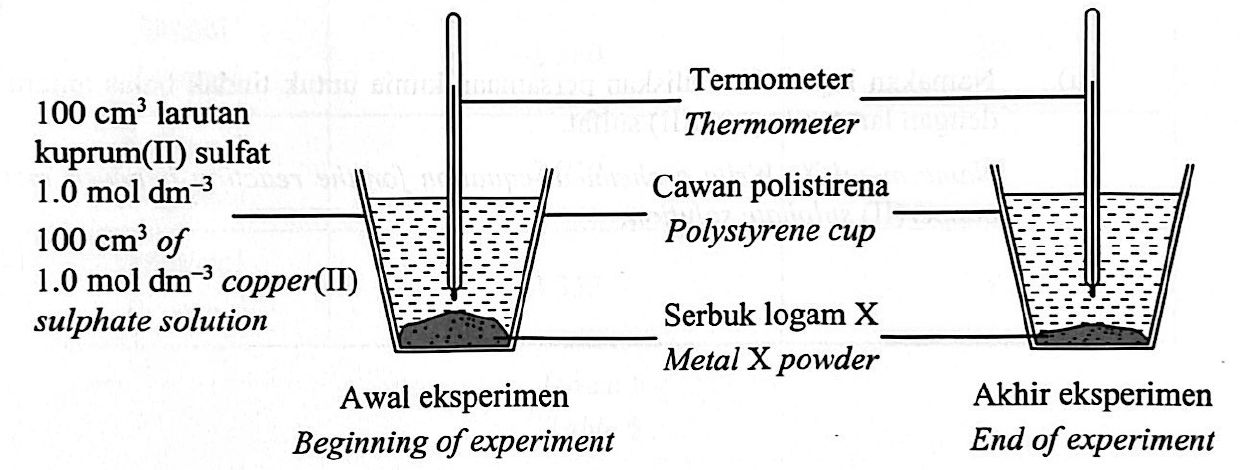
- (a)
State the meaning of heat of displacement.
[1] - (b)(i)
State the colour change of the solution in this reaction.
[2]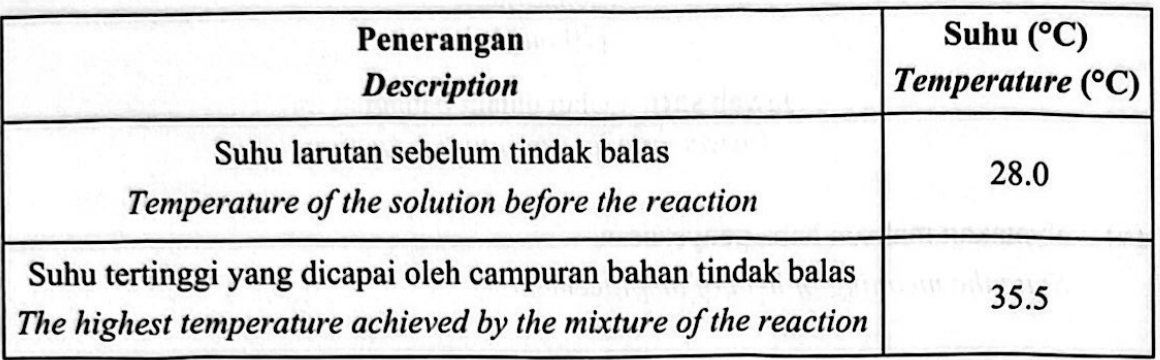
- (b)(ii)
Name metal X. Write a chemical equation for the reaction between metal X and copper(II) sulphate solution.
[2] - (c)
Calculate the heat of displacement when 1 mole of copper is displaced by metal X. [Specific heat capacity of solution, c = 4.2 J g⁻¹ °C⁻¹; Density of solution = 1 g cm⁻³]
[4] - (d)
Draw the energy level diagram for this reaction.
[3] - (e)(i)
Based on Table 5, calculate the value of Y. Then choose a more suitable alcohol to be used as fuel. Justify your choice. [Relative atomic mass: H = 1, C = 12, O = 16]
[5]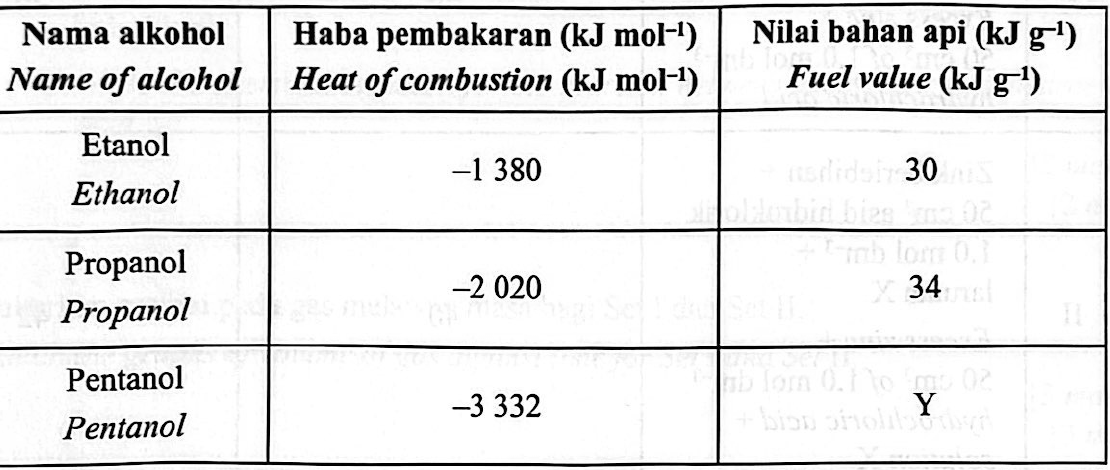
- (e)(ii)
If you are a nature lover, which alcohol will you choose to use as fuel? Explain.
[3]
Table 6 shows three sets of experiments to investigate factors affecting the rate of reaction between excess zinc and 50 cm³ of 1.0 mol dm⁻³ hydrochloric acid. Set I: temperature 40 °C, 56 s to collect 30 cm³ hydrogen. Set II: with solution X added, 40 °C, 42 s. Set III: 50 °C, 35 s.
Hard20 marks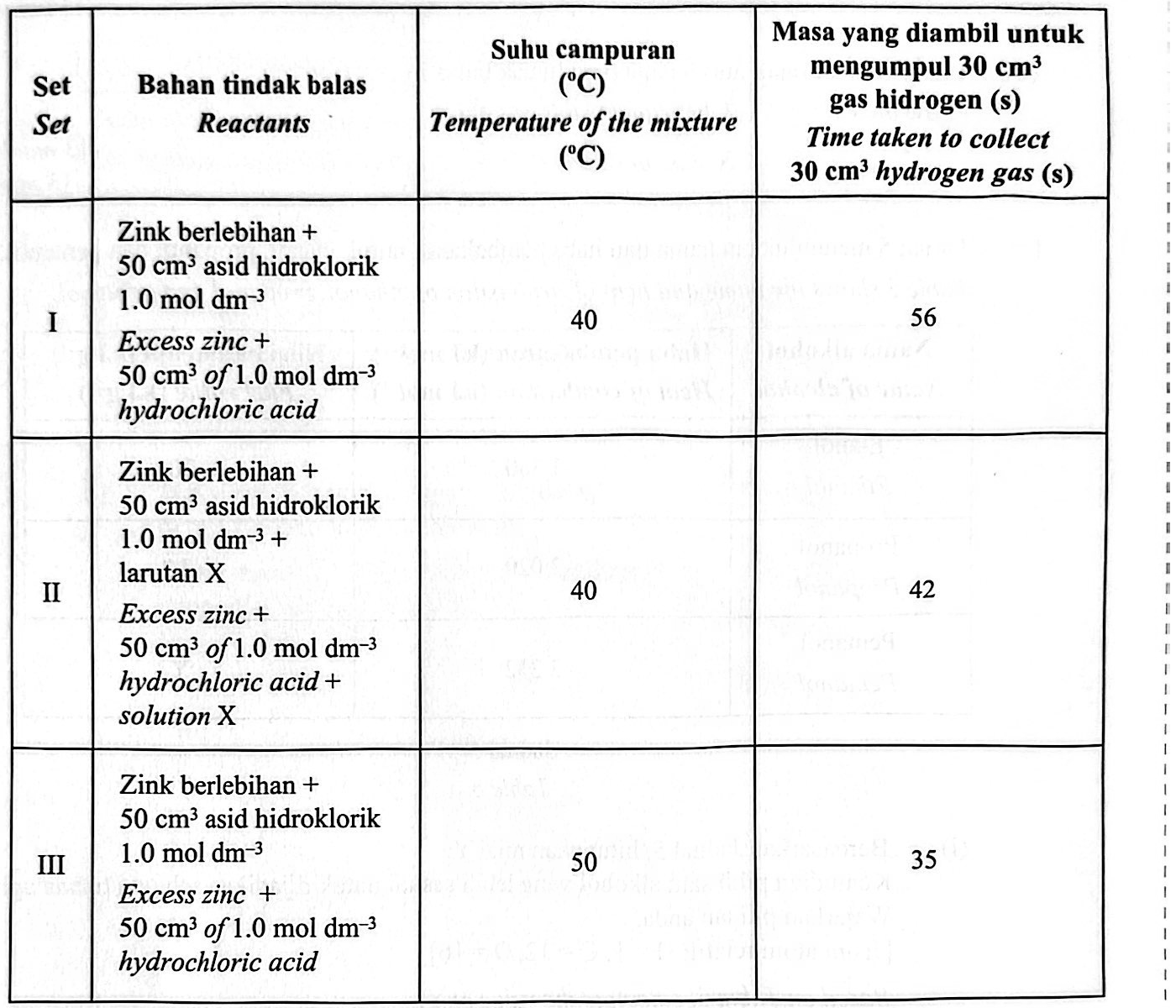
- (a)(i)
What is the meaning of rate of reaction?
[1] - (a)(ii)
Name the solution X and its function.
[2] - (a)(iii)
Write the chemical equation for the reaction between excess zinc and hydrochloric acid.
[2] - (b)
Sketch the graphs of volume of gas against time for Set I and Set II.
[3] - (c)
Calculate the average rate of reaction produced in (i) Set I (ii) Set II.
[2] - (d)(i)
Based on the information in Table 6, compare the rate of reaction between Set I and Set II. By using the collision theory, explain your answer.
[5] - (d)(ii)
Compare the rate of reaction between Set I and Set III. By using the collision theory, explain your answer.
[5]