Write your answer on paper. Then open the answer to check it.
Section A
Diagram 1.1 shows the structural formula of natural polymer present in latex from a rubber tree (repeating unit of poly(2-methylbut-1,3-diene), isoprene units).
Medium5 marks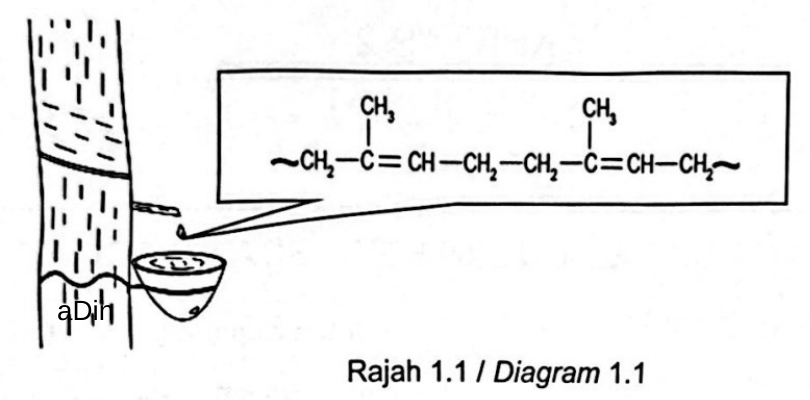
- (a)
What is meant by polymer?
[1] - (b)
Polymer can be classified to thermoplastic, thermoset and elastomer polymers based on characteristics. State the class of type of polymer in Diagram 1.1.
[1] - (c)
State the name of substance that can be added to maintain latex in liquid state.
[1] - (d)
Polymer in Diagram 1.1 undergoes process Z (with sulphur) to improve the original properties as shown in Diagram 1.2. State the name for process Z and draw the polymer structure formed in the space provided.
[2]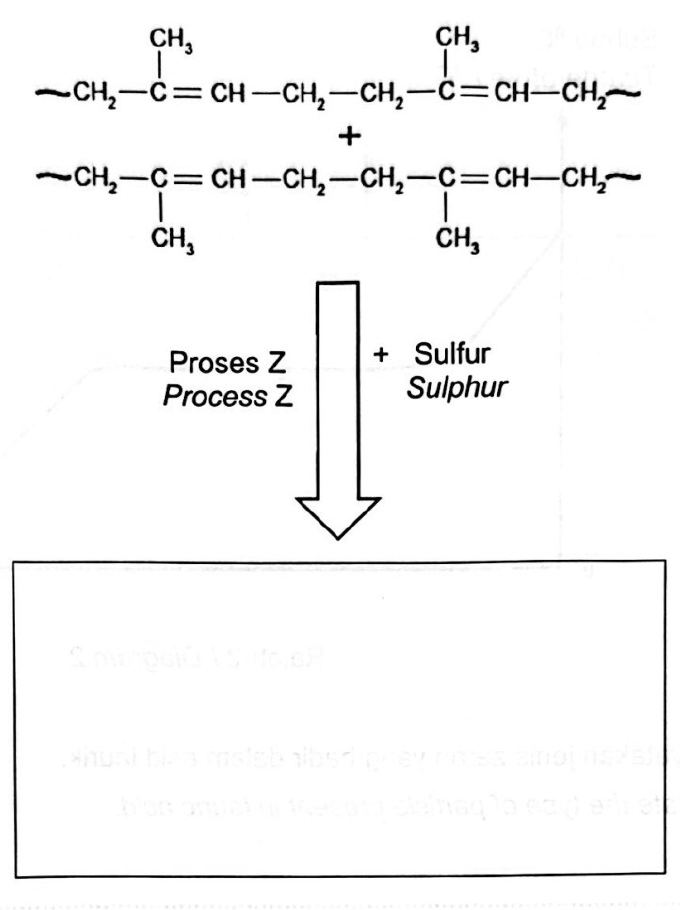
Diagram 2 shows the cooling curve graph from 50.0 °C to room temperature for lauric acid, C12H24O2. The freezing point of lauric acid is 43.8 °C. (Graph of temperature against time: falls, flat section, then falls again.)
Medium5 marks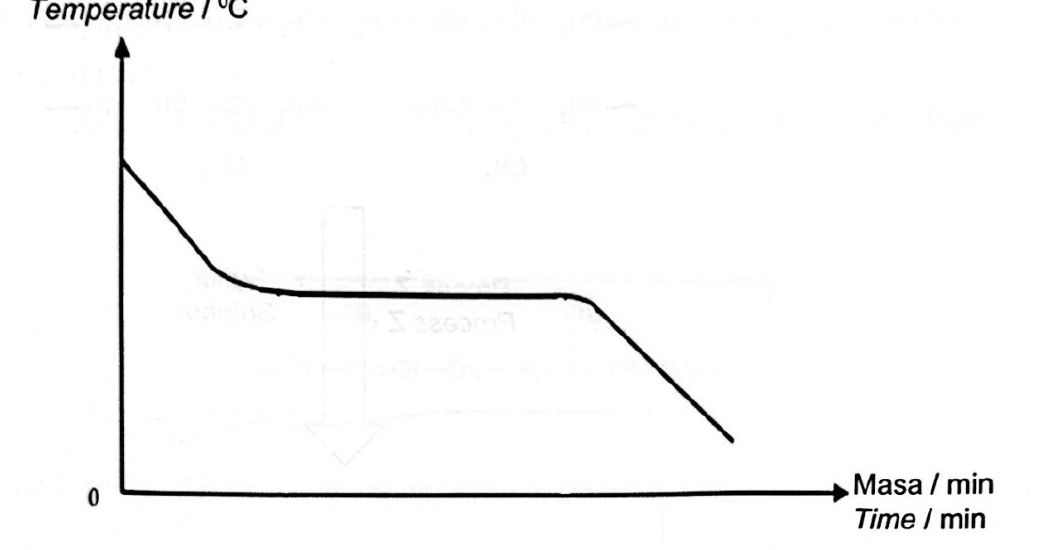
- (a)
State the type of particle present in lauric acid.
[1] - (b)
Name the process in conversion state of matter involved in obtaining the curve in Diagram 2.
[1] - (c)
Mark the freezing point of lauric acid in Diagram 2.
[1] - (d)
Draw the particles arrangement of lauric acid at 30 °C and 45 °C.
[2]
Diagram 3 shows medicine (Aspirin tablets) given to a patient to relieve pain.
Medium6 marks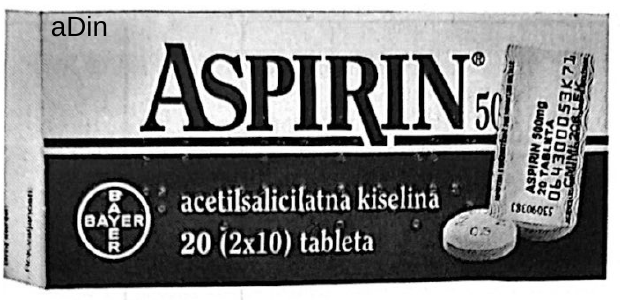
- (a)(i)
State the type of the medicine.
[1] - (a)(ii)
State one side effect if aspirin is given to a child.
[1] - (b)
A patient is experiencing symptoms of itching, swelling and arthritis. Suggest the suitable type of medicine to treat these symptoms.
[1] - (c)
The field of nanotechnology has developed very widely. Water filtration is no exception to using this technology to ensure more efficient filtration can be carried out. Suggest an allotrope of carbon that is suitable for use as a filtering material. Explain your answer.
[3]
Diagram 4 shows a quote from an article: STAR 21 is the first high-speed train in Japan to use an electric motor with variable frequency. The body of the train is made from double-layered aluminum using long hollow sections welded together. Its assembly utilizes duralumin rivets, a technique learned from aircraft construction.
Medium7 marks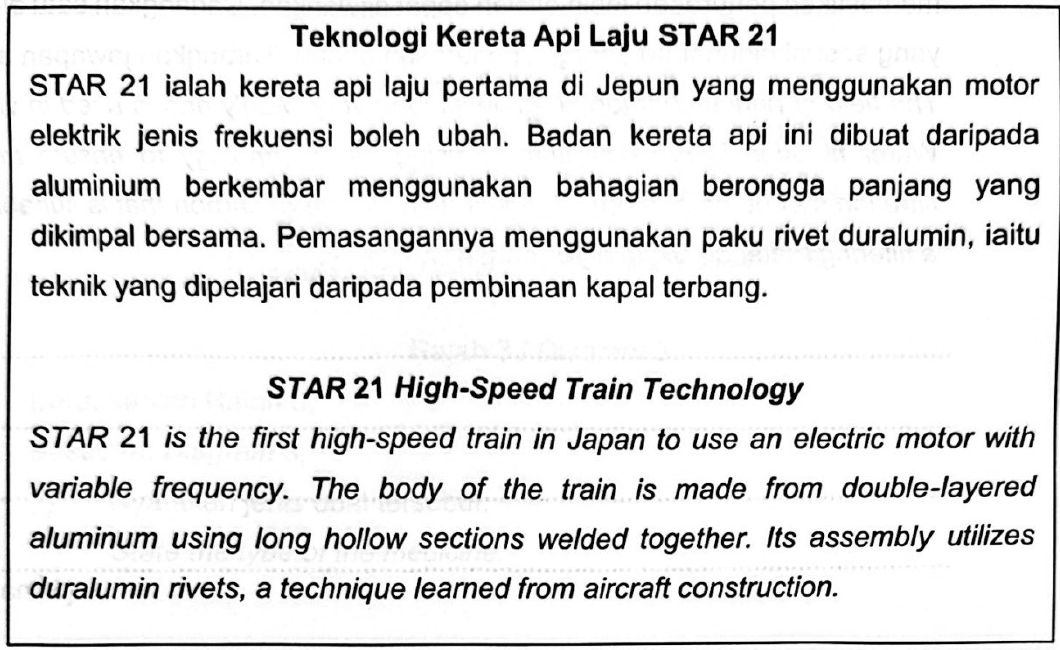
- (a)
What other element is found in rivets besides aluminium?
[1] - (b)(i)
Explain why duralumin is stronger than aluminium.
[2] - (b)(ii)
Duralumin contains 93% aluminium. Calculate the weight of aluminium in kg if the weight of one wagon is 35 tons. [1 tonne = 1000 kg]
[2] - (c)
An internet service provider company in a rural area is facing coverage issues and slow data transmission when using copper cables. Residents have complained that it is difficult to attend online classes and virtual meetings. Suggest a way to overcome this problem and explain.
[2]
Diagram 5 shows two sets of experiments that had been carried out to investigate the properties of hydrogen chloride gas. Set I: hydrogen chloride gas passed into methylbenzene. Set II: hydrogen chloride gas passed into water.
Medium8 marks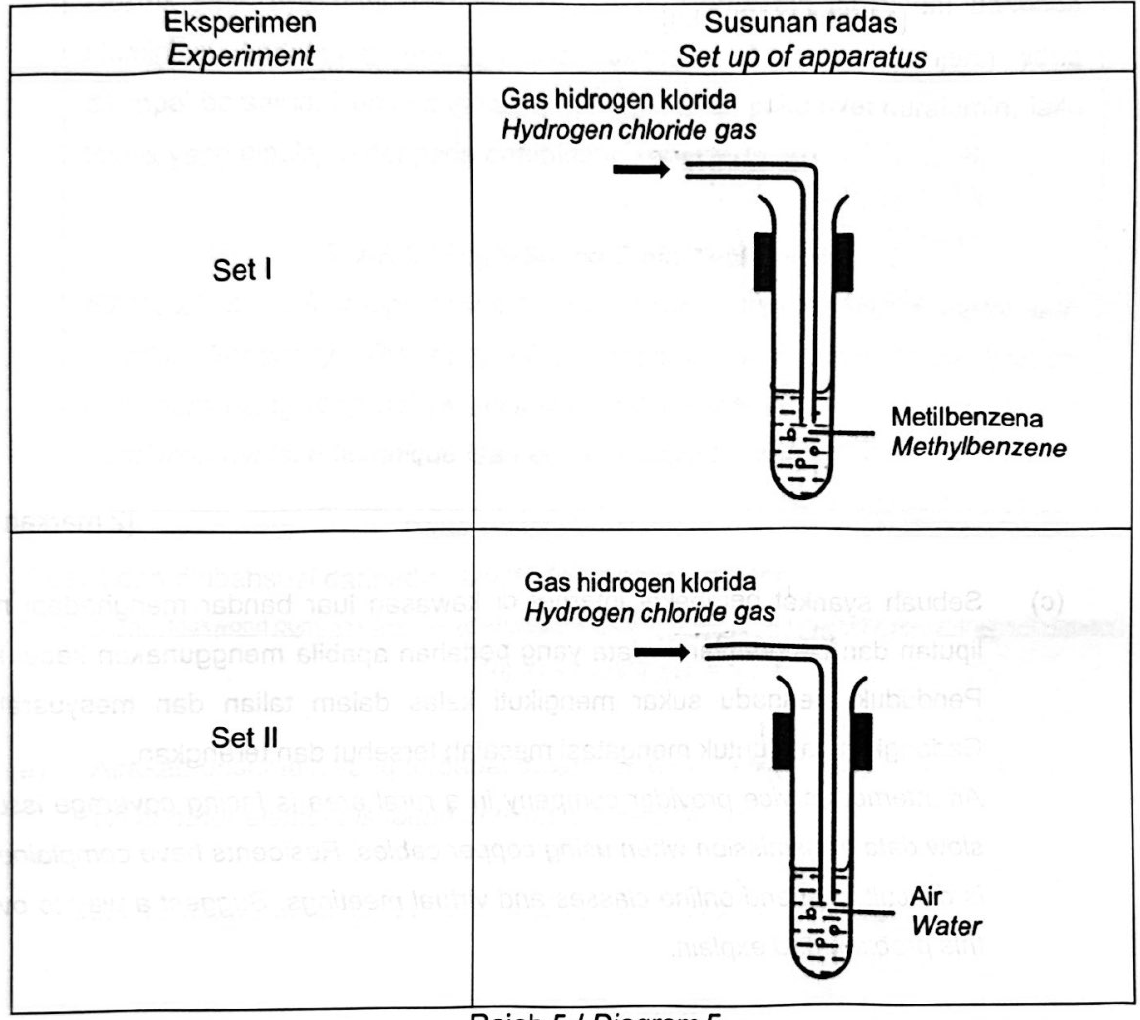
- (a)
State the type of bond in hydrogen chloride gas.
[1] - (b)
What is observed when blue litmus papers are put into the test tube for Set I and Set II? Explain your answer.
[3] - (c)
Calculate the concentration of the solution formed when 480 cm³ of hydrogen chloride gas at room condition is dissolved into 500 cm³ of distilled water. Hence, determine the pH value of the resulting solution. [Molar volume = 24 dm³ mol⁻¹ at room condition]
[4]
Two experiments were carried out to investigate the effect of concentration of sulphuric acid on the rate of reaction. Table 6 shows the results. Experiment I: 1.2 g magnesium ribbon, excess 1.0 mol dm⁻³ sulphuric acid, time for magnesium to dissolve completely 30 s. Experiment II: 1.2 g magnesium ribbon, excess 0.5 mol dm⁻³ sulphuric acid, 60 s.
Medium9 marks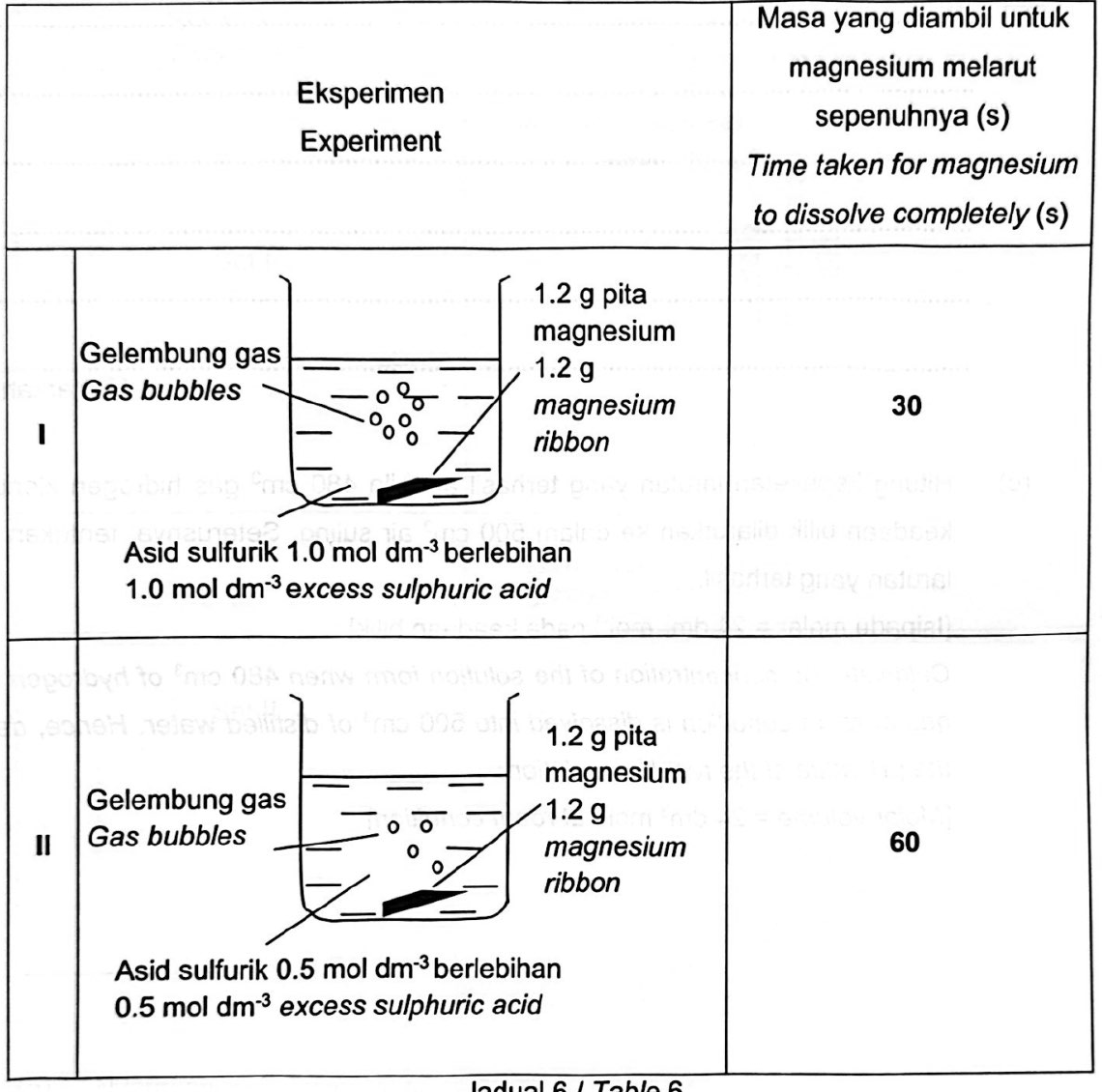
- (a)
State one factor that can affect the rate of reaction.
[1] - (b)(i)
Name the gas released in this experiment.
[1] - (b)(ii)
Write a chemical equation for the reaction between magnesium and sulphuric acid.
[1] - (b)(iii)
Calculate the maximum volume of the gas released at room temperature in this experiment. [Relative atomic mass: Mg=24; Volume of 1 mole of gas at room temperature = 24 dm³]
[3] - (c)
Compare the rate of reaction between experiment I and experiment II. Explain your answer based on collision theory.
[3]
Diagram 7.1 shows the particle structure of the Z compound (a lattice of alternating positive and negative ions).
Medium10 marks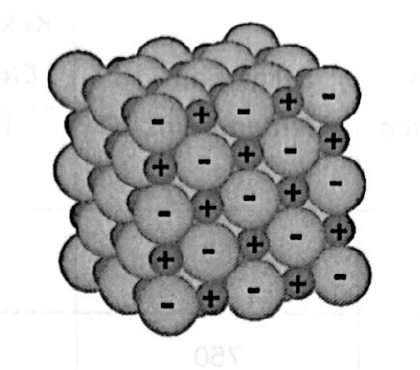
- (a)(i)
State the type of compound Z.
[1] - (a)(ii)
State the type of subatomic particles involved in the formation of chemical bonds.
[1] - (b)(i)
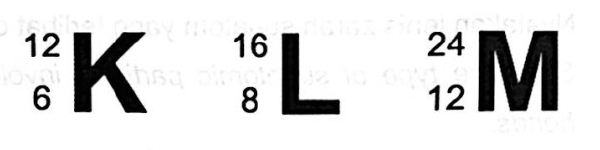
Table 7 shows the physical properties of substance P, Q and R (P: m.p. 55 °C, not conducting as solid or molten; Q: 750 °C, conducts only when molten; R: 600 °C, conducts as solid and molten). Diagram 7.2 shows the symbols of three different elements: ¹²₆K, ¹⁶₈L, ²⁴₁₂M. Based on Diagram 7.2, which element is substance R?
[1]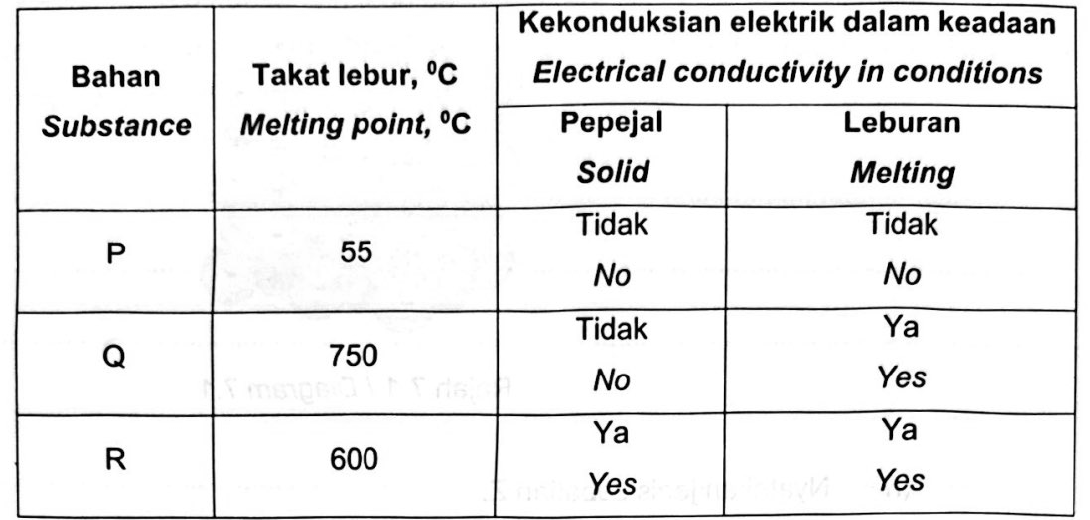
- (b)(ii)
Identify the elements that can form the substance P.
[1] - (b)(iii)
Draw the electron arrangement for the substance P.
[2] - (b)(iv)
Calculate the relative mass of substance P.
[1] - (c)
Diagram 7.3 shows a shirt that was exposed to oil paint during painting activities. Which of the two substances shown in Diagram 7.3 (water, turpentine) is more suitable for removing the paint? Justify your answer.
[3]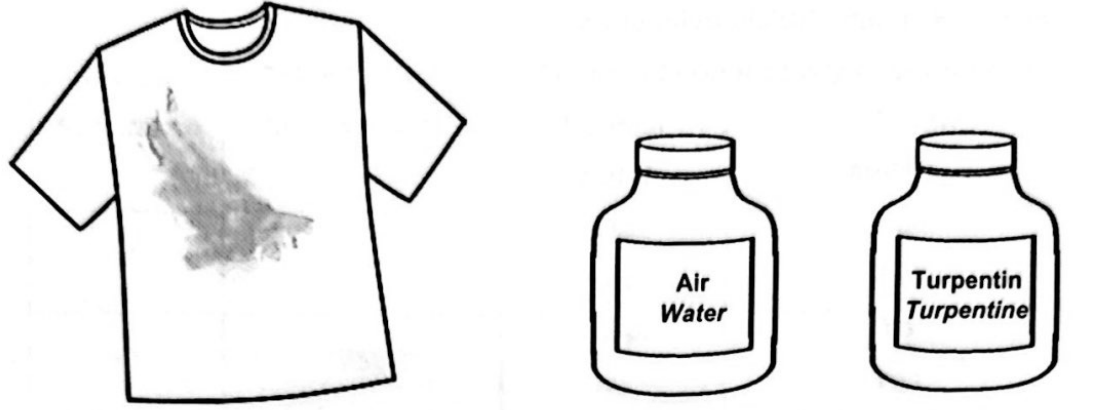
Table 8 (Diagram 8) shows the apparatus setup for investigating the displacement of halogens from their halide solutions by halogens X2, Y2 and Z2 in 1,1,1-trichloroethane. Set I: X2 added to potassium chloride solution, organic layer purple. Set II: Y2 added to potassium bromide solution, brown. Set III: Z2 added to potassium iodide solution, purple.
Medium10 marks- (a)(i)
State the function of 1,1,1-trichloroethane.
[1]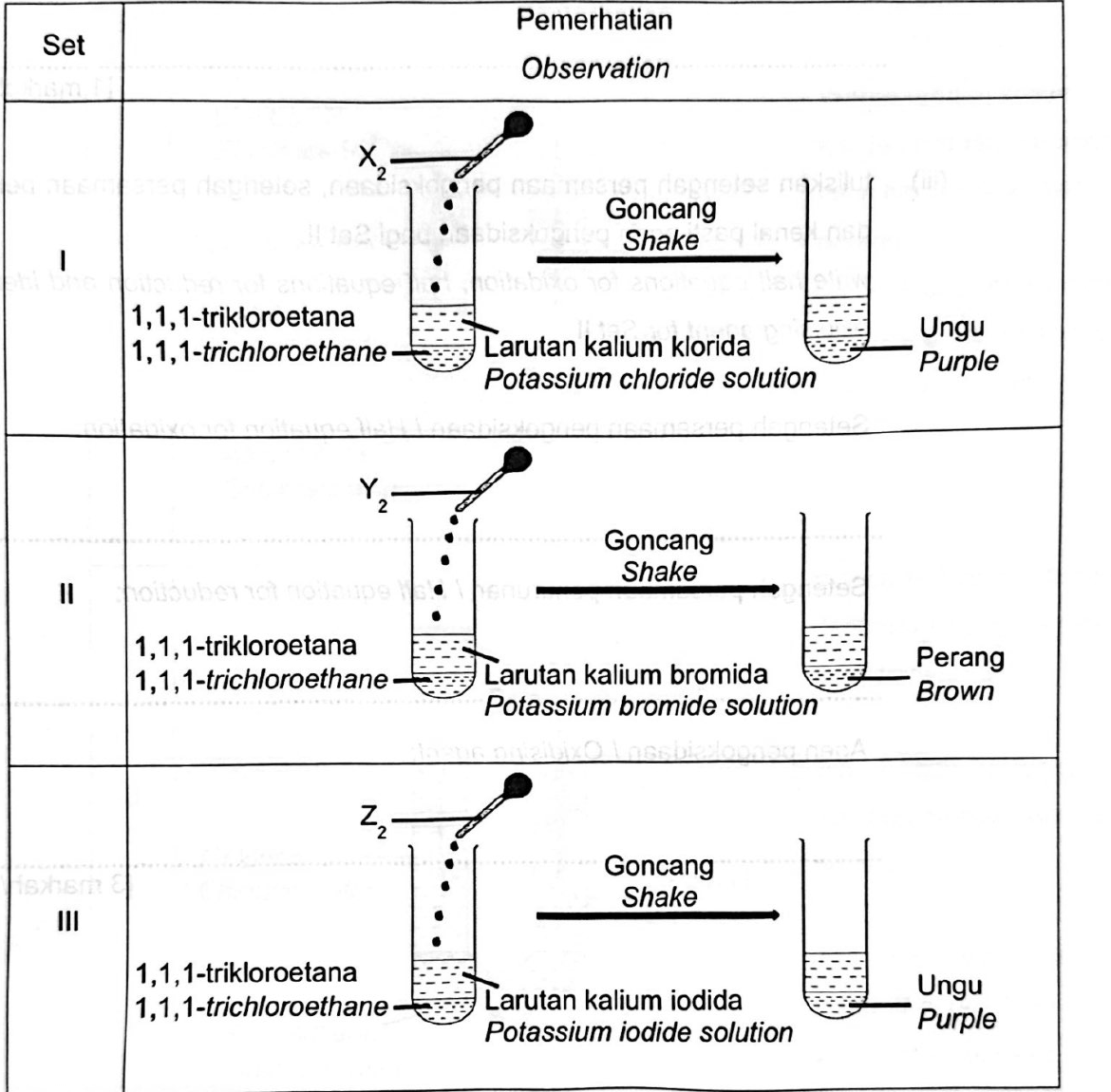
- (a)(ii)
Arrange element X, Y and Z in terms of strength as oxidising agents in ascending order.
[1] - (a)(iii)
Write half equations for oxidation, half equation for reduction and identify the oxidising agent for Set II.
[3] - (b)(i)
Table 8 shows two sets of experiments to investigate electron transfer at a distance (Set I: potassium iodide solution and K solution in sulphuric acid, solution turns colourless to brown; Set II: chlorine water and L solution, chlorine water yellow to colourless, green solution L turns brown). Based on the information in Table 8, identify solution K and solution L.
[2]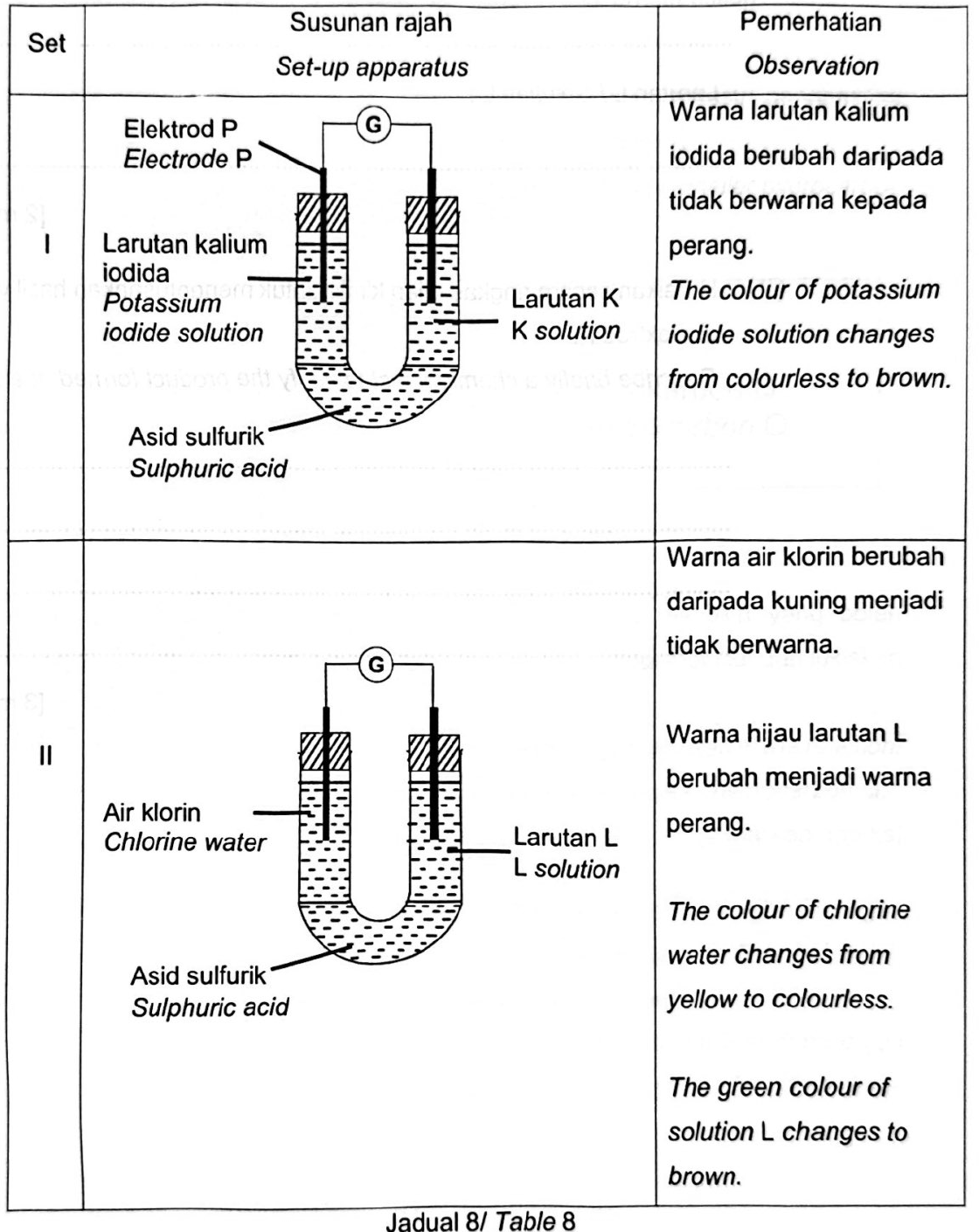
- (b)(ii)
Describe briefly a chemical test to verify the product formed at electrode P.
[3]
Section B
Diagram 9.1 shows the reaction used in industrial production of smaller hydrocarbon from long chain hydrocarbon: C7H16 --(mixture of catalyst, heat)--> C2H4 + hydrocarbon Q. (Answer either Question 9 or Question 10.)
Hard20 marks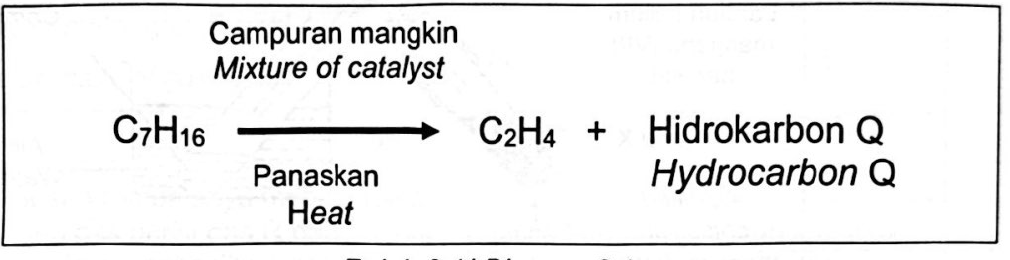
- (a)(i)
Name the above reaction and suggest a catalyst that can be used in the reaction. State the molecular formula and draw the structural formula of hydrocarbon Q.
[4] - (a)(ii)
5.6 kg compound C2H4 burnt in excess oxygen to produce carbon dioxide gas and water. Write chemical equation for this reaction, hence calculate the volume of carbon dioxide gas produced. [Relative atomic mass C=12; H=1; Molar volume of gas at room conditions = 24 dm³ mol⁻¹]
[5] - (b)
Diagram 9.2 shows apparatus set-up of conversion process of compound X to compound Z. Compound X has number of carbon atom per molecule less than three. Reaction I: compound X + acidified potassium manganate(VII) solution, heated, gives compound Y collected over water. Reaction II: compound X + compound Y with concentrated sulphuric acid, heated, gives compound Z poured into water. Based on Diagram 9.2, identify reaction I, reaction II, compound X, compound Y and compound Z. State one similar property between compound X and compound Z.
[6]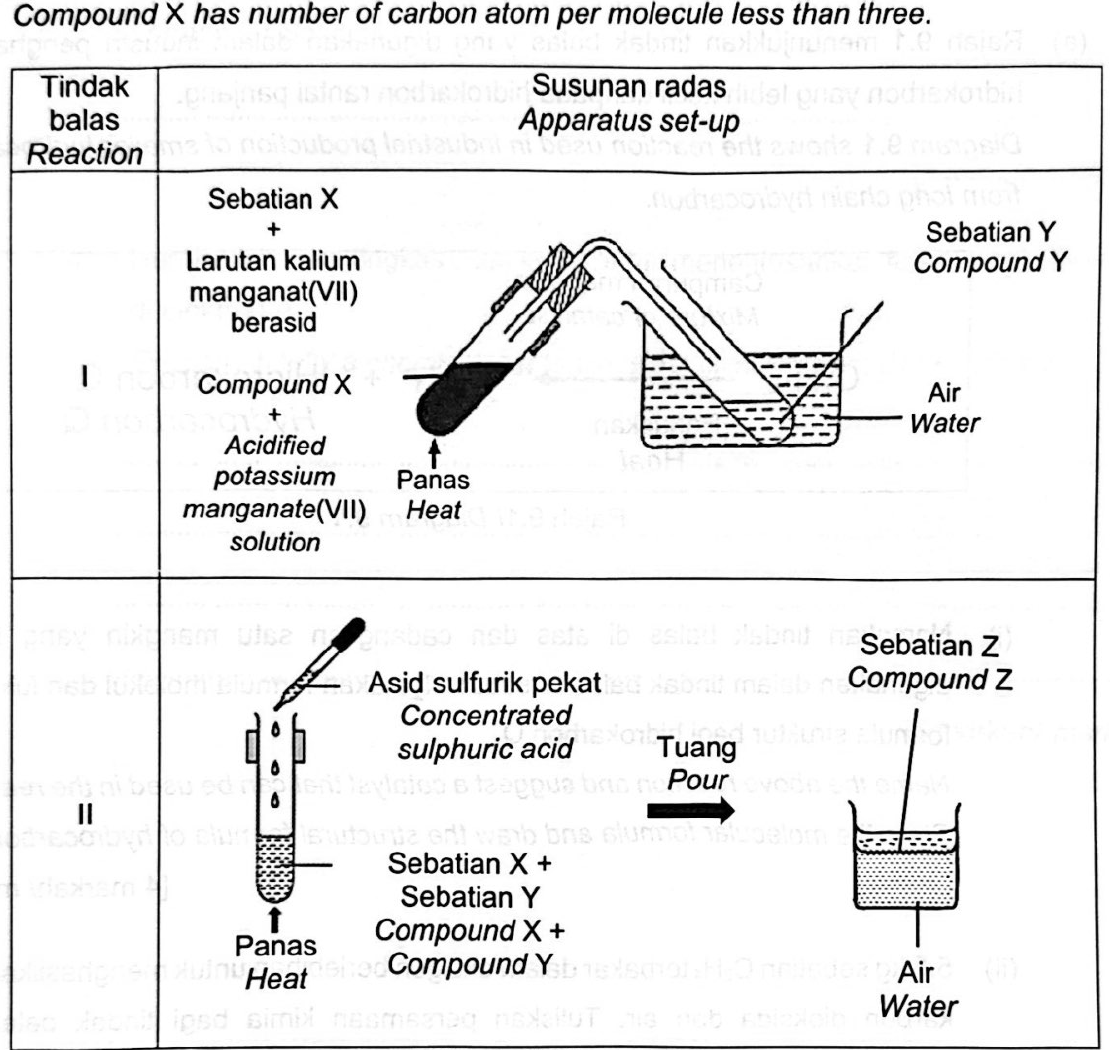
- (c)
Diagram 9.3 shows two cooking gas cylinders filled with different type of gas (R: molar mass 44 g mol⁻¹; S: 58 g mol⁻¹) and Diagram 9.4 shows conversation between Susan and Siti: Susan's gas R, 15 mol produces 33301.5 kJ of heat; Siti's gas S, 10 mol produces 28775 kJ of heat. Based on diagram 9.3 and 9.4, whose home cooking gas is more economical? Prove it by calculating the fuel value of the gas.
[5]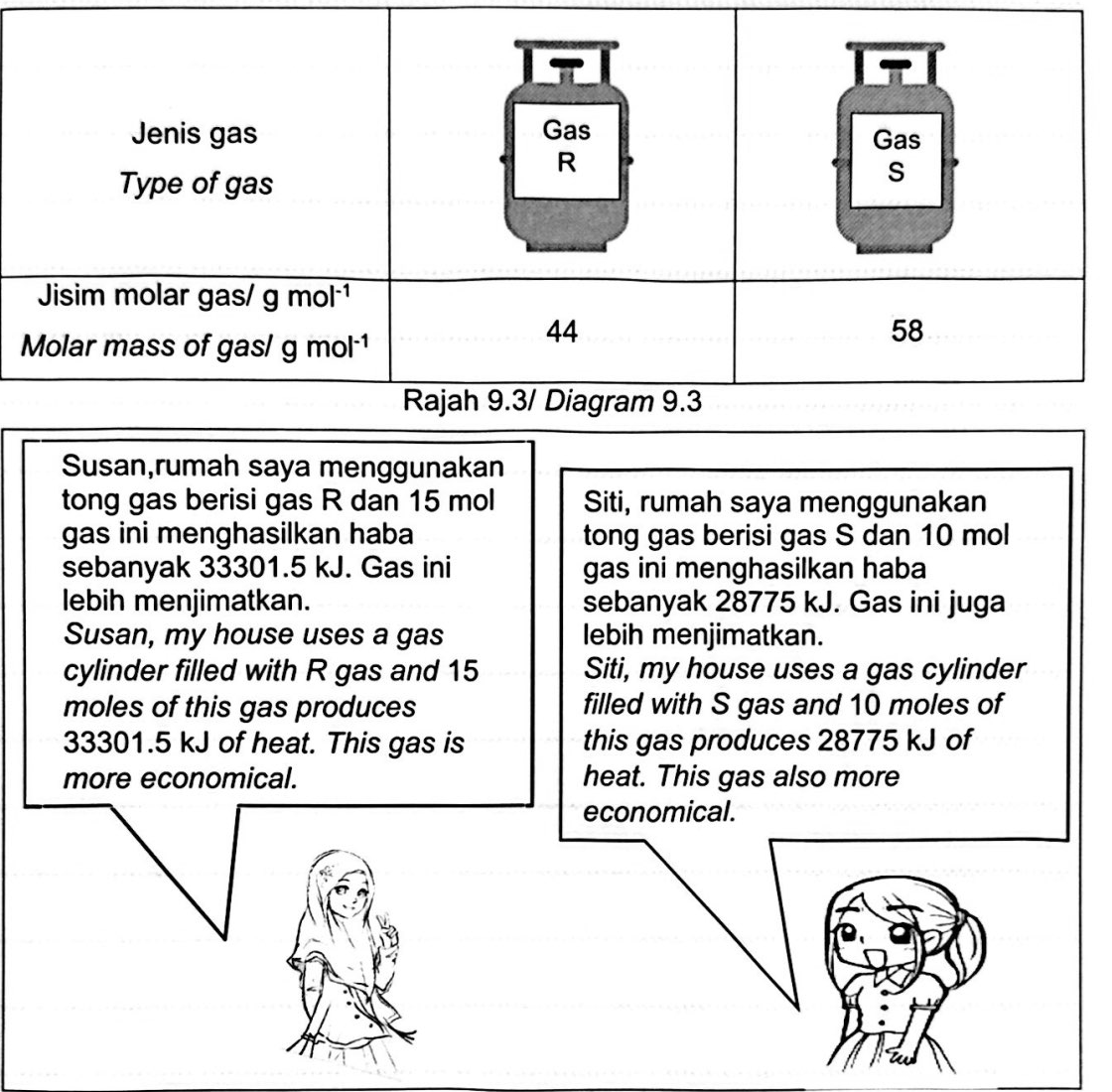
Diagram 10.1 shows the apparatus set up of an experiment to determine the heat of neutralisation between acid and alkali: 25 cm³ of 1.0 mol dm⁻³ hydrochloric acid poured into 25 cm³ of 1.0 mol dm⁻³ sodium hydroxide solution. The thermochemical equation: HCl + NaOH → NaCl + H₂O, ΔH = -57.12 kJ mol⁻¹. (Answer either Question 9 or Question 10.)
Hard20 marks- (a)(i)
What is meant by heat of neutralisation? State type of reaction based on heat energy change and draw the energy level diagram for this reaction.
[4]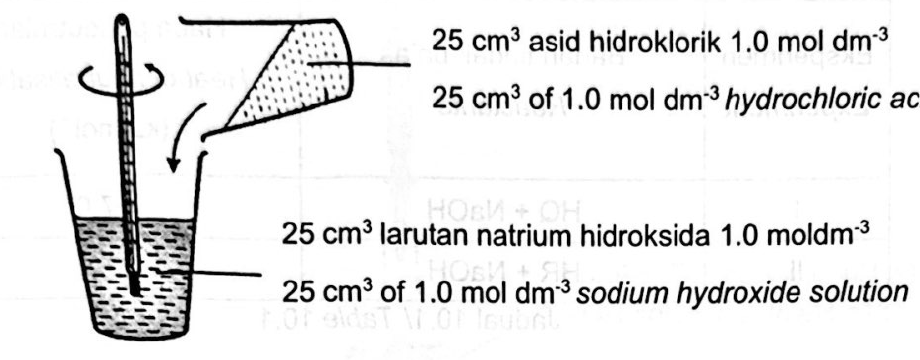
- (a)(ii)
Table 10.1 shows the heat of neutralisation of the reaction between two monoprotic acids HQ and HR with sodium hydroxide solution (Experiment I: HQ + NaOH, -57.0 kJ mol⁻¹; Experiment II: HR + NaOH, -55.0 kJ mol⁻¹). Based on Table 10.1, suggest acid HR. Explain the difference in the heat of neutralisation for Experiment I and Experiment II. If Experiment I repeated by using sulphuric acid with same volume and concentration, predict the heat of neutralisation of this reaction.
[5]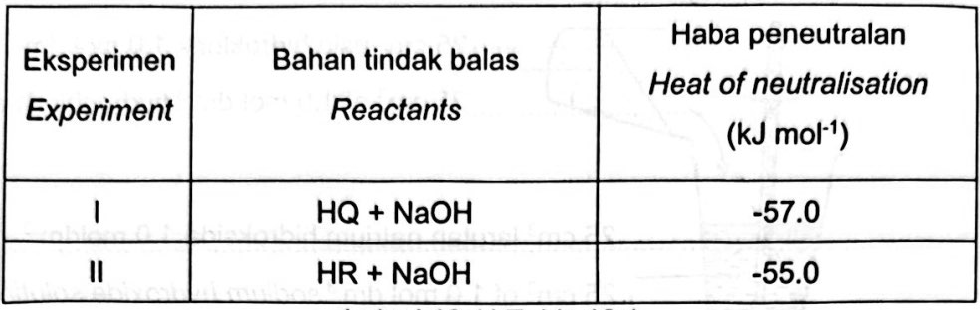
- (b)(i)
Diagram 10.2 shows an apparatus set-up of a titration (sulphuric acid in the burette, TOH solution with pH = 13 in the conical flask). What is meant by pH value? Determine the strength and concentration of TOH solution.
[4]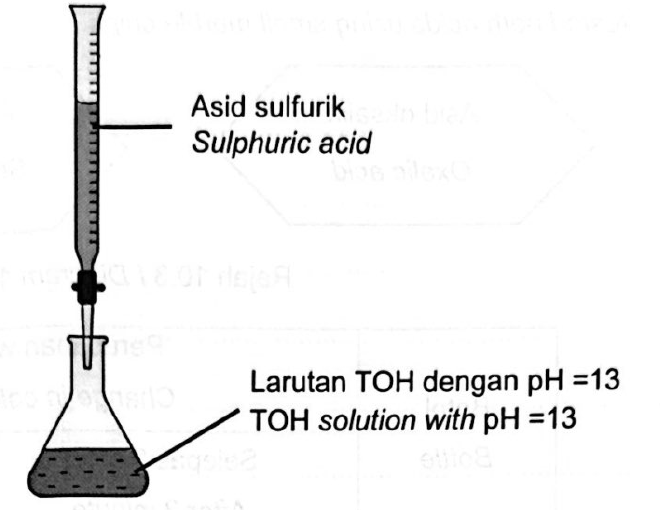
- (b)(ii)
The alkaline solution is used to neutralise 0.002 mol of sulphuric acid as below equation: 2TOH + H₂SO₄ → T₂SO₄ + 2H₂O. Determine the volume of TOH solution used.
[2] - (c)
Diagram 10.3 shows labels of two bottles of acid that have come off (oxalic acid, sulphuric acid). Mr. Ali tested both acids using small marble chips. Table 10.2 (Bottle A: lime water unchanged after 2 minutes, cloudy after 5 minutes; Bottle B: lime water cloudy after 2 minutes and after 5 minutes). Based on Table 10.2, identify the label for each reagent bottle. Explain your answer.
[5]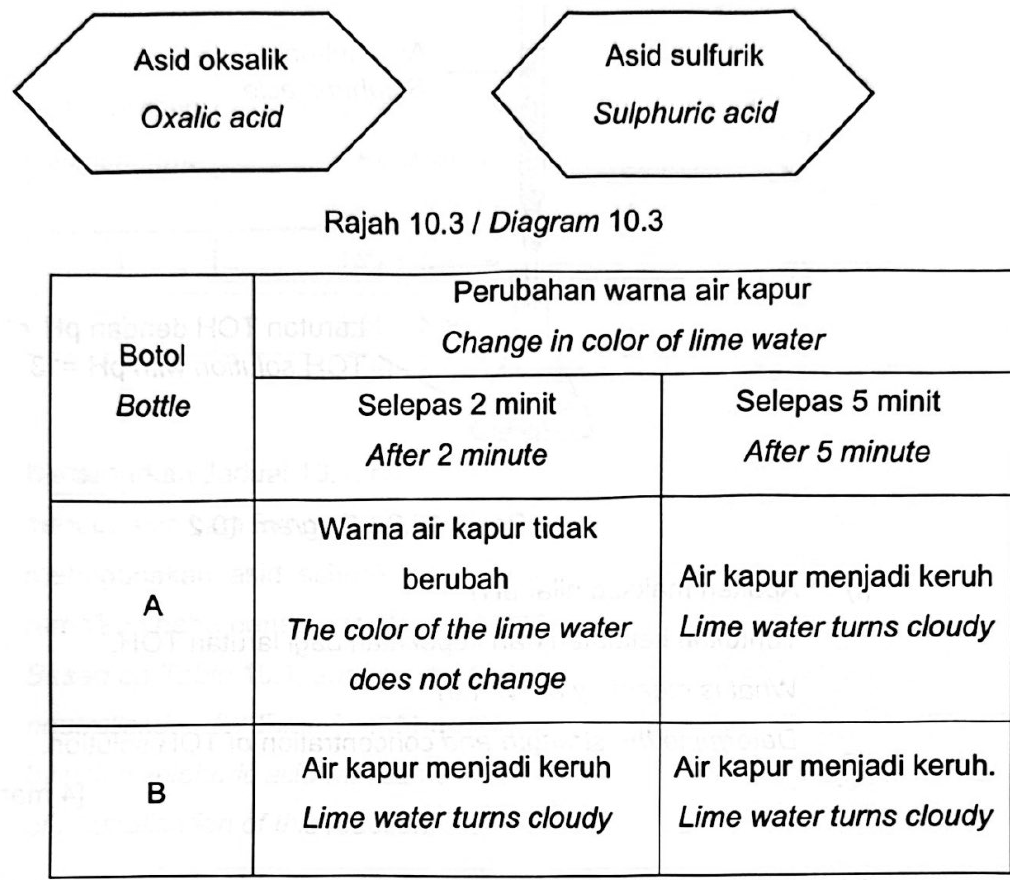
Section C
Diagram 11.1 shows a metal displacement reaction from its salt solution: zinc powder added to copper(II) nitrate solution gives solution K and solid L.
Hard20 marks- (a)
State the meaning of redox. Based on Diagram 11.1, write the chemical formula for the solution K formed and state the colour of solid L.
[3]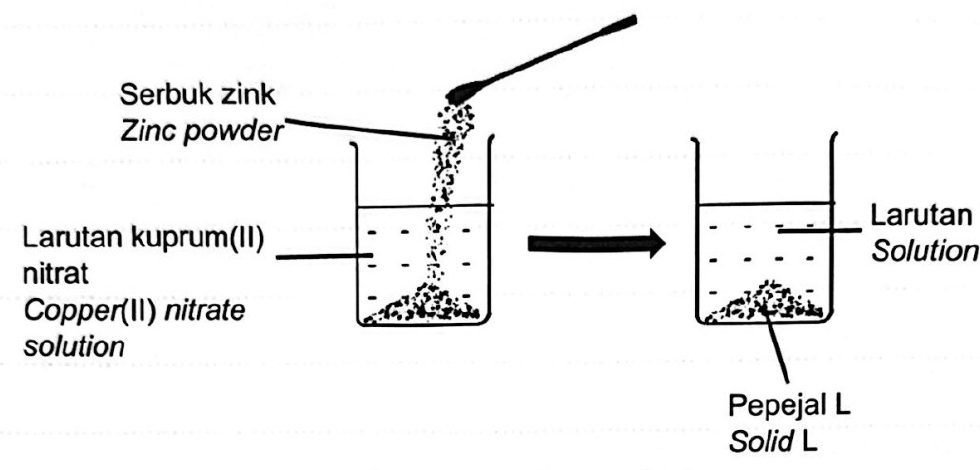
- (b)
Ba(NO₃)₂ + Na₂SO₄ → ............. + ............ Copy and complete the above equation. Name the above reaction. Determine whether the reaction is a redox reaction or not. Explain your answer.
[4] - (c)
Table 11: Salt Y: solid Y is heated and the liberated gas N is tested with damp blue litmus paper (turns red) and gas P is tested with a glowing wooden splinter (ignites); solid residue M changes from yellow to white when cooled. Salt Z: reaction between 2.0 mol dm⁻³ sodium sulphate solution and 2.0 mol dm⁻³ lead(II) nitrate solution, a white precipitate is formed. Based on Table 11, identify salt Y, salt Z, solid residue M and gas P. State the colour of the gas N that turns damp blue litmus paper to red.
[5]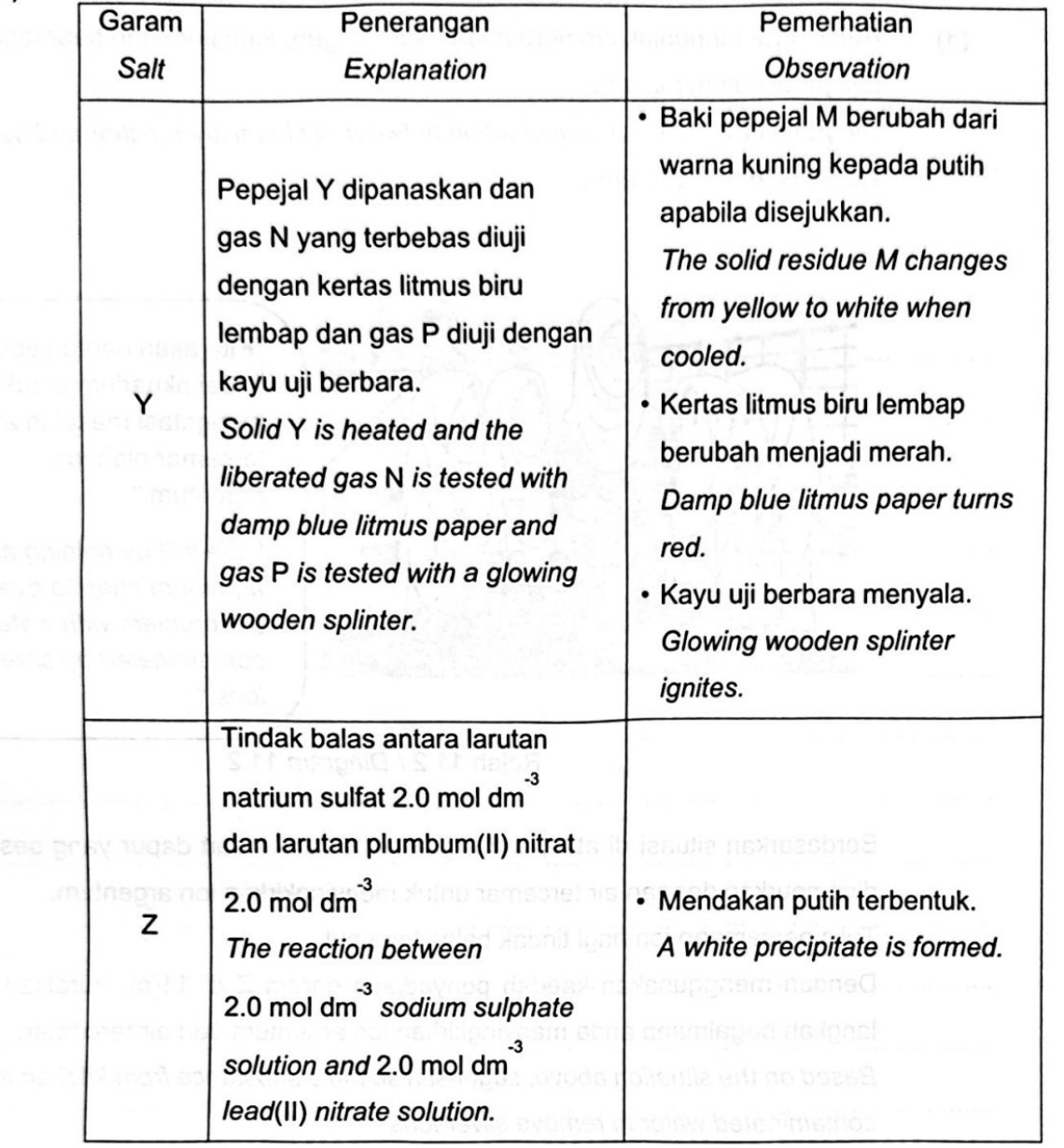
- (d)
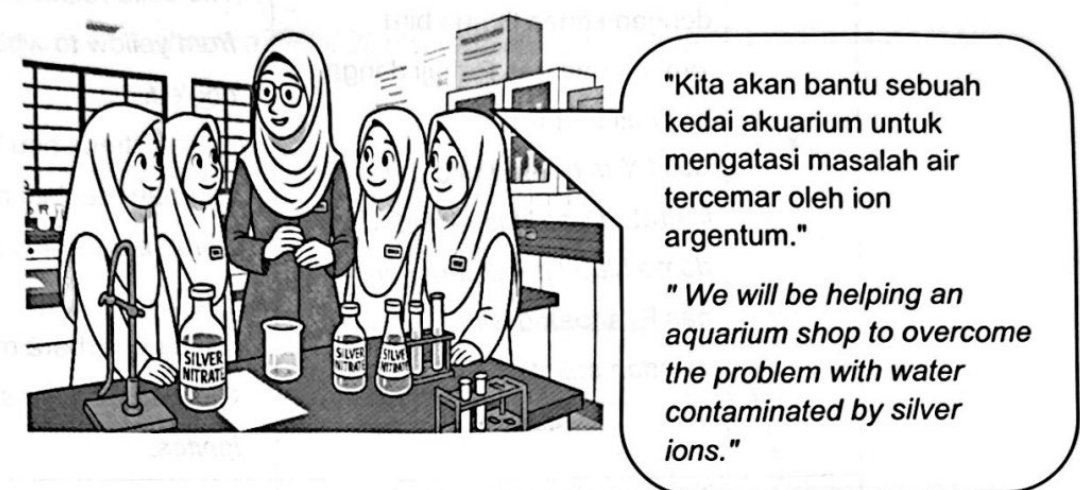
Diagram 11.2 shows a conversation between a chemistry teacher and several students: 'We will be helping an aquarium shop to overcome the problem with water contaminated by silver ions.' Based on the situation, suggest a suitable substance from the kitchen to add to contaminated water to remove silver ions. Write the ionic equation for the reaction. By using the method of preparing salt Z in 11(c), describe the steps on how you would remove silver ions from contaminated water.
[8]