Write your answer on paper. Then open the answer to check it.
Section A
Table 1 shows information for two elements, X and Y. Element X: electron arrangement 2.7, number of neutrons 10. Element Y: electron arrangement 2.8.8.2, number of neutrons 20.
Medium5 marks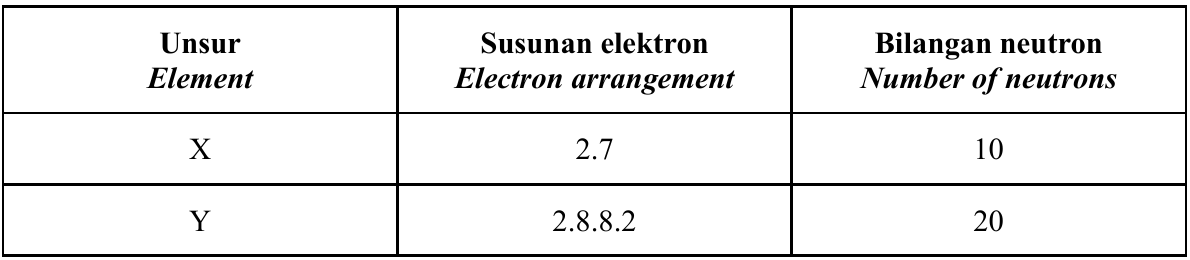
- (a)
State the proton number and nucleon number of atom Y.
[2] - (b)
Write the electron arrangement of ion X.
[1] - (c)
Draw the atomic structure of atom X.
[2]
A gardener uses ammonium nitrate fertiliser, NH₄NO₃, to fertilise plants. He dissolved 0.042 mol of ammonium nitrate in water. Then, sodium hydroxide solution is added to neutralise the soil.
Medium5 marks- (a)
Write the chemical equation for the reaction between ammonium nitrate and sodium hydroxide to produce sodium nitrate, ammonia and water.
[2] - (b)
Calculate the mass of water produced. [Relative atomic mass: H = 1; N = 14; O = 16]
[2] - (c)
Describe the chemical equation in 2(a) qualitatively.
[1]
Diagram 1 shows the standard representation of several elements from the same group: ³⁵₁₇Cl, ⁸⁰₃₅Br, ¹²⁷₅₃I.
Medium6 marks
- (a)
What is the meaning of group?
[1] - (b)
State the group for all the elements.
[1] - (c)
Why are these elements placed in the same group?
[1] - (d)
Chlorine and bromine react with iron to produce metal halides. Compare the reactivity of chlorine and bromine with iron. Explain your answer.
[3]
Table 2 shows the name and molecular formulae of some compounds: magnesium oxide, MgO; ammonia, NH₃; naphthalene, C₁₀H₈.
Medium7 marks- (a)(i)
Based on Table 2, state the ionic compound.
[1]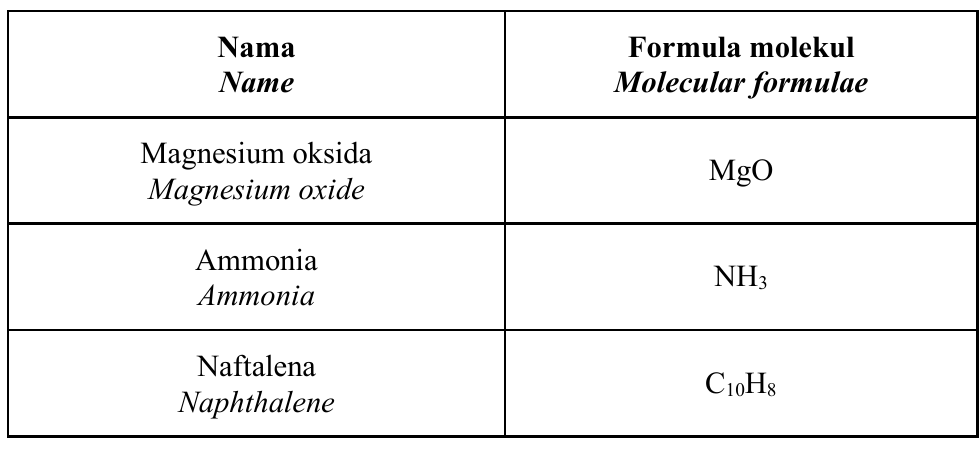
- (a)(ii)
Based on Table 2, explain the solubility of ammonia in water.
[2] - (b)
Nitrogen and hydrogen react to form ammonia compound. Draw the formation of hydrogen bond for the compound formed.
[2] - (c)
Diagram 2 shows an experiment to compare the physical property of two compounds (molten sodium chloride and naphthalene heated in crucibles with carbon electrodes connected to a bulb). Based on Diagram 2, compare the electrical conductivity of both compounds. Explain your answer.
[2]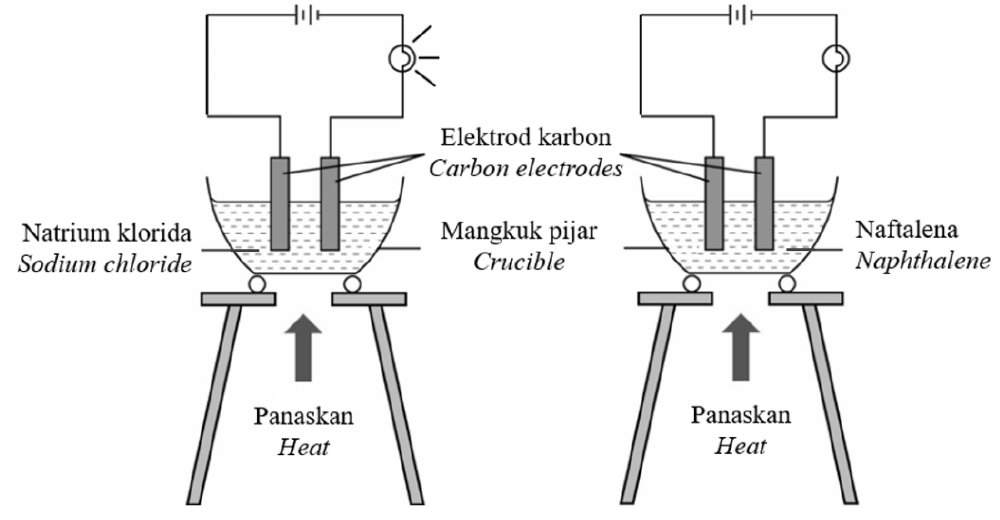
Table 3 shows the composition and uses of three types of alloys. Brass: 70% copper, 30% zinc, use P. Alloy Q: 90% copper, 10% tin, use: trophy. Duralumin: 93% aluminium, 3% copper, 3% magnesium, 1% manganese, use: racing bicycle.
Medium8 marks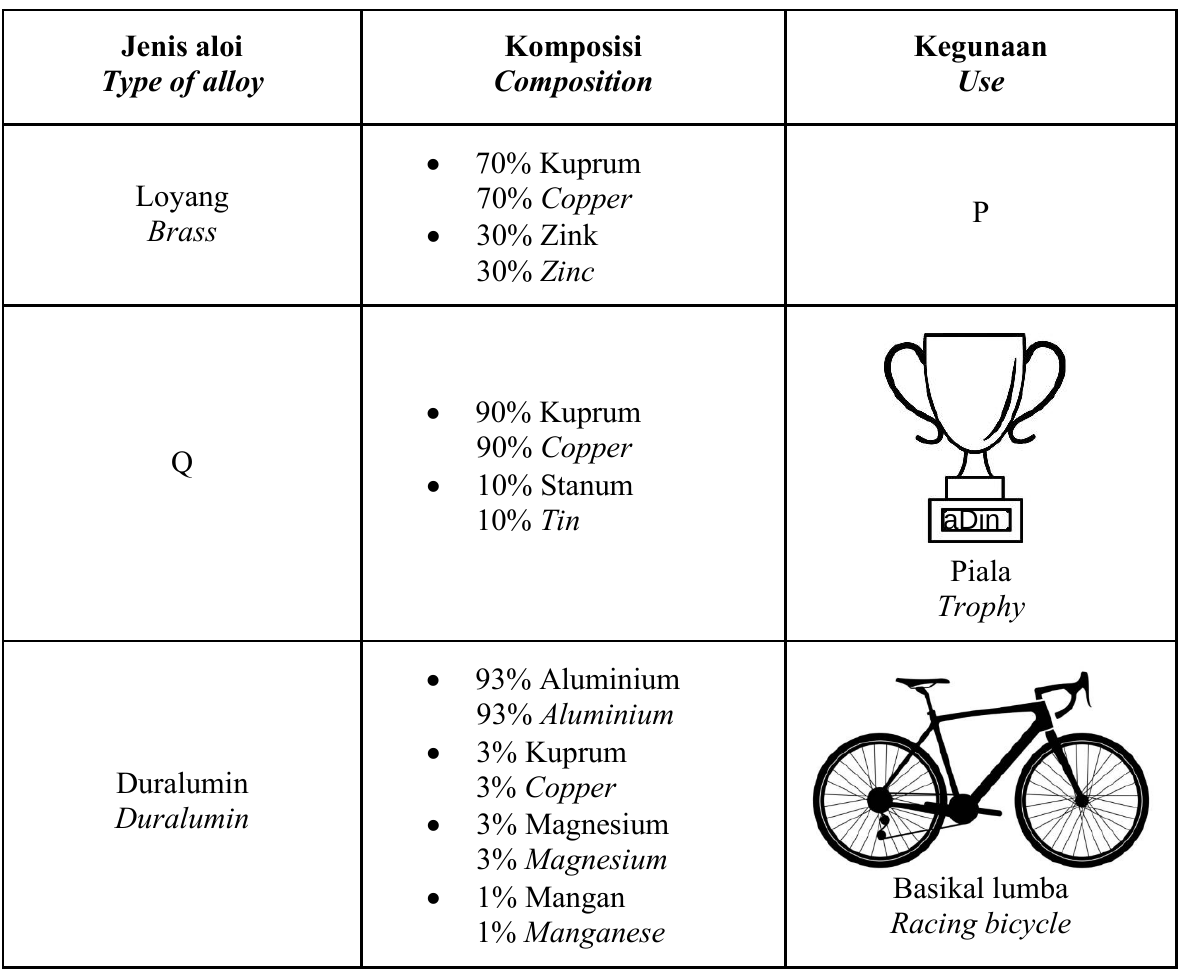
- (a)(i)
Based on Table 3, suggest P.
[1] - (a)(ii)
State the name of alloy Q.
[1] - (b)
You are given a brass trophy and a trophy Q. Every trophy has the same mass of 400 g. Calculate the mass of copper in each of the trophy.
[2] - (c)
Alex Yoong is a national car racer. Suggest a type of alloy that is suitable to manufacture his racing car. Give your reason.
[2] - (d)
Diagram 3 shows the diameter of the dents of the copper and brass blocks of an experiment to study the hardness of pure metal and alloy. Explain why the diameter of the dent formed on the brass block is smaller.
[2]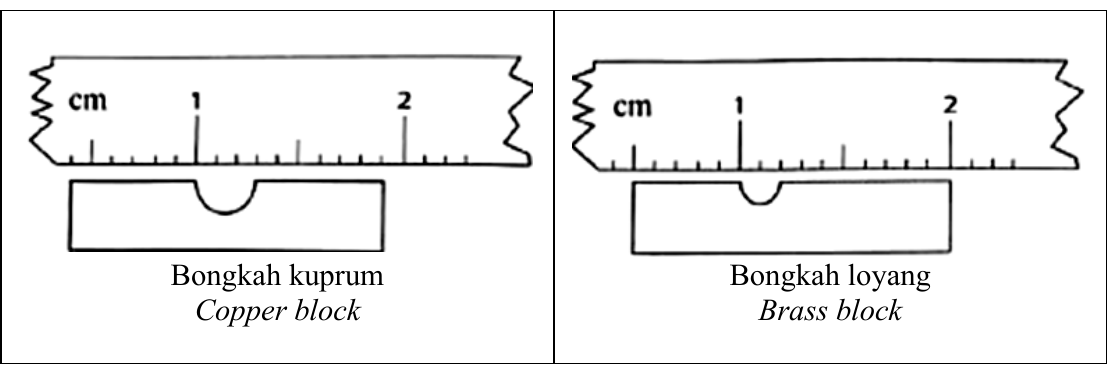
Table 4 shows Experiment I and Experiment II in the preparation of salt. Experiment I: sulphuric acid is added from a burette to 20.0 cm³ of 0.5 mol dm⁻³ potassium hydroxide solution + phenolphthalein in a conical flask. Experiment II: 25 cm³ of 0.5 mol dm⁻³ lead(II) nitrate solution is mixed with 25 cm³ of 0.5 mol dm⁻³ potassium iodide solution to give solution S and salt T.
Hard9 marks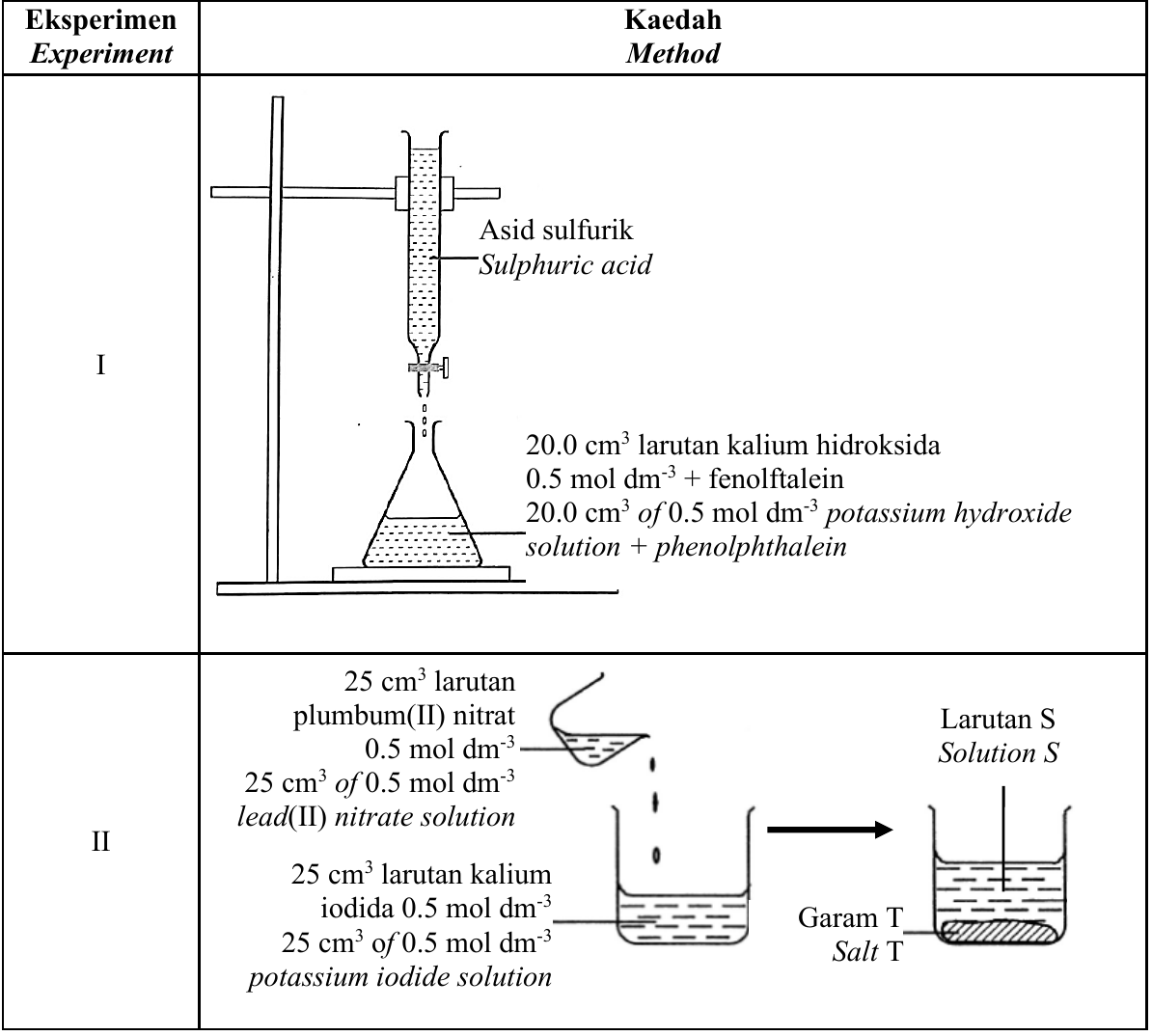
- (a)(i)
Based on Experiment I, write the chemical equation for the reaction that takes place.
[2] - (a)(ii)
State the name of salt formed in the conical flask.
[1] - (a)(iii)
State one example of salt that can be prepared through this method.
[1] - (b)(i)
Based on Experiment II, state the name of the reaction for the preparation of salt T.
[1] - (b)(ii)
State the colour of salt T.
[1] - (c)
Describe briefly the confirmatory test of anion of solution S.
[3]
Diagram 4.1 shows a series of reactions that occurred on butene. Butene + hydrogen gas (180 °C, Ni) gives compound W. Reaction I (300 °C, 60 atm, H₃PO₄) gives compound Y. Reaction II of compound Y + compound Z gives butyl ethanoate (banana smell).
Medium10 marks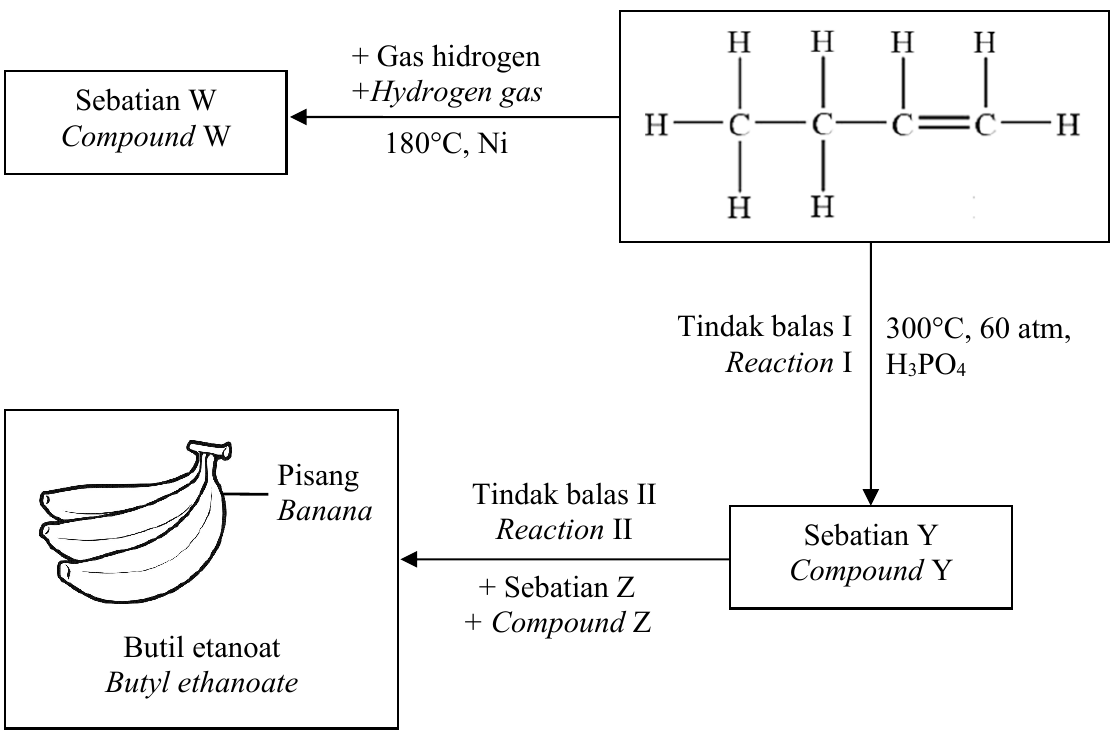
- (a)(i)
State the name of reaction I.
[1] - (a)(ii)
State the functional group for compound Y.
[1] - (a)(iii)
Draw structural formula of one of the isomers of compound Y.
[1] - (b)(i)
State compound Z.
[1] - (b)(ii)
Write a chemical equation to produce butyl ethanoate.
[2] - (b)(iii)
Suggest a product in the food manufactured industry that used butyl ethanoate.
[1] - (c)(i)
State the chemical formula for compound W.
[1] - (c)(ii)
Diagram 4.2 shows that the surface of Mrs. Salma's pot has turned black after using unsuitable fuel. In your opinion, between butene and compound W, which is more suitable to be used as fuel for cooking at home? Explain your answer.
[2]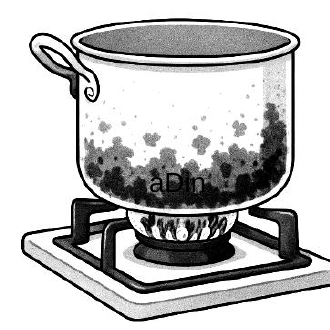
Diagram 5.1 shows the structural formula of two types of polymers and their uses in daily life. Polymer X: repeating unit –[CH₂–CH(CH₃)]ₙ– (drinking straw). Polymer Y: repeating unit –[CH₂–C(CH₃)=CH–CH₂]ₙ– (glove).
Medium10 marks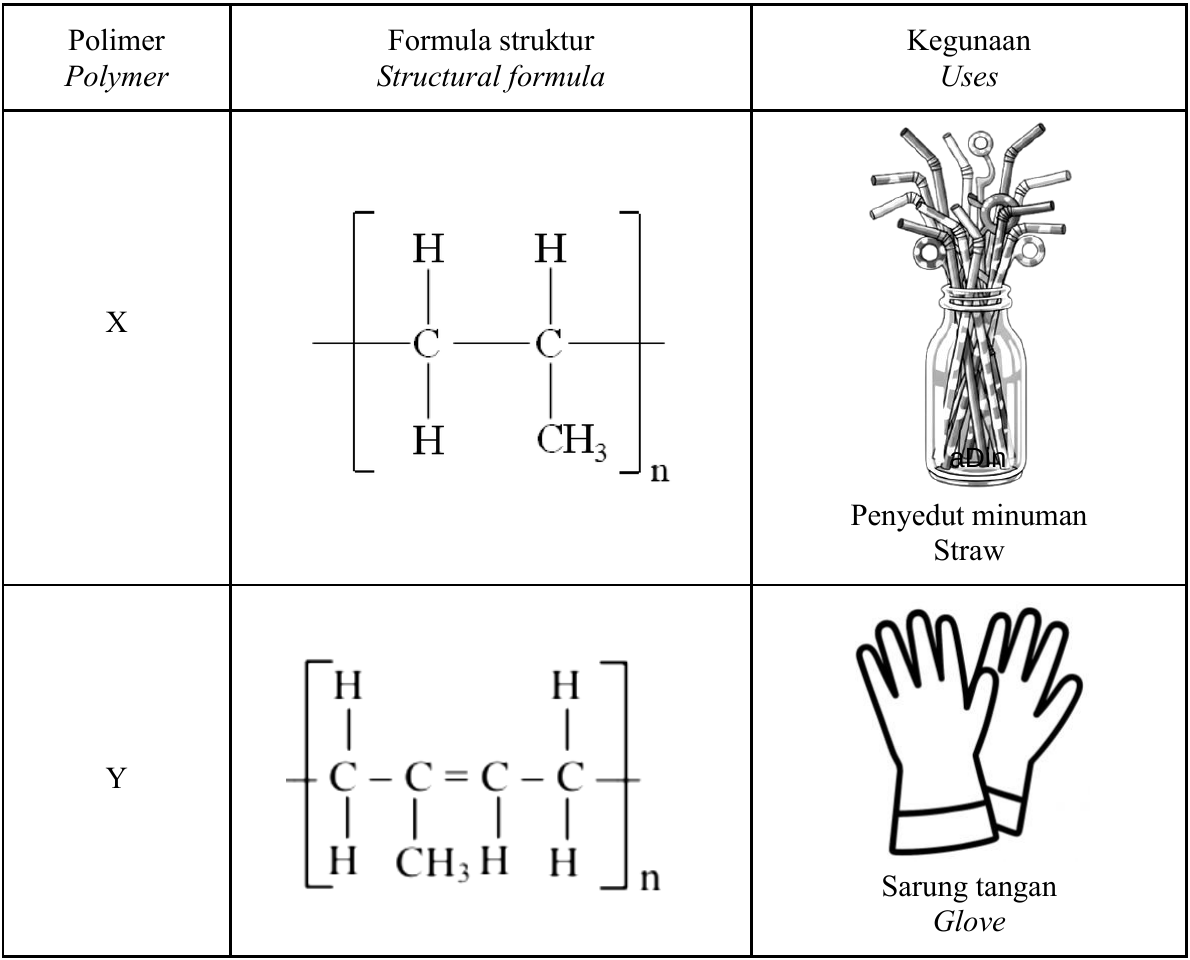
- (a)
What is meant by polymer?
[1] - (b)
Draw the structural formula of the monomer that forms polymer X.
[1] - (c)
Based on Diagram 5.1, which polymer is more environmentally friendly? Explain your answer.
[2] - (d)
Rubber gloves made from polymer Y easily tear when stored for too long. Explain why this happens and suggest one way to improve the production of gloves.
[2] - (e)(i)
Diagram 5.2 shows a campaign poster for reducing the use of drinking straws made from polymer X in a restaurant, in support of the government's Green Technology initiative. As a student with knowledge of Green Technology, justify the action of the restaurant owner.
[3]
- (e)(ii)
Suggest one type of eco-friendly drinking straw as an alternative to drinking straws made from polymer X.
[1]
Section B
Answer part (a) and (b). Table 5 shows the chemical formulae for two oxides of vanadium: compound P, VO; compound Q, V₂O₅. Diagram 6 shows the apparatus set-up of an experiment to investigate the transfer of electrons at a distance for a redox reaction (a U-tube containing dilute sulphuric acid, with carbon electrodes X in acidified potassium manganate(VII) solution and Y in iron(II) sulphate solution, connected to a galvanometer).
Hard20 marks- (a)(i)
Based on Table 5, state two special characteristics of vanadium element.
[2] - (a)(ii)
State the name for both compounds based on the IUPAC nomenclature system. Explain your answers.
[4] - (a)(iii)
Solid Q reacts with hydrogen gas to form vanadium(III) oxide and water. Based on the statement, write the chemical equation, determine the substance that is oxidised and the substance that is reduced.
[4] - (b)(i)
Based on Diagram 6, state the meaning of redox reaction.
[1]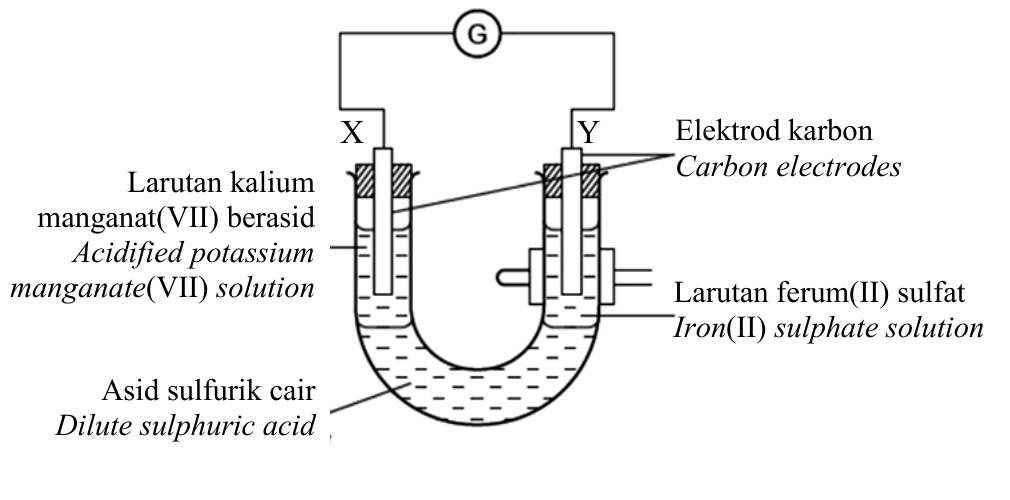
- (b)(ii)
Identify positive terminal and negative terminal.
[2] - (b)(iii)
State the direction of electron flow.
[1] - (b)(iv)
State the observation at positive terminal and negative terminal.
[2] - (b)(v)
Write half equation for the reaction at positive terminal and negative terminal.
[2] - (b)(vi)
Describe briefly the chemical test to identify the presence of ions formed at the negative terminal.
[2]
Hana conducted an experiment to study the rate of reaction between excess calcium carbonate and hydrochloric acid. Gas X liberated was collected in a gas syringe and its volume was recorded in Table 6.1 at 1 minute intervals for 6 minutes. Time (min): 0.0, 1.0, 2.0, 3.0, 4.0, 5.0, 6.0. Volume of gas X (cm³): 0.0, 25.0, 40.0, 51.0, 59.0, 65.0, 65.0. Table 6.2 shows three sets of experiments. Set I: excess calcium carbonate powder + 25 cm³ of 0.5 mol dm⁻³ hydrochloric acid, 7.0 min to collect 70 cm³ gas. Set II: excess calcium carbonate chips + 25 cm³ of 0.5 mol dm⁻³ hydrochloric acid, 12.0 min. Set III: excess calcium carbonate powder + 25 cm³ of 0.5 mol dm⁻³ ethanoic acid, 14.0 min.
Medium20 marks- (a)(i)
State the meaning of rate of reaction.
[1]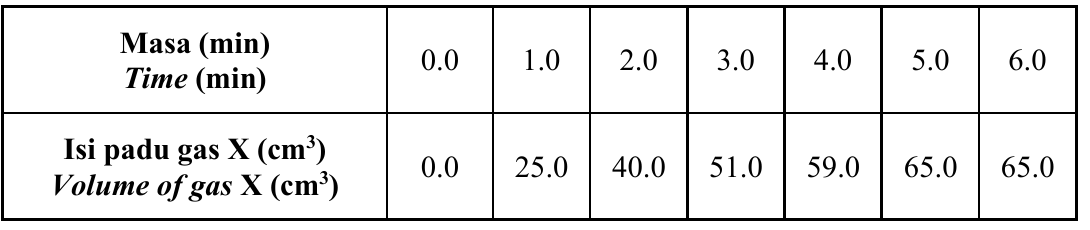
- (a)(ii)
State the name of gas X formed in this experiment.
[1] - (a)(iii)
Based on Table 6.1, draw a graph of the volume of gas against time on the graph paper on page 28 and calculate: the average rate of reaction for the overall reaction; the rate of reaction at the second minute.
[8] - (b)(i)
Using the Collision Theory, compare the rate of reaction between Set I and Set II.
[5]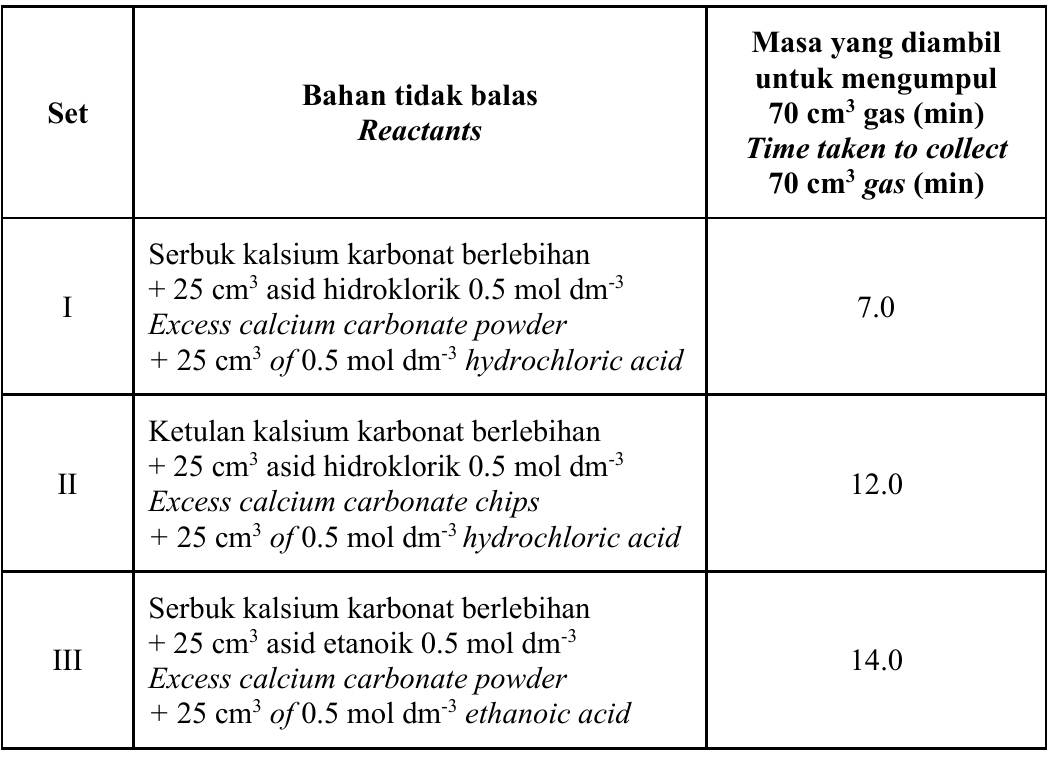
- (b)(ii)
Using the Collision Theory, compare the rate of reaction between Set I and Set III.
[5]
Section C
The reaction between nitrogen gas and oxygen gas shown in the thermochemical equation N₂(g) + O₂(g) → 2NO(g), ΔH = +180 kJ mol⁻¹ is an endothermic reaction.
Medium20 marks- (a)
What is meant by endothermic reaction?
[1] - (b)
Diagram 7.1 shows a list of chemical reactions: dissolve ammonium sulphate into water; dissolve sodium hydroxide into water; reaction between sodium carbonate with hydrochloric acid; reaction between sodium hydrogen carbonate with hydrochloric acid. Classify all the chemical reactions in Diagram 7.1 to endothermic reaction and exothermic reaction.
[2] - (c)(i)
Diagram 7.2 shows apparatus set-up to determine heat of precipitation of magnesium carbonate (50 cm³ of 1.0 mol dm⁻³ potassium carbonate solution added to 50 cm³ of 1.0 mol dm⁻³ magnesium nitrate solution in a polystyrene cup). Table 7: initial temperature of magnesium nitrate solution 29.0 °C; initial temperature of potassium carbonate solution 30.0 °C; lowest temperature of mixture 27.0 °C. Write the ionic equation involved.
[2]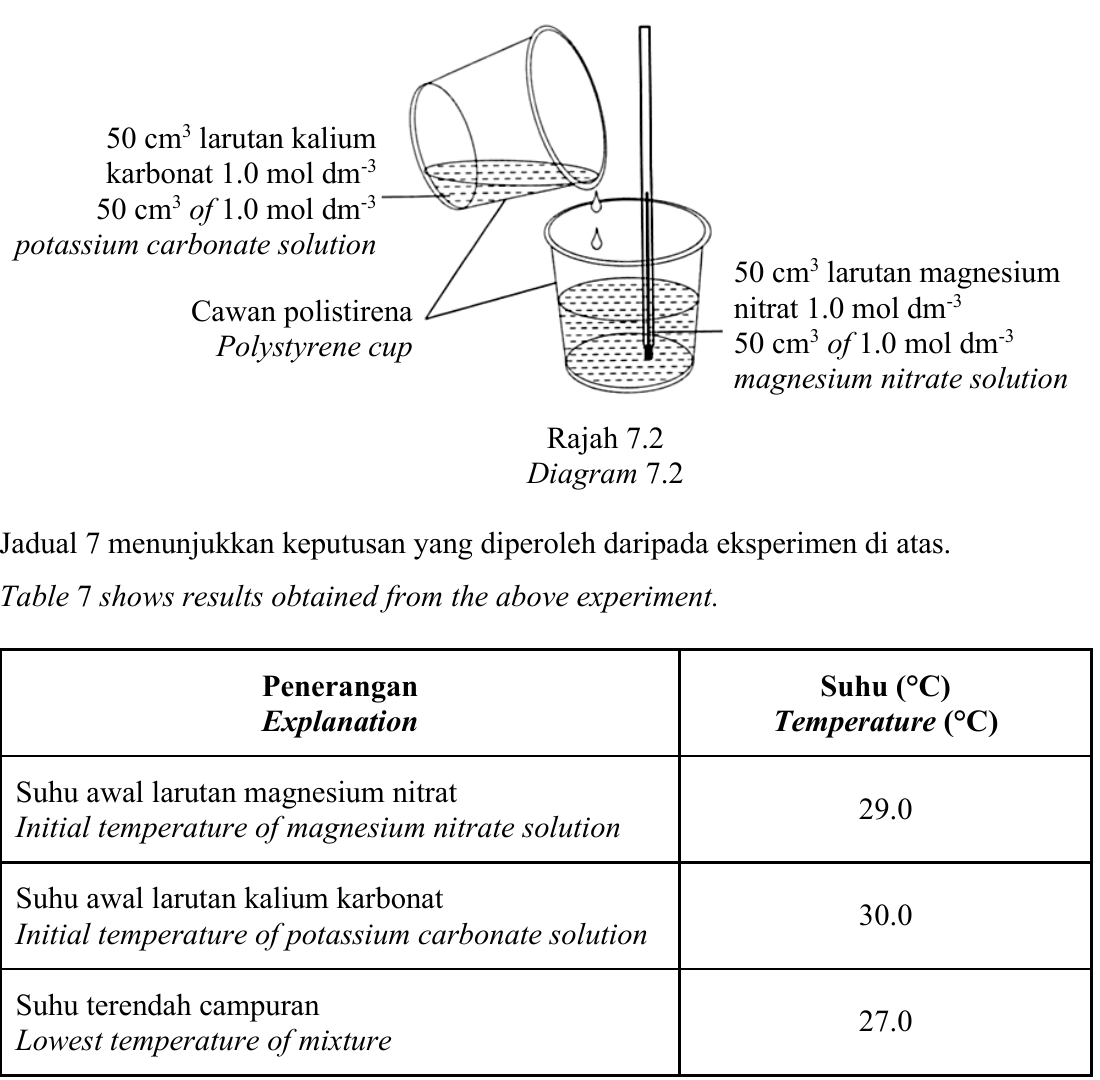
- (c)(ii)
Calculate the heat change in the reaction. [Specific heat capacity, c = 4.2 J g⁻¹ °C⁻¹; density of solution = 1 g cm⁻³]
[2] - (c)(iii)
Calculate the heat of precipitation of magnesium carbonate.
[3] - (d)
The experiment is repeated by using 50 cm³ of 1.0 mol dm⁻³ sodium carbonate solution to replace potassium carbonate solution. Predict the heat of precipitation that will be obtained. Explain your answer.
[3] - (e)
Aqif's leg was sprained when he walked down the staircase at home. Aqif remembered that he learned about using a cold pack to ease the pain of his swollen leg. Suggest two materials which can be obtained at home to make a cold pack. Describe the method to produce the cold pack by using the suggested materials.
[7]