Write your answer on paper. Then open the answer to check it.
Section A
Diagram 1 shows the electron arrangement for the compound formed between sodium ion, Na+ and oxide ion, O2-.
Medium5 marks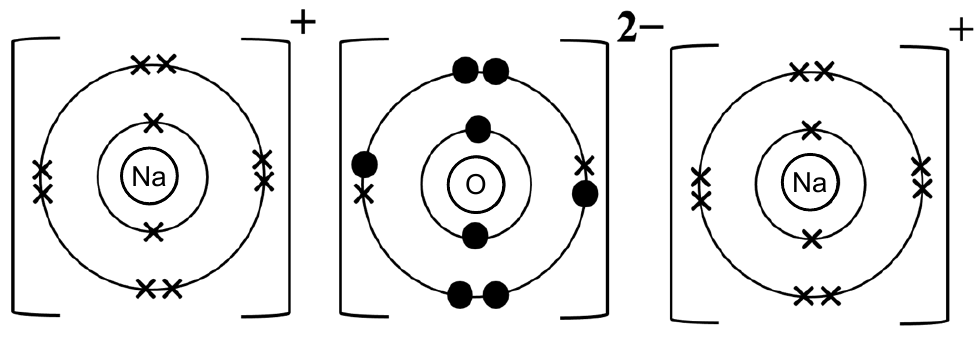
- (a)
Based on Diagram 1, state the type of bond for the compound formed.
[1] - (b)
Write the chemical formula for the compound.
[1] - (c)
State force of attraction that exists between sodium ion, Na+ and oxide ion, O2-.
[1] - (d)
Explain briefly how the compound in Diagram 1 is formed.
[2]
Diagram 2 shows the trophy won by Azrul in the National Chess Competition. This trophy is made of alloy X with the main composition is copper.
Medium5 marks
- (a)(i)
State the type of alloy X.
[1] - (a)(ii)
Draw and label the arrangement of atoms in the alloy stated in a(i).
[2] - (b)
Car bumpers are one of the composite materials that are lightweight and have high tensile strength. State the matrix substance and strengthening substance for the composite substance.
[2]
Table 1 shows three substances and their chemical formulae. Substance | Chemical formula Sodium | Na Chlorine | Cl2 X | ......
Medium6 marks- (a)(i)
Mark ✓ for the type of particles found in sodium. Options: Atom / Molecule / Ion.
[1] - (a)(ii)
Melting point and boiling point of chlorine are -101.0 °C and -34.0 °C respectively. What is the physical state of chlorine at 27.0 °C?
[1] - (b)(i)
Compound X is formed when sodium reacts with chlorine. Write a chemical equation for the reaction.
[2] - (b)(ii)
Calculate the mass of sodium needed to completely react with 2 mol of chlorine. [Molar mass X = 58 g mol-1]
[2]
Diagram 3 shows part of the Periodic Table of Elements. (P is a Group 1 element in Period 3; R is in Group 18, Period 1; T is a Group 17 element in Period 3.)
Medium7 marks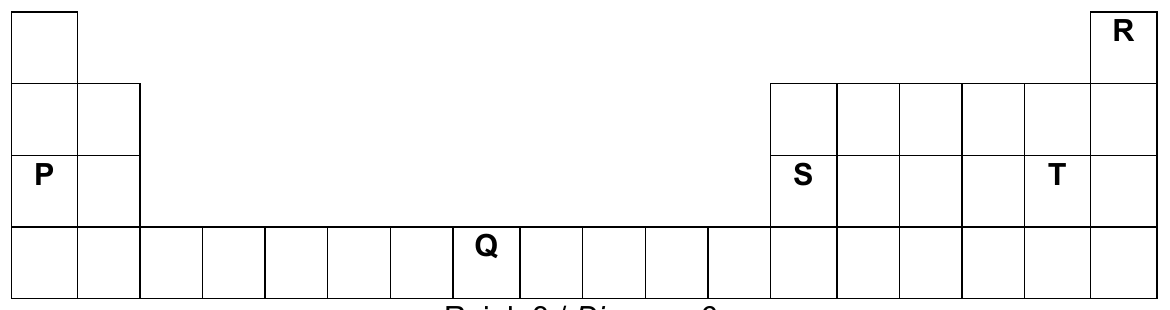
- (a)(i)
Which element is a monoatomic gas?
[1] - (a)(ii)
Compare the size between atom P and T. Give a reason.
[2] - (b)(i)
Write the chemical equation for the reaction between element P and water.
[2] - (b)(ii)
0.5 mol of element P reacts with water. Calculate the volume of gas released. [Molar volume of gas at room condition: 24 dm3 mol-1]
[2]
Diagram 4 shows the decomposition of solid M to solid copper(II) oxide and gas N: Solid M → (Reaction 1) → solid copper(II) oxide + gas N.
Medium8 marks- (a)(i)
State the colour of copper(II) oxide.
[1] - (a)(ii)
Identify Solid M.
[1] - (b)(i)
How is Reaction 1 carried out?
[1] - (b)(ii)
Write a balanced chemical equation for this reaction.
[1] - (b)(iii)
Draw a labelled diagram for Reaction 1.
[2] - (c)
Describe briefly the confirmatory test for gas N.
[2]
Table 2 shows the information on two sets of experiments conducted to study the factor that affects the rate of reaction. Experiment I: 100 cm3 of 0.5 mol dm-3 sodium thiosulphate solution + excess 1.0 mol dm-3 nitric acid at 40 °C. Time taken for the mark 'X' to disappear from sight: 50 s. Experiment II: 100 cm3 of 0.5 mol dm-3 sodium thiosulphate solution + excess 1.0 mol dm-3 nitric acid at 60 °C. Time taken: 30 s.
Medium9 marks- (a)
What is meant by rate of reaction?
[1] - (b)
Why does the product of the mixture in this reaction turn cloudy?
[1] - (c)(i)
Calculate the rate of reaction for Experiment I.
[1] - (c)(ii)
Write a balanced ionic equation for the reaction in the experiment.
[2] - (d)(i)
Predict the time taken for mark 'X' to disappear from sight if 1.0 mol dm-3 sodium thiosulphate solution is used in Experiment II without changing the temperature and the volume.
[1] - (d)(ii)
Explain your answer in (d)(i) using collision theory.
[3]
Question on cleaning agents, coagulation of latex, types of cosmetics and food colouring.
Medium10 marks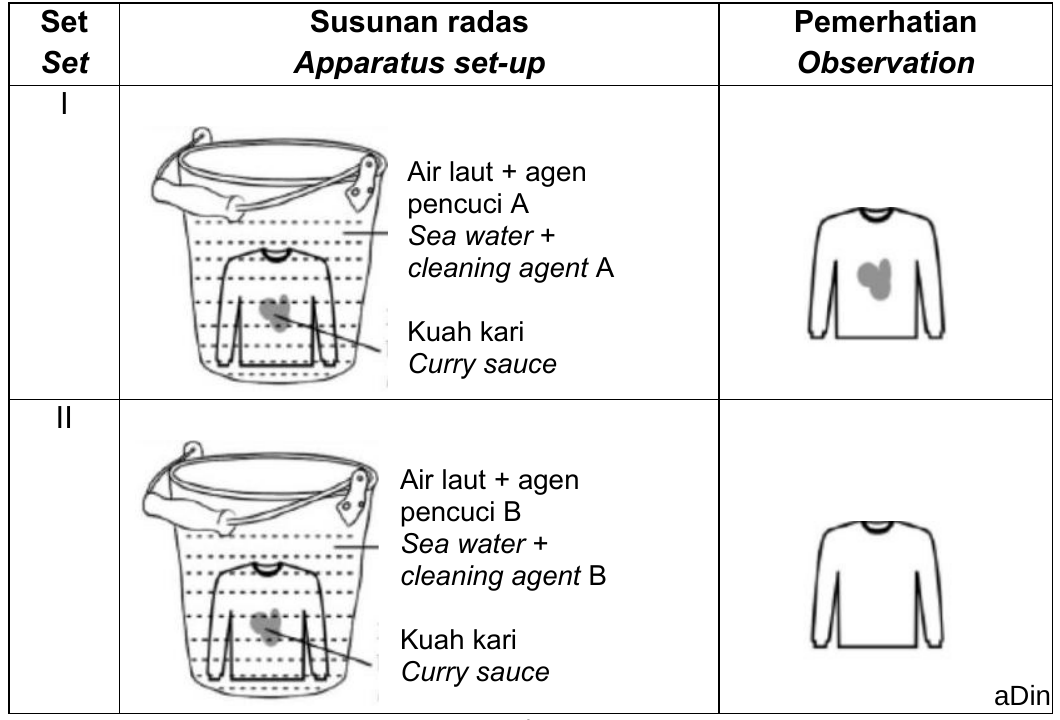
- (a)(i)
Diagram 5 shows the effect of cleaning agents A and B on clothes stained by curry sauce (Set I: sea water + cleaning agent A, the stain remains; Set II: sea water + cleaning agent B, the stain is removed). The formation of scum occurs when sea water reacts with cleaning agent A. State the name of two ions in sea water that cause scum formation.
[1] - (a)(ii)
Based on Diagram 5, state the type of cleaning agent B.
[1] - (b)
Table 3 shows the results when solution X and solution Y were added to latex after leaving it for 15 minutes. Latex + solution X: latex coagulates. Latex + solution Y: latex does not coagulate. Suggest solution X and solution Y. Explain the differences between the two sets.
[3] - (c)
Table 4 shows three types of cosmetics along with their uses. Type of cosmetic | Use: R | To give fragrance; Makeup cosmetics | S; T | To treat the body. Based on Table 4, write the answers for R, S and T.
[3] - (d)
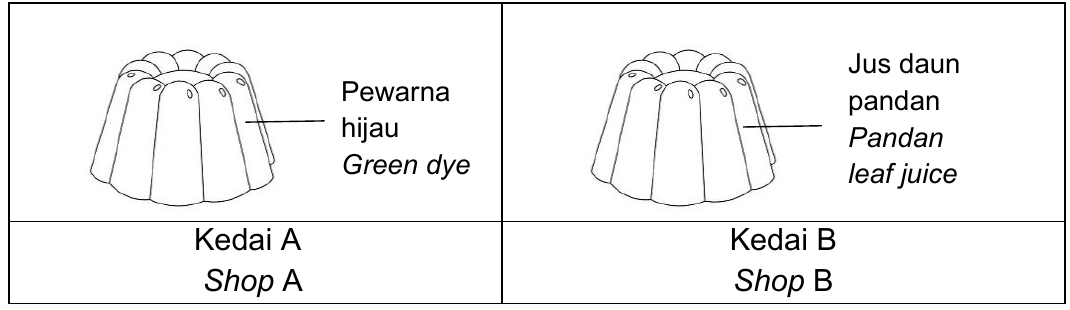
Mrs. T plans to buy pudding for her son's birthday party. Diagram 6 shows the types of colouring used for pudding sold in two shops (Shop A: green dye; Shop B: pandan leaf juice). Justify the choices that Mrs. T can make. Give a reason.
[2]
Diagram 7 shows the structural formula for three carbon compounds: compound A (CH2=CH-CH2-CH3, but-1-ene), compound B (butan-1-ol, CH3CH2CH2CH2OH) and compound C (ethanoic acid, CH3COOH).
Medium10 marks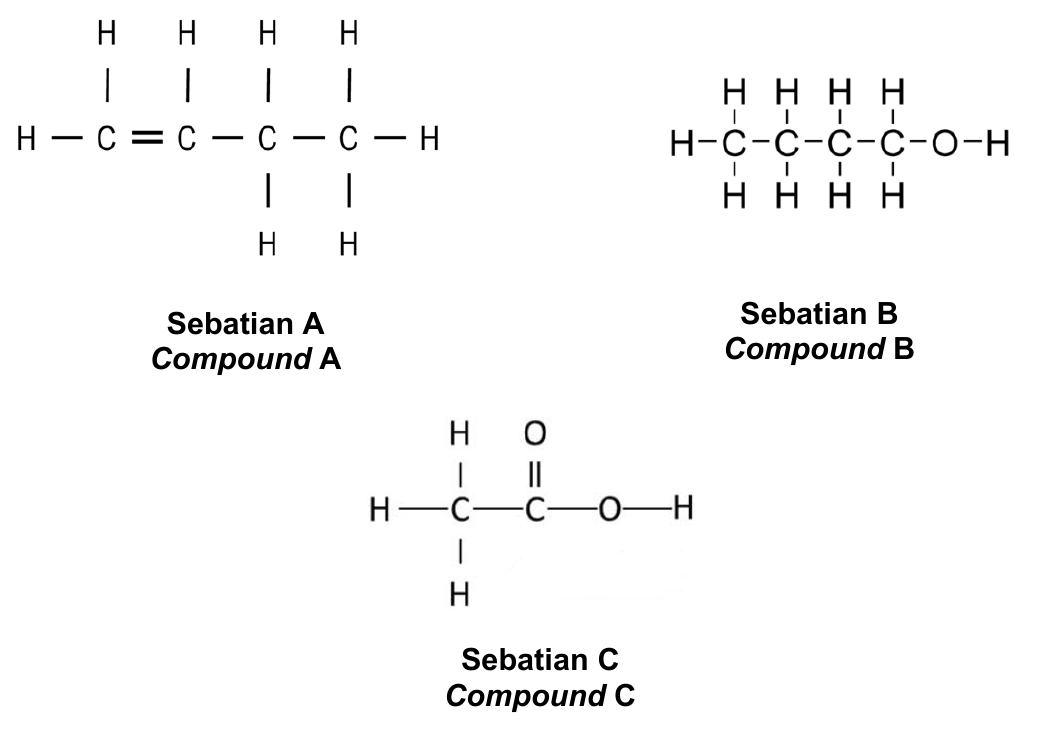
- (a)
What is meant by carbon compound?
[1] - (b)
State the functional group for compound A.
[1] - (c)(i)
Compound A can be converted to compound B through process I. State the name for process I.
[1] - (c)(ii)
State one condition that must be used to carry out process I.
[1] - (c)(iii)
Draw the structural formula for one isomer of compound A.
[1] - (d)(i)
Compound B burns with a blue flame. Write the chemical equation for the combustion.
[2] - (d)(ii)
Compounds B and C can be reacted to form a carbon compound that is less dense than water. Describe briefly how the reaction can be carried out in the laboratory.
[3]
Section B
Diagram 8 shows a set of experiments carried out by students to determine the heat of precipitation for precipitate X: 100 cm3 of 1.0 mol dm-3 potassium iodide solution (26.0 °C) is mixed with 100 cm3 of 1.0 mol dm-3 lead(II) nitrate solution (27.0 °C). The lowest temperature of the mixture is 25.0 °C, and precipitate X forms. (Answer only one question from Section B.)
Hard20 marks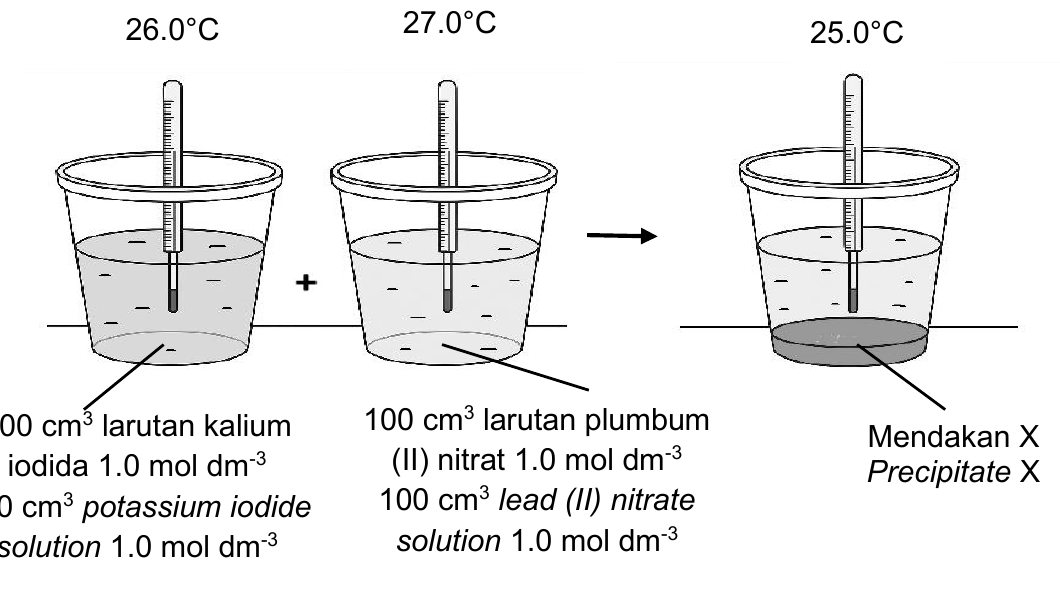
- (a)(i)
What is meant by heat of precipitation? Write the chemical formula of potassium iodide.
[2] - (a)(ii)
State the type of the reaction. What is the colour of precipitate X?
[2] - (b)
Write the ionic equation for the reaction. Calculate the heat of precipitation for precipitate X in the experiment. [Specific heat capacity of solution, c = 4.2 J g-1 °C-1; density of solution = 1 g cm-3]
[6] - (c)
Table 5 shows information about three types of fuel that can be used for domestic heating during camping activities. Substance | Chemical formula | Heat of combustion (kJ mol-1) Butane | C4H10 | 2877 Kerosene | C12H26 | 6100 Gasoline | C8H18 | 5460 Based on Table 5, choose the best substance to use in terms of fuel value and explain your answer. Show the calculation steps to support your choice. Write the chemical equation for the combustion of the substance. [Relative atomic mass: C = 12, H = 1]
[10]
Question on alkali and soap, ionisation of acid X formed from gas X in water, pH value, treating a jellyfish sting and the strength and basicity of acids. (Answer only one question from Section B.)
Hard20 marks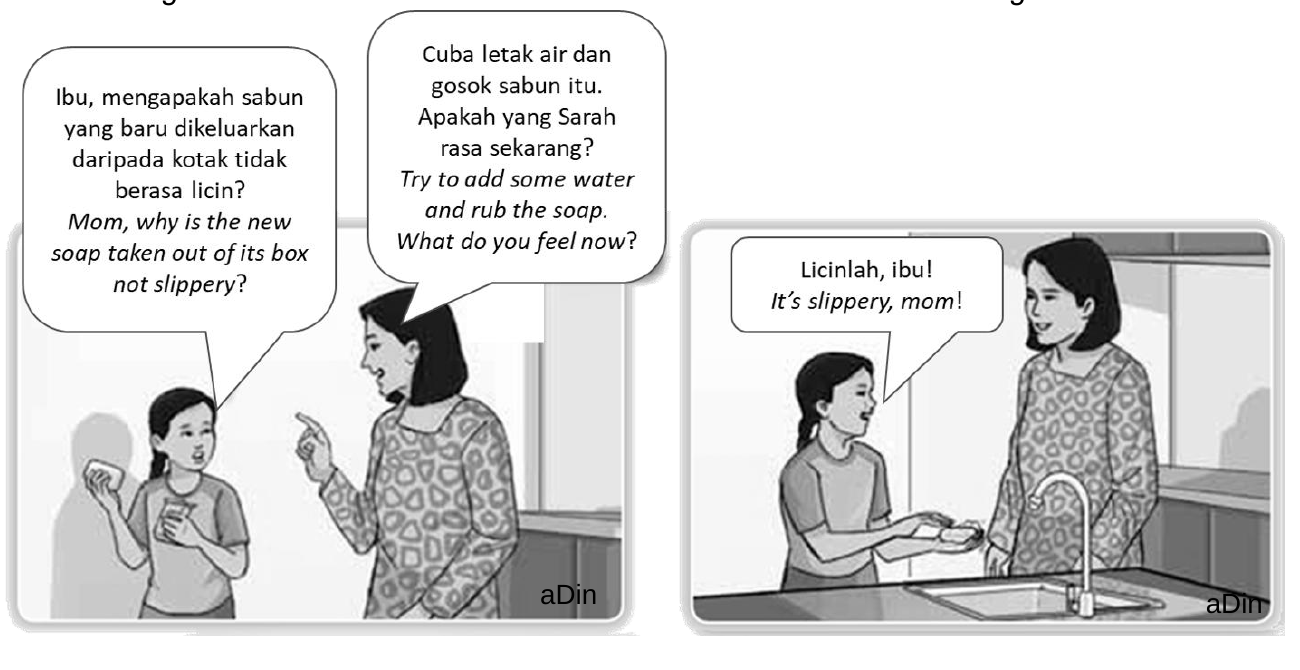
- (a)
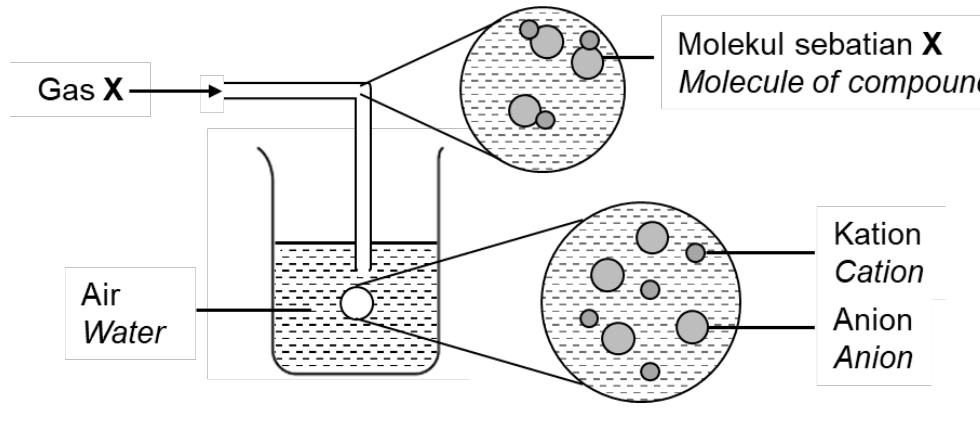
Diagram 9.1 shows a conversation between a mother and her daughter (a new soap from its box is not slippery; after adding water and rubbing the soap it is slippery). Based on Diagram 9.1, state the meaning of alkali. State the ion that causes the alkaline properties of soap.
[2] - (b)(i)
Diagram 9.2 shows the ionisation of acid X in water, formed from gas X. Identify acid X. State the cation and anion for the acid.
[2] - (b)(ii)
If the concentration of acid X is 0.1 mol dm-3, calculate the pH value of acid X.
[2] - (c)
The sting of a jellyfish is alkaline and causes pain. Suggest one substance that can be applied to the skin without causing further injury. Explain your answer.
[4] - (d)
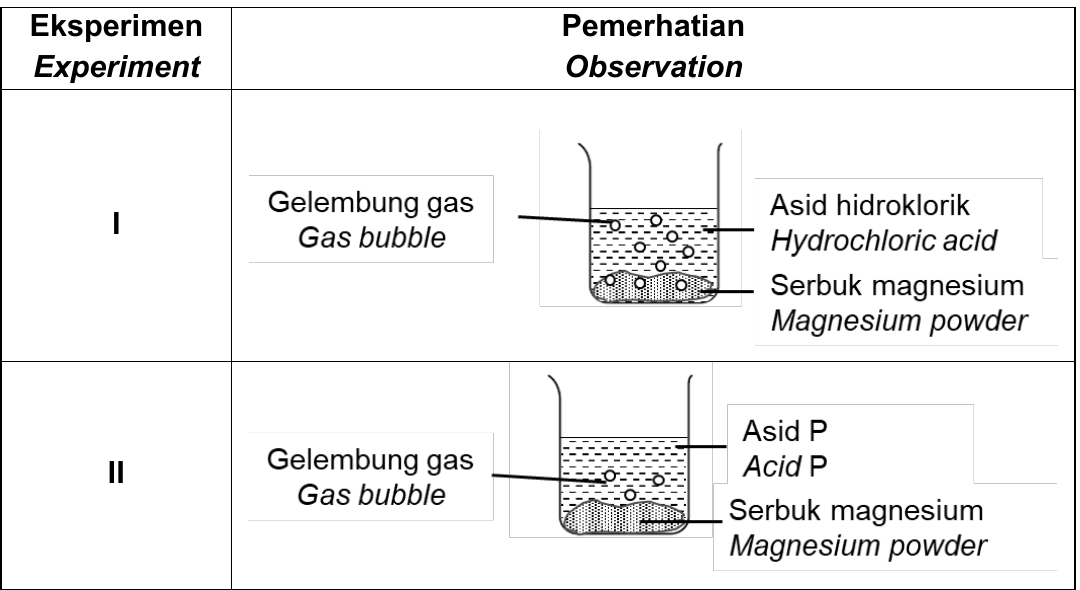
Diagram 9.3 shows the observations on the reaction between two types of acids and magnesium powder in two experiments. Experiment I: hydrochloric acid + magnesium powder, many gas bubbles. Experiment II: acid P + magnesium powder, fewer gas bubbles. Based on the information in Diagram 9.3, suggest acid P and identify the gas produced. Explain the difference in observations between Experiment I and II.
[5] - (e)
Table 6 shows the pH value of two acids with the same concentration. Acid Y: strong acid, pH 2.0. Acid Z: strong acid, pH 1.0. Using one named example for each acid, explain the difference in pH value between acid Y and acid Z.
[5]
Section C
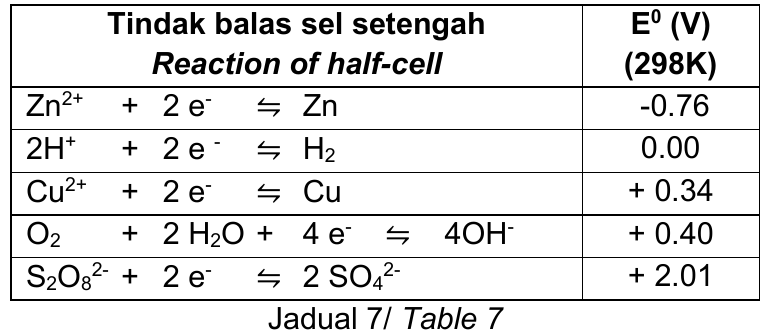
Diagram 10.1 shows an apparatus setup used to electroplate a rusted iron ring: Cell I (zinc in 1.0 mol dm-3 zinc sulphate solution joined by dilute sulphuric acid salt bridge to copper in 1.0 mol dm-3 copper(II) sulphate solution, with a voltmeter) is connected to Cell II (copper anode and iron ring cathode in 1.0 mol dm-3 copper(II) sulphate solution). Table 7 shows part of the standard electrode potential values. Half-cell reaction | E0 (V) at 298 K Zn2+ + 2e- ⇌ Zn | -0.76 2H+ + 2e- ⇌ H2 | 0.00 Cu2+ + 2e- ⇌ Cu | +0.34 O2 + 2H2O + 4e- ⇌ 4OH- | +0.40 S2O8²⁻ + 2e- ⇌ 2SO4²⁻ | +2.01
Hard20 marks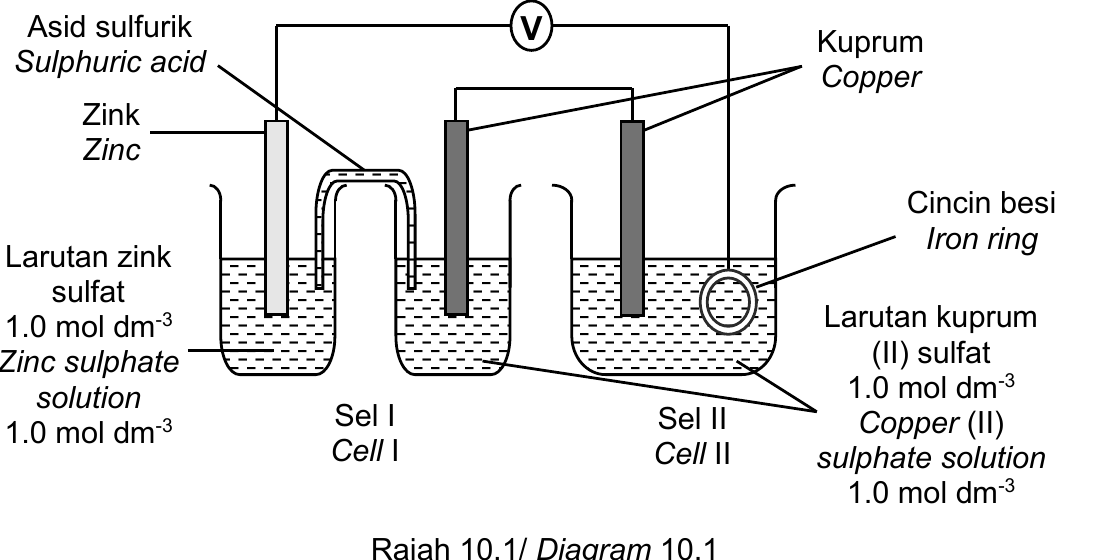
- (a)(i)
Based on Cell I, state the function of dilute sulphuric acid. Determine the negative terminal of Cell I and give a reason for your answer.
[3] - (a)(ii)
Write the cell notation for the cell and calculate the E0 cell produced.
[4] - (a)(iii)
Based on Cell II and Table 7, explain the reactions that occurred at the cathode based on: ions attracted; ion chosen to be reduced and reasons; observation; half equation.
[5] - (b)
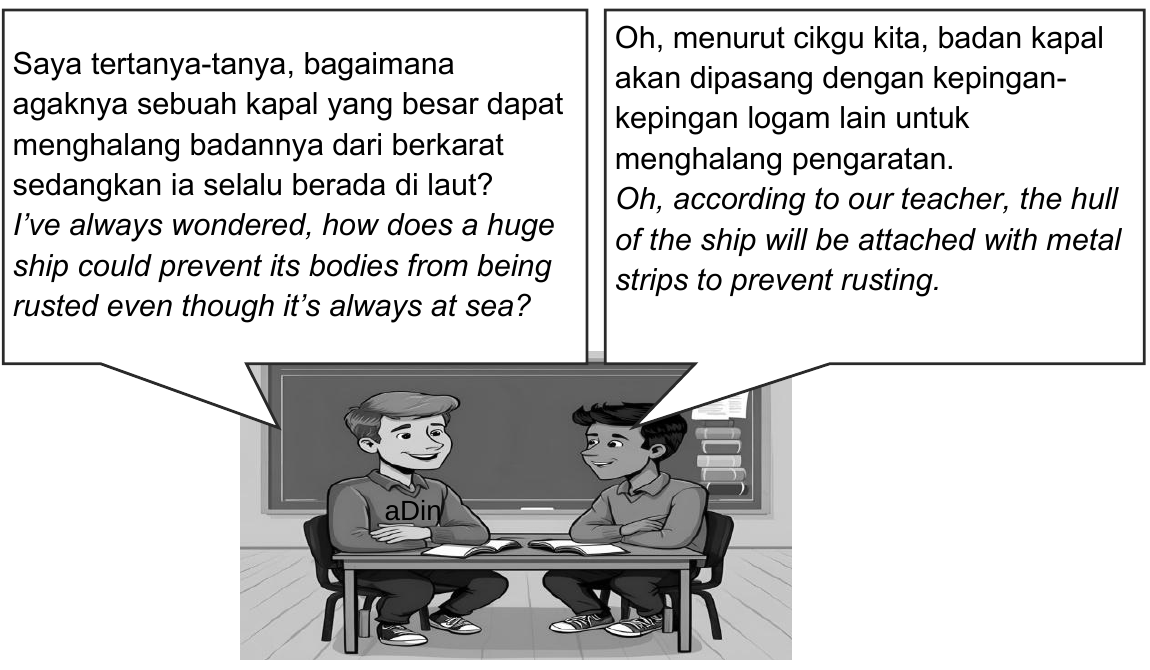
Diagram 10.2 shows the conversation between two students about a chemical reaction that occurred to a ship: the hull of the ship will be attached with metal strips to prevent rusting. Based on Diagram 10.2, describe a method that can be carried out in the laboratory, using suitable apparatus and materials, to prove the statement given.
[8]