Which of the following is not the symptom of mercury poisoning?
Medium
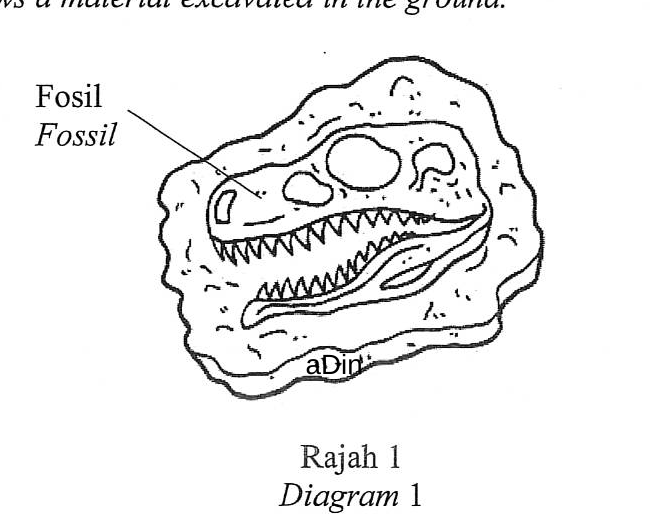
Diagram 1 shows a material excavated in the ground (a fossil). Which of the following isotopes is used to estimate the age of the material?
Easy
Which of the following is the IUPAC name for Cu2O?
Easy
Which of the following is a monoatomic gas?
Easy
Which of the following substances is a covalent compound?
Easy
Which of the following substances ionise partially in water?
Medium
Which of the following is a fast reaction?
Easy
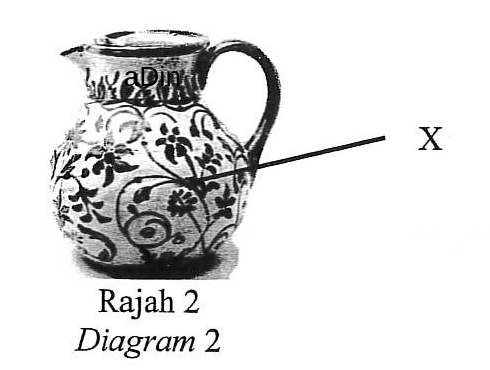
Diagram 2 shows a type of manufactured substance in industry (a decorated jug, X). What is X?
Easy
Solution Q is used to change iron(II) ion to iron(III) ion. What is Q?
Medium
Which of the following is true about the physical properties of alkene?
Easy
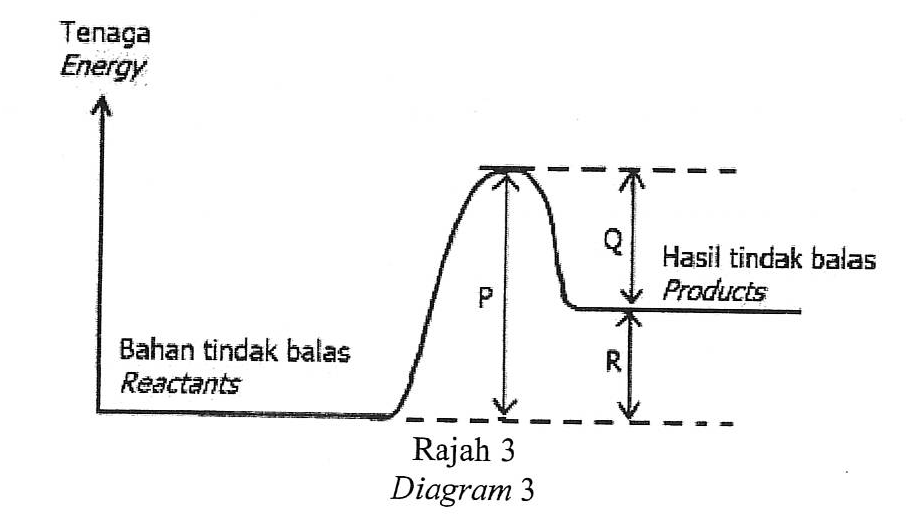
Diagram 3 shows an energy profile diagram (P, Q and R are marked as energy differences). Which of the following represents the heat of reaction?
Medium
Which polymer is correct for its source and monomer?
Medium
Diagram 4 shows an example of cosmetic (a lipstick). Which of the following shows the same type of cosmetic as Diagram 4?
Easy
Who discovered proton?
Easy
Compound Z is made up of lead(II) ion and hydroxide ion. Which of the following is the formula of compound Z?
Medium
Element Q is located in the same group as neon, Ne in the Periodic Table of Elements. Which of the following is true about element Q?
Medium
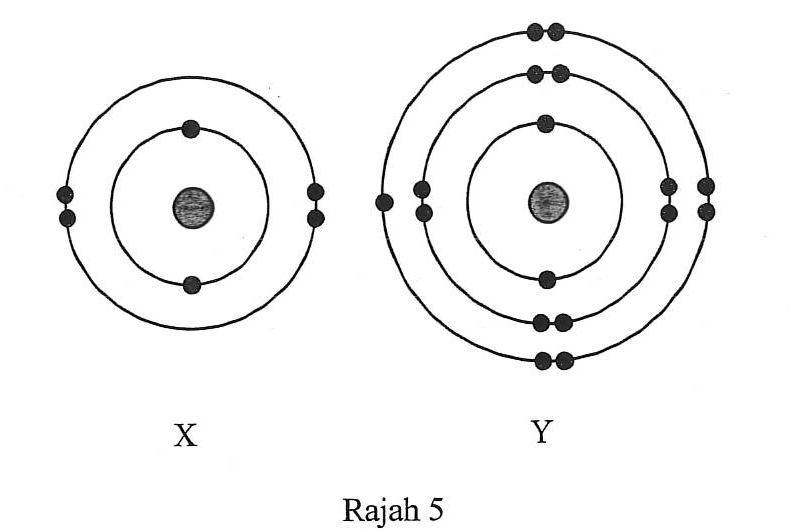
Diagram 5 shows the electron arrangement of atom X and atom Y. X and Y are not the actual symbols of the elements. Which pair of formula and the type of compound is correct?
Medium
A green colour salt produces a blue solution when dissolved in water. What is the name of the salt?
Medium
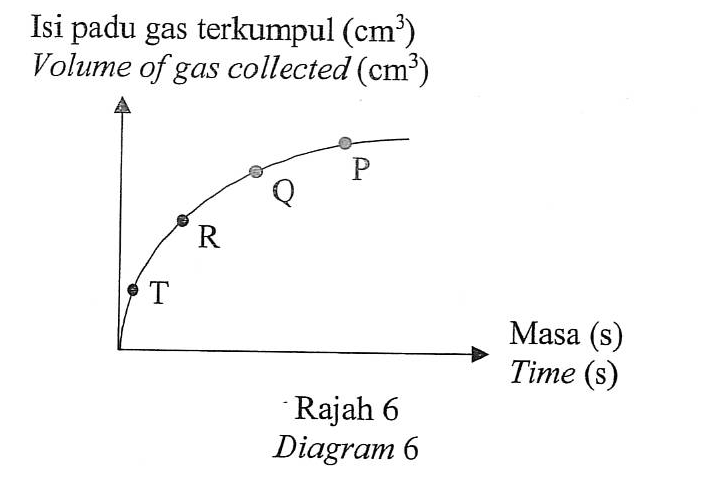
Diagram 6 shows a graph of gas collected from the reaction between calcium carbonate and hydrochloric acid. Which point shows the highest rate of reaction?
Medium
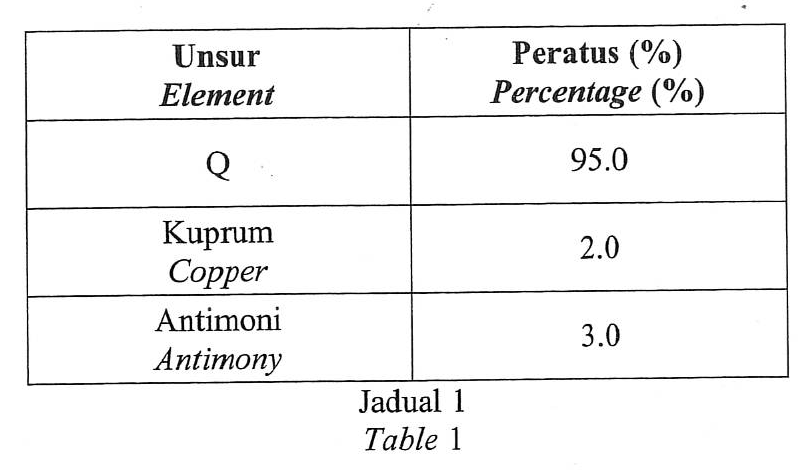
Table 1 shows the composition of pewter (Q 95.0%, copper 2.0%, antimony 3.0%). What is Q?
Easy
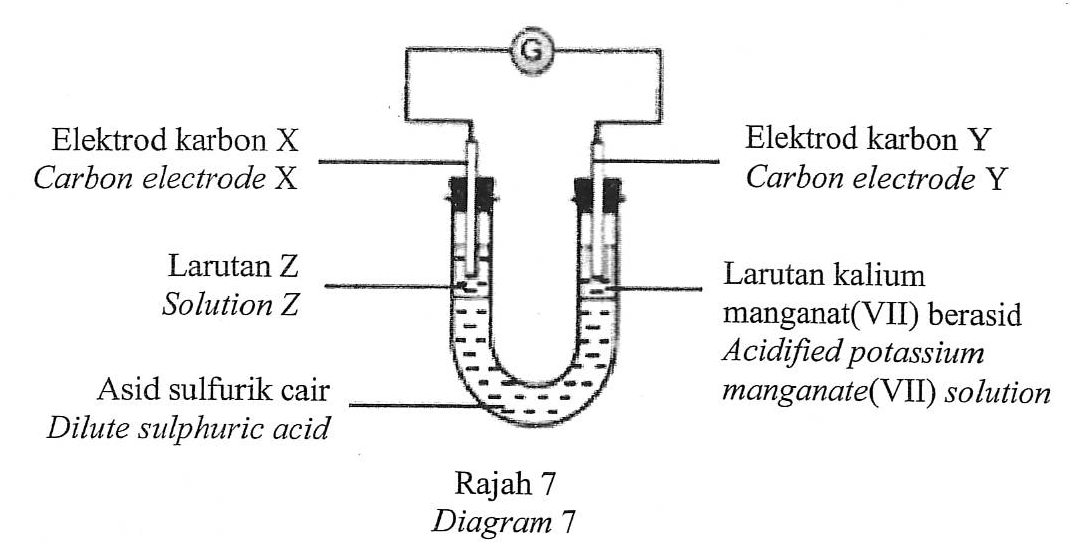
Diagram 7 shows the apparatus set-up to study transfer of electron at a distance. Deflection of galvanometer needle shows that electron move from carbon electrode X to Y. Which of the following substances are suitable as solution Z?
I Chlorine water
II Potassium bromide solution
III Iron(II) sulphate solution
IV Acidified potassium dichromate(VI) solution
Medium
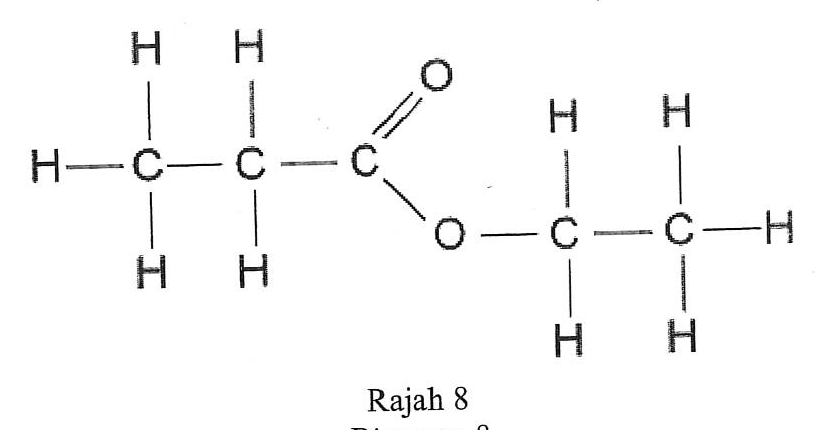
Diagram 8 shows the structural formula of a compound (ethyl propanoate). Which of the following are the correct statements about the compound?
I Soluble in water
II Non-hydrocarbon
III Produced from the reaction between ethanol and propanoic acid
IV Reacts with reactive metal to produce hydrogen gas
Medium
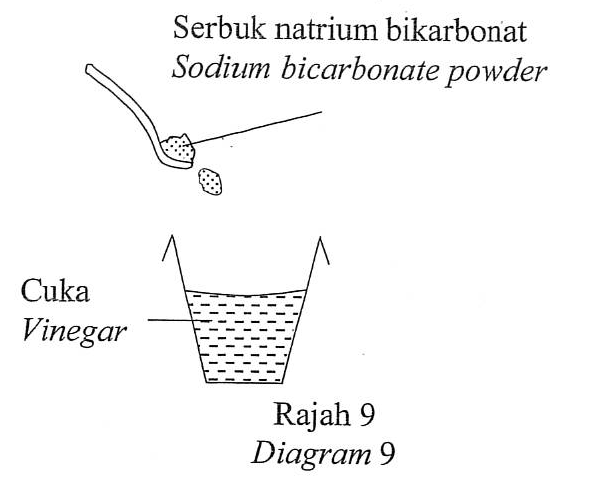
Diagram 9 shows two substances used to determine heat of reaction (sodium bicarbonate powder added to vinegar). Which of the following statement is correct based on the above reaction?
Medium
Which of the following explains the main difference between addition polymerisation and condensation polymerisation?
Medium
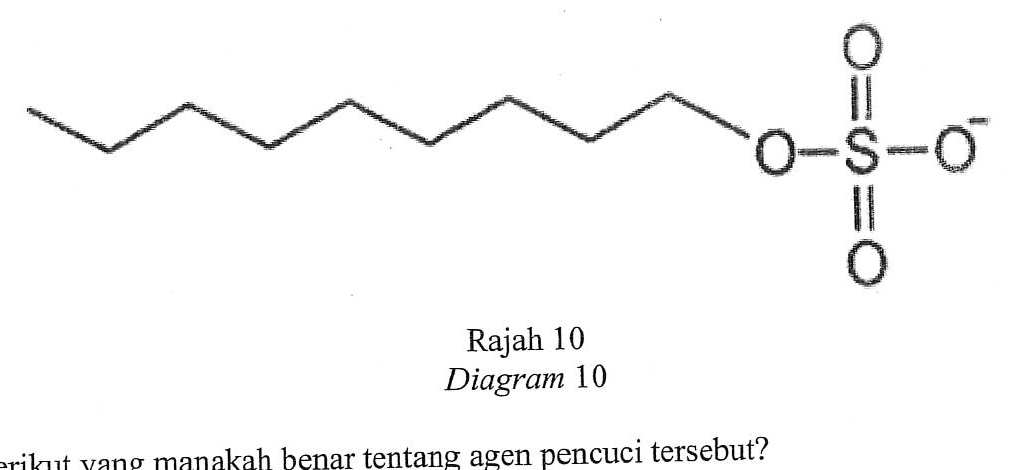
Diagram 10 shows the anion structure of a cleaning agent. Which of the following is true about the cleaning agent?
Medium
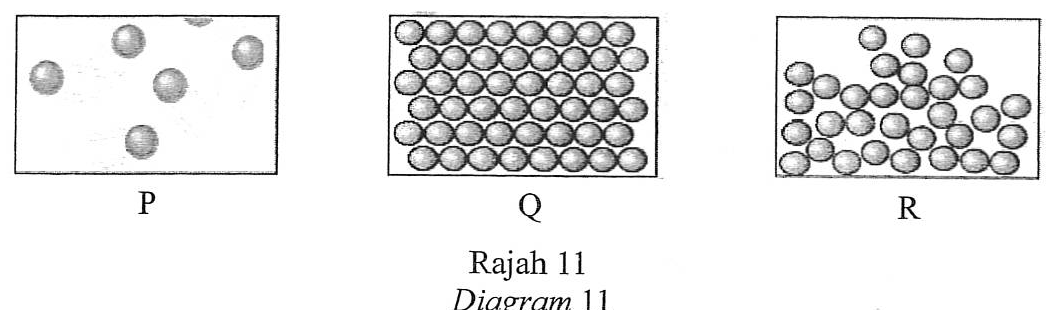
Diagram 11 shows the arrangement of particles for substances P, Q and R at room temperature. Which of the following are substances P, Q and R?
Medium
Which pair of ions has the same number of electrons? [Proton number: O = 8, Na = 11, Mg = 12, Al = 13, Cl = 17, Ca = 20]
Medium
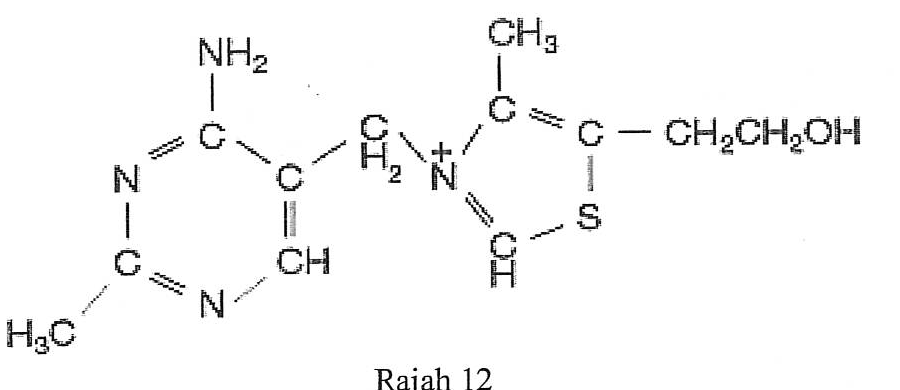
Diagram 12 shows the molecular structure of vitamin B known as thiamine. Which of the following is the empirical formula for thiamine?
Medium
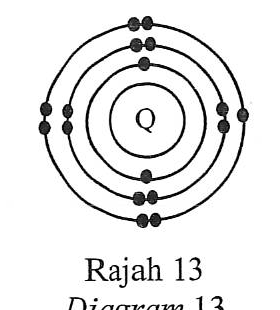
Diagram 13 shows the electron arrangement of atom Q. Which of the following is correct about Q?
Medium
The boiling point of ethanoic acid and sulphur dioxide are 118 °C and -10 °C respectively. Which of the following statement best explains the difference?
Medium
What is the concentration of solution produced when 400 cm³ of distilled water is added into volumetric flask containing 100 cm³ of 2.0 mol dm⁻³ nitric acid?
Medium
Which equations represent a neutralisation reaction?
I CuO + H₂SO₄ → CuSO₄ + H₂O
II C₂H₅OH + 3O₂ → 2CO₂ + 3H₂O
III MgCO₃ + 2HCl → MgCl₂ + CO₂ + H₂O
IV CH₃COOH + NaOH → CH₃COONa + H₂O
Medium
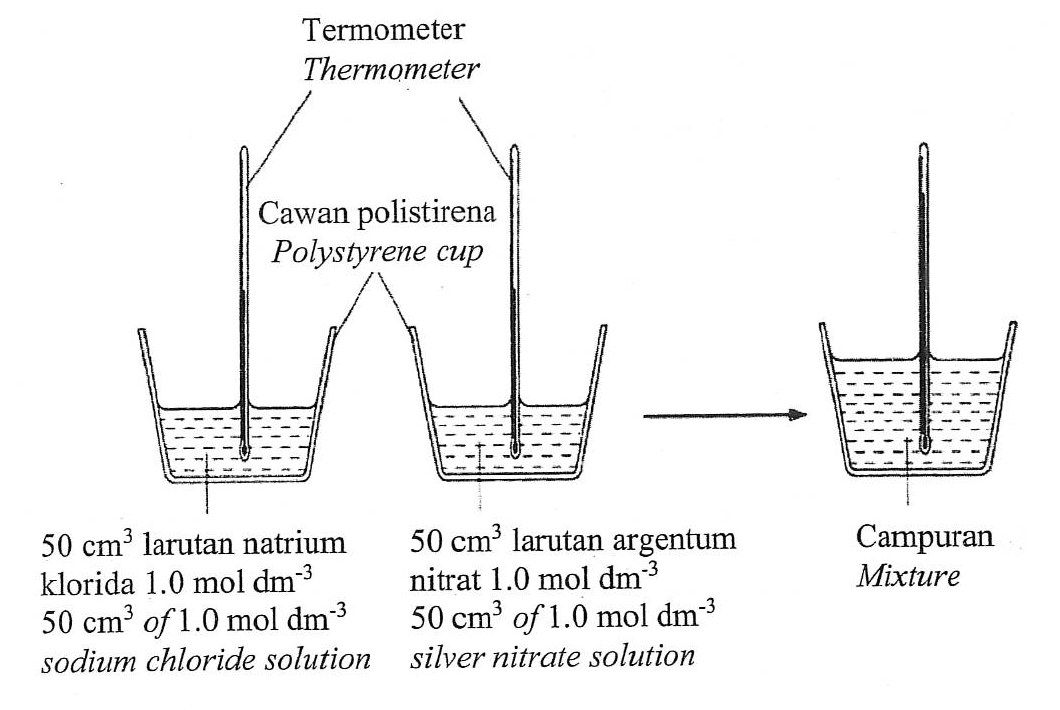
Diagram 14 shows the set-up of apparatus to determine the heat of precipitation of silver chloride (50 cm³ of 1.0 mol dm⁻³ sodium chloride solution and 50 cm³ of 1.0 mol dm⁻³ silver nitrate solution). The temperature of mixture increases by 5 °C. What need to be done to double the temperature rise?
Medium
10 g of magnesium oxide is added to 100 cm³ of 2.0 mol dm⁻³ hydrochloric acid. What is the mass of unreacted magnesium oxide? [Relative atomic mass: O = 16, Mg = 24]
Medium
When excess magnesium powder is added to 50 cm³ of 0.1 mol dm⁻³ nitric acid, 60 cm³ gas is produced. Which acid can produce the same volume of gas in shorter time?
I 50 cm³ of 0.2 mol dm⁻³ hydrochloric acid
II 25 cm³ of 0.2 mol dm⁻³ hydrochloric acid
III 25 cm³ of 0.1 mol dm⁻³ sulphuric acid
IV 50 cm³ of 0.1 mol dm⁻³ sulphuric acid
Medium
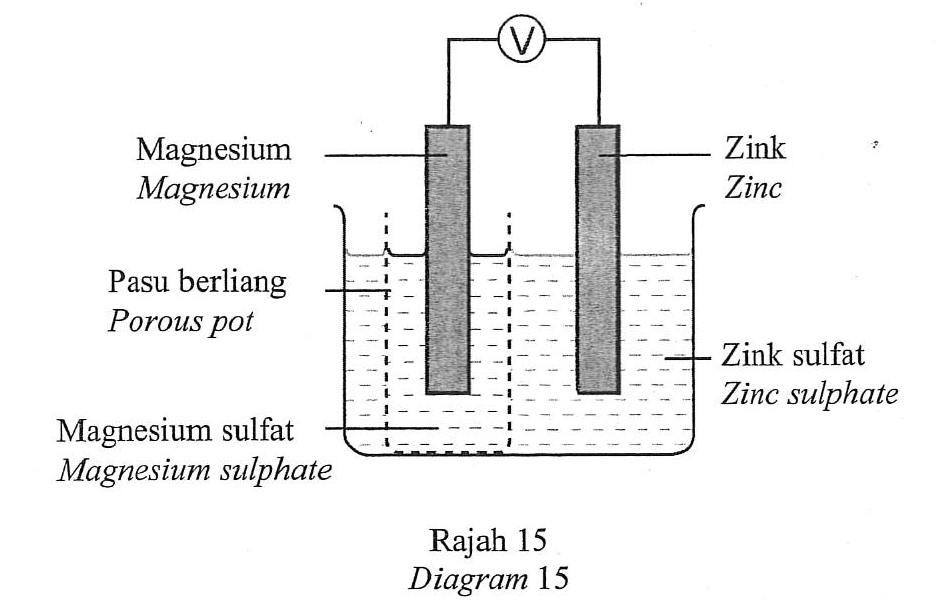
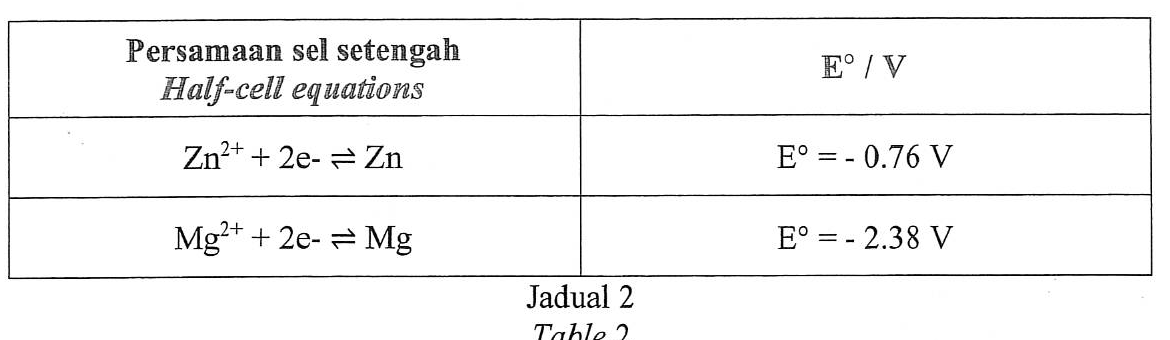
Diagram 15 shows the apparatus set-up for a simple voltaic cell (magnesium in magnesium sulphate in a porous pot, zinc in zinc sulphate). Table 2 shows the standard electrode potential of half-cells: Zn²⁺ + 2e⁻ ⇌ Zn, E° = -0.76 V; Mg²⁺ + 2e⁻ ⇌ Mg, E° = -2.38 V. What is the voltage value of the cell?
Medium
The following equation represents the complete combustion of a compound.
CₓH₂ₓ₊₁OH + zO₂ → xCO₂ + yH₂O
What are the values of x, y and z?
Medium
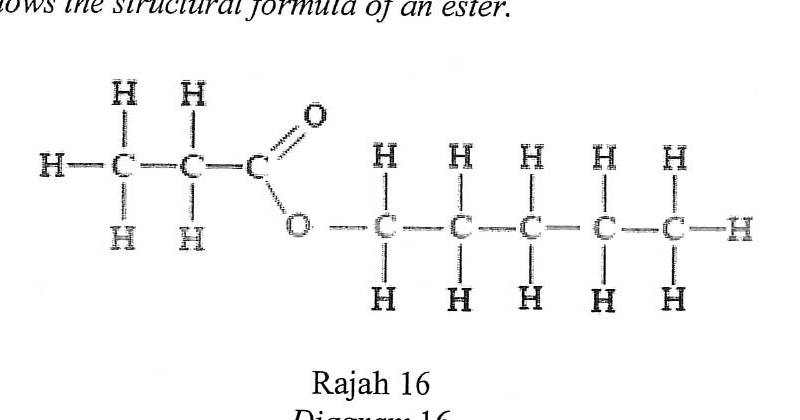
Diagram 16 shows the structural formula of an ester. Which of the following are the names of alcohol and carboxylic acid used to prepare the ester?
Medium
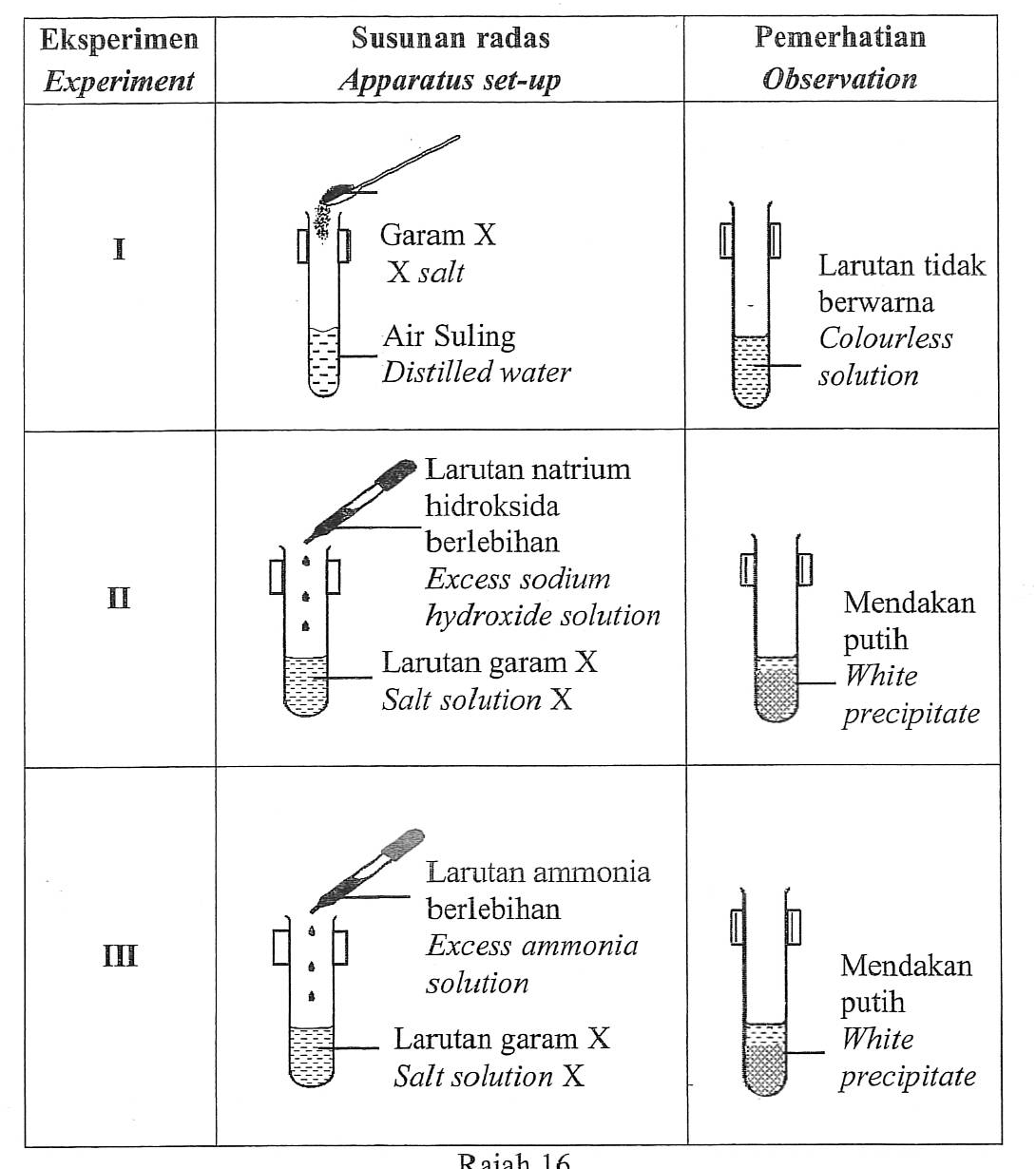
Diagram 17 shows the observation of three tests on salt X. I: dissolves in distilled water giving a colourless solution. II: excess sodium hydroxide solution gives white precipitate. III: excess ammonia solution gives white precipitate. What is X?
Medium
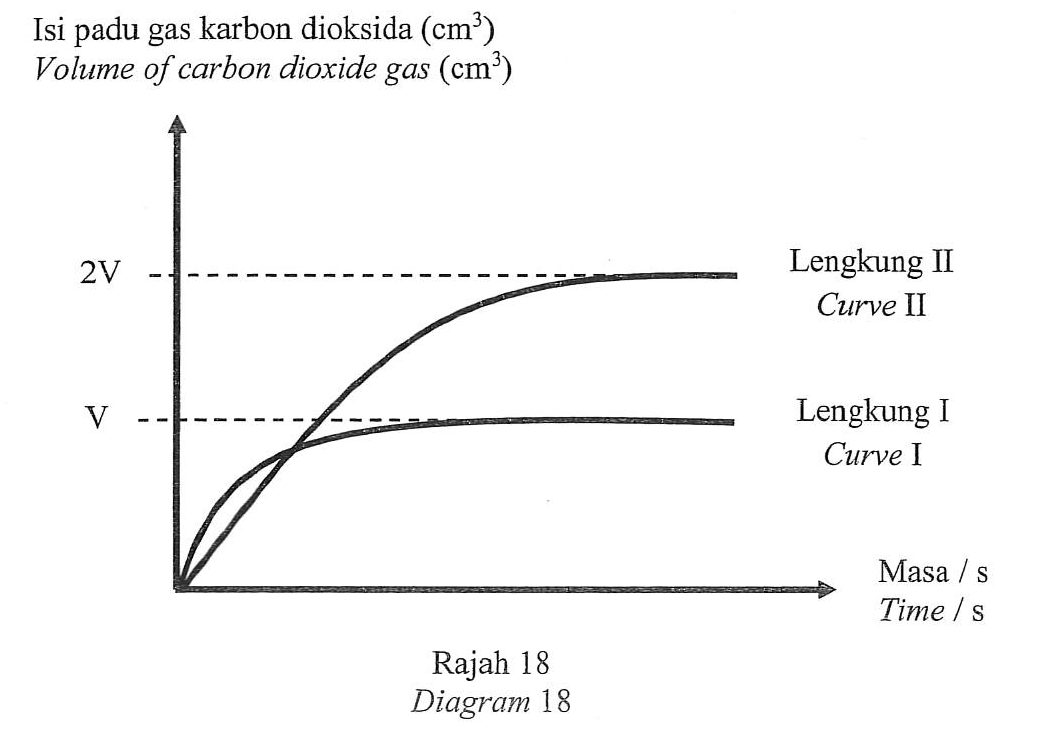
Diagram 18 shows the graph of volume of carbon dioxide gas against time when excess marble powder is added to hydrochloric acid, HCl with different concentration and volume. Which of the following produce curve I and II?