Write your answer on paper. Then open the answer to check it.
Section A
Diagram 1 shows the atomic structure for isotope of carbon (carbon-12 and carbon-14).
Medium5 marks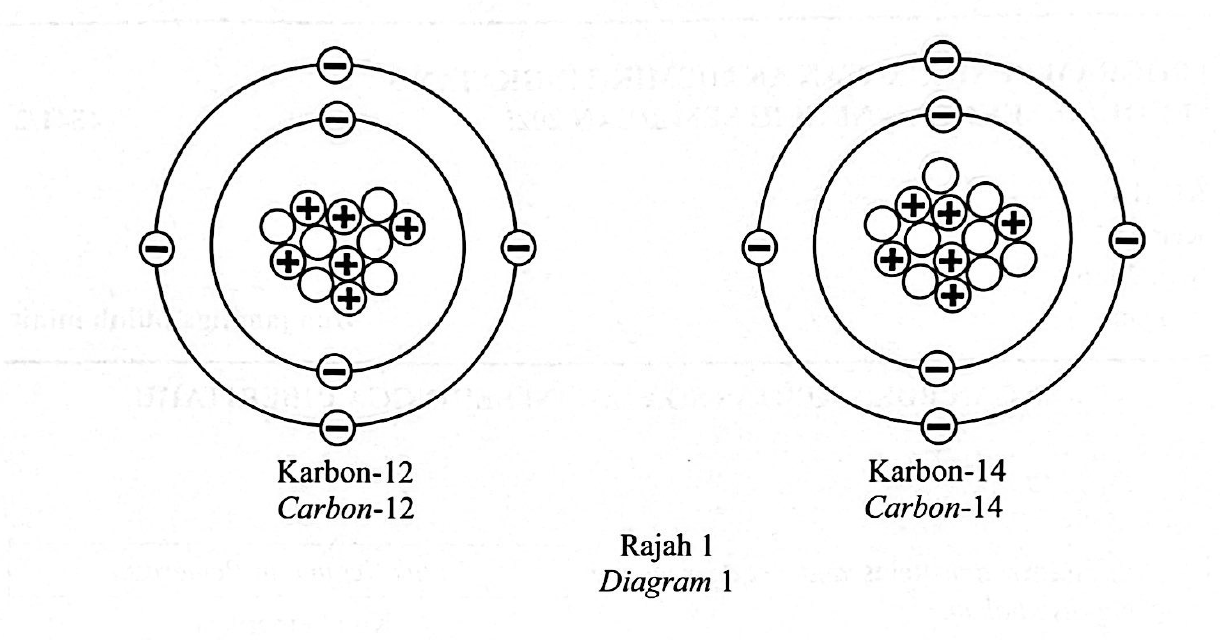
- (a)
What is meant by isotope?
[1] - (b)(i)
Based on carbon-12, determine the number of valence electrons.
[1] - (b)(ii)
Based on carbon-12, write in standard representation, ᴬ_Z X.
[1] - (c)(i)
Based on carbon-14, determine the number of neutrons.
[1] - (c)(ii)
Based on carbon-14, state its use.
[1]
Table 1 shows the condition of bowls made of two different types of polymer (bowl X melts and deforms on heating; bowl Y chars and breaks).
Medium5 marks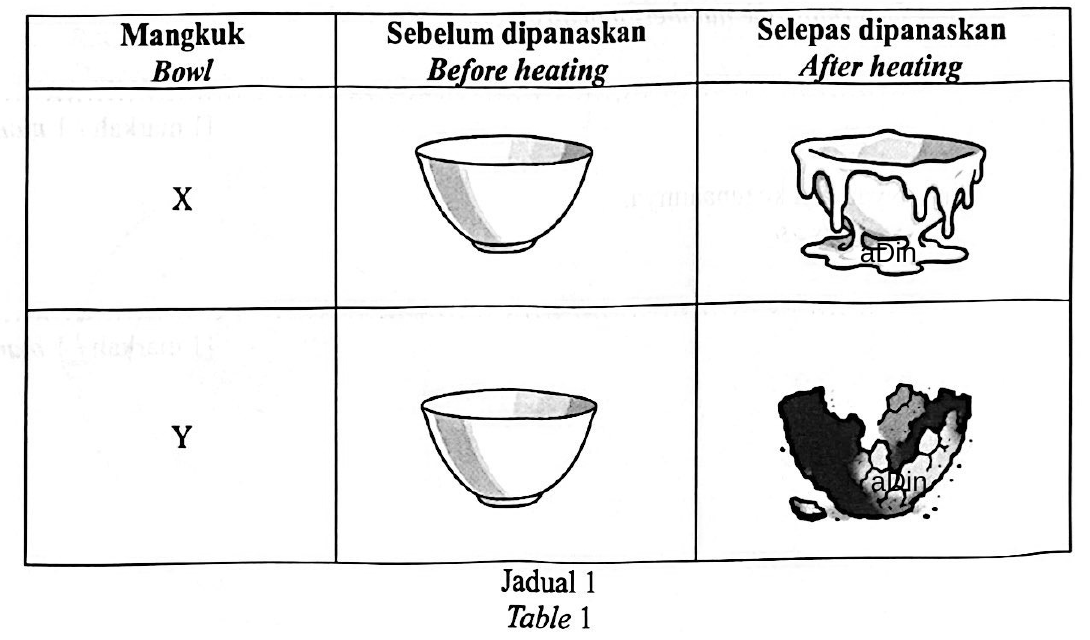
- (a)
What is the meaning of polymer?
[1] - (b)
State the type of polymers for X and Y.
[2] - (c)
Which bowl can be recycled? Give a reason.
[2]
Diagram 2 shows the standard representation for elements X (²³₁₁X) and Cl (³⁵₁₇Cl). Letter X used is not the actual symbol of the element.
Medium6 marks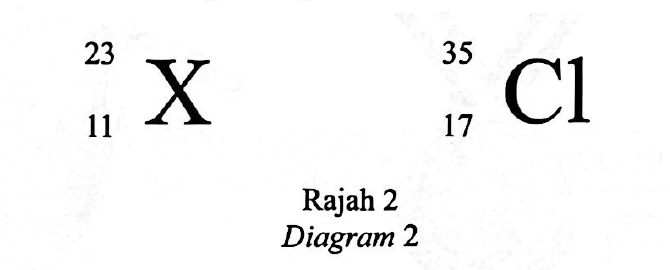
- (a)
What is the purpose of forming bond between atoms?
[1] - (b)(i)
Elements X and Cl can react to produce a compound. State the type of compound formed.
[1] - (b)(ii)
Write a chemical equation for the reaction.
[2] - (b)(iii)
Draw the electron arrangement of the compound formed.
[2]
Diagram 3.1 shows two alloy products, R (a medal) and S (a brass instrument). Diagram 3.2 shows the materials used to make soap through saponification reaction. (Printed as Question 4 with diagrams numbered 3.1 and 3.2.)
Medium7 marks- (a)(i)
Based on Diagram 3.1, state the pure metal for the alloys.
[1]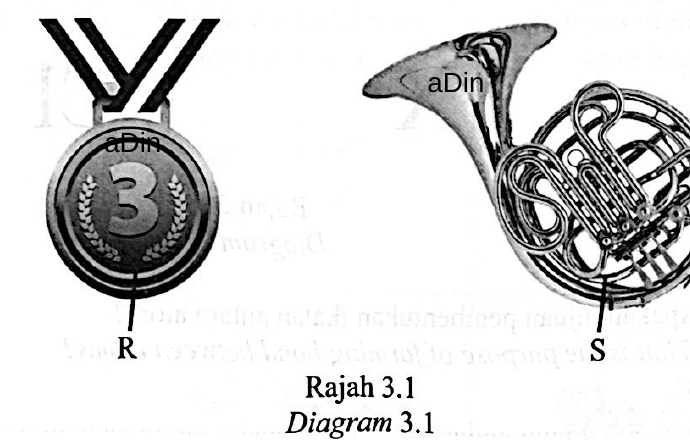
- (a)(ii)
Pure metal is not suitable to make those products. Give a reason.
[1] - (a)(iii)
Draw the arrangement of atom for alloy R.
[1] - (b)(i)
Write the chemical equation for Reaction I.
[1]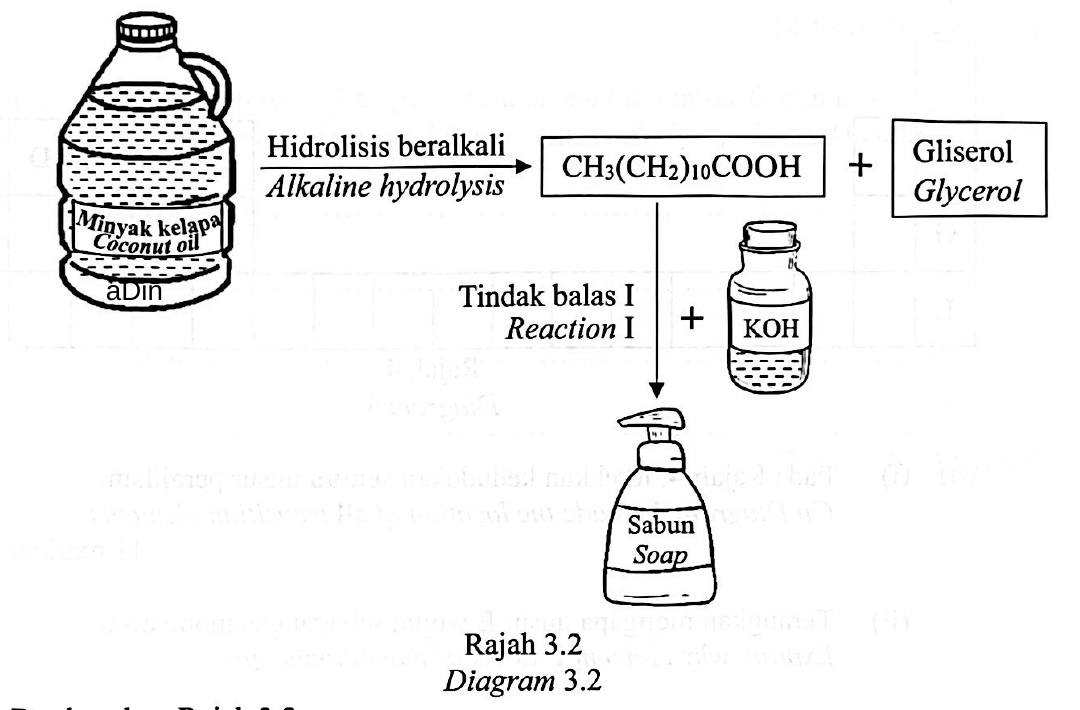
- (b)(ii)
A student used a large quantity of soap to remove the stain from clothes that is cleaned in hard water and causes wastage of cleaning substance. Without changing the type of water, how can you help the student to overcome the problem? Explain your answer.
[3]
Diagram 4 shows part of the Periodic Table of Elements. The symbols given do not represent the actual elements. Element G and element L can react with element D to form a compound. Table 2 shows the observations for each reaction (G burned vigorously and produced white fume; L burned very vigorously and produced white fume).
Medium8 marks- (a)(i)
On Diagram 4, shade the location of all transition elements.
[1]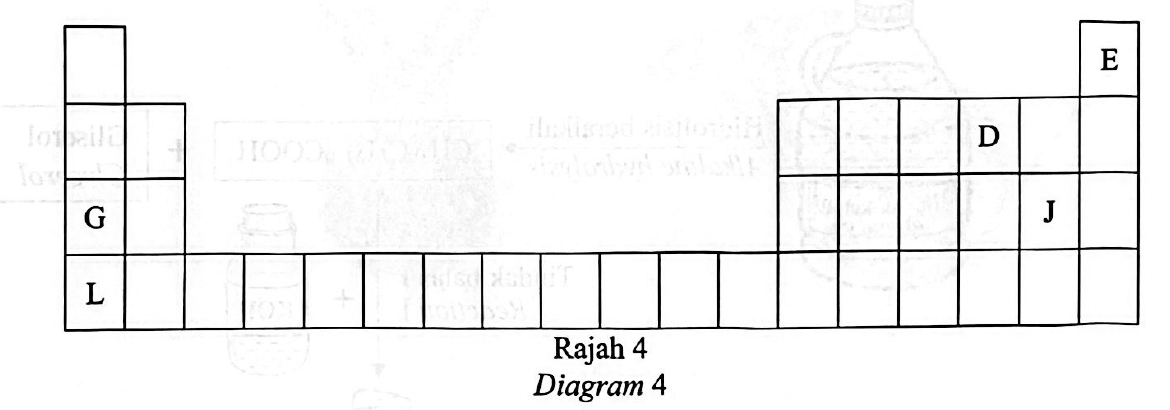
- (a)(ii)
Explain why element E exists as monoatomic gas.
[1] - (a)(iii)
Write the electron arrangement for atom J.
[1] - (b)(i)
Write a chemical equation for the reaction between element G and D.
[2]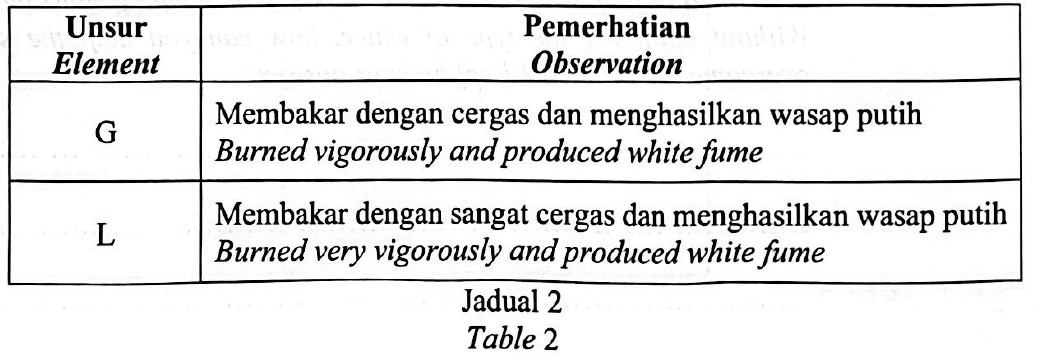
- (b)(ii)
Compare and explain the difference in reactivity of element G and L.
[3]
Table 3 shows the pH values of monoprotic acids P and Q (both 0.1 mol dm⁻³; P pH 1, Q pH 5).
Medium9 marks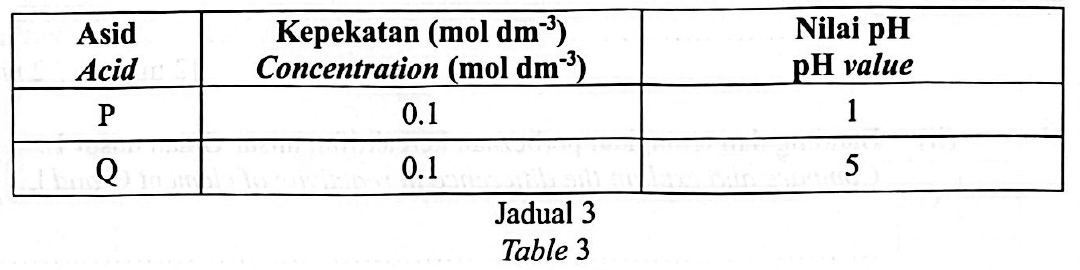
- (a)
State the meaning of acid.
[1] - (b)
Suggest the name for acid P.
[1] - (c)(i)
25 cm³ of 0.1 mol dm⁻³ potassium hydroxide solution is titrated with acid P. Write the chemical equation for the reaction.
[1] - (c)(ii)
Calculate the volume of acid P used.
[3] - (d)
Explain the difference in strength of acid for acid P and Q.
[3]
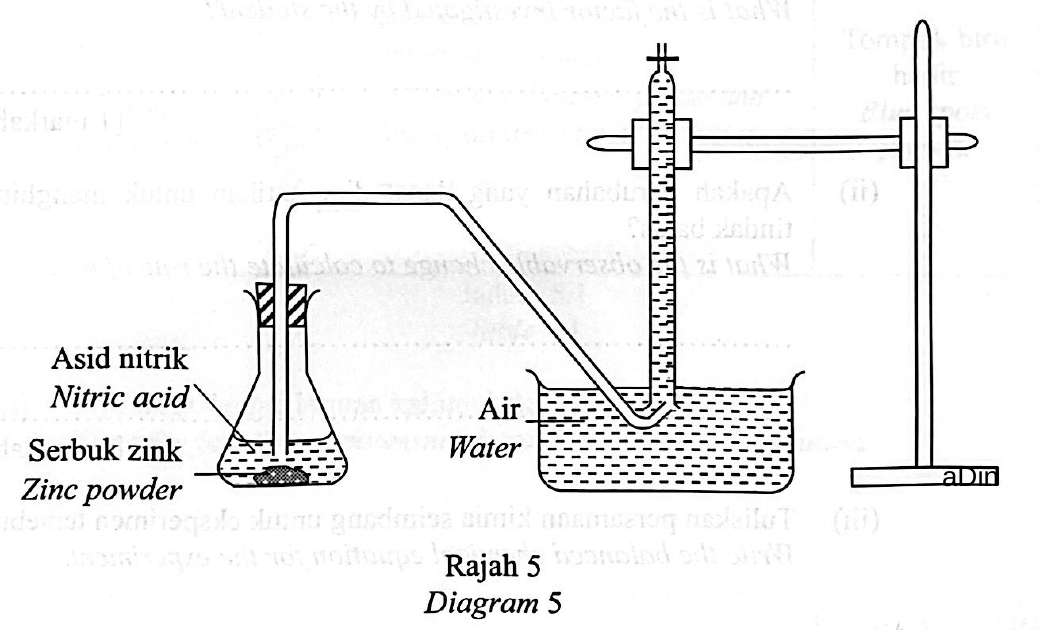
Table 4 shows two sets of experiment planned by a student to study the factor that affects the rate of reaction. Set I: excess zinc powder + 50 cm³ of 1.0 mol dm⁻³ nitric acid. Set II: excess zinc powder + 50 cm³ of 1.0 mol dm⁻³ nitric acid + 2 cm³ of 1.0 mol dm⁻³ copper(II) sulphate. Diagram 5 shows the apparatus set-up for this experiment (conical flask with nitric acid and zinc powder, delivery tube dipping into the acid, gas collected over water in an inverted burette).
Medium10 marks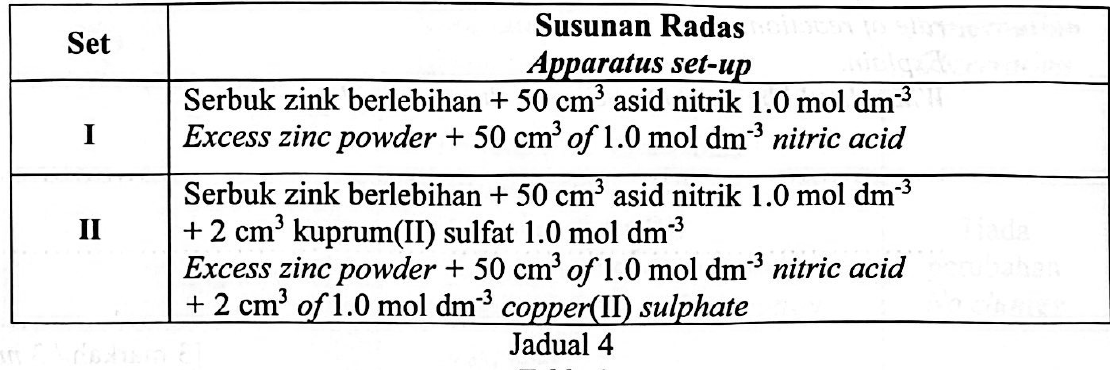
- (a)
State the meaning of rate of reaction.
[1] - (b)
The apparatus set-up in Diagram 5 causes the student to be unable to calculate the rate of reaction. Explain. What should be done to overcome the problem?
[3] - (c)(i)
Based on Table 4, what is the factor investigated by the student?
[1] - (c)(ii)
What is the observable change to calculate the rate of reaction?
[1] - (c)(iii)
Write the balanced chemical equation for the experiment.
[2] - (d)
If the experiment in Set II is repeated using 2.0 mol dm⁻³ of copper(II) sulphate, explain the effect on the rate of reaction.
[2]
Table 5.1 shows an experiment to investigate the effect of different metals on the rusting of iron nail (Set I: metal M, no change; Set II: metal N, blue spots present; hot agar solution + potassium hexacyanoferrate(III) solution). Diagram 6 shows the apparatus for electroplating of iron nail to prevent rusting. Table 5.2 shows an experiment to investigate the displacement of metal (Set I zinc wire in lead(II) nitrate: grey solid deposited; Set II copper wire in lead(II) nitrate: no change).
Medium10 marks- (a)(i)
State the function of potassium hexacyanoferrate(III) solution.
[1]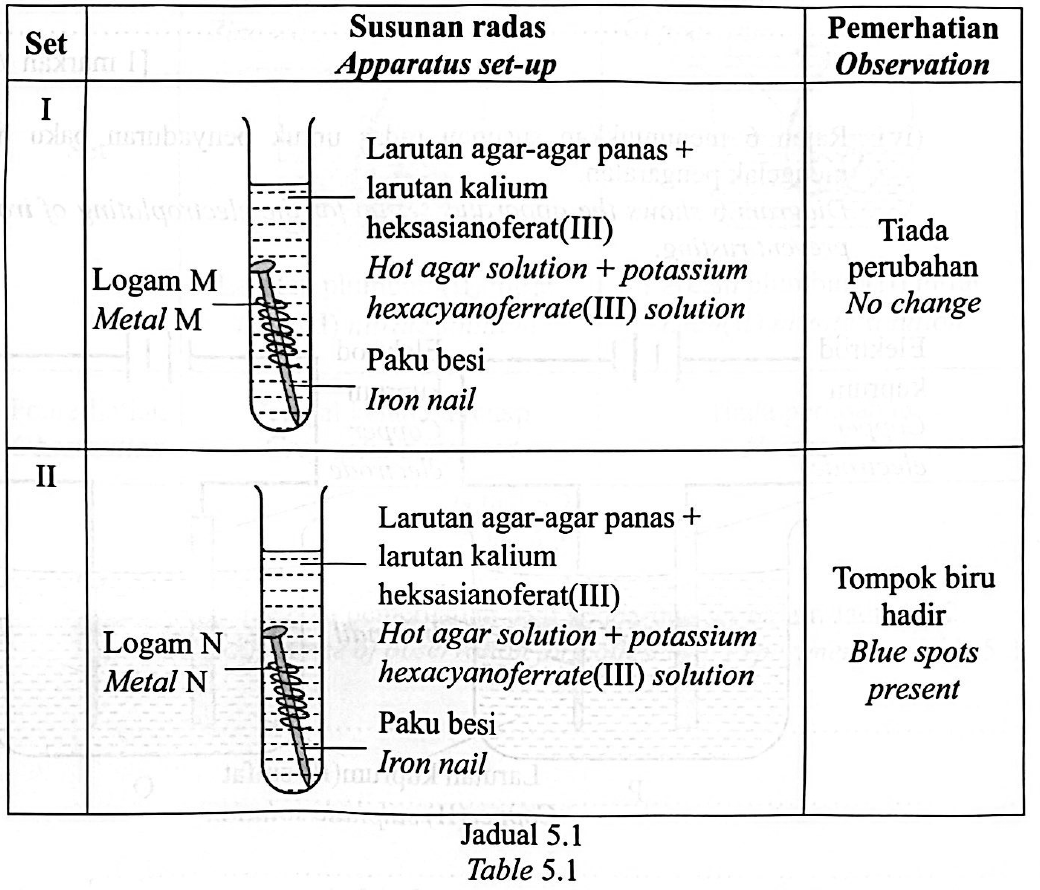
- (a)(ii)
Rusting of iron nail is a redox reaction. Based on Set II, state the substance that undergoes oxidation and write the half equation for the reaction involved.
[2] - (a)(iii)
Based on the observation in Table 5.1, arrange the electropositivity of metal M, N and iron in ascending order.
[1] - (a)(iv)
Based on Diagram 6, which apparatus set-up is correct for electroplating of iron nail? Explain the reaction occurred at iron nail.
[2]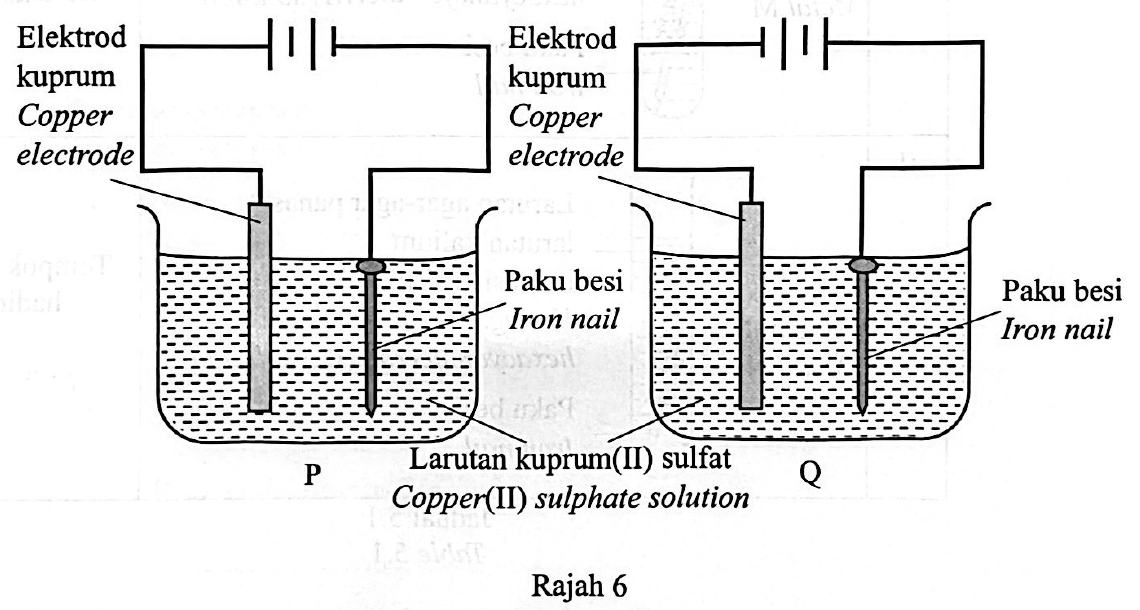
- (b)(i)
Explain the difference of observation for both sets of experiment in Table 5.2.
[3]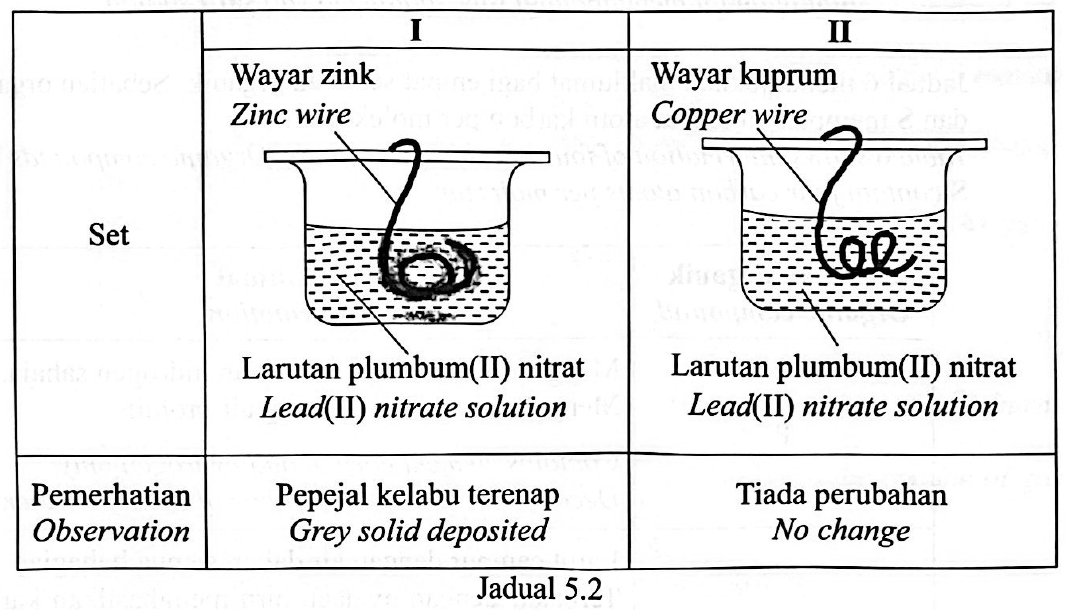
- (b)(ii)
When solution in Set II is changed to solution X, the colourless solution turns blue. Suggest solution X.
[1]
Section B
Table 6 shows information of four organic compounds. Organic compounds P, R and S contain four carbon atoms per molecule. P: contains carbon and hydrogen only; decolourises the brown colour of bromine water. R: miscible in water in all proportions; burns with blue flame to produce carbon dioxide and water. S: soluble in water; reacts with calcium carbonate to produce carbon dioxide gas. T: has fruity smell; produced through the reaction between compound R and compound S. (Section B: answer one question.)
Hard20 marks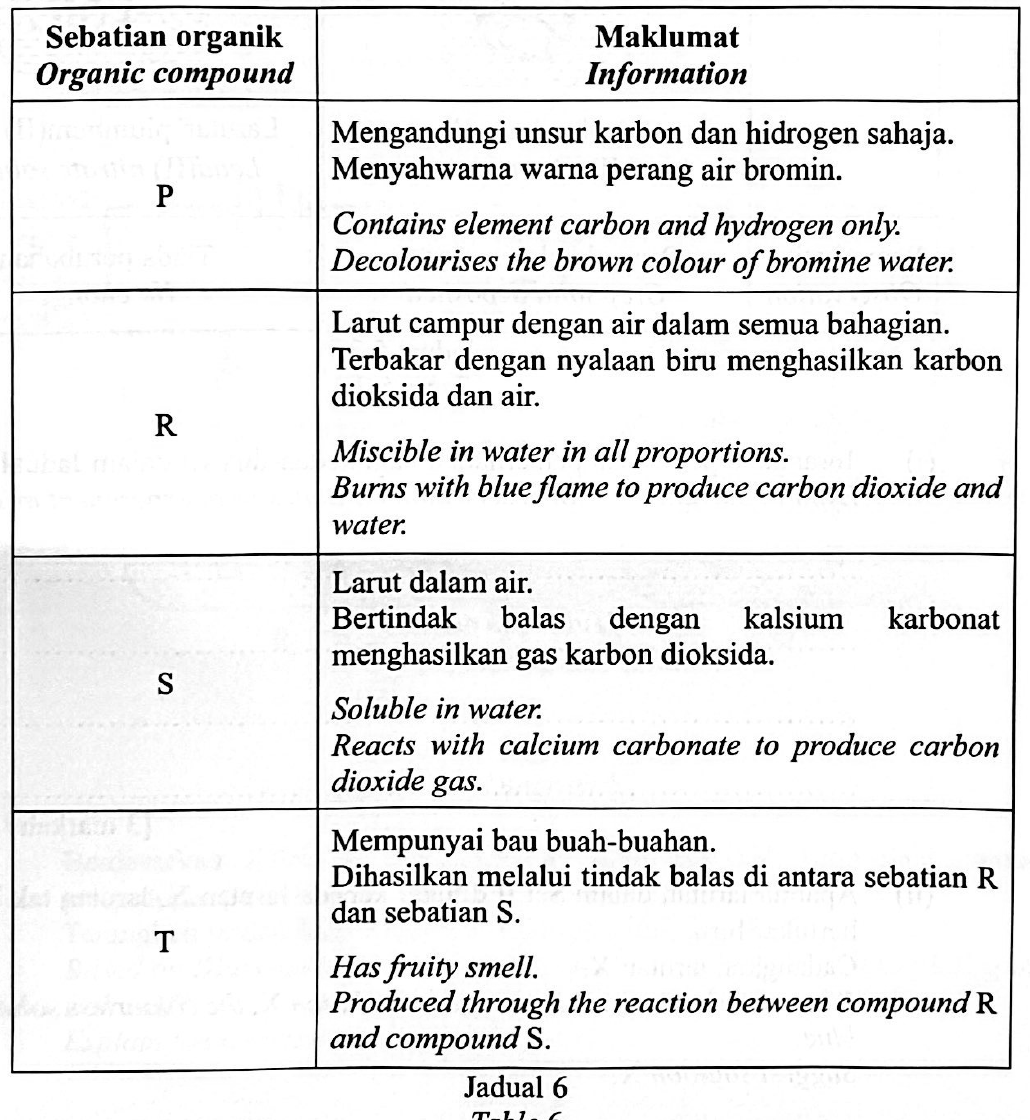
- (a)
State the meaning of isomer. Draw the structural formula for two isomers of compound P and state the names of the isomers by using IUPAC nomenclature.
[5] - (b)
Identify the homologous series, functional group and structural formula for compounds R, S and T.
[9] - (c)
Gas that turns limewater cloudy is released when compound R burns completely in oxygen. Write a chemical equation for the reaction and calculate the volume of gas released when 29.6 g of R is completely burnt. [Relative atomic mass: H = 1, C = 12, O = 16; Molar volume of gas at room conditions = 24 dm³ mol⁻¹]
[6]
Diagram 7 shows the energy level diagram for the combustion of propanol: C₃H₇OH + 9/2 O₂ at the higher level, 3CO₂ + 4H₂O at the lower level, ΔH = -2016 kJ mol⁻¹. (Section B: answer one question.)
Medium20 marks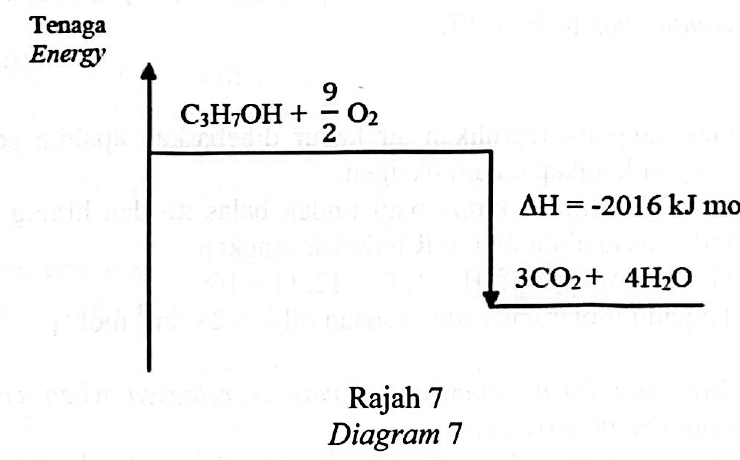
- (a)
State the meaning of heat of combustion.
[1] - (b)
State four information that can be obtained from the energy level diagram. Give one other example of heat reaction that experienced the heat change as in Diagram 7.
[5] - (c)(i)
Heat of combustion of propanol obtained from experiment is lower than the theoretical value. Explain. Suggest one precautionary step when carrying out the experiment. Draw a labelled diagram of apparatus set-up for the experiment.
[6] - (c)(ii)
The experiment is carried out to heat 400 cm³ of water. 3 g of propanol is used. Determine the temperature change of water in this experiment. [Relative atomic mass: H = 1, C = 12, O = 16; Heat capacity of water = 4.2 J g⁻¹ °C⁻¹]
[4] - (d)
The experiment is repeated by replacing propanol with pentanol. Predict the heat of combustion obtained. Explain your answer.
[4]
Section C
Diagram 8.1 shows the reactions involving compound T: compound T on heating gives black solid Q + brown gas R + oxygen; solid Q + substance Y gives compound T. (Section C: compulsory.)
Medium20 marks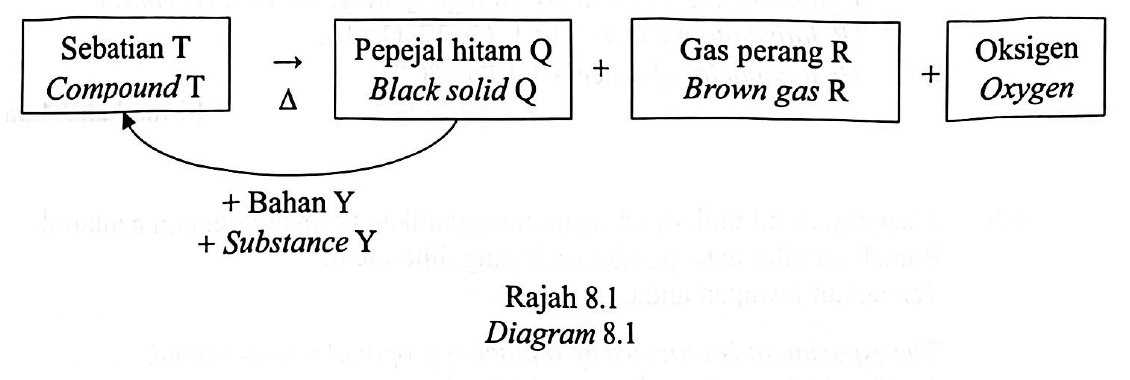
- (a)(i)
State the chemical formula of oxygen gas.
[1] - (a)(ii)
Identify compound T, solid Q and gas R.
[3] - (a)(iii)
Compound T can be produced by adding solid Q to substance Y. Suggest the name of substance Y and write a chemical equation for the reaction. Calculate the mass of solid Q needed to produce 0.94 g compound T. [Molar mass: T = 188 g mol⁻¹, Q = 80 g mol⁻¹]
[6] - (b)(i)
Diagram 8.2 shows the conversation between teacher and students. The teacher asks: Can you suggest the reactants to prepare calcium sulphate? Tommy: CaCO₃ and H₂SO₄. Jimmy: CaCl₂ and Na₂SO₄. Which student stated the suitable reactants? Explain.
[4]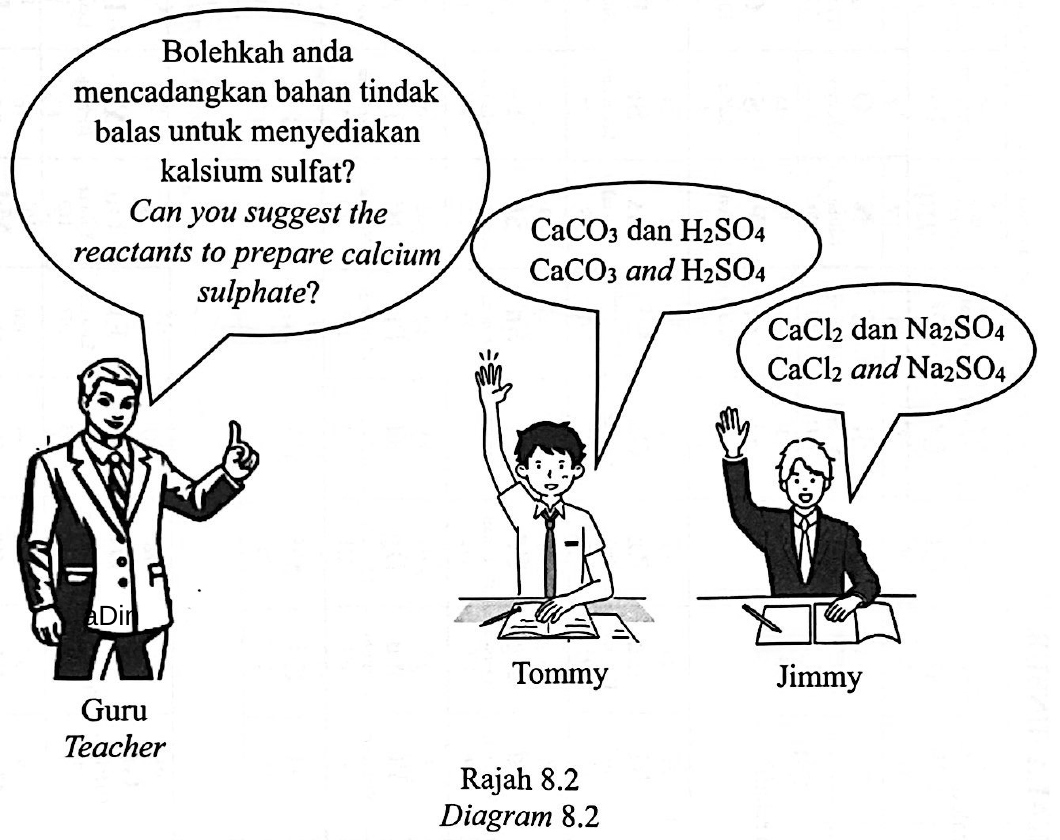
- (b)(ii)
By using the reactants in 11(b)(i), describe how the student prepares calcium sulphate in the laboratory.
[6]