Where heavy metals and toxic substance should be stored?
Easy
Which of the following substances exist as the molecules?
Easy
Why helium gas does not react with other elements?
Easy
Zink chloride is an ionic compound. Which substance can dissolves zink chloride?
Medium
Which of the following is true about the properties of a strong alkali?
Medium
Which of the following will produce an insoluble salt?
Medium
What is the meaning of the reaction rate referring to the reaction between magnesium ribbon and 50 cm³ of 1.0 mol dm⁻³ hydrochloric acid?
Medium
Qaseh's glasses look dark when they are in a hot place. What material is added to the glasses to make the glass lenses?
Medium
What is the process for producing alcohol from ethene in the presence of phosphoric acid as a catalyst at 300°C and 60 atm?
Easy
Which of the following is a metal slow down rusting of iron?
I Silver
II Zinc
III Lead
IV Magnesium
Medium
The following is a factor in fuel selection except
Easy
Weather factors and disease attacks on rubber trees have made synthetic rubber the main choice in the manufacturing industry. Which of the following is a characteristic of synthetic rubber?
Medium
Cosmetics are products used to enhance appearance as well as to cleanse oneself. The following are examples of makeup cosmetics except
Medium
Ceramic is used in power stations area which have high voltage because
Medium
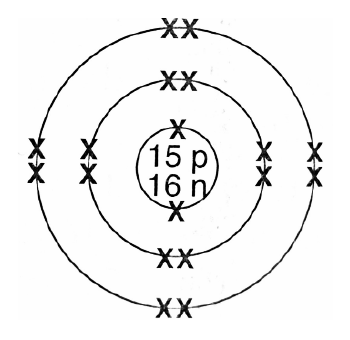
Diagram 1 shows electron arrangement for element X (nucleus: 15 protons, 16 neutrons). Which standard representation represents atom for element X?
Medium
The chemical formula of oxide for metal Q is Q₂O₃ and chemical formula of potassium phosphate is K₃PO₄. What is the chemical formula of phosphate of metal Q?
Medium
Ionic compound of aluminium oxide has formula Al₂O₃. What is the number of ions in 1 mol of the compound? [Avogadro constant: 6.02 × 10²³ mol⁻¹]
Medium
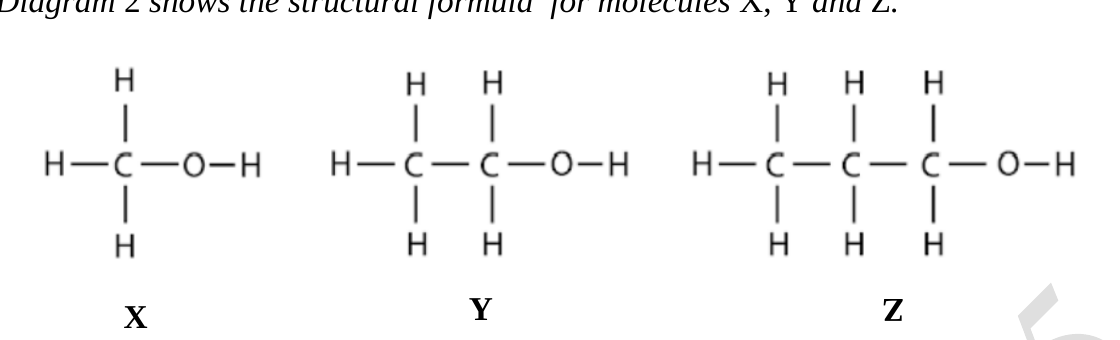
Diagram 2 shows the structural formula for molecules X (CH₃OH), Y (C₂H₅OH) and Z (C₃H₇OH). Which statement is true for all the above molecules?
I X, Y and Z are non hydrocarbon compounds.
II X, Y and Z have different chemical properties.
III X, Y and Z are represented by the same general formula.
IV X, Y and Z have different functional groups.
Medium
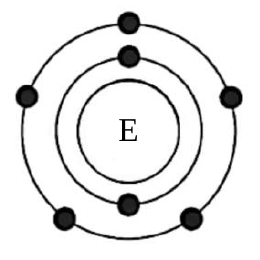
Diagram 3 shows the electron arrangement for atom E. How many pairs of electrons are involved to form molecule E?
Medium
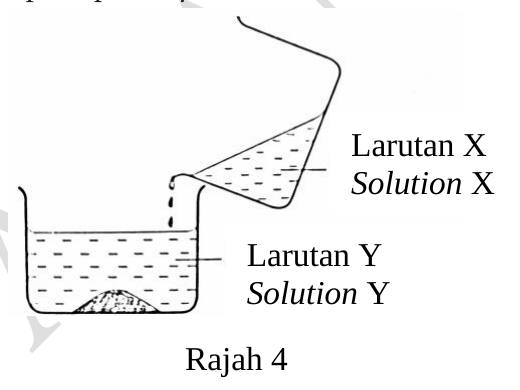
Diagram 4 shows white precipitate formed when solution X is added into solution Y. Which of the following is the most suitable to represent solution X and solution Y?
A X: Fe(NO₃)₃, Y: Na₂CO₃
B X: Pb(NO₃)₂, Y: KI
C X: Pb(NO₃)₂, Y: KCl
D X: Cu(NO₃)₂, Y: K₂CO₃
Medium
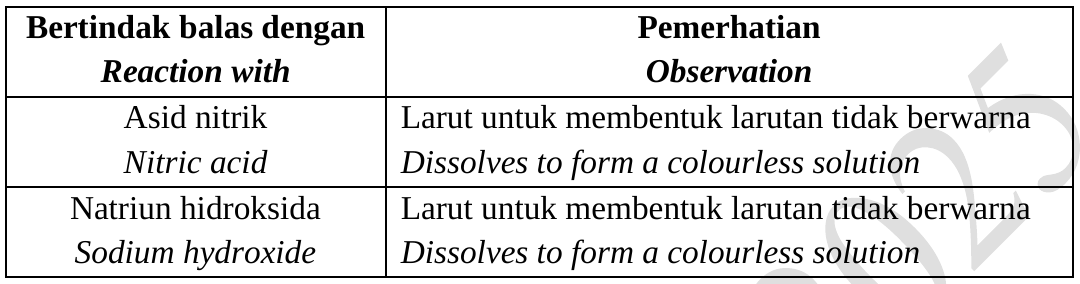
J is one of the element in Period 3 of the Periodic Table of Elements. Table 1 shows the observation of the oxide of element J reacts with nitric acid (dissolves to form a colourless solution) and sodium hydroxide solution (dissolves to form a colourless solution). What is element J?
Medium
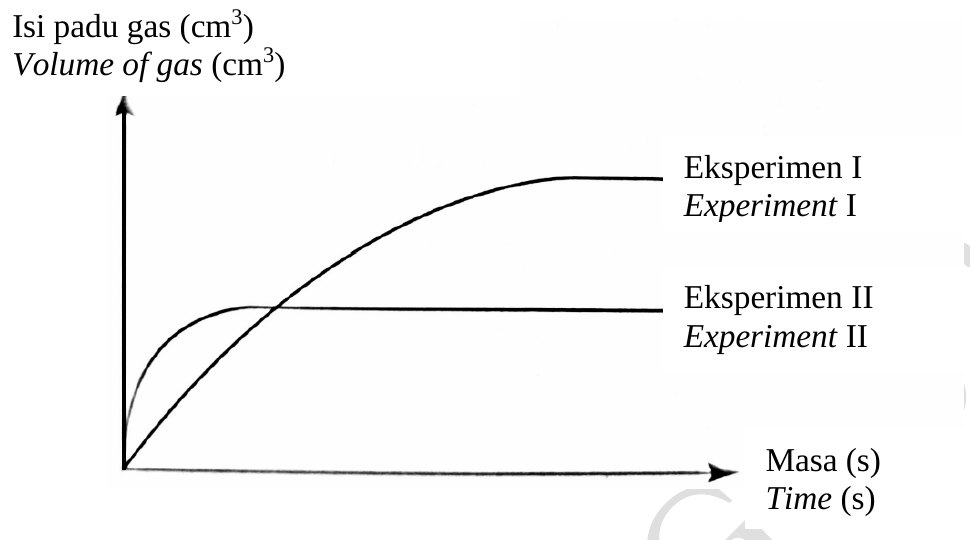
Diagram 5 shows graph of volume of gas against time for reaction between zinc and hydrochloric acid (Experiment I: higher final volume, slower; Experiment II: lower final volume, faster). Experiment I uses excess granulated zinc and 50 cm³ of 1.0 mol dm⁻³ hydrochloric acid. Which is suitable to be used in Experiment II?
Medium
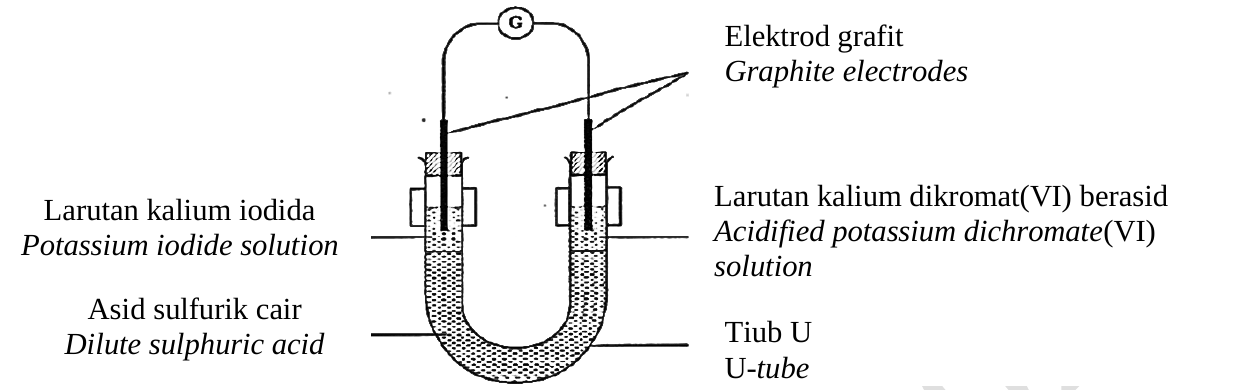
Diagram 6 shows the apparatus set-up to study the transfer of electron at a distance (potassium iodide solution and acidified potassium dichromate(VI) solution separated by dilute sulphuric acid in a U-tube, graphite electrodes). Which of the following is the colour change of the two solutions?
Medium
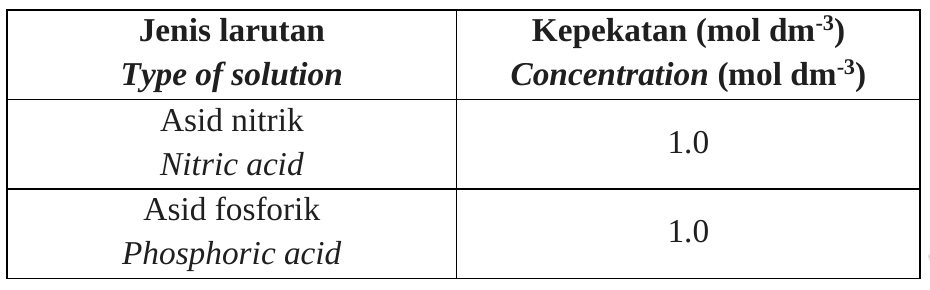
Table 2 shows nitric acid 1.0 mol dm⁻³ and phosphoric acid 1.0 mol dm⁻³. Which of the following is correct about the two solutions?
I The pH value of nitric acid is lower than phosphoric acid
II The degree of ionisation of phosphoric acid is lower than nitric acid
III The concentration of hydrogen, H⁺ ion is higher in phosphoric acid
IV Phosphoric acid is a strong acid while nitric acid is a weak acid
Medium
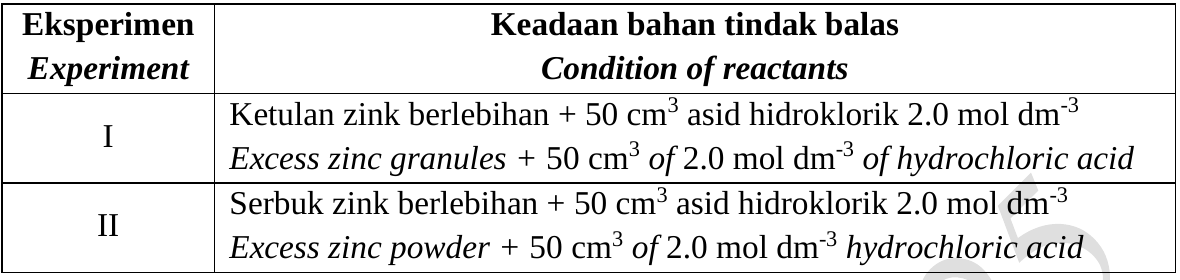
Table 3: Experiment I uses excess zinc granules + 50 cm³ of 2.0 mol dm⁻³ hydrochloric acid; Experiment II uses excess zinc powder + 50 cm³ of 2.0 mol dm⁻³ hydrochloric acid. Which graph shows the correct curve for Experiment I and Experiment II?
Medium
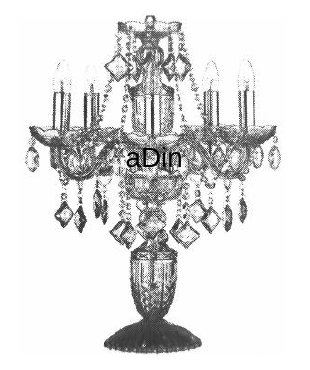
Diagram 7 shows a crystal lamp made from glass. The type of glass is suitable to make the crystal lamp because it
Medium
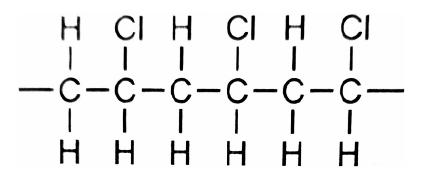
Diagram 8 shows the structural formula of polyvinyl chloride. Which of the following is the molecular formula of its monomer?
Medium
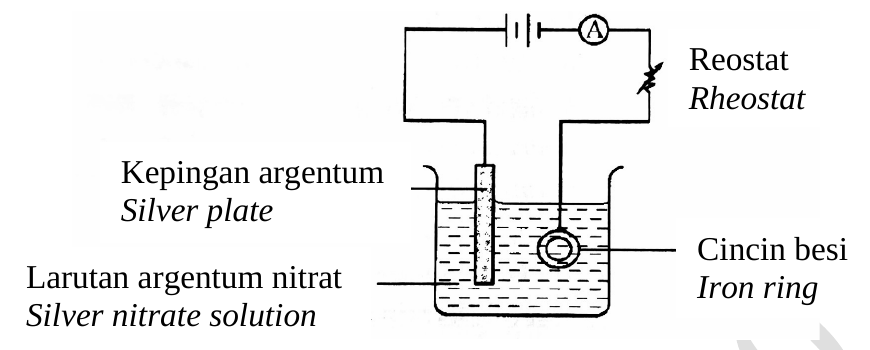
Diagram 9 shows the apparatus set-up for an experiment to electroplate an iron ring with silver (silver plate, silver nitrate solution). Which half equations represent the reactions at the anode and the cathode?
Medium
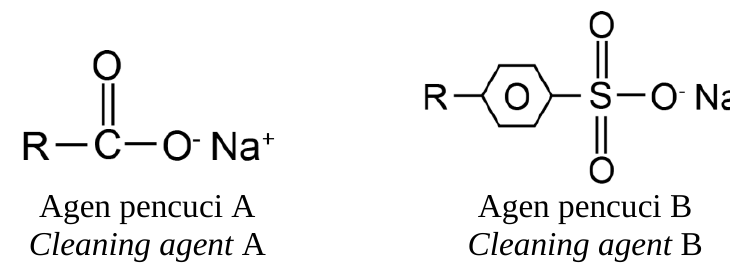
Diagram 10 shows the structural formula of two cleaning agents: A (R-COO⁻Na⁺, soap) and B (R-C₆H₄-SO₃⁻Na⁺, detergent). Which of the following statements is true?
Medium
The following shows the thermochemical equations for neutralisation reactions.
KOH + HCl → KCl + H₂O ΔH = -57 kJ mol⁻¹
KOH + CH₃COOH → CH₃COOK + H₂O ΔH = -54 kJ mol⁻¹
Which of the following statements explain the difference of heat of neutralisation for both reactions?
Medium
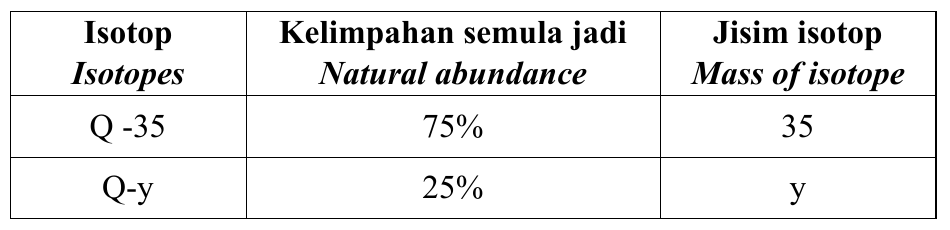
Table 4: isotope Q-35 has natural abundance 75% and mass 35; isotope Q-y has natural abundance 25% and mass y. Calculate value of y. [Relative atomic mass Q = 35.5]
Medium
In a chemical reaction to determine a rate of reaction, 1.5 mol of calcium carbonate powder react with excess hydrochloric acid. After 2.0 minutes, 0.5 mol of calcium carbonate unreacted. What is the average rate of reaction? [Relative atomic mass: Ca = 40, C = 12, O = 16]
Medium
Zn + CuSO₄ → ZnSO₄ + Cu ΔH = -240 kJ mol⁻¹. Heat released when 100 cm³ of x mol dm⁻³ copper(II) sulphate solution reacts with excess magnesium powder is 4 800 J. Calculate the x value. [Specific heat capacity of solution = 4.2 J g⁻¹ °C⁻¹]
Medium
The empirical formula of metal oxide is MO₂. If the oxide metal contain 60% of metal M by mass, what is the relative atomic mass of metal M? [Relative atomic mass O = 16]
Medium
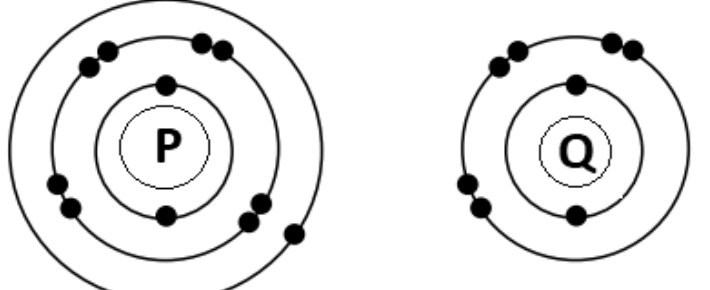
Diagram 11 shows the electron arrangements of atoms P and Q. Which of the following chemical equation represent formation of compound for atoms P and Q?
Medium
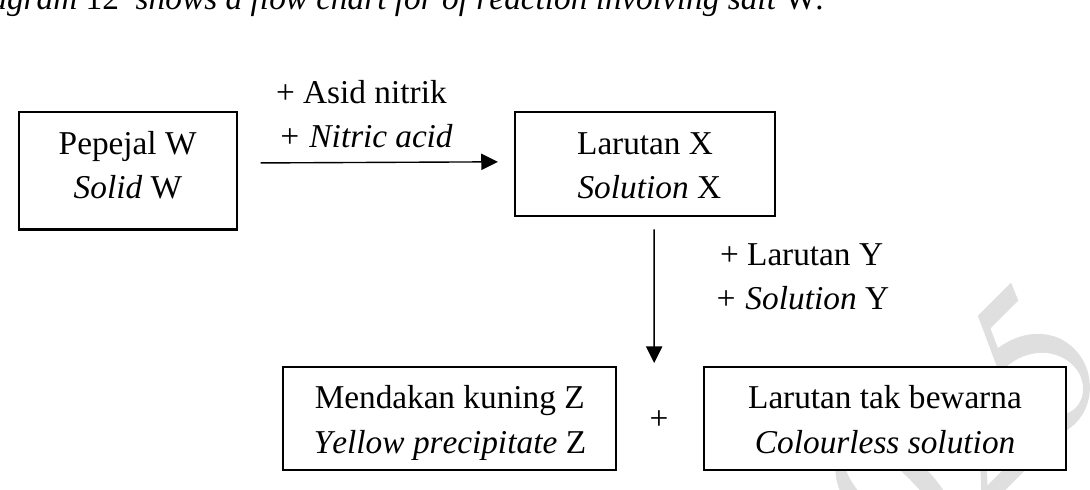
Diagram 12 shows a flow chart for reaction involving salt W: solid W + nitric acid → solution X; solution X + solution Y → yellow precipitate Z + colourless solution. State cation and anion present in yellow precipitate Z and name a solution Y.
Medium
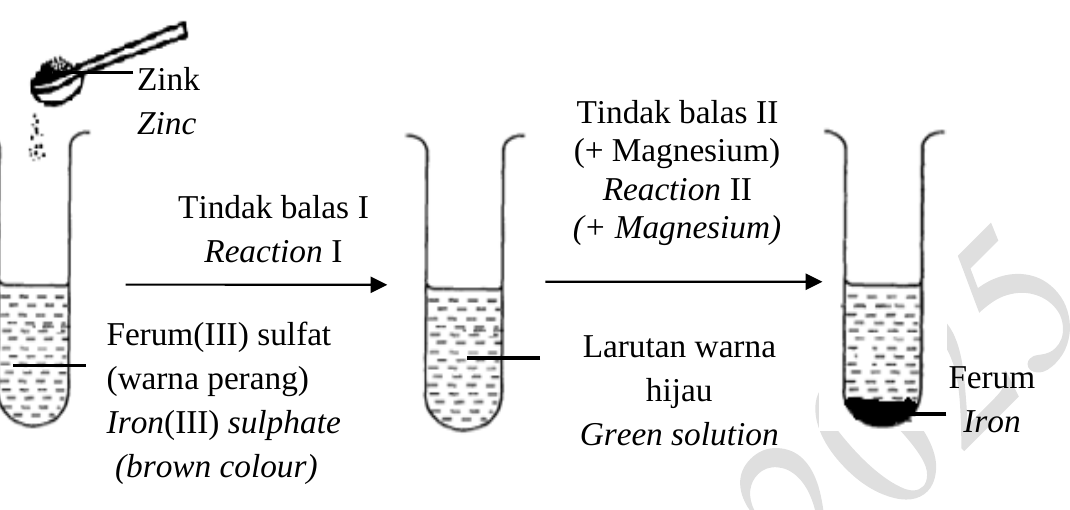
Diagram 13 shows several reactions involving a redox reaction: iron(III) sulphate (brown) + zinc (reaction I) → green solution; + magnesium (reaction II) → iron. Which of the following represent the half equation of oxidation for reactions I and II?
Medium
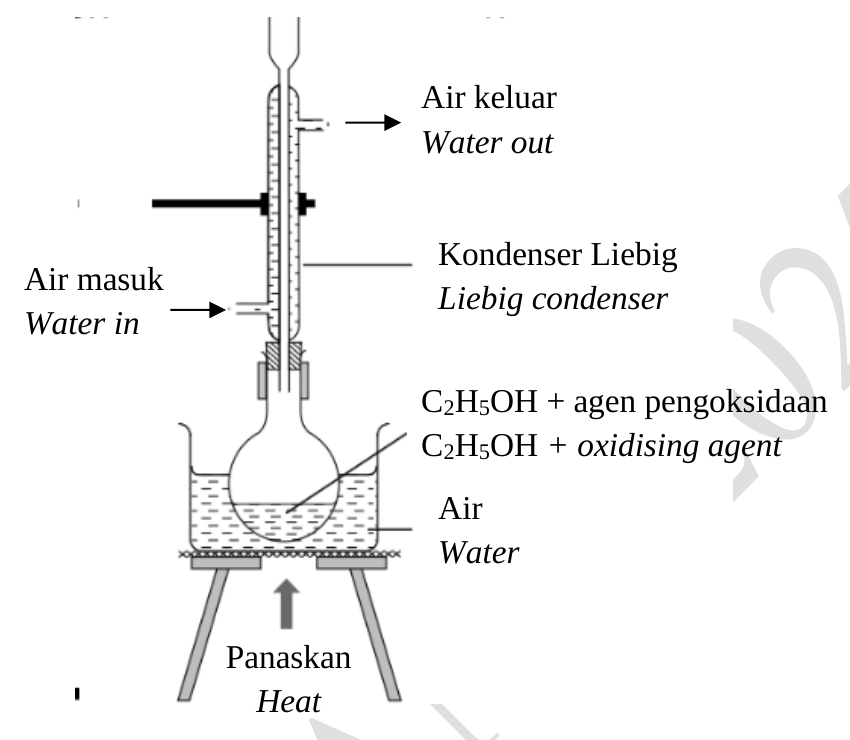
Diagram 14 shows an apparatus set-up (Liebig condenser, heating in a water bath) for chemical reaction of C₂H₅OH + oxidising agent. Which of the following is correct for the above reaction?
Medium
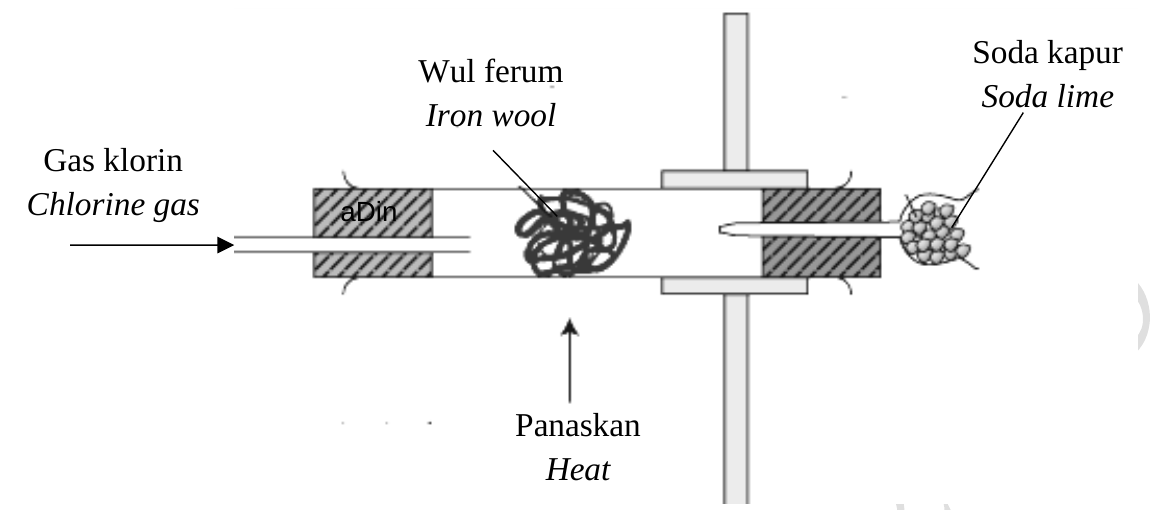
Diagram 15 shows the set up of apparatus for the reaction between chlorine gas and iron wool. What is the volume of chlorine gas at room temperature if 3.25 g of brown solid are formed? [Relative atomic mass: Fe = 56; Cl = 35.5. Molar volume of gas = 24 dm³ mol⁻¹ at room temperature]
Medium
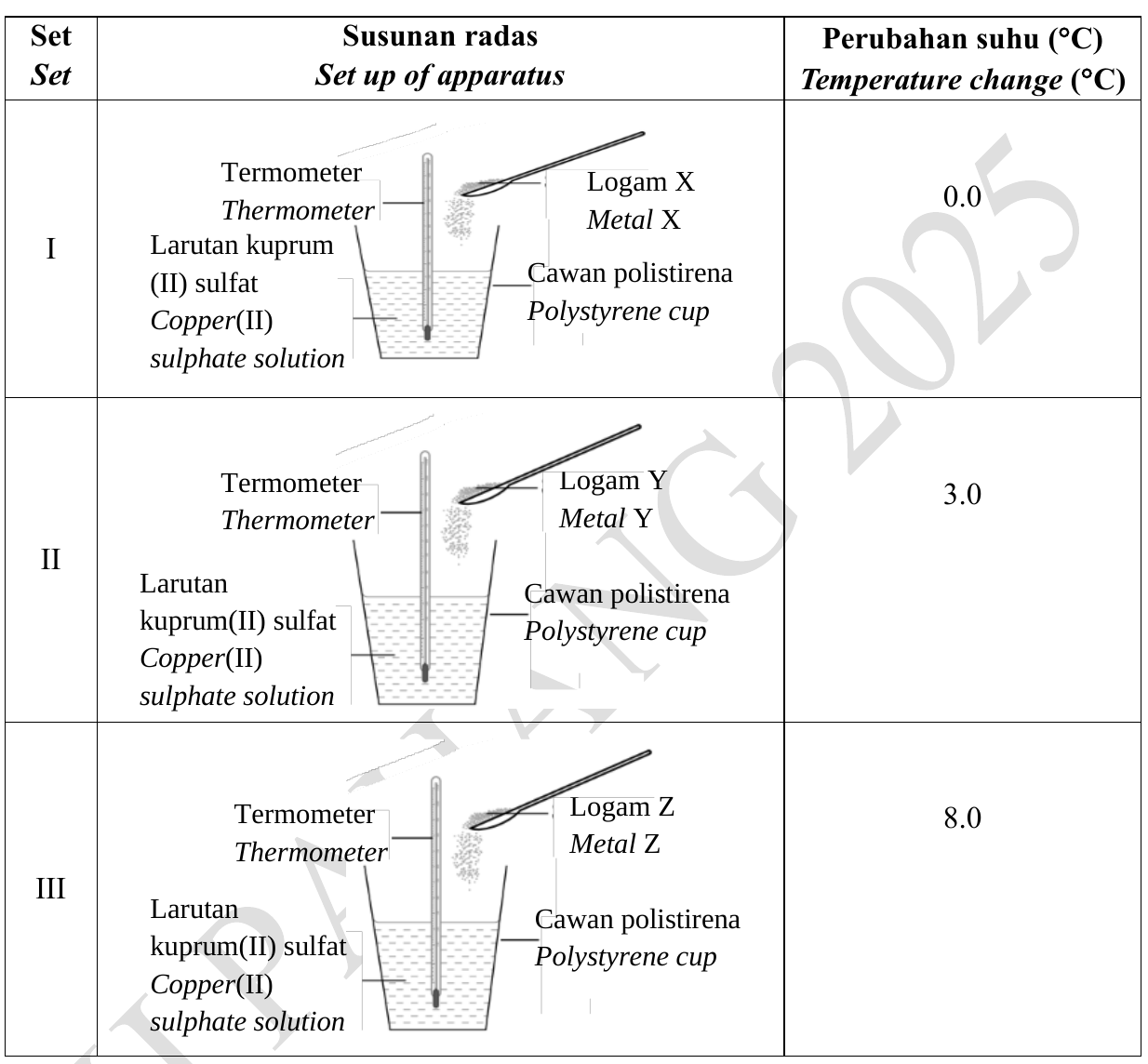
Diagram 16 shows three sets of experiments to determine the heat of displacement: metal X added to copper(II) sulphate solution, temperature change 0.0 °C; metal Y, 3.0 °C; metal Z, 8.0 °C. Which of the following represent metal X, Y and Z?