Write your answer on paper. Then open the answer to check it.
Section A
Diagram 1 shows a palm oil that can be processed to produce margarine (hydrogenation).
Medium5 marks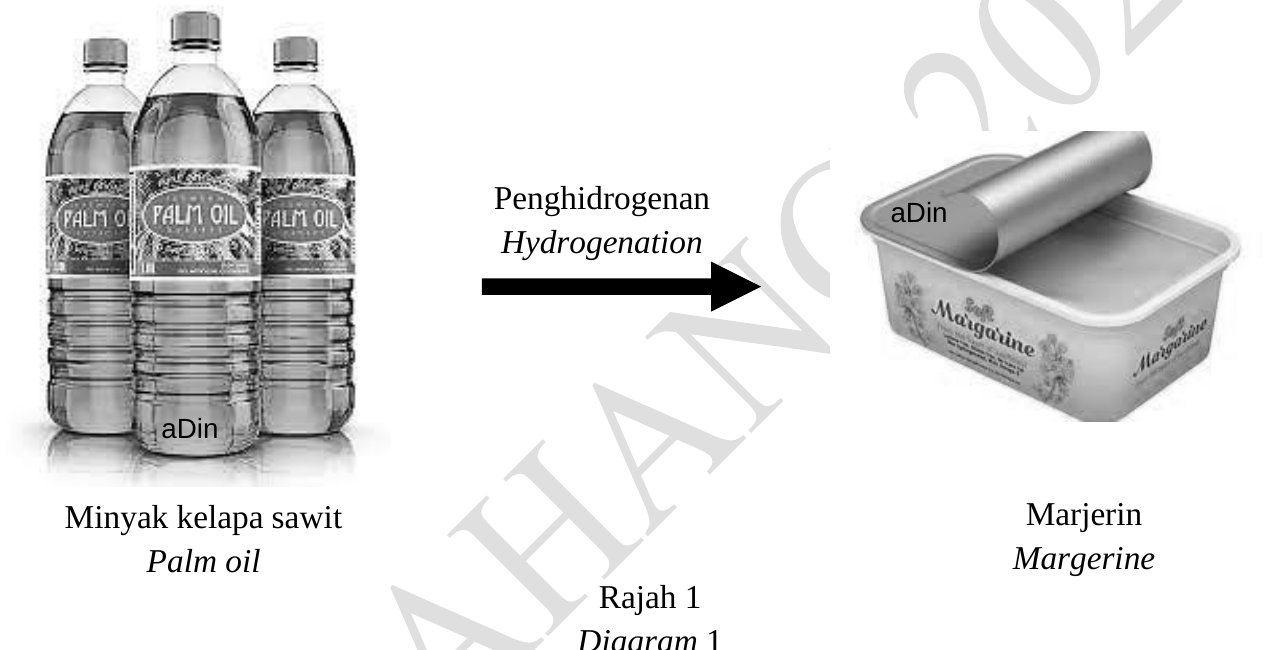
- (a)
State the homologous series for oil.
[1] - (b)
State two uses of oil in daily life.
[2] - (c)
Explain why margarine exists in a solid state at room temperature even though it is made from palm oil.
[2]
Table 1 shows four substances and their chemical formula: Helium He; Zinc Zn; Lead(II) chloride PbCl2; Tetrachloromethane CCl4.
Medium5 marks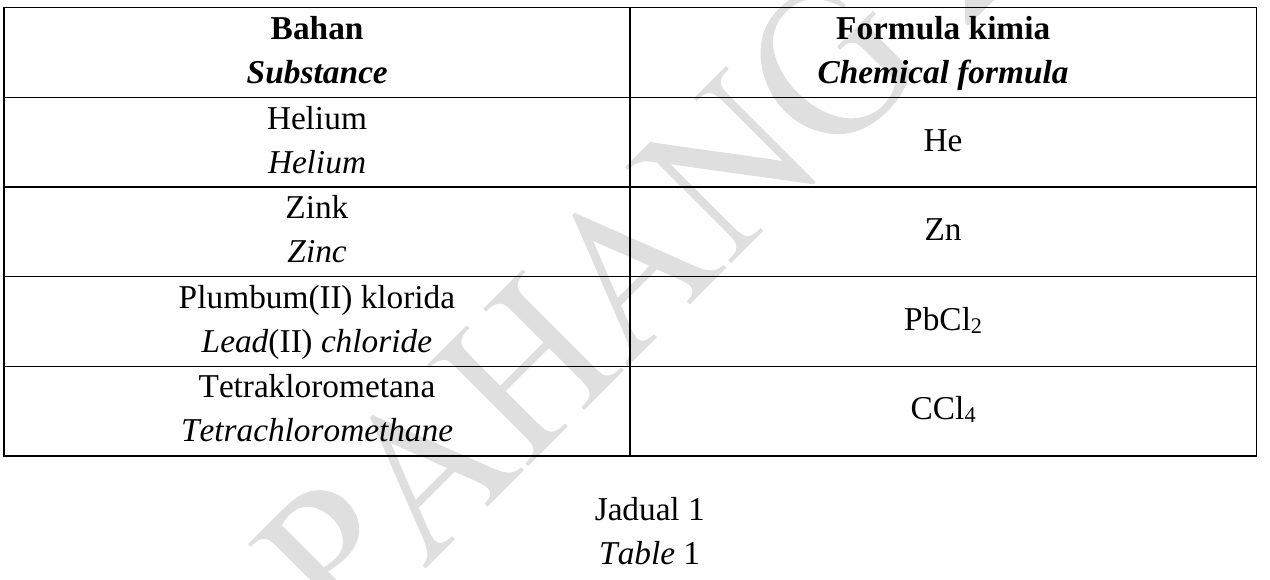
- (a)
State the type of particle of tetrachloromethane.
[1] - (b)
State the colour of solid lead(II) chloride.
[1] - (c)
Write the ionic formula for zinc.
[1] - (d)
Classify the substances in Table 1 into element and compound.
[2]
Diagram 2 shows the rubber particle cross section which is a natural polymer labelled as polymer X.
Medium6 marks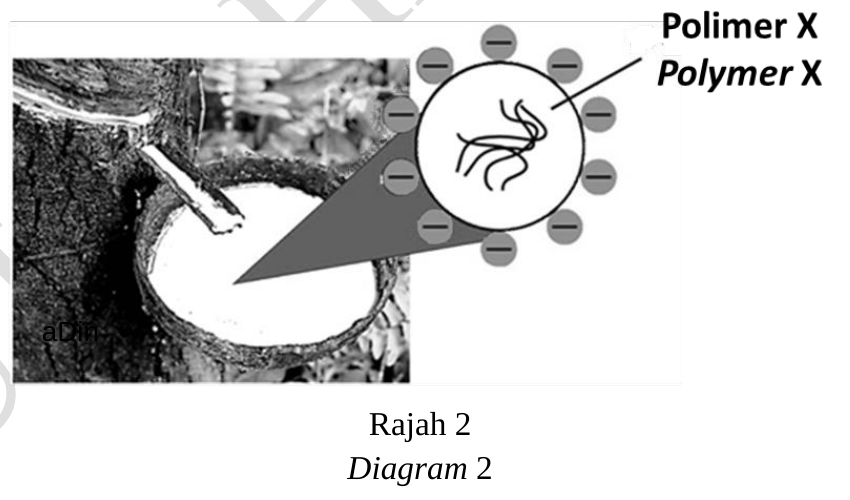
- (a)
State the name of polymer X.
[1] - (b)
Draw the structural formula for the monomer of polymer X.
[1] - (c)
State one characteristic of natural rubber.
[1] - (d)
Amira finds that a rubber band easily breaks and becomes sticky. In order to overcome the problem, suggest a process to enhance the quality of the rubber band. Explain your answer.
[3]
Diagram 3 shows the reaction during the activity of determining the empirical formula of magnesium oxide (magnesium ribbon heated in a crucible with lid on a pipe clay triangle).
Medium7 marks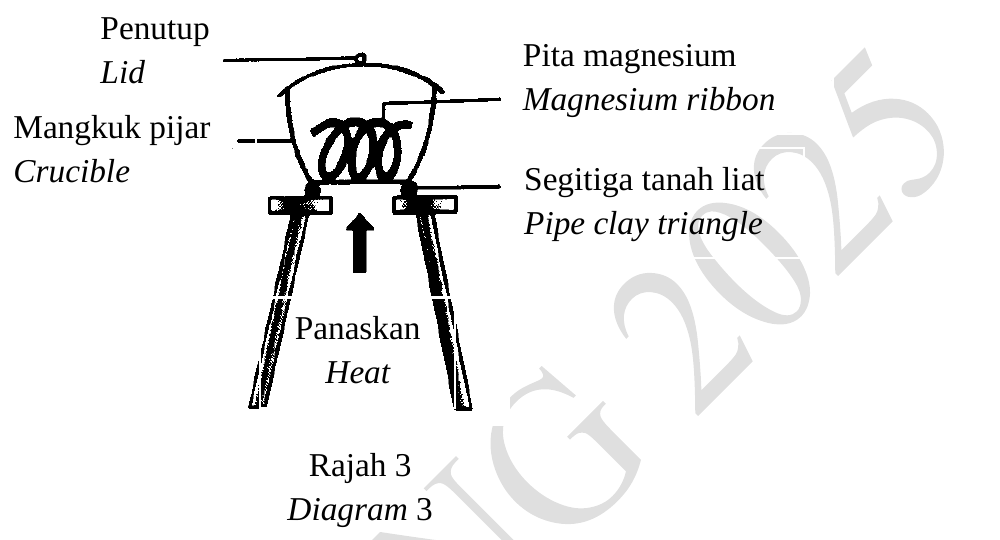
- (a)
State the colour of magnesium oxide.
[1] - (b)
How do you ensure all the magnesium ribbon has completely reacted?
[2] - (c)
The result of the experiment is shown in Table 2: crucible + lid 26.35 g; crucible + lid + magnesium ribbon 28.75 g; crucible + lid + magnesium oxide 30.35 g. Based on the results in Table 2, determine the empirical formula of magnesium oxide.
[4]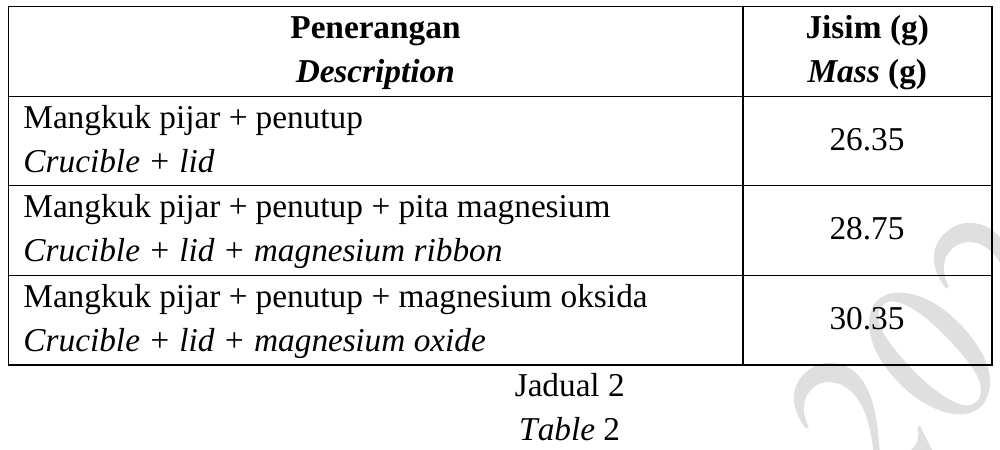
Diagram 4 shows a part of the Periodic Table of Elements with elements W (Group 1, Period 3), X, Y (Group 17, Period 3) and Z (Group 18, Period 1).
Medium8 marks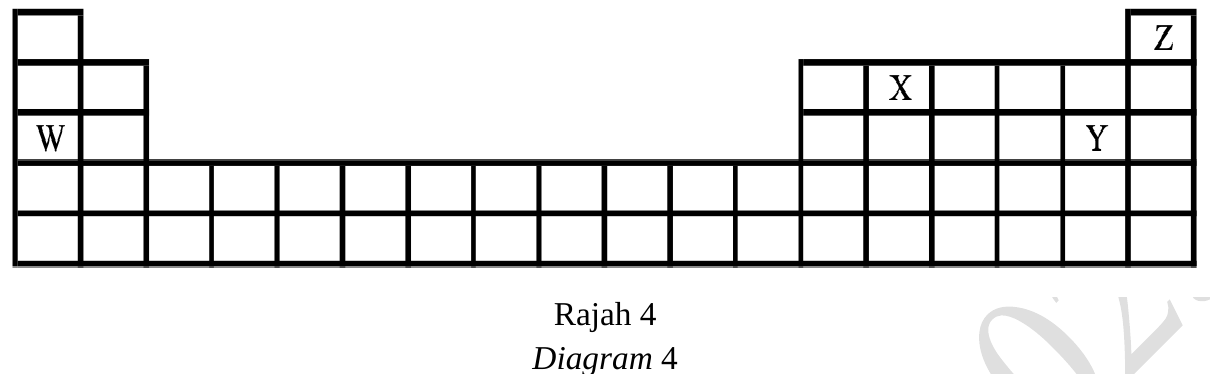
- (a)
State how the elements in the Periodic Table of Elements are arranged.
[1] - (b)
Write the electron arrangement for atom W.
[1] - (c)
Element Z exists as monoatomic gas. Explain why.
[2] - (d)(i)
Element Y and element W react to form compound A while element Y and element X react to form compound B. Write the chemical equation for the formation of compound A.
[2] - (d)(ii)
Explain the differences in the melting point of compound A and compound B.
[2]
A telescope is a tool used to see distant objects such as planets and stars in space. Diagram 5 shows a telescope with Material X labelled.
Medium9 marks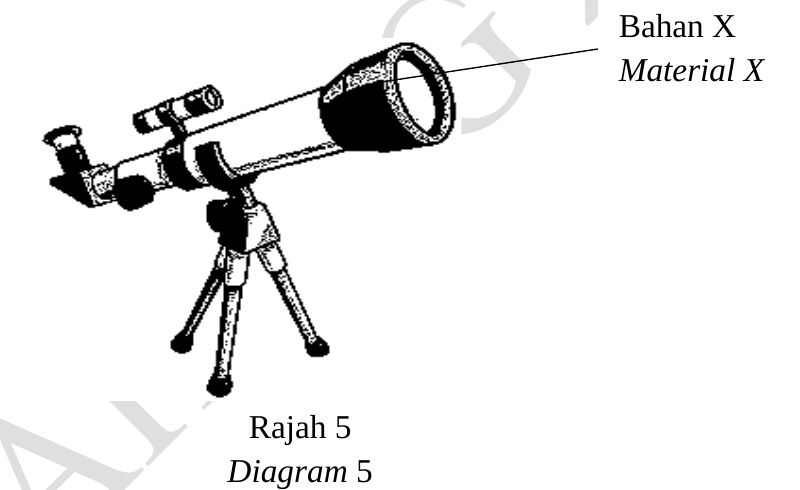
- (a)(i)
Material X is a type of glass. State the main component of glass.
[1] - (a)(ii)
Material X is one of the components used to make telescope. State the material X.
[1] - (a)(iii)
State one other use of substance X.
[1] - (b)
Company X found that there was a poor telecommunication in a remote area under its maintenance. To improve the telecommunication infrastructure in the area, state the materials used. Explain.
[3] - (c)
Floods occurred in Village A and Village B. The concrete bridge in Village A collapsed, while the concrete bridge in Village B did not collapse. Compare the materials used in the manufacture of the concrete pillars of the bridges in Village A and Village B. Explain.
[3]
Table 3 shows the results of the experiment for Set I and Set II: sodium thiosulphate + sulphuric acid 1.0 mol dm⁻³ (Set I) takes 10 s for the X mark to disappear; with sulphuric acid 0.5 mol dm⁻³ (Set II) it takes 20 s.
Medium10 marks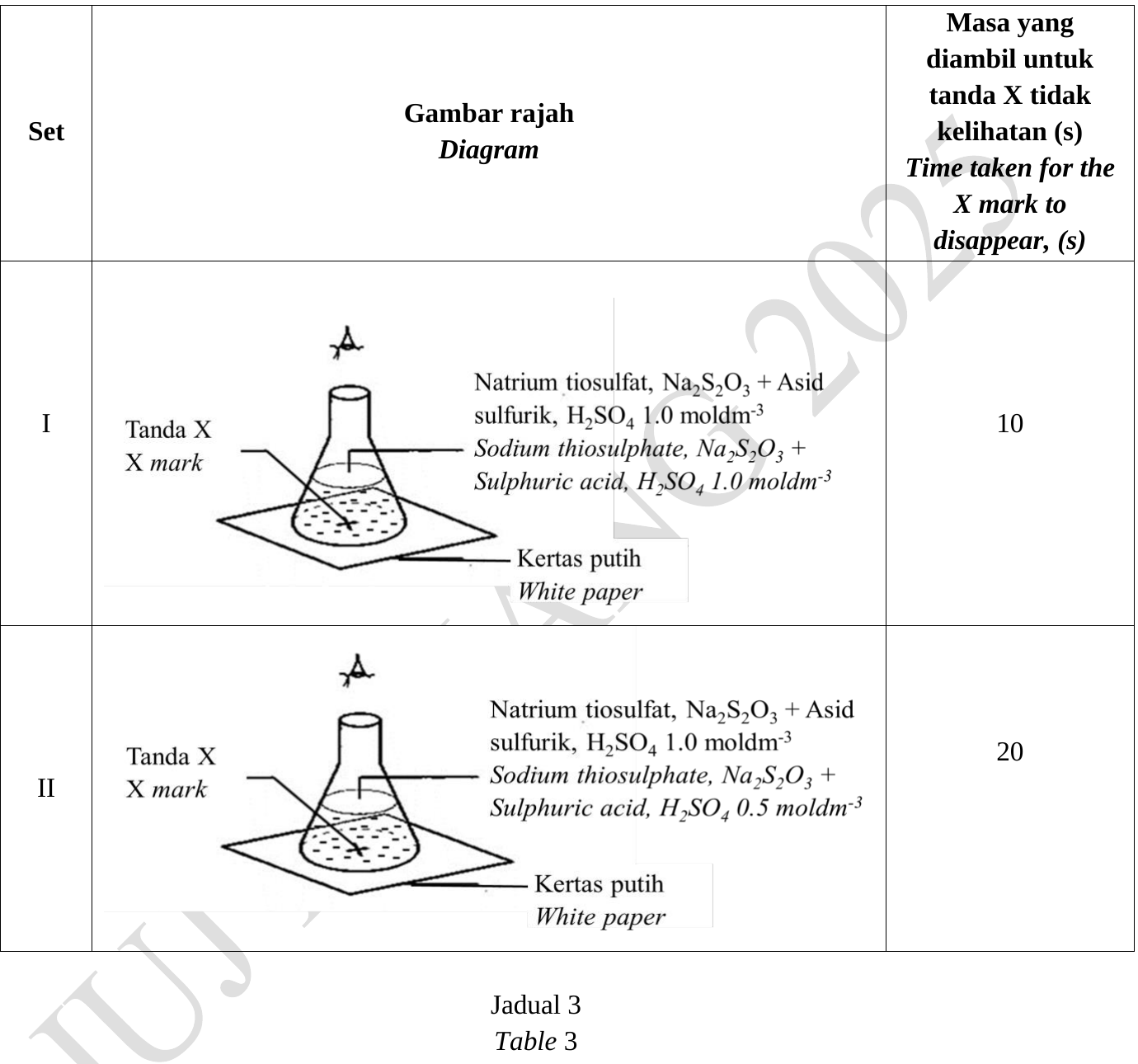
- (a)(i)
State one factor that affects the rate of reaction.
[1] - (a)(ii)
Write a chemical equation for the reaction between sodium thiosulphate and sulphuric acid.
[1] - (a)(iii)
State the name of precipitate formed.
[1] - (b)(i)
Calculate the average rate of reaction for Set I and Set II.
[2] - (b)(ii)
Rate of reaction in Set I is higher than Set II. By referring to the Collision Theory, explain why there are differences in the rate of reaction in both experiments.
[3] - (c)
Alcohol can be produced through the hydration of ethene and the fermentation of glucose. Using your chemical knowledge, which method is more effective in producing alcohol? Justify.
[2]
Diagram 6 shows a series of reactions involving C3H7OH: dehydration gives compound Y; hydrogenation of compound Y gives compound Z.
Medium10 marks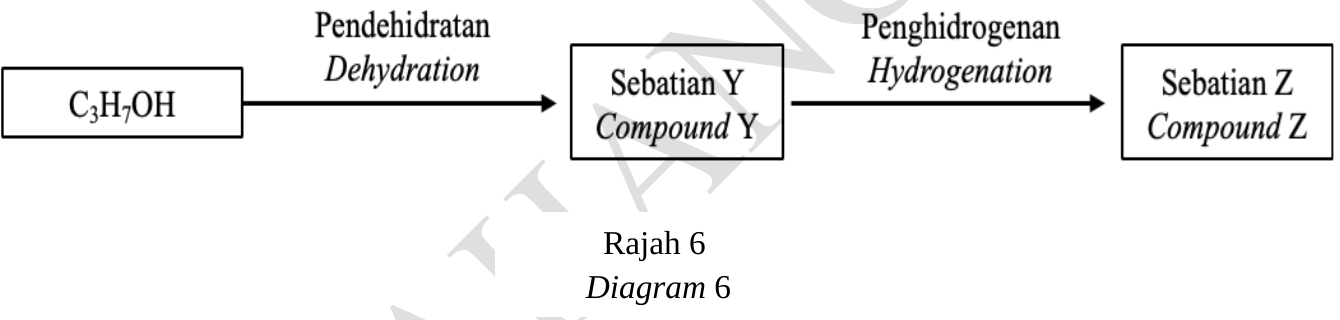
- (a)(i)
State the functional group of alcohol.
[1] - (a)(ii)
What is meant by isomers?
[1] - (a)(iii)
Draw the structural formula of two isomers for C3H7OH.
[2] - (b)
Write the chemical equation for the formation of compound Y.
[1] - (c)
Describe briefly a chemical test to differentiate between compound Y and compound Z.
[2] - (d)
Complete combustion of compound Y and compound Z produces carbon dioxide and water. Choose a compound that has less impact on environmental pollution. Justify.
[3]
Section B
Answer ONE question from Section B (Question 9 or 10). (a) Diagram 7 shows an experiment to study heat of precipitation for copper(II) carbonate: 100 cm³ of 0.1 mol dm⁻³ copper(II) sulphate solution at 29 °C mixed with 100 cm³ of 0.1 mol dm⁻³ X carbonate solution at 29 °C in a polystyrene cup; the highest temperature reached is 33 °C.
Medium20 marks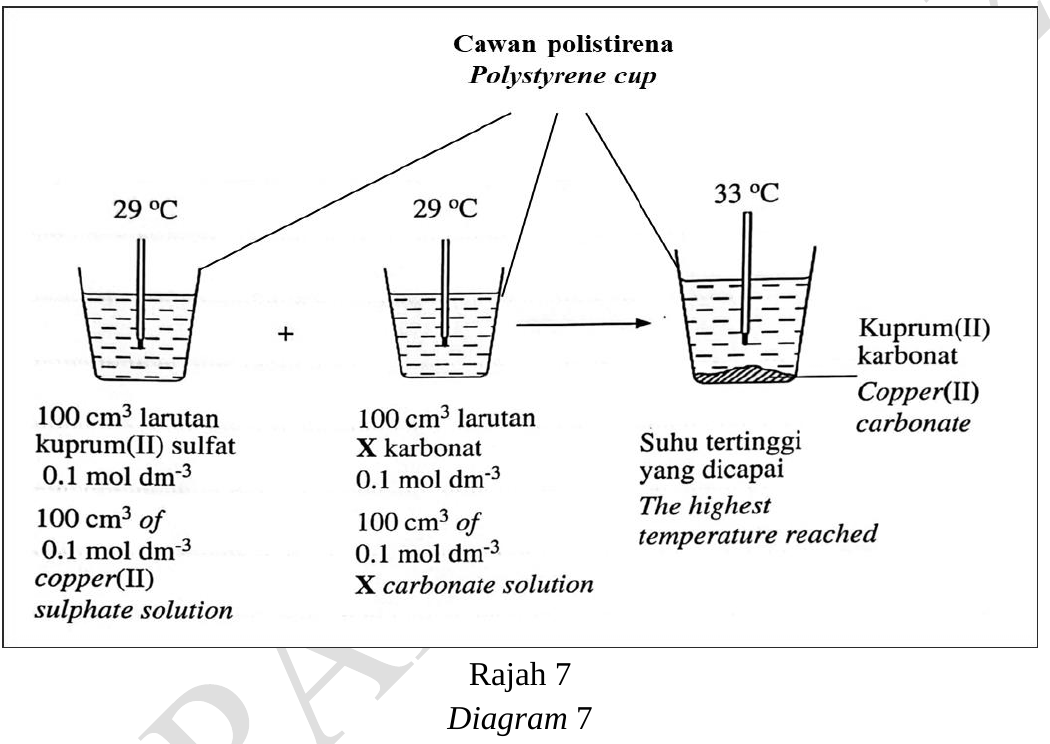
- (a)(i)
State the colour of copper(II) carbonate and the function of polystyrene cup used in this experiment.
[2] - (a)(ii)
Suggest X carbonate solution and write a balanced chemical equation for the reaction.
[3] - (a)(iii)
Calculate the heat of precipitation of copper(II) carbonate and draw the energy level diagram for the reaction. [Specific heat capacity of solution C = 4.2 J g⁻¹ °C⁻¹; density of solution = 1 g cm⁻³]
[6] - (b)
Diagram 8 shows a Q pack (distilled water and sodium hydroxide pellets) and a S pack (distilled water and ammonium nitrate solid) that apply the thermochemistry concept in daily life. Based on Diagram 8, state the type of reaction in Q pack and S pack. Compare the difference in the type of reaction for Q pack and S pack in terms of the change in temperature, difference in energy content of reactants and products and energy changes during bond breaking and bond formation. Suggest one substance that can replace ammonium nitrate and produce the same type of reaction as in pack S.
[9]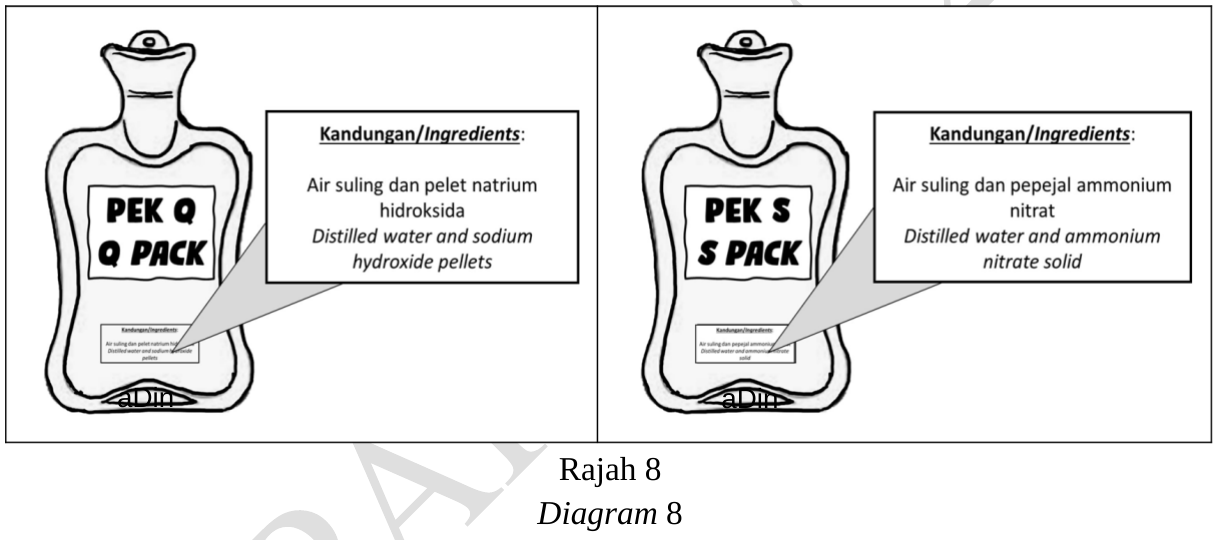
Answer ONE question from Section B. The equation shows a reaction between zinc and acid R. Acid R is a strong monoprotic acid: Zn + Acid R → Salt S + H2.
Medium20 marks- (a)
Based on equation, state the meaning of strong acid and state one physical property for this acid. State the name of acid R and salt S.
[4] - (b)(i)
Diagram 9 shows a flow chart for the reaction of zinc salts: ZnSO4, ZnCl2 or Zn(NO3)2 + solution T (reaction I) → ZnCO3 + salt U; ZnCO3 → ZnO + gas V (reaction II). Based on Diagram 9, suggest the solution T. Choose one of the three zinc salts that can react with solution T and write the chemical equation involved.
[3]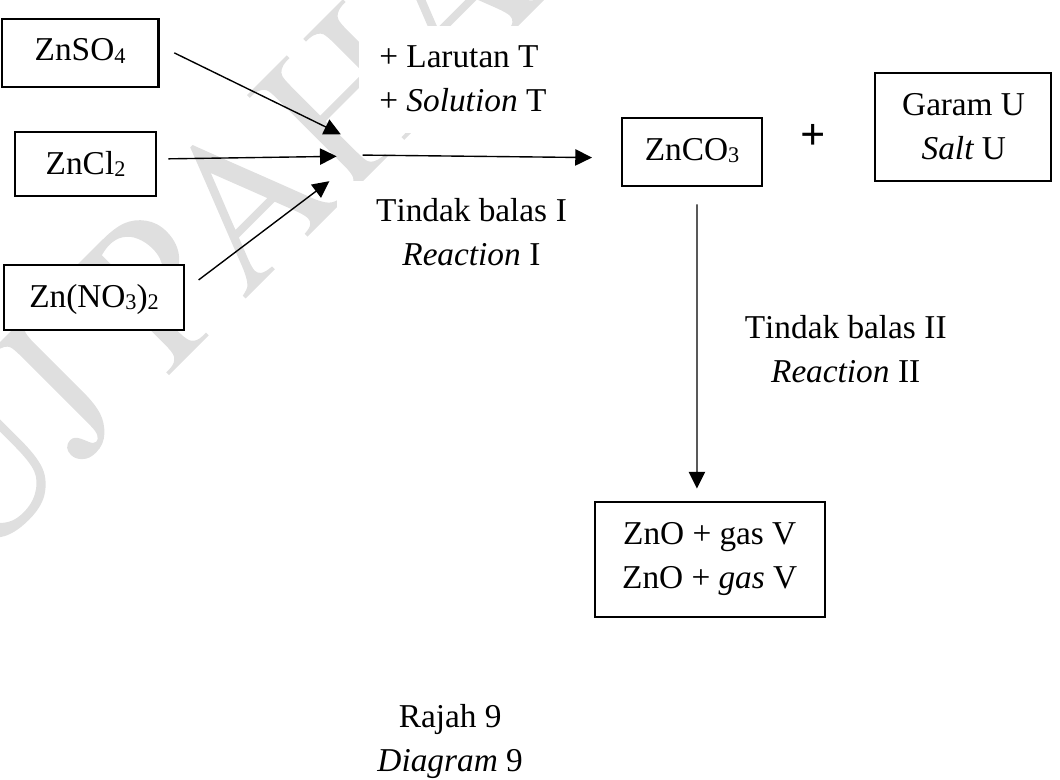
- (b)(ii)
If 25 g of zinc carbonate is used in reaction II, determine the maximum volume of gas V that can be produced at room condition. [Relative atomic mass: Zn=65, C=12, O=16; 1 mol of gas occupies 24 dm³ at room condition]
[3] - (c)
An experiment is carried out to study the acidic properties and electrical conductivity of solution A (glacial ethanoic acid + solvent C) and solution B (glacial ethanoic acid + solvent D). Diagram 10 shows the observation for two sets of the experiment (Set I: marble chips added to each solution; Set II: carbon electrodes, battery and bulb in each solution). Based on Diagram 10, identify solvent C and solvent D. Explain why there are differences in the observation in Set I and Set II. Write the chemical equation for the reaction that occurs in Set I.
[10]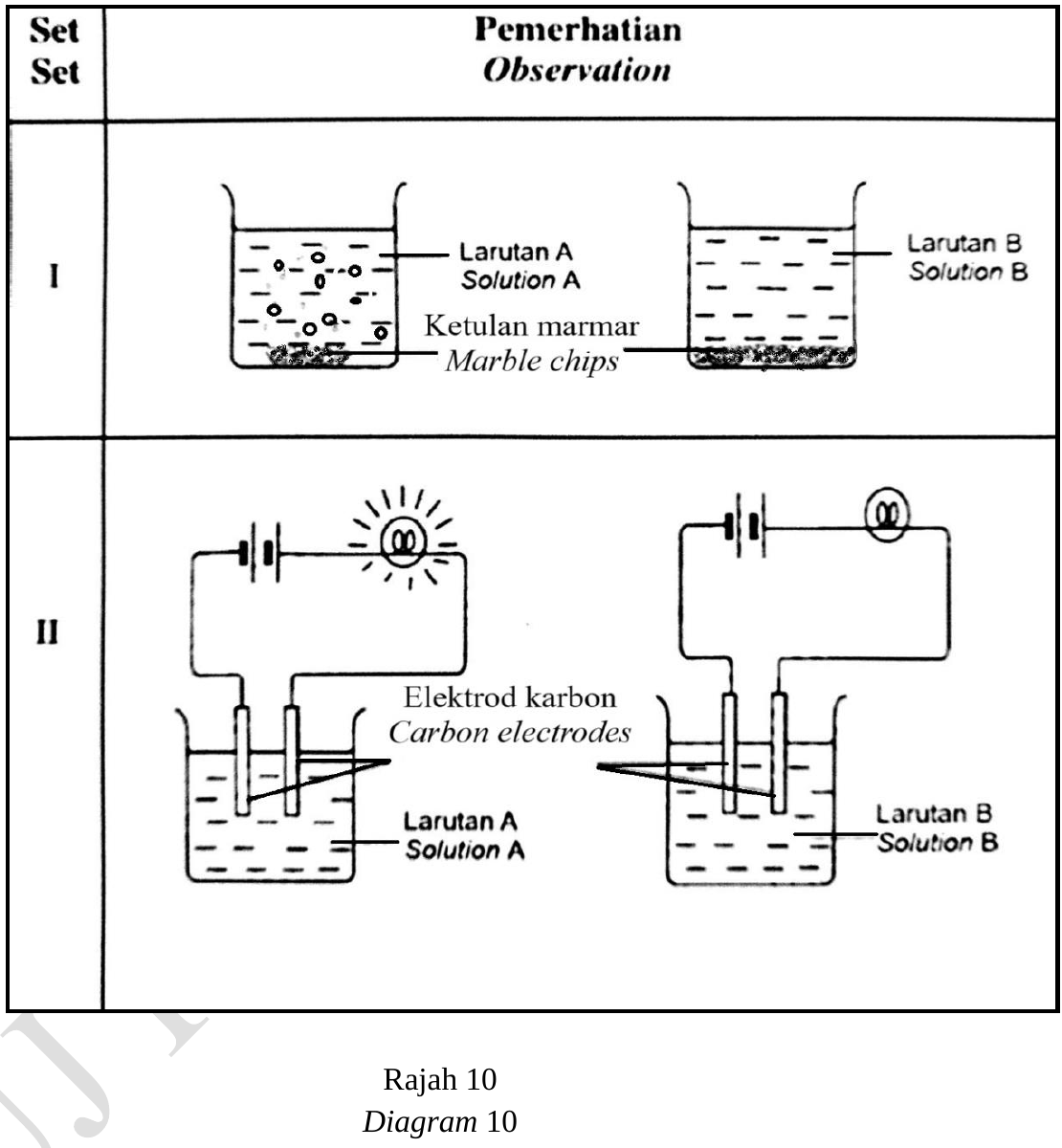
Section C
Table 4 shows two different reactions: Reaction I, zinc powder added to hydrochloric acid (colourless gas bubbles released); Reaction II, zinc powder added to copper(II) chloride solution (brown solid is formed). This question must be answered.
Medium20 marks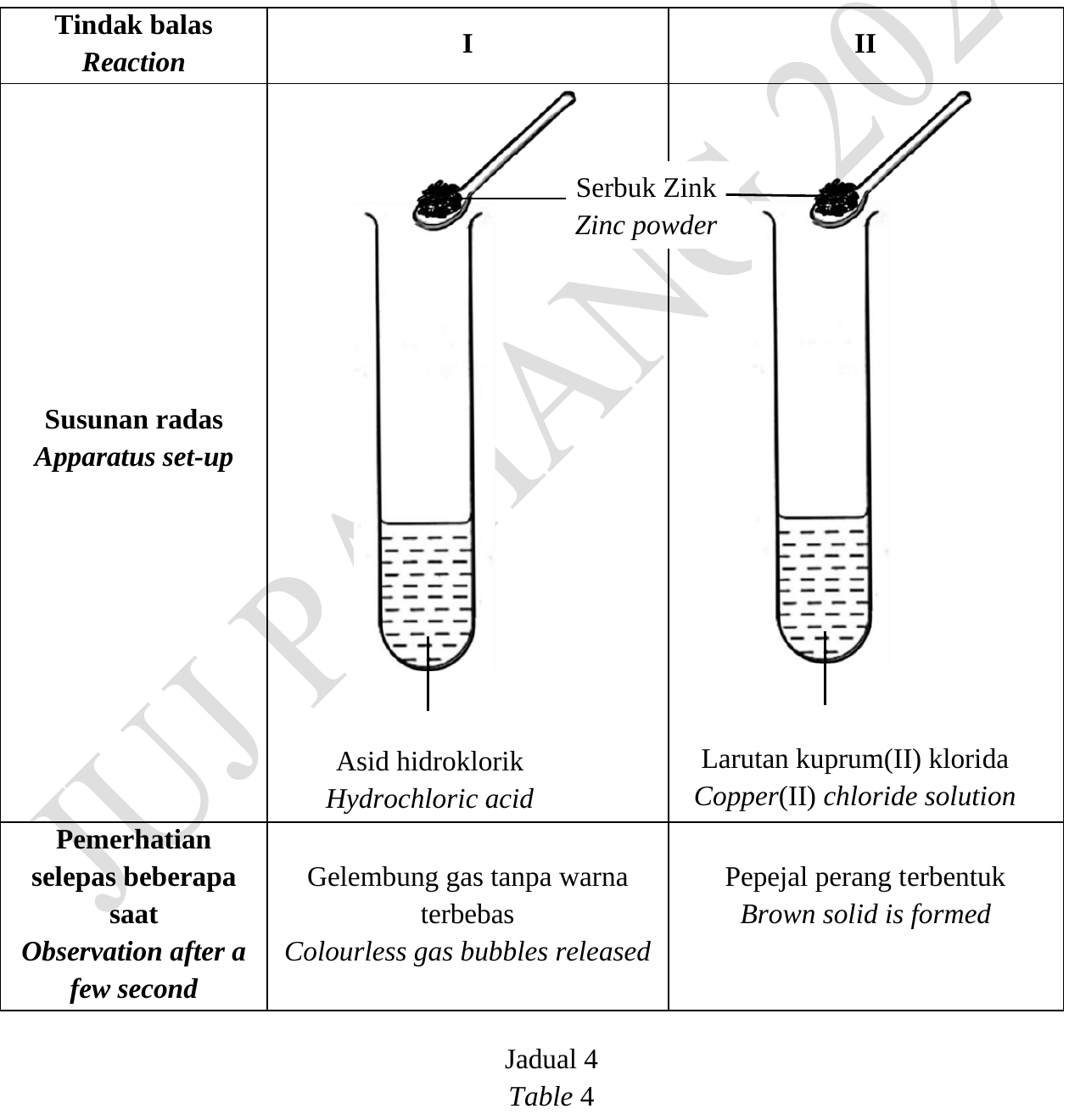
- (a)(i)
Based on Table 4, state one method of preparing soluble salt. In reaction II, state the salt produced and name the brown solid formed.
[3] - (a)(ii)
Write the chemical equation in reaction I and calculate the volume of gas released when 0.2 mol of hydrochloric acid is used. [1 mol of gas occupies 24 dm³ at room conditions]
[4] - (b)
Diagram 11 shows a series of reactions to produce substance Q: blue solution of substance P + Na2CO3 (reaction X) → green solid of substance Q + Na2SO4; Q → black solid of substance R + gas S. Substance Q decomposed into substance R and released gas that turns limewater cloudy when heated. Identify substances P, Q, R and gas S. State the name of reaction X.
[5]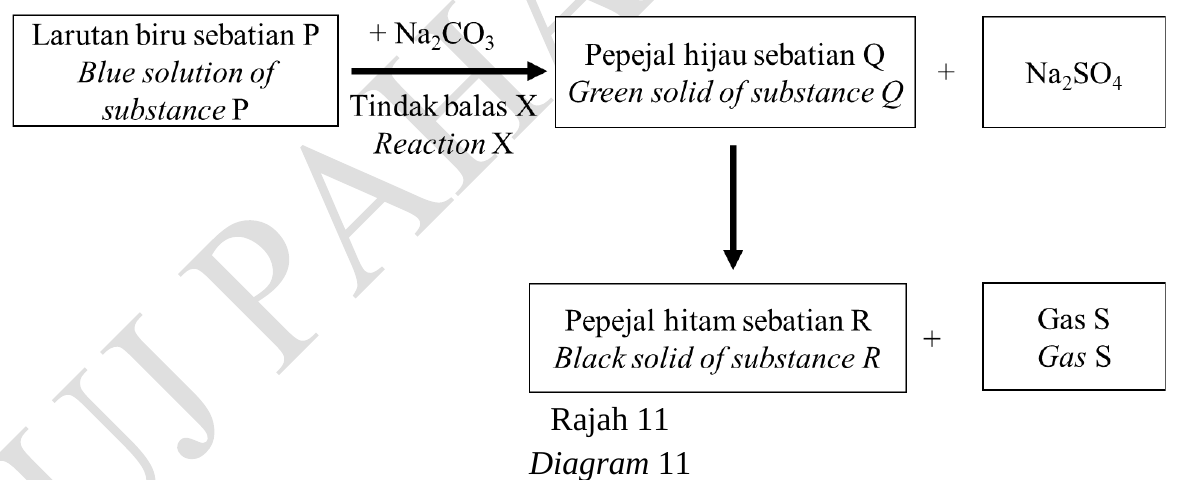
- (c)
Azmi is assigned by his teacher to purify an impure copper strip in the laboratory. Describe how Azmi could complete the task using compound P as electrolyte, pure copper strip and suitable apparatus. In your description, include observation and write half equation at anode and cathode.
[8]