Which of the following atoms has three valence electrons?
Medium
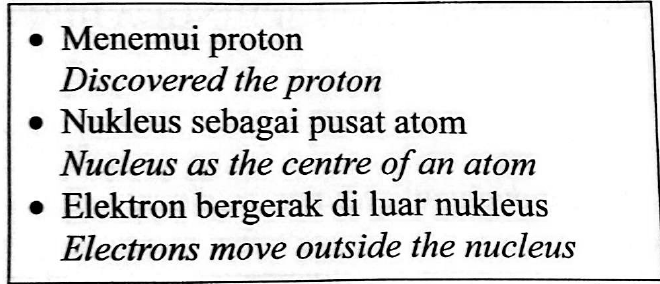
The following statement refers to the contribution of a scientist in the development of ideas about atomic structure: discovered the proton; nucleus as the centre of an atom; electrons move outside the nucleus. Who is the scientist?
Medium
Element X and element Y are located in Group 1 and Group 16 respectively in the Periodic Table of Elements. Element X reacts with element Y to form a compound. What is the chemical formula of the compound?
Medium
Which of the following physical properties are the same for the elements in Group 17 of the Periodic Table of Elements?
Medium
Which of the following statements is true about the role of water in showing acidic properties?
Medium
The following are the characteristics of elements L and M: forms complex ions; forms coloured compounds. What are L and M? I Iron II Barium III Chromium IV Magnesium
Easy
Which of the following statements explains about dative bond?
Medium
Which of the following reactions is a slow reaction?
Easy
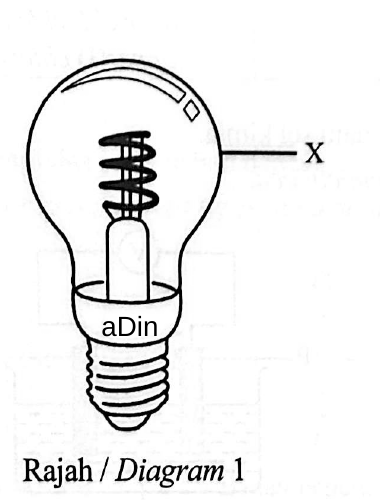
Diagram 1 shows a LED bulb. Which of the following glass is suitable for producing part X?
Medium
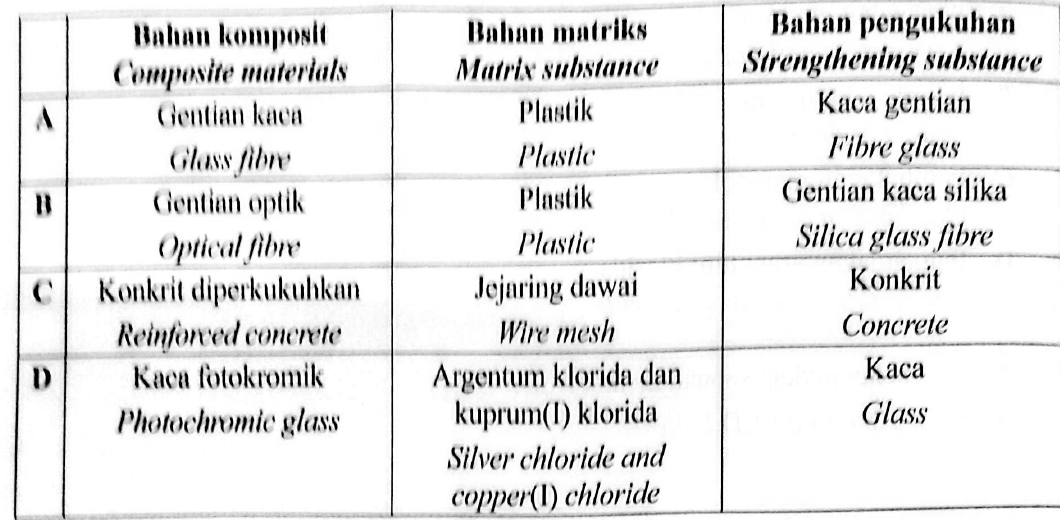
Which of the following is matched correctly? (Table of composite materials, matrix substance and strengthening substance: A Glass fibre / Plastic / Fibre glass; B Optical fibre / Plastic / Silica glass fibre; C Reinforced concrete / Wire mesh / Concrete; D Photochromic glass / Silver chloride and copper(I) chloride / Glass)
Easy
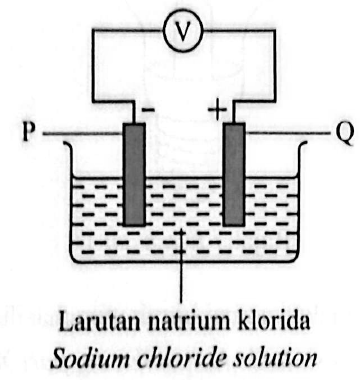
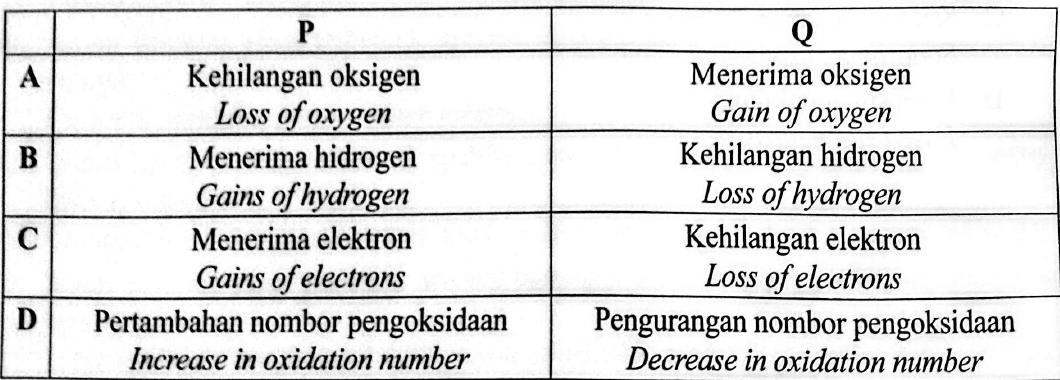
Diagram 2 shows a chemical cell (P at the negative terminal, Q at the positive terminal, sodium chloride solution). What happen at P and Q? A P: loss of oxygen, Q: gain of oxygen; B P: gains of hydrogen, Q: loss of hydrogen; C P: gains of electrons, Q: loss of electrons; D P: increase in oxidation number, Q: decrease in oxidation number
Medium
Table 1 shows the standard electrode potential value of half-cells: Cu²⁺(aq) + 2e ⇌ Cu(s) E° = +0.34 V; Ag⁺(aq) + e ⇌ Ag(s) E° = +0.80 V. Which of the following reducing agents is the strongest?
Medium
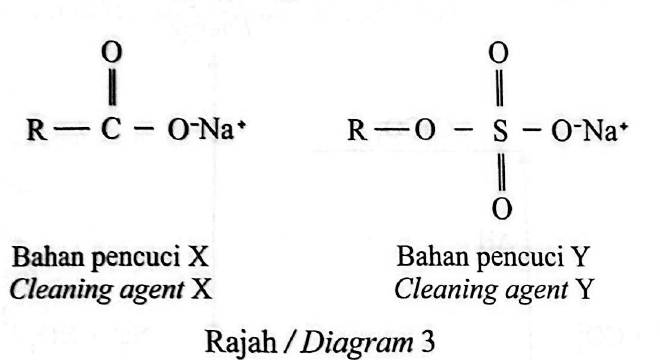
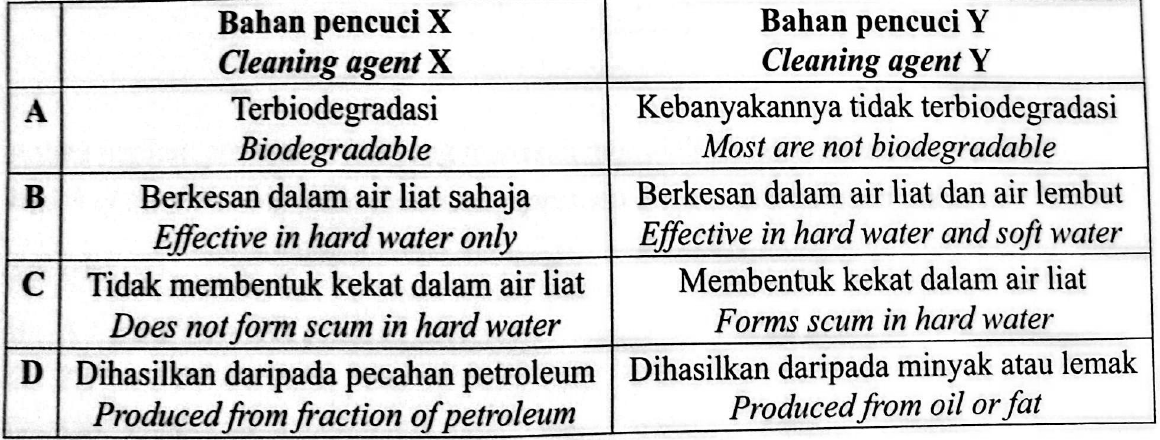
Diagram 3 shows the formulae for two different types of cleaning agent X (R-COO⁻Na⁺) and Y (R-O-SO₂-O⁻Na⁺). Which of the following statements is correct about cleaning agent X and Y? A X biodegradable, Y most are not biodegradable; B X effective in hard water only, Y effective in hard and soft water; C X does not form scum in hard water, Y forms scum in hard water; D X produced from fraction of petroleum, Y produced from oil or fat
Medium
The reaction between calcium nitrate solution and sodium carbonate solution is an endothermic reaction. Which of the following energy level diagrams represents the reaction?
Medium
The discovery of graphene has opened a new chapter in the field of nanotechnology. Which of the following is a physical property of graphene?
Easy
Which of the following substances can dissolve in water?
Easy
Diagram 4 shows the ionic formulae of elements X (X³⁺) and Y (Y²⁻). Which of the following ionic equations represents the reaction between the ions?
Medium
What type of bond present between carbon atoms in a propyne, C₃H₄ molecule?
Medium
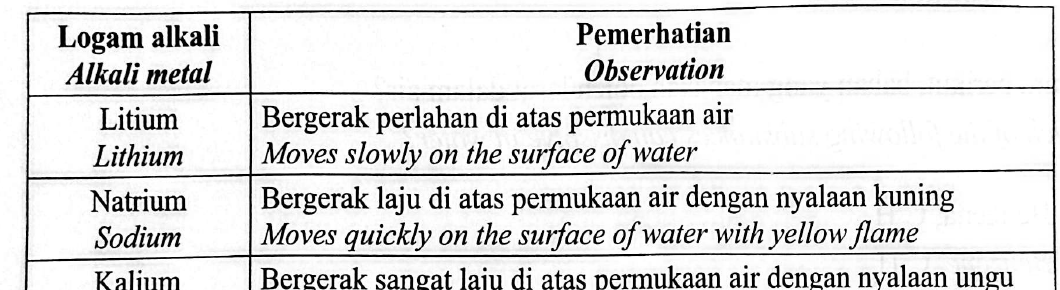
Table 2 shows observations when three alkali metals are placed into water: lithium moves slowly on the surface of water; sodium moves quickly with yellow flame; potassium moves very fast with lilac flame. Which of the following statements best explains the observation?
Medium
Which of the following is true about weak acid?
Easy
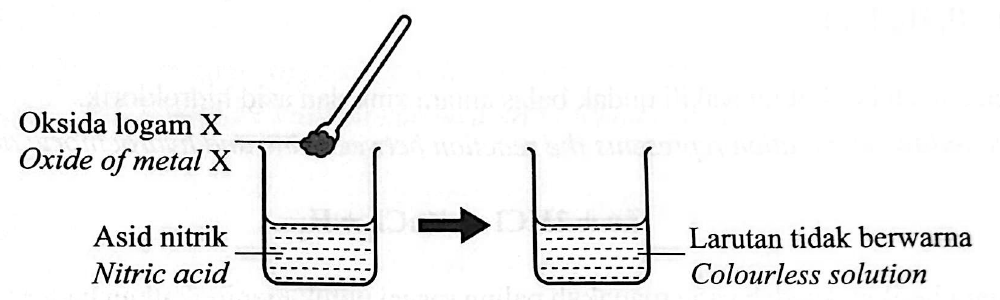
Diagram 5 shows the observation when oxide of metal X is added into nitric acid: a colourless solution forms. Which of the following substances will show the same observation when added to nitric acid? I Calcium oxide II Sodium oxide III Silicon dioxide IV Copper(II) oxide
Medium
Which of the following is the correct sequence in preparation of solution by dilution method? I Transfer the solution into a volumetric flask II Calculate the volume of stock solution to be diluted III Use a pipette to measure the volume of solution needed IV Add distilled water until the calibration mark
Medium
The following equation represents the reaction between zinc and hydrochloric acid: Zn + 2HCl → ZnCl₂ + H₂. Which of the following methods is the most suitable to increase the rate of reaction?
Easy
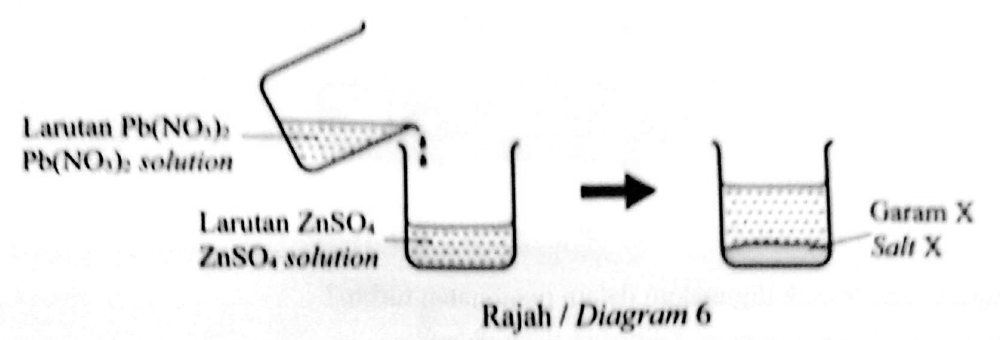
Diagram 6 shows an experiment to produce salt X by adding Pb(NO₃)₂ solution to ZnSO₄ solution. The experiment is repeated to produce salt Y which has the same solubility as salt X. Which of the following salt solutions can be used to replace the Pb(NO₃)₂ solution?
Medium
Which of the following methods can use to cook 100 potatoes within the shortest time?
Easy
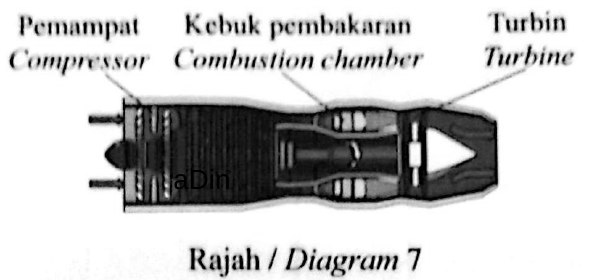
Diagram 7 shows the engine of a jet. Why is ceramic used in manufacturing the turbine?
Easy
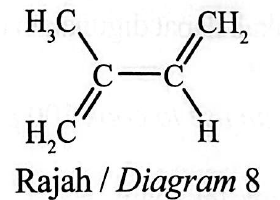
Diagram 8 shows the monomer of latex. What is the name of the monomer?
Easy
Which of the following substances is miscible in water in all proportions?
Medium
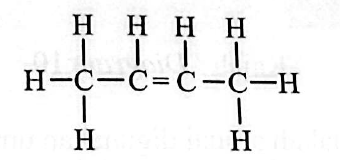
Diagram 9 shows the structural formula of an alkene (but-2-ene, CH₃-CH=CH-CH₃). What is the product formed when the alkene reacts with steam?
Medium
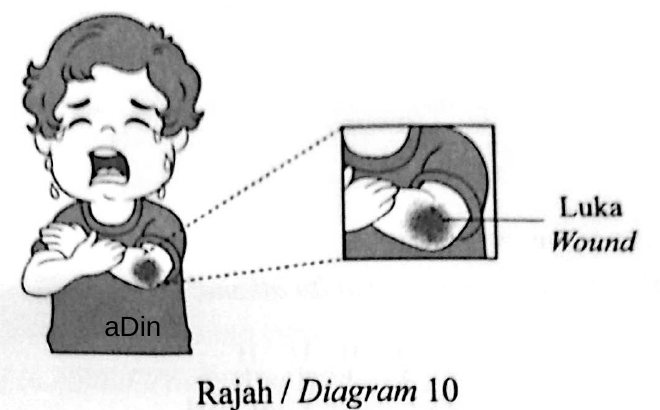
Diagram 10 shows an injured child with a wound. Which of the following medicines is used to treat his injury?
Easy
The following equation represents the reduction of iron(III) oxide by magnesium: 3Mg + Fe₂O₃ → 3MgO + 2Fe. What is the mass of iron(III) oxide that is reduced if 7.2 g magnesium is used? [Relative atomic mass: Fe = 56, Mg = 24, O = 16]
Medium
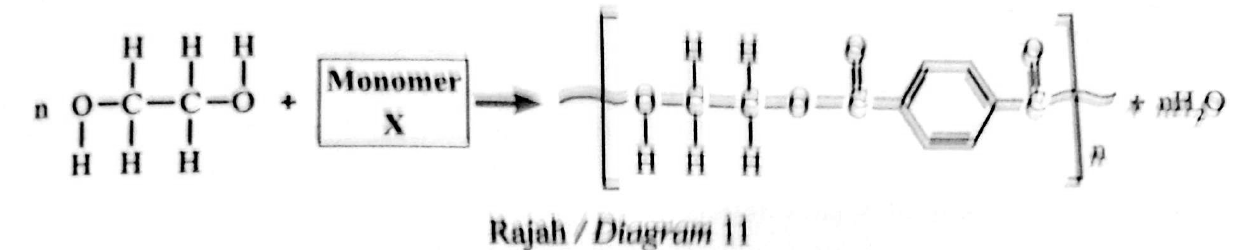
Diagram 11 shows the formation of terylene (ethane-1,2-diol + monomer X → terylene + nH₂O). What is monomer X?
Medium
The following information shows the observation when a solution containing cation R is tested with alkali solutions: white precipitate is insoluble in excess NaOH solution; white precipitate is insoluble in excess NH₃ solution. What is cation R?
Medium
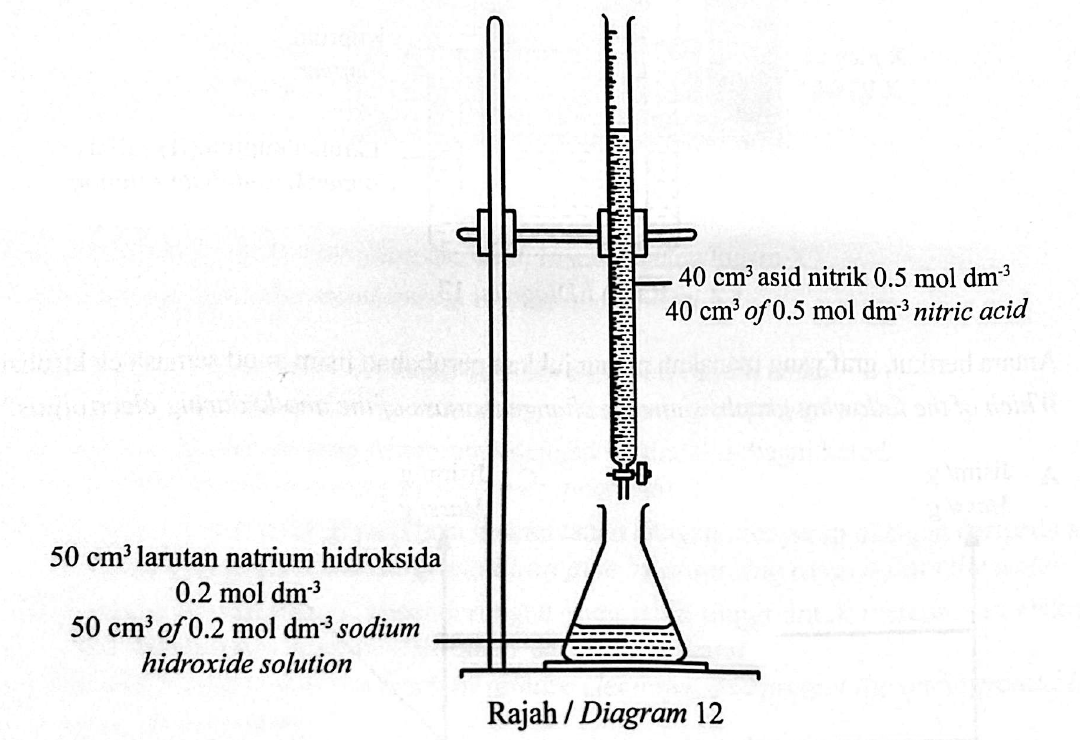
Diagram 12 shows the apparatus set-up for the titration of sodium hydroxide, NaOH with nitric acid, HNO₃ (burette: 40 cm³ of 0.5 mol dm⁻³ nitric acid; flask: 50 cm³ of 0.2 mol dm⁻³ sodium hydroxide solution). What is the maximum mass of the salt formed in this reaction? [Relative atomic mass: Na = 23, O = 16, N = 14]
Medium
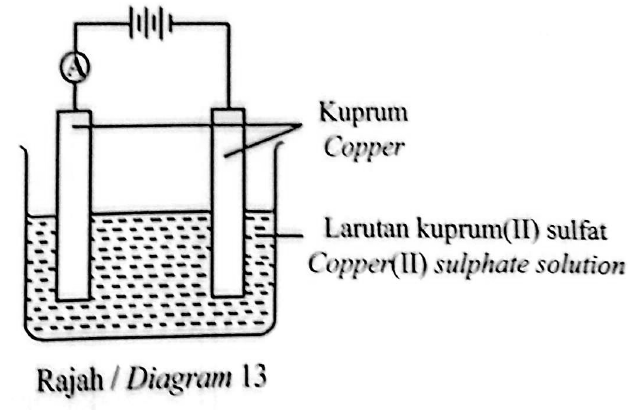
Diagram 13 shows the setup of apparatus for an electrolytic cell (copper electrodes in copper(II) sulphate solution). Which of the following graphs show the change in mass of the anode during electrolysis?
Medium
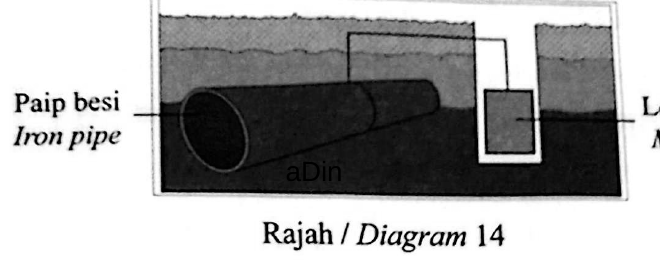
Diagram 14 shows the sacrificial metal used in underground iron pipes. Which of the following statements is correct about metal X?
Medium
Which of the following are the isomer for C₅H₁₁OH? I Pentan-2-ol II 2-ethylpropanol III 2,2-dimethylpropan-1-ol IV 2,3-dimethylpropan-2-ol
Medium
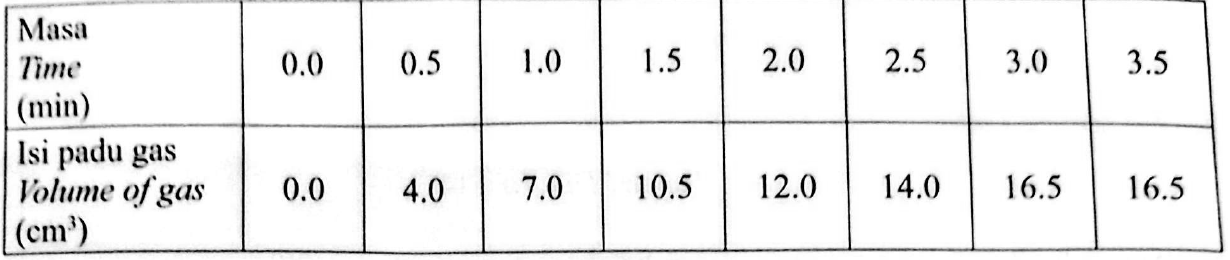
Table 3 shows the volume of hydrogen gas collected in the reaction between zinc powder and dilute hydrochloric acid. What is the average rate of reaction at the second minute?
Medium
A student prepared 100 cm³ of sodium hydroxide solution, NaOH by dissolving 4.0 g of sodium hydroxide in distilled water. After that, 150 cm³ of distilled water was added to the solution to dilute it. What is the pH value of the dilute solution? [Relative atomic mass: Na = 23, O = 16, H = 1]
Medium
The following thermochemical equation shows the combustion of butane gas: C₄H₁₀ + 13/2 O₂ → 4CO₂ + 5H₂O, ΔH = -2880 kJ mol⁻¹. 2400 cm³ oxygen gas, O₂ is burnt completely in butane gas. What is the heat change of the reaction? [1 mol of any gas occupies 24 dm³ at room conditions]