Write your answer on paper. Then open the answer to check it.
Section A
Diagram 1 shows the ingredients in a can of pineapple: pineapple, pineapple juice, citric acid, ethyl butanoate, substance X.
Medium5 marks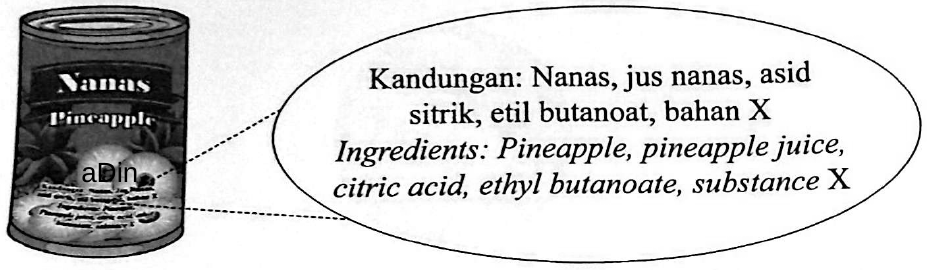
- (a)
State the meaning of food additive.
[1] - (b)(i)
State the function of citric acid.
[1] - (b)(ii)
State the function of ethyl butanoate.
[1] - (c)(i)
Substance X is added as preservative and flavouring. State substance X.
[1] - (c)(ii)
State how substance X can function as preservative.
[1]
Diagram 2 shows the symbols of elements U (²³₁₁U), V (²⁷₁₃V) and W (³⁵₁₇W). The letters used are not the actual symbols of the elements.
Medium5 marks
- (a)(i)
State the meaning of period.
[1] - (a)(ii)
In which period are elements U, V and W located in the Periodic Table of Elements? Explain your answer.
[2] - (b)(i)
Nitric acid is produced through the Ostwald process. State the transition metal used as the catalyst in the process.
[1] - (b)(ii)
State one other special characteristic of transition elements.
[1]
The decomposition of potassium chlorate(V), KClO₃, by heat is often used to produce oxygen gas in the laboratory: 2KClO₃ (s) → X KCl (s) + Y O₂ (g).
Medium6 marks- (a)
State the physical state of potassium chlorate(V).
[1] - (b)
State the value of X and Y.
[1] - (c)
A group of researchers require 200 dm³ of oxygen gas for a research project. As preparation, 1 kg of potassium chlorate(V), KClO₃, has been purchased. Is the purchase sufficient? Explain. [Relative atomic mass: O = 16, Cl = 35.5, K = 39; 1 mol of gas occupies 24 dm³ at room conditions]
[4]
Diagram 3.1 shows the use of glass P (silica, sodium carbonate, calcium carbonate) on a house and glass Q (silica, silver chloride, calcium carbonate) on a tall building. Diagram 3.2 shows a ceramic pot.
Medium7 marks- (a)(i)
State the type of glass P and glass Q.
[2]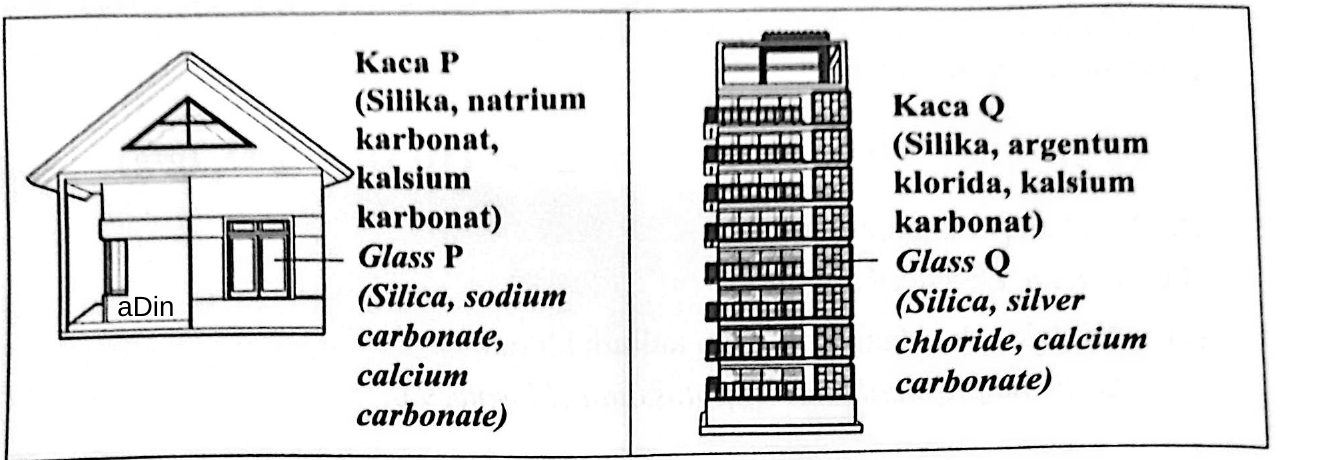
- (a)(ii)
Explain why glass P and glass Q are used on the buildings.
[2] - (b)(i)
What is the major component in making ceramic pots?
[1]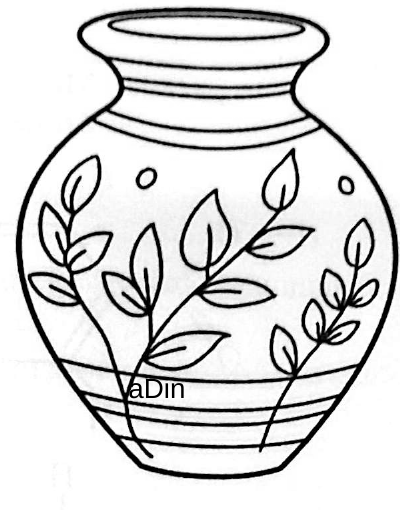
- (b)(ii)
Ceramics is also used in the medical field. State the type of advanced ceramic used in dental implants and give one property of the advanced ceramic.
[2]
Table 1 shows the monomers of two synthetic polymers: terylene (benzene-1,4-dicarboxylic acid and ethane-1,2-diol) and polystyrene (styrene, C₆H₅-CH=CH₂).
Medium8 marks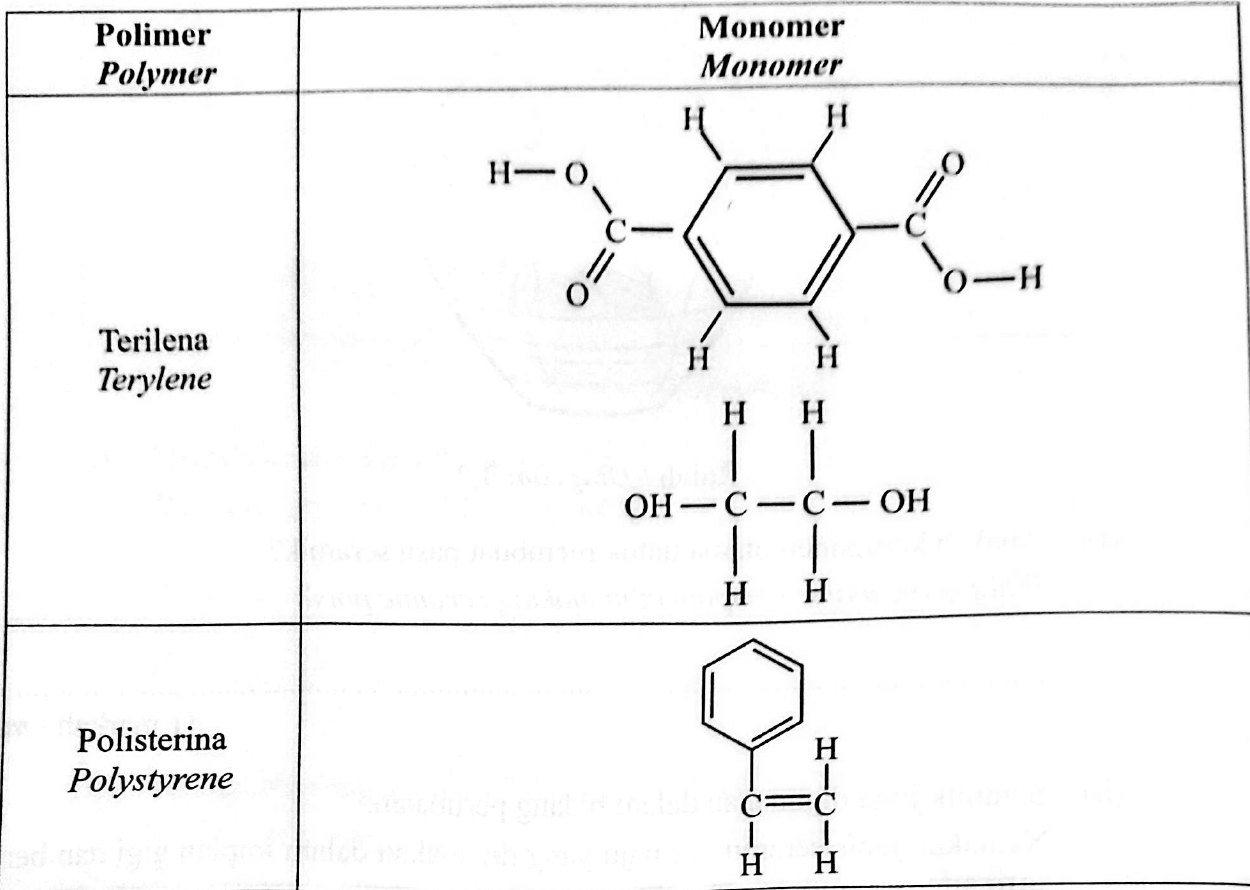
- (a)
State the meaning of polymer.
[1] - (b)(i)
State one use of terylene.
[1] - (b)(ii)
State the by-product of the polymerisation reaction for the formation of terylene.
[1] - (b)(iii)
Compare the polymerisation reaction of terylene and polystyrene, other than the production of by-products.
[1] - (c)
Write a chemical equation to show the polymerisation reaction to produce polystyrene.
[2] - (d)
Diagram 4 shows examples of materials made from nylon (a rope and a safety vest). Give two reasons why nylon is suitable for this purpose.
[2]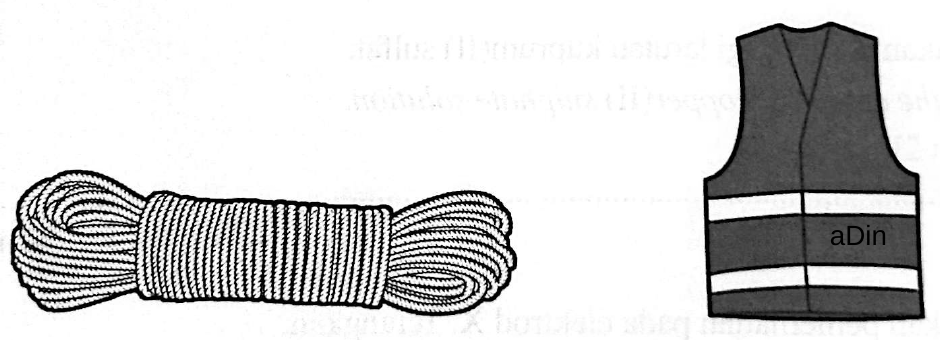
Diagram 5.1 shows the setup for electrolysis of 1.0 mol dm⁻³ copper(II) sulphate solution using carbon electrodes X and Y. Table 2 shows part of the standard electrode potential series: 2H⁺ + 2e ⇌ H₂ 0.00 V; Cu²⁺ + 2e ⇌ Cu +0.34 V; O₂ + 2H₂O + 4e ⇌ 4OH⁻ +0.40 V; S₂O₈²⁻ + 2e ⇌ 2SO₄²⁻ +2.01 V.
Medium9 marks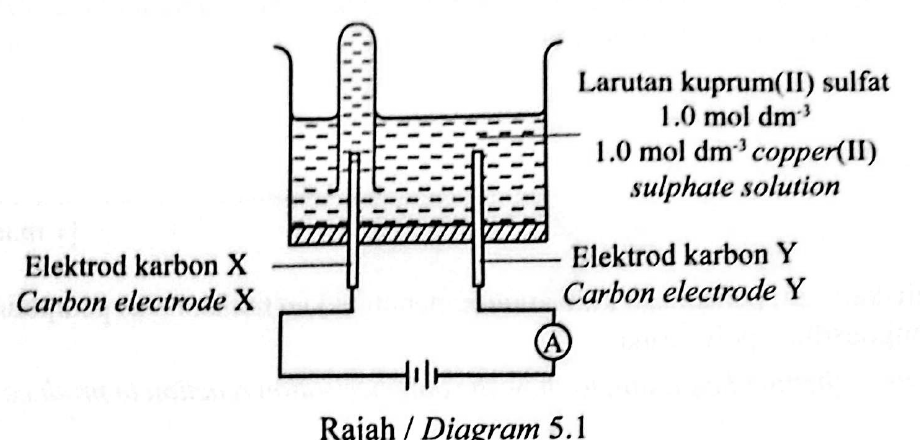
- (a)
State the colour of copper(II) sulphate solution.
[1] - (b)
State the observation at electrode X. Explain.
[3]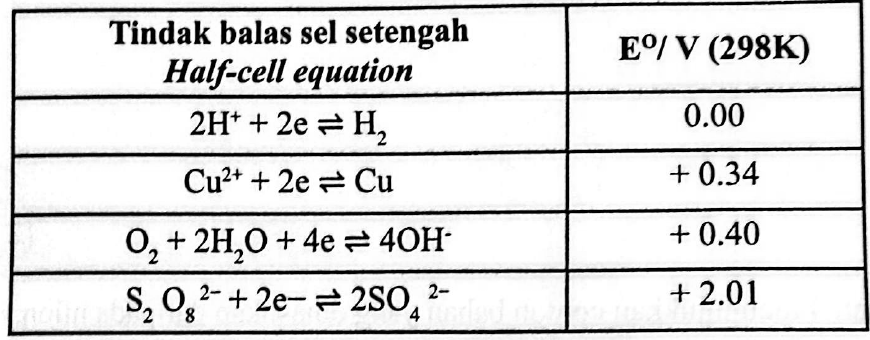
- (c)(i)
A student found that his iron ring rusted. Suggest how to make the iron ring look more attractive and resistant to rust by using the concept of electrolysis.
[1] - (c)(ii)
Draw and label the setup of the apparatus for the method suggested in 6(c)(i).
[2] - (d)
Diagram 5.2 shows the extraction process of aluminium from aluminium oxide. Explain the effect of the metal extraction method towards the environment.
[2]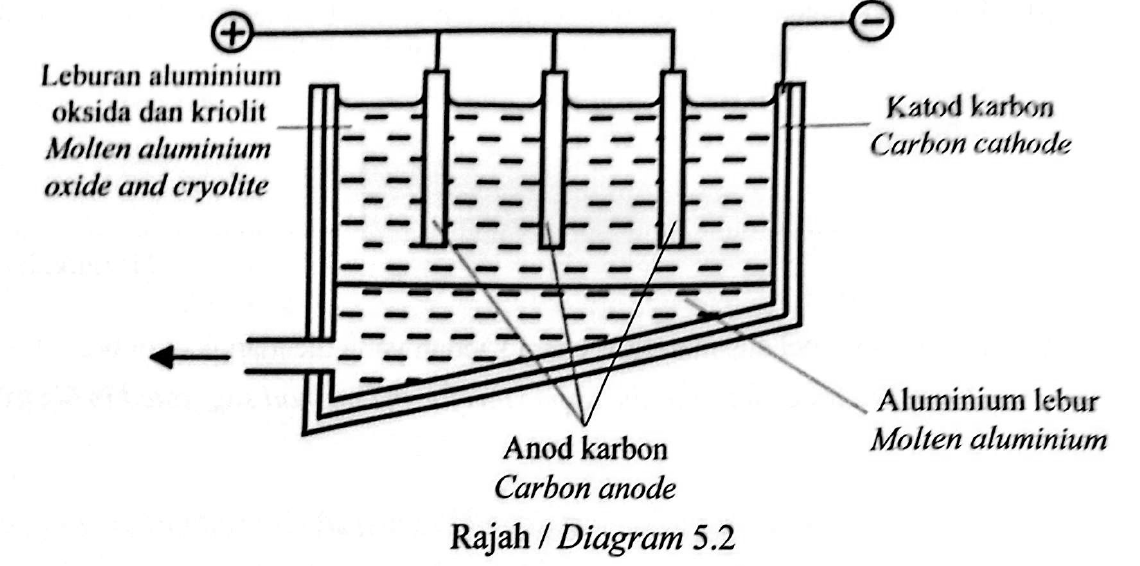
A group of students conducted an experiment to study the factor that affects the rate of reaction. Diagram 6.1 shows the observation: Set I uses 5 g marble chips, Set II uses 5 g marble powder, each with 50 cm³ of 2.0 mol dm⁻³ hydrochloric acid. Mass readings: Set I 144.26 g at the beginning and 142.46 g after 5 minutes; Set II 142.67 g at the beginning and 140.47 g after 5 minutes.
Medium10 marks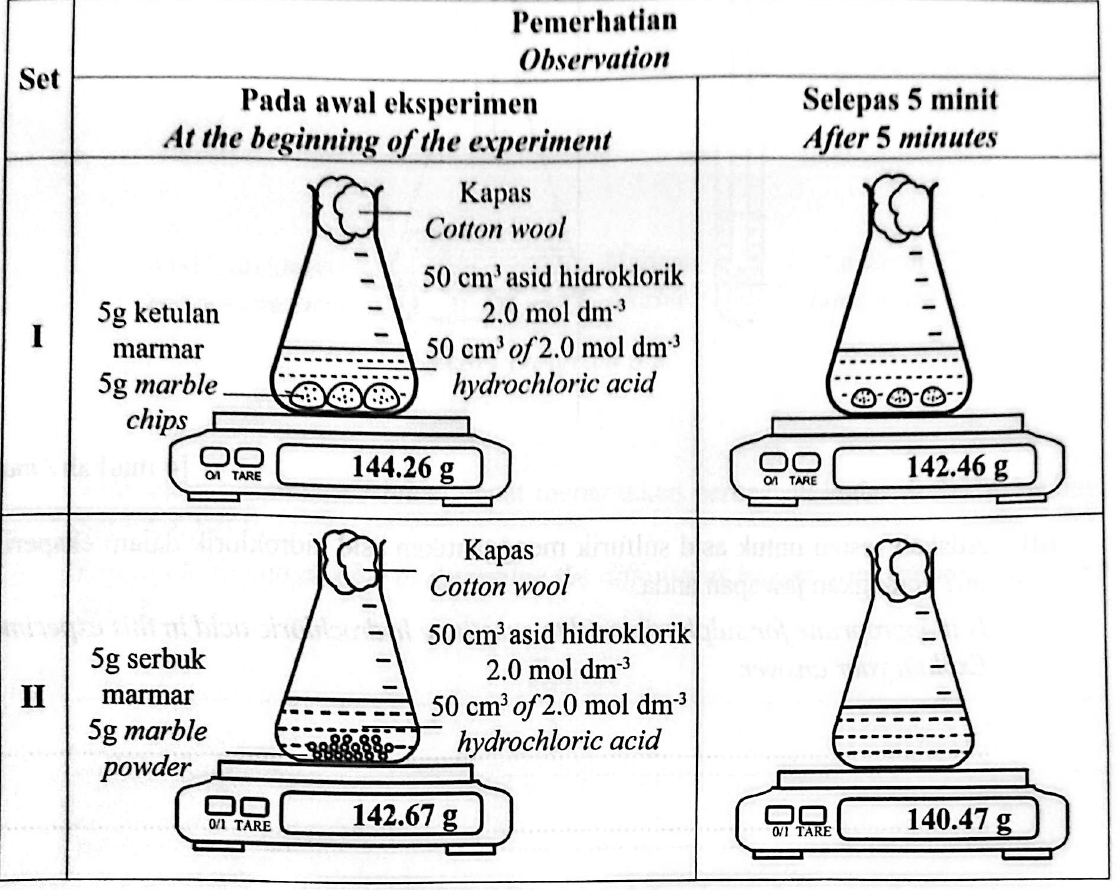
- (a)
State the factor that affects the rate of reaction.
[1] - (b)
State one observable change in this experiment that can be used to determine the rate of reaction.
[1] - (c)
Calculate the rate of reaction for Set I and Set II.
[4] - (d)
Is it appropriate for sulphuric acid to substitute hydrochloric acid in this experiment? Explain your answer.
[2] - (e)
Ahmad repeats the experiment using the apparatus setup in Diagram 6.2 (flask with marble and hydrochloric acid, gas delivered to lime water). Explain how Ahmad is able to determine the difference in rate of reaction for Set I and Set II.
[2]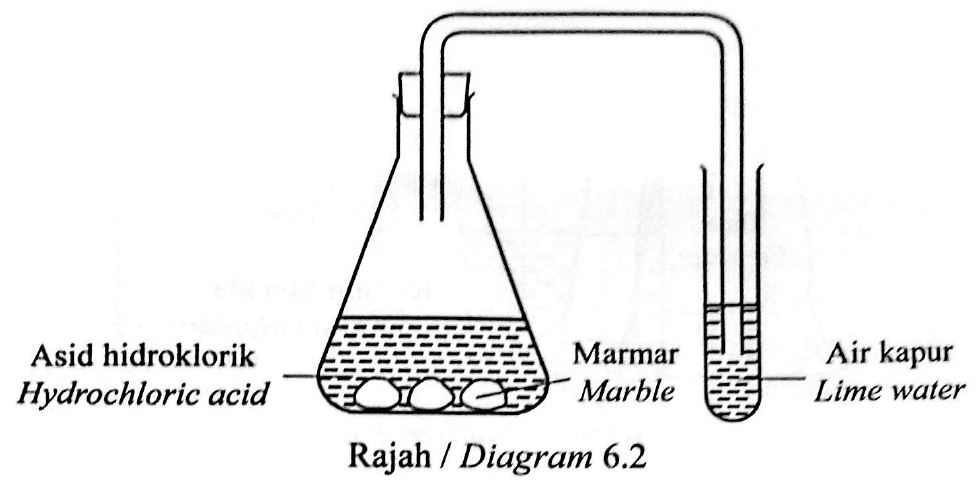
Diagram 7.1 shows potassium chloride as the main ingredient in fertilizer.
Medium10 marks- (a)(i)
State the type of chemical bond for the compound (potassium chloride).
[1]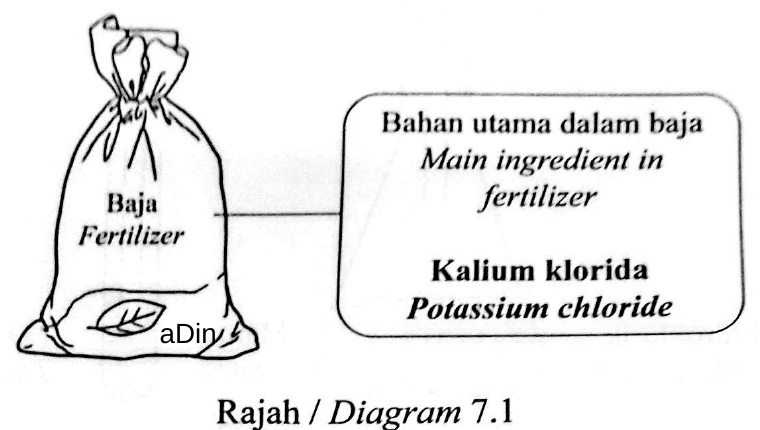
- (a)(ii)
State how the bond in 8(a)(i) is formed.
[1] - (b)
Diagram 7.2 shows apparatus to study the melting point and boiling point of potassium chloride and naphthalene (heated in a water bath). Naphthalene melted at 78°C, while potassium chloride shows no change after ten minutes. Explain.
[2]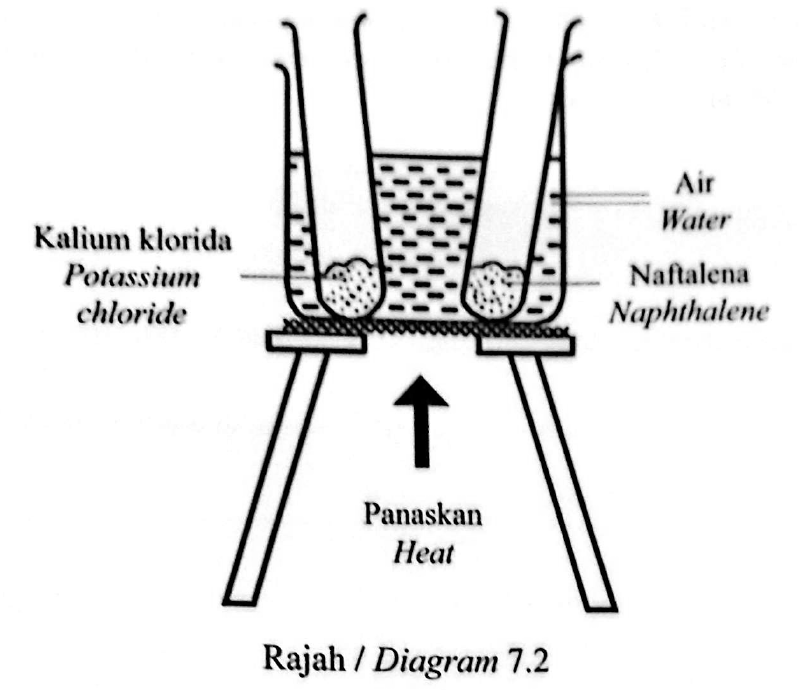
- (c)
When ice cubes are added into a glass of syrup, the ice will float because ice is less dense than syrup. This is because the water molecules in the ice form hydrogen bonds. Draw and label a diagram to explain the statement. Your answer must include the bonds in the water molecule, H₂O.
[2] - (d)
Diagram 7.3 shows the Mohs scale of hardness (talc 1, quartz 7, diamond 10). Diamond is an allotrope of carbon. Explain why diamond ranks 10th on the Mohs scale.
[1]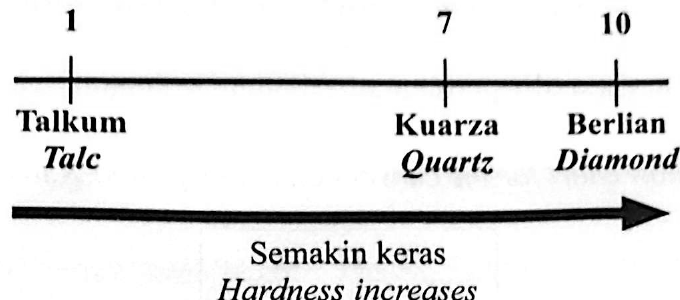
- (e)
Jessica wants to remove the nail polish on her fingers. Between water and acetone, which one is more suitable to be used to remove the nail polish? Justify Jessica's choice.
[3]
Section B
Diagram 8 shows a flow chart for the conversion of compound X (propene, CH₃-CH=CH₂) to compounds W (+ H₂, reaction I), Y (+ H₂O, reaction II) and Z (+ Br₂, reaction III). Answer ONE question from Section B (Question 9 or 10).
Medium20 marks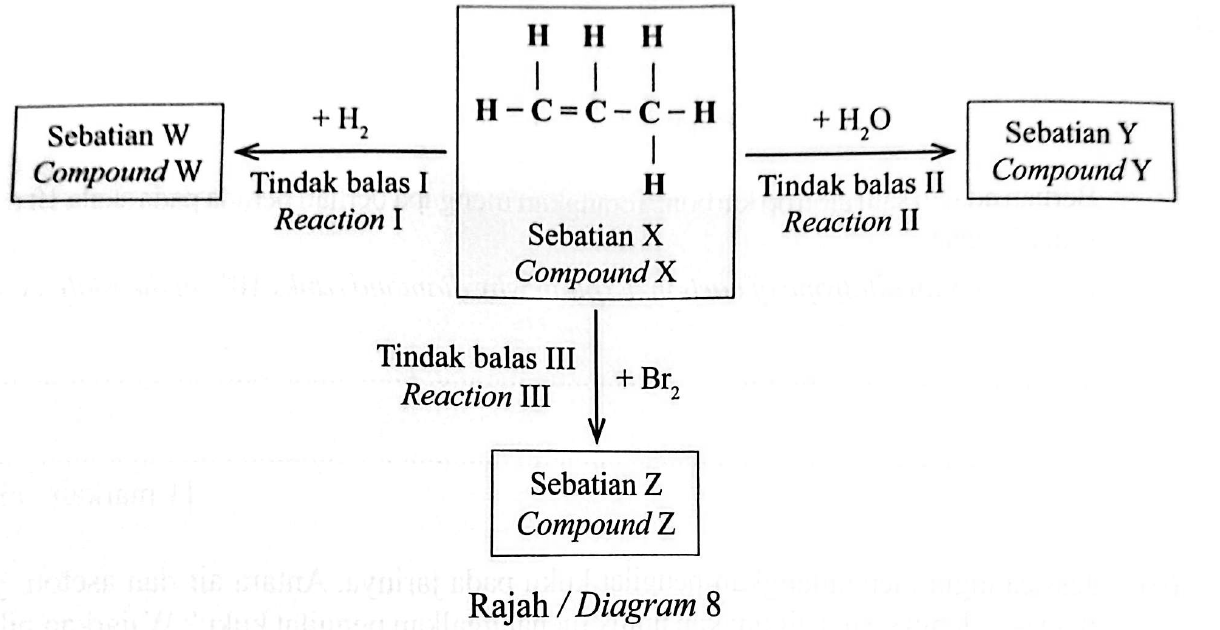
- (a)
State the meaning of unsaturated hydrocarbon.
[1] - (b)
Name the reactions I and II, compounds W, X and Y. State the homologous series and general formula of compounds W, X and Y.
[11] - (c)
Write the chemical equation for reaction II. State the conditions used in the reaction. If 4.2 g of compound X is used, calculate the mass of compound Y produced. [Relative atomic mass: C = 12, O = 16, H = 1]
[5] - (d)
State the observation for reaction III. Draw the structural formula and name compound Z according to the IUPAC nomenclature.
[3]
Diagram 9.1 shows two workers at a sausage factory adding substance X, a type of salt, into a mixture as preservative. Diagram 9.2 shows heating of green solid Y to give black solid Z and carbon dioxide gas. Diagram 9.3 shows a flow of reactions on oxide of metal P with dilute sulphuric acid, giving brown solution Q; Q with Pb(NO₃)₂ solution gives white precipitate R and brown solution S.
Medium20 marks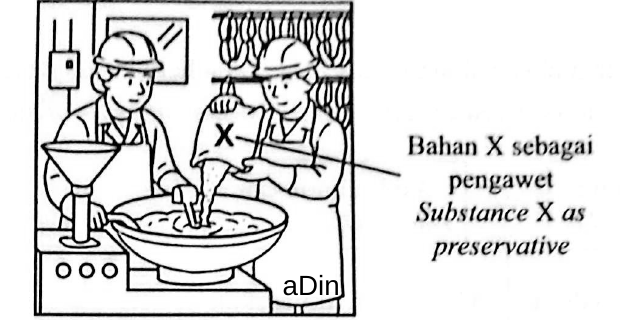
- (a)
Substance X that is added into the mixture is a type of salt. State the meaning of salt and name the substance X.
[2] - (b)(i)
State Y and Z.
[2]
- (b)(ii)
Write a balanced chemical equation for the heating reaction of green solid Y. Calculate the volume of carbon dioxide gas released at room temperature if 74.4 g of green solid Y is heated. [Molar mass of green solid Y = 124 g mol⁻¹; 1 mol of gas occupies 24 dm³ at room conditions]
[5] - (b)(iii)
When solid Z is added into hydrochloric acid, a solution is formed. Name the solution formed and state the colour of the solution.
[2] - (c)(i)
Diagram 9.3 shows a flow of reactions that occur on oxide of metal P. Identify oxide of metal P, white precipitate R and brown solution S.
[3]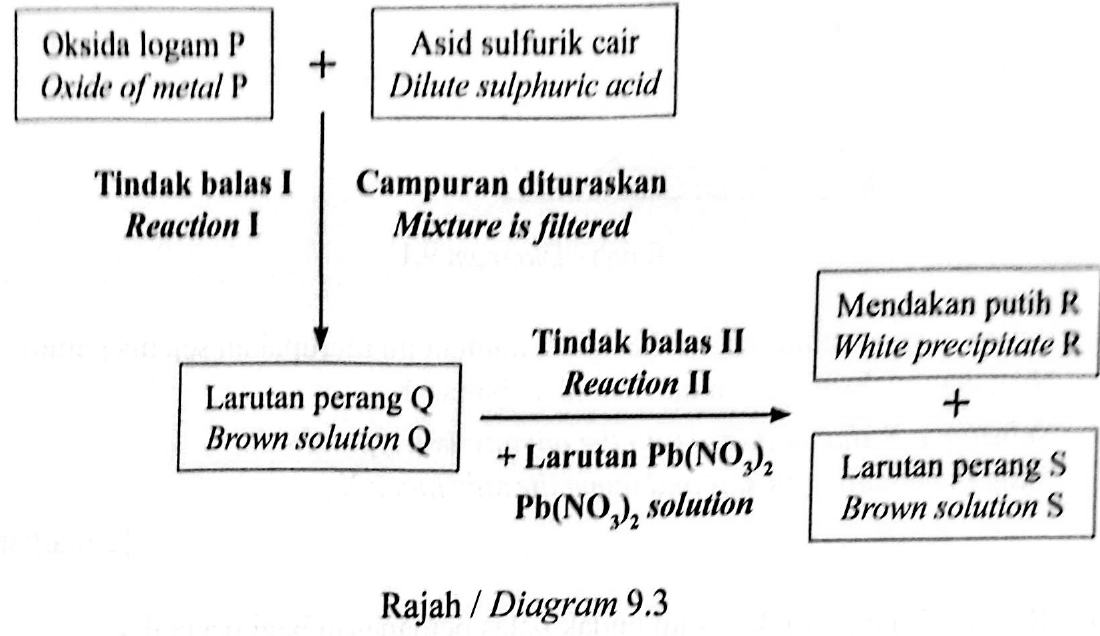
- (c)(ii)
Describe a chemical test to verify the presence of the anion and cation in brown solution Q.
[6]
Section C
Table 3 shows thermochemical equations for two sets of experiment. Set I: Zn (s) + 2HCl (aq) → ZnCl₂ (aq) + H₂ (g), ΔH = −126 kJ mol⁻¹. Set II: CaCO₃ (s) → CaO (s) + CO₂ (g), ΔH = +178 kJ mol⁻¹.
Medium20 marks- (a)(i)
Determine the type of reaction for Set I and Set II.
[2]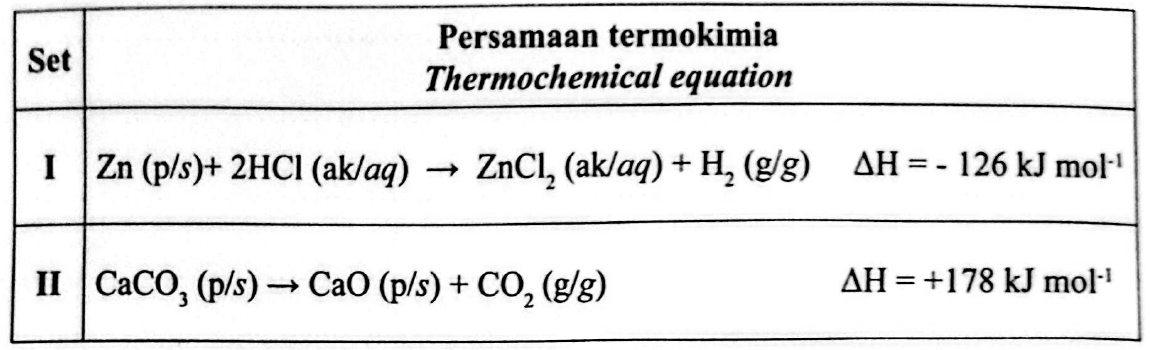
- (a)(ii)
Draw energy level diagram for Set I and Set II. Compare in terms of: heat change; change in total energy content of reactants and products; energy change during formation and breaking of bond.
[5] - (b)
Diagram 10 shows an experiment to determine the heat of precipitation of silver chloride, AgCl (25 cm³ of 0.5 mol dm⁻³ KCl mixed with 25 cm³ of 0.5 mol dm⁻³ AgNO₃). In this experiment, temperature increased by 3.0 °C. Calculate the heat of precipitation. Write the ionic equation for the reaction. State one precaution step in this experiment.
[5]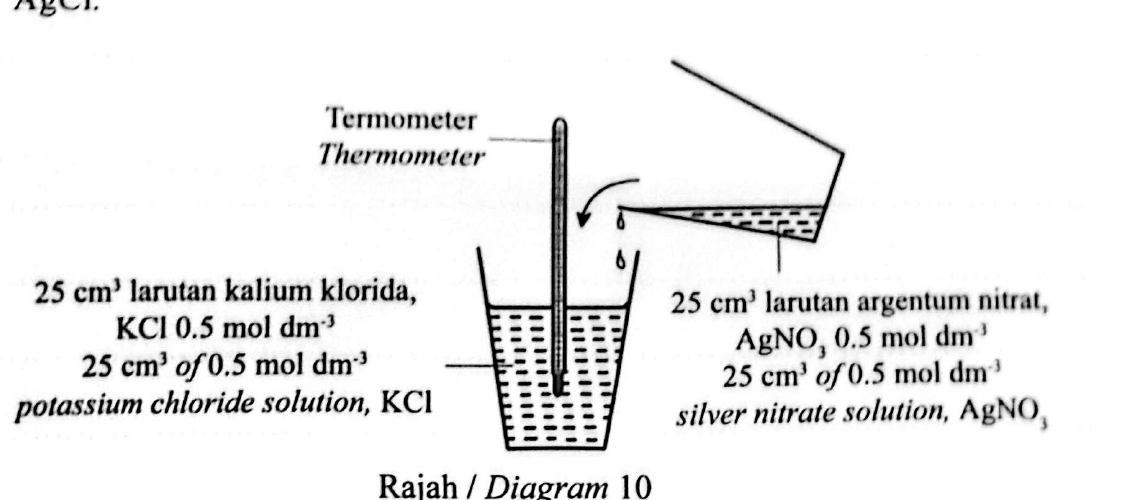
- (c)
Cold packs are used in first aid to reduce swelling or pain from injuries. Cold packs can be produced by applying a reaction between baking soda and a weak acid. Based on the statement, suggest one household substance that can be used to react with baking soda. Describe a method to produce the cold pack using both substances to reduce swelling at the knee. State two advantages of the cold pack produced.
[8]