Which of the following is explaining the reduction reaction?
Easy
Which of the following statements is true about effective collision?
Medium
Which of the following uses polyethene?
Easy
The chemical substance with highest pH value is
Easy
Which of the following processes occur when ice changes to water?
Easy
The uses of catalysts increase the rate of reaction. Which of the catalysts is used to convert pollutants from car exhaust into safe substances before released into the environment?
Easy
The elements in the Modern Periodic Table of Elements are arranged according to
Easy
What is the composition of fused silica glass?
Easy
Soaps are produced from the ________ reaction between fatty acids and alkalis.
Easy
Diagram 1 shows a statement of a scientist: "Nucleus contains neutrons that has no charge and the mass almost equal to protons." Who is the scientist?
Easy
What is the other name of Group 2 in the Periodic Table of Element?
Easy
Which of the following statements is correct about chemical bonds?
I A hydrogen bond is a type of covalent bond in which the shared pair of electrons comes from only one atom
II Electrostatic attraction between a sea of electrons and positively charged metal ions forms metallic bonds
III Ionic bonds are formed by the transfer of electrons between metal atoms and non-metal atoms
IV A single covalent bond is formed when two atoms share two pairs of electrons
Medium
What is meant by strong acid?
Easy
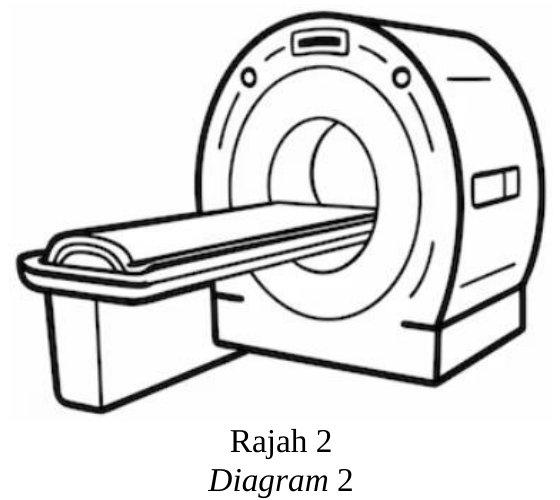
Diagram 2 shows a magnetic resonance imaging machine, MRI. State types of composite materials in the machine.
Medium
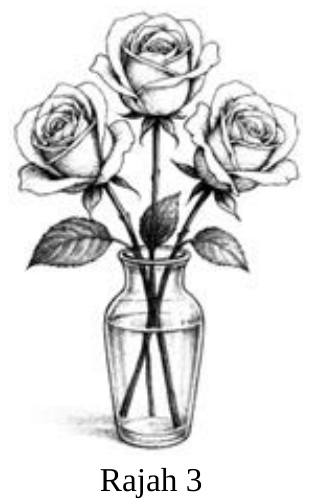
Diagram 3 shows a flower that has a pleasant fragrance. What is the name of the substance that gives the pleasant fragrance?
Easy
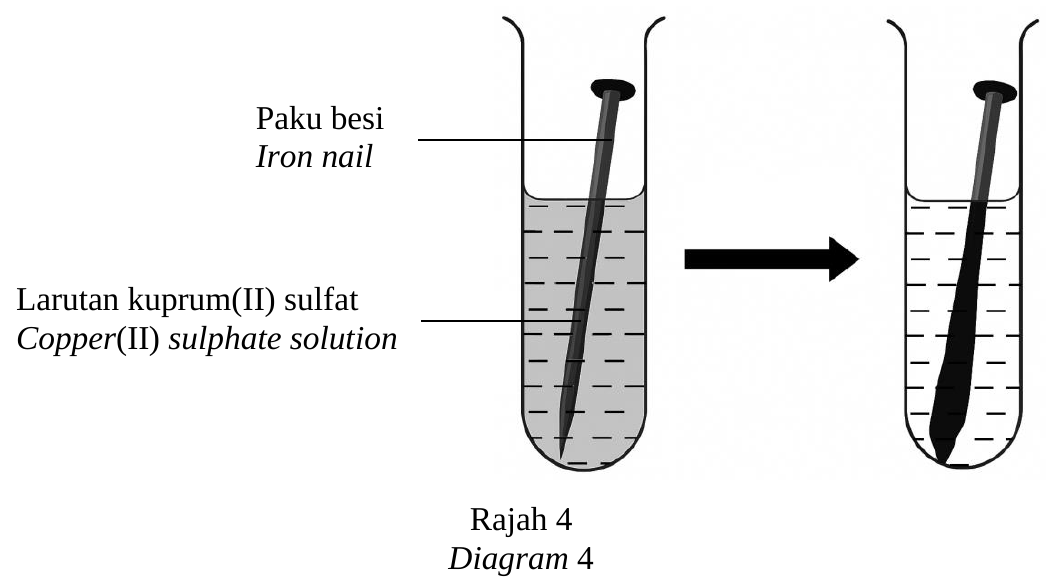
Diagram 4 shows a reaction that releases heat (an iron nail in copper(II) sulphate solution). What statement best describes the heat of reaction in the above situation?
Medium
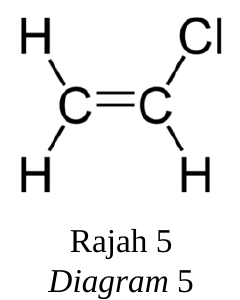
Diagram 5 shows a structural formula of a monomer (chloroethene, CH2=CHCl). Which of the following is the similarity between the monomer and its polymer?
Medium
Amran has washed his clothes with water from well but the dirt is still there. Which of the following statements is the most accurately describe the situation?
Medium
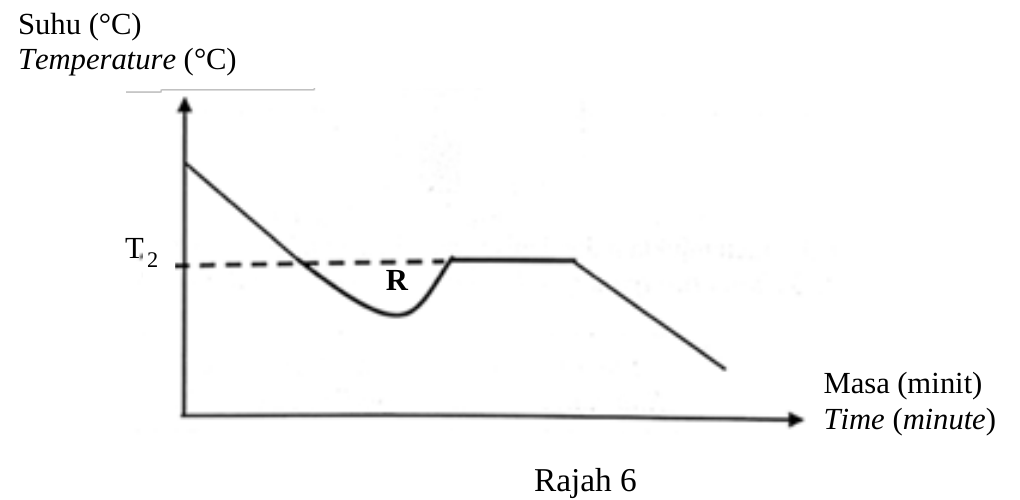
Diagram 6 shows graphs of cooling curves of naphthalene plotted by a student (temperature against time; the curve dips below T2 at R before rising back to the freezing plateau). Which of the following phenomena occur at R?
Medium
Which chemical equation is balanced?
Medium
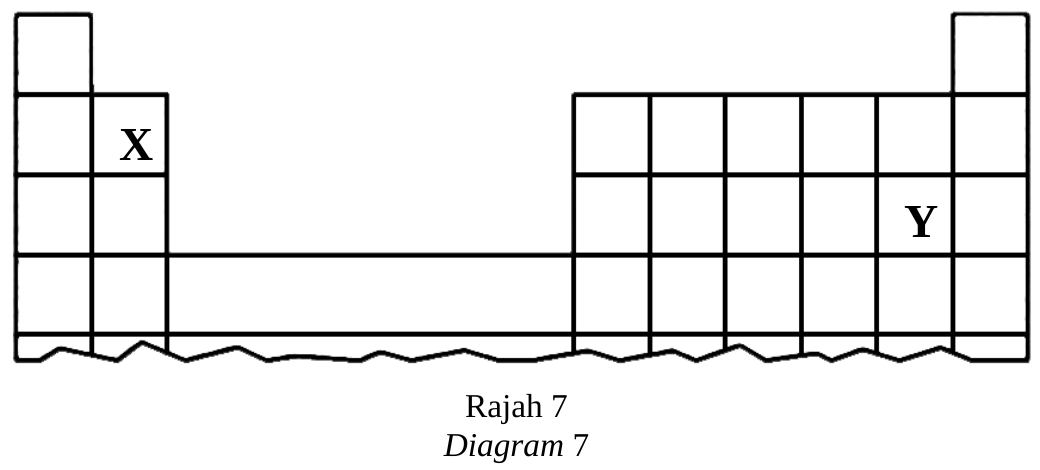
Diagram 7 shows part of the Periodic Table of Elements (X is in Group 2, Y is in Group 17). Which of the following compounds may form when element X reacts with element Y?
Medium
Diagram 8 shows an illustration of conversation between atom P and atom Q. P says: "I am in Group 14 in the Periodic Table of Elements." Q says: "I am in Group 17 in the Periodic Table of Elements." What is the type of chemical bond that will be formed between atom P and atom Q?
Medium
Which of the following pairs of chemical substances and degree of dissociation is correct?
A Ammonia solution - Complete
B Sodium hydroxide - Partial
C Oxalic acid - Partial
D Ethanoic acid - Complete
Medium
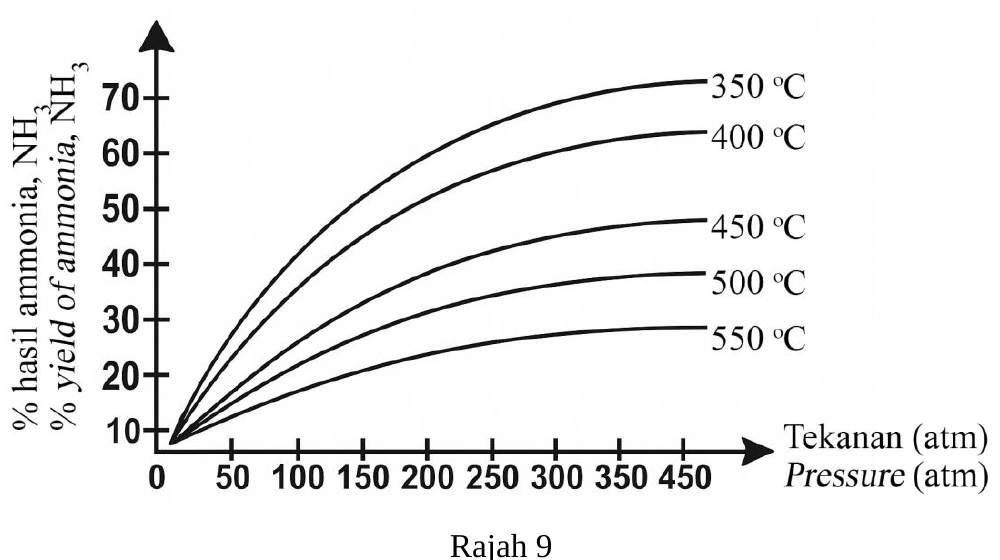
Ammonia, NH3 is produced by the direct combination between nitrogen, N2 and hydrogen, H2. Diagram 9 shows the percentage yield of ammonia, NH3 under different conditions. Choose the correct statement to explain the using of temperature 350 °C in the process of producing ammonia, NH3.
Medium
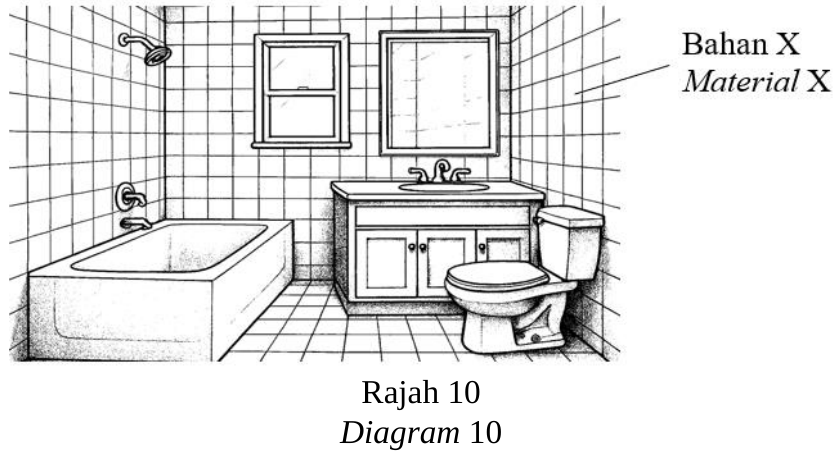
Diagram 10 shows material X in a bathroom (tiles, bath, basin and toilet). What is the most suitable characteristic that enables material X to be used widely?
Easy
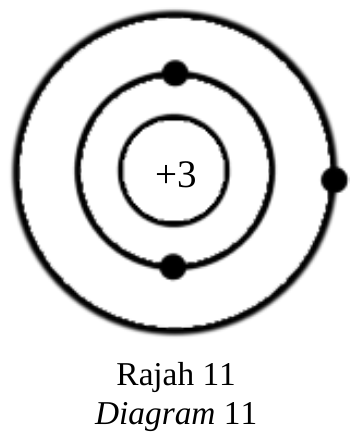
Diagram 11 shows the structure of an atom (nucleus +3, with 3 electrons in two shells). Which statement is true based on Diagram 11?
I Atom X has 3 electrons
II Atom X has +3 charge
III Atom X has no neutron
IV Atom X is neutral
Medium
Here is half of the oxidation equation: 2Br⁻(aq) → Br2(aq) + 2e⁻. Based on the equation, which statement is true?
Medium
Which of the organic compound is an unsaturated hydrocarbon?
Easy
Petrol vapour and air are compressed in the car engine combustion chamber before burnt. The compression increases the number of petrol vapour per unit volume and allows the petrol to burn very quickly until it explodes. Choose one factor that affects the rate of reaction in the above statement.
Medium
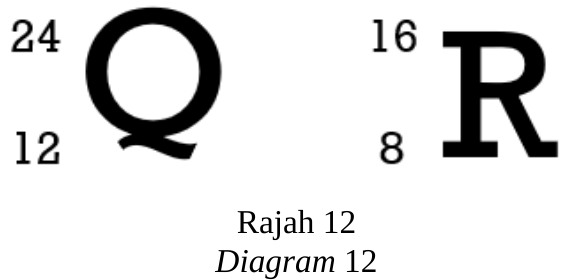
Diagram 12 shows standard representations for element Q (nucleon number 24, proton number 12) and R (nucleon number 16, proton number 8). 0.5 mole of element Q reacts with element R to form compound QR. What is the mass of QR formed from the reaction?
Medium
Diagram 13 shows the thermochemical equation for the formation of barium sulphate: Ba2+ + SO4 2- → BaSO4, ΔH = X kJ/mol. In this reaction, the thermometer reading increases. Among the following pairs, which one is correct about the type of reaction and the value of X?
A Endothermic, +858.56
B Endothermic, -858.56
C Exothermic, +858.56
D Exothermic, -858.56
Medium
The monomer of polyisoprene is isoprene or by the IUPAC name 2-methylbut-1,3-diene. What is the relative molecular mass of the monomer isoprene? [Relative atomic mass : C = 12, H = 1]
Medium
Table 1 shows a few types of medicines and their example: Anti allergies = P; Analgesics = Q; Psychotic drugs = R. Which of the following represent P, Q and R?
A P Antihistamines, Q Paracetamol, R Haloperidol
B P Antimicrobials, Q Aspirin, R Clozapine
C P Corticosteroids, Q Penicillin, R Codeine
D P Antihistamines, Q Haloperidol, R Paracetamol
Medium
Table 2 shows three elements that exist in gems: Ruby - Chromium; Sapphire - Iron, titanium; Amethyst - Manganese. Apart from the characteristics in the table above, choose the correct statement to explain the other characteristics found in the element.
Medium
Diagram 14 shows a reagent bottle containing sodium hydroxide solution with pH 13. What is the concentration of sodium hydroxide solution in mol dm⁻³?
Medium
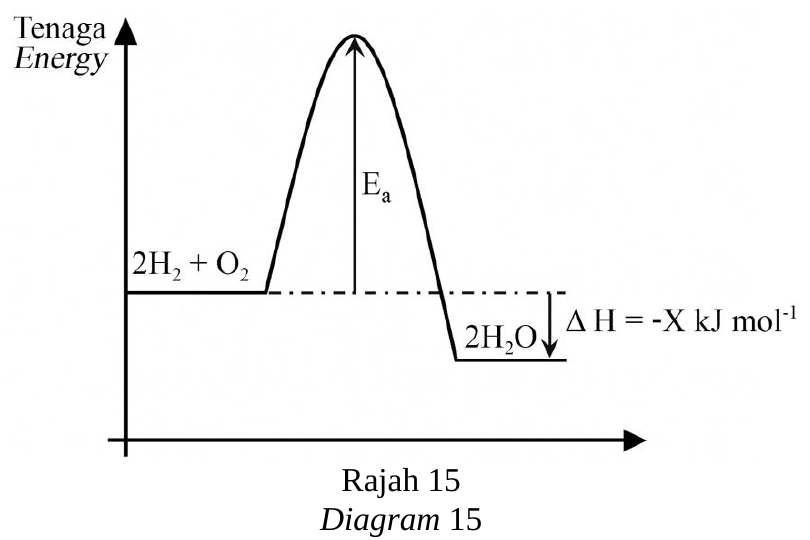
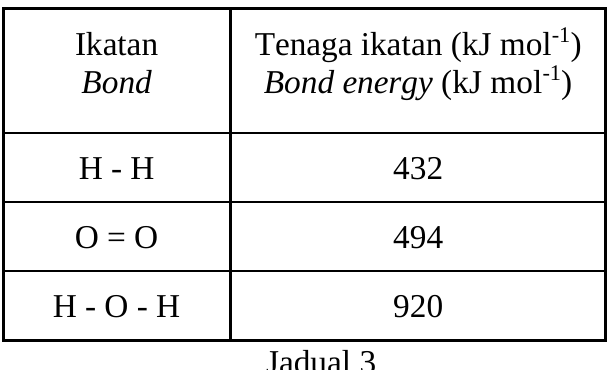
Diagram 15 shows an energy level diagram for combustion of hydrogen gas (2H2 + O2 → 2H2O, ΔH = -X kJ mol⁻¹). Table 3: bond energy H-H 432, O=O 494, H-O-H 920 (kJ mol⁻¹). A Chinese company is manufacturing a high-capacity train using hydrogen gas as fuel. If 0.8 kg hydrogen was used to propel the train for 100 km, how much heat energy was released? [Relative atomic mass : H = 1]
Medium
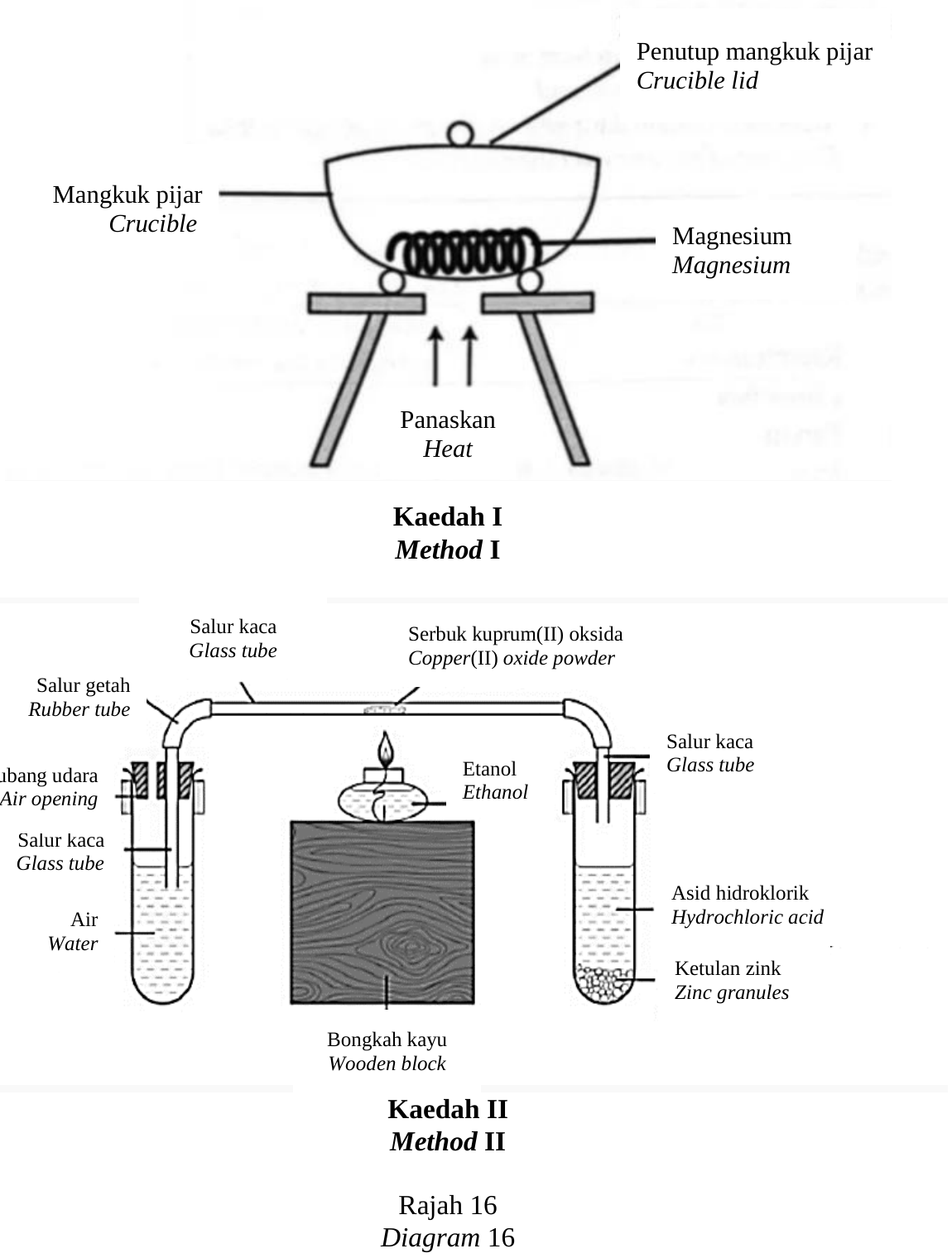
Diagram 16 shows the set up apparatus to determine the empirical formula of two types of metal oxides (Method I: magnesium heated in a crucible with lid; Method II: hydrogen from zinc and hydrochloric acid passed over heated copper(II) oxide powder). Which of the following statements best describes the reaction of the metal used?
A Method I: Magnesium is more reactive towards oxygen; Method II: Copper is more reactive towards oxygen
B Method I: Magnesium is flammable; Method II: Copper is not flammable
C Method I: Magnesium is more reactive towards oxygen; Method II: Copper is less reactive towards oxygen
D Method I: Magnesium is less reactive towards hydrogen; Method II: Copper is more reactive towards hydrogen
Medium
Table 4 shows the value of the heat of neutralisation, ΔH for chemical reactions. Set I: HCl + NaOH → NaCl + H2O, ΔH = x; Set II: CH3COOH + NaOH → CH3COONa + H2O, ΔH = y. Which of the following statements is true regarding the thermochemical equation above?
A Set I: HCl is a strong acid that ionises partially in water; Set II: CH3COOH is a weak acid that ionises fully in water
B Set I: HCl produces high concentration of hydrogen ion; Set II: CH3COOH produces low concentration of hydrogen ion
C Set I: The reaction between HCl and NaOH is complete; Set II: The reaction between CH3COOH and NaOH is incomplete
D Set I: Heat of reaction ΔH is positive; Set II: Heat of reaction ΔH is negative