Write your answer on paper. Then open the answer to check it.
Section A
Diagram 1.1 shows the structural formula of nylon (a polyamide repeating unit with -N-C(=O)- linkages, shown as [ ]n).
Medium5 marks
- (a)(i)
What type of polymerisation for nylon?
[1] - (a)(ii)
State one property and one use of nylon.
[2] - (b)
Diagram 1.2 shows the structure of a type of polymer (repeating -CH2-CH(CH3)-). Draw and name the monomer involved.
[2]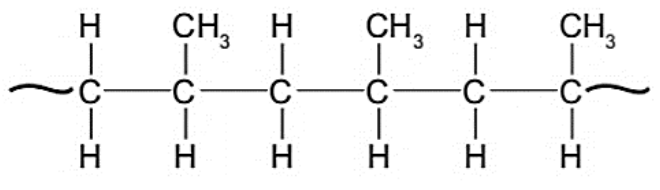
Table 1 shows some of the chemical substances with its chemical formula: lead(II) nitrate, Pb(NO3)2; lithium, Li; P, ZnSO4; nitrogen gas, N2.
Medium5 marks- (a)(i)
State the types of particles of lead(II) nitrate.
[1] - (a)(ii)
State the type of chemical bond in nitrogen gas.
[1] - (a)(iii)
Name substance P.
[1] - (a)(iv)
Classify the substances in Table 1 into elements and compounds.
[2]
Diagram 2 shows the apparatus set-up to determine the empirical formula of oxide of copper (hydrogen from zinc and hydrochloric acid passed over heated copper(II) oxide, with a water-filled test tube at the exit).
Medium6 marks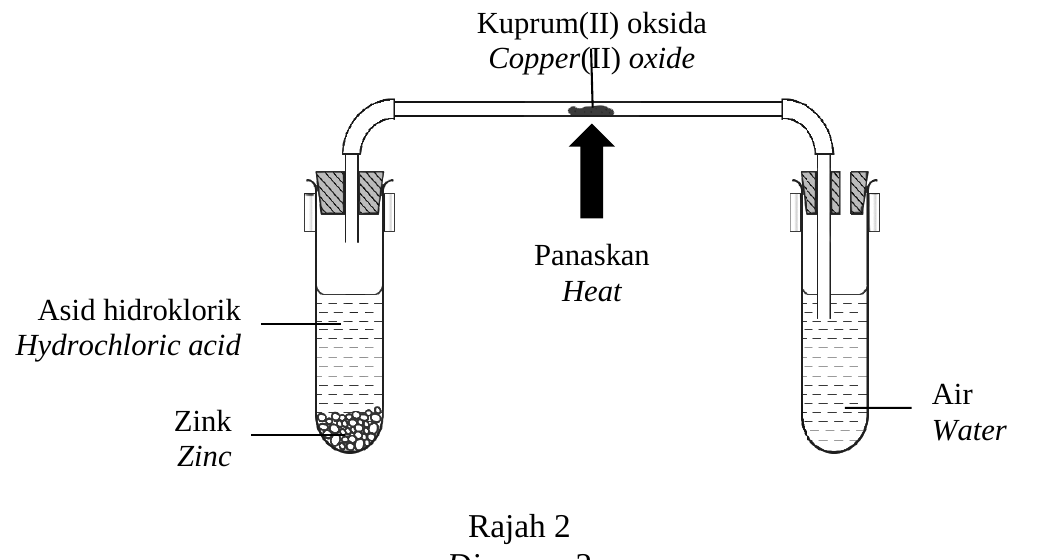
- (a)
What is meant by empirical formula?
[1] - (b)
What is the change that can be observed in copper(II) oxide powder?
[1] - (c)(i)
Write the chemical equation for the reaction between hydrochloric acid and zinc.
[2] - (c)(ii)
13 g of zinc powder reacts with excess hydrochloric acid. Determine the volume of hydrogen gas produced. [Relative atomic mass: Zn = 65; 1 mole of gas occupies 24 dm3 at room conditions]
[2]
Diagram 3 shows the change of state of matter (the water cycle: water evaporating from a river/sea, rain falling from clouds; Process P is shown by arrows rising from the water).
Medium7 marks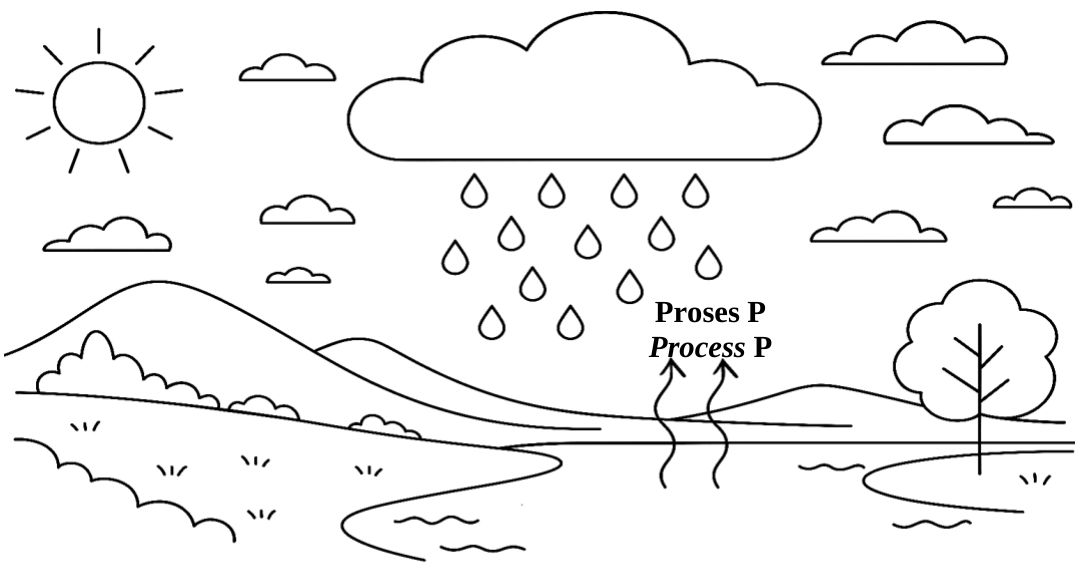
- (a)(i)
What is meant by matter?
[1] - (a)(ii)
What is process P and the energy change involved?
[2] - (b)(i)
Table 2 shows information about isotopes of boron: Boron-11, natural abundance 80%, mass 11; Boron-10.05, natural abundance 20%, mass 10.05. Calculate the relative atomic mass for boron.
[2] - (b)(ii)
Aisha applies acetone to her skin to disinfect a cut. Shortly after, she notices a cool feeling where the acetone was applied. Explain why.
[2]
Diagram 4 shows the information of four organic compounds W, X, Y and Z. W: 6 carbon atoms; contains carbon and hydrogen only; decolourises brown colour of bromine water. X: 6 carbon atoms; contains carbon and hydrogen only; does not decolourise brown colour of bromine water. Y: 3 carbon atoms; soluble in water; reacts with magnesium to produce hydrogen gas. Z: 3 carbon atoms; soluble in water; reacts with ethanoic acid to produce a sweet smell.
Medium8 marks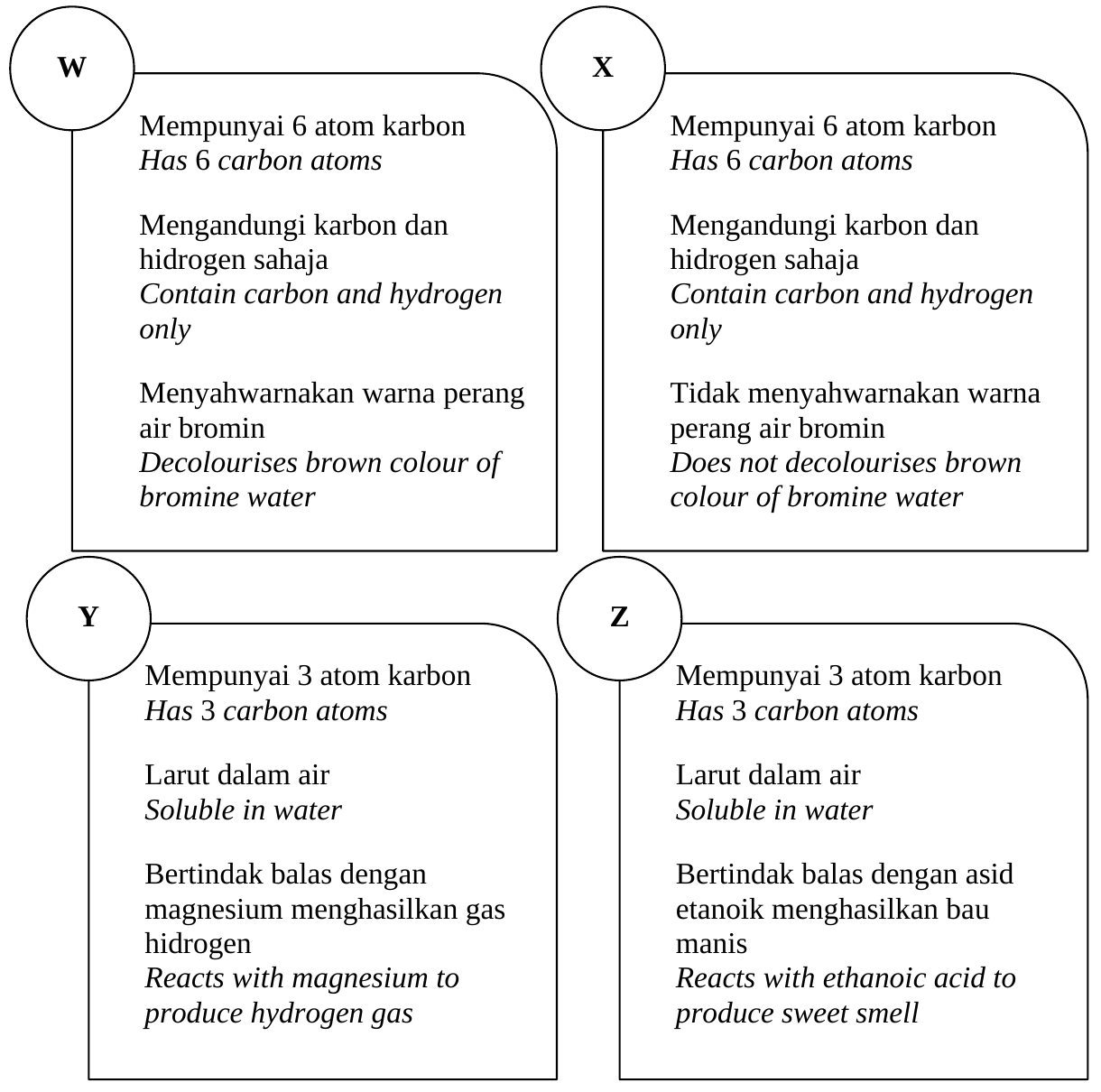
- (a)
Based on organic compound Y, determine (i) molecular formula, (ii) homologous series.
[2] - (b)(i)
W and X burn in oxygen producing soot. Which compounds produce more soot?
[1] - (b)(ii)
Explain your answer in 5(b)(i). [Relative atomic mass: H = 1; C = 12]
[3] - (c)
Compound Z can form two isomers. Draw the structural formula of one of those isomers and state the name according to IUPAC nomenclature.
[2]
Diagram 5 shows a Periodic Table of Element with Na, Al, Cl, C and Ne marked (Na in Group 1 Period 3; C in Group 14 Period 2; Al in Group 13 Period 3; Cl in Group 17 Period 3; Ne in Group 18 Period 2).
Medium9 marks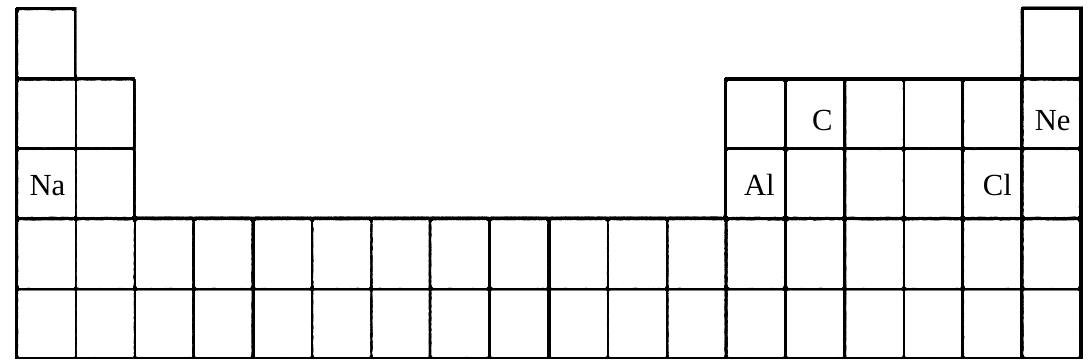
- (a)
What is meant by Group?
[1] - (b)
State the element that is able to share electrons with the chlorine element to form a covalent bond.
[1] - (c)(i)
Aluminium metal reacts with chlorine gas to form aluminium chloride: __ Al + __ Cl2 → __ AlCl3. Complete the chemical equation above.
[1] - (c)(ii)
If 0.2 mole aluminium metal is used, what volume of chlorine gas is needed at room conditions to react completely to produce aluminium chloride? [1 mole of gas occupies 24 dm3 at room conditions]
[2] - (d)
Element W is located below Na in Group 1. Explain the difference in reactivity of element W with Na when reacting with water.
[4]
Diagram 6 shows examples of ceramic use: X is a decorated vase and Y is a ring. Ceramics can be classified into two groups which are traditional ceramics and advanced ceramics.
Medium10 marks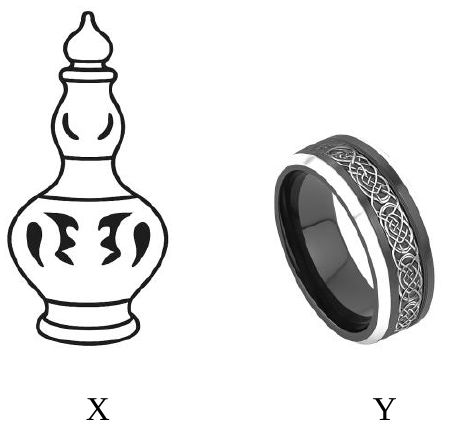
- (a)(i)
What is the meaning of ceramic?
[1] - (a)(ii)
State one basic property of ceramic X.
[1] - (a)(iii)
State three ceramic materials used in the construction of houses.
[3] - (b)(i)
Graphene is one of the carbon allotropes, other than diamond and graphite. State three differences between graphene and carbon in terms of hardness, electrical conductor and transparency.
[3] - (b)(ii)
NanoMalaysia Autonomous Vehicle - Navi by NanoMalaysia is an autonomous car that utilises nanotechnology. Justify the use of the car compared to ordinary cars.
[2]
Table 3 shows information related to two types of acids, J and K. Acid J: formula H2SO4, pH 0.7. Acid K: formula CH3COOH, pH 5.0.
Medium10 marks- (a)(i)
What is the basicity of acid J?
[1] - (a)(ii)
Explain your answer in 8(a)(i).
[1] - (b)(i)
Determine the molarity of acid K in units of mol dm⁻³.
[1] - (b)(ii)
Write a balanced chemical equation for the reaction between acid K and zinc powder.
[2] - (c)(i)
Diagram 7.1 shows a flow chart for a series of reactions on Salt N. Salt N is white; heated vigorously, it gives a residue that is yellow when hot and white when cold, plus a colourless gas; the gas poured into lime water makes it cloudy; Salt N dissolved in water gives a white solid that does not dissolve. Identify the metal oxide that decomposes when Salt N is heated.
[1]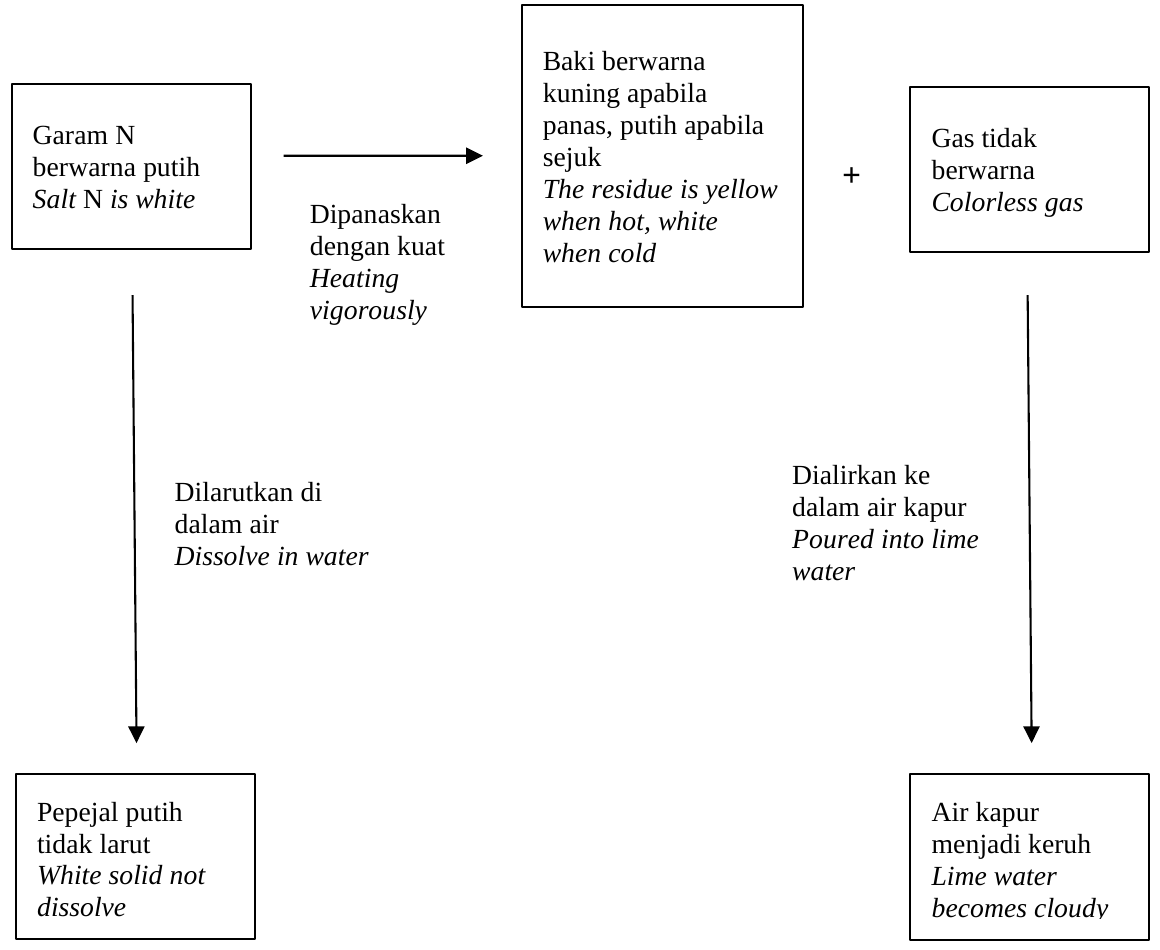
- (c)(ii)
Name the colourless gas.
[1] - (d)(i)
Diagram 7.2 shows a balloon filled with copper(II) oxide powder over a conical flask containing vinegar. A group of students wants to inflate the balloon with these materials but the balloon does not inflate. You are a chemistry student and group leader: what decision is needed to replace any one of the substances so that the balloon inflates?
[1]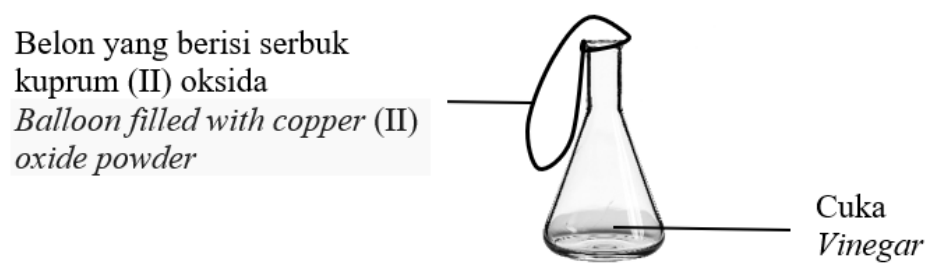
- (d)(ii)
Summarise how the material can help the balloon inflate.
[2]
Section B
Question 9 (Section B, answer any one of Q9 or Q10). Parts (a) to (c) are about factors affecting the rate of reaction.
Medium20 marks- (a)
Diagram 8.1 shows two types of the same soap in different conditions used in washing: Soap A (powder) and Soap B (bar). Which soap is better in washing action? What is the factor of rate of reaction involved?
[2]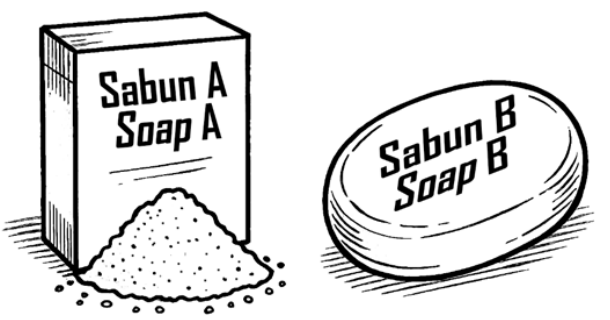
- (b)(i)
Syakir carried out experiments to investigate the factor affecting the rate of reaction between calcium carbonate and nitric acid. Table 4 shows the reactants and the time taken to collect 40 cm3 of gas Z. Set I: excess calcium carbonate powder and 50 cm3 of 1.0 mol dm⁻³ nitric acid, 25 s. Set II: excess calcium carbonate powder and 50 cm3 of 0.5 mol dm⁻³ nitric acid, 50 s. State the meaning of rate of reaction.
[1] - (b)(ii)
Name the gas Z produced. Write a chemical equation for the reaction between calcium carbonate and nitric acid. Calculate the maximum volume of gas Z produced in experiment Set I. [1 mol of gas occupies 24 dm3 at room conditions]
[6] - (b)(iii)
Calculate the average rate of reaction for experiment Set I and experiment Set II.
[2] - (b)(iv)
By using the collision theory, explain the difference in the rate of reaction between experiment Set I and experiment Set II.
[5] - (b)(v)
Syakir repeats the experiment Set I by heating the nitric acid without changing the concentration of the acid to increase the rate of reaction. Explain how the action can increase the rate of reaction.
[2] - (c)
Diagram 8.2 shows three different carbonated drinks, D, E and F, reacting with 3 g of eggshell, with the time taken to dissolve all the eggshell shown on stopwatches (D about 42 s, E 30 s, F about 17 s). Based on Diagram 8.2, which of the carbonated drinks is the most unhealthy to our stomach if it is taken regularly? State your reason.
[2]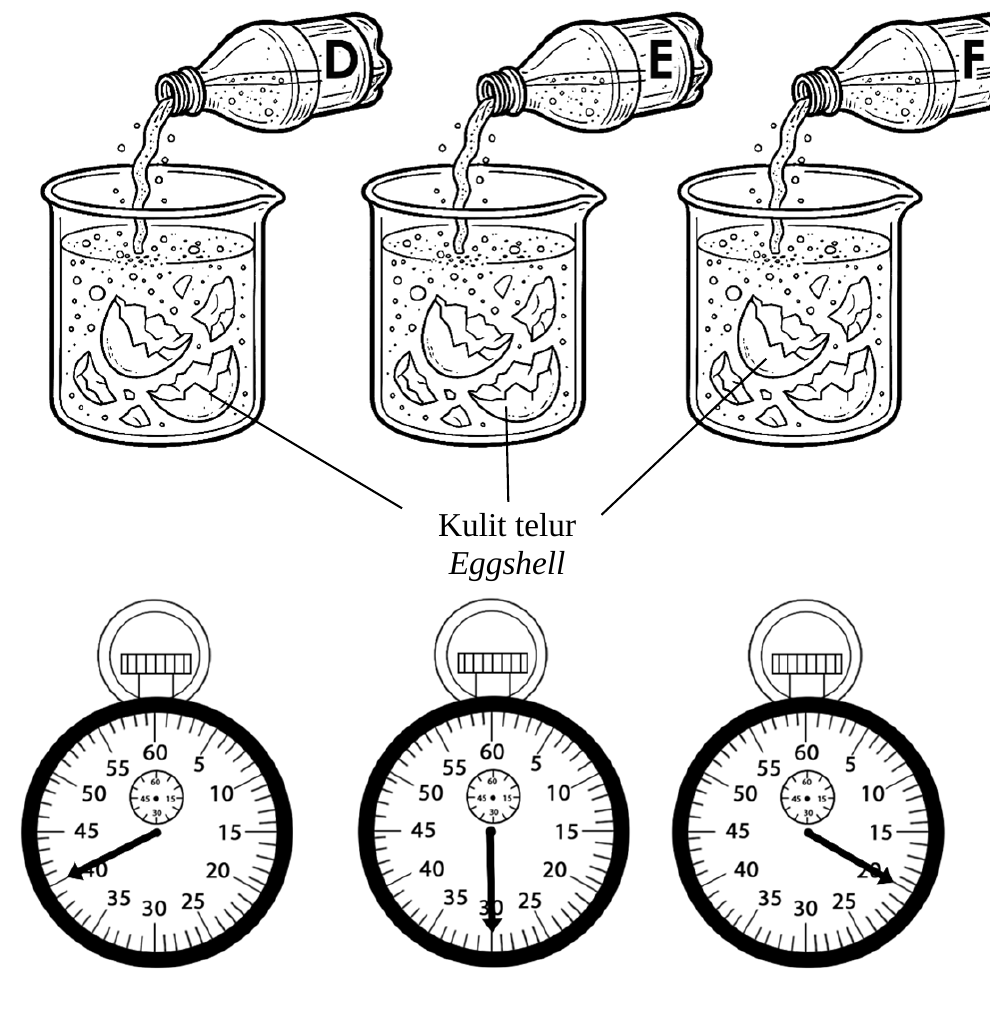
The following thermochemical equations represent two neutralisation reactions: KOH(aq) + HCl(aq) → KCl(aq) + H2O(l), ΔH = -57 kJ mol⁻¹; KOH(aq) + CH3COOH(aq) → CH3COOK(aq) + H2O(l), ΔH = -49 kJ mol⁻¹.
Medium20 marks- (a)(i)
Write the definition of the heat of neutralisation.
[1] - (a)(ii)
State the type of heat of neutralisation reactions above.
[1] - (a)(iii)
Write the ionic equation for the first neutralisation reaction.
[1] - (a)(iv)
Compare the heat of neutralisation from the thermochemical equations above. Explain it.
[8] - (b)(i)
50 cm3 of 0.1 mol dm⁻³ sodium hydroxide, NaOH solution reacts with 50 cm3 of 0.1 mol dm⁻³ nitric acid, HNO3. The initial temperature for both solutions is 28 °C and the highest temperature of the mixture is 35 °C. Calculate the heat of neutralisation of the reaction. [Specific heat capacity of the solution, c = 4.2 J g⁻¹ °C⁻¹; density of the solution = 1.0 g cm⁻³]
[5] - (b)(ii)
Draw the energy level diagram for this reaction.
[2] - (b)(iii)
State two pieces of information that can be obtained from the energy level diagram in 10(b)(ii).
[2]
Section C
Question 11 (Section C, answer all parts).
Medium20 marks- (a)(i)
Diagram 9.1 shows a setup apparatus of U-tube to investigate transfer of electron at a distance (solution A at electrode X, solution B at electrode Y, sulphuric acid in the bottom of the U-tube, carbon electrodes connected to a galvanometer G). What is the function of sulphuric acid?
[1]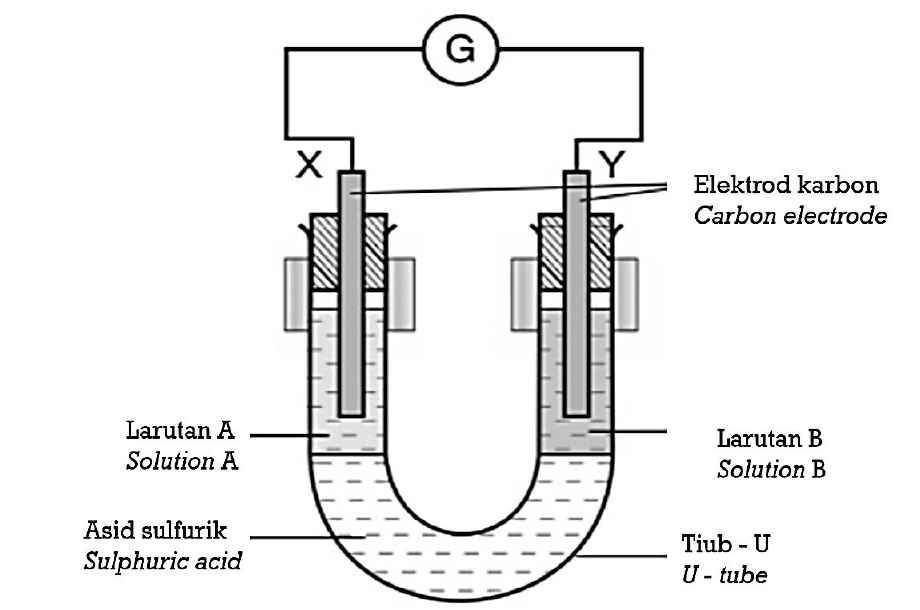
- (a)(ii)
Carbon electrodes are not allowed to touch the sulphuric acid layer. Explain why.
[2] - (a)(iii)
If solution A is iron(II) sulphate 1.0 mol dm⁻³, suggest the appropriate solution B. Predict the observation at electrode X and Y and write the half equation of the reaction that occurs at electrode X and Y.
[5] - (b)
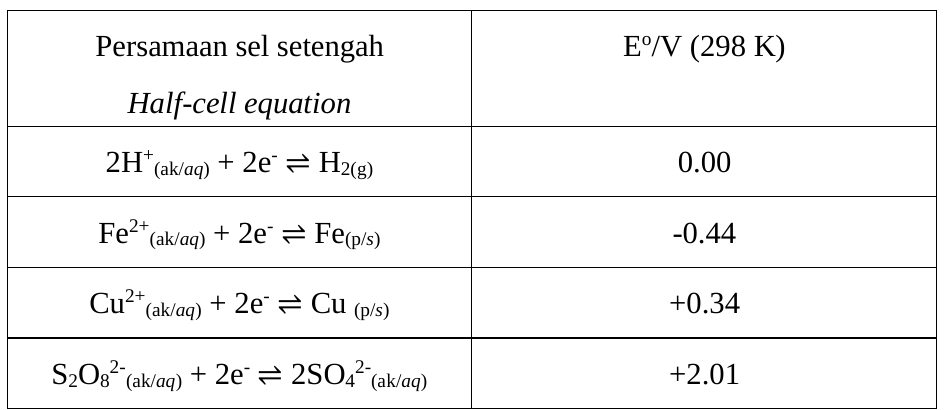
Ekhwan runs an experiment of electroplating of an iron spoon as shown in Diagram 9.2 (copper electrode as anode, iron spoon as cathode, 300 cm3 of 0.1 mol dm⁻³ copper(II) sulphate solution). Write half-equations at the anode and cathode. What is the maximum mass of copper metal that can be plated on the iron spoon without considering the presence of the copper electrode? [Relative atomic mass: Cu = 64; Fe = 56] The standard electrode potentials given: 2H⁺ + 2e⁻ ⇌ H2, 0.00 V; Fe²⁺ + 2e⁻ ⇌ Fe, -0.44 V; Cu²⁺ + 2e⁻ ⇌ Cu, +0.34 V; S2O8²⁻ + 2e⁻ ⇌ 2SO4²⁻, +2.01 V.
[4]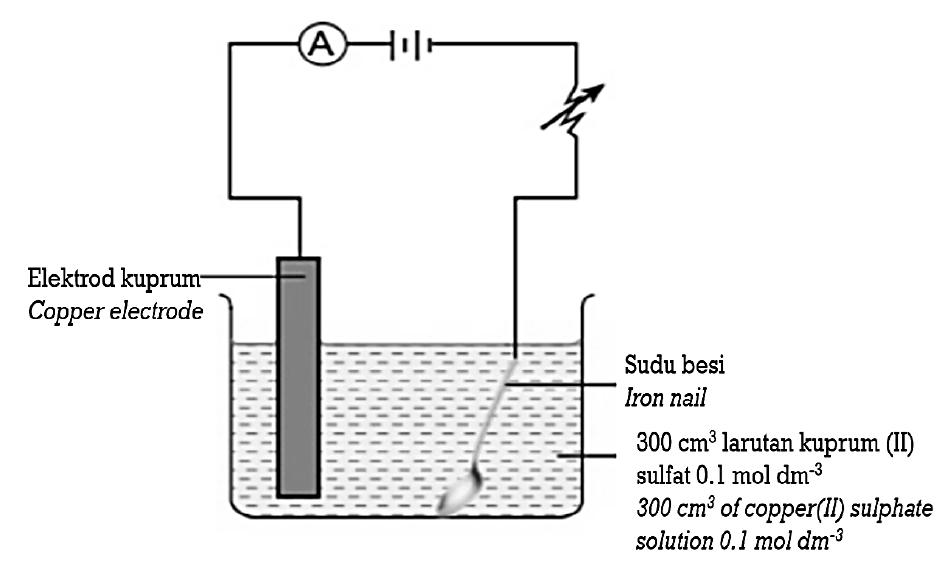
- (c)
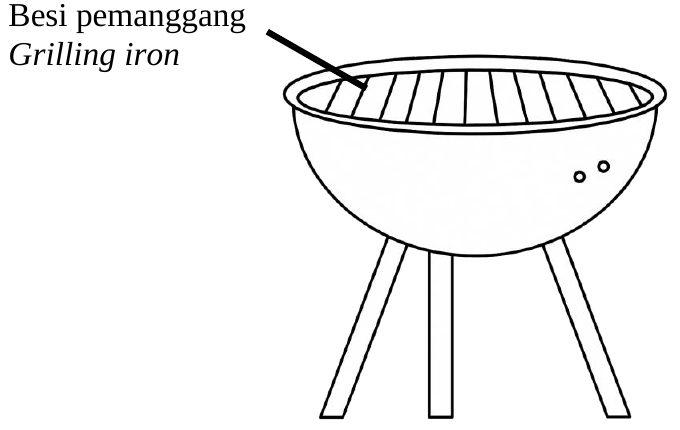
Diagram 9.3 shows a grilling iron. Elisa found that after a week of using the grilling iron, it had rust. As a chemistry student, suggest two ways Elisa can remove the rust and two ways to prevent the grilling iron from rusting. Each suggestion must be explained by a scientific reason.
[8]