Write your answer on paper. Then open the answer to check it.
Section A
Diagram 1 shows the products that are manufactured by using synthetic rubber X and natural rubber.
Medium5 marks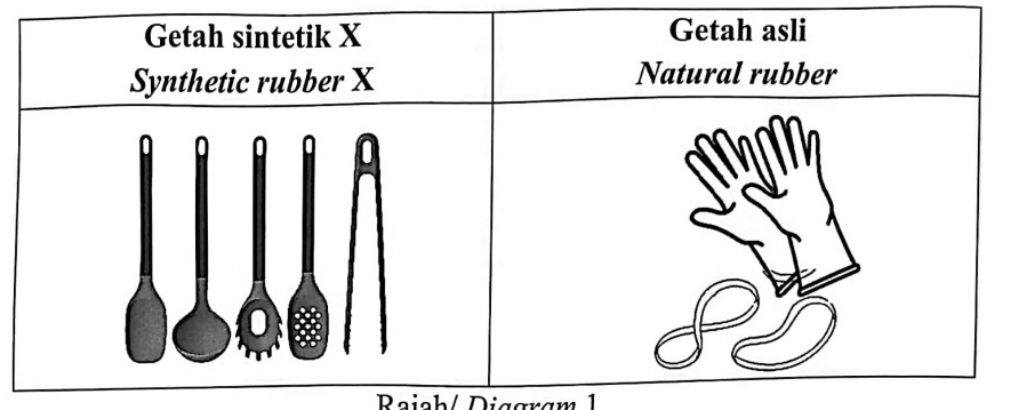
- (a)(i)
State one characteristic of synthetic rubber.
[1] - (a)(ii)
State one characteristic of natural rubber.
[1] - (b)
State the name of natural rubber polymer.
[1] - (c)(i)
What is synthetic rubber X?
[1] - (c)(ii)
State the name of the process to improve the characteristics of natural rubber so it has a better quality and last longer.
[1]
Diagram 2 shows two types of bonds found in ammonium ion (N surrounded by four H; bond Y and bond Z are labelled).
Medium5 marks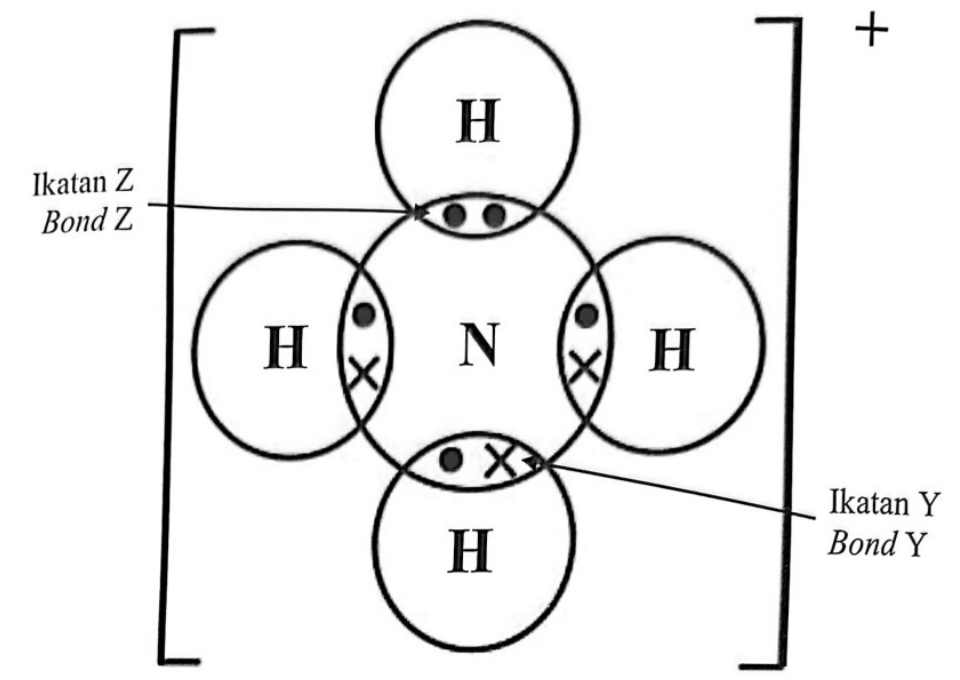
- (a)
State the type of particle for the ammonium ion.
[1] - (b)
What are the elements found in ammonium ion?
[1] - (c)
State the chemical formula for the ammonium ion.
[1] - (d)
Based on Diagram 2, label the type of bond Y and bond Z.
[2]
Table 3 shows the information about elements P, Q and R. Element / Proton number / Nucleon number P / 11 / 23 Q / 11 / 24 R / 12 / 24
Medium6 marks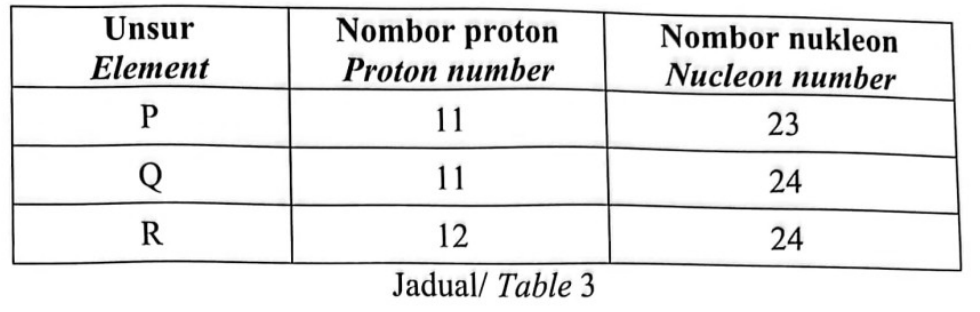
- (a)
What is meant by nucleon number?
[1] - (b)(i)
Based on Table 3, write the electron arrangement of ion P.
[1] - (b)(ii)
Draw the atomic structure of element R.
[2] - (c)(i)
Diagram 3 shows the leakage of pipe. Which element is the most suitable to be used on the instrument to detect the leakage?
[1]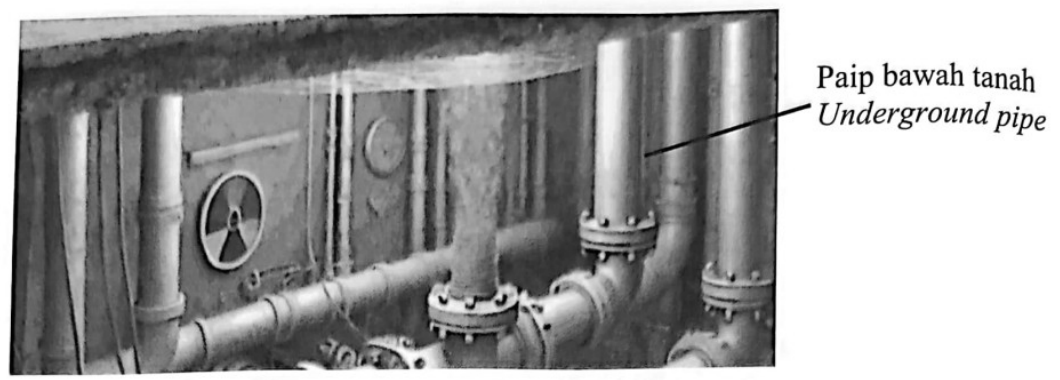
- (c)(ii)
State one disadvantage of the instrument used.
[1]
Diagram 4 shows an apparatus set up to investigate the chemical properties of Group 1 element in the Periodic Table of Elements (Q burning in oxygen gas; the product + water gives QOH solution). [Relative atomic mass: O = 16, Q = 39]
Medium7 marks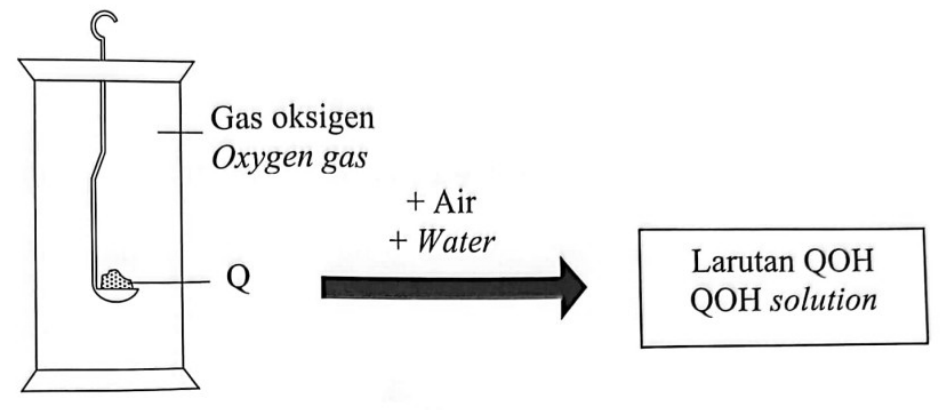
- (a)
State one method to store Group 1 elements in laboratory.
[1] - (b)
Write a chemical equation for the reaction between Q and oxygen gas.
[2] - (c)
Calculate the mass of the compound formed when 0.08 mol of element Q reacts completely with oxygen.
[2] - (d)
Predict the pH value of QOH solution formed. Give one reason.
[2]
Diagram 5.1 shows the arrangement of atom of one material that is widely used in nanotechnology field (graphene, C).
Medium8 marks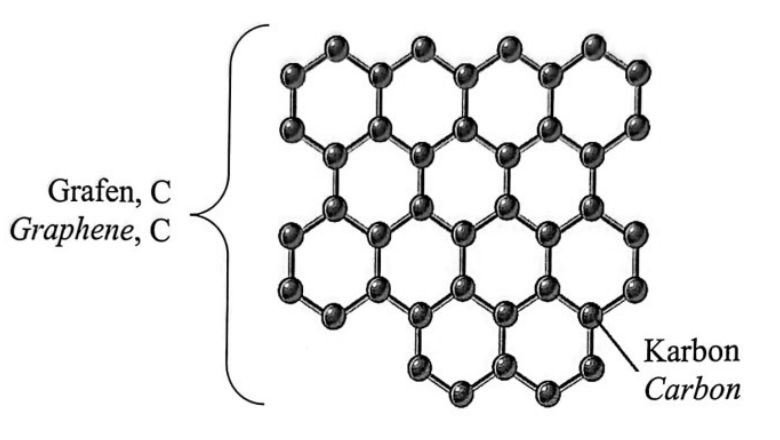
- (a)
What is meant by nanotechnology?
[1] - (b)
State one characteristic of the material that allow it to be used in the production of sensor.
[1] - (c)
Write the chemical equation for the reaction between graphene and oxygen to produce carbon dioxide.
[2] - (d)
Diagram 5.2 shows the situation in landfill that gives bad impact on the environment (methane gas produced causes fire and global warming; organic waste decomposed producing foul odour). Suggest two methods that can be done to reduce the bad impact as shown in Diagram 5.2.
[2]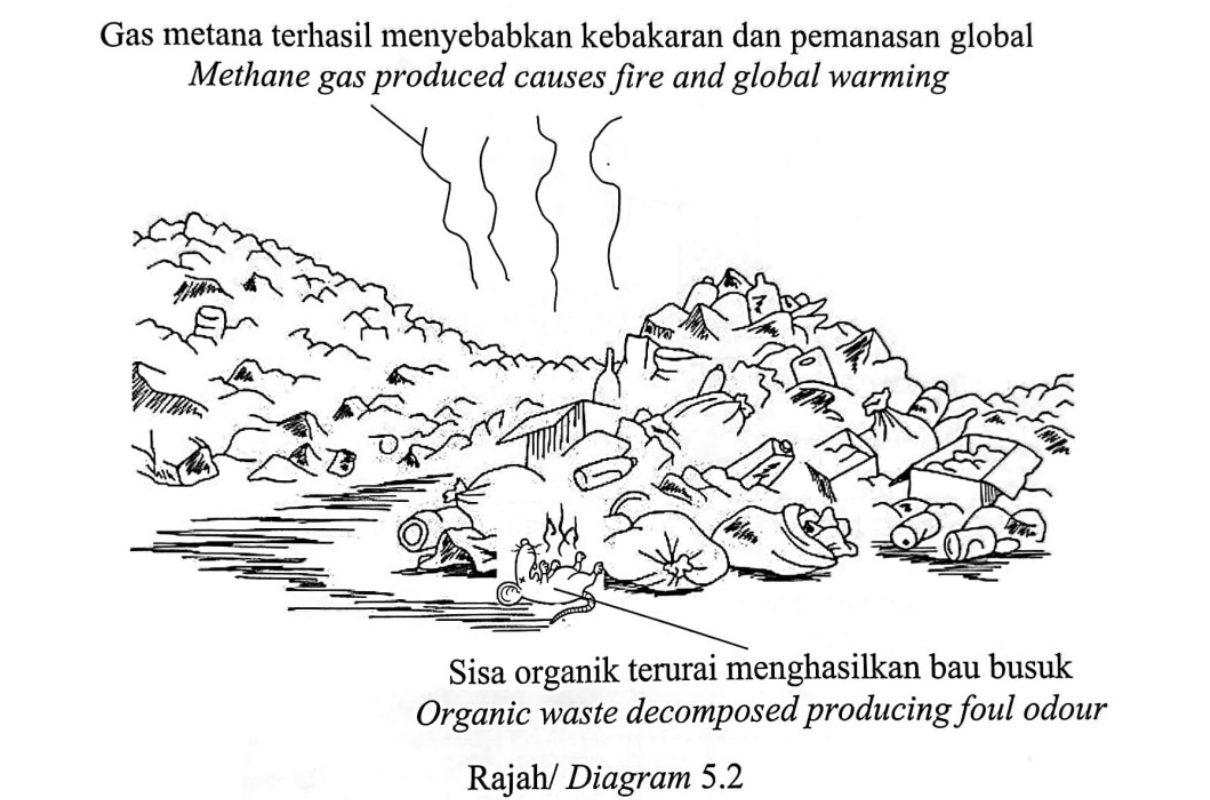
- (e)
Diagram 5.3 shows the apparatus set up to study the corrosion of pure metal and its alloy (Set I: iron nail in distilled water, brown solid deposited after two weeks; Set II: stainless steel nail in distilled water, no change). Explain the difference in the observation in Diagram 5.3.
[2]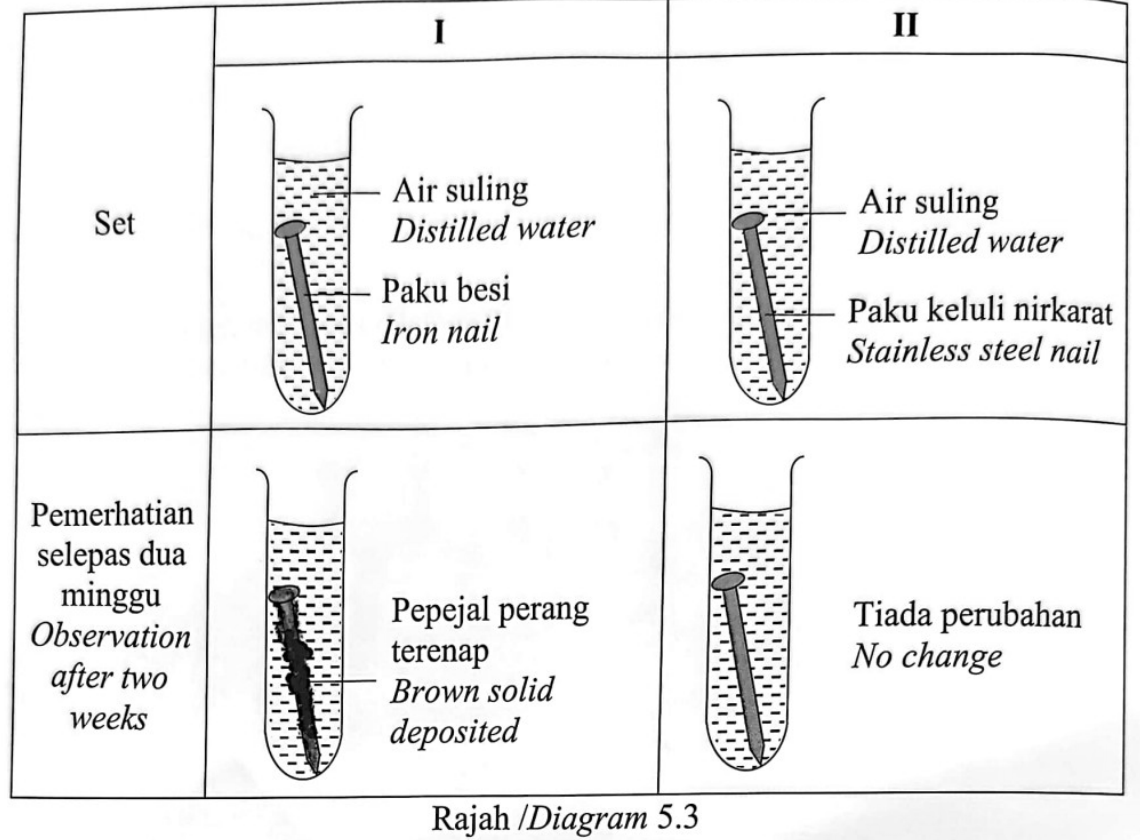
Diagram 6.1 shows the structural formula for two types of compounds that commonly used as food additives: compound X (sugar) and compound Y (table salt, Na⁺ and Cl⁻ lattice).
Medium9 marks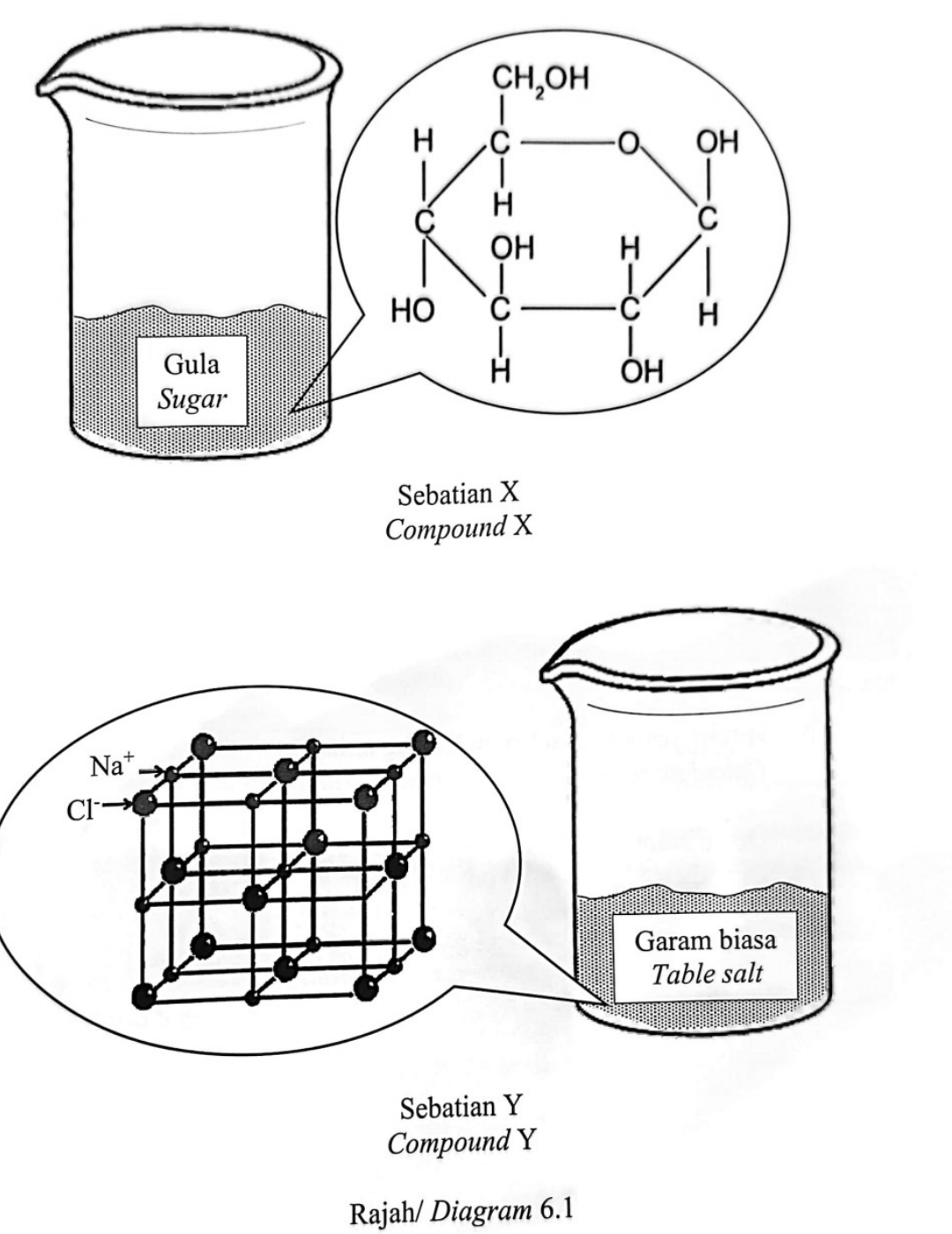
- (a)(i)
Based on Diagram 6.1, state the function of both of the compounds.
[1] - (a)(ii)
State the type of particle and empirical formula of compound X.
[2] - (a)(iii)
1200 cm³ chlorine gas reacted with excess sodium to form compound Y. The chemical equation: 2Na + Cl₂ → 2NaCl. Calculate the mass of compound Y produced. [Relative atomic mass: Na = 23, Cl = 35.5; Molar volume of gas = 24 dm³ mol⁻¹ at room conditions]
[3] - (b)
Solid X and Y are dissolved in water to form solutions. Diagram 6.2 shows the apparatus set up to investigate the electrical conductivity of the solutions (solution X: bulb does not light; solution Y: bulb lights). Diagram 6.3: Pupil K says both solution X and Y can conduct electricity; Pupil S says solution X cannot conduct electricity while solution Y can. Based on Diagram 6.1, 6.2 and 6.3, which pupil gives correct statement? Explain your answer.
[3]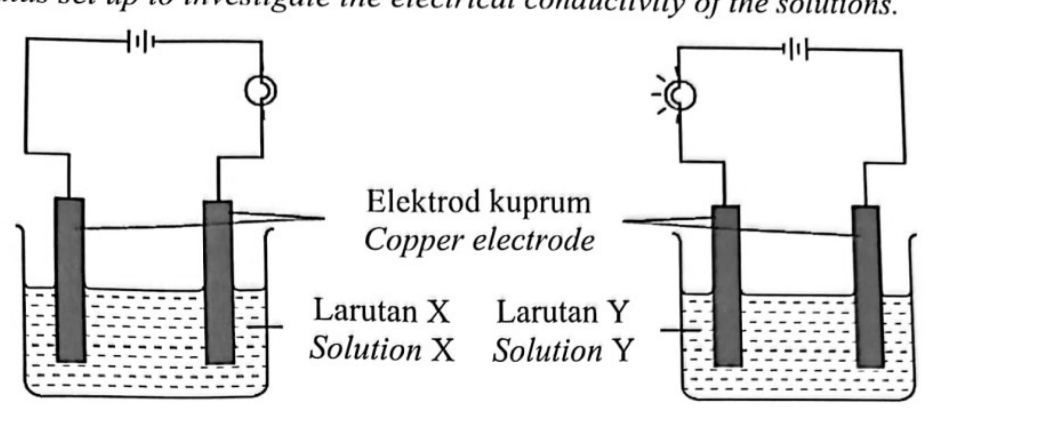
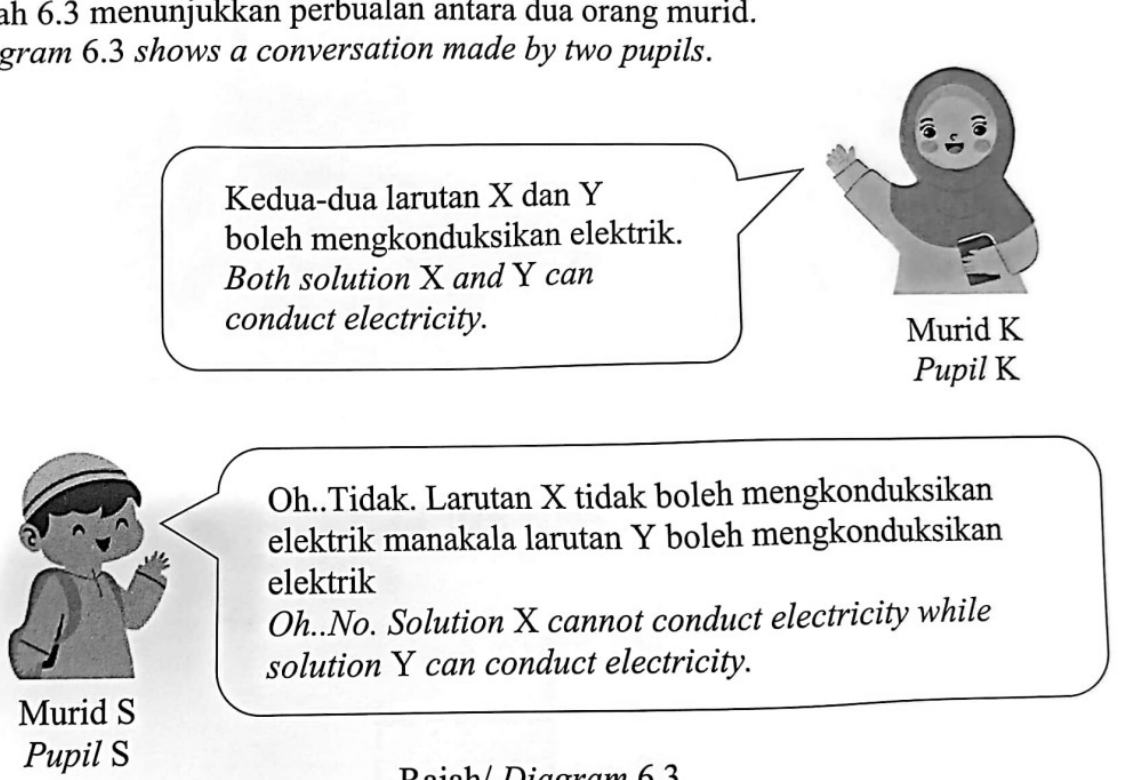
Diagram 7.1 shows the apparatus set up to produce salts. Set I: metal R added to heated nitric acid gives a green solution containing ion R²⁺. Set II: oxide of Q added to heated sulphuric acid gives a blue solution containing ion Q²⁺. Set III: 50 cm³ of 0.1 mol dm⁻³ T(NO₃)₂ solution mixed with 50 cm³ of 0.1 mol dm⁻³ NaCl solution gives a white precipitate.
Medium10 marks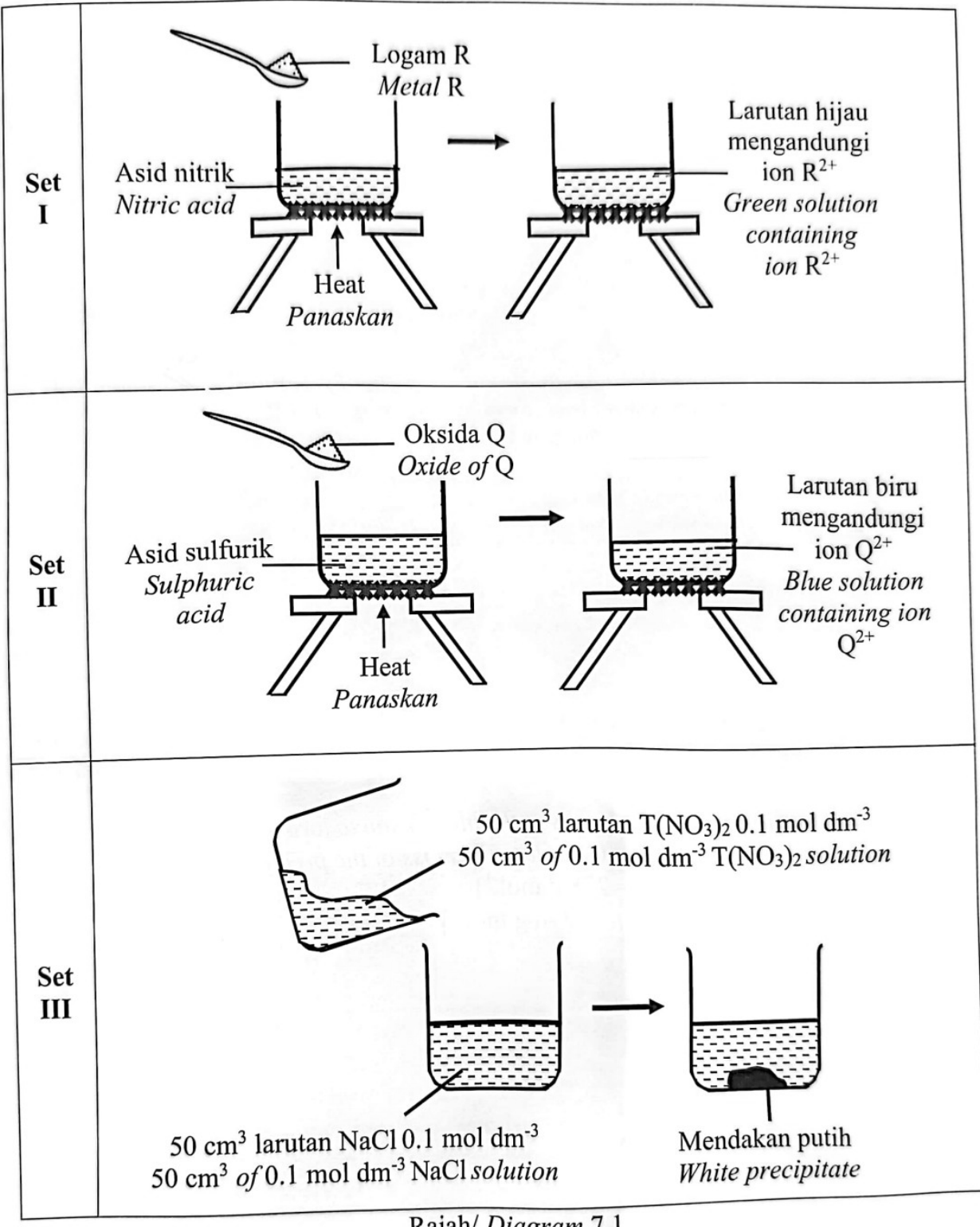
- (a)
Salt is ionic compound formed when an ion from acid is replaced with metal ion or ammonium ion. What is the ion?
[1] - (b)
Write the chemical formula for the green solution in Set I.
[1] - (c)
Based on the observation in Diagram 7.1, identify ions R²⁺, Q²⁺ and ion T. (The paper prints S²⁺ for the Set II ion; it is corrected by hand to Q²⁺.)
[3] - (d)
0.1 mol of ion T in Set III reacts with chloride ion to form precipitate. Write an ionic equation for the reaction. Calculate the mass of the precipitate formed. [Molar mass of precipitate = 278 g mol⁻¹]
[3] - (e)
Diagram 7.2 shows a type of acidic gas Y released by the industrial factory. Gas Y can be produced from the reaction between sodium sulphite, Na₂SO₃ and hydrochloric acid. Draw a labelled apparatus set up to verify the presence of gas Y in laboratory.
[2]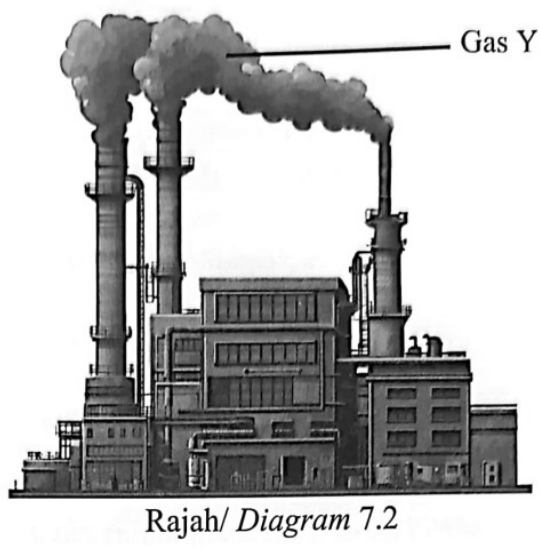
The iodine clock reaction is a reaction between acidified hydrogen peroxide solution and potassium iodide solution to form iodine. Iodine then reacts with starch to produce dark blue solution. Rate of reaction is determined by recording the time taken for the blue colour to appear. Ionic equation: H₂O₂(aq) + 2I⁻(aq) + 2H⁺(aq) → I₂(aq) + 2H₂O(l). Table 8 shows the result: Set I: KI 3.0 mol dm⁻³, 20 s, 1/time 0.050 s⁻¹; Set II: 4.5 mol dm⁻³, 13 s, 0.077 s⁻¹; Set III: 6.0 mol dm⁻³, 10 s, 0.100 s⁻¹.
Medium10 marks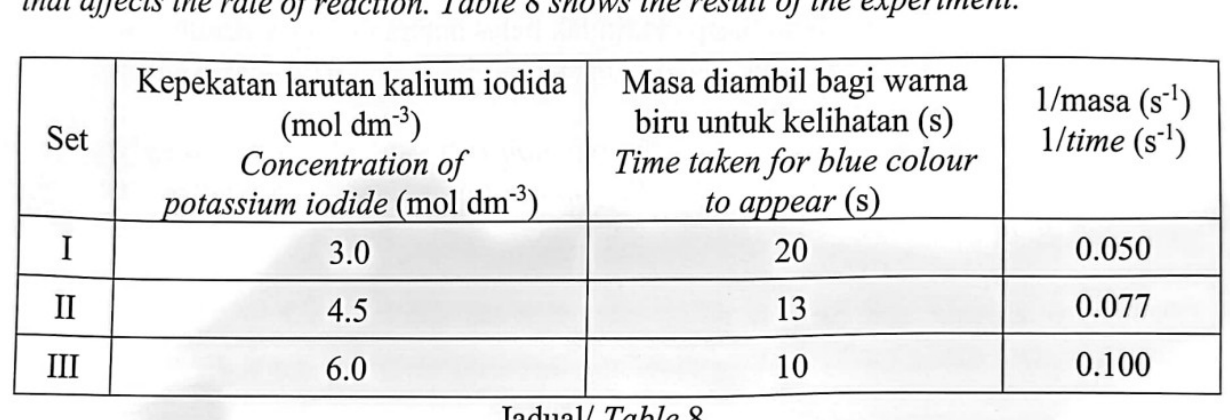
- (a)
What is represented by 1/time?
[1] - (b)
Sketch the graph for concentration of potassium iodide against 1/time.
[2] - (c)(i)
State the factor that affects the rate of reaction in this experiment.
[1] - (c)(ii)
Compare the rate of reaction for Set I and Set II. Explain your answer based on Collision Theory.
[3] - (d)
Diagram 8 shows few lump sugar and a cup of hot water. Without changing the temperature of water, state a method to dissolve the sugar with higher rate of solubility. Explain your answer.
[3]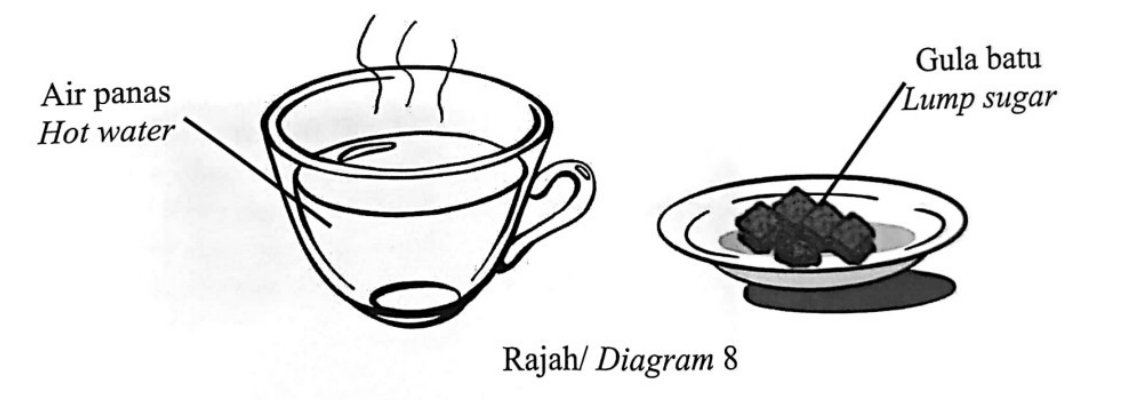
Section B
Diagram 9.1 shows two examples of unsaturated hydrocarbon compounds: compound X (CH₃–CH=CH–CH₂–CH₃) and compound Y (CH₃–CH₂–C≡C–CH₃).
Medium20 marks- (a)
State one characteristic of unsaturated hydrocarbon. State the names of compounds X and Y based on IUPAC nomenclature system. Then draw a structural formula of other isomer of compound Y.
[4]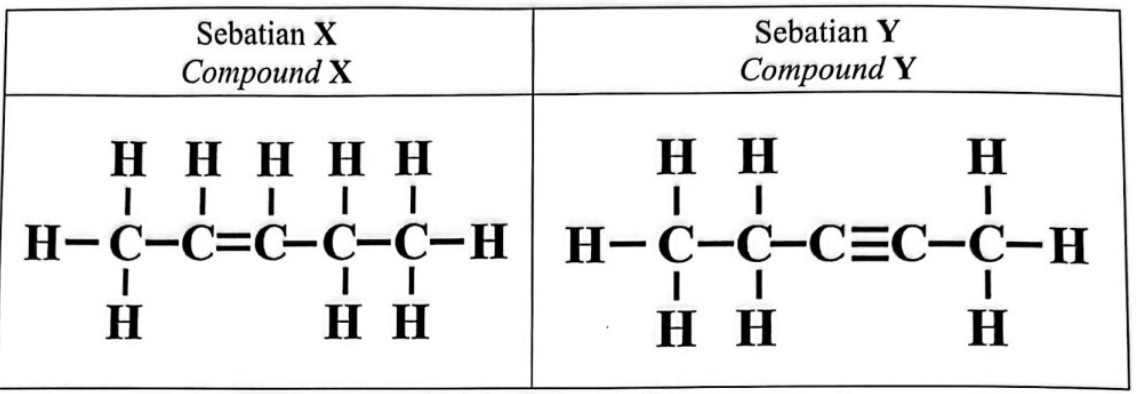
- (b)
Saturated hydrocarbon Z has the same number of carbon atoms as compound X. Both of the compounds burns completely in excess oxygen. Diagram 9.2 shows the sootiness of flames during the combustion of both compounds (filter paper I has less soot; filter paper II has more soot). Write a chemical equation for the combustion of compound Z. Which filter paper shows the sootiness of compound Z? Explain your answer. [Relative atomic mass: H = 1, C = 12]
[6]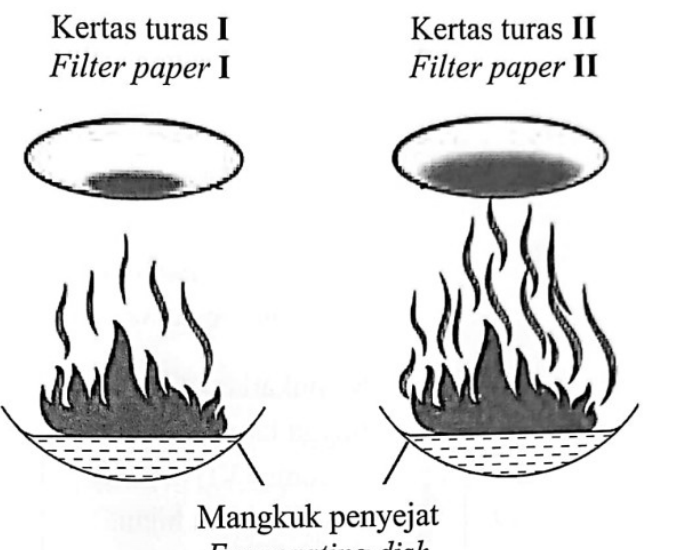
- (c)(i)
Table 9 shows the information about carbon compounds J, M and Q. J: formed from fermentation of pineapple chunks; highly flammable, burns with a blue flame without soot. M: compound with double bond between carbon atoms which is the second member of the homologous series; changes the orange colour of acidified potassium dichromate(VI) solution to green [as printed]. Q: non-hydrocarbon compound with three carbon atoms; reacts with compound J to form sweet fruity smell compound. Identify carbon compounds J, M and Q. Then state the general formula and draw the structural formula of compounds J, M and Q.
[9]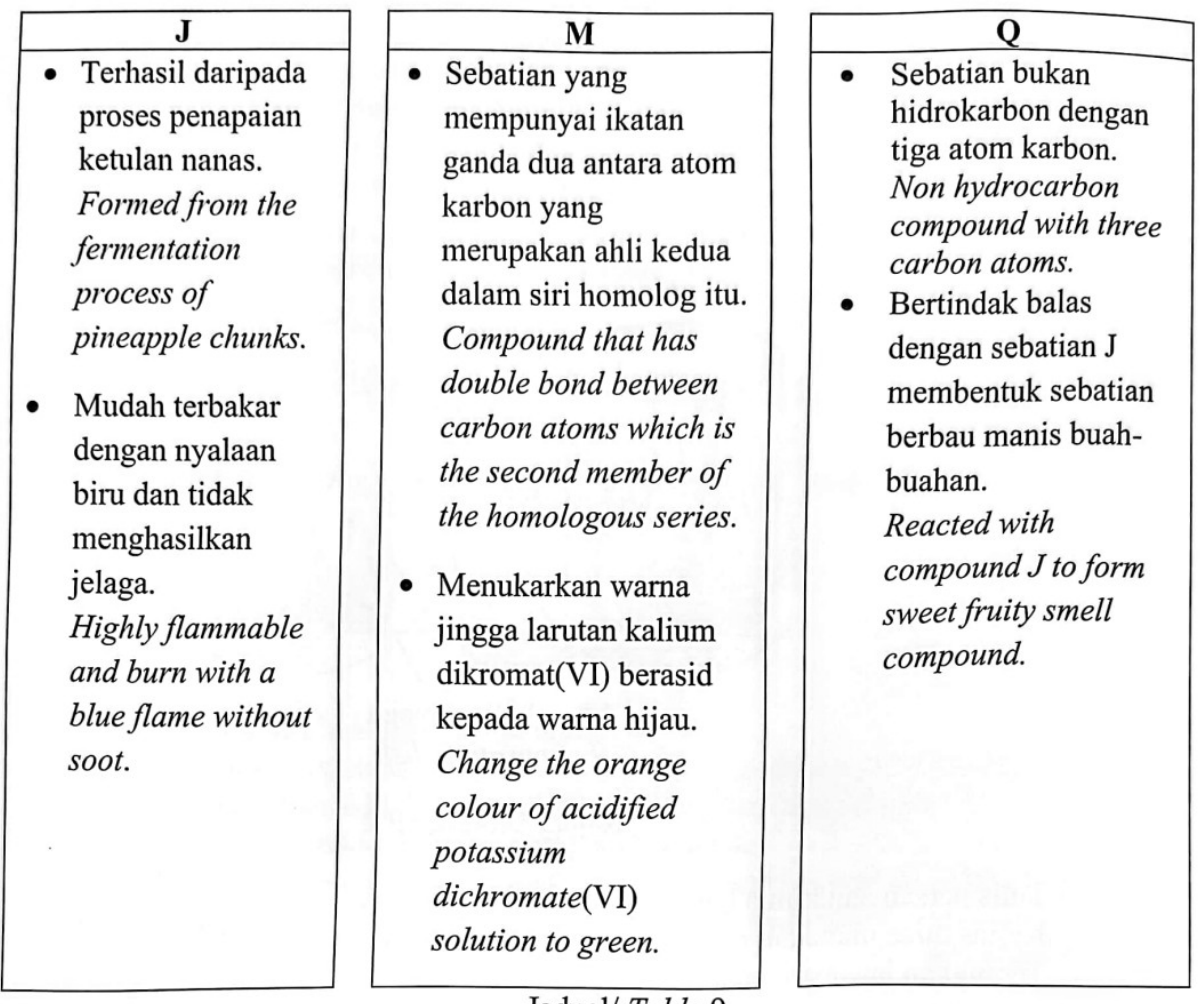
- (c)(ii)
Compound J can also react with acidified potassium dichromate(VI) solution. State the name of the product of the reaction.
[1]
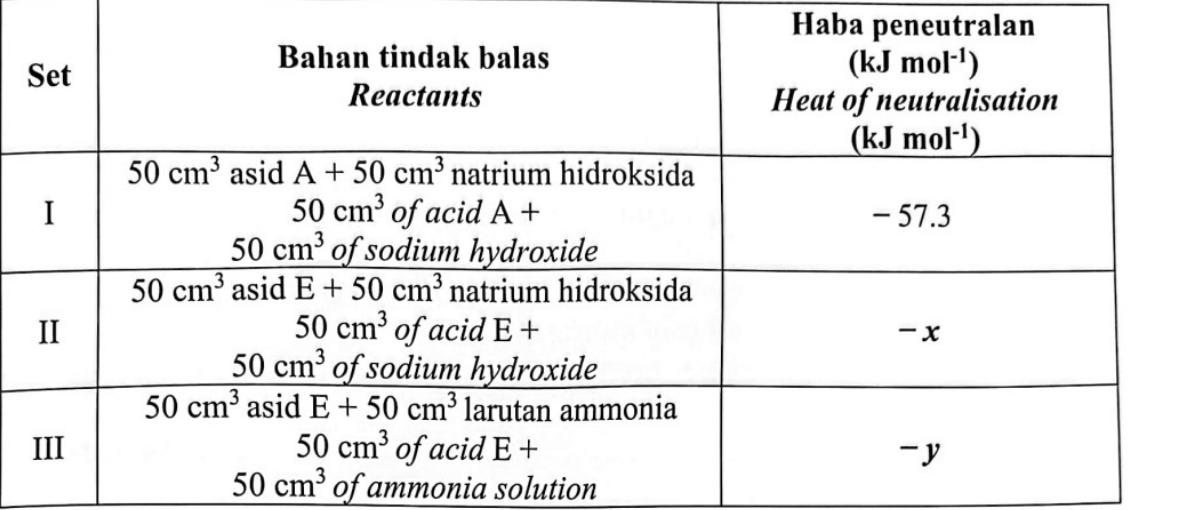
Diagram 10 shows the relationship between the concentration of acid and pH value for acid A and acid E (graph of pH value against concentration of acid, 0.1 to 0.001 mol dm⁻³: acid A pH 1.0 at 0.1 mol dm⁻³, 2.0 at 0.01, 3.0 at 0.001; acid E pH about 2.4 at 0.1, 3.4 at 0.01, 3.9 at 0.001). Both acids are monoprotic acid. Table 10 shows the information about neutralisation reaction involving acid A and acid E. The reactions occur are exothermic reactions. Heat of neutralisation (kJ mol⁻¹): Set I: 50 cm³ acid A + 50 cm³ sodium hydroxide: −57.3; Set II: 50 cm³ acid E + 50 cm³ sodium hydroxide: −x; Set III: 50 cm³ acid E + 50 cm³ ammonia solution: −y.
Medium20 marks- (a)
State two informations of exothermic reaction.
[2] - (b)(i)
Suggest acid A and acid E. Write the chemical equation for the reaction occur in Set I. Calculate the temperature change in Set I if the molarity of both acid A and sodium hydroxide solution is 1.0 mol dm⁻³.
[7]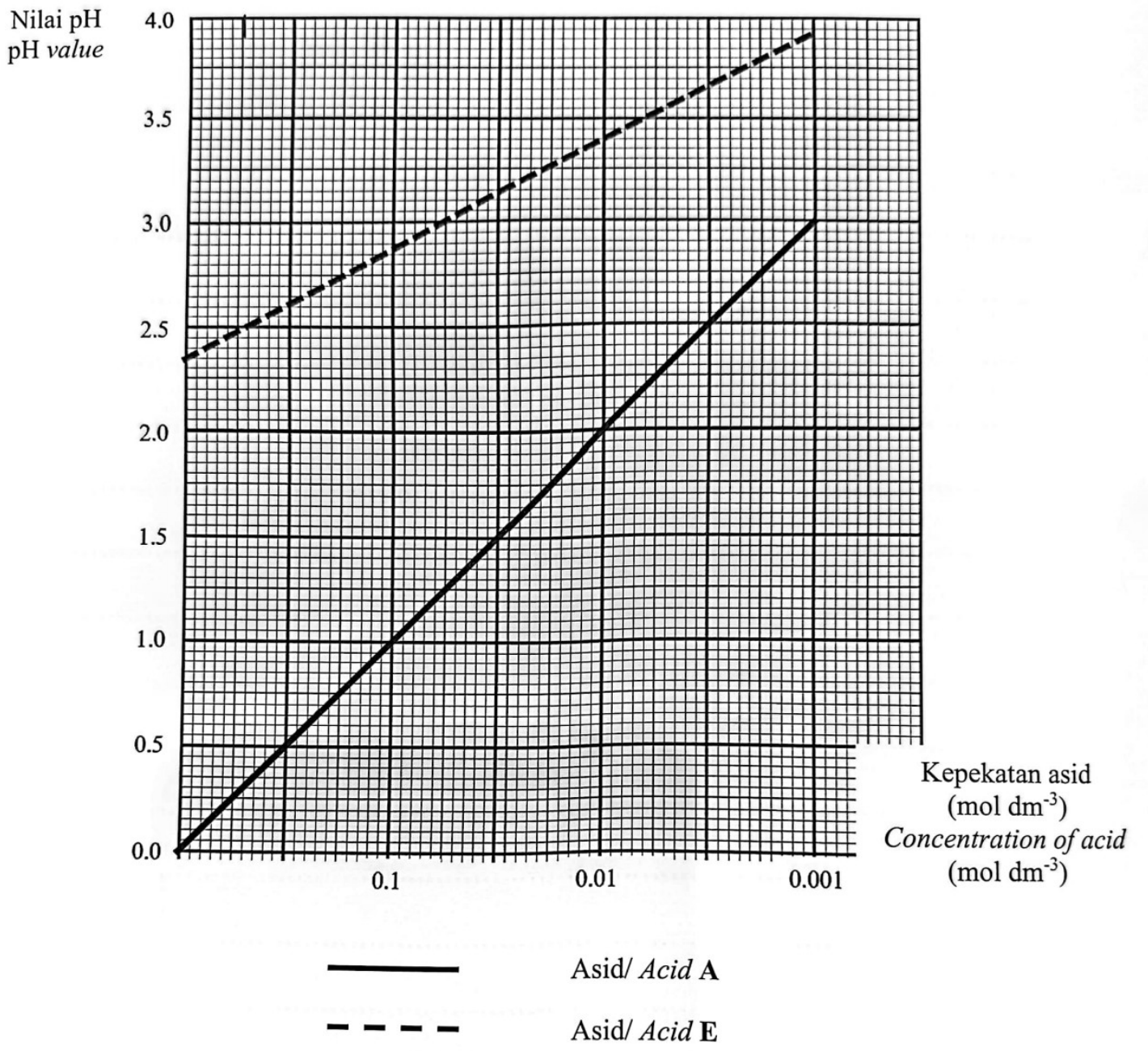
- (b)(ii)
Determine the concentration of hydrogen ion for acid A with the pH value of 1.0. Compare the pH value for both acid A and E with the concentration of 0.01 mol dm⁻³. Explain your answer according to: concentration of hydrogen ion; relationship between concentration of hydrogen ions and pH value.
[4] - (b)(iii)
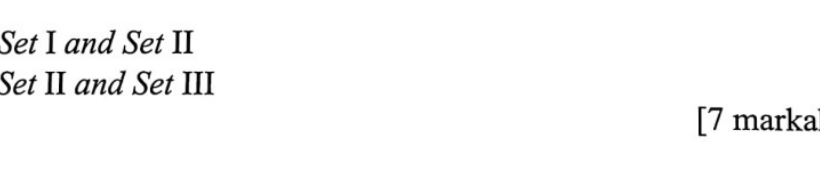
Predict the value of x and y. Explain the difference of heat of neutralisation between: Set I and Set II; Set II and Set III.
[7]
Section C
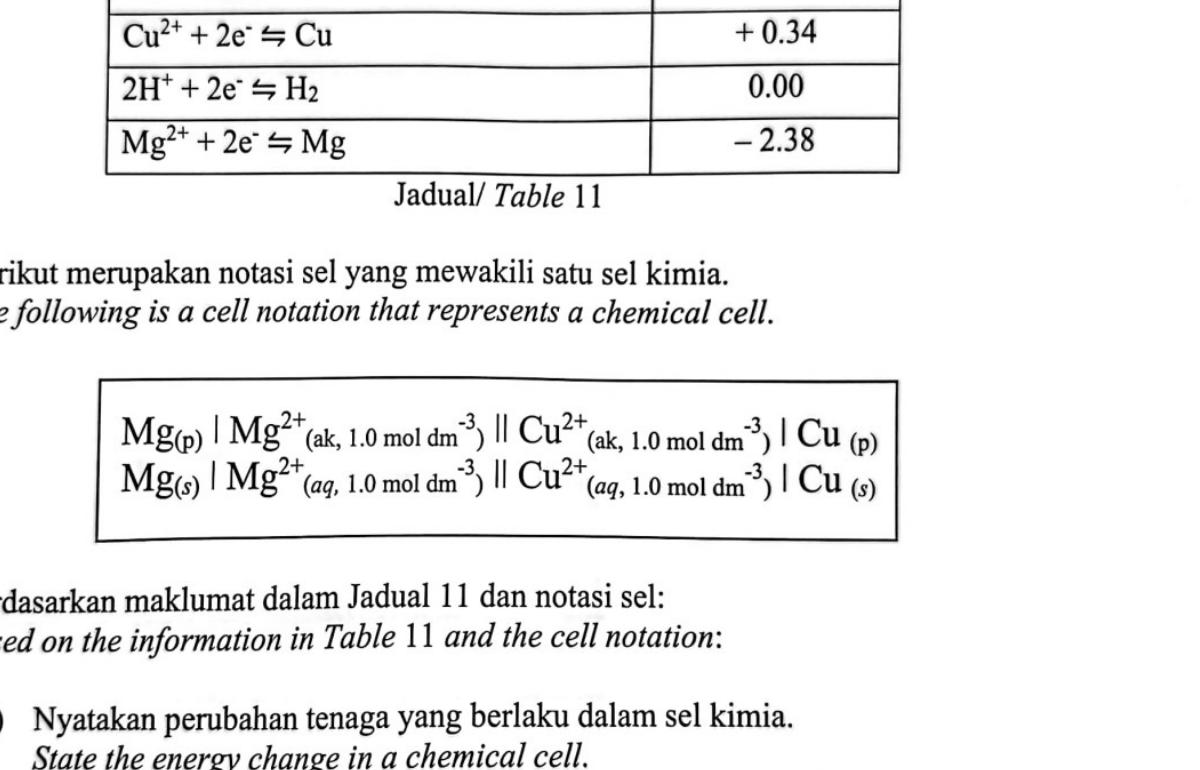
A redox reaction based on the transfer of electrons can be investigated by using a chemical cell. Table 11 shows a part of the standard electrode potential value of half-cells (E°/V at 298 K): O₂ + 2H₂O + 4e⁻ ⇌ 4OH⁻ +0.40; Cu²⁺ + 2e⁻ ⇌ Cu +0.34; 2H⁺ + 2e⁻ ⇌ H₂ 0.00; Mg²⁺ + 2e⁻ ⇌ Mg −2.38. The following is a cell notation that represents a chemical cell: Mg(s) | Mg²⁺(aq, 1.0 mol dm⁻³) || Cu²⁺(aq, 1.0 mol dm⁻³) | Cu(s).
Hard20 marks- (a)(i)
State the energy change in a chemical cell.
[1] - (a)(ii)
Identify the negative terminal of the chemical cell and give one reason. Draw the apparatus set up and calculate the cell voltage of the chemical cell.
[6]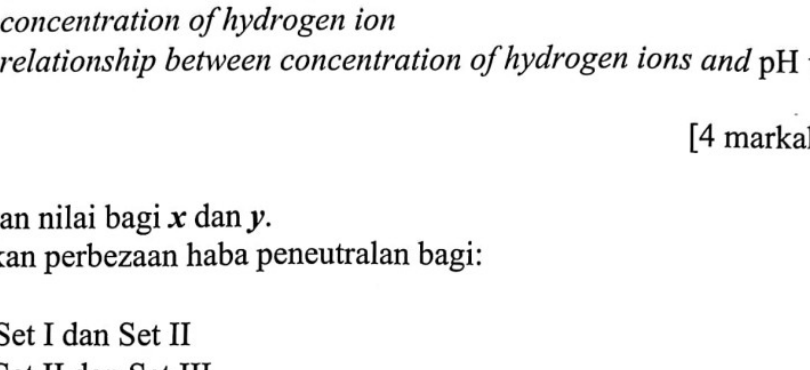
- (a)(iii)
Compare the positive and negative terminals of the chemical cell in terms of: substance that undergoes reduction and oxidation; observation. Hence, explain the oxidation process based on the transfer of electrons.
[5] - (b)
Ahmad uses the apparatus set up in Diagram 11 to electroplate an iron key with copper (copper plate and iron key in 0.5 mol dm⁻³ copper(II) nitrate solution). After 30 minutes Ahmad found out that there is no change at the iron key. By modifying the apparatus set up, describe an experiment to electroplate the iron key with copper. In your description, include the half equation for the reactions occur at the anode and cathode.
[8]