JOHOR SET 1 2024 P2 Q10
MediumWrite your answer on paper. Then open the answer to check it.
Question 10 is in Section B (answer one of Questions 9 and 10).
Medium20 marks- (a)(i)
Table 10.1 shows two sets of experiments carried out by a student to study the factor that affects the rate of reaction between hydrochloric acid and excess calcium carbonate. Set I: 50 cm³ of 0.1 mol dm⁻³ hydrochloric acid and calcium carbonate granules; 40 cm³ of carbon dioxide gas collected in 50 s. Set II: 50 cm³ of 0.1 mol dm⁻³ hydrochloric acid and calcium carbonate powder; 40 cm³ of gas collected in 20 s (gas collected by displacement of water). State the definition of the rate of reaction.
[1]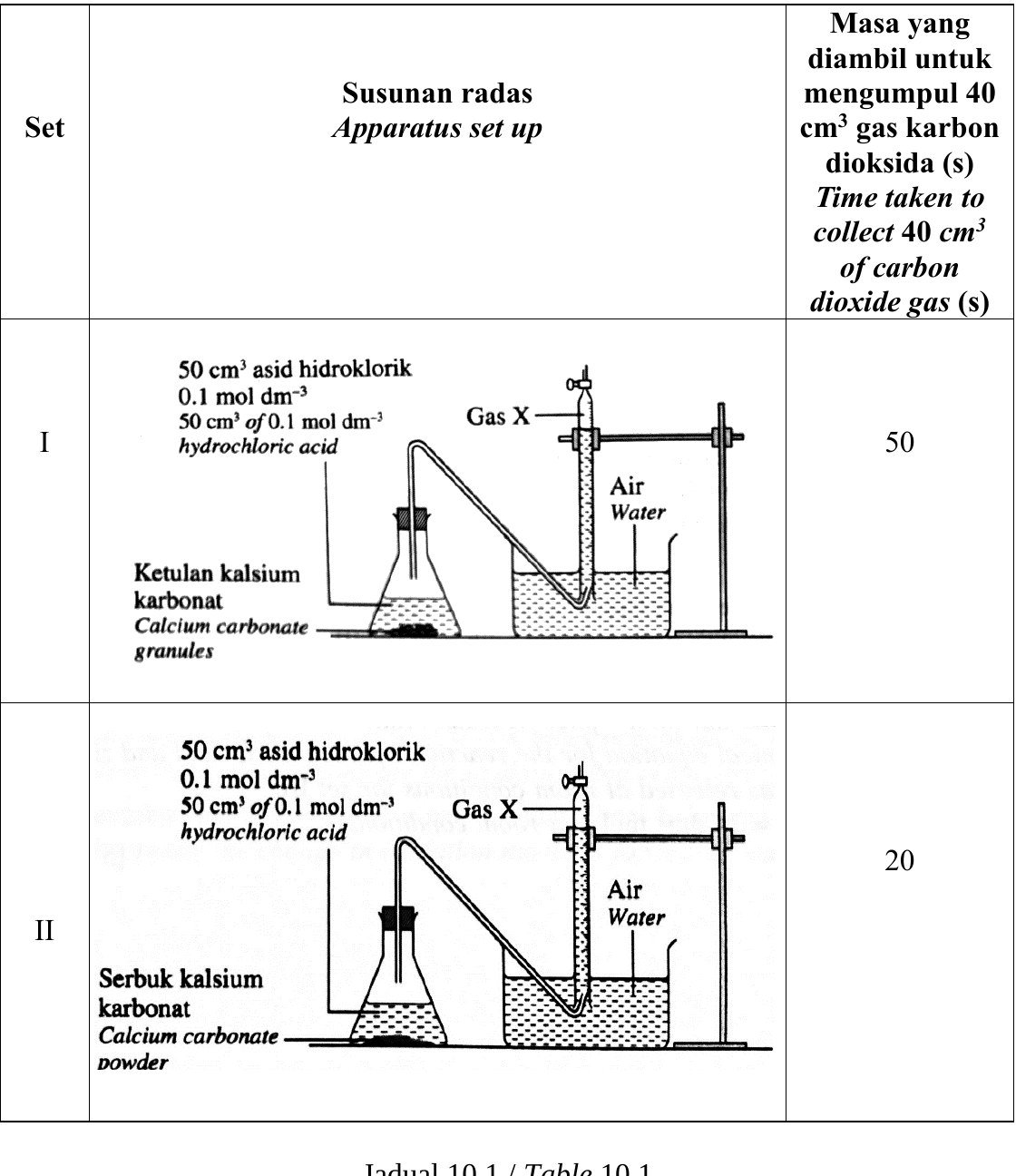
- (a)(ii)
Calculate the average rate of reaction in set I.
[1] - (a)(iii)
Based on the information in Table 10.1, compare the rate of reaction between set I and set II. Explain your answer using the collision theory.
[5] - (a)(iv)
Sketch a graph of the volume of carbon dioxide gas collected against time for the experiments in set I and set II on the same axis.
[2] - (b)(i)
An experiment studies the rate of reaction between zinc and nitric acid. Excess zinc granules react with 25 cm³ of nitric acid in set III and set IV. Table 10.2: Set III: 0.2 mol dm⁻³, 27 °C, rate low; Set IV: 1.0 mol dm⁻³, 37 °C, rate high. Based on Table 10.2, state two factors that affect the rate of reaction. Choose one of the factors and explain your answer using the collision theory.
[6]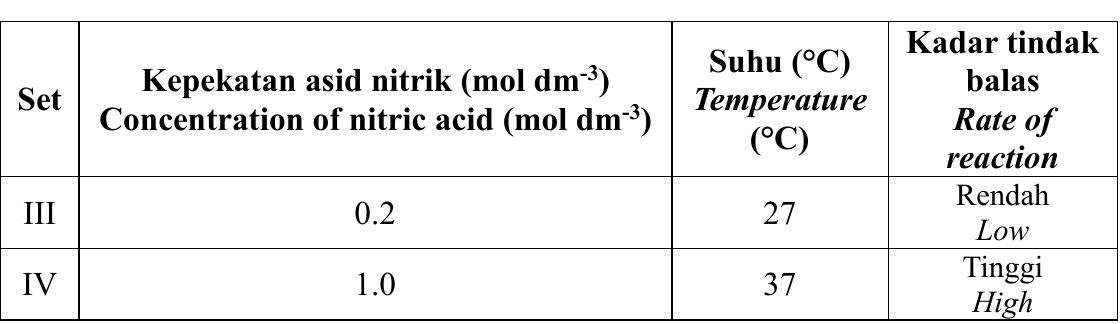
- (b)(ii)
Write a balanced chemical equation for the reaction between nitric acid and zinc. Calculate the maximum volume of gas released at room conditions for set III. [Molar volume of gas = 24 dm³ mol⁻¹ at room conditions]
[5]