KELANTAN 2024 P2 Q9
MediumWrite your answer on paper. Then open the answer to check it.
Table 9.1 shows the reactants used to study the factors that affect the rate of reaction. Set I: 50 cm3 of 1.0 mol dm-3 hydrochloric acid + excess zinc powder. Set II: 50 cm3 of 1.0 mol dm-3 hydrochloric acid + excess zinc powder + copper(II) sulphate solution. Graph 9.2 shows some of the results (volume of hydrogen gas, cm3, against time, s): Exp I reaches 50 cm3 at 70 s; Exp II reaches 50 cm3 at 30 s.
Medium20 marks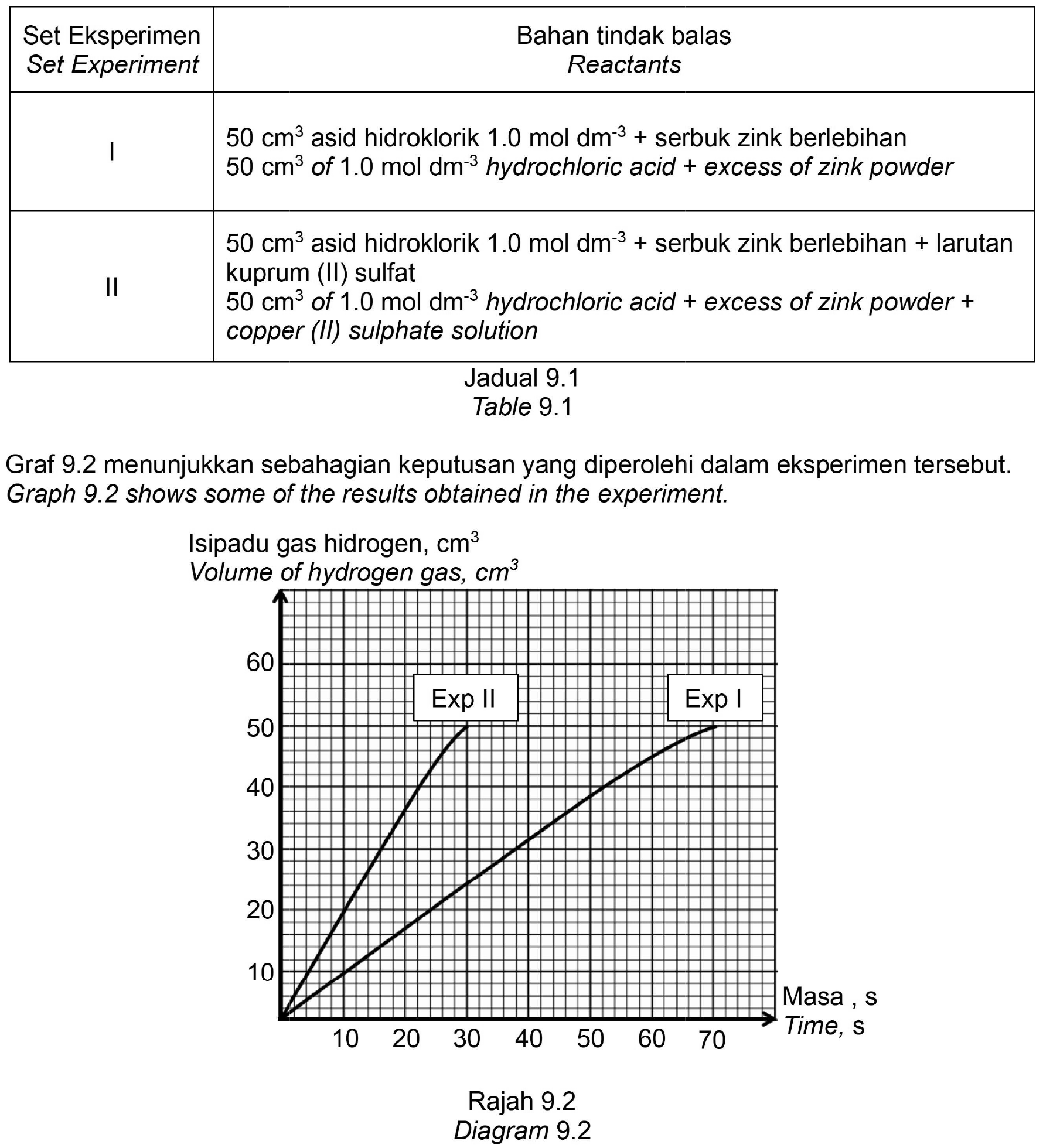
- (a)(i)
What is meant by rate of reaction?
[1] - (a)(ii)
In a reaction, effective collisions between the reacting particles must occur for the reaction to occur. State two conditions necessary for effective collision to occur.
[2] - (a)(iii)
Draw the energy profile for the reaction. Show the activation energy for experiment Set I labeled Ea and the activation energy for experiment Set II labeled Eb on the same energy profile.
[3] - (b)(i)
Calculate the average rate of reaction for experiment Set I and Set II.
[2] - (b)(ii)
Compare the reaction rates in Set I and Set II experiments. Explain your answer based on collision theory.
[5] - (c)(i)
Experiment Set I was repeated by replacing hydrochloric acid with sulphuric acid at the same volume and concentration. Write the chemical equation for the reaction in (c) and calculate the volume of hydrogen gas that may be liberated in the reaction. [Molar volume of gas at room temperature = 24 dm3 mol-1]
[5] - (c)(ii)
Compare the rate of reaction between the experiment in (c) with the Set I experiment. Explain your answer.
[2]