KELANTAN 2025 P2 Q7
MediumWrite your answer on paper. Then open the answer to check it.
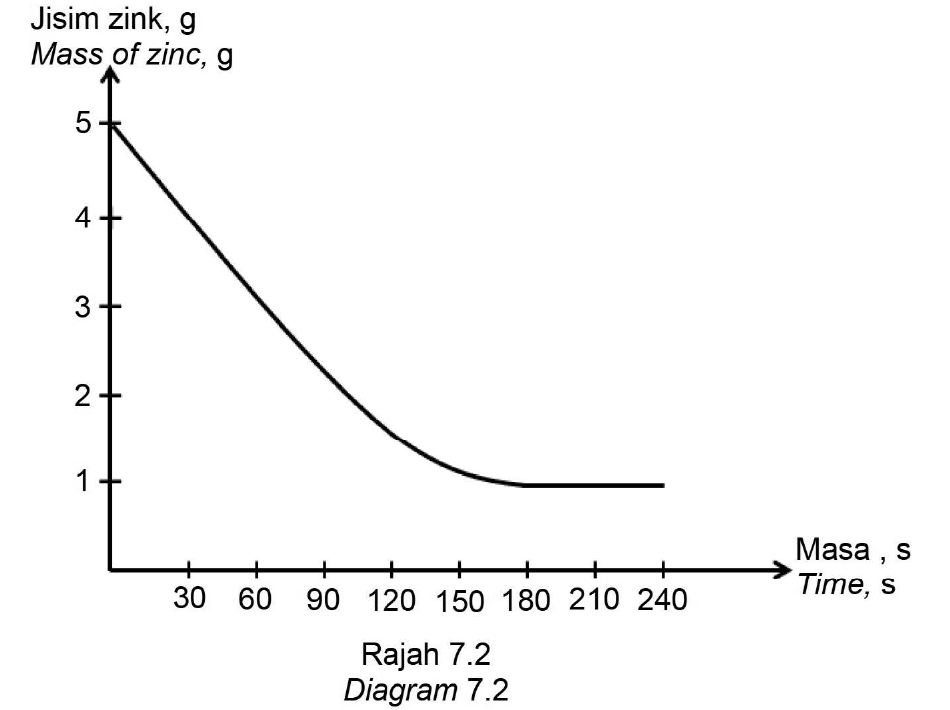
Diagram 7.1 shows the arrangement of the apparatus used to study the rate of reaction between zinc and hydrochloric acid (conical flask with 50 cm³ hydrochloric acid and zinc on a weighing scale reading 5.00 g). Diagram 7.2 shows a sketch of the graph obtained from the experiment (mass of zinc, g against time, s: 5.00 g at 0 s, decreasing to 1.00 g at about 180 s then constant until 240 s).
Medium10 marks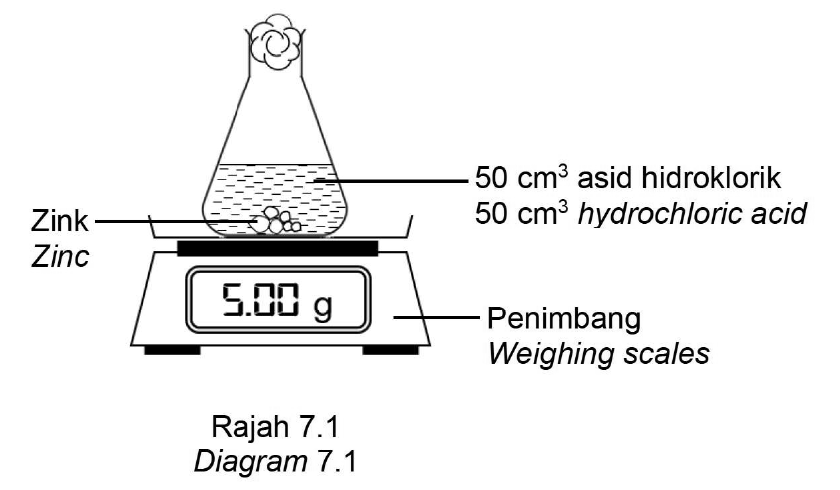
- (a)(i)
State the meaning of rate of reaction
[1] - (a)(ii)
Determine the average reaction rate of the entire reaction.
[1] - (a)(iii)
Write a chemical equation to represent the reaction that occurred.
[2] - (a)(iv)
Calculate the concentration of acid used. [Relative atomic mass: H=1, Cl=35.5, Zn=64]
[3] - (a)(v)
The experiment is repeated by adding 2 cm³ of copper (II) sulphate solution to the reactants. What will happen to the time taken for the reaction to occur?
[1] - (b)
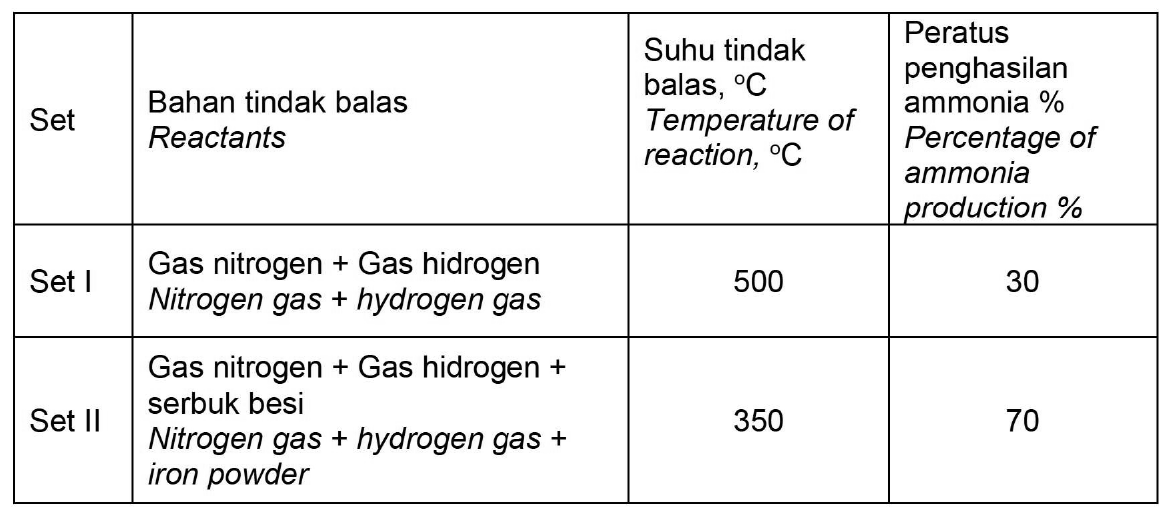
Ammonia is produced by a direct reaction between nitrogen gas and hydrogen gas at high temperature and pressure. The ammonia production company is looking for the most optimal production method so that the production rate can be increased. Table 7.3 shows the recommended temperature and production rate suggested by the company's engineers. Both reactions are carried out at a pressure of 450 atm. (Set I: nitrogen gas + hydrogen gas, 500 °C, 30% ammonia; Set II: nitrogen gas + hydrogen gas + iron powder, 350 °C, 70% ammonia.) The company chose Set II as the method that should be used by the company. Using the concept of rate of reaction, justify the choice made by the company.
[2]