PERLIS 2025 P2 Q9
MediumWrite your answer on paper. Then open the answer to check it.
Question 9 (Section B, answer any one of Q9 or Q10). Parts (a) to (c) are about factors affecting the rate of reaction.
Medium20 marks- (a)
Diagram 8.1 shows two types of the same soap in different conditions used in washing: Soap A (powder) and Soap B (bar). Which soap is better in washing action? What is the factor of rate of reaction involved?
[2]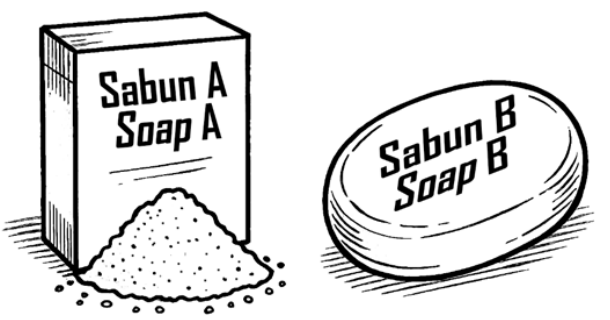
- (b)(i)
Syakir carried out experiments to investigate the factor affecting the rate of reaction between calcium carbonate and nitric acid. Table 4 shows the reactants and the time taken to collect 40 cm3 of gas Z. Set I: excess calcium carbonate powder and 50 cm3 of 1.0 mol dm⁻³ nitric acid, 25 s. Set II: excess calcium carbonate powder and 50 cm3 of 0.5 mol dm⁻³ nitric acid, 50 s. State the meaning of rate of reaction.
[1] - (b)(ii)
Name the gas Z produced. Write a chemical equation for the reaction between calcium carbonate and nitric acid. Calculate the maximum volume of gas Z produced in experiment Set I. [1 mol of gas occupies 24 dm3 at room conditions]
[6] - (b)(iii)
Calculate the average rate of reaction for experiment Set I and experiment Set II.
[2] - (b)(iv)
By using the collision theory, explain the difference in the rate of reaction between experiment Set I and experiment Set II.
[5] - (b)(v)
Syakir repeats the experiment Set I by heating the nitric acid without changing the concentration of the acid to increase the rate of reaction. Explain how the action can increase the rate of reaction.
[2] - (c)
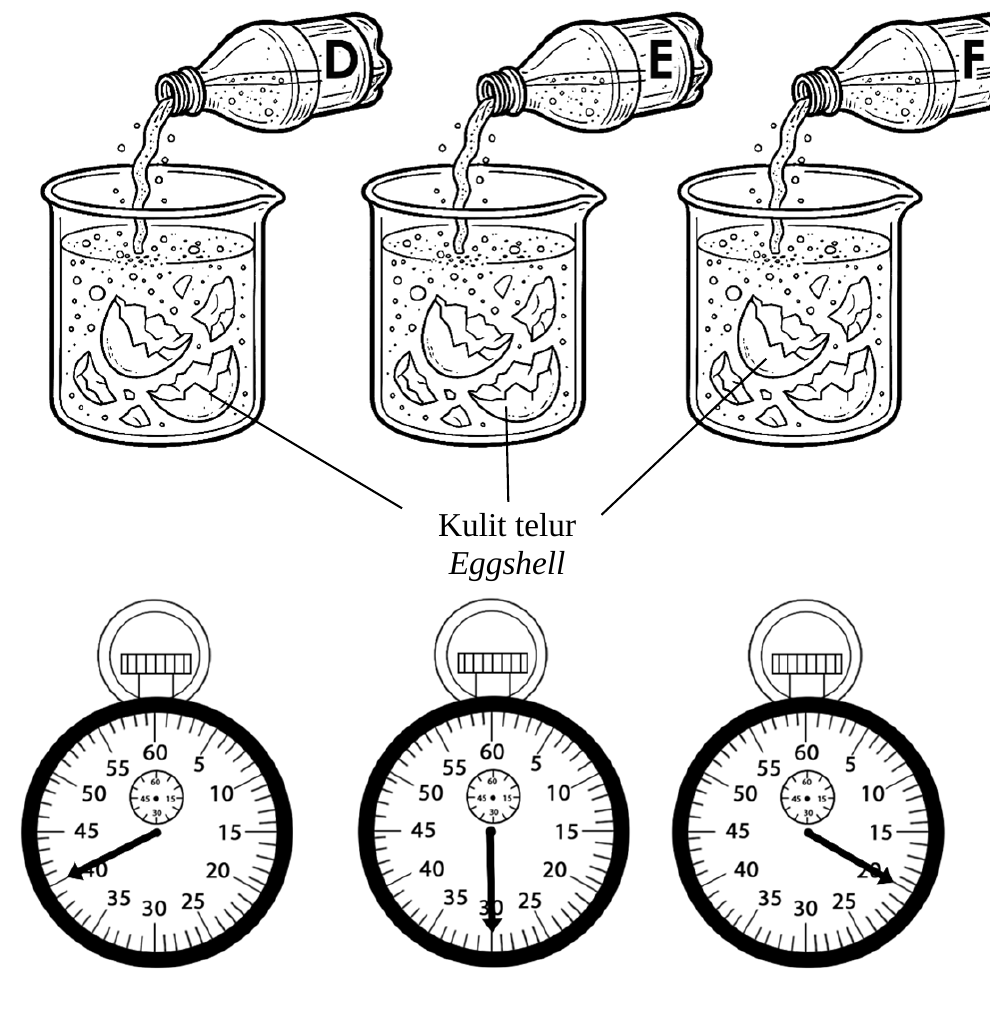
Diagram 8.2 shows three different carbonated drinks, D, E and F, reacting with 3 g of eggshell, with the time taken to dissolve all the eggshell shown on stopwatches (D about 42 s, E 30 s, F about 17 s). Based on Diagram 8.2, which of the carbonated drinks is the most unhealthy to our stomach if it is taken regularly? State your reason.
[2]