SARAWAK SET 2 2024 P2 Q11
HardWrite your answer on paper. Then open the answer to check it.
Section C (answer this question). A fast chemical reaction is a process of converting reactants into products that completes in a short time while a slow reaction takes long to complete.
Hard20 marks- (a)
State the definition of rate of reaction. Sketch a graph of quantity of reactants against time for a fast reaction then label it as 'I'. On the same axis, sketch another graph for slow reaction and then label it using 'II'.
[3] - (b)(i)
In three separate experiments, nitric acid is added to excess marble chips. Diagram 10.1 shows the volume of carbon dioxide gas evolved against time for three experiments I, II and III (V1 for I and III, V2 for II). In all three experiments the volume of nitric acid used is the same; the concentration, or temperature, or both are changed. In Experiment I and III, 100 cm³ of nitric acid 0.5 mol dm⁻³ is added to marble chips. What is the factor being manipulated in these two experiments? Write a balanced chemical equation for the reaction in Experiment I. Calculate the volume of gas, V1. [Molar volume of gas at room condition = 24.0 dm³ mol⁻¹]
[5]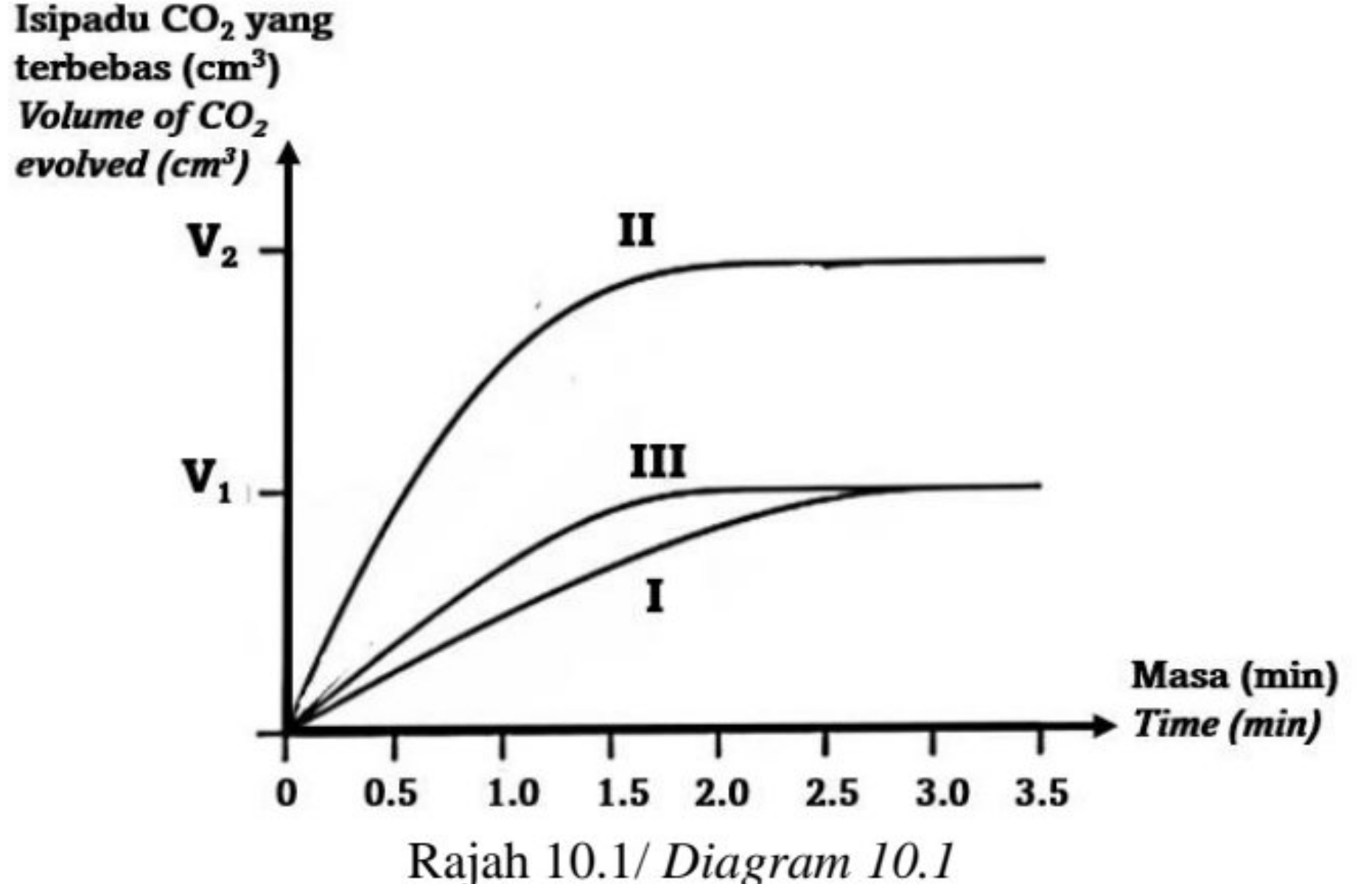
- (b)(ii)
Based on Diagram 10.1, describe how to obtain curve II from the experiment. Explain why there are differences in the initial rate of reaction between Experiment I and Experiment II. Explain your answer using collision theory.
[4] - (c)
Diagram 10.2 shows two methods that can be used in large scale production of ethanol fuel for vehicle use: Method 1: fermentation (C6H12O6 → 2C2H5OH + 2CO2, zymase, from sugarcane and maize); Method 2: hydration (C2H4 + H2O → C2H5OH, H3PO4, 300 °C, 60 atm, from ethene). You are assigned to evaluate which method is more suitable to produce ethanol as fuel. State your choice based on Diagram 10.2 and justify your answer.
[2]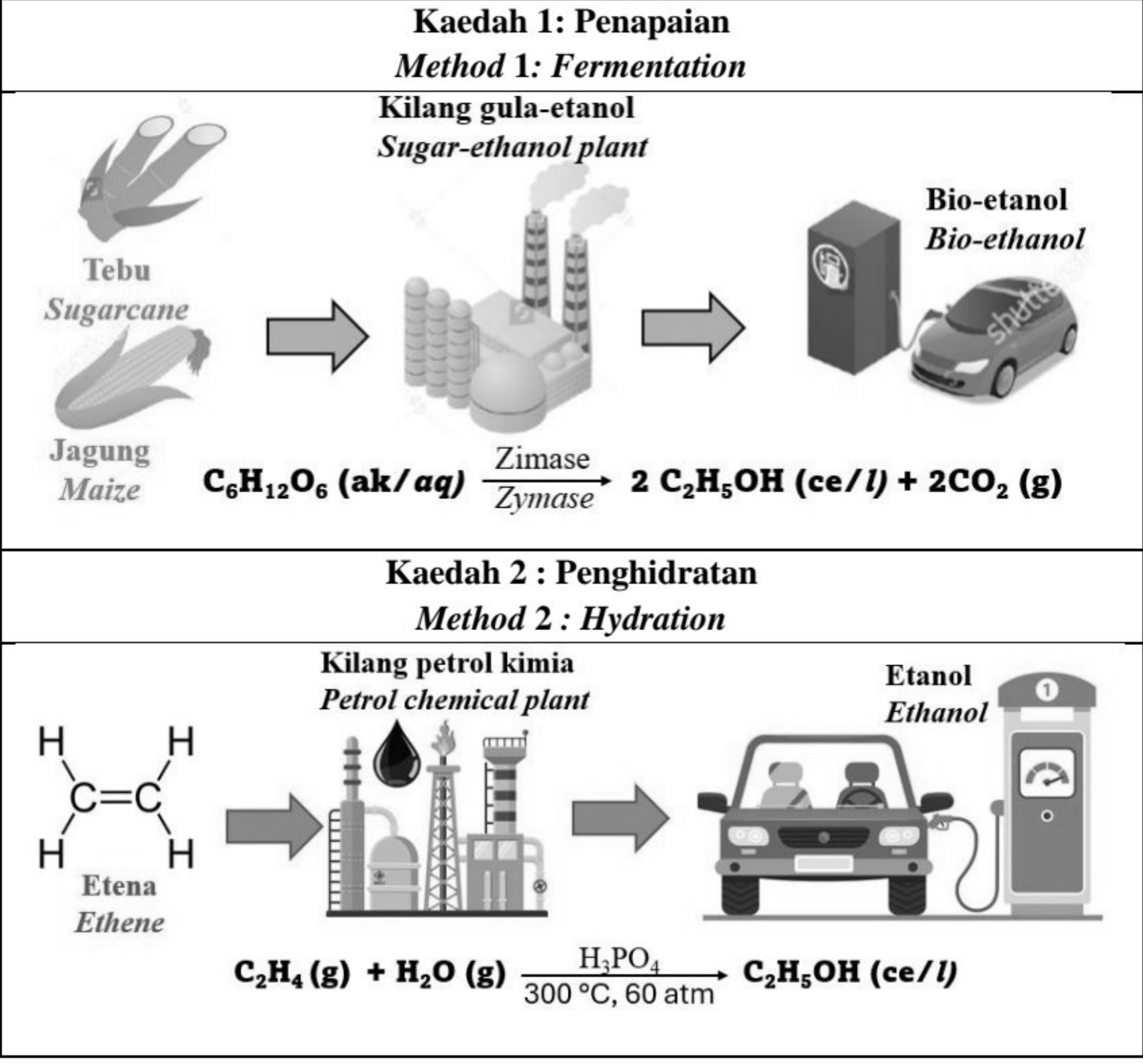
- (d)
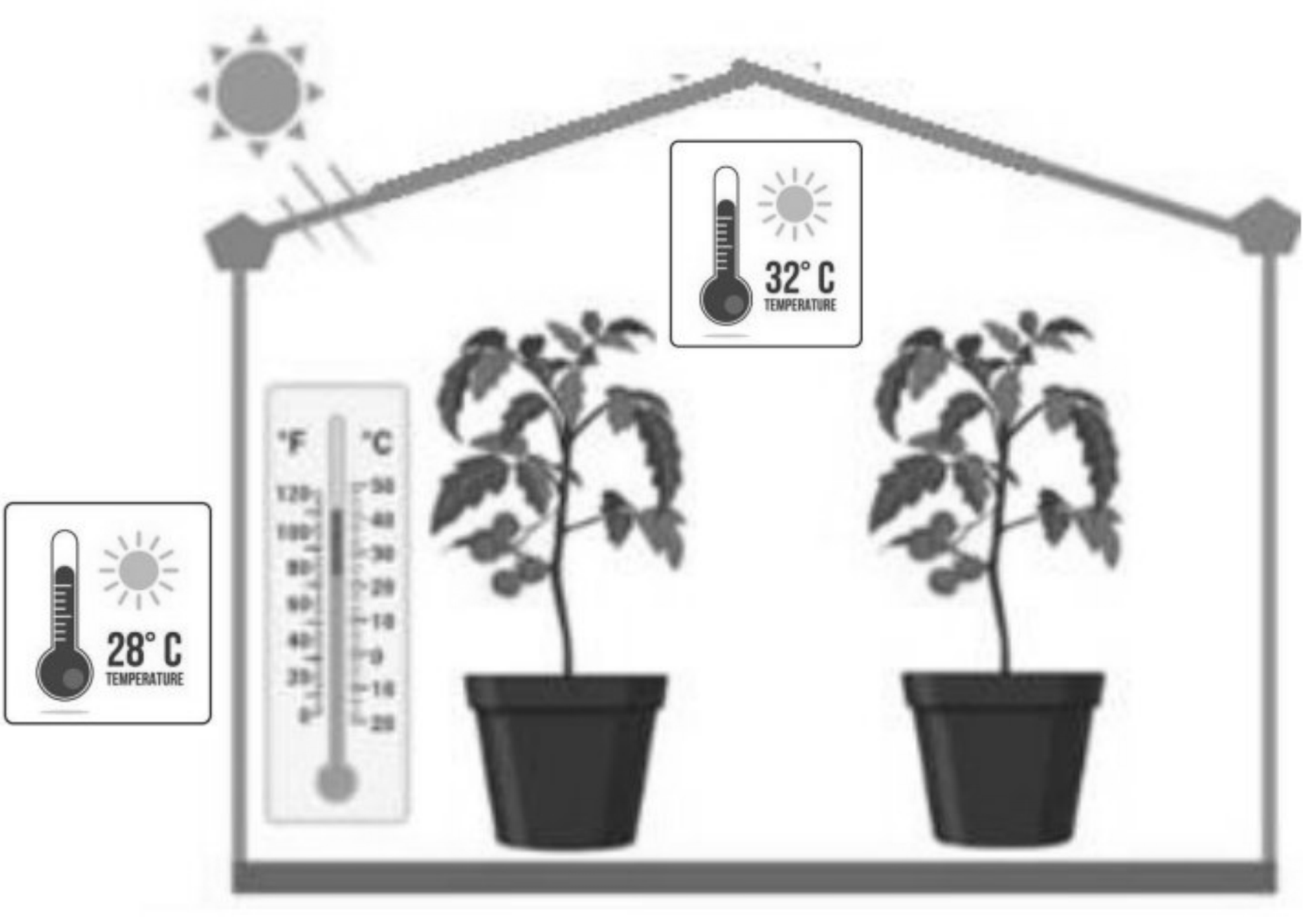
Diagram 10.3 shows tomato plants in a greenhouse protected from pests (28 °C outside, 32 °C inside). The farmer faces a problem where all the tomatoes ripen simultaneously during summer. This arises when premature green tomatoes are stimulated by the ethylene gas, C2H4, released from mature fruits. By using your knowledge in chemistry, suggest two solutions to overcome the problem so that the farmer can harvest the tomato periodically. Explain your answer.
[6]