Write your answer on paper. Then open the answer to check it.
Section A
Diagram 1 shows a Cartesian plane (shaded region bounded by a sloping line through (−8, 0) and (0, 8), the horizontal dashed line y = 8, the vertical dashed line x = −12 and the x-axis).
Medium4 marks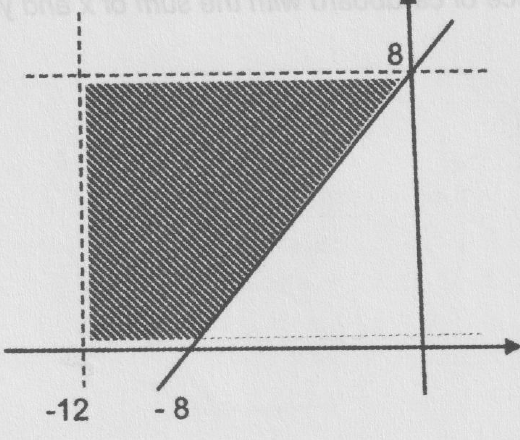
Write four inequalities that define the shaded region.
[4]
Given the area of a triangle, A, varies directly with the constant, k, with height, x cm and base, y cm. Rajoo has a triangular-shaped piece of cardboard with x and y 80 cm and 48 cm respectively.
Medium4 marksCalculate the value of k if the area of the cardboard is 15 360 cm². Next calculate the value of A if Rajoo has another piece of cardboard with the sum of x and y is 180 cm where the ratio of x to y is 5 : 4.
[4]
Zulaikha is 132₆ years old. Zulaikha's age is twice the age of her daughter, Zahira. The ratio of Zahira's age to the age of her younger brother, Ahmad is 7 : 6.
Medium4 marksCalculate the total age Zulaikha and her children in base 7.
[4]
In a furniture exhibition, there is a piece of round-shaped window decorated with a small circle carving the same size as Diagram 2 (seven equal small circles inside the large circle). The radius of the window is 72 cm.
Medium4 marks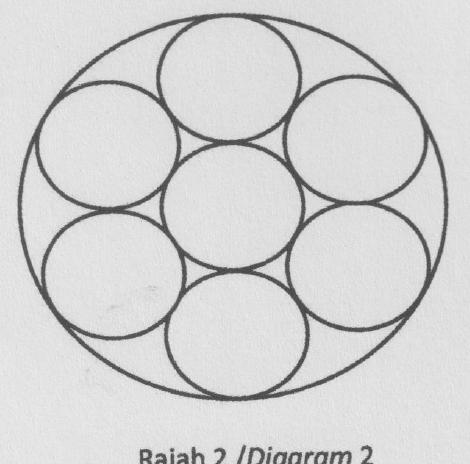
Calculate the area of the uncarved area. (Use π = 22/7)
[4]
(a) Determine whether the following argument is valid or invalid; for a valid argument, determine whether it is sound or not sound. Premise 1: All prime numbers are odd numbers. Premise 2: 3 is a prime number. Conclusion: 3 is an odd number. (b) From an implication "p if and only if q", write the contrapositive for the implication: If a is an odd number, then a cannot be divided exactly by 2.
Medium4 marks- (a)
Determine whether the argument is valid or invalid, and if valid whether it is sound or not sound.
[2] - (b)
Form the implication "p if and only if q" for the implication, then write its contrapositive.
[2]
Diagram 3 shows an unfolded cuboid box (dimensions marked 4r² cm and 2s cm).
Medium4 marks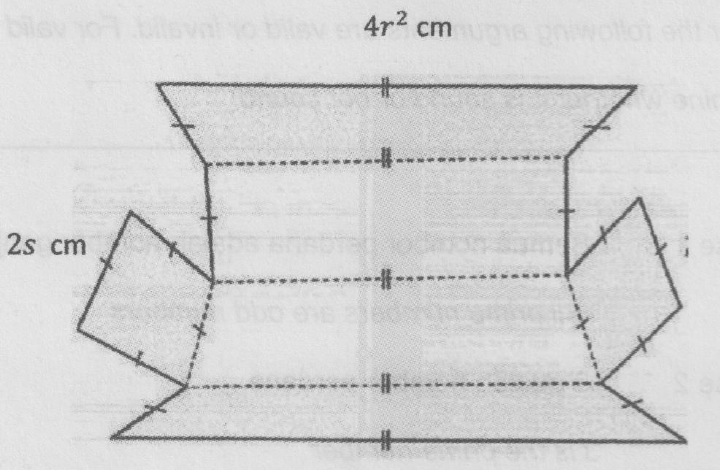
Express the total surface area of the cuboid in terms of r and s, then calculate the volume, in cm³, of the box if r = 4 cm and s = 6 cm.
[4]
Table 1 shows the financial plan prepared by Cikgu Muji to manage his money effectively. Net income: Teacher salary RM5 500; Tuition teacher's salary RM2 000; Rental received RM1 550; Syer interest RM600. Expenses budget: Housing instalment RM1 200; Car instalment RM750; Allowances to parents RM600; Groceries RM500; Utility bills RM300; Petrol RM250.
Medium4 marks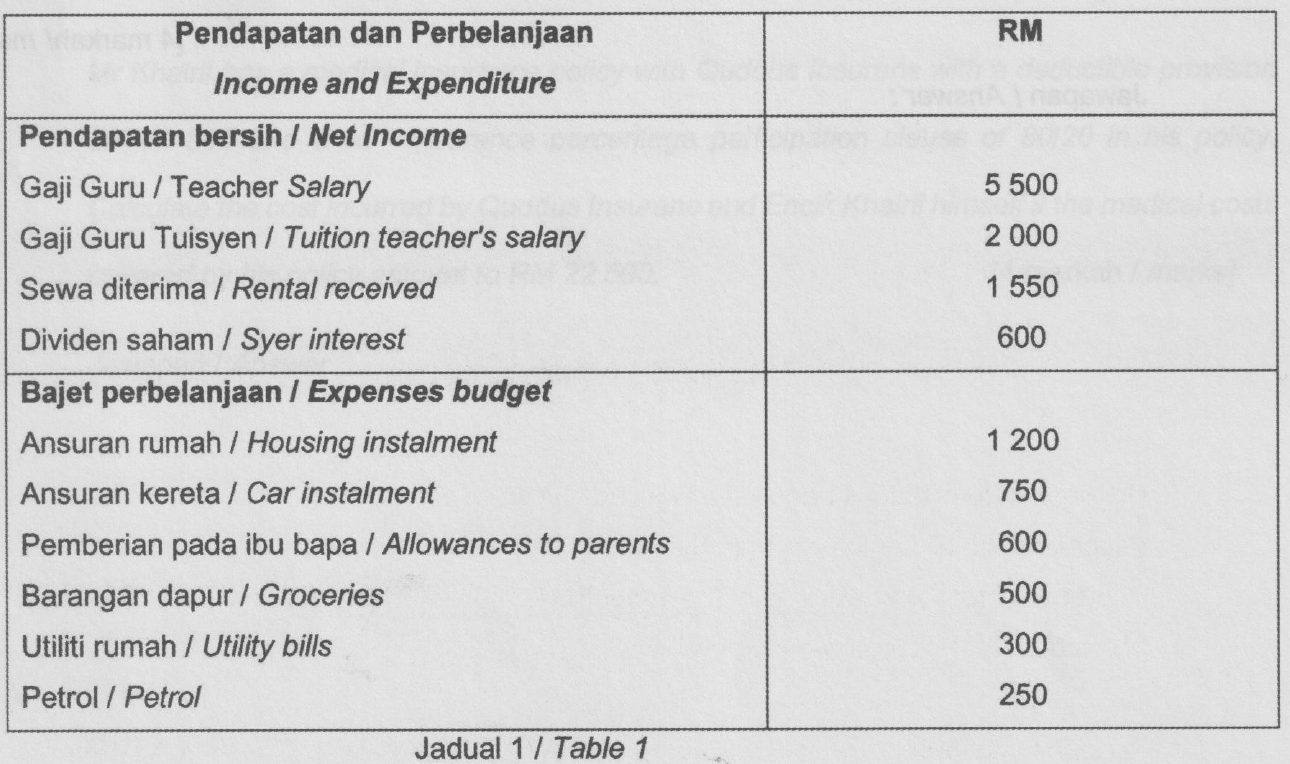
- (i)
Calculate the active income.
[1] - (ii)
Calculate the passive income.
[1] - (iii)
Calculate the fixed expenses.
[1] - (iv)
Calculate the variable expenses.
[1]
Draw a graph with multiple edges and loops according to the information provided. V = {A, B, C, D, E, F}; E = {(A,B), (A,C), (A,A), (B,C), (B,D), (B,E), (B,F), (C,D), (C,D), (D,E), (D,E), (E,F)}
Medium4 marksDraw the graph.
[4]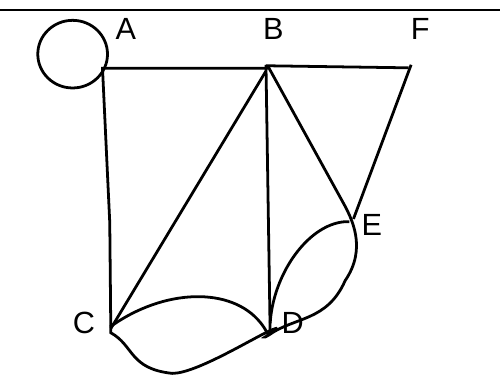
Mr Khairil has a medical insurance policy with Quddus Insurans with a deductible provision of RM800 and a co-insurance percentage participation clause of 80/20 in his policy. The medical costs covered by his policy amount to RM22 500.
Medium4 marksCalculate the cost incurred by Quddus Insurans and Encik Khairil himself.
[4]
Diagram 4 shows two right-angled triangles, ACE and DBE. BCE is a straight line and AE = DE = 8 cm (angle at A = 45°, angle at E = 30°, BC = x cm).
Medium4 marks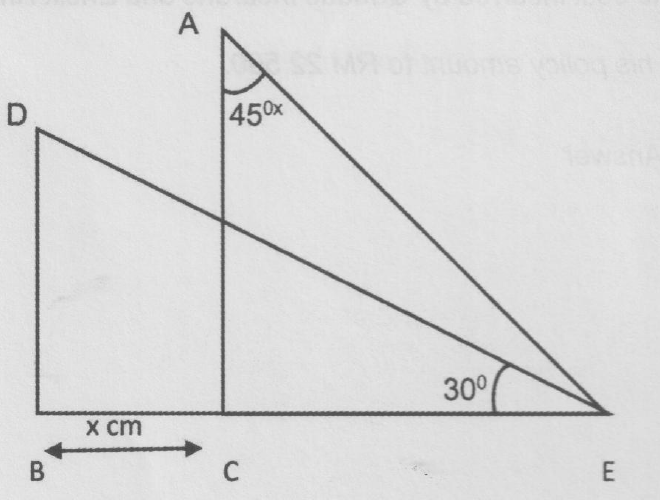
Calculate the value of x.
[4]
Section B
The mean for the set of numbers k, k + 4, k + 8, 3k − 4, 2k + 3, k − 1 and 4k is 7.
Medium8 marks- (a)
Find the value of k.
[3] - (b)
Find the interquartile range.
[2] - (c)
Find the standard deviation.
[3]
(a) Given M [[9, 3], [−8, −6]] = [[1, 0], [0, 1]]. (b) An H truck is capable of carrying x kg of sand and a T truck is capable of carrying y kg of sand. 8 H trucks and 6 T trucks are capable of carrying a total of 5 200 kg of sand at a time while 10 H lorries and 11 T lorries are capable of carrying 90% of the total 8 tons of sand.
Medium9 marks- (a)
Find matrix M.
[2] - (b)(i)
Write 2 linear equations that represent the above information.
[2] - (b)(ii)
Next using the matrix method, calculate the values of x and y.
[5]
Table 2 shows the speed and time of a particle in 10 seconds (the BM text prints 12 seconds). Speed (m s⁻¹): 0, 15, 15, 30. Time (s): 0, 2, 6, 10.
Medium9 marks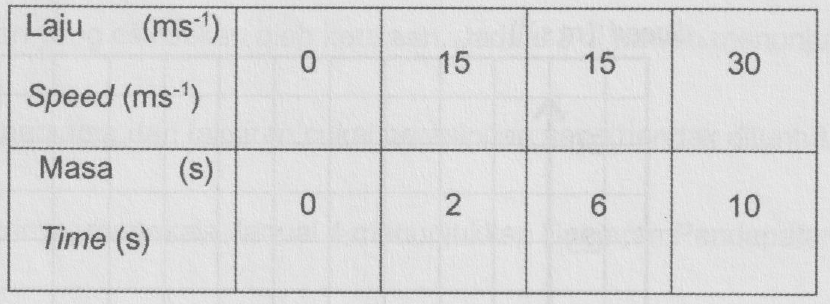
- (a)
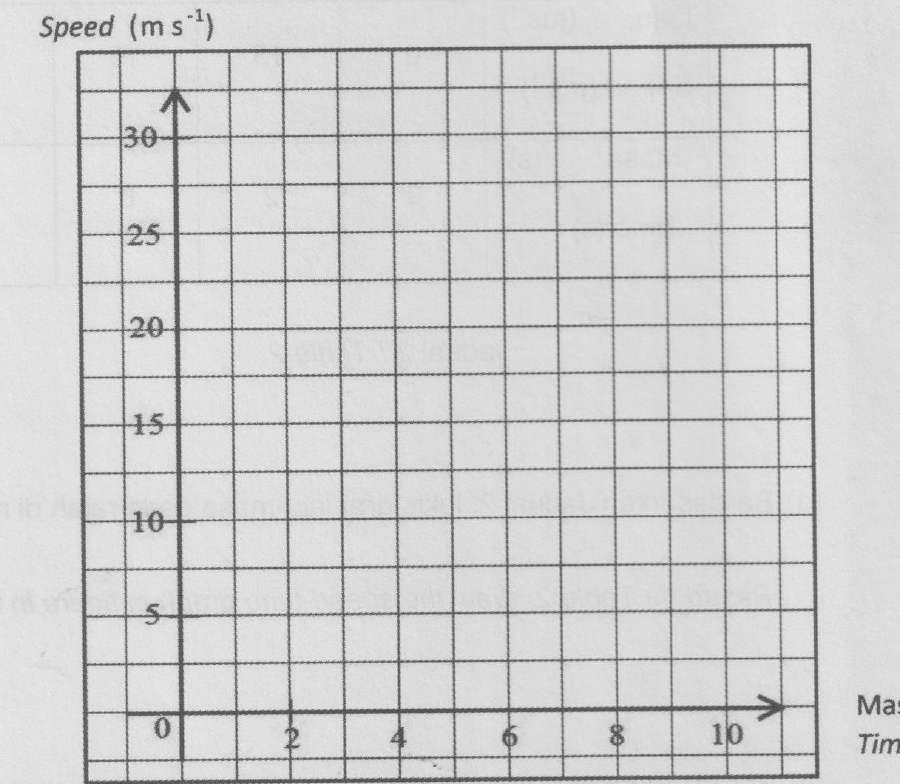
Based on Table 2, draw the speed-time graph in the figure in the answer space (grid: speed 0 to 30 m s⁻¹, time 0 to 10 s).
[2]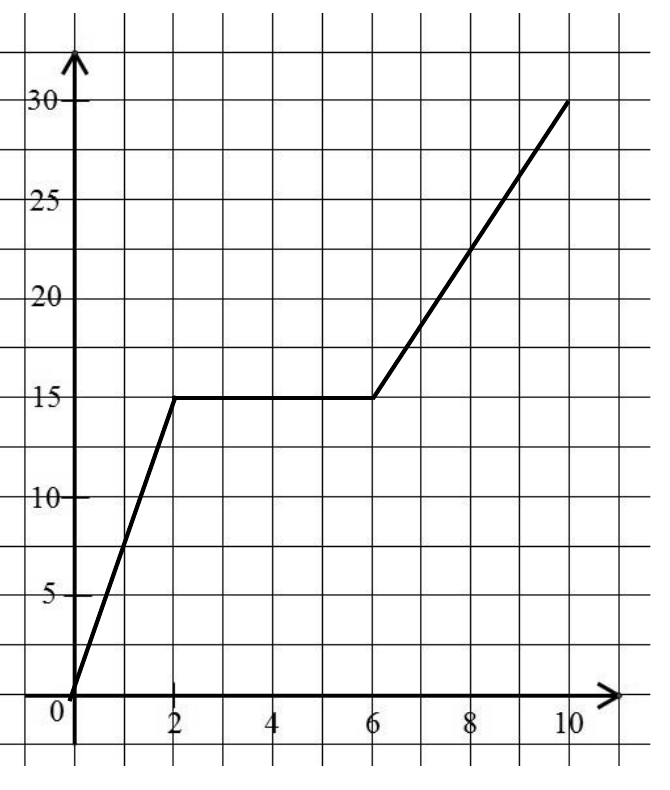
- (b)(i)
Based on the graph, state the uniform speed, in m s⁻¹, of the particle.
[1] - (b)(ii)
State the duration of time, in seconds, the particle moves in uniform speed.
[1] - (c)
Calculate the rate of change of speed, in m s⁻², for the last 4 seconds.
[2] - (d)
Calculate the average speed, in m s⁻¹, of the particle in the period of 10 seconds.
[3]
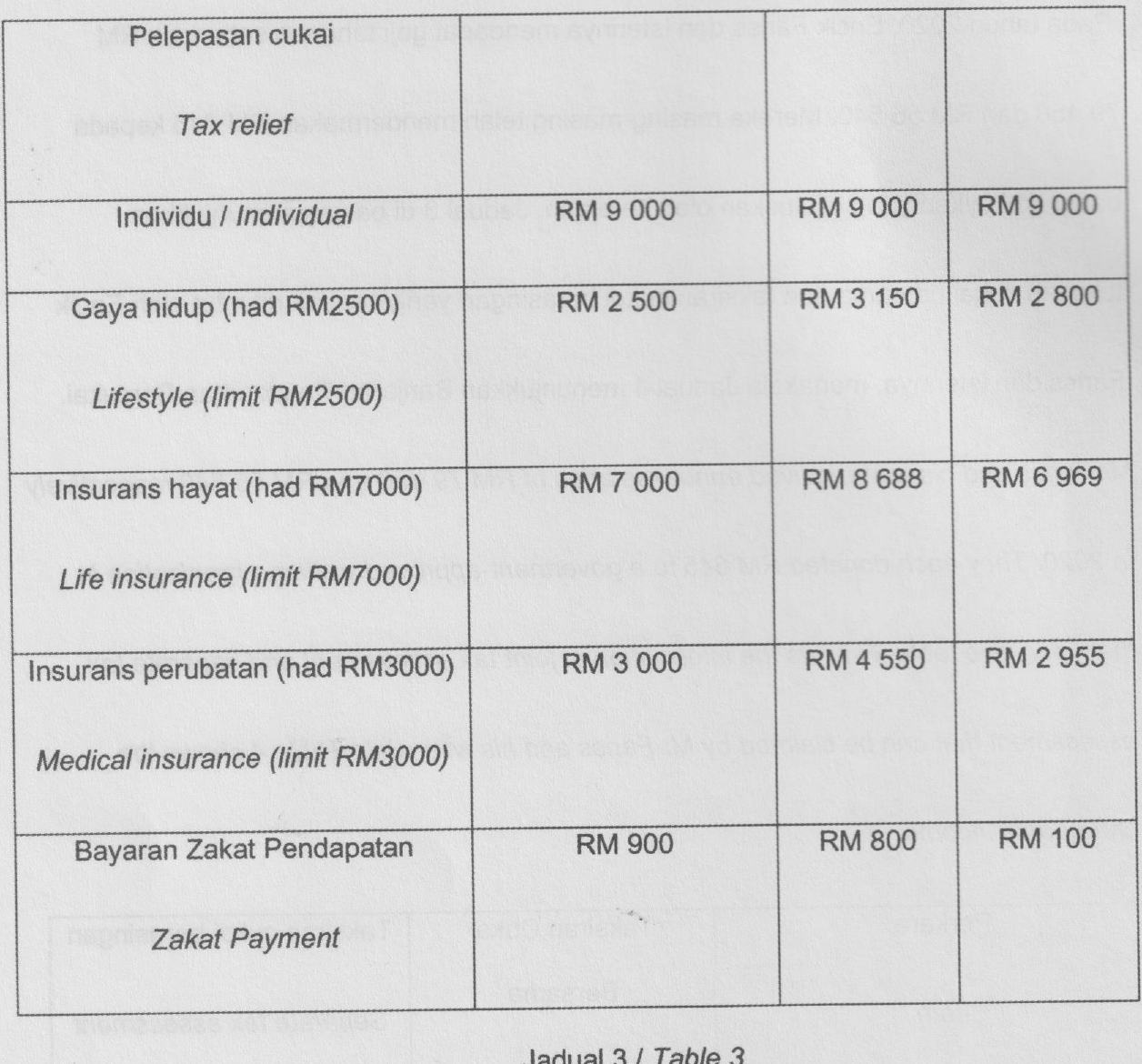
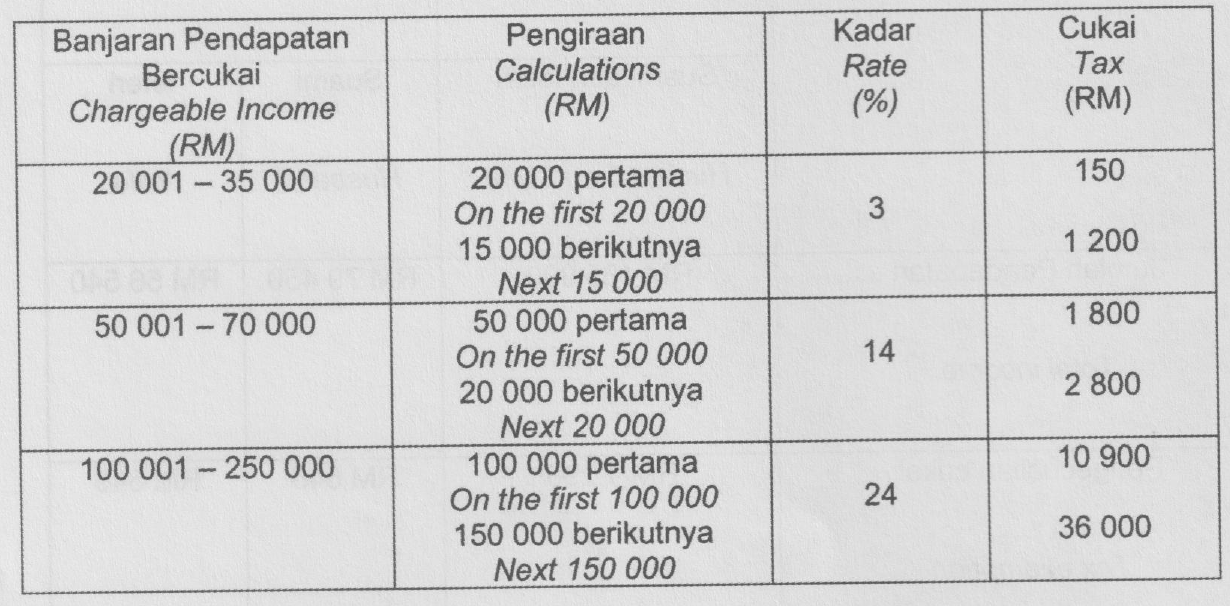
In 2020, Mr Fariss and his wife received annual salaries of RM79 450 and RM56 540 respectively. They each donated RM645 to a government-approved welfare organisation. Table 3 shows the information of joint tax assessment and separate tax assessment (Joint: total income RM135 990, tax exemption RM1 290, individual relief RM9 000, lifestyle RM2 500, life insurance RM7 000, medical insurance RM3 000, zakat RM900. Husband: income RM79 450, exemption RM645, individual RM9 000, lifestyle RM3 150, life insurance RM8 688, medical insurance RM4 550, zakat RM800. Wife: income RM56 540, exemption RM645, individual RM9 000, lifestyle RM2 800, life insurance RM6 969, medical insurance RM2 955, zakat RM100; reliefs are limited: lifestyle RM2 500, life insurance RM7 000, medical insurance RM3 000). Table 4 shows the chargeable income bands: 20 001 – 35 000: tax on first 20 000 is RM150, next 15 000 at 3% (RM1 200 for band top); 50 001 – 70 000: first 50 000 RM1 800, next 20 000 at 14% (RM2 800); 100 001 – 250 000: first 100 000 RM10 900, next 150 000 at 24% (RM36 000).
Medium10 marks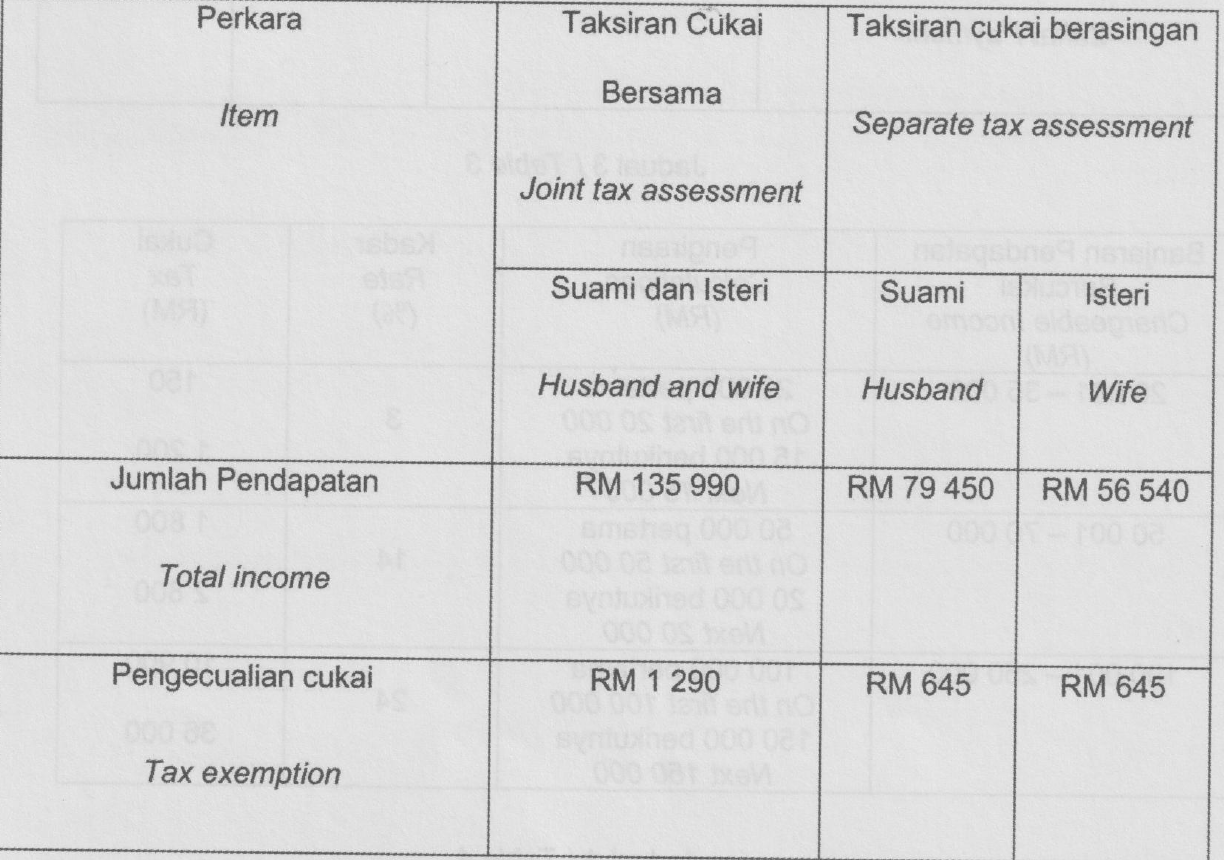
- (i)
Calculate the total income tax for Mr Fariss and his wife by using joint tax assessment and separate tax assessments.
[9] - (ii)
Next state between the joint tax assessment and the separate tax assessment, which is more suitable to be used by Mr Fariss and his wife.
[1]
Diagram 5 shows two trapeziums, PQRS and P′Q′R′S′. P′Q′R′S′ is the image of PQRS under combined transformation AB.
Medium9 marks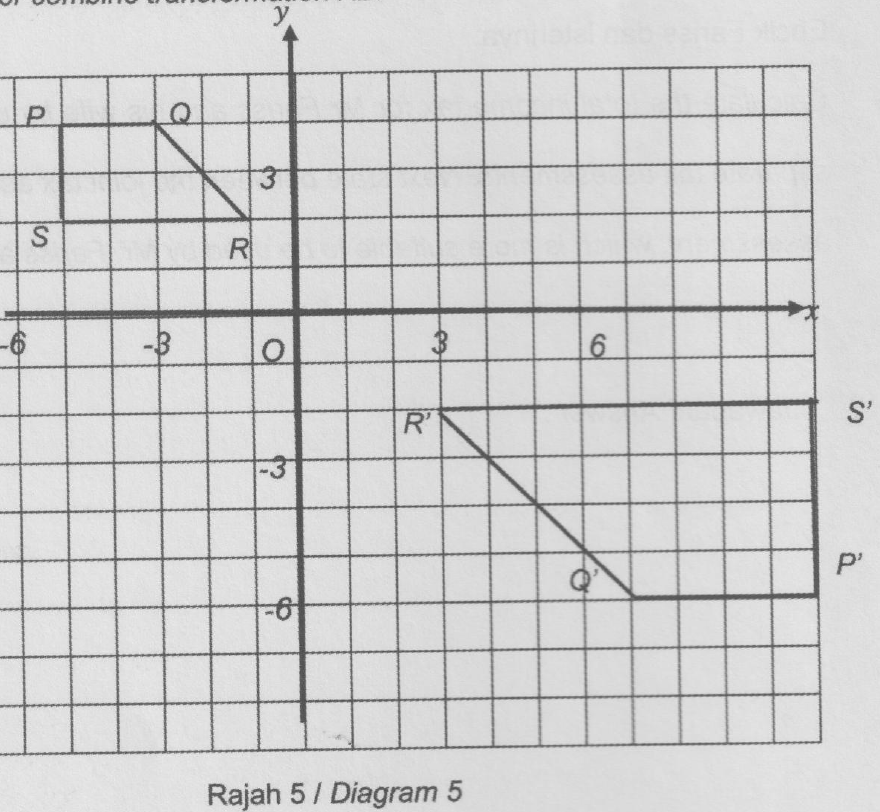
- (a)(A)
Describe transformation A.
[3] - (a)(B)
Describe transformation B.
[3] - (b)
Given that the area of trapezium PQRS is 20 unit², calculate the area of trapezium P′Q′R′S′ in unit².
[3]
Section C
Diagram 6 shows the position of the swimming pool, fish pond and house of Mrs. Halina and her two children, Hazeq and Haqq. The built-up swimming pool is equidistant between the three houses of Mrs. Halina, Haqq and Hazeq. Coordinates: Mrs. Halina's house (2, 4); Haqq's house (−6, −2); Hazeq's house (2, y); fish pond (x, 7). Answer only one question from Section C.
Medium15 marks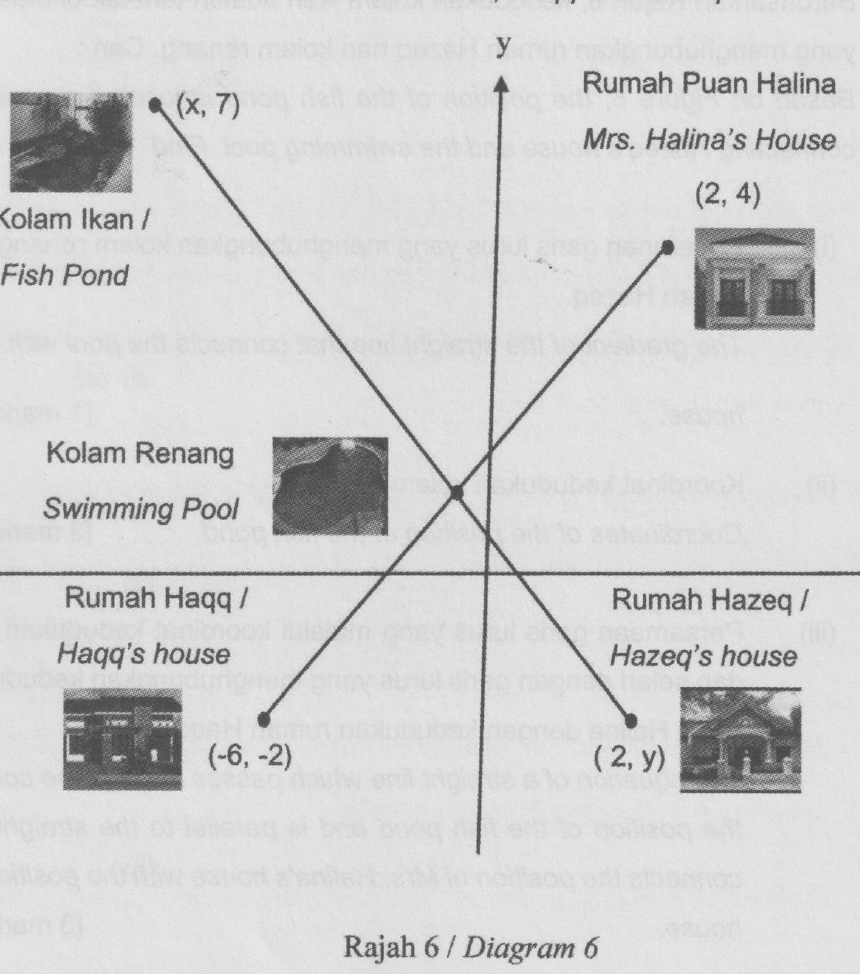
- (a)(i)
Find the coordinates of the position of the pool.
[2] - (a)(ii)
Calculate the distance between Haqq's house and the pool.
[2] - (a)(iii)
Find the coordinates of Hazeq's house position.
[4] - (b)(i)
The position of the fish pond is on the straight line connecting Hazeq's house and the swimming pool. Find the gradient of the straight line that connects the pool with Hazeq's house.
[1] - (b)(ii)
Find the coordinates of the position of the fish pond.
[3] - (b)(iii)
Find the equation of the straight line which passes through the coordinates of the position of the fish pond and is parallel to the straight line which connects the position of Mrs. Halina's house with the position of Haqq's house.
[3]
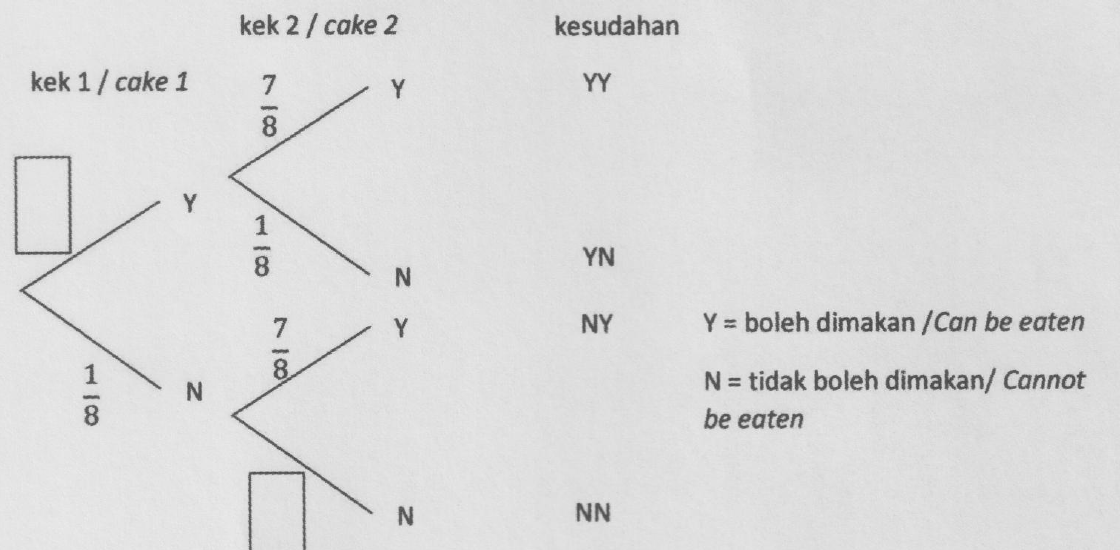
(a) Diagram 7.1 shows the shape of the cake that Cikgu Alam wants to order. The two-tiered cake consists of a combination of a cuboid (27 cm high, 36 cm by 30 cm) and a cylinder with a radius of 14 cm. The total volume of the cake in Figure 7.1 is 34 998 cm³. Cikgu Alam then wants to change the cylindrical cake to a cube-shaped cake as in Figure 7.2 without changing the original volume of the cake. [use π = 22/7] (b) Cikgu Alam decides to order a cake as shown in Figure 7.2. During the ceremony, Cikgu Alam cut the first part of the cube-shaped cake. The remainder of the cake after the first cut is shown in Figure 7.3. The edges of RK and SL are perpendicular. Given GF = ML = 12 cm. (c) The probability that the ordered cake cannot be eaten after a week is 1/8. Two cakes are chosen at random. Answer only one question from Section C.
Hard15 marks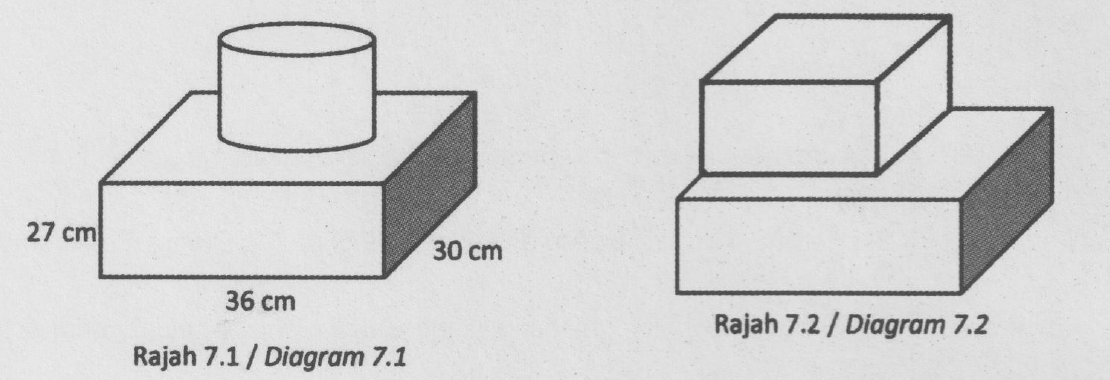
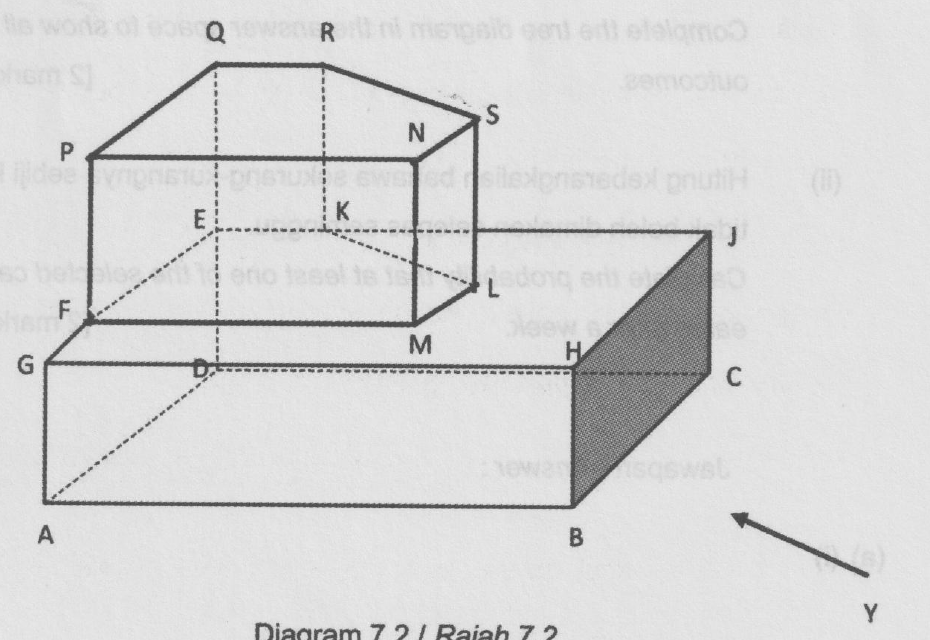
- (a)(i)
Calculate the height, in cm, of the cylindrical cake in Figure 7.1. Round the correct answer to 3 significant figures.
[4] - (a)(ii)
Calculate the length, in cm, of the sides of the cube-shaped cake. Round off the correct answer to 2 significant figures.
[3] - (b)
Using a scale of 1 : 3, draw the elevation of the remaining cake on a vertical plane parallel to BC, as viewed from Y.
[4]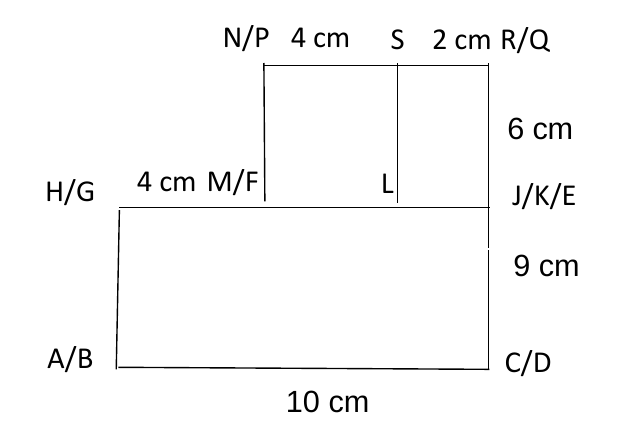
- (c)(i)
Complete the tree diagram in the answer space to show all possible outcomes (Y = can be eaten, N = cannot be eaten).
[2] - (c)(ii)
Calculate the probability that at least one of the selected cakes cannot be eaten after a week.
[2]