Write your answer on paper. Then open the answer to check it.
Section A
Write four linear inequalities that represent the shaded region in Diagram 1. (Lines: y = −5x + 5 solid, y = 6 − x dashed, y = x dashed, x-axis solid.)
Medium4 marks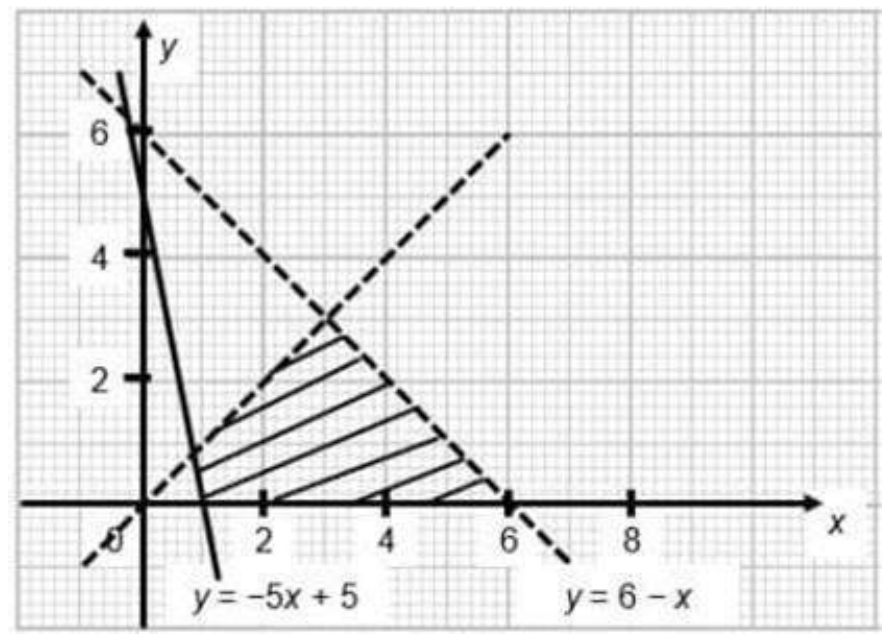
- I
Inequality I
[1] - II
Inequality II
[1] - III
Inequality III
[1] - IV
Inequality IV
[1]
Diagram 2 shows a pizza with an area of 346.5 cm² equally cut into 6 slices. Use π = 22/7.
Medium4 marks
- (a)
Find the radius, in cm, of the pizza.
[2] - (b)
Hence, find the perimeter, in cm, of a slice of pizza.
[2]
Question about the line 3x + 2y − 6 = 0.
Medium4 marks- (a)
Write the equation 3x + 2y − 6 = 0 in the form y = mx + c.
[1] - (b)
Next, find the equation of the straight line which is parallel to 3x + 2y − 6 = 0 and passes through the point (−4, 5).
[3]
A set of data consists of 9, 2, 7, x² − 1 and 4. Given the mean is 6. Find:
Medium4 marks- (a)
the positive value of x.
[3] - (b)
the median using the value of x in (a).
[1]
Arul used 30 minutes to read a book that has 20 pages. The time taken, t, for Arul to read a book is directly proportional to the square root of the number of pages, h, in the book.
Medium4 marks- (a)
Write the relation between the time, t, and page, h, with the symbol ∝.
[1] - (b)
How much time does Arul need to read a book with 80 pages?
[3]
Solve the simultaneous linear equations below using the matrix method: 3x + 2y = 4; 9x + 4y = 14.
Medium4 marksSolve the simultaneous equations using matrices.
[4]
Madam Aminah has a major medical insurance policy with a deductible provision of RM500 and a 75/25 co-insurance percentage participation clause in her policy. Calculate the cost borne by the insurance company and Madam Aminah herself if the medical cost covered by her policy is RM20 800.
Medium4 marksCalculate the cost borne by the insurance company and by Madam Aminah.
[4]
Mr Idris works as a private teacher. He receives an income of RM4 500 a month. He also teaches tuition classes and earns RM1 000. Mr Idris also rents out his house for RM750 a month. Mr Idris has fixed expenses of RM1 500 and variable expenses of RM900 per month. Calculate Mr Idris' monthly cash flow. Explain your answer.
Medium4 marksCalculate the monthly cash flow and explain.
[4]
Two magazines are chosen at random from a rack consisting of 4 travel magazines and 6 health magazines. Calculate the probability of getting both health magazines such that
Medium4 marks- (a)
the first magazine is replaced before choosing the second magazine.
[2] - (b)
the first magazine is not replaced before choosing the second magazine.
[2]
Question on y = 2 cos x for 0° ≤ x ≤ 360°.
Medium4 marks- (a)
Sketch the graph of y = 2 cos x for 0° ≤ x ≤ 360°.
[3] - (b)
Hence, determine the minimum value for the graph.
[1]
Section B
Questions on statements, compound statements, deductive and inductive reasoning.
Medium9 marks- (a)
Determine whether the sentence below is a statement or non-statement. Explain your justification. 'Each cylinder has two curved surfaces.'
[2] - (b)
State whether the compound statement is true or false: 90 × 80% = 70 or 8 × 8 × 8 = 324
[1] - (c)
Complete the following argument to form a valid and sound deductive argument. Premise 1: …… Premise 2: m < 12 Conclusion: m + 3 > 2m − 9
[1] - (d)
Determine the contrapositive for the implication: If 2 × 3 = 6, then 8 − 2 × 3 = 18.
[1] - (e)
Given the surface area of a cone is πj(j + s). Construct a deductive conclusion for the surface area of five cones with j = 7 cm and s = 13 cm. Keep your final answer in π.
[2] - (f)
Construct an inductive conclusion to the number pattern 3, 8, 17, 30, … given 3 = 3(1) + 2(0)², 8 = 3(2) + 2(1)², 17 = 3(3) + 2(2)², 30 = 3(4) + 2(3)² (as printed in the paper).
[2]
Questions on a simple graph (Diagram 12.1) and a directed weighted graph of flights (Diagram 12.2).
Medium9 marks- (a)(i)
Based on the simple graph in Diagram 12.1, determine the set of vertices, V, and n(V).
[2]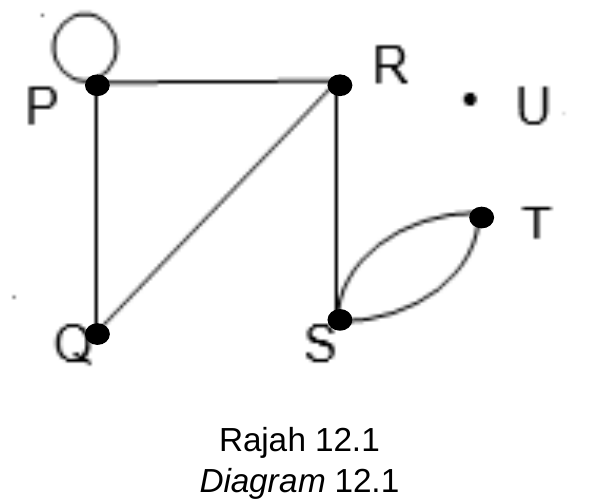
- (a)(ii)
the set of edges, E, and n(E).
[2] - (a)(iii)
the number of degree.
[1] - (b)(i)(a)
Diagram 12.2 shows ticket fees and travel times for flights from P to S via transit airports Q and R (transit time 45 minutes at each airport). State the cheapest route.
[1]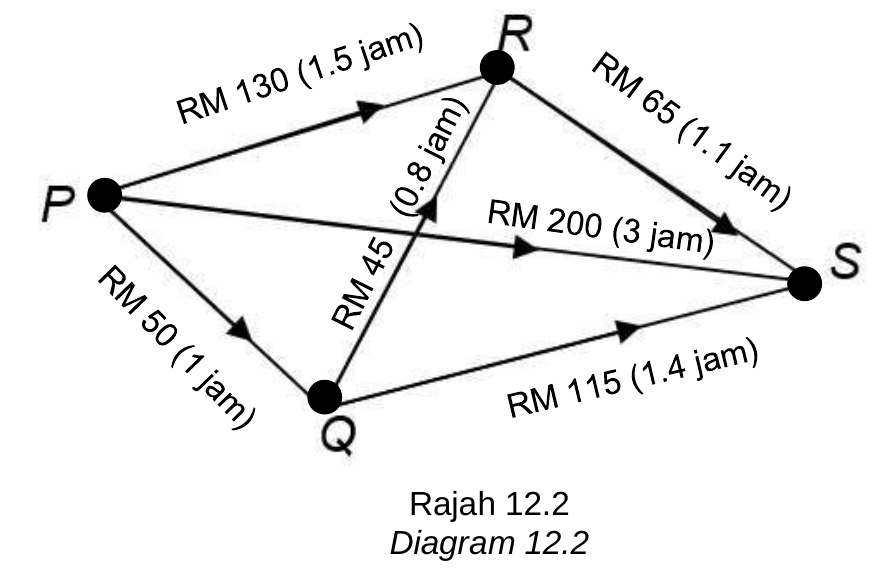
- (b)(i)(b)
State the route that takes the shortest travel time.
[1] - (b)(ii)
If you need to get to the destination with optimal cost, specify the route you choose. Explain your justification.
[2]
Mr Halim, single, works as a clerk. His monthly income is RM4 200. He wants to calculate his income tax for the Assessment Year 2020. Table 13.1 (tax relief): Individual RM9 000; Lifestyle (limit RM5 000) RM3 500; Life insurance and EPF (limit RM7 000) RM7 800; Medical and education insurance (limit RM3 000) RM2 650; Socso (limit RM250) RM125. In the same year: I: bonus RM2 100 at year end. II: donated RM150 to an IRB-approved welfare centre. III: paid zakat RM30. IV: Monthly Tax Deduction (PCB) RM18.50. Table 13.2: on the first RM20 000 tax RM150; next RM15 000 (chargeable income RM20 001 – 35 000) at 3% = RM450. Note: tax rebate RM400 if chargeable income does not exceed RM35 000.
Medium8 marks- (a)
Calculate Mr Halim's chargeable income.
[2] - (b)
Based on Table 13.2, calculate the income tax to be paid by Mr Halim.
[3] - (c)
Does Mr Halim need to pay any additional income tax, or will he receive excess deduction of PCB refunded by IRB? Explain your answer.
[3]
Questions on a translation (Diagram 14.1) and combined transformation UV on a map (Diagram 14.2).
Medium10 marks- (a)
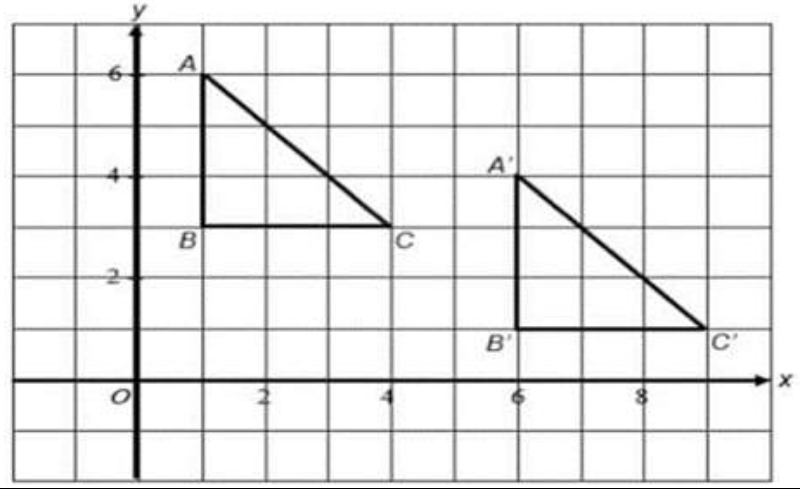
Diagram 14.1 shows triangle ABC drawn on a Cartesian plane: A(1, 6), B(1, 3), C(4, 3). Draw the image of triangle ABC under the translation (5, −2) (column vector: 5 right, 2 down).
[1]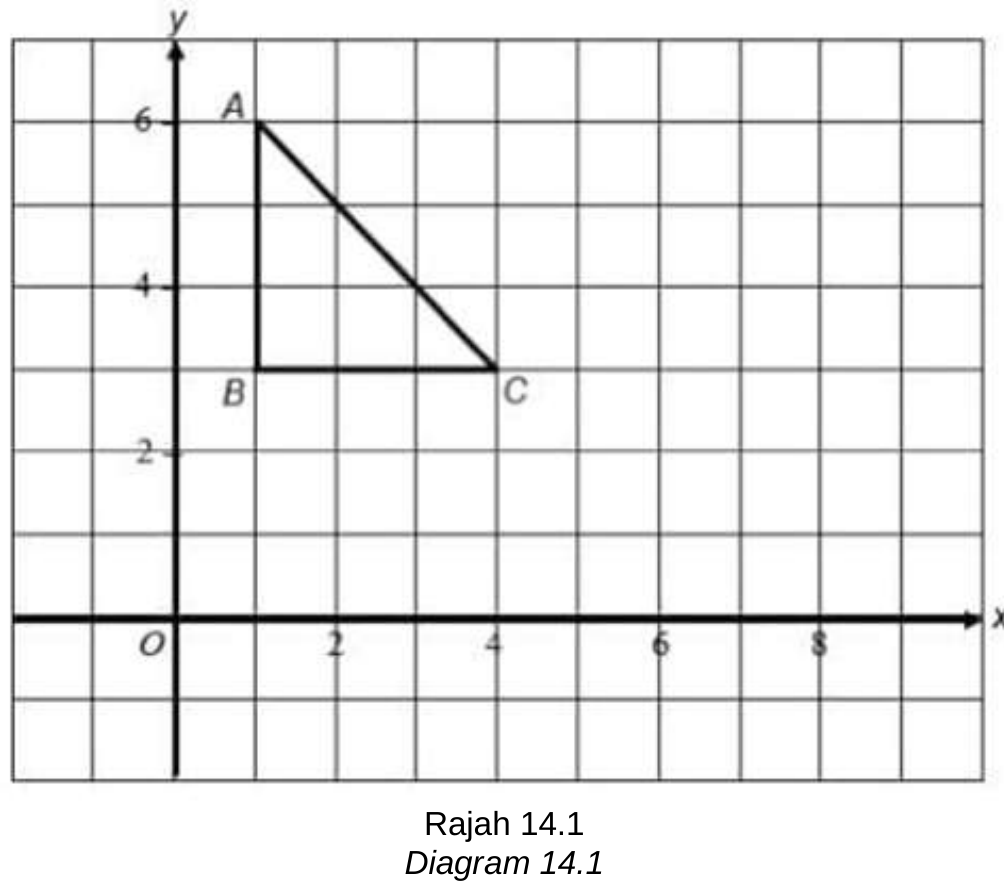
- (b)(i)(a)
Diagram 14.2 shows the map of a tropical forest. The coloured region is the habitat of a group of wildlife. Quadrilateral regions A (DEFG) and B (HJKL) are observatories. MNKP is the image of DEFG under the combined transformation UV. Describe in full the transformation U.
[3]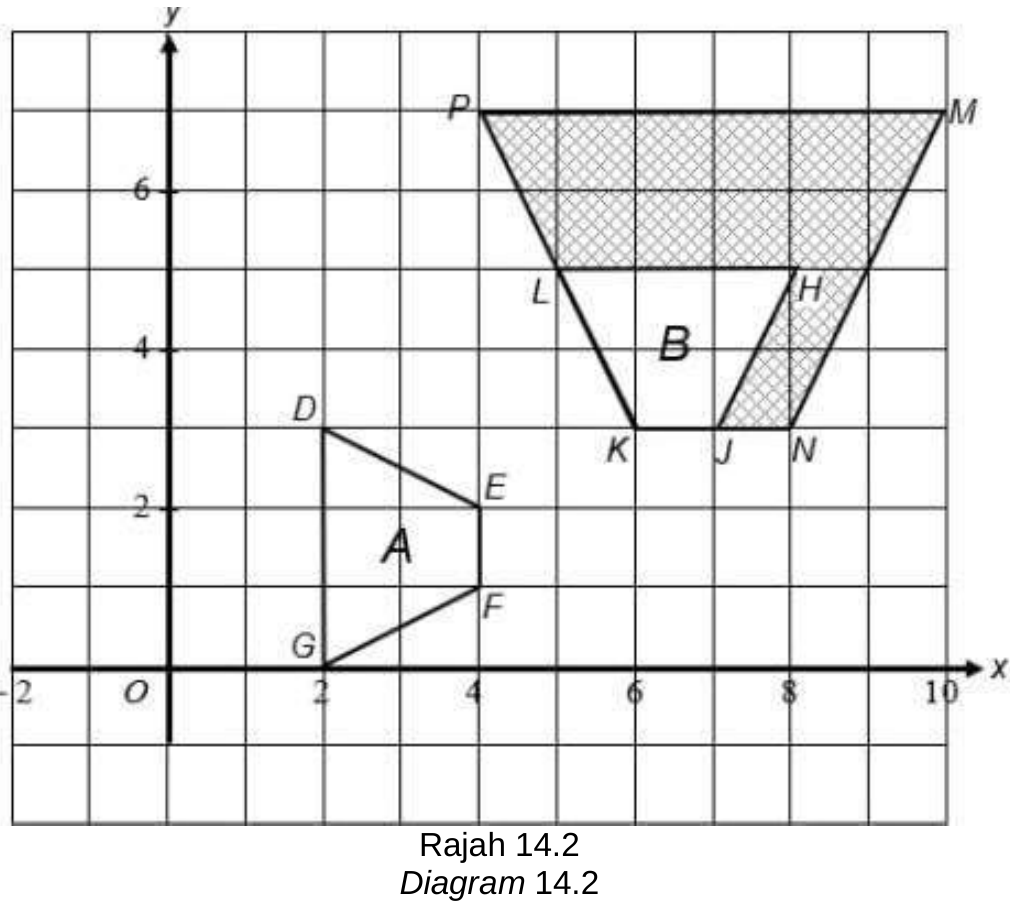
- (b)(i)(b)
Describe in full the transformation V.
[3] - (b)(ii)
Given that the area of A is 60 m², calculate the area, in m², of the wildlife region.
[3]
The distance between Town A and town B is 26 km. A cyclist, Jamil, leaves town A at 1300 hours and pedals at a speed of 16 km h⁻¹ for 1 hour 15 minutes. Then he rests until 1500 hours and continues his journey at a constant speed v km h⁻¹ and arrives in town B at 1530 hours.
Medium9 marks- (a)
Calculate the value of v.
[3] - (b)
Calculate the average speed, in km h⁻¹, for the whole journey.
[2] - (c)(i)
Complete Diagram 15 in the answer space to represent Jamil's whole journey. (Diagram: distance (km) against time; the first segment from 1300 is already drawn.)
[2]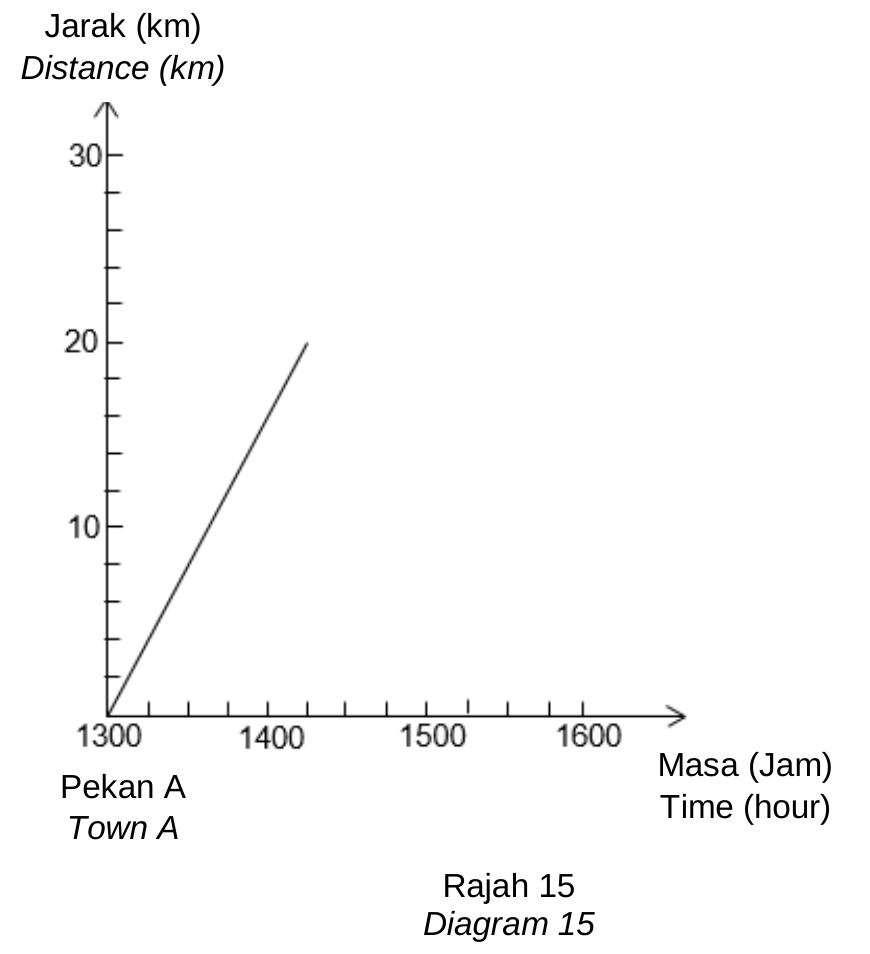
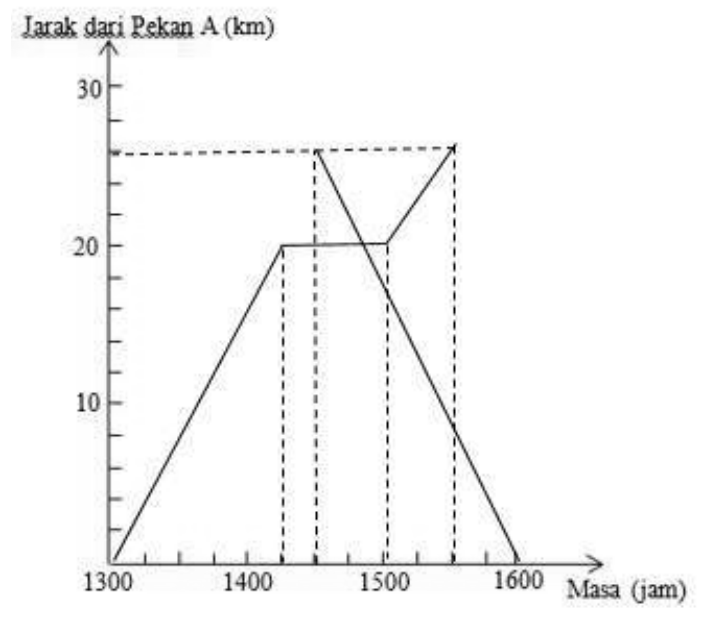
- (c)(ii)
A lorry leaves town B at 1430 hours and moves to town A at a constant speed of 17⅓ km h⁻¹. Draw a distance-time graph representing the journey of the lorry on the same axes.
[2]
Section C
Answer one question in Section C. Khusairi plans to build a model with a floor plan and a combined solid.
Hard15 marks- (a)
Khusairi planned to build a model with a floor plan as in Diagram 16.1 (rectangle PQRS with a semicircle on side RS). Given the length of PS is 2 cm longer than PQ and the total area of the floor plan is 62 1/7 cm² (62 1/7 = 435/7), calculate the length of PQ.
[5]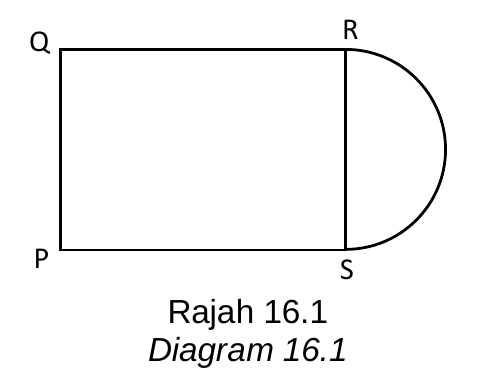
- (b)(i)
Diagram 16.2 shows a right prism with rectangular base PQRS on a horizontal plane. The surface SPTWML is its uniform cross-section. The rectangle MJKL is an inclined plane. The rectangle TUVW is a horizontal plane. The edges PT, QU, SL, RK, WM and VJ are vertical edges. Given TW = UV = 3 cm (PT = 3 cm, WM = 5 cm, SL = 4 cm). A half-cylinder is joined to the solid at the plane RSLK to form the combined solid. Using the value from 16(a), calculate the volume of the combined solid.
[5]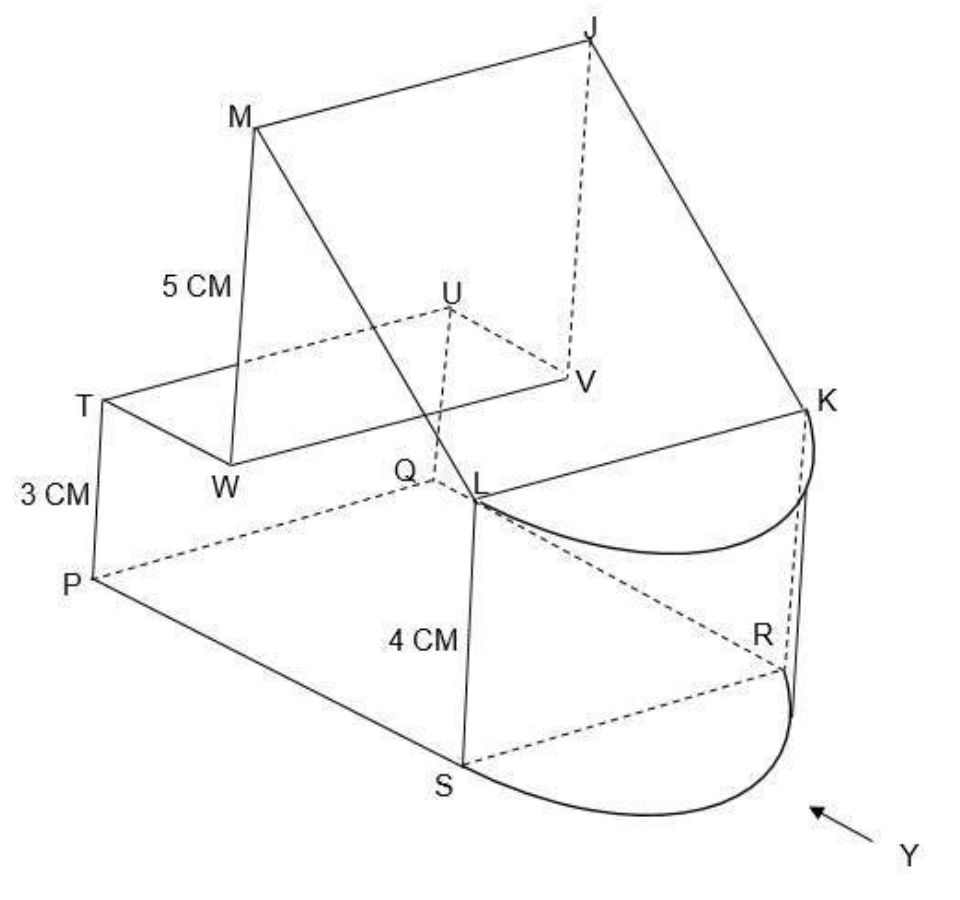
- (b)(ii)
Draw in full scale the elevation of the solid on a vertical plane parallel to SR as viewed from Y.
[5]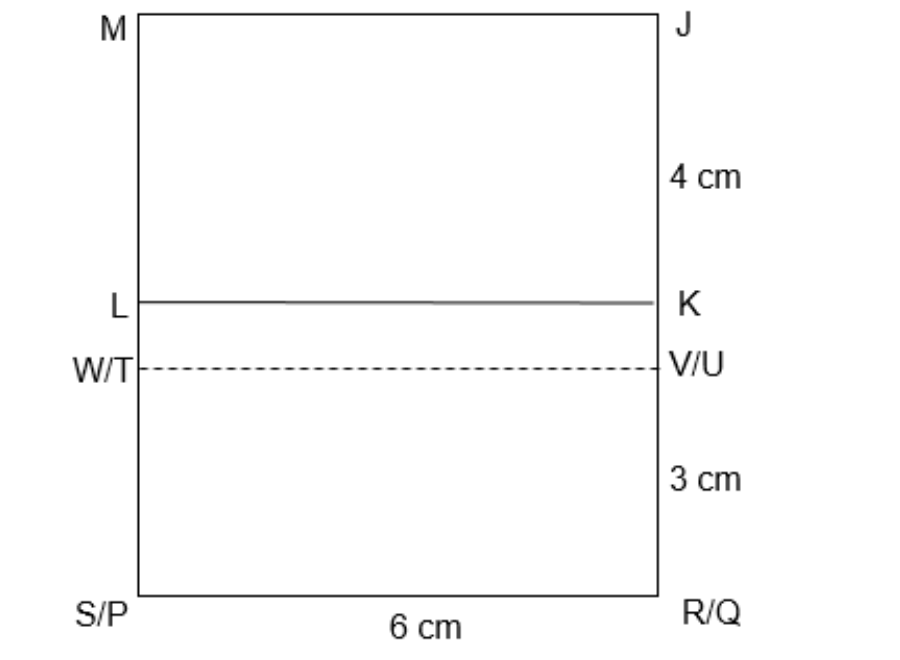
Answer one question in Section C. A study was conducted on 200 buyers at Sheng Light Company about brands X, Y and Z of bulbs.
Medium15 marks- (a)(i)
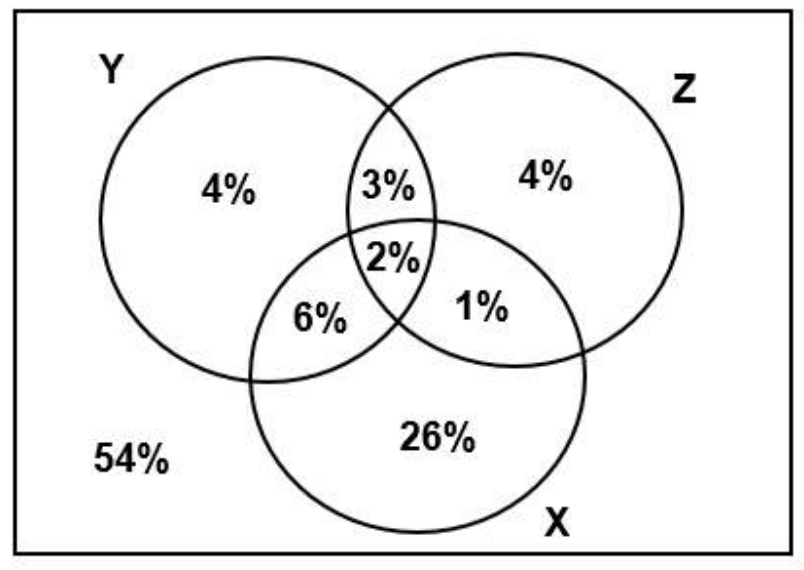
35% of buyers buy X brand bulbs, 15% buy Y and 10% buy Z. Of that number, 8% buy X and Y, 5% buy Y and Z and 3% buy X and Z while 2% buy all three bulbs. Complete the Venn diagram in Diagram 17 to show the relationship between the sets X, Y and Z (the 3% and 2% regions are already shown).
[2]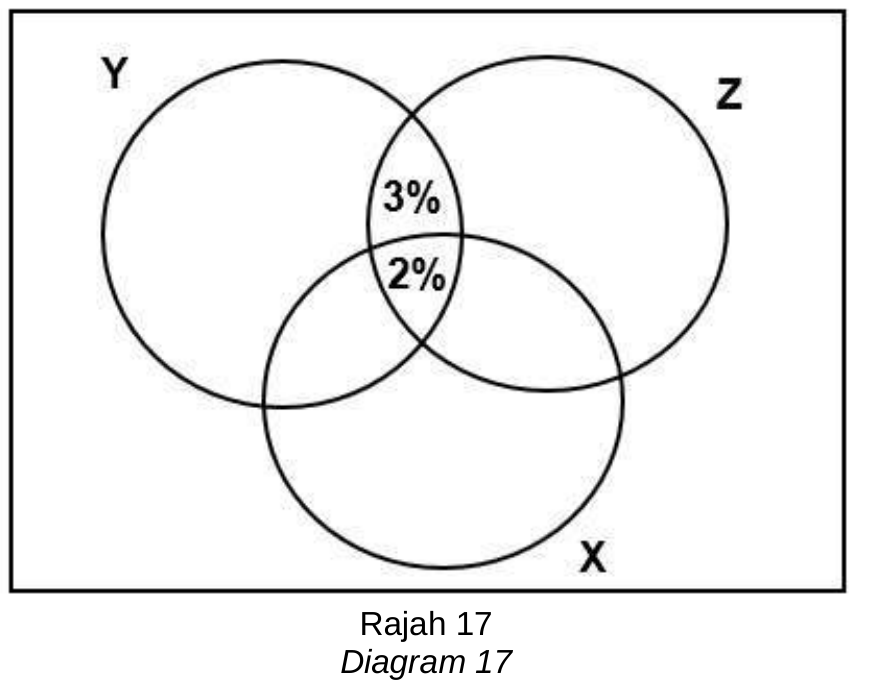
- (a)(ii)
Find the number of buyers who bought X brand bulbs only.
[1] - (a)(iii)
Find the number of buyers who did not buy X, Y or Z brand bulbs.
[1] - (a)(iv)
Find the number of buyers, n(Y ∪ Z ∩ X′).
[1] - (b)
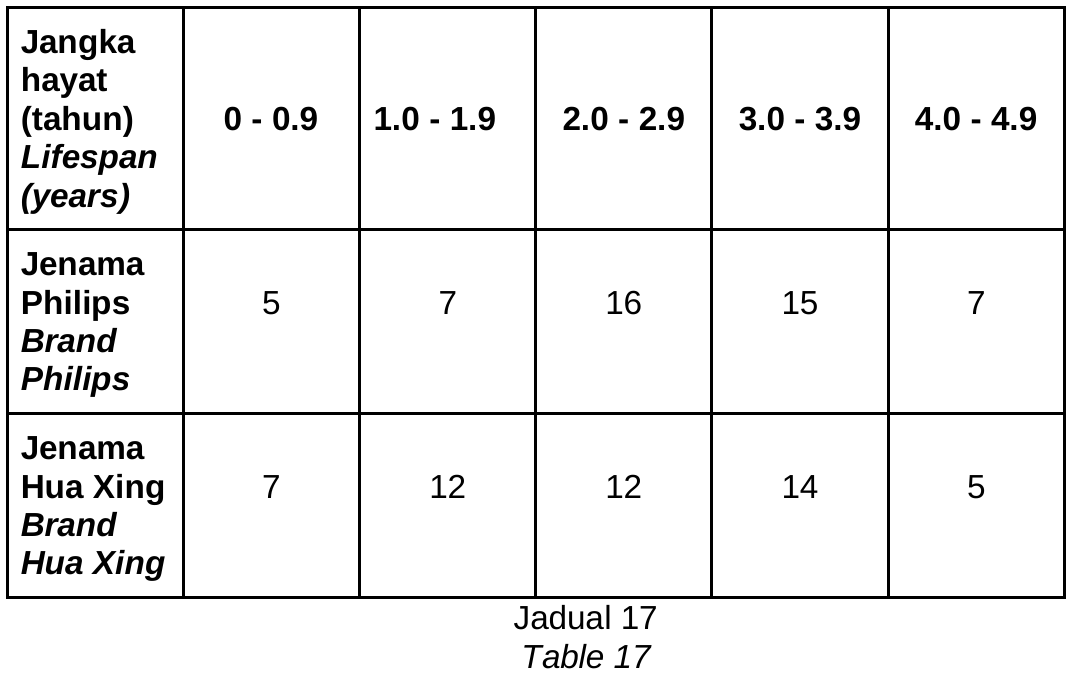
Table 17 shows the lifespan (years) of two new brands of bulbs. Lifespan 0–0.9, 1.0–1.9, 2.0–2.9, 3.0–3.9, 4.0–4.9. Brand Philips frequency: 5, 7, 16, 15, 7. Brand Hua Xing frequency: 7, 12, 12, 14, 5. By using suitable measures, determine which brand of light bulb is better and long-lasting before being marketed for sale. Justify your answer using suitable measures.
[10]