Write your answer on paper. Then open the answer to check it.
Section A
Solve the quadratic equation (5m² − 8)/(10m) = 3/5.
Medium4 marksSolve the quadratic equation (5m² − 8)/(10m) = 3/5.
[4]
Table 2 shows the distribution of mass, in kg, of a group of objects: 10 − 14 (frequency p), 15 − 19 (4), 20 − 24 (6), 25 − 29 (8), 30 − 34 (9). Find the value of p if the mean of an object is 24 2/3.
Medium4 marks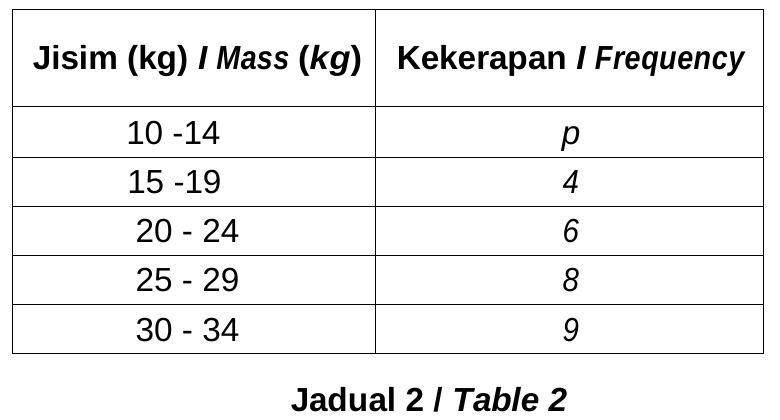
Find the value of p if the mean of an object is 24 2/3.
[4]
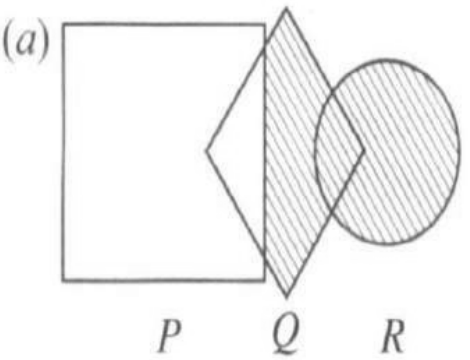
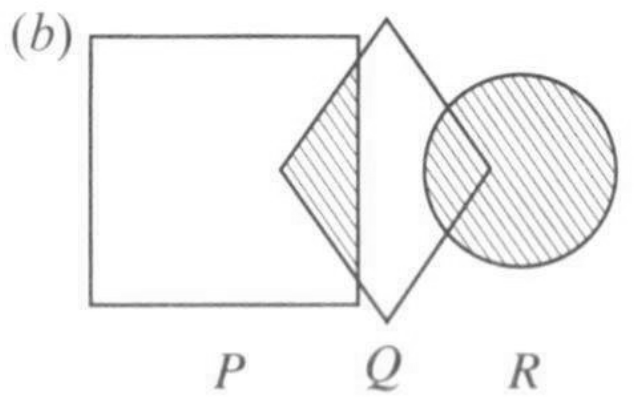
The Venn diagram in the answer space shows set P, set Q and set R such that the universal set ξ = P ∪ Q ∪ R. On the diagram, shade the set (a) P′ and (b) (P ∩ Q) ∪ R.
Medium3 marks- (a)
Shade the set P′.
[1]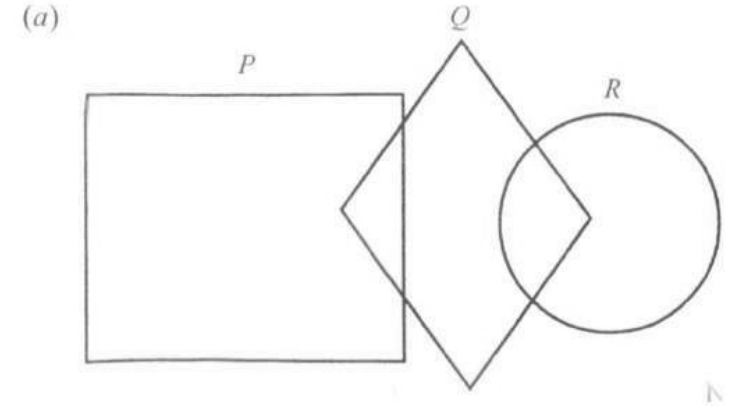
- (b)
Shade the set (P ∩ Q) ∪ R.
[2]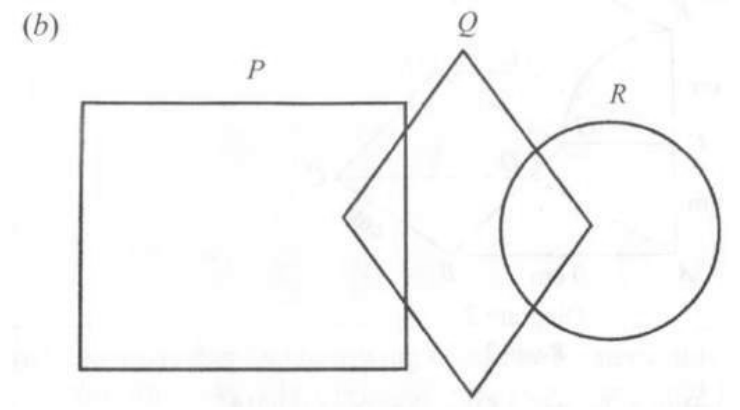
Solving using matrix method is not allowed in this question. In a factory, the number of staff in the processing department exceeds the number of staff in the technical department by 24. The factory manager supplied three T-shirts to each processing staff and two T-shirts to each technical staff. The total number of T-shirts supplied is 222. Calculate the number of processing staff and the number of technical staff.
Medium4 marksCalculate the number of processing staff and the number of technical staff.
[4]
A kindergarten buys x tables and y chairs. A table costs RM60 and a chair RM15. Constraints: I the total number of furniture is at most 75; II the total allocation is at least RM600; III the ratio of number of chairs to number of tables is not less than 1 : 2. Write three inequalities, other than x ≥ 0 and y ≥ 0, which satisfy the constraints.
Medium3 marksWrite three inequalities, other than x ≥ 0 and y ≥ 0, which satisfy the three constraints.
[3]
Transformation K is a translation (4, −2) (column vector). Transformation L is an anticlockwise rotation of 90° about the centre (−2, 1). Find the coordinates of the image of point (−6, −1) under (i) L², (ii) LK.
Medium4 marks- (i)
Find the image of (−6, −1) under L².
[2] - (ii)
Find the image of (−6, −1) under LK.
[2]
Diagram 7 shows a cylinder with the height of 12 cm. A cone with radius 3 cm of the same height is removed from the cylinder. Calculate the volume of the remaining solid. (Use π = 22/7.)
Medium4 marks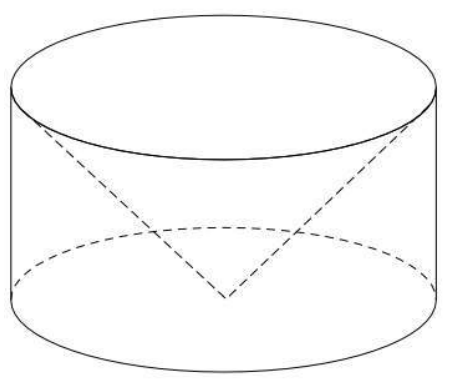
Calculate the volume of the remaining solid.
[4]
Diagram 8 shows a parallelogram ABCD drawn on a Cartesian plane, with D at the origin, C on the x-axis and B(8, 6). A is on the same horizontal line as B. The equation of the straight line AD is 2y − 3x = 0. Find (a) the coordinates of A, (b) the equation of the straight line BC.
Medium5 marks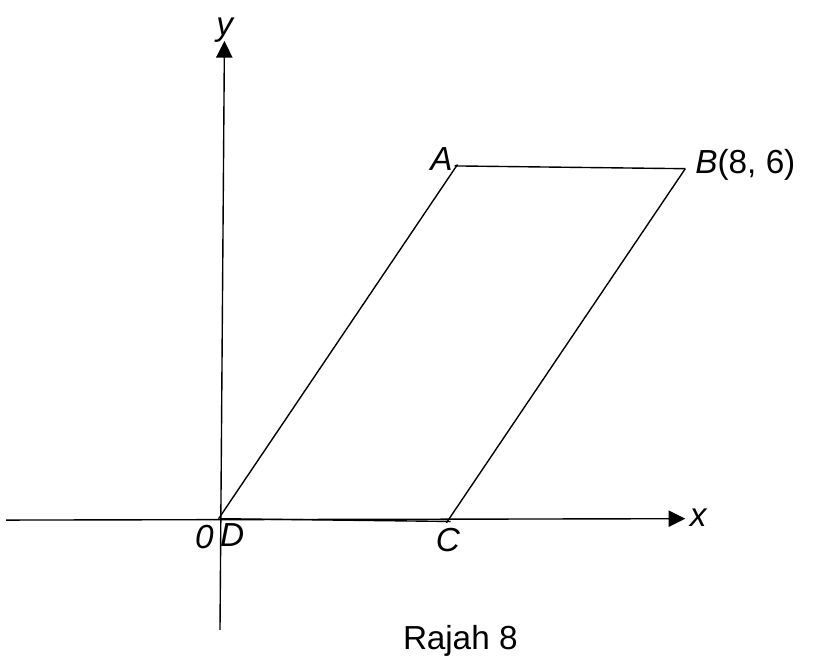
- (a)
Find the coordinates of A.
[2] - (b)
Find the equation of the straight line BC.
[3]
Encik Nathan wants to buy fire insurance for his house. The insurable value is RM300 000. The policy by ZY Insurance Sdn. Bhd. has co-insurance 80% and deductible RM3 000. (a) Calculate the amount of insurance he needs to buy. (b) Calculate the compensation he receives if he insured the house for RM180 000 and the house caught fire with a loss of RM70 000.
Medium4 marks- (a)
Calculate the amount of insurance he needs to buy.
[1] - (b)
Calculate the compensation he will receive.
[3]
(a) Write two implications for: 5k² + k = 252 if and only if k = 7. (b) Complete the argument. Premise 1: All parallel lines have the same gradient. Premise 2: KL and MN are parallel lines. Conclusion: ... (c) Make a general conclusion by induction for the pattern 5 = 3(2)¹ − 1, 10 = 3(2)² − 2, 21 = 3(2)³ − 3, ...
Medium5 marks- (a)
Write two implications for the statement: 5k² + k = 252 if and only if k = 7.
[2] - (b)
Write the conclusion to complete the argument.
[1] - (c)
Make a general conclusion by induction.
[2]
Section B
Diagram 11 shows the distance-time graph of two cars. Graph PQRS is Kumar's car, from Town A, and graph TU is Sinchan's car, from Town B. Both leave at 1130 along the same route. In the graph, P is at the origin, Q = (1.5, 120), R = (3.0, 120), S = (5.0, h), T = (0, h), U = (4.0, 0). (a) (i) State the duration, in minutes, when Kumar's car is at rest. (ii) The rate of change in distance of Kumar's car for the last 2 hours is 90 km h⁻¹. Calculate h. (iii) Calculate the distance, in km, from Town B when the two vehicles meet. (iv) At what time, in the 24-hour system, do the two vehicles meet? (b) Van P moves at the speed of Kumar's car for the first 1.5 hours. Van Q moves at the speed of Sinchan's car. Which van moves faster? Justify your answer.
Medium10 marks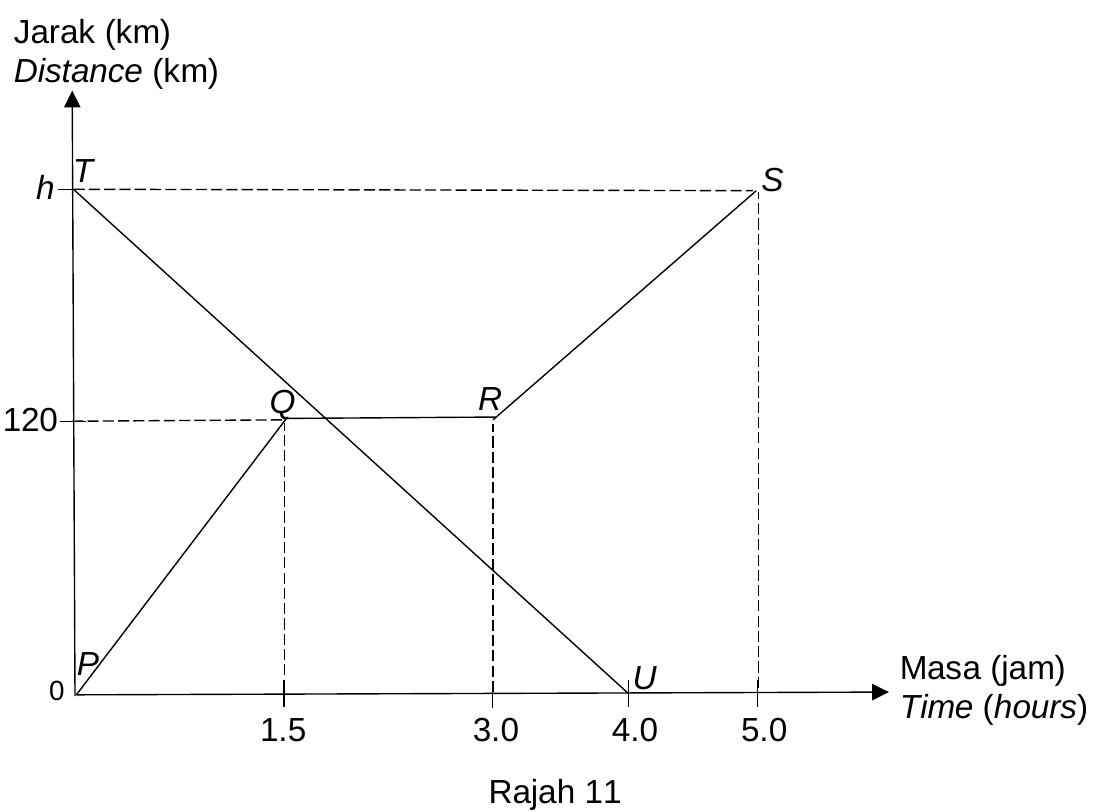
- (a)(i)
State the duration, in minutes, when Kumar's car is at rest.
[1] - (a)(ii)
The rate of change in distance of Kumar's car for the last 2 hours is 90 km h⁻¹. Calculate the value of h.
[2] - (a)(iii)
Calculate the distance, in km, from Town B when the two vehicles meet.
[1] - (a)(iv)
At what time, in the 24-hour system, do the two vehicles meet?
[3] - (b)
Which van moves faster? Justify your answer.
[3]
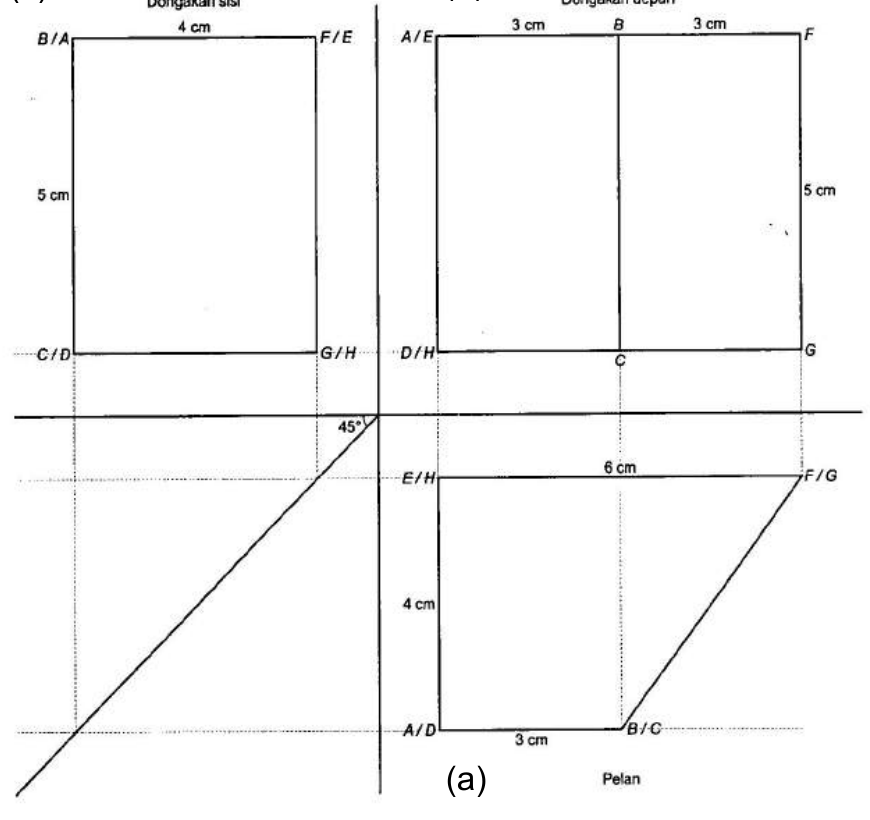
You are not allowed to use graph paper. Diagram 12 shows a prism with trapezium base DCGH on a horizontal plane. Trapezium ABFE is the cross-section of the prism. Edges AD, BC, EH and FG are vertical. (Dimensions: AD = BC = 5 cm, DC = 3 cm, EF = 6 cm, AE = BF = 4 cm, CG = 5 cm.) Draw to full scale (a) the plan of the prism, (b) the elevation of the prism on a vertical plane parallel to CD as viewed from X, (c) the elevation of the prism on a vertical plane parallel to DH as viewed from Y.
Medium9 marks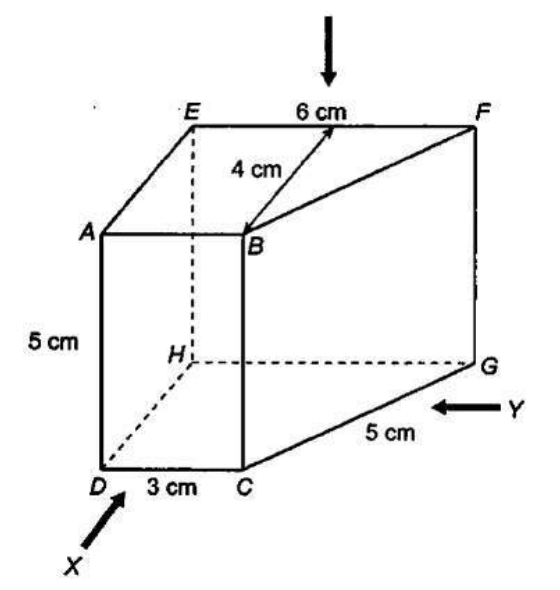
- (a)
Draw to full scale the plan of the prism.
[3]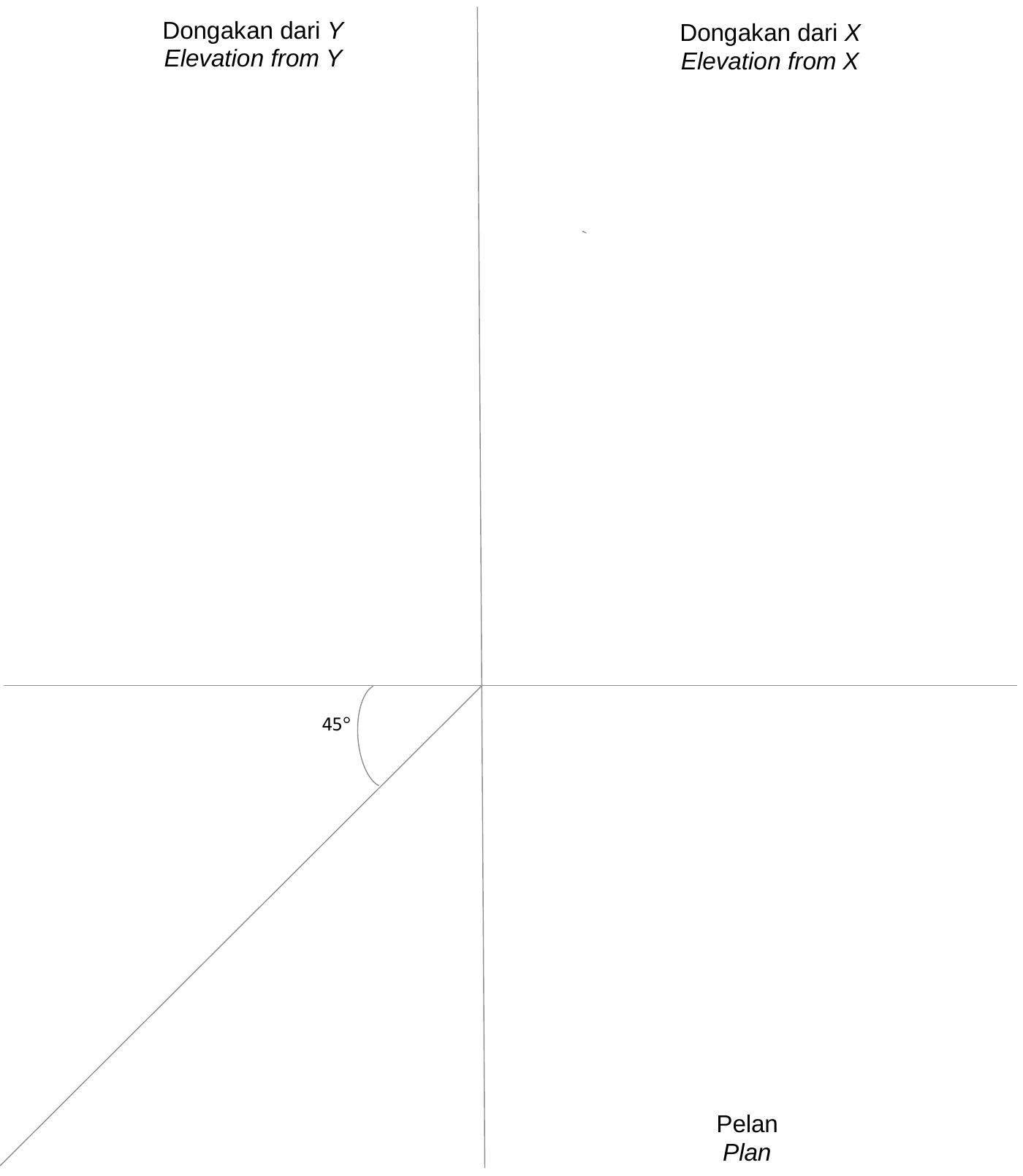
- (b)
Draw to full scale the elevation of the prism on a vertical plane parallel to CD as viewed from X.
[3] - (c)
Draw to full scale the elevation of the prism on a vertical plane parallel to DH as viewed from Y.
[3]
A box contains eight red marbles, six yellow marbles and four blue marbles. Two marbles are chosen at random one by one. If the first marble is blue, it is returned to the box before the second is chosen. If the first marble is not blue, it is not returned and the second marble is chosen. (a) Represent the situation by a tree diagram. (b) Calculate the probability of getting (i) the second marble is yellow, (ii) both are red marbles, (iii) two marbles of different colours.
Medium8 marks- (a)
Represent the situation by using a tree diagram.
[2]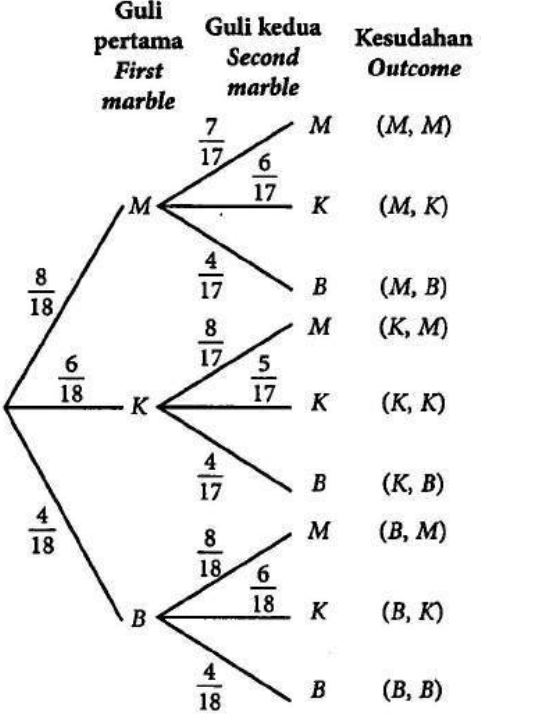
- (b)(i)
Calculate the probability that the second marble is yellow.
[2] - (b)(ii)
Calculate the probability that both marbles are red.
[2] - (b)(iii)
Calculate the probability that the two marbles are of different colours.
[2]
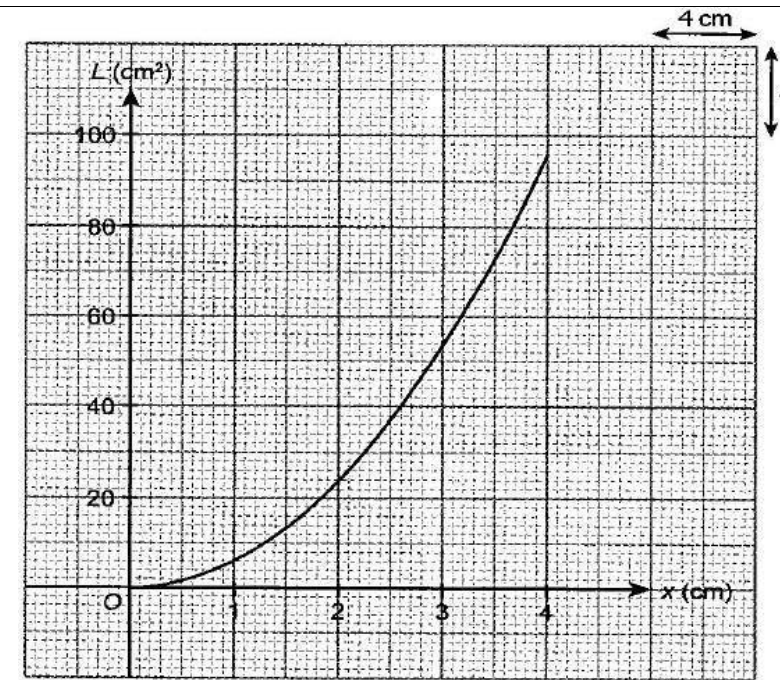
(a) Complete Table 14 for the graph of y = 6x², where y is the total surface area and x is the side length of the cube (x = 0, 1, 1.45, 2, 2.8, 3, 3.5, 4; y = 0, 6, ?, 24, 47.04, ?, 73.5, 96). (b) Using the graph paper on page 25, with a scale of 4 cm to 1 unit on the x-axis and 2 cm to 10 units on the y-axis, draw the graph of y = 6x² for 0 ≤ x ≤ 4. (c) From the graph, find (i) the side length of the cube if its surface area is 60 cm², (ii) the surface area of the cube if the side length is 3.8 cm.
Medium8 marks- (a)
Complete Table 14 for y = 6x².
[2]
- (b)
Using the graph paper, draw the graph of y = 6x² for 0 ≤ x ≤ 4 (scale 4 cm to 1 unit on the x-axis, 2 cm to 10 units on the y-axis).
[4]
- (c)(i)
From the graph, find the side length of the cube if its surface area is 60 cm².
[1] - (c)(ii)
From the graph, find the surface area of the cube if the side length is 3.8 cm.
[1]
The table shows the transportation, distance, travel time and expenses. Private car: Town P to Uncle's house, 200 km, 2 hours 15 minutes, toll RM5.90 and petrol RM0.18 per km. Train: Town P to Town Q, 190 km, 2 hours 30 minutes, RM30. Bus: Town P to Town Q, 190 km, 3 hours, RM13. Taxi: Town Q to Uncle's house, 15 km, 30 minutes, RM20. Raju lives in Town P and wants to visit his uncle who lives in Town Q. (a) Draw graphs for each route Raju can take to reach his uncle's house. (b) Calculate the total distance, expenses and time for each route in (a). (c) Determine the best route for Raju. Justify your answer.
Medium10 marks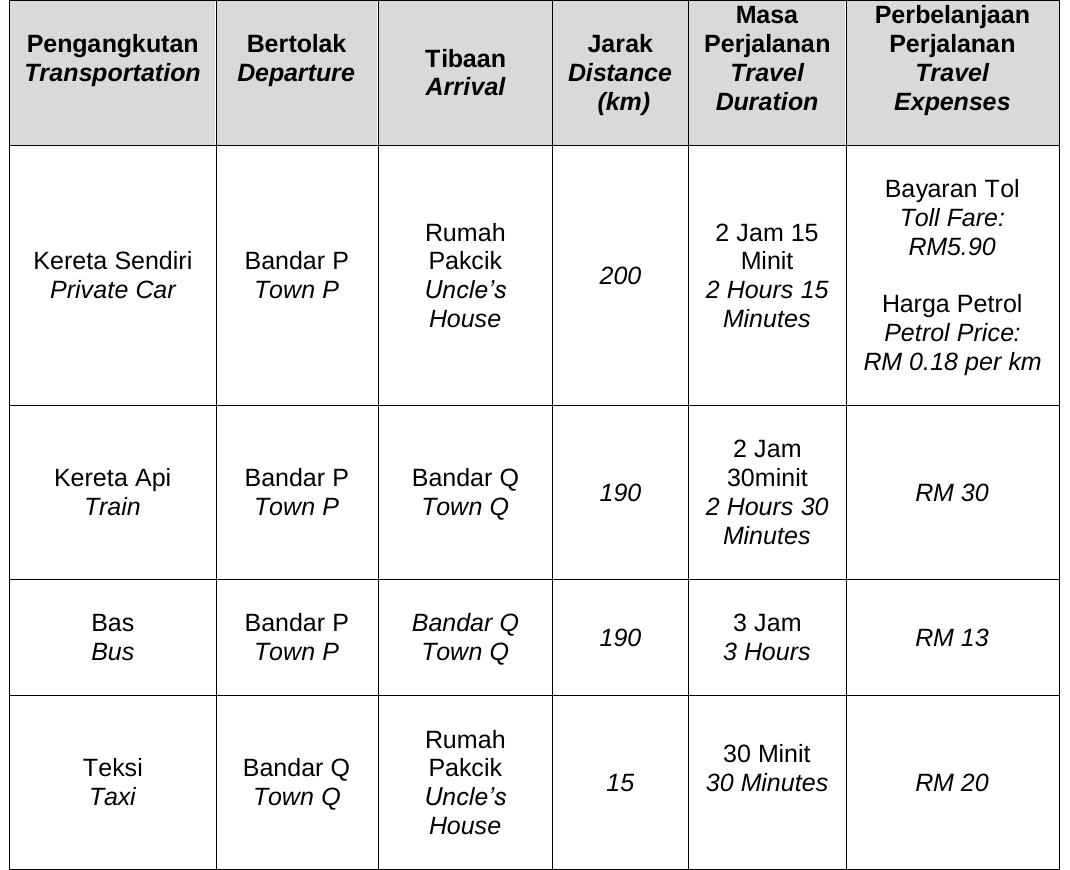
- (a)
Draw graphs for each route which can be taken by Raju to reach his uncle's house.
[3]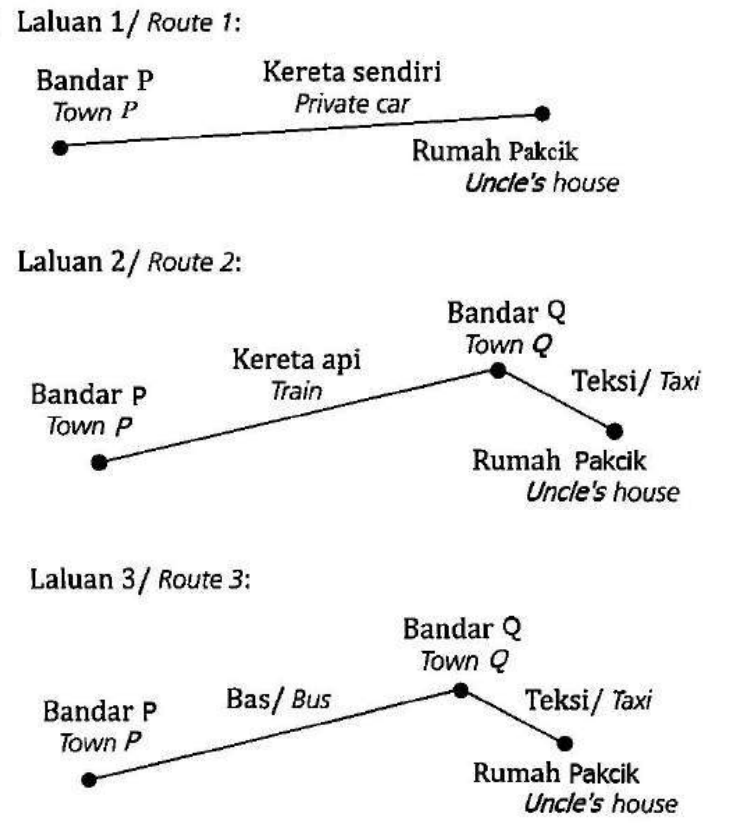
- (b)
Calculate the total distance, expenses and time for each route in (a).
[5] - (c)
Determine the best route for Raju. Justify your answer.
[2]
Section C
Answer only one question in Section C (both Q16 and Q17 are indexed). (a) Samad buys small tiles (p pieces, RM3 each) and big tiles (2q pieces, RM7 each). The total number of tiles is 155 and the total price is RM665. Write two linear equations in p and q. Hence, by using the matrix method, calculate p and q. (b) Samad takes a personal loan of RM35 000 for 5 years at a flat rate of 3.2% per annum. (i) Calculate the total repayment and the monthly instalment. (ii) If he can save RM500 each month from his income, will this loan burden him? Give your justification. (c) The resting place is a rectangle 5 m by 4 m. Calculate its area, in m², and convert it to base 3.
Hard15 marks- (a)
Write two linear equations in p and q. Hence, by using the matrix method, calculate the value of p and of q.
[6]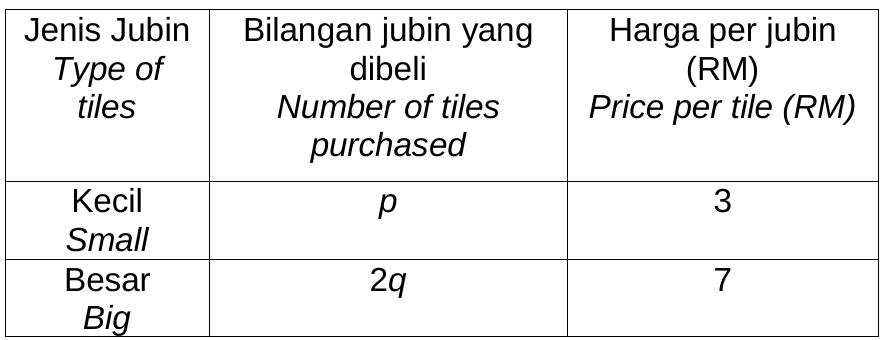
- (b)(i)
Calculate the total repayment and the monthly instalment.
[4] - (b)(ii)
Will this personal loan burden him? Give your justification.
[2] - (c)
Calculate the area of the resting place, in m², and convert it to base 3.
[3]
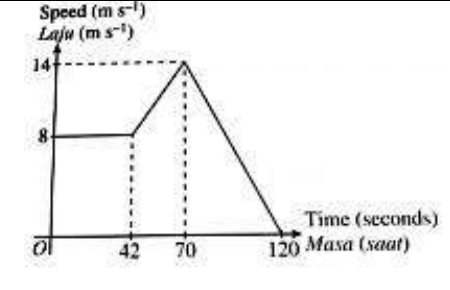
Khairil cycles every day. (a) Diagram 17 shows his route: two circular sectors with centre O (sector with radius 7 km, sector with radius 4 km and angle 120° at O); AOD is a straight line. He starts at A, passes B, C, D and returns to A through O. (i) Calculate the distance, in km, of each complete route. Give the answer correct to 2 decimal places. [Use π = 22/7] (ii) His target is at least 65 km a day. Calculate the number of complete routes he needs. (b) The diagram in the answer space shows an incomplete speed-time graph for the last 2 minutes of the first round. The bicycle moves at a uniform speed of 8 m s⁻¹ for the first 42 seconds, then increases the speed to 14 m s⁻¹ at the 70th second and decelerates constantly until it stops at the 2nd minute. (i) Complete the speed-time graph. (ii) From the graph, calculate the deceleration, in m s⁻², in the last 50 seconds. (iii) Calculate the total distance, in m, travelled in the 2 minutes. (c) On the fifth day, Khairil was in an accident. His major medical insurance policy has a deductible of RM400 and an 80/20 co-insurance clause. The medical cost covered by his policy is RM15 300. (i) Calculate the medical cost after deductible. (ii) Calculate the cost to be borne by Khairil himself.
Hard15 marks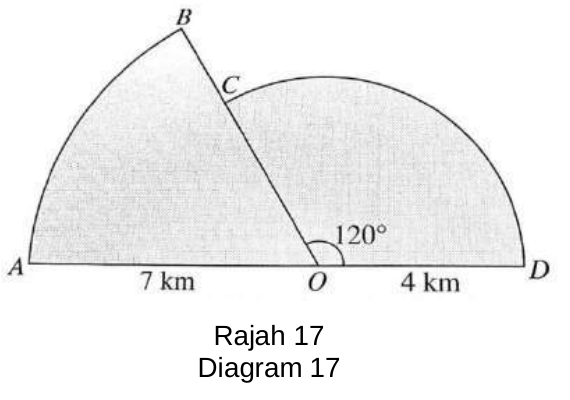
- (a)(i)
Calculate the distance, in km, of each complete route. Give the answer correct to 2 decimal places. [Use π = 22/7]
[3] - (a)(ii)
Calculate the number of complete routes needed to cycle at least 65 km.
[2] - (b)(i)
Complete the speed-time graph in the answer space.
[2]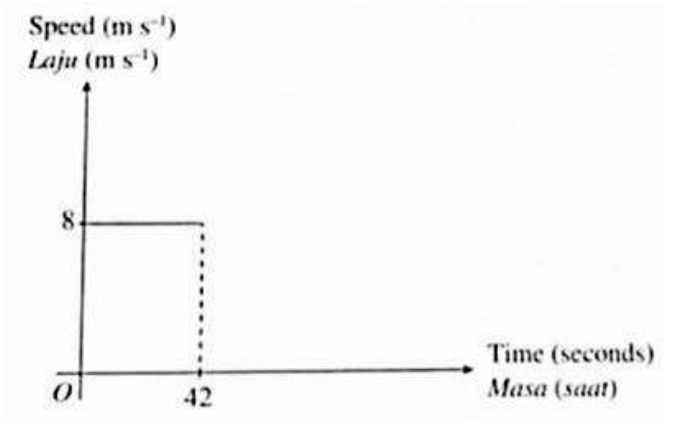
- (b)(ii)
Calculate the deceleration, in m s⁻², in the last 50 seconds.
[2] - (b)(iii)
Calculate the total distance, in m, travelled in the 2 minutes.
[3] - (c)(i)
Calculate the medical cost after deductible.
[1] - (c)(ii)
Calculate the cost to be borne by Khairil himself.
[2]