Write your answer on paper. Then open the answer to check it.
Section A
Diagram 1 shows the prices of three brands of alarm clocks sold in a shop: Brand P RM33₆, Brand Q RM1001₃, Brand R RM25. Arrange the brands of the three alarm clocks according to the prices in descending order.
Medium2 marks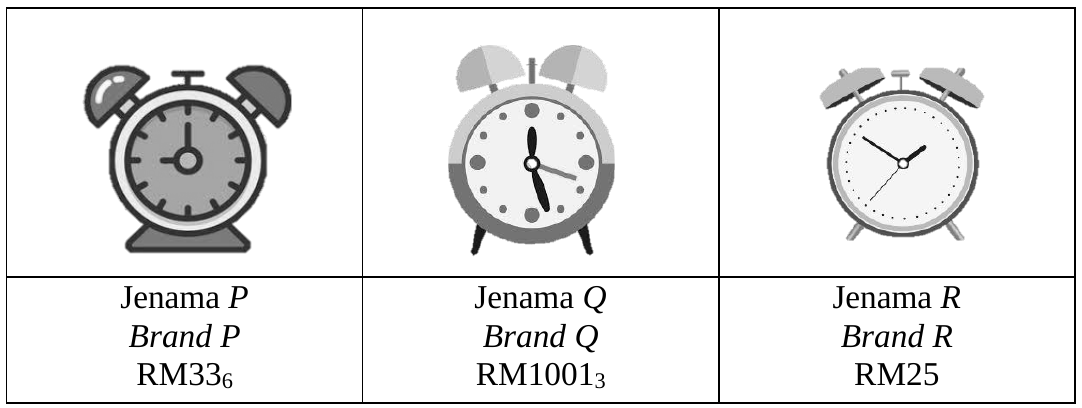
Arrange the brands in descending order of price.
[2]
You are not allowed to use the matrix method to solve this problem. The Mayor plans to build a flyover across two roads. Diagram 2.2 shows the plan of the flyover: the flyover crosses Road 1 making angle p, and crosses Road 2 making angles 2p and 3q (see figure). Calculate the value of p and q.
Medium5 marks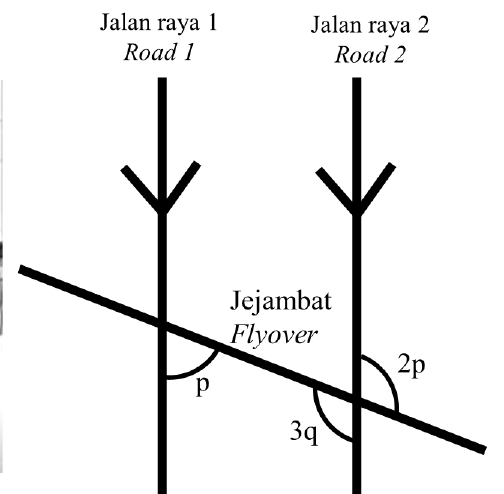
Calculate the value of p and q.
[5]
Diagram 3 shows cross-section of a house. The height of the wall is x m, and the door has width (x − 4) m and height (x − 2) m. Given the length of the wall is 3 m more than twice the height of the wall. The area of the shaded region is 154 m². Calculate the length, in m, of the wall.
Medium4 marks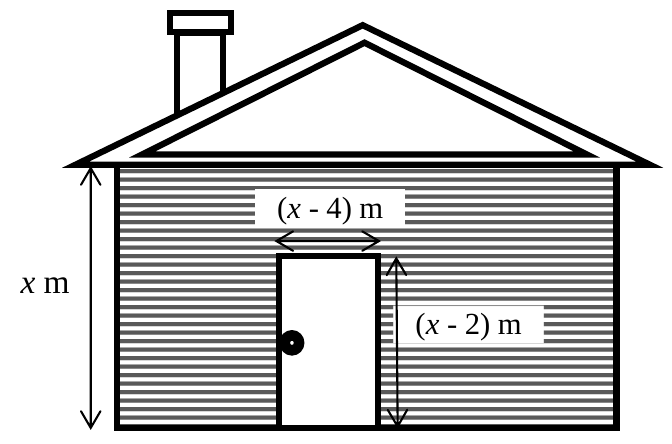
Calculate the length, in m, of the wall.
[4]
Diagram 4 in the answer space shows a rhombus PQRS, drawn on a grid of equal squares with the side of 1 unit. X and Y are points which move in the diagram. Draw, (a) the locus of point X which moves such that it is always equidistant from line PS and line QR; (b) the locus of point Y which moves such that it is always equidistant from point P and point R; (c) mark ⊗ the intersection of locus X and locus Y.
Medium3 marks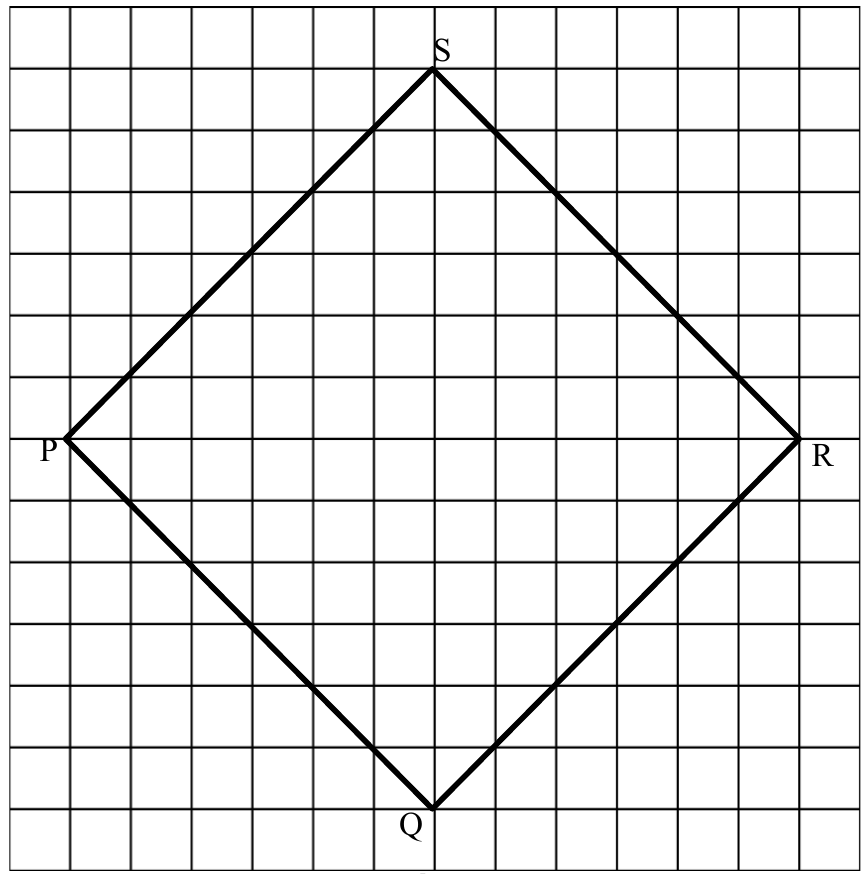
- (a)
Draw the locus of X (equidistant from PS and QR).
[1]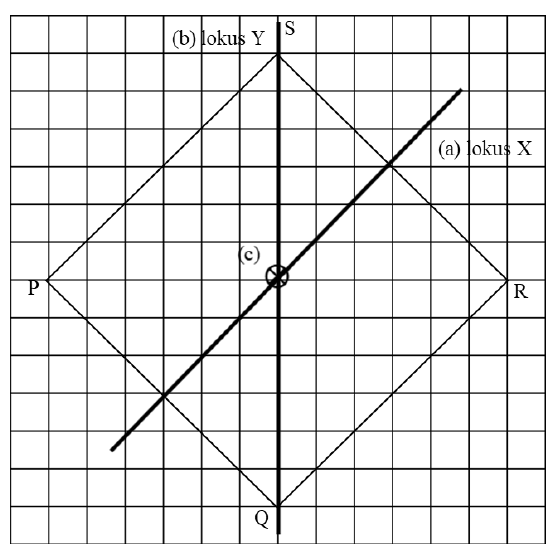
- (b)
Draw the locus of Y (equidistant from P and R).
[1] - (c)
Mark ⊗ the intersection of locus X and locus Y.
[1]
Mr Fazli has bought a fire insurance for his house. Table 1 shows: insurable value RM380 000; co-insurance 80% of insurable value; deductible RM6 000. (a) Calculate the amount of insurance that should be taken by Mr Fazli. (b) Mr Fazli's house has suffered a fire and the total loss is as much as RM75 000. Calculate the compensation payment that he will receive if he insures his house with the amount of RM228 000.
Medium4 marks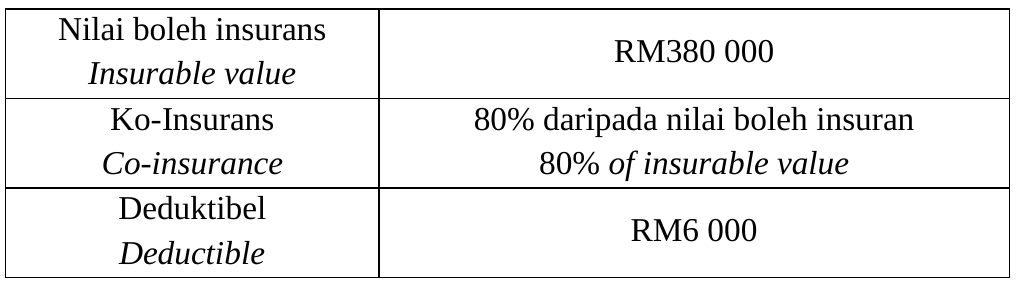
- (a)
Calculate the amount of insurance that should be taken.
[2] - (b)
Calculate the compensation payment if insured for RM228 000.
[2]
You are not allowed to use a graph paper to answer this question. Diagram 5 shows a right prism joined to a solid on vertical plane DLJI. The surface DWU is the uniform cross-section of the prism. The base DEMLTU is on the horizontal plane. The radius of the semicircle VWX is 2 cm and DU = 4 cm. (Dimensions in the figure: JK = 2 cm, KP = 5 cm, PN = 4 cm, NM = 3 cm, EM = 5 cm, DE = 6 cm, UX = 3 cm.) Draw to full scale, the orthogonal projection of the solid on a vertical plane parallel to EM as viewed from B.
Medium5 marks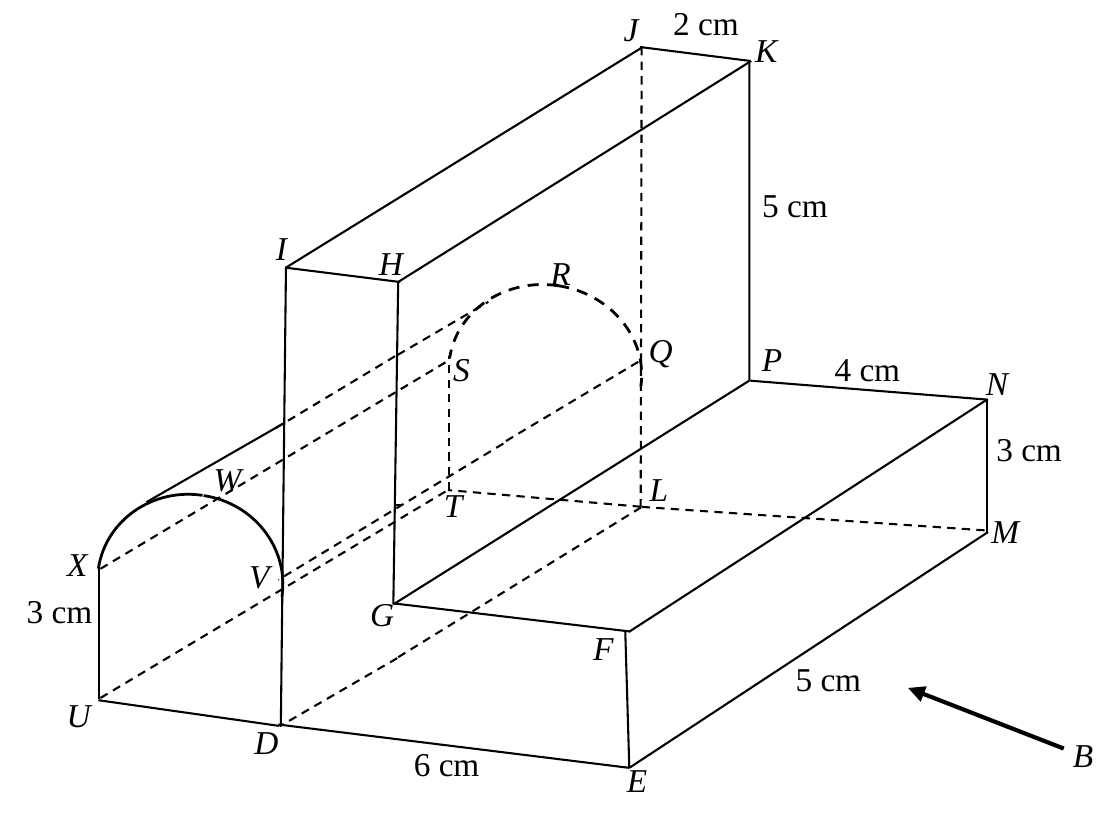
Draw to full scale the orthogonal projection as viewed from B.
[5]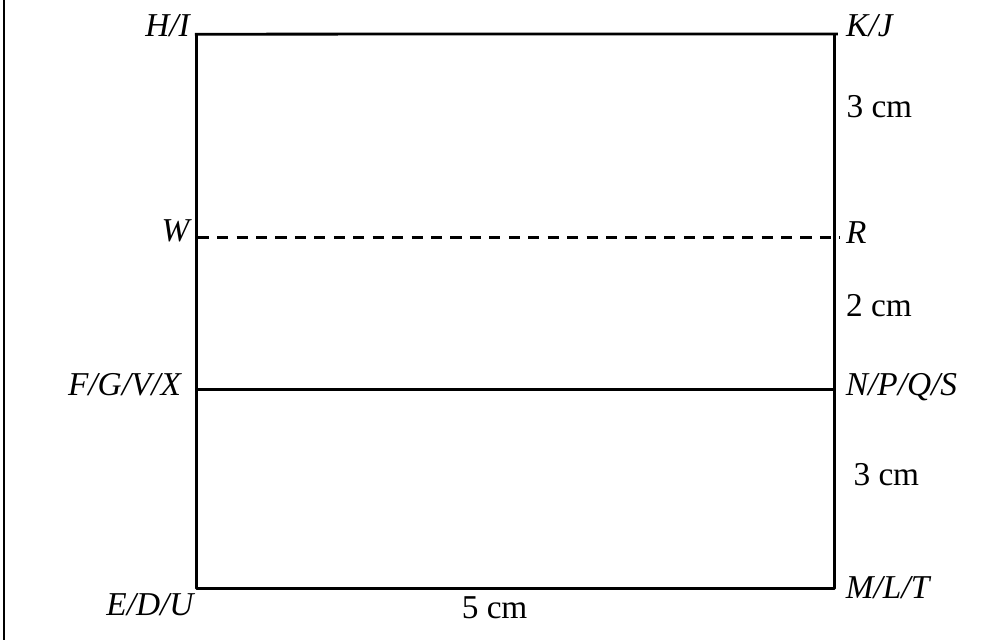
(a) Write down the contrapositive of the following implication. Hence, state whether the contrapositive is true or false. 'If p is an even number, then p is divisible by 2.' (b) Write Premise 2 to complete the following argument. Premise 1: All quadratic functions have turning points. Premise 2: ... Conclusion: The function g(x) has a turning point. (c) Form an inductive argument based on the sequence 3, 8, 17, 30, … where 3 = 3(1) + 2(0)², 8 = 3(2) + 2(1)², 17 = 3(3) + 2(2)², 30 = 3(4) + 2(3)², … = ……
Medium5 marks- (a)
Write the contrapositive and state if it is true or false.
[2] - (b)
Write Premise 2.
[1] - (c)
Form an inductive argument from the sequence.
[2]
Diagram 6 shows the trigonometric function y = a cos bx + c for 0° ≤ x ≤ 360° (a cosine curve with maximum value 3 at x = 0° and x = 360°, and minimum value −1 at x = 180°). State the value of (a) a, (b) b, (c) c.
Medium3 marks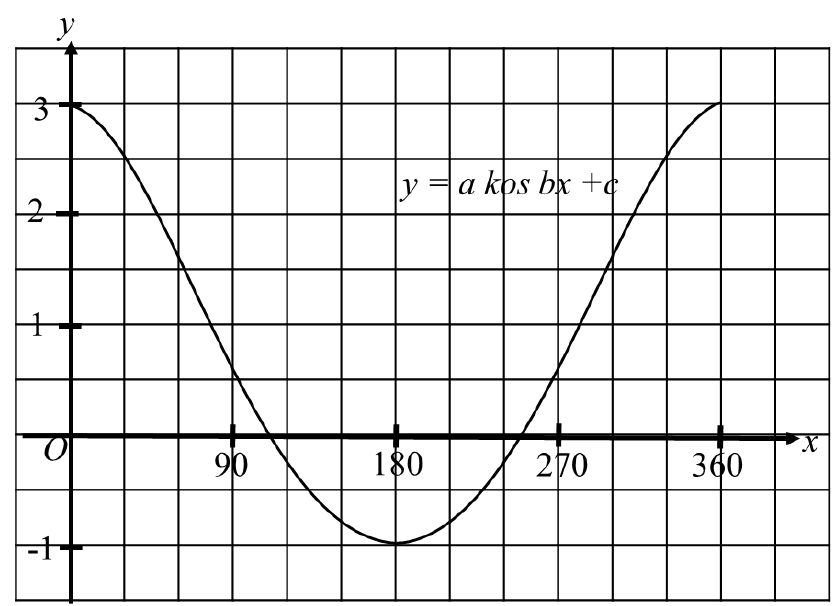
- (a)
State the value of a.
[1] - (b)
State the value of b.
[1] - (c)
State the value of c.
[1]
Luqman has bought a land lot for RM150 000 through a bank loan. He paid a down payment of 40% and a loan term of 10 years. The bank offers an interest rate of 2.8% per annum. Calculate, (a) the monthly payment that must be paid, (b) the value of the return on investment he gets if after 10 years he sells the land lot with a profit value of RM80 520.
Medium5 marks- (a)
Calculate the monthly payment.
[3] - (b)
Calculate the return on investment.
[2]
Diagram 7 shows a network of graph with vertices J, K, L, M, N, P, Q (edges: JK, KQ, KL, QM, LP, LN, LM, PN, NM). (a) State: (i) V, (ii) the number of degrees. (b) Draw a tree based on the graph.
Medium4 marks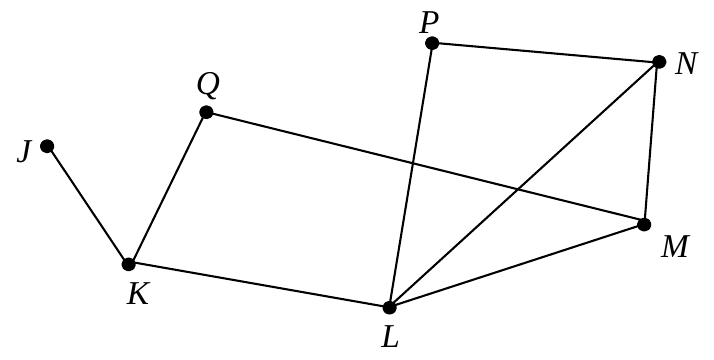
- (a)(i)
State V.
[1] - (a)(ii)
State the number of degrees.
[2] - (b)
Draw a tree based on the graph.
[1]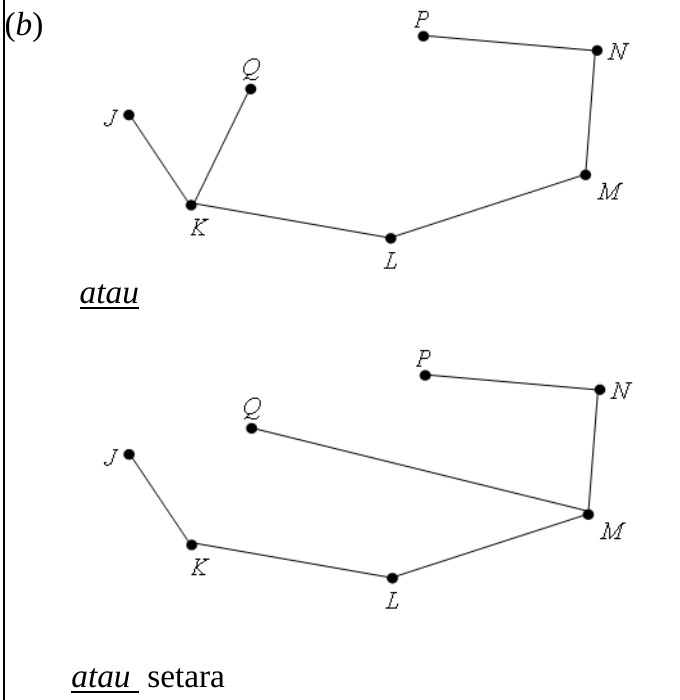
Section B
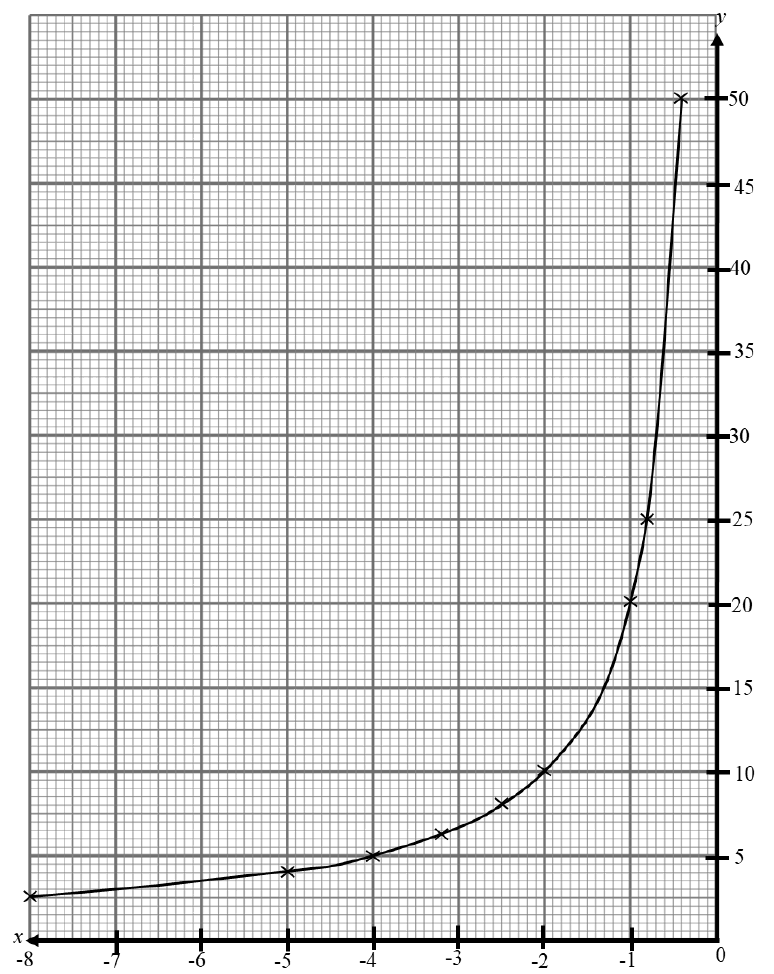
(a) Complete the table in the answer space for the equation y = −20/x by writing down the values of y when x = −3.2, x = −1 and x = −0.4. Table: x = −8, −5, −4, −3.2, −2.5, −2, −1, −0.8, −0.4; y = 2.5, 4, 5, ( ), 8, 10, ( ), 25, ( ). (b) Using a scale of 2 cm to 1 unit on the x-axis and 2 cm to 5 units on the y-axis, draw the graph y = −20/x for −8 ≤ x ≤ −0.4 (use the graph paper on page 17; a flexible curve ruler may be used). (c) From the graph, find (i) the value of y when x = −1.5, (ii) the value of x when y = 26.
Medium9 marks- (a)
Complete the table: y when x = −3.2, −1, −0.4.
[3] - (b)
Draw the graph of y = −20/x for −8 ≤ x ≤ −0.4 on the graph paper (scale 2 cm : 1 unit on x-axis, 2 cm : 5 units on y-axis).
[4]
- (c)(i)
From the graph, find y when x = −1.5.
[1] - (c)(ii)
From the graph, find x when y = 26.
[1]
Diagram 8 shows a speed-time graph for the movement of a particle for a period of 50 seconds (speed rises from v at t = 0 to 24 m s⁻¹ at t = 12 s, stays at 24 m s⁻¹ until t = 35 s, then falls to 0 at t = 50 s). (a) State: (i) the uniform speed, in m s⁻¹, of the particle, (ii) the duration of time, in s, for which the particle moves with uniform speed. (b) Calculate the value of v, if the total distance travelled in 50 seconds is 957 m. (c) Describe the motion of the particle in the last 15 seconds.
Medium8 marks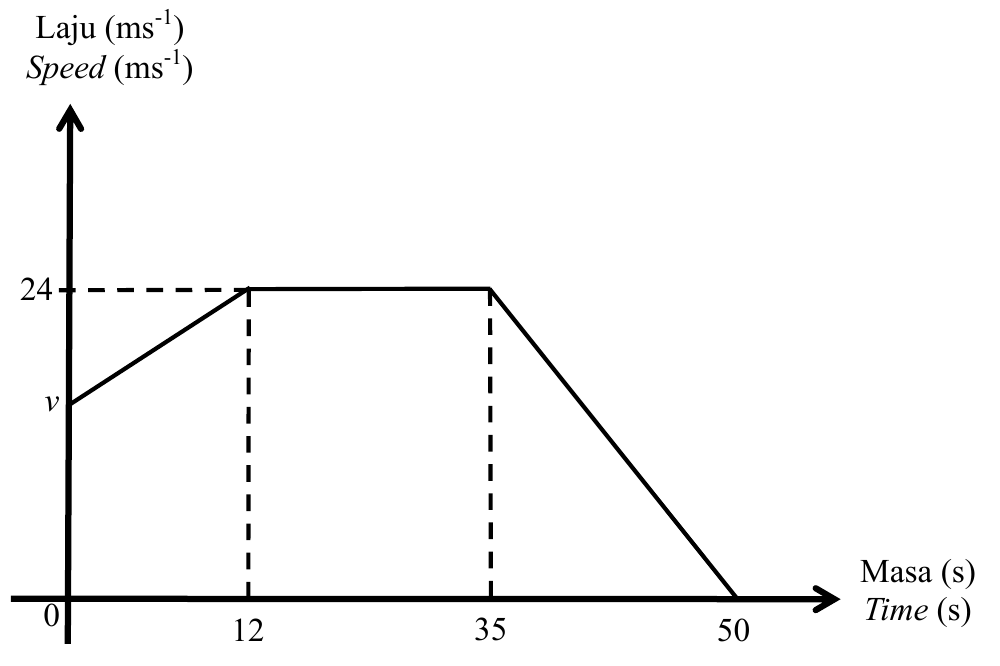
- (a)(i)
State the uniform speed in m s⁻¹.
[1] - (a)(ii)
State the duration of uniform speed in s.
[1] - (b)
Calculate the value of v.
[3] - (c)
Describe the motion of the particle in the last 15 seconds.
[3]
Diagram 9 shows three quadrilaterals ABCD, EFGH and JKLM, drawn on a cartesian plane. (a) JKLM is the image of ABCD under the combined transformation XY. Describe in full the transformation, (i) Y, (ii) X. (b) It is given that JKLM represents a region of area 129.6 m². Calculate the area, in m², of the region represented by ABCD. Hence, find the difference between the area of image and object.
Medium8 marks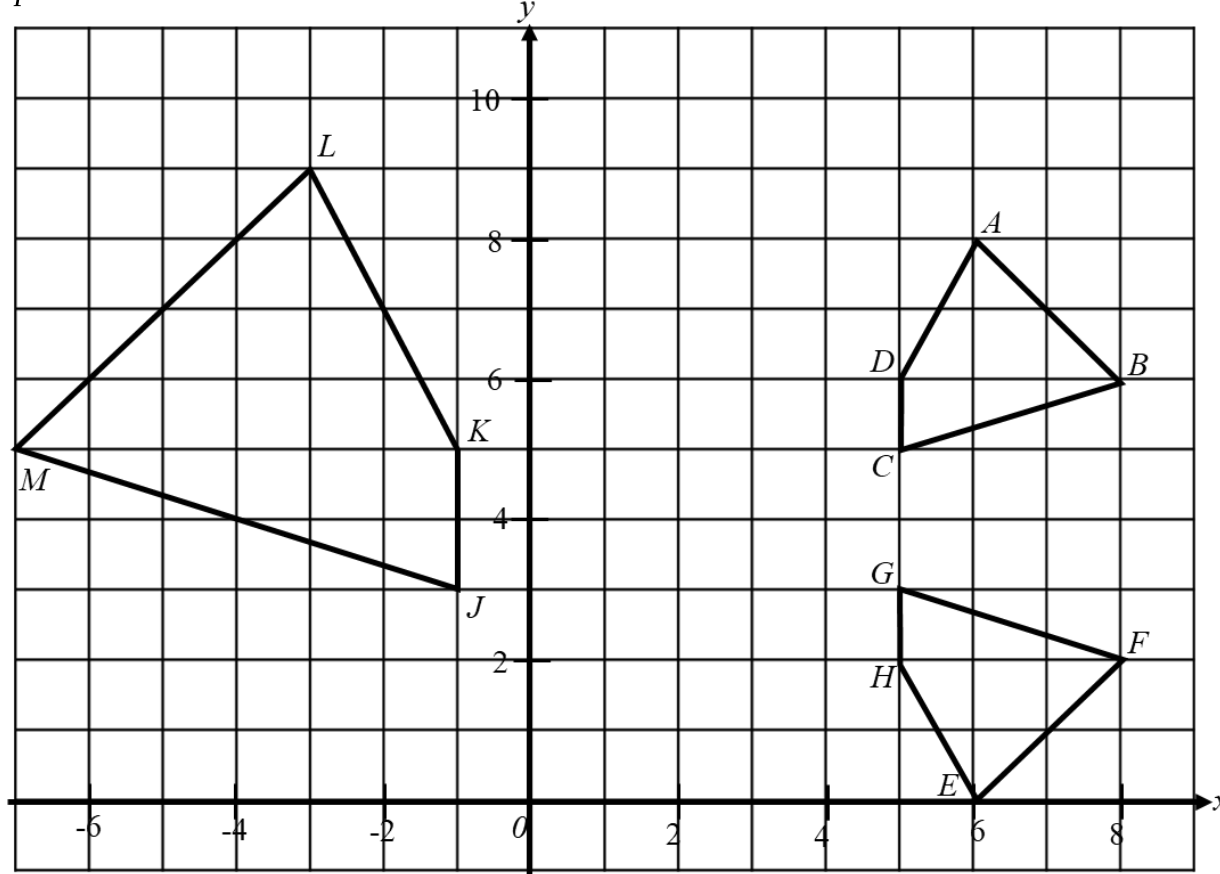
- (a)(i)
Describe in full the transformation Y.
[2] - (a)(ii)
Describe in full the transformation X.
[3] - (b)
Calculate the area of ABCD, then the difference between the area of image and object.
[3]
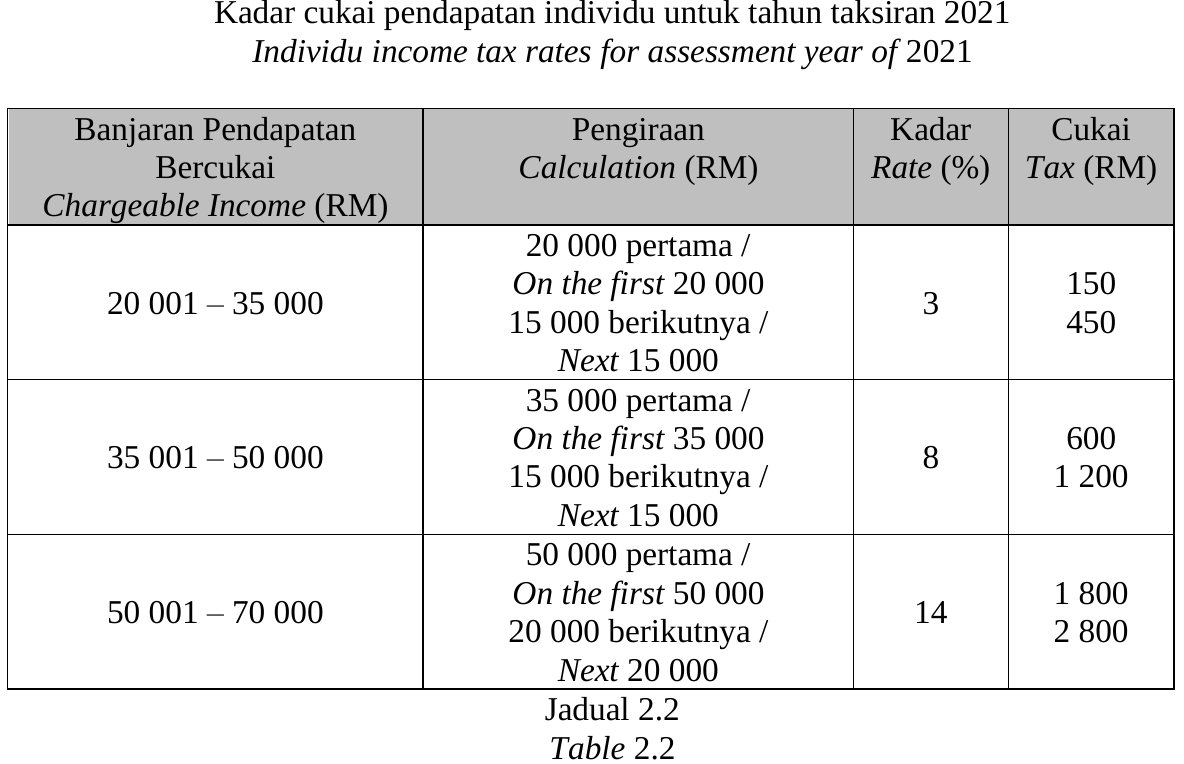
Mr Harris's annual income was RM84 450 in 2021. Table 2.1 shows the tax reliefs he claimed: Individual RM9 000; Life insurance and EPF RM8 350 (limited to RM7 000); Lifestyle RM3 400 (limited to RM2 500); Medical expenses for parents RM1 250 (limited to RM5 000); Unmarried son of 16 years old RM2 000. Table 2.2 shows part of the individual income tax rates for assessment year 2021: chargeable income 20 001–35 000: tax on the first 20 000 is RM150, next 15 000 at 3%; 35 001–50 000: tax on the first 35 000 is RM600, next 15 000 at 8%; 50 001–70 000: tax on the first 50 000 is RM1 800, next 20 000 at 14%. Mr Harris paid zakat of RM485 for that year. (a) Calculate the chargeable income for Mr Harris. (b) Calculate the income tax payable by Mr Harris for the particular year. (c) A monthly tax deduction (PCB) of RM240 is deducted monthly from his salary. Is the PCB enough to pay for Mr Harris's income tax? Justify your answer.
Medium10 marks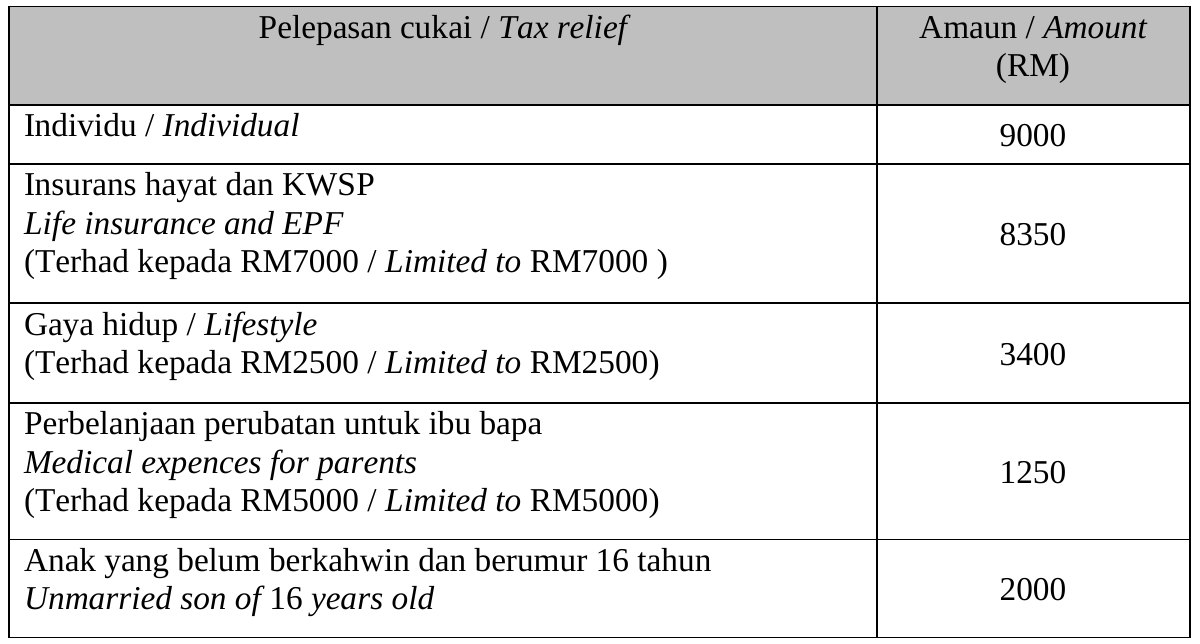
- (a)
Calculate the chargeable income.
[2] - (b)
Calculate the income tax payable.
[4] - (c)
Is the PCB enough to pay the income tax? Justify.
[4]
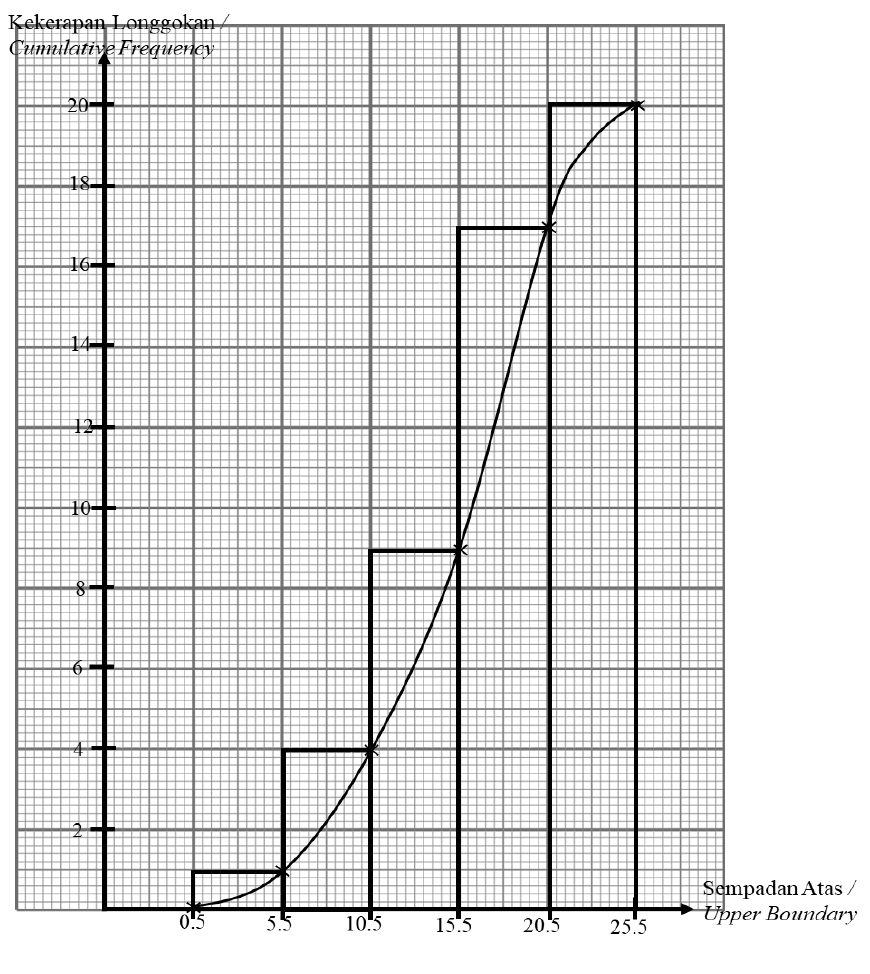
Table 3 shows data for the number of books read by 20 students at a school: 1–5 books: frequency 1; 6–10: 3; 11–15: 5; 16–20: 8; 21–25: 3. (a) Based on the data, calculate: (i) the mean, (ii) the standard deviation. (b) Using a scale of 2 cm to 5 books on the horizontal axis and 2 cm to 2 students on the vertical axis, draw a cumulative histogram to represent the data.
Medium10 marks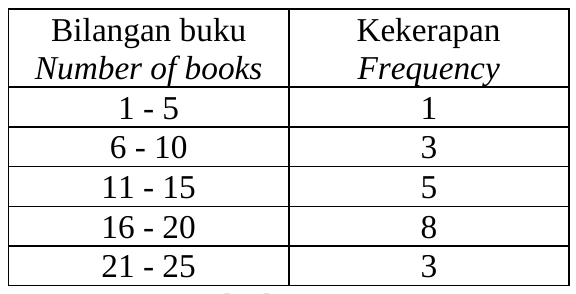
- (a)(i)
Calculate the mean.
[3] - (a)(ii)
Calculate the standard deviation.
[3] - (b)
Draw the cumulative histogram on the graph paper (2 cm : 5 books horizontal, 2 cm : 2 students vertical).
[4]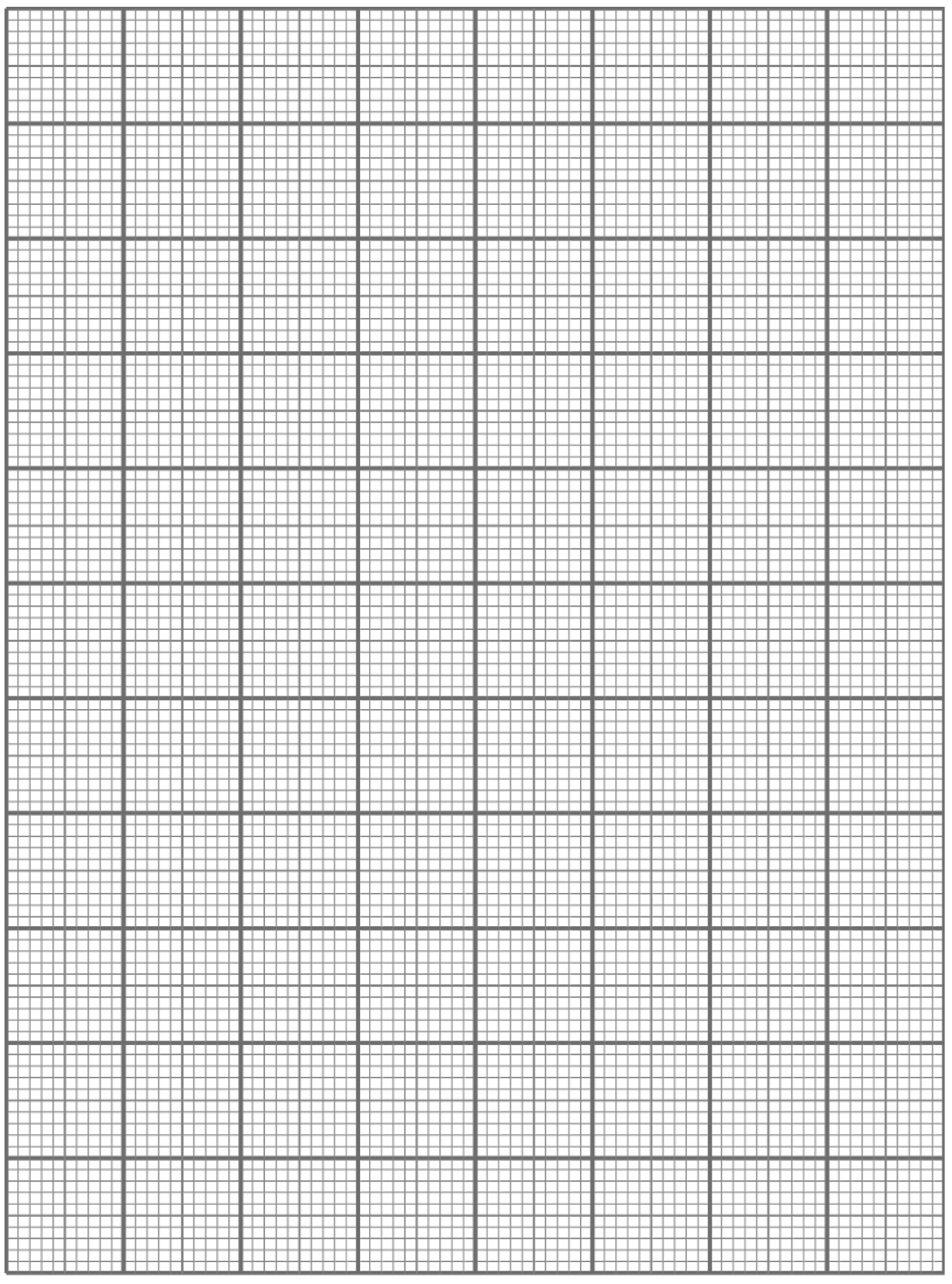
Section C
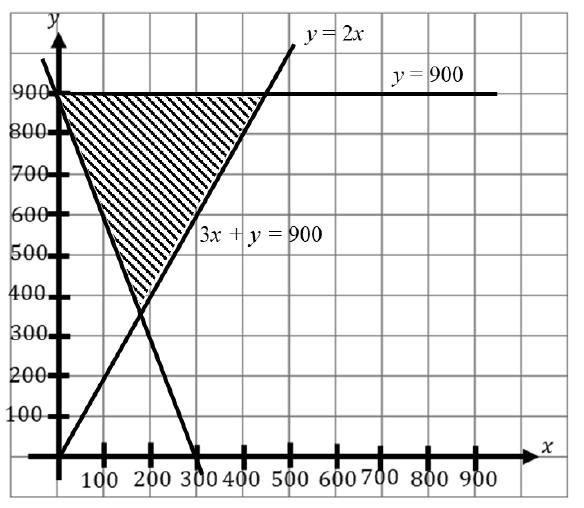
(a) Shizuka is a florist. She sells x tulips and y roses in her shop for RM 3 and RM 1 per stalk respectively. The minimum sales amount of the flowers is RM 900. The number of roses sold is at least twice the number of tulips. Meanwhile, the maximum number of roses sold is 900 stalks. (i) Write down the three inequalities that satisfy those requirements. (ii) On the graph in the answer space, draw and shade the region that satisfies all three requirements. (b) Shizuka allocates 500 seconds to produce a bouquet of flowers. Calculate the time, in minutes, which is required to produce 650 bouquets. Give your answer in standard form. (c) On one particular day, Shizuka received a reservation to make four bouquets for a ceremony. She used x stalks of tulips and y stalks of daisy flowers. The price of a tulip and a daisy is RM4.50 and RM4.00 respectively. Shizuka allocated a cost of RM304. The total number of flowers needed is 72 stalks. Using the matrix method, calculate the required number of tulips and daisy flowers. (d) Shizuka kept RM7800 of her sales proceeds in Ohio Bank. The bank offers a fixed interest rate of 3.5% per annum. Calculate the amount of her savings, in RM, after 5 years.
Medium15 marks- (a)(i)
Write down the three inequalities.
[3] - (a)(ii)
Draw and shade the region satisfying all three inequalities on the given graph.
[2]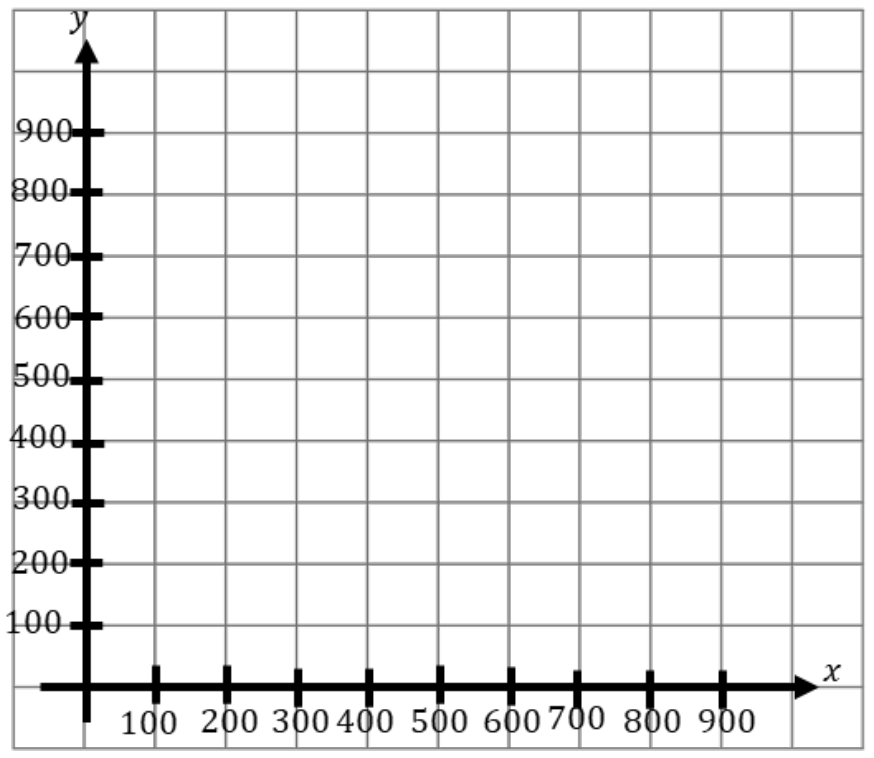
- (b)
Calculate the time in minutes, in standard form.
[2] - (c)
Using the matrix method, find the number of tulips (x) and daisies (y).
[5] - (d)
Calculate the amount of her savings after 5 years.
[3]
(a) Table 4 shows the financial plan of Mr. Khairulnizam who works as a lecturer at a college in Kuala Lumpur: monthly salary RM8500; passive income RM800; monthly income total RM9300; monthly fixed saving (10% of monthly income) X; emergency fund saving RM200; income balance RM8170; fixed expenses: house instalment RM1500, car instalment RM1200, insurance premium RM500, total RM3200; variable expenses: kitchen RM1800, petrol RM500, telephone RM300, utility RM450, holiday RM1000, parents' expenses RM500, total RM4550; surplus/deficit Y. (i) Find the value of X and Y. (ii) Explain Mr. Khairulnizam's cash flow. (b) Mr. Khairulnizam is passionate about a new car worth RM270 000. He plans to get the car within three years and wants to save for the 10% down payment. How much monthly savings should he save to achieve his financial goal? In your opinion, is he able to afford the car? Give your justification. (c) For his fifth wedding anniversary, he plans to buy gifts: two pairs of baju kurung and a watch for his wife, and a pair of baju kurung and a watch for his daughter, with budgets of RM550 and RM350 respectively. By using the matrix method, calculate the price, in RM, of a pair of baju kurung and a watch. (d) The time spent, t, to arrange chairs varies directly as the number of seats, x, and inversely as the number of employees, y. He hired 4 employees for 2 hours to arrange 200 seats. Calculate the number of employees needed to arrange 200 seats in 1 hour.
Hard15 marks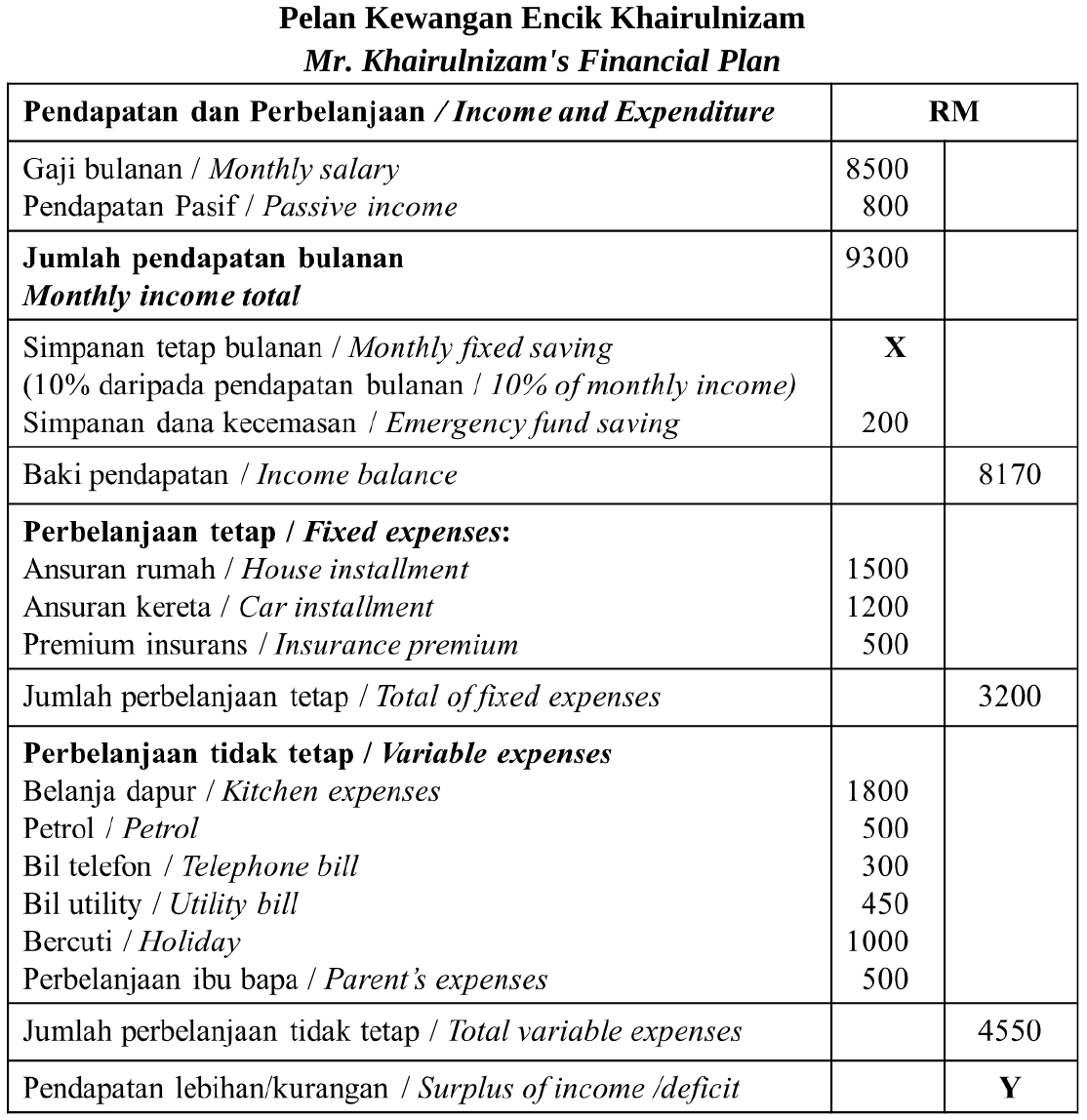
- (a)(i)
Find the values of X and Y.
[2] - (a)(ii)
Explain the cash flow.
[1] - (b)
Monthly savings needed; can he afford the car?
[3] - (c)
Using the matrix method, find the price of a pair of baju kurung and of a watch.
[5] - (d)
Find the number of employees needed to arrange 200 seats in 1 hour.
[4]