Write your answer on paper. Then open the answer to check it.
Section A
(a) S + [[10, −8, 4], [6, −11, 7]] = [[15, 8, 6], [−4, −11, 9]]. Find matrix S. (b) It is given that matrix M = [[3, −5], [3, −4]]. Find the inverse matrix of M.
Medium4 marks- (a)
S + [[10, −8, 4], [6, −11, 7]] = [[15, 8, 6], [−4, −11, 9]]. Find matrix S.
[2] - (b)
It is given that matrix M = [[3, −5], [3, −4]]. Find the inverse matrix of M.
[2]
Given a simple graph as shown (vertices P, Q, R, S, T, U, V, W). Determine (a) n(V), (b) E, (c) sum of degrees, (d) draw a subgraph based on the given graph.
Medium4 marks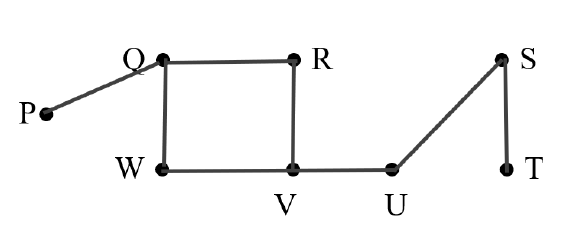
- (a)
n(V)
[1] - (b)
E
[1] - (c)
Sum of degrees
[1] - (d)
Draw a subgraph based on the given graph.
[1]
Mr. Kumar buys a motor insurance policy for his car from Insurance Company ABC. Sum insured: RM31 000; Age of vehicle: 6 years; Engine capacity: 1594 cc; NCD: 55%. Using the Motor Tariff table (Peninsular Malaysia): (a) Calculate the gross premium if he buys a comprehensive policy. (b) Calculate the gross premium for the third party policy.
Medium5 marks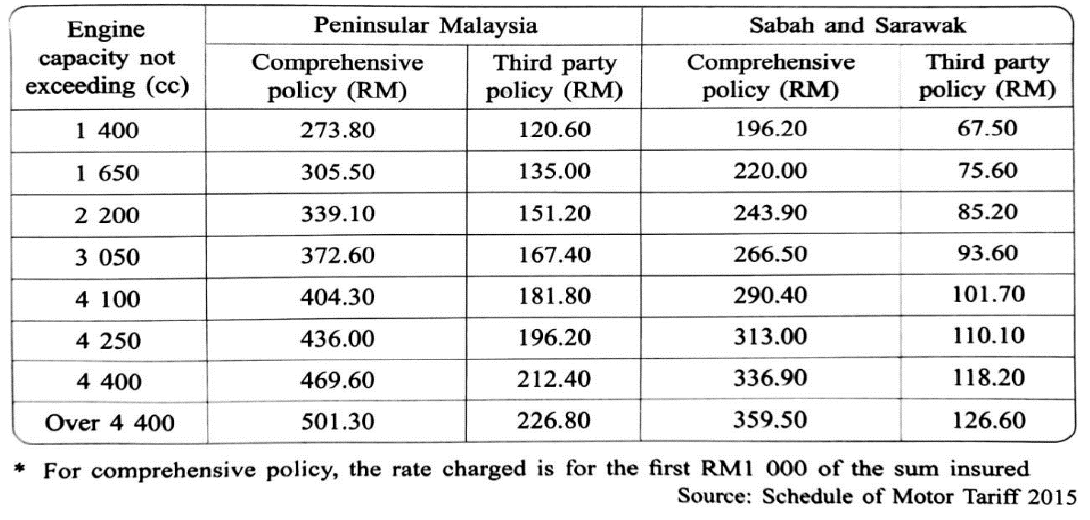
- (a)
Calculate the gross premium for a comprehensive policy.
[3] - (b)
Calculate the gross premium for the third party policy.
[2]
Diagram 1 shows the speed-time graph for the movement of a particle for a period of 60 seconds (speed rises to 40 m s⁻¹ at 25 s, stays constant until 40 s, then increases until 60 s). (a) State the uniform speed, in m s⁻¹, of the particle. (b) Calculate the difference of the rate of change of speed, in m s⁻², of the particle for the first 25 seconds.
Medium3 marks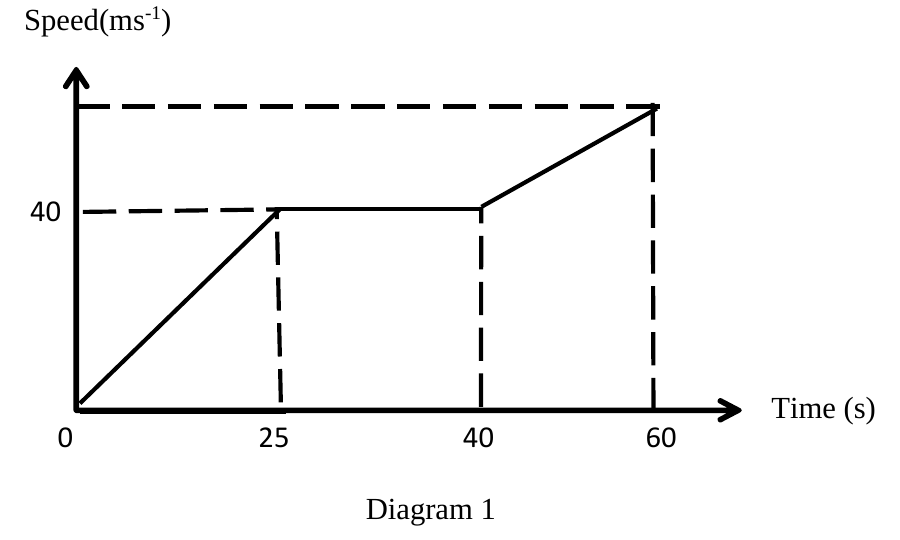
- (a)
State the uniform speed, in m s⁻¹, of the particle.
[1] - (b)
Calculate the difference of the rate of change of speed, in m s⁻², of the particle for the first 25 seconds.
[2]
Diagram 2 shows a regular pentagon PQRST. X and Y are moving points which move in the pentagon. On the diagram, (a) draw the locus of the point X which moves such that it is always equidistant from point R and S. (b) draw the locus of point Y which moves such that its distance is constantly 4 cm from P. (c) hence, mark with the symbol ⊗ the intersection of the locus of X and the locus of Y.
Medium3 marks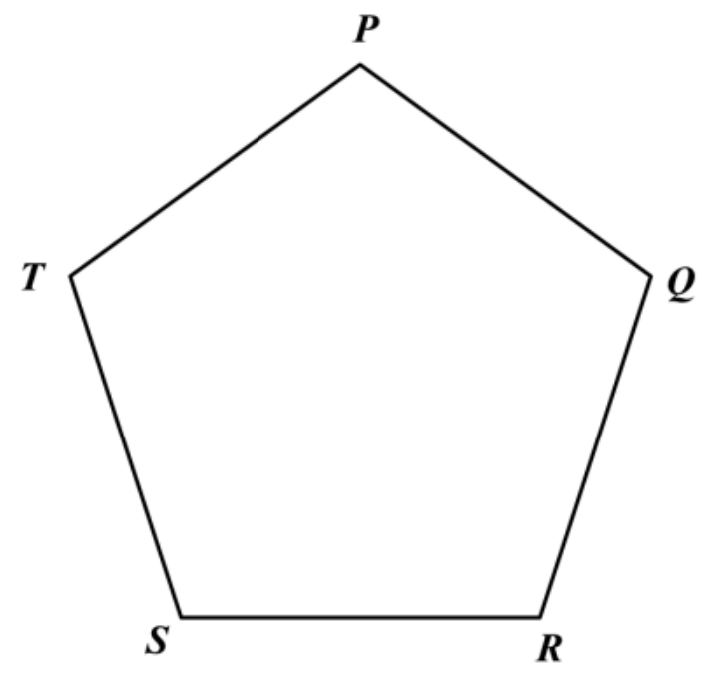
- (a)-(c)
Draw the locus of X (equidistant from R and S), the locus of Y (4 cm from P) and mark the intersection with ⊗.
[3]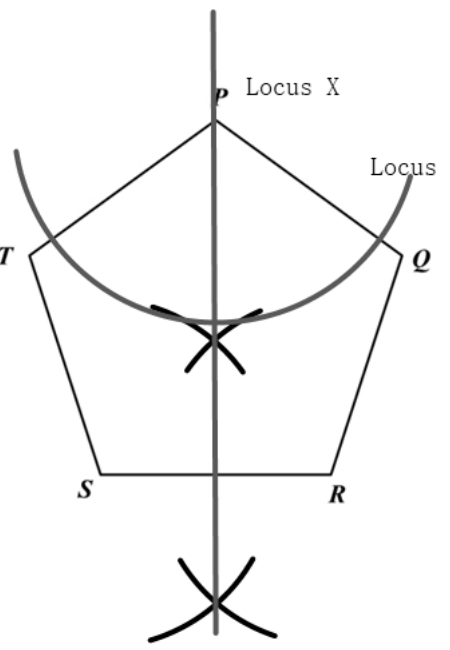
Jamilah bought a new car (price RM48 000) with downpayment 10% of the car price. The balance will be settled through a vehicle loan. The bank offered an interest rate 3.5% for 9 years. Calculate (a) the amount of downpayment, (b) the total repayment, (c) the monthly instalment payable by Jamilah.
Medium5 marks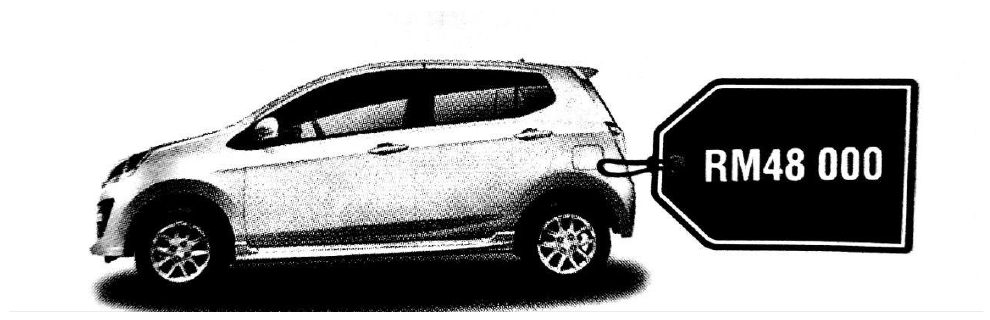
- (a)
the amount of downpayment
[1] - (b)
the total repayment
[2] - (c)
the monthly instalment payable by Jamilah
[2]
Table 1 shows the number of pendrive sold in period of four months in 2022: January 11210₅, February 2762₈, March 6441₇, April Q. Given the number of pendrive sold in four months was 8415 (base 10). (a) Change the number of pendrive sold in March in base 10. (b) Calculate the value of Q, number of pendrive sold in April in base 10.
Medium4 marks- (a)
Change the number of pendrive sold in March (6441₇) to base 10.
[2] - (b)
Calculate the value of Q (April) in base 10.
[2]
(a) Write down the contrapositive of the following implication. Hence, state whether the contrapositive is true or false. "If a straight line AB touches a circle C at one point, then the straight line AB is a tangent to a circle C." (b) Write down the converse of the following implication. Hence, state whether the converse is true or false. "If a < b, then a – b < 0"
Medium4 marks- (a)
Write down the contrapositive and state whether it is true or false.
[2] - (b)
Write down the converse and state whether it is true or false.
[2]
Diagram 3 (i) shows the distance-time graph of Allyna's journey (distance falls from 120 km to 0 at 1.2 h) and Diagram 3 (ii) shows the speed-time graph of Roxane's journey (speed 20 km h⁻¹ at 0, 120 km h⁻¹ at 0.8 h, 0 at 1.2 h). (a) If Allyna starts her journey at 11.30 a.m., at what time does she arrive at her destination? (b) Calculate the difference in distance, in km, travelled by Allyna and Roxane for a period of 1.2 hours.
Medium5 marks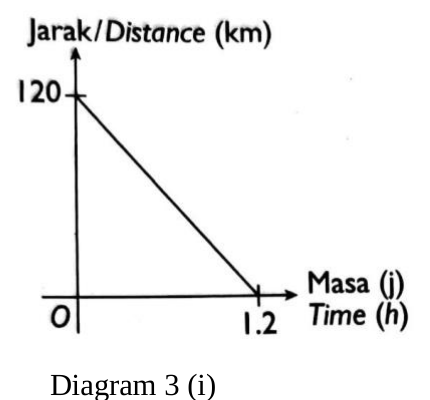
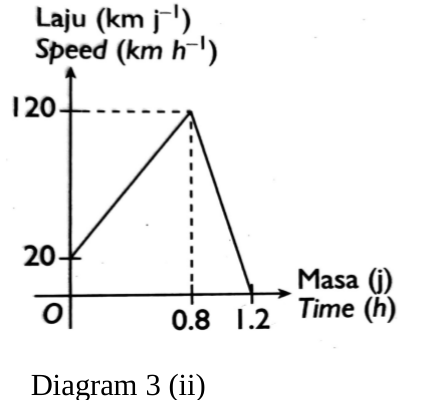
- (a)
If Allyna starts at 11.30 a.m., at what time does she arrive at her destination?
[2] - (b)
Calculate the difference in distance, in km, travelled by Allyna and Roxane for a period of 1.2 hours.
[3]
Diagram 4 shows a unit circle with centre O. A point (p, 0.8205) lies on the circle in the second quadrant, and θ is the angle measured anticlockwise from the positive x-axis. Calculate the value of (a) θ, (b) p, (c) tan θ.
Medium3 marks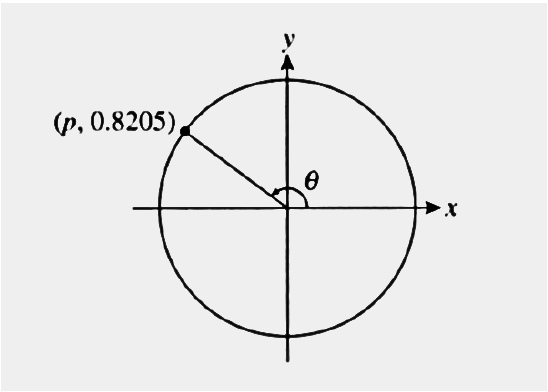
- (a)
θ
[1] - (b)
p
[1] - (c)
tan θ
[1]
Section B
Thomas tests his water rocket. Its height after t seconds is given by h = 18t – 3t², where h is in metres. (a) Complete Table 2 for h = 18t – 3t² for 0 ≤ t ≤ 5 (t = 0, 1, 2, 3, 4, 5; h = 0, __, 24, 27, __, 15). (b) Using a scale of 2 cm to 1 unit on the t-axis and 2 cm to 5 units on the h-axis, draw the graph of h = 18t – 3t² for 0 ≤ t ≤ 5. (c) Use the graph to estimate (i) the time taken for the rocket to reach the height of 14 metres, (ii) the height reached for the rocket after 3.5 seconds.
Medium8 marks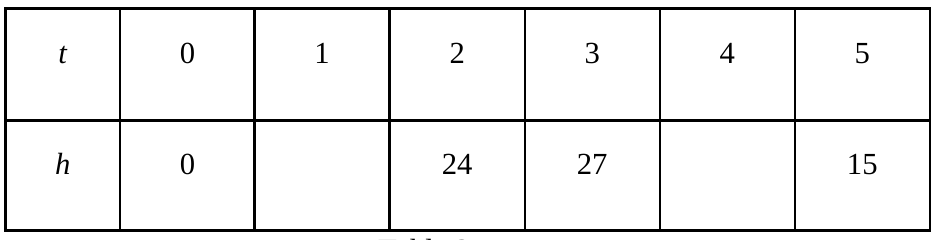
- (a)
Complete Table 2 (the missing values of h at t = 1 and t = 4).
[2] - (b)
Using a scale of 2 cm to 1 unit on the t-axis and 2 cm to 5 units on the h-axis, draw the graph of h = 18t – 3t² for 0 ≤ t ≤ 5.
[4]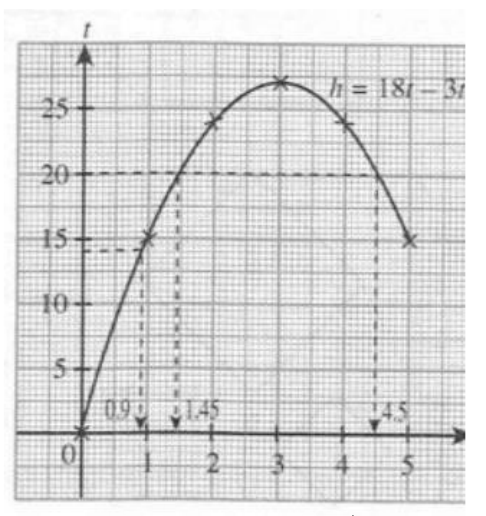
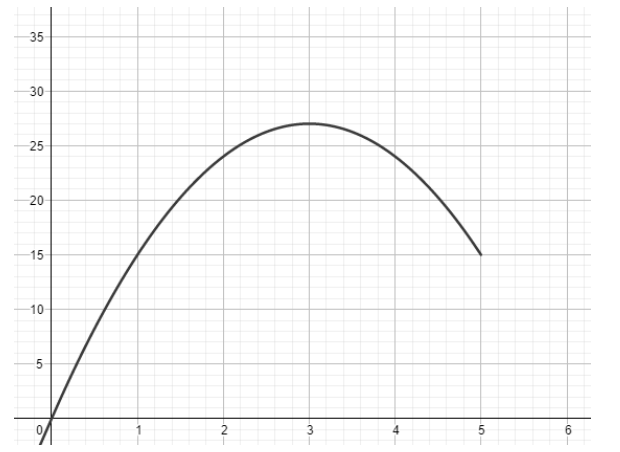
- (c)(i)
Estimate the time taken for the rocket to reach the height of 14 metres.
[1] - (c)(ii)
Estimate the height reached for the rocket after 3.5 seconds.
[1]
Table 3 shows the time, in minutes, taken by 45 students to solve some trigonometry problems. Time: 35–39, 40–44, 45–49, 50–54, 55–59, 60–64, 65–69 Midpoint: 37, 42, 47, 52, 57, 62, 67 Frequency: 4, 3, 8, 10, 9, 6, 5 (a) Based on Table 3, calculate (i) the estimated mean of time taken by a student, (ii) the standard deviation of the data. (b) Using the scale of 2 cm to 5 minutes on the horizontal axis and 2 cm to 1 student on the vertical axis, draw a frequency polygon for the data.
Medium10 marks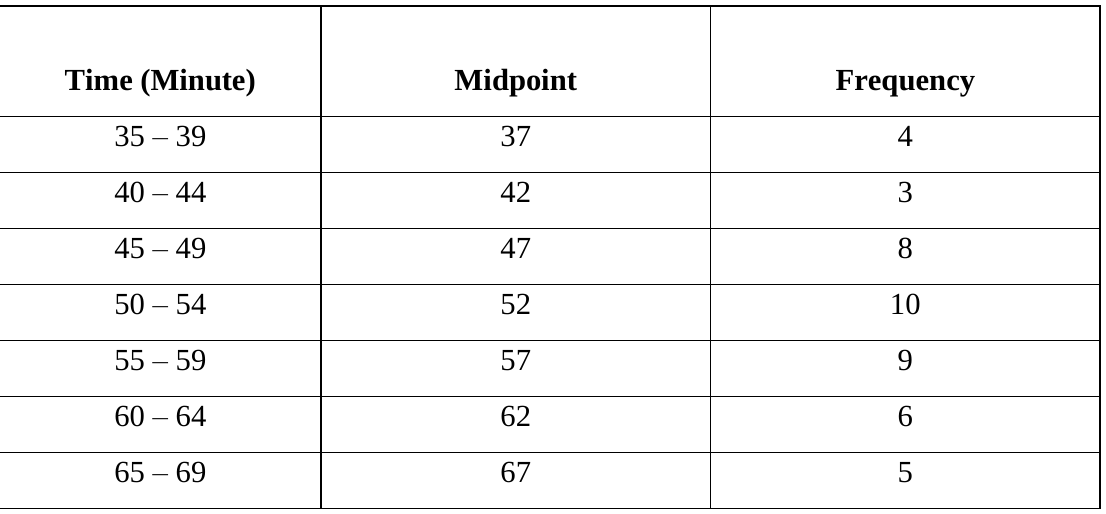
- (a)(i)
Complete the fx and fx² columns and calculate the estimated mean of the time taken by a student.
[4] - (a)(ii)
Calculate the standard deviation of the data.
[2] - (b)
Draw a frequency polygon for the data (2 cm to 5 minutes on the horizontal axis, 2 cm to 1 student on the vertical axis).
[4]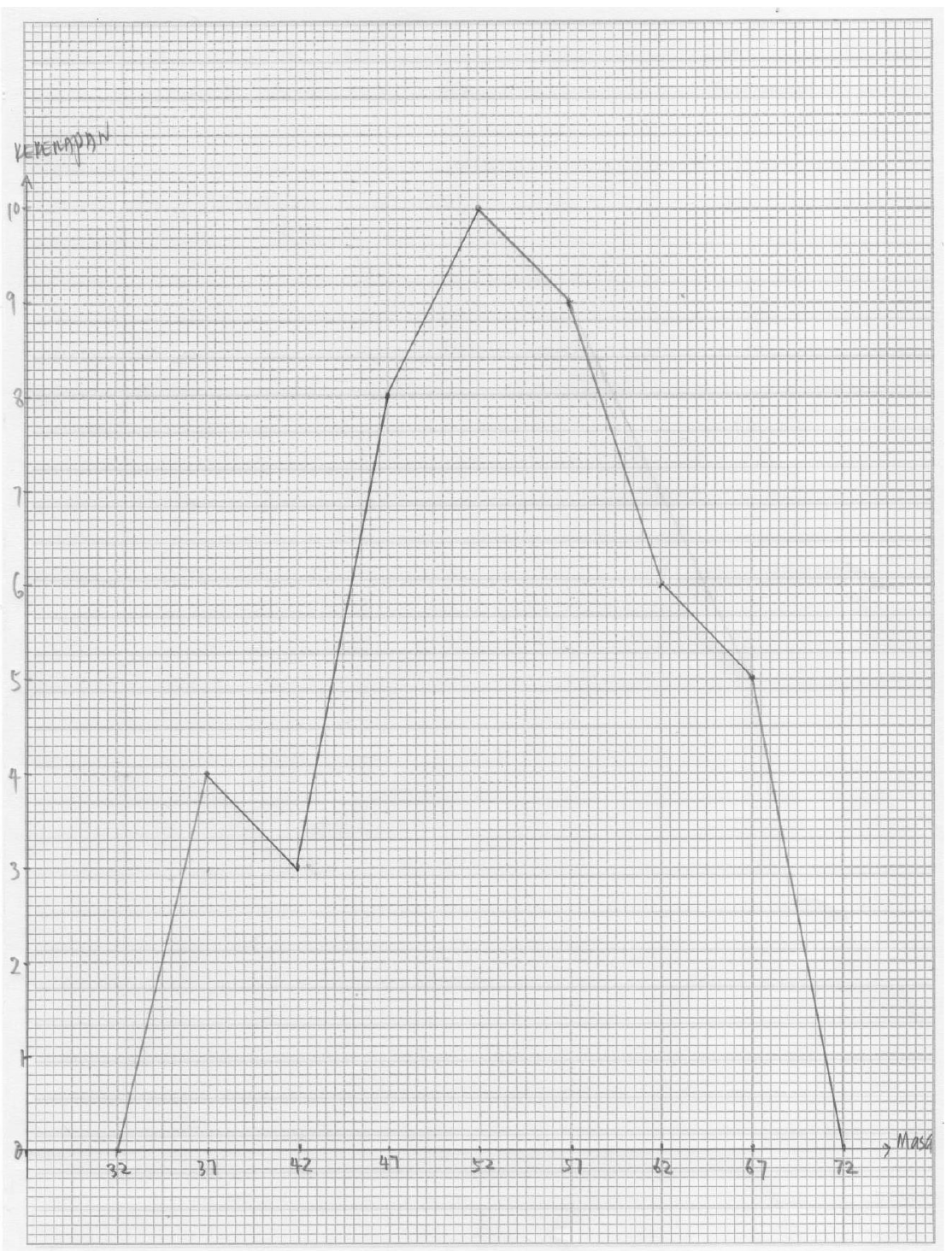
Diagram 5 shows six numbered balls (1, 3, 4, 5, 6, 7) in Bag 1 and four balls which are blue, green, purple and red in Bag 2. One ball is chosen at random from Bag 1 and Bag 2. (a) Using B for blue, G for green, P for purple and R for red, complete the sample space (table). (b) By listing down all the possible outcomes of the event, find the probability that (i) a number less than 6 and a green ball are chosen, (ii) a number which is multiple of 3 or a red ball is chosen. (c) Find the probability that number 1 is chosen from Bag 1 only.
Medium8 marks
- (a)
Complete the sample space in the table (partly filled).
[3]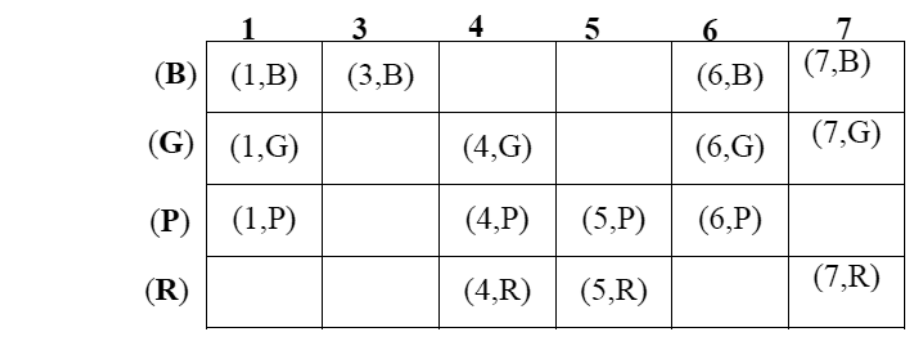
- (b)(i)
A number less than 6 and a green ball are chosen: list the outcomes and find the probability.
[2] - (b)(ii)
A number which is multiple of 3 or a red ball is chosen: list the outcomes and find the probability.
[2] - (c)
Find the probability that number 1 is chosen from Bag 1 only.
[1]
Mr Tan works as an engineer and receives net salary of RM 4200 per month. Table 4 shows his monthly expenses: Food RM600, Petrol expenses RM250, House utilities RM500, Housing loan instalment RM850, Entertainment RM100, Car Instalment RM450, Insurance premiums RM250, Allowance for parents RM200. Mr Tan sets aside 10% of his salary as a fixed monthly savings and RM100 as a saving for emergency fund. He plans to buy a new laptop with the price of RM2500 in 6 months, paying lump-sum with his savings. (a) Complete the financial plan for Mr Tan. (b) Based on the plan, can he achieve his financial goal? Why? (Show your calculation.) (c) Is Mr Tan's financial management wise? Justify your answer.
Medium9 marks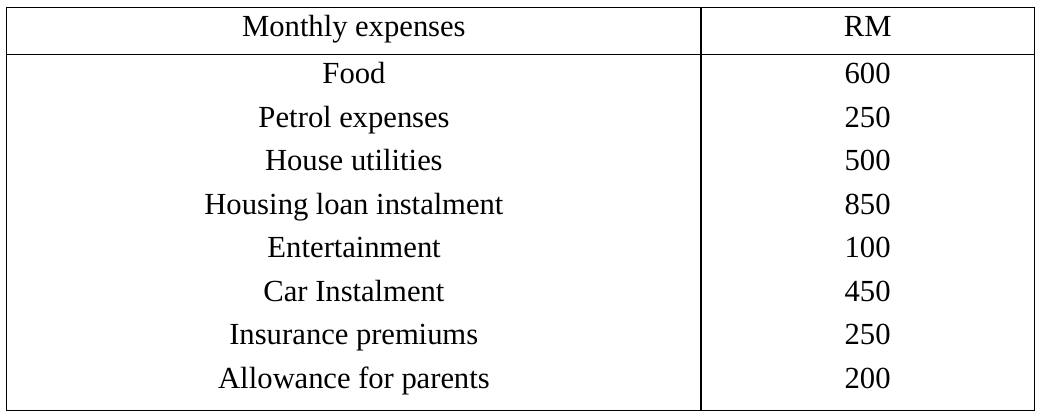
- (a)
Complete the financial plan (Income and Expenditure table) for Mr Tan.
[4] - (b)
Based on Mr Tan's financial plan, can he achieve his financial goal? Why? (Show your calculation.)
[3] - (c)
Is Mr Tan's financial management wise? Justify your answer.
[2]
Diagram 6 shows three quadrilaterals ABCD, KLMN and PQRS, drawn on a Cartesian plane. KLMN is the image of ABCD under transformation U. PQRS is the image of KLMN under transformation V. (a) Describe in full the transformation (i) U, (ii) V. (b) Given that the area of PQRS is 15 cm², calculate the area, in cm², of the shaded region. (c) State the image of point J (−4, −2) under the translation (8, −3) (column vector). (d) Find the image of J′ under the reflection on the x-axis.
Medium10 marks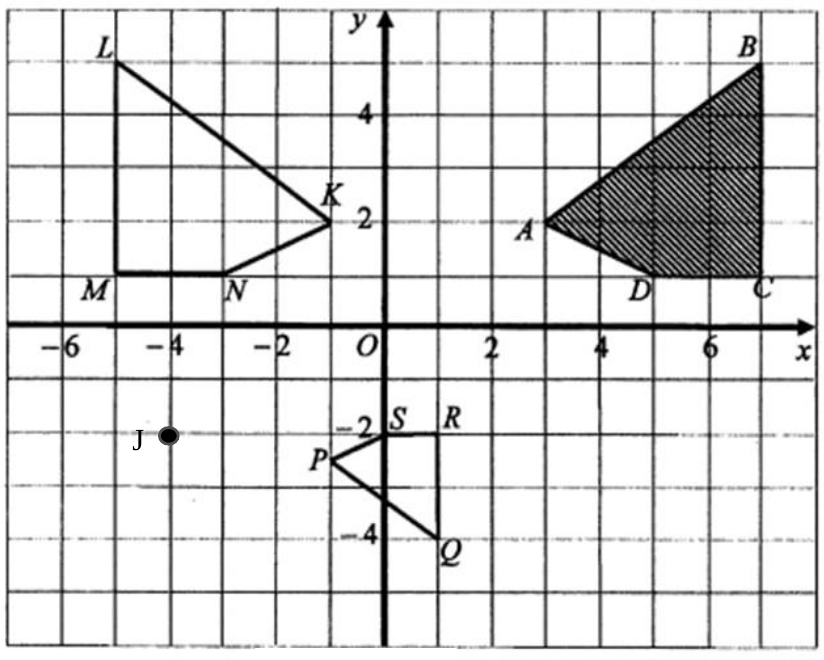
- (a)(i)
Describe in full the transformation U.
[2] - (a)(ii)
Describe in full the transformation V.
[3] - (b)
Given that the area of PQRS is 15 cm², calculate the area of the shaded region.
[3] - (c)
State the image of point J (−4, −2) under the translation (8, −3).
[1] - (d)
Find the image of J′ under the reflection on the x-axis.
[1]
Section C
(a)(i) Simplify 2p × 3q² ÷ (−12qp²). (ii) Express 1/(5a) − (5f − 3)/(10a) as a single fraction in its simplest form. (b) The mass, in kg, of 15 passengers in a bus: 10, 25, 43, 36, 52, 25, 10, 15, 48, 30, 32, 32, 40, 28, 48. (i) Find the range. (ii) Complete Table 5 (first quartile, median, third quartile). (iii) Construct a box plot. (c) Mr. Hakim's annual salary is RM84 000 in 2021. He claims individual relief of RM9000, life insurance and EPF of RM7000, medical insurance of RM2500 and his mother's medical expenses of RM1700. He donated RM800 to an approved welfare centre and paid zakat of RM1202 that year. His salary is deducted monthly at RM230 for the monthly tax deduction, PCB. (i) Calculate the income tax that needs to be paid that year. (ii) Does Mr. Hakim need to pay the balance of income tax?
Medium15 marks- (a)(i)
Simplify 2p × 3q² ÷ (−12qp²).
[2] - (a)(ii)
Express 1/(5a) − (5f − 3)/(10a) as a single fraction in its simplest form.
[2] - (b)(i)
Find the range of the set of data.
[1] - (b)(ii)
Complete Table 5: first quartile, median, third quartile.
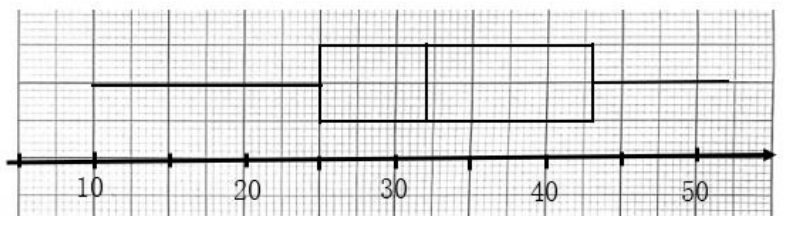
[3] - (b)(iii)
Construct a box plot.
[2]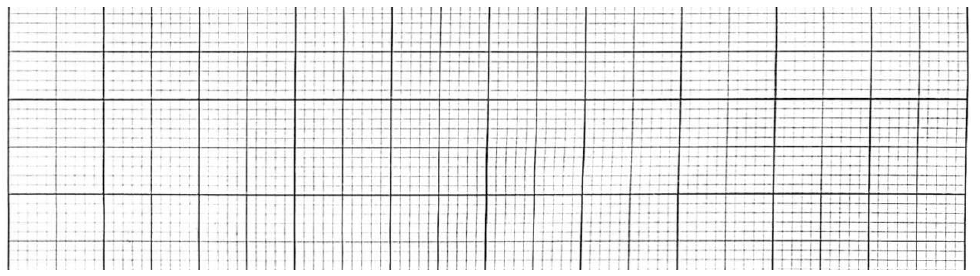
- (c)(i)
Calculate the income tax that needs to be paid that year (tax table given).
[4] - (c)(ii)
Does Mr. Hakim need to pay the balance of income tax?
[1]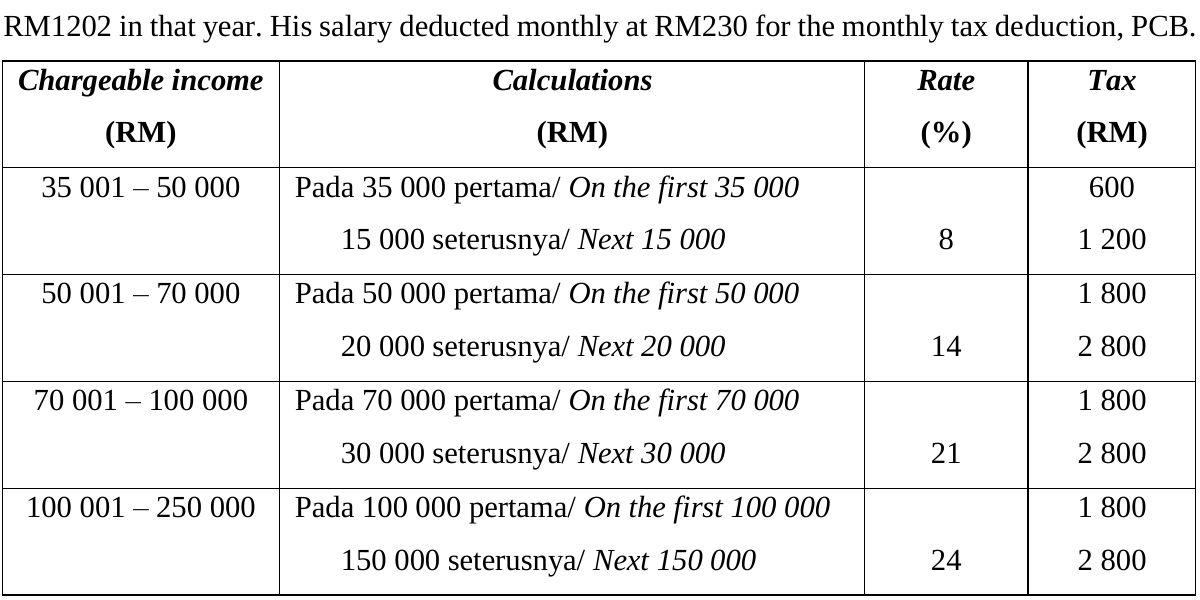
(a) Diagram 8 shows a rectangle (sides 1.5q cm and p/3 cm) and a right-angled triangle (sides q cm, p cm, hypotenuse 1.7 cm). The perimeters of the rectangle and triangle are 3.4 cm and 4 cm respectively. Find p and q. (b) The Venn diagram shows the number of members of three societies from 80 students: M only y; S only x; E only 23; M∩S only 12; M∩E only 8; S∩E only 3; M∩S∩E 6. M = Mathematics Society, S = Science Society, E = English Language Society, ξ = M ∪ S ∪ E. The number of members of the Mathematics Society is twice the number of members of the Science Society. (i) Calculate the number of members of the Science Society. (ii) Find the total number of students who are members of the Mathematics Society only and members of the Science Society only. (c) Diagram 8 shows point Q (0, 5) on a Cartesian plane. Transformation R is a clockwise rotation of 90° about the centre (2, 2). Transformation T is a translation (1, −3). State the coordinates of the image of point Q under (i) T², (ii) TR, (iii) the reflection in the line y = 3.
Hard15 marks- (a)
Find the values of p and q.
[4]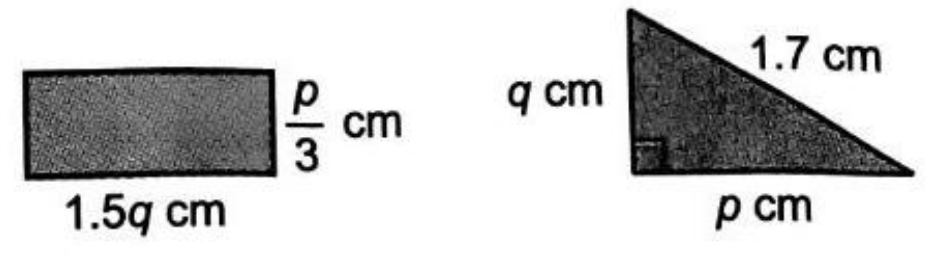
- (b)(i)
Calculate the number of members of the Science Society.
[3]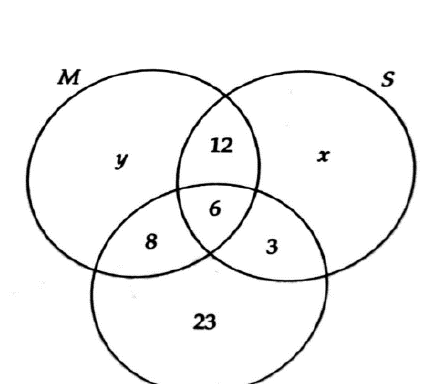
- (b)(ii)
Find the total number of students who are members of the Mathematics Society only and members of the Science Society only.
[3] - (c)(i)
State the coordinates of the image of Q under T².
[2]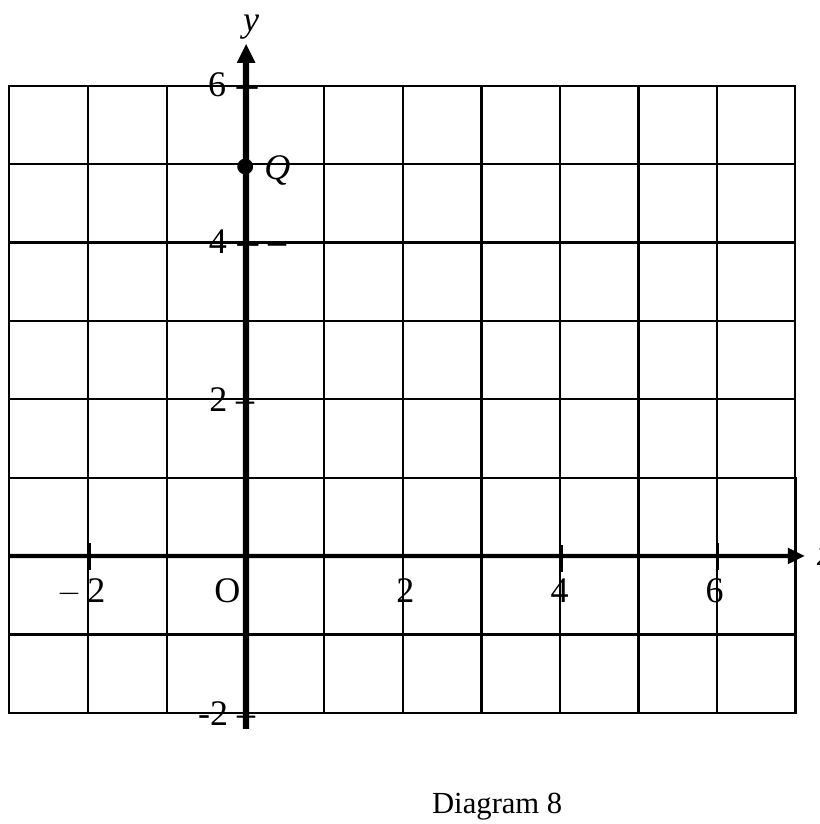
- (c)(ii)
State the coordinates of the image of Q under TR.
[2] - (c)(iii)
State the image of Q under reflection in the line y = 3.
[1]