Write your answer on paper. Then open the answer to check it.
Section A
Using matrices, solve the simultaneous equations 5x + 3y = 41 and 4x + 2y = 30.
Medium4 marksUsing matrices, solve: 5x + 3y = 41, 4x + 2y = 30.
[4]
The diagram is a weighted undirected graph showing the distance, in km, between five main locations A, B, C, D, E in a city (AB 5, BC 5, CD 2, AD 10, AE 3, CE 6, DE 7). (a) Draw two subgraphs of the graph. (b) Draw a tree with a maximum total weight and calculate the maximum total weight.
Medium4 marks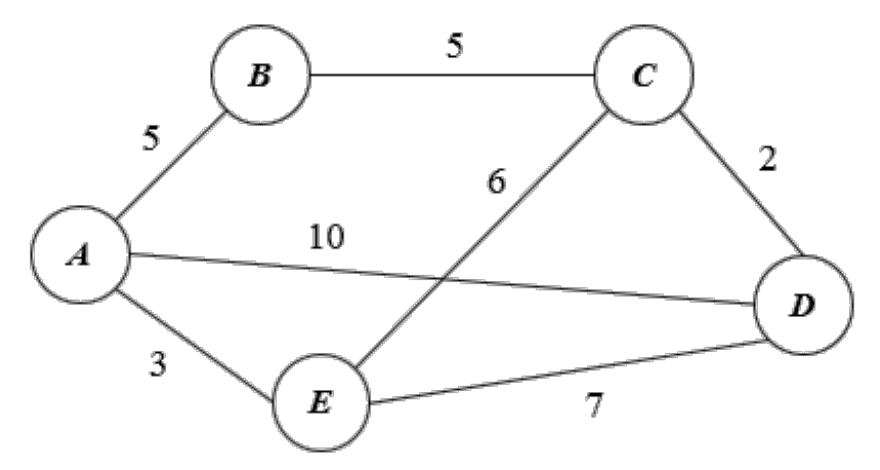
- (a)
Draw two subgraphs of the graph.
[2]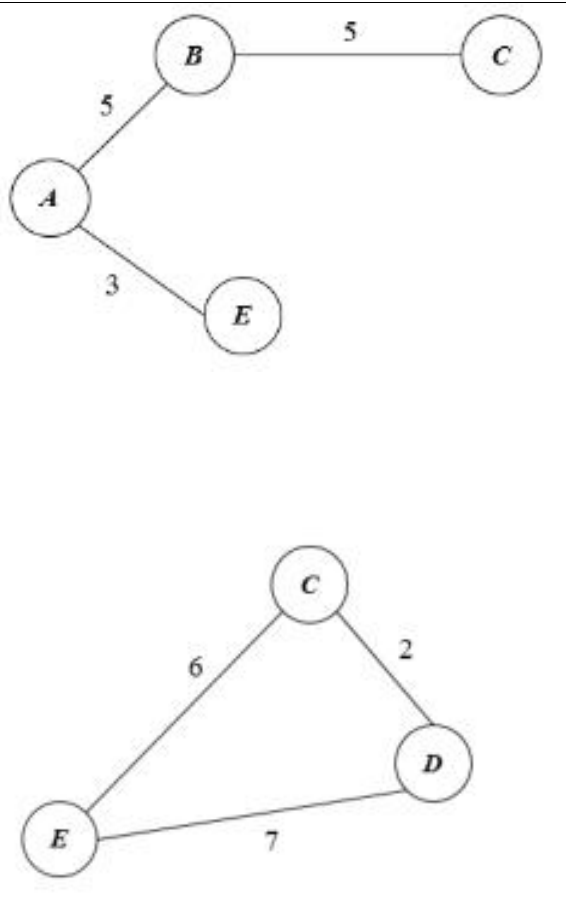
- (b)
Draw a tree with a maximum total weight and calculate the maximum total weight.
[2]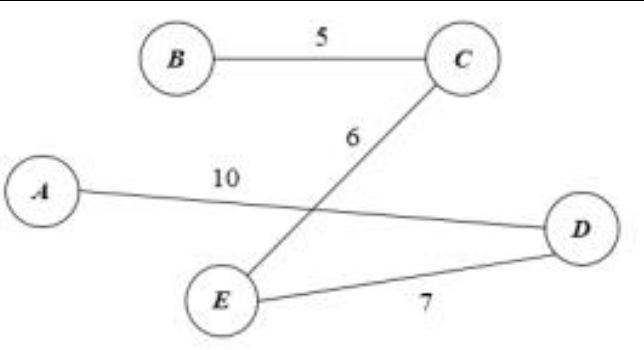
Table 3 shows the annual premium rate for every RM 1 000 face value of temporary insurance annual renewable offered by Selamat Insurance Company. Age 30: male non-smoker 1.90, male smoker 2.48, female non-smoker 1.32, female smoker 1.71. Age 31: 1.90, 2.52, 1.45, 1.82. Age 32: 1.90, 2.63, 1.56, 1.97. Mrs. Fatin is 31 years old and a non-smoker. She bought the insurance policy amounting to RM 180 000 and would like to add a critical illness policy. The critical illness policy offers 25% base face value protection with a premium rate of RM1.65 for every RM 1 000 according to age and health status. Calculate the annual premium that needs to be paid.
Medium4 marksCalculate the annual premium that needs to be paid.
[4]
A motorcycle travelling at a speed of 80 km/h decreases its speed by 25% of its initial speed within 50 seconds. Calculate the acceleration.
Medium4 marksCalculate the acceleration.
[4]
The diagram shows a square PQRS. K and L are midpoints of PQ and SR. X, Y and Z are three points which move in the square. By using the letters on the diagram, state (a) the locus of point X which is always equidistant from points P and Q, (b) the locus of point Y such that YR = RS, (c) the locus of point Z which is always equidistant from lines RS and RQ.
Medium3 marks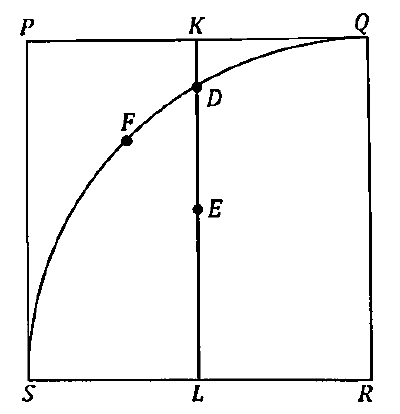
- (a)
Locus of X, equidistant from P and Q.
[1] - (b)
Locus of Y such that YR = RS.
[1] - (c)
Locus of Z, equidistant from RS and RQ.
[1]
Rajiv bought a home theater system for RM8 250. He paid a 10% deposit and the balance is charged with an interest of 8%. He will pay the instalments for 2 years. (a) How much is Rajiv's balance? (b) Calculate the interest charge. (c) If he pays an equal monthly instalment, calculate the payment for each instalment.
Medium5 marks- (a)
How much is Rajiv's balance?
[1] - (b)
Calculate the interest charge.
[2] - (c)
Calculate the payment for each monthly instalment.
[2]
Tisha's marks in Mathematics and Additional Mathematics are 87₉ and 244₅ respectively. Calculate the difference between the marks in Mathematics and Additional Mathematics.
Medium4 marksCalculate the difference between the marks.
[4]
(a) Write down two implications based on the statement: A triangle is equilateral if and only if all the interior angles of the triangle are 60°. (b) Make an inductive conclusion for the sequence 3, 0, −7, −18, … which follows the pattern 3 = 2(1 − 1²) + 3(1), 0 = 2(1 − 2²) + 3(2), −7 = 2(1 − 3²) + 3(3), −18 = 2(1 − 4²) + 3(4).
Medium4 marks- (a)
Write down two implications.
[2] - (b)
Make an inductive conclusion for the sequence.
[2]
Baiti drives a car from city P to city Q along the PLUS highway. Diagram 9 shows the distance-time graph (distance 0 to d km in 50 min, stationary from 50 to 70 min at d km, then to 160 km at 160 min). (a) State the period of time, in minutes, Baiti's car stopped. (b) Given that Baiti drove at 90 km h⁻¹ in the last 90 minutes, calculate d. (c) Calculate the average speed, in km h⁻¹, of Baiti's car in 160 minutes.
Medium5 marks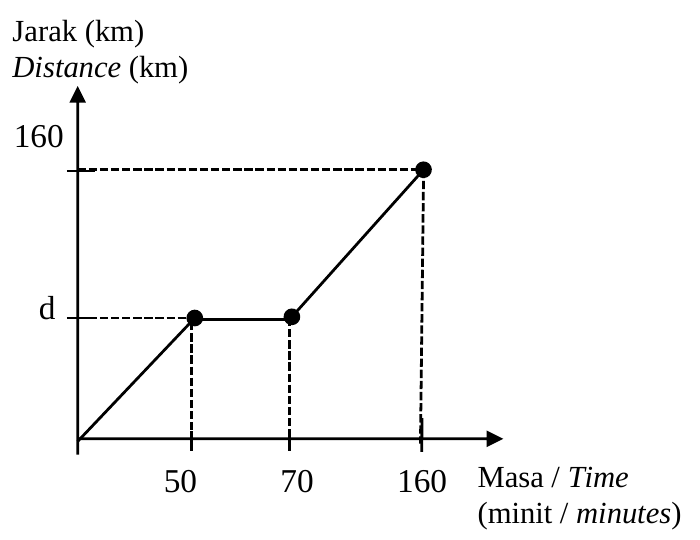
- (a)
State the period of time, in minutes, the car stopped.
[1] - (b)
Given 90 km h⁻¹ in the last 90 minutes, calculate d.
[2] - (c)
Calculate the average speed, in km h⁻¹, in 160 minutes.
[2]
In Diagram 10, PQR is a vertical lamp post on the side of the road AR. Q is the midpoint of PR. Given that PA = 10 m and AR = 8 m, find tan x (x is the angle at A).
Medium3 marks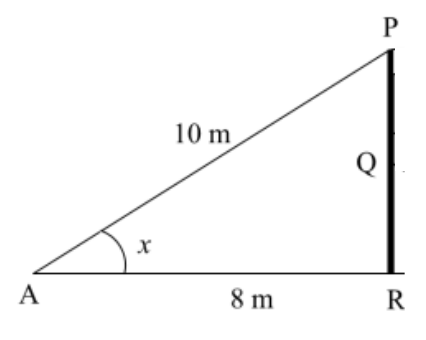
Find tan x.
[3]
Section B
Given the quadratic function f(x) = 3x(x − 1) − (x − 1)(x + 3). (a) Express f(x) in the form ax² + bx + c. (b) Solve each quadratic equation: (i) f(x) = 6, (ii) f(x) = −(3 − 2x).
Medium8 marks- (a)
Express f(x) in the form ax² + bx + c.
[2] - (b)(i)
Solve f(x) = 6.
[3] - (b)(ii)
Solve f(x) = −(3 − 2x).
[3]
Table 12 shows the frequency distribution of speed (km h⁻¹) of 40 cars passing through a road: 35–39: 0; 40–44: 4; 45–49: 5; 50–54: 7; 55–59: 9; 60–64: 6; 65–69: 5; 70–74: 4. (a) Complete the cumulative frequency table in the answer space. (b) Calculate the estimated mean speed of the cars. (c) Using a scale of 2 cm to 5 km h⁻¹ on the horizontal axis and 2 cm to 5 cars on the vertical axis, draw an ogive from the table.
Medium10 marks- (a)
Complete the cumulative frequency table (upper boundaries and cumulative frequencies).
[3]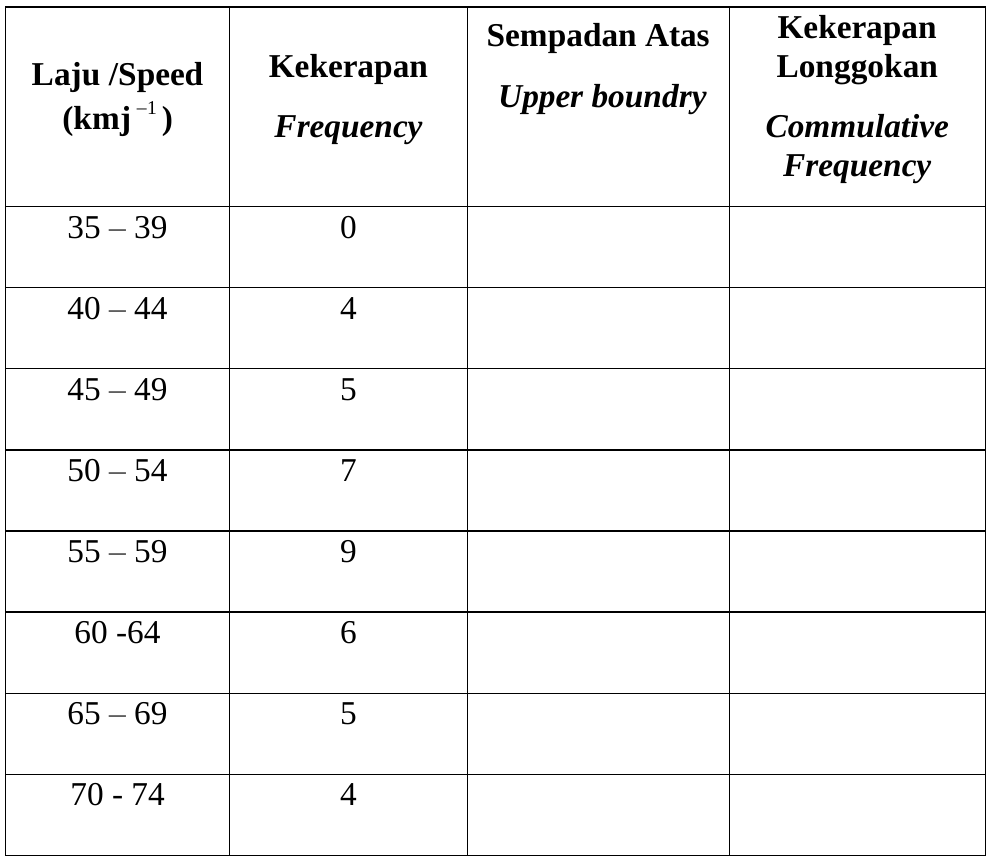
- (b)
Calculate the estimated mean speed.
[3] - (c)
Draw an ogive (graph paper not included in the PDF).
[4]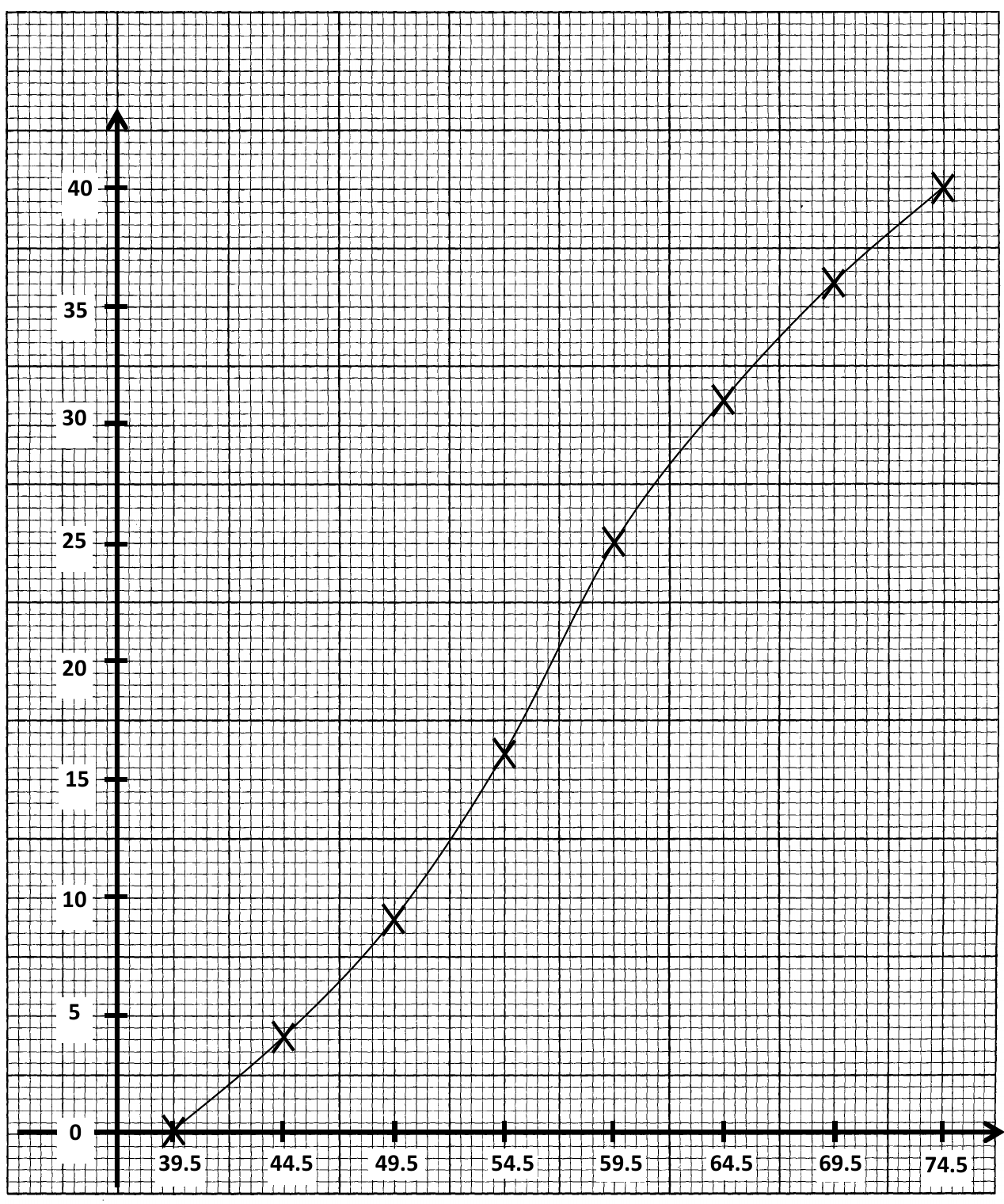
Diana and Ezzaty sat for a Mathematics test. The probabilities that they pass the test are 2/5 and 2/3 respectively. (a) Sketch a tree diagram to show all the possible outcomes. (b) Calculate the probability that both of them failed the test. (c) Calculate the probability that at least one of them passed the test.
Medium8 marks- (a)
Sketch a tree diagram showing all possible outcomes.
[4]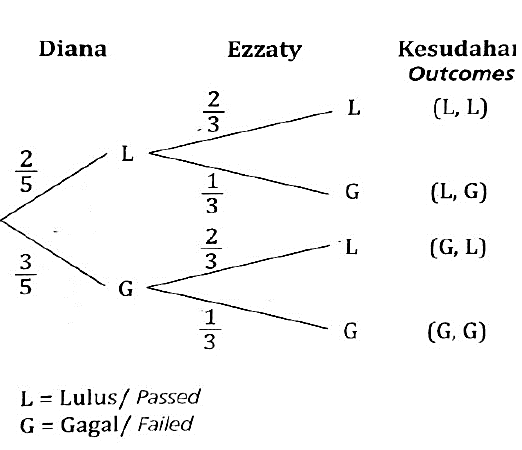
- (b)
Probability that both failed.
[1] - (c)
Probability that at least one passed.
[3]
Rihana is a kindergarten teacher who earns RM2 800 a month. She wants to buy a laptop that costs RM1 800 in six months. Describe the financial management process that Rihana needs to carry out to achieve her goal. (Steps given: Setting Goals; Evaluating Financial Status; Creating Financial Plan; Carrying Out Financial Plan; Reviewing and Revising the Progress.)
Medium9 marksDescribe the financial management process Rihana needs to carry out.
[9]
(a) Transformation H is a translation (−2, 3) [column vector] and transformation G is a clockwise rotation of 90° about the centre (1, 1). State the coordinates of the image of point A(−2, 4) under (i) H, (ii) G. (b) Diagram 15 shows three pentagons ABCDE, FGHIJ and KLMNJ on a Cartesian plane. KLMNJ is the image of ABCDE under the combined transformation PQ. Describe in full the transformations P and Q. (c) Given that the area of pentagon ABCDE is 20 cm², calculate the area of the shaded region.
Medium10 marks- (a)(i)
Image of A(−2, 4) under H.
[1] - (a)(ii)
Image of A(−2, 4) under G.
[1] - (b)
Describe in full the transformations Q and P (KLMNJ is the image of ABCDE under PQ).
[5]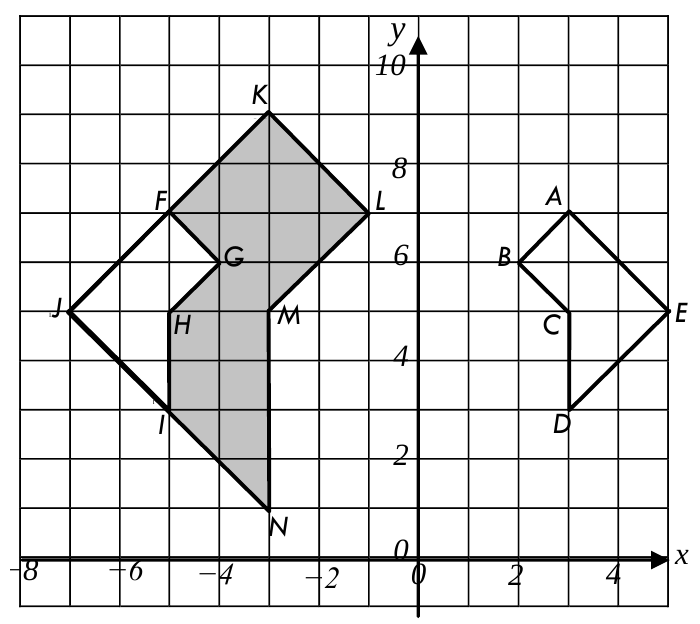
- (c)
Area of the shaded region, given area ABCDE = 20 cm².
[3]
Section C
(a) A box has dimensions (5x − 10) cm, (2x + 5) cm and height 10 cm. Given the volume of the box is 10 000 cm³, find the value of x. (b)(i) The box plot shows the age distribution (in years) of Mr. Danial's online customers. State the value of (a) the range, (b) the median, (c) the interquartile range. (ii) Table 16 shows reward points and frequency: points 1, 2, 3, 4, 5 with frequencies 5, 13, 17, 4, 1. Calculate the interquartile range. (c) Mr. Danial's annual income is RM 108 000. He claims tax relief for: life insurance premium RM 1800; his mother's medical expenses RM2300; internet subscription RM100 per month; sports equipment RM500; tablet RM 2800. He pays zakat of RM1200. Calculate the chargeable income and the income tax to be paid, using the tax rate table (Assessment Year 2019).
Medium15 marks- (a)
Find the value of x (box: (5x − 10) cm, (2x + 5) cm, 10 cm; volume 10 000 cm³).
[4]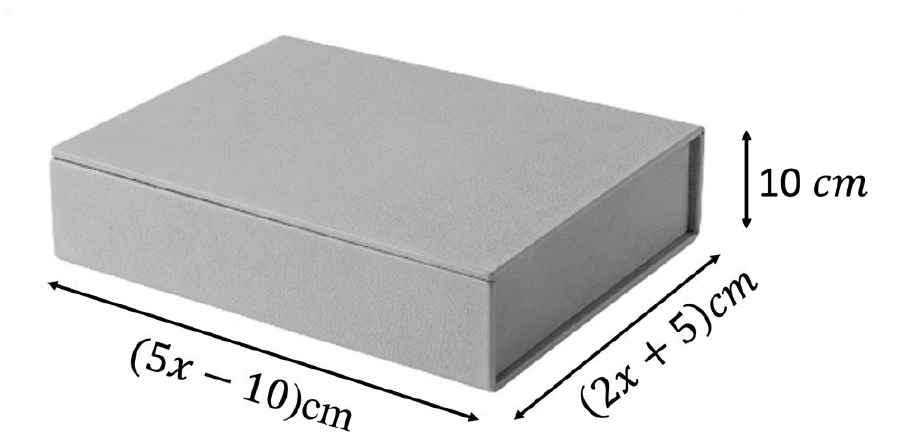
- (b)(i)
From the box plot state (a) the range, (b) the median, (c) the interquartile range.
[3]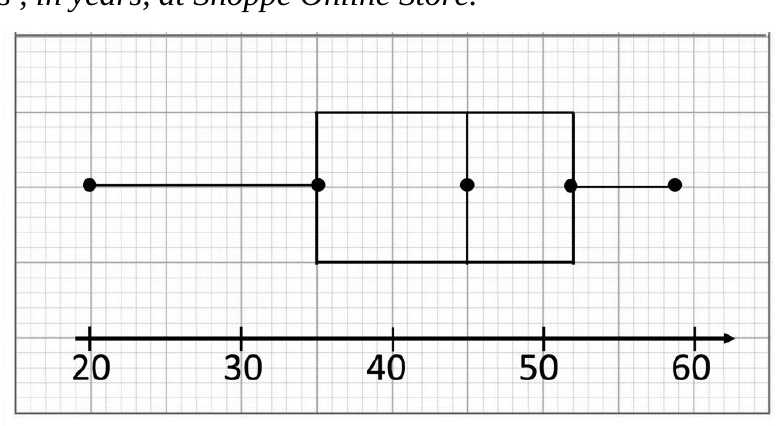
- (b)(ii)
Calculate the interquartile range (reward points 1–5; frequencies 5, 13, 17, 4, 1).
[3]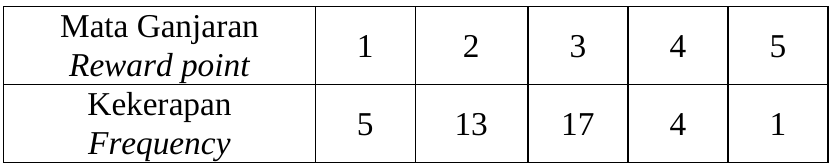
- (c)
Calculate the chargeable income and the income tax to be paid.
[5]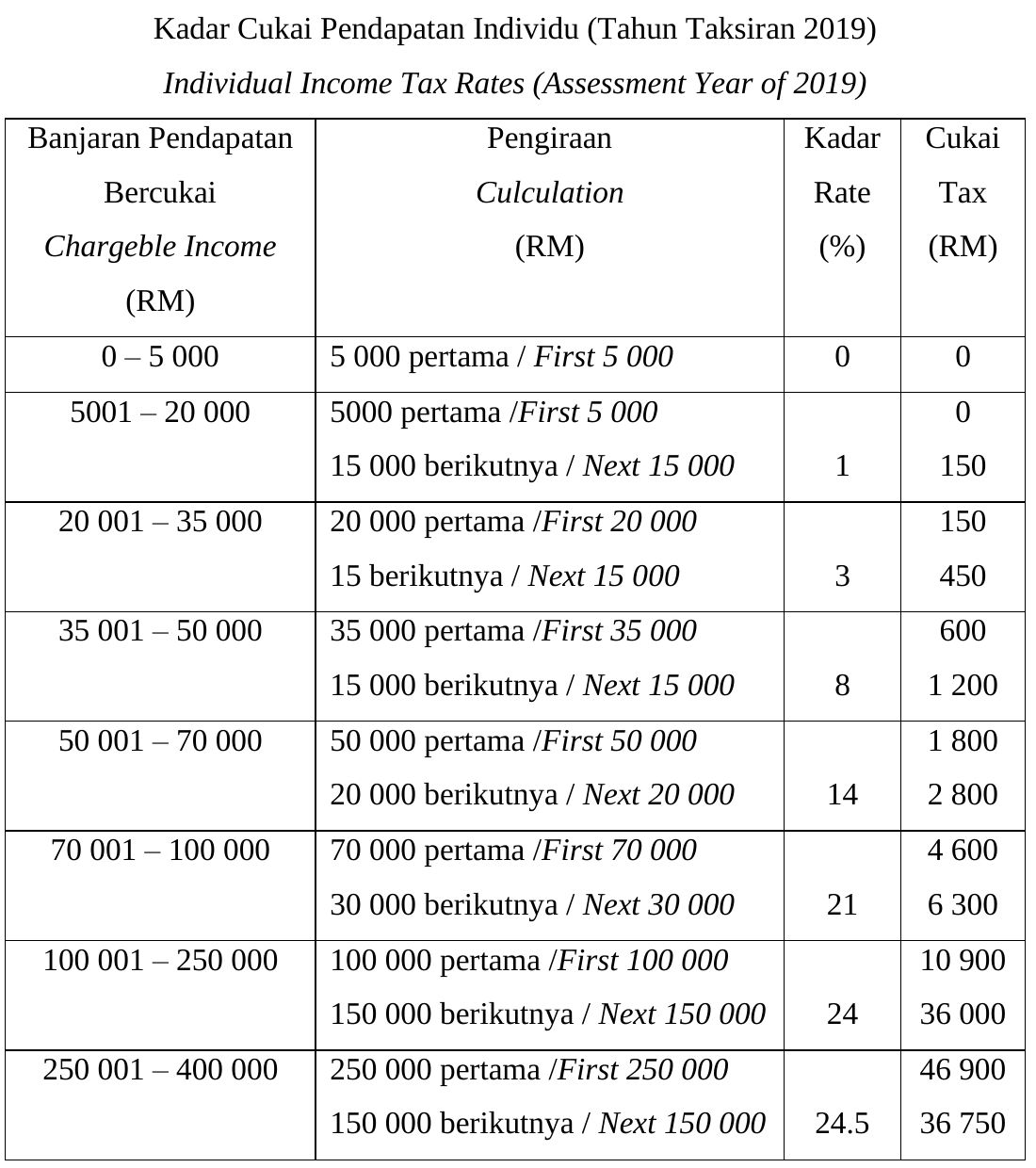
Sedap Restaurant sells fast food set A and set B. The selling price of each set with drinks is RMx and without drinks is RMy. Diagram 17a shows the sets sold in an hour: set A: 3 with drinks, 4 without drinks; set B: 5 with drinks, 3 without drinks. (a) The total sales of set A and set B are RM72 and RM87 respectively. Without using matrices, calculate the selling price of a set with drinks and without drinks. (b) Diagram 17b shows a Venn diagram, universal set ξ = B ∪ F, B = {customers who buy burgers}, F = {customers who buy fries}, with 2x in B ∩ F. (i) There are 46 customers on Tuesday. The number who bought burgers only is x and the number who bought neither burger nor fries is y. Complete the Venn diagram in terms of x and y. (ii) If the number who bought burgers only is 7 and fries only is 16, calculate the number who bought neither. (iii) State the number who bought burgers and fries. (c) Diagram 17c shows the floor plan of two ponds P and Q; the shaded area is a picnic spot. Octagon A′B′C′D′E′F′G′H′ is the image of pond P under the combined transformation XY. X is an enlargement at centre H′ with scale factor 2. Y is a reflection in the line y = −x − 2. (i) Given the area of the picnic spot is 51 m², calculate the area, in m², of pond P. (ii) The architect decides to shift pond P under a translation (−2, 1) [column vector]. Describe the new transformation Y.
Hard15 marks- (a)
Calculate the selling price of a set with drinks and without drinks (without matrices).
[4]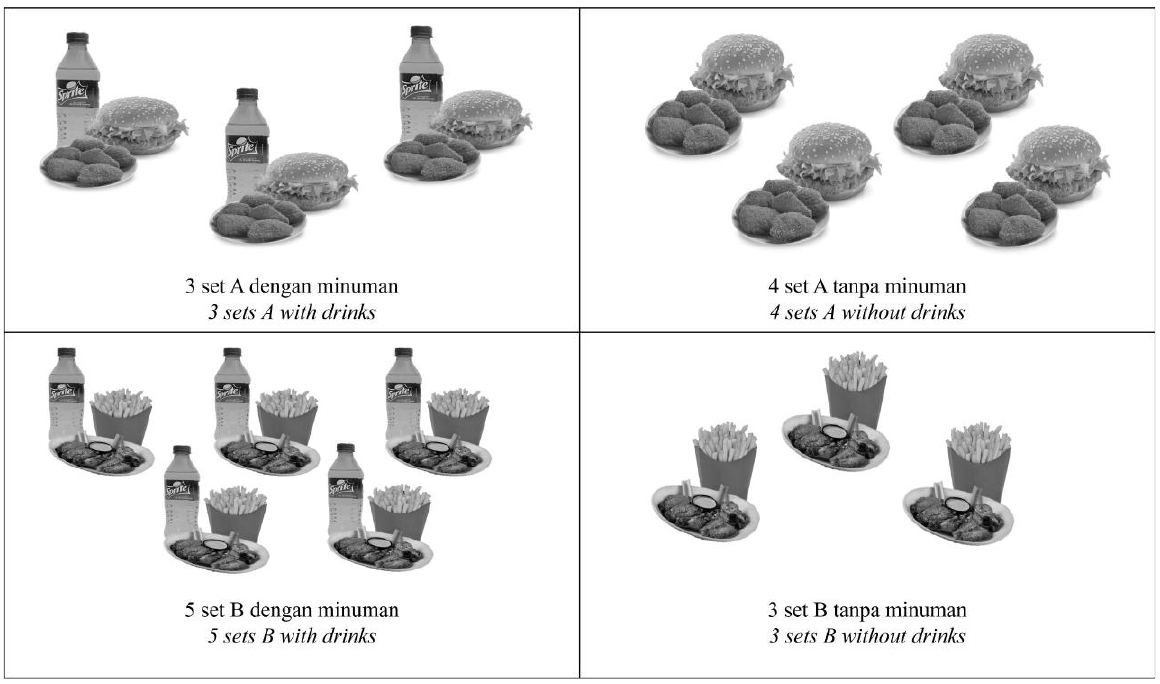
- (b)(i)
Complete the Venn diagram in terms of x and y.
[3]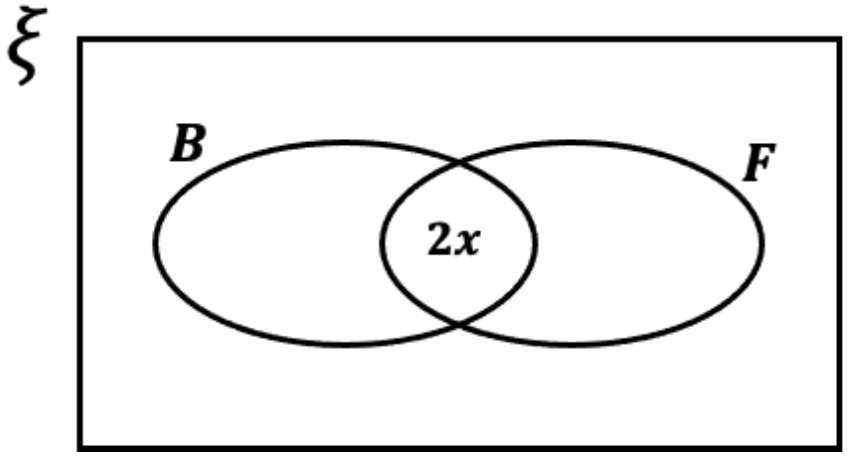
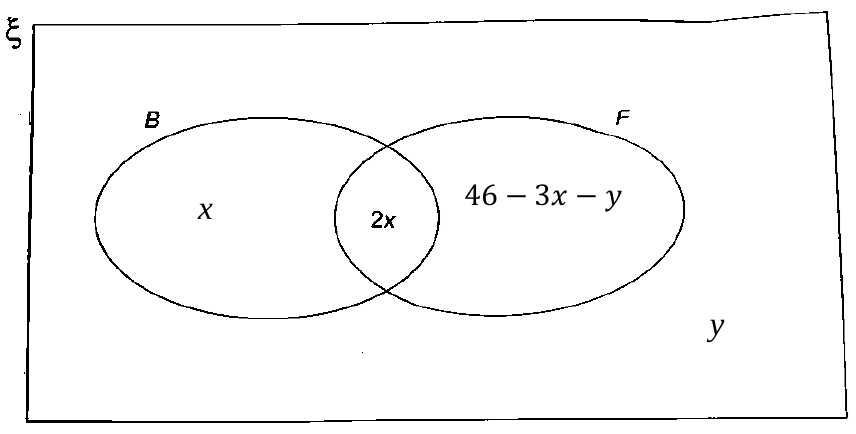
- (b)(ii)
Burgers only = 7, fries only = 16: number who bought neither.
[2] - (b)(iii)
Number of customers who bought burgers and fries.
[1] - (c)(i)
Area of pond P given the picnic spot area is 51 m².
[2]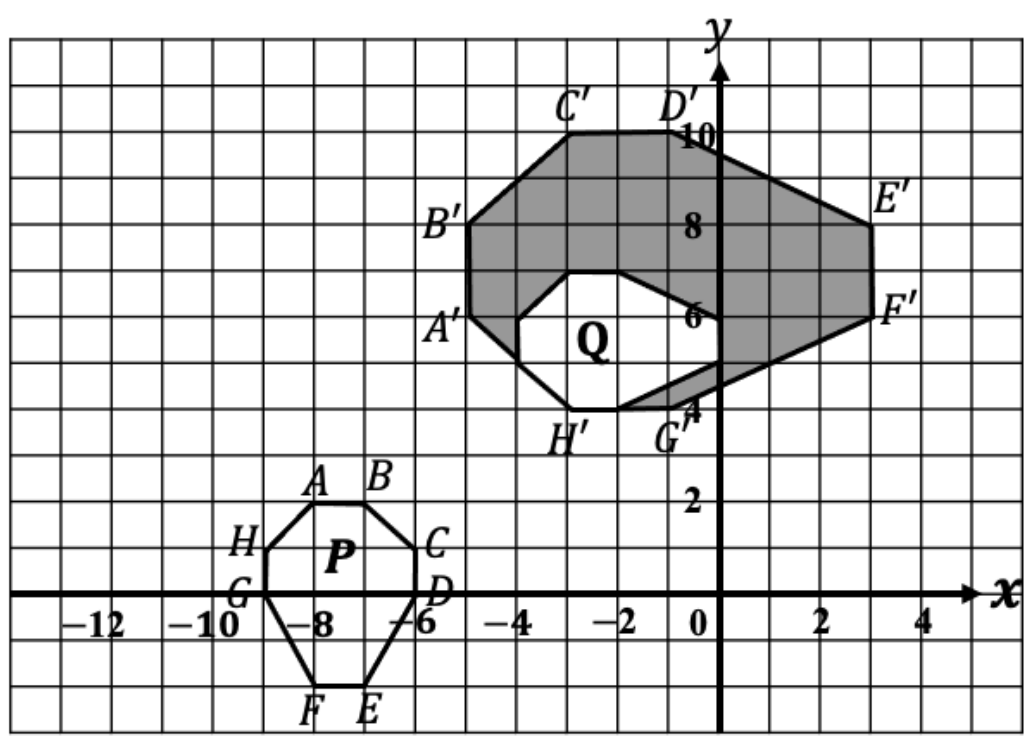
- (c)(ii)
Describe the new transformation Y after translating pond P by (−2, 1).
[3]