Write your answer on paper. Then open the answer to check it.
Section A
(a) Given that q × [[−2, 3], [−4, 5]] is the inverse matrix of [[5, −3], [4, −2]], find the value of q. (b) Using the matrix method, find m and n that satisfy [[5, −3], [4, −2]] [m, n] = [13, 10] (column matrices).
Medium4 marks- (a)
Given that q × [[−2, 3], [−4, 5]] is the inverse matrix of [[5, −3], [4, −2]], find the value of q.
[1] - (b)
Using the matrix method, find m and n: [[5, −3], [4, −2]] [m, n] = [13, 10] (column).
[3]
(a) Draw a simple graph with vertices V = {A, B, C, D, E, F} and edges E = {(A,B), (A,C), (B,C), (C,D), (C,F), (D,E)}. (b) A network graph has 8 edges. Calculate the sum of degrees of the graph.
Medium4 marks- (a)
Draw a simple graph based on V = {A, B, C, D, E, F} and E = {(A,B), (A,C), (B,C), (C,D), (C,F), (D,E)}.
[3]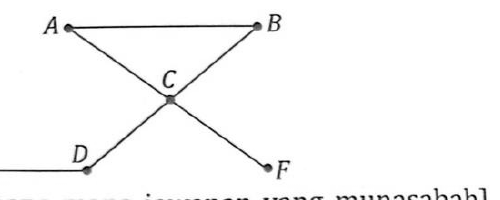
- (b)
A network graph has 8 edges. Calculate the sum of degrees of the graph.
[1]
Table 1 shows the annual premium rate per RM1000 face value of life insurance (Selamat's Insurance Company) by age, sex and smoking status. (a) Mrs Nancy, 34, non-smoker, wants RM350 000 coverage; find her annual premium. (b) Mr Kamal, 32, smoker, has RM300 000 coverage with annual premium RM905.10; find x.
Medium4 marks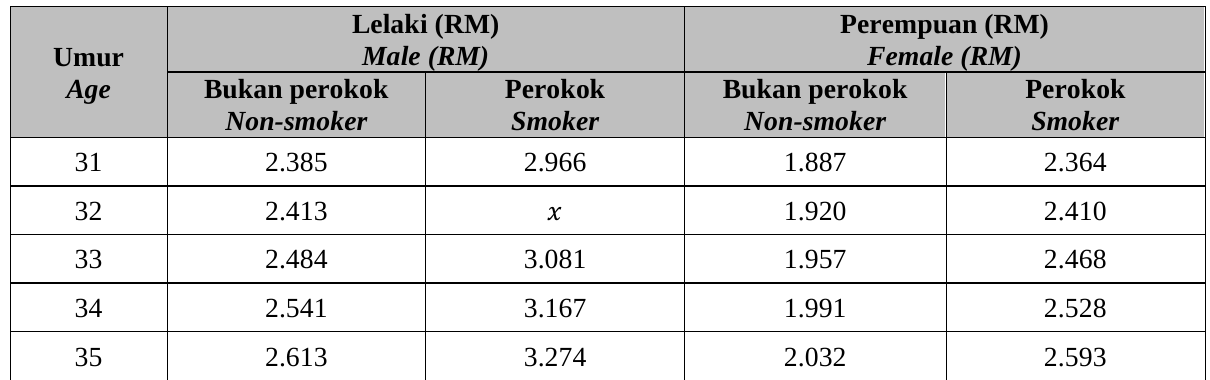
- (a)
Mrs Nancy is 34 years old and a non-smoker. She wants life insurance coverage worth RM350 000. Based on Table 1, calculate the annual premium.
[2] - (b)
Mr Kamal is 32 years old and a smoker. He gets life insurance coverage worth RM300 000 with annual premium RM905.10. Find the value of x.
[2]
(a) John left his house at 11.25 a.m. for a town 169 km away and arrived at 2.40 p.m. Find his speed in km/h. (b) Calculate the deceleration: (i) Haikal slows his car from 120 km/h to 90 km/h in 0.75 hour; (ii) a bicycle's speed changes from 50 m/min to 35 m/min in 2 minutes.
Medium4 marks- (a)
John left his house at 11.25 a.m. to a town 169 km away. He reached his destination at 2.40 p.m. Find his speed, in km/h.
[2] - (b)(i)
Haikal slows his car's speed from 120 km/h to 90 km/h in 0.75 hour. Calculate the deceleration.
[1] - (b)(ii)
The speed of a bicycle changes from 50 m/min to 35 m/min in 2 minutes. Calculate the deceleration.
[1]
Diagram 1 shows a square ABCD with midpoints E, F, G, H of AD, AB, BC, CD... (E on AD, H on CD, G on BC, F on AB; the square has sides of 2 cm). Using the letters in the diagram, complete Table 2: (a) a point moving so that its distance is always 2 cm from line BC; (b) a point moving so that it is always equidistant from points B and D; (c) a point moving so that it is always equidistant from lines AD and BC.
Medium3 marks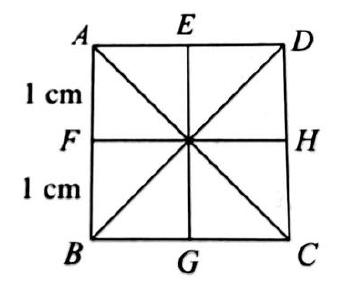
- (a)
A point which moves such that its distance is constantly 2 cm from line BC. Name the locus using the letters in the diagram.
[1] - (b)
A point which moves such that it is always equidistant from point B and point D.
[1] - (c)
A point which moves such that it is always equidistant from line AD and line BC.
[1]
(a) Complete Table 3 using 'Fixed deposit account' and 'Current account': (i) allows payments by cheque; (ii) saves money for a certain period to get higher interest. (b) Mark (√) the high-risk, high-return investment: unit trust, shares or real estate. (c) Mr Zulkifli buys a car for RM95 000, pays a 10% down payment and takes a bank loan at 3.2% per annum. Total interest is RM13 680 and the loan period is 5 years. Determine the type of interest and prove it.
Medium5 marks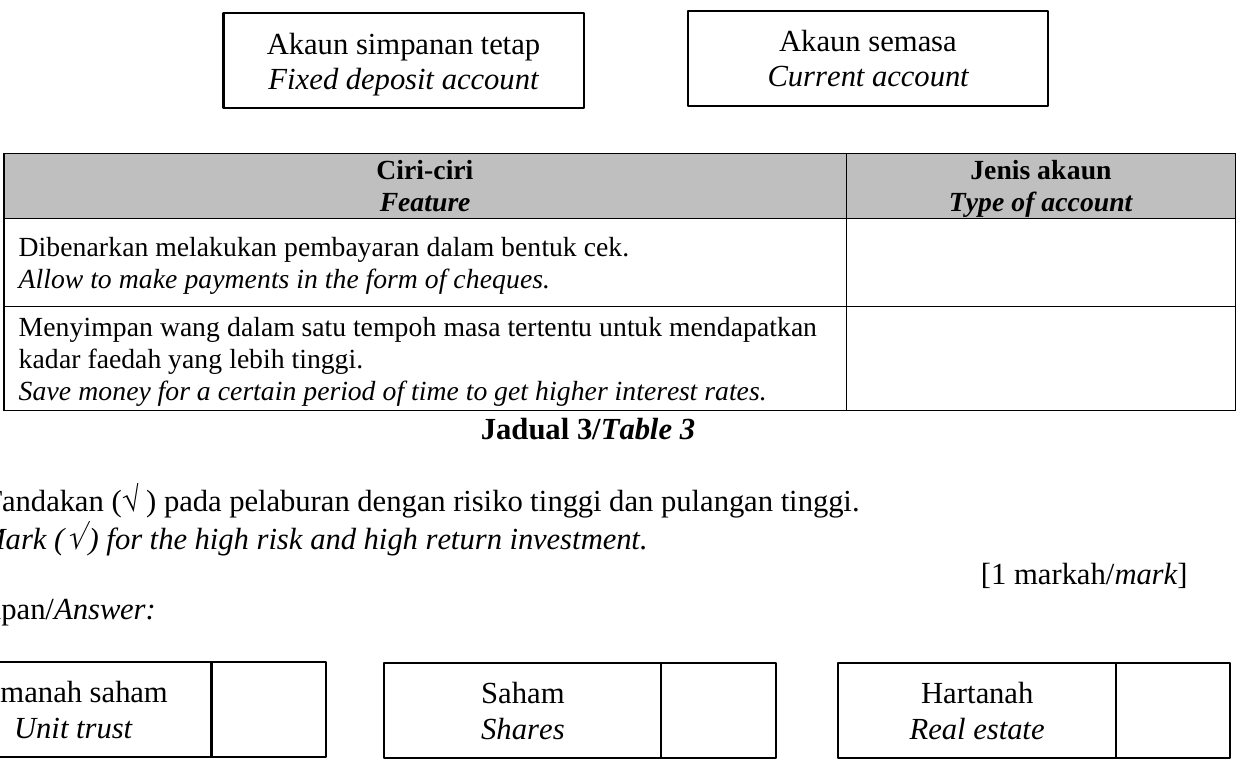
- (a)
(i) Feature: allows payments in the form of cheques. (ii) Feature: save money for a certain period of time to get higher interest rates. State the type of account for each.
[2] - (b)
Mark (√) for the high risk and high return investment: Unit trust / Shares / Real estate.
[1] - (c)
Mr Zulkifli buys a car for RM95 000 with a 10% down payment and a bank loan at 3.2% per annum. Total interest charged is RM13 680 and the loan period is 5 years. Determine the type of interest. Prove your answer.
[2]
(a) Convert 487₉ to base 3. (b) Given 1241₇ − 352₇ = k₇, find k.
Medium4 marks- (a)
Convert 487₉ to base 3.
[2] - (b)
It is given that 1241₇ − 352₇ = k₇. Find the value of k.
[2]
(a) State whether each sentence is a statement or not a statement: (i) 3/7 is an improper fraction. (ii) Syazana has RM520 in her saving account. (b) Write the contrapositive of "If x² = 4, then x = 2" and state its truth value.
Medium4 marks- (a)(i)
State whether '3/7 is an improper fraction' is a statement or not a statement.
[1] - (a)(ii)
State whether 'Syazana has RM520 in her saving account' is a statement or not a statement.
[1] - (b)
Write the contrapositive of 'If x² = 4, then x = 2'. Hence, state the truth value of the contrapositive.
[2]
Diagram 2 shows a speed-time graph of Lex driving to a supermarket: speed rises from 20 m/min at time 0 to 120 m/min at 5 minutes, stays at 120 m/min until 6 minutes, then falls to 0 at 8 minutes. (a) Calculate the acceleration in the first 5 minutes. (b) Describe the movement from the 5th to the 6th minute in terms of speed. (c) Calculate the rate of change in speed in the last 2 minutes.
Medium5 marks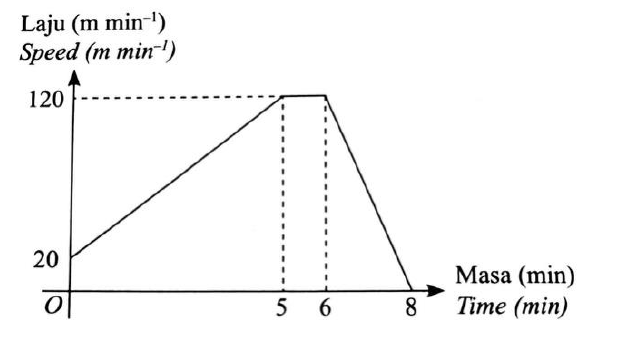
- (a)
Calculate the acceleration, in m min⁻², of Lex's movement for the first 5 minutes.
[2] - (b)
Describe Lex's movement from the 5th minute to the 6th minute in terms of speed.
[1] - (c)
Calculate the rate of change in speed, in m min⁻², of Lex's movement in the last 2 minutes.
[2]
(a) Given sin θ = k, state sin(θ − 180°) in terms of k. (b) Diagram 3 shows part of the graph y = (5/2) sin 6x. State the values of a and b.
Medium3 marks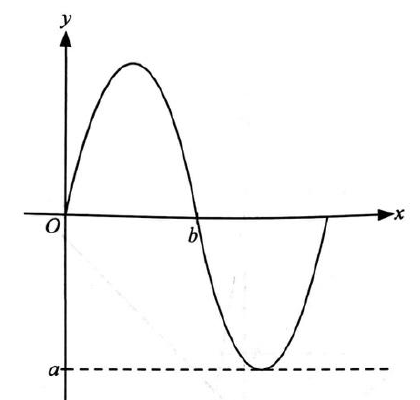
- (a)
Given sin θ = k. State sin(θ − 180°) in terms of k.
[1] - (b)
Diagram 3 shows part of the graph y = (5/2) sin 6x. State the value of a and b (a = minimum value on the y-axis, b = x-intercept after the first maximum).
[2]
Section B
(a) Solve x/(2x + 3) = 3/(4x − 3). (b) Diagram 4 shows an isosceles triangle of area 22 cm² with base (x + 7) cm and height (x − 4) cm. (i) Write a quadratic equation for the triangle. (ii) Sketch the graph of f(x) = x² − 16.
Medium8 marks- (a)
Solve the quadratic equation x/(2x + 3) = 3/(4x − 3).
[4] - (b)(i)
Diagram 4 shows an isosceles triangle with an area of 22 cm² (height (x − 4) cm, base (x + 7) cm). Write a quadratic equation for the triangle.
[2]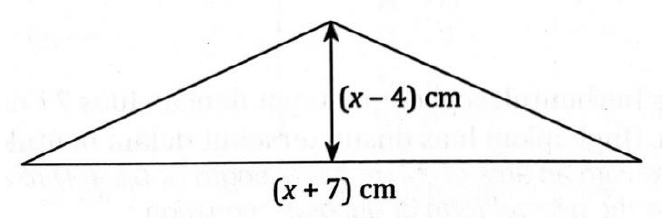
- (b)(ii)
Sketch the quadratic function graph f(x) = x² − 16.
[2]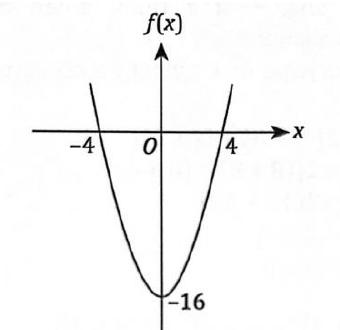
Diagram 5 shows the marks of 40 students in a Mathematics test: 78 48 76 82 64 / 36 87 17 67 67 / 50 77 50 54 24 / 20 14 69 11 49 / 85 15 39 78 73 / 25 71 46 16 59 / 89 27 60 56 58 / 58 78 19 88 12. (a) Complete Table 4 (class intervals 0–9 to 90–99, frequency, midpoint). (b) Calculate the estimated mean mark, correct to two decimal places. (c) Using a scale of 2 cm to 10 marks on the horizontal axis and 2 cm to 1 student on the vertical axis, draw a frequency polygon.
Medium10 marks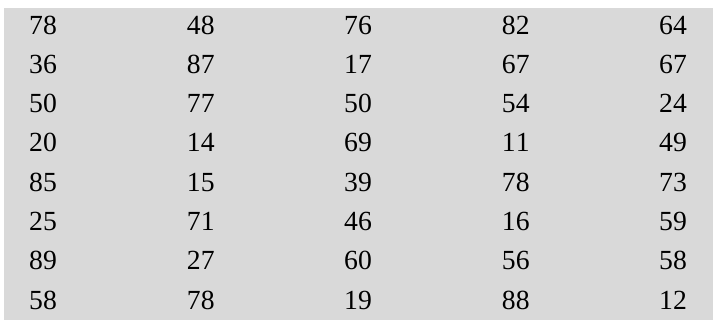
- (a)
Based on Diagram 5, complete Table 4 (Marks, Frequency, Midpoint) in the answer space.
[3]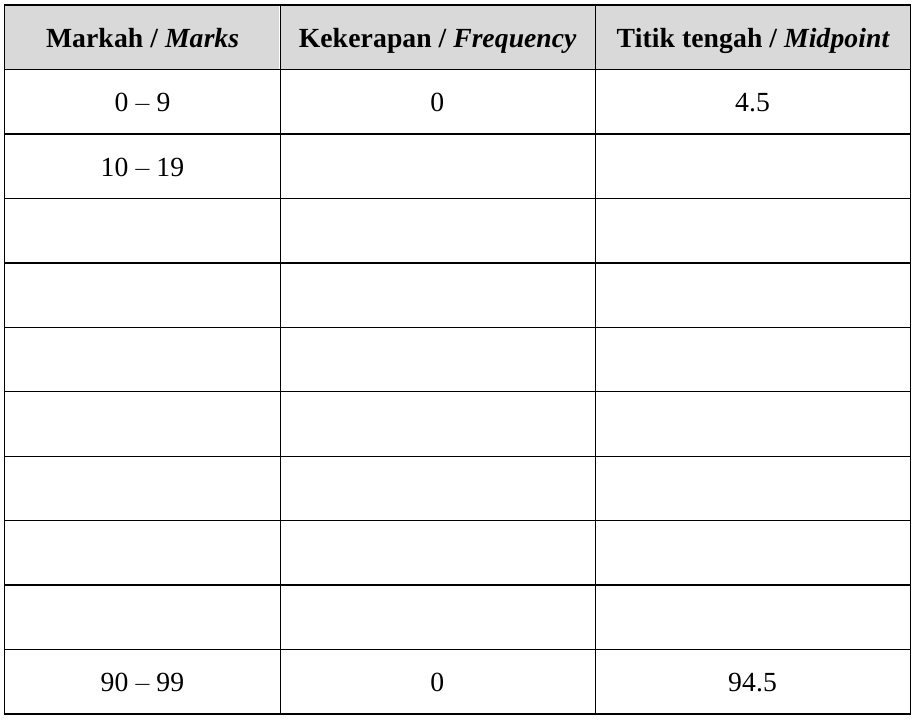
- (b)
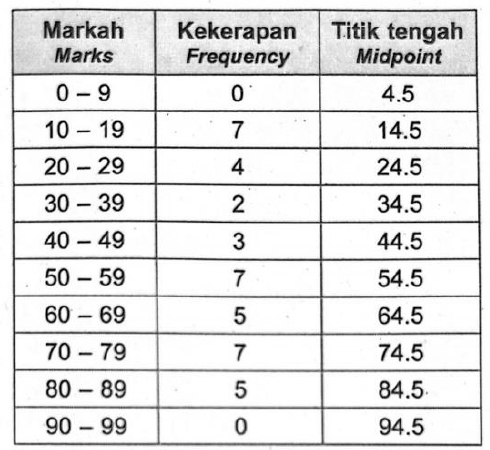
Based on Table 4, calculate the estimated mean marks of a student. Give your answer correct to two decimal places.
[3] - (c)
Use graph paper. Using a scale of 2 cm to 10 marks on the horizontal axis and 2 cm to 1 student on the vertical axis, draw a frequency polygon for the data.
[4]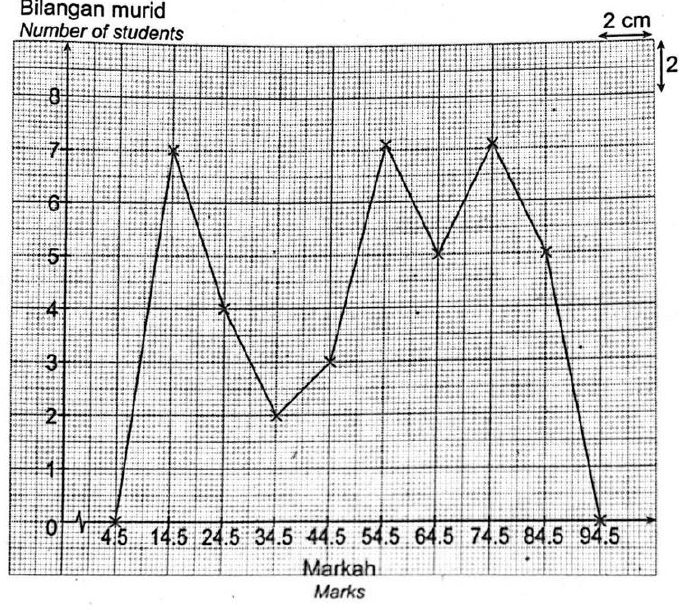
Diagram 6 shows five labelled cards in Box P (C, O, V, I, D) and two labelled cards in Box Q (1, 9). One card is picked at random from each box. (a) List the sample space and state n(S). (b) List the outcomes and find the probability that (i) the code is a consonant or a multiple of 3; (ii) the code is a vowel and the number 9. (c) State the probability of getting a vowel and a prime number.
Medium8 marks- (a)
List the sample space and state n(S).
[3] - (b)(i)
List all the possible outcomes of the event 'a consonant or a multiple of 3' and find the probability.
[2] - (b)(ii)
List all the possible outcomes of the event 'a vowel and the number 9' and find the probability.
[2] - (c)
State the probability of getting the combination of a vowel and a prime number.
[1]
The table shows Samuel's financial plan (net income RM6 000; passive income 0; savings RM100; fixed expenses RM950; variable expenses RM3 170; surplus RM1 780). (a) Explain whether Samuel manages his finances effectively. (b) If he needs a RM30 000 down payment for a house within one year, can he achieve his goal? Why? (c) Samuel earns RM500 passive income and allocates 10% of total income as monthly savings. Can he still achieve his goal if he extends to two years?
Medium9 marks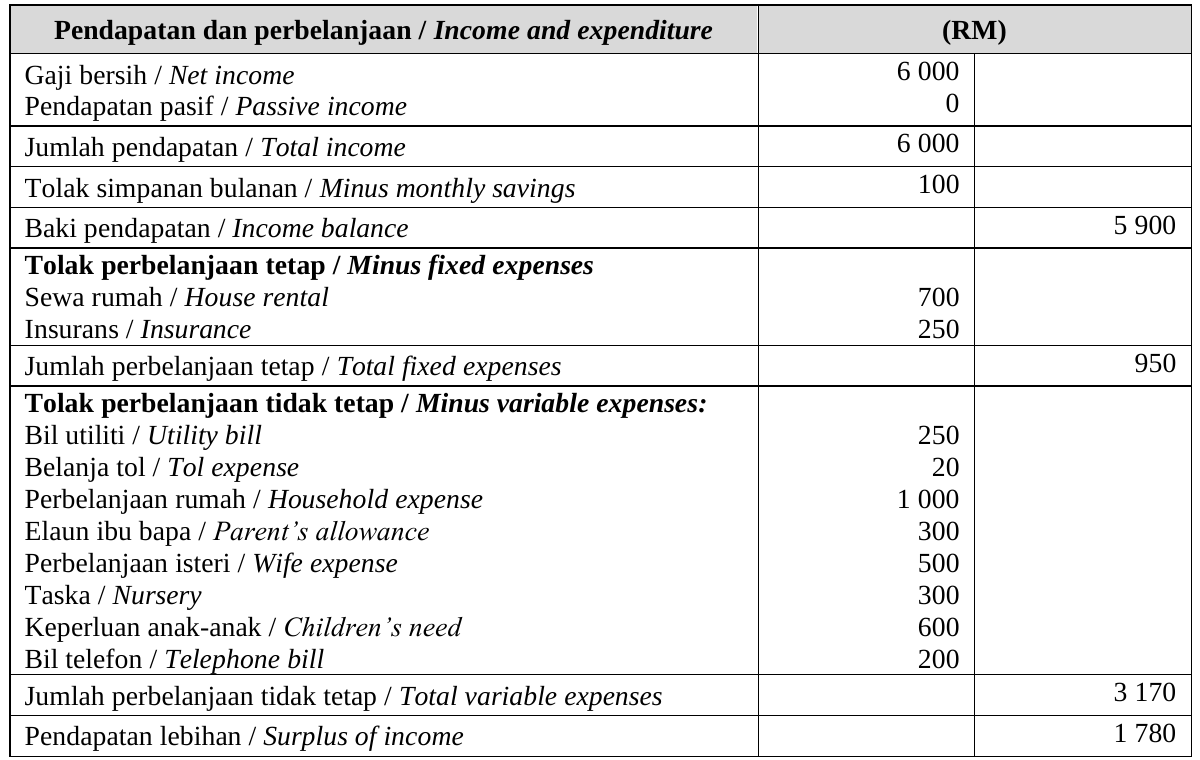
- (a)
Explain whether Samuel manages his financial effectively.
[3] - (b)
If Samuel needs to pay a down payment of RM30 000 to purchase a house within one year, is he able to achieve his financial goal with his spending behaviour? Why?
[3] - (c)
Samuel gets a passive income of RM500 from online sales of shoes and allocates 10% of his total income as monthly savings. Can he still achieve his financial goal if he extends to two years of savings?
[3]
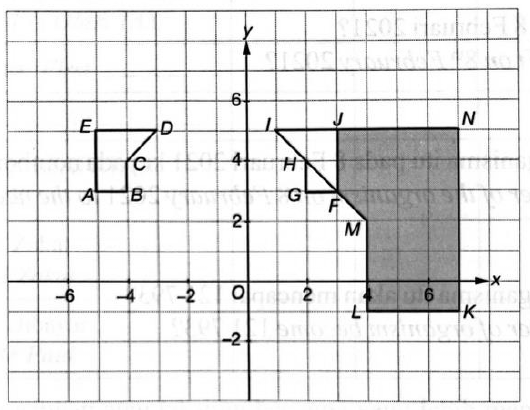
Diagram 7 shows quadrilaterals ABCD, KLMN and EFGH on a Cartesian plane. P is a reflection in the line x = 3; R is a rotation of 90° anticlockwise about the centre (2, 0). (a) State the coordinates of the image of A under (i) R, (ii) RP; hence state a single transformation of A that represents RP. (b) EFGH is the image of ABCD under combined transformation VU. Describe in full (i) U, (ii) V.
Medium10 marks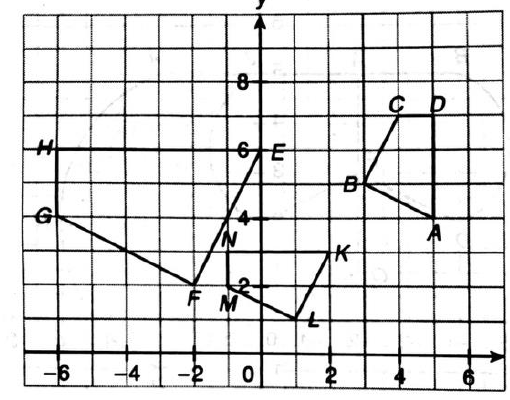
- (a)
Transformation P is a reflection in the line x = 3. Transformation R is a rotation of 90° anticlockwise about the centre (2, 0). State the coordinates of the image of point A under (i) R, (ii) RP. Hence, state a single transformation of the point A that represents the combined transformation RP.
[6] - (b)(i)
Describe in full the transformation U.
[2] - (b)(ii)
Describe in full the transformation V.
[2]
Section C
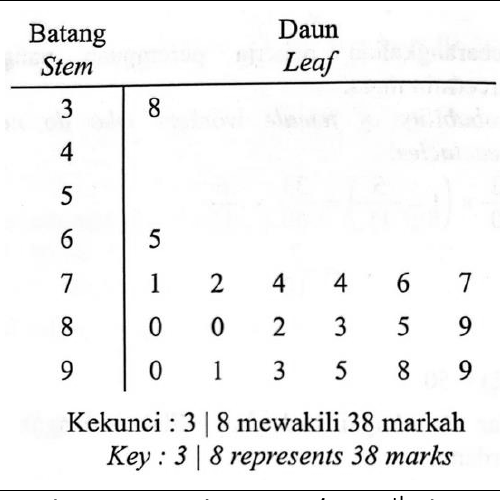
Section C: answer any one (Q16 or Q17). (a)(i) Which is equal to 3m − 2n + 7m + 5n? (ii) Expand 4(3p + 5), −7(3 − 2r), 10p(−6p − 2). (b) Diagram 8 shows the marks of 20 students: 80 65 38 72 82 74 85 91 95 90 / 71 83 74 76 77 89 98 99 80 93. (i) Construct a stem-and-leaf plot. (ii) Find the median and interquartile range. (c) Mr Tan owns a 1 822 cc car. Using Table 5, calculate the road tax.
Medium15 marks- (a)(i)
Which of the following is equal to 3m − 2n + 7m + 5n? A. 10m + 3n B. 10m − 3n C. 10m + 7n D. 10m − 7n
[1] - (a)(ii)
Expand each of the following: (a) 4(3p + 5); (b) −7(3 − 2r); (c) 10p(−6p − 2).
[3] - (b)(i)
Construct a stem-and-leaf plot to represent the marks of the 20 students: 80 65 38 72 82 74 85 91 95 90 71 83 74 76 77 89 98 99 80 93.
[3]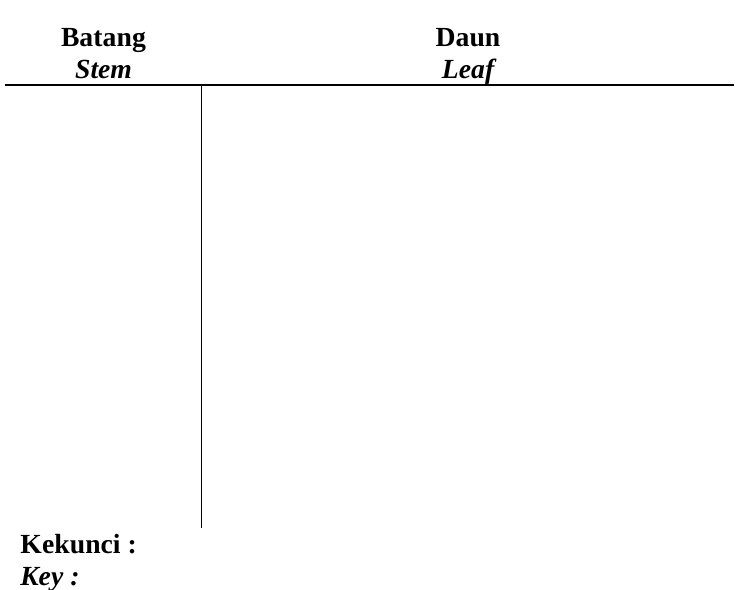
- (b)(ii)
Find the median and the interquartile range.
[3] - (c)
Mr Tan owns a 1 822 cc car. Based on Table 5, calculate the road tax Mr Tan has to pay.
[5]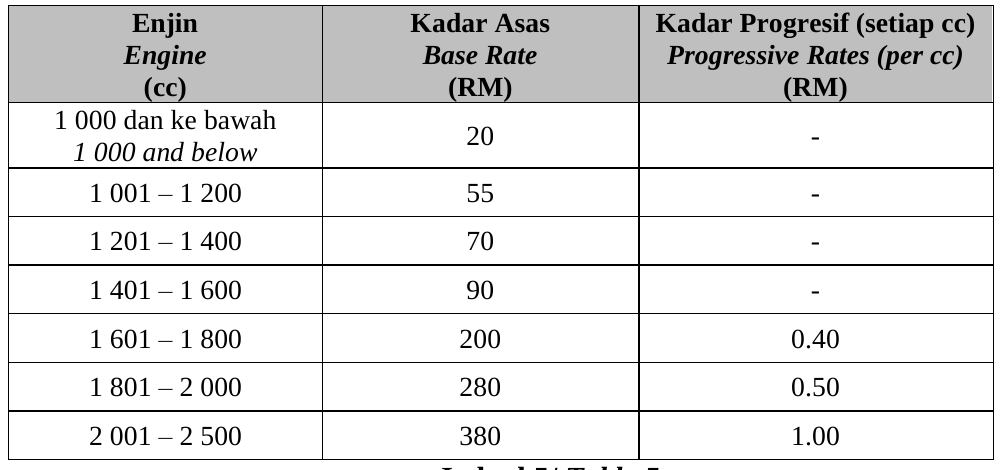
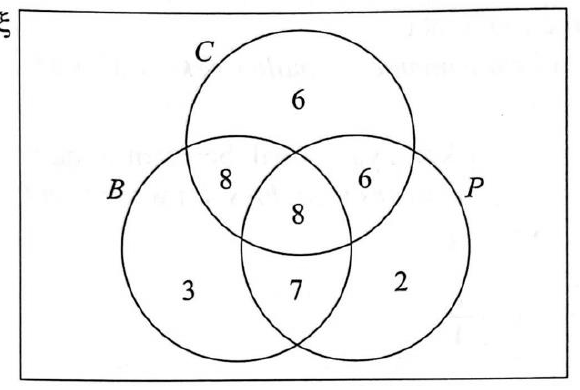
(a) Calculate k and n that satisfy 3k − 4n = −16 and k + 2n = 8. (b) Set B = students who like Biology, C = Chemistry, P = Physics. Table 6 shows the favourite subjects of 40 students: n(B) = 26, n(C) = 28, n(P) = 23, n(B ∩ C) = 16, n(B ∩ P) = 15, n(C ∩ P) = 14, n(B ∩ C ∩ P) = k. (i) Find k. (ii) Complete the Venn diagram of B ∪ C ∪ P. (c) Diagram 9 shows pentagons ABCDE, FGHIJ and KLMIN on a Cartesian plane. KLMIN is the image of ABCDE under combined transformation PQ. Describe in full (I) Q, (II) P.
Hard15 marks- (a)
Calculate the value of k and n that satisfy the simultaneous linear equations 3k − 4n = −16 and k + 2n = 8.
[4] - (b)(i)
Table 6 (40 students): n(B) = 26, n(C) = 28, n(P) = 23, n(B ∩ C) = 16, n(B ∩ P) = 15, n(C ∩ P) = 14, n(B ∩ C ∩ P) = k. Find the value of k.
[3] - (b)(ii)
Complete the Venn diagram in the answer space to show the relationship of B ∪ C ∪ P.
[3]
- (c)
Pentagon KLMIN is the image of pentagon ABCDE under the combined transformation PQ. Describe in full the transformations (I) Q and (II) P.
[5]