Write your answer on paper. Then open the answer to check it.
Section A
A cow and a duck are shown in Diagram 1. The total number of heads of cows and ducks is 63 and the total number of legs is 180. By using the matrix method, calculate the number of cows and ducks.
Medium4 marksCalculate the number of cows and ducks using the matrix method.
[4]
Diagram 2 shows a directed graph with vertices P, Q, R, S and T.
Medium4 marks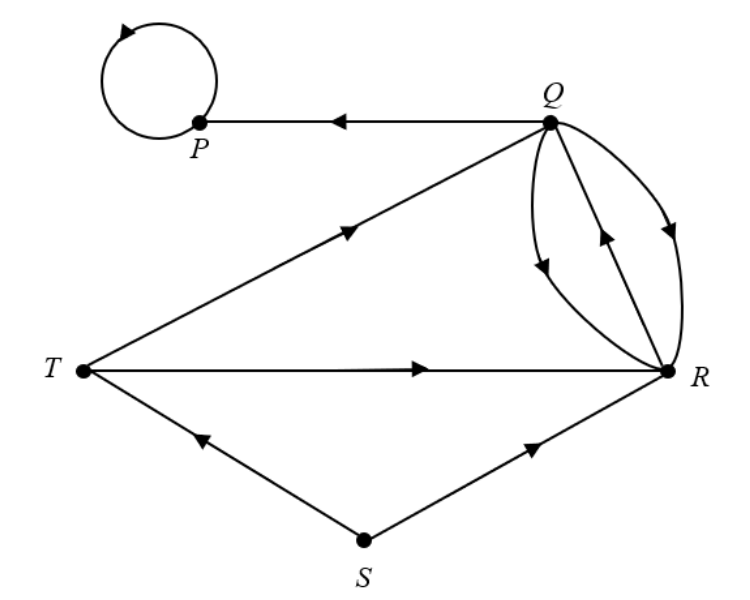
- (i)
List the set of edges, E for the directed graph above.
[2] - (ii)
Determine the value of d_in and d_out for P and R.
[2]
Table 3 shows the premium rates under the Motor Tariff 2015 (for comprehensive policy the rate is for the first RM1 000 of the sum insured; engine not exceeding 2 200 cc, Peninsular Malaysia: RM339.10; every additional RM1 000 or part thereof: RM26). Fasha stays in Peninsular Malaysia. Sum insured: RM95 000; age of vehicle: 6 years; engine capacity: 1800 cc; NCD: 55%. Calculate the gross premium for the comprehensive policy.
Medium4 marks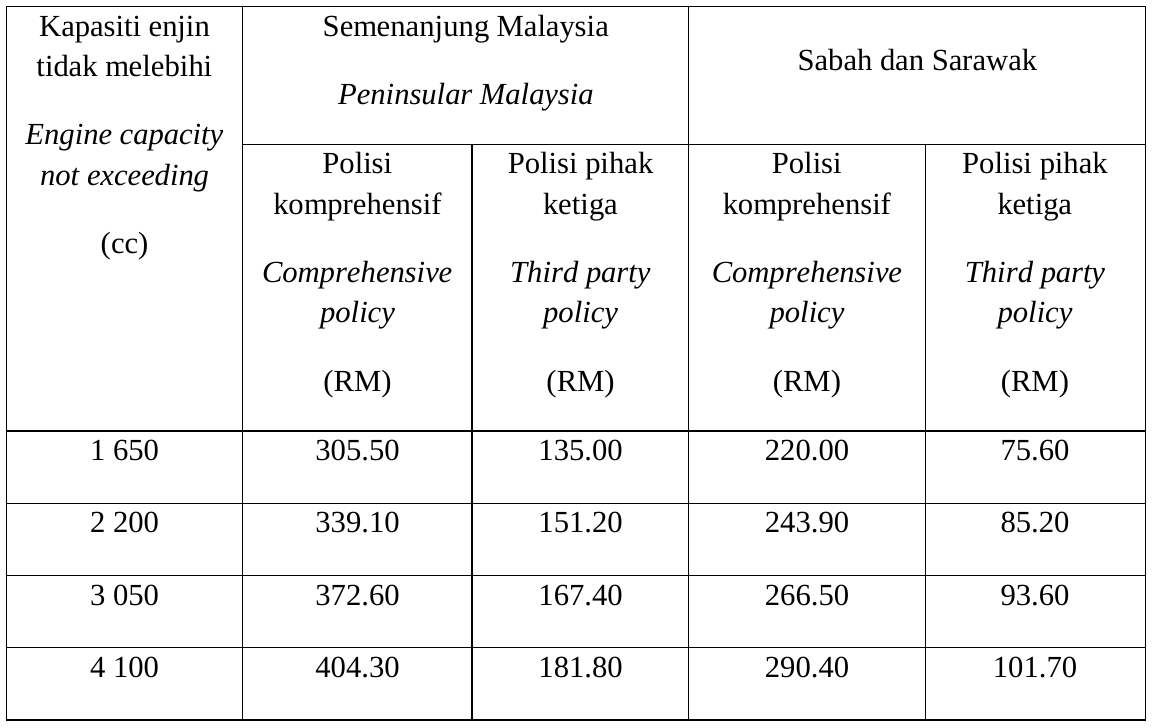
Calculate the gross premium.
[4]
The table shows the distances travelled and time taken by three cars: P 54 km, 30 min; Q 30 km, 20 min; R 24 km, 15 min.
Medium4 marks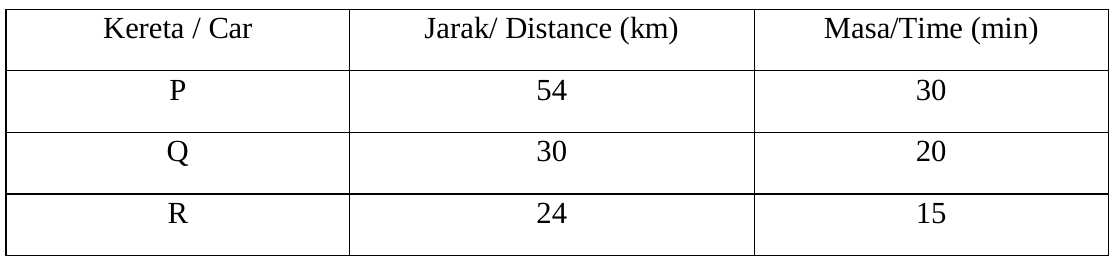
- (a)(i)
Determine the car that moves with the highest average speed.
[1] - (a)(ii)
Determine the car that moves with the lowest average speed.
[1] - (b)
Calculate the acceleration, in km/h per second, of a car that accelerates from 60 km/h to 90 km/h in 0.1 minute.
[2]
Diagram 5 shows four squares ABEF, BCDE, FEHG and EDIH. X and Y are two moving points. On the diagram, draw (i) the locus of X such that XE = EF; (ii) the locus of Y such that its distance from points C and G are the same; (iii) hence, mark with ⊗ all the intersections of the locus of X and the locus of Y.
Medium3 marks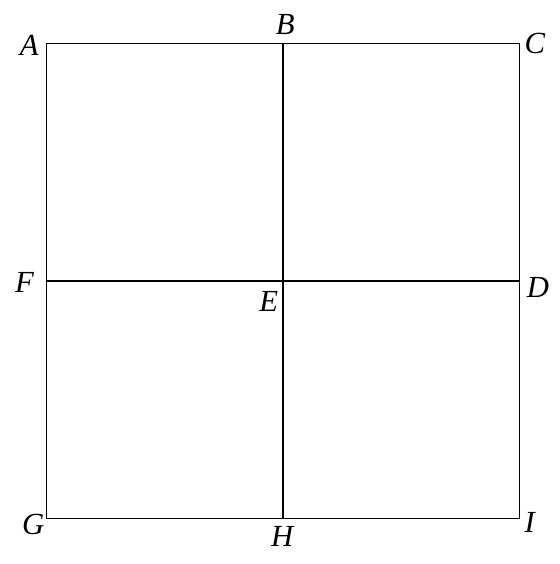
Draw the loci and mark the intersections.
[3]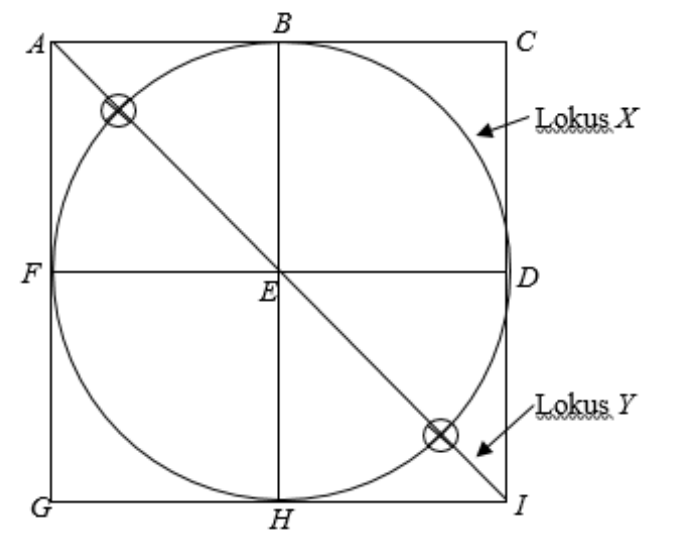
Mozza and Mai Li save money in banks earning simple interest.
Medium5 marks- (a)
Mozza deposited RM15 000 at Bank Sinar with an interest rate 2% per annum. How much is the interest earned by Mozza after 4 years?
[2] - (b)
Bank M: interest rate 3.7% per annum. Bank N: monthly rate 0.3% per month. Mai Li saves RM10 000 each in Bank M and Bank N. Calculate the total interest earned from the two banks after a year.
[3]
Diagram 7 shows the price of two watches in two different number bases: Watch M costs RM 501₉ and Watch N costs RM 2545₆. Determine the cheaper watch.
Medium4 marksDetermine the cheaper watch.
[4]
Statements and arguments.
Medium4 marks- (a)
Complete the statement using the quantifier "all" or "some" to form a true statement: ______ of the prime numbers are odd numbers.
[1] - (b)
Write Premise 2 to complete the argument. Premise 1: If M is a multiple of 6, then M is a multiple of 3. Premise 2: ______. Conclusion: 23 is not a multiple of 6.
[1] - (c)
Write two implications based on the compound statement: p − q > 0 if and only if p > q.
[2]
Diagram 9 shows a distance-time graph for the journey of a car from Kuala Lumpur to Ipoh. Kuala Lumpur at 1200, arrives at Tapah (152 km) at 1345, leaves Tapah at 1400, reaches Ipoh (205 km) at 1520 (24-hour system).
Medium5 marks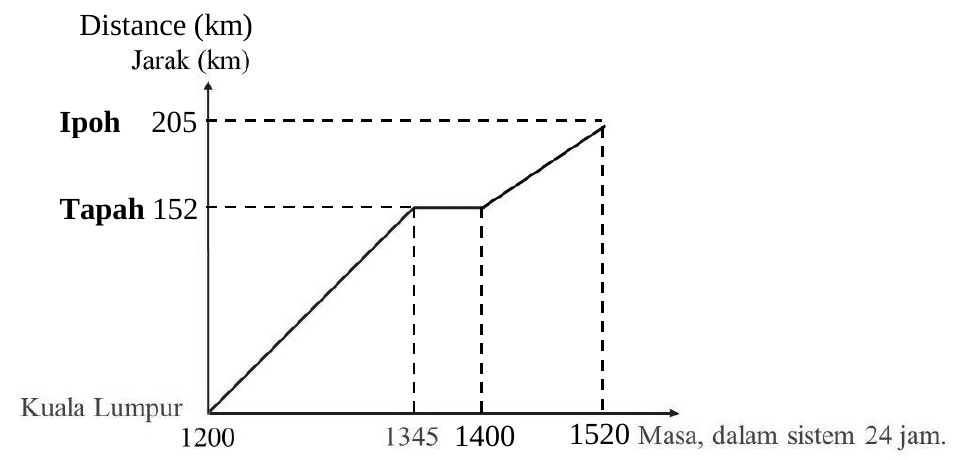
- (a)
State the duration of time, in minutes, the driver stopped to rest at Tapah.
[1] - (b)
Calculate the speed, in km h⁻¹, of the car from Kuala Lumpur to Tapah.
[2] - (c)
Calculate the average speed, in km h⁻¹, of the car for the whole journey.
[2]
In Diagram 10, QRS is a straight line. It is given that RS = 4 cm, RU = 6 cm and sin x° = 5/13. Find the value of cos y°.
Medium3 marks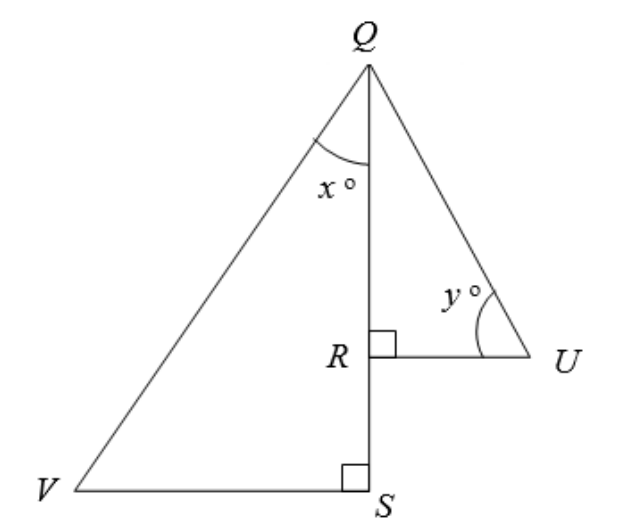
Find the value of cos y°.
[3]
Section B
3x(x − 4) = 6 − 5x.
Medium8 marks- (a)
Write the quadratic equation 3x(x − 4) = 6 − 5x in general form. Hence, solve the quadratic equation.
[3] - (b)
Write the general-form equation from (a) as a quadratic function f(x). Without plotting the graph, determine the y-intercept and the coordinates of the minimum point.
[5]
Table 12.1 shows the marks of a Mathematics test for class 5 Aktif. Marks 40–49: 4 students; 50–59: 8; 60–69: 12; 70–79: 10; 80–89: 9; 90–99: 7.
Medium9 marks
- (a)
Based on Table 12.1, complete Table 12.2 (cumulative frequency and upper boundary).
[2]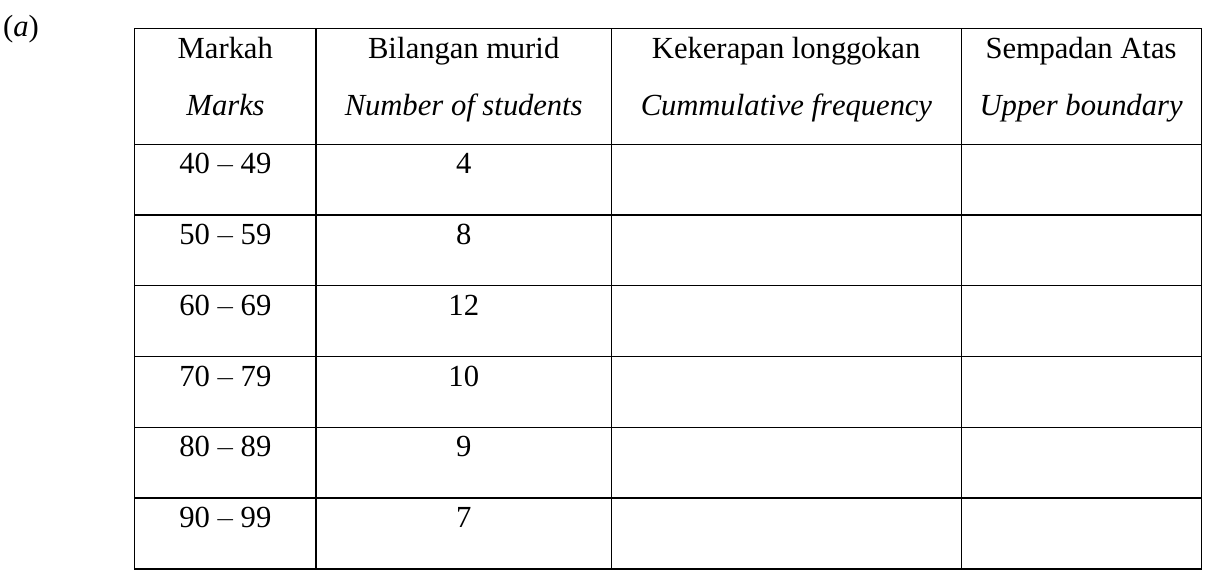
- (b)
Using a scale of 2 cm to 5 students (horizontal) and 2 cm to 10 marks (vertical) as printed, draw an ogive for the data on the graph paper provided.
[4]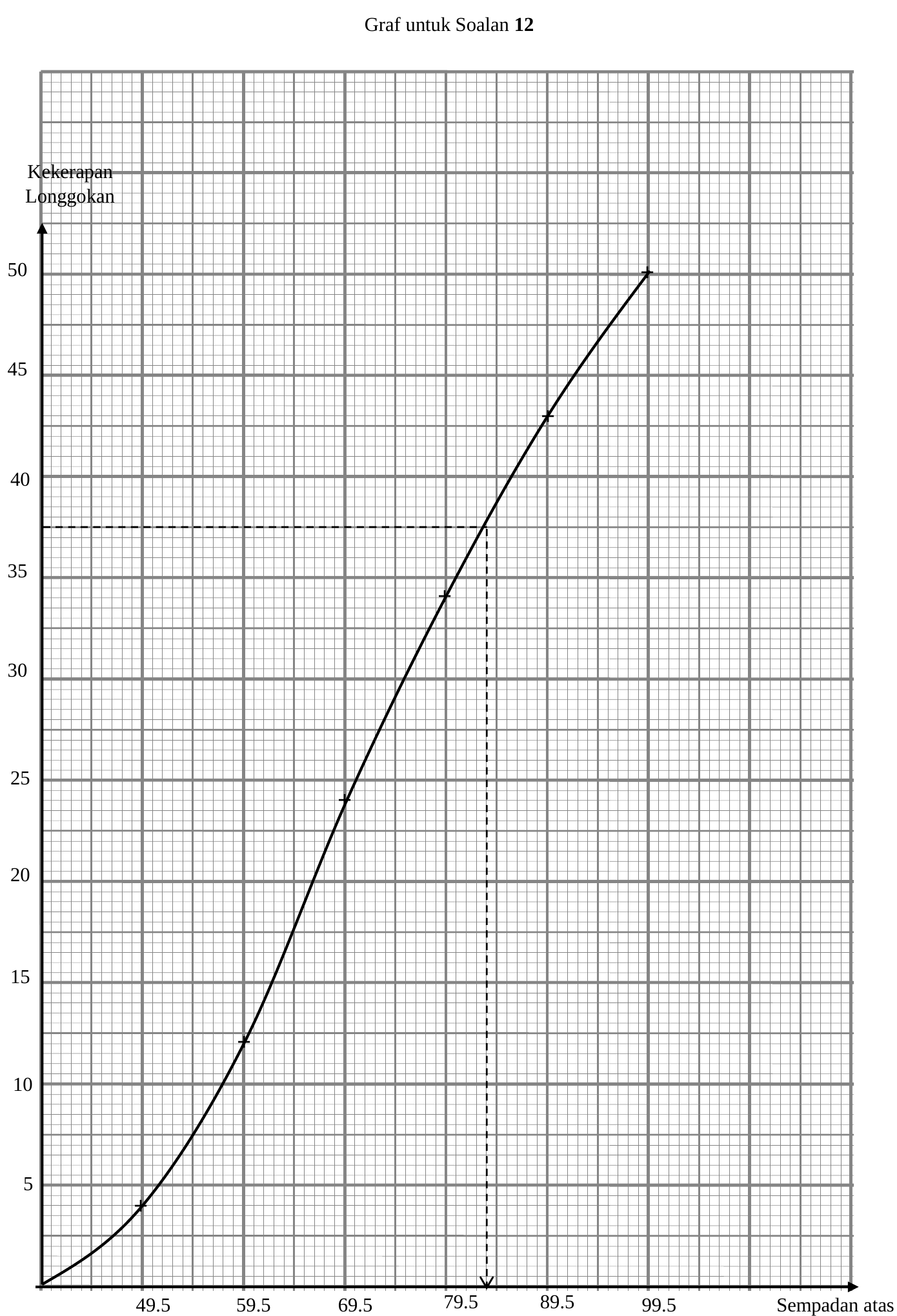
- (c)
Students at the 75th percentile and above will get a present. What is the minimum score to obtain the present?
[3]
Box R contains five blue marbles and seven yellow marbles; box T contains four blue and eight yellow marbles. A marble is randomly selected from box R. If it is blue, it is put into box T. If it is yellow, it is returned to box R. Then a marble is randomly selected from box T. The colours of the marbles are recorded.
Medium9 marks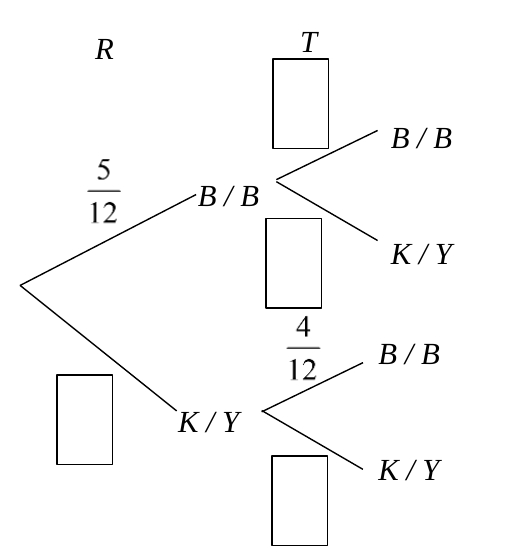
- (a)
Complete the tree diagram in the answer space.
[2] - (b)(i)
Calculate the probability that both marbles selected are blue.
[2] - (b)(ii)
Calculate the probability that the two marbles selected are of different colours.
[3] - (c)
Class 5 Mahir has 36 pupils. Each pupil selects two marbles under the conditions above; a pupil who selects two yellow marbles gets a gift worth RM5. Estimate the cost of gifts needed.
[2]
Table 14 shows Cik Zuyyin's financial planning: net income RM4100, passive income RM400, total monthly income RM4500, fixed monthly savings RM0, emergency fund RM200, income balance T; housing loan RM1500, car instalment RM750, total fixed expenses RM2250; groceries RM1000, utility bills RM550, travel savings RM600, total variable expenses U; surplus of income V.
Medium9 marks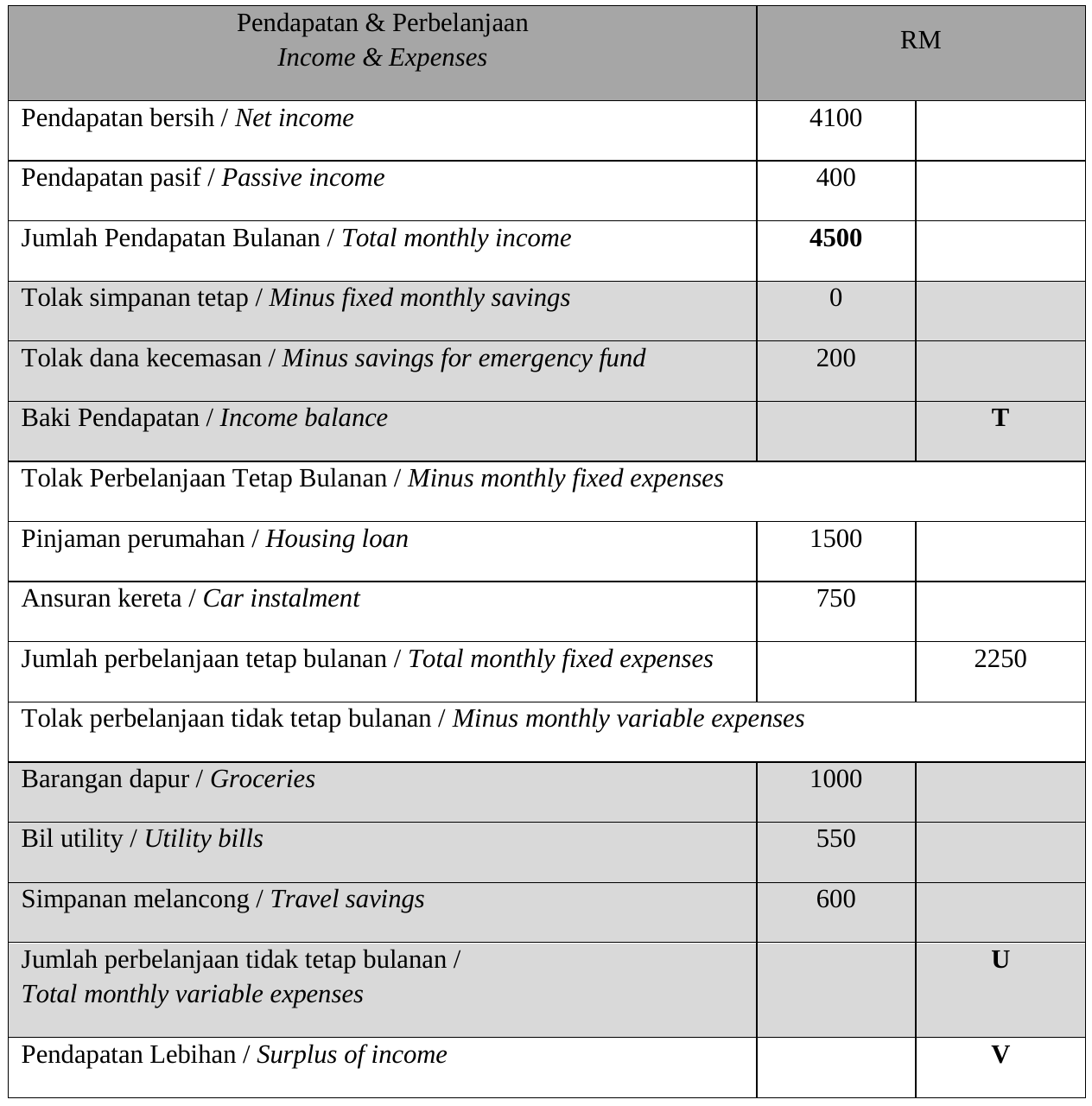
- (a)
Calculate the values of T, U and V.
[3] - (b)
Calculate Cik Zuyyin's cash flow. Determine whether she manages her finances efficiently or inefficiently. Give your justification.
[3] - (c)
Cik Zuyyin plans to buy a plot of land for RM36 000 within 3 years. Calculate her monthly savings and give two improvement suggestions.
[3]
Transformation P is reflection in the line x = 7. Transformation R is a clockwise rotation of 90° about the centre (9, 7). Transformation T is a translation (−2, 5). Point A is at (10, 3). (b) EFGH is the image of ABCD under transformation V. PQRS is the image of EFGH under transformation W.
Medium10 marks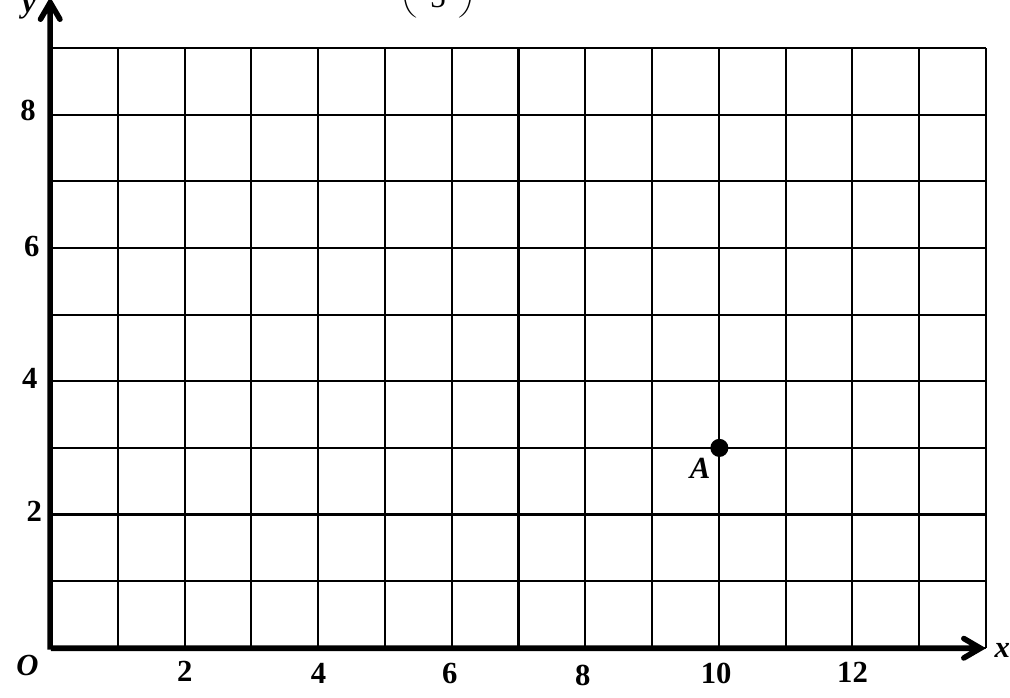
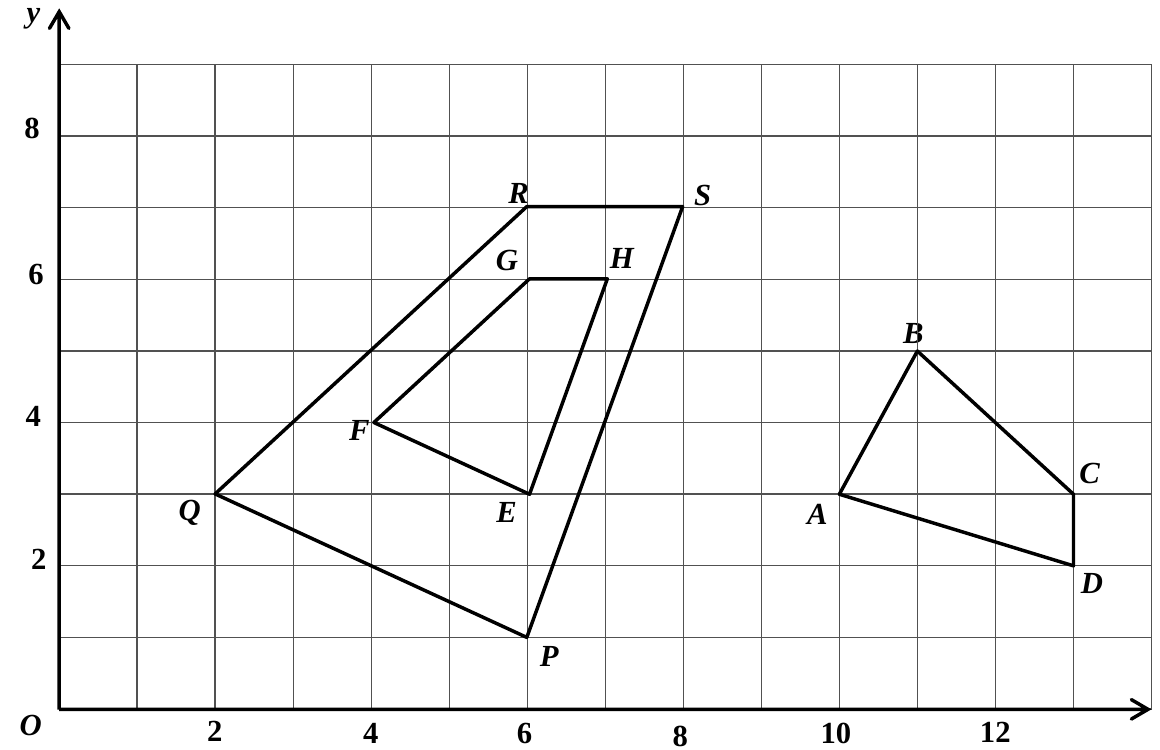
- (a)(i)
State the coordinates of the image of point A under the transformation T.
[2] - (a)(ii)
State the coordinates of the image of point A under the transformation PR.
[2] - (b)(i)
Describe in full the transformation V.
[3] - (b)(ii)
Describe in full the transformation W.
[3]
Section C
Section C: answer any one question (this is question 16). Siti has chocolate (k² − 16) cm long to share equally among (k − 4) grandchildren; archery scores of two participants; income tax of Mr Salimin.
Hard15 marks- (a)
Siti has a piece of chocolate measuring (k² − 16) cm long and wants to divide it equally among her (k − 4) grandchildren. What length of chocolate will each receive?
[4] - (b)(i)
Table 16(b): scores of participants A (8.4, 9.5, 7.2, 9.9, 9.8, 8.7, 9.4, 8.9) and B (9.1, 9.3, 8.1, 8.0, 7.5, 8.6, 8.4, 9.8). Determine the appropriate measure of dispersion to select the more consistent participant.
[1]
- (b)(ii)
Calculate the mean, variance and standard deviation for both participants.
[6] - (c)
Mr Salimin earned an annual salary of RM75 800 in 2021; his wife had no income. Reliefs claimed: individual RM9 000; life insurance and EPF RM7 500 (limit RM7 000); lifestyle RM2 220 (limit RM2 500); spouse RM4 000; medical expenses for parents RM3 100 (limit RM5 000). Calculate the total income tax using joint tax assessment.
[4]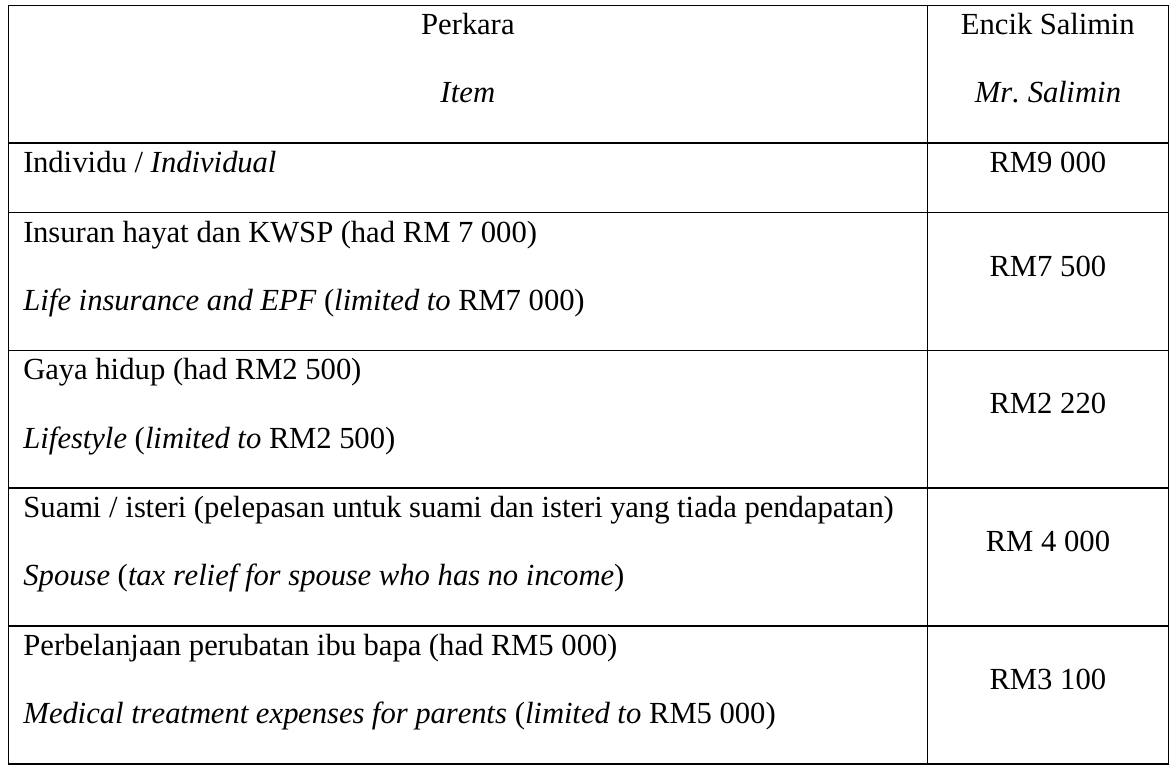
Section C: answer any one question (this is question 17). Souvenirs for guests; sets L, M, N; hexagons and combined transformation.
Hard15 marks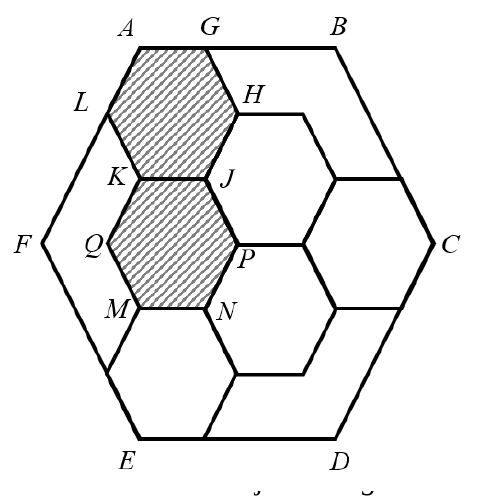
- (a)
Solving using the matrix method is not allowed. For his son's wedding, Mrs Fazura provides souvenirs: RM3.50 for each male guest and RM4 for each female guest. The total number of guests was 2800 and the total spent was RM10 600. Calculate the number of male and female guests.
[4] - (b)(a)
Universal set ξ = {x : 28 ≤ x ≤ 40, x is an integer}. L = {perfect squares}, M = {multiples of 4}, N = {numbers with one digit equal to 2}. List the elements of sets L, M and N.
[3] - (b)(b)
Find (i) L ∪ M; (ii) n(M′ ∩ N).
[3] - (c)
Diagram 13 shows hexagonal shapes. Given AF = 3AL. MNPJKQ is the image of ABCDEF under the combined transformation VW. Describe the transformation (i) W; (ii) V.
[5]