Write your answer on paper. Then open the answer to check it.
Section A
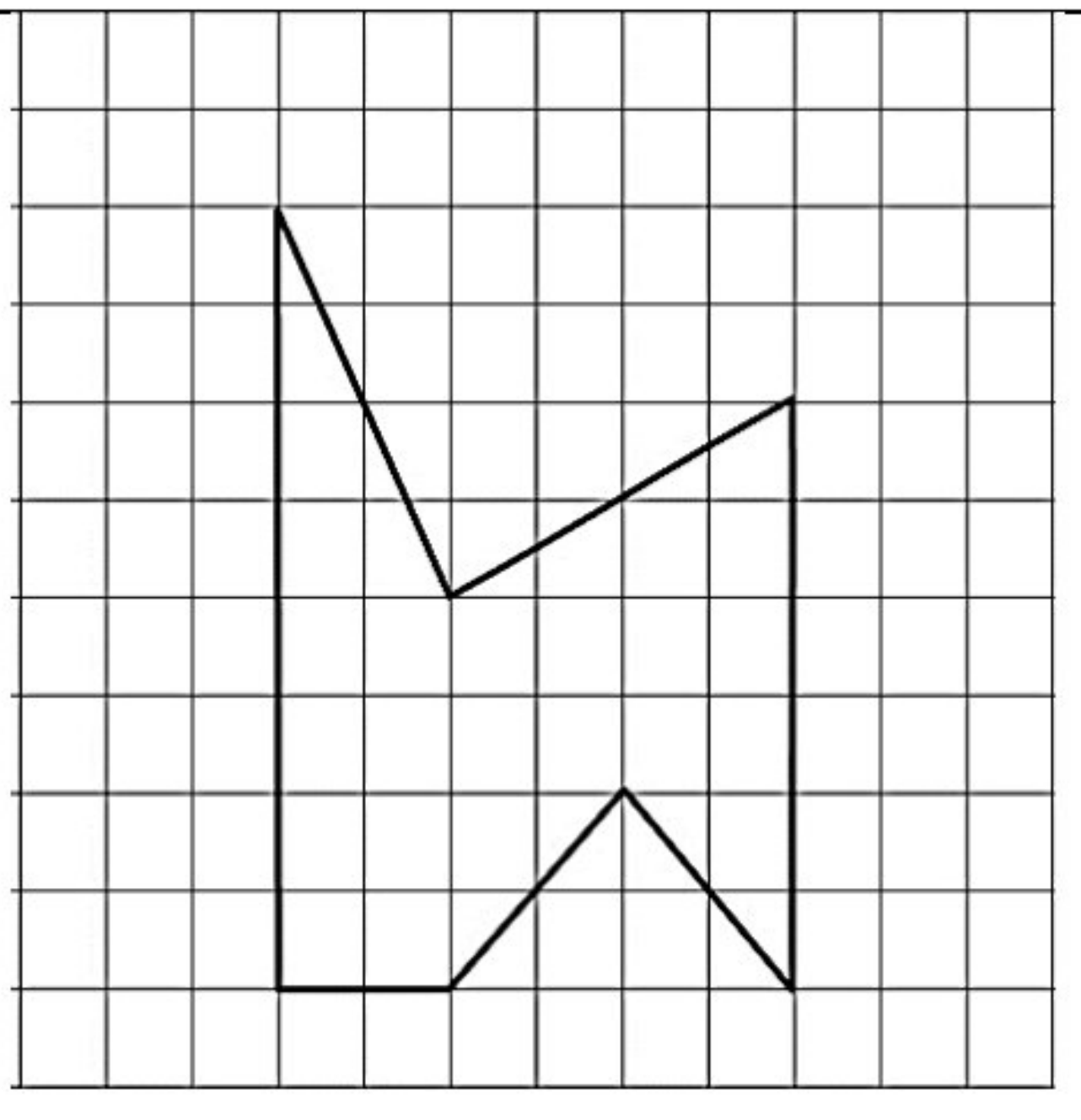
Diagram 1 shows a regular polygon (an octagon).
Easy3 marks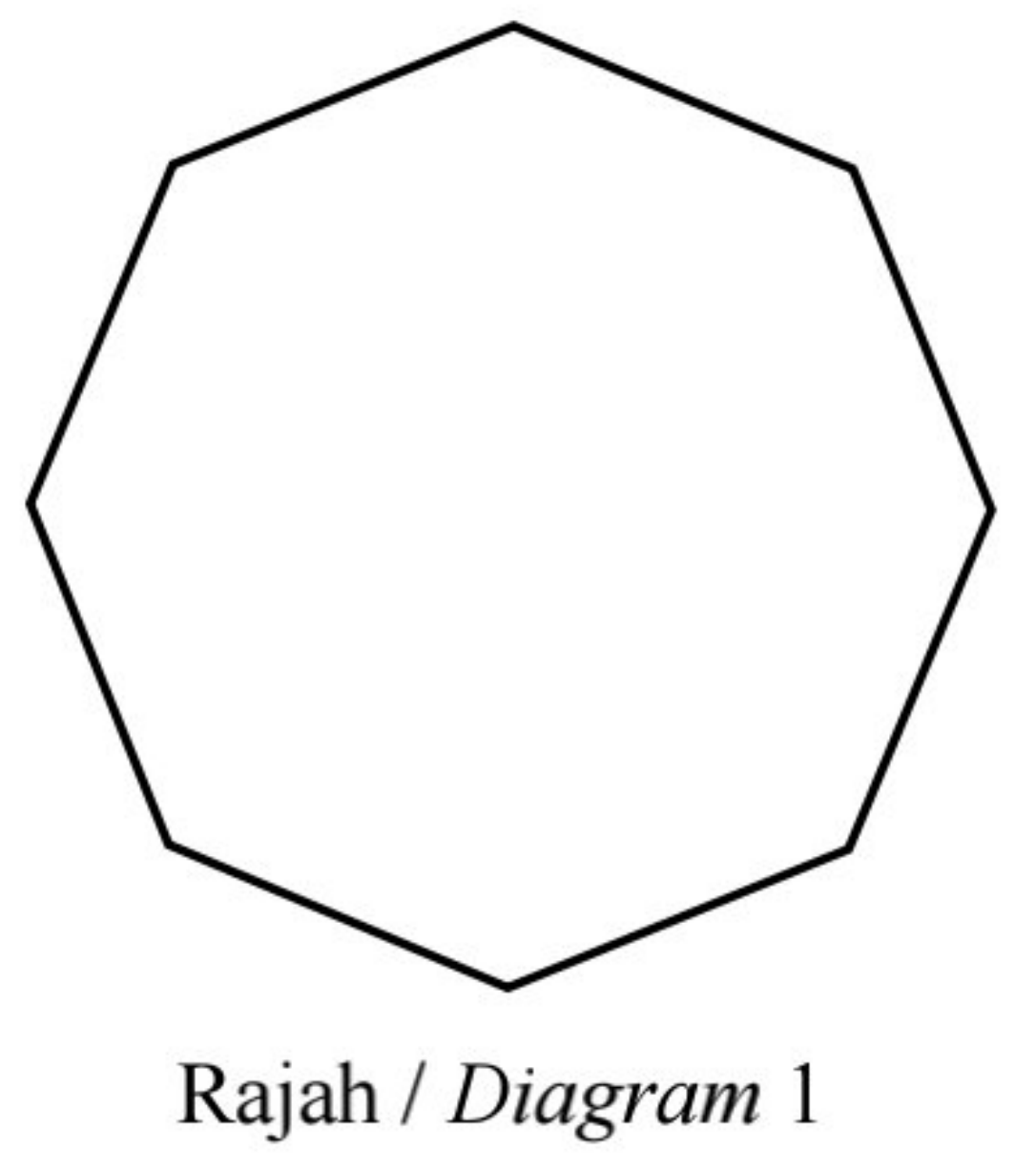
- (a)
State the name of the polygon.
[1] - (b)
Calculate the exterior angle for regular polygon above.
[2]
(a) Diagram 2(a) shows an object P and a scaled drawing Q drawn on a square grid. (b) Diagram 2(b) in the answer space shows a scale drawing of the object R drawn on a square grid on a scale of 1 : 2.
Medium3 marks- (a)
State the scale used in the form of 1 : n.
[1]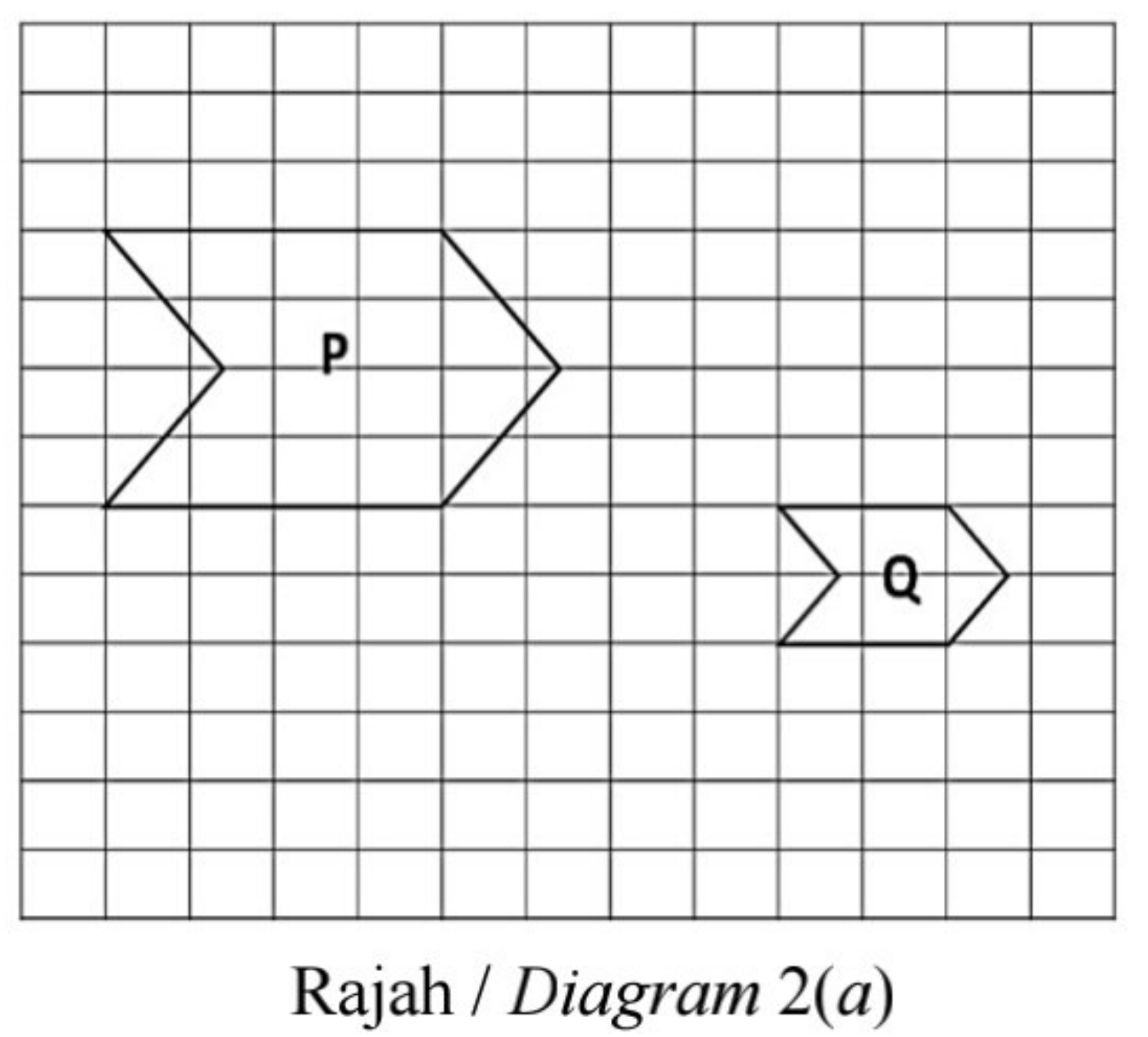
- (b)
Draw an object of R.
[2]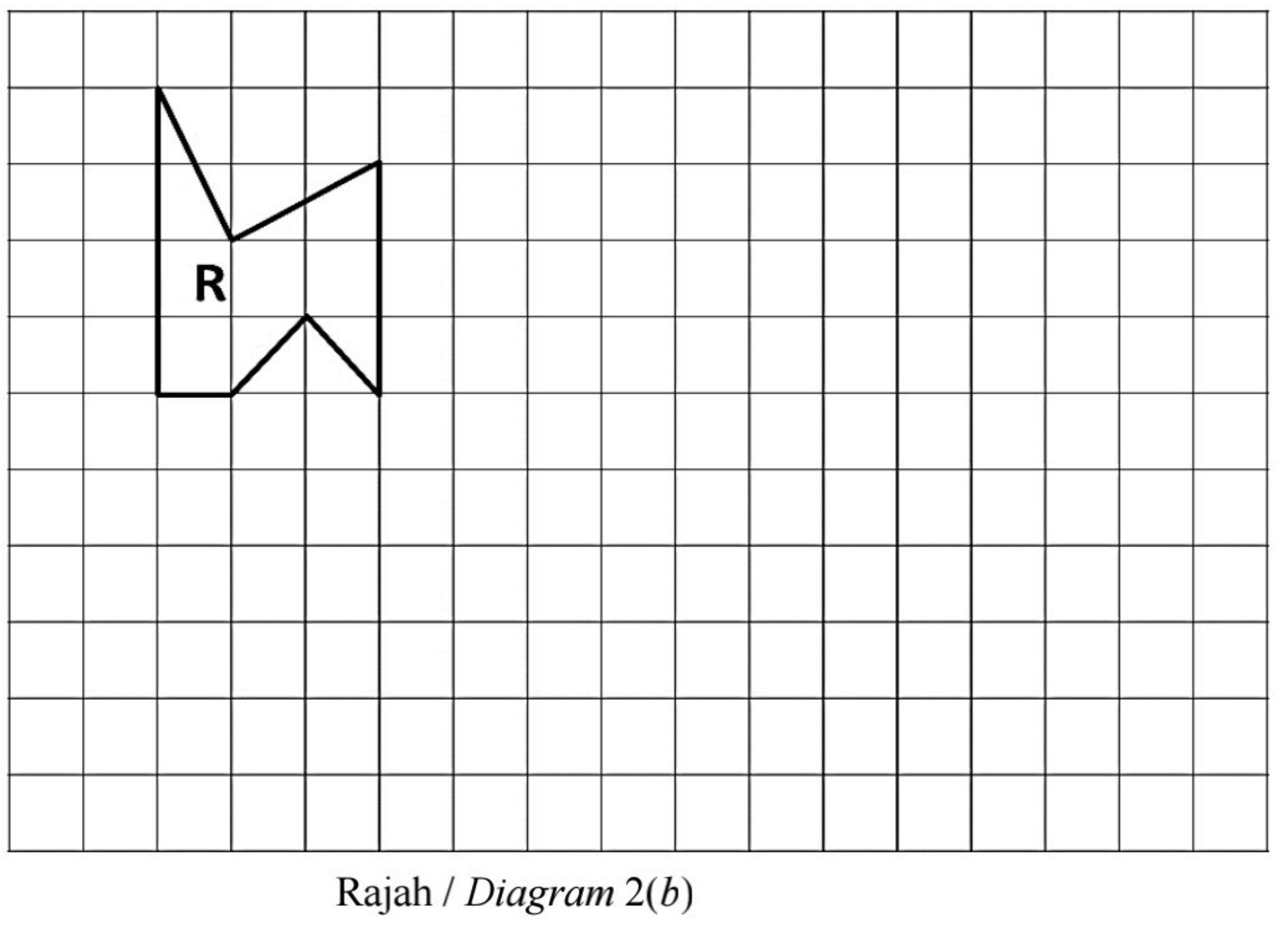
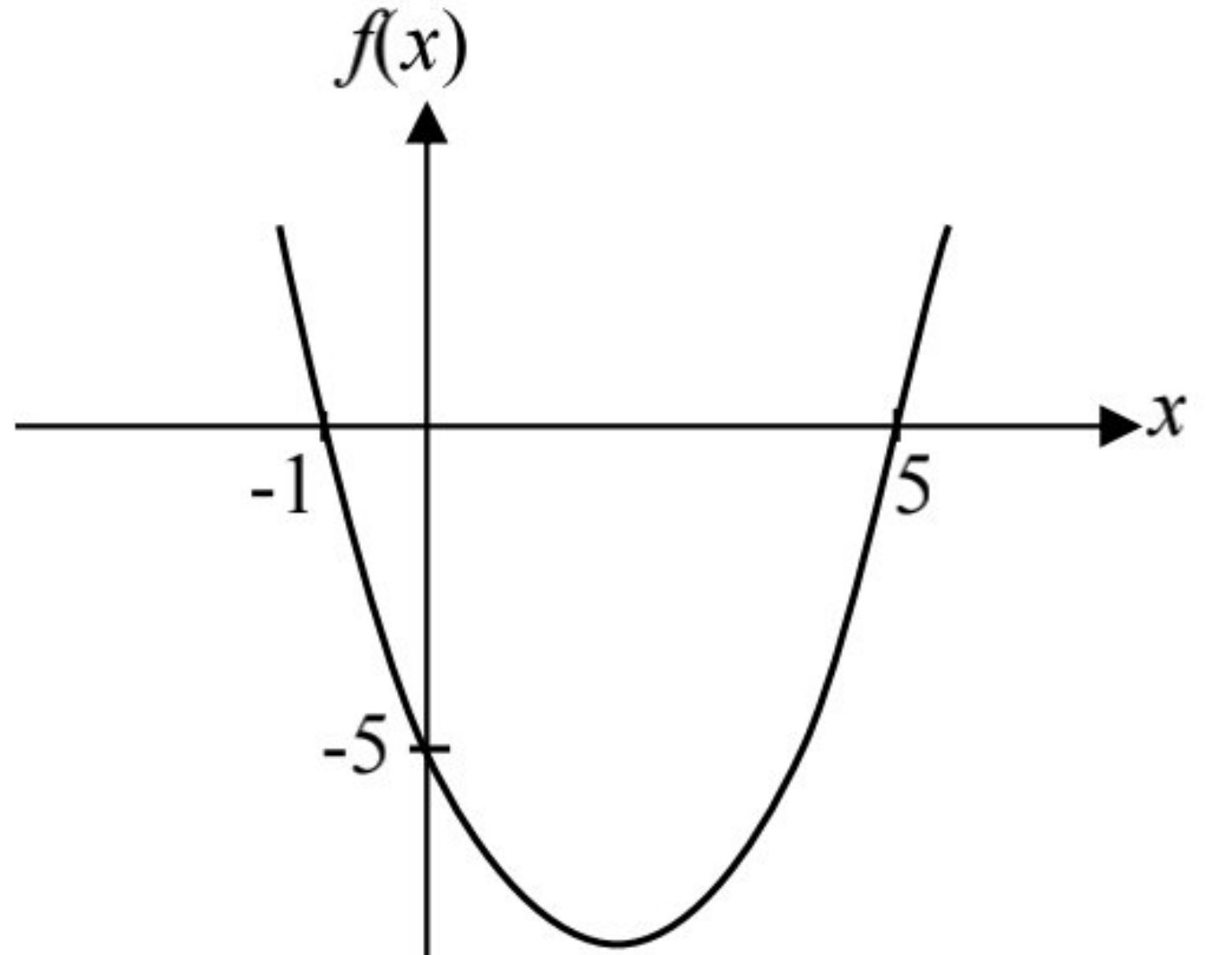
Given the quadratic function f(x) = x² − 4x − 5.
Medium3 marks- (a)
In the answer space, sketch the graph of the quadratic function f(x) = x² − 4x − 5.
[2]
- (b)
Hence, determine the equation of the axis of symmetry.
[1]
Encik Faizal rented a room in a hotel for RM220 per night for three nights.
Medium4 marks- (a)
State the type of tax to be paid by Encik Faizal.
[1] - (b)
The receptionist made a mistake in Encik Faizal's payment bill and charged a fee of RM875.20 including 6% service tax. Calculate the money that needs to be returned to Encik Faizal.
[3]
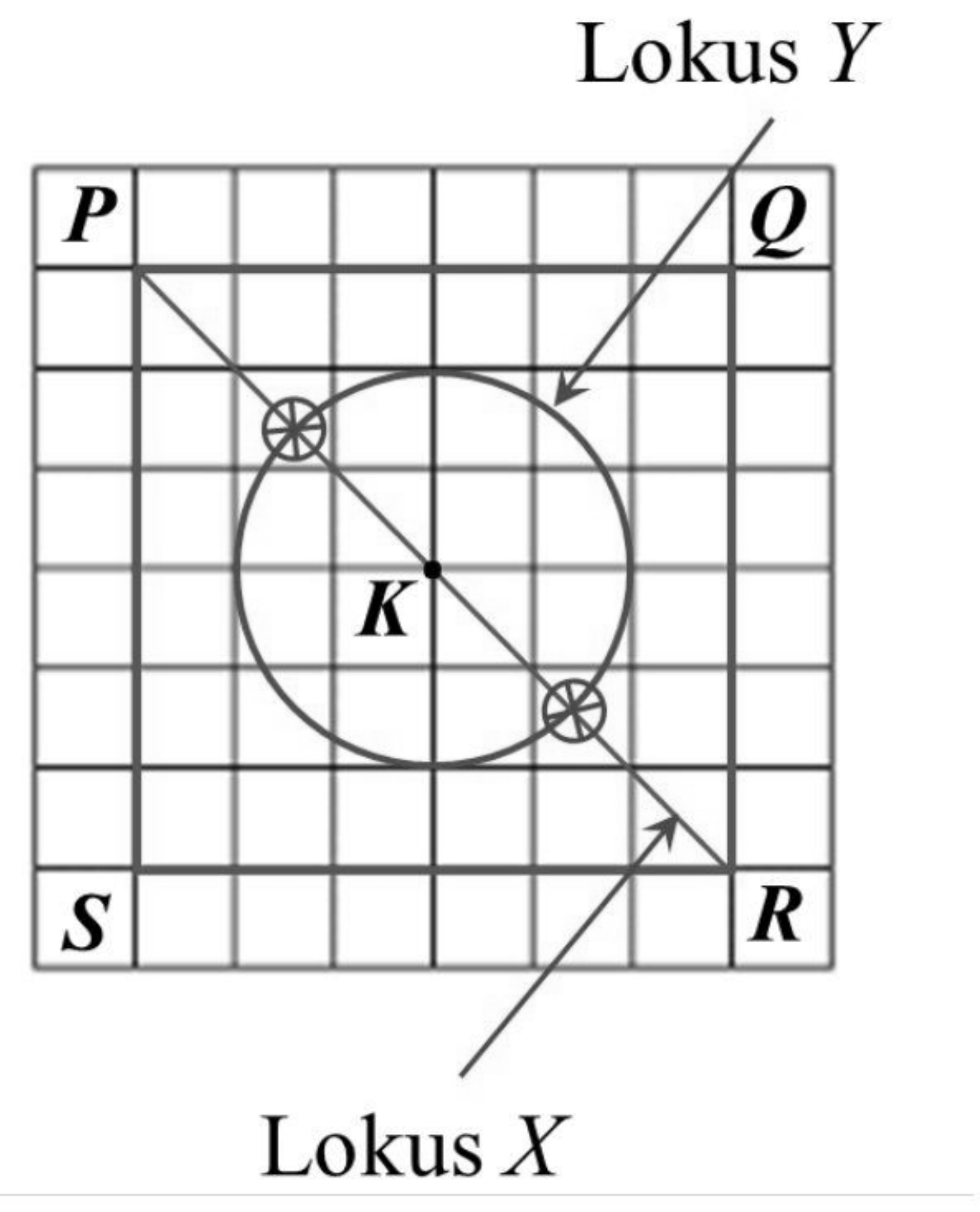
Diagram 5 in the answer space shows a square PQRS with sides of 6 units drawn on a grid of equal squares with sides of 1 unit. W, X and Y are the points that move in the square. K is a point inside the square.
Medium4 marks- (a)
W is a point that moves equidistant from point P and point R. Describe the locus of point W.
[1] - (b)
On the Diagram 5, draw (i) the locus of point X which moves such that it is always equidistant from the lines PQ and PS, (ii) the locus of point Y which moves such that its distance is always 2 unit from point K, (iii) Hence, mark with symbol ⊗ the intersection of the locus of X and locus of Y.
[3]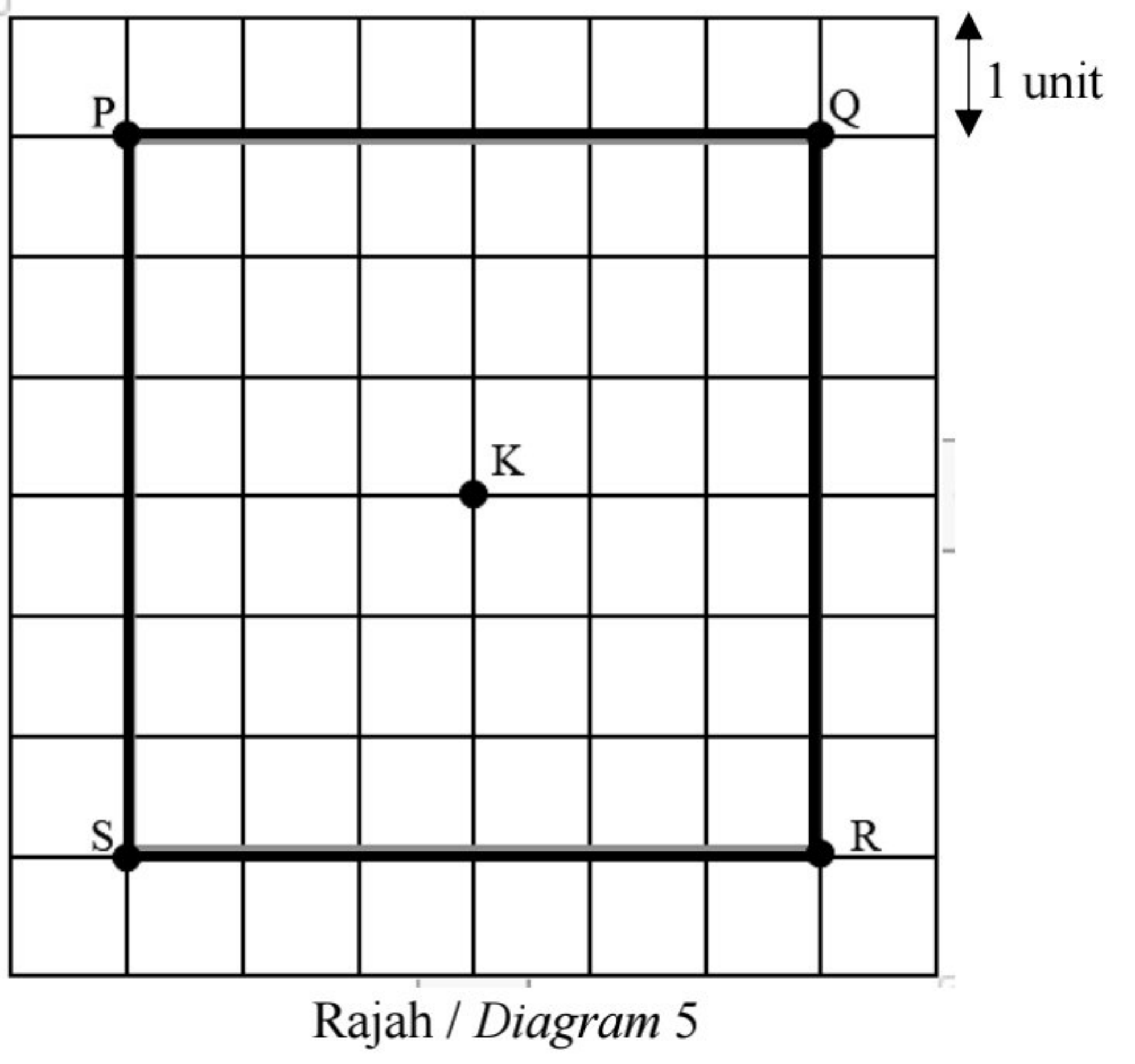
Mr. Adam lives in Peninsular Malaysia and has a Toyota model car. He wants to buy a motor insurance policy. Table 6(a) shows the information of the vehicle he wants to insured: sum insured RM75 000; vehicle age 5 years; engine capacity 1 500 cc. Table 6(b) shows 2015 Motor Tariff.
Medium4 marks- (a)
From the information above, state one other factor that affects the gross premium payment of motor insurance.
[1]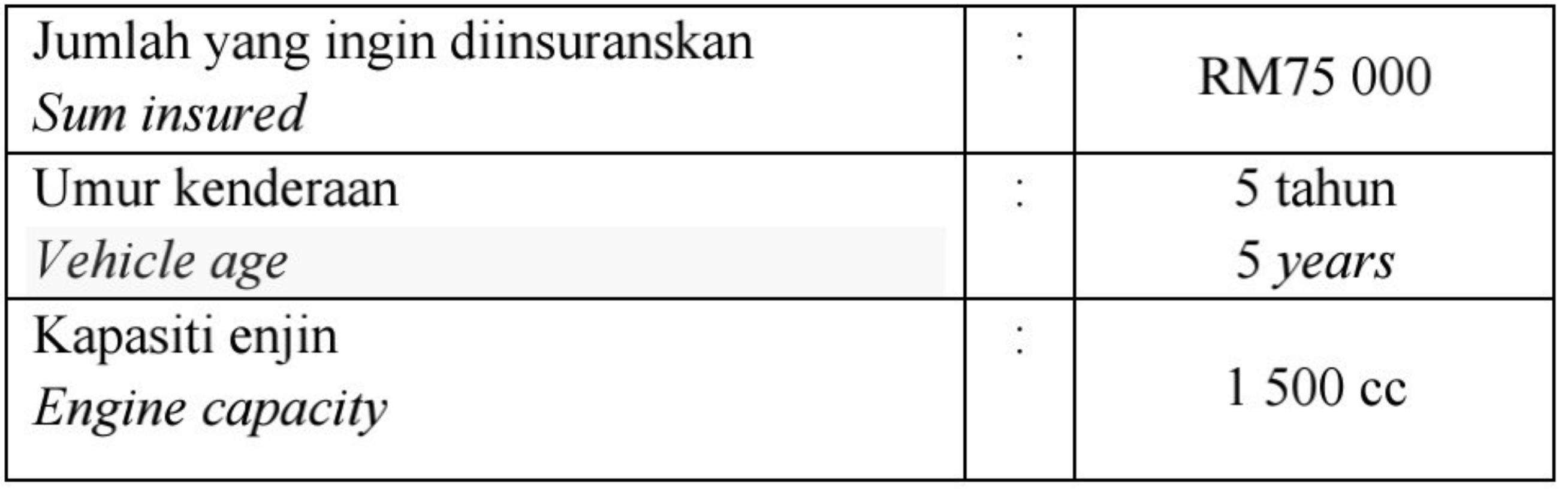
- (b)
Calculate the NCD, in RM, value of the vehicle if the gross premium for the comprehensive policy is RM1783.60.
[3]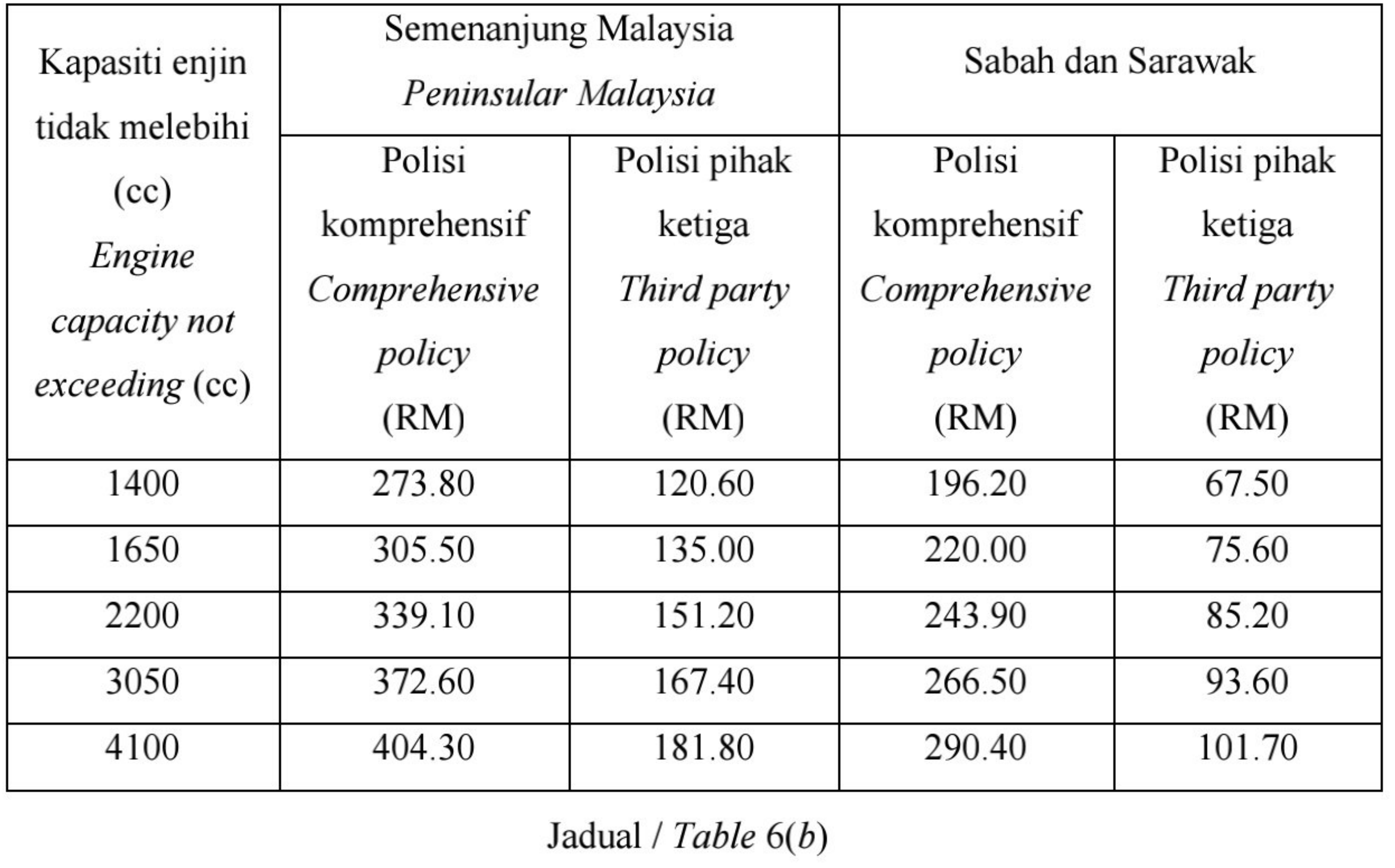
Diagram 7 shows a parallelogram, KLMN drawn on a Cartesian plane. Given that the equation of straight line KL is 4y = x + 16. K lies on the y-axis, N is to the right of K at the same height as K, L and M are on a horizontal line below the x-axis, and M is the point (2, −2).
Medium4 marks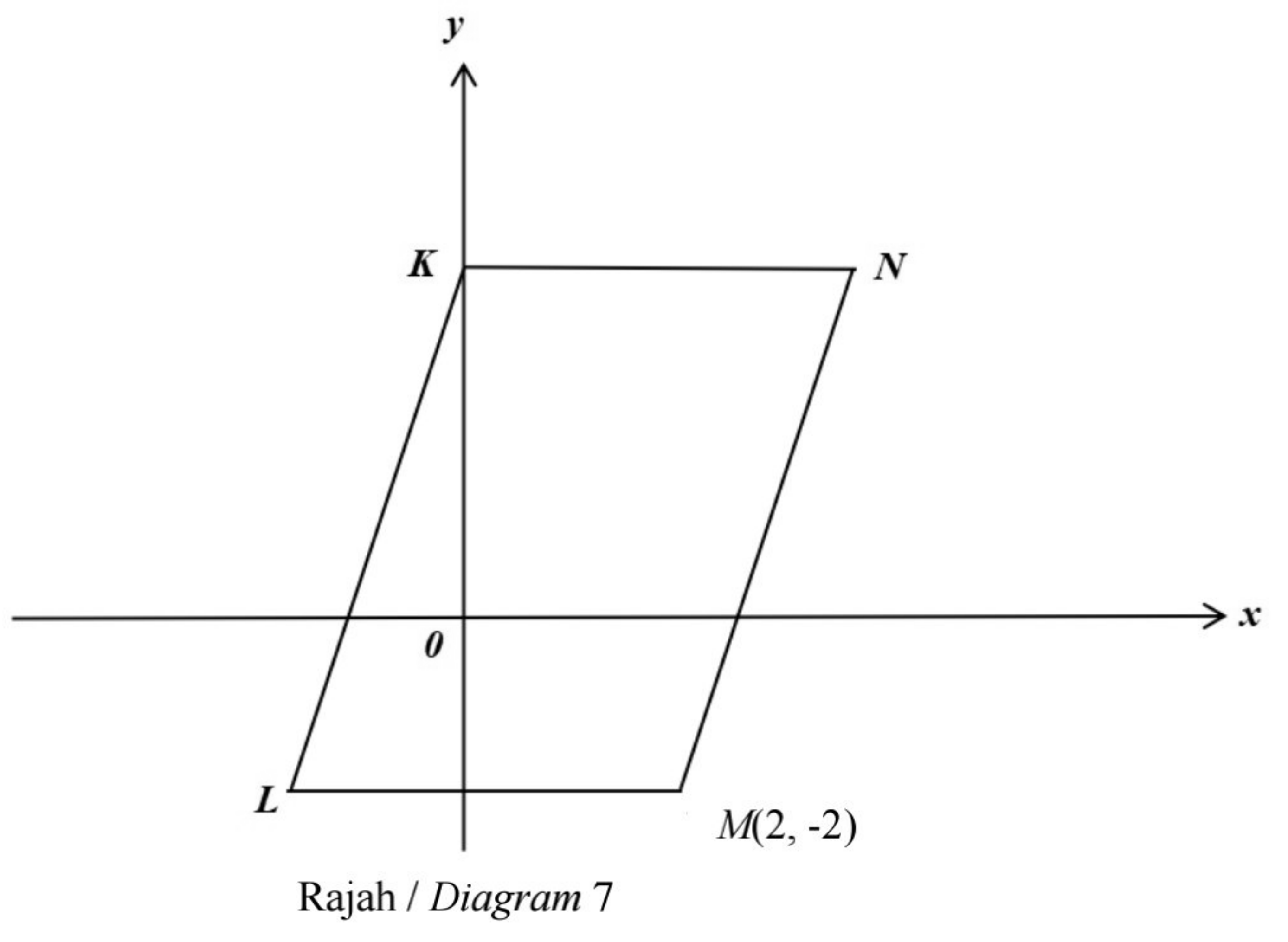
- (a)
State the equation of the straight line LM.
[1] - (b)
Find the equation of straight line MN.
[3]
Diagram 8 shows a set of marbles labelled with letters P, A, N in box K and a set of marbles labelled with numbers 2, 3, 5, 7 in box L. A marble is picked at random from box K and a marble is picked at random from box L.
Medium4 marks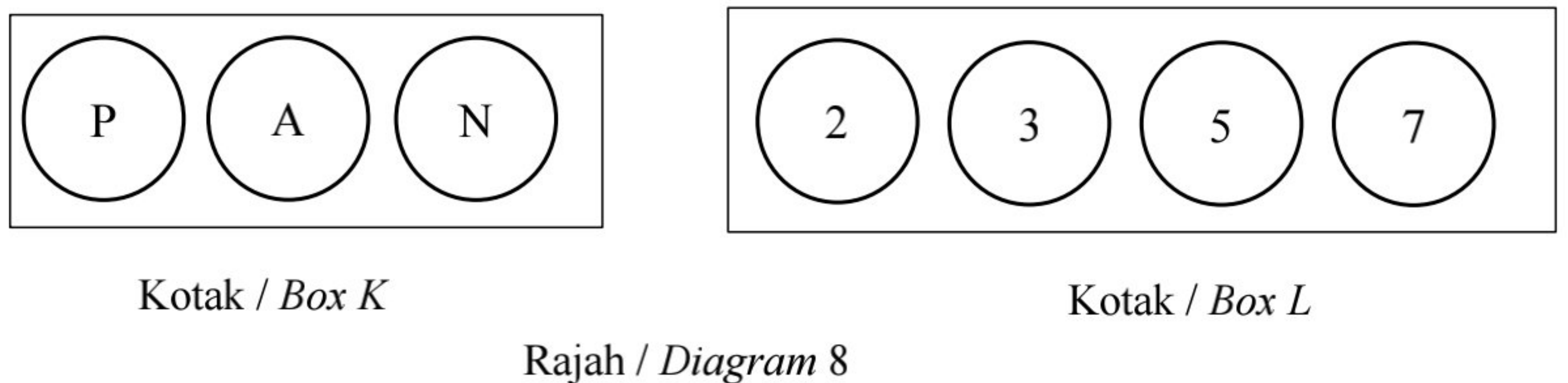
- (a)
List the sample space.
[2] - (b)
By listing down the possible outcomes of the event, find the probability that a marble picked is labelled with letter P or labelled with an odd number.
[2]
Zalikha's monthly income is RM7 000. She wants to buy a laptop worth RM6 000 within eight months in cash. Zalikha needs to save RM750 from her income each month to reach her goal.
Medium6 marks- (a)
Based on Zalikha's situation, complete the table 9(a) in the answer space with the suitable description for each concept of SMART. (Specific: buy a laptop worth RM6000. Attainable: can achieve a monthly saving of RM750 from a monthly income of RM7000. Realistic: RM750 of the monthly income RM7000 represent 10.71% of her income. Measurable and Time-bound are blank.)
[2]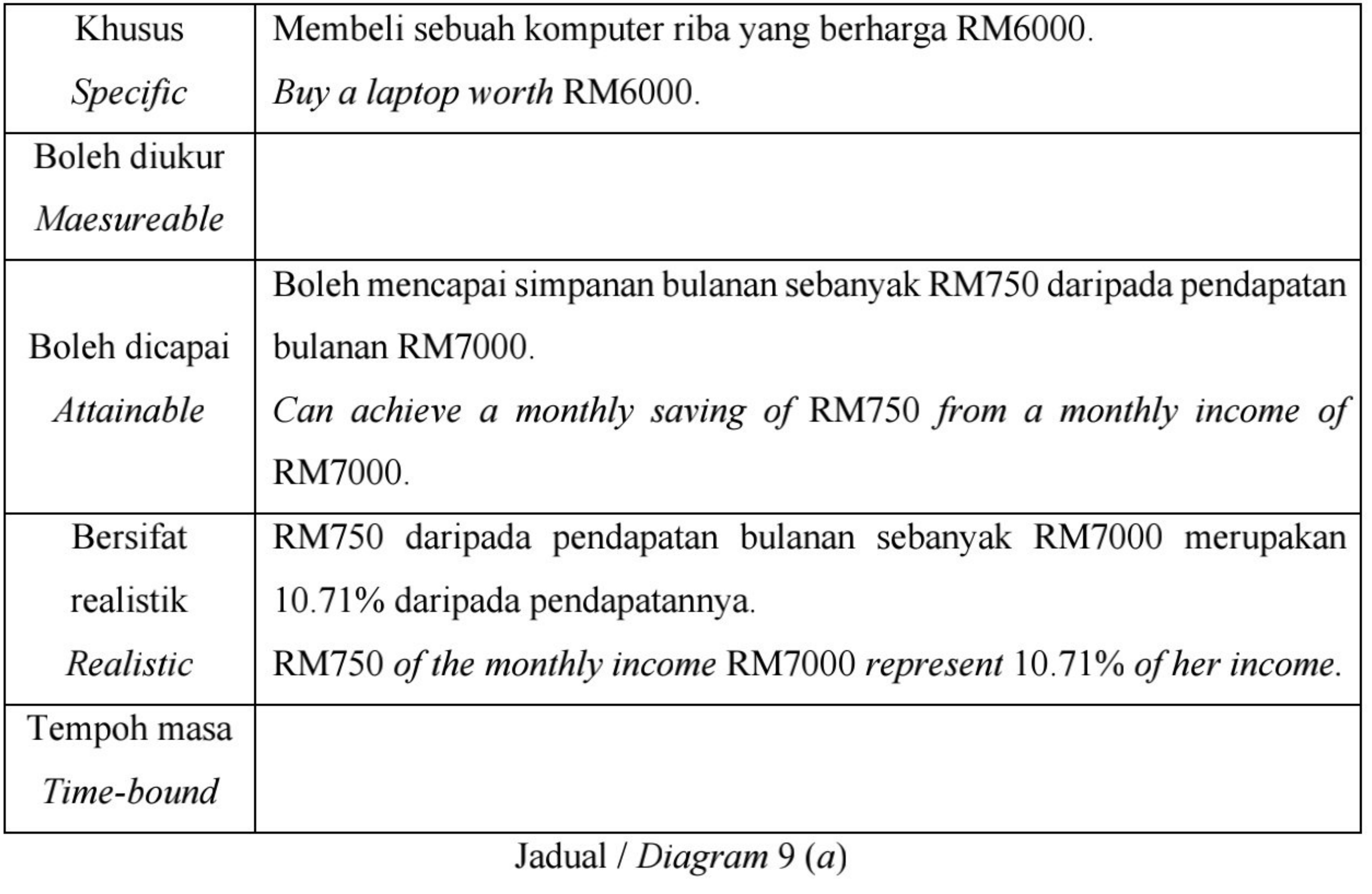
- (b)(i)
Table 9(b) shows Zalikha's personal financial plan (salary 7000, commission 250, total monthly income 7250, minus fixed monthly savings 725, minus savings for emergency fund 150, income balance a; fixed expenses: home loan instalment 2350, insurance 450, total 2800; variable expenses: food 900, utility bill 450, toll and petrol 500, children's education 1400, allowances for parents 500, total variable expenses b; surplus of income c). Based on the above financial plan, find the value of a, b, and c.
[2]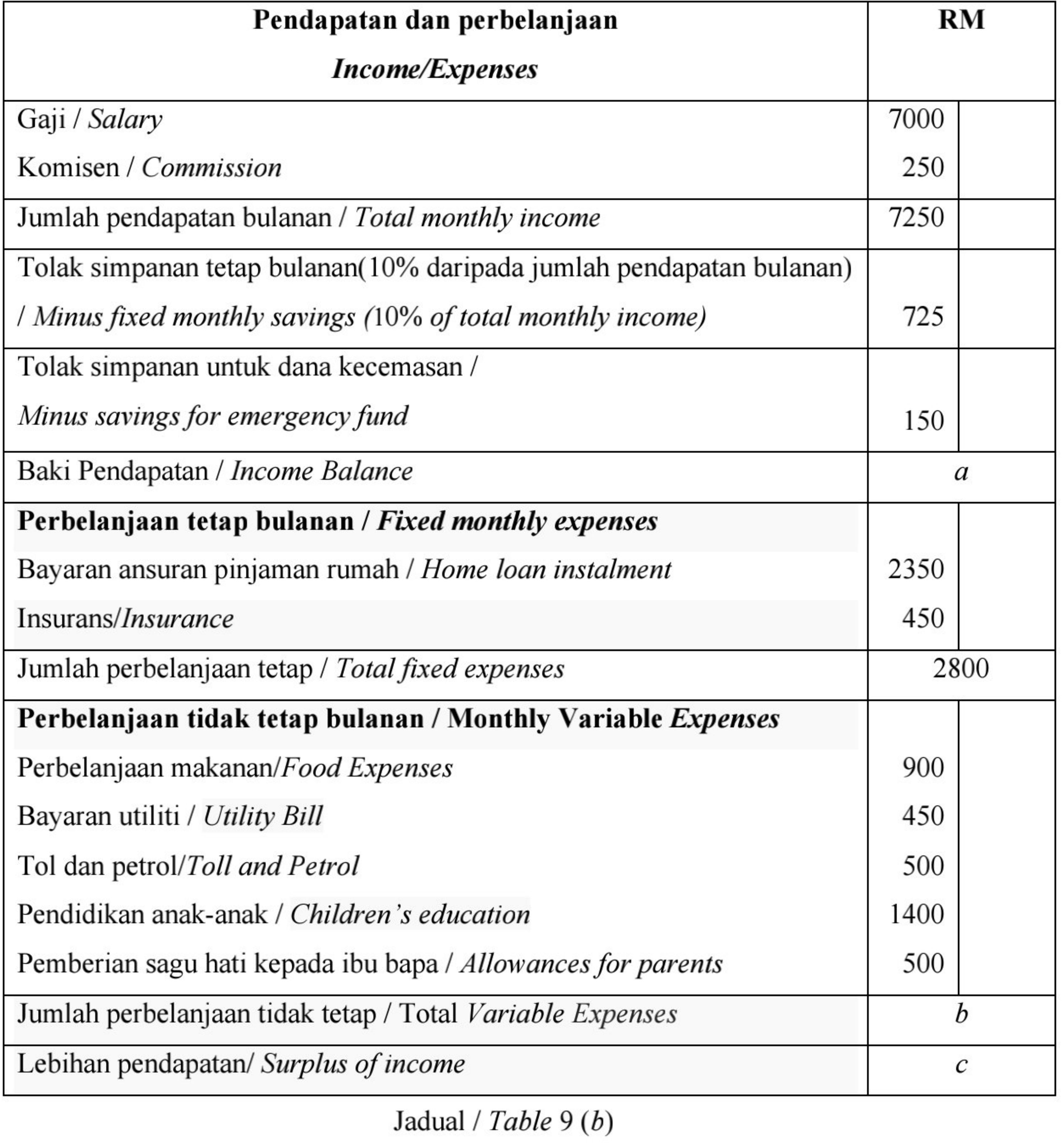
- (b)(ii)
Based on Zalikha's financial plan, will she be able to achieve her goal? Justify your answer.
[2]
Trigonometric ratios and graph of the cosine function.
Easy5 marks- (a)
Calculate the value of cos 262° based on the corresponding reference angle. Give the answer correct to 4 decimal places.
[2] - (b)(i)
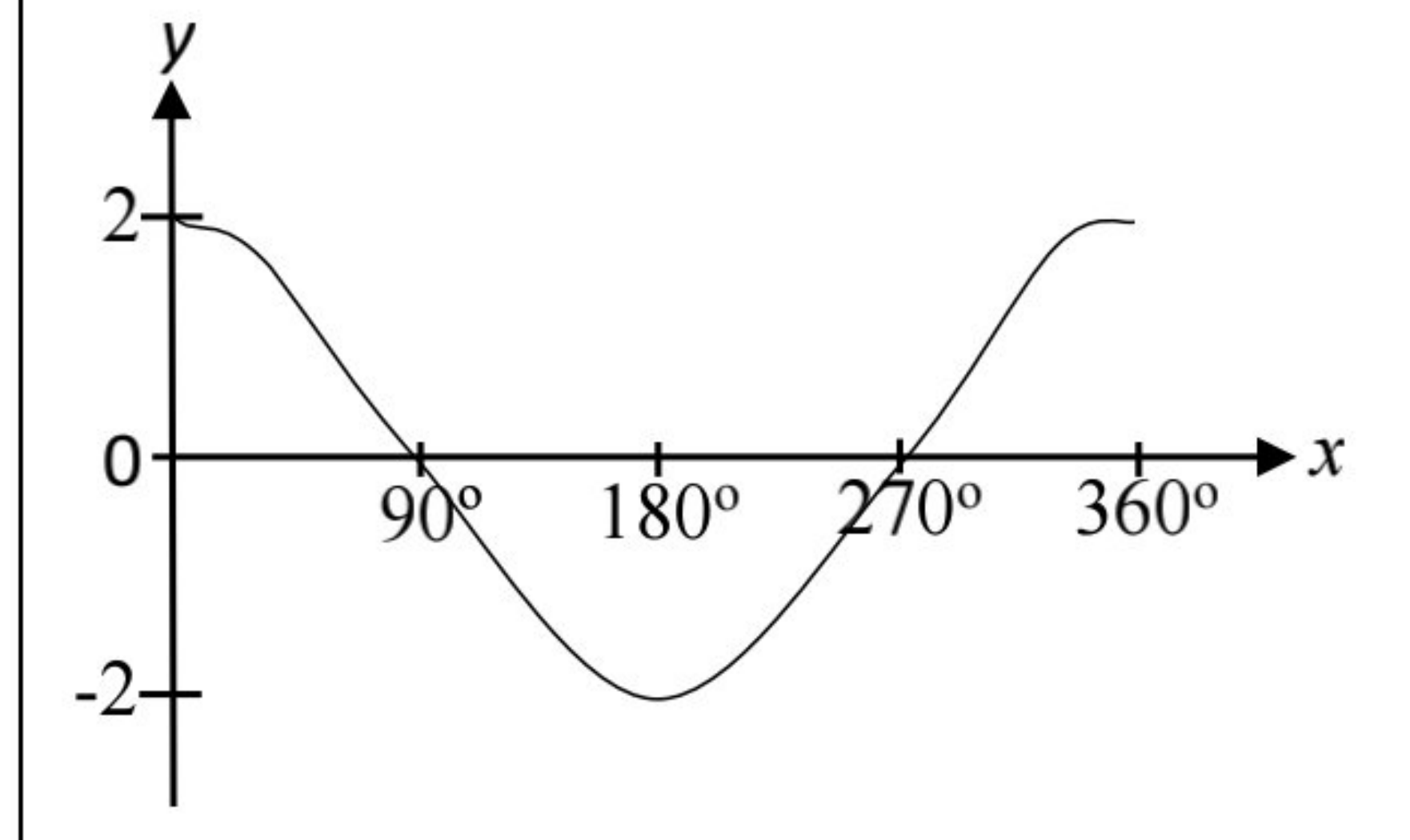
Based on the Diagram 10(b), state the trigonometric function of the graph.
[1]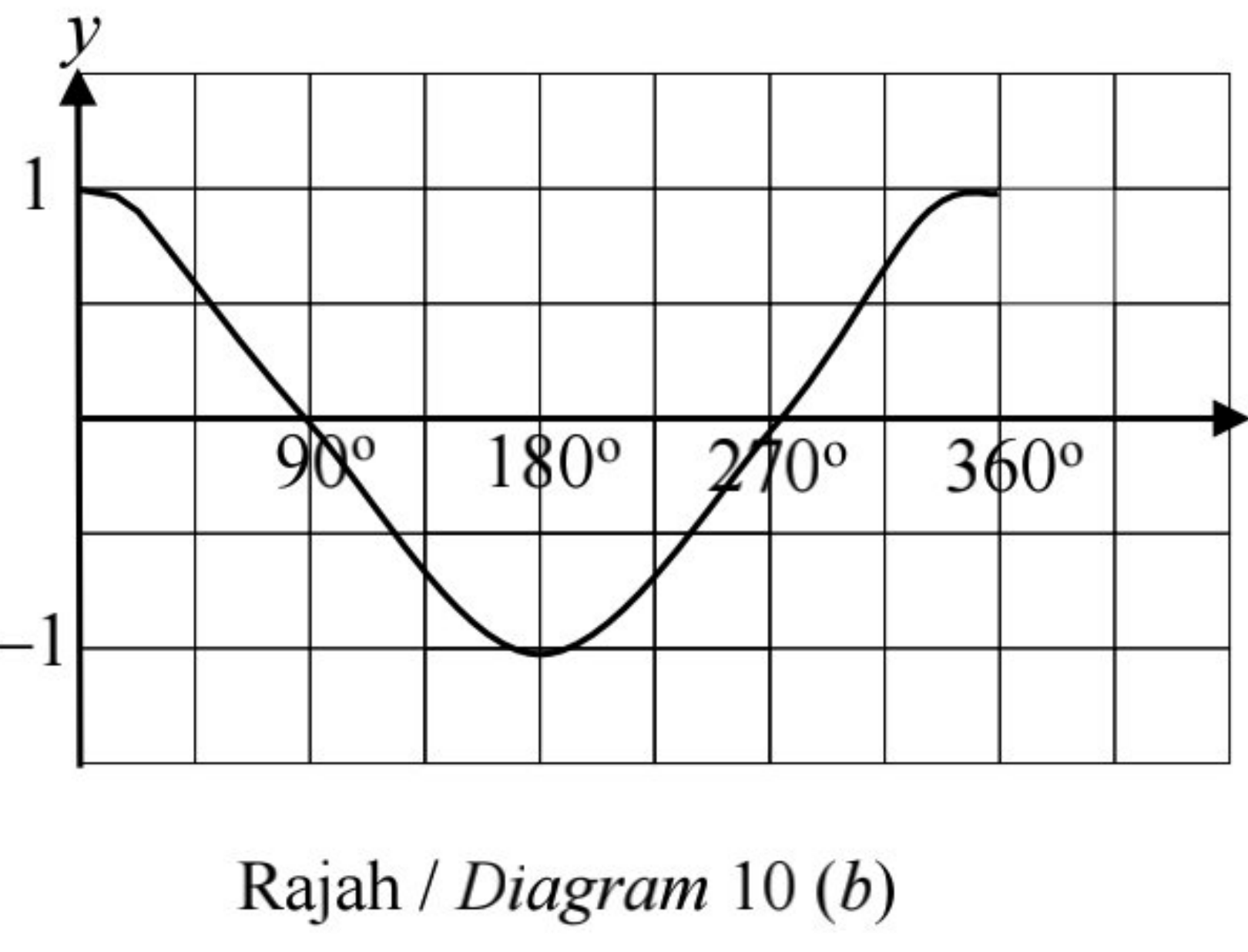
- (b)(ii)
Hence, in the answer space, sketch graph of y = 2 cos x for 0° ≤ x ≤ 360°.
[2]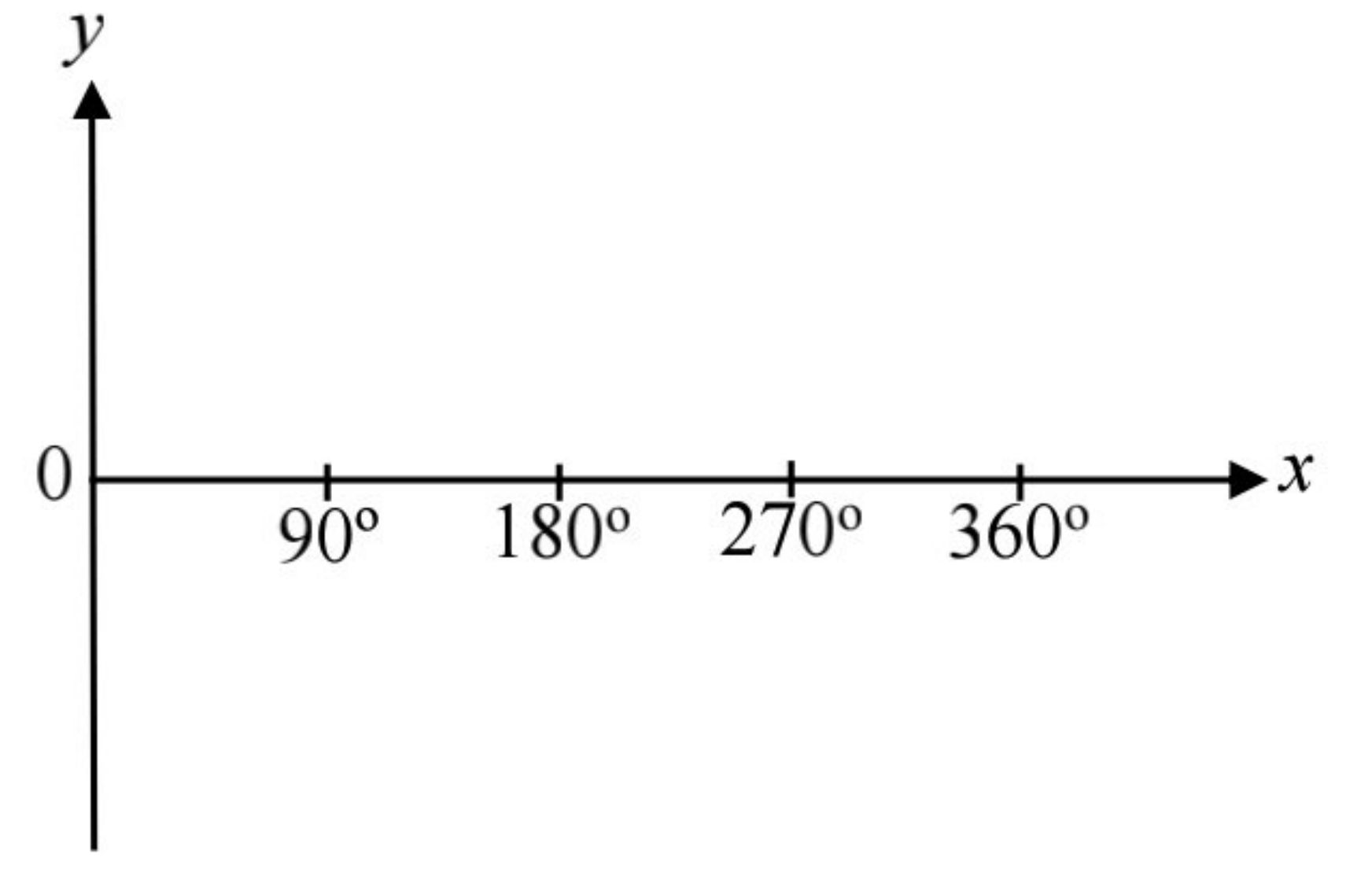
Section B
Transformations on the Cartesian plane: translation, triangle congruency and the combined transformation VW.
Medium8 marks- (a)(i)
Diagram 11(a)(i) shows point of P on a Cartesian plane (P = (−4, 3)). Transformation of T is a translation (6, −4) (column vector). Determine the coordinate of point P under transformation T.
[1]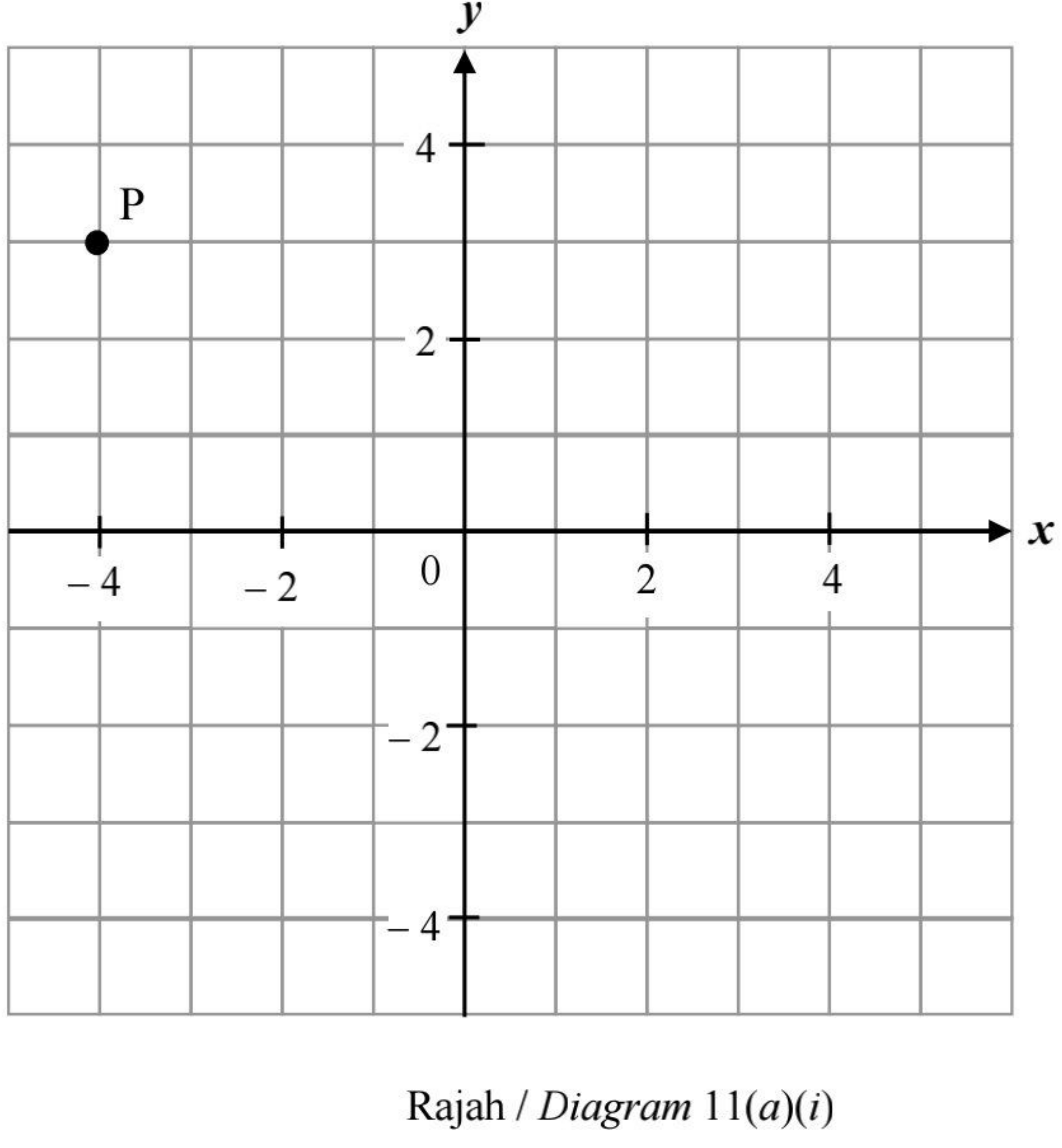
- (a)(ii)
Diagram 11(a)(ii) shows triangle of ABC and PQR (ABC: AB unmarked, BC = 5 cm, AC = 13 cm, angle at A = 30°; PQR: PR = 26 cm, QR = 10 cm, angle at P = 30°). Determine whether a pair of the triangles satisfies the properties of triangle congruency. Justify your answer.
[2]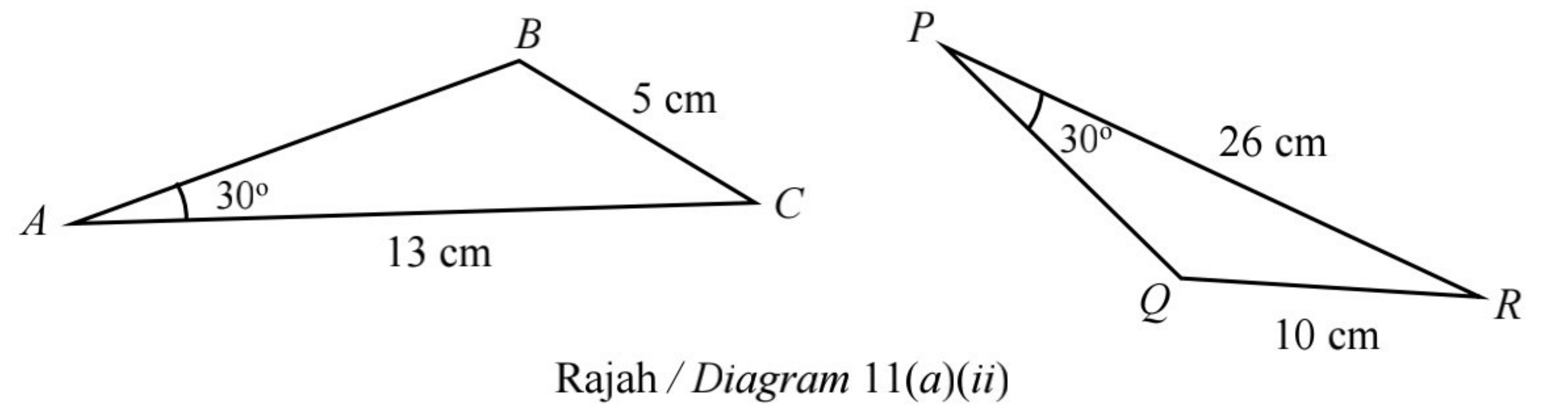
- (b)(i)
Diagram 11(b) shows quadrilaterals EFGH, KMLN and PQRS drawn on a Cartesian plane. The quadrilateral PQRS is the image of quadrilateral EFGH under the combined transformation VW. Describe in full, the transformation W.
[2]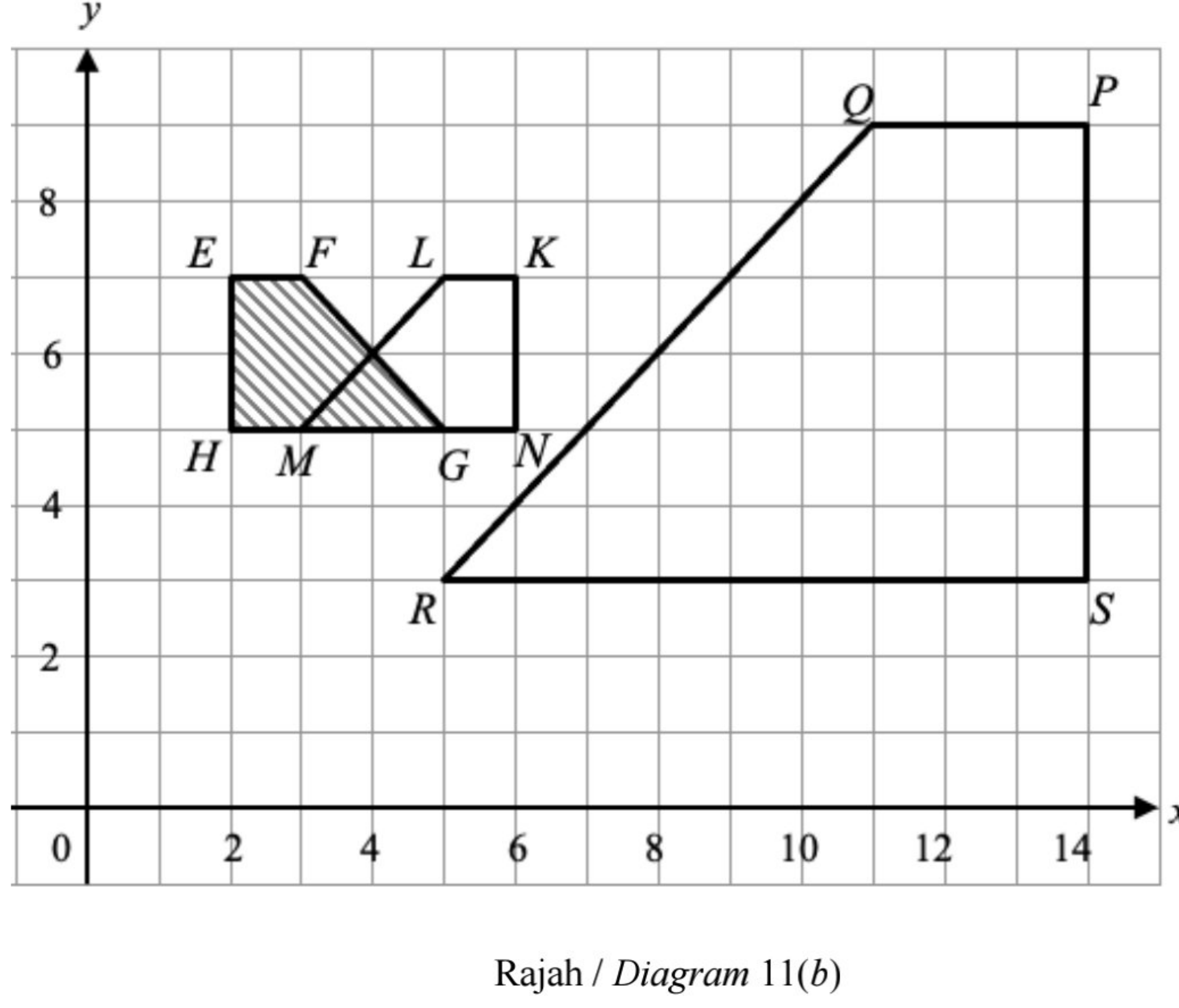
- (b)(ii)
Describe in full, the transformation V (for the combined transformation VW in Diagram 11(b)).
[3]
Matrix equations and a simultaneous-equation problem solved with the matrix method.
Medium10 marks- (a)(i)
Given [[−2, 7], [s, 3]] × [[5], [3]] = [[11], [29]], calculate the value of s.
[2] - (a)(ii)
It is given (1/m) × [[1, 4], [−2, n]] × [[−7, −4], [2, 1]] = [[1, 0], [0, 1]]. Find the value of m and of n.
[2] - (b)(i)
Aziah is a frozen roti canai entrepreneur. Aziah has two machines, X and Y that can produce 94 pieces of roti canai in a minute. If machine X operates for 2 minutes and machine Y operates for 5 minutes, 296 pieces roti canai can be produced. Given that, machine X can produce x pieces in a minute and machine Y can produce y pieces in a minute. Write two linear equations to represent the above information.
[2] - (b)(ii)
Hence, by using matrix method, calculate the value of x and of y.
[4]
Ali organized a Family Day at the end of the year. He has rented a hall for the event. There are at most 35 large and small tables for at least 160 students involved in a workshop in a hall. Only 8 students can be seated around the large table and only 4 students for the small tables.
Medium9 marks- (a)(i)
Write two linear inequalities other than x ≥ 0 and y ≥ 0, which represent the situation with the assumption that x is large table, and y is small table.
[2] - (a)(ii)
By using a scale of 2 cm to 5 units on both axes, draw and shade the region that satisfies the above system of linear inequalities.
[4]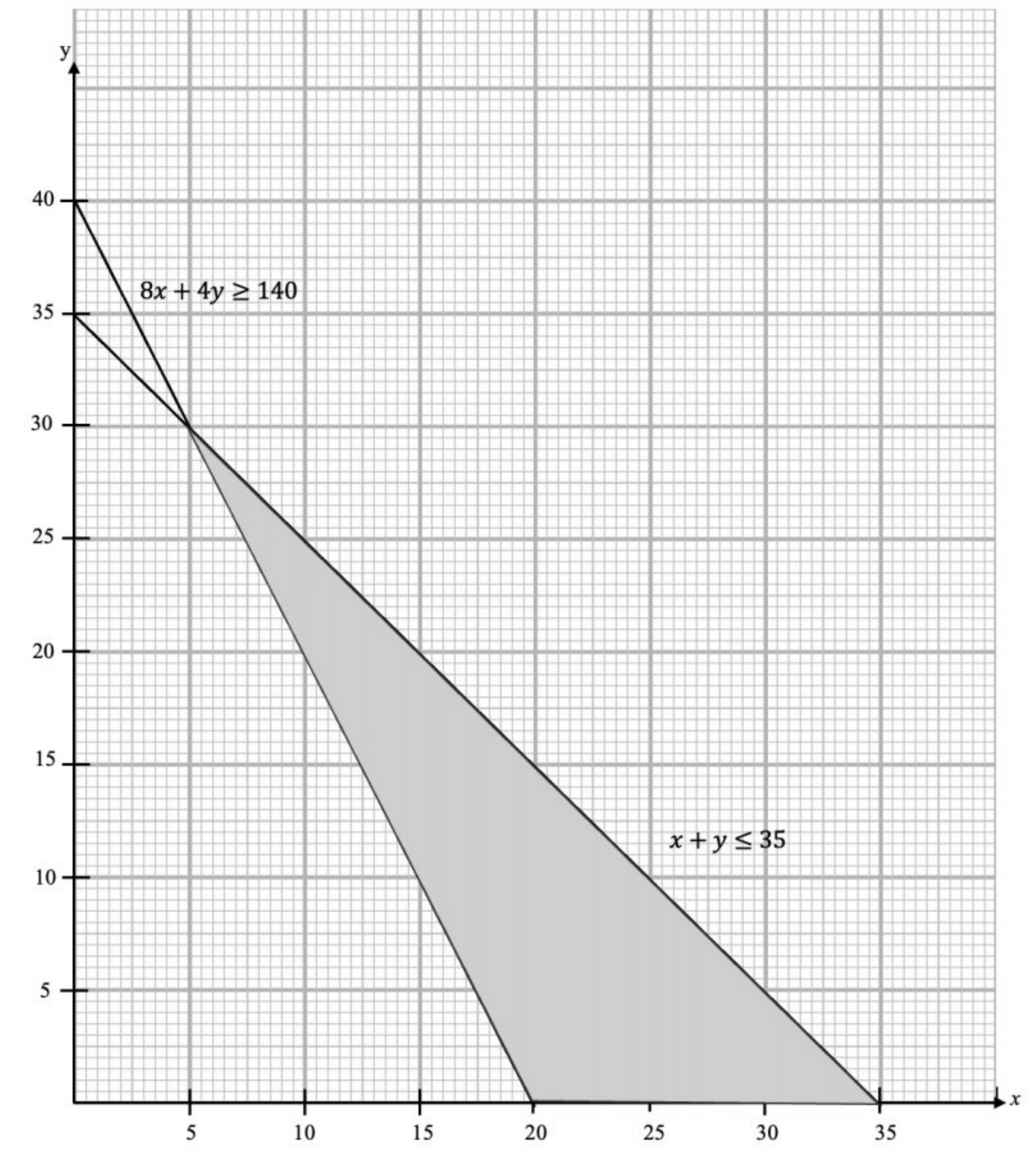
- (b)(i)
From the graph, determine the minimum number of large tables in the hall when the number of small tables is 10.
[1] - (b)(ii)
From the graph, determine the maximum number of students who can sit in the hall when the number of large tables is 15.
[2]
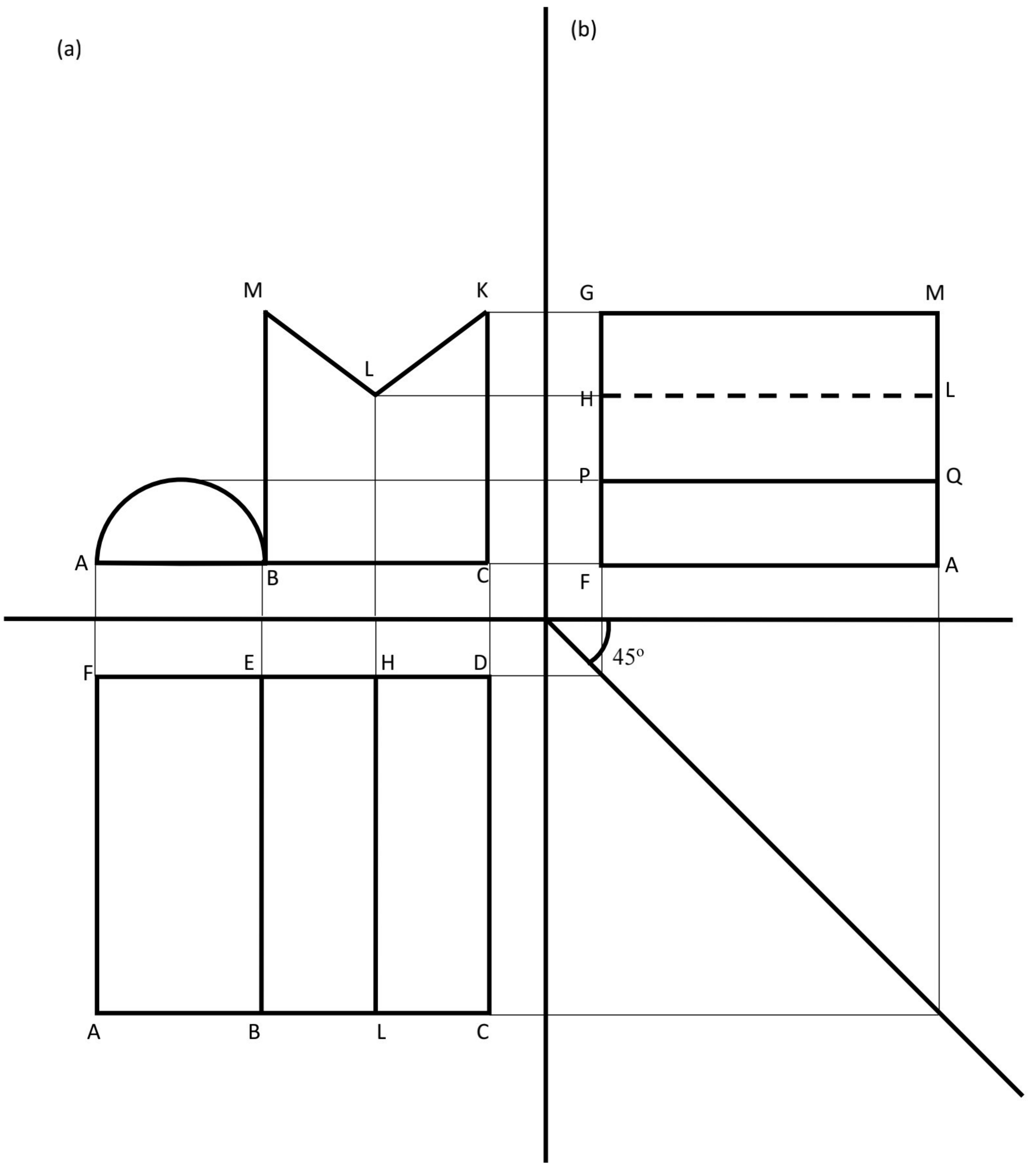
Diagram 14 shows a composite solid made up of a right prism and a semi cylinder. ABCKLM is the uniform cross section of the object. The rectangles HJKL and GHLM are inclined planes. HL is 3 cm above the base BCDE, KL = ML and CK = BM. Edges BM, CK, DJ and EG are vertical. (Dimensions: AB = 3 cm, BC = 4 cm, 6 cm length along AF direction, CK = 4.5 cm.)
Hard9 marks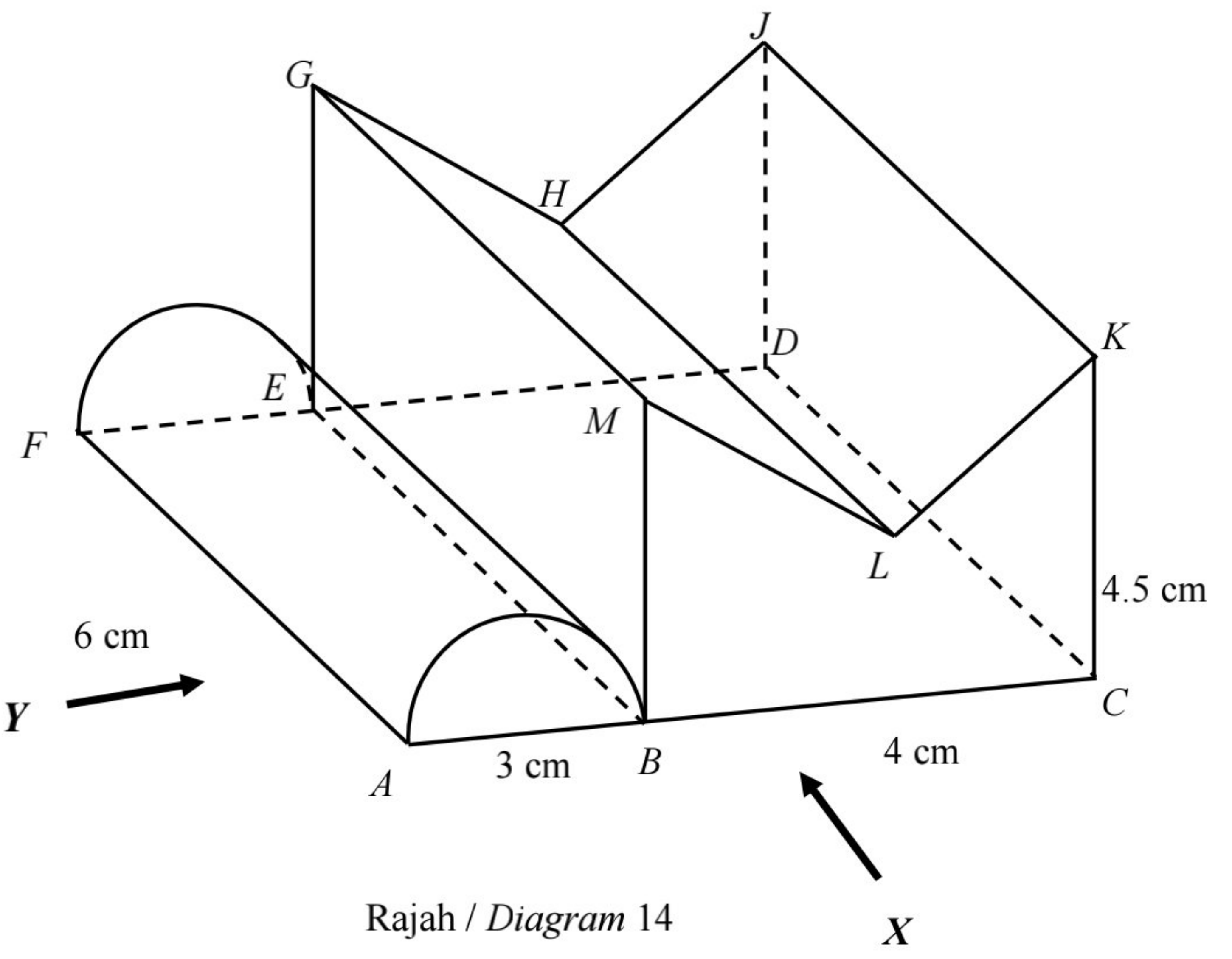
- (a)
In the answer space provided, draw the full scale of the elevation from X.
[4]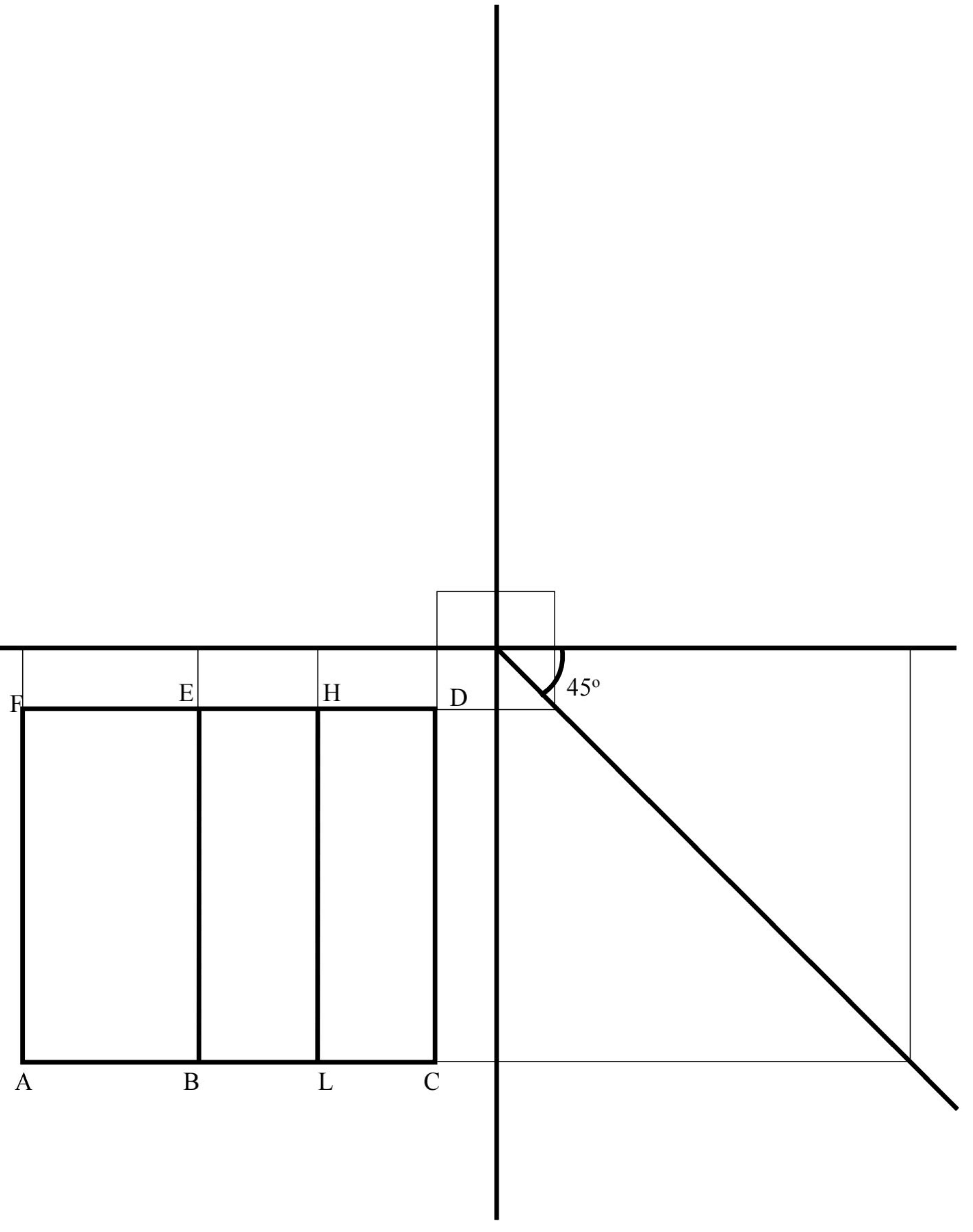
- (b)
In the answer space provided, draw the full scale of the elevation from Y.
[5]
(a) Diagram 15(a) shows the stem-and-leaf plot which represent the Mathematics marks of Class 5 Alpha and Beta in Test 1. Key: 4 | 0 means 40 marks for class 5 Beta. (b) Table 15(b) shows the frequency distribution of mass, in kg, of 100 students in a school: 11–15: 6; 16–20: 8; 21–25: 19; 26–30: 27; 31–35: 25; 36–40: 13; 41–45: 2.
Medium9 marks- (a)(i)
Based on the stem-and-leaf plot, determine the range for both classes.
[2]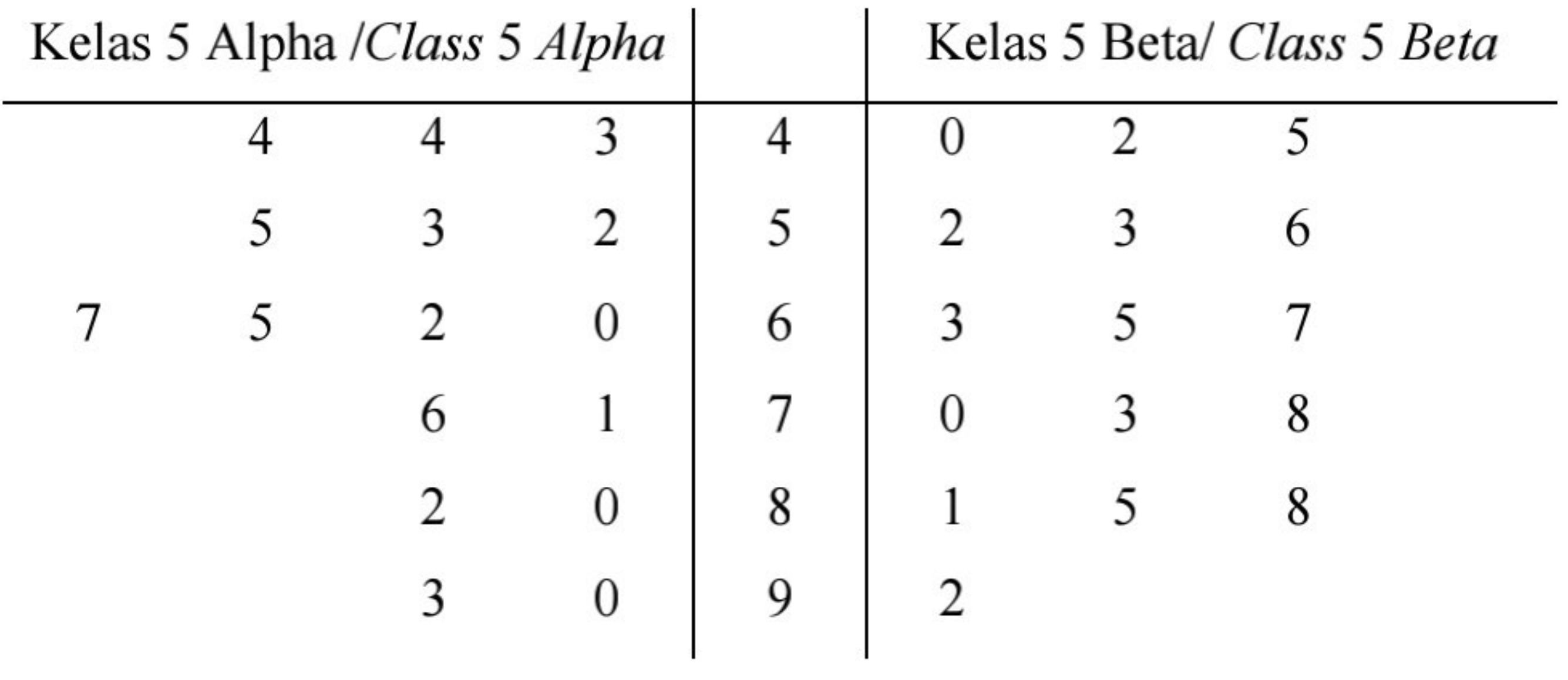
- (b)(i)
Based on table 15(b), complete table 15(b)(i) in the answer space (columns: mass, frequency, cumulative frequency, upper boundary; first row 6–10: 0, 0, 10.5; last row 41–45: 2, cumulative 100).
[3]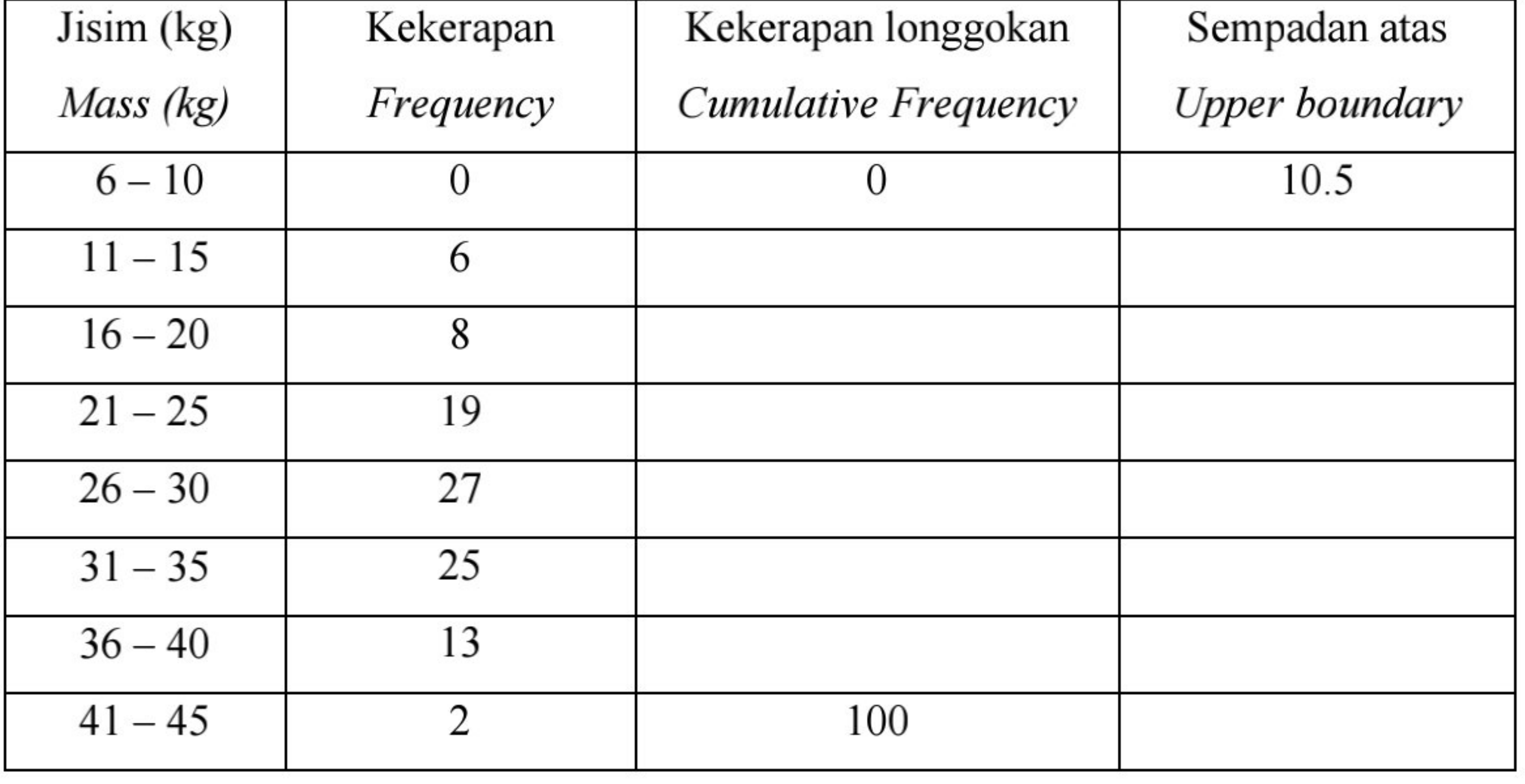
- (b)(ii)
Using a scale of 2 cm to 5 kg on the horizontal axis and 2 cm to 10 pupils on the vertical axis, draw an ogive for the data.
[4]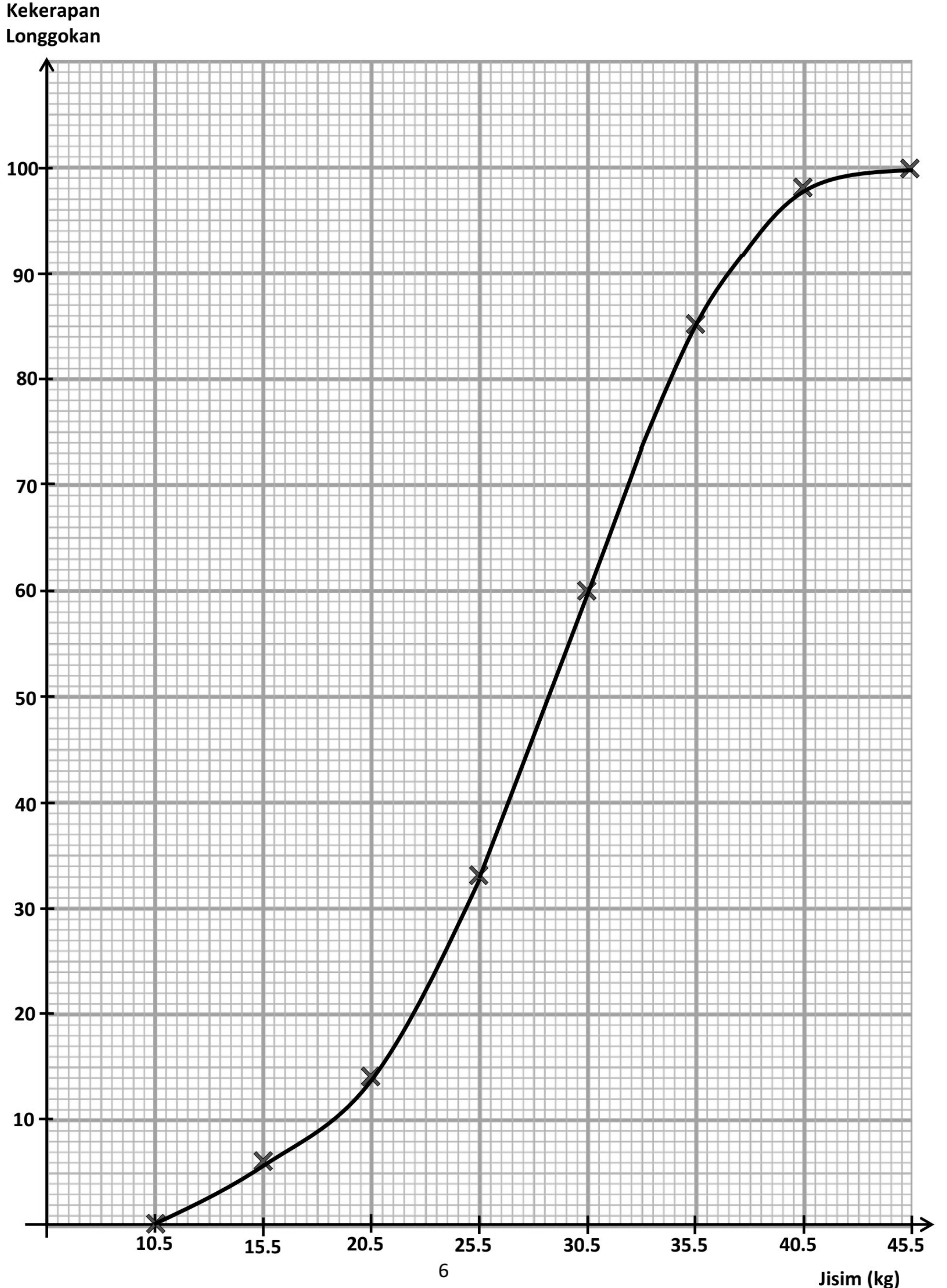
Section C
Siti has a flower shop in the Impian Town. Siti's shop sells fresh flower bouquets and the combination of fresh flowers, fruits and chocolates bouquets according to the customer requests.
Hard15 marks- (a)(i)
Siti received an order of 30 bouquets of roses and lilies for a ceremony. The price of one bouquet of roses and one bouquet of lilies is RM50 and RM45 respectively. Siti has received a payment of RM1 450. Write two linear equations to represent the situation.
[2] - (a)(ii)
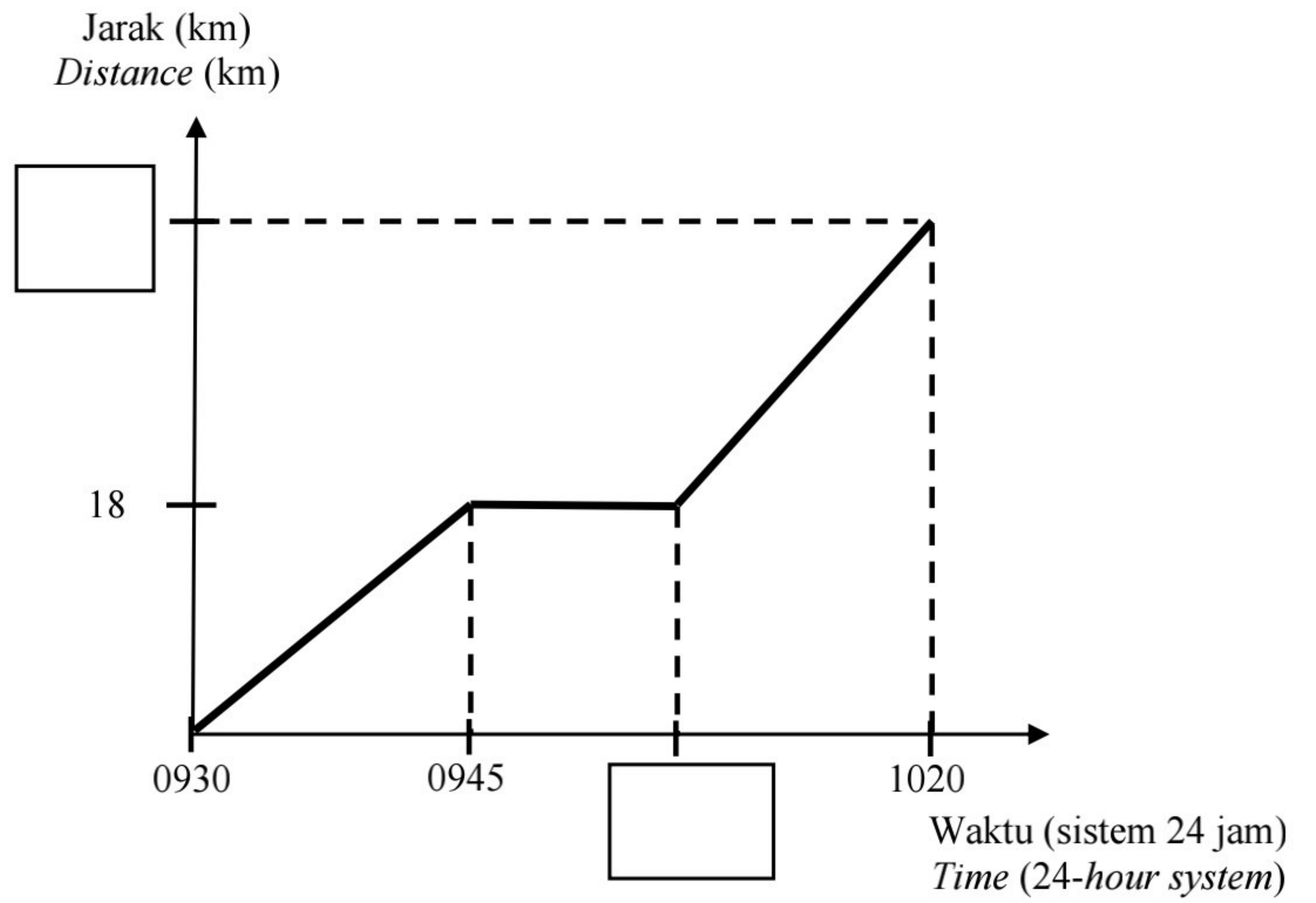
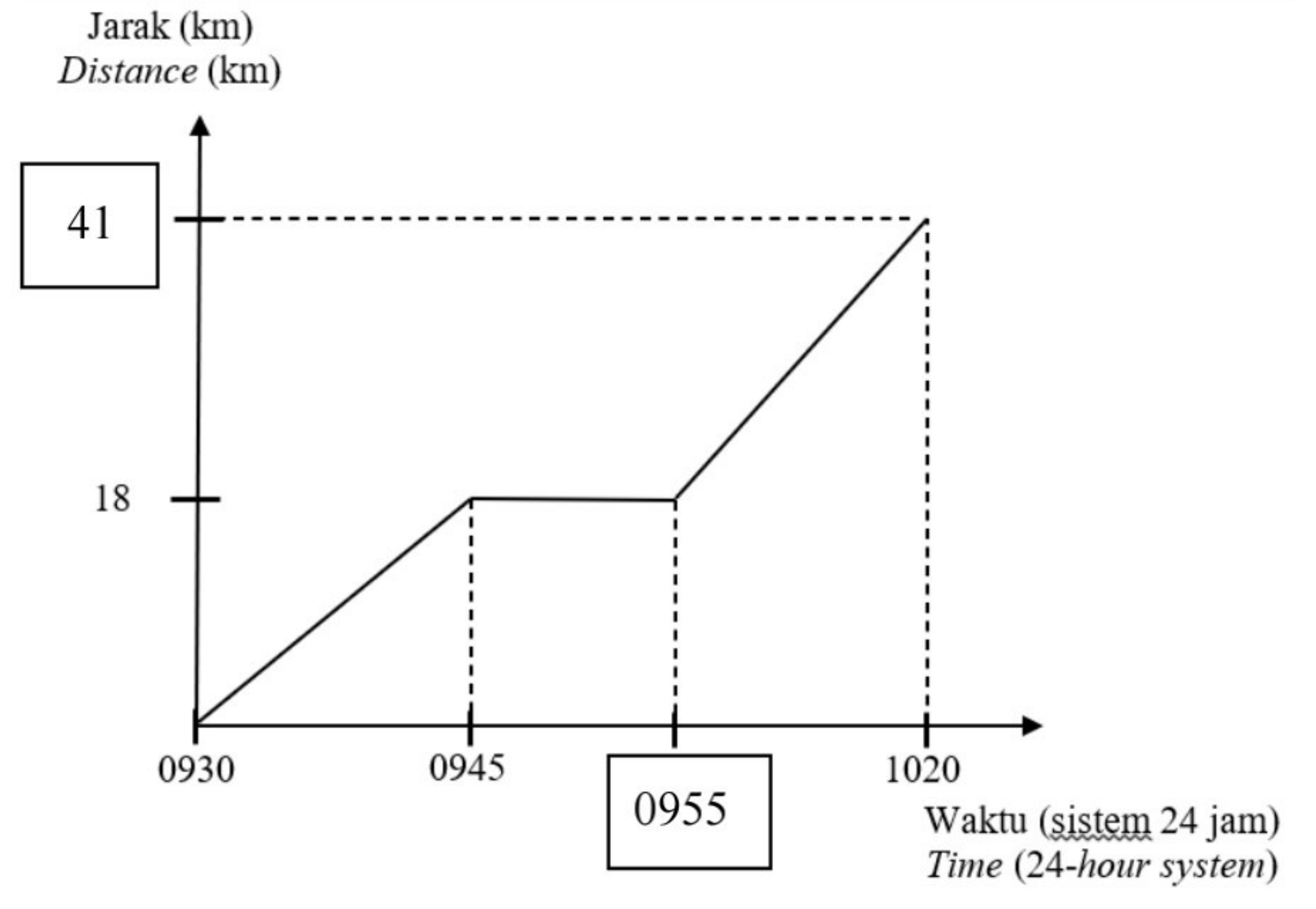
Siti delivered all the ordered bouquets to the event venue on Saturday. Table 16(a): 9.30 am depart from the shop; 9.45 am stop at the petrol station in 10 minutes; (blank time) depart from the petrol station; 10.20 am arrive at the event venue. It is given that the distance from the shop to the petrol station is 18 km and the distance from the petrol station to the event venue is 23 km. Complete the distance-time graph in the answer section.
[2]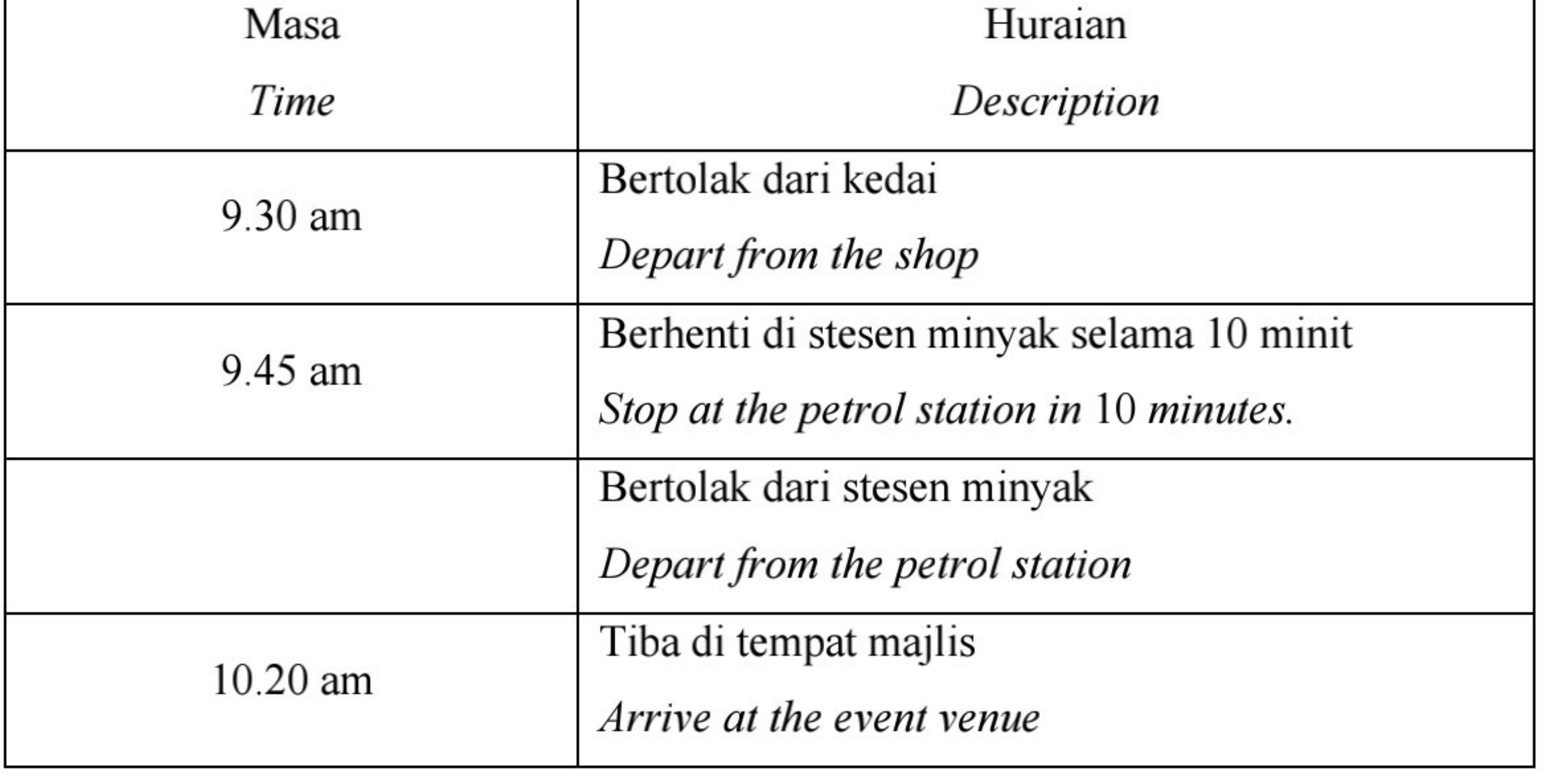
- (b)(i)
Siti will provide a lucky draw for every customer who buys a flower bouquet worth more than RM150. The lucky draw box contains a total of 40 vouchers. Table 16(b)(i): RM5: 25; RM7: x; RM10: 5. What is the probability of a customer getting RM7 voucher?
[1]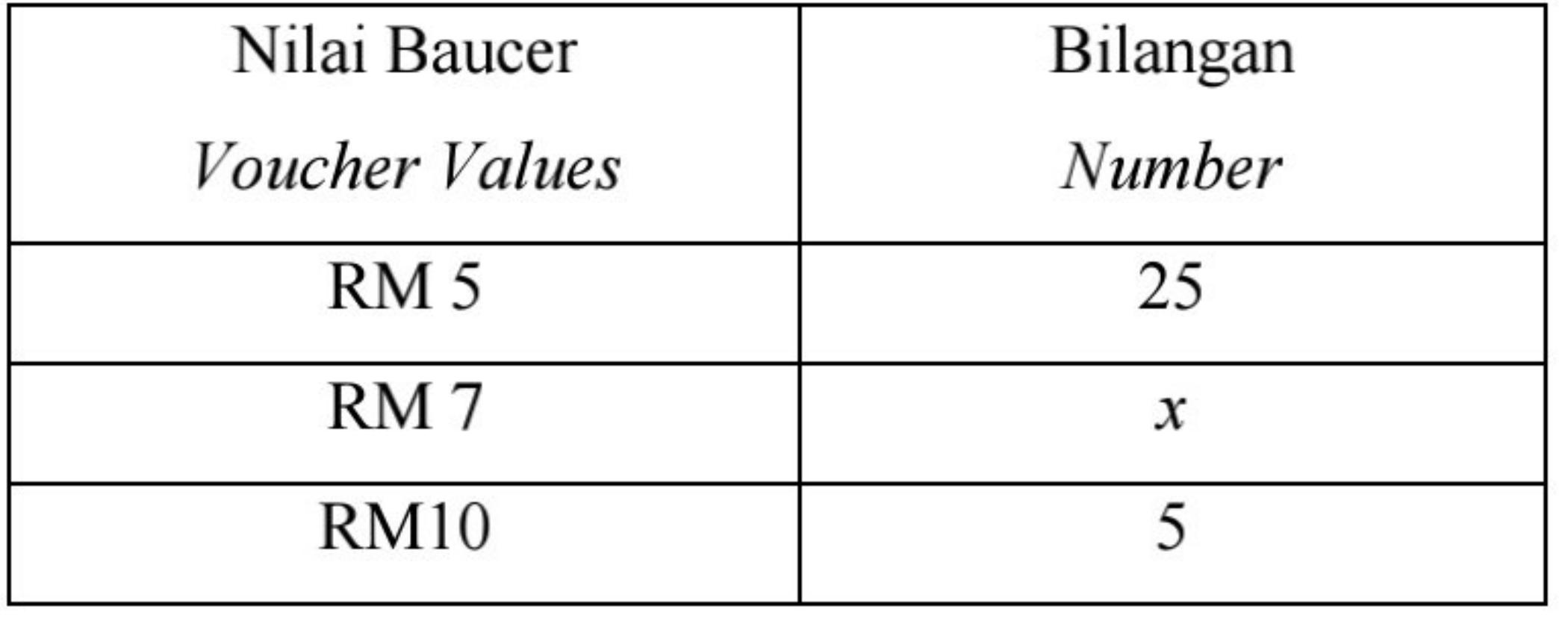
- (b)(ii)
Siti has two workers. Table 16(b)(ii) shows the time, in minutes, taken by the two workers to make 15 similar flower bouquets (time 4.0–4.4, 4.5–4.9, 5.0–5.4, 5.5–5.9, 6.0–6.4; Worker A: 3, 5, 4, 2, 1; Worker B: 3, 4, 5, 3, 0). Given that the average time taken by the two workers is 4.97 minutes. Which employee will be selected to participate in flower bouquet competition? Give your justification.
[3]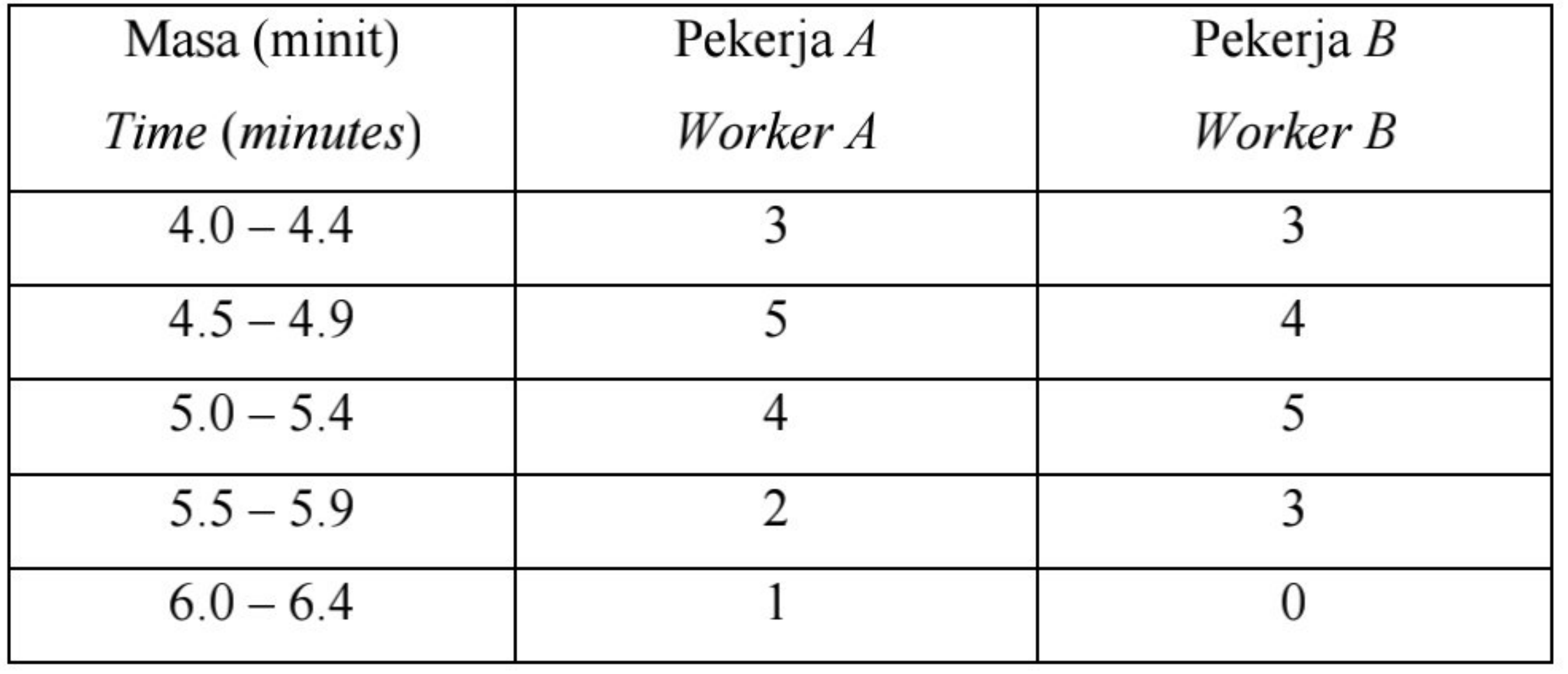
- (c)
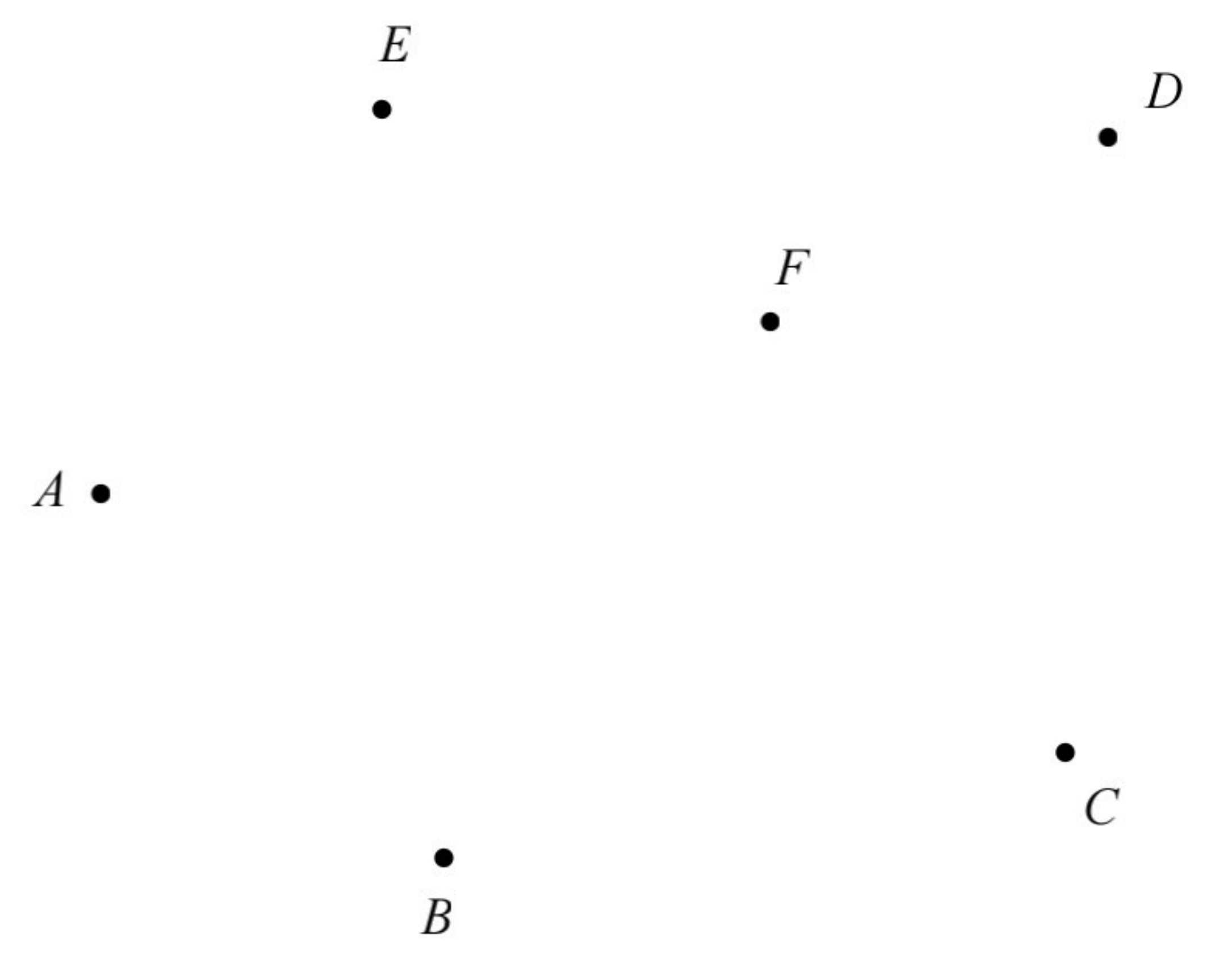
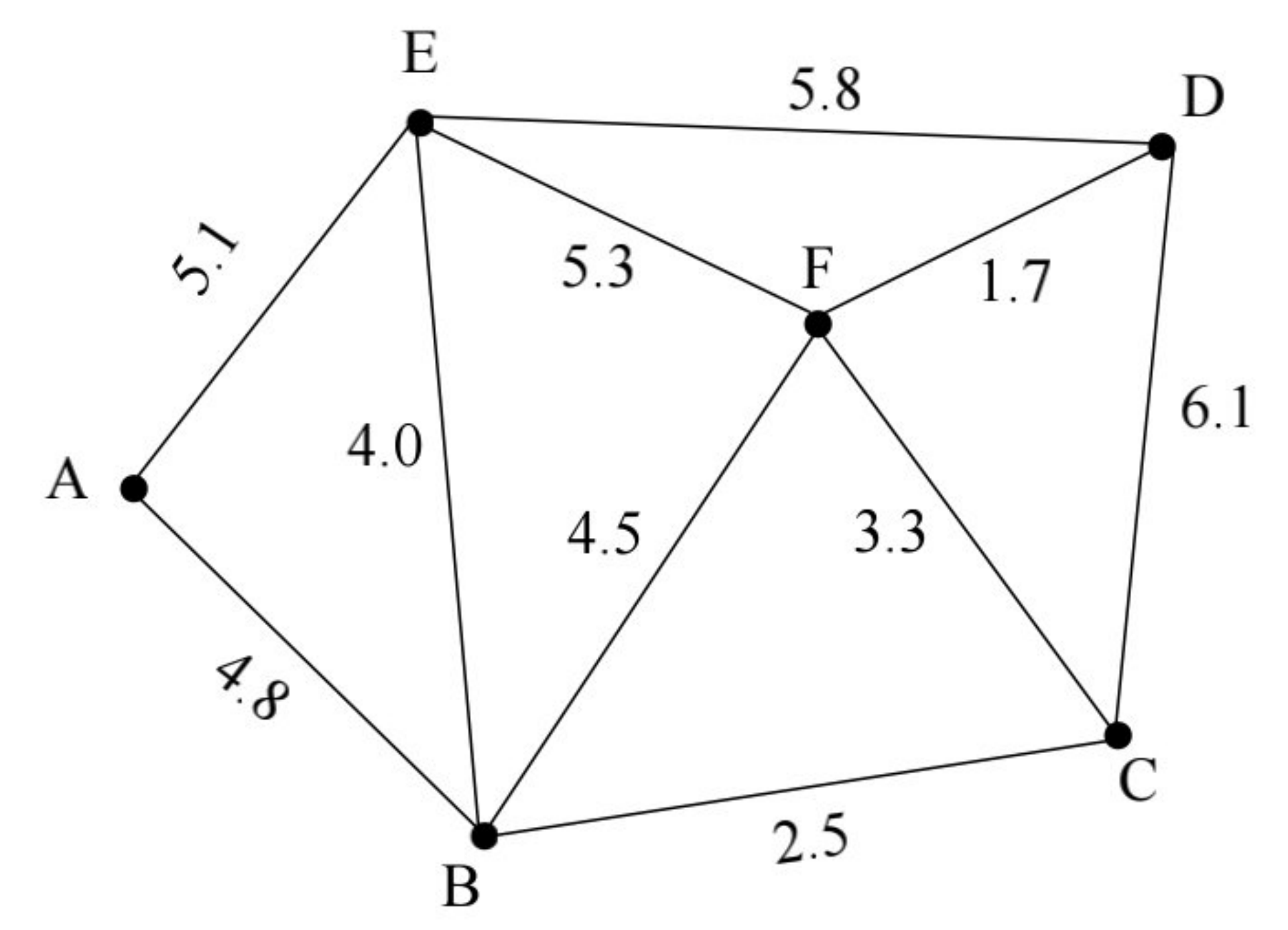
On Sunday, Siti received orders from six different customers. Table 16(c) shows the path that connects the locations of all the customers (A–B 4.8, A–E 5.1, B–C 2.5, B–E 4.0, B–F 4.5, C–D 6.1, C–F 3.3, D–E 5.8, D–F 1.7, E–F 5.3, km). Complete the undirected weighted graph in the answer space. Hence, state the shortest total distance if Siti passes through each location only once starting from location A and ending at location C.
[3]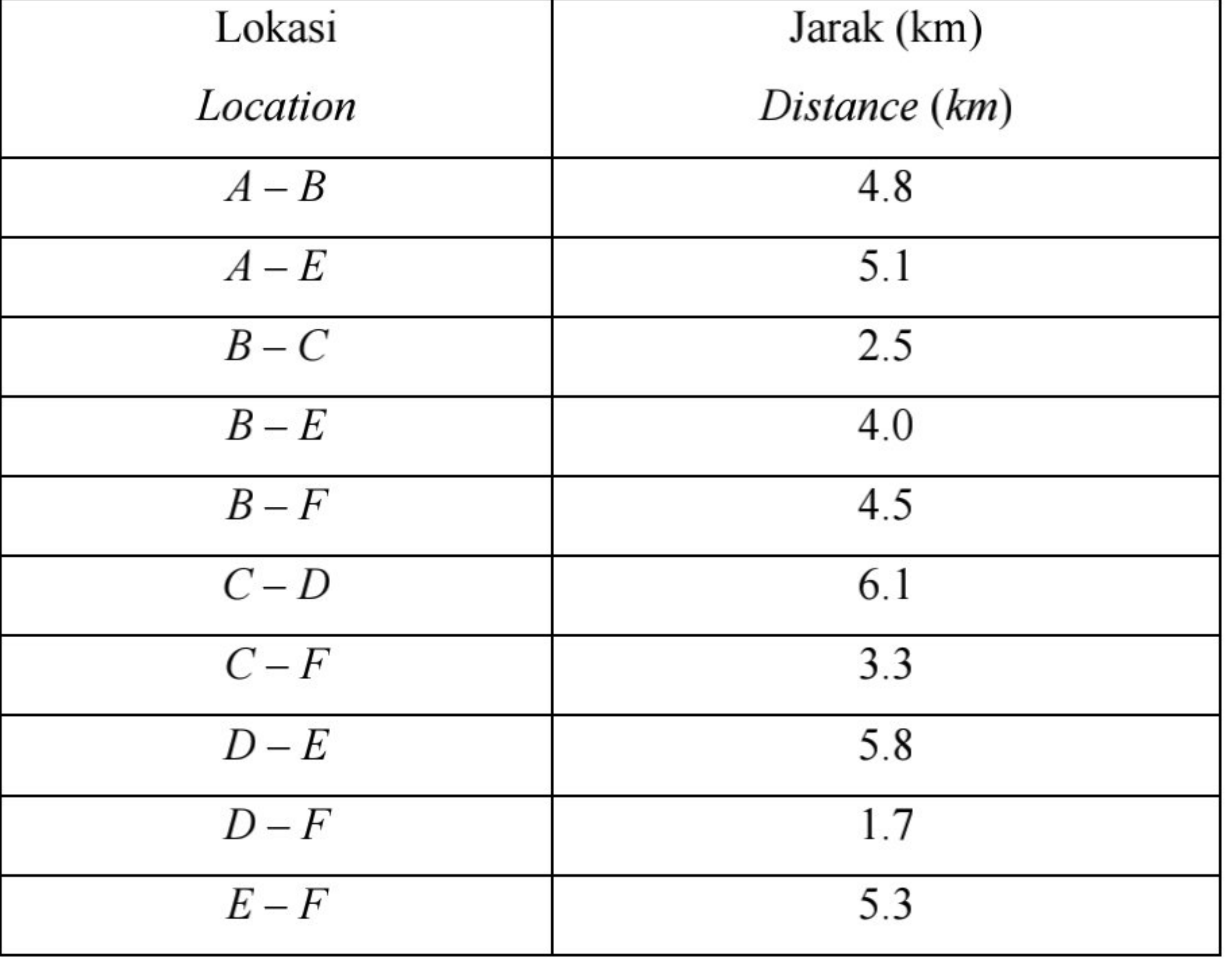
- (d)
Siti has made a profit of RM12 000 from her shop in June. She plans to make a fixed deposit in Bank Maju for 3 years with an interest rate of 6% per annum. She has to make a choice whether to save with simple interest or compound interest (with compounding every 3 months). Based on the calculation of simple interest and compound interest which is more profitable? Give your justification.
[4]
Mr. Hafiz is a manager of a scarf supplier company. Last week he sent the scarf to Butik Anggun by car.
Hard15 marks- (a)(i)(a)
The diagram 17(a) shows the speed-time graph of Mr. Hafiz's car journey (speed rises from 0 to 60 km/h in 1 h, stays at 60 km/h until 2 h, then rises to 80 km/h at 2.5 h). State the uniform speed in km/h.
[1]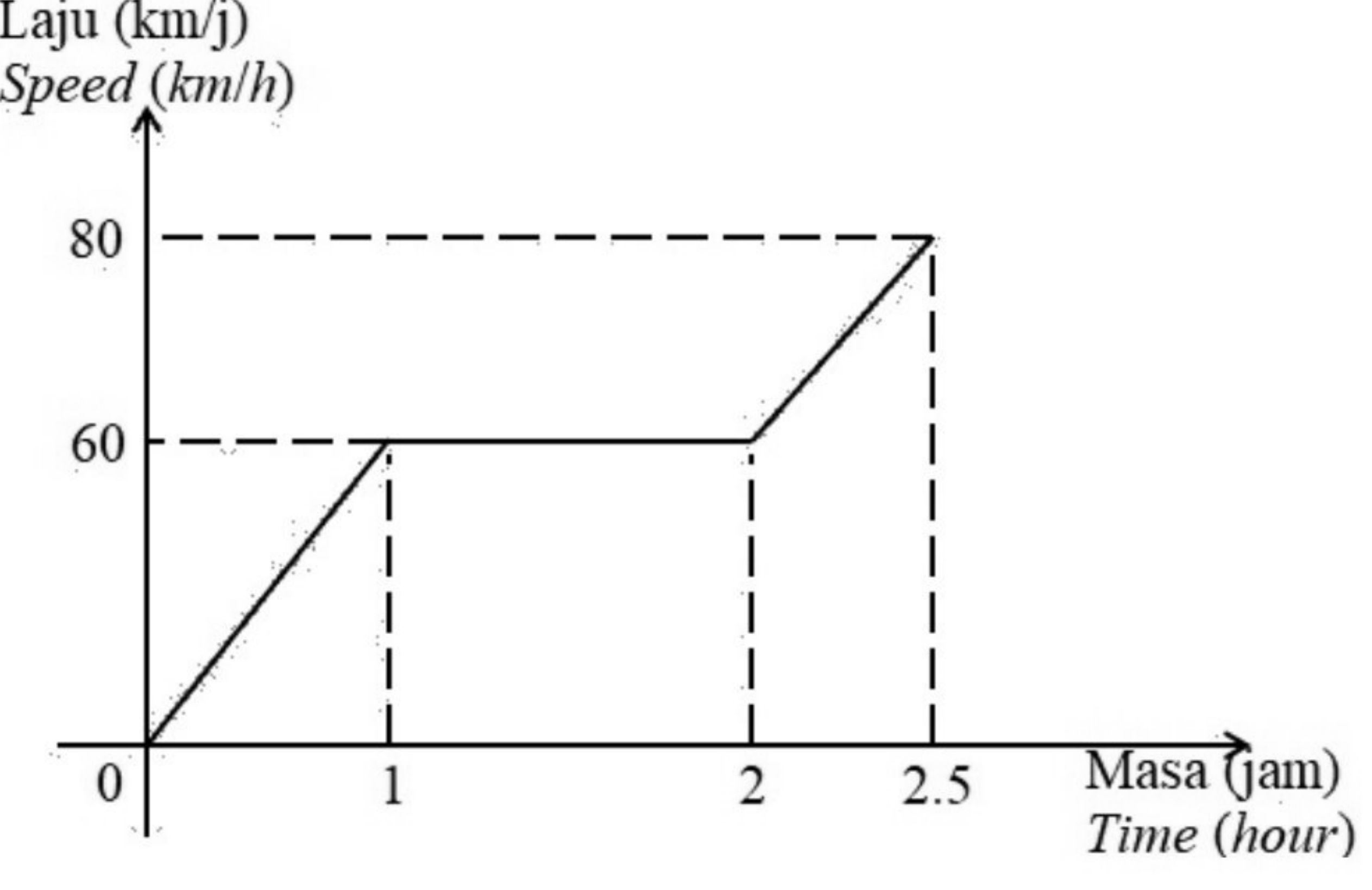
- (a)(i)(b)
Next, calculate the rate of change in speed, in km/h², for the last 0.5 hours.
[2] - (a)(ii)
Mr. Hafiz asked the workers to sort the scarves at Butik Anggun. The time used, T hours to arrange the scarf varies directly with the number of scarves, N and varies inversely with the number of workers involved, P people. Given that 4 workers use 2 hours to sort 400 scarves. Calculate the number of scarves that can be arranged in 5 hours, if the number of workers is 8 people.
[2] - (b)(i)
The following month, Mr Hafiz received orders from three boutiques according to desired scarves colour. Given a set of universes, ξ = {Blue(B), Orange(O), Purple(U), Green(H), Gray(K), White(P), Yellow(K), Indigo(I), Red(M)}. Set X = {scarves colour with vowel letter}; Set Y = {scarves colour with consonant letter}; Set Z = {scarves colour starts with letter K}. List the elements of set (Y ∩ Z)′.
[1] - (b)(ii)
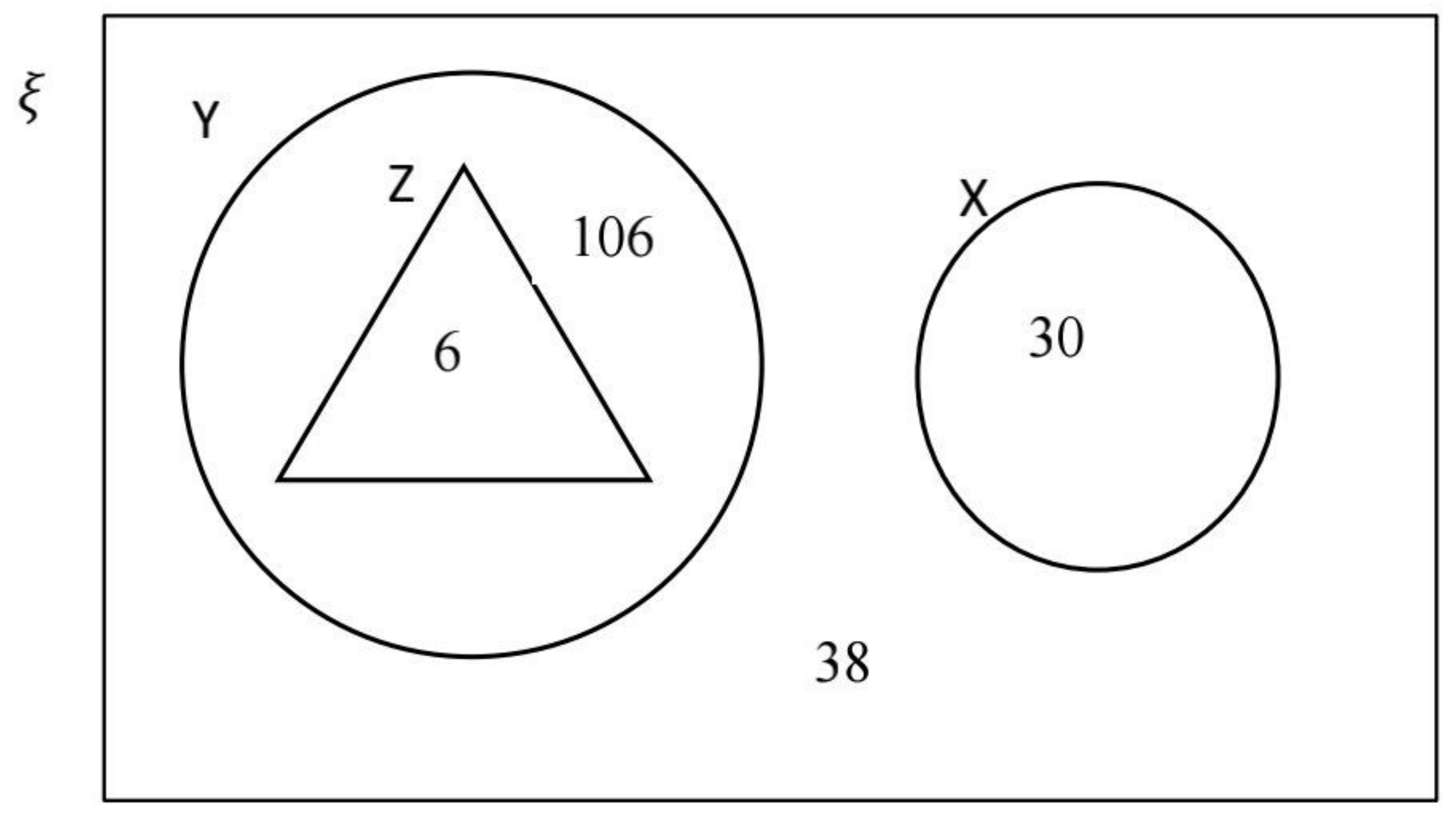
Diagram 17(b) in the answer space shows an incomplete Venn diagram (ξ with circle Y containing triangle Z, and separate circle X) for the number of scarves colours ordered by the three boutiques, n(ξ) = 180, n(X) = 30, n(Y) = 112 and n(Y ∩ Z) = 6. Complete the Venn diagram in the answer space and then, find the number of scarf colours that are not ordered by those three boutiques.
[3]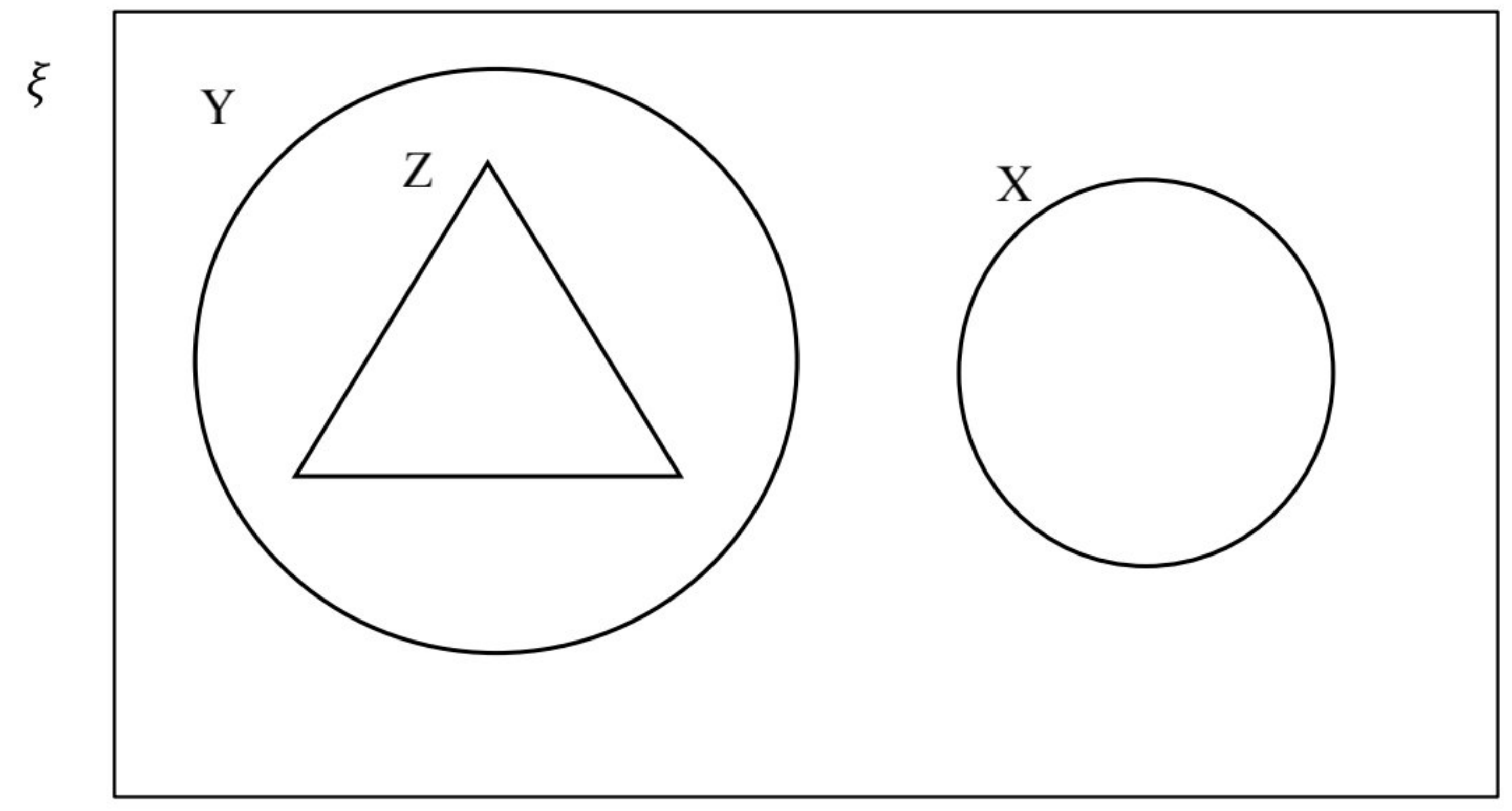
- (c)
The diagram 17(c) shows a trapezoid-shaped cross section of a box used to pack a scarf ordered by a customer (parallel sides 5 cm and 9 cm). Given the area of the trapezium is 84 cm², calculate the height in cm of the trapezium.
[2]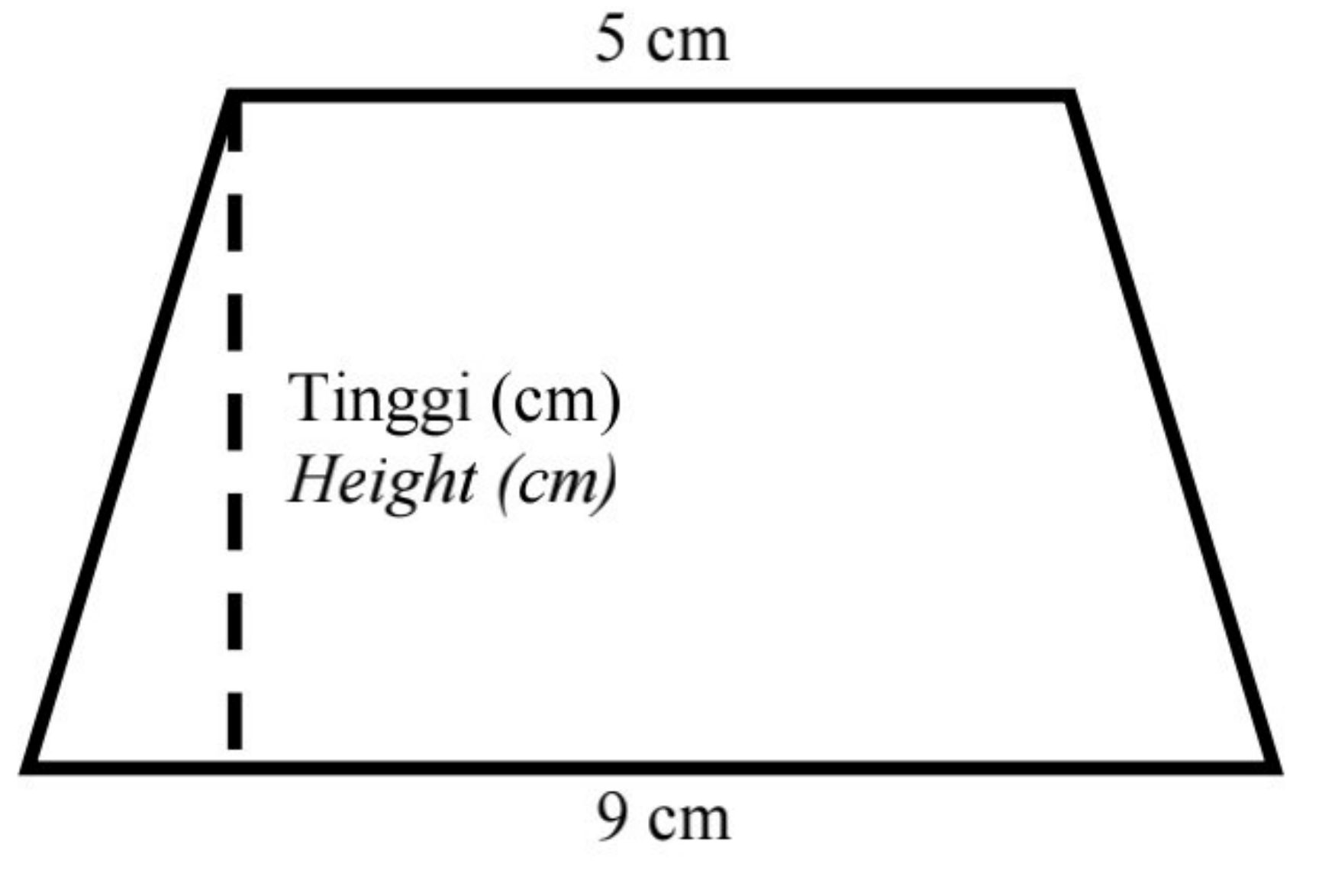
- (d)
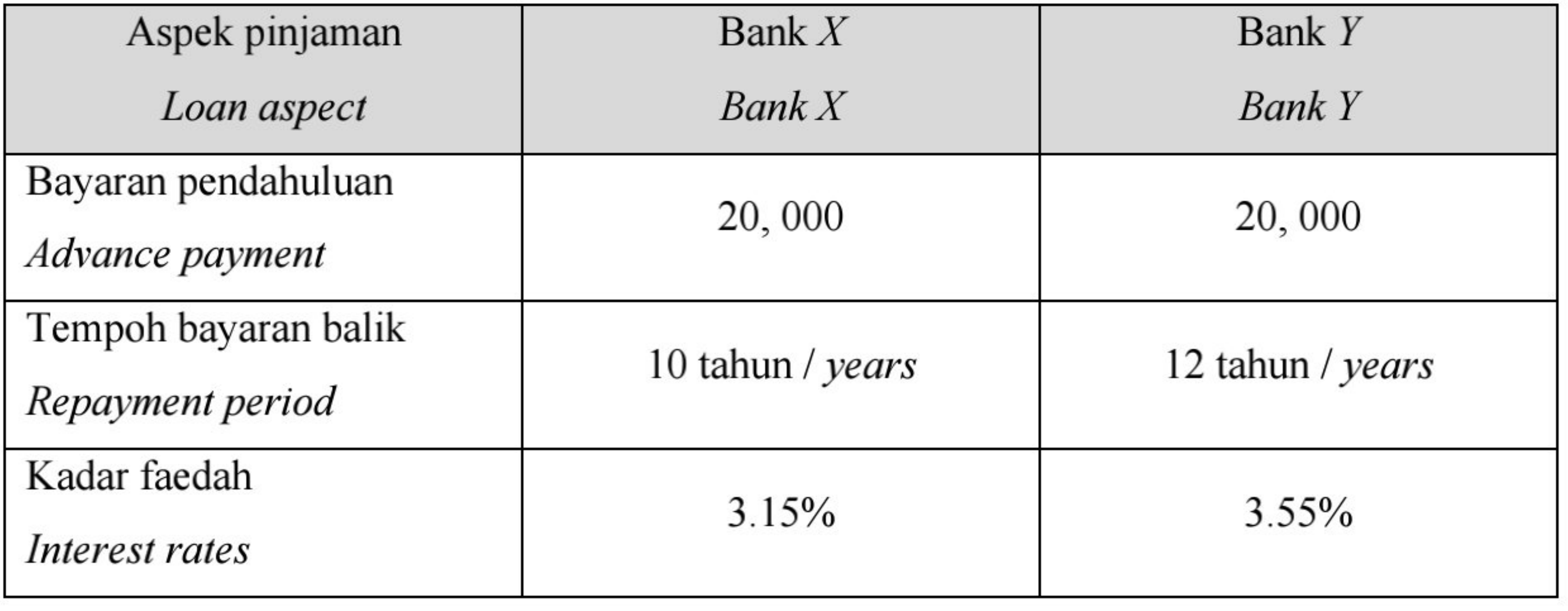
Mr Hafiz wants to open a new boutique branch. He plans to apply for a loan worth RM200 000 from a bank that offers low monthly instalments. Table 17(d): advance payment RM20 000 (Bank X and Bank Y); repayment period 10 years (Bank X), 12 years (Bank Y); interest rate 3.15% (Bank X), 3.55% (Bank Y). Which bank should be selected by En Hafiz to apply for a loan? Justify your answer with calculation.
[4]