Write your answer on paper. Then open the answer to check it.
Section A
Diagram 1 shows three cakes with weights: A = 900 g, B = 1.2 kg, C = x g.
Medium3 marks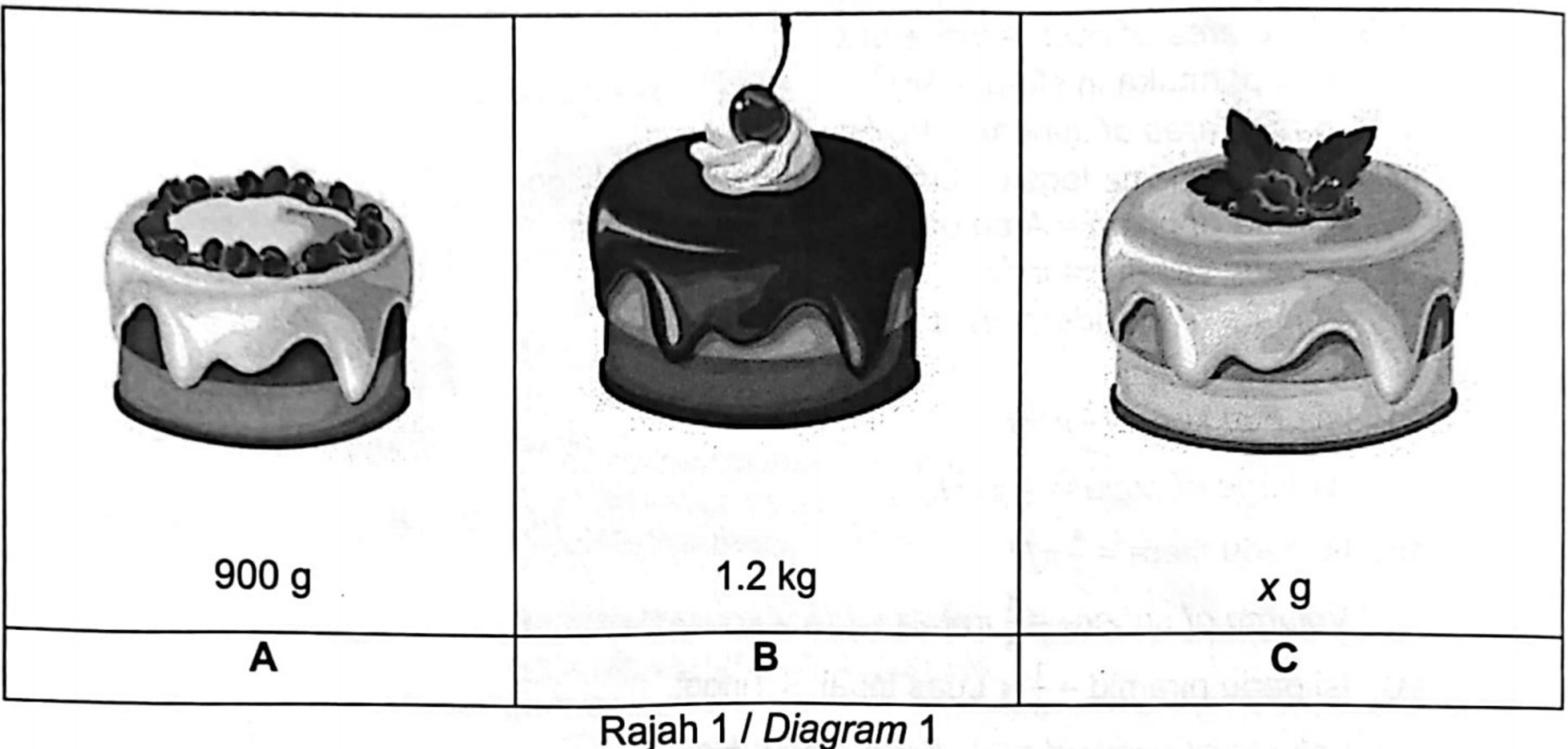
- (a)
State the ratio of the weight of cake A to cake B.
[1] - (b)
Given that the ratio of the weight of cake B to cake C is 8:9, calculate the value of x.
[2]
Given the universal set ξ = {x : 1 ≤ x ≤ 12, x is an integer}, set P = {x : x is a factor of 9} and set Q = {x : x is a perfect square}.
Medium4 marks- (a)
List all the subsets of set P.
[1] - (b)(i)
By drawing sets P and Q and writing the elements of ξ, P and Q, complete the Venn diagram in the answer space.
[2]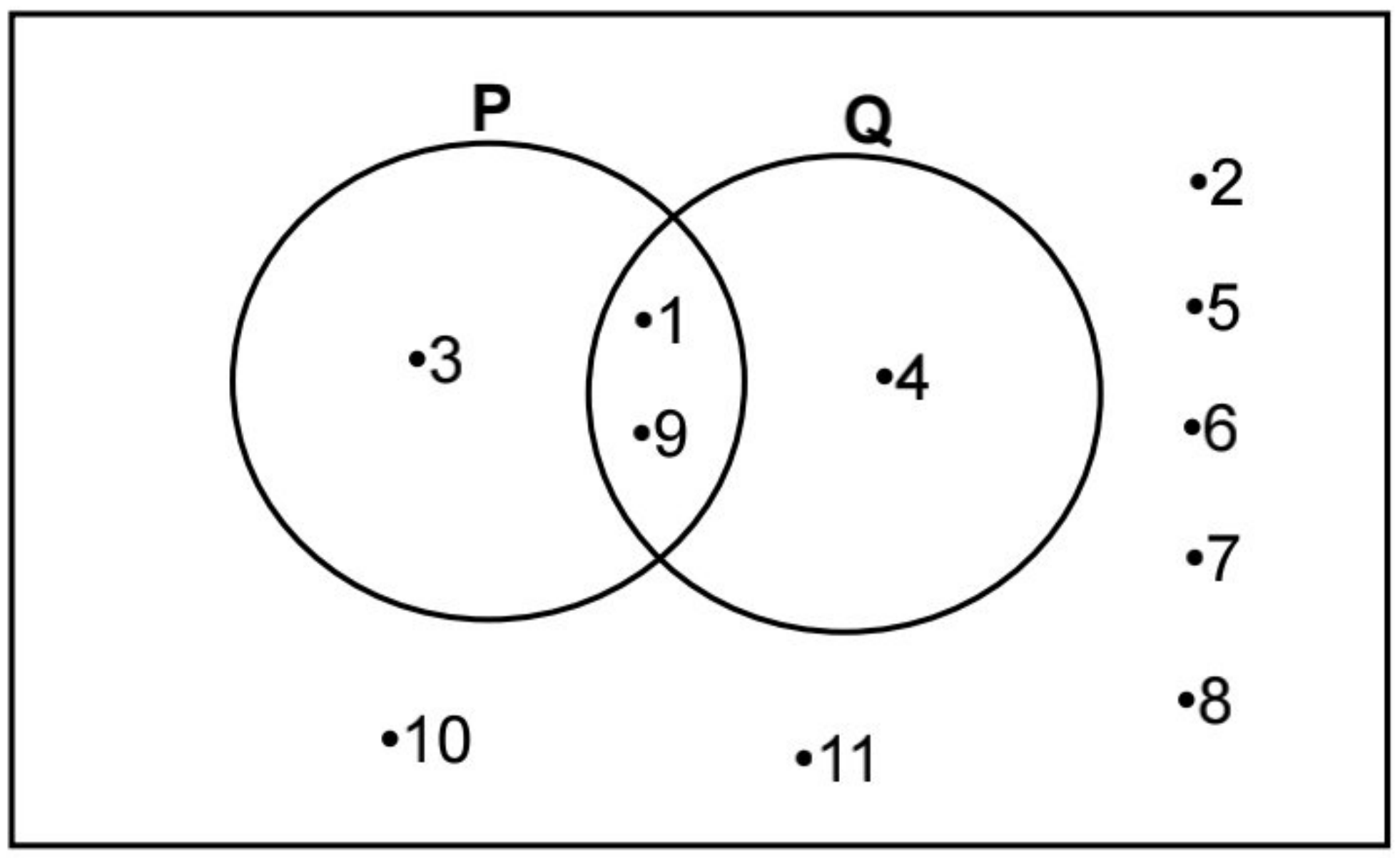
- (b)(ii)
List all the elements of set P′ ∩ Q′.
[1]
Diagram 2 shows an object made up of a pyramid and a cube. The height of the object is 10 cm. The cube has edge 6 cm. Calculate the surface area of the object in m².
Medium4 marks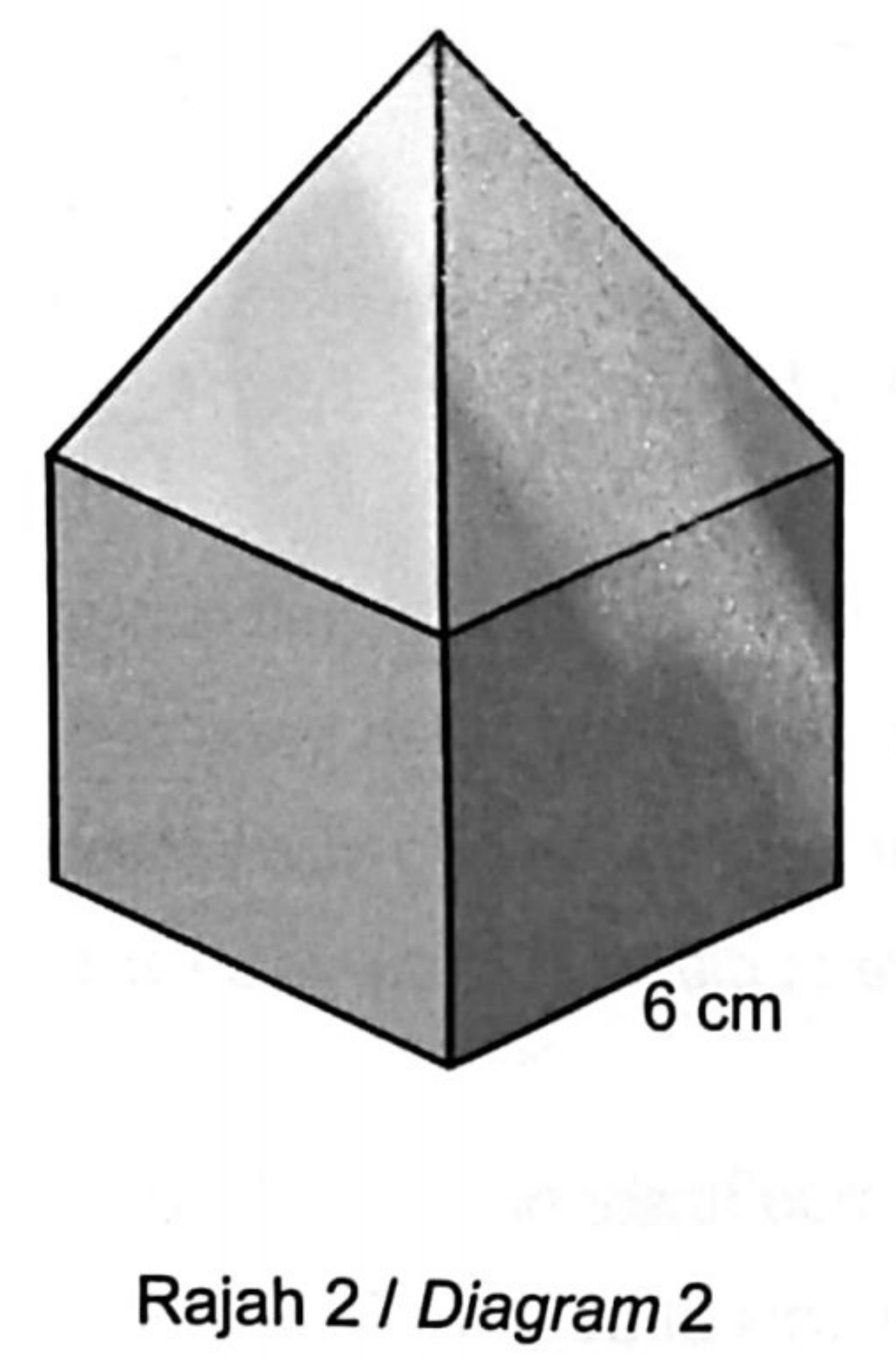
Calculate the surface area of the object in m².
[4]
Table 1 gives the roads connecting several houses (distance in km): Ali–Bob 8.7; Ali–Chong 25.4; Chong–David 3.5; Bob–Eusoff 20.4; Eusoff–Fiona 16.7; Bob–Ganesh 32.8.
Medium4 marks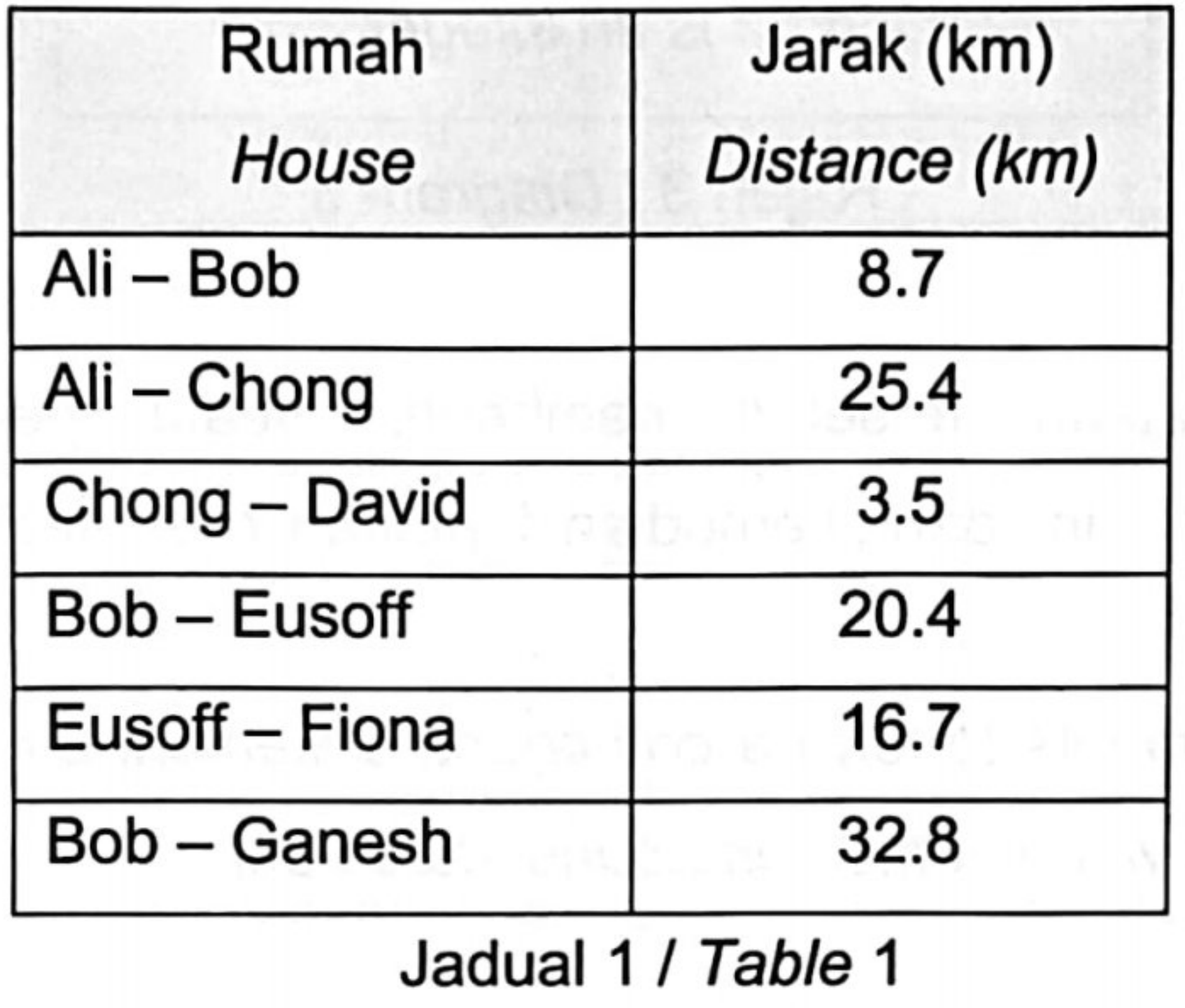
- (a)
Draw an undirected and weighted graph representing the roads connecting several houses as in Table 1.
[2]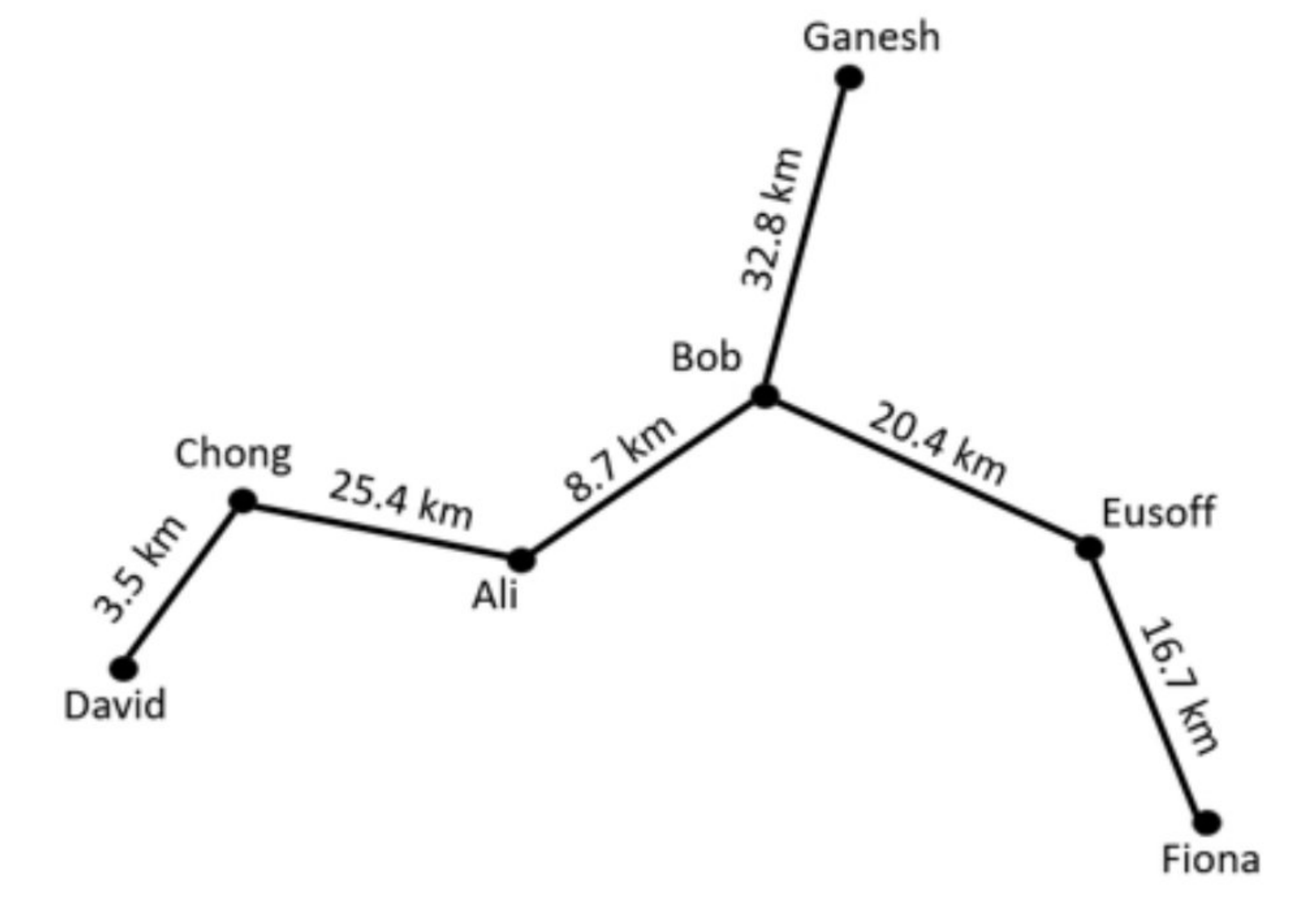
- (b)
State whether the graph drawn in (a) is a tree or not a tree. Justify your answer.
[2]
Diagram 3 shows the statements p: −5 is an integer; q: 3 is an integer.
Medium5 marks- (a)
Combine the statements to form a compound statement using the word "and", then determine the truth value of the compound statement.
[2] - (b)
Determine whether the argument is strong or weak and cogent or not cogent. Justify your answer. Premise 1: 1 is a prime number. Premise 2: 2 is a prime number. Premise 3: 3 is a prime number. Premise 4: 5 is a prime number. Conclusion: All prime numbers are divisible by 1 and itself.
[3]
Given the function f(x) = −x² + x + 20.
Medium4 marks- (a)
Sketch the graph of the function f(x) = −x² + x + 20 in the answer space (blank axes f(x) against x are given).
[2]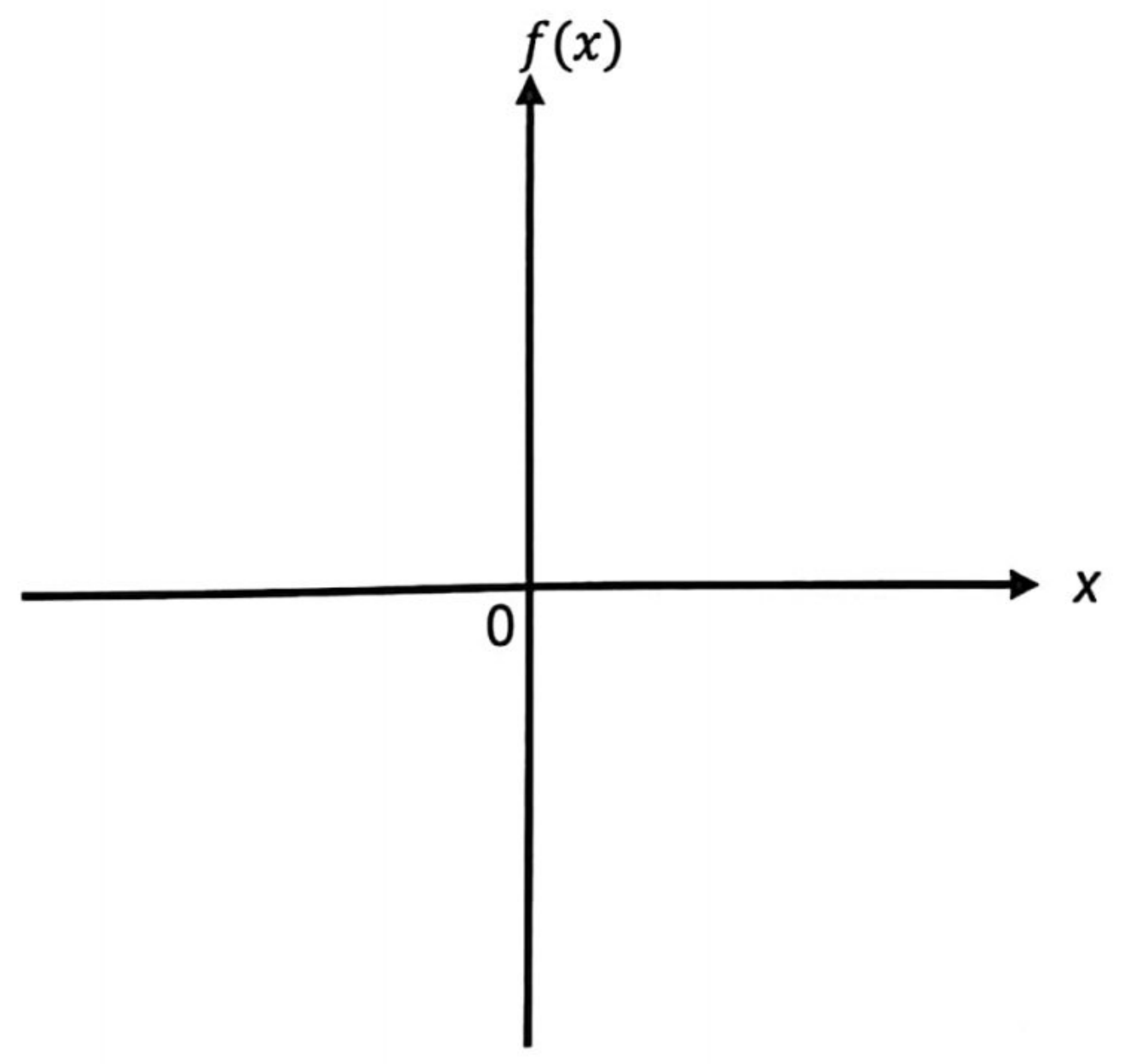
- (b)
State the equation of the axis of symmetry and the coordinates of the maximum point or minimum point of the function in (a).
[2]
In Diagram 4, PQ, QR, QS and RS are straight lines drawn on a Cartesian plane. Point Q is on the y-axis. The straight line PQ is parallel to the straight line RS. The straight line QR is parallel to the x-axis. Given that the equation of PQ is 3x + 2y = 6. S is the point (−3, 10).
Medium4 marks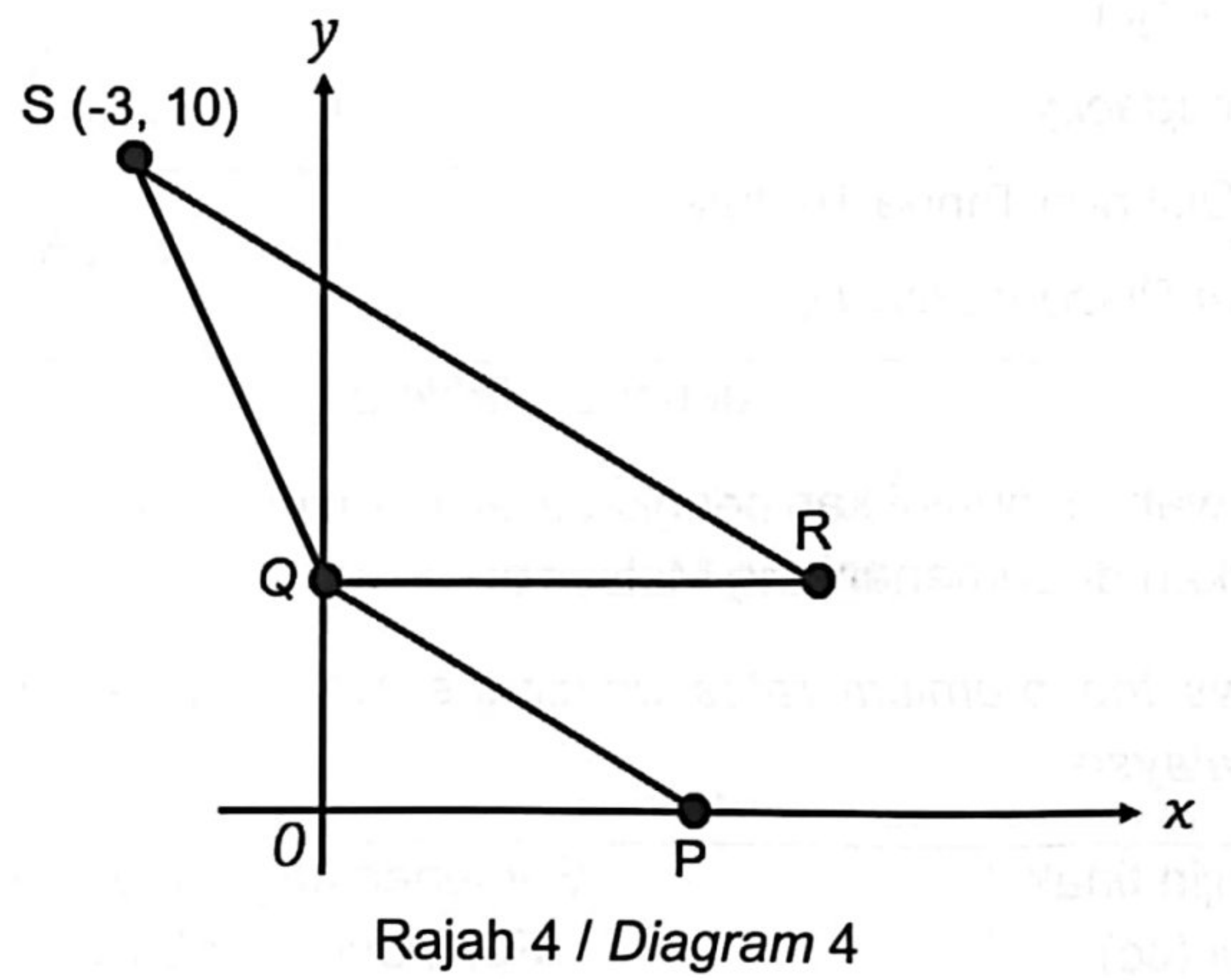
- (a)
State the equation of the straight line QR.
[1] - (b)
Determine the equation of the straight line RS.
[3]
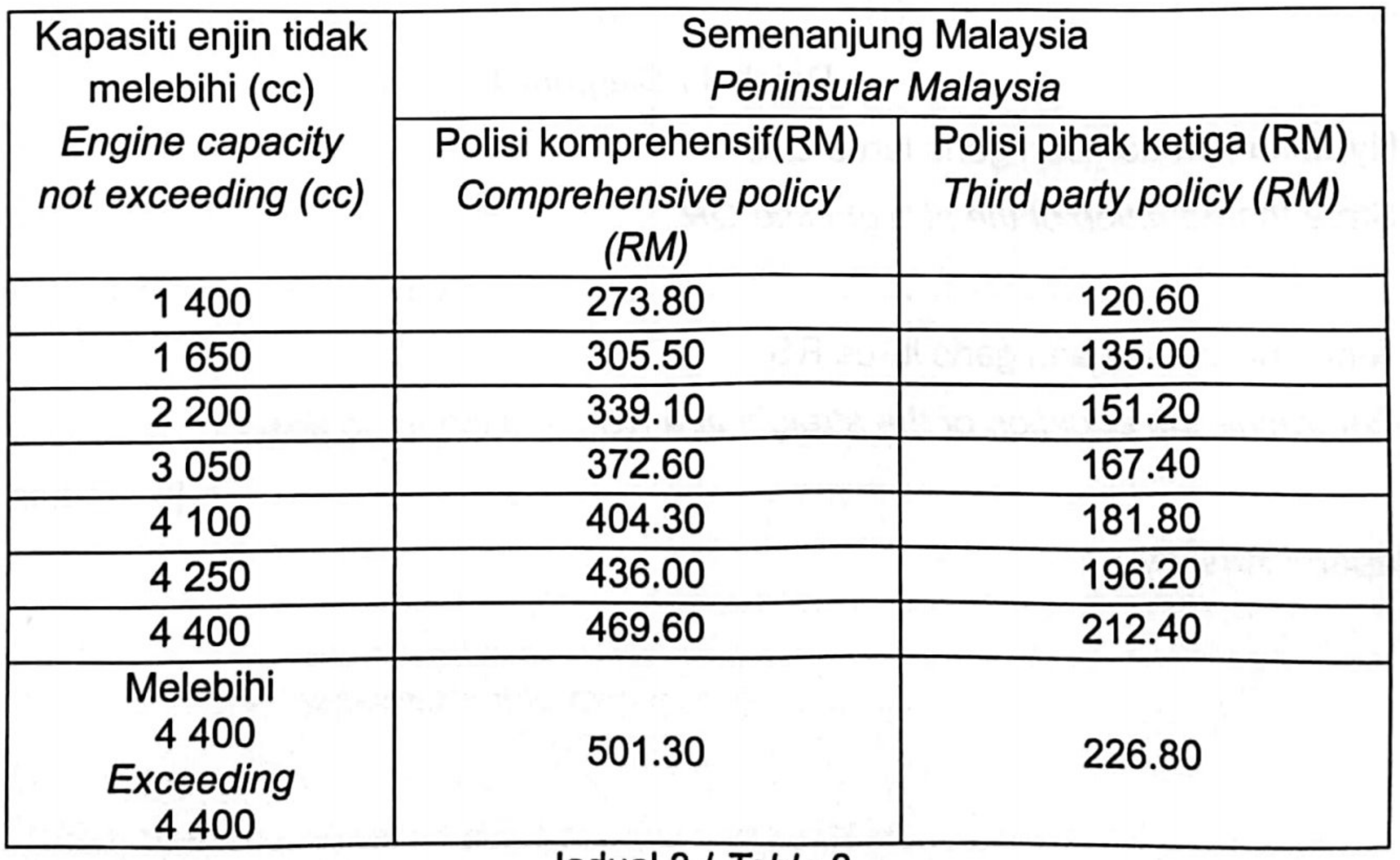
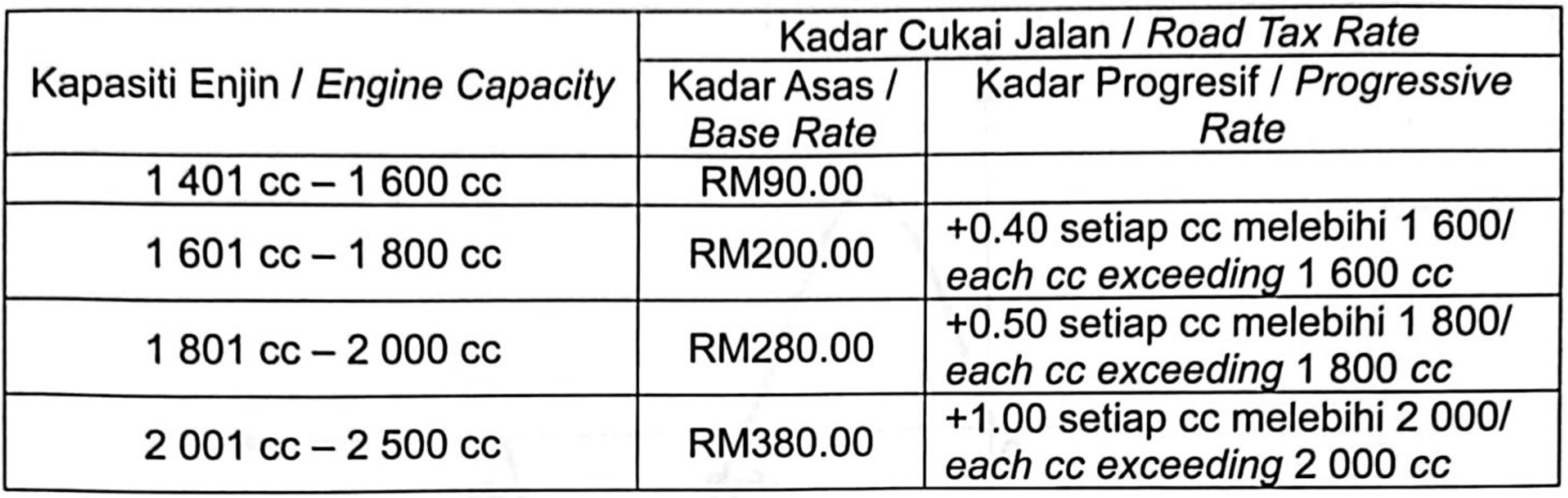
Encik Subhan stays in Peninsular Malaysia. He wants to renew road tax by buying a motor insurance policy for his car. Table 2: Sum insured RM75 000; age of vehicle 2 years; engine capacity 1 798 cc; No Claim Discount (NCD) 25%. Table 3 gives the premium rates under the Motor Tariff for Peninsular Malaysia (comprehensive and third party policy, by engine capacity). Table 4 gives the road tax rates for a private car in Peninsular Malaysia (base rate and progressive rate by engine capacity).
Easy5 marks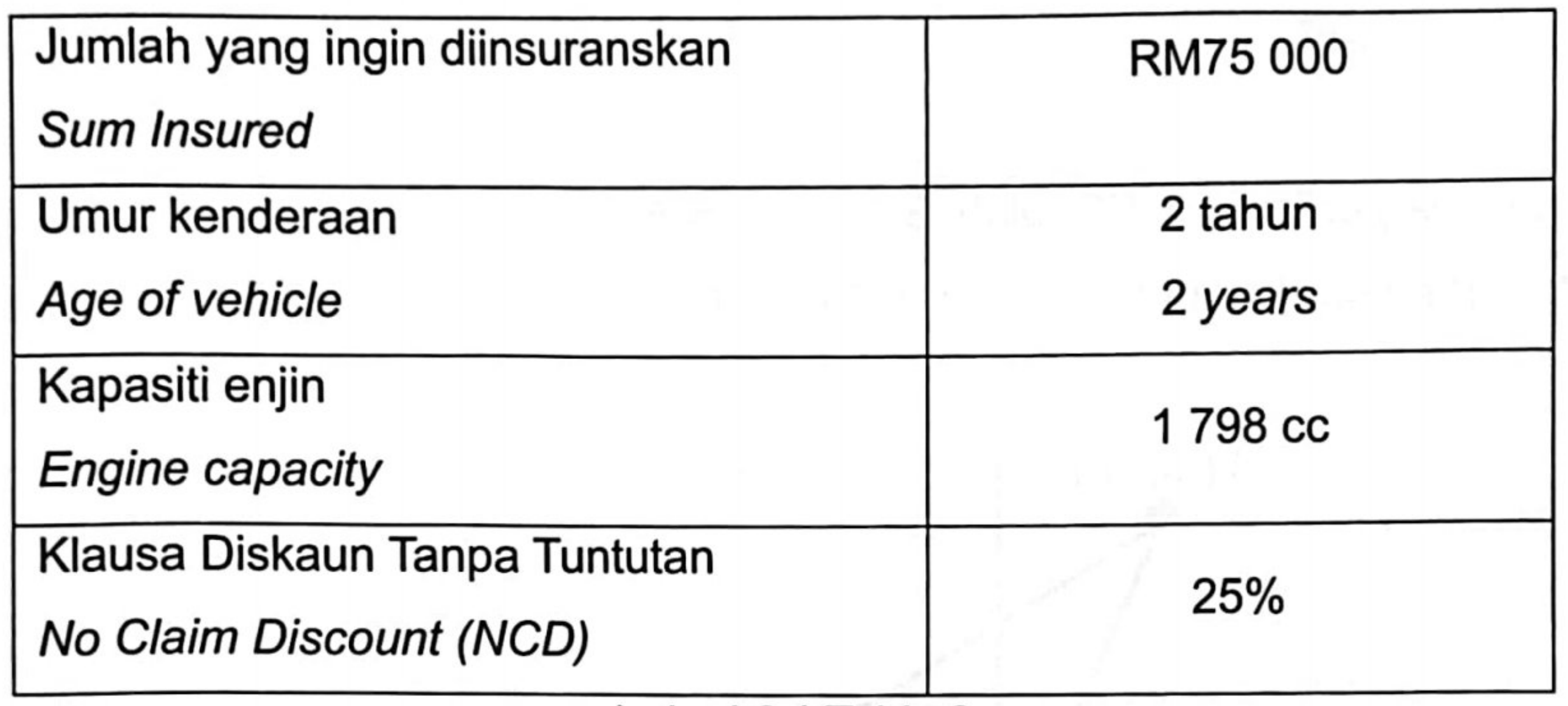
- (a)
Calculate the gross premium for Encik Subhan's car under the comprehensive policy.
[3] - (b)
Calculate the road tax that Encik Subhan has to pay.
[2]
Diagram 5 shows the graph of a trigonometric function for 0° ≤ x ≤ 360°. The graph passes through the origin, has maximum value 2 and minimum value −2, crosses the x-axis at 180° and 360°, and passes through the point (p, −1).
Medium3 marks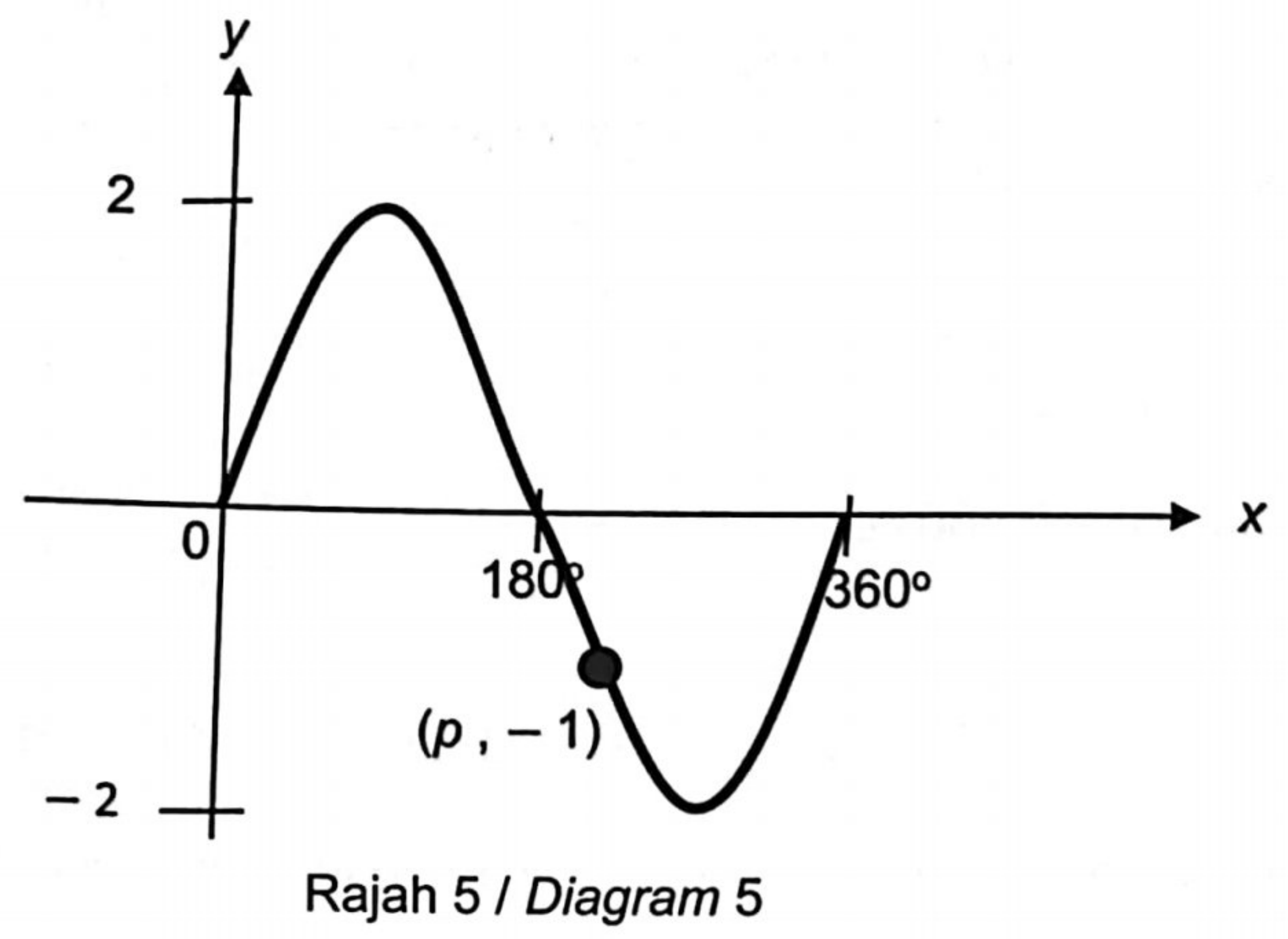
- (a)
State the trigonometric function.
[1] - (b)
Determine the value of p.
[2]
Aleeya sent admission applications to three local universities. The probability of Aleeya getting an offer from universities R, S and T is 3/5, 4/9 and 5/12 respectively. Calculate the probability that Aleeya gets an offer from
Medium4 marks- (a)
Any two universities.
[2] - (b)
At least one university.
[2]
Section B
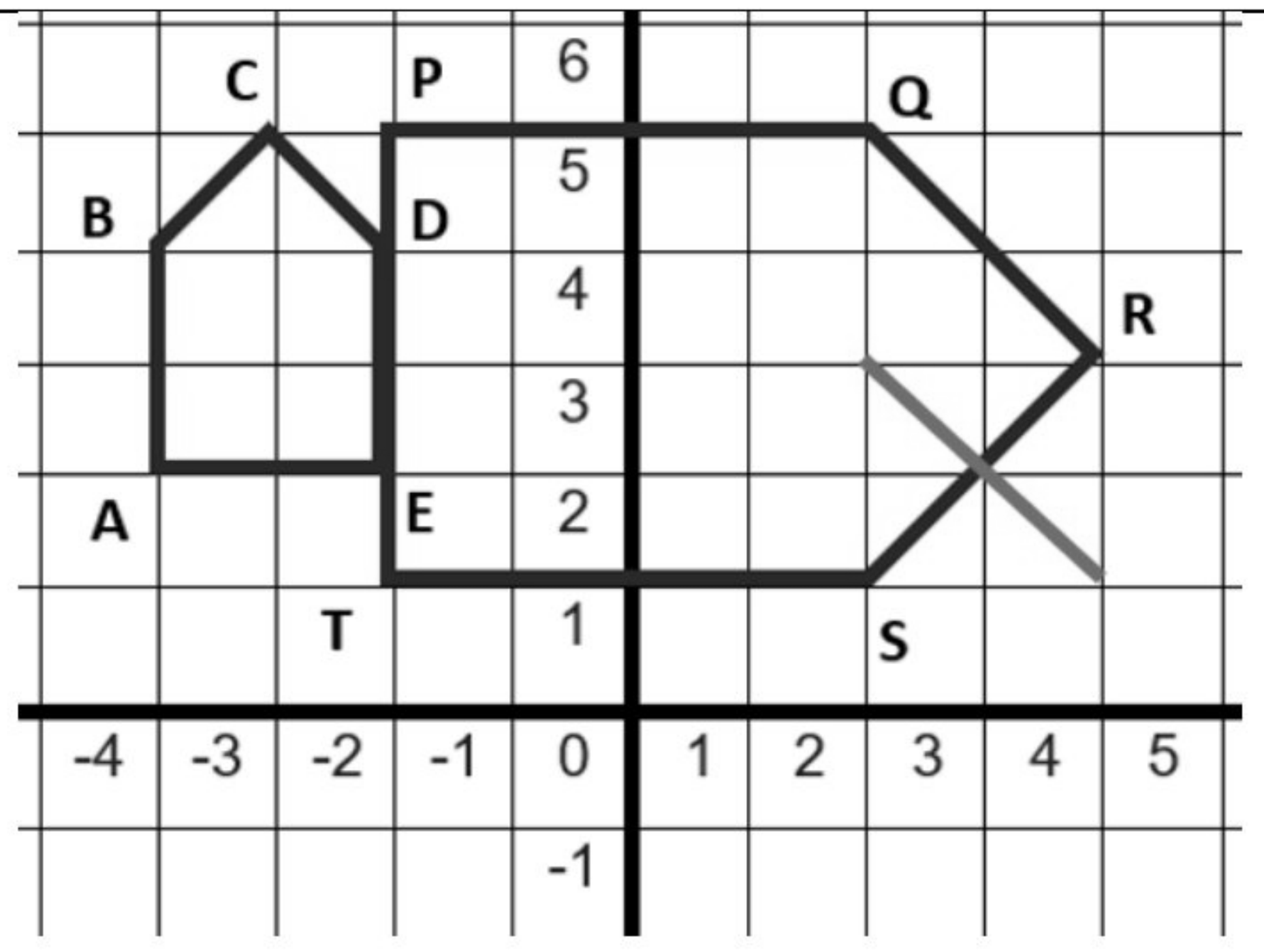
Diagram 6 shows the pentagons ABCDE and PQRST drawn on a Cartesian plane.
Hard9 marks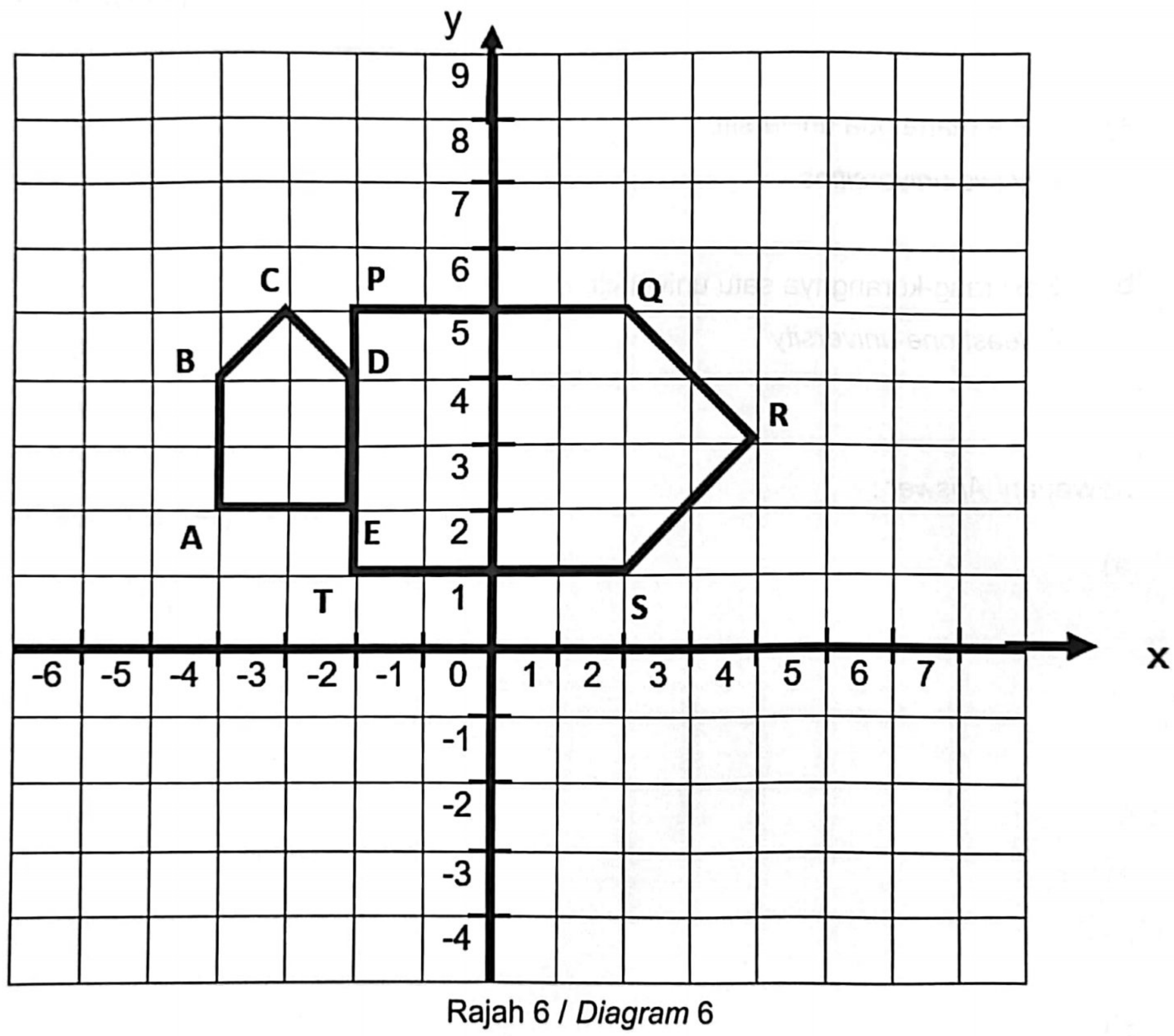
- (a)
Pentagon PQRST is the image of pentagon ABCDE under the combined transformation MN. Describe transformation M and transformation N.
[6] - (b)(i)
Draw the image of the straight line SR under a reflection in the line x = 3. (Grid with pentagons ABCDE and PQRST is given in the answer space.)
[1]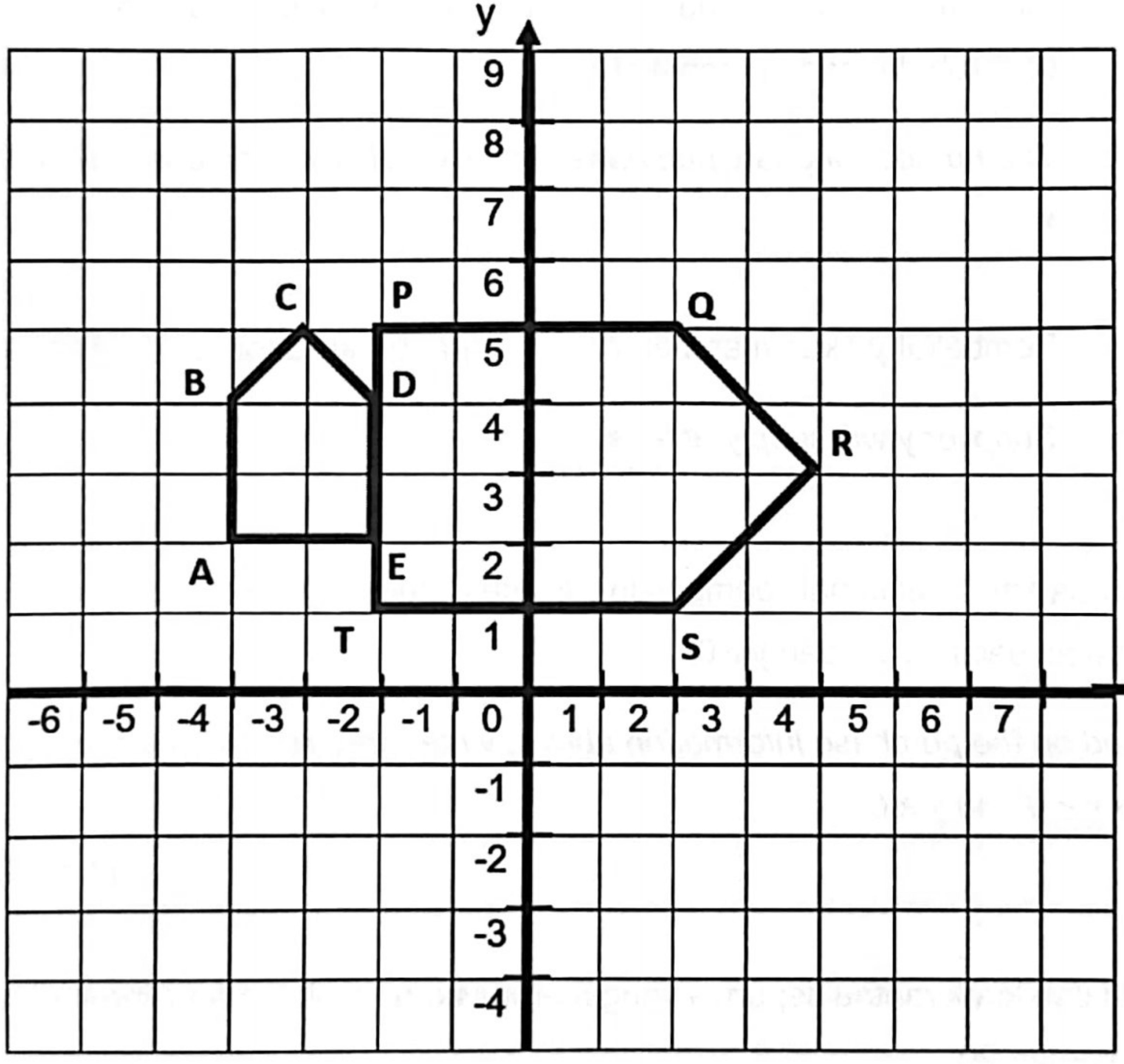
- (b)(ii)
Given that the area of pentagon ABCDE is 120 units², calculate the area of PQRST.
[2]
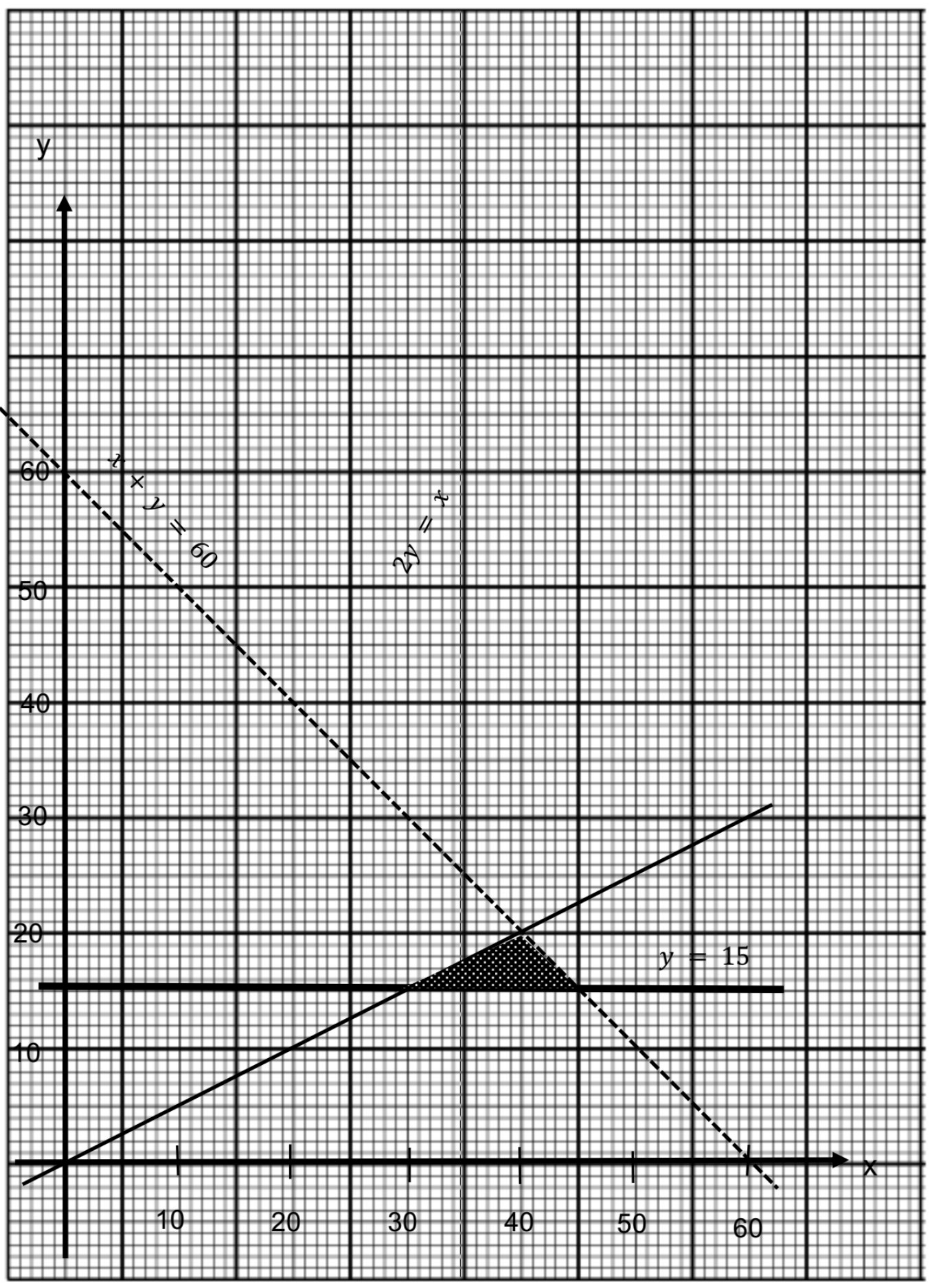
Mr. Zairul wants to buy some goats from supplier x and supplier y. (i) The maximum total of goats he can buy is less than 60. (ii) The number of goats purchased from supplier y is at least half that of supplier x. (iii) Supplier y will supply at least 15 goats.
Medium9 marks- (a)
Based on the purchase information above, write three related linear inequalities other than x ≥ 0 and y ≥ 0.
[3] - (b)
Draw and shade the common region that satisfies the linear inequalities in (a) on the graph on page 20 (blank graph paper, x and y axes from 0 to 60, is given).
[4]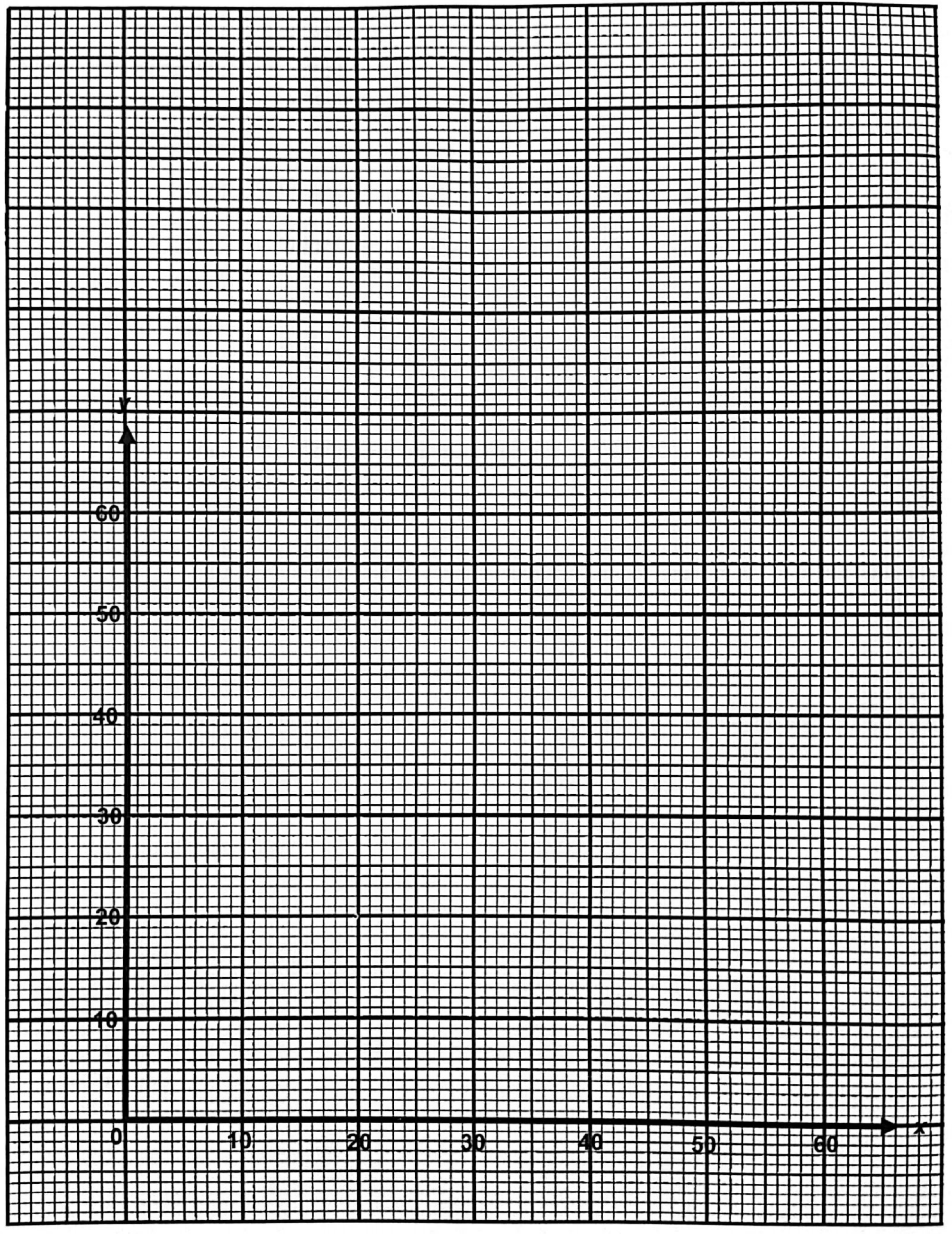
- (c)
From the graph, determine the minimum and maximum number of goats purchased from supplier y if Mr. Zairul buys 35 goats from supplier x.
[2]
Table 5(i) shows the Mathematics Test scores for twenty-five students of class 5 Gigih: 40–49: 3; 50–59: 4; 60–69: 5; 70–79: 6; 80–89: 5; 90–99: 2 (marks: number of students).
Medium9 marks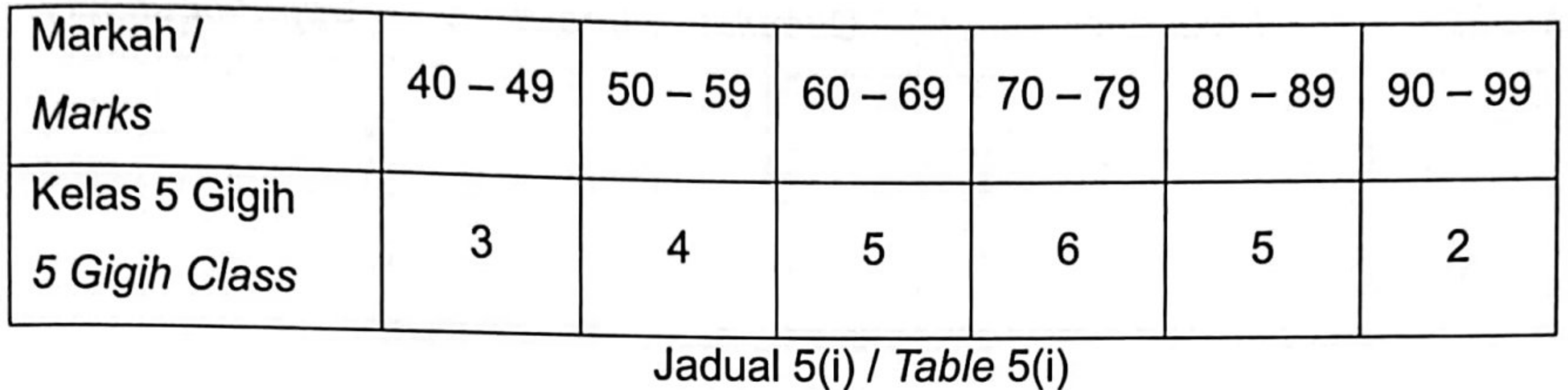
- (a)
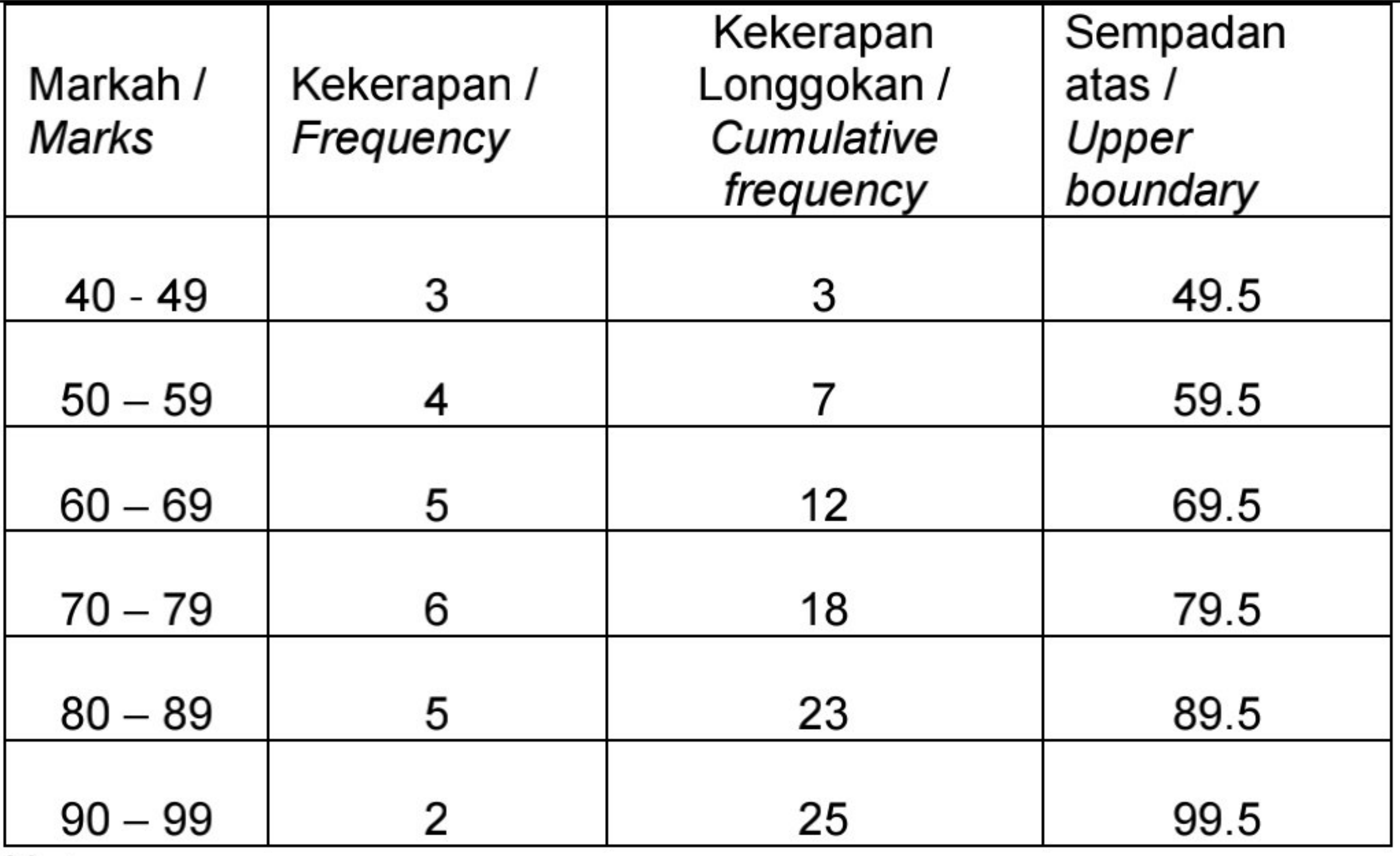
Based on Table 5(i), complete Table 5(ii) in the answer space (columns: marks, frequency, cumulative frequency, upper boundary).
[2]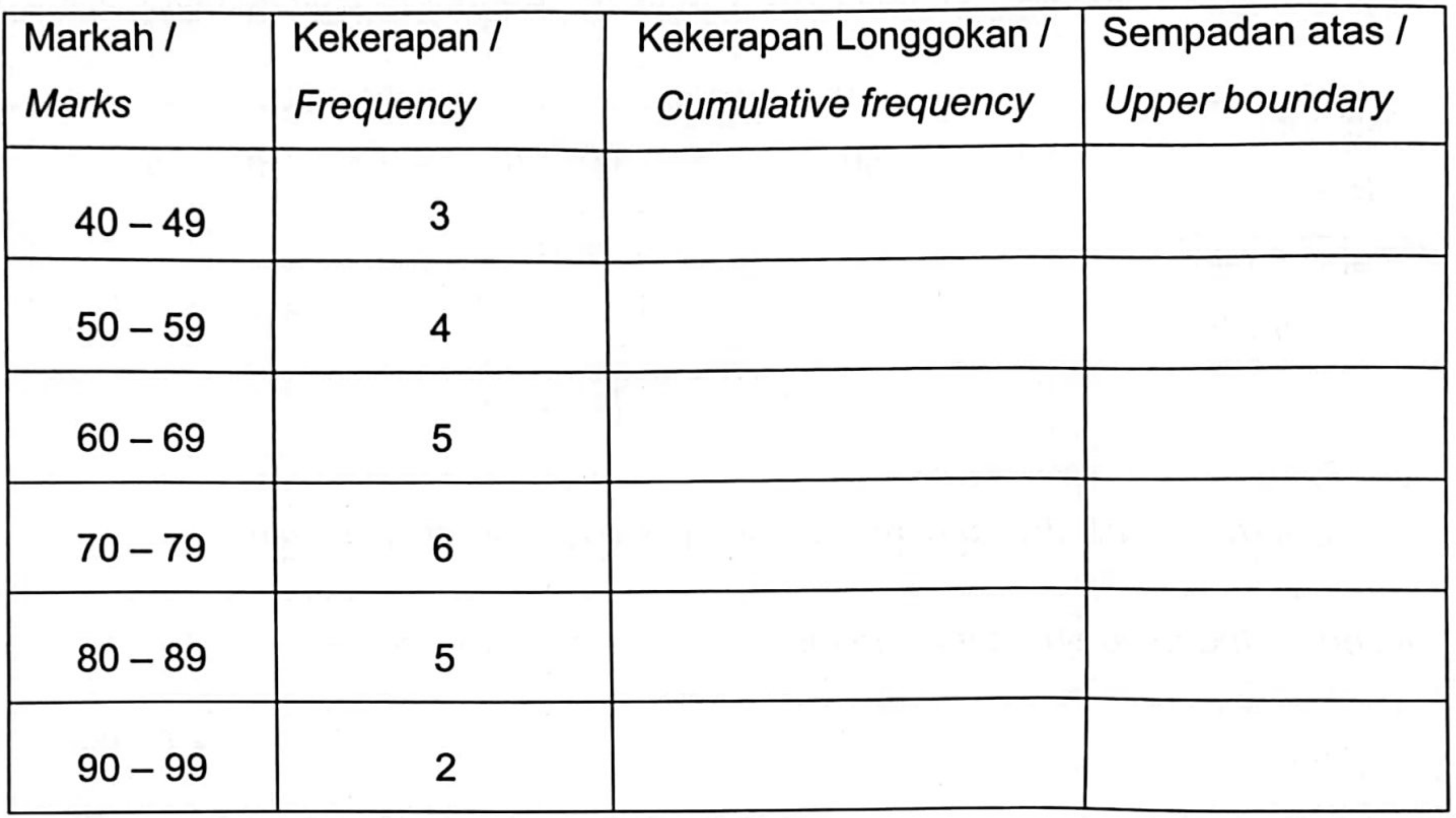
- (b)
Using a scale of 2 cm to 10 marks on the horizontal axis and 2 cm to 5 students on the vertical axis, draw an ogive based on the frequency table (graph paper on page 23 is given).
[4]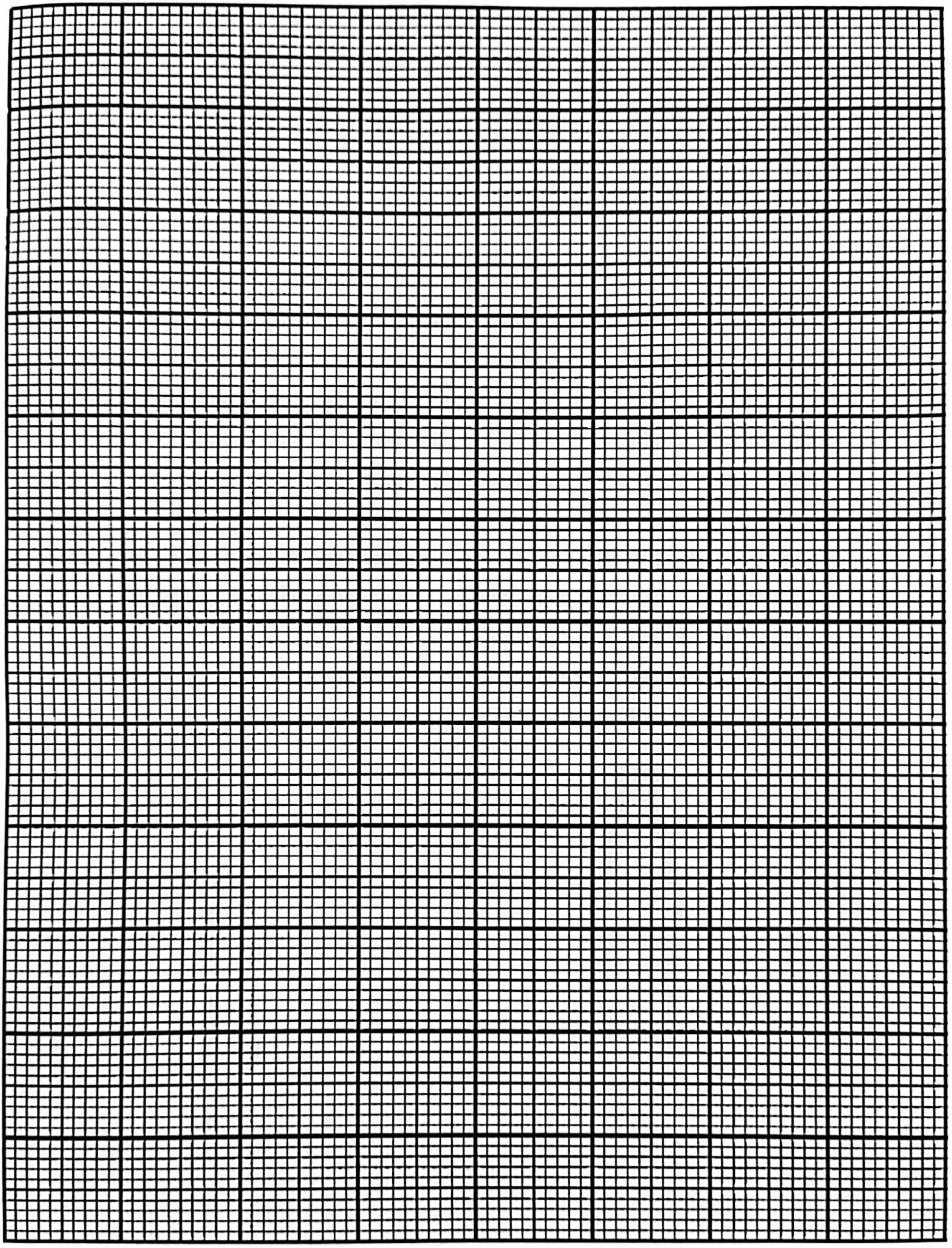
- (c)
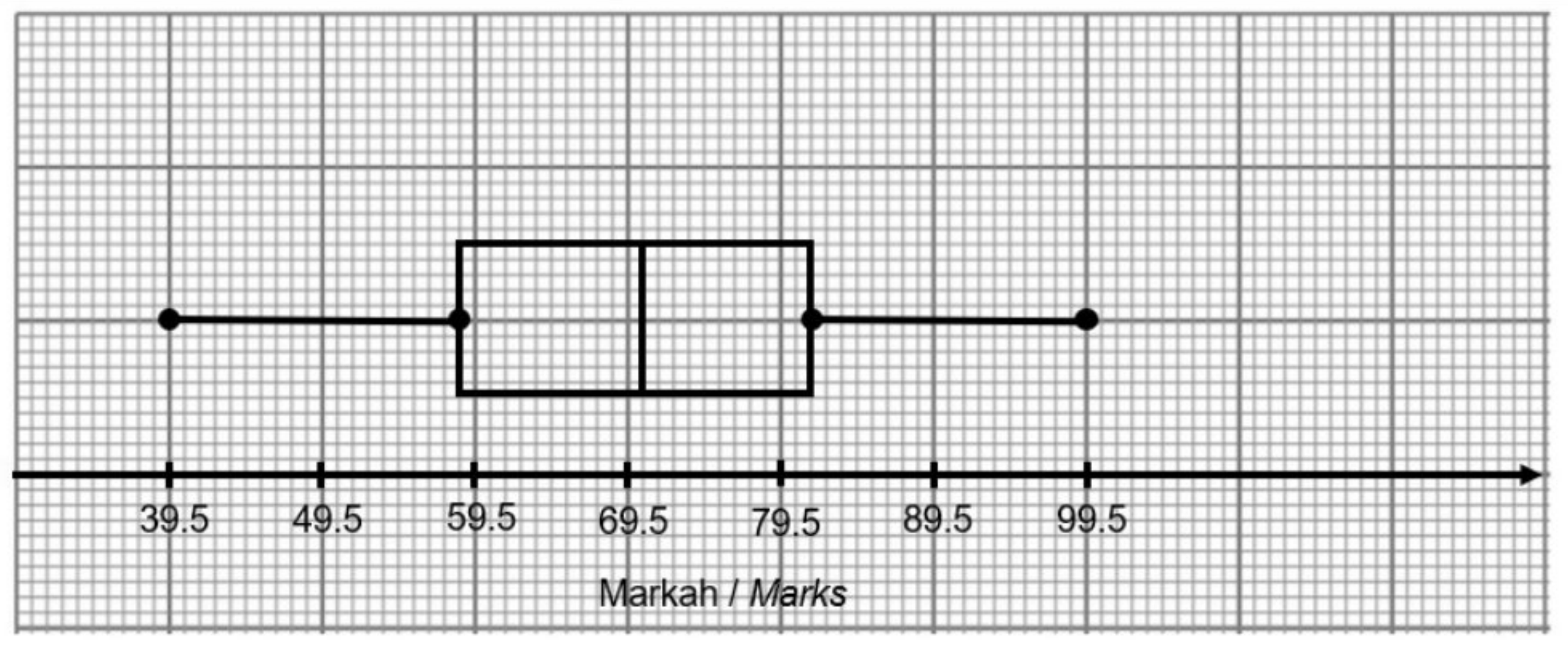
From the ogive in (b), draw a box plot (graph paper is given).
[3]
(a) Given [[m, n], [4, 5]] × [[6, 6], [8, −3]] = [[−12, 21], [64, 9]]. (b) Diagram 7 shows two sizes of mineral water: 1.5 litre at RM2.10 and 600 ml at RM1.30.
Medium9 marks- (a)
Find the values of m and n.
[4] - (b)
Puan Marshada bought several bottles of 1.5 litre and 600 ml mineral water for RM38.40. The total volume of the mineral water bought is 22.5 litres. Using the matrix method, calculate the number of bottles of 1.5 litre and 600 ml mineral water purchased.
[5]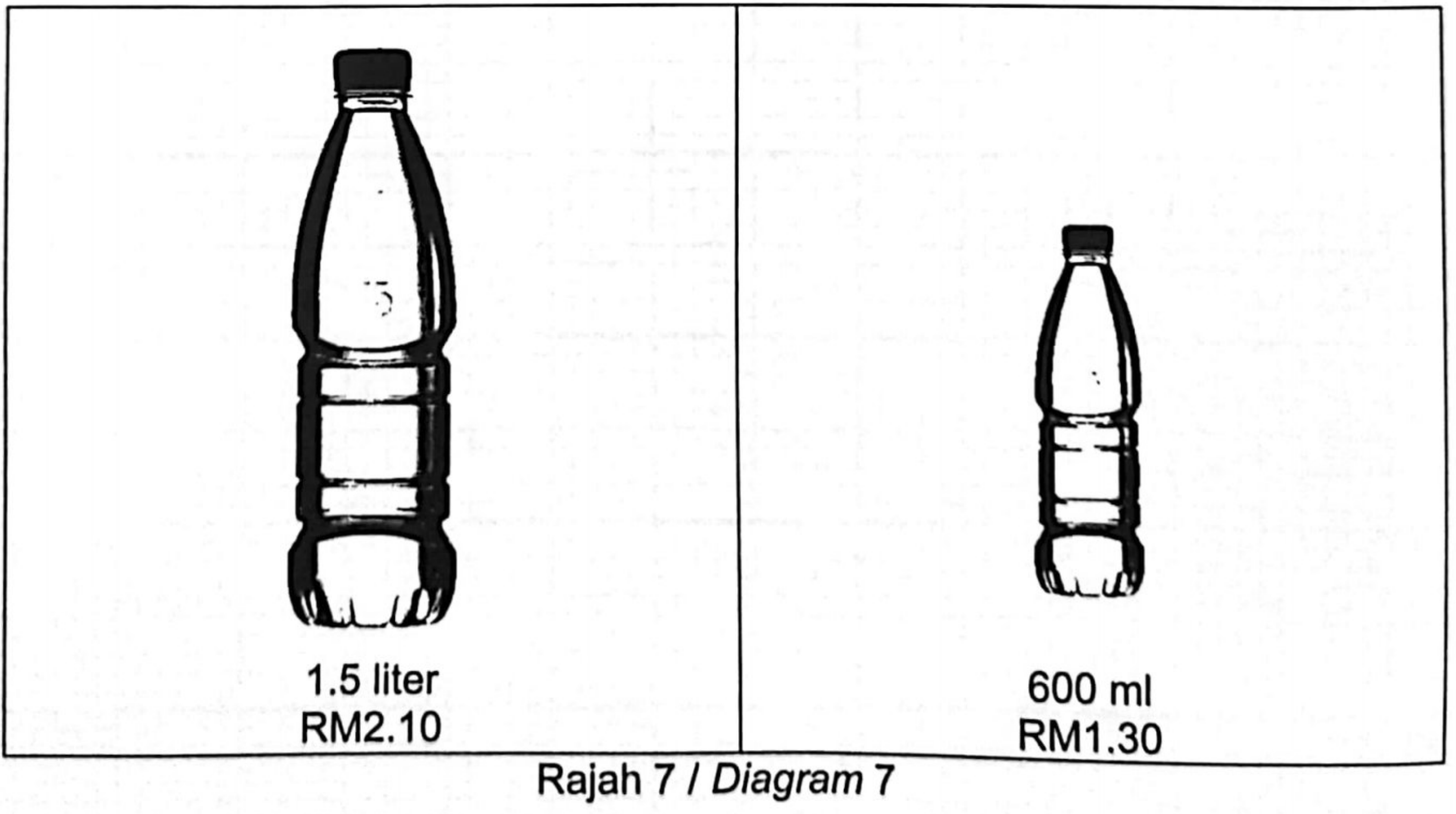
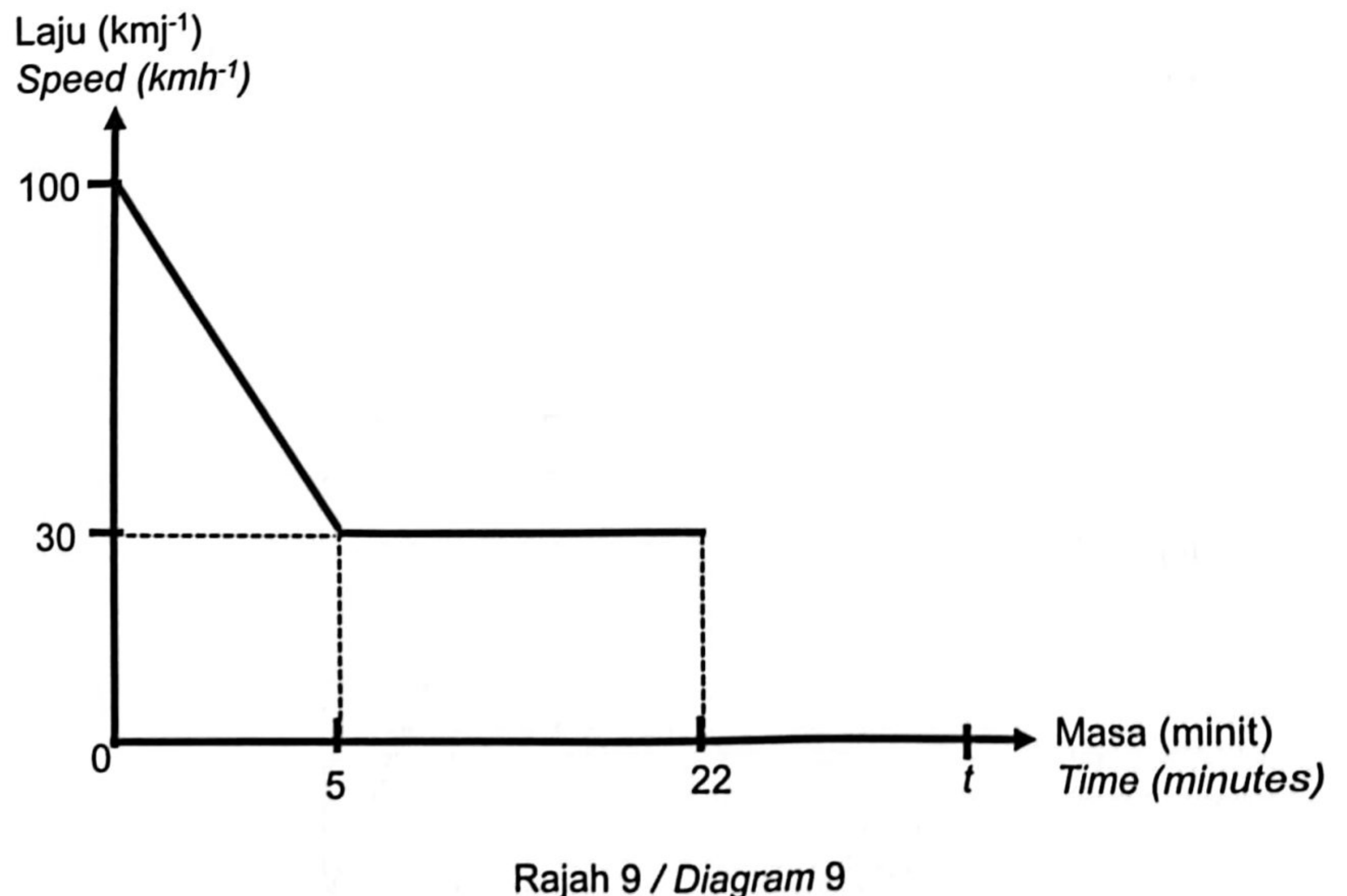
(a) In Diagram 8, ABCD is the distance-time graph of a bus from town P to town Q. EF is the distance-time graph of a car from town Q to town P. Both vehicles used the same road. (b) Diagram 9 shows the incomplete speed-time graph of the motion of a car: speed 100 km h⁻¹ at 0 min falling to 30 km h⁻¹ at the 5th minute, then constant 30 km h⁻¹ until the 22nd minute. After 22 minutes, the car increases its speed to 80 km h⁻¹ at the tth minute.
Medium9 marks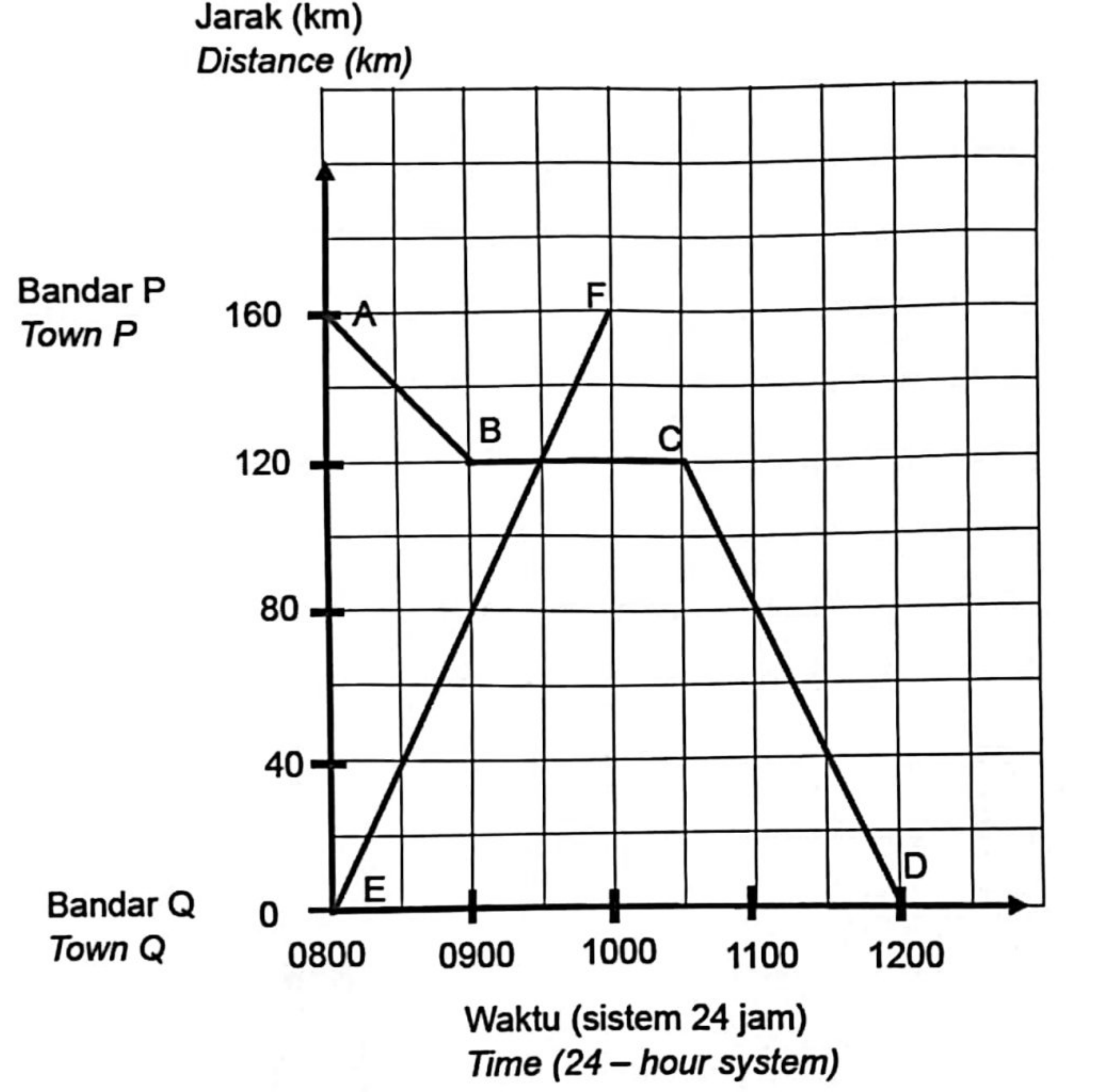
- (a)(i)
When did the two vehicles meet?
[1] - (a)(ii)
Find the distance between the two vehicles at 0830.
[1] - (a)(iii)
Find the speed, in km h⁻¹, of the bus in the last 45 minutes.
[2] - (b)(i)
Complete the speed-time graph in the answer space.
[1]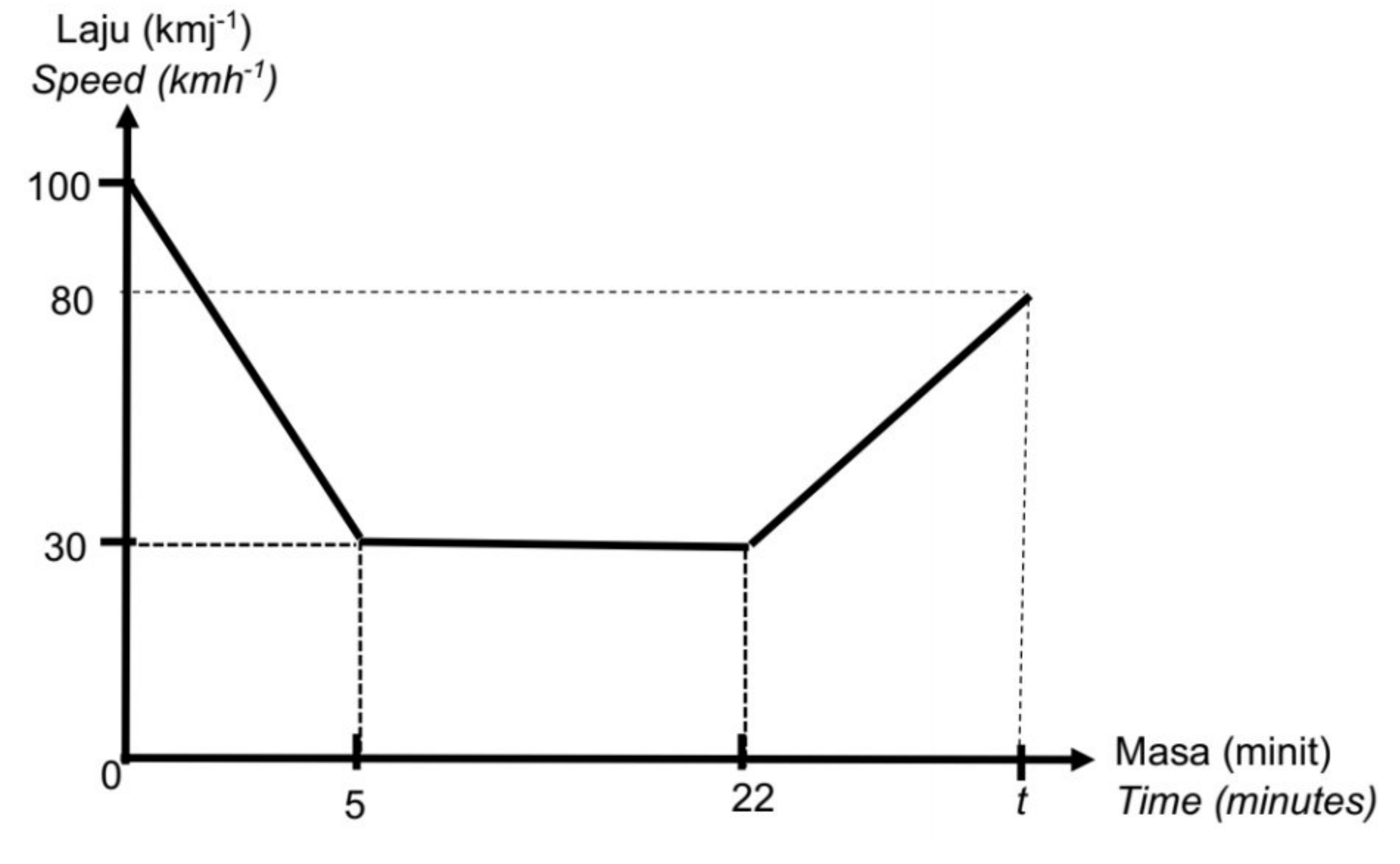
- (b)(ii)
Describe the motion of the car from the 5th minute to the 22nd minute.
[1] - (b)(iii)
Calculate the value of t if the distance travelled by the car after the first 5 minutes is 14 km.
[3]
Section C
Puan Aina is a teacher at a government school who has retired after thirty years of service. She received a total service reward of RM360 000 and invested all of it in several units of shares, a land and a house.
Medium15 marks- (a)
Calculate the amount of investment in RM that Puan Aina uses for the investment of shares, land and house with a ratio of 1 : 2 : 9.
[3] - (b)
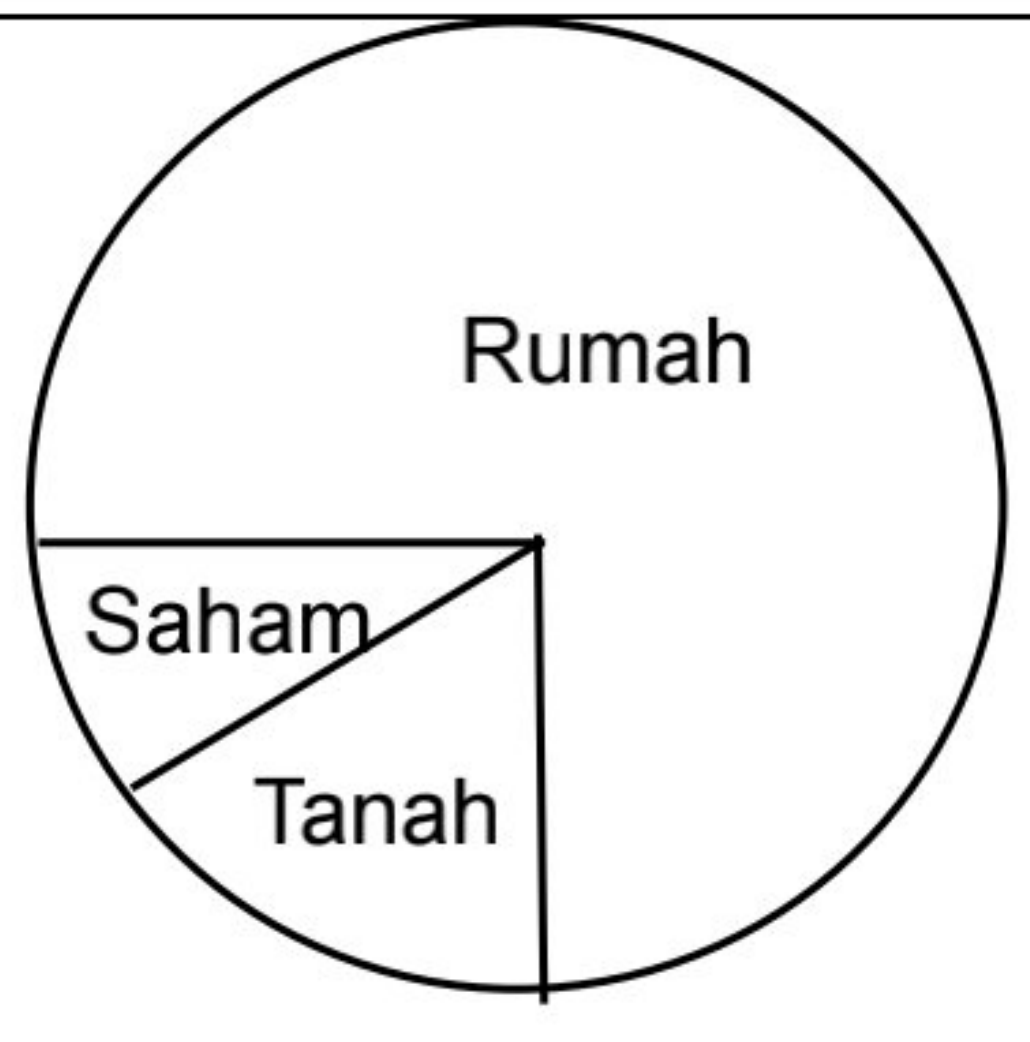
After a year, the present value of the shares, land and house has increased to RM60 000, RM120 000 and RM540 000 respectively (printed as 'RM540 0000'). Based on the above information, complete a pie chart in the answer space (a circle with one radius drawn) to represent the value of the investment.
[4]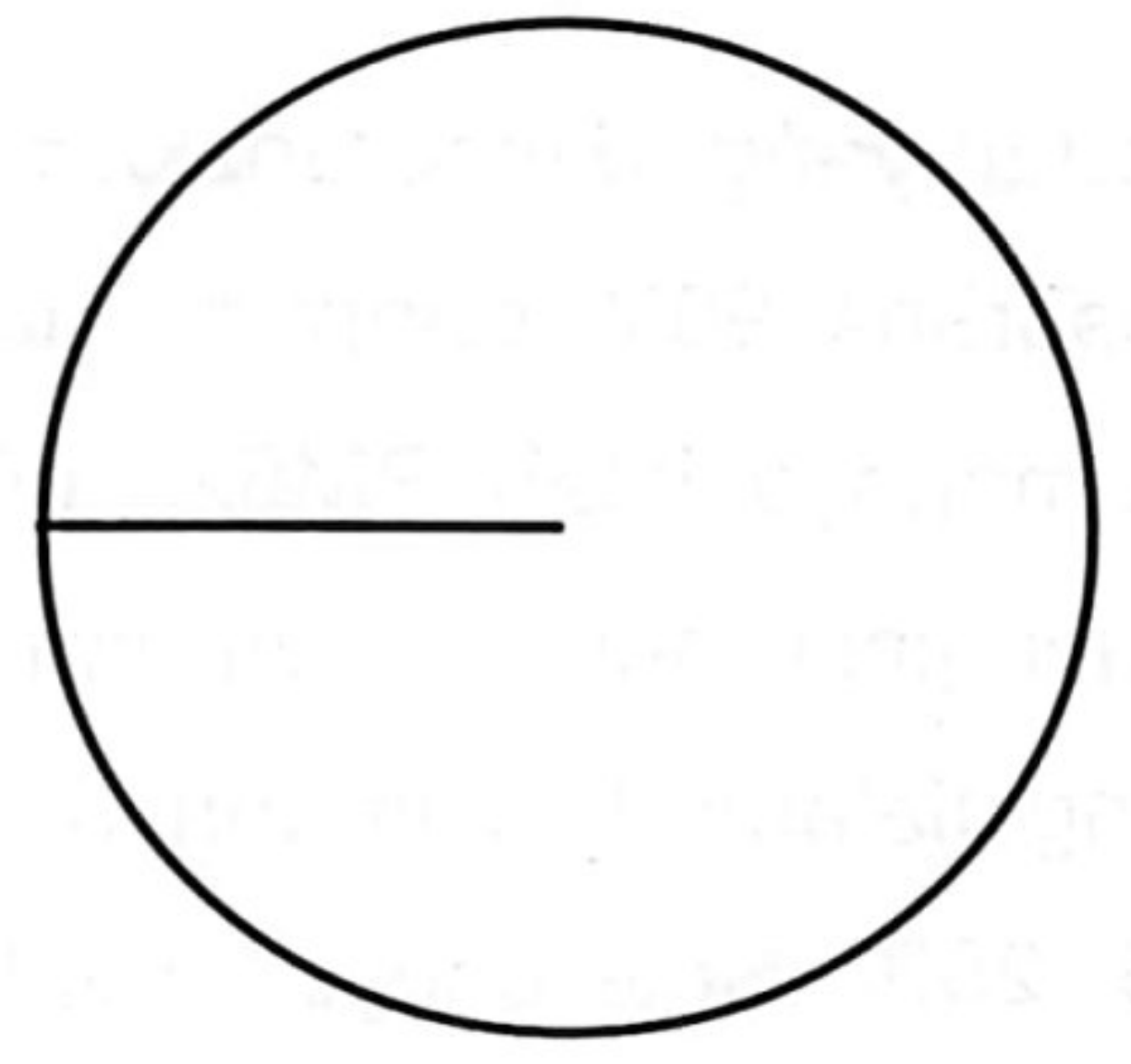
- (c)(i)
After seeing the profit of Aina's shares, her husband also purchased shares from the same company amounting to RM45 000. After a year the company gave a dividend of 15%. He then sold all 15 000 units of shares he owned for a 30% increase in price. Calculate the capital price of a unit of shares.
[1] - (c)(ii)
Next, calculate the value of the return on investment (ROI) of the investment.
[3] - (d)
Puan Aina bought a shophouse insured with fire insurance which has a co-insurance provision of 90% of her shophouse's insurable value. The insurable value is RM520 000 and the deductible is RM35 000. If she insured it for RM378 300, calculate the estimated amount of loss if the house is on fire and the compensation she receives is RM86 250. Hence, state her co-insurance penalty.
[4]
Encik Fariss is a real estate investor. He bought a piece of land for RM150 000 and a house for RM350 000.
Hard15 marks- (a)(i)
He intends to sell the land at a profit of 50%. Calculate the price of the land he has sold.
[2] - (a)(ii)
The house was sold for RM480 000. Calculate the percentage of his profit from the sale of the house.
[2] - (b)(i)
A year later, Encik Fariss purchased another piece of land, rectangle PRVS with SV = 36 m and a slant side of B = 39 m, and divided it into 3 parts as shown. Trapezium-shaped land A and parallelogram B are two rented areas. The rental rate is RMx per square metre. U is the midpoint of SV and T is the midpoint of SU. If the difference in ground rent is RM540, calculate the value of x.
[3]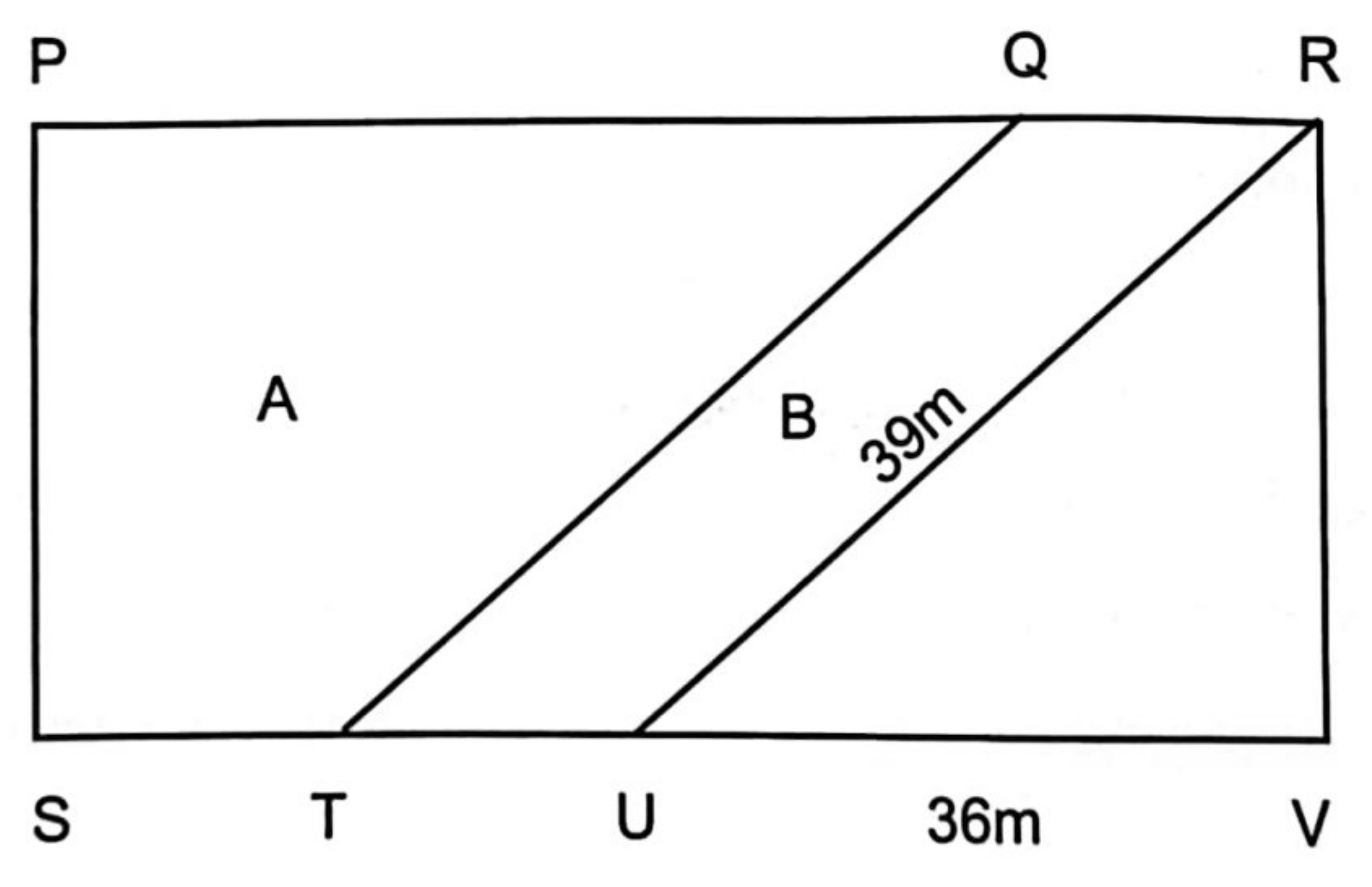
- (b)(ii)
Calculate the amount of monthly rent earned.
[1] - (c)
After a few years, Encik Fariss opened a housebuilding company. The profit from house sales, U, increases as the area of the house, L, increases, but decreases as the construction time, T months, increases. He made a profit of RM70 000 for a 1 500 square feet house completed within three months. If the profit he received for building a house within one year is RM87 500, calculate the area of the house.
[4] - (d)
To expand his business, Encik Fariss made a personal loan of RM200 000 with a monthly instalment of RM2416.67 for 10 years. Calculate the annual flat interest rate charged by the bank.
[3]