Write your answer on paper. Then open the answer to check it.
Section A
(a) In the expression −5pq³, state the coefficient of −p. (b) Diagram 1 shows a rectangle PQRS. Given the length of the rectangle is twice its width, express the perimeter of PQRS in terms of a and b. The side QR is (2a + b) cm.
Medium3 marks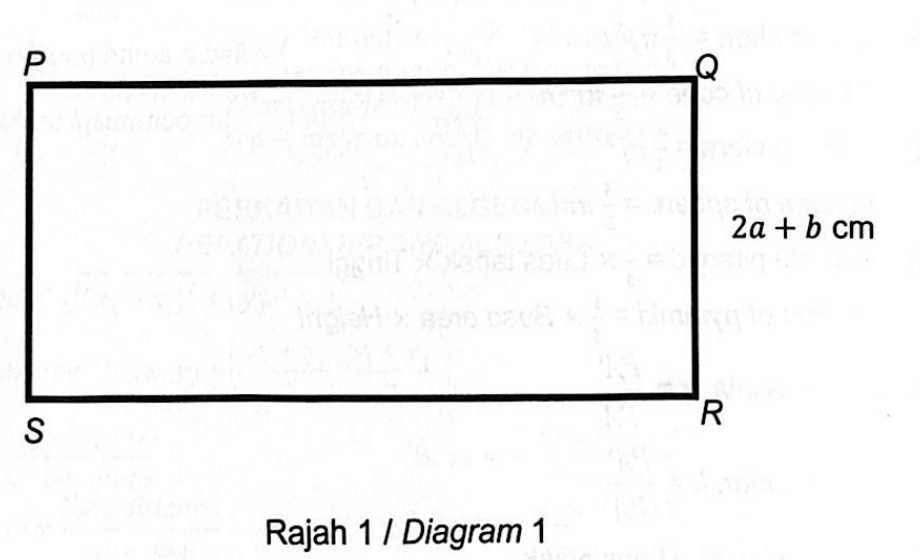
- (a)
In the expression −5pq³, state the coefficient of −p.
[1] - (b)
Express the perimeter of rectangle PQRS in terms of a and b.
[2]
(a) State the inverse and contrapositive of the statement: If x + 3 > 9, then x > 5. (b) Diagram 2 shows arrangements of shapes that follow a certain sequence (3, 5, 7 shapes in the first three diagrams; the paper calls them pentagons).
Medium4 marks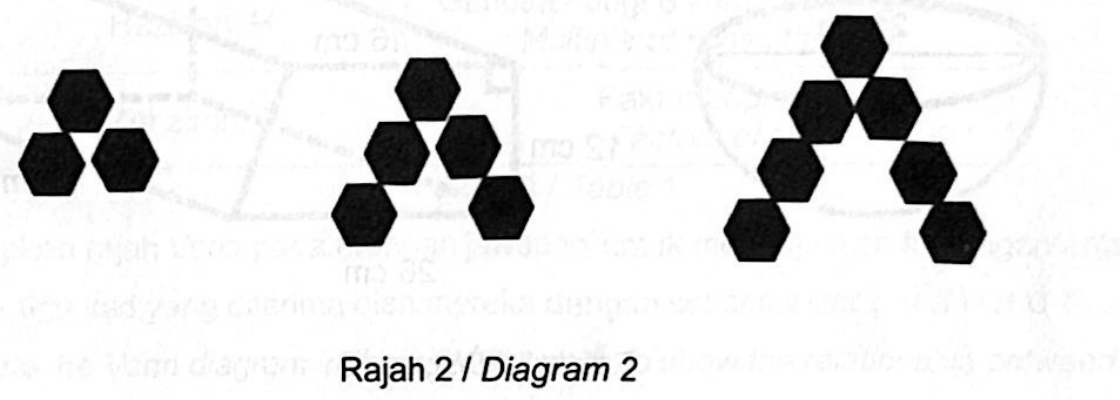
- (a)
State the inverse and contrapositive of: If x + 3 > 9, then x > 5.
[2] - (b)(i)
Make a general conclusion by induction for the nth term.
[1] - (b)(ii)
Hence, determine the number of pentagons at the 30th sequence.
[1]
Diagram 3 shows an object shaped like a hemisphere (diameter 21 cm) and a right prism (a trapezium cross-section with parallel sides 16 cm and 26 cm, height 12 cm, length p cm). The total volume of the two hemispheres is the same as the right prism. Calculate the value of p. Use π = 22/7.
Medium3 marks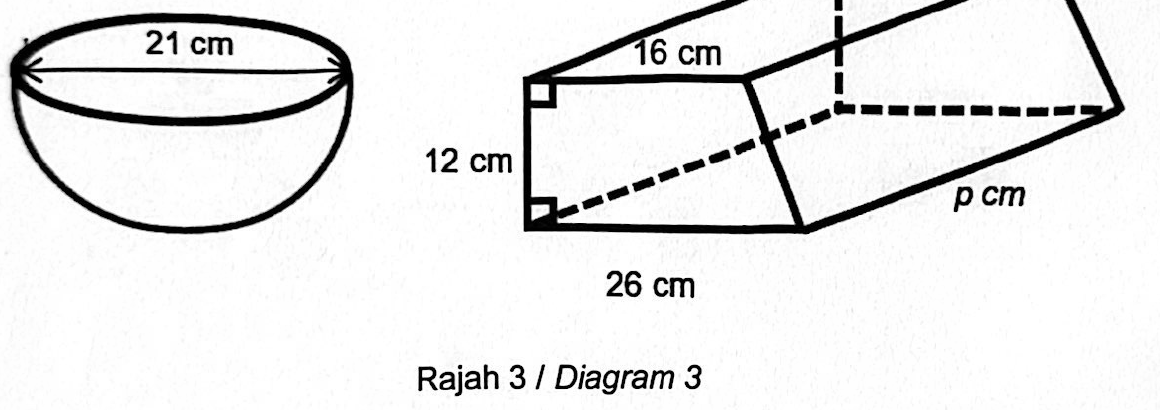
Calculate the value of p. Use π = 22/7.
[3]
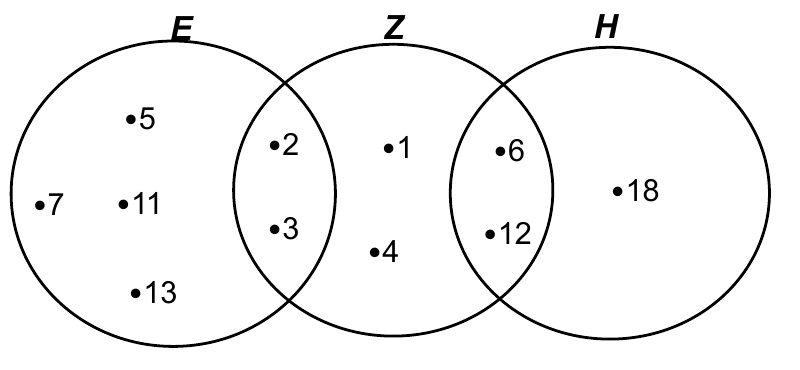
Teacher Rin has number cards for members of the Robotics Club. Table 1: Elina, E: prime numbers less than 15. Haziqah, H: multiples of 6 less than 20. Zuhairah, Z: factors of 12. (a) Complete the Venn diagram in the answer space to show the relationship between the three cards received, with universal set ξ = E ∪ H ∪ Z. (b)(i) On the same diagram, shade (H ∪ Z)′ ∩ E. (ii) List the elements of (E ∪ H ∩ Z)′.
Medium4 marks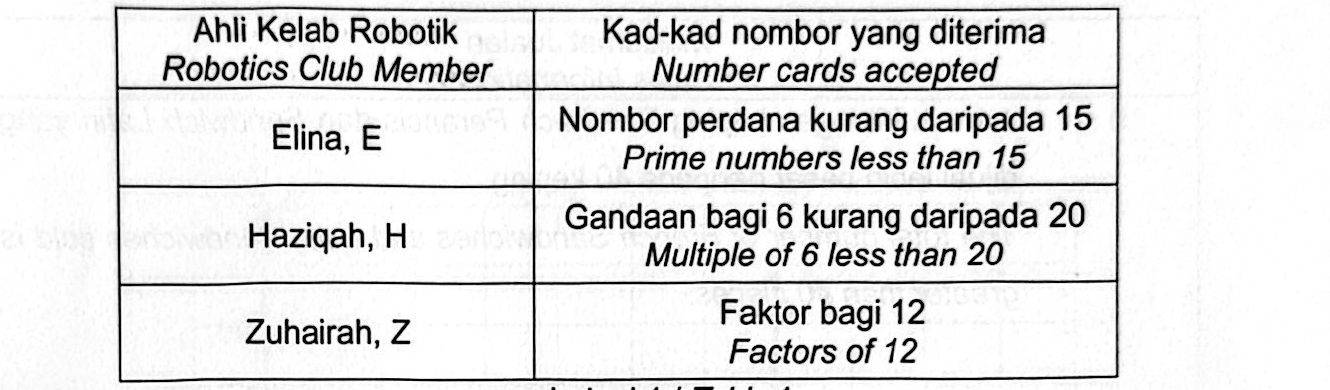
- (a)
Complete the Venn diagram (circles E, Z, H as printed in the answer space) with ξ = E ∪ H ∪ Z.
[2]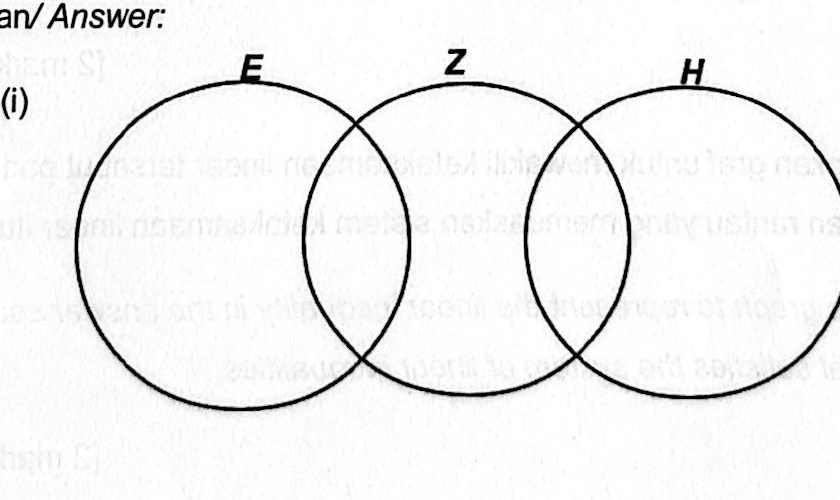
- (b)(i)
On the same diagram, shade (H ∪ Z)′ ∩ E.
[1]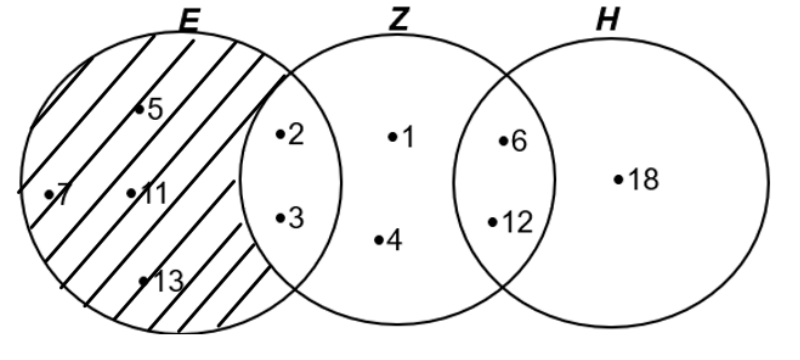
- (b)(ii)
List the elements of (E ∪ H ∩ Z)′.
[1]
Rasuli sold x pieces of French Sandwich and y pieces of Latin Sandwich on Saturday. Table 2: (i) The total number of French Sandwiches and Latin Sandwiches sold is greater than 40 pieces. (ii) The number of French Sandwiches sold is at most 35 pieces. (iii) The maximum number of Latin Sandwiches sold is 40 pieces. (a) Write two linear inequalities for information (i) and (ii). (b) Hence, complete the graph in the answer space and shade the region that satisfies the system of linear inequalities. (The line y = 40 for (iii) is already drawn.)
Medium4 marks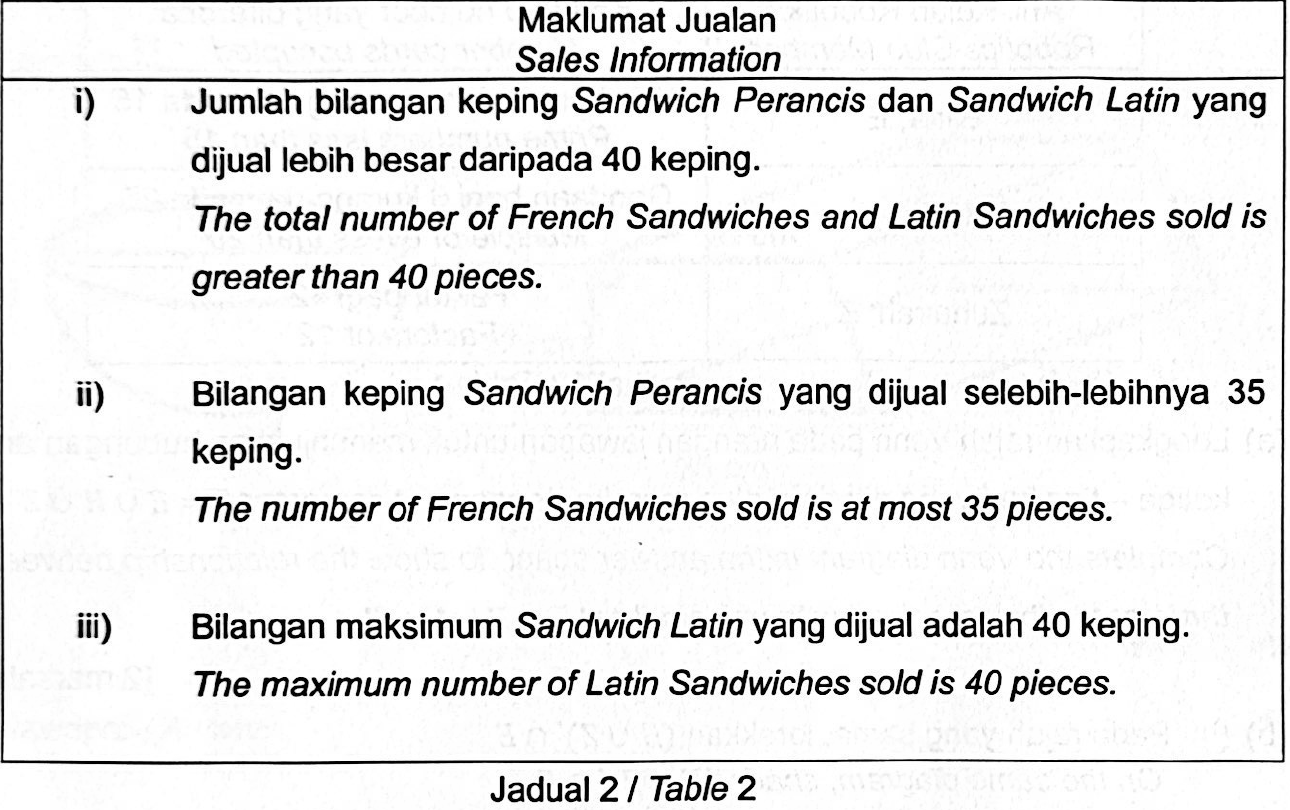
- (a)
Write two linear inequalities for information (i) and (ii).
[2] - (b)
Complete the graph and shade the region that satisfies the system of linear inequalities.
[2]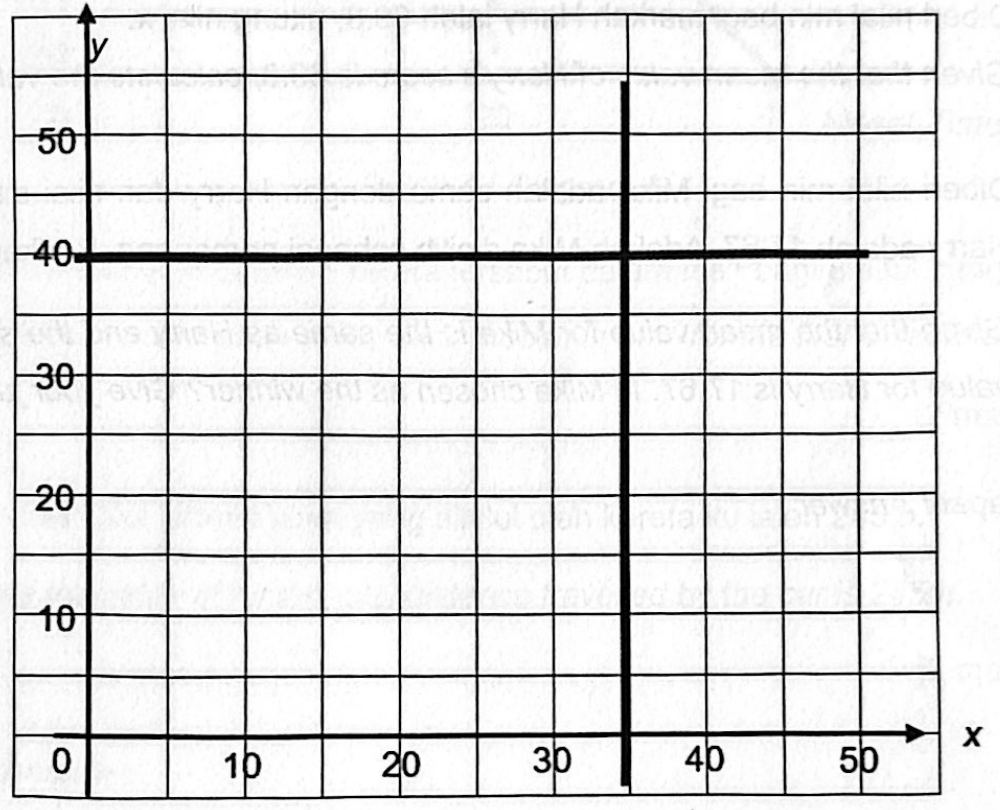
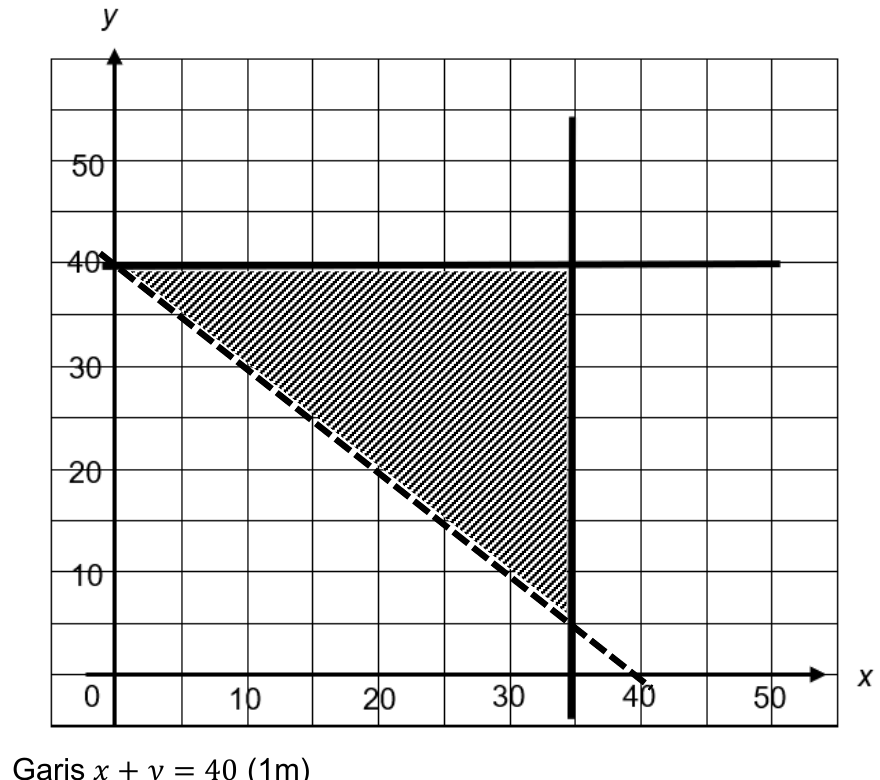
Table 3 shows the achievement scores of two participants in 5 Mathematics tests. Harry: 64, 85, 70, x, 90. Mika: 73, 65, 73, 58, 80. (a) Given the mean value of Harry's score is 69.8, calculate the value of x. (b) Given the mean for Mika is the same as Harry and the standard deviation for Harry is 17.67, is Mika chosen as the winner? Give your justification.
Medium4 marks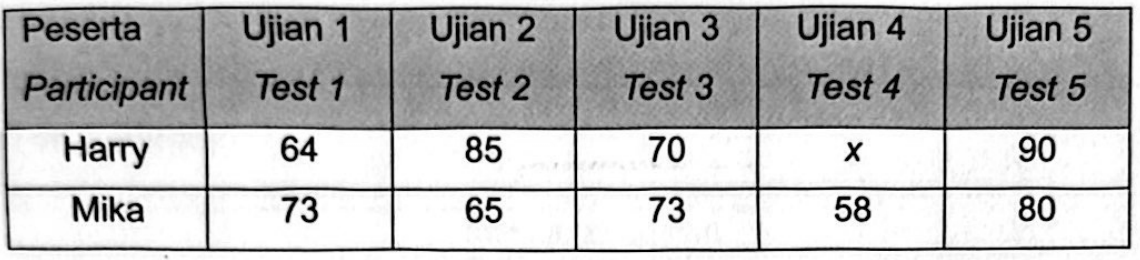
- (a)
Given the mean of Harry's score is 69.8, calculate x.
[2] - (b)
Mika has the same mean as Harry; Harry's standard deviation is 17.67. Is Mika chosen as the winner? Justify.
[2]
Diagram 4 shows a speed-time graph for the movement of a car over a period of t seconds. The speed falls from 15 m s⁻¹ to 10 m s⁻¹ in the first 8 s, stays at 10 m s⁻¹ until 20 s, then falls uniformly to rest at t s. (a) Calculate the deceleration of the car's motion in m s⁻² for the first 8 seconds. (b) Calculate the value of t if the total distance travelled by the car is 245 m.
Medium5 marks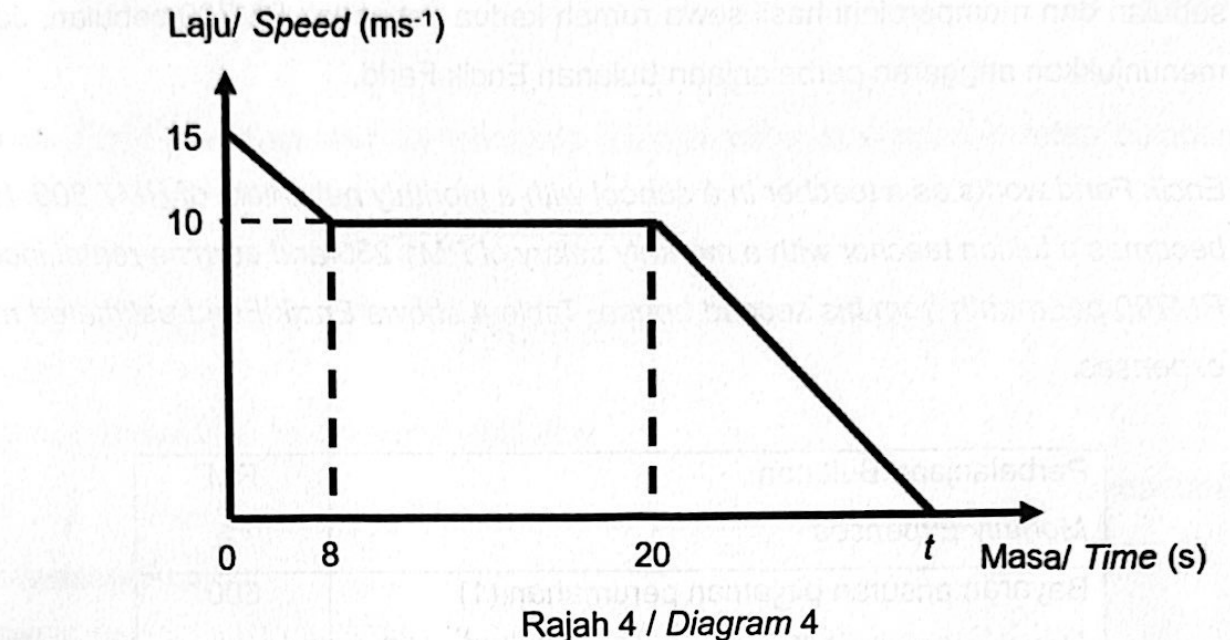
- (a)
Calculate the deceleration for the first 8 seconds in m s⁻².
[2] - (b)
Calculate the value of t if the total distance travelled is 245 m.
[3]
Encik Farid works as a teacher with a monthly net salary of RM7 800. He also earns RM1 250 a month as a tuition teacher and RM700 a month rental income from his second house. Table 4 shows his monthly expenses: housing loan (1) RM600, housing loan (2) RM900, food RM700, utilities RM350, toll and petrol RM200, internet RM100, fancy restaurant food RM400, insurance RM350. (a) State Encik Farid's passive income. (b) He sets aside 10% of his salary as monthly fixed savings. Calculate his monthly cash flow.
Medium4 marks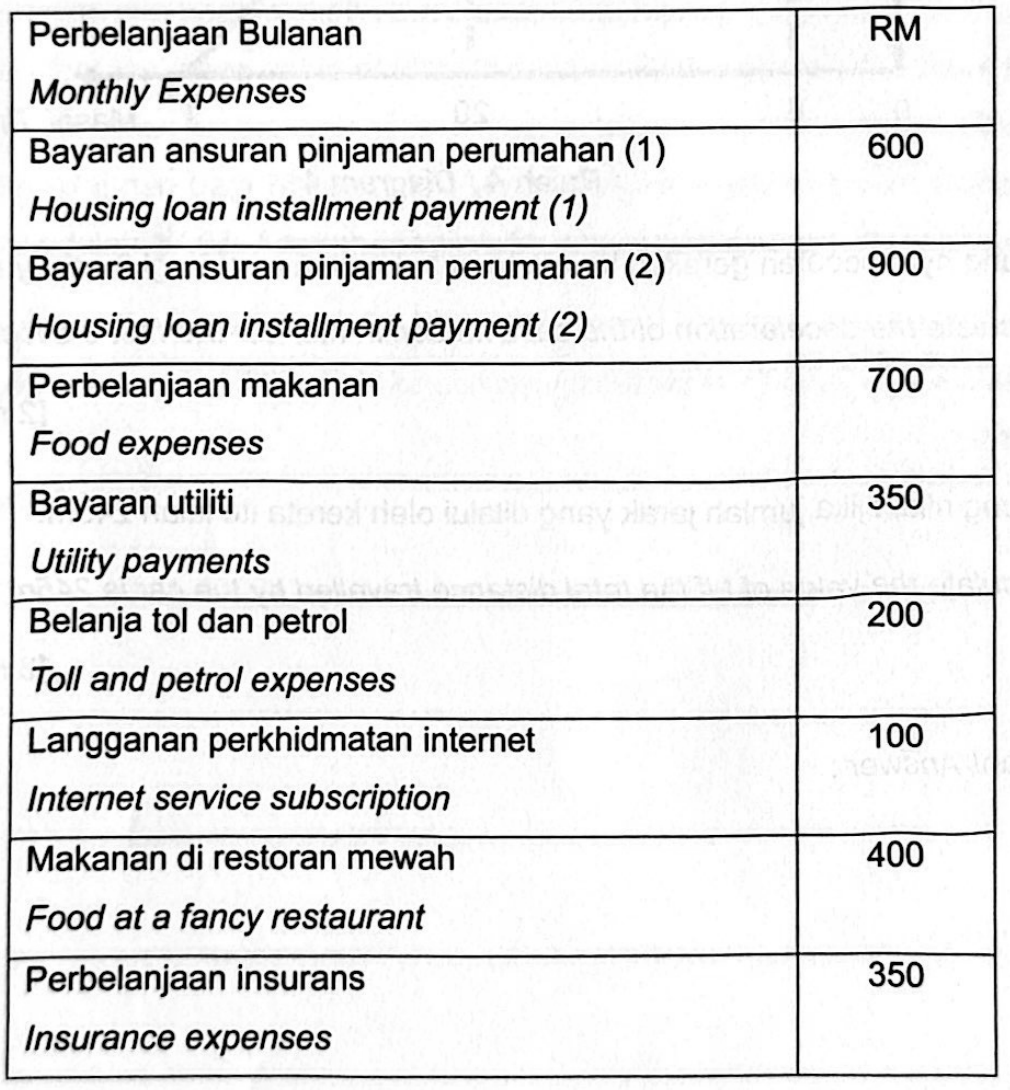
- (a)
State Encik Farid's passive income.
[1] - (b)
Calculate Encik Farid's monthly cash flow.
[3]
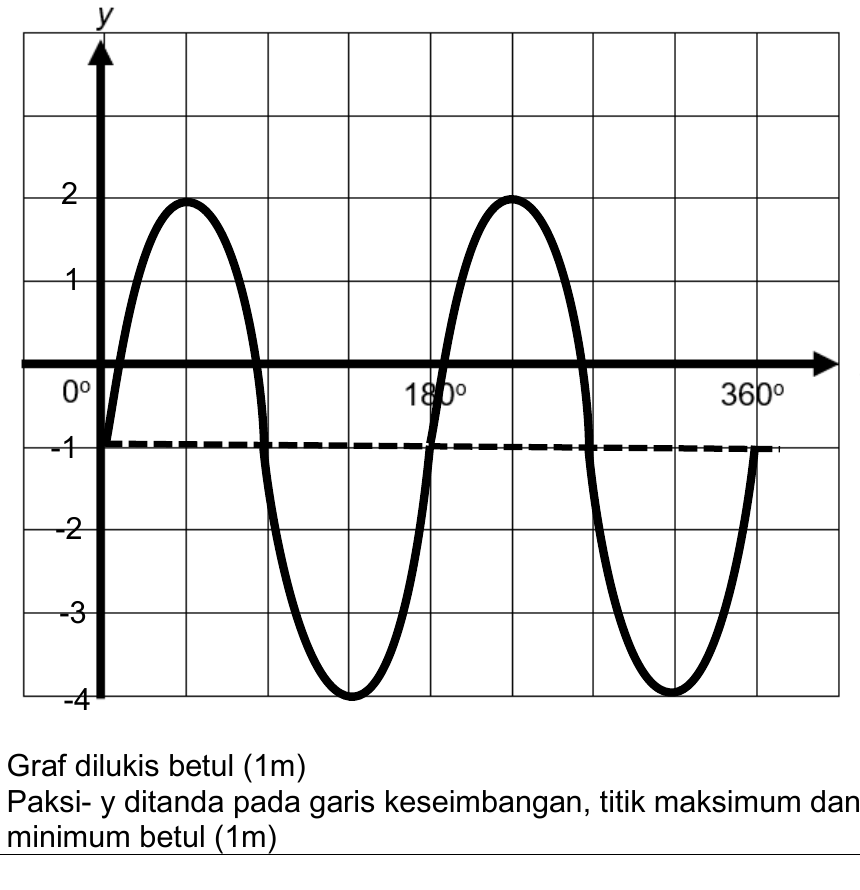
Find the following values without using a scientific calculator. (a) 4 sin 135° − 3 tan 300° + 2 cos 315°. (b) In the answer space, sketch the graph y = 3 sin 2x − 1 for 0° ≤ x ≤ 360°.
Medium4 marks- (a)
Find 4 sin 135° − 3 tan 300° + 2 cos 315° without a calculator.
[2] - (b)
Sketch the graph y = 3 sin 2x − 1 for 0° ≤ x ≤ 360°.
[2]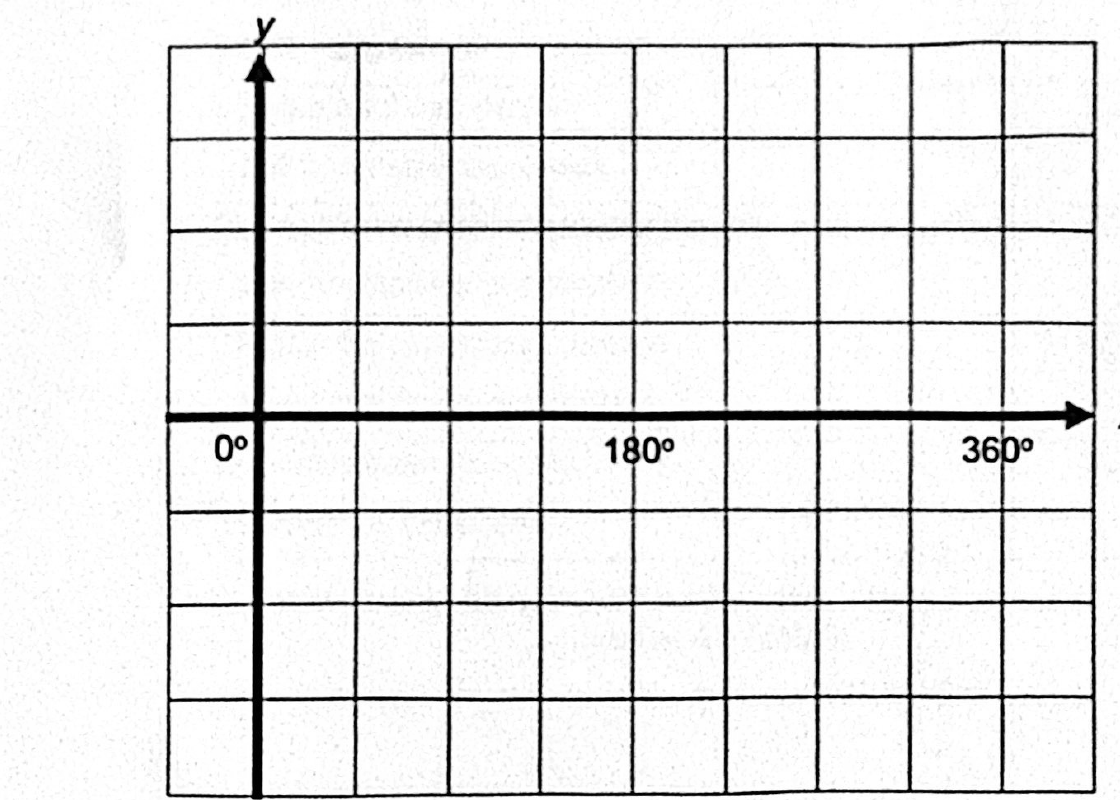
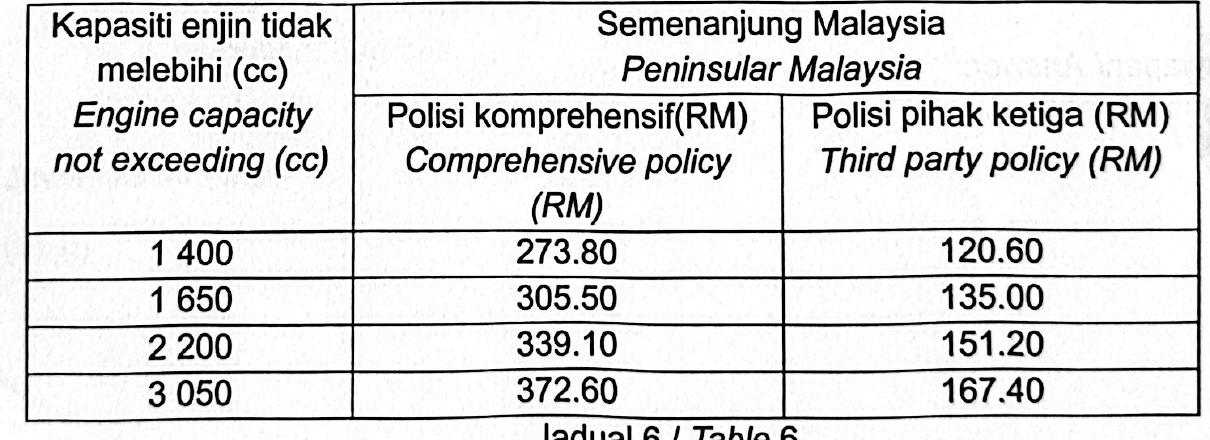
Encik Samer stays in Peninsular Malaysia and buys a motor insurance policy. Table 5: sum insured RM89 000; age of vehicle 3 years; engine capacity 1 800 cc; No Claim Discount (NCD) 30%. Table 6 gives premium rates under the Motor Tariff for Peninsular Malaysia (comprehensive / third party, RM): up to 1 400 cc 273.80 / 120.60; 1 650 cc 305.50 / 135.00; 2 200 cc 339.10 / 151.20; 3 050 cc 372.60 / 167.40. For a comprehensive policy the rate charged is for the first RM1 000 of the sum insured. Formula: Basic premium = rate for the first RM1 000 + RM26 for each RM1 000 or part thereof on value exceeding the first RM1 000. (a) Calculate the basic premium for his car's third party, fire and theft policies. (b) Next, calculate the gross premium for the third party, fire and theft policies of his car.
Medium5 marks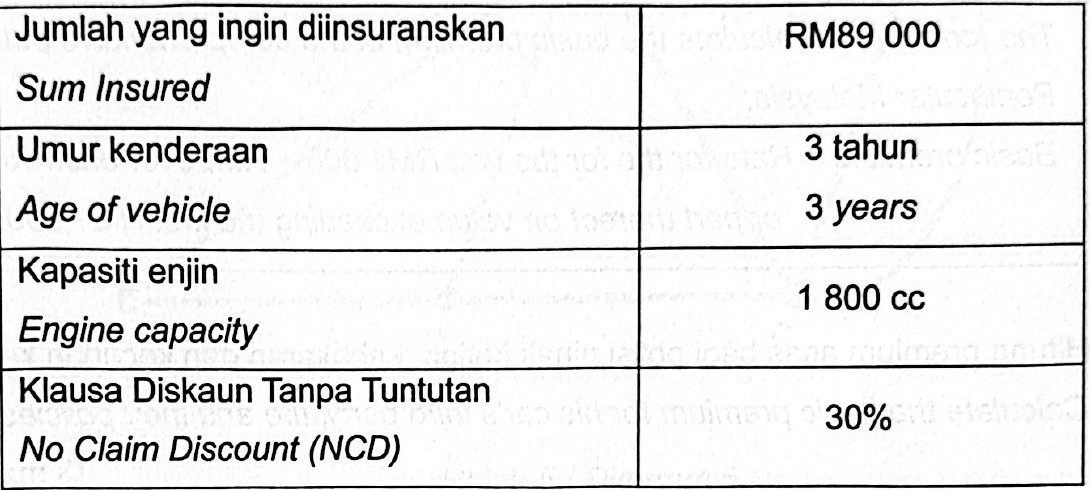
- (a)
Calculate the basic premium for the third party, fire and theft policy (75% of the comprehensive basic premium).
[3] - (b)
Calculate the gross premium for the third party, fire and theft policy.
[2]
Section B
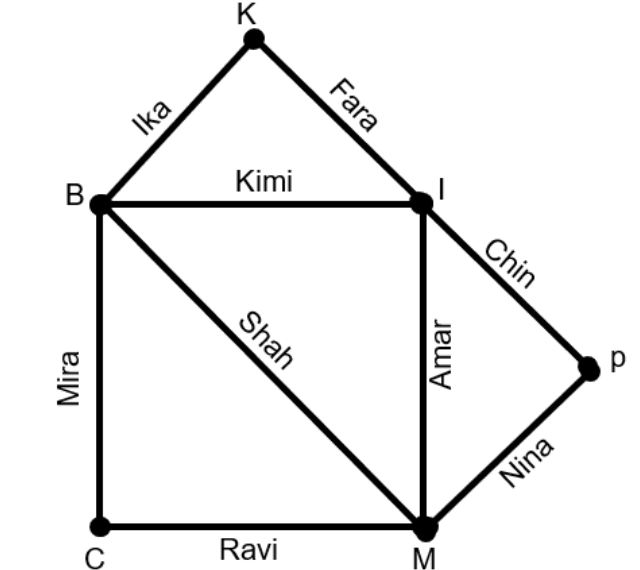
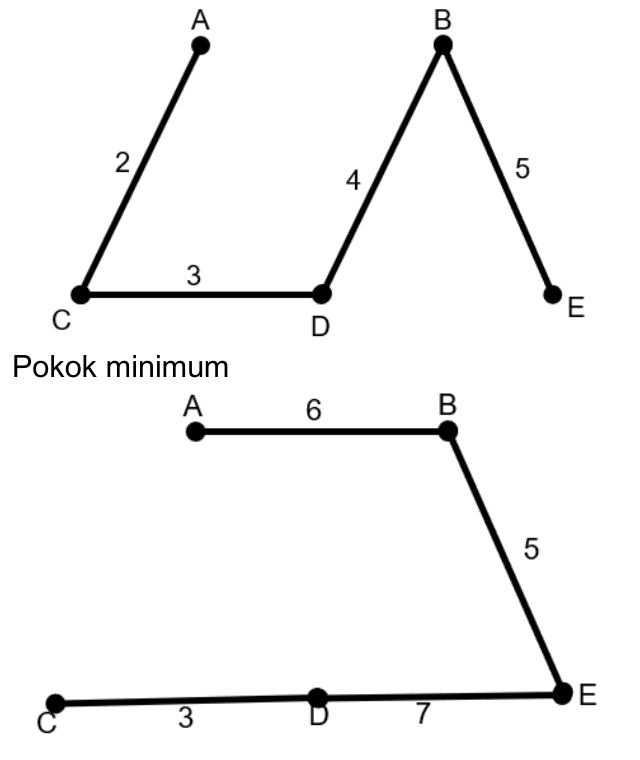
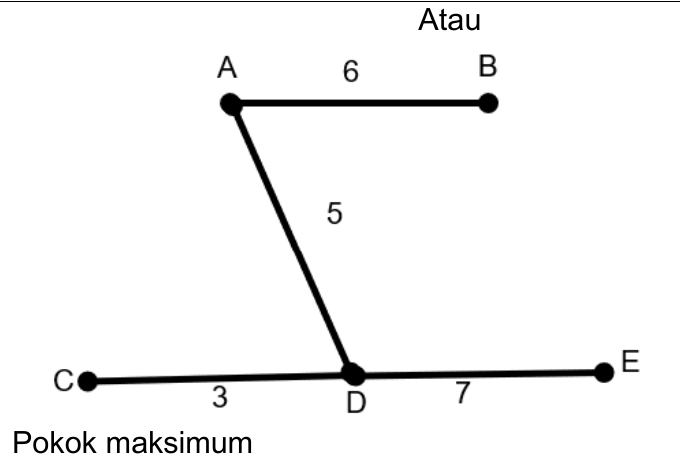
(a) Diagram 5 shows an undirected graph that has loops and multiple edges (vertices A, B, C, D, E). State (i) the edges (E) and (ii) the number of degrees. (b) Table 7 shows clubs and societies for students: Malay Language (B): Shah, Mira, Kimi, Ika. English Language (I): Kimi, Chin, Amar, Fara. Mathematics (M): Shah, Ravi, Amar, Nina. Travel (P): Chin, Nina. Chess (C): Mira, Ravi. Entrepreneurship (K): Ika, Fara. Based on Table 7, draw a simple graph. (c) Diagram 6 shows an undirected weighted graph representing a pipe network between five locations A, B, C, D, E. Edge lengths in km: AB 6, AC 2, AD 5, BD 4, BE 5, CD 3, DE 7. (i) Draw two trees with minimum and maximum weights. (ii) Calculate the minimum cost of a pipe network if the cost per metre of pipe is RM12.70.
Medium9 marks- (a)(i)
State the edges (E) of the graph in Diagram 5.
[1]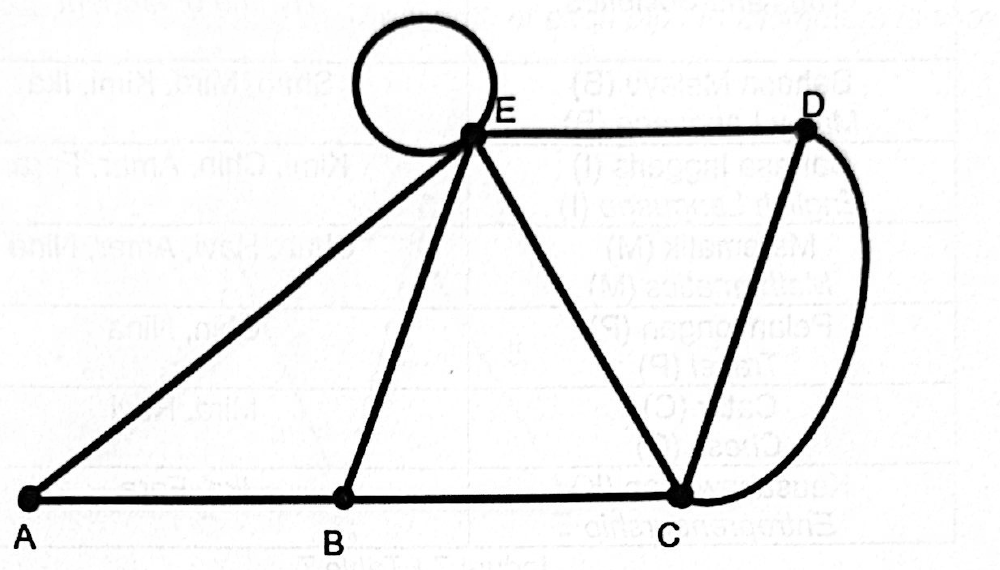
- (a)(ii)
State the number of degrees.
[1] - (b)
Based on Table 7, draw a simple graph.
[3]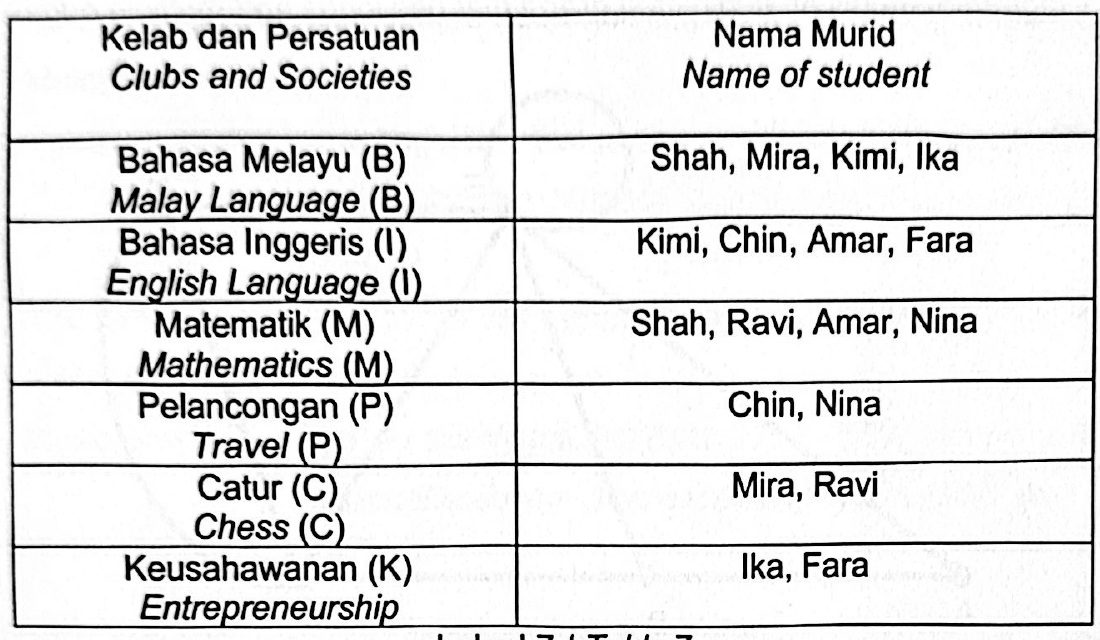
- (c)(i)
Draw two trees with minimum and maximum weights.
[2]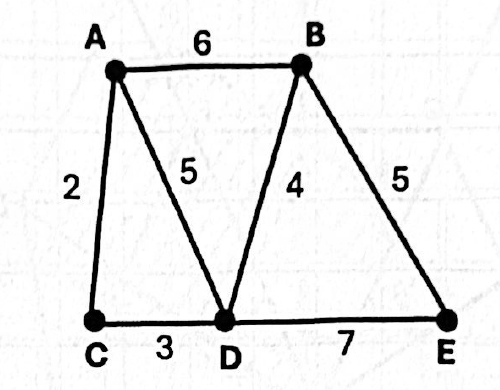
- (c)(ii)
Calculate the minimum cost of the pipe network if the cost per metre is RM12.70.
[2]
(a) Diagram 7 shows polygons drawn on a Cartesian plane. List two pairs of triangles which are congruent. (b) Diagram 8 shows three pentagons ABCDE, AFGHI and AJKLM drawn on a Cartesian plane. (i) AJKLM is the image of ABCDE under the combination of transformations PQ. Describe fully the transformation P and the transformation Q. (ii) Given that the area of pentagon AJKLM is 4.125 unit², calculate the area of the shaded region.
Medium9 marks- (a)
List two pairs of triangles which are congruent.
[2]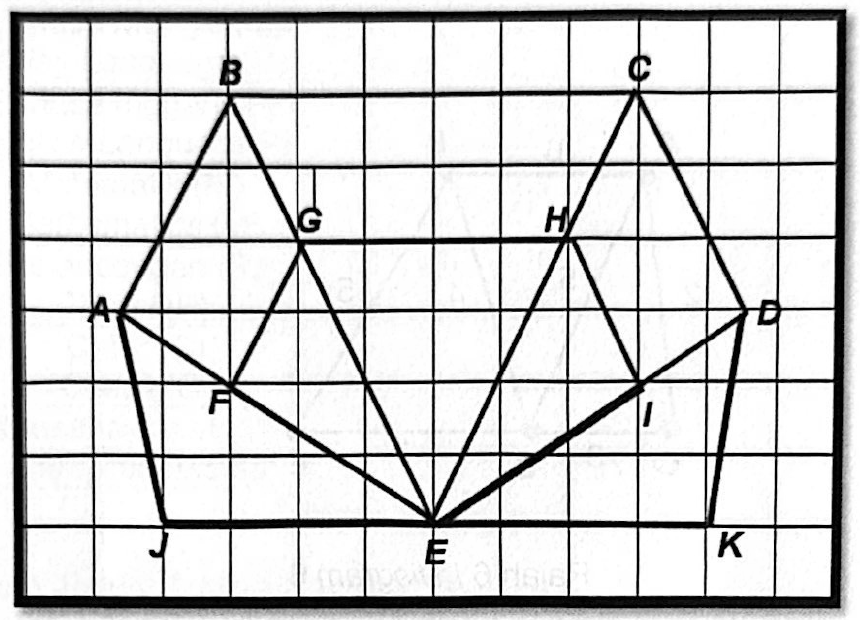
- (b)(i)
Describe fully the transformations P and Q.
[5]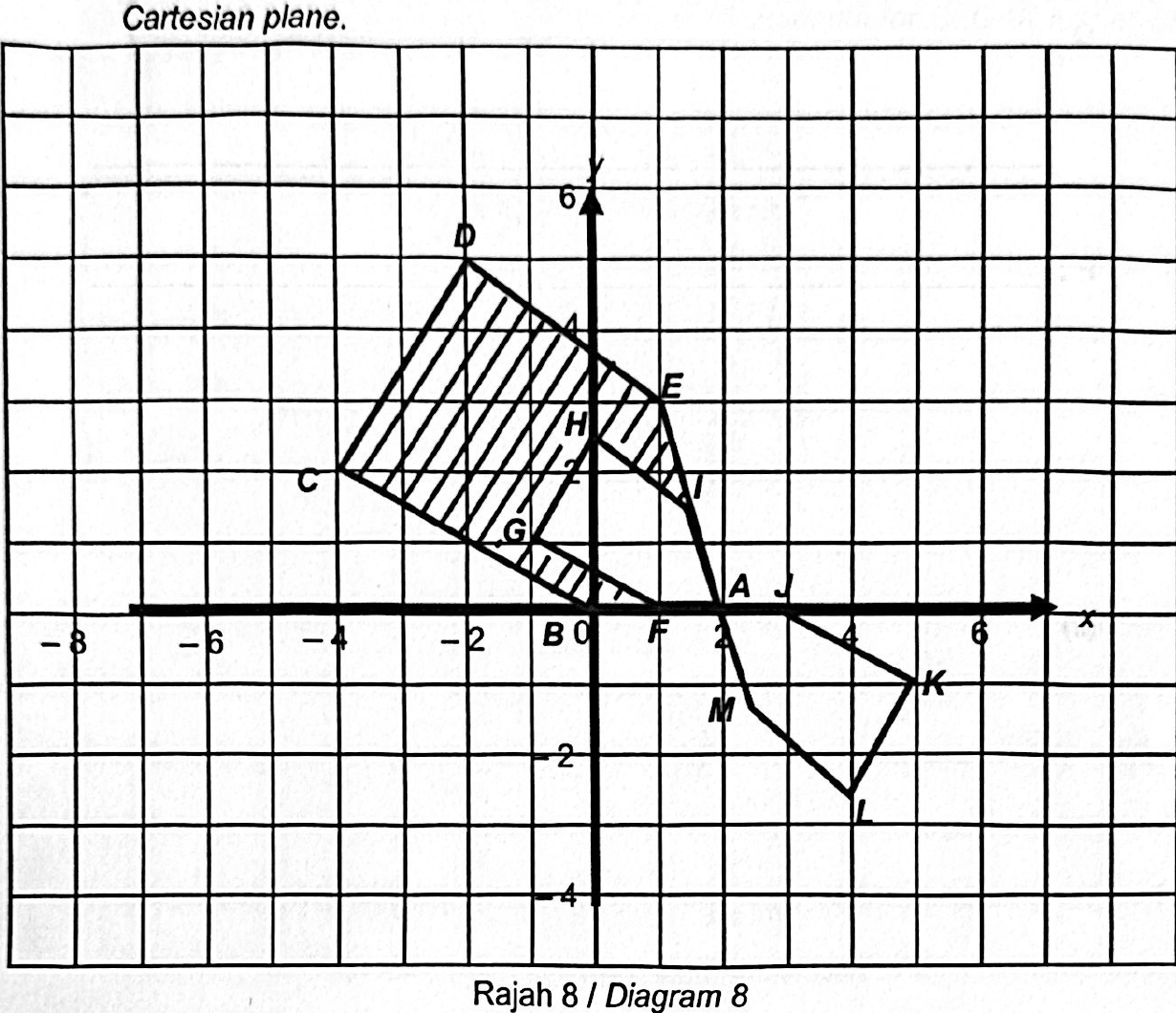
- (b)(ii)
Given the area of pentagon AJKLM is 4.125 unit², calculate the area of the shaded region.
[2]
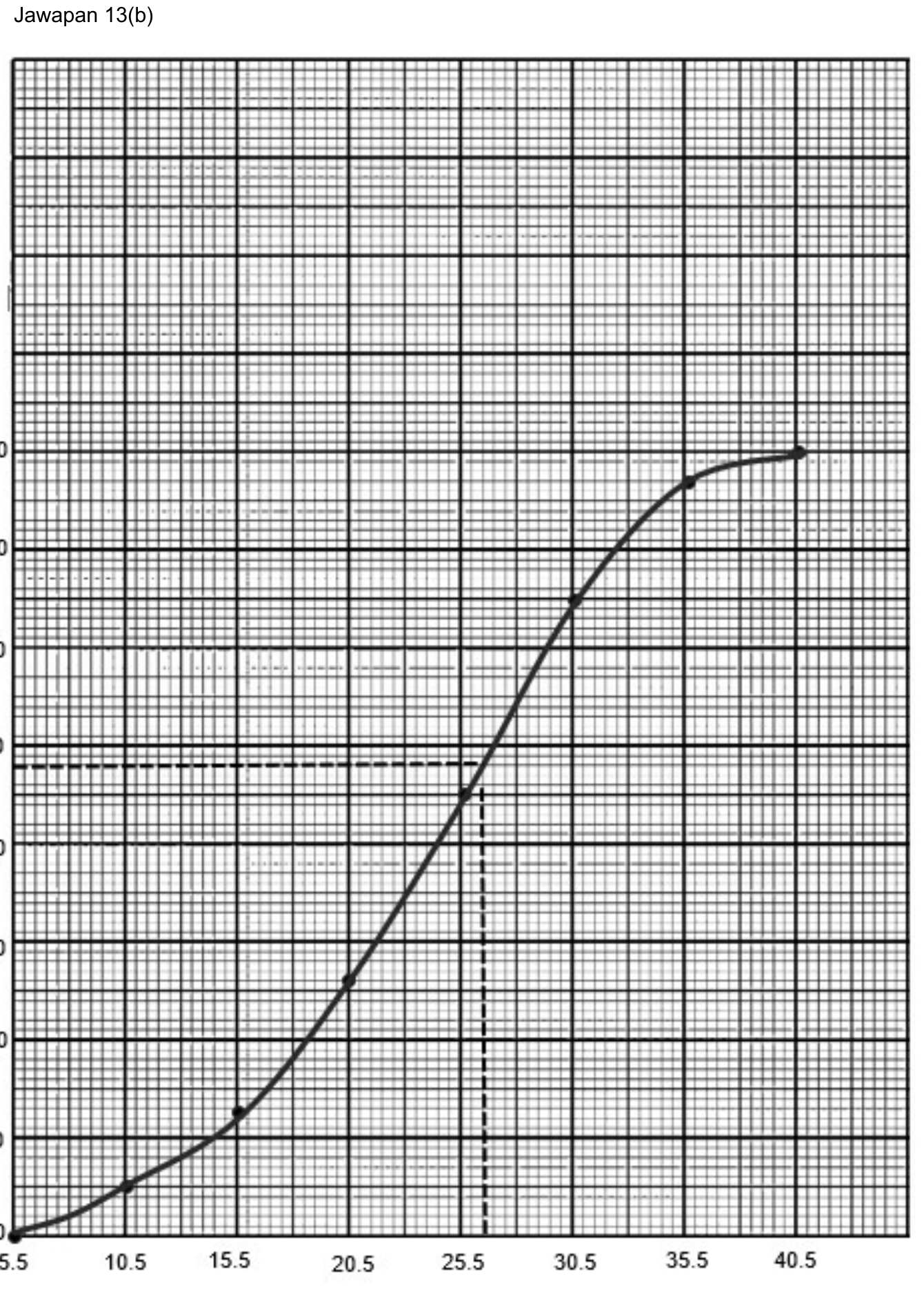
Table 8 shows push-up data for 80 students: 6–10: 5; 11–15: 8; 16–20: 13; 21–25: 19; 26–30: 20; 31–35: 12; 36–40: 3. (a)(i) State the size of class interval and the range of the data. (ii) Complete Table 9 (upper boundary and cumulative frequency). (b) Using a scale of 2 cm to 5 units on the horizontal axis and 2 cm to 10 students on the vertical axis, draw the ogive on the graph paper provided. (c) Hence, from the ogive, find the 60th percentile.
Medium9 marks- (a)(i)
State the size of class interval and the range of the data.
[2]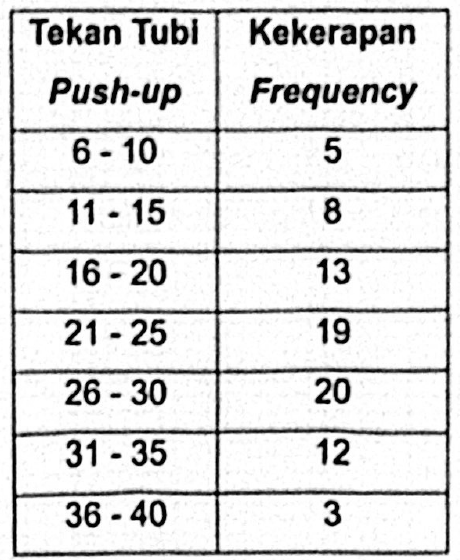
- (a)(ii)
Complete Table 9 with upper boundary and cumulative frequency.
[2]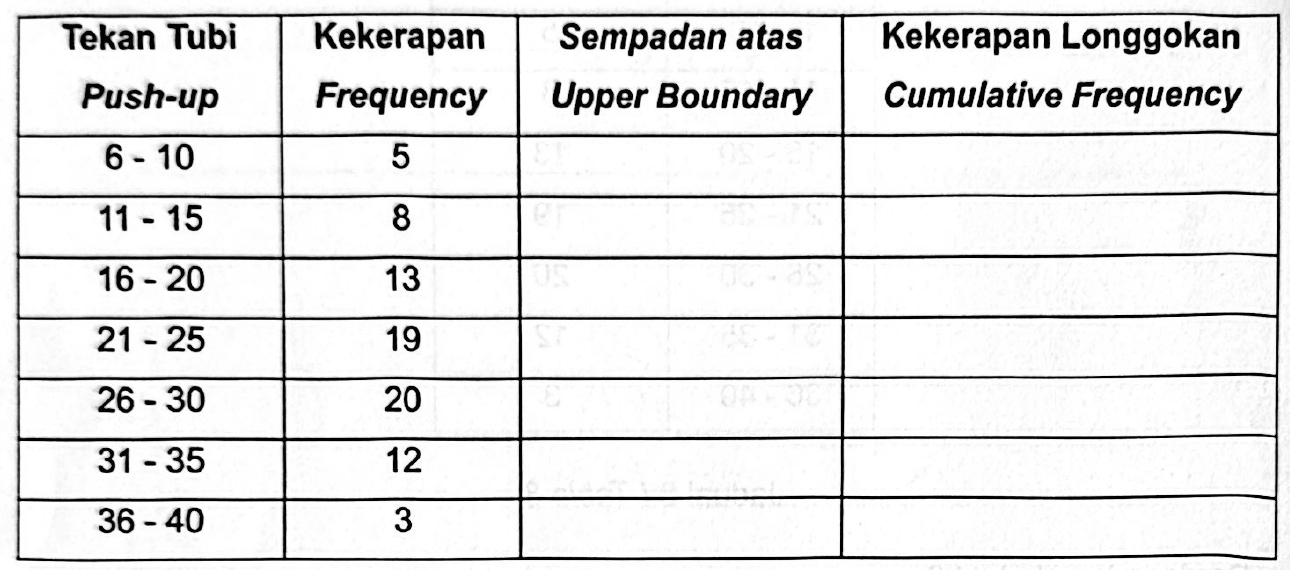
- (b)
Draw the ogive using the given scales on the graph paper.
[4]
- (c)
From the ogive, find the 60th percentile.
[1]
(a) Encik Rahman owns a private car with an engine capacity of 1 789 cc in Kota Bharu. Table 10 (road tax): 1 401–1 600 cc: base rate RM90.00; 1 601–1 800 cc: RM200.00 plus RM0.40 for each cc exceeding 1 600 cc; 1 801–2 000 cc: RM280.00 plus RM0.50 for each cc exceeding 1 800 cc. Calculate the road tax. (b) In 2024, Encik Rahman received an annual salary of RM90 000 while his wife received RM12 000 less. They each donated RM500 to an approved charity. Total zakat RM2 500. Total tax relief for joint tax assessment RM25 000. Table 11 (individual tax rates): chargeable income 50 001–70 000: tax on first 50 000 RM1 500, next 20 000 at 11% RM2 200; 70 001–100 000: first 70 000 RM3 700, next 30 000 at 19% RM5 700; 100 001–400 000: first 100 000 RM9 400, next 300 000 at 25%. (i) Use the joint tax assessment to calculate (a) the taxable income and (b) the income tax. (ii) Each month their salary was deducted by RM650 and RM500 for monthly tax deduction (PCB). Do they have to pay the balance of income tax? Explain.
Medium9 marks- (a)
Calculate the road tax Encik Rahman must pay.
[2]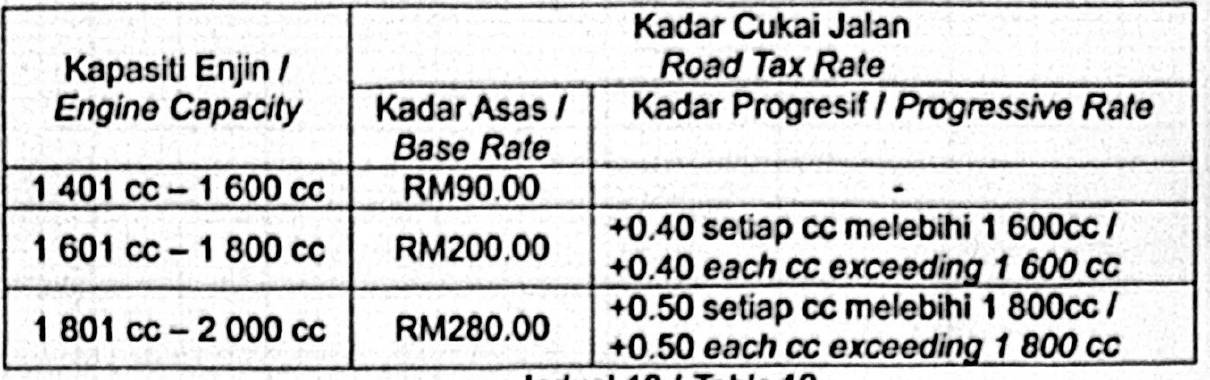
- (b)(i)(a)
Use the joint tax assessment to calculate the taxable income.
[2]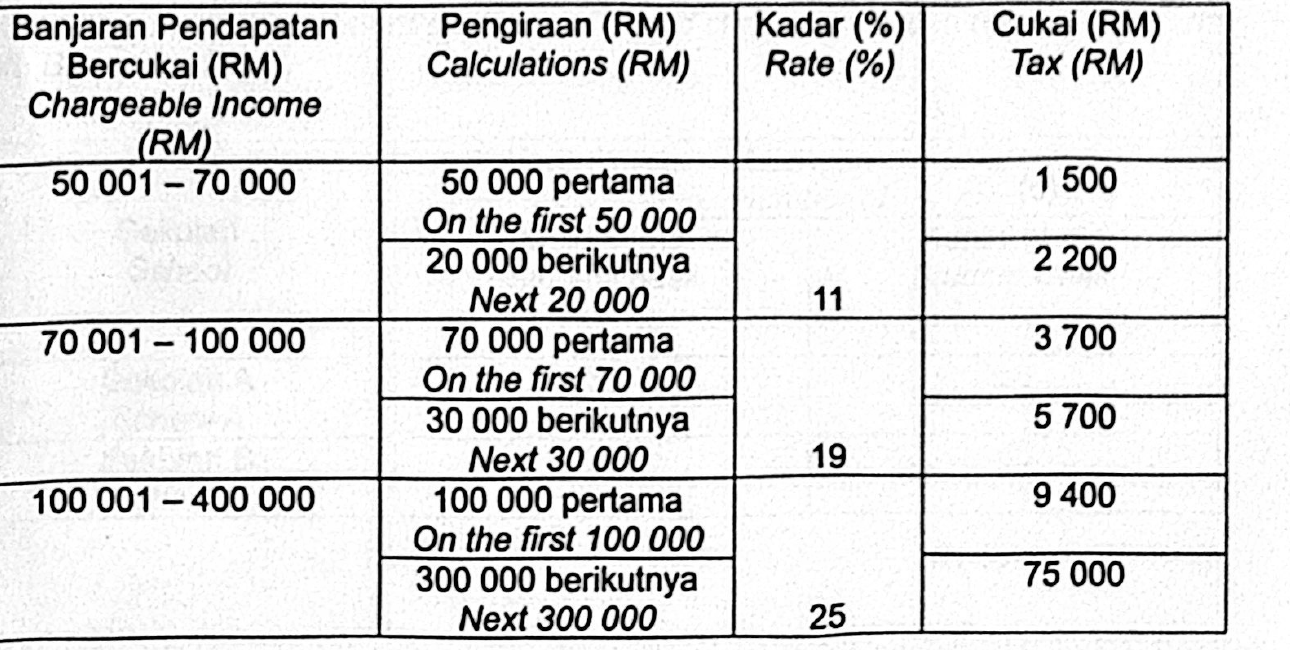
- (b)(i)(b)
Calculate the income tax of Encik Rahman and his wife.
[2] - (b)(ii)
Do they have to pay the balance of income tax? Explain.
[3]
(a) Given matrix M = [[3, x + 2], [9, −2y]] and N = [[2, 15], [5z + x, 10]]. Given that M − N = [[1, −11], [2, −4]], find the value of (i) x, (ii) y, (iii) z. (b) Table 12: School A: 50 student desks and 60 student chairs; School B: 30 desks and 45 chairs. The total price allocation for desks and chairs for School A is RM10 850. School B receives an allocation of RM3 575 less than School A. Using the matrix method, calculate the price of one student desk and one student chair.
Medium9 marks- (a)
Find x, y and z.
[4] - (b)
Using the matrix method, calculate the price of one student desk and one student chair.
[5]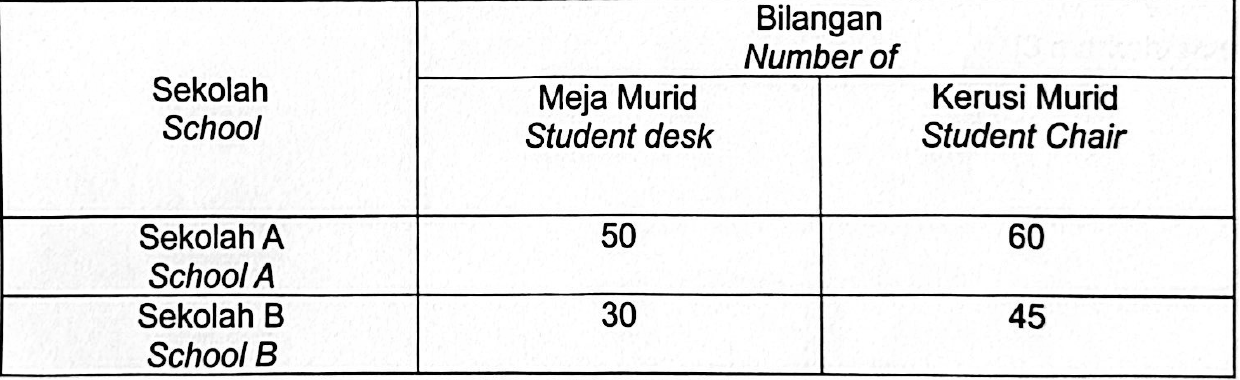
Section C
MyTiqnAI company is developing an artificial intelligence system. (a) A customer chooses a package with a subscription price of RM120 per month. The total bill payable is RM127.20 including service tax. (i) State the party responsible for collecting service tax. (ii) Calculate the service tax rate charged. (b) Table 13: Basic Package RM50 per month; Professional Package RM120 per month. The total number of customers for both packages is 500 and the total subscription revenue is RM39 000. By using the substitution and elimination methods, calculate the number of customers for the Basic Package and for the Professional Package. (c) Diagram 9 shows the floor plan of a rectangle ABCD with BC = (x + 5) m and CD = (2x + 4) m. An isosceles triangle EFG (E the midpoint of AB, AE = EB = GF, EH = 8 m) is the customer interactive space and the shaded area is the seating area. (i) Express the area of the customer seating space, L m², in terms of x. (ii) If the area of the customer interactive space is 48 m², calculate the area, in m², of the customer seating area. (d) The company invested RM500 000 in an AI project by purchasing shares priced at RM1.25 per unit, with a target return of more than 60%. At the end of the year, a dividend of 20 sen per unit was declared. The next year it sold all its shares at RM1.75 per unit. Calculate the return on investment. Was the target achieved?
Hard15 marks- (a)(i)
State the party responsible for collecting service tax.
[1] - (a)(ii)
Calculate the service tax rate charged.
[2] - (b)
Using substitution and elimination, find the number of Basic and Professional customers.
[4]
- (c)(i)
Express the area of the customer seating space, L m², in terms of x.
[2]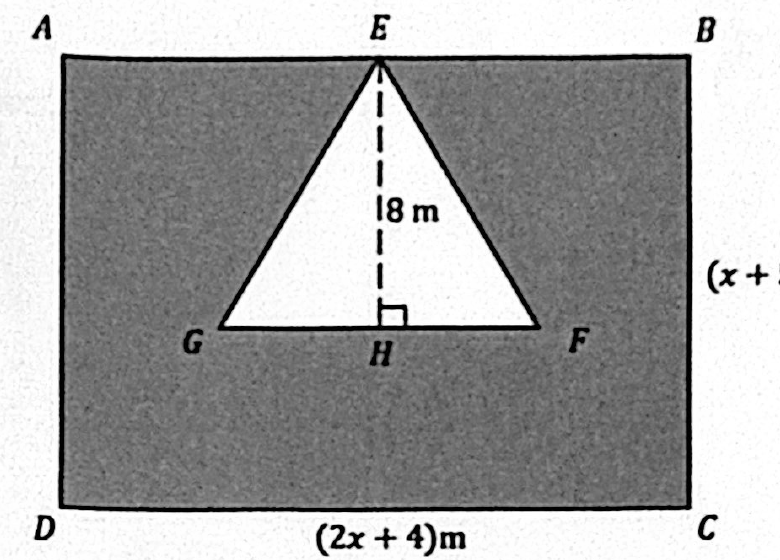
- (c)(ii)
If the area of the interactive space is 48 m², calculate the seating area in m².
[3] - (d)
Calculate the return on investment. Was the target (more than 60%) achieved?
[3]
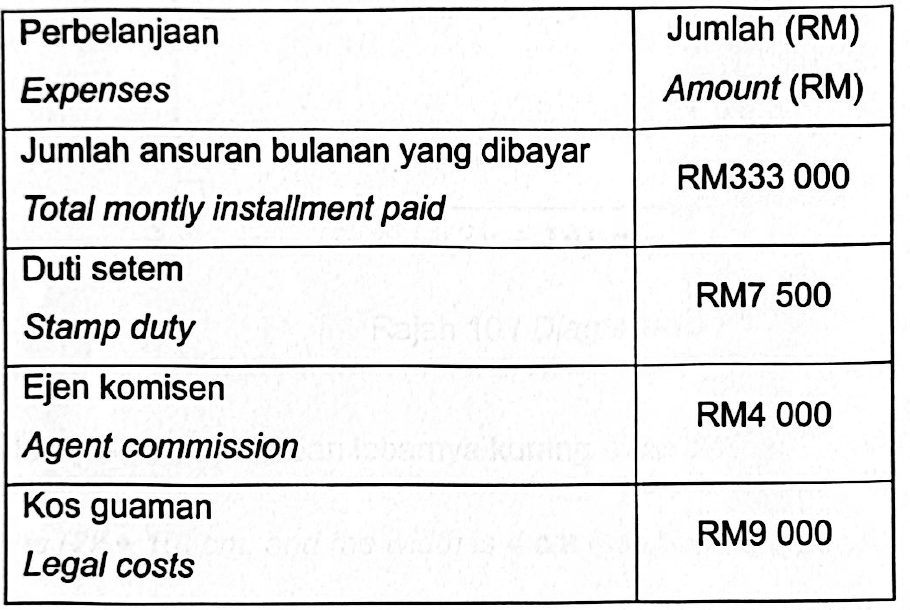
Sarah runs a small business selling semperit and tart cookies. (a) Sarah used 690 kWh of electricity. Usage exceeding 600 kWh in a month is subject to a 6% service tax. Table 14: tariff blocks 200, 100, 300, 300 kWh; average blocks 200, 100, 300, 90 kWh; rates RM0.218, RM0.334, RM0.516, RM0.546. Calculate the total electricity bill. (b) The price per jar of semperit and tart cookies is RM15 and RM20 respectively. Haliza paid RM1 000 for 50 jars of festive cookies and received RM150 in change. Without using the matrix method, calculate the number of jars of each she bought. (c) Diagram 10 shows the inside surface PQRS of a rectangular aluminium tray. The length is (2x + 10) cm and the width is 4 cm less than the length. (i) Given that the inside surface area of the tray is 480 cm², form a quadratic equation in terms of x in the form ax² + bx + c = 0. (ii) Hence, calculate the width of the tray. (d) Sarah purchased a shop unit for RM270 000 and paid 10% down payment of RM27 000. She aims for a 35% return within 20 years. After 20 years she sold the shop for RM500 000. Other expenses: total monthly instalments paid RM333 000, stamp duty RM7 500, agent commission RM4 000, legal costs RM9 000. Calculate her return on investment. Did she achieve her goal of 35%?
Hard15 marks- (a)
Calculate the total electricity bill charged for that month.
[3]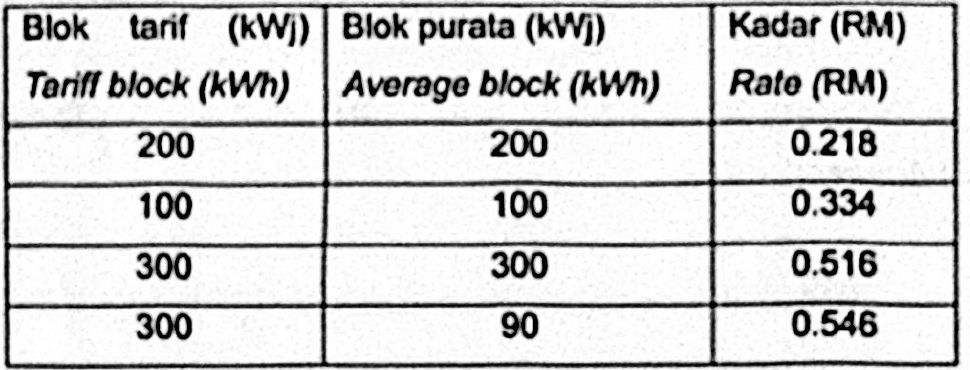
- (b)
Without matrices, calculate the number of jars of semperit and tart cookies.
[4] - (c)(i)
Form a quadratic equation in x in the form ax² + bx + c = 0 for the tray area 480 cm².
[2]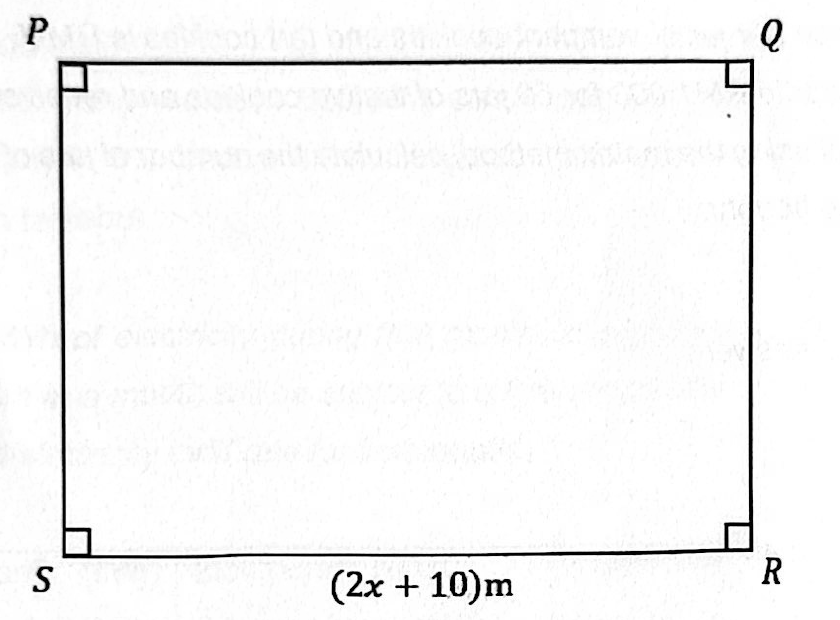
- (c)(ii)
Hence, calculate the width of the tray.
[3] - (d)
Calculate Sarah's return on investment. Did she achieve her 35% goal?
[3]