Write your answer on paper. Then open the answer to check it.
Section A
(a) Write the negation of the statement '12 is the highest common factor (HCF) of 28 and 42', then state its truth value. (b) Determine whether the argument is valid and sound. Premise 1: All multiples of 2 are multiples of 4. Premise 2: 22 is a multiple of 2. Conclusion: 22 is a multiple of 4. Justify your answer.
Medium4 marks- (a)
Write the negation of the statement and state its truth value.
[2] - (b)
Determine whether the argument is valid and sound. Justify.
[2]
Diagram 3 is a pie chart showing the number of mangosteens eaten by 4 students (Ahmad 12, Siva 10, Mandeep 20, Kenny 18). Calculate (a) the mean number of mangosteens eaten by a student, (b) the angle of the sector that represents Kenny.
Medium4 marks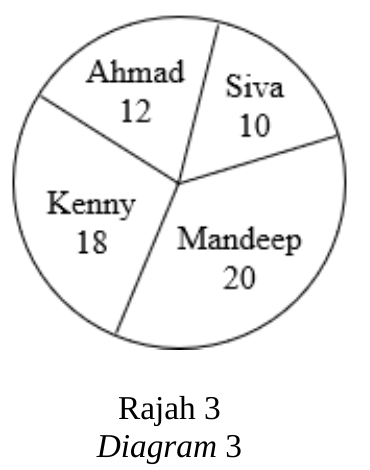
- (a)
Calculate the mean number of mangosteens eaten by a student.
[2] - (b)
Calculate the angle of the sector that represents Kenny.
[2]
In Diagram 4, O is the centre of a circle of radius 3 cm and ROS is a straight line. Given ∠ORP = 25° and PS is the tangent to the circle at P. Find (a) x°, (b) the length of RS.
Medium4 marks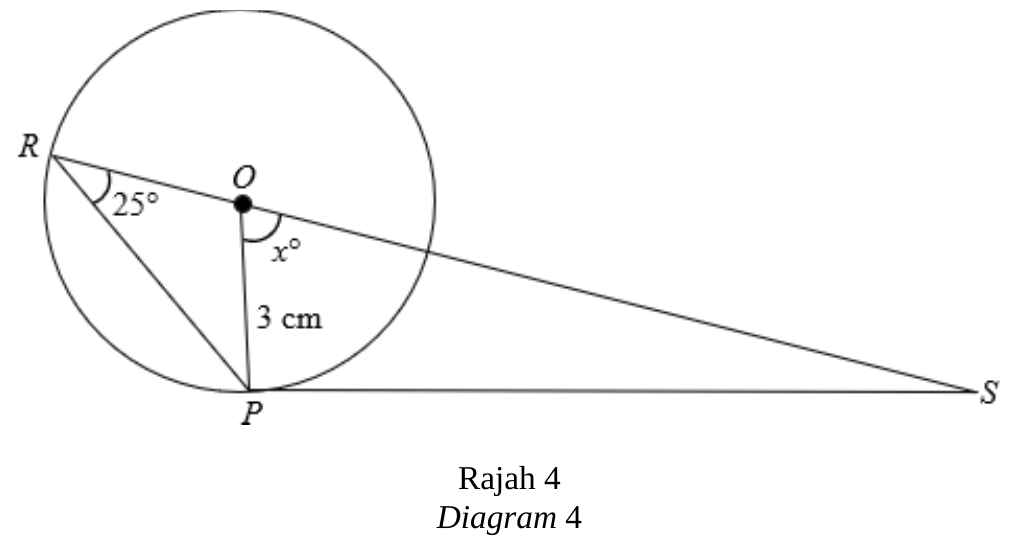
- (a)
Find x°.
[1] - (b)
Find the length of RS.
[3]
(a) Jimmy has an Axia car for personal use in Sabah. His car has never made a claim. Age of car: 3 years; engine capacity: 1 500 cc; NCD: 30%; amount to be insured: RM 45 000. Calculate the gross premium under the third party, fire and theft policy if the basic premium for the comprehensive policy is RM 1 113.20. (b) Yusri's car hit another car and he was at fault. Both cars were badly damaged and the other driver broke a leg. State the claims Yusri can make if his car is insured under a third-party policy.
Medium5 marks- (a)
Calculate the gross premium under the third party, fire and theft policy.
[3] - (b)
State the claims Yusri can make under a third-party policy.
[2]
Diagram 7 shows part of the graph of the quadratic function f(x) = –a(x – m)(x – n) with m < n (x-intercepts –1 and 4, y-intercept 4). (a) Calculate the value of (i) m, (ii) n, (iii) a. (b) State the equation of the axis of symmetry.
Medium4 marks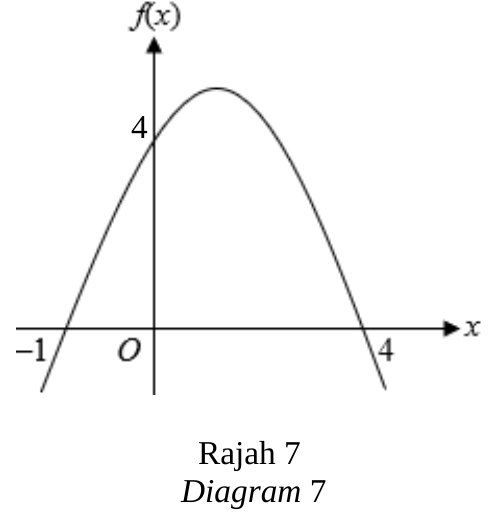
- (a)(i)
Calculate m.
[1] - (a)(ii)
Calculate n.
[1] - (a)(iii)
Calculate a.
[1] - (b)
State the equation of the axis of symmetry.
[1]
Complete Table 1 for the value of x = –1 which satisfies y = x³ – 11x + 2. Hence draw the graph of y = x³ – 11x + 2 for –3 ≤ x ≤ 4. Table: x = –3, –2, –1, 0, 1, 2, 3, 3.5, 4; y = 8, 16, __, 2, –8, –12, –4, 6.4, 22. Draw on the given grid.
Medium4 marks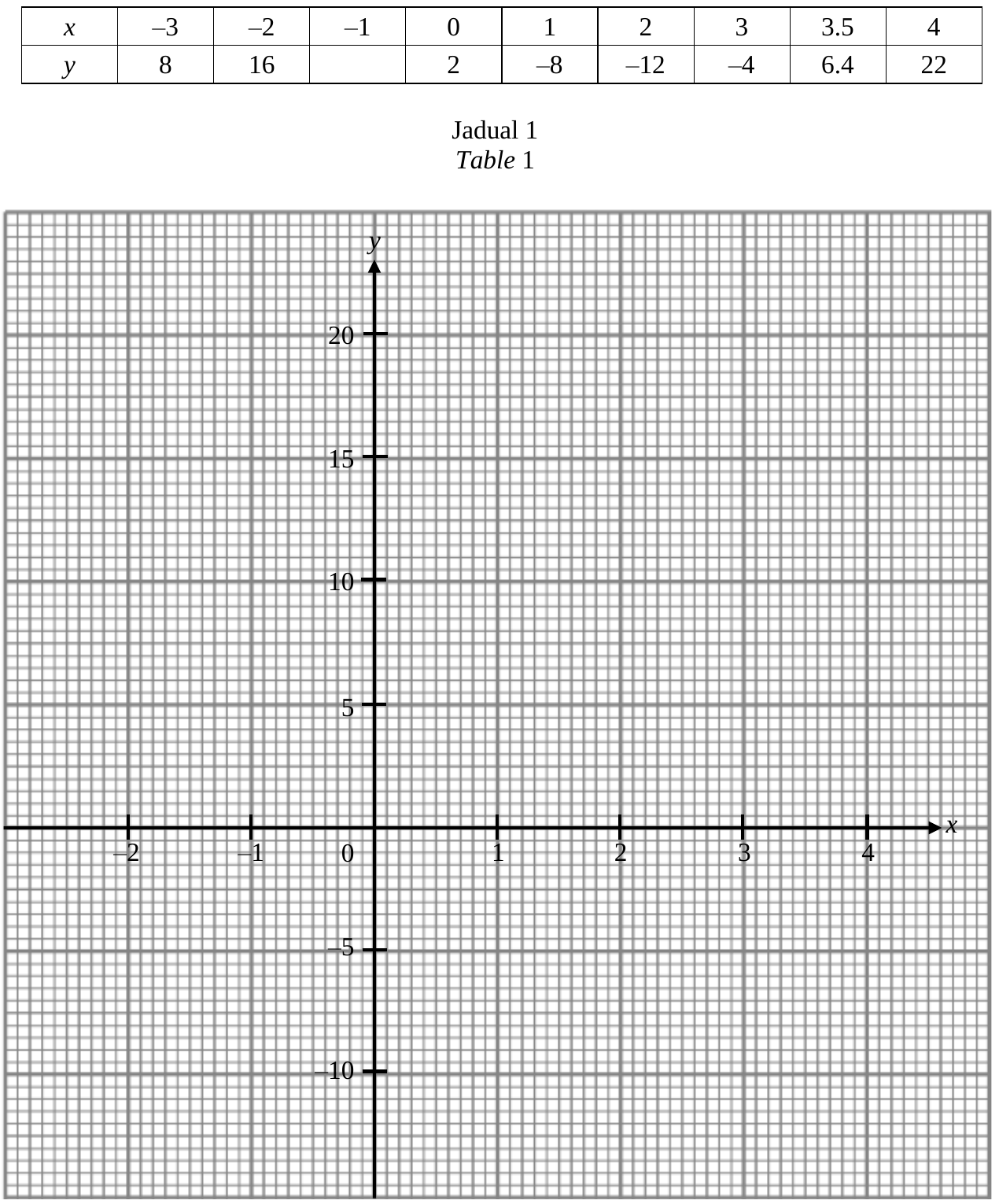
Complete the table for x = –1 and draw the graph.
[4]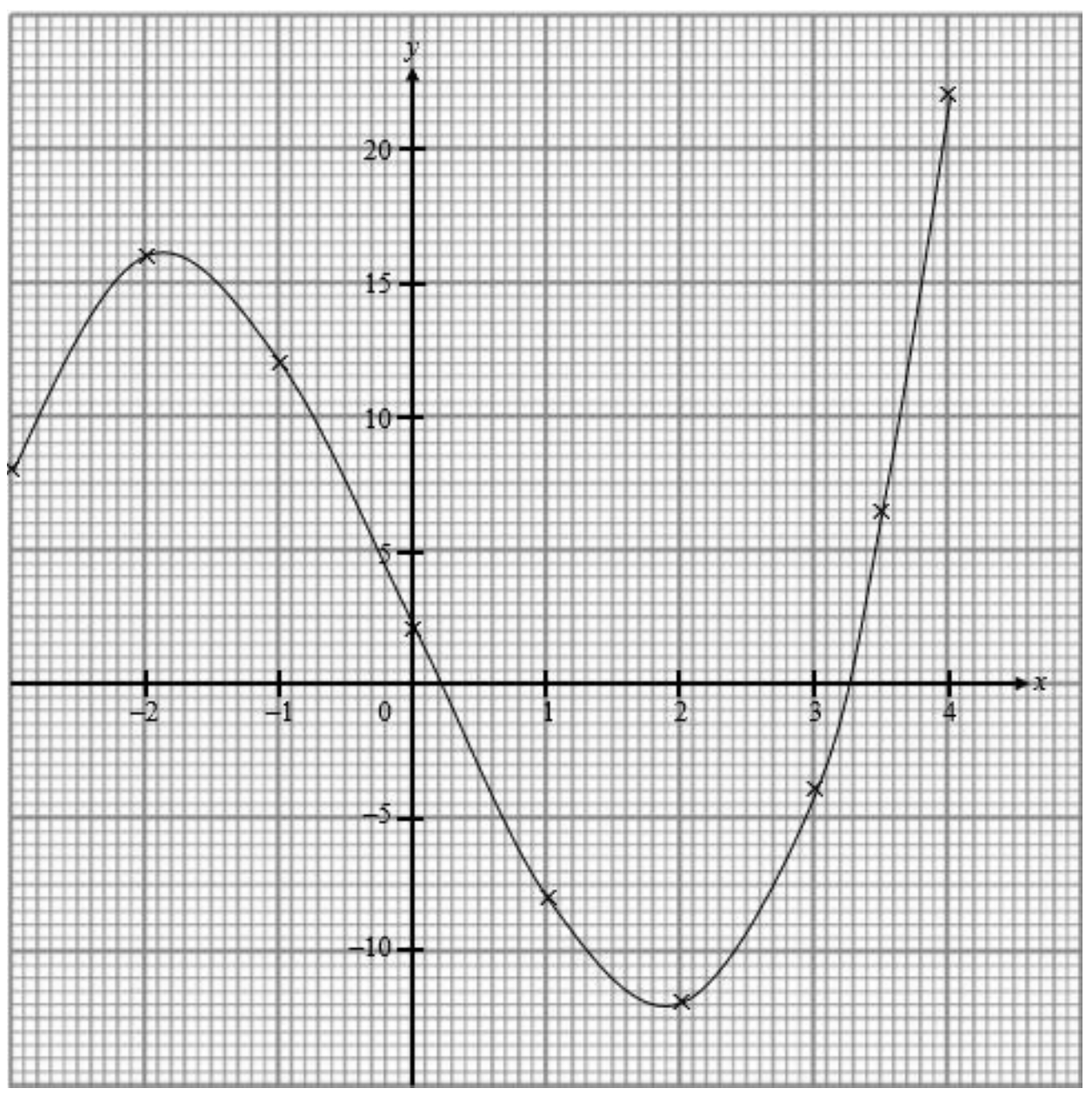
Draw a directed graph to represent the roads that connect a few cities. Hence determine the number of degrees of the graph. E = {(K, L), (L, M), (M, N), (M, O), (N, P), (P, Q)}. Vertices K, L, M, N, O, P, Q are given in Diagram 8.
Medium3 marks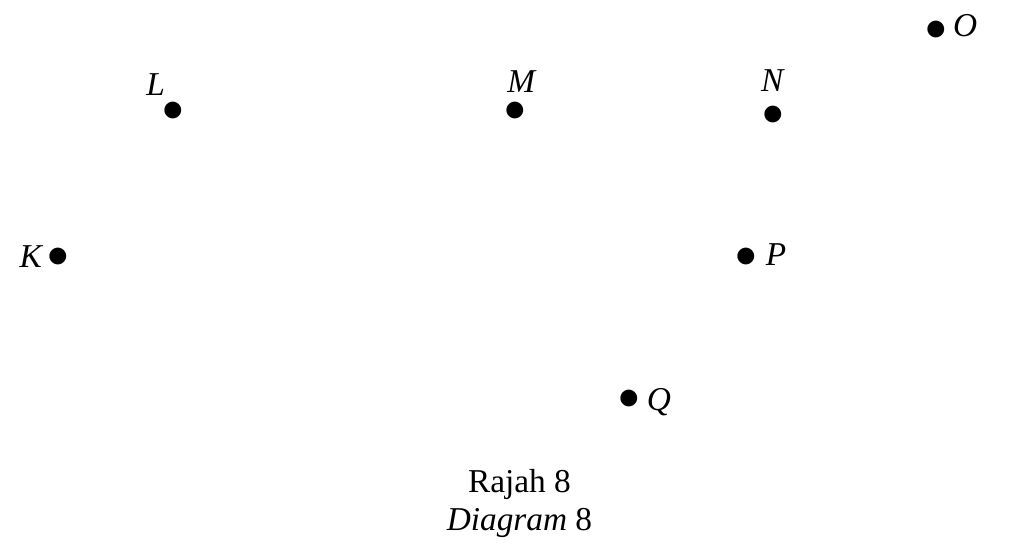
Draw the directed graph and determine the number of degrees.
[3]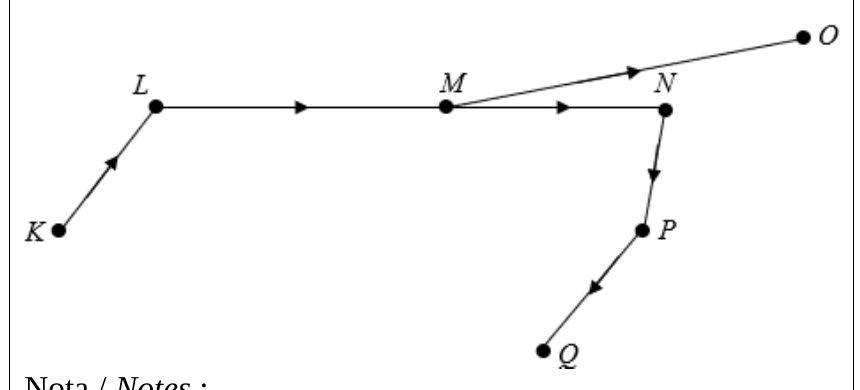
Diagram 9 shows an incomplete tree diagram for watches produced by the Rolax factory. Two watches are selected at random. The probability that a watch is not working, J, is 3/14. (a) Complete the tree diagram. (b) Calculate the probability that (i) at least one watch is not working, (ii) both watches are working.
Medium5 marks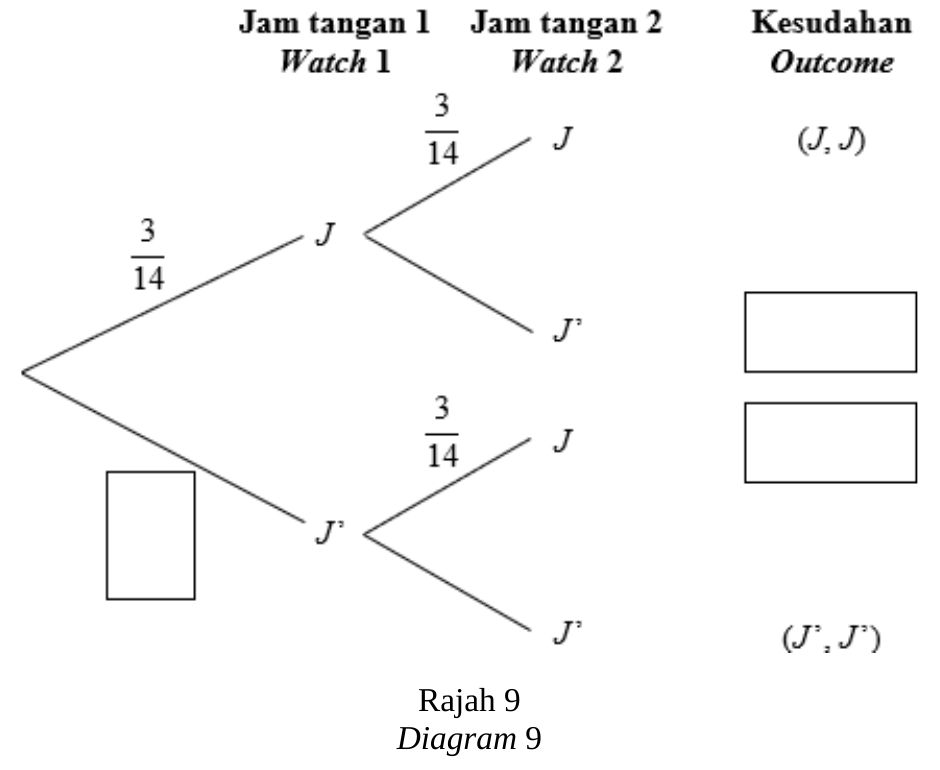
- (a)
Complete the tree diagram in Diagram 9.
[2]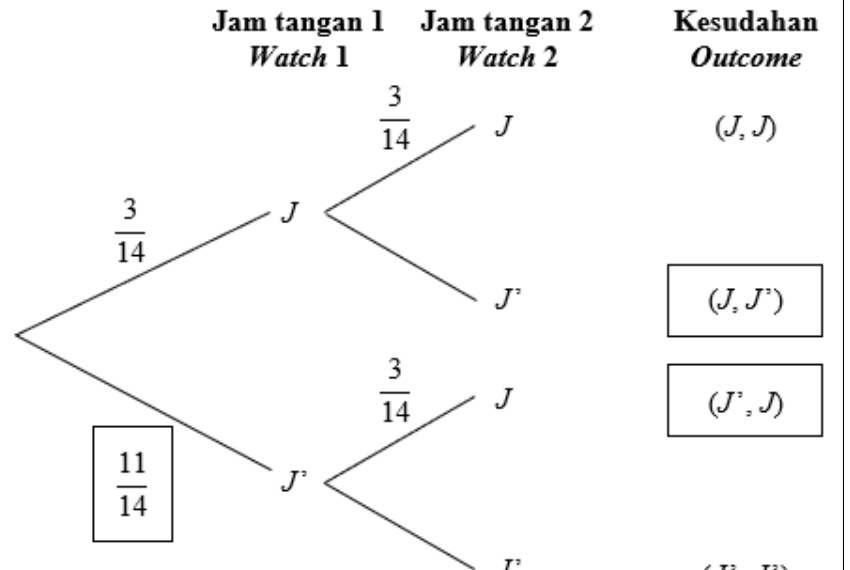
- (b)(i)
Calculate the probability that at least one watch is not working.
[2] - (b)(ii)
Calculate the probability that both watches are working.
[1]
Diagram 10 shows a distance-time graph (distance in km, time in minutes) of a car. OABC is the car's journey from Penang to Ipoh and CD is the journey home (O(0,0), A(30,160), B(60,160), C(120,180), D(240,0)). (a) State the period of time, in minutes, the car stops at the Rest and Relaxation Area. (b) Calculate the average speed, in km h⁻¹, of the whole journey. Hence describe the movement of the car.
Medium4 marks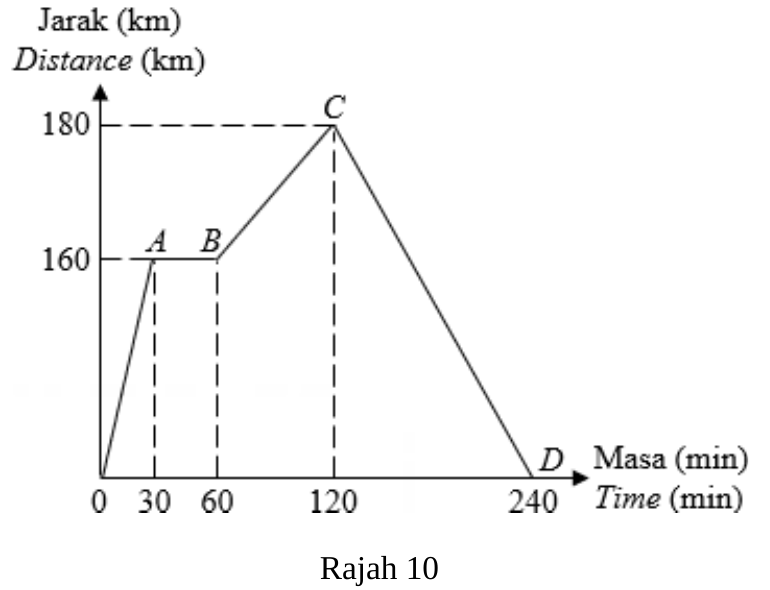
- (a)
State the period of time the car stops at the Rest and Relaxation Area.
[1] - (b)
Calculate the average speed of the whole journey in km h⁻¹ and describe the movement.
[3]
Diagram 11 shows six spherical marbles arranged horizontally in one straight line. The volume of each marble is 179 2/3 cm³. Calculate the horizontal length, in cm, of the six marbles. (Use π = 22/7)
Medium3 marks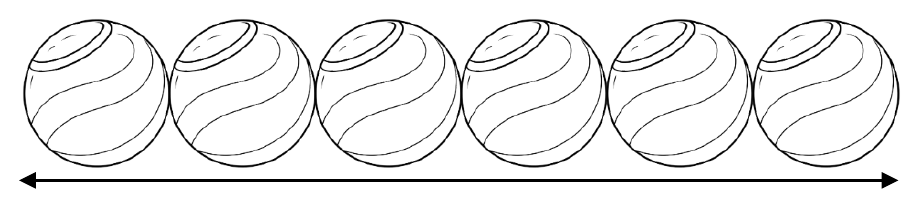
Calculate the horizontal length of six marbles.
[3]
Section B
(a) Diagram 12 shows point S(4, 2) on a Cartesian plane. T is a translation (–4, 2) [column vector –4 over 2]. R is a reflection in the line y = 4. P is a clockwise rotation of 90° about the centre (6, 3). State the image coordinates of S under (i) R, (ii) PT. (b) Diagram 13 shows pentagons ABCDE, APQRS and GHIJK. (i) GHIJK is the image of ABCDE under the combined transformation ST. Describe in full (a) T, (b) S. (ii) Pentagon ABCDE represents a region of area 290 m². Calculate the area, in m², of the shaded region.
Medium11 marks- (a)(i)
State the image of S under R.
[1]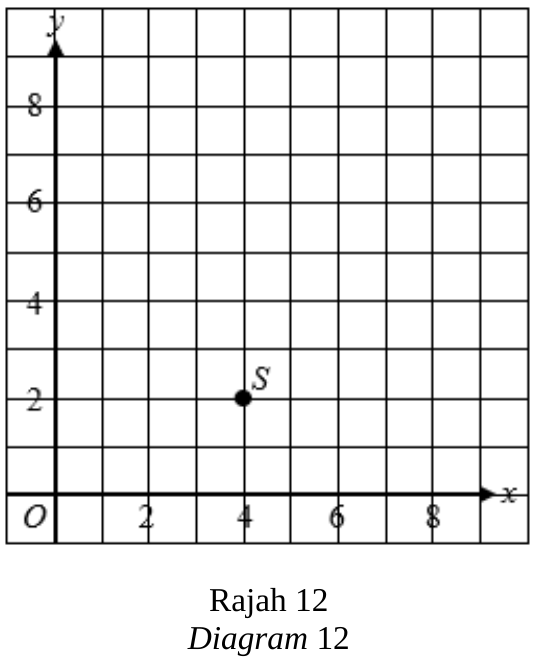
- (a)(ii)
State the image of S under PT.
[2] - (b)(i)(a)
Describe in full the transformation T.
[3]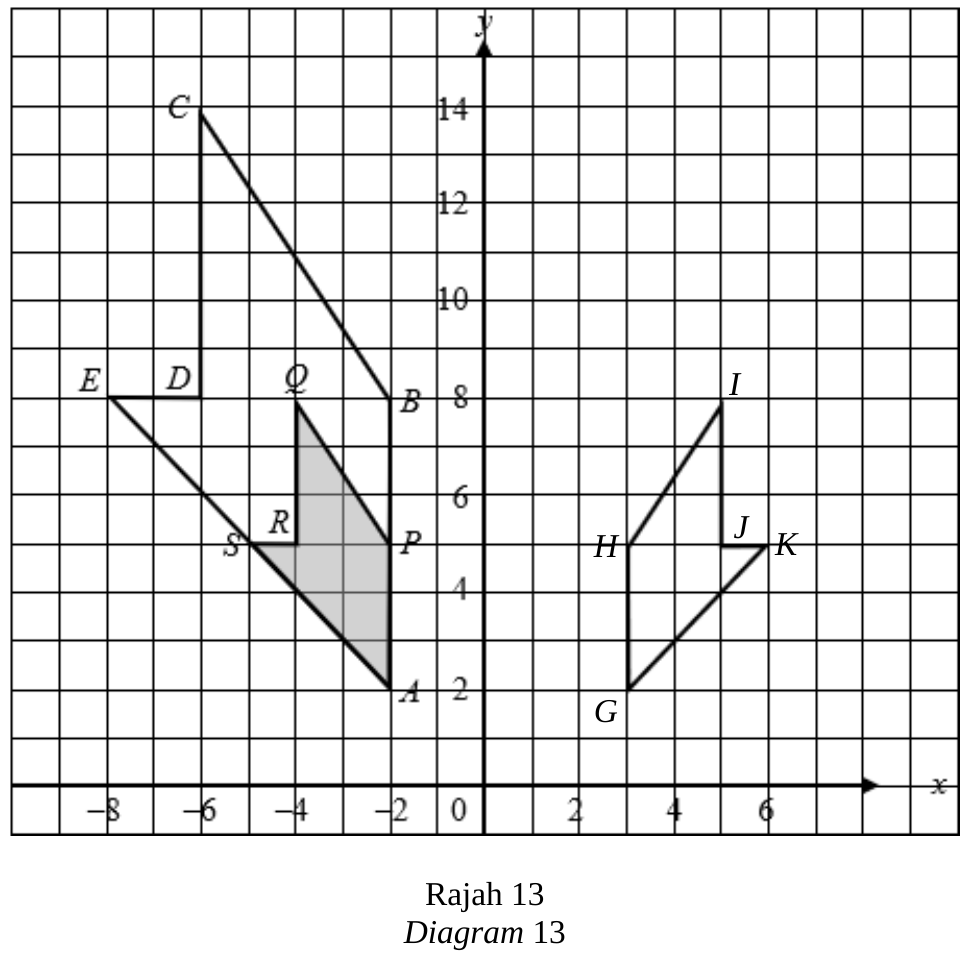
- (b)(i)(b)
Describe in full the transformation S.
[2] - (b)(ii)
Calculate the area of the shaded region.
[3]
(a) Puan Hannah owns land measuring 11 m × 23.5 m. The land tax rate is RM 0.40 per square metre. Calculate the land tax she must pay each year. (b) The annual value of her house was RM 30 000 in 2024 and the property assessment tax rate was 6%. Calculate the property assessment tax. (c) She used 750 kWh of electricity in December. Usage exceeding 600 kWh a month is subject to 6% service tax. Table 2 shows the bill (tariff block 200 kWh, prorate 200, rate 0.218, RM 43.60; 100, 100, 0.334, RM 33.40; 300, 300, 0.516, RM 154.80; 300, 150, 0.546, x). Calculate (i) the value of x, (ii) the total payment not subject to service tax, (iii) the service tax imposed on the December bill.
Medium7 marks- (a)
Calculate the land tax per year.
[2] - (b)
Calculate the property assessment tax.
[2] - (c)(i)
Calculate the value of x.
[1]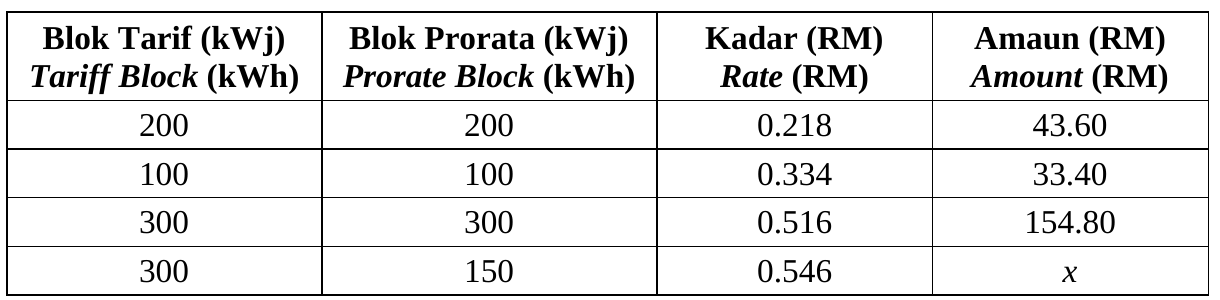
- (c)(ii)
Calculate the total payment not subject to service tax.
[1] - (c)(iii)
Calculate the service tax imposed.
[1]
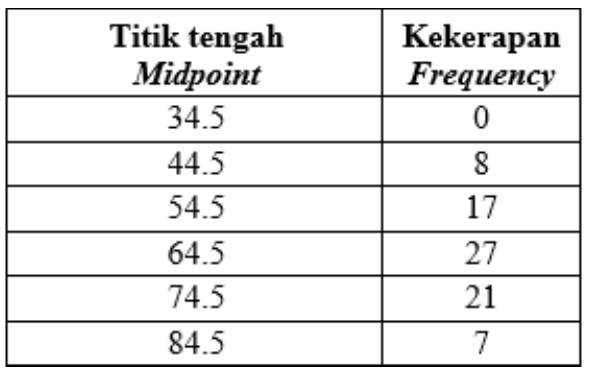
Diagram 14 shows an ogive of the distribution of mass, in kg, of 80 students in class 5 Walid. (a) Based on the ogive, find (i) the 15th percentile, P15, (ii) the third quartile. (b) Complete Table 3 (columns: mass; upper boundary; midpoint; frequency) for the classes 30–39, 40–49, 50–59, 60–69, 70–79, 80–89. (c) (i) Using a scale of 2 cm to 10 kg on the horizontal axis and 2 cm to 5 students on the vertical axis, draw a histogram for Table 3. (ii) State the shape of the distribution of the histogram.
Medium9 marks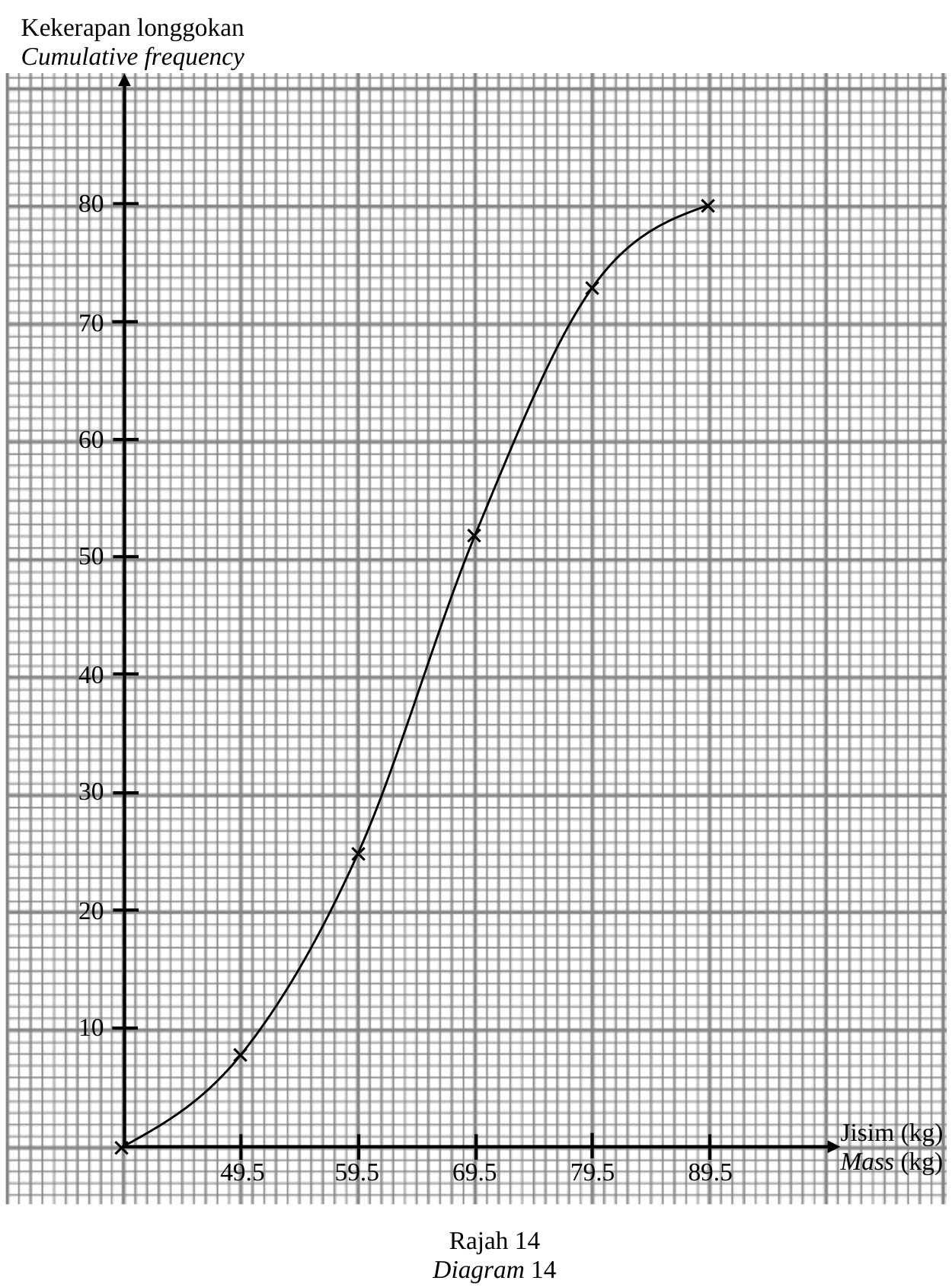
- (a)(i)
Find the 15th percentile, P15.
[1] - (a)(ii)
Find the third quartile.
[1] - (b)
Complete Table 3 (midpoint and frequency).
[2]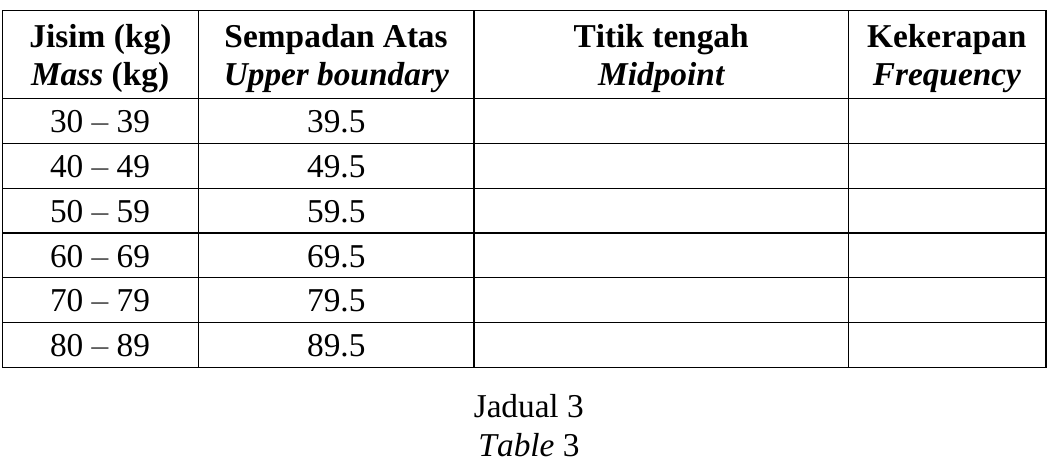
- (c)(i)
Draw the histogram for Table 3 with the given scales.
[4]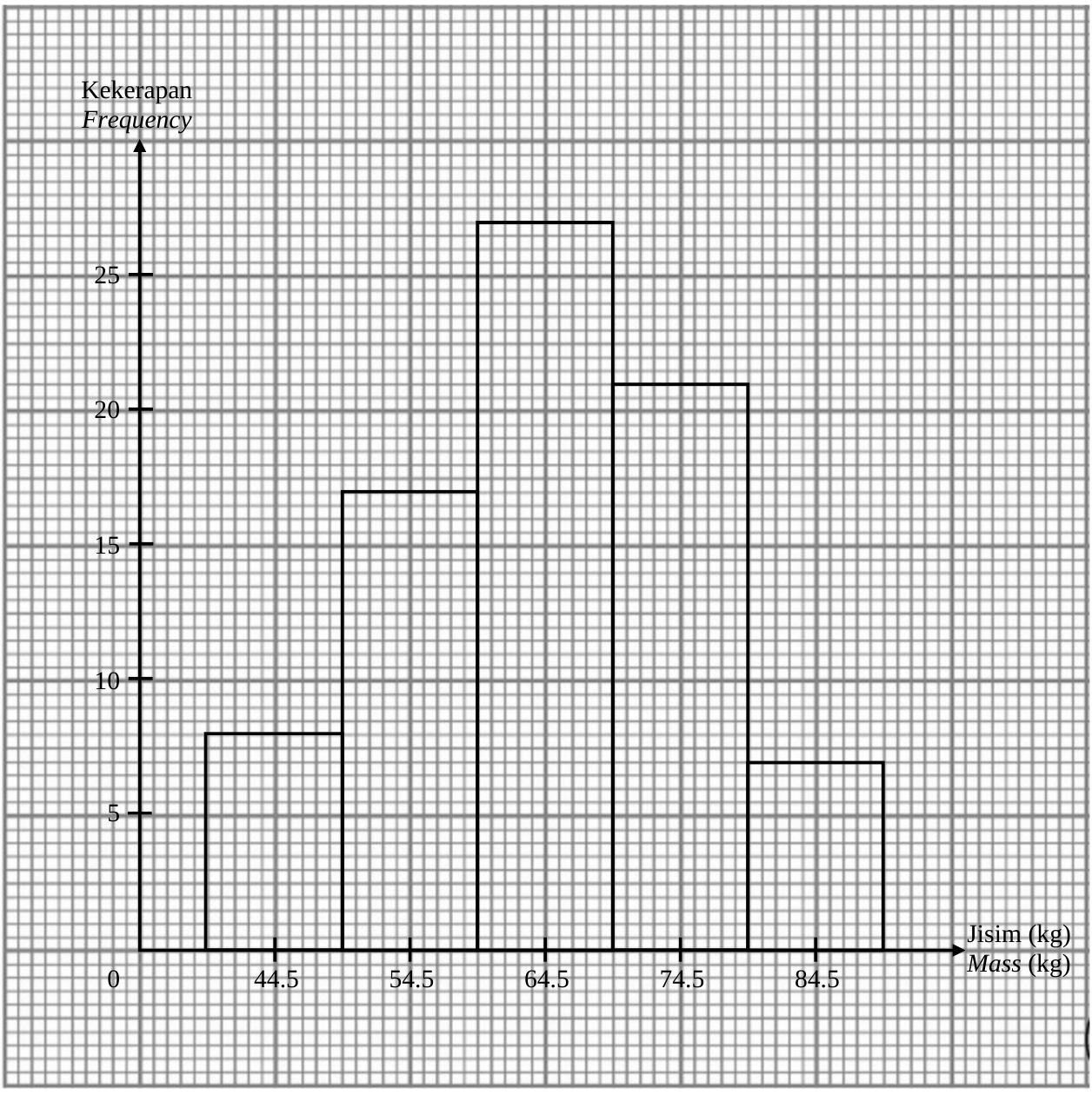
- (c)(ii)
State the shape of the distribution.
[1]
On Cooperative Day the STEM Club sells x souvenirs A and y souvenirs B, with profits of RM 4 and RM 5 each. The number of A sold is at least equal to the number of B sold. The total number of A and B sold is at most 15. The club wants a minimum profit of RM 40. Table 4: (i) x ≥ y; (ii) x + y ≤ 15; (iii) the minimum profit is RM 40. (a) (i) Write a condition that represents linear inequality (ii). (ii) Write a linear inequality that represents condition (iii). (b) On Diagram 15 (lines y = x and 4x + 5y = 40 are drawn), complete the graph for the linear inequalities and shade the region. (c) From the graph, determine the minimum number of souvenirs A that can be sold if 6 souvenirs B have been sold. (d) If 5 souvenirs A are sold, calculate the maximum profit.
Medium7 marks- (a)(i)
Write a condition that represents x + y ≤ 15.
[1] - (a)(ii)
Write a linear inequality for condition (iii).
[1] - (b)
Complete the graph and shade the region.
[2]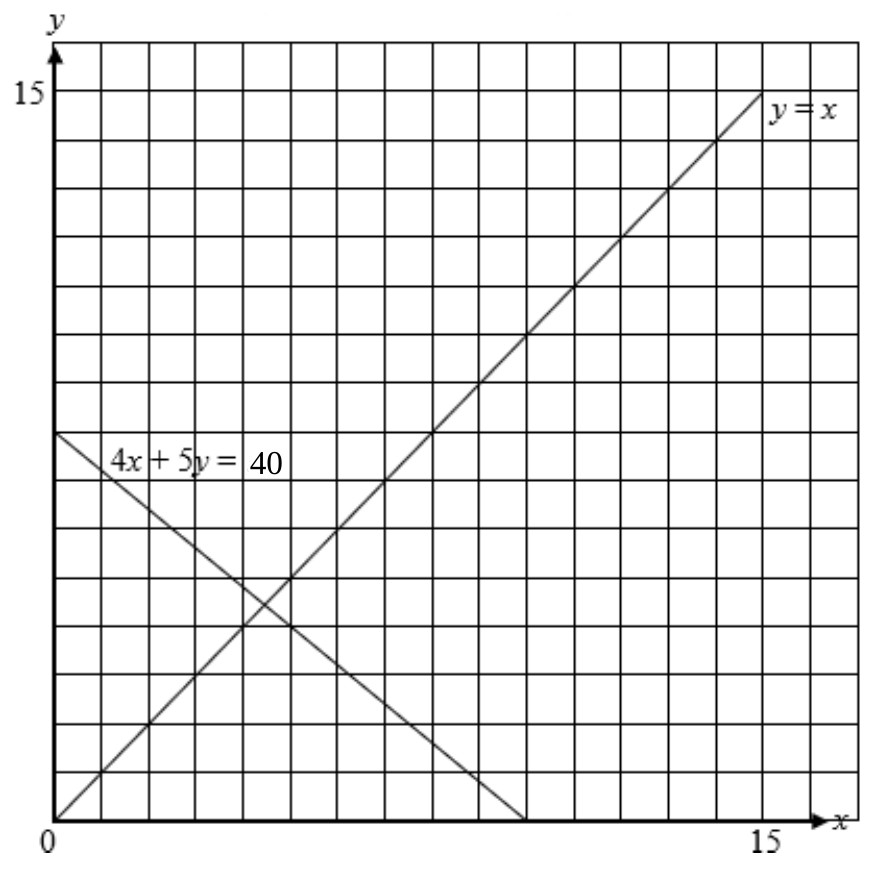
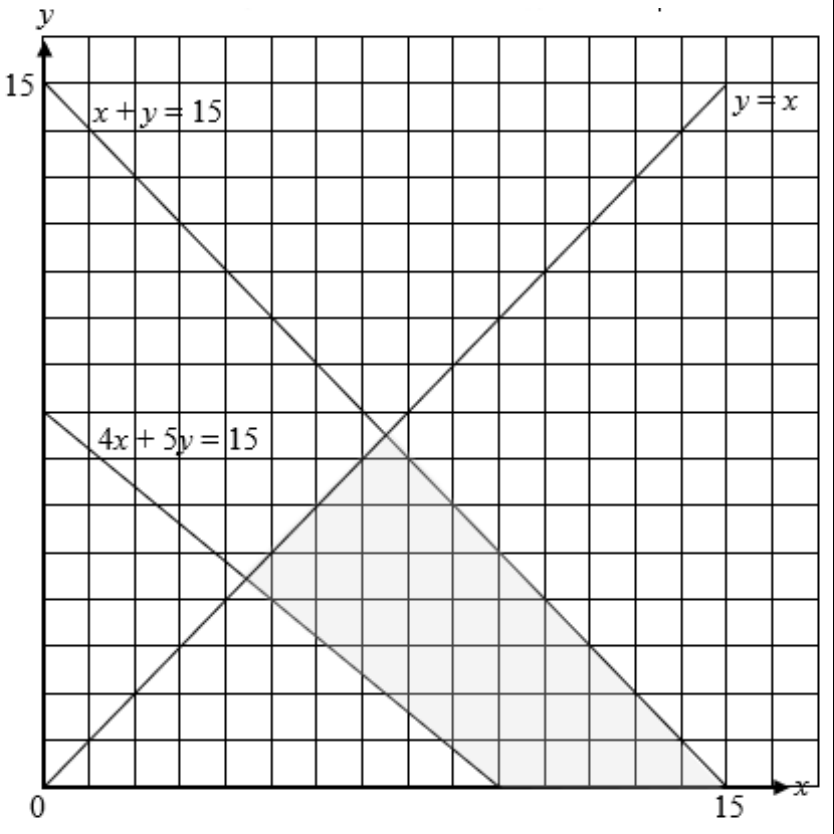
- (c)
Minimum number of souvenirs A if 6 souvenirs B are sold.
[1] - (d)
Maximum profit if 5 souvenirs A are sold.
[2]
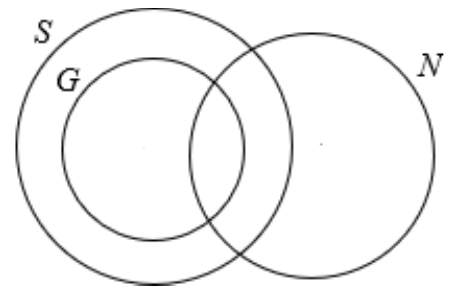
(a) A study of 100 farms in a district. Diagram 16 (Venn diagram with ξ = G ∪ N ∪ S, G ⊂ S): G only 48; G ∩ N 3x; S only 2x; S ∩ N only 16; N only x + 12. (i) Farms that grow only pineapples get a fertiliser voucher. Shade the region on the Venn diagram in Diagram 17. (ii) State, in terms of x, the number of farms that grow oil palm and rubber. (iii) Calculate x and hence the number of farms that do not grow pineapples. (b) Table 5: set X = prime numbers less than 15, set Y = multiples of 2 less than 11, set Z = factors of 15. (i) List X, Y and Z using set notation. (ii) Hence determine the number of subsets of Z.
Medium11 marks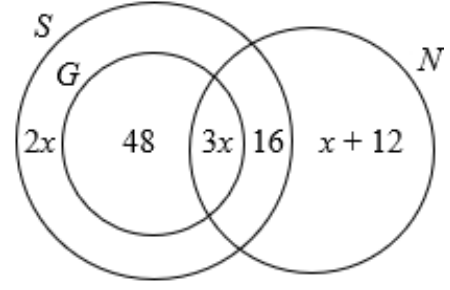
- (a)(i)
Shade the region for farms with only pineapples.
[1]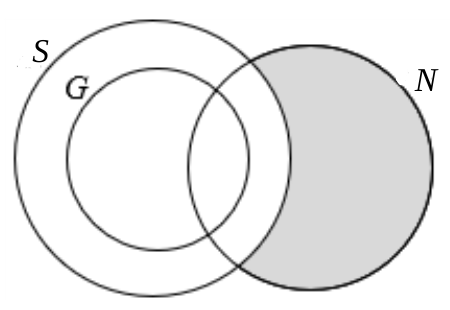
- (a)(ii)
Number of farms that grow oil palm and rubber in terms of x.
[1] - (a)(iii)
Calculate x and the number of farms that do not grow pineapples.
[4] - (b)(i)
List sets X, Y and Z.
[3] - (b)(ii)
Number of subsets of Z.
[2]
Section C
(a) Table 6 shows Photography Club members: Form 3: 10 boys, 10 girls; Form 4: 12 boys, 8 girls; Form 5: 5 boys, 15 girls. (i) State the ratio of boys to girls. (ii) A student is randomly selected from the boys' group. Find the probability the student is a Form 5 boy. (b) Table 7 gives marks of class 1 Mawar: 40–44: 3; 45–49: 6; 50–54: m; 55–59: 16; 60–64: 10; 65–69: 4. (i) Given the mean is 55.6, find m. (ii) Hence calculate the variance and standard deviation. (c) A quiz has 25 questions; each correct answer gives x marks and each wrong answer loses y marks. Table 8: Amir 21 correct, 4 wrong, 198 marks; Priya 18 correct, 7 wrong, 159 marks. Construct two simultaneous linear equations and use the matrix method to find x and y. (d) Diagram 18 shows school bag prices in different number bases: brand Q RM 340₅, brand Z RM 341₇. The maximum budget for three bags is RM 345. Determine which bag can be bought. Justify.
Hard15 marks- (a)(i)
State the ratio of the number of boys to the number of girls.
[1]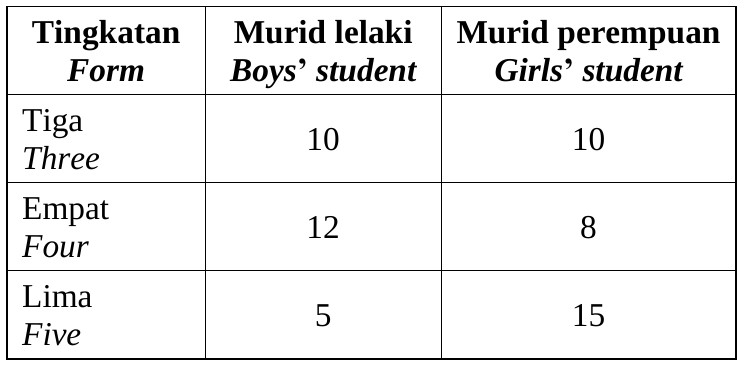
- (a)(ii)
Probability that the selected boy is from Form 5.
[1] - (b)(i)
Find m given the mean is 55.6.
[2]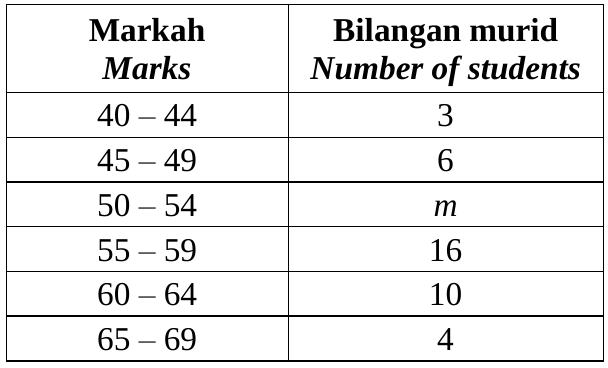
- (b)(ii)
Calculate the variance and standard deviation.
[3] - (c)
Construct two simultaneous equations and solve by the matrix method.
[5]
- (d)
Determine which school bag can be bought and justify.
[3]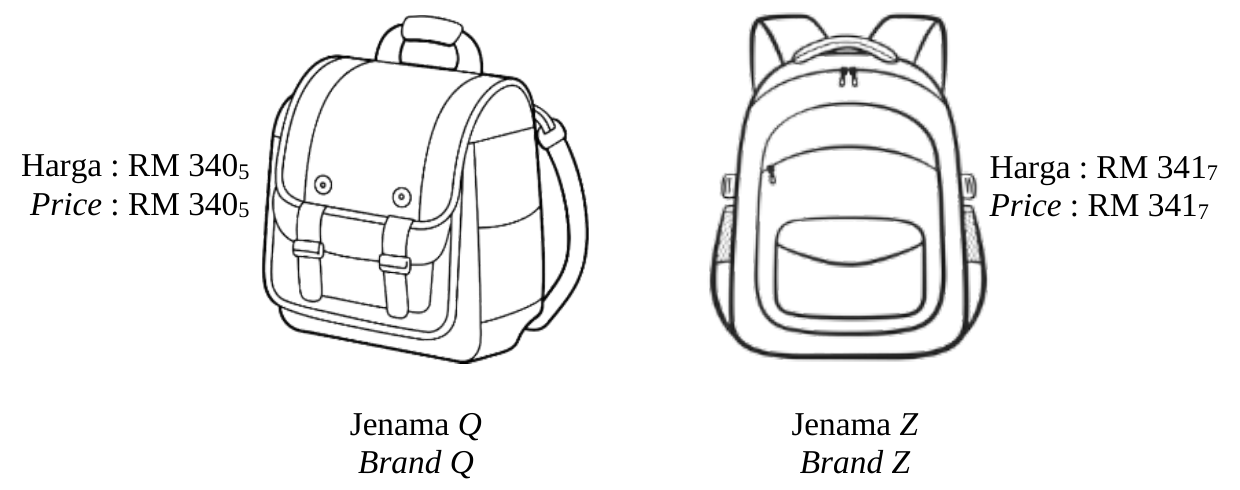
Encik Aiman earns RM 4 100 a month. He saves 10% of his income and RM 200 for an emergency fund. Table 9 gives monthly expenses: housing loan RM 1 200, car loan RM 650, utility bills RM 400, insurance RM 300, groceries RM 700. (a) His goal is a positive cash flow of RM 300 a month. Has he achieved it? Justify and suggest a recommendation if not. (b) Table 10 shows his 2023 annual income statement (basic pay RM 49 200; allowances: attendance RM 1 200, medical RM 3 000, petrol RM 1 800; total income RM 55 200; deductions: KWSP RM 672, insurance RM 4 200, zakat RM 360; total deduction RM 5 232; nett income RM 49 968). He has tax relief of RM 9 000 (individual) and RM 3 600 (child), a year-end bonus of RM 500 and donated RM 200 to the Penang State Public Library Corporation. Using the 2023 tax rate table (Table 11), calculate (i) his chargeable income, (ii) whether he is eligible for a rebate (justify), (iii) his income tax for 2023. (c) Without the matrix method: corn and sugarcane plants total 2 080 in ratio 3 : 5. Calculate the number of each. (d) He wants to buy a Perodua Axia (RM 39 900) for his daughter. Bank Berjaya offers financing up to 90% at 4.25% per annum. Calculate the monthly instalment for a 7-year loan.
Hard15 marks- (a)
Has the goal been achieved? Justify and recommend.
[2]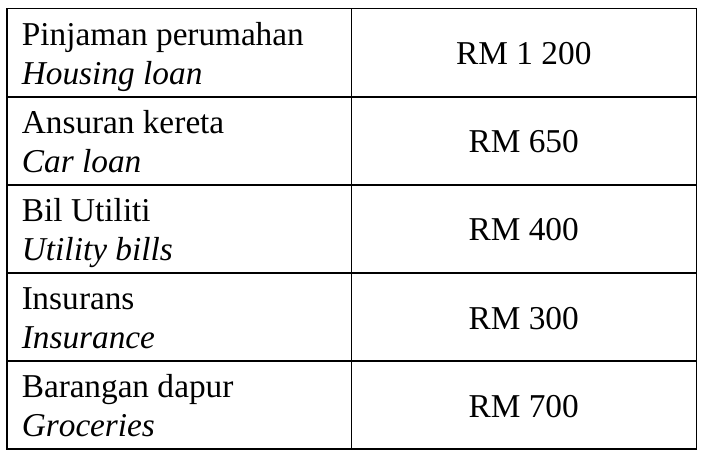
- (b)(i)
Calculate the chargeable income.
[2]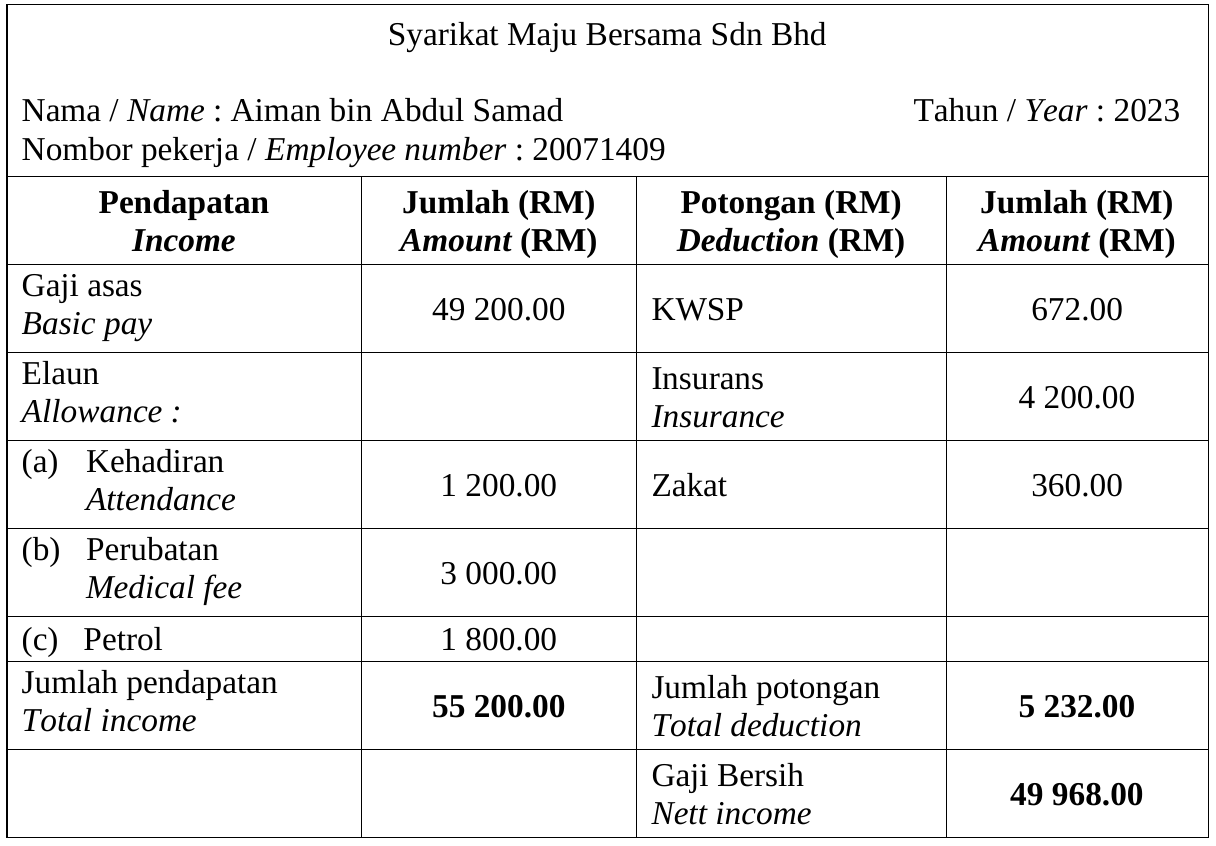
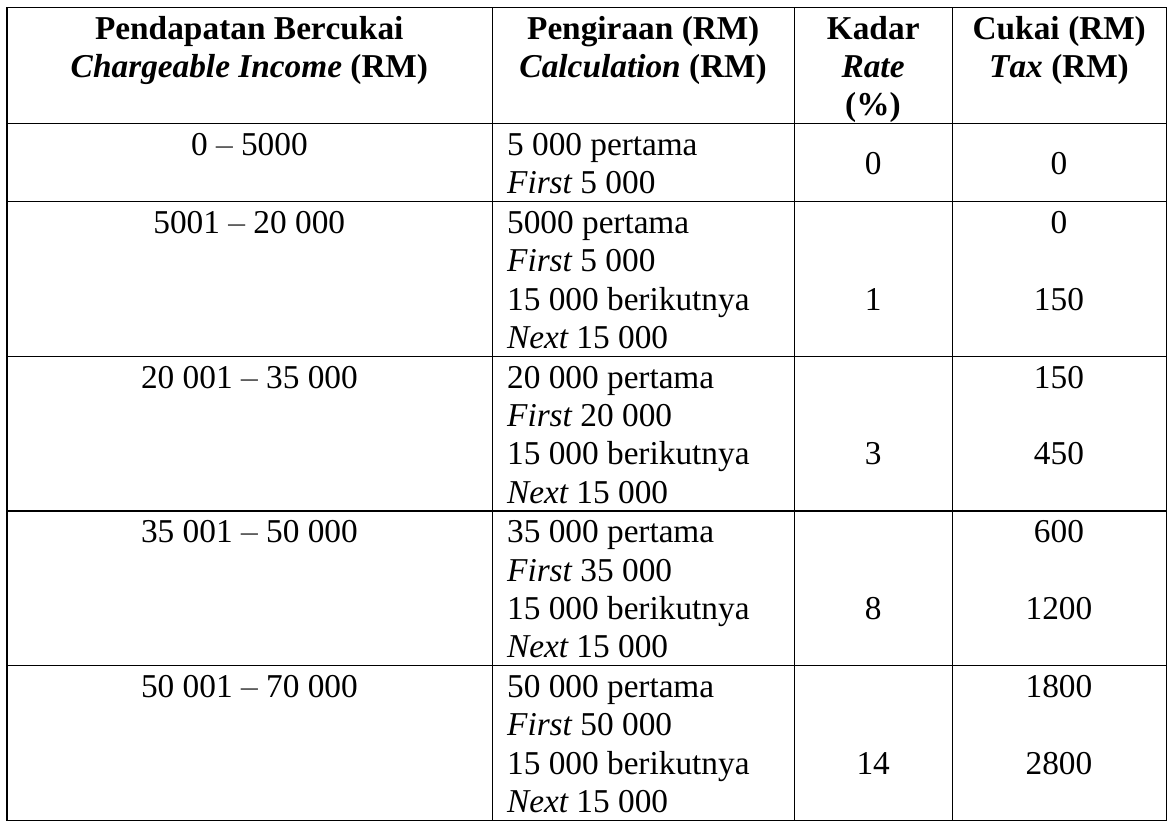
- (b)(ii)
Is he eligible for a rebate? Justify.
[1] - (b)(iii)
Calculate the income tax for 2023.
[3] - (c)
Calculate the number of corn and sugarcane plants (no matrix method).
[4] - (d)
Calculate the monthly instalment for a 7-year loan.
[3]