Write your answer on paper. Then open the answer to check it.
Section A
Write the following simultaneous equation in the form of matrix: x + 3y = 5, 2x − y = −4. Hence, by using matrix method, solve the following simultaneous linear equations.
Medium4 marksWrite in matrix form and solve by the matrix method.
[4]
Given universal set ξ = {x : 0 ≤ x ≤ 15; x is an integer}, set P = {x : x is a prime number}, set Q = {x : x is an even number} and set R = {x : x is a factor of 36}.
Medium4 marks- (a)
List all the elements of set P, set Q and set R using set notation.
[3] - (b)
State n(Q ∪ R′).
[1]
Diagram 1 shows a shaded region that satisfies the systems of linear inequalities (lines through (0, 5) and (8, 0), the line y = x through the origin and the dashed horizontal line through (−3, −3)). State all linear inequalities that satisfy the shaded region given.
Medium4 marks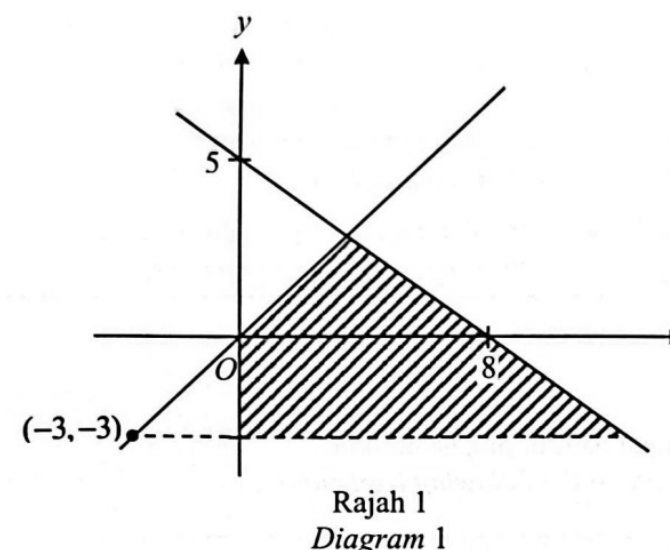
State all linear inequalities that satisfy the shaded region.
[4]
Question on logical reasoning: (a) compound statement using 'or' and its truth value, (b) the inverse of an implication, (c) complete the premise of an argument.
Medium4 marks- (a)
Write a compound statement by combining the following two statements using the word 'or'. Hence, state the truth value of that compound statement. • 125 is a multiple of 5. • 125 is a perfect square number.
[2] - (b)
Write the inverse of the following implication: If 3x ≤ −21, then x ≤ −7.
[1] - (c)
Complete the premise for the following argument. Premise 1: If a regular polygon has 6 sides, then the interior angle of the regular polygon is 120°. Premise 2: ______. Conclusion: Regular polygon M does not have 6 sides.
[1]
Table 1 shows the road tax rates for private cars in Peninsular Malaysia (base rate and progressive rate by engine capacity).
Medium4 marks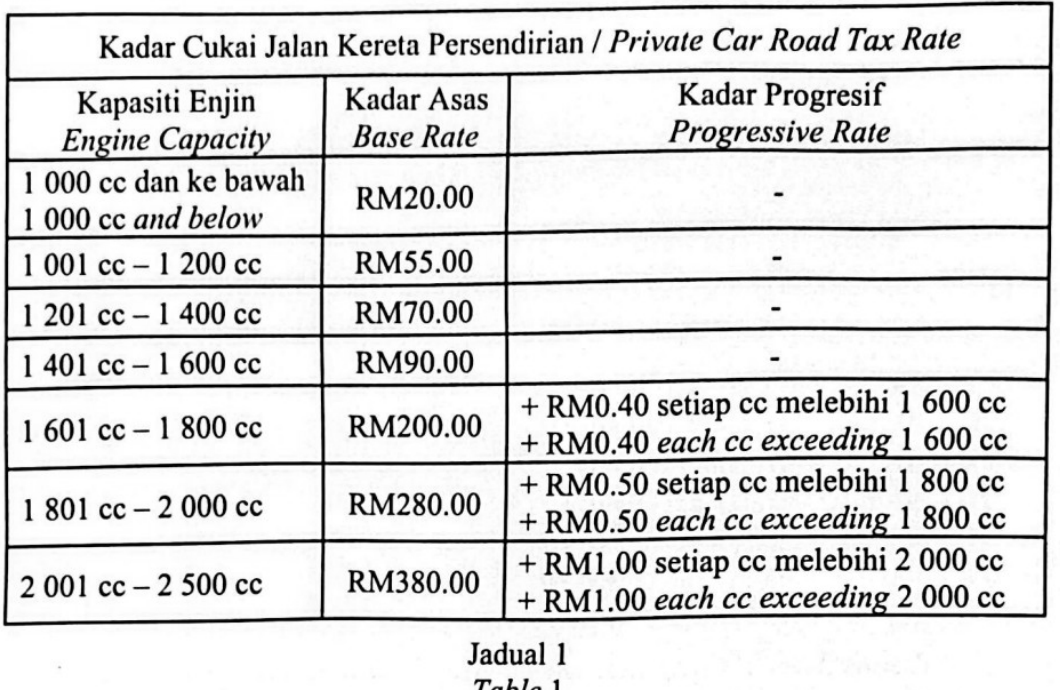
- (a)
Encik Haikal needs to pay road tax for two cars with an engine capacity of 1 000 cc and 2 400 cc. Calculate the total road tax for both of his cars.
[3] - (b)
Encik Haikal plans to buy a new car. He allocates RM150 to pay for the road tax of the car. What is the maximum possible engine capacity for Encik Haikal's new car?
[1]
Solving using matrix method is not allowed in this question. Diagram 2 shows a sketch of the intersection between road PR and road QS on a Cartesian plane. A water fountain is located at the centre of the roundabout at the junction of road PR and road QS. Given that the equations of the straight lines for road PR and road QS are y = −x + 3 and 2y = 3x + 1 respectively which intersect at point T. Determine the coordinates of T.
Medium4 marks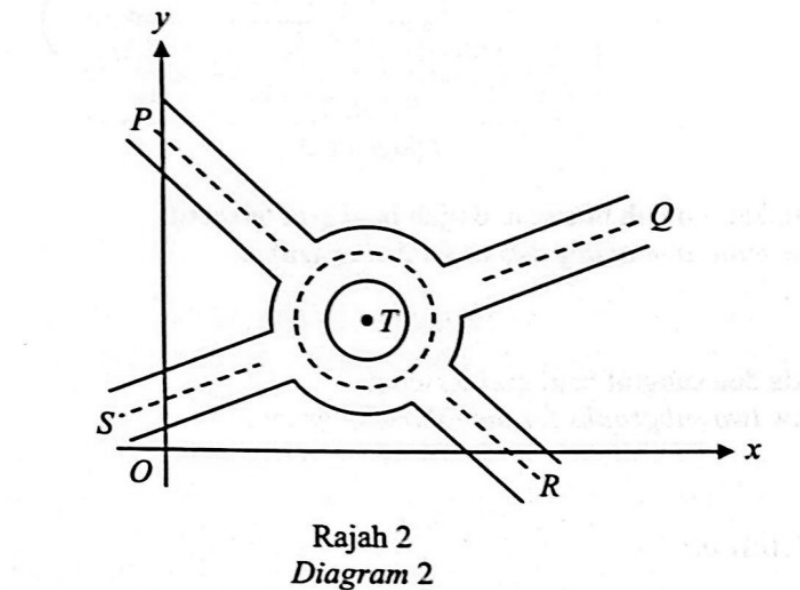
Determine the coordinates of T.
[4]
Diagram 3 shows an undirected graph (vertices P, Q, R, S; a double edge between P and Q, edge QR, edge RS and a loop at R).
Medium4 marks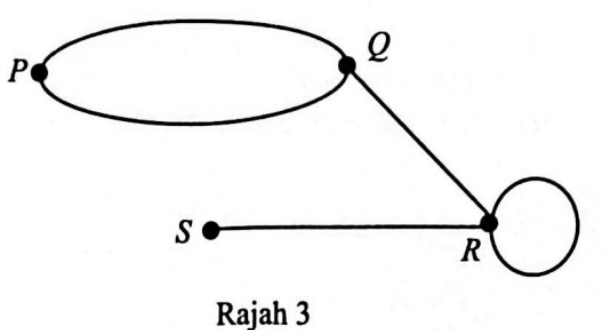
- (a)
Determine sum of degrees of following graph.
[2] - (b)
Draw two subgraphs for the following graph.
[2]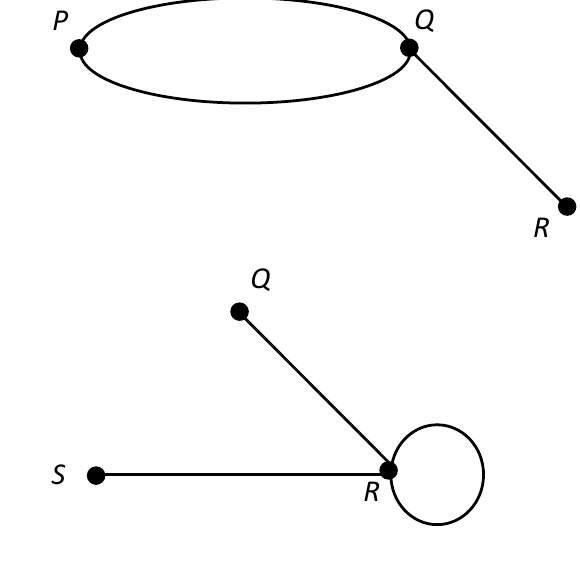
Diagram 4 shows a rectangular carpet with length (5x − 10) m and width (x + 5) m. Given the area of the carpet is 600 m², calculate the value of x.
Medium4 marks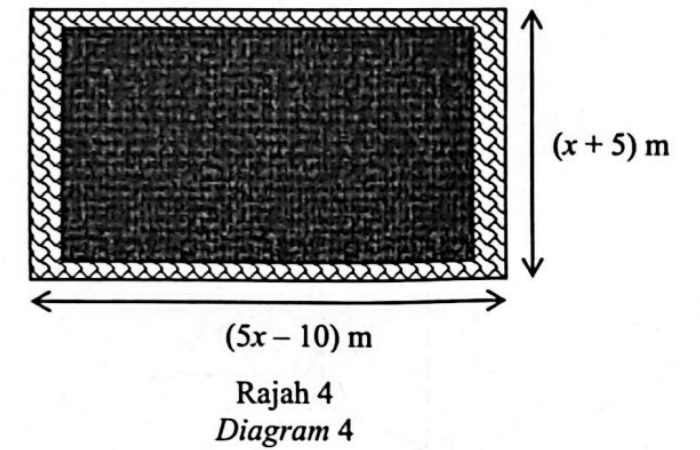
Calculate the value of x.
[4]
Diagram 5 shows a composite solid formed by joining a right prism and a half-cylinder lies on a horizontal plane. EFG is the uniform cross section of the prism (EF = 16 cm, FG = 14 cm, prism length 6 cm). It is given that the volume of the solid is 1 288 cm³. Calculate the height, in cm, of QR. (Use π = 22/7)
Medium4 marks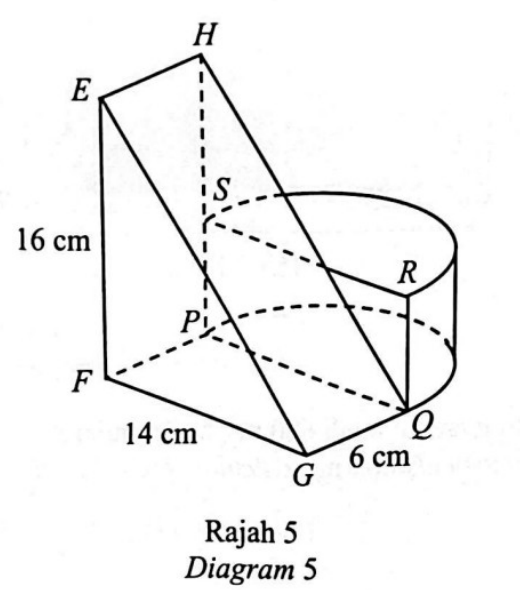
Calculate the height, in cm, of QR.
[4]
Hafizah works as a teacher. She earns an income of RM3 580 per month. Other than that, she conducts tuition classes as part-time and receives RM820 per month. She allocates 20% of her total monthly income as fixed savings. Table 2 shows Hafizah's expenses for the month of June (House rent RM600; Car instalment RM740; Groceries RM450; Utility RM350; Entertainment RM725; Toll and petrol RM550).
Medium4 marks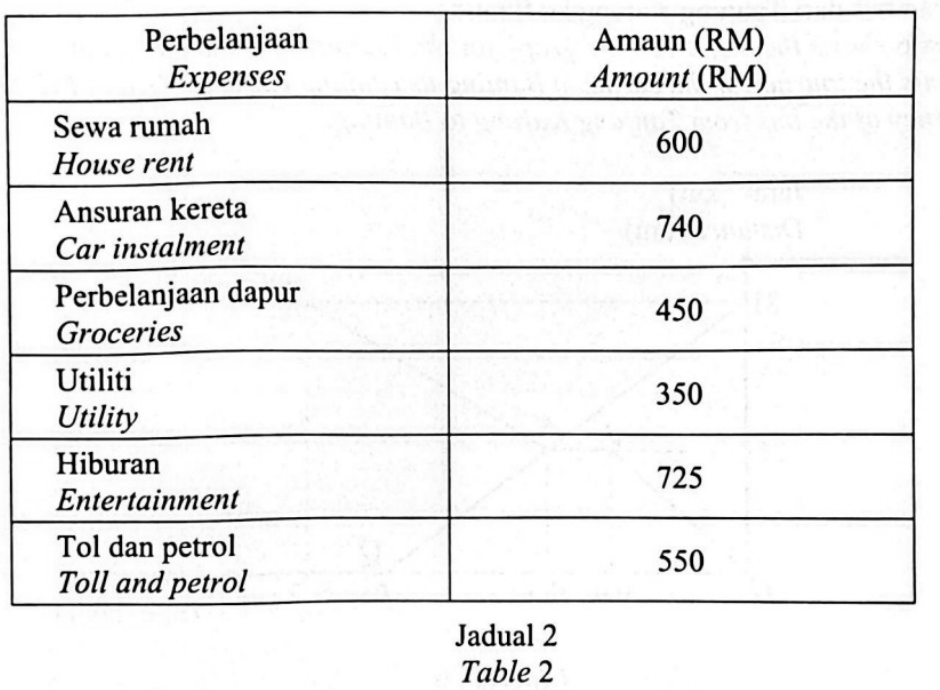
- (a)
Calculate Hafizah's cash flow.
[3] - (b)
If Hafizah's cash flow is negative, suggest one step she can take to manage her finances more effectively.
[1]
Section B
Diagram 6 shows the distance-time graph for the journey of a bus and a car. Graph OJKL represents the journey of the car from Banting to Tanjung Karang. Graph PKQ represents the journey of the bus from Tanjung Karang to Banting.
Medium9 marks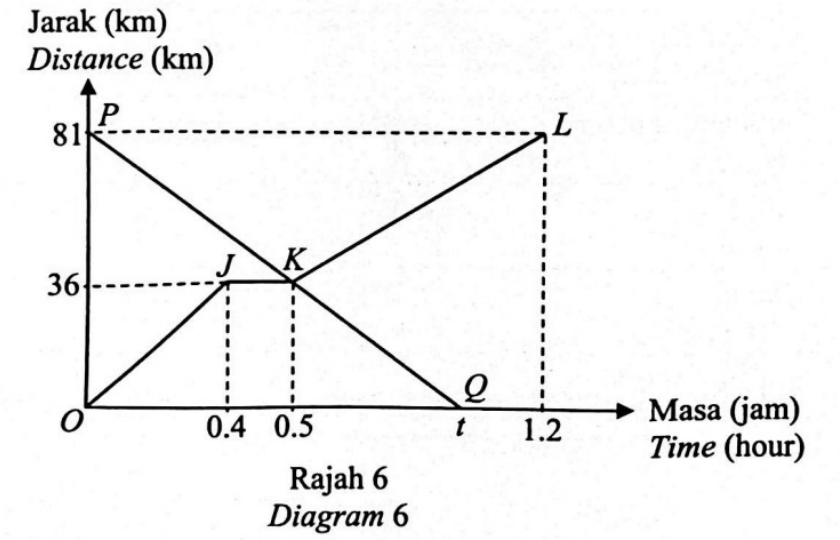
- (a)(i)
Calculate the rate of change in distance, in km h⁻¹, of the bus for the first 30 minutes.
[2] - (a)(ii)
Calculate the value of t.
[2] - (b)(i)
Calculate the speed of the car, in km h⁻¹, for the last 0.7 hour.
[2] - (b)(ii)
Describe motion of the car from K to L.
[3]
Diagram 7 shows three quadrilaterals, EFGH, RSTU and KLMN, drawn on a Cartesian plane. Part (b) refers to triangle PQR in Diagram 8.
Medium9 marks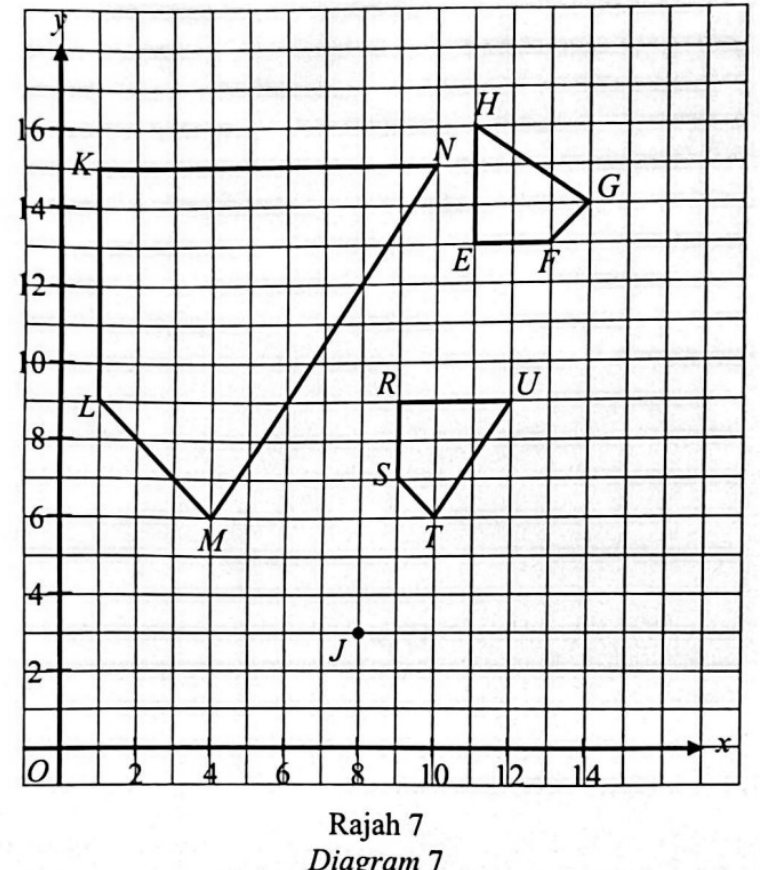
- (a)(i)
State the coordinate of the image of point J under reflection in the line y = 6.
[1] - (a)(ii)(a)
KLMN is the image of EFGH under the combined transformation PQ. Describe in full the transformation Q.
[3] - (a)(ii)(b)
KLMN is the image of EFGH under the combined transformation PQ. Describe in full the transformation P.
[3] - (b)
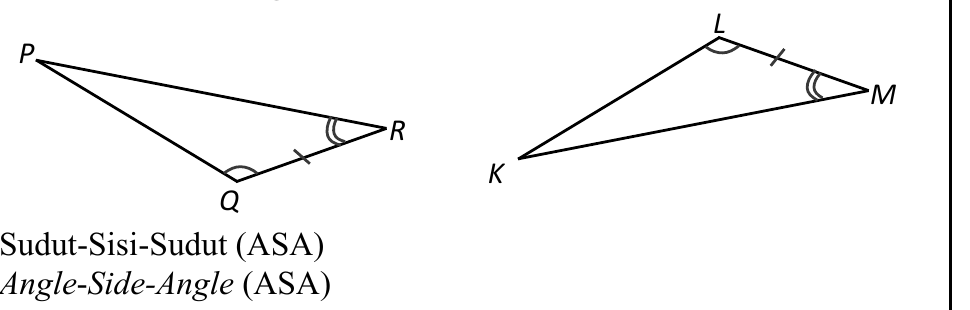
Diagram 8 shows a triangle, PQR. Given another triangle KLM has the same shape and size as the triangle PQR. Label and state the triangle congruence rule used to determine if both triangles are congruent if ∠PQR = ∠KLM, ∠PRQ = ∠KML, QR = LM.
[2]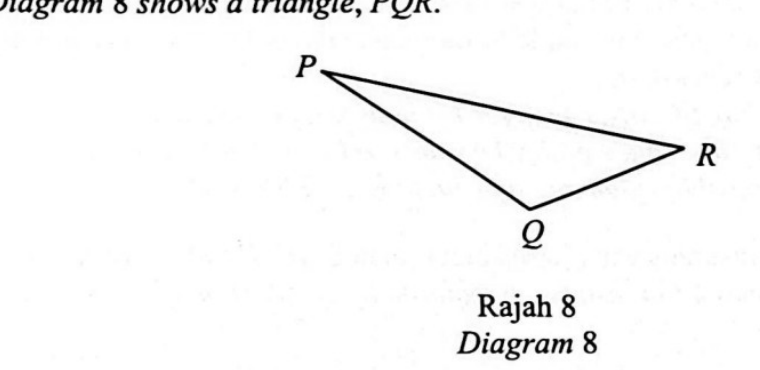
Encik Han wants to buy fire insurance for his house. The insurable value of the house is RM520 000. The fire insurance policy he wants to buy has a co-insurance provision to insure 90% of its insurable value and a deductible of RM4 000.
Medium9 marks- (a)
Calculate the amount of insurance required by Encik Han for the house.
[1] - (b)(i)
Encik Han's house caught on fire and the amount of loss is RM150 000. Calculate the amount of compensation that Encik Han will receive if he insures his house at the amount of required insurance.
[2] - (b)(ii)
Calculate the amount of compensation that Encik Han will receive if he insures his house at a sum of RM400 000. Hence, calculate the co-insurance penalty.
[4] - (c)
Encik Han's house suffered a total loss. If he insured his house at a sum of RM200 000, calculate the amount compensation he will receive.
[2]
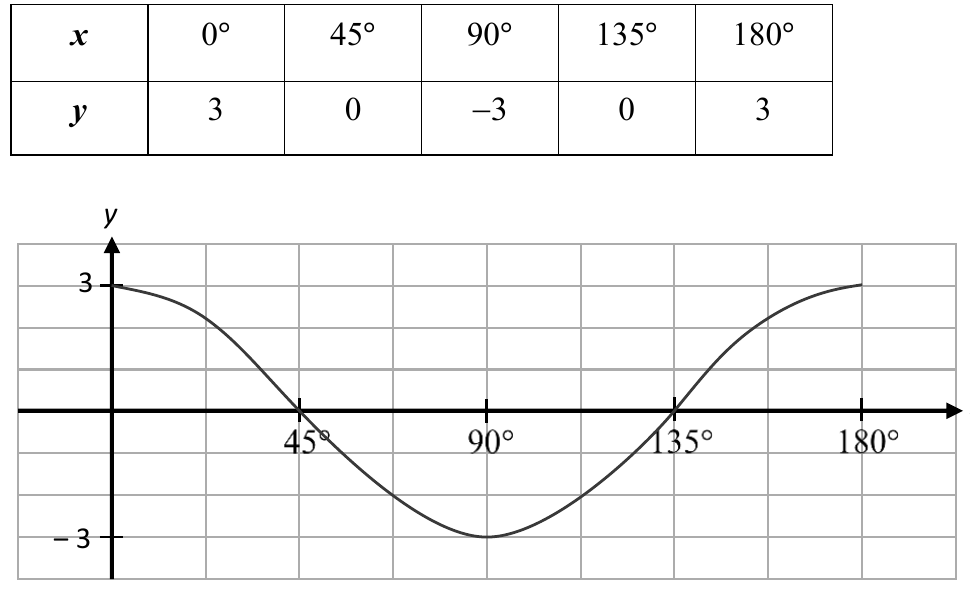
Trigonometric functions: (a) complete a table and sketch y = 3 cos 2x for 0° ≤ x ≤ 180°, (b) state the period of y = tan 3x − 1, (c) Diagram 9 shows a graph of y = a sin bx + c for 0° ≤ x ≤ 180°.
Medium9 marks- (a)
Complete the table in the answer space (x = 0°, 45°, 90°, 135°, 180°) and sketch a graph y = 3 cos 2x for 0° ≤ x ≤ 180°.
[4]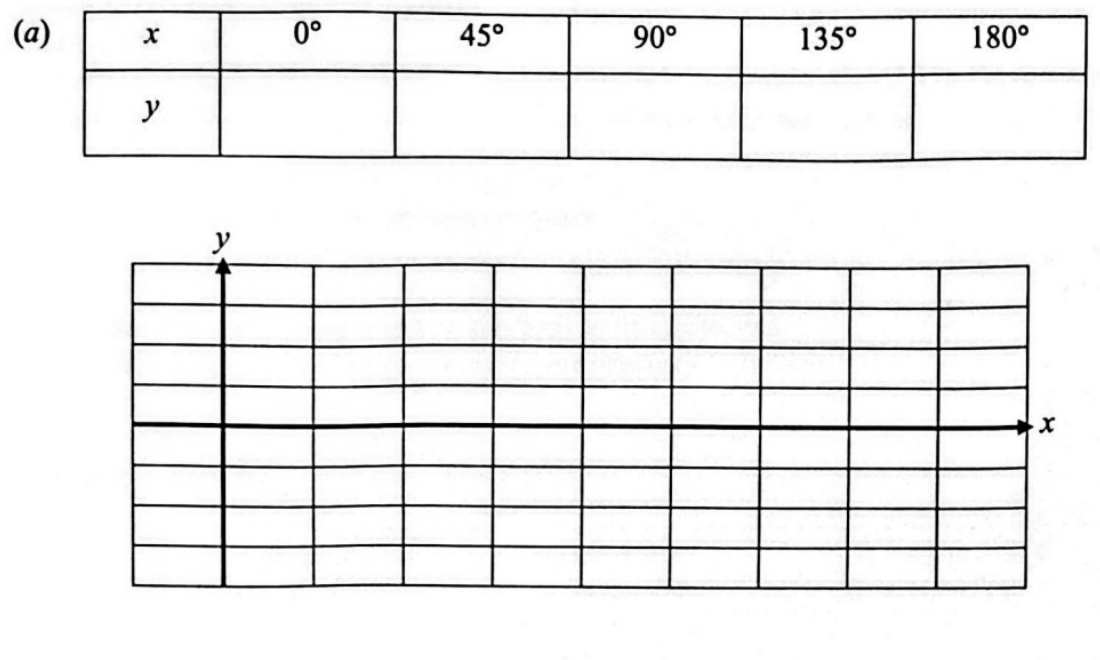
- (b)
State the period for trigonometric function y = tan 3x − 1.
[2] - (c)
Diagram 9 shows a graph of y = a sin bx + c for 0° ≤ x ≤ 180° (maximum 2, minimum −4, y-intercept −1, crossing 90°). State the value of a, b and c from the graph.
[3]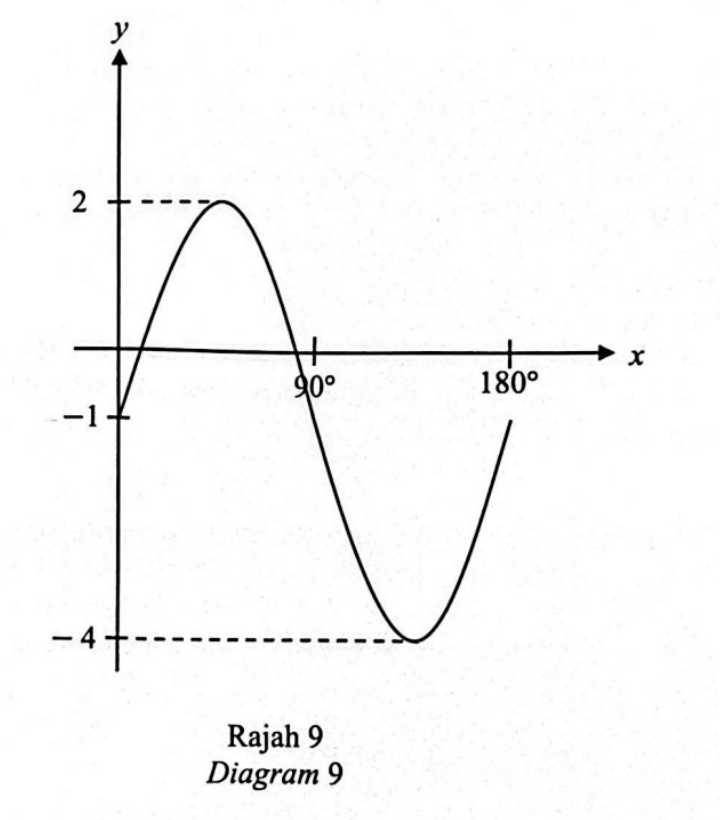
A total of 30 pupils from 5 Berlian took the Mathematics quiz. Table 3 in the answer space shows an incomplete frequency table for the Mathematics quiz scores (class 40–49 has 3 pupils; the other classes have 5, 6, 9, 5, 2 pupils).
Medium9 marks- (a)
Complete Table 3 in the answer space.
[2]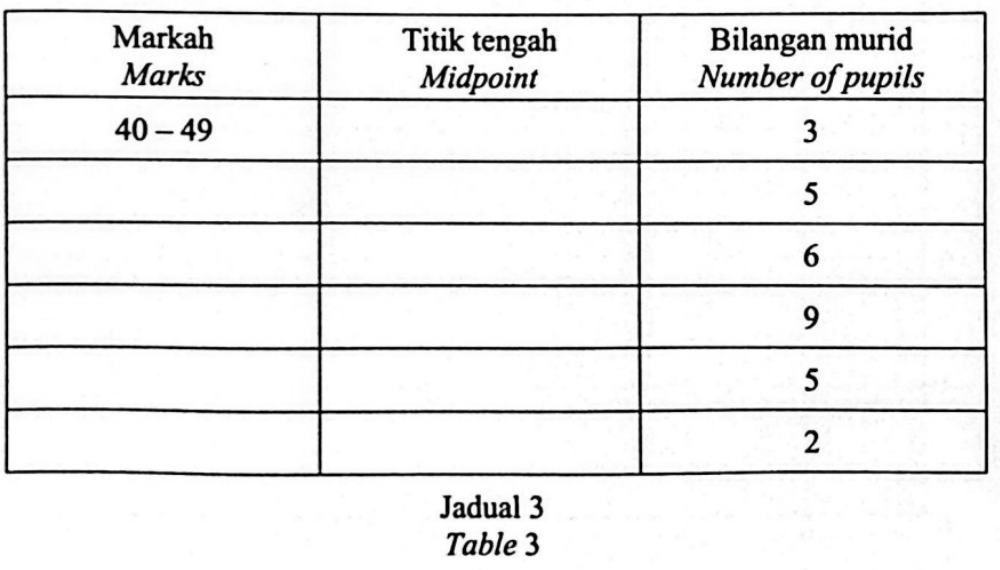
- (b)
Hence, calculate the mean marks for pupils of 5 Berlian.
[3] - (c)(i)
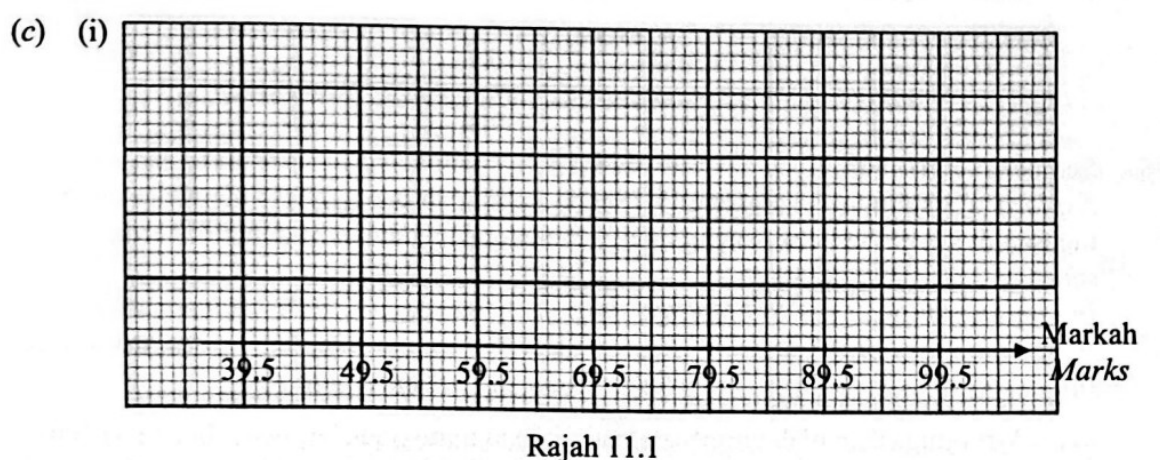
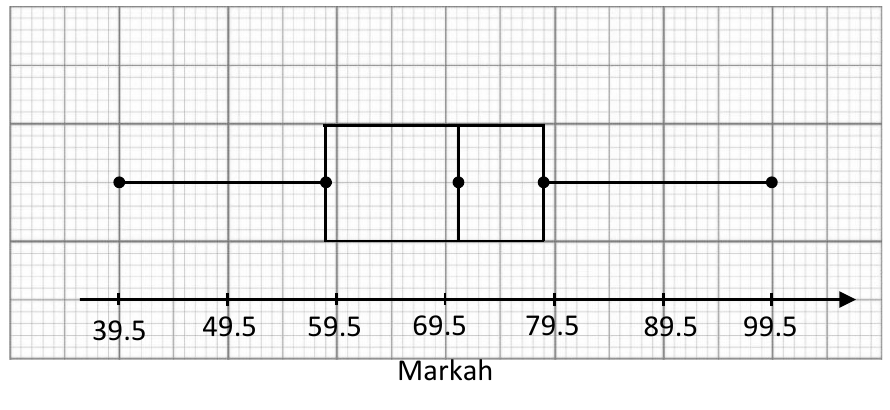
Diagram 11 shows an ogive that represents the marks of Mathematics quiz for 30 pupils of class 5 Berlian. Based on the ogive in Diagram 11, construct a box plot on Diagram 11.1 in the answer space.
[3]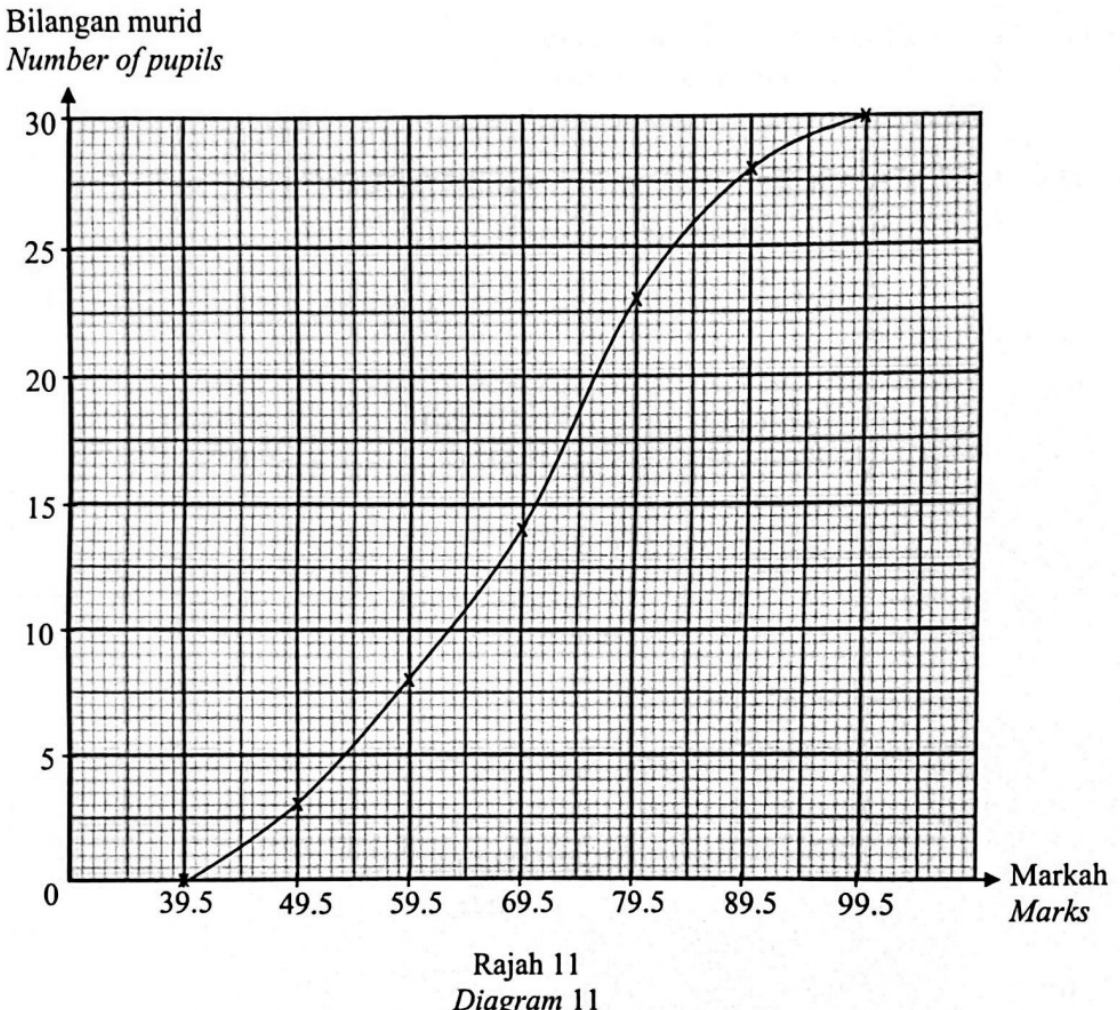
- (c)(ii)
Hence, from the box plot constructed, state the shape of distribution of the data.
[1]
Section C
Section C: answer one question. In conjunction with the STEM Day, the school has organized a 'Mathematics Explorace' competition for Form 5 students. Each team is required to complete several tasks at different stations using Mathematical knowledge based on real-life situations.
Hard15 marks- (a)(i)
Arif was assigned by his Mathematics teacher to draw a route plan for the activity at the school square. The plan was drawn on a Cartesian plane, with a scale of 1 unit representing 1 meter in real life. Point A(5, 2) represents the school gate and point B(25, 18) represents the school canteen. Determine the midpoint coordinates of the location between the school gate and the canteen.
[2] - (a)(ii)
Calculate the actual distance in meters between both locations.
[2] - (b)(i)
The marks on the score card are written in base four. A group with at least 60 marks will qualify for the next round. Bella's team score card shows the mark of 3214. Convert the mark shown on the Bella's team score card, in base 10.
[2] - (b)(ii)
Hence, determine whether Bella's team qualifies or not for the next round.
[1] - (c)(i)
At a station, participants draw two cards at random without replacement from a box containing eight coloured cards: one red card, two blue cards, three green cards and two yellow cards. Calculate the probability that the first card is red and the second card is green.
[2] - (c)(ii)
Calculate the probability that both cards are the same colour.
[2] - (d)
In the final round, the best two teams obtained the same overall marks. To determine the winner, the evaluation is based on the time taken by each team to complete the tasks at each station. The time, in minutes, taken by each team is as in Table 4. Mean time for both groups is 16 minutes. As a competition judge, you are required to determine the most deserving team as the winner.
[4]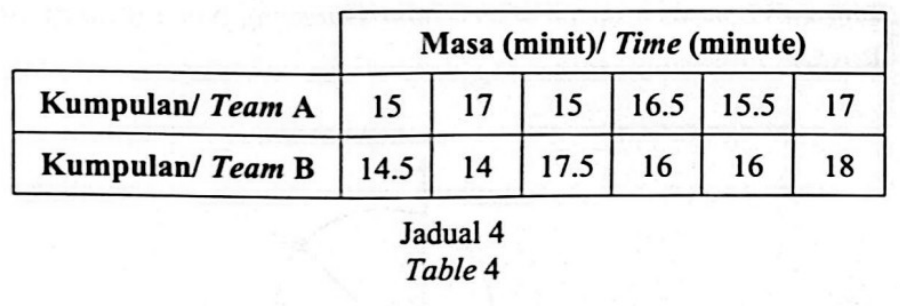
Section C: answer one question. Jitson is the owner and the manager of a homestay in Kapit, Sarawak. As an initiative to enhance the attractiveness of his homestay, Jitson plans to build a swimming pool within the homestay compound.
Hard15 marks- (a)
Diagram 12 shows a sketch of a circular swimming pool drawn by Jitson on a Cartesian plane. JK is a diameter of the swimming pool centered at point (3, 1). Given the coordinate of point J is (7, 4). What is the coordinate of point K?
[3]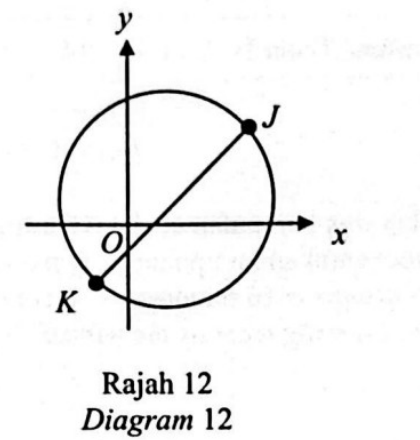
- (b)
Jitson wants to choose between two contractors, J and K, to build the swimming pool. The two contractors have quoted prices of RM3827₉ and RM6514₇ respectively. Calculate the difference in the quotes, in RM, between the two contractors in base ten.
[4] - (c)(i)
Aizat's family and Deeva's family want to rent Jitson's homestay. Table 5 shows the number of members: Aizat's family 13 male, 9 female; Deeva's family 14 male, 6 female. Two people were randomly selected from the families, to participate in mini games. Calculate the probability that a male and a female are selected.
[2]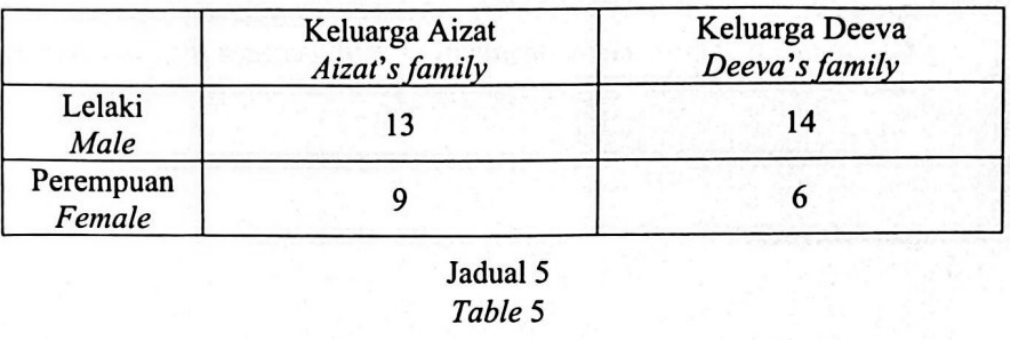
- (c)(ii)
Calculate the probability that both selected members are from the same family.
[2] - (d)(i)
Aizat's family has 22 family members with x representing the age of each his family member. Given that Σ(x − x̄)² = 900 and Σx² = 3060. Calculate the variance.
[2] - (d)(ii)
Calculate the mean age.
[2]