Write your answer on paper. Then open the answer to check it.
Section A
Diagram 1 shows a velocity-time graph of a bus with passengers on board. After 10 seconds the bus driver steps on the brake pedal to stop the bus. (Graph: velocity rises from 0 at X to 10 m s⁻¹ at Y at t = 10 s, then falls to 0 at Z at t = 20 s.)
Medium4 marks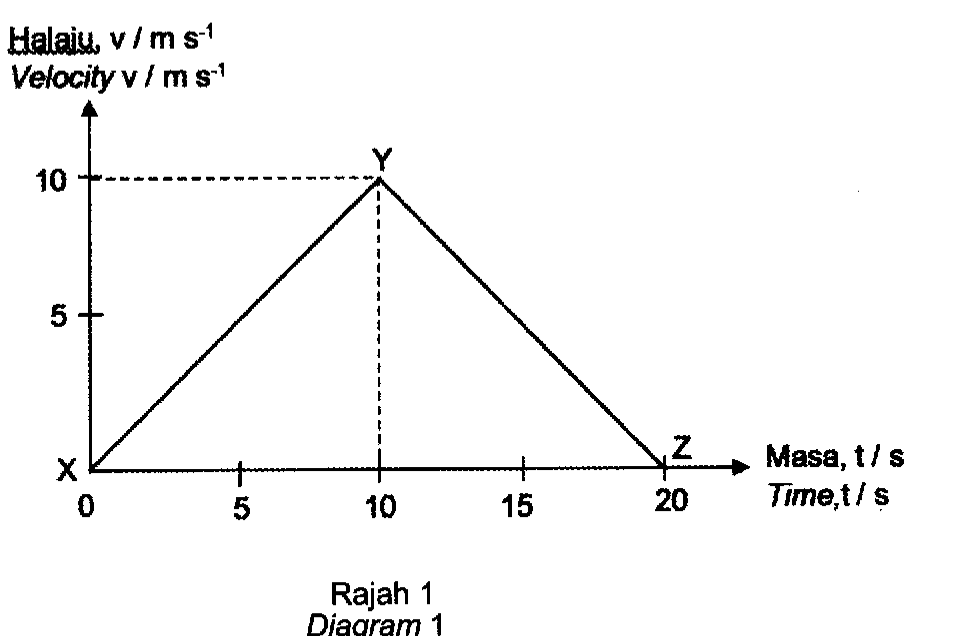
- (a)
Tick (√) the correct answer. Velocity can be defined as: [ ] Rate of change of distance. [ ] Rate of change of displacement.
[1] - (b)(i)
Based on Diagram 1, state the type of the motion of the bus after 10 seconds.
[1] - (b)(ii)
Determine the position where the bus is accelerating.
[1] - (c)
State the physical quantity represented by the area under the graph.
[1]
Diagram 2.1 shows the experiment used to demonstrate the photoelectric effect (light falls on a metal surface in a tube; anode, cathode, detector, ammeter, battery).
Medium5 marks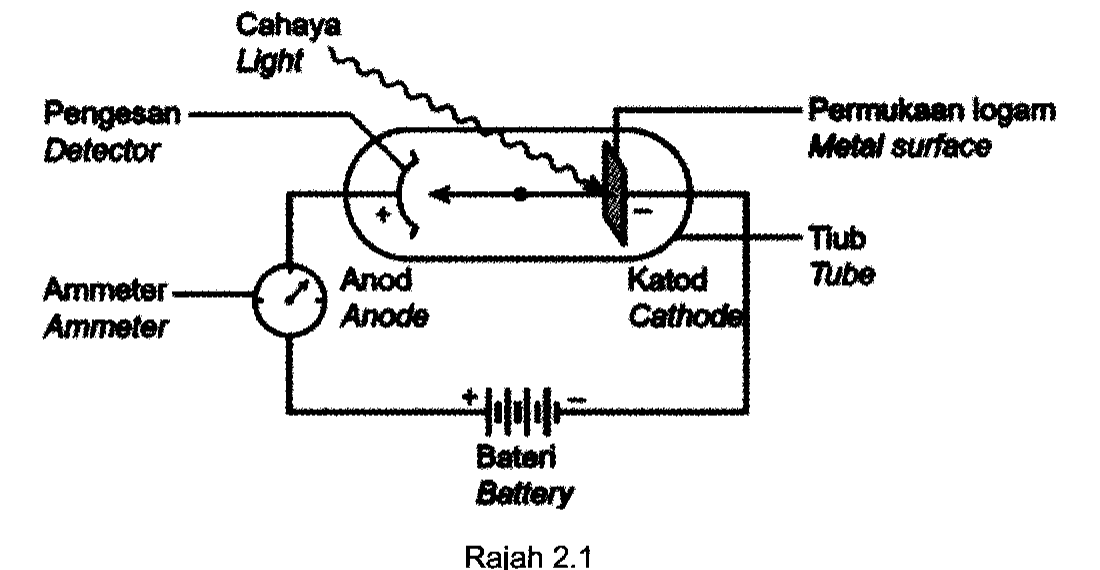
- (a)
What is the meaning of photoelectric effect?
[1] - (b)
State one condition for electron to be emitted from the surface of the metal.
[1] - (c)(i)
A beam of light with frequency of 7 × 10¹⁴ Hz is directed at a metal surface which has work function 2.32 × 10⁻¹⁹ J. (Planck constant, h = 6.63 × 10⁻³⁴ J s.) Calculate the energy of the light.
[1] - (c)(ii)
Calculate the kinetic energy of emitted electron.
[2]
Diagram 3 shows a man is pulling a sack containing fruit of mass 7 kg upwards using a pulley with a force of 68.67 N. The forces acted on the sack are in equilibrium.
Medium6 marks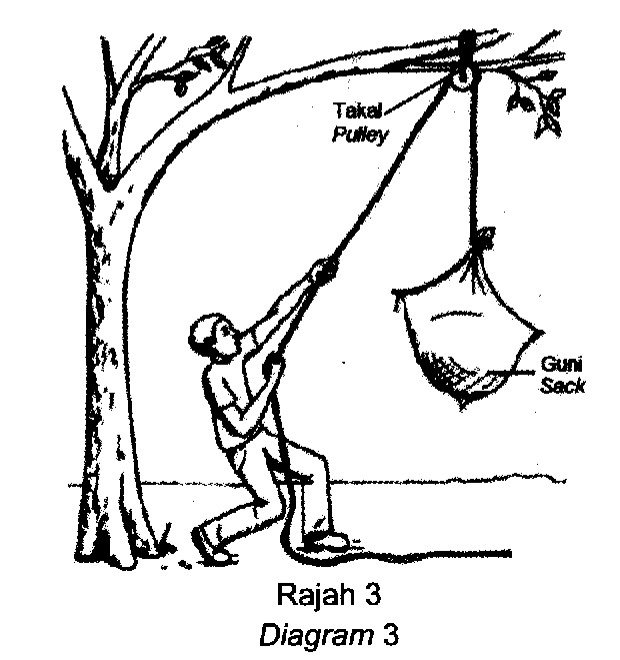
- (a)
What is meant by forces in equilibrium?
[1] - (b)(i)
Sketch the free body diagram for the two forces that acting on the sack.
[2] - (b)(ii)
What is the value of the downward acting force that stated in 3(b)?
[1] - (b)(iii)
What is the force must be applied by the man to move up the sack with an acceleration of 2 m s⁻²?
[2]
Diagram 4.1 shows two bodies P (m = 8.0 kg) and Q (m = 20.0 kg) at a distance R = 175 cm between each other. The gravitational force, F can be explained by Newton's Universal Law of Gravitation.
Medium9 marks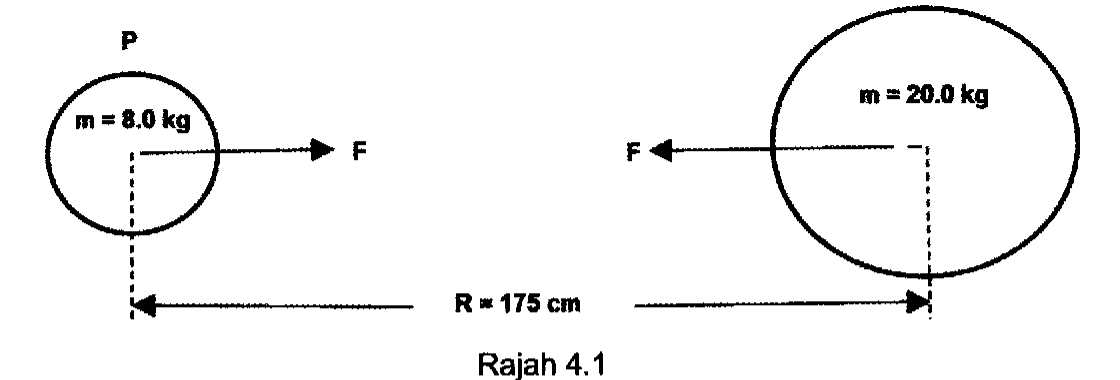
- (a)
State Newton's Universal Law of Gravitation.
[1] - (b)(i)
Calculate the weight of P and Q. (g = 9.81 m s⁻²)
[2] - (b)(ii)
Calculate force, F between P and Q. (G = 6.67 × 10⁻¹¹ N m² kg⁻²)
[2] - (b)(iii)
Are they attracted to each other?
[1] - (b)(iv)
Give a reason for answer in 4(b)(iii).
[1] - (c)
Diagram 4.2 shows a metal ball of mass 75 g is tied to the end of a string 0.8 m long which is rotated in a horizontal circle with a speed of 1.8 m s⁻¹. Calculate the tension of the string.
[2]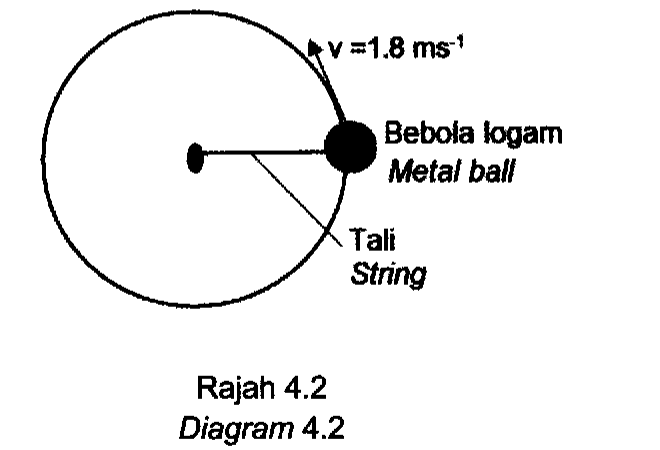
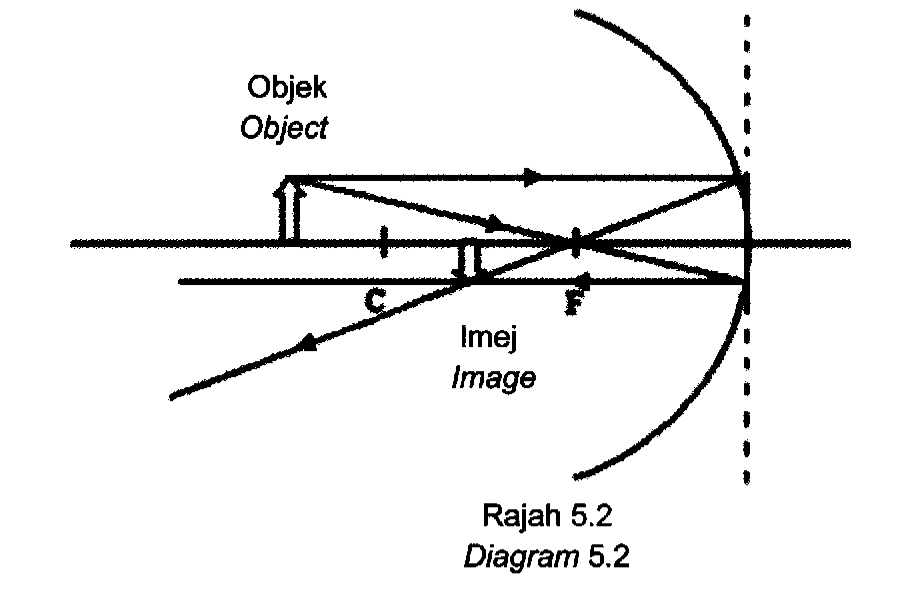
Diagram 5.1 and Diagram 5.2 show the ray diagram for an upright object that is at two different distances in front of an identical concave mirror. C is the centre of curvature and F is the principal focus.
Medium9 marks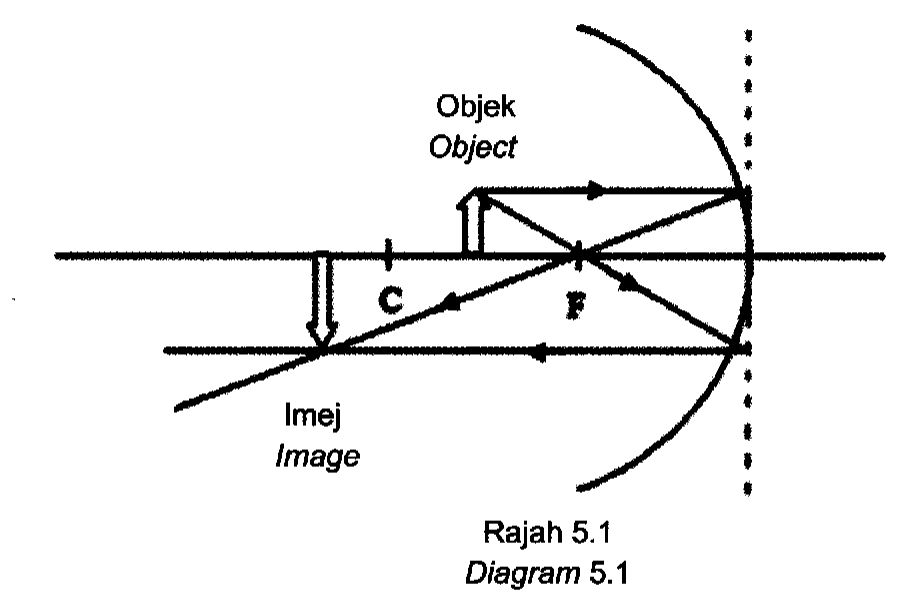
- (a)
Name the light phenomenon involved.
[1] - (b)(i)
Compare the object distance.
[1] - (b)(ii)
Compare the image distance.
[1] - (b)(iii)
Compare the size of the image.
[1] - (b)(iv)
Relate the object distance with the image distance.
[1] - (b)(v)
Relate the object distance with the size of the image.
[1] - (c)
Diagram 5.3 shows an incomplete ray diagram (object between F and the mirror). Complete the ray diagram to show how the image is formed.
[3]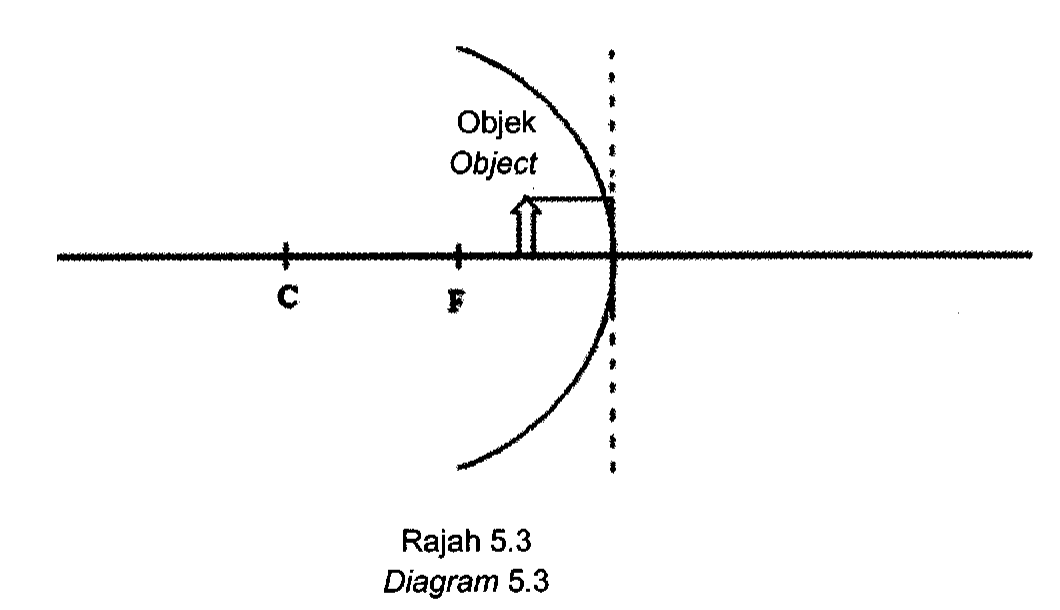
Diagram 6.1 and Diagram 6.2 show two circuits with battery P and battery Q used to determine the e.m.f. and internal resistance of each battery. The resistor used in both circuits is the same. Table 6.1 (battery P): switch off 12.0 V, 0.0 A; switch on 9.6 V, 4.8 A. Table 6.2 (battery Q): switch off 12.0 V, 0.0 A; switch on 8.0 V, 4.0 A.
Medium9 marks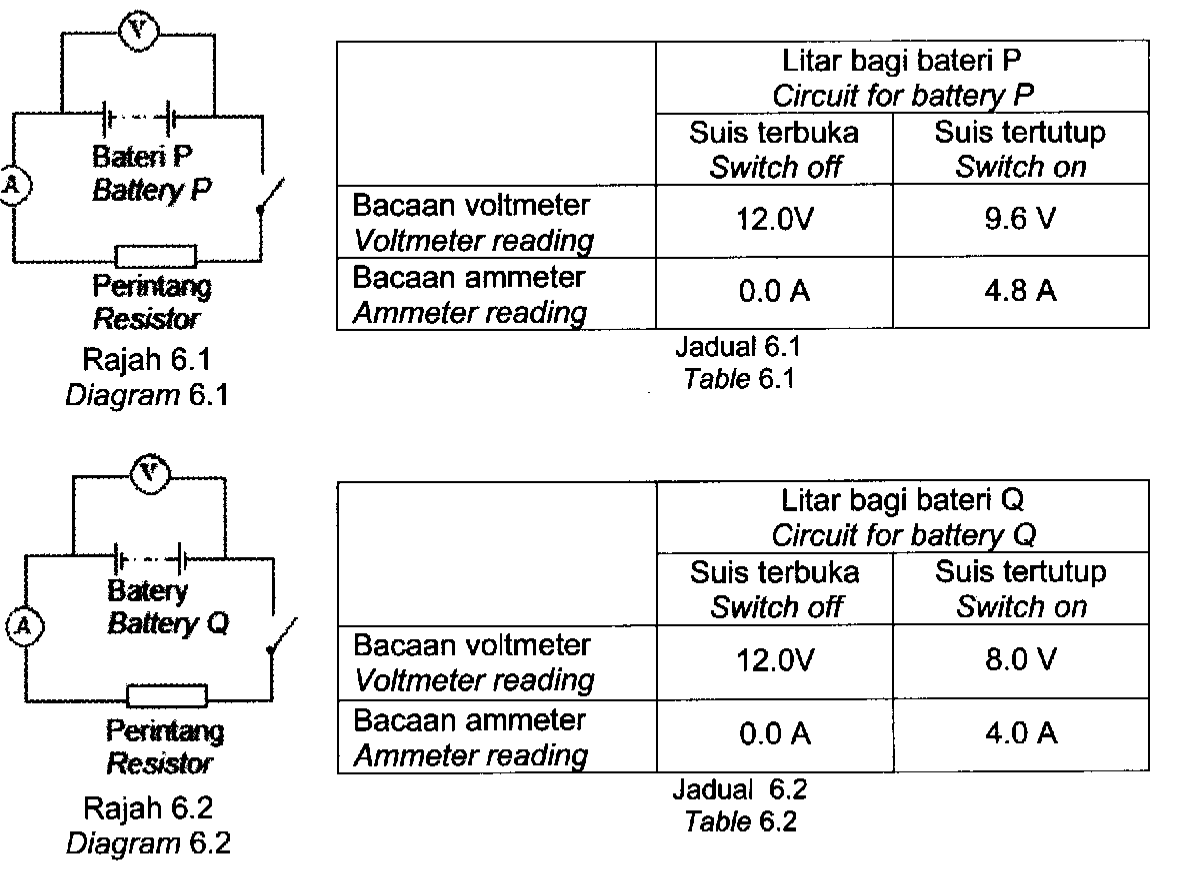
- (a)
What is meant by electromotive force?
[1] - (b)(i)
Based on Table 6.1 and Table 6.2, compare the electromotive force of the battery.
[1] - (b)(ii)
Compare the reading of the voltmeter when the switch is on.
[1] - (b)(iii)
Compare the reading of the ammeter when the switch is on.
[1] - (c)(i)
Based on your answer at 6(b), state the relationship between voltage drop and the ammeter's reading.
[1] - (c)(ii)
State the relationship between voltage drop and the internal resistance.
[1] - (d)(i)
Diagram 6.3 shows a dry cell with e.m.f. 1.5 V and internal resistance r = 1 Ω connected to a circuit consisting of a voltmeter, an ammeter and a bulb. If an identical bulb is connected in parallel to the circuit, what happens to the voltmeter and ammeter reading?
[2]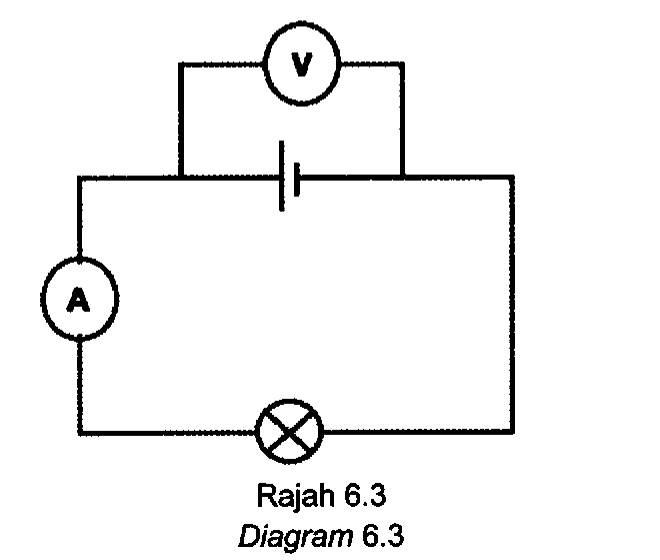
- (d)(ii)
Give one reason to the answer in 6(d)(i).
[1]
Diagram 7.1 shows the decay curve of a radioisotope Sodium-24 (²⁴₁₁Na): activity falls from 2000 at t = 0 to 1000 at 15 minutes (time axis 15, 30, 45, 60 minutes).
Medium9 marks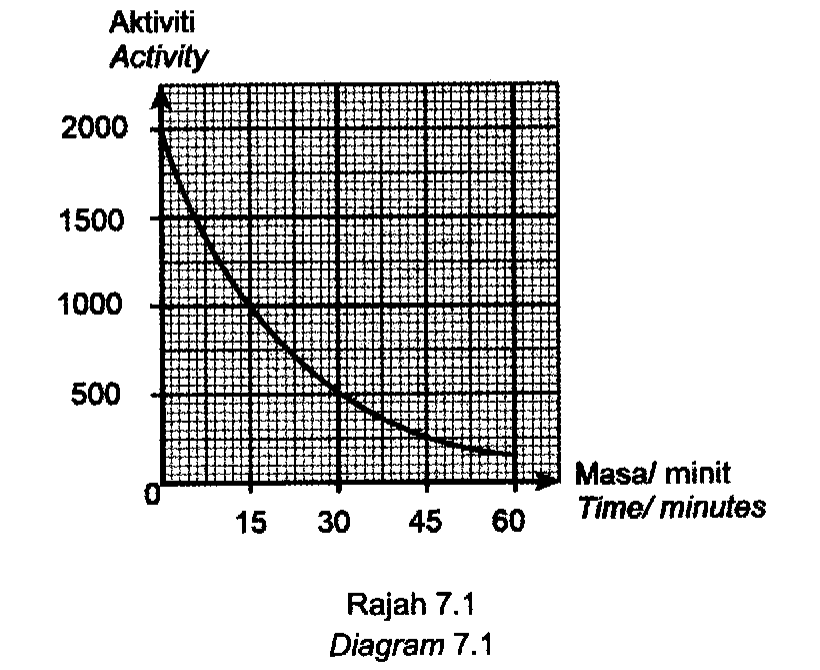
- (a)
What is the meaning of half-life?
[1] - (b)(i)
Determine the half-life of radioisotope Sodium-24. Show on the graph how you determine the half-life.
[2] - (b)(ii)
Determine the activity of the radioisotope Sodium-24 after three half-lives.
[1] - (c)(i)
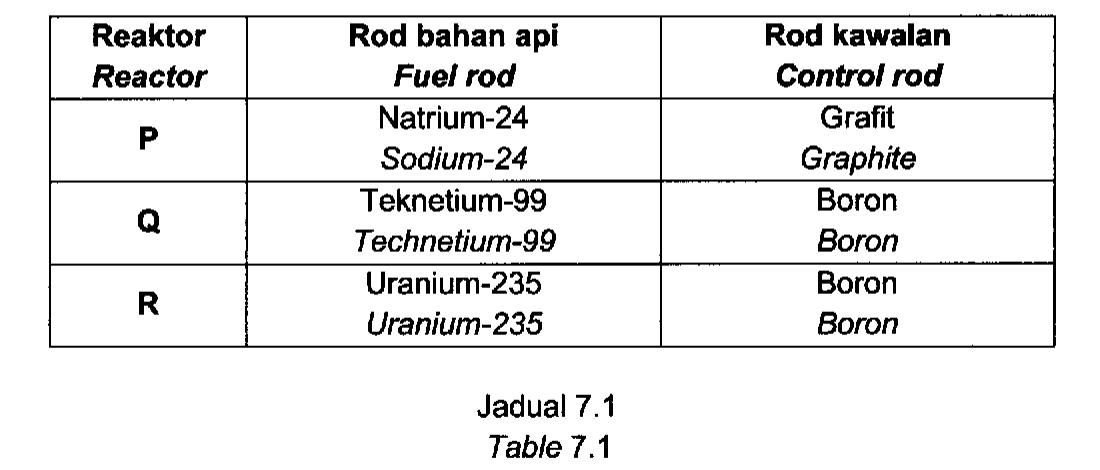
Diagram 7.2 shows a cross section of a nuclear reactor model. Table 7.1: P (fuel rod Sodium-24, control rod Graphite); Q (Technetium-99, Boron); R (Uranium-235, Boron). Based on Table 7.1, state the suitable characteristic of the fuel rod of the nuclear reactor model to be built, and give a reason.
[2]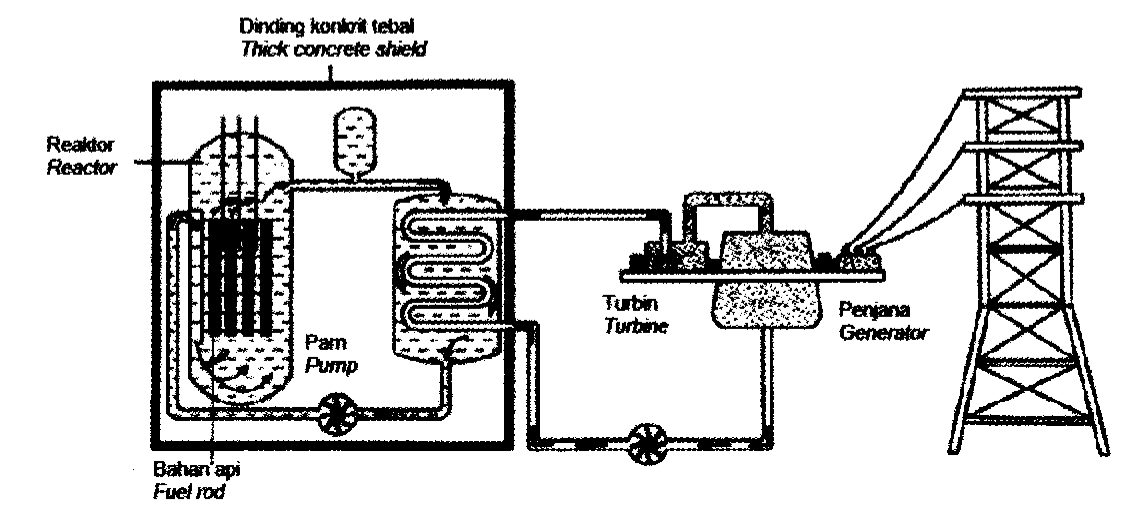
- (c)(ii)
State the suitable characteristic of the control rod and give a reason.
[2] - (c)(iii)
Based on your answer in 7(c)(i) and 7(c)(ii), choose the most suitable nuclear reactor model.
[1]
Diagram 8.1 shows a ship in front of a cliff. The ship sounded the horn and an echo was heard after 9.4 s later.
Medium9 marks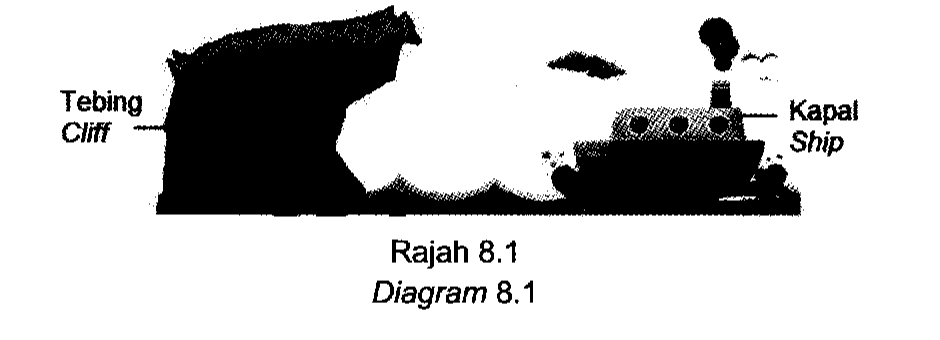
- (a)(i)
State the wave phenomenon involved in the situation.
[1] - (a)(ii)
Explain how echoes can be used to determine the distance.
[2] - (b)
The ship is 1600 m from the cliff. Calculate the speed of the sound wave.
[2] - (c)(i)
Diagram 8.2 shows a dolphin uses wave to detect its prey. Based on the aspect the type of waves, suggest how the dolphin is able to detect its prey efficiently, and give one reason.
[2]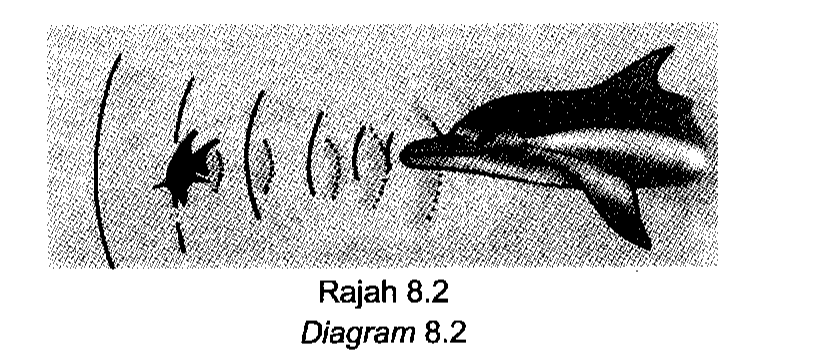
- (c)(ii)
Based on the aspect the frequency of waves, give a suggestion and one reason.
[2]
Section B
Diagram 9.1 shows a metal can filled with hot water at temperature 70 °C immersed in a polystyrene cup filled with cold water at temperature 5 °C. After a while, the two liquids reach thermal equilibrium.
Hard20 marks- (a)(i)
What is the meaning of thermal equilibrium?
[1]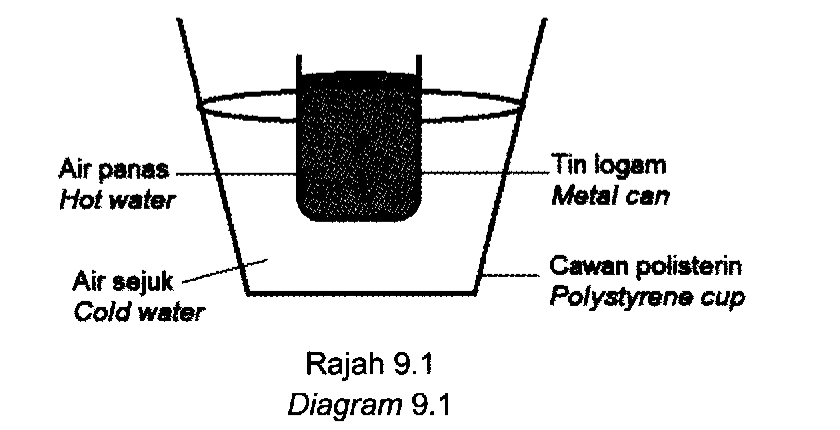
- (a)(ii)
Explain how thermal equilibrium is achieved between the two liquids.
[4] - (b)
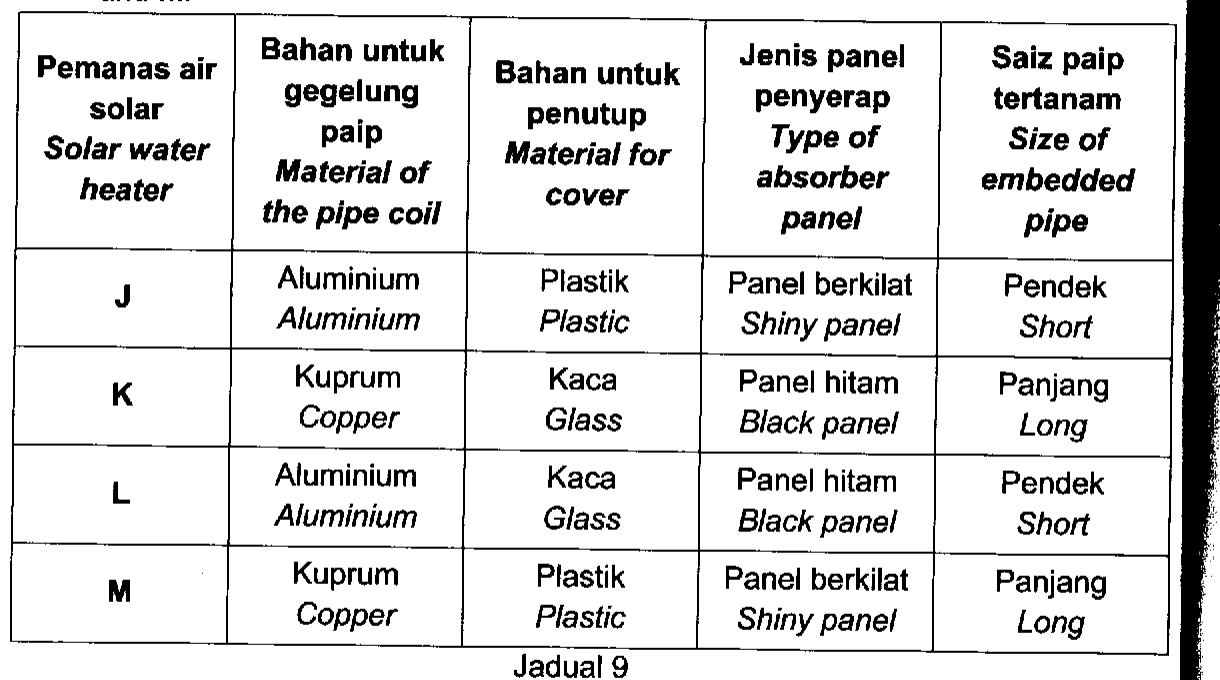
Diagram 9.2 shows a solar water heater to be installed on the roof of a hotel to heat water in the water storage tank. Table 9 shows the specifications of four solar water heater designs J, K, L and M (pipe coil material / cover material / absorber panel / embedded pipe size): J Aluminium, Plastic, Shiny panel, Short; K Copper, Glass, Black panel, Long; L Aluminium, Glass, Black panel, Short; M Copper, Plastic, Shiny panel, Long. Study the specifications of each solar water heater. Explain the suitability of each characteristic and determine the most suitable solar water heater to produce hot water efficiently. Give reasons for your choice.
[10]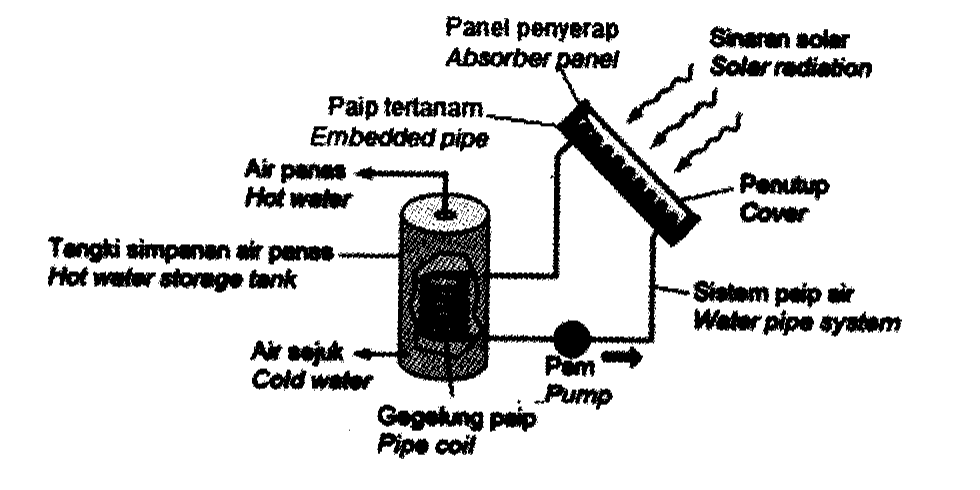
- (c)(i)
Diagram 9.3 shows a heating curve for solid X of mass 0.8 kg. The solid is heated with an immersion heater of 50 W. What is the melting point of X?
[1]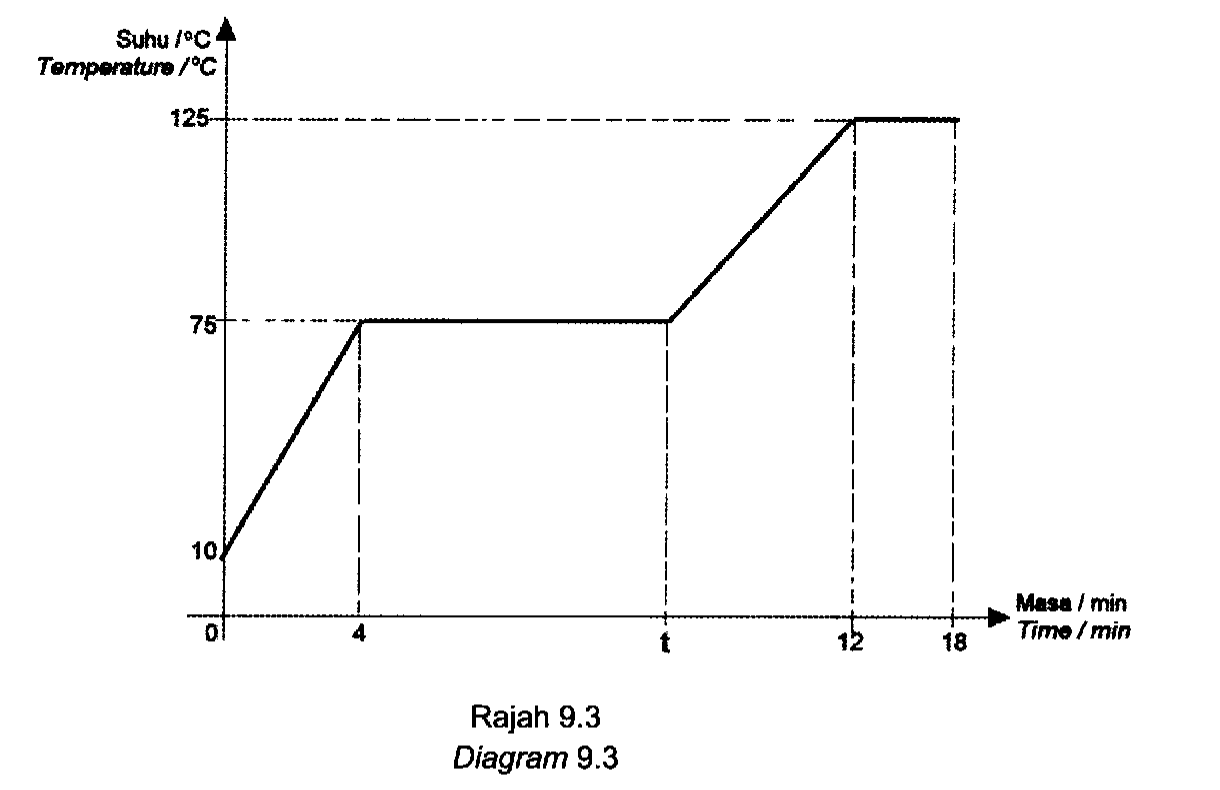
- (c)(ii)
Calculate the specific heat capacity of X.
[2] - (c)(iii)
Determine the value of t, if the specific latent heat of fusion for X is 3.4 × 10⁴ J kg⁻¹.
[2]
Diagram 10.1 shows two syringes of different sizes which is used to lift up a load (force F₁ applied on the small piston, force F₂ produced by the large piston).
Medium20 marks- (a)(i)
What is the physics principle which explains the above situation?
[1] - (a)(ii)
Explain how the large syringe can be used to lift a load when force F₁ is applied on the small piston with cross-sectional area A₁.
[4]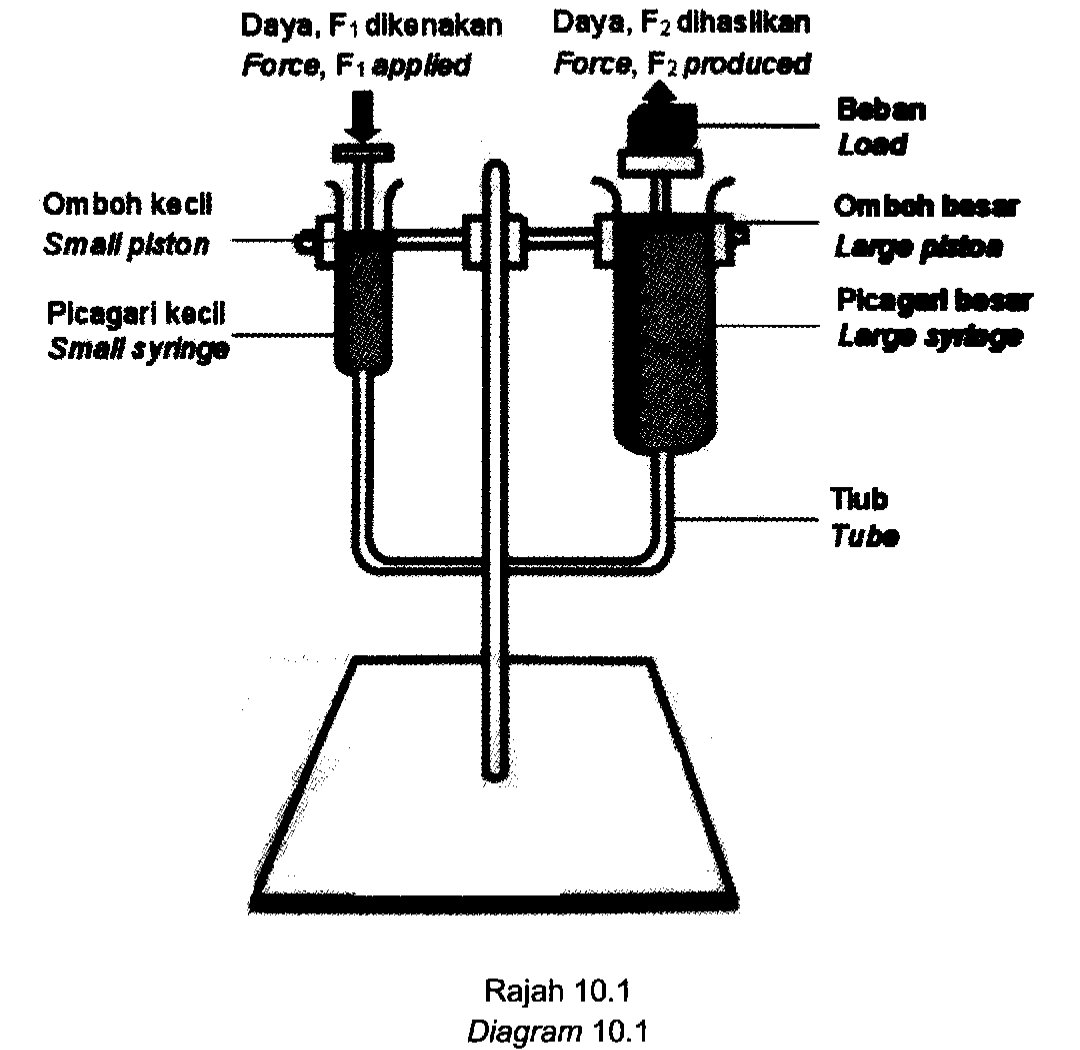
- (b)
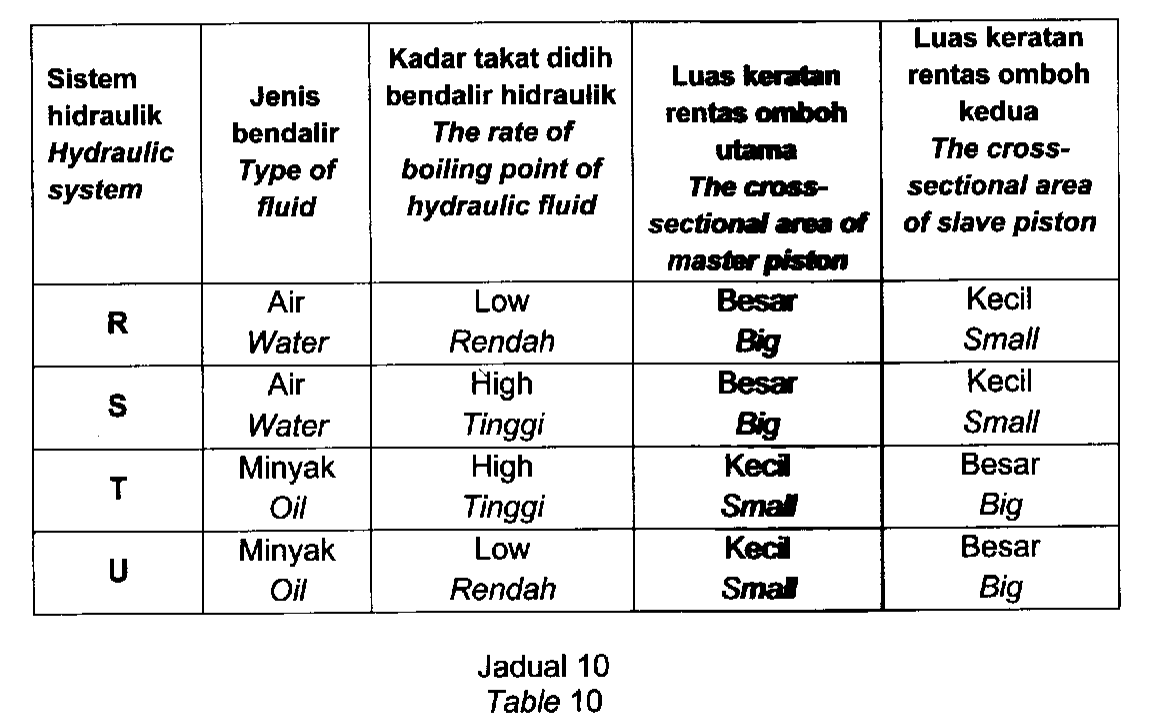
Diagram 10.2 shows an excavator using a hydraulic system to unload sand from the excavator bucket. Table 10 (type of fluid / boiling point of hydraulic fluid / cross-sectional area of master piston / of slave piston): R Water, Low, Big, Small; S Water, High, Big, Small; T Oil, High, Small, Big; U Oil, Low, Small, Big. Study the specifications of all four hydraulic systems. Explain the suitability of each specification and determine the most suitable hydraulic system to unload sand from the excavator bucket. Give reasons for your choice.
[10]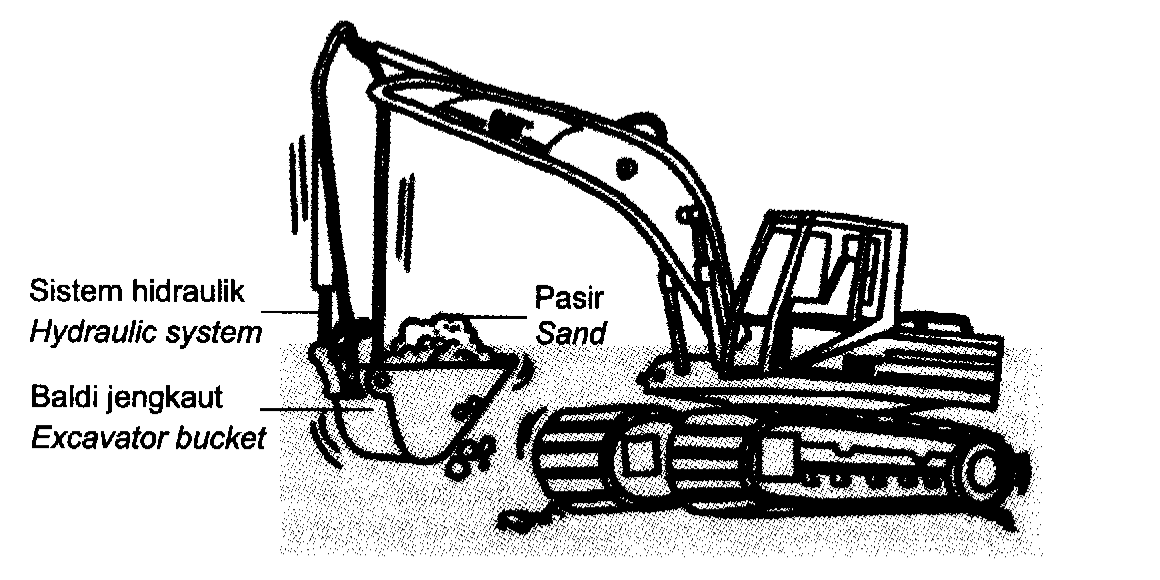
- (c)(i)
In the hydraulic brake system of an excavator, the cross-sectional area of the piston in the master cylinder and the front wheel are 2 cm² and 8 cm² respectively. A force of 40 N is applied to the piston in the master cylinder. Calculate the pressure transmitted throughout the brake fluid.
[2] - (c)(ii)
Calculate the force exerted on the piston of the front wheel.
[3]
Section C
Diagram 11.1 shows a bicycle dynamo. The dynamo is used to produce induced current which will light a bulb on the bicycle.
Medium20 marks- (a)
What is the meaning of induced current?
[1]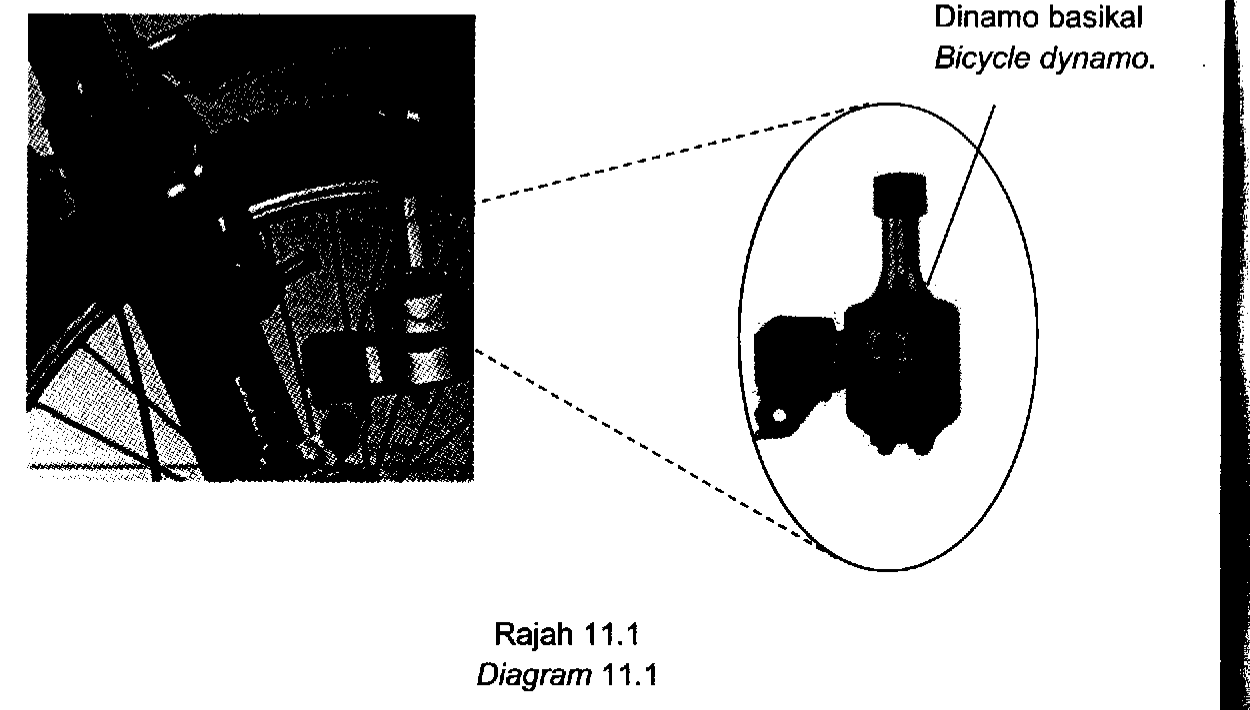
- (b)
Diagram 11.2(a) and 11.2(b) show a bar magnet dropped from a certain height and subsequently enters a coil (1000 turns in (a), 3000 turns in (b)). Compare (i) the relative motion between the magnet and the coil, (ii) the number of turns of the coil, (iii) the induced current produced.
[3]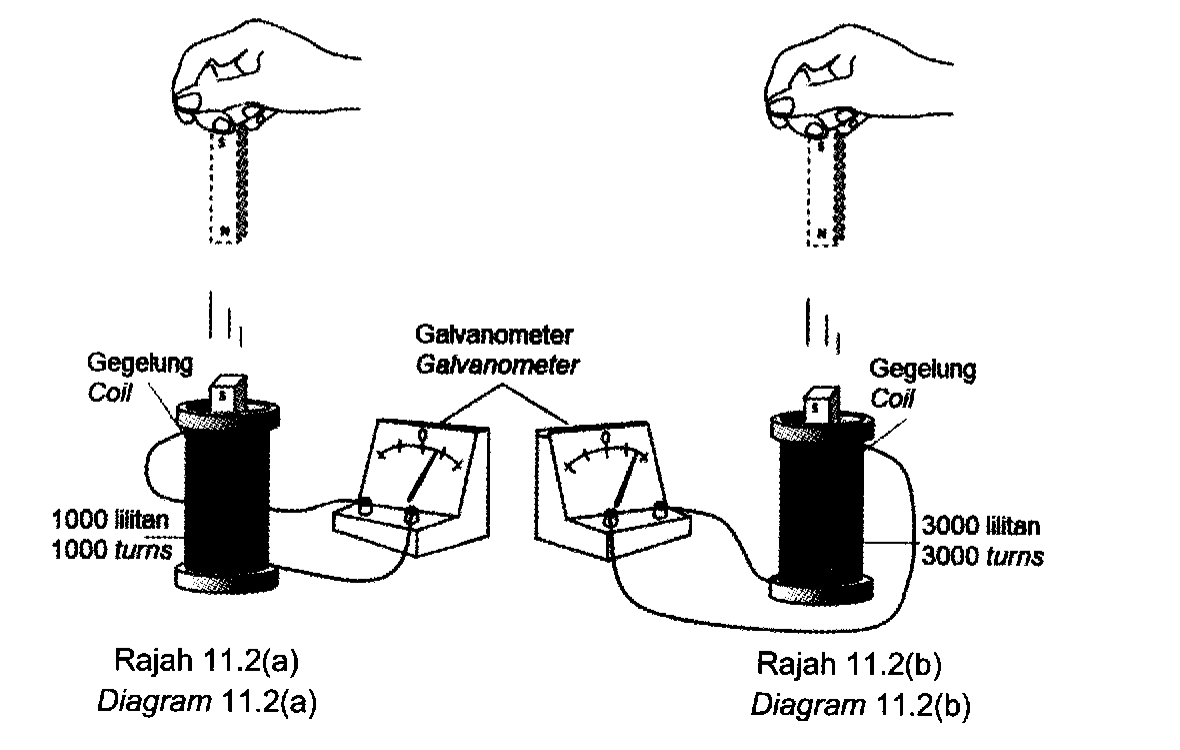
- (c)
State the relationship between the number of turns of the coil and (i) the rate of change of the magnetic field, (ii) the magnitude of the induced current produced.
[2] - (d)
Diagram 11.3 shows a direct current generator. Explain how the generator works to produce a direct current.
[4]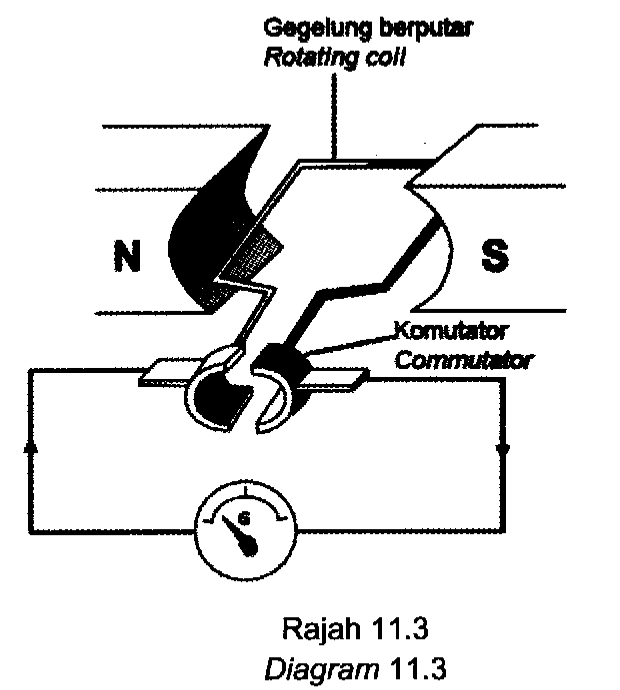
- (e)
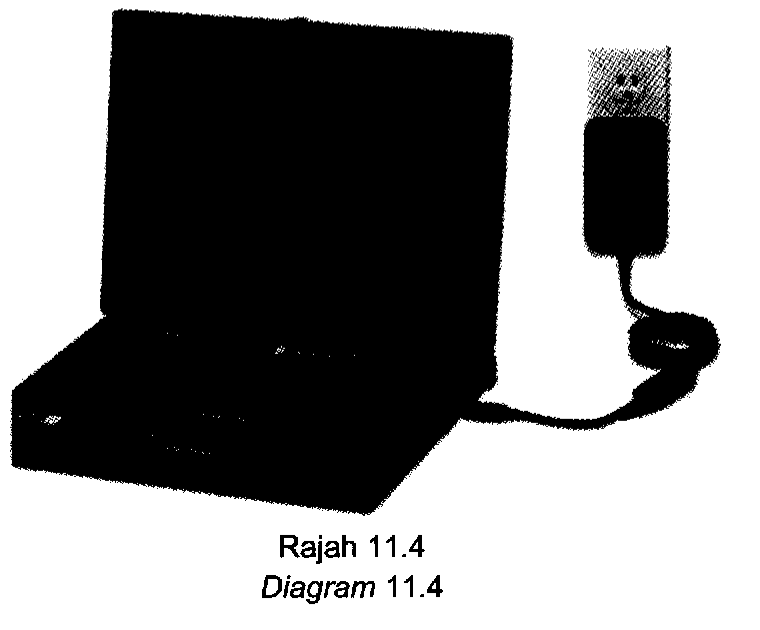
Diagram 11.4 shows a laptop that requires direct current being charged. However, the charger is broken. The transformer in the charger is used to reduce an alternating voltage from 240 V to 20 V. Using the knowledge of transformer and rectifier, suggest and explain how to build a voltage adapter which can be used to charge the laptop battery. Your answer should include the type of the transformer, the ratio of number of turns in primary coil to the number of turns in secondary coil, the type of the core, the material of the wire and the electronic component that should be connected to the output of secondary coil.
[10]