Write your answer on paper. Then open the answer to check it.
Section A
Given an equation relating the photon energy, E, speed of light, c, and wavelength of light, λ: E = hc/λ.
Medium4 marks- (a)
What is the meaning of wavelength?
[1] - (b)
Complete the following sentence by ticking the correct answer. Symbol h represents: De Broglie constant / Planck constant.
[1] - (c)
What is the S.I. unit of h?
[1] - (d)
What will happen to the photon energy, E if the wavelength of light, λ increases?
[1]
Diagram 2 shows gravitational force, F acting on a boy and a girl of mass 70 kg and 53 kg respectively, separated by a distance r = 1.0 m.
Medium5 marks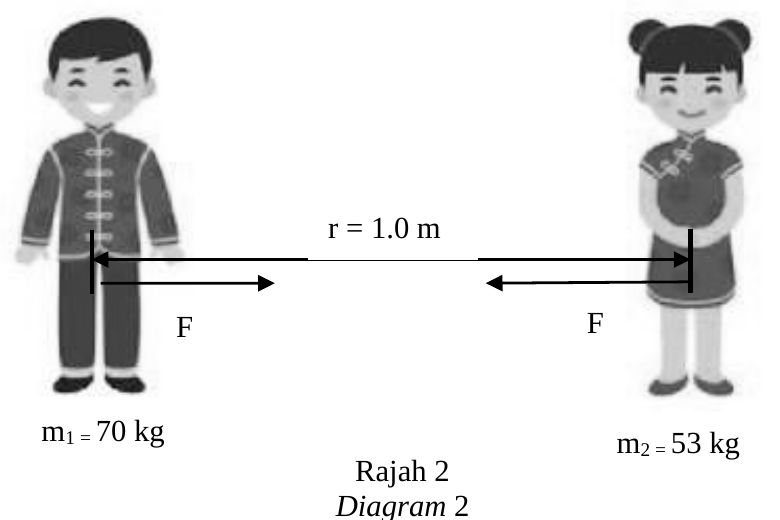
- (a)
What is the meaning of gravitational force?
[1] - (b)(i)
Gravitational force F can be calculated by F = G m₁m₂ / r², where G is the gravitational constant. State the unit of F in terms of base units.
[1] - (b)(ii)
Calculate the gravitational force, F.
[2] - (c)
Why do the boy and the girl not experience the effect of the gravitational force toward each other?
[1]
Coherent sound waves are produced by two loudspeakers, S₁ and S₂, separated by a distance of 0.5 m as shown in Diagram 3. A student walks slowly in front of and 2.5 m away from the loudspeakers. In Diagram 3, the positions where very loud sounds are heard are labelled L and the positions where very soft sounds are heard are labelled S.
Medium7 marks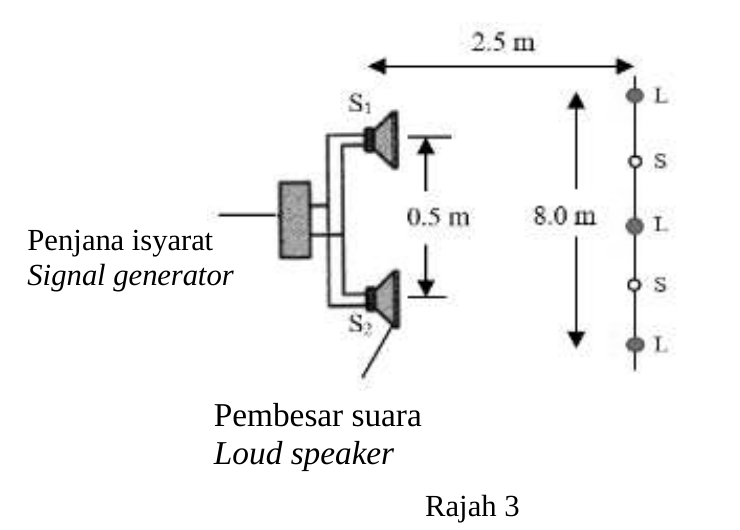
- (a)(i)
What is the meaning of coherent waves?
[1] - (a)(ii)
State whether sound is a transverse or a longitudinal wave. Explain your answer.
[2] - (b)(i)
State what happens at the points labelled L.
[2] - (b)(ii)
The distance between three consecutive loud sounds is 8.0 m. Calculate the wavelength of the sound.
[2]
Diagram 4 shows an acrobat standing still on a tight rope. The acrobat experiences equilibrium of forces (T₁ makes 27° and T₂ makes 50° with the horizontal). The mass of the acrobat is 50 kg and the tension of the rope, T₂, is 450 N. The gravitational field strength is 9.81 N kg⁻¹.
Medium9 marks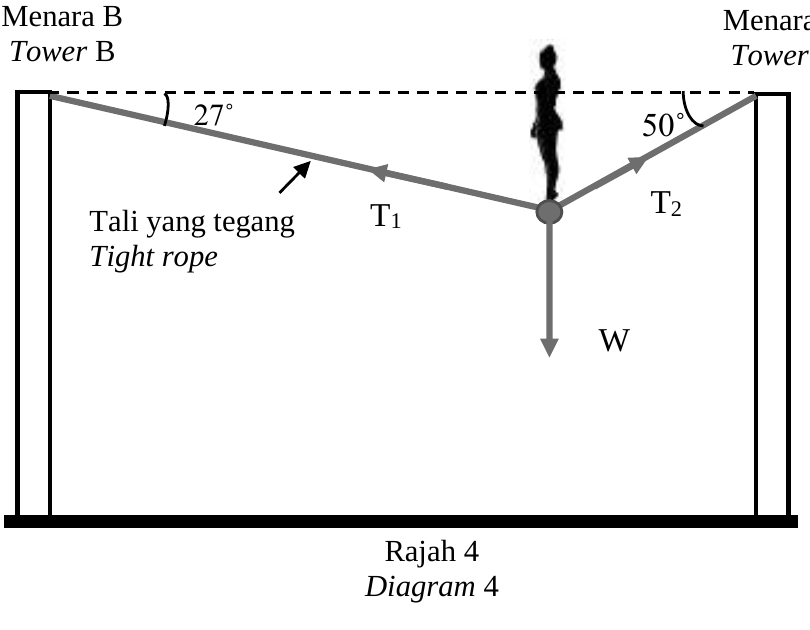
- (a)
What is the meaning of equilibrium of forces?
[1] - (b)
What should the acrobat do to maintain her balance while walking through the rope? Explain your answer.
[2] - (c)(i)
In the space below, sketch the diagram to show the triangle of forces acting in Diagram 4. In your sketch indicate the direction of forces, label all the forces and show the angles involved.
[3]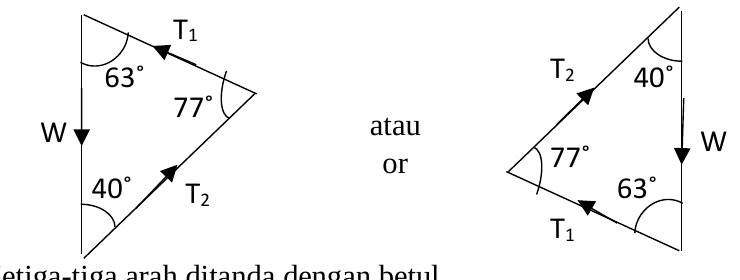
- (c)(ii)
Determine the tension of the rope, T₁.
[3]
Diagram 5 shows the parts of the electromagnetic spectrum with their respective wavelengths and frequencies (gamma rays, X-rays, ultraviolet, visible light, infrared, Y, radio waves; energy increases towards gamma rays).
Medium9 marks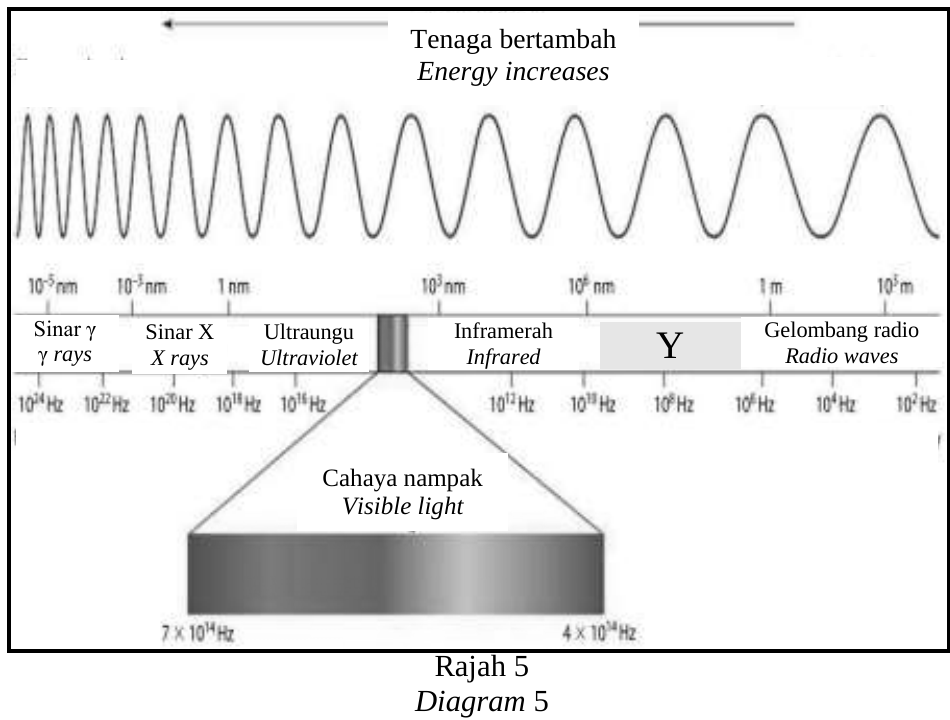
- (a)
What is the meaning of electromagnetic waves?
[1] - (b)(i)
Based on Diagram 5, compare the wavelength of γ-rays and radio waves.
[1] - (b)(ii)
Compare the frequency of γ-rays and radio waves.
[1] - (b)(iii)
Compare the energy carried by γ-rays and radio waves.
[1] - (c)
Using your answers in (b), state the relationship between wavelength and frequency of electromagnetic waves.
[1] - (d)
Compare the velocity of γ-rays and radio waves.
[1] - (e)
Name one use of the electromagnetic wave at position Y on the spectrum in Diagram 5.
[1] - (f)
A television station emits radio waves of frequency 2.5 × 10⁸ Hz. Calculate the wavelength of the waves emitted by this television station.
[2]
Diagrams 6.1(a) and 6.2(a) show two circuits used to investigate the relationship between potential difference and electric current of a constantan wire of different thickness. Diagrams 6.1(b) and 6.2(b) show the graph of potential difference against electric current for Diagrams 6.1(a) and 6.2(a) respectively. The gradient of the graph represents the resistance of the constantan wire.
Medium9 marks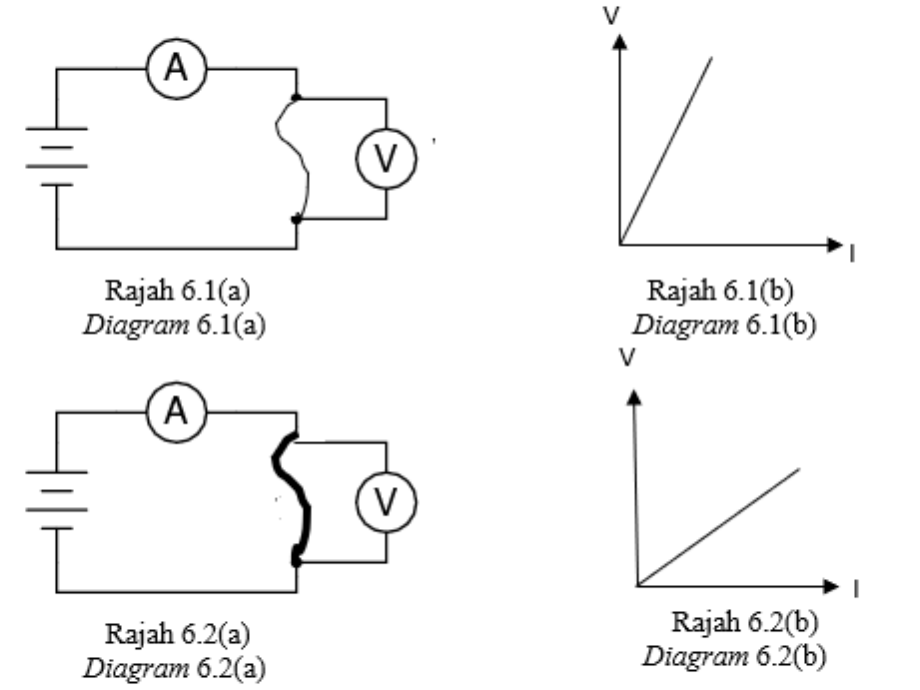
- (a)
What is the meaning of resistance?
[1] - (b)(i)
Based on Diagrams 6.1 and 6.2, compare the thickness of the constantan wire.
[1] - (b)(ii)
Compare the resistance of the constantan wire.
[1] - (b)(iii)
Relate the thickness with the resistance.
[1] - (c)(i)
Diagram 6.3 shows three resistors X, Y and Z of resistance 20 Ω each connected to a dry cell, 6 V (Y and Z in parallel, in series with X). Calculate the effective resistance of the circuit.
[2]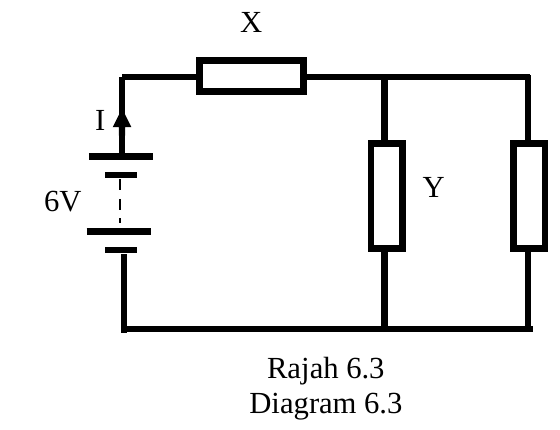
- (c)(ii)
Calculate the current, I.
[1] - (c)(iii)
Calculate the power dissipated at resistor X.
[1] - (d)
What will happen to the current, I if resistor Z is removed?
[1]
Diagram 7.1 shows a velocity-time graph of a car which applies the brake after moving at constant velocity 10 m s⁻¹ (constant 10 m s⁻¹ until 0.5 s, then decreasing uniformly to zero at 4 s).
Hard9 marks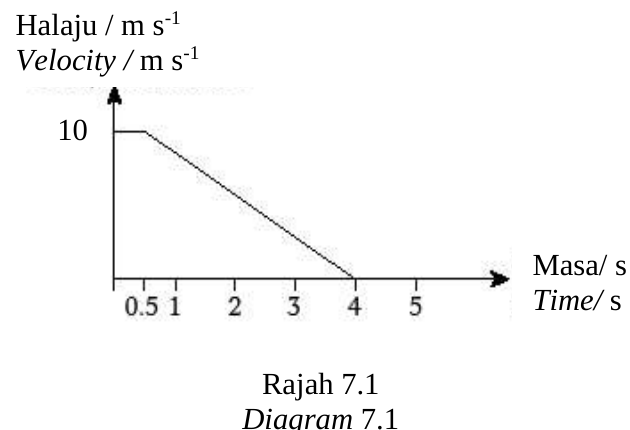
- (a)
State the physics quantity that represents the area under the graph.
[1] - (b)(i)
State the type of motion of the car after 0.5 s.
[1] - (b)(ii)
Calculate the total distance travelled by the car.
[2] - (c)(i)
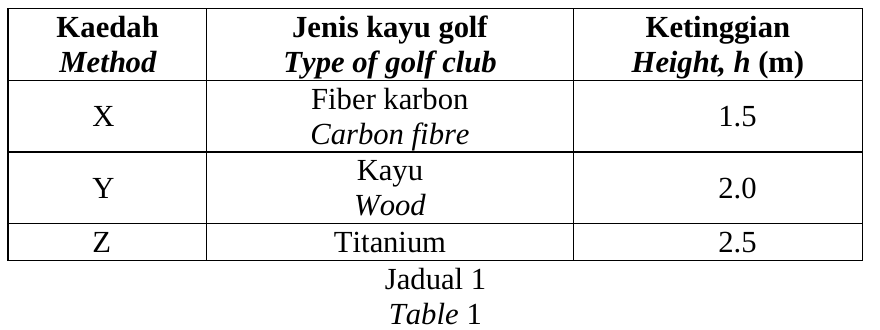
Diagram 7.2 shows a man playing golf. Table 1 shows different types of golf club and height, h, used in a golf game (X: carbon fibre, 1.5 m; Y: wood, 2.0 m; Z: titanium, 2.5 m). Suggest the suitable method to increase the distance travelled by the golf ball based on the type of golf club. Reason.
[2]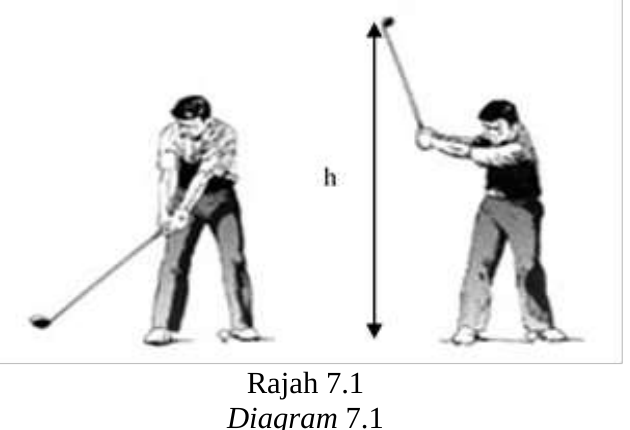
- (c)(ii)
Height, h. Reason.
[2] - (d)
Based on your answers in (c), choose the most suitable method used in the golf game.
[1]
Diagram 8.1 shows a permanent magnet inside a bicycle dynamo rotating at high speed, lighting a bulb.
Medium9 marks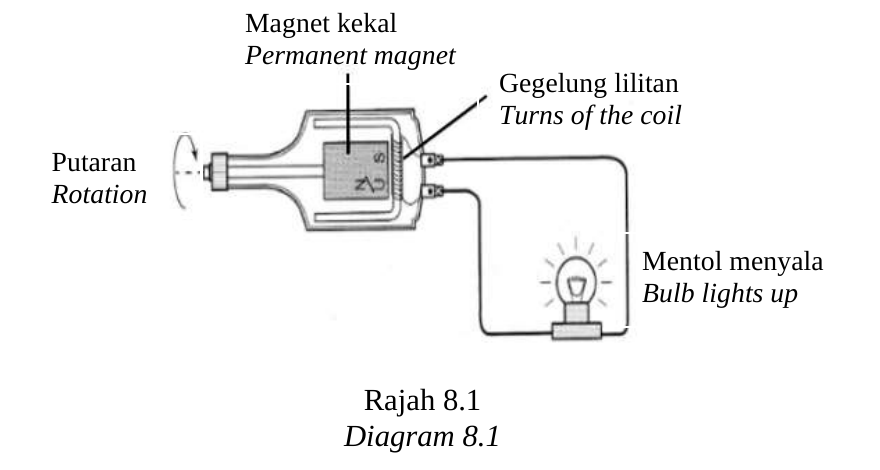
- (a)(i)
State the energy changes that take place at the dynamo.
[1] - (a)(ii)
State the physics concept involved.
[1] - (b)(i)
Diagram 8.2 shows a girl cycling at night. The bicycle's lamp is a bit dim although the girl cycles faster. State a modification needed to the dynamo to increase the brightness of the bulb: the magnet used. Reason.
[2]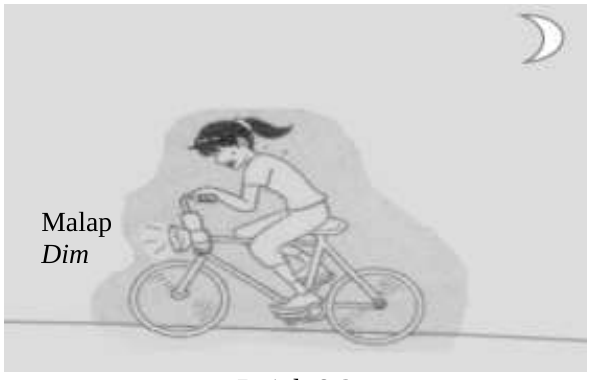
- (b)(ii)
The number of turns of the coil. Reason.
[2] - (b)(iii)
Suitable material of the coil wire. Reason.
[2] - (c)
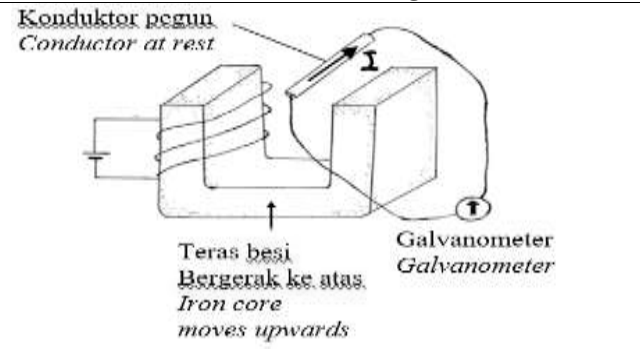
Diagram 8.3 shows a current induced when the U-shaped iron core is moved upwards. Mark on Diagram 8.3 the direction of current flow in the conductor.
[1]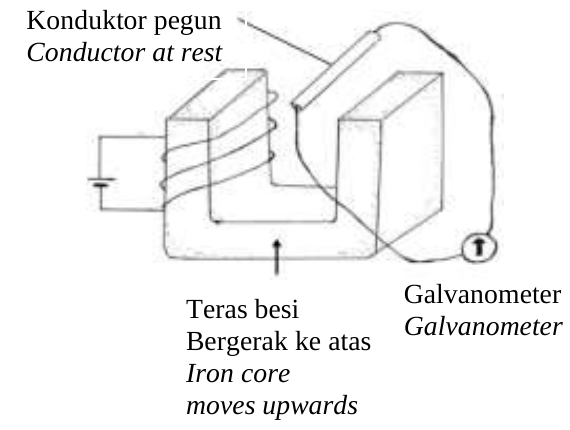
Section B
Diagram 9 shows the cross-section of a thermal cooker (cover for inner pot, inner pot, space S, outer pot).
Medium20 marks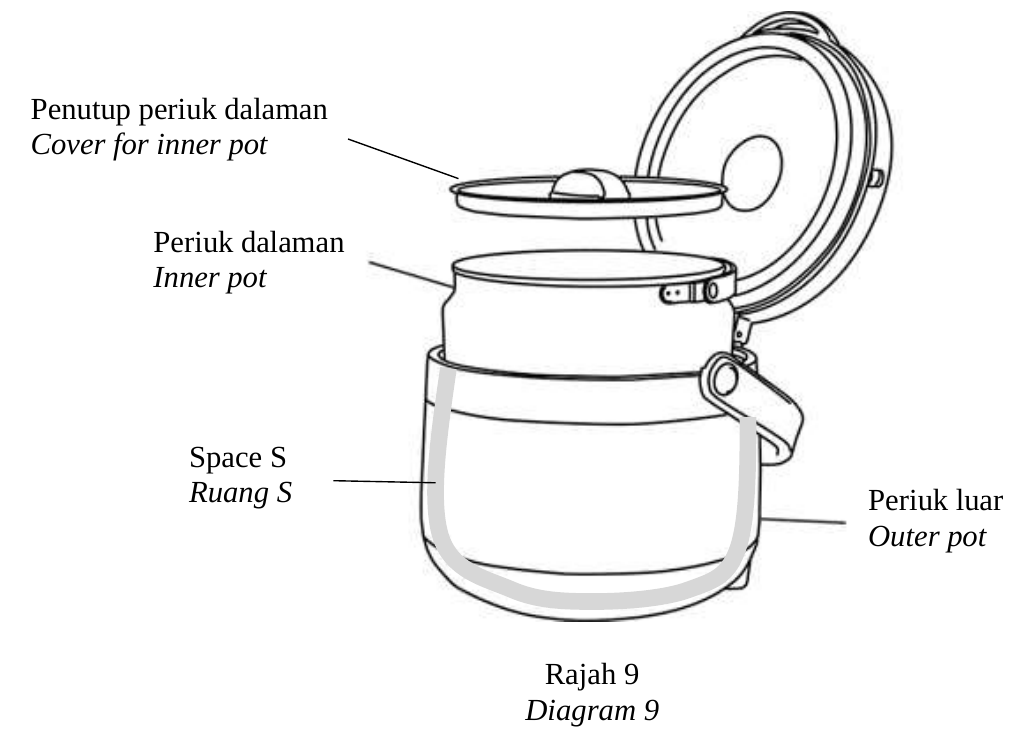
- (a)
What is the meaning of heat?
[1] - (b)
Explain how the thermal cooker works. Give 2 advantages of using a thermal cooker.
[4] - (c)
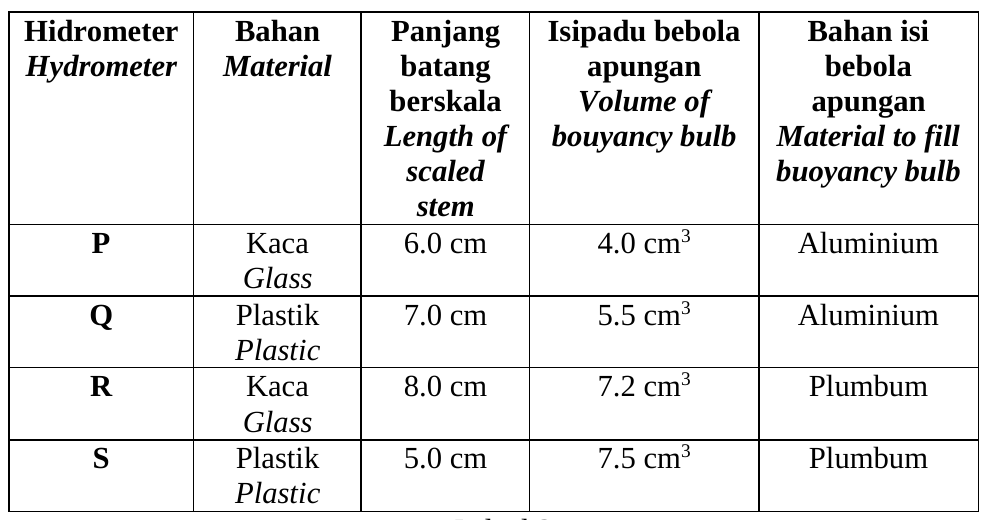
Table 2 shows the characteristics of thermal cookers P, Q, R and S (inner pot material; inner layer coating; outer pot material; space S). You are required to determine the most suitable thermal cooker to keep the food warm for a few hours. Explain the suitability of each specification. Choose the most suitable thermal cooker and give reasons for your choice.
[10]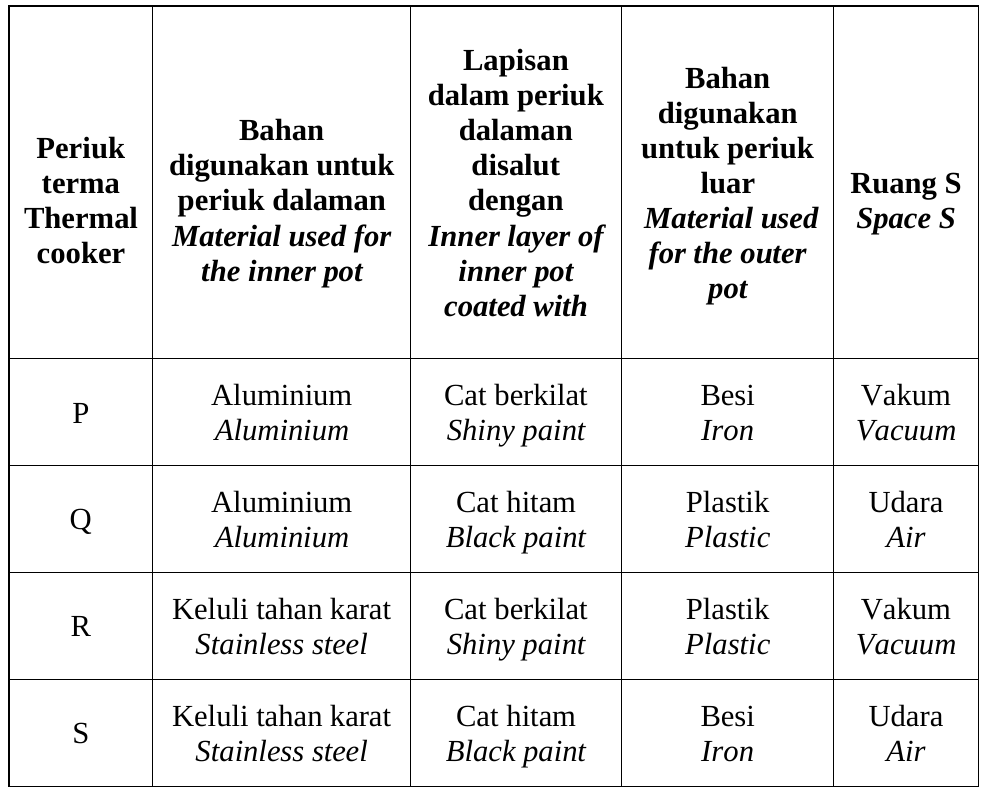
- (d)(i)
750 g of ice at -3 °C is put into a glass and left to melt to room temperature at 30 °C. Sketch the temperature-time graph for the process of the melting ice.
[2]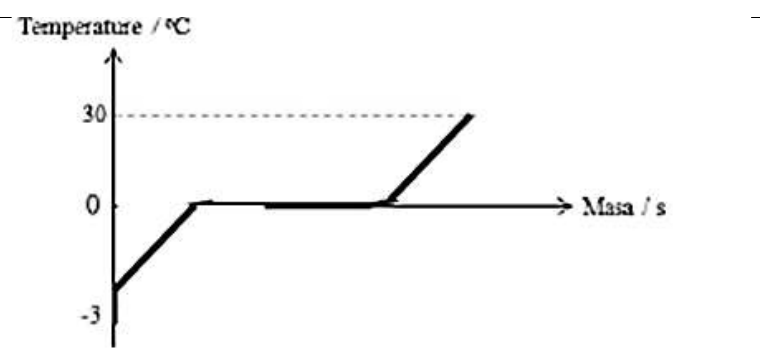
- (d)(ii)
Calculate the quantity of heat gained by the melting ice. The latent heat of fusion of ice is 3.34 × 10⁵ J kg⁻¹, the specific heat capacity of water is 4200 J kg⁻¹ °C⁻¹ and the specific heat capacity of ice is 2100 J kg⁻¹ °C⁻¹.
[3]
Diagrams 10.1(a) and 10.1(b) show the apparatus used by a student to study a physics principle. In 10.1(a) the weight of an object measured by a spring balance in air is 6.0 N. In 10.1(b) the object is lowered until fully submerged in water; its weight in water is 4.8 N and the weight of the water displaced is 1.2 N. The density of water is 1 × 10³ kg m⁻³.
Hard20 marks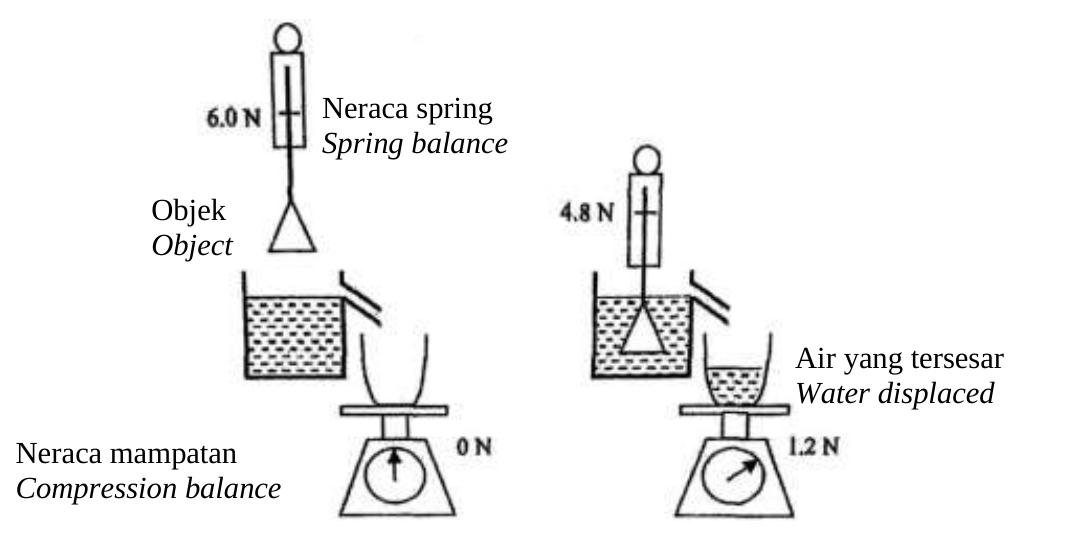
- (a)
Name the physics principle involved.
[1] - (b)(i)
Based on Diagrams 10.1(a) and (b), what is the buoyant force acting on the object?
[1] - (b)(ii)
Compare the buoyant force and the weight of water displaced by the object.
[1] - (b)(iii)
Calculate the volume of the object.
[3] - (c)
A hydrometer measures the relative density of liquids based on buoyancy (Diagram 10.2: sealed hollow glass tube with a wider buoyancy bulb, a ballast bulb and a narrow stem with a scale). Table 3 shows the characteristics of hydrometers P (glass, 6.0 cm stem, 4.0 cm³ bulb, aluminium), Q (plastic, 7.0 cm, 5.5 cm³, aluminium), R (glass, 8.0 cm, 7.2 cm³, lead) and S (plastic, 5.0 cm, 7.5 cm³, lead). Explain the suitability of each characteristic listed and determine which hydrometer should be chosen. Give reasons for your choice.
[10]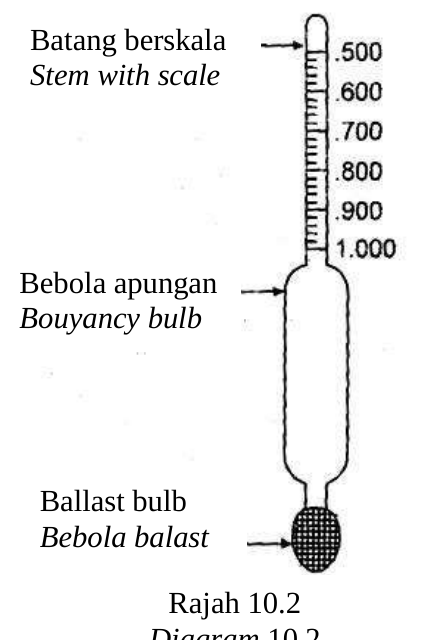
- (d)
Diagram 10.2 shows an orange floating on the surface while a peeled orange sinks to the bottom of a glass of water. Using Archimedes' Principle, explain how this situation happened.
[4]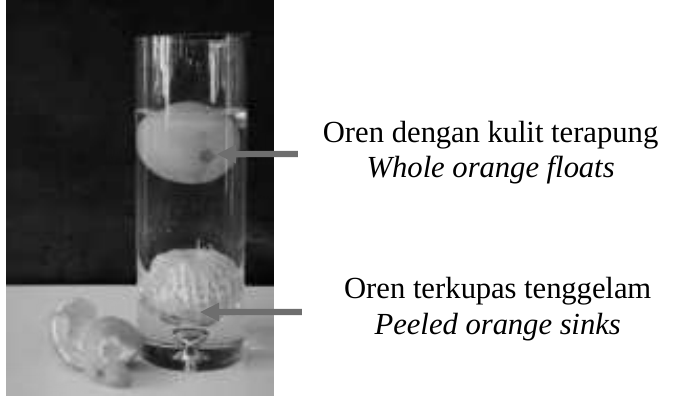
Section C
Diagrams 11.1 and 11.2 show refraction of light through two mediums of different density. Both rays have an incident angle of 60°; the refracted angle is 35° in medium X and 25° in medium Y. The refractive index of medium X and Y are 1.51 and 2.05 respectively.
Medium20 marks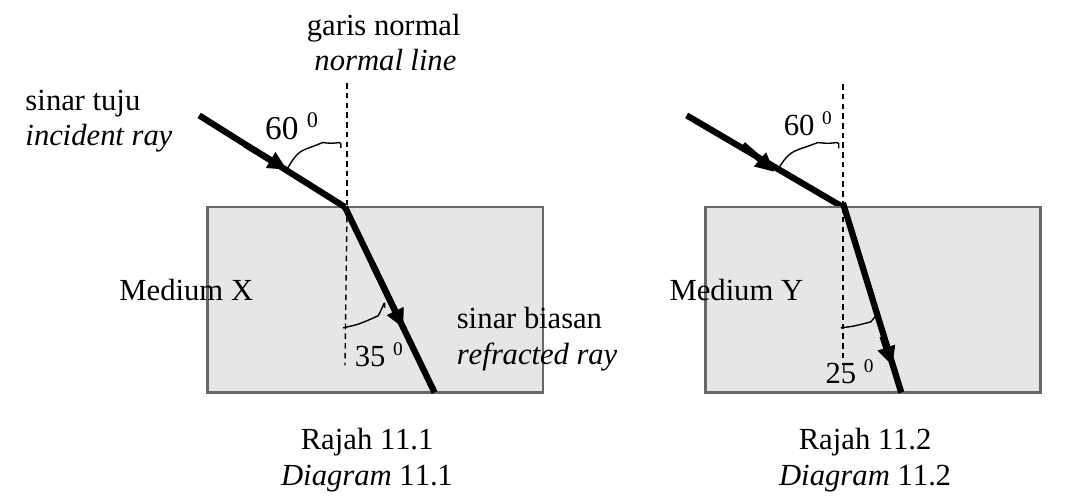
- (a)
What is the meaning of refraction?
[1] - (b)(i)
Based on Diagrams 11.1 and 11.2, compare the incident angle, the refracted angle and the refractive index between medium X and medium Y.
[3] - (b)(ii)
Relate the refracted angle with the refractive index to make a deduction on the relationship between refractive index and the density of the medium.
[2] - (c)
Diagram 11.3 shows the structure of a rear reflector of a bicycle created by a student. The reflector consists of a prism with critical angle 42°. You are assigned to give suggestions on the characteristics of the reflector so that it can reflect high intensity of light. State and explain your suggestion based on: (i) angle of prism used, (ii) material of the prism, (iii) characteristic of the cover, (iv) number of prisms, (v) position of the reflector.
[10]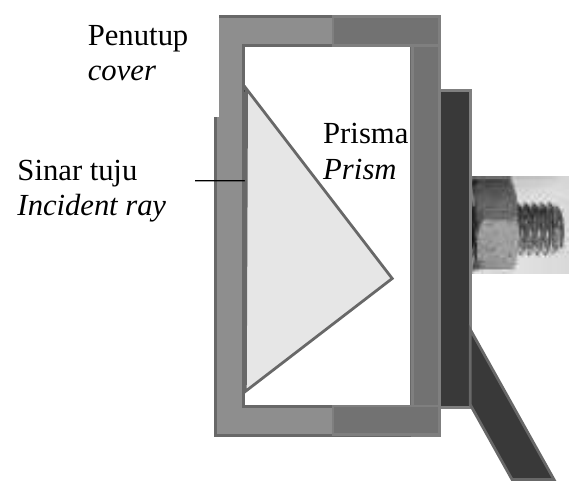
- (d)(i)
Diagram 11.4 shows a light ray passing into diamond. The critical angle of diamond is 24°. x is the incident angle. Explain what will happen to the light ray at point B if x = 20°.
[2]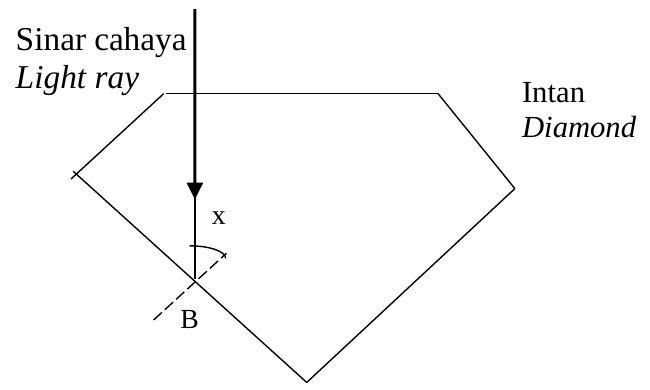
- (d)(ii)
Explain what will happen to the light ray at point B if x = 30°.
[2]