Which of the following physical quantities matched with the correct SI unit?
A Time – Minute
B Mass – Kilogram
C Length – Kilometer
D Force – Joule
Easy
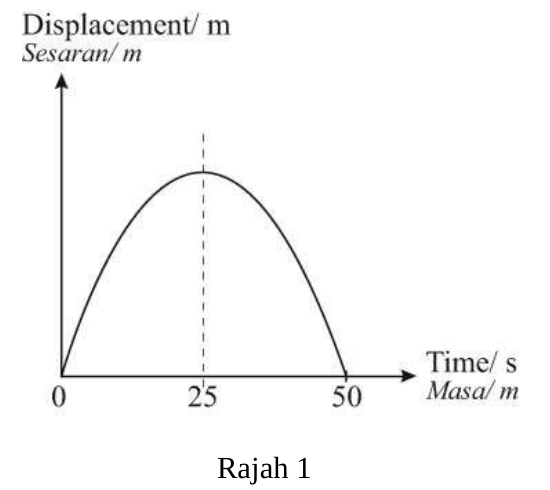
Diagram 1 shows a displacement-time graph of a car moving in a straight line (a parabola rising from 0 m at 0 s to a maximum at 25 s and returning to 0 m at 50 s). Which of the following velocity-time graphs represents the motion of the car?
Medium
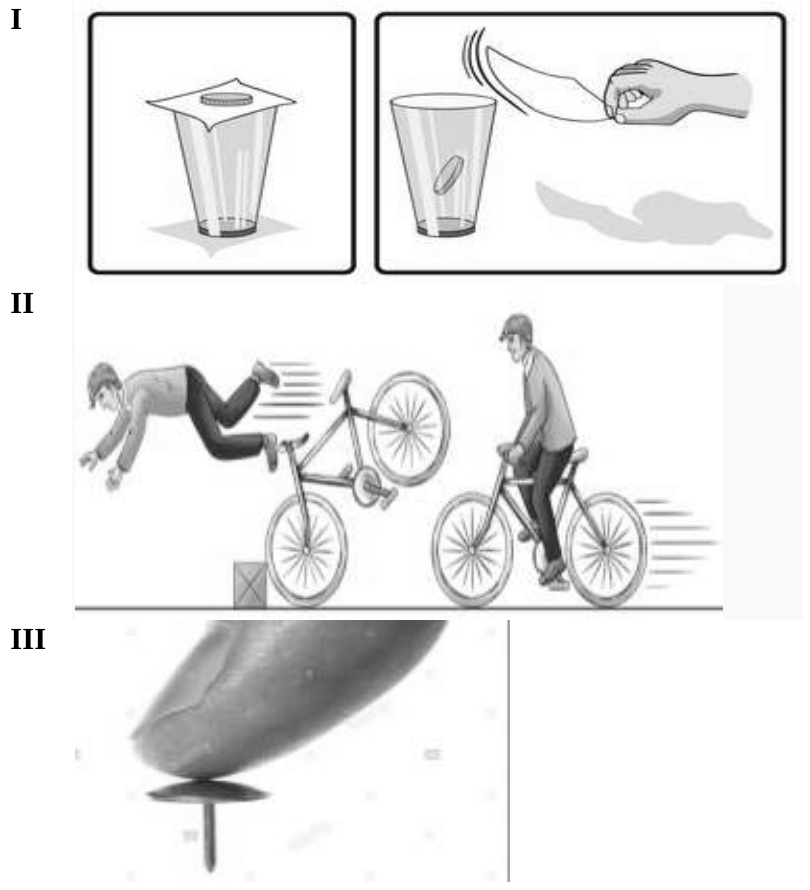
Which of the following shows effect of inertia?
I Coin drops into the glass when the card is flicked away
II Cyclist thrown forward when the bicycle hits an obstacle
III Thumbtack pressed by a finger into a surface (shown in Diagram)
A I and II
B I and III
C II and III
D I, II and III
Hard
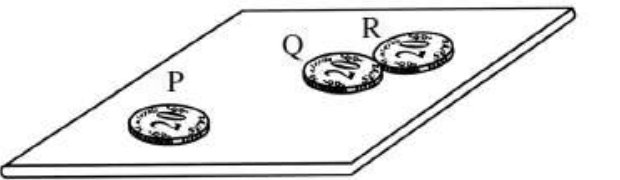
Diagram 2 shows three identical coins, P, Q and R, at rest on a horizontal surface. What happens if P is pushed and collided with Q?
P / Q / R
A Moves / Stationary / Stationary
B Stationary / Stationary / Moves
C Moves / Moves / Stationary
D Moves / Stationary / Moves
Medium
Which of the following systems will give the greatest acceleration on an object of mass m?
Medium
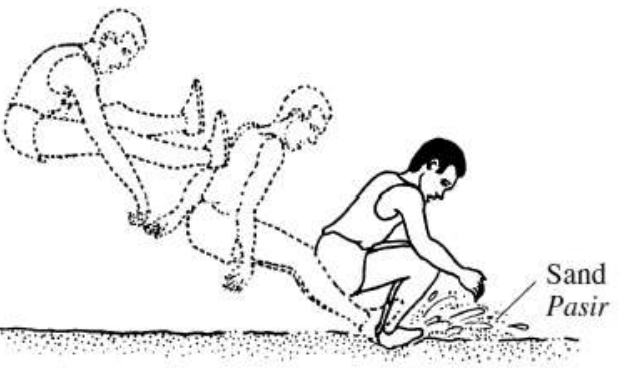
Diagram 3 shows an athlete bending his legs upon landing in a long jump event. The athlete bent his legs to reduce the
A impulse on his feet
B impulsive force on his feet
C velocity just before landing
D time of impact between his feet and the sand
Medium
What is the reason for the motion of the Moon on its orbit?
A The gravitational force exerted by the Sun.
B The gravitational force exerted by the Planets.
C The gravitational force exerted on the Earth by the Moon.
D The gravitational force exerted on the Moon by the Earth.
Easy
The period of a satellite in a circular orbit of radius R is T. The period of another satellite in circular orbit of radius 4R is
A 8T
B 2T
C ¼T
D ½T
Medium
Two objects that are said to be in thermal equilibrium have
A the same mass
B the same temperature
C the same heat capacity
D the same amount of heat energy
Easy
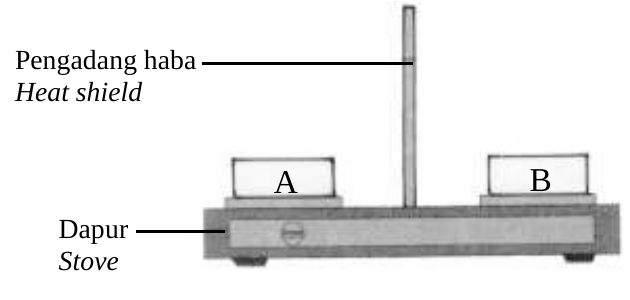
Diagram 4 shows solid blocks A and B of equal mass, being heated. The initial temperature of A and B is the same and they are heated by the same amount of energy. It is observed that A is hotter faster than B. This observation is due to the difference in
A melting point
B density
C specific heat capacity
D latent heat of fusion
Medium
Which of the following graphs (pressure P/kPa against temperature T/K) is related to Gay-Lussac’s Law?
Easy
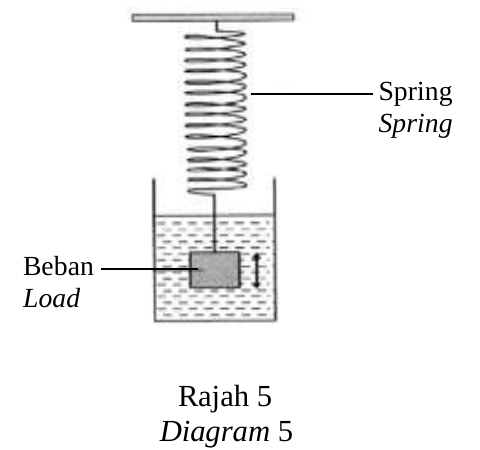
Diagram 5 shows a load tied to a spring which oscillates vertically in the water. Which of the following displacement-time graphs shows the oscillation of the load?
Medium
Which statement is correct when water waves are reflected by a reflector?
A The wavespeed before and after reflection are the same.
B Frequency of the water waves become smaller after reflection.
C The wavelength of the water waves become longer after reflection.
Medium
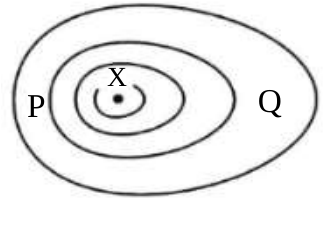
Diagram 6 shows wave patterns produced in ripple tank by a circular vibrator at X. Which of the following statements is true?
A Region P is deeper than region Q.
B Region Q is deeper than region P.
C Both regions P and Q have uniform depth.
D The speed in region P is greater than the speed in region Q.
Medium
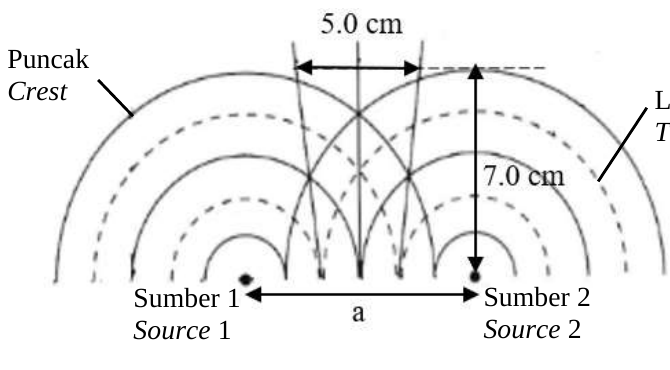
Diagram 7 shows an interference pattern produced by two sources of water waves. If the wavelength is 1.0 cm, then what is the value of a, the distance between the two sources?
A 1.0 cm
B 1.4 cm
C 2.8 cm
D 3.2 cm
Medium
Which of the following is a property of an electromagnetic wave?
A It can be polarised
B It is a longitudinal wave
C It cannot propagate through vacuum
Easy
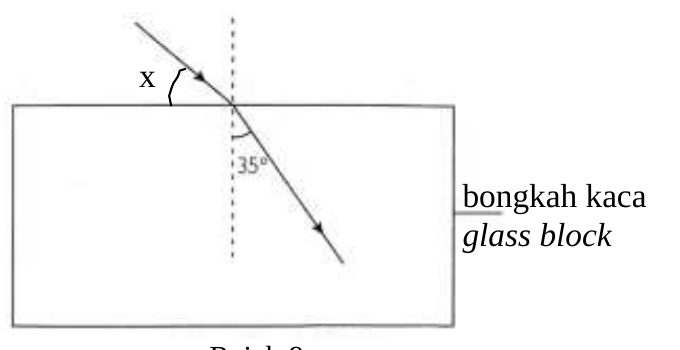
Diagram 9 shows a ray of light passing into a glass block. The refractive index of the glass is 1.52. The angle of refraction shown is 35° and x is the angle between the incident ray and the glass surface. What is the angle of x?
A 23.0°
B 29.3°
C 60.7°
D 67.0°
Medium
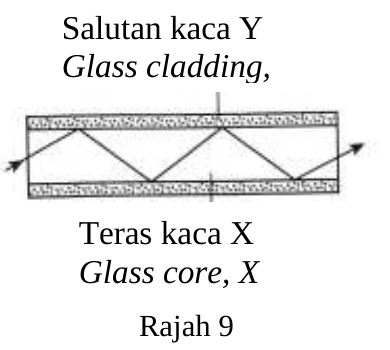
Diagram 9 shows a light ray travelling through an optical fiber. The optical fiber has a glass core, X, of refractive index, nX and a glass cladding, Y, of refractive index, nY. Which of the following is correct?
A nX = nY
B nX > nY
C nX < nY
D nX < 1, nY > 1
Medium
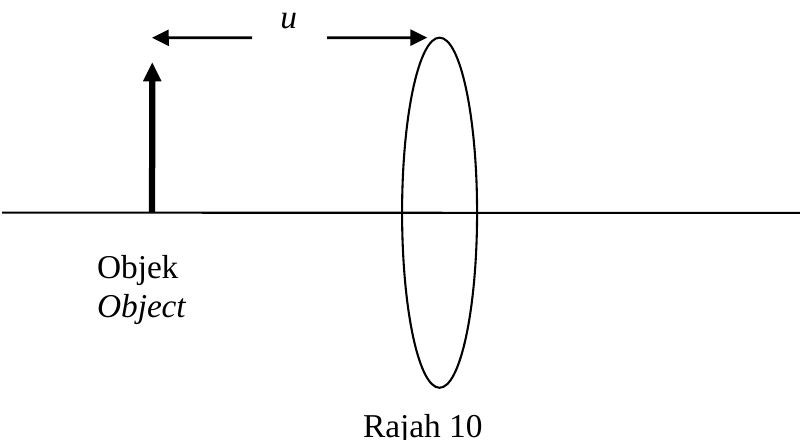
Diagram 10 shows an object placed at u cm from the center of a convex lens. The focal length of the lens is 30 cm. Which of the following characteristics of the image is correct if u is 25 cm, 40 cm, 60 cm and 70 cm from the lens?
A u = 25 cm: Virtual and bigger
B u = 40 cm: Virtual and smaller
C u = 60 cm: Real and smaller
D u = 70 cm: Real and bigger
Medium
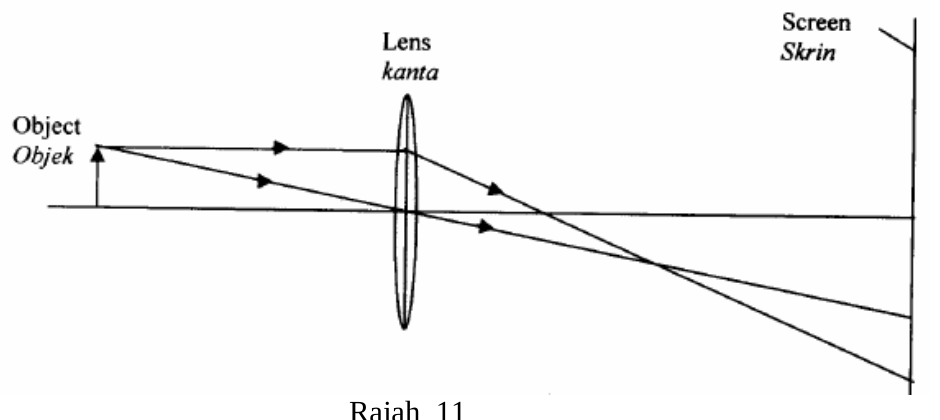
Diagram 11 shows the image formed on the screen is blurred (the rays from the lens meet before reaching the screen). Which modification will produce a sharp image on the screen?
A Replace the lens with another convex lens of longer focal length
B Replace the lens with another convex lens of shorter focal length.
C Move the object further from the lens.
D Move the object until it is at the focal point of the lens.
Medium
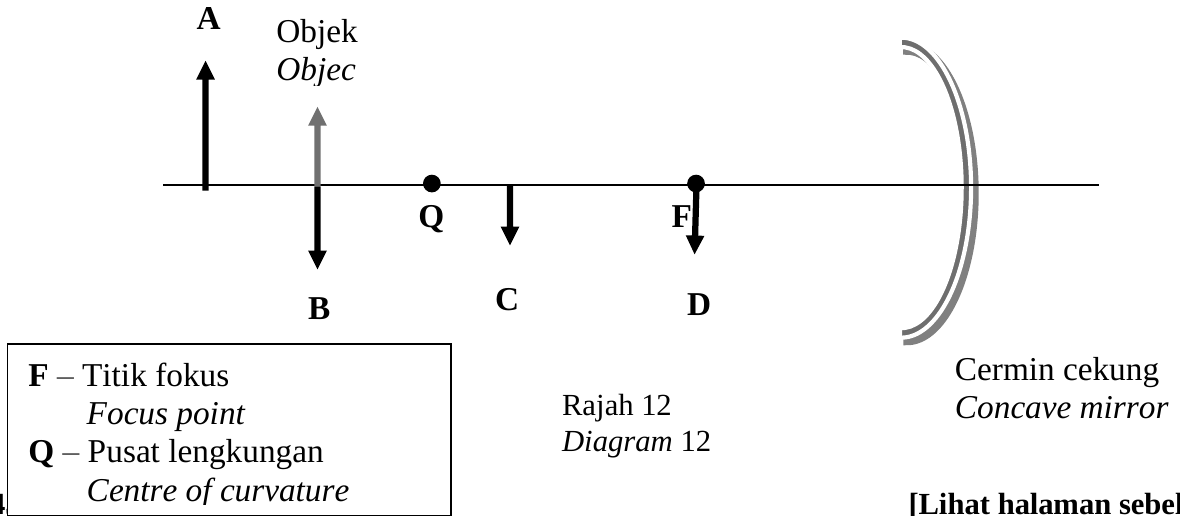
Diagram 12 shows an object in front of a concave mirror. Which is the correct image? (F = focus point, Q = centre of curvature; candidate images are marked A, B, C and D on the diagram.)
Medium
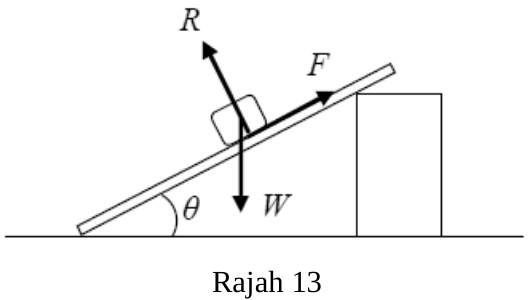
Diagram 13 shows an object is at rest on a rough inclined plane (R normal reaction, F friction, W weight, angle of incline θ). Which relationship is correct?
A R = F cos θ
B R = W sin θ
C F = W cos θ
D F = W sin θ
Medium
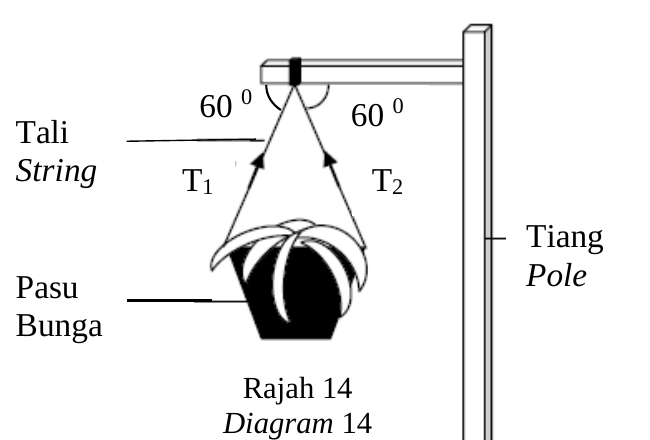
Diagram 14 shows a flower pot of weight W hanging from a pole by two strings with tensions T1 and T2, each at 60° to the horizontal. Which of the vector diagrams represent the forces T1, T2 and W acting on the load?
Medium
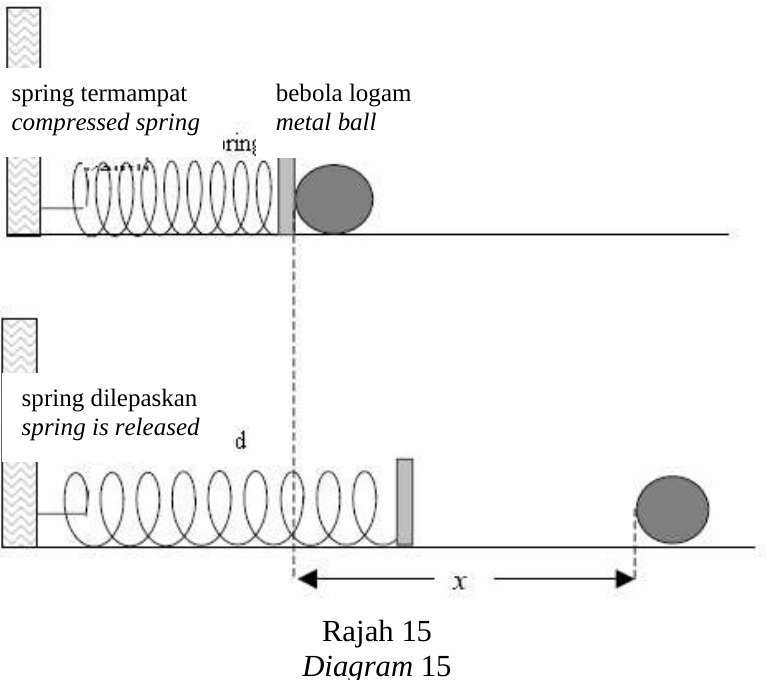
Diagram 15 shows the position of a metal ball at the compressed spring and after the spring is released. Distance x can be increased by using
A a softer spring
B a longer spring
C a spring with bigger diameter
D two identical springs connected in parallel
Medium
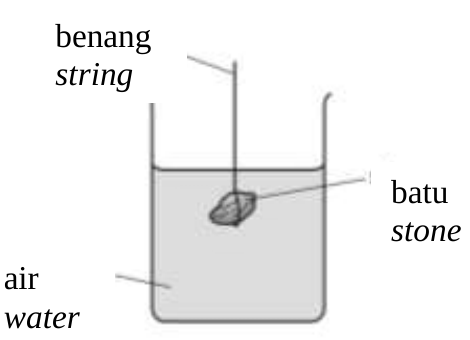
Diagram 16 shows a stone suspended on a string under the surface of the water in a beaker. The stone experiences a pressure caused by the water. What would lower the pressure on the stone?
A using a liquid with a lower density
B substituting the water with cooking oil
C lowering the stone into the water
D decreasing the surface area of the stone
Medium
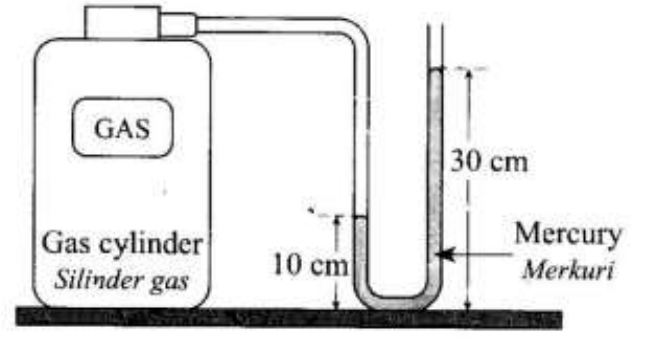
Diagram 17 shows a mercury filled manometer connected to a gas cylinder (mercury levels differ by 20 cm; labels 10 cm and 30 cm on the diagram). Determine the gas pressure in the gas cylinder. [Atmospheric pressure = 75 cm Hg]
A 65 cm Hg
B 85 cm Hg
C 95 cm Hg
D 105 cm Hg
Medium
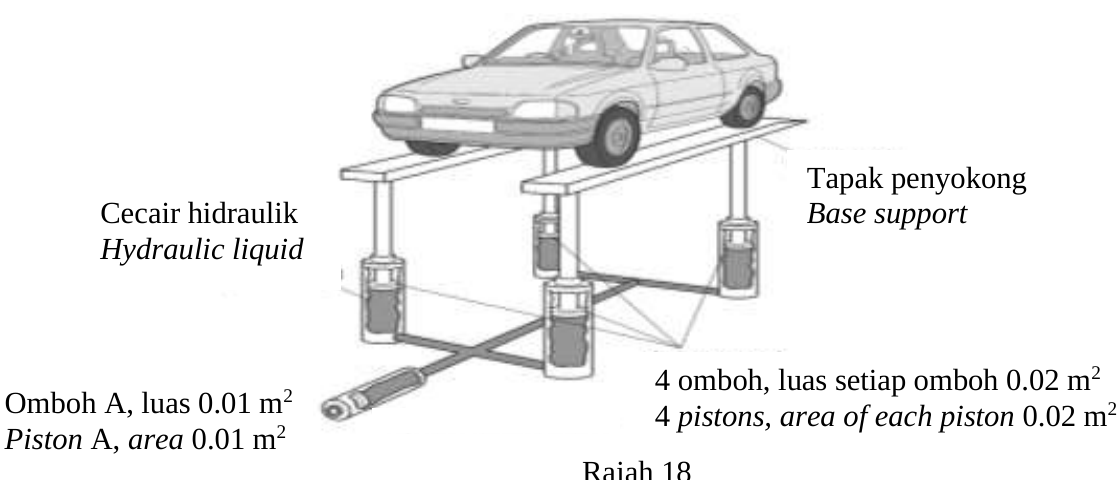
Diagram 18 shows a hydraulic lift in a car repair workshop (input piston A area 0.01 m²; 4 pistons, area of each 0.02 m²). It is given that the force exerted on piston A to lift the car and the car support is 2000 N. Determine the total weight of the base support and the car.
A 32 000 N
B 16 000 N
C 8 000 N
D 4 000 N
Medium
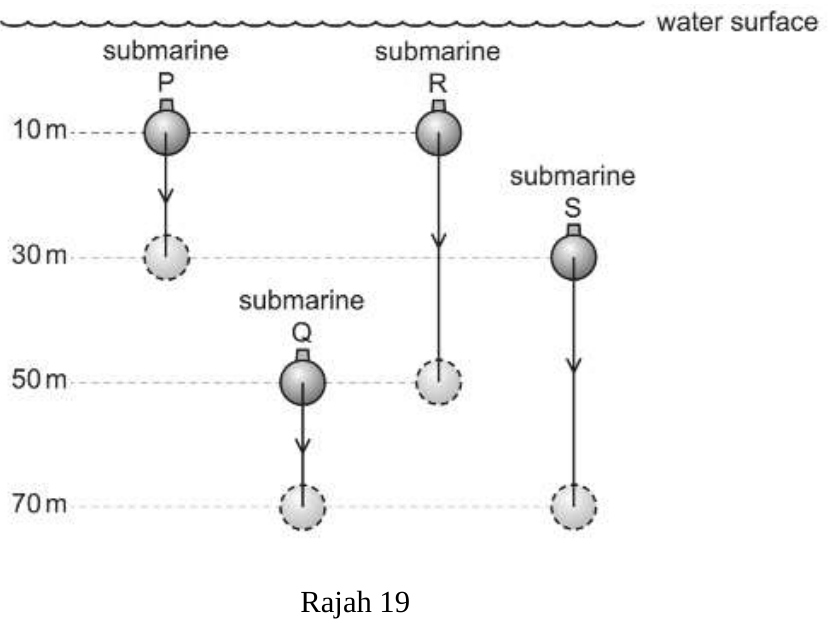
Four identical submarines P, Q, R and S are lowered from one depth to another in water of constant density (P: 10 m to 30 m; R: 10 m to 50 m; Q: 50 m to 70 m; S: 30 m to 70 m, as in Diagram 19). Which submarines experience the same change in pressure?
A P and R
B P and Q
C Q and R
D Q and S
Medium
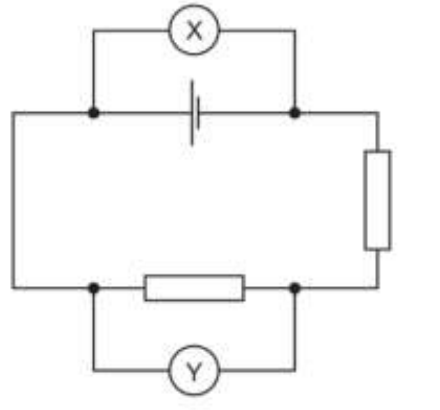
Diagram 20 shows a circuit with two measuring instruments X and Y connected correctly (both connected in parallel across a component). The unit measured by instrument X and Y are
X / Y
A ampere / ampere
B ampere / volt
C volt / ampere
D volt / volt
Easy
A student uses a length of wire as a resistor. To decrease the resistance, he needs wire that is …
A longer and thinner.
B longer and thicker.
C shorter and thinner.
D shorter and thicker.
Medium
Which of the following electric circuit components produces an electromotive force (emf)?
A Dry cell
B Resistor
C Diode
D Transistor
Easy
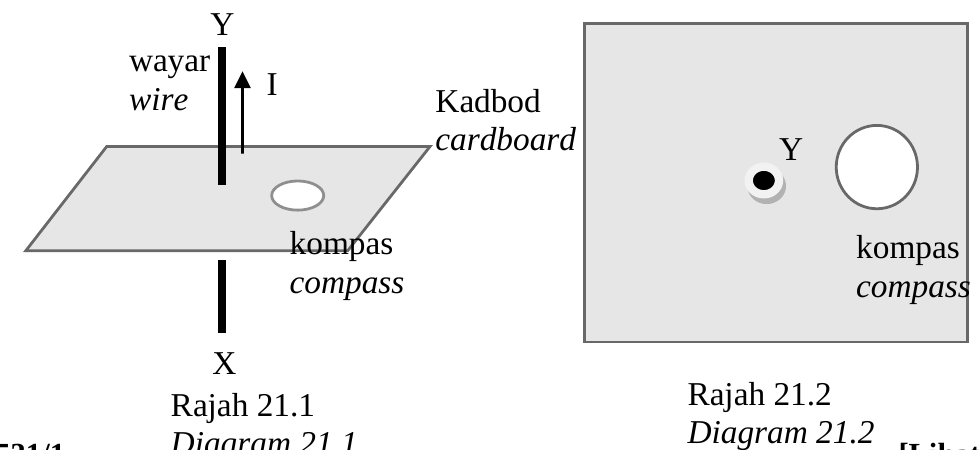
Diagram 21.1 shows electric current flows through wire XY (upward, from X to Y, through a cardboard). Diagram 21.2 shows the top view of the cardboard (wire at Y shown as a dot, compass beside it). Which diagram shows the correct position of compass needle when a current flows from X to Y?
Medium
Induced current flows in such a way that it opposes the change that produced it. This is
A Faraday’s law
B Snell’s law
C Lenz’s law
D Ohm’s law
Easy
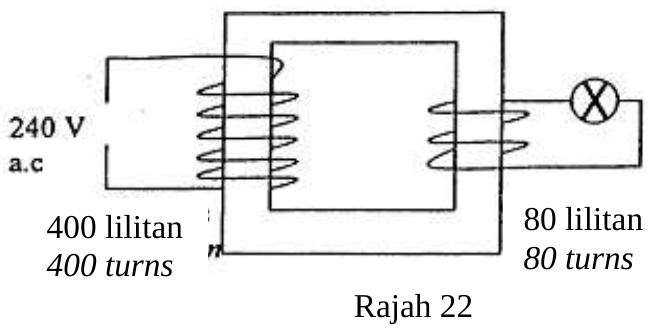
Diagram 22 shows a transformer that is used to light up a bulb (primary 240 V a.c., 400 turns; secondary 80 turns). Which of the following statements is true about the transformer?
A Step-up, 1200 V
B Step-up, 480 V
C Step down, 120 V
D Step down, 48 V
Medium
The release of electrons from a surface of a metal when it is heated is known as
A photon
B X-ray
C photoelectric
D thermionic emission
Easy
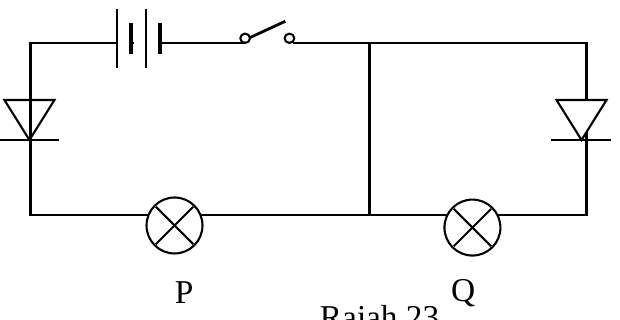
Diagram 23 shows a circuit containing two identical bulbs P and Q that are connected to a battery and two diodes. What happens to the bulbs when the switch is on?
P / Q
A Light off / Light off
B Light off / Light up
C Light up / Light off
D Light up / Light up
Medium
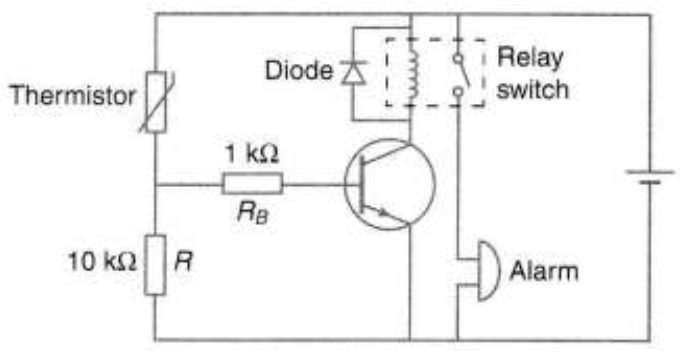
Diagram 24 shows a heat-controlled switch in a transistor circuit. Which of the following statements is true?
I The transistor is npn.
II The alarm will be turned on in cold conditions.
III The voltage across the 10 kΩ resistor increases in hot conditions
IV The resistance of the thermistor increases linearly to the temperature
A I and III
B II and IV
C I, II and III
D II, III and IV
Medium
Which of the following is a fission reaction?
A ²₁H + ²₁H → ³₂He + ¹₀n + E
B ²²⁶₈₈Ra → ²²²₈₆Rn + α + E
C ²¹₁₁Na → ²¹₁₂Mg + β + E
D ²³⁹₉₂U → ⁹⁵₃₈Sr + ¹⁴¹₅₄Xe + 3¹₀n + E
Medium
Calculate the power of the red light lamp which emits 1.76 × 10²⁰ photons per second. Wavelength, λ, of red light = 7.0 × 10⁻⁷ m. Given Planck constant, h = 6.63 × 10⁻³⁴ J s
A 40 W
B 50 W
C 120 W
D 150 W
Medium
Photoelectric effect is used in
I Solar panel
II Polaroid camera
III Laser pointer
IV Endoscope
A I and III
B II and IV
C I, II and III
D II, III and IV