Write your answer on paper. Then open the answer to check it.
Section A
Given an equation relating the photon energy, E and the frequency of light, f: E = hf.
Medium4 marks- (a)
What is the meaning of frequency?
[1] - (b)
Complete the sentence by ticking the correct answer. Symbol h represents: De Broglie constant / Planck constant.
[1] - (c)
What is the S.I. unit of h?
[1] - (d)
What will happen to the photon energy, E if the frequency of light increases?
[1]
Diagram 2 shows the Earth, the Moon and a satellite. There is gravitational force acting on the Earth, Moon and satellite.
Medium5 marks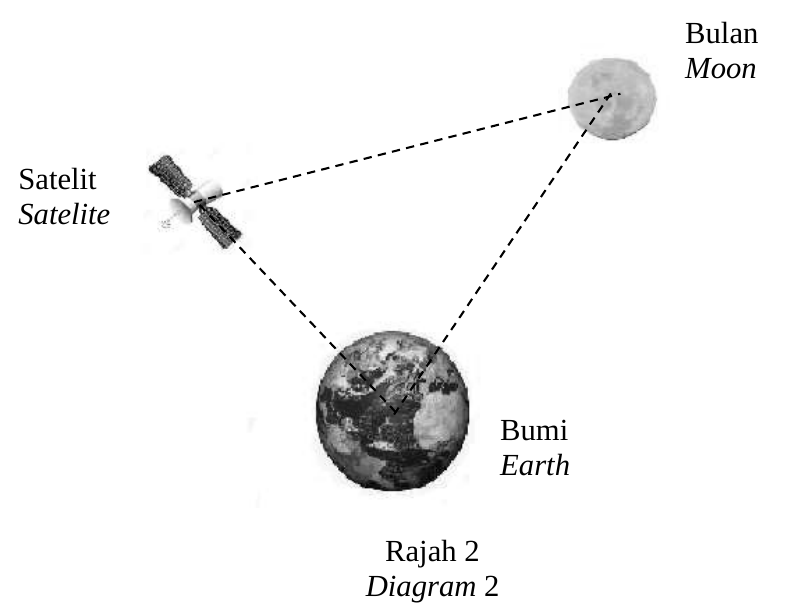
- (a)
What is the meaning of gravitational force?
[1] - (b)
Calculate the gravitational force between the Earth and the satellite. [Earth's mass = 5.97 × 10²⁴ kg, satellite mass = 1.2 × 10³ kg, distance between Earth's centre and satellite centre = 7.87 × 10⁶ m; G = 6.67 × 10⁻¹¹ N m² kg⁻²]
[2] - (c)
Which pair of bodies experience the smallest gravitational force? Give a reason for your answer.
[2]
Diagram 3 shows the sound waves produced in air when a gong is hit by a hammer (compressions and rarefactions; labelled distances 0.8 m and 1.2 m; region X marked).
Medium6 marks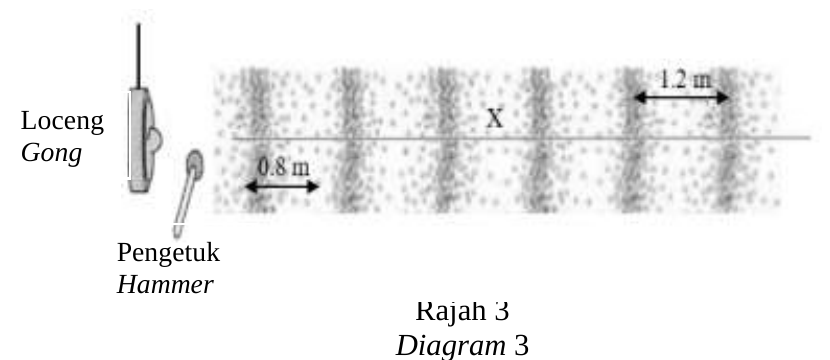
- (a)
State the type of sound wave.
[1] - (b)(i)
Name region X.
[1] - (b)(ii)
Determine the wavelength of the sound wave produced by the gong.
[1] - (c)
Speed of sound in the air is 330 m s⁻¹. Calculate the frequency of the sound wave.
[2] - (d)
When sound wave travels through water, state what happens to the speed of wave.
[1]
Diagram 4 shows a monkey holding firmly a light rope that passes over a frictionless pulley and is attached to a 15 kg bunch of bananas. The monkey and the bananas are in equilibrium.
Medium9 marks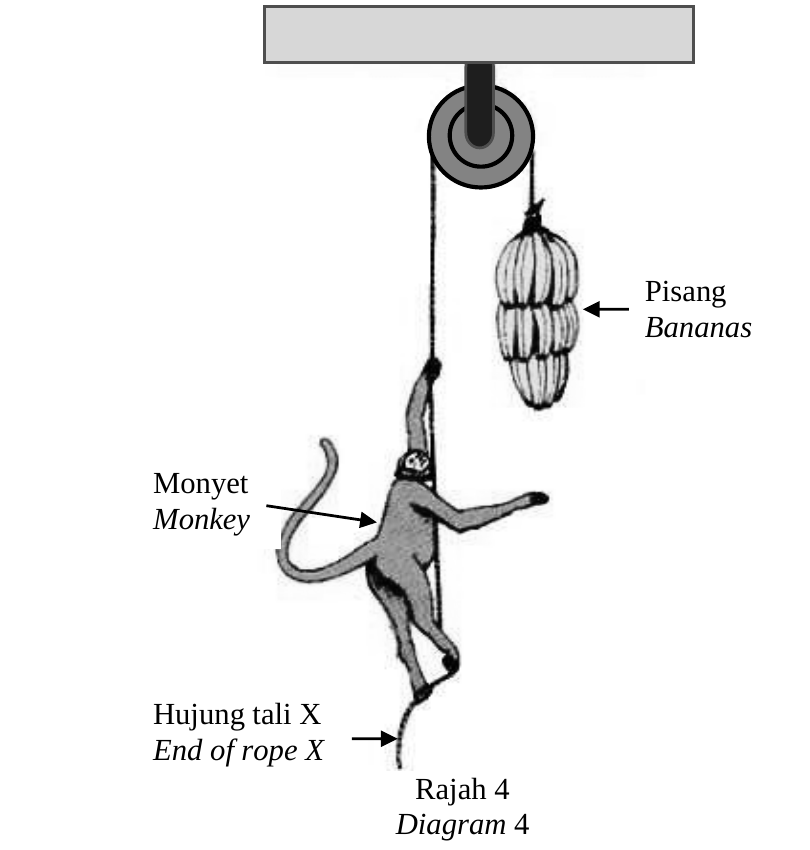
- (a)
What is the resultant force acting on the pulley system?
[1] - (b)
Indicate the direction of forces and label all the forces that act on the monkey.
[2] - (c)
What is the weight of the monkey?
[1] - (d)
Another monkey of mass 12 kg saw the bananas, jumped towards them and held the end of the rope X. What happened to the motion of both monkeys?
[1] - (e)(i)
Calculate the acceleration of the system.
[3] - (e)(ii)
Calculate the tension of the rope.
[1]
Diagram 5.1 and Diagram 5.2 show fringes formed when identical monochromatic lights pass through double slits (slit separation a, fringe separation x, screen 6 m from the double slit; y is the distance across four fringe spacings in Diagram 5.1).
Medium9 marks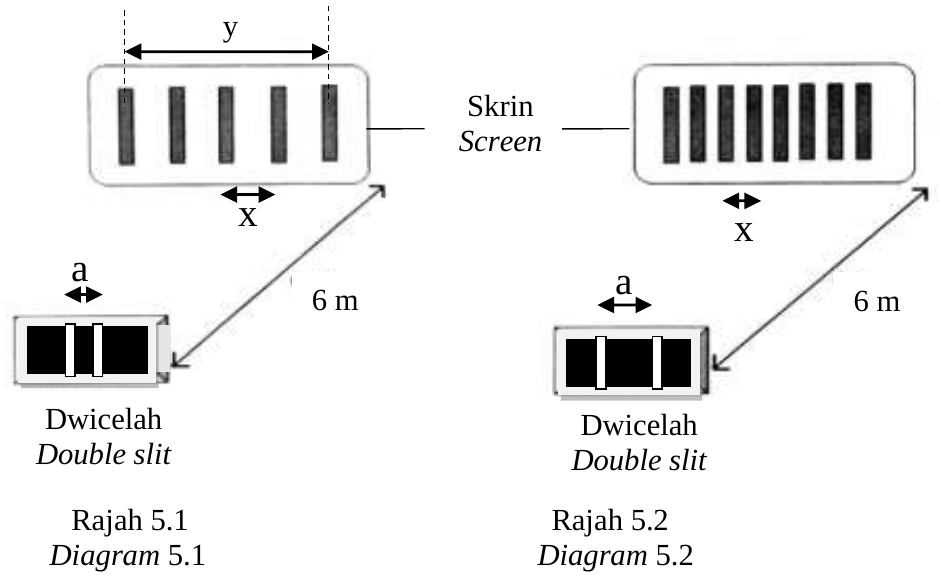
- (a)
What is the meaning of monochromatic light?
[1] - (b)(i)
Compare the distance between the slits, a.
[1] - (b)(ii)
Compare the wavelength of the light that passes through the double slits.
[1] - (b)(iii)
Compare the distance between the double slits and the screen.
[1] - (b)(iv)
Compare the distance between the fringes, x.
[1] - (c)
Using your answers in 5(b), state the relationship between x and a.
[1] - (d)
Based on Diagram 5.1, the slit separation is 0.2 mm and the wavelength of the monochromatic light is 450 nm. Calculate distance y.
[3]
Diagram 6.1(a) and 6.2(a) show two circuits used to investigate the relationship between potential difference and electric current of a constantan wire of different length. Diagram 6.1(b) and 6.2(b) show the graph of potential difference against electric current for Diagram 6.1(a) and 6.2(a) respectively. The gradient of the graph represents the resistance of the constantan wire.
Medium9 marks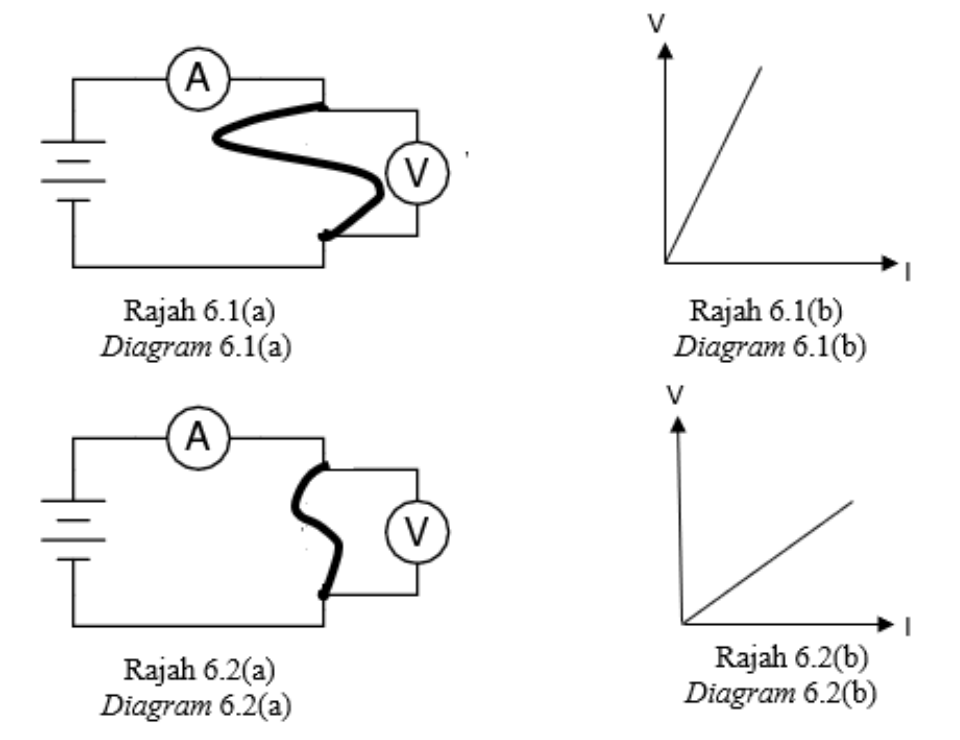
- (a)
What is the meaning of potential difference?
[1] - (b)(i)
Based on Diagram 6.1 and 6.2, compare the length of the constantan wire.
[1] - (b)(ii)
Compare the resistance of the constantan wire.
[1] - (b)(iii)
Relate the length of the wire and the resistance.
[1] - (c)(i)
Diagram 6.3 shows two resistors X and Y, each of resistance 20 Ω, connected in parallel to a 6 V dry cell. Calculate the effective resistance of the circuit.
[2]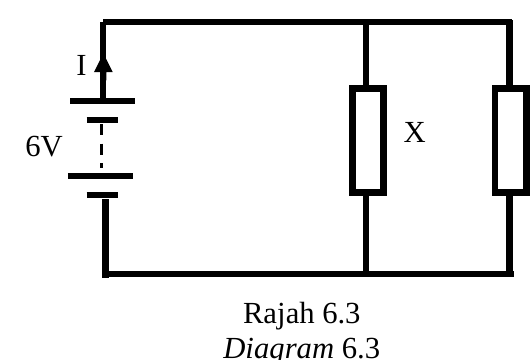
- (c)(ii)
Calculate the current, I.
[1] - (c)(iii)
Calculate the power dissipated at resistor X.
[1] - (d)
What will happen to the current, I if resistor X is removed?
[1]
Diagram 7.1(a) and 7.2(a) show two actions on landing by two athletes (Athlete A and Athlete B).
Medium9 marks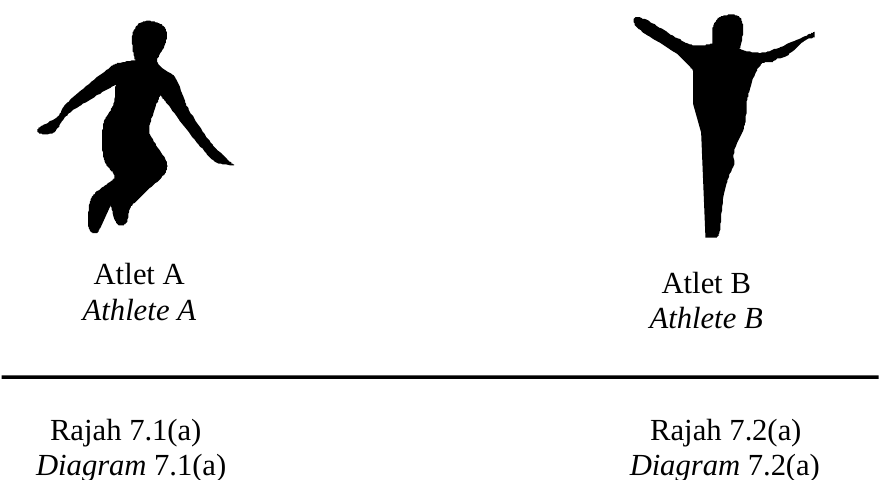
- (a)
Both athletes jumped from the same height and fall on the same ground. Name the force that causes the athletes to fall down.
[1] - (b)(i)
Both athletes of mass 50 kg jumped and landed with velocity 4 m s⁻¹ before touching the ground. The landing time for athlete A and athlete B are 0.5 s and 0.2 s respectively. Calculate the impulsive force acting on athlete A.
[1] - (b)(ii)
Calculate the impulsive force acting on athlete B.
[1] - (b)(iii)
What is the effect of time of impact on the impulsive force?
[1] - (c)(i)
Diagram 7.3 shows a set of playing equipment to be placed in a children's playground. Table 1 shows three types of ground and the height of the glider. Suggest the suitable material for the ground. Give a reason.
[2]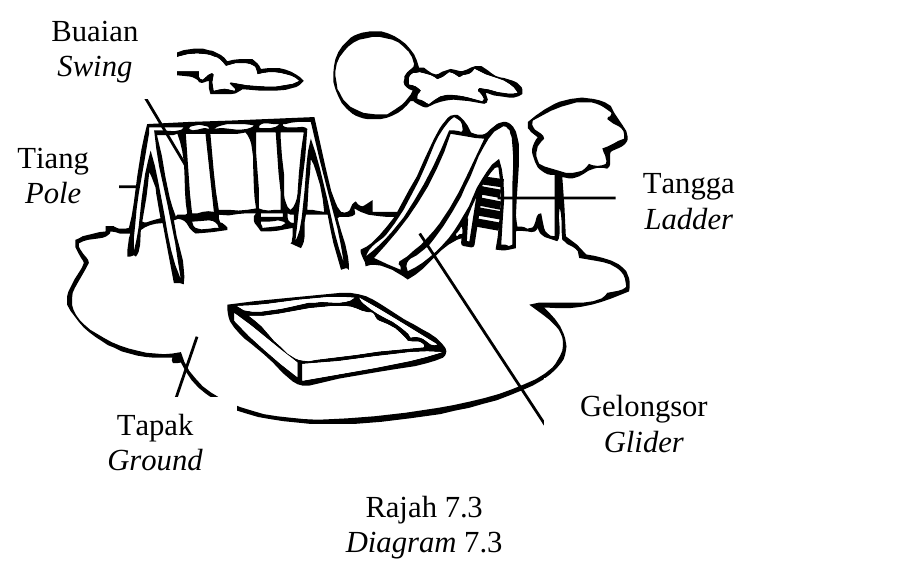
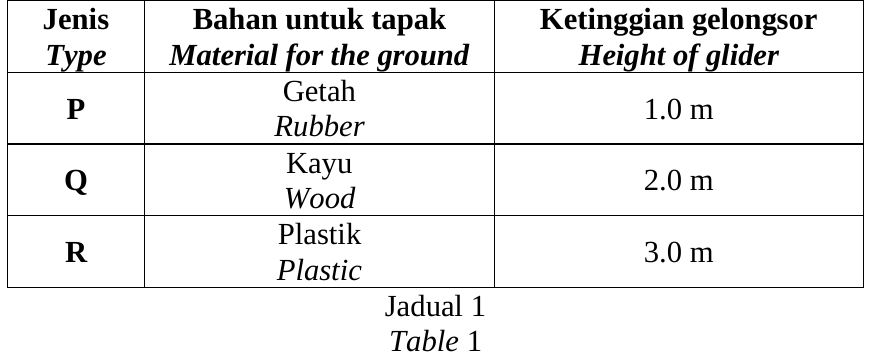
- (c)(ii)
Suggest the suitable height of the glider. Give a reason.
[2] - (d)
Based on your answers in 7(c), choose the most suitable type to be used in the playground.
[1]
Diagram 8.1 shows a copper rod placed on two electrical plates between two bar magnets (S pole above, N pole below), connected to a battery, switch and rheostat.
Medium9 marks- (a)
The switch is on. Mark and label (i) the direction of current, I through the copper rod, (ii) the direction of the magnetic field, M, (iii) the direction of the force, F produced.
[3]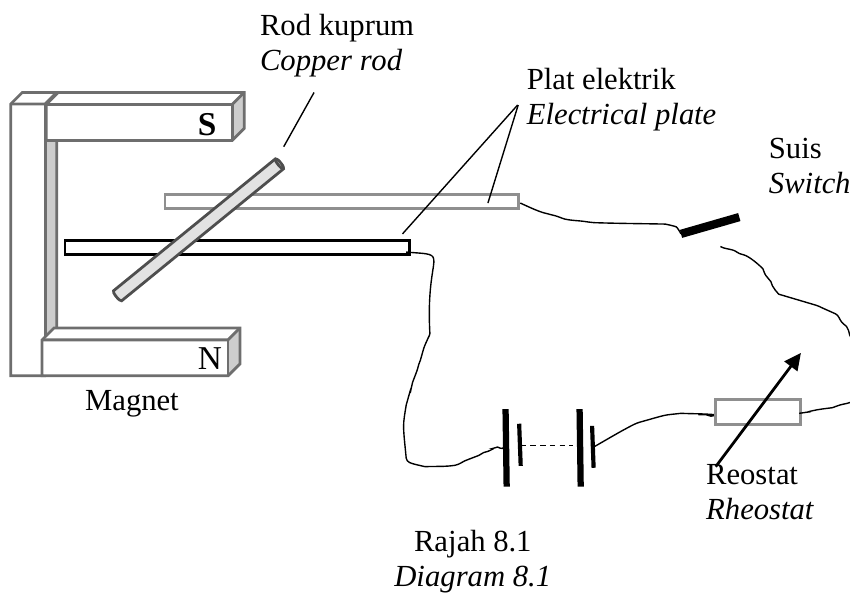
- (b)
Explain how the force is produced.
[2] - (c)(i)
Diagram 8.2 shows a simple electric motor. Suggest a modification so that the motor functions more effectively: thickness of the coil wire. Give a reason.
[2]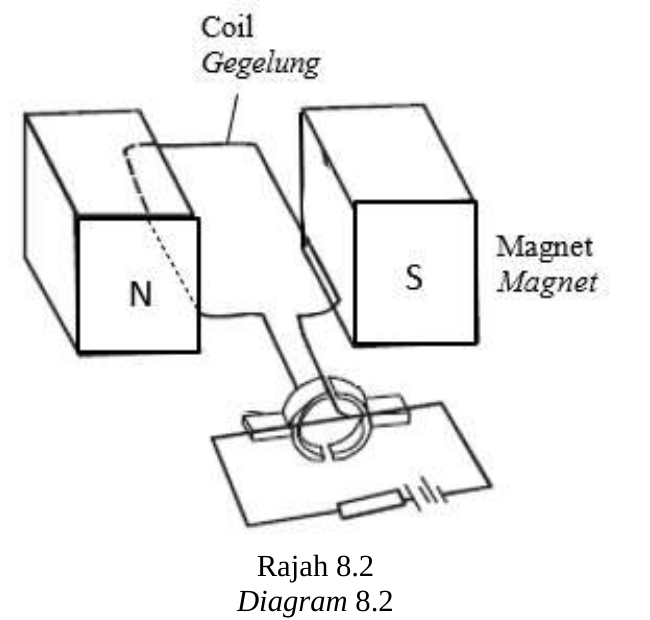
- (c)(ii)
Shape of the magnet. Give a reason.
[2]
Section B
Diagram 9.1 shows a stainless-steel straw in a glass of ice drink. The stainless-steel straw achieved thermal equilibrium.
Easy20 marks- (a)
What is the meaning of thermal equilibrium?
[1] - (b)
Based on the concept of thermal equilibrium, explain how the stainless-steel straw becomes as cold as the ice drink in the glass.
[4]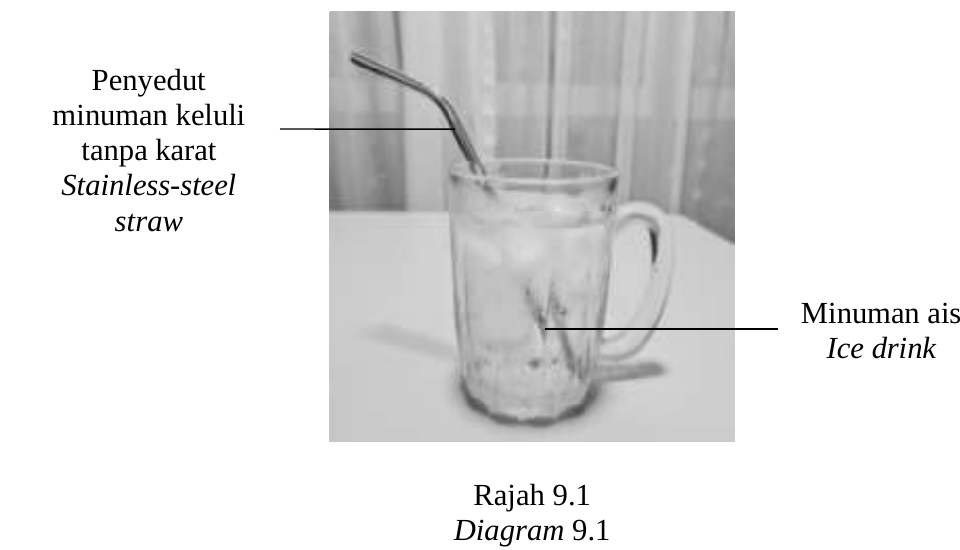
- (c)
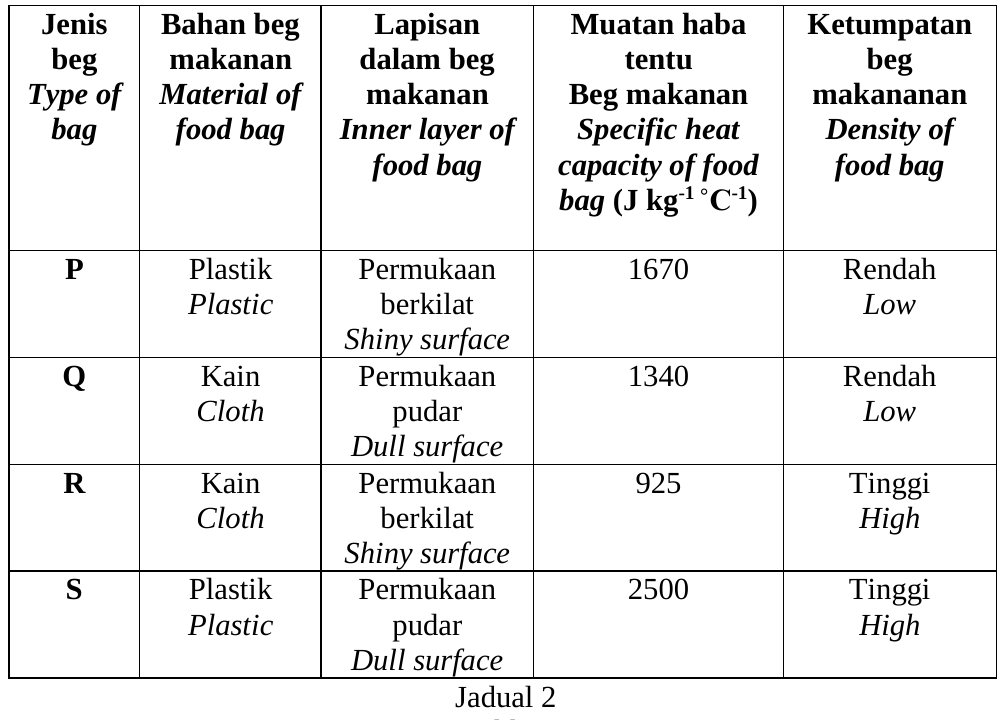
Diagram 9.2 shows a food bag used by a student to bring food to school. The food became cold during recess. Table 2 shows the specifications of four types of lunch bag P, Q, R and S. You are required to determine the most suitable food bag to keep the food warm for a few hours. Explain the suitability of each specification. Choose the most suitable food bag and give reasons for your choice.
[10]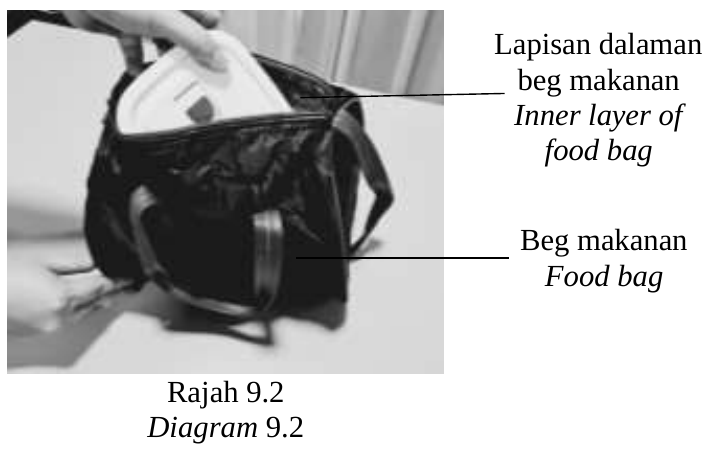
- (d)(i)
Diagram 9.3 shows a non-calibrated thermometer with a mercury column of length 4.0 cm at 0 °C and 22.0 cm at 100 °C. The column becomes 17.5 cm when immersed in liquid P. Give one reason why mercury is used as the liquid in a thermometer.
[1]
- (d)(ii)
Determine the temperature of liquid P in kelvin.
[4]
Diagram 10.1 shows the apparatus used by a student to study Archimedes' Principle. (a) A metal block is measured by a spring balance: reading 20 N. (b) The block is semi-submerged in water: reading 14 N. (c) The block is fully submerged: reading 10 N. The density of water is 1 × 10³ kg m⁻³.
Hard20 marks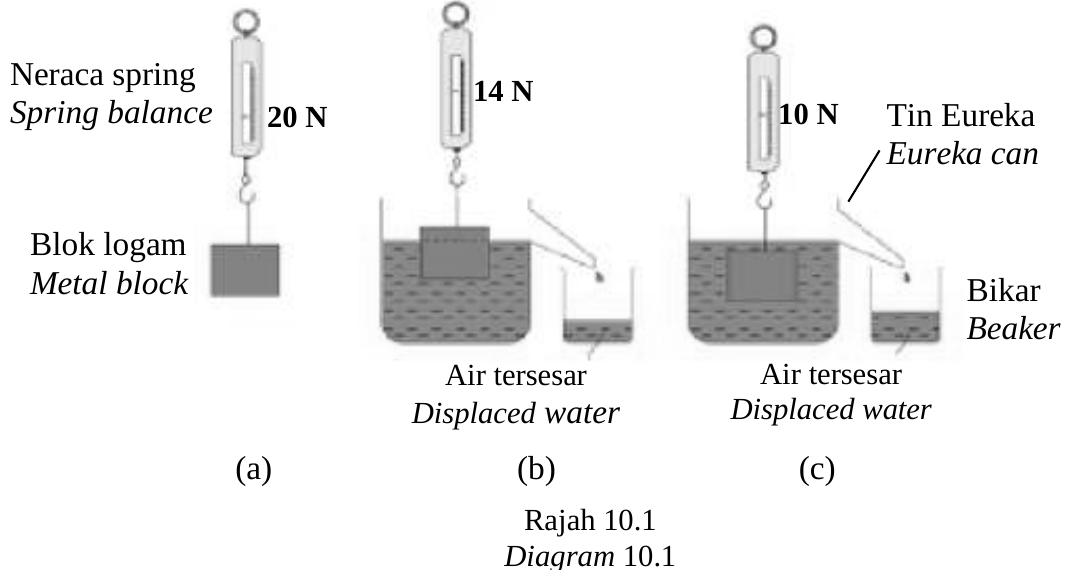
- (a)
What is Archimedes' Principle?
[1] - (b)(i)
Based on Diagram 10(a), (b) and (c): what is the buoyant force acting on the metal block in Diagram 10(b)?
[1] - (b)(ii)
Calculate the volume of the metal block in Diagram 10. The density of water is 1 × 10³ kg m⁻³.
[3] - (b)(iii)
Diagrams 10(b) and (c) show that the volume of displaced water increases when the block is lowered into the water. What would happen to the volume of displaced water if the block is lowered further into the water?
[1] - (c)
A deep submergence vehicle (DSV) is required by a marine mining company to carry out deep sea rescue operations. The vehicle must submerge and emerge quickly, travel at high horizontal speed and carry a number of crew safely. Table 3 gives characteristics of four DSVs P, Q, R and S. Explain the suitability of each characteristic listed and determine which DSV should be chosen. Give reasons for your choice.
[10]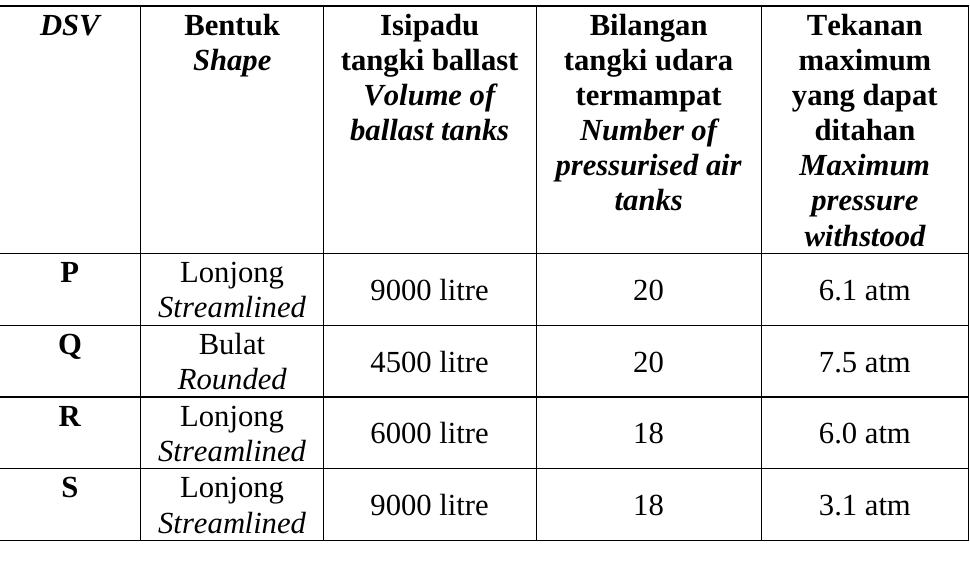
- (d)
Diagram 10.2 shows a person pushing a ball below the surface of the water. When released, the ball rushes upwards, out of the water. Explain how this situation happens.
[4]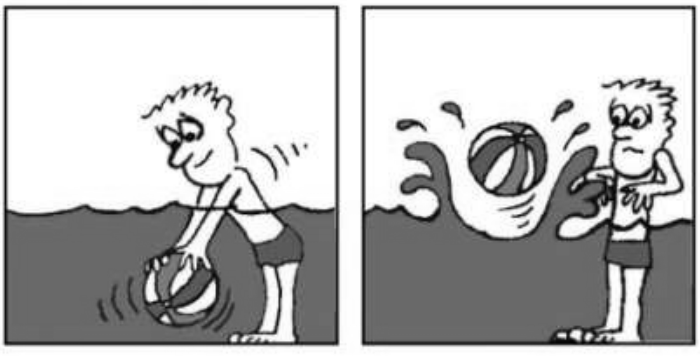
Section C
Diagram 11.1 and 11.2 show refraction of light through two media of different density. Refractive index of medium X and Y are 1.51 and 2.05 respectively (angle of incidence 60° in both; angle of refraction 35° in X and 25° in Y).
Medium20 marks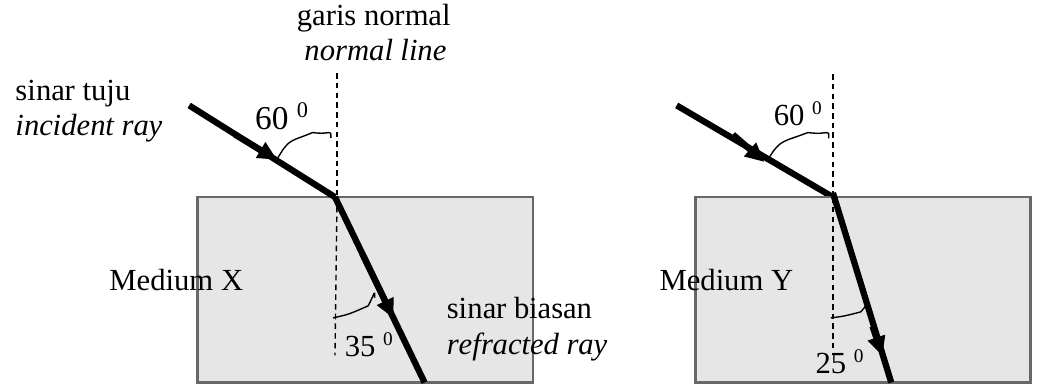
- (a)
What is the meaning of refractive index?
[1] - (b)(i)
Compare the refracted angle, refractive index and the density between medium X and medium Y.
[3] - (b)(ii)
Relate the refracted angle with the refractive index to make a deduction on the relationship between refractive index and the density of the medium.
[2] - (c)
Diagram 11.3 shows the structure of an optical fibre. You are to suggest characteristics of the optical fibre so that it can be used in communications and medicine. State and explain your suggestion based on: (i) features of optical fibre, (ii) comparison between the refractive index of inner core and the outer cladding, (iii) flexibility, (iv) purity of inner core, (v) additional features.
[10]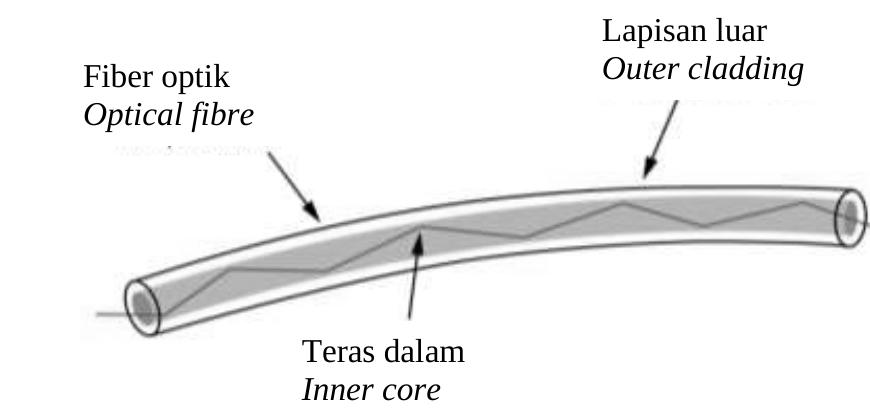
- (d)
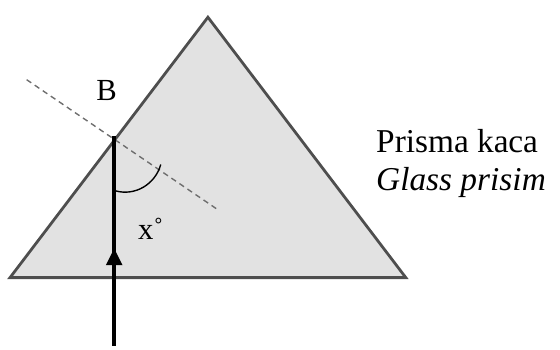
Diagram 11.4 shows a light ray propagating towards a glass prism which has a critical angle of 42° (the paper's English text says refractive index 1.5). Explain what will happen to the light ray at point B if (i) x = 30°, (ii) x = 50°.
[4]