Write your answer on paper. Then open the answer to check it.
Section A
Diagram 1 shows an electrical circuit using electronic component X (a diode connected in series with a switch, a bulb and a cell).
Medium4 marks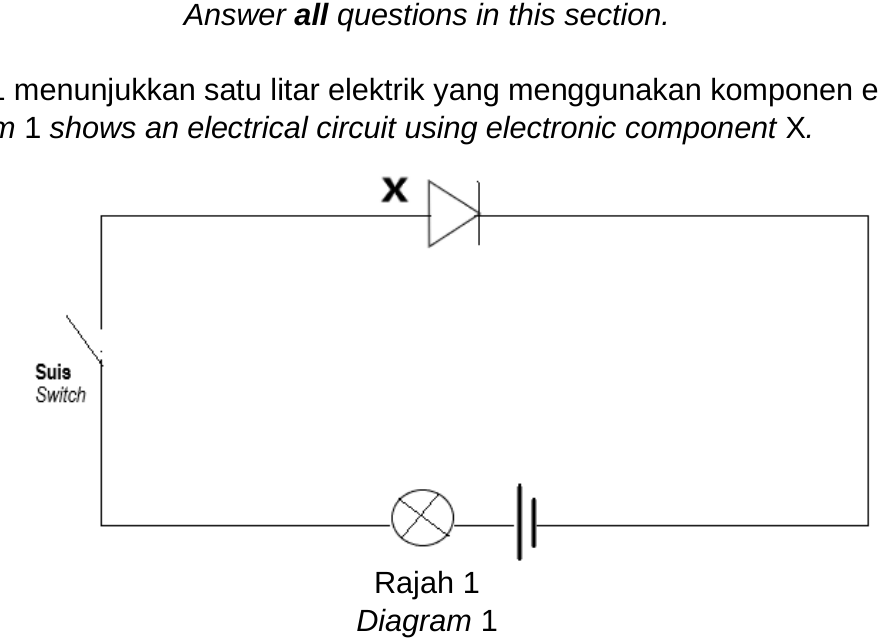
- (a)
Name the electronic component X.
[1] - (b)
Underline the correct answer: The X component allows current to flow in (one way / two way).
[1] - (c)
When the switch is ON, what will happen to the bulb? Give the reason.
[2]
Diagram 2.1 shows the process of a nuclear reaction in a nuclear reactor to generate electricity: n(1,0) + U(235,92) → Xe(140,54) + Sr(94,38) + 2 n(1,0) + ENERGY.
Medium5 marks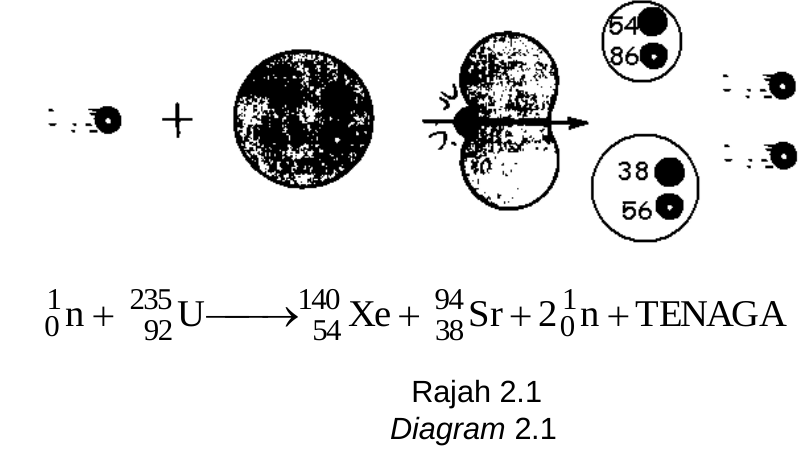
- (a)
Name the nuclear reaction that happens in the nuclear reactor.
[1] - (b)
Based on Diagram 2.1, explain how the nuclear reaction continues and how it can be used to generate electrical energy.
[2] - (c)
Given the mass defect is 0.1876 u in the nuclear reaction, calculate the nuclear energy produced. [1 u = 1.66 × 10⁻²⁷ kg]
[2]
Diagram 3.1 shows the spectrum produced by mercury lamp light (a few separate bright lines on a dark background).
Medium6 marks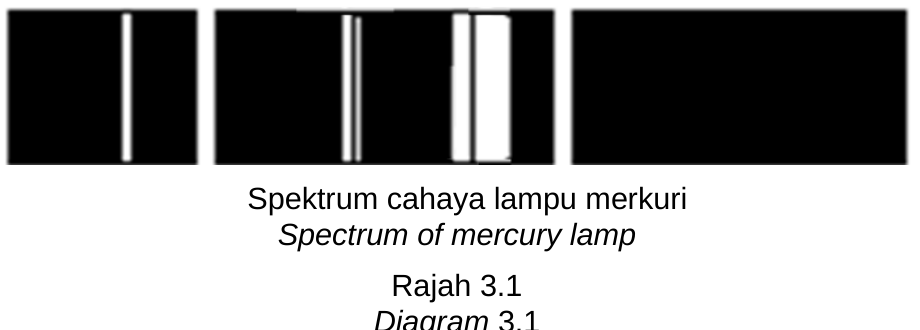
- (a)(i)
Referring to Diagram 3.1, name the spectrum of light produced by the mercury lamp.
[1] - (a)(ii)
State one characteristic of the spectrum of the mercury lamp.
[1] - (b)
Based on your answer in (a)(ii), deduce the energy released by the spectrum that you named in (a)(i).
[1] - (c)
Based on the light spectrum of the mercury lamp, relate the quantity of energy with the frequency radiated to deduce the meaning of quantum energy.
[1] - (d)
A laser pointer produces a beam of photons of wavelength 6.5 × 10⁻⁷ m. Given Planck's constant h = 6.33 × 10⁻³⁴ J s and speed of light c = 3 × 10⁸ m s⁻¹, calculate the energy of a photon.
[2]
An object of mass m is at a height of 3R above the Earth's surface where the Earth's radius R is 6.37 × 10⁶ m (Diagram 4.1).
Medium9 marks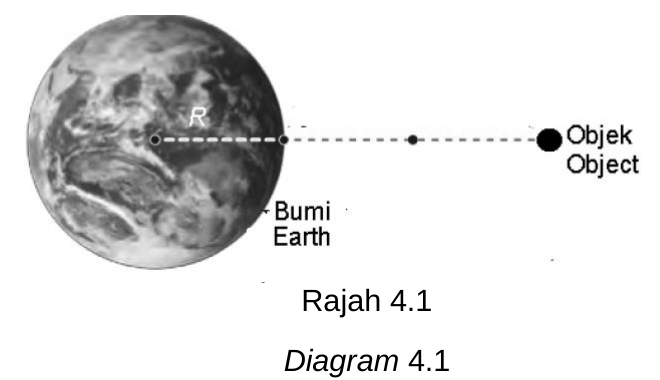
- (a)
Name the type of motion experienced by the object when it falls to the ground.
[1] - (b)(i)
If an object of greater mass falls from the same position, state whether the type of motion you stated in (a) increases, decreases or is unchanged.
[1] - (b)(ii)
Explain the answer that you gave in (b)(i).
[2] - (c)(i)
Diagram 4.2 shows a graph of the variation of the quantity you named in (a), where P is the surface of the Earth (g rises linearly from 0 to P at r = R, then falls as r increases to 4R). On Diagram 4.2, label both axes in the boxes provided.
[2]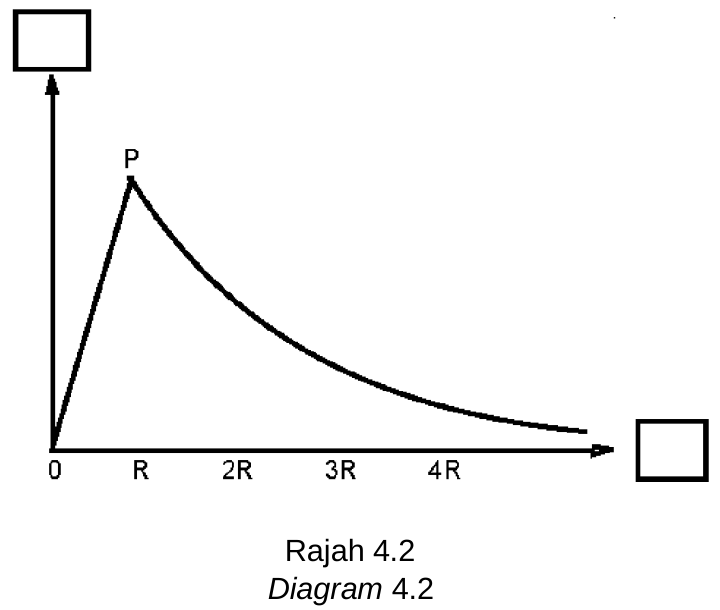
- (c)(ii)
State the value of g at point P.
[1] - (d)
The value of g affects human growth. In the table, state one effect of low g values on the blood circulation system and on bone fragility.
[2]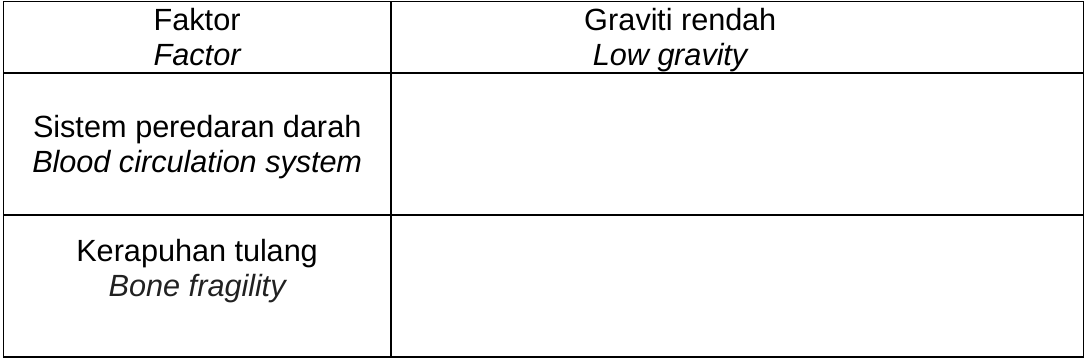
Diagrams 5.1 and 5.2 show refraction of light when propagating through two different media: Diagram 5.1 air to glass (i = 60°, r = 32°, n = 1.63); Diagram 5.2 air to diamond (i = 60°, r = 21°, n = 2.42).
Medium9 marks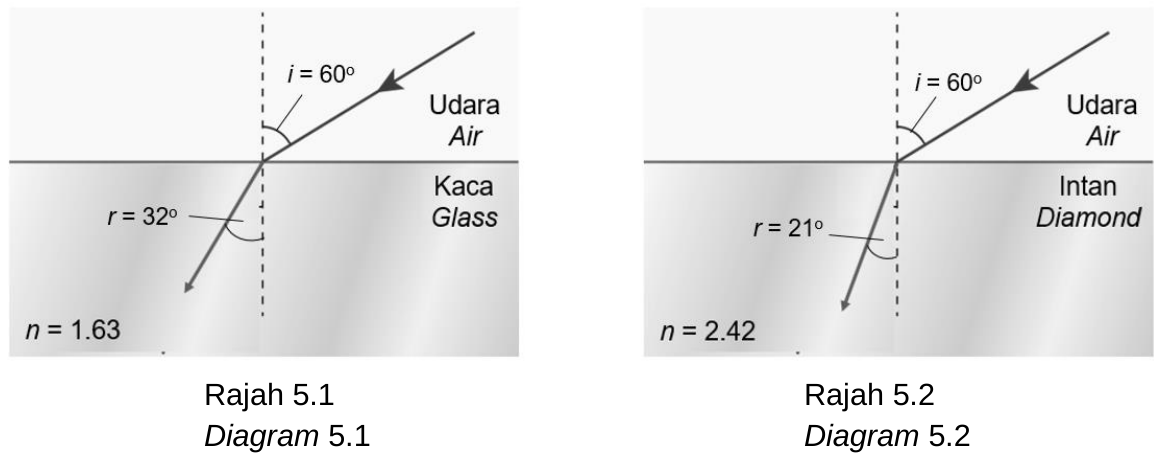
- (a)
What is the meaning of refraction?
[1] - (b)
Give one reason why light rays bend after propagating in different media as shown in Diagrams 5.1 and 5.2.
[1] - (c)(i)
Based on Diagrams 5.1 and 5.2, compare the angle of refraction, r.
[1] - (c)(ii)
Compare the refractive index, n.
[1] - (c)(iii)
Compare the optical density.
[1] - (d)(i)
Using your answers in 5(c), state the relationship between the angle of refraction, r and the refractive index, n.
[1] - (d)(ii)
State the relationship between the refractive index, n and the optical density.
[1] - (e)
If the angle of incidence, i in Diagram 5.2 is changed to 70°, calculate the angle of refraction, r.
[2]
Diagram 6.1 shows two identical bottles P and Q filled with sand floating stationary in water (Q holds more sand and sinks deeper than P).
Medium9 marks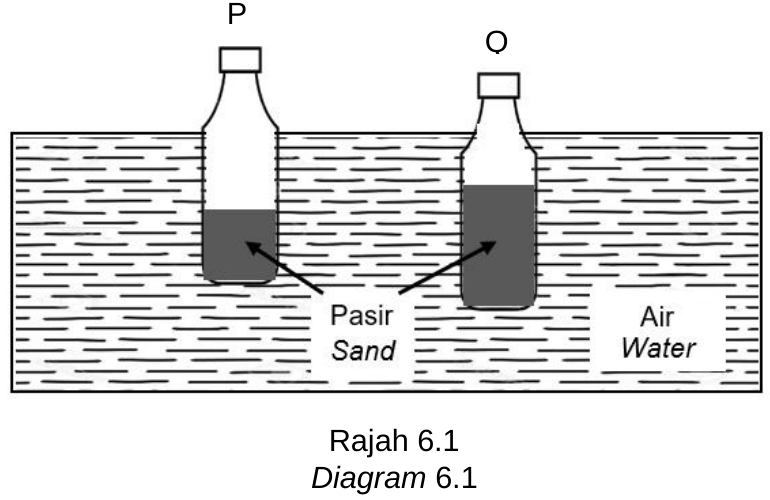
- (a)
Tick (/) the correct answer: Bottle Q floats stationary in the water because (i) the weight of Q is lower than the buoyant force; (ii) the weight of Q is greater than the buoyant force; (iii) the weight of Q is the same as the buoyant force.
[1] - (b)(i)
Observe Diagram 6.1. Compare the weight of bottles P and Q.
[1] - (b)(ii)
Compare the volume of bottles P and Q immersed.
[1] - (b)(iii)
Compare the weight of water displaced by bottles P and Q.
[1] - (c)(i)
Based on 6(b), state the relationship between the weight of water displaced and the volume of the bottle immersed.
[1] - (c)(ii)
State the relationship between the weight of water displaced and the weight of the bottle.
[1] - (d)(i)
Diagram 6.2 shows a boat with two passengers and loads moving from the sea to a river. The immersed level of the boat increases as it moves towards the river. What should be done to make sure that the boat will not sink?
[1]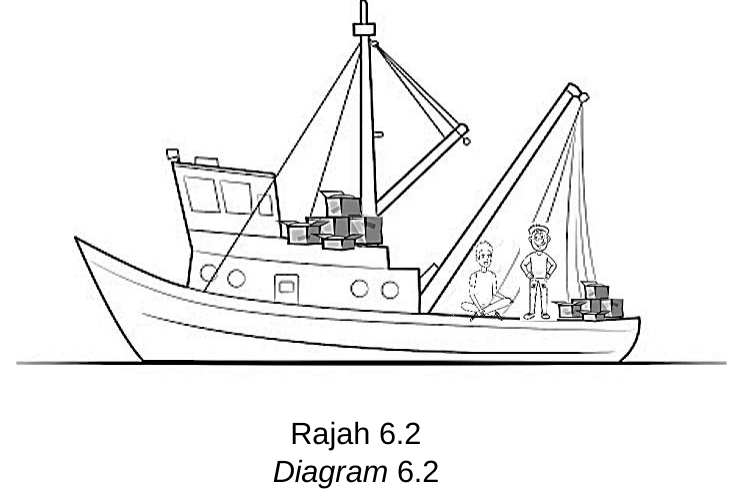
- (d)(ii)
Give one reason for your answer in 6(d)(i).
[1] - (d)(iii)
State the law involved based on the situation in (d)(i).
[1]
Diagram 7.1 shows the heating element of an electric bread toaster with specification 240 V, 100 W.
Medium9 marks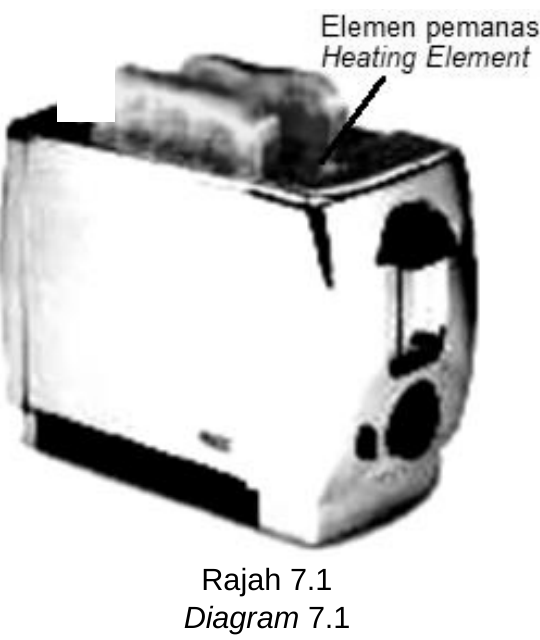
- (a)
What is meant by specification 240 V, 100 W?
[1] - (b)
When the toaster is connected to a 240 V supply, calculate the current that flows through the heating element.
[2] - (c)(i)
A student compares the heating effect of bread toasters P, Q and R, toasting two slices of bread each time. Table 7: P 240 V, 0.6 A, 90 s; Q 240 V, 0.5 A, 100 s; R 240 V, 0.4 A, 120 s. Calculate the energy supplied by each bread toaster to toast two slices of bread.
[4]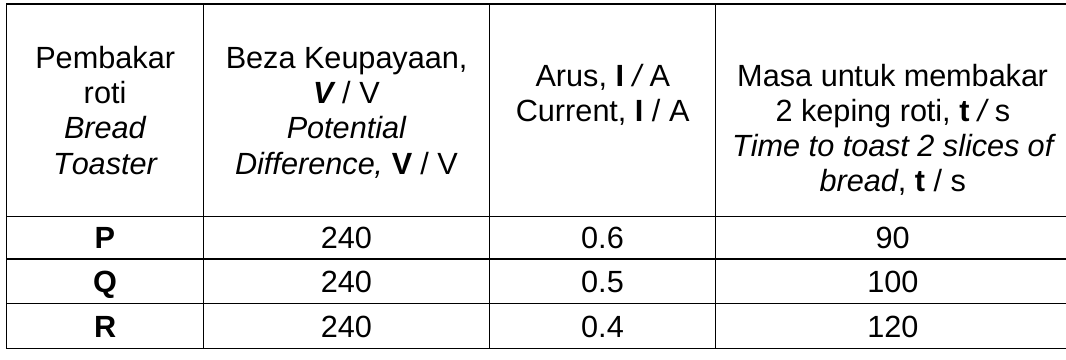
- (d)(i)
Using your answer in 7(c), state the most suitable bread toaster to toast bread.
[1] - (d)(ii)
Give one reason for your answer in 7(d)(i).
[1]
Diagram 8.1 shows two photographs of the Tacoma Narrows Bridge in Washington State, USA, that collapsed on 1 July 1940 due to resonance.
Medium9 marks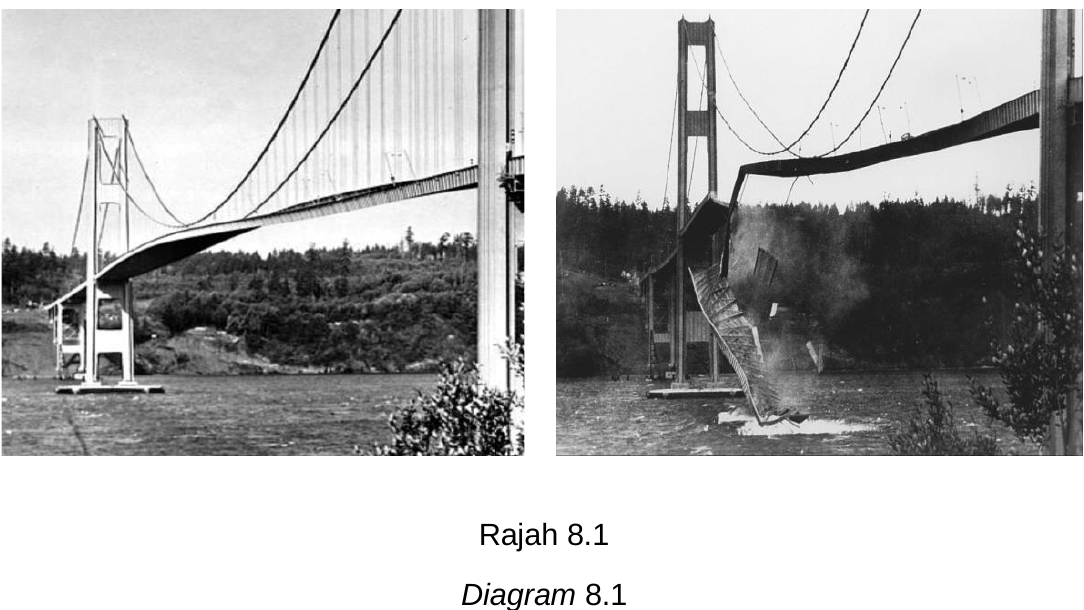
- (a)
What is the meaning of resonance?
[1] - (b)
Based on Diagram 8.1 and data from the shippai.org web, the blowing wind has a speed of 19 m s⁻¹ and a frequency of 0.6 Hz. Calculate the wavelength of the wind.
[2] - (c)(i)
Diagram 8.2 shows two shock absorber springs in a suspension system on a motorcycle. Using appropriate physics concepts, explain the use of appropriate materials and specific designs to improve the suspension system and riders' comfort on uneven roads. Aspect: length of spring. Give the reason.
[2]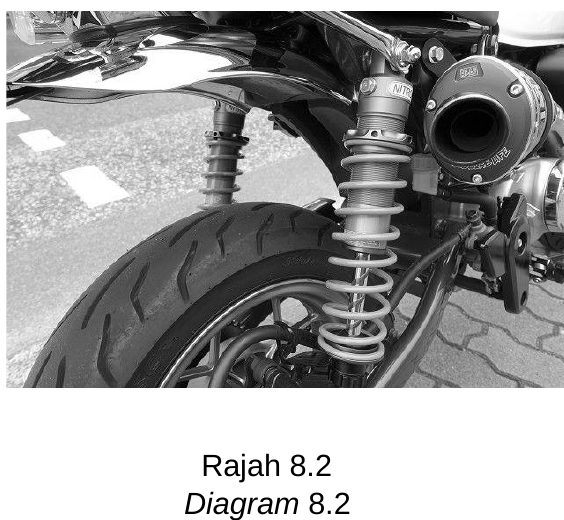
- (c)(ii)
The number of oscillations produced while receiving a shock. Give the reason.
[2] - (c)(iii)
The type of material for the spring. Give the reason.
[2]
Section B
Diagram 9.1 shows a phenomenon in daily life (wind blowing from the sea towards the land, with the Sun shining). Answer any ONE question in Section B.
Medium20 marks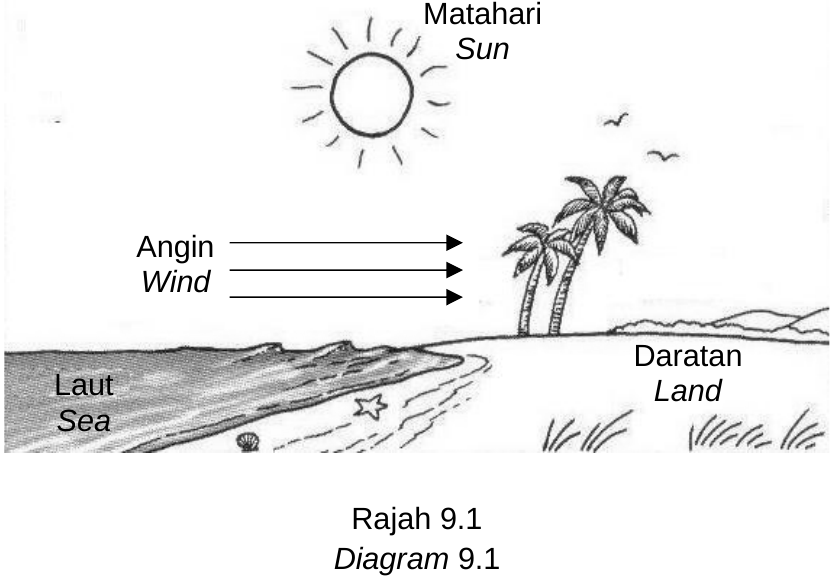
- (a)
Name the phenomenon that occurs.
[1] - (b)
Using the related physics concepts, explain how this phenomenon occurs.
[4] - (c)(i)
In an experiment, 2 kg of seawater was heated using a 400 W electric heater for 300 s. The temperature rise is 15.4 °C. Assuming no heat is lost to the surroundings, calculate the heat energy produced by the heater.
[2] - (c)(ii)
Calculate the specific heat capacity of the seawater.
[3] - (d)
Diagram 9.2 shows the apparatus to determine the specific heat capacity of an aluminium block (retort stand, thermometer, aluminium block, immersion heater, power supply, liner, wrapper, hole). Table 9.1 gives the materials: set W: wrapper tissue paper, liner copper, liquid in hole oil, heater 48 W; set X: aluminium foil, asbestos, oil, 24 W; set Y: tissue paper, asbestos, oil, 48 W; set Z: aluminium foil, copper, water, 24 W. Explain the suitability of each material in Table 9.1, then determine the most suitable set of apparatus to determine the specific heat capacity of the aluminium block. State the reason for your answer.
[10]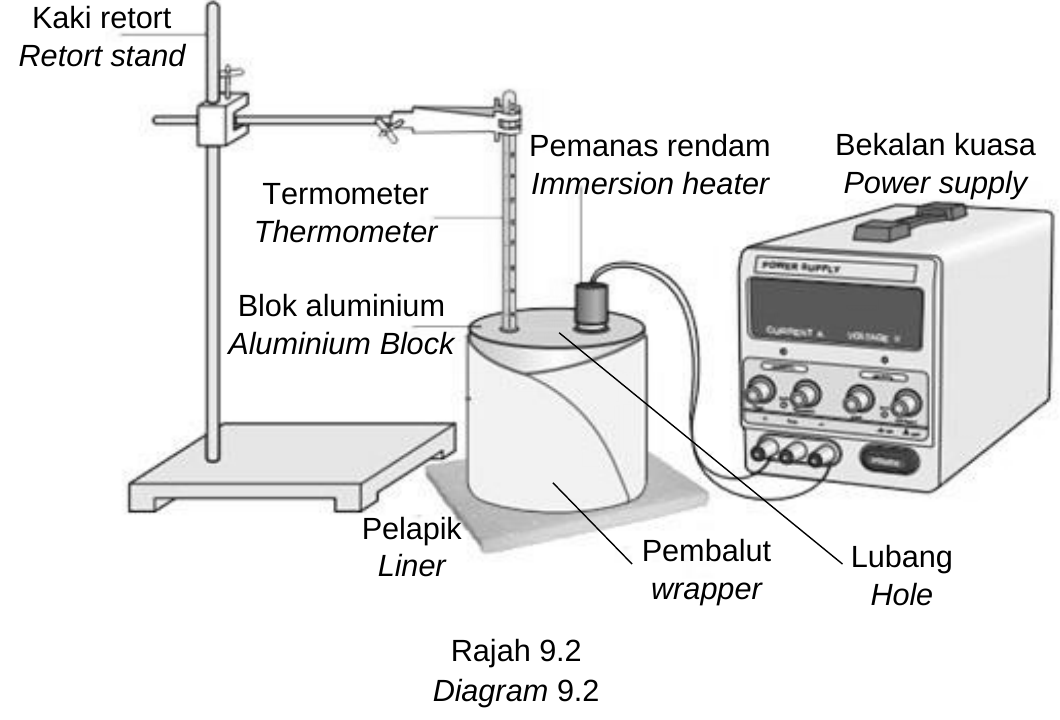
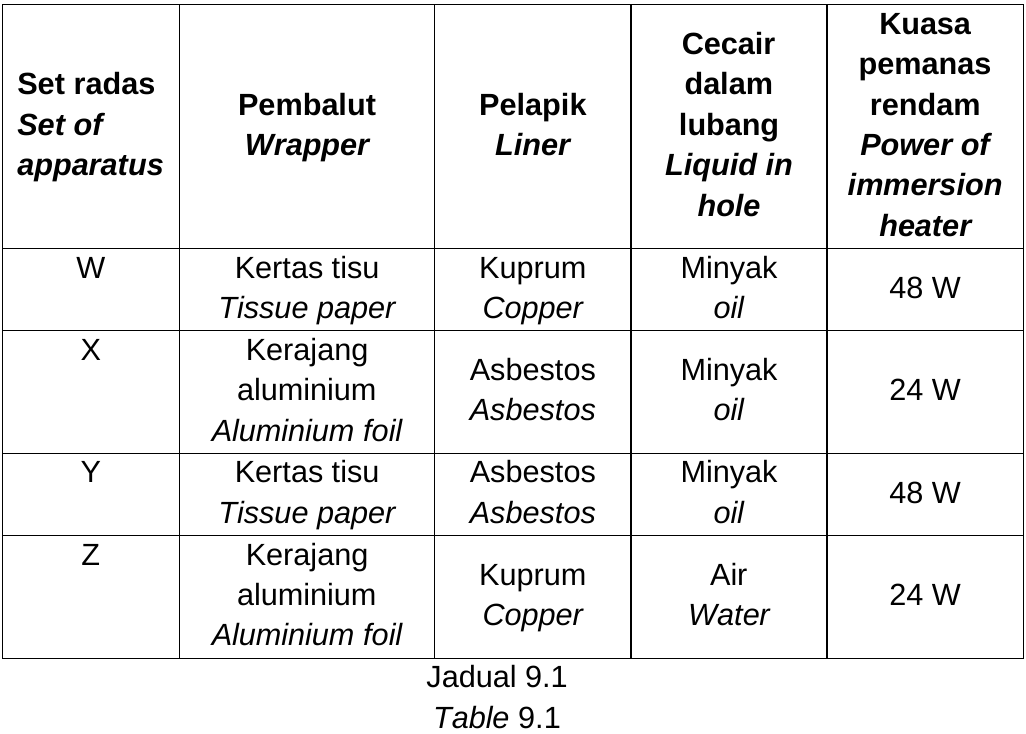
Diagram 10.1 shows a model of a simple transformer built by a student in a school laboratory. Answer any ONE question in Section B.
Hard20 marks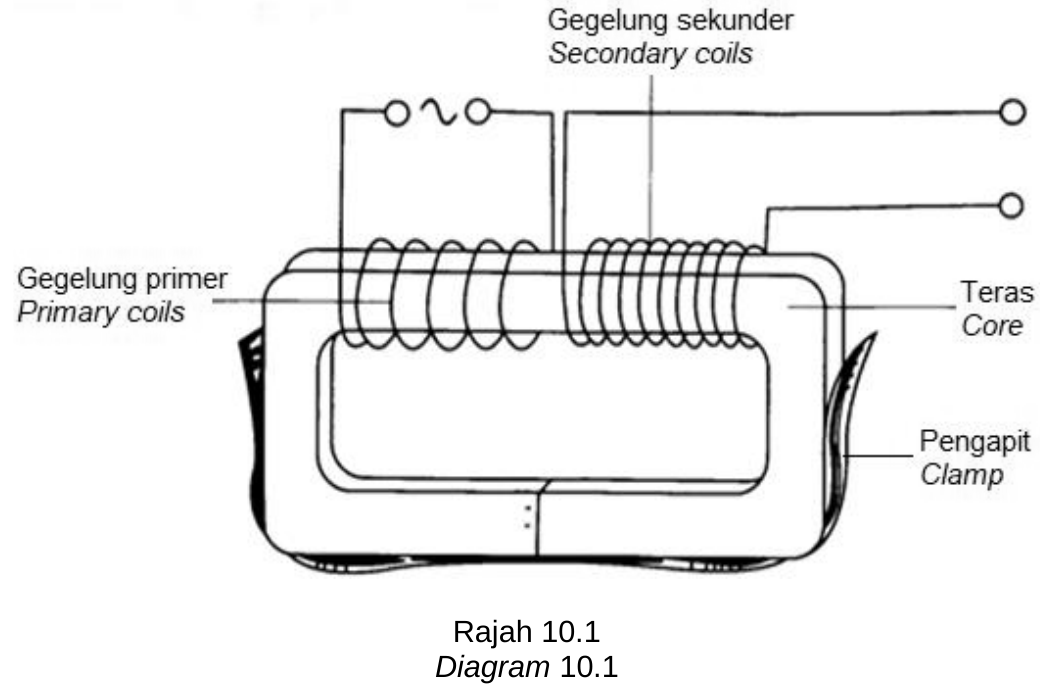
- (a)(i)
Based on Diagram 10.1, name the type of the transformer.
[1] - (a)(ii)
Referring to Diagram 10.1 and your knowledge about electromagnetic induction, explain the principle of operation of a transformer.
[4] - (b)(i)
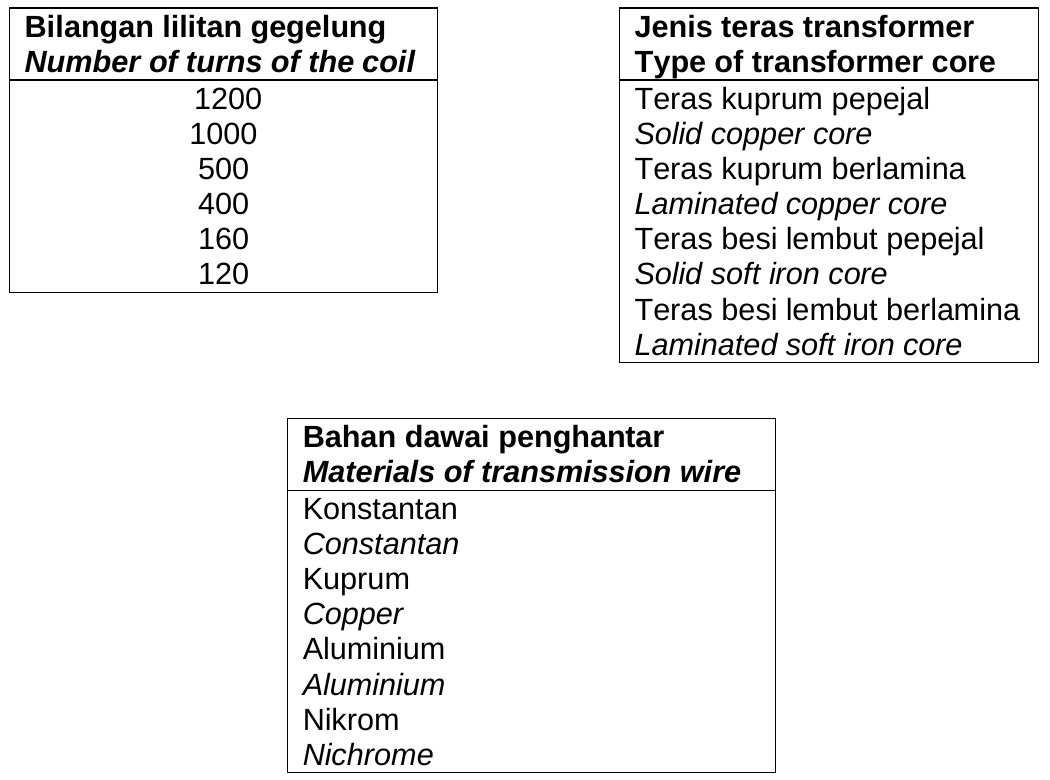
Diagram 10.2 shows a model of an electric transmission system: a power station generating 12 V a.c. transmits electrical energy through transmission wires (24 V a.c.) and transformers P, Q and R to factories (8 V a.c.) and houses (6 V a.c.). Using Table 10 (turns of coil: 1200, 1000, 500, 400, 160, 120; core types: solid copper, laminated copper, solid soft iron, laminated soft iron; wire materials: constantan, copper, aluminium, nichrome), explain and determine the number of turns in the primary and secondary coils of transformers P, Q and R, showing your calculations.
[6]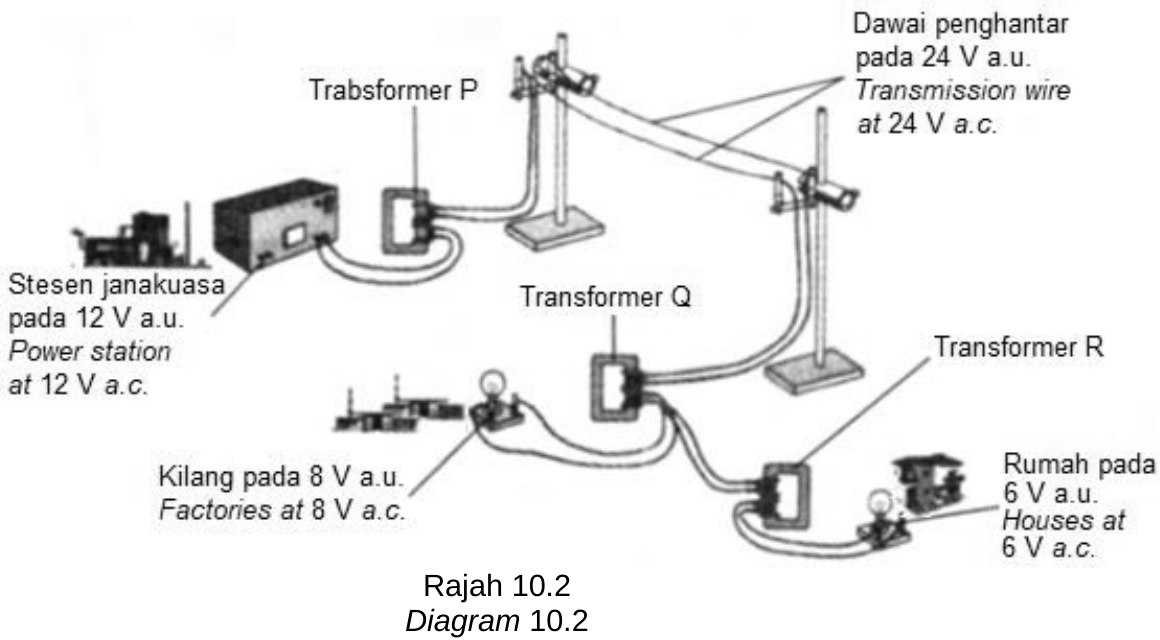
- (b)(ii)
The type of core you will use for all transformers, and justify your choice.
[2] - (b)(iii)
The material you will use for the transmission wire, and justify your choice.
[2] - (c)(i)
If the resistance of the transmission wires between transformers P and Q is 30 Ω, calculate the current that flows in the transmission wire.
[2] - (c)(ii)
Calculate the power loss due to the heating effect of the current in the transmission wire.
[3]
Section C
Diagrams 11.1 and 11.2 show two ticker tapes of different lengths produced by the motion of two trolleys (same number of dots; the dots on 11.2 are further apart).
Medium20 marks- (a)
State the type of physical quantity of length.
[1]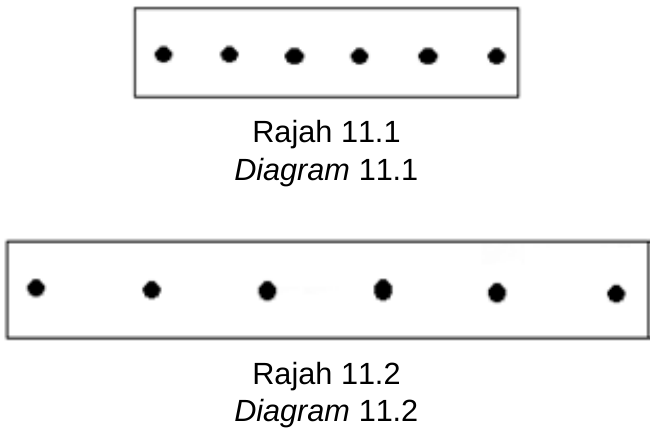
- (b)
Referring to Diagrams 11.1 and 11.2, compare the number of ticks, the length of the ticker tapes and the average speed. Using your comparison, state the relationship between the length of a ticker tape and the average speed. Next, state the relationship between the distance between consecutive points and the type of motion of an object.
[5] - (c)
Diagram 11.3 shows the pattern of oil drops dropping at a uniform rate on a road from a moving car (the drops are close together and equally spaced at the start of the motion, then spread further apart toward the end of the pattern). Explain the type of motion at the beginning and at the final part of the motion of the car.
[4]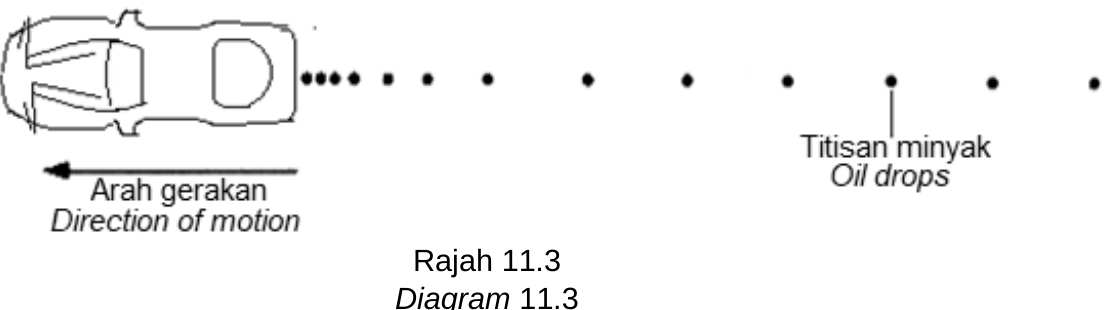
- (d)
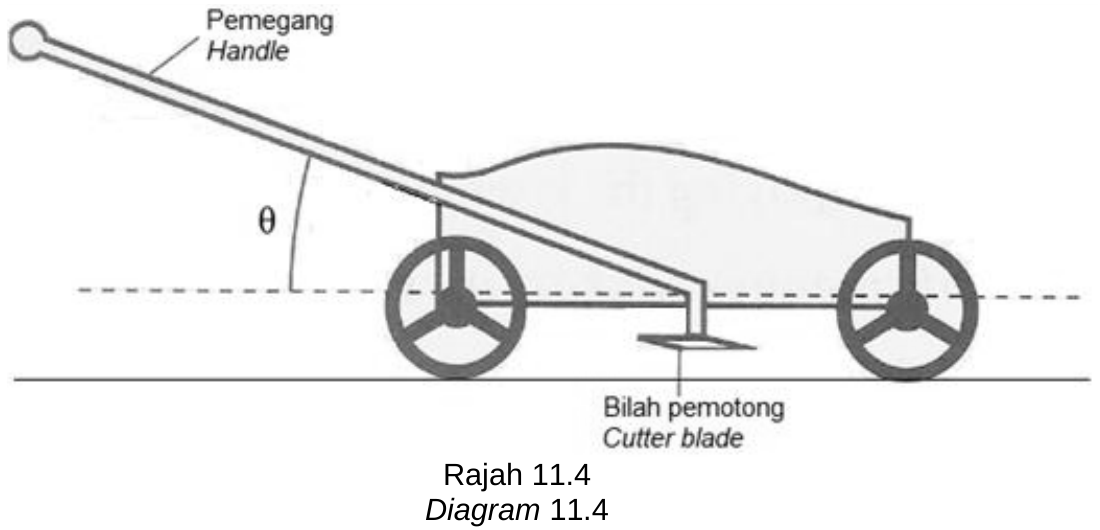
Diagram 11.4 shows a lawnmower used by a gardener to cut grass (handle at angle θ to the horizontal, cutter blade below). The lawnmower is less efficient when used. Give suggestions for modification and reasons so that the lawnmower is more stable and can be used efficiently, based on: the way to move the lawnmower, the angle θ, the size of the cutter blade, the mass of the lawnmower and the length of the handle.
[10]