Write your answer on paper. Then open the answer to check it.
Section A
Diagram 1 shows the pattern formed when seen through the gap of the two fingers.
Medium4 marks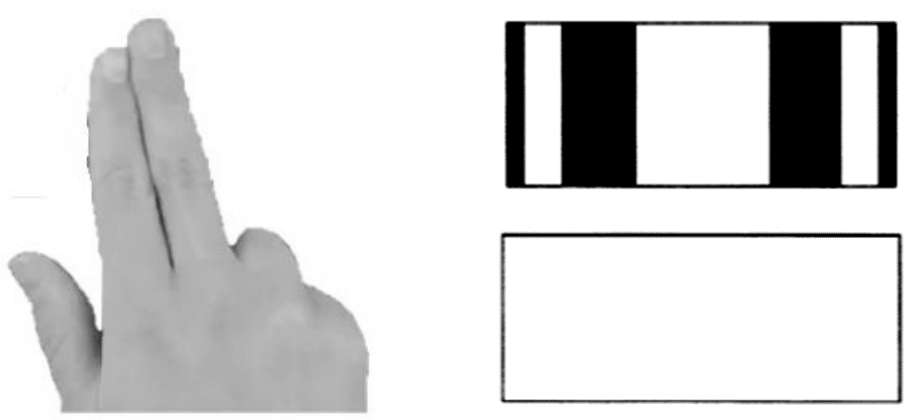
- (a)
Name the light phenomenon involved.
[1] - (b)(i)
In the space provided above, draw the pattern formed when the gap size between the two fingers is decreased.
[2]
- (b)(ii)
What will happen to the amplitude of the light after it passes through the gap?
[1]
Diagram 2 shows a ball of mass 200 g drops from a height of 15.8 m from the floor.
Medium5 marks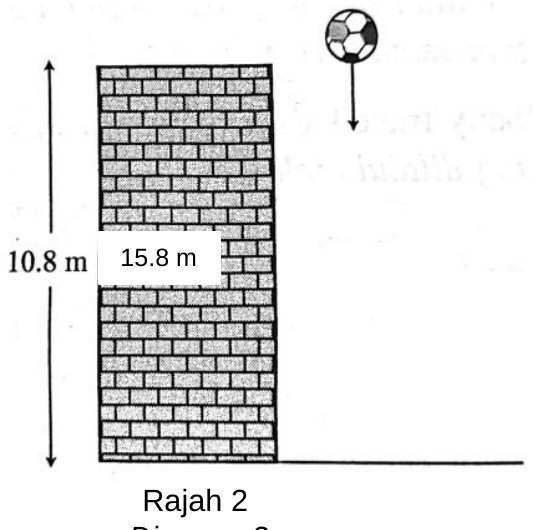
- (a)
What is meant by free fall motion?
[1] - (b)
Calculate the magnitude of the velocity of the ball as it reaches the floor.
[2] - (c)
How long does the ball take to reach the floor?
[2]
Diagram 3 shows the displacement-time graph of a moving object (A at origin, B at s = 10 m at t = 3 s, C at s = 10 m at t = 10 s, D at s = 0 at t = 15 s).
Medium6 marks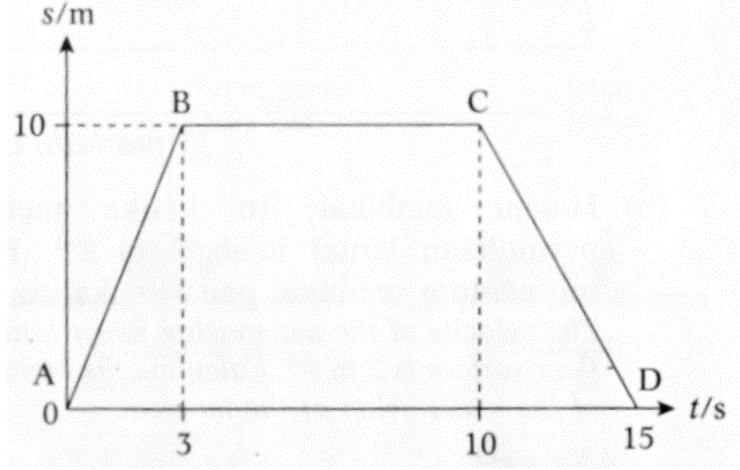
- (a)
What is meant by velocity?
[1] - (b)
Calculate the velocity of the object in the initial period of 3 seconds.
[2] - (c)
How long the object is stationary?
[1] - (d)
Calculate the average velocity.
[2]
Diagram 4 shows a graph of maximum kinetic energy, Kmax against frequency of calcium metal where f₀ is threshold frequency (Kmax = 0.27 eV for light P and 0.60 eV for light Q). The calcium metal is irradiated with lights P and Q.
Medium9 marks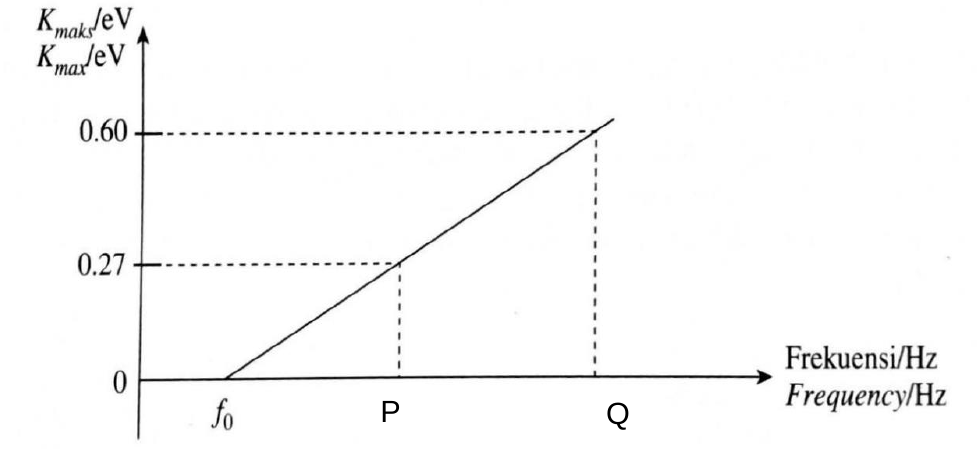
- (a)
State the definition of work function.
[1] - (b)(i)
The work function, W of calcium metal is 3.00 eV. Calculate the threshold frequency, f₀.
[2] - (b)(ii)
Calculate the energy of light Q when it irradiated calcium metal.
[3] - (c)
What happens to the emission of photoelectron from metal surface if the frequency is less than the value in b(i)? Give explanation for your answer.
[3]
Diagram 5.1 shows two satellites, S₁ and S₂ with the same mass (m₁ = m₂ = 400 kg) revolving the earth at orbit radii r₁ and r₂.
Medium9 marks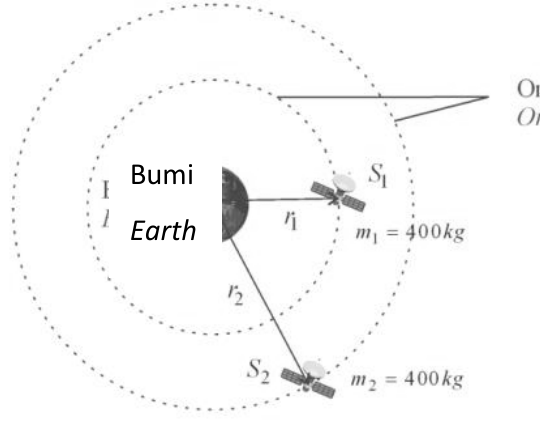
- (a)
Mass is ____ quantity.
[1] - (b)(i)
Compare the mass of satellite m₁ and m₂.
[1] - (b)(ii)
Compare the radius of orbit of satellite r₁ and r₂.
[1] - (b)(iii)
Compare the period of orbit of satellite S₁ and S₂.
[1] - (b)(iv)
State the relationship between the radius of orbit and the period of orbit.
[1] - (c)(i)
State the law of physics involved in 5(b)(iv).
[1] - (c)(ii)
Explain the physics concept involved in 5(c)(i).
[1] - (d)(i)
What will happen to the period of revolving if the mass of satellite S₁ is increased?
[1] - (d)(ii)
Explain your answer for question d(i).
[1]
Diagram 6.1 shows an electrical circuit with six similar dry cells (e.m.f. 1.5 V each, internal resistance 0.5 Ω each) connected in series with a bulb. Diagram 6.2 shows another circuit with one dry cell (e.m.f. 9 V, internal resistance 0.01 Ω) connected in series with a bulb.
Medium9 marks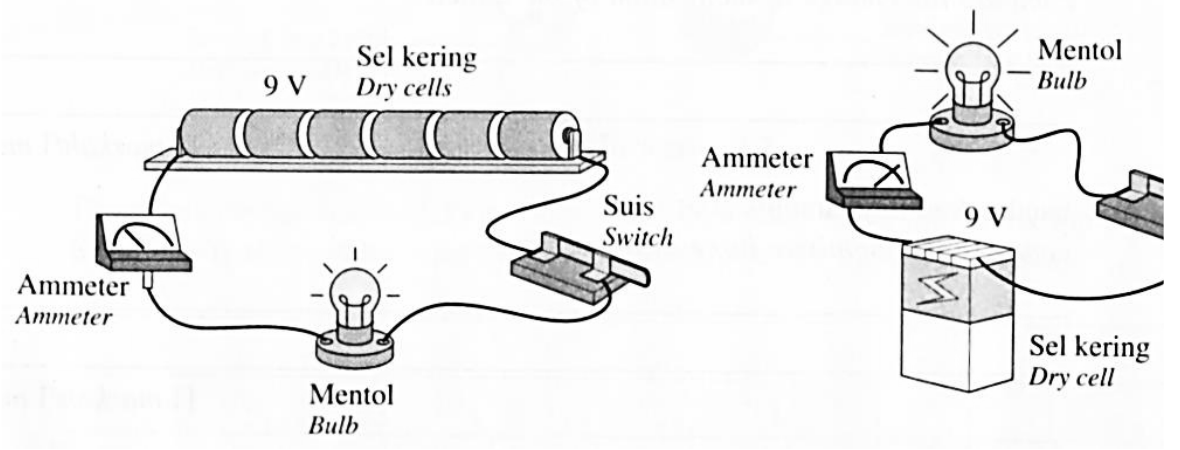
- (a)
What is the meaning of electromotive force (e.m.f.)?
[1] - (b)(i)
Compare the brightness of the bulb.
[1] - (b)(ii)
Compare the total electromotive force (e.m.f.) in the circuit.
[1] - (b)(iii)
Compare the total internal resistance in the circuit.
[1] - (b)(iv)
Compare the magnitude of the current flow in the circuit.
[1] - (c)(i)
State the relationship between the brightness of the bulb and the total internal resistance.
[1] - (c)(ii)
State the relationship between the total internal resistance and the number of dry cells.
[1] - (d)
A car is turned on with an electric current from a lead-acid accumulator with an e.m.f. of 12 V. If the accumulator is replaced with eight dry cells of 1.5 V each, can the car be turned on? Give one reason for your answer.
[2]
Diagram 7 shows an image seen through a convex lens that has a focal length of 10 cm.
Medium9 marks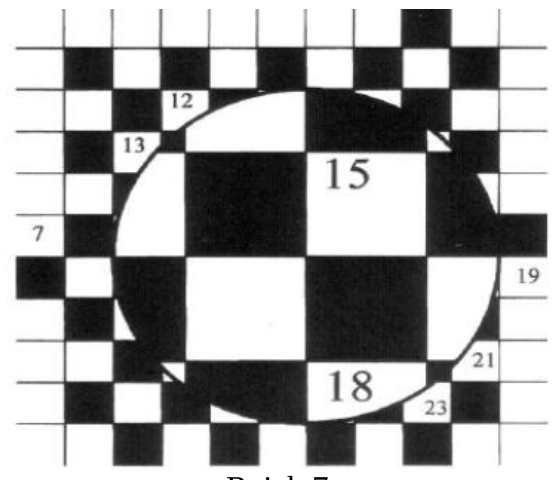
- (a)
What does focal length mean?
[1] - (b)(i)
Draw a ray diagram in the figure below to show how the image of the object is formed (object placed between F and the lens).
[2]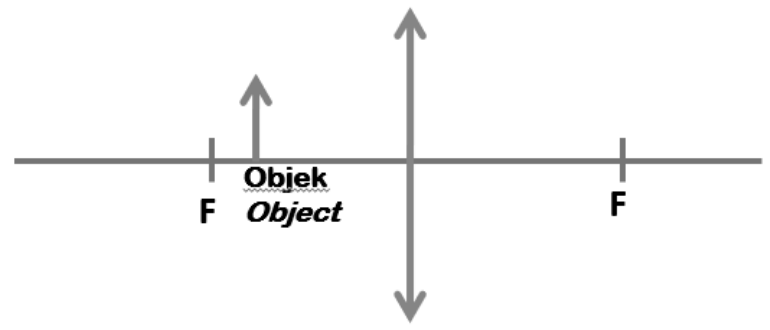
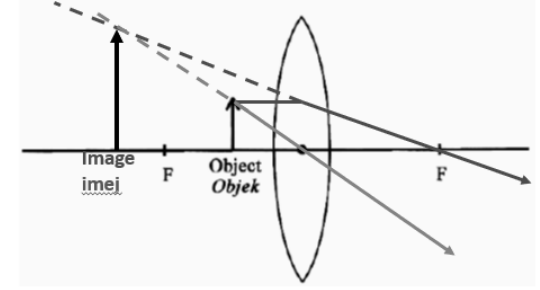
- (b)(ii)
State the characteristics of the image formed.
[1] - (c)(i)
Diagram 7.2 shows prism binoculars. Table 7 shows the characteristics of three lenses P (f = 1.0 cm, small diameter), Q (f = 10.0 cm, big diameter) and R (f = 100.0 cm, big diameter). State the suitable focal length of the objective lens. Give one reason.
[2]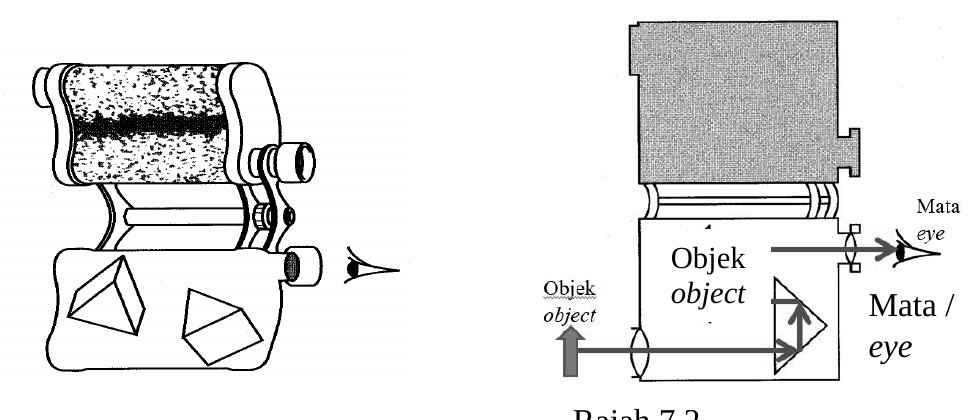
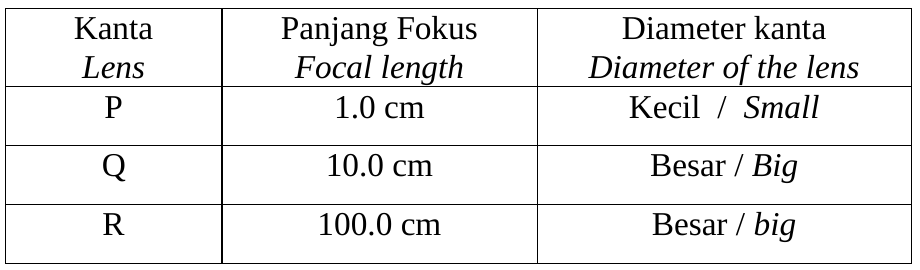
- (c)(ii)
State the suitable diameter of the objective lens. Give one reason.
[2] - (d)
Based on the answers in 7(c)(i) and 7(c)(ii), determine the most suitable lens to be used as the objective lens.
[1]
Diagram 8 shows a submarine floating stationary on the surface of the sea.
Medium9 marks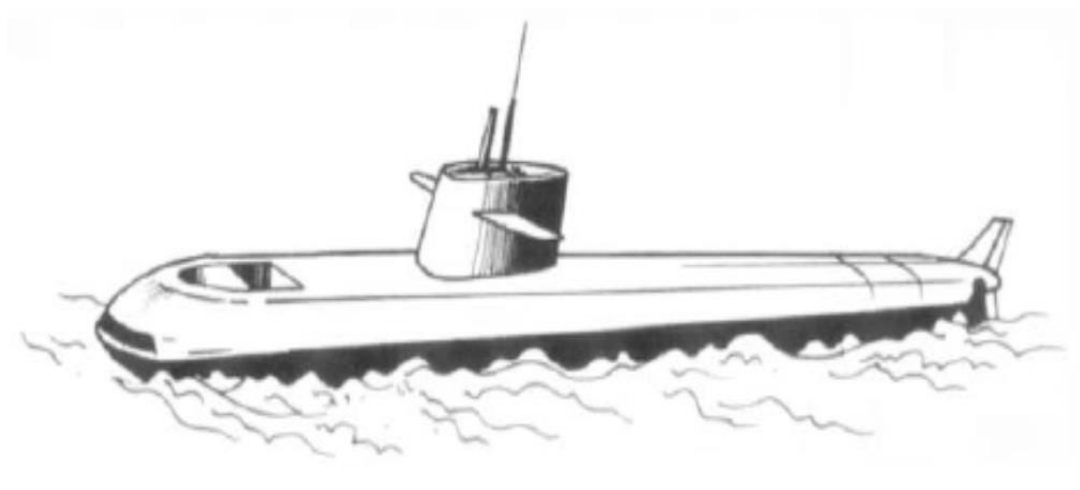
- (a)
State the principle that enables the submarine to float.
[1] - (b)
The mass of the submarine is 1.5 × 10⁷ kg. [Density of sea water = 1.03 × 10³ kg m⁻³] Calculate the buoyant force acting on the submarine.
[2] - (c)(i)
Based on Diagram 8, suggest a submarine construction that can explore the ocean: shape of submarine, with reason.
[2] - (c)(ii)
Material of the submarine body, with reason.
[2] - (c)(iii)
Wall of the submarine, with reason.
[2]
Section B
Diagram 9.1 shows a clinical thermometer used by a doctor to check the temperature of a patient’s body during medical treatment.
Medium20 marks- (a)
What is the meaning of temperature?
[1]
- (b)
Referring to the principle of thermal equilibrium and the working principle of a thermometer, explain how a doctor can check his patient’s temperature during the medical treatment.
[4] - (c)(i)
Diagram 9.2 shows an uncalibrated thermometer with mercury column length L₀ = 5.0 cm at 0 °C and L₁₀₀ = 25.0 cm at 100 °C. The mercury column Lθ is 12.0 cm when put into liquid X. Calculate the temperature of liquid X. State your answer in kelvin.
[3]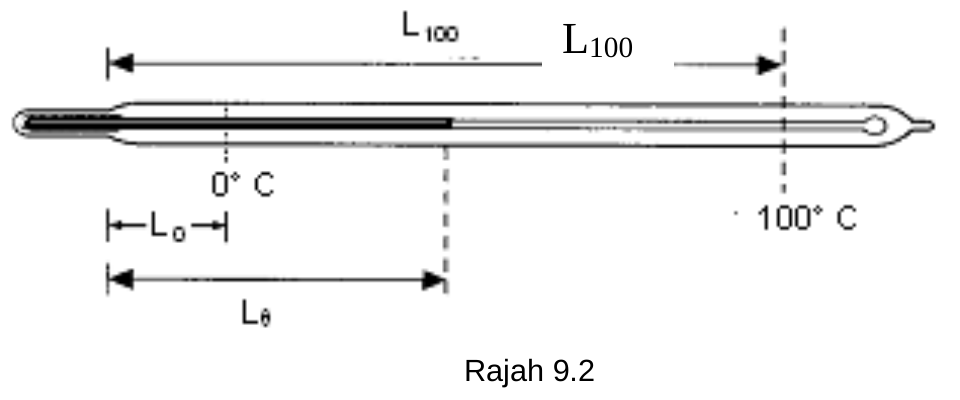
- (c)(ii)
What is the length of the mercury column from the bulb at a temperature of 30 °C?
[2] - (d)
Four rice keepers J, K, L and M keep hot rice warm: J (polystyrene foil; melting point 68 °C; c = 800 J kg⁻¹ °C⁻¹; density 800 kg m⁻³), K (copper foil; 240 °C; 1900 J kg⁻¹ °C⁻¹; 670 kg m⁻³), L (polystyrene foil; 240 °C; 1900 J kg⁻¹ °C⁻¹; 670 kg m⁻³), M (copper foil; 68 °C; 900 J kg⁻¹ °C⁻¹; 800 kg m⁻³). Determine the most suitable rice keeper to keep the rice hot for a long time and be moved easily. Study the melting point, specific heat capacity, density and material between the inner and outer walls. Explain the suitability of the aspects and justify your choice.
[10]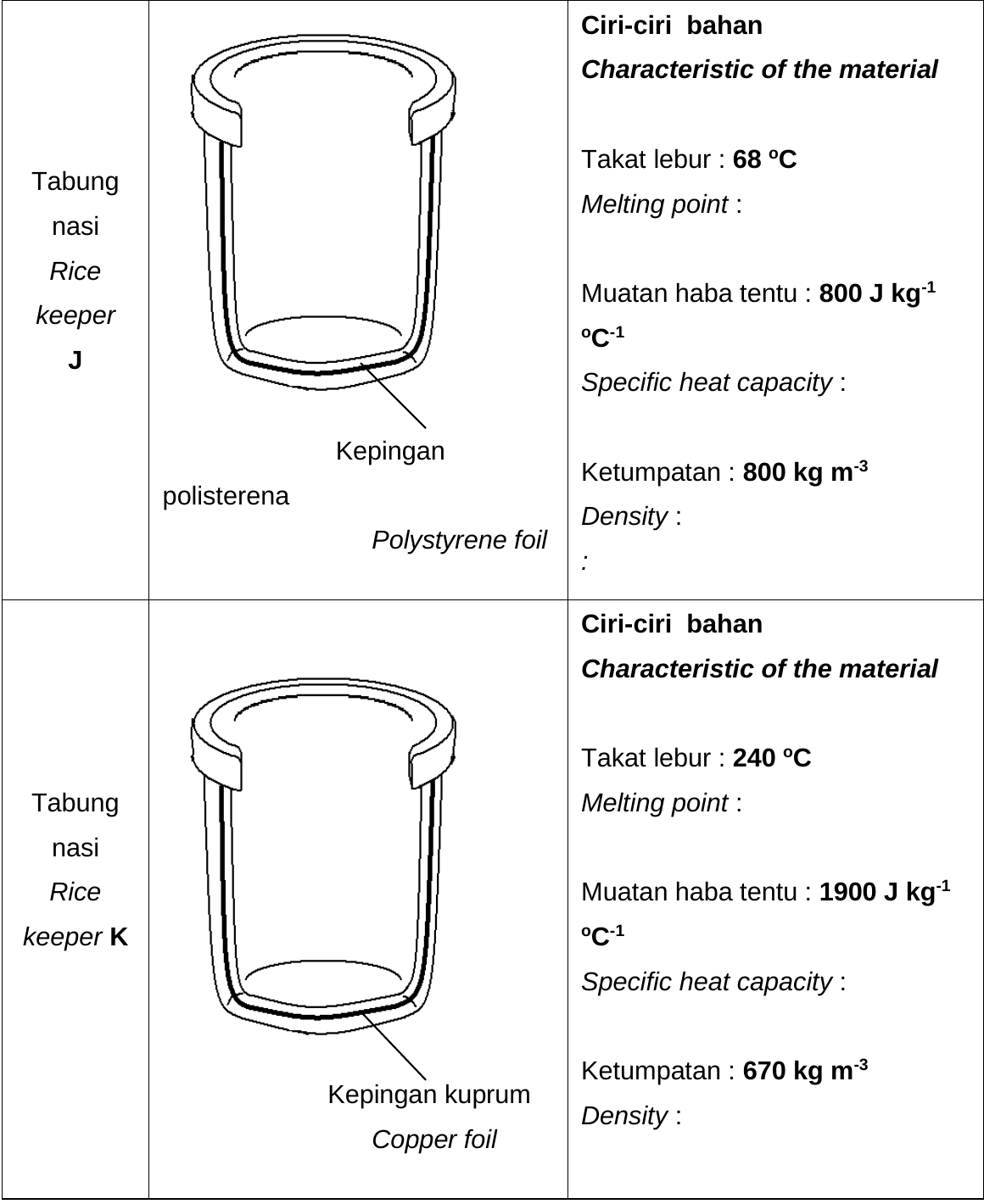
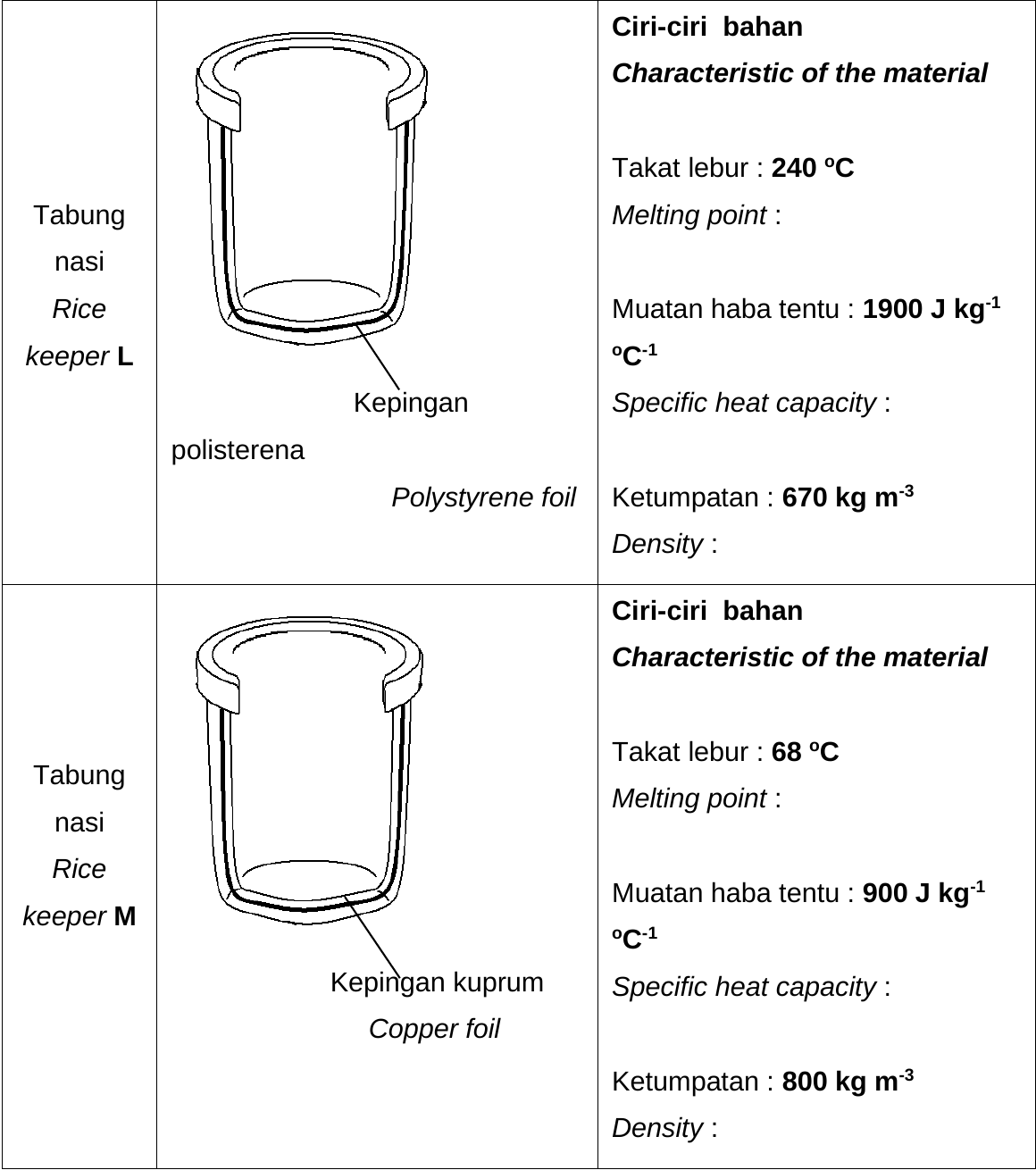
Diagram 10 shows the radioactive decay series for the nuclei Uranium-238 to Radium-226 (nucleon number A against proton number Z; U 238/92 → Th 234/90 → Pa 234/91 → U 234/92 → Th 230/90 → Ra 226/88).
Hard20 marks- (a)
What is meant by a radioactive decay series?
[1] - (b)
Based on Diagram 10, explain how the radioactive decay series of a Uranium-238 nucleus emits radiation and produces Radium-226. Name the time taken for half of the unstable atoms to decay.
[4]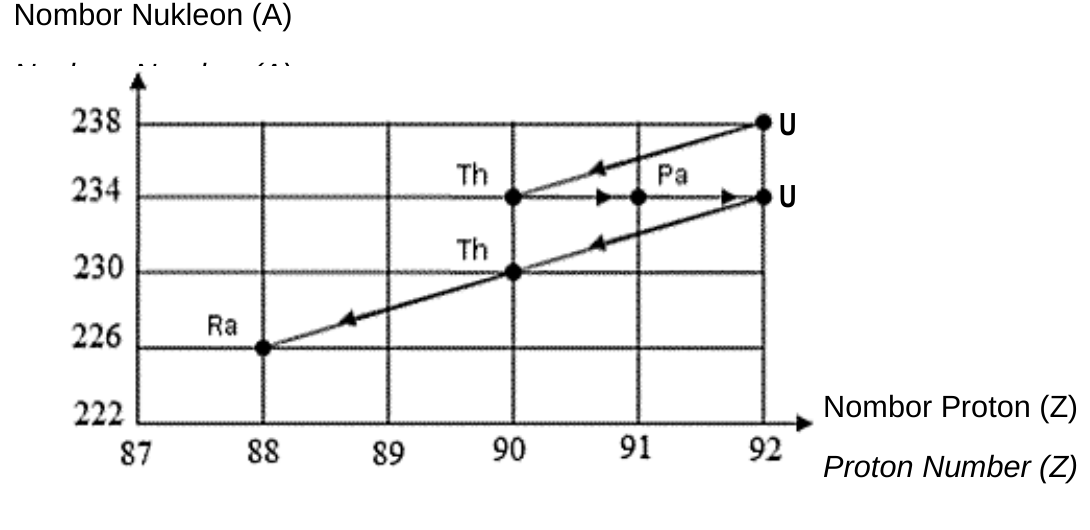
- (c)(i)
A sample of Lead-211 of mass 96 g has a half-life of 36.1 minutes. What is the mass of the sample that has not decayed after 108.3 minutes?
[3] - (c)(ii)
What is the mass of the decayed products after this period of time?
[2] - (d)
Table 10 shows the properties of four radioactive substances J, K, L and M (J: solid, beta, 1620 years, high ionising power; K: liquid, gamma, 6 hours, low; L: solid, gamma, 5.27 years, low; M: liquid, beta, 15 days, high). Explain the suitable characteristics of the radioactive substance for use to kill cancer cells in a patient. Determine which radioactive substance is the most suitable for the treatment of cancer cells in a patient and give your reasons.
[10]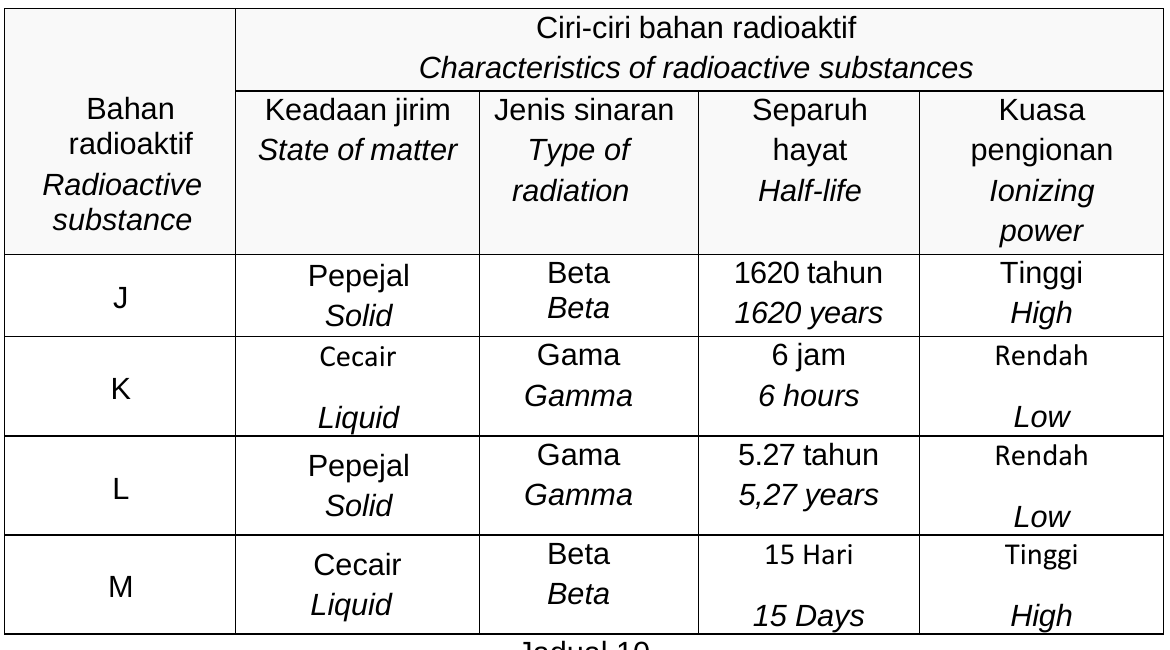
Section C
Diagram 11.1 and Diagram 11.2 show two types of dynamos with different numbers of turns of coil (Diagram 11.2 has more turns and a brighter lamp).
Medium20 marks- (a)
What is the definition of electromagnetic induction?
[1]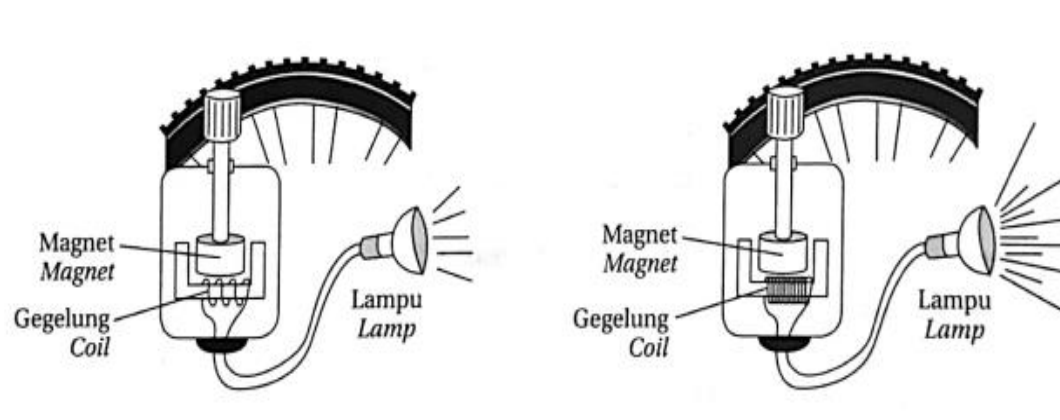
- (b)
Using Diagram 11.1 and Diagram 11.2, compare the strength of the magnet, the number of turns of coil and the brightness of the lamp. State the relationship between the number of turns of coil and the brightness of the lamp. State the relationship between the number of turns of coil and the magnitude of the induced current produced.
[5] - (c)(i)
Diagram 11.3 shows an induction cooker used to cook food in a pot. Explain how the induction cooker functions.
[4]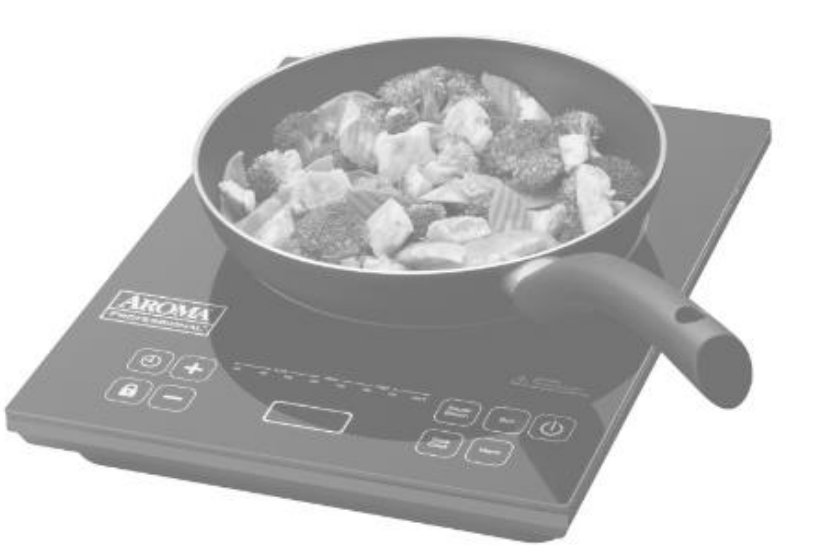
- (c)(ii)
Using appropriate physics concepts, explain the modifications that need to be done on the induction cooker in Diagram 11.3 to heat up the pot faster. State and explain your suggestion based on aspects such as the characteristics of the base of the pot, the number of turns of coil, the magnitude of current flowing in the coils and the type of current flowing in the coils.
[10]