Write your answer on paper. Then open the answer to check it.
Section A
Diagram 1 shows light rays at a certain frequency illuminating a metal surface. Electrons are emitted from the metal surface.
Medium4 marks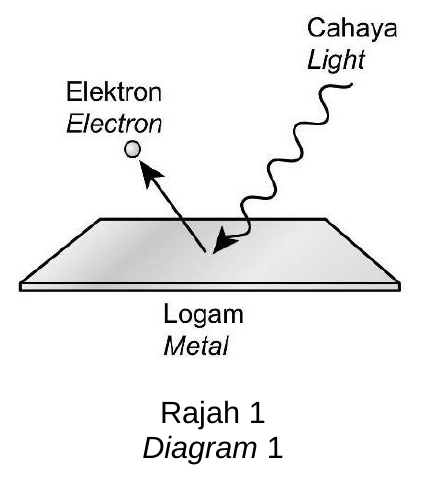
- (a)
Mark (√) the correct answer. This phenomenon is known as: thermionic emission / photoelectric effect.
[1] - (b)
Name the minimum frequency that allows electrons to be emitted from the metal surface when light is illuminated.
[1] - (c)(i)
What will happen to the kinetic energy of the electron when the intensity of light increases?
[1] - (c)(ii)
Explain your answer in (c)(i).
[1]
Diagram 2.1 shows a student observing a pencil inside a cup. The pencil appears to bend due to the phenomenon of refraction of light.
Medium5 marks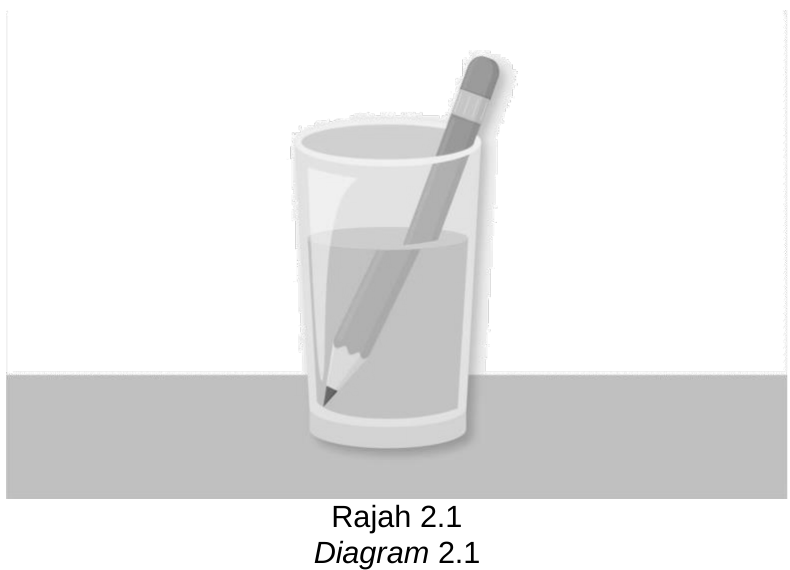
- (a)
What is the meaning of the refraction of light?
[1] - (b)
Explain how the phenomenon in Diagram 2.1 can occur.
[2] - (c)
Based on Diagram 2.2, complete the ray diagram to show the position of the image observed by the fish (a beetle above the water surface, the image is drawn above it, the fish is the observer).
[2]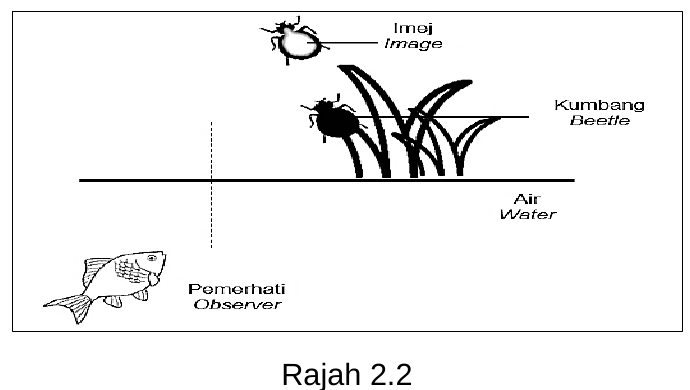
Iodine-131 is a radioisotope of iodine. A radioisotope sample that contains 200 g of iodine-131 undergoes a decay process. The half-life of iodine-131 is 8 days.
Medium6 marks- (a)
What is the meaning of half-life?
[1] - (b)
Give one reason why iodine-131 undergoes a decay process.
[1] - (c)(i)
Calculate the mass of iodine-131 after 32 days.
[2] - (c)(ii)
On Diagram 3, sketch a graph to show the decay process of iodine-131 (mass in g against time in days, 200 g marked on the mass axis).
[2]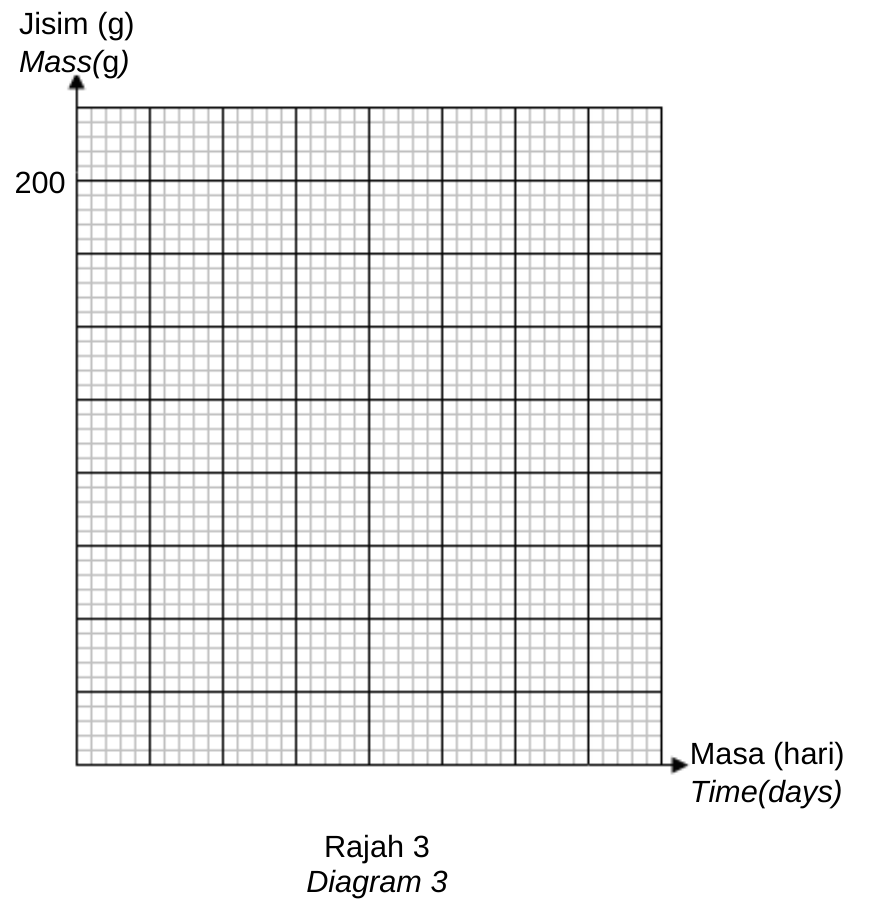
Diagram 4 shows an audio generator set with two loudspeakers arranged together with a microphone set and a cathode ray oscilloscope (C.R.O). The speakers produce coherent wave sources. The microphone is moved along the line PQRS to detect changes in amplitude of the sound (the distance shown from the speakers to the line is 0.8 m).
Medium9 marks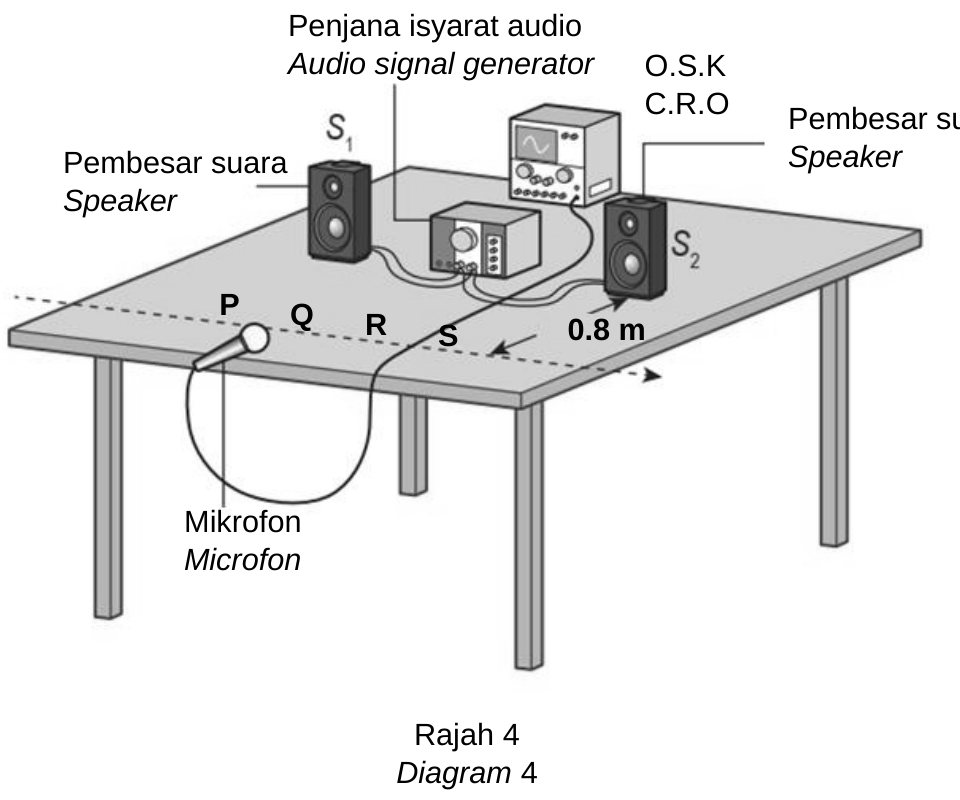
- (a)
What is meant by coherent wave source?
[1] - (b)
After the experiment was carried out, high-amplitude sounds were detected at points P and R, while low-amplitude sounds were detected at points Q and S. Explain why.
[3] - (c)(i)
The audio generator is adjusted to a frequency of 1000 Hz and the speed of sound waves in air is 330 m s⁻¹. If the distance between the two speakers is 75 cm, calculate the wavelength of the sound, λ.
[2] - (c)(ii)
Calculate the distance between point P and point S.
[3]
Diagram 5.1 and Diagram 5.2 show two identical transistor circuits in two states (Diagram 5.1: LDR in the dark, voltmeter reading low, bulb off; Diagram 5.2: LDR in bright light, voltmeter reading higher, bulb on).
Medium9 marks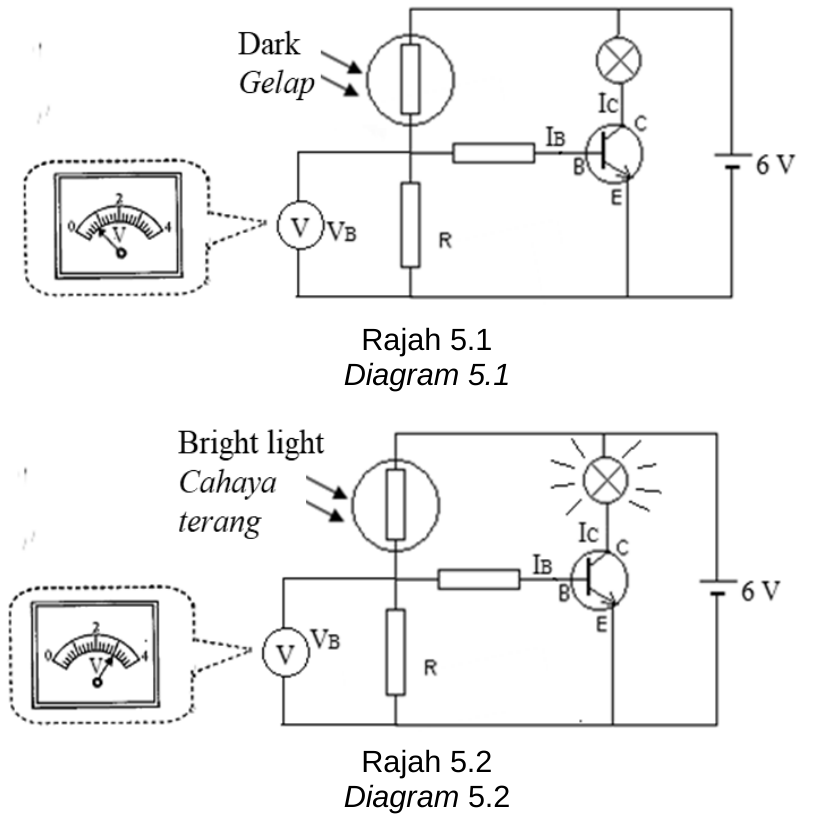
- (a)
What is the type of transistor used?
[1] - (b)(i)
Based on Diagram 5.1 and Diagram 5.2, compare the base voltage, VB.
[1] - (b)(ii)
Compare the lighting of the bulb.
[1] - (b)(iii)
Compare the base current, IB.
[1] - (c)(i)
Based on the answers in 5(b), state the relationship between the base voltage and the base current.
[1] - (c)(ii)
State the relationship between the base current and the collector current.
[1] - (d)
Diagram 5.3 shows a transistor circuit that consists of a light dependent resistor (LDR) in series with R = 10 kΩ across a 6 V supply. When the LDR detects light, the potential difference of the LDR is 1.2 V. Calculate the resistance of the LDR.
[3]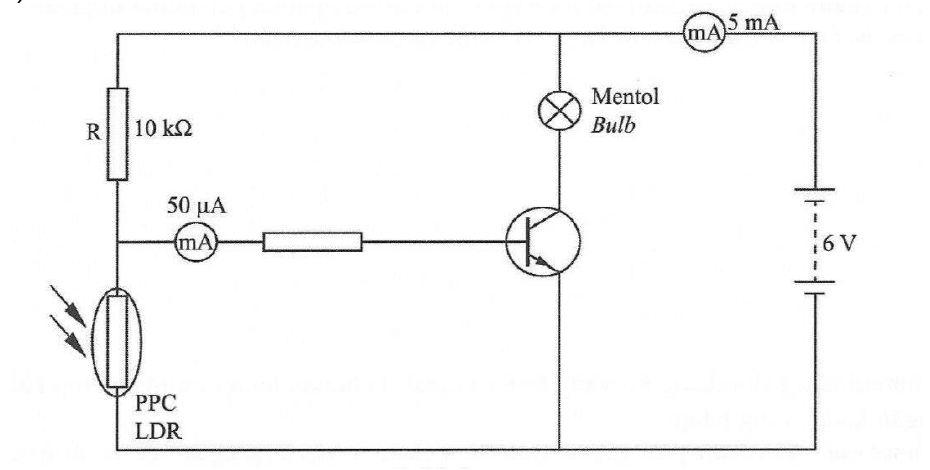
Diagram 6.1 and Diagram 6.2 show the water level of an electric kettle that is boiling (Diagram 6.1: after 5 minutes of boiling; Diagram 6.2: after 10 minutes of boiling, lower water level).
Medium9 marks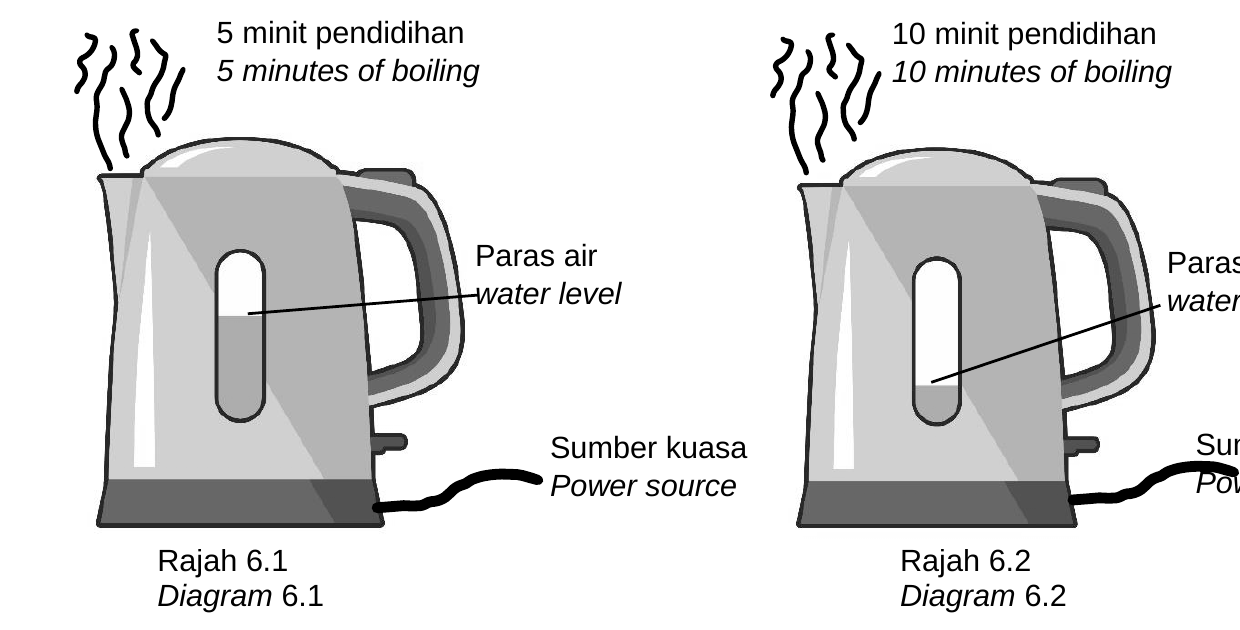
- (a)
Name the type of heat absorbed during the boiling process.
[1] - (b)
Give a reason why there is no change in temperature during the boiling process of water.
[1] - (c)(i)
Based on Diagram 6.1 and Diagram 6.2, compare the boiling time.
[1] - (c)(ii)
Compare the heat energy absorbed by the water.
[1] - (c)(iii)
Compare the amount of water that turns into steam.
[1] - (d)(i)
Based on your answer in 6(c), state the relationship between boiling time and the heat energy absorbed by the water.
[1] - (d)(ii)
State the relationship between the heat energy absorbed by the water and the amount of water that turns into steam.
[1] - (e)
If the heat energy absorbed by the water in Diagram 6.1 is 2.40 × 10⁵ J, calculate the mass of water that has turned into steam. [Specific latent heat of vaporisation of water, l_v = 2.26 × 10⁶ J kg⁻¹]
[2]
Diagram 7 shows the working principle of an induction cooker (a pan on an induction hob).
Medium9 marks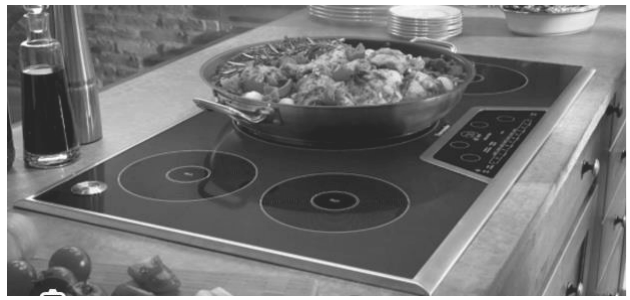
- (a)
What is the concept that enables an induction cooker to work?
[1] - (b)
Explain how the induction cooker in Diagram 7 can be used for cooking.
[3] - (c)(i)
Table 7 shows three types of induction cooker (P: a.c., 5 coils; Q: d.c., 10 coils; R: a.c., 15 coils). Based on Table 7, state the suitable type of current supply to increase the efficiency, and the reason.
[2]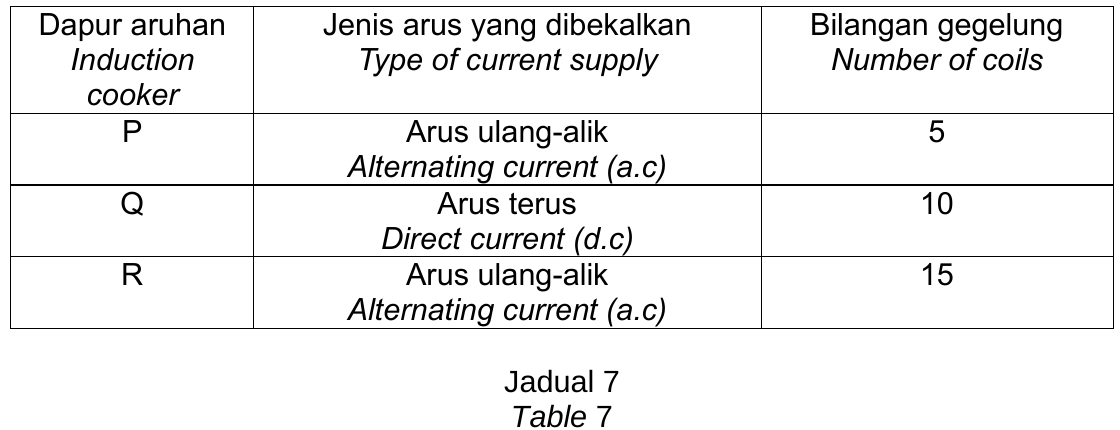
- (c)(ii)
State the suitable number of coils to increase the efficiency, and the reason.
[2] - (d)
Based on your answers in 7(c)(i) and 7(c)(ii), choose the most efficient induction cooker.
[1]
Diagram 8 shows an athlete spinning a hammer in a hammer throw event. The centripetal force acting on the hammer when rotated is the tension of the steel wire.
Medium9 marks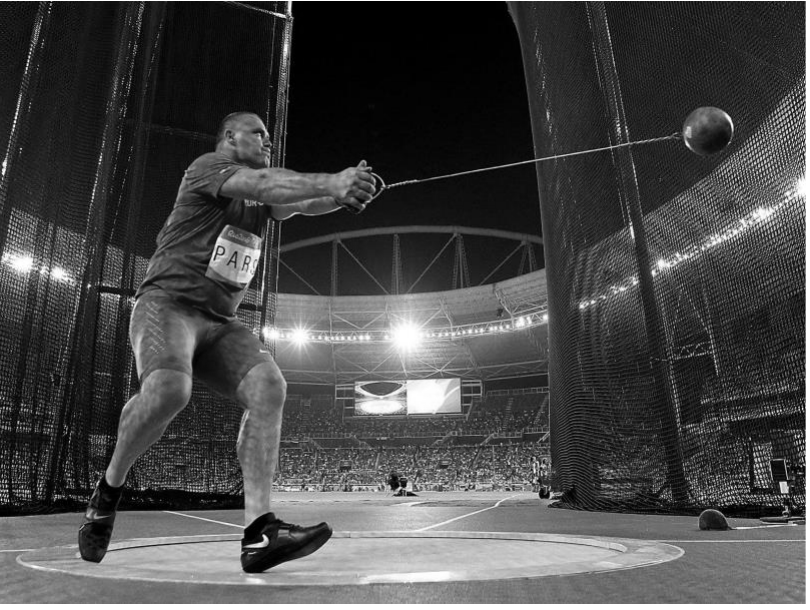
- (a)
What is centripetal force?
[1] - (b)
The hammer of mass 4 kg is rotated in a horizontal circle of radius 1.6 m with a linear speed of 25 m s⁻¹. Calculate the centripetal force acting on the hammer.
[2] - (d)(i)
Suggest the suitable length of the steel wire to produce a higher landing distance after spinning, and the reason.
[2] - (d)(ii)
Suggest the suitable linear speed of the hammer when it is rotated, and the reason.
[2] - (d)(iii)
Suggest the suitable angle of hammer throwing, and the reason.
[2]
Section B
Diagram 9 shows a water tank tower at Ahmad's house and a water tank at Ali's house. The water taps of both houses are at the same distance of 1 m from the ground surface (Ahmad's tank is 10 m above the ground; Ali's tank on the roof is 4 m above the ground).
Medium20 marks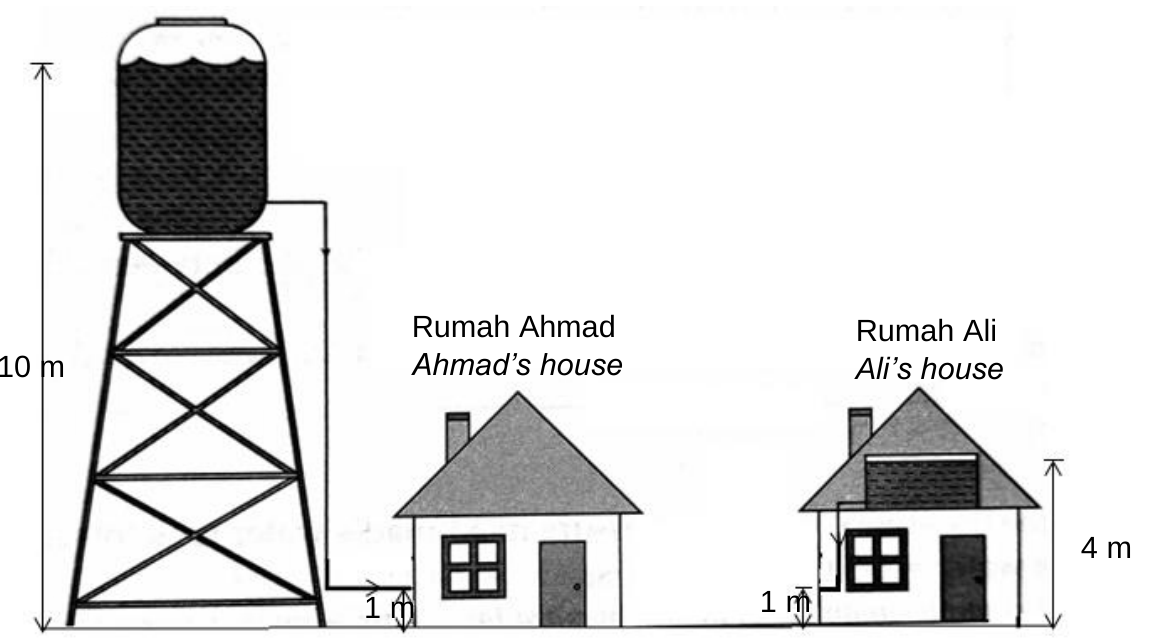
- (a)
State the physics concept that causes water to come out after the tap is opened.
[1] - (b)
Explain why the tap in Ahmad's house produces water faster than the tap in Ali's house.
[4] - (c)
Ali wants to install a water tank on his house roof. Table 9 shows tanks J (thick wall, big, low density, 2 m from tap), K (thin, small, high density, 2 m), L (thick, big, low density, 4 m) and M (thin, small, high density, 4 m). Explain the suitability of each characteristic of the water tank to be installed on the roof. Determine the most suitable water tank so that water flows faster and the tank is long lasting and easy to install. Give reasons for your choice.
[10]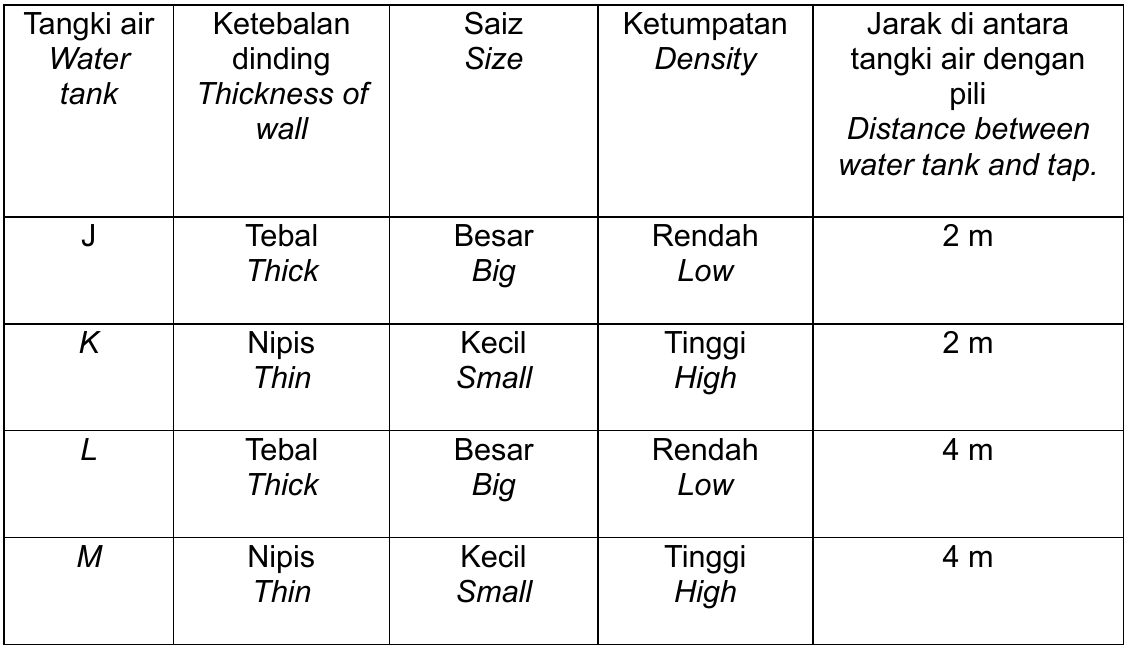
- (d)(i)
Calculate the difference of water pressure at the tap in Ahmad's house and the tap in Ali's house. [Density of water = 1 000 kg m⁻³]
[3] - (d)(ii)
Explain what will happen to the water pressure in Ahmad's house if he replaces his water tank with a new tank with a larger diameter but the same height.
[2]
Diagram 10.1 shows a softball player continuing his throw after the ball moves forward. The player's action is called 'follow through'.
Medium20 marks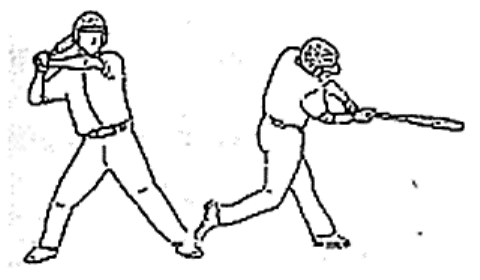
- (a)
What is the meaning of impulse?
[1] - (b)
Explain how the 'follow through' action can increase the distance of motion of the softball.
[4] - (c)(i)
Diagram 10.2 shows a car collision test. A car of mass 1500 kg hits a wall with a speed of 15 m s⁻¹ and rebounds at a speed of 2.6 m s⁻¹. The impact time is 150 ms. Calculate the impulse produced in the collision.
[2]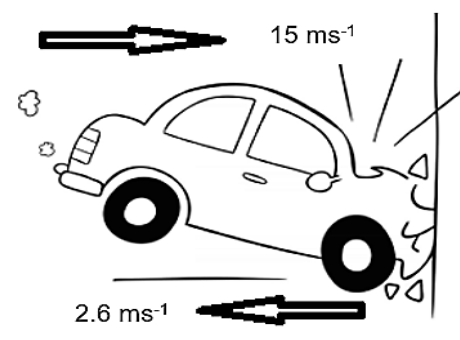
- (c)(ii)
Calculate the impulsive force acting on the car.
[3] - (d)
Table 10 shows hockey sticks P, Q, R and S with different characteristics (P: density high, carbon fibre, long, flexibility high; Q: density high, carbon fibre, short, flexibility low; R: density low, carbon fibre, long, flexibility high; S: density low, fibreglass, short, flexibility low). Explain the suitability of the characteristics of the hockey sticks for use by hockey teams in high-level matches. Choose the most suitable hockey stick and give the reasons for your choice.
[10]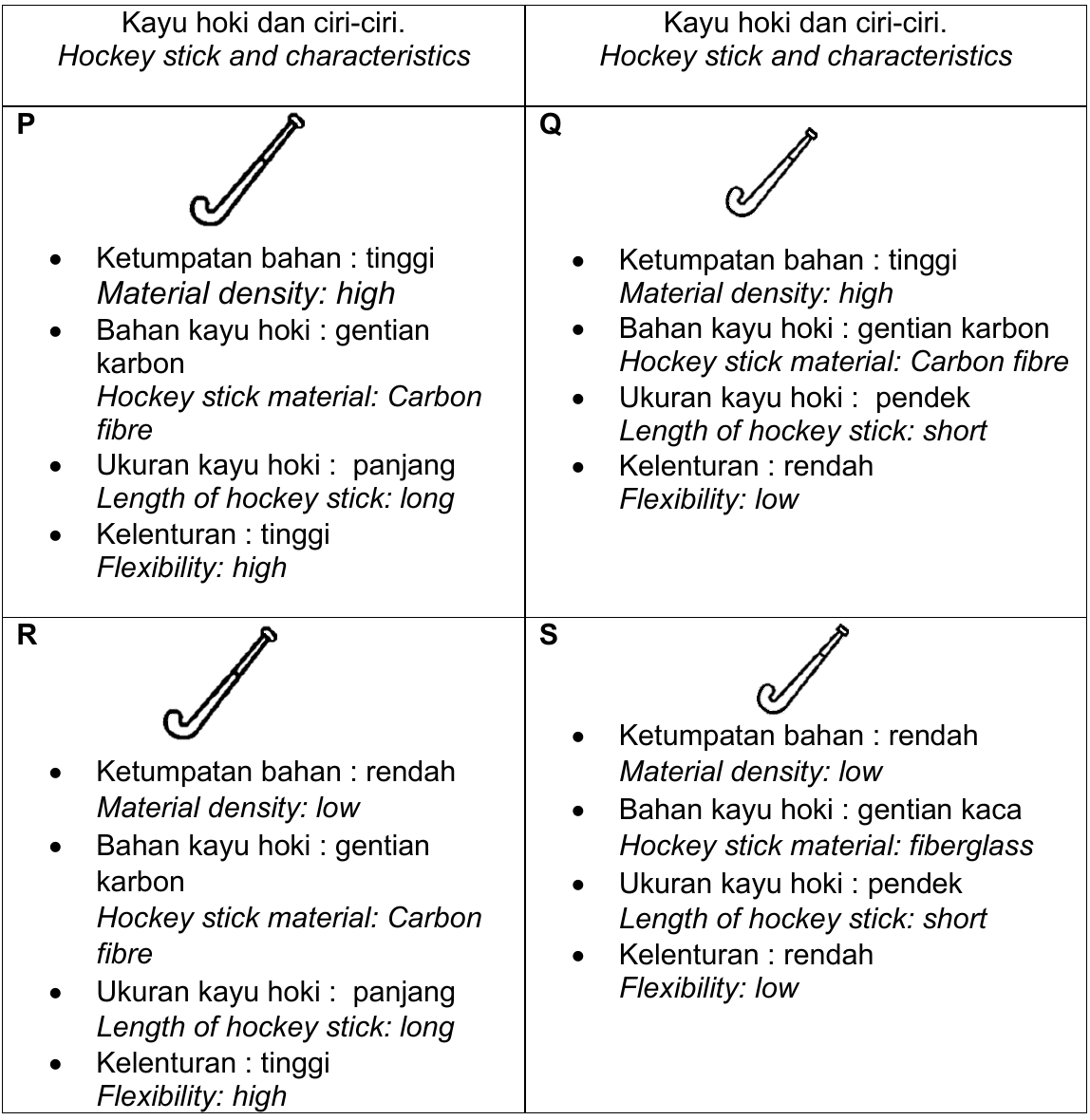
Section C
An archer practises archery using the same equipment with an initial force, F as shown in Diagram 11.1 (F = 250 N, stretching distance x) and Diagram 11.2 (F = 150 N, smaller x). When the arrow is released, it travels at a speed due to the elasticity of the bow.
Hard20 marks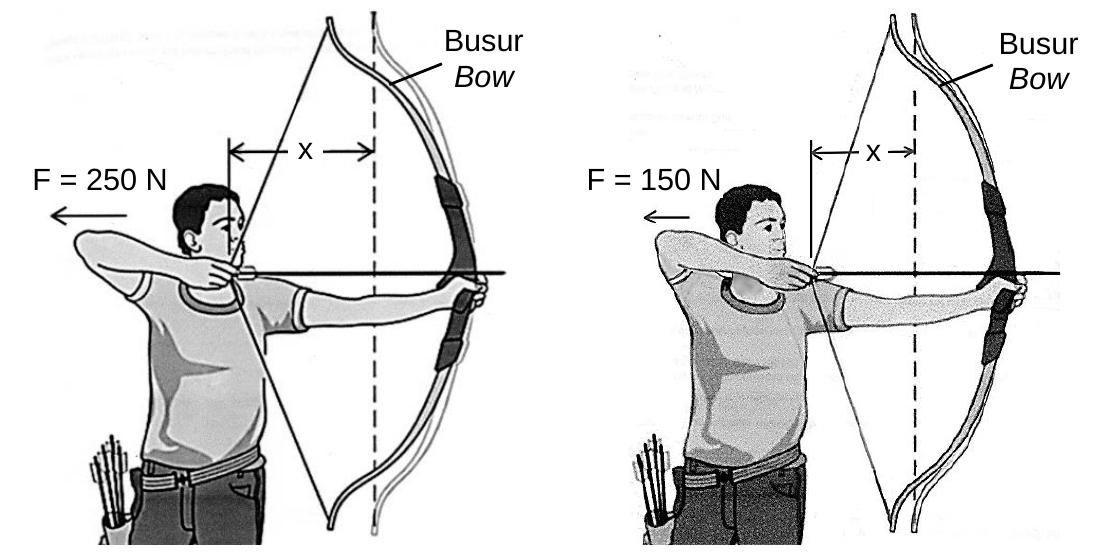
- (a)
What is the meaning of elasticity?
[1] - (b)
Based on Diagram 11.1 and Diagram 11.2, compare (i) the initial force, F, (ii) the stretching distance, x, (iii) the spring constant of the bow.
[3] - (c)
State the relationship between the initial force and the stretching distance, and then state a law that explains the relationship.
[2] - (d)
Based on Diagram 11.1 and Diagram 11.2, which method will produce a further shooting distance? Explain your answer.
[4] - (e)
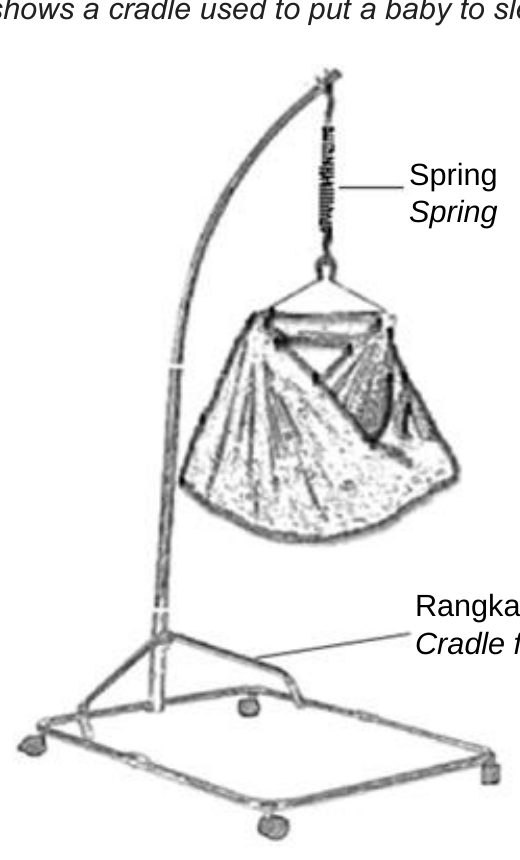
Diagram 11.3 shows a cradle used to put a baby to sleep. You are required to give suggestions to improve the design of the cradle so that it can accommodate a larger baby. Explain your recommendations based on the characteristics of the spring and the characteristics of the cradle frame so that it is safer and easier to use.
[10]