Write your answer on paper. Then open the answer to check it.
Section A
Diagram 1 shows a result of an experiment to determine the relationship between the potential difference V across the dry cell and the current I flowing. The graph is a straight line sloping downwards (V = 1.00 V at I = 0.10 A, V = 0.60 V at I = 0.30 A, V = 0.20 V at I = 0.50 A).
Medium4 marks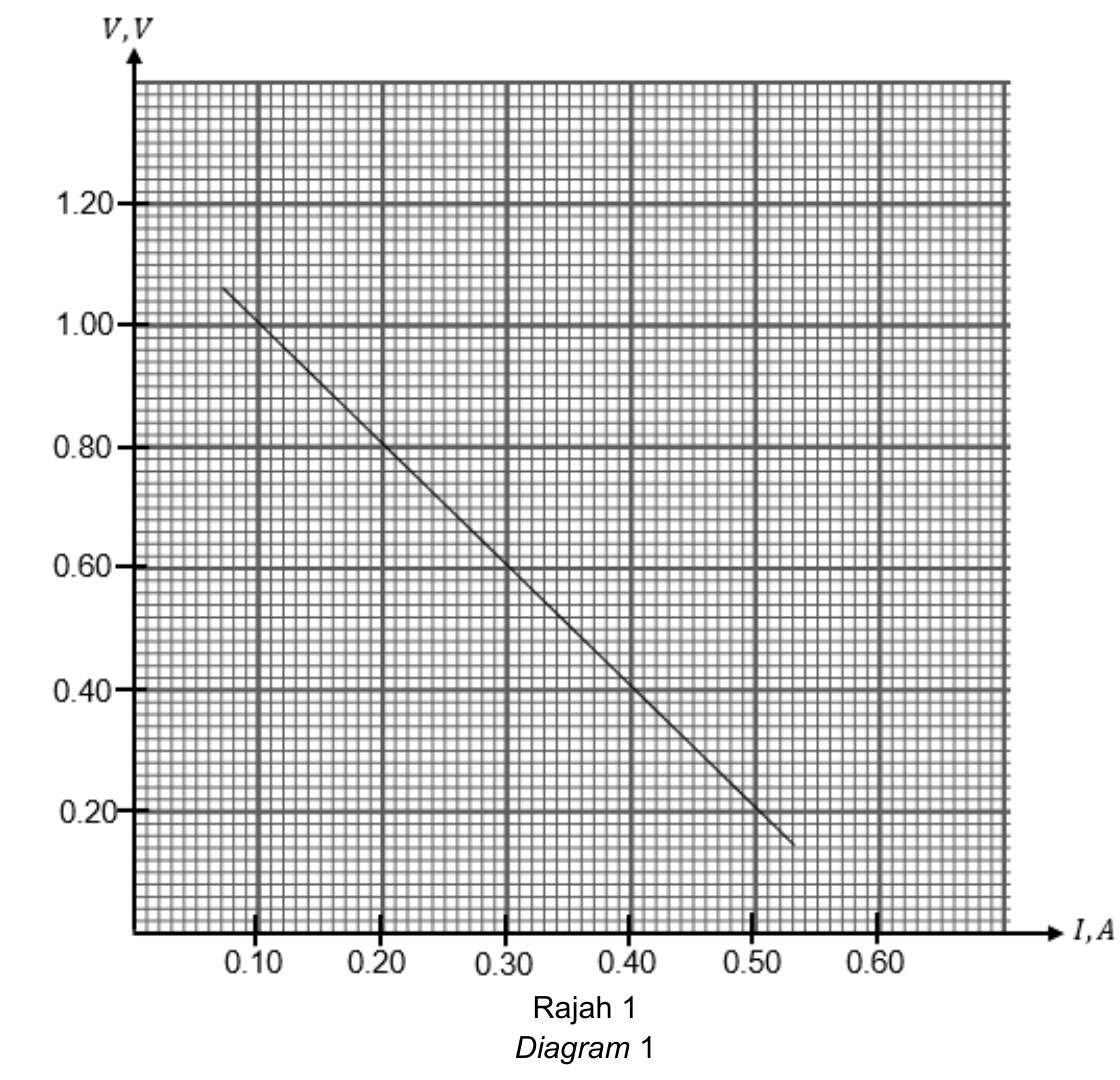
- (a)(i)
Based on Diagram 1, what happens to the potential difference, V when the current, I increases?
[1] - (a)(ii)
Determine the value of V when I = 0.00 A. Show how the value of V is determined on the graph in Diagram 1.
[2] - (b)
What happens to the slope of the graph when the number of dry cells is added and connected in series?
[1]
Diagram 2 shows a Barton's pendulum which consists of five simple pendulums hanging on a horizontal string. When pendulum X is pulled and released, it causes the other four pendulums (A, B, C, D) to oscillate. Pendulum C has the same length as X.
Medium5 marks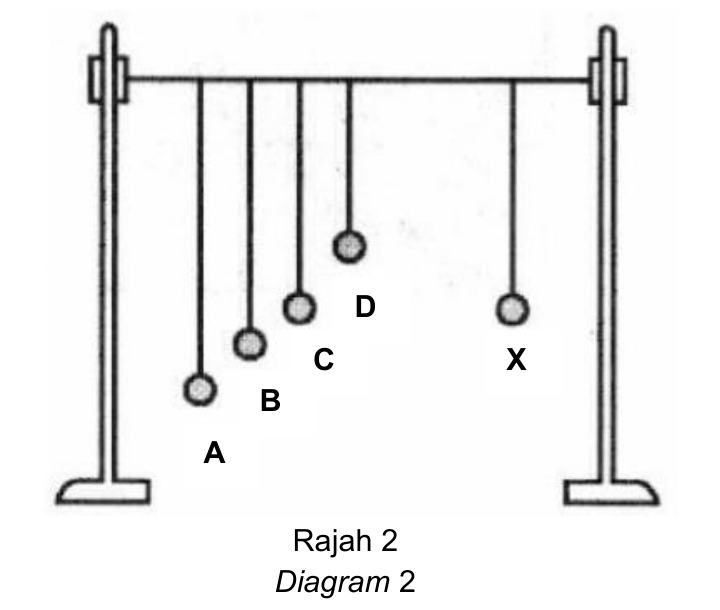
- (a)
What is the meaning of frequency?
[1] - (b)(i)
Which pendulum oscillates with the maximum amplitude?
[1] - (b)(ii)
Explain your answer in 2(b)(i).
[2] - (c)
Name the phenomenon stated in (b).
[1]
Diagram 3.1 shows one of the equipment used in dental treatment (a concave mirror). Diagram 3.2 shows an object placed between the focal point F and the mirror (C is the centre of curvature).
Medium6 marks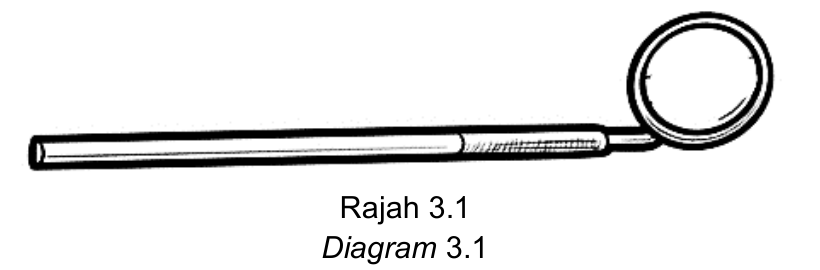
- (a)
What is meant by virtual image?
[1] - (b)(i)
In Diagram 3.2, draw a ray diagram to show the position of the image formed.
[3]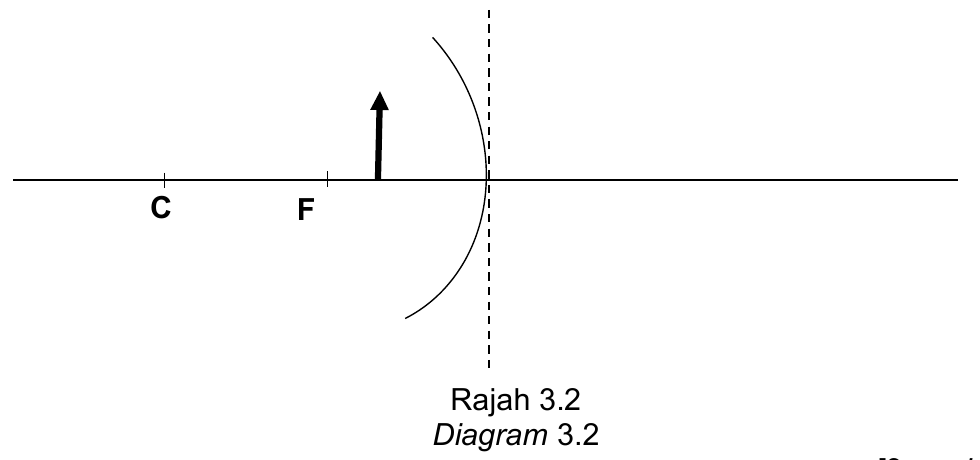
- (b)(ii)
State one characteristic of the image formed.
[1] - (c)
Give one application of this mirror in daily life.
[1]
Diagram 4 shows a U-shaped soft iron core wound with insulated copper wire PQ and RS. An alternating current (a.c.) voltage of 240 V is connected at the ends of PQ and a bulb of 12 V, 60 W is connected at the ends of RS.
Easy9 marks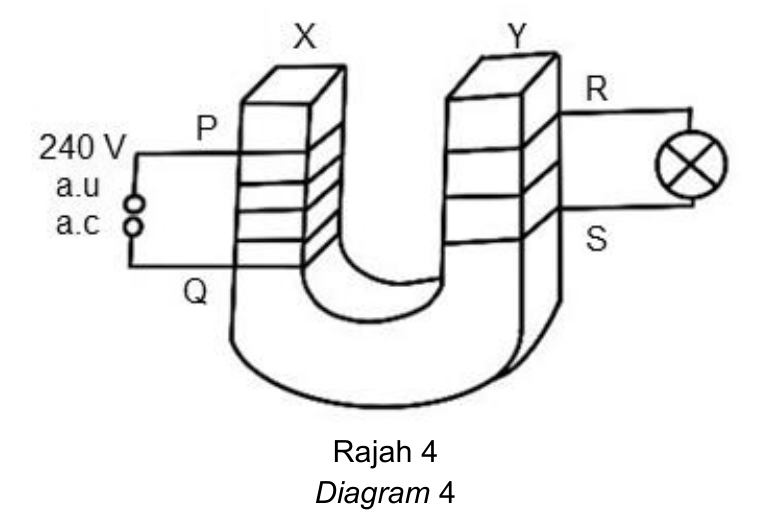
- (a)
State the type of transformer used.
[1] - (b)(i)
Explain why an a.c. voltage is used in Diagram 4.
[1] - (b)(ii)
How is the output voltage RS produced by the transformer? Explain.
[2] - (c)(i)
If the bulb lights up with normal brightness, determine the ratio of the number of turns in coil PQ to the number of turns in coil RS.
[1] - (c)(ii)
Calculate the output current flowing.
[2] - (c)(iii)
Calculate the input current if the efficiency of the transformer is 70%.
[2]
Diagrams 5.1(a) and 5.1(b) show the same kid sliding down a slide at the angle θ = 30° and θ = 45° with different acceleration. The same frictional force, Fg acts on the child on both slides. Weight of kid, W = 250 N. Wx = component of weight parallel to the slide (Wx = 125 N in 5.1(a), Wx = 177 N in 5.1(b)). The resultant force parallel to the slide, Fx = Wx − Fg.
Medium9 marks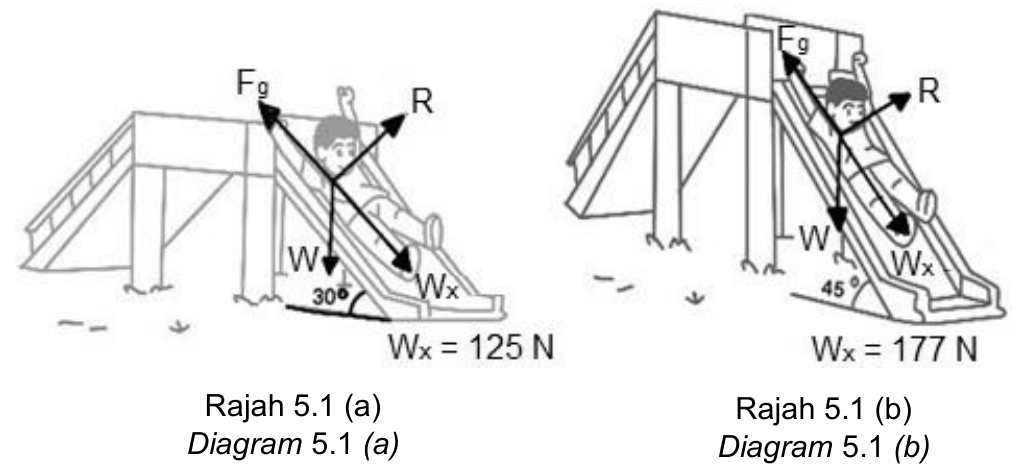
- (a)
What is the meaning of resultant force?
[1] - (b)(i)
Observe Diagram 5.1(a) and 5.1(b), compare angle θ.
[1] - (b)(ii)
Compare Wx.
[1] - (b)(iii)
Compare Fx.
[1] - (c)(i)
Based on answer in 5(b), state the relationship between angle θ and Fx.
[1] - (c)(ii)
State the relationship between angle θ and acceleration.
[1] - (d)
Name the law involved.
[1] - (e)
Diagram 5.2 shows a box (2.0 kg) being pulled by a man with a force of 50 N at 40° to the horizontal; a frictional force of 4.0 N acts against the motion. What is the resultant force acting on the box?
[2]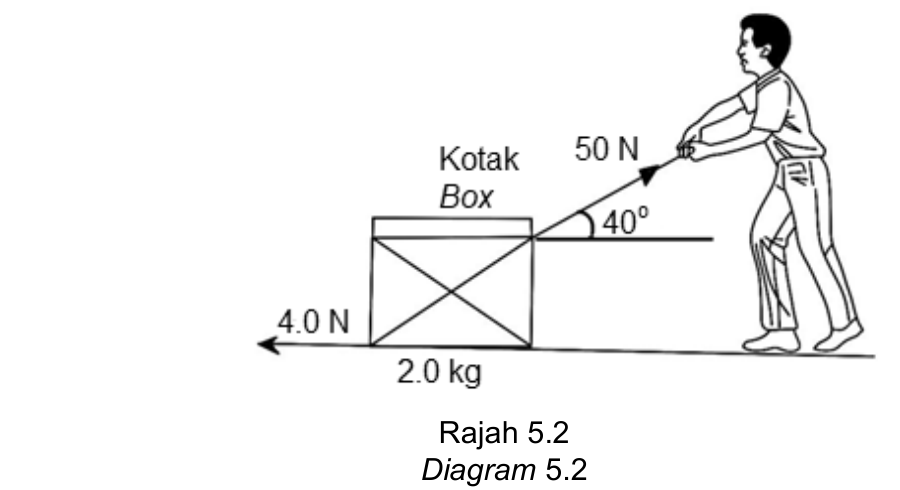
Diagram 6 shows the solar system with planet A (nearer the Sun, smaller) and planet B (further from the Sun, larger).
Medium9 marks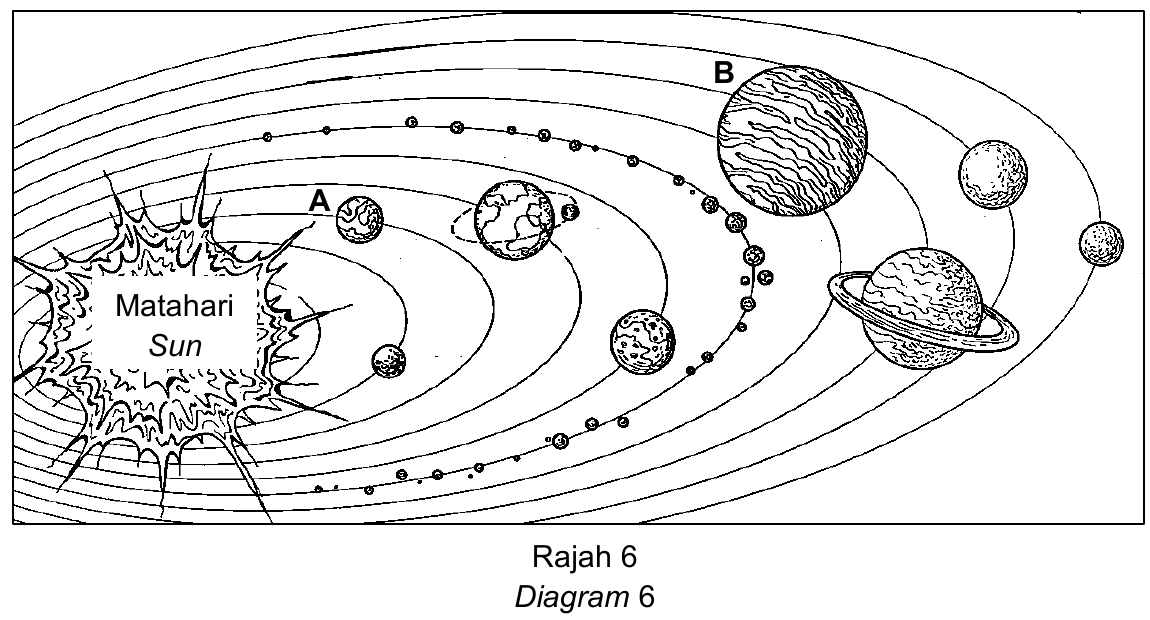
- (a)
Tick (√) the correct answer. State the shape of orbits of the planets: Circle / Sphere / Ellipse.
[1] - (b)(i)
Observe Diagram 6, compare planet A and planet B in terms of mass.
[1] - (b)(ii)
Compare radius of orbit.
[1] - (b)(iii)
Compare orbital period.
[1] - (c)
Relate the radius of orbit with the orbital period.
[1] - (d)
Name the law involved in 6(c).
[1] - (e)
Given the radius of orbit of Earth, R = 150 Gm and the orbital period of planet B, T = 11.9 years, calculate the radius of orbit of planet B.
[3]
Diagram 7 shows an image sensor which is the main component in a high-resolution camera.
Medium9 marks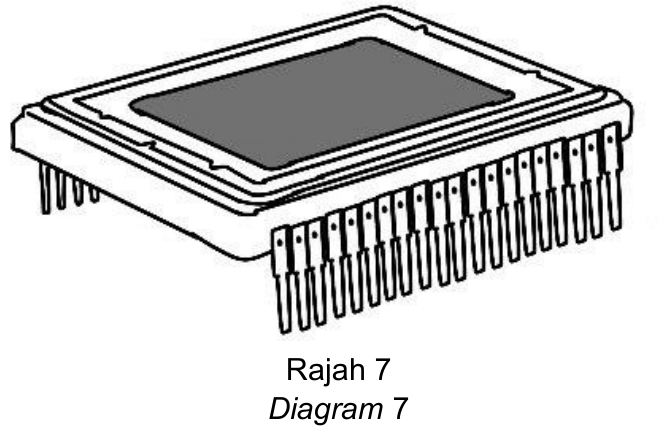
- (a)
What is meant by photoelectric effect?
[1] - (b)(i)
State one condition so that electrons can be emitted from the surface of the semiconductor material in the image sensor.
[1] - (b)(ii)
Indicate the signal changes that occur inside the image detector.
[1] - (c)(i)
Table 7 shows image detectors A (resolution High, quantum efficiency 40%), B (Low, 30%) and C (High, 80%). State the suitable image detector resolution and give a reason.
[2]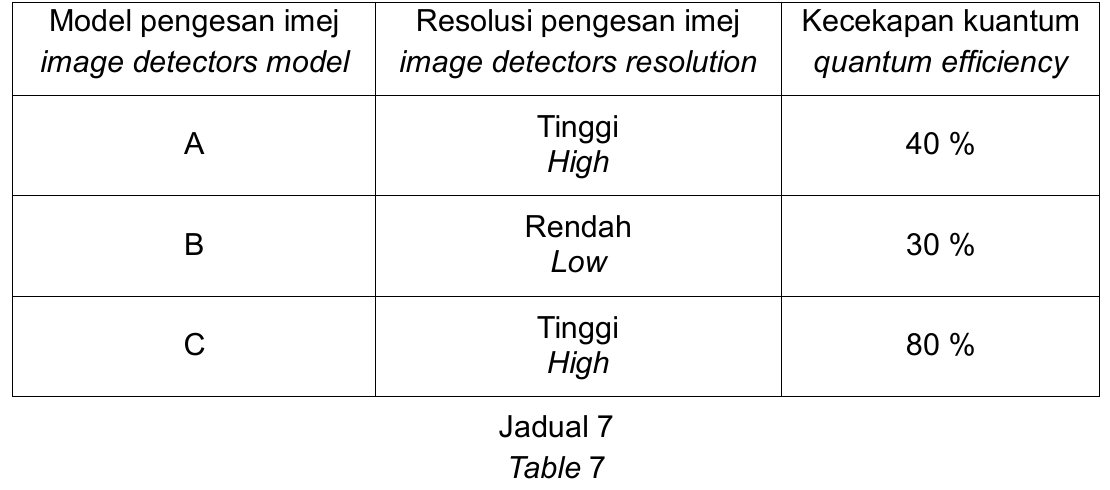
- (c)(ii)
State the suitable quantum efficiency and give a reason.
[2] - (d)
Based on your answer in 7(c), choose the most suitable image detector to be used as component in the camera.
[1] - (e)
State one other application of the photoelectric effect.
[1]
Diagram 8.1 shows a boy throwing a baseball vertically upward with initial velocity u = 10 m s⁻¹. Diagram 8.2 shows a paragliding activity participated by a man.
Medium9 marks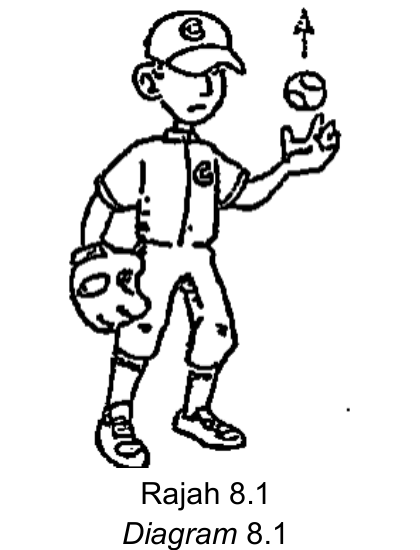
- (a)
Name one force that opposes the direction of motion of the baseball.
[1] - (b)
Calculate the maximum height that can be reached by the baseball.
[2] - (c)(i)
State the modification to the parachute canopy to increase the time in the air: area of parachute canopy; give a reason.
[2]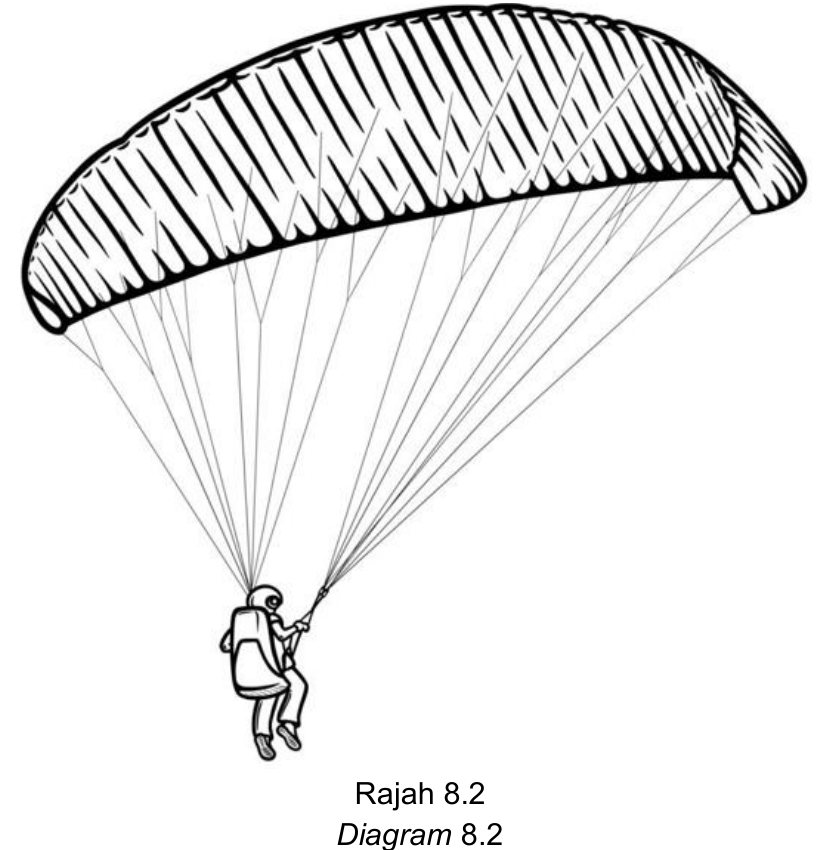
- (c)(ii)
Density of parachute canopy; give a reason.
[2] - (c)(iii)
Material of parachute canopy; give a reason.
[2]
Section B
Diagram 9.1 shows the air cushion wrap commonly used in the packaging and shipping of fragile goods. The plastic has bubbles filled with air to provide cushioning, reducing impact and vibration. When pressure is applied, the air inside gives resistance. (Section B: answer one of Question 9 or 10.)
Medium20 marks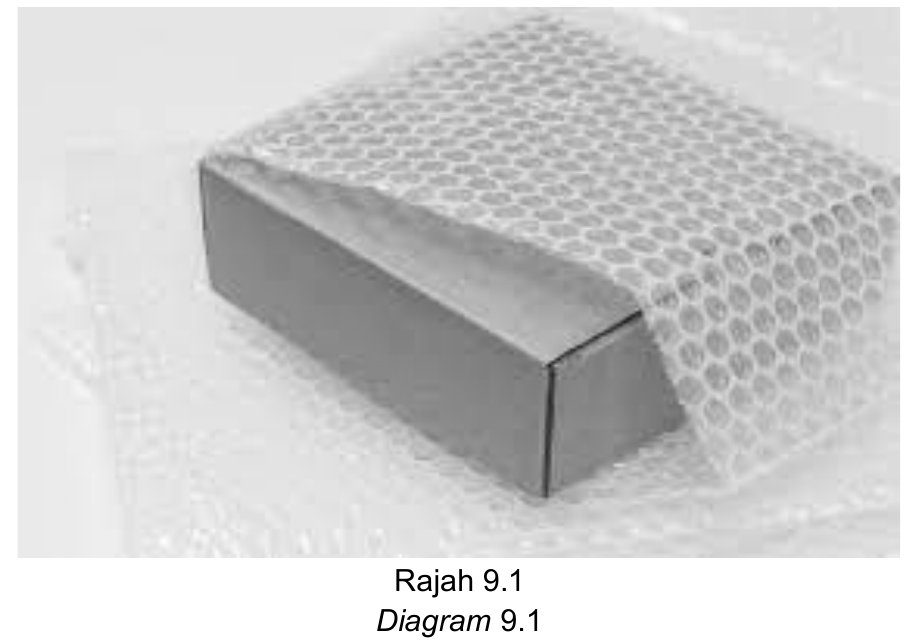
- (a)
State the SI unit for pressure.
[1] - (b)
A telecommunications store selling mobile phones online uses air cushion wrap to wrap the package box. Based on the Kinetic Theory of Gases, explain in terms of the behaviour of gas molecules how the air cushion wrap can prevent the phone from breaking.
[4] - (c)
Table 9 shows four ways of packaging fragile items (A: small box, strong and small tape, high density, no shock absorption; B: big box, moderate and wide tape, high density, shock absorption present; C: big box, strong and wide tape, low density, shock absorption present; D: small box, moderate and small tape, low density, no shock absorption). Determine the most suitable specifications to ensure fragile items arrive in good condition. Explain the suitability of each specification. Choose the most suitable way of packaging and give reasons.
[10]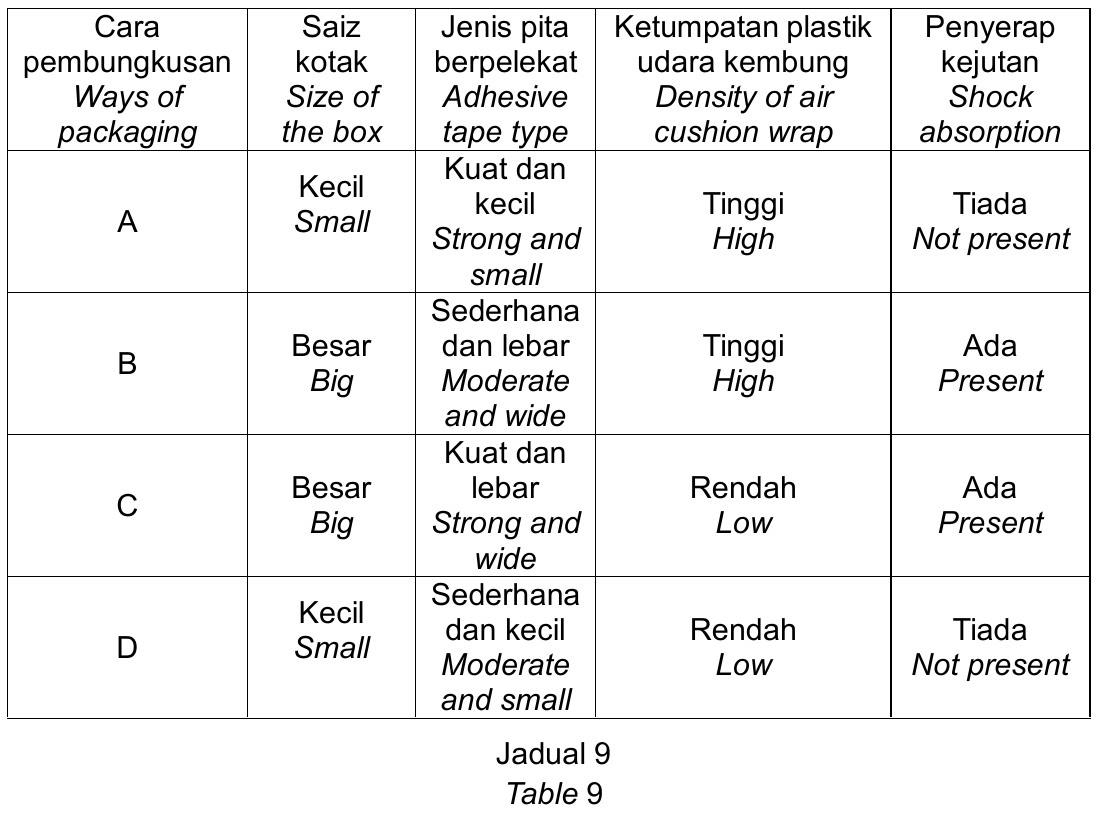
- (d)(i)
Diagram 9.2 shows the pressure-temperature graph for a fixed mass of gas at constant volume. State the value of the temperature that represents −273 °C in SI unit.
[1]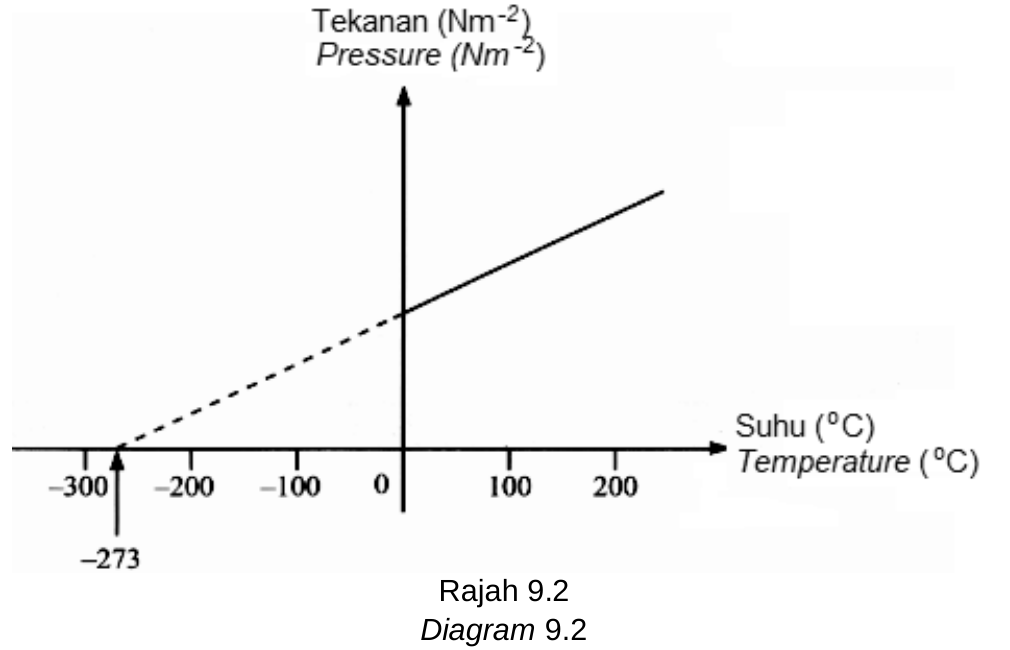
- (d)(ii)
The pressure in a car tyre is 200 kPa at 30 °C. Calculate the pressure of the tyre at the temperature of 273 K.
[2] - (d)(iii)
During the hot season, the temperature of the tyre increases two times from its initial temperature. Calculate the pressure of the tyre at that time.
[2]
Diagram 10.1 shows a spaceship launched using a rocket from a launch site. Diagram 10.2 shows a high-speed train floating above the track. The train changes speed from 0 km h⁻¹ to 360 km h⁻¹ in 10 s. (Section B: answer one of Question 9 or 10.)
Medium20 marks- (a)
What are the principles of physics applied to a rocket?
[1] - (b)
Explain how the expulsion of hot gases through a rocket's exhaust can accelerate the rocket upwards.
[4]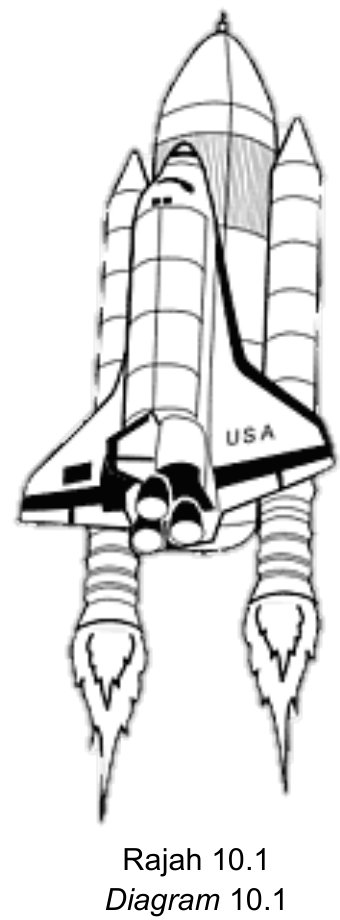
- (c)(i)
What is the final speed of the train in the unit of m s⁻¹?
[1]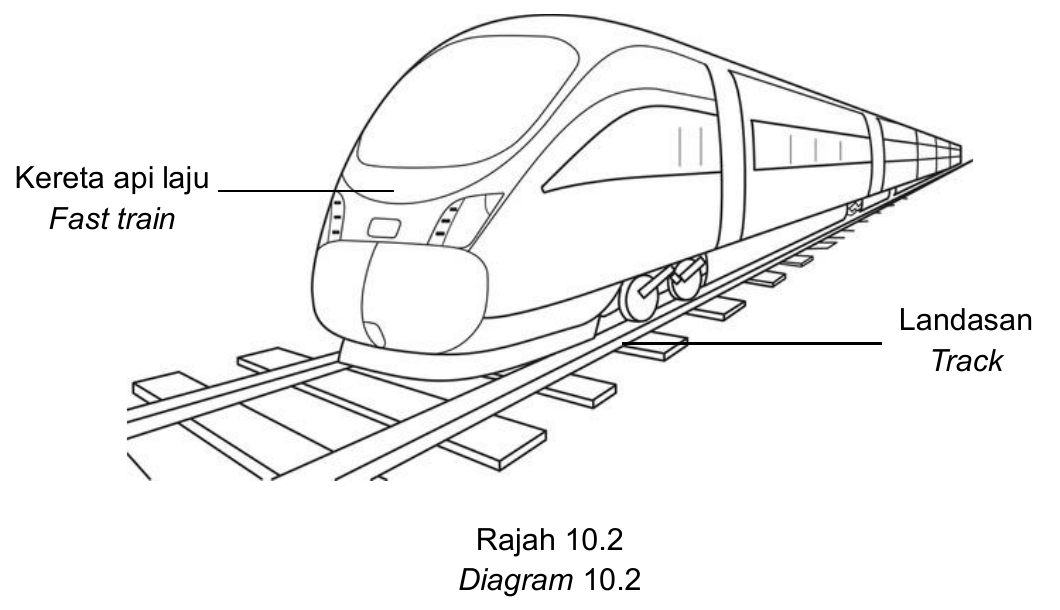
- (c)(ii)
What is the acceleration of the train in the unit of m s⁻²?
[2] - (c)(iii)
What is the distance travelled by the train in 10 s?
[2] - (d)
Assume you are an engineer assigned to create a model of a high-speed train. Referring to Table 10 (P: pentagon shape, low density, one long coach, superconductor; Q: aerodynamic, high density, 8 short coaches, soft-iron core; R: aerodynamic, low density, 8 short coaches, superconductor; S: pentagon, high density, one long coach, soft-iron core), explain the suitability of each characteristic of a fast train. Determine the most suitable fast train which can move with the highest speed by floating above the tracks. Give reasons for your choice.
[10]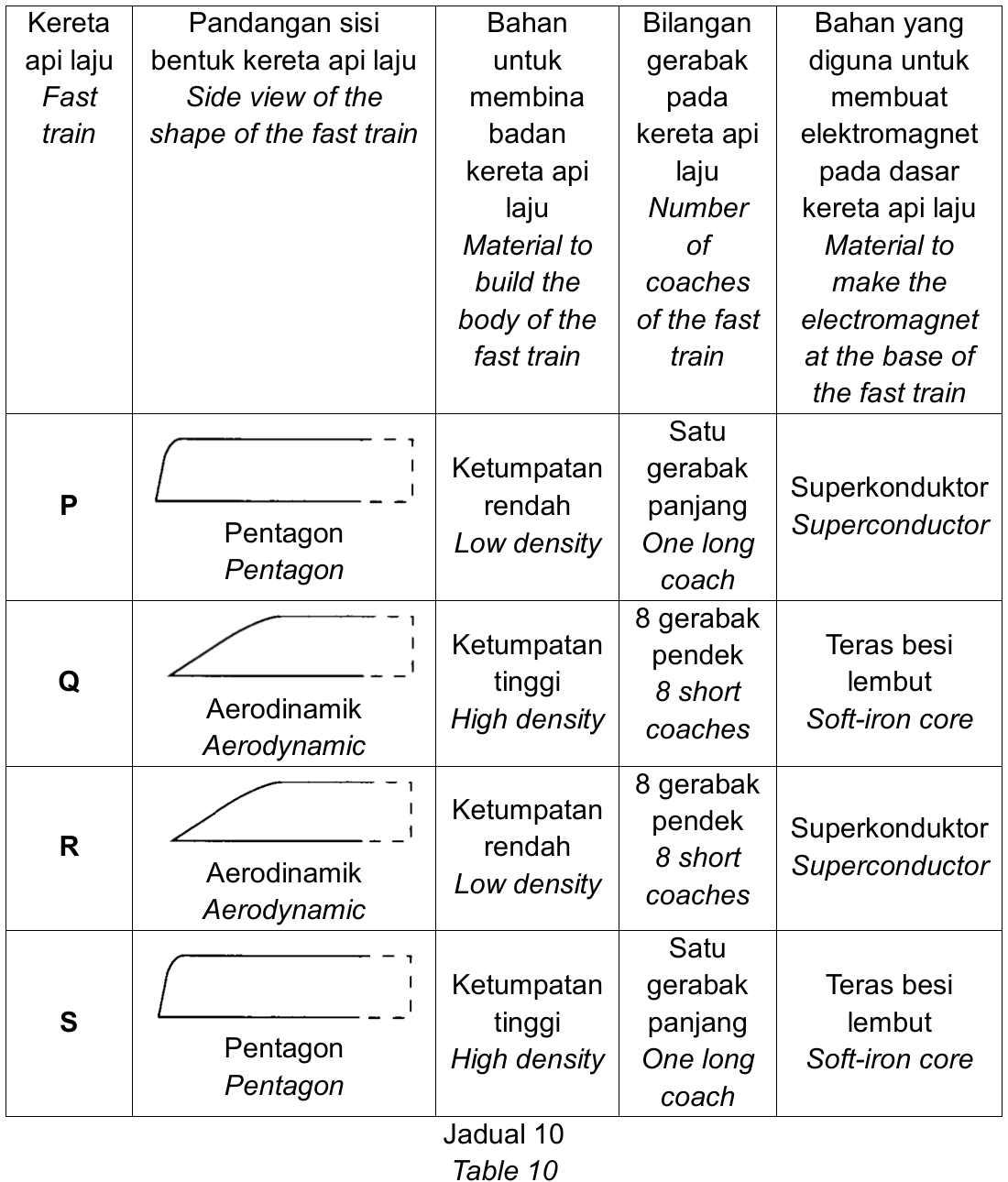
Section C
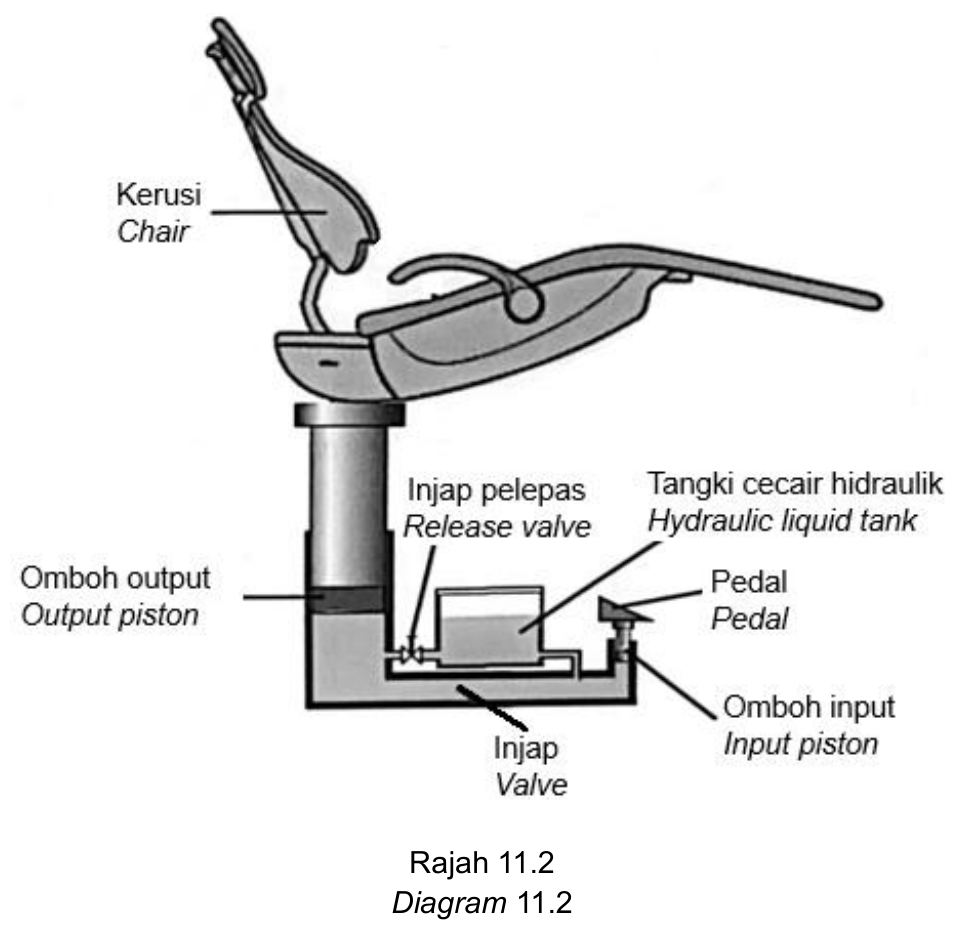
Diagram 11.1 shows a hydraulic jack with force F1 = 50 N on the input piston (A1 = 0.5 m²) and F2 = 800 N on the output piston (A2 = 8 m²). Diagram 11.2 shows a hydraulic chair used by dentists. (Section C: compulsory.)
Medium20 marks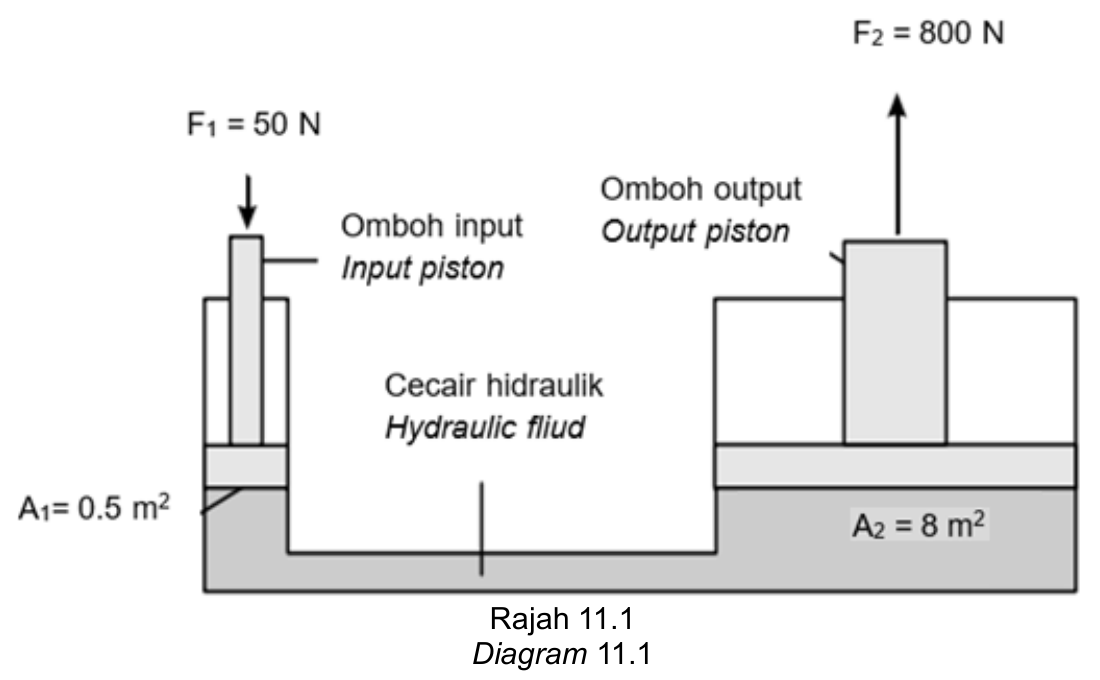
- (a)
What is meant by Pascal's Principle?
[1] - (b)
Observe Diagram 11.1, compare the pressure exerted on the input and output pistons, the cross-sectional areas A1 and A2, and the forces F1 and F2. Relate the applied pressure with the force produced on the output piston and deduce the relationship between the output cross-sectional area and the force produced.
[5] - (c)
Explain how a hydraulic jack can be used to lift a car when a force F1 is applied to an input piston of cross-sectional area A1. State how the force F2 on the output piston of cross-sectional area A2 can lift a heavy car.
[4] - (d)
You are a member of the school innovation association and are asked to build a model of a hydraulic chair that can withstand big loads and is safe to use. Suggest modifications involving the characteristics of the fluid used, the material for the chair and pedals, and additional features. Give reasons.
[10]