Which of the following statement is correct about distance?
Easy
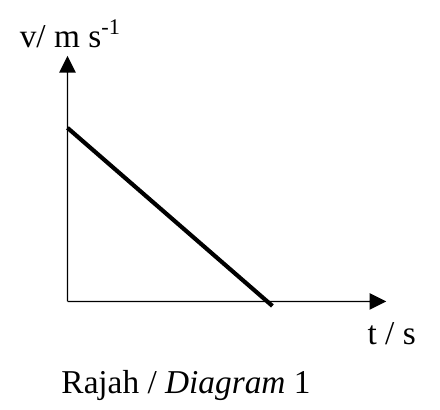
Diagram 1 shows a linear motion graph of a moving object (velocity v / m s⁻¹ against time t / s: a straight line sloping downwards from a positive initial velocity to zero). Which of the following statement is the correct interpretation of the graph?
Medium
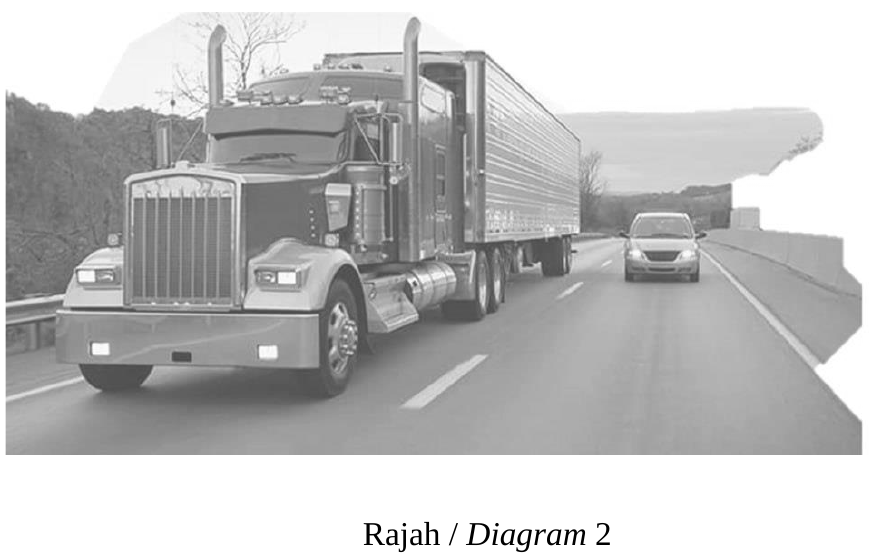
Diagram 2 shows a car and a lorry moving on a highway. Why is the lorry more difficult to stop if both vehicles are driven at the same velocity? I Big mass needs greater force to stop; II Big mass needs greater energy to stop; III Big mass possesses greater impulse to stop; IV Big mass possesses greater momentum to stop.
Medium
What happens to the acceleration of an object if the force acting on it is doubled while its mass is fixed?
Medium
A clay ball of mass 68 g is horizontally thrown at a velocity of 15 m s⁻¹ and stuck to a vertical wall. If the time of impact is 0.005 seconds, what is the impulsive force acting on the clay ball?
Medium
What is the S.I. unit of weight?
Easy
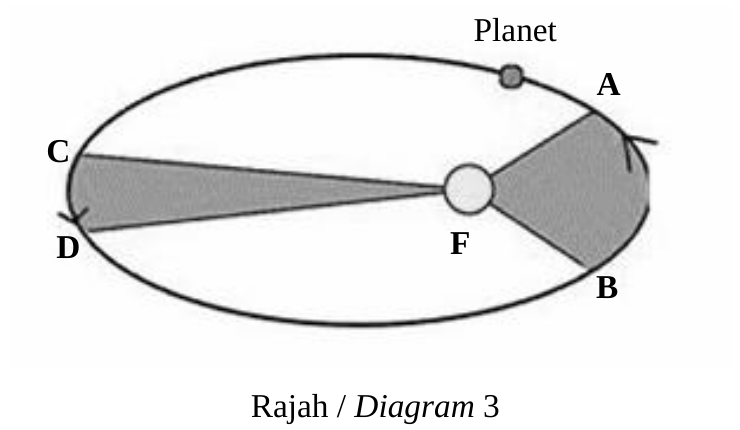
Diagram 3 shows the motion of a planet in its orbit (shaded sectors AFB and CFD about the central body F). Which of the following is correct?
Medium
The escape velocity of a rocket from the Earth does not depend on
Medium
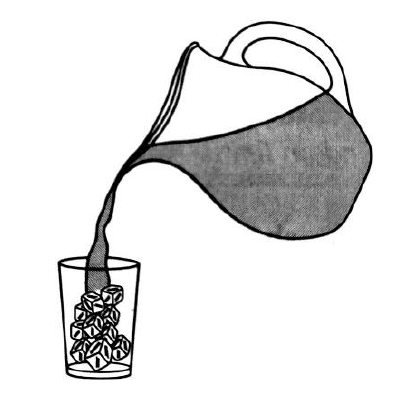
Diagram 4 shows 0.5 kg of water at temperature 70 °C poured into a glass of ice cubes at 0 °C. What is the mass of the ice cubes that melt? [Specific latent heat of fusion of ice = 3.36 × 10⁵ J kg⁻¹, specific heat capacity of water = 4200 J kg⁻¹ °C⁻¹]
Medium
Which graph shows the relationship between the pressure and absolute temperature of a fixed mass of gas at constant volume?
Medium
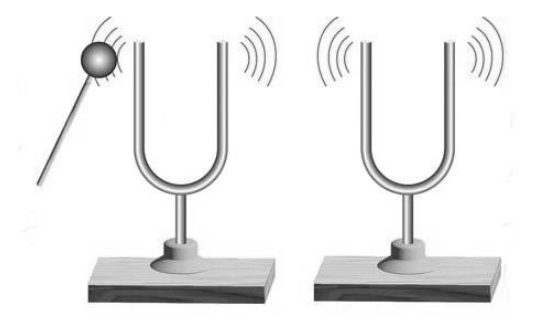
Diagram 5 shows two identical tuning forks side by side. When a student knocks the first fork, its vibrations force the second fork to oscillate with maximum amplitude. Which phenomenon is correct in describing the situation?
Easy
Which pair of physical quantities will remain unchanged when water wave is reflected?
Medium
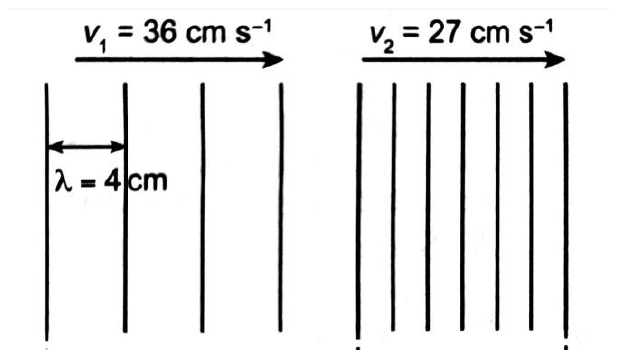
Diagram 6 shows water waves propagating from a deep area (v₁ = 36 cm s⁻¹, λ = 4 cm) to a shallow area (v₂ = 27 cm s⁻¹). What is the wavelength of the water waves in the shallow area?
Medium
Why are sound waves more easily diffracted compared with light waves?
Medium
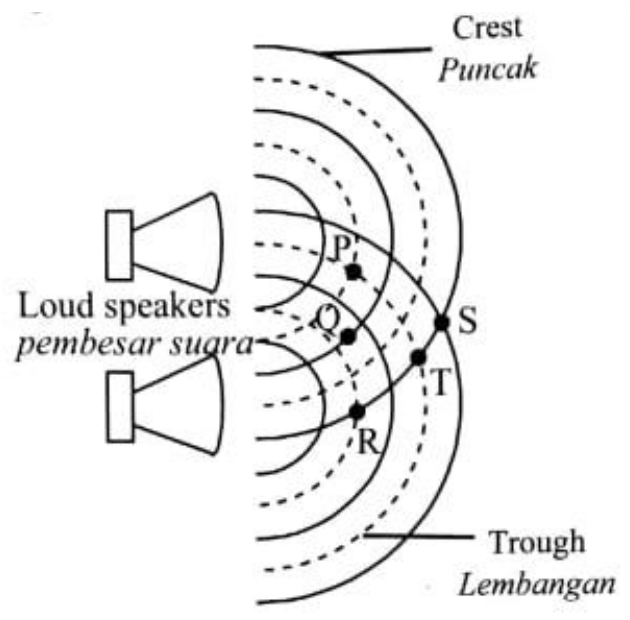
Diagram 7 shows an interference of sound waves emitted from two coherent loudspeakers (solid arcs = crests, dashed arcs = troughs; points P, Q, R, S, T marked). Which of the following shows the constructive interference?
Medium
Diagram 8 shows an electromagnetic spectrum: Gamma ray, Q, Visible ray, Infrared ray, R, Radio wave. Which of the following is correct for Q and R?
Medium
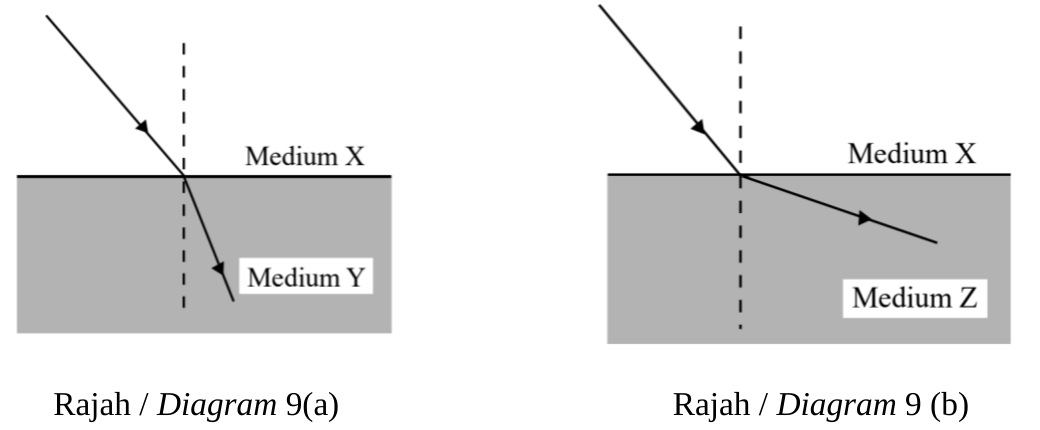
Diagram 9(a) shows a ray of light passing from medium X to medium Y while Diagram 9(b) shows a ray of light passing from medium X to medium Z. Which of the following sequence of optical density of a medium is in descending order?
Medium
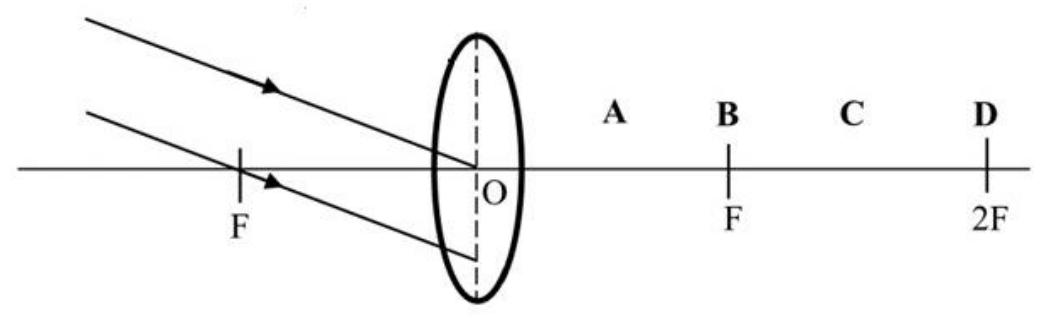
Diagram 10 shows light rays travelling from a distant object to a convex lens (positions A, B at F, C, D at 2F on the right of the lens). At which position A, B, C or D is the image formed?
Medium
An astronomical telescope has 120 cm of normal adjustment with the focal length of the eyepiece 40 cm. What is the magnification of the telescope?
Medium
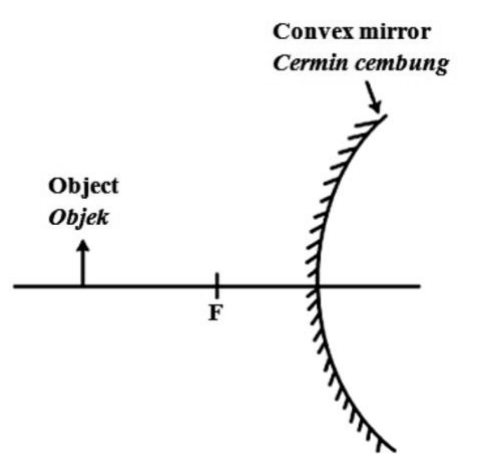
Diagram 12 shows an object positioned in front of a convex mirror. Which of the following is the characteristic of the image formed?
Medium
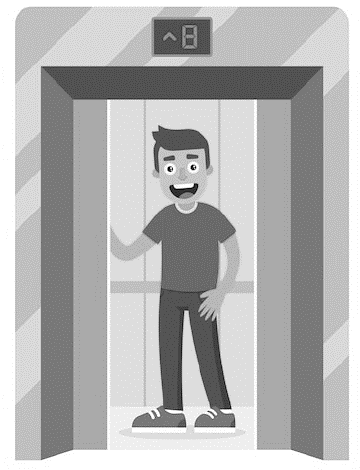
Diagram 13 shows a passenger of mass 65 kg in an elevator. Calculate the magnitude of normal reaction, R when the lift moves upward with an acceleration 1.5 m s⁻². (g = 9.81 m s⁻²)
Medium
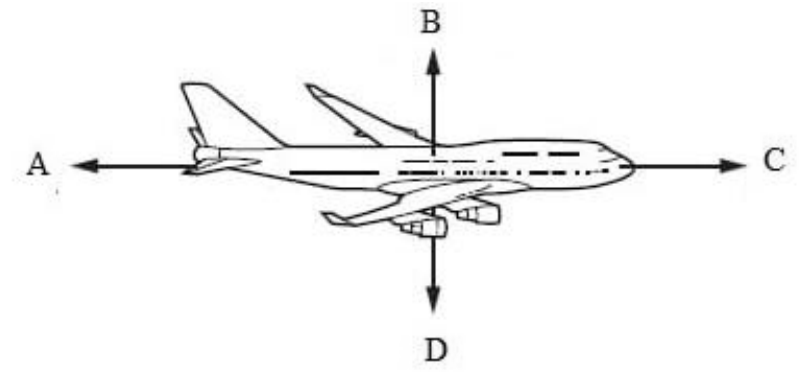
Diagram 14 shows an aeroplane flying at a fixed height with constant velocity (arrows: A to the left, B upward, C to the right in the direction of flight, D downward). Which of the following represents thrust force?
Medium
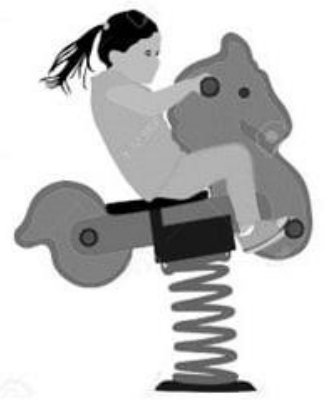
Diagram 15 shows a girl playing on a spring horse at a playground. What modification should be done to the spring when heavier kids play on the spring horse?
Medium
Which of the following affect the pressure in liquid?
Easy
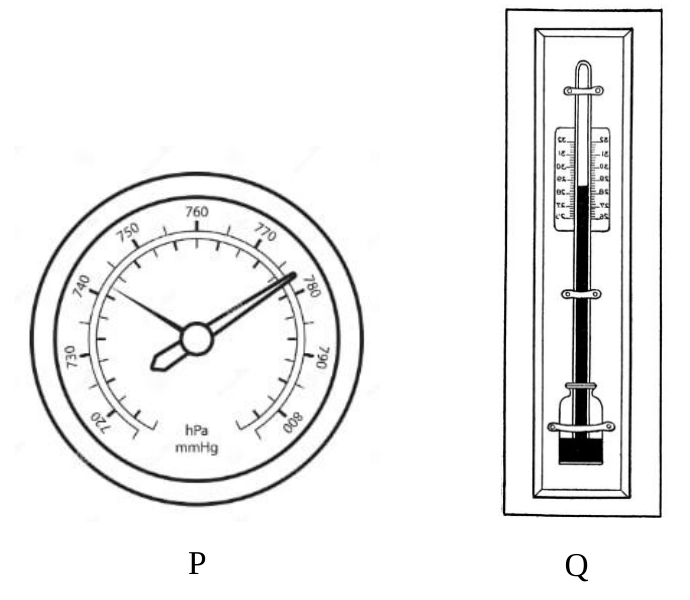
Diagram 16 shows two types of instrument to measure atmospheric pressure: P (dial gauge) and Q (mercury column on a board). Which of the following is correct?
Medium
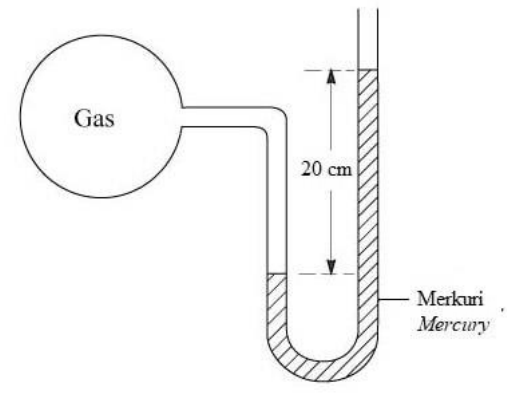
Diagram 17 shows a manometer connected to a gas supply (mercury level difference 20 cm). What is the gas pressure in Pa? [density of mercury = 13600 kg m⁻³, atmospheric pressure = 103360 Pa, g = 9.81 m s⁻²]
Medium
Which physics principle is used to float a hot air balloon in air?
Medium
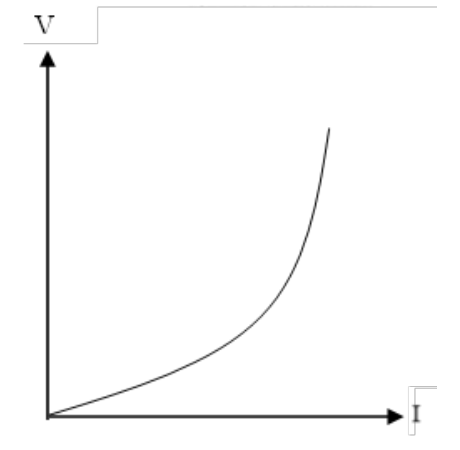
Diagram 18 shows a graph of potential difference V against current I (a curve through the origin that rises ever more steeply). Which of the following statement is correct about the graph?
Medium
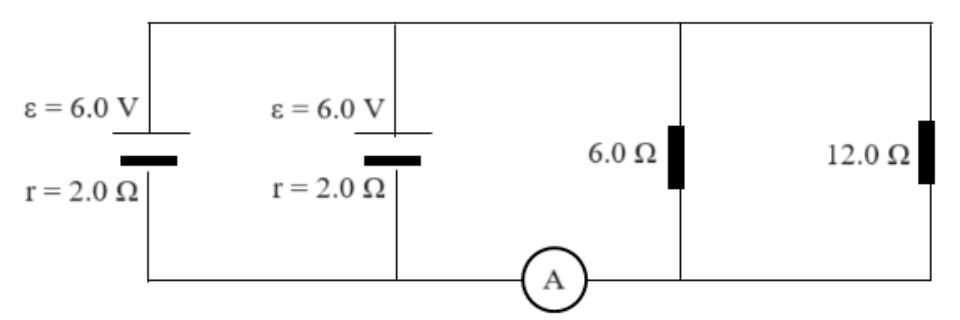
Diagram 19 shows two dry cells in parallel, each of e.m.f. 6.0 V and internal resistance 2.0 Ω, connected to a 6.0 Ω and a 12.0 Ω resistor in parallel. What is the ammeter reading?
Medium
What is the best step in reducing energy usage at home?
Easy
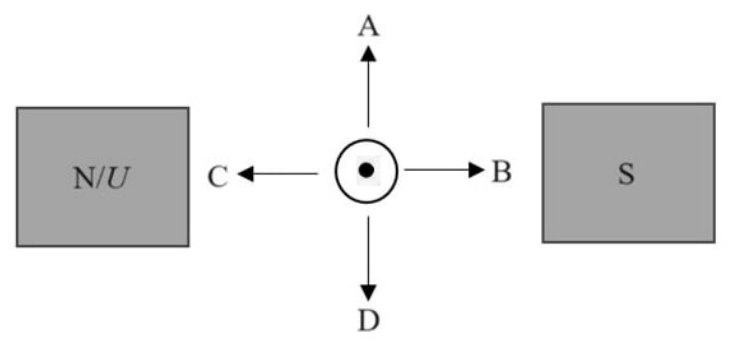
Diagram 20 shows a current-carrying conductor (current out of the page) in a magnetic field between the N pole (left) and S pole (right). In which direction, A, B, C or D, does the force act on the conductor?
Medium
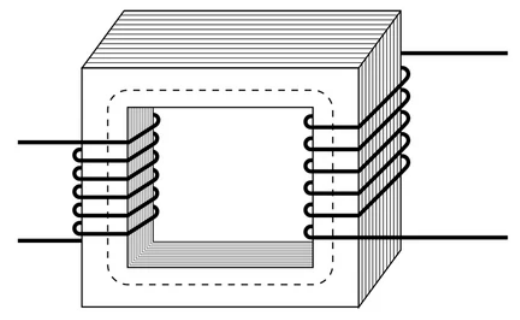
Diagram 21 shows a transformer with efficiency of 60%. How can the efficiency of the transformer be increased?
Easy
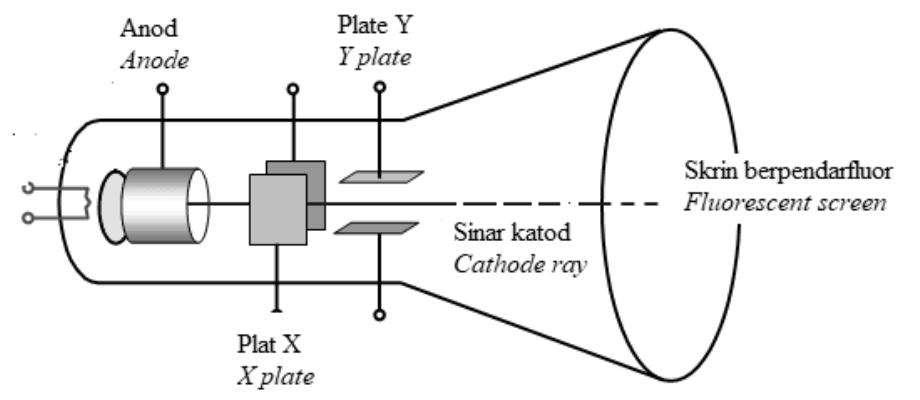
Diagram 22 shows a cathode ray tube. What particles are found in the cathode rays?
Easy
Diagram 23 shows the symbol of an electronic component (a semiconductor diode). What is the function of the electronic component?
Easy
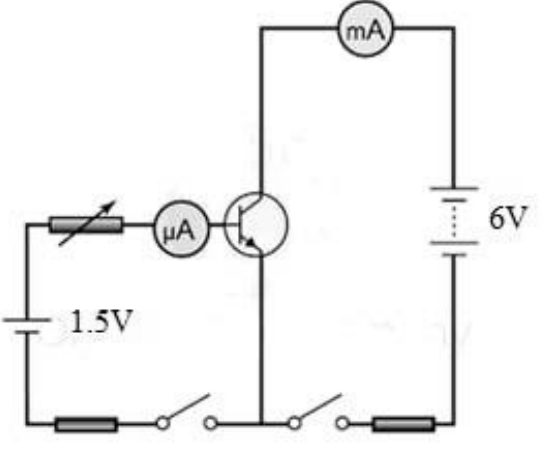
Diagram 24 shows a simple transistor amplifier circuit (base circuit 1.5 V with microammeter; collector circuit 6 V with milliammeter). What is the amplification factor of the amplifier, β, of the circuit?
Medium
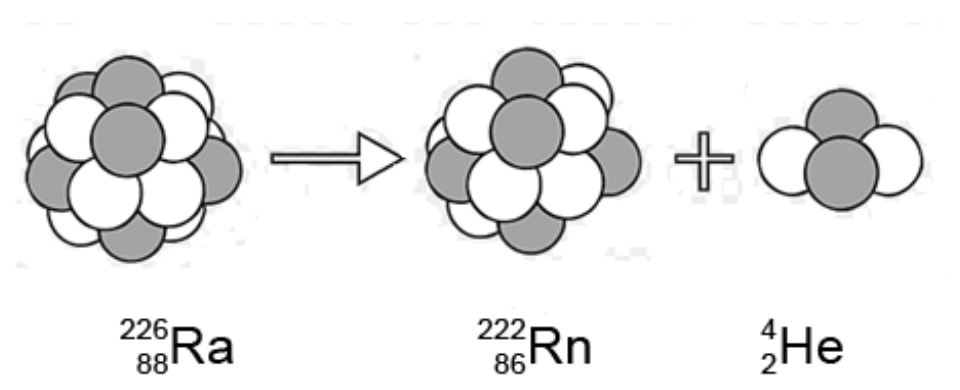
Diagram 25 shows a radioactive decay of a nucleus: Ra-226 (88) → Rn-222 (86) + He-4 (2). What is the type of radiation emitted by the nucleus?
Medium
Diagram 26 shows a series of radioactive decay: ²¹⁸₈₄Po → ²¹⁴₈₂Pb → ²¹⁴₈₃Bi → ²¹⁴₈₄Po → ²¹⁰₈₂Pb. Which of the following sequence of radioactive rays is correct in explaining the decay series?
Medium
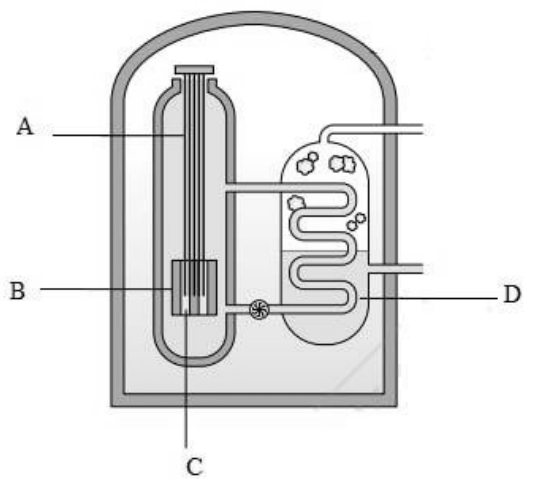
Diagram 27 shows the cross section of the internal section of a nuclear reactor (parts A, B, C, D labelled). Which of the following represents the control rod which absorbs excessive neutrons?
Easy
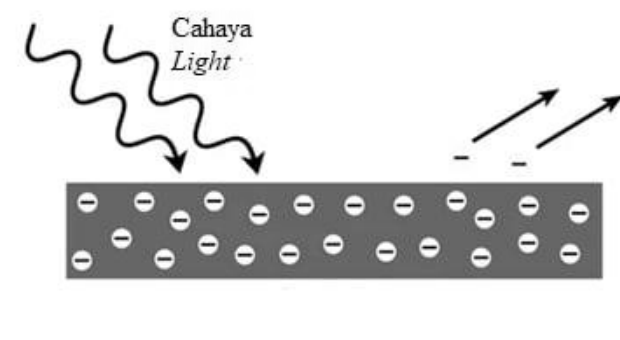
Diagram 28 shows a phenomenon on a metal surface (light falls on the metal and electrons are emitted). Which of the following is correct about the phenomenon?