Write your answer on paper. Then open the answer to check it.
Section A
Diagram 1 shows an electromagnetic spectrum (radio wave, P, infrared, ultraviolet, R, S marked along the spectrum; Q is the distance between two successive crests of a wave drawn below).
Medium4 marks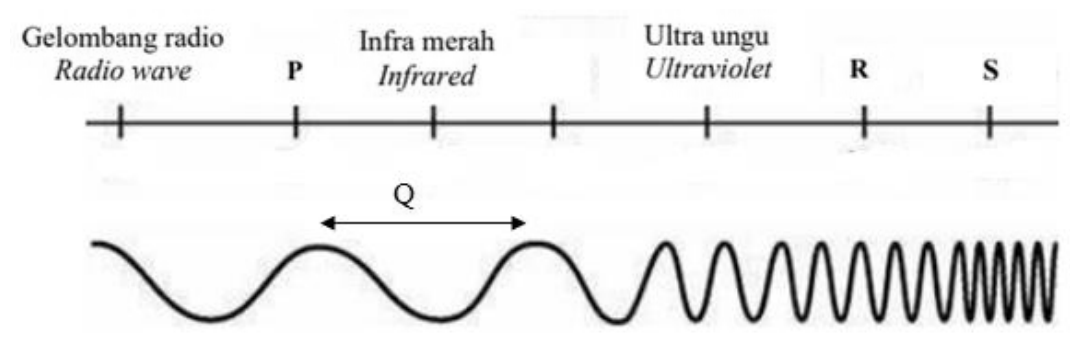
- (a)
Mark (X) at the correct answer to complete the following statement: Continuous spectrum / Line spectrum
[1] - (b)
Name the physical quantity represented by Q.
[1] - (c)(i)
Based on Diagram 1, state the type of wave P.
[1] - (c)(ii)
Compare the frequency of wave P and S.
[1]
Diagram 2 shows the effect of mass between two bodies on gravitational force (F₁ between two small masses, F₂ between two larger masses).
Medium5 marks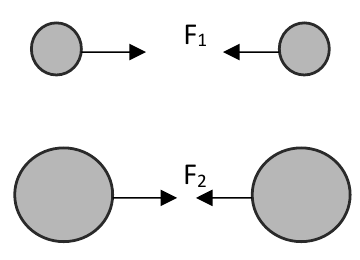
- (a)
Name the force F₁ and F₂ acted on the two bodies as above.
[1] - (b)
Determine the magnitude of gravitational force if the larger masses of bodies are used.
[1] - (c)
Calculate the gravitational force between the Earth and the man-made satellite. Given: mass of the Earth 5.97 × 10²⁴ kg; radius of the Earth 6.37 × 10⁸ m; mass of the satellite 1.20 × 10³ kg; distance of Earth and satellite 4.22 × 10⁷ m.
[3]
Diagram 3 shows the reading of the Bourdon gauge (180 kPa) when air is heated in a round bottom flask. The initial temperature of the water is 25 °C.
Medium6 marks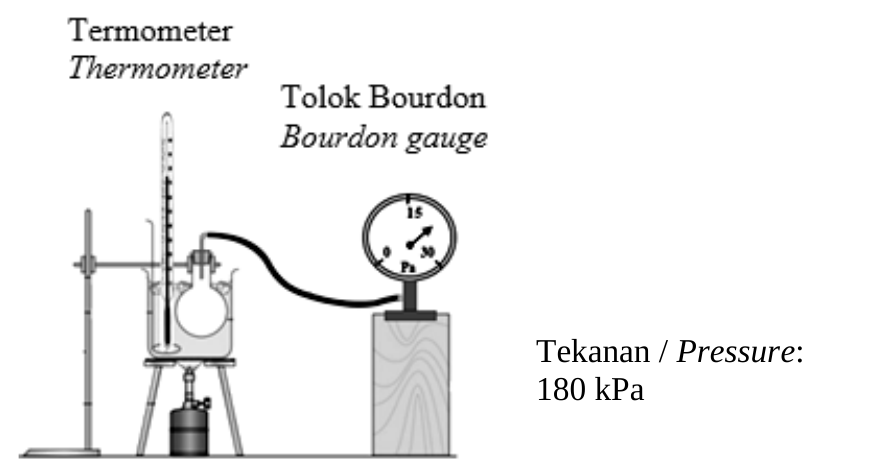
- (a)
Name the physical quantity measured by the Bourdon gauge.
[1] - (b)
Based on Diagram 3, state the gas law involved.
[1] - (c)
Based on the Kinetic Theory of Gas, explain the relationship between the pressure of air in the round bottom flask and temperature.
[2] - (d)
Based on Diagram 3, calculate the pressure in the round bottom flask when the water is heated to 80 °C.
[2]
Diagram 4 shows a photo frame with mass 4.3 kg hung onto a wall using a string. Each side of the string makes an angle of 40° with the wall/ceiling line; the angle between the two strings at the frame is x; the tension in each string is T.
Medium9 marks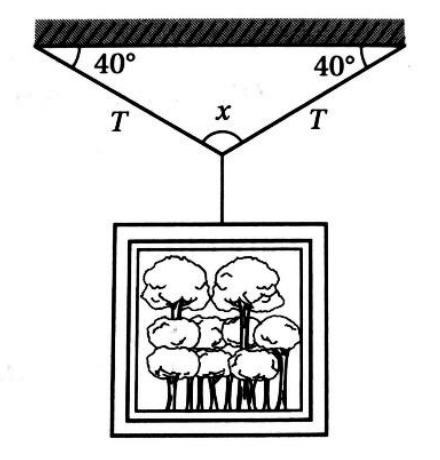
- (a)
What is meant by weight?
[1] - (b)
Based on Diagram 4, draw the triangle of forces in the space below.
[2] - (c)(i)
Determine the weight of the photo frame.
[2] - (c)(ii)
Determine the tension of the string.
[3] - (d)
What will happen to T if the angle x increases?
[1]
Diagram 5 shows two different containers filled with water to the same depth of 0.2 m; P and Q are points at the base of each container.
Easy9 marks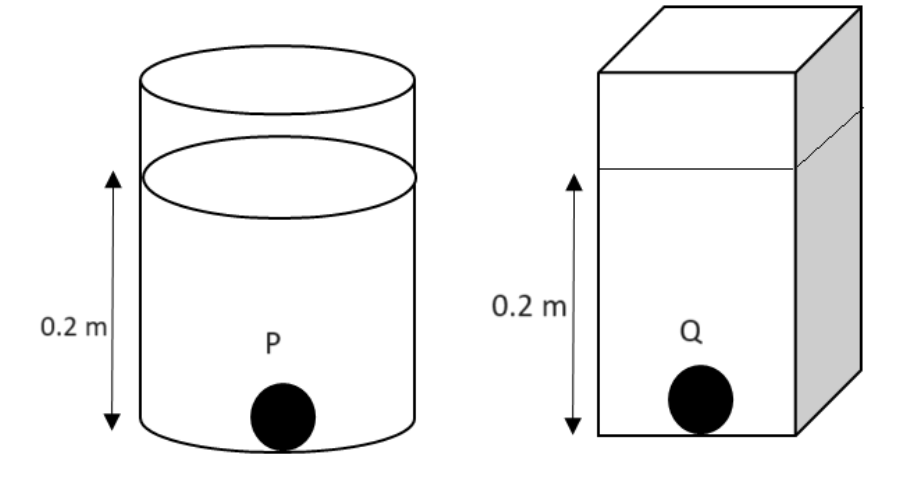
- (a)
What is the meaning of pressure?
[1] - (b)(i)
Compare the pressure at point P and Q.
[1] - (b)(ii)
Calculate the water pressure at point P. [Density of water = 1000 kg m⁻³]
[2] - (c)
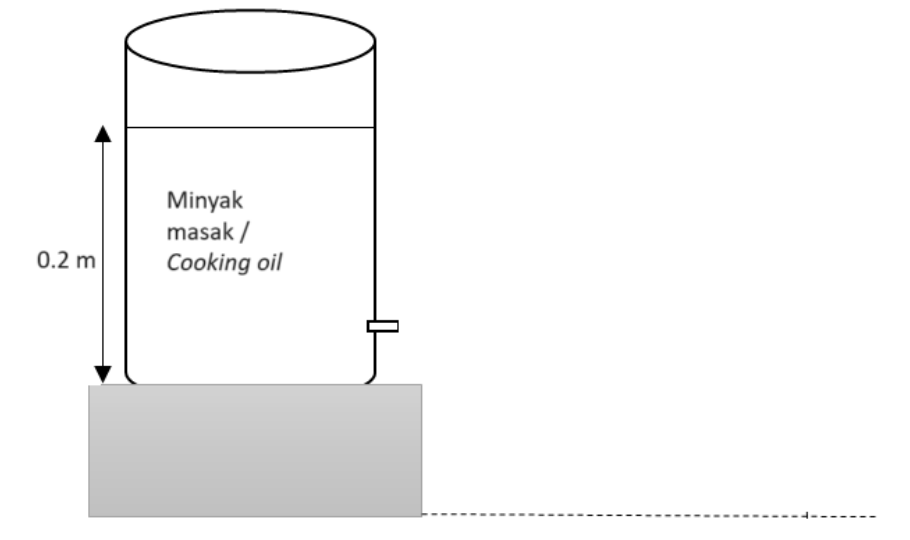
Diagram 5(a) shows the spurting of water from a hole at the base of a container. Diagram 5(b) shows cooking oil filled in the same container replacing the water. On Diagram 5(b) draw the spurting of cooking oil from the same hole.
[1]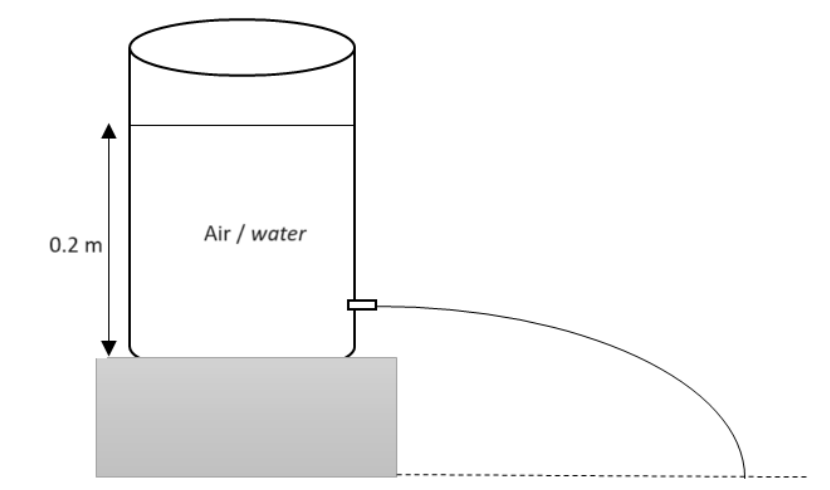
- (d)(i)
Based on your answer in 5(c), compare the spurting distance for both water and cooking oil.
[1] - (d)(ii)
Compare the density of water and cooking oil.
[1] - (d)(iii)
State the relationship between the spurting distance and density.
[1] - (e)
Predict what will happen to the distance of the spurt if alcohol is used.
[1]
Diagrams 6.1(a) and 6.2(a) show two circuits investigating the relationship between potential difference and current in a conductor wire. Diagrams 6.1(b) and 6.2(b) show the corresponding graphs of potential difference V against current I (Graph 6.1(b) is steeper than Graph 6.2(b)). The resistance of the wire is represented by the gradient of the graph.
Medium9 marks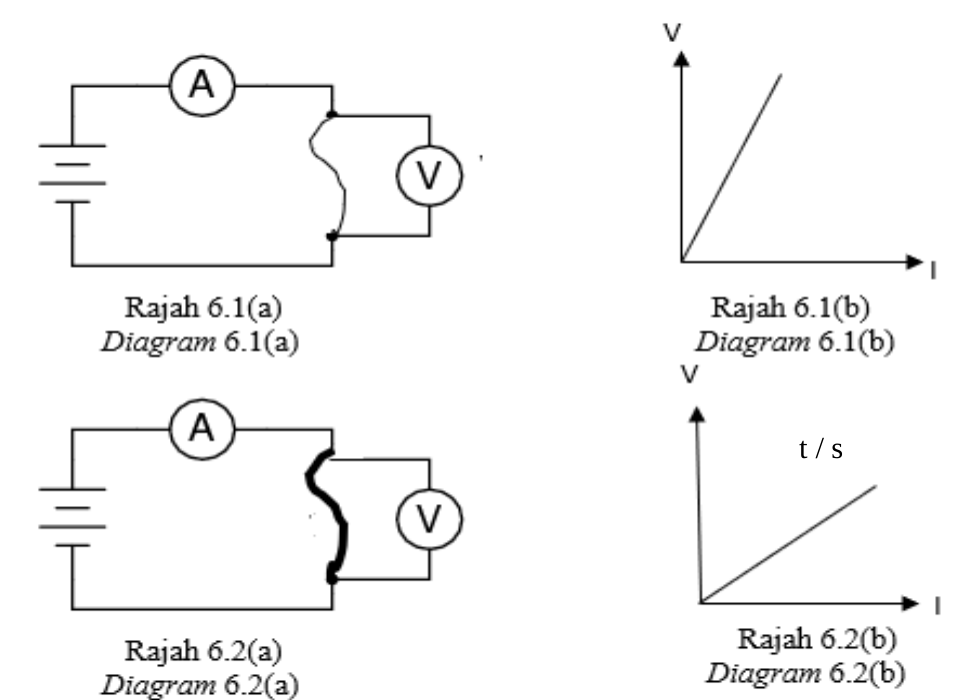
- (a)
What is the meaning of resistance?
[1] - (b)(i)
Based on Diagram 6.1 and 6.2, compare the thickness of the conductor wire.
[1] - (b)(ii)
Compare the resistance of the conductor wire.
[1] - (c)
Relate the thickness of the conductor wire with resistance.
[1] - (d)(i)
Diagram 6.3 shows three resistors S, T and U, each 20 Ω, connected to a 6 V dry cell (T and U in parallel, in series with S). Calculate the effective resistance of the circuit.
[2]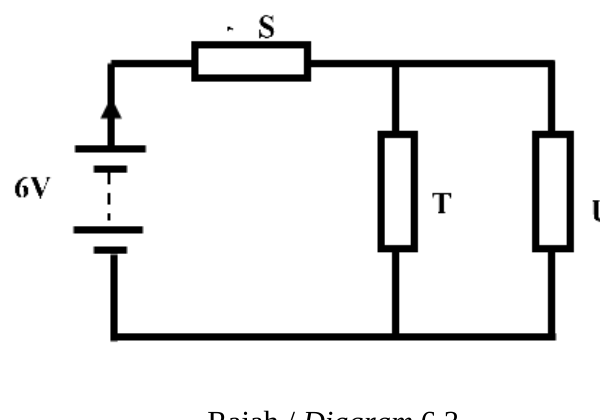
- (d)(ii)
Calculate the power dissipated by resistor S.
[3]
Diagram 7 shows an object O placed in front of a convex lens K (object between 2F and F on the left of the lens). The focal length of the convex lens K is 4 cm.
Medium9 marks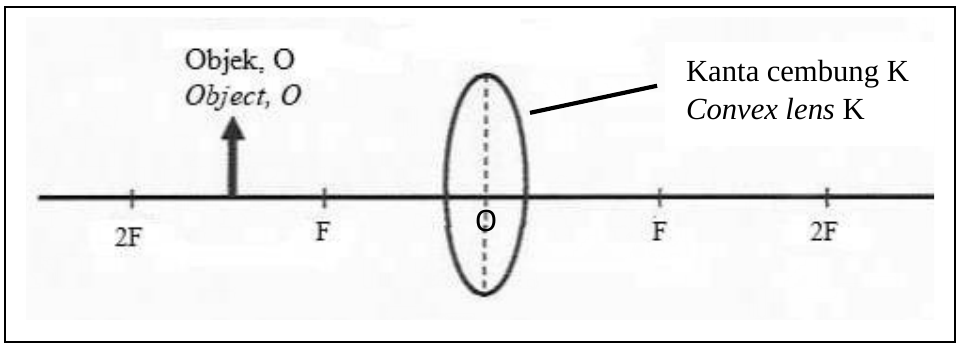
- (a)
What is the meaning of focal length?
[1] - (b)
On Diagram 7, draw a ray diagram that will form an image.
[3] - (c)(i)
Convex lens K acts as an eyepiece lens and must be combined with an objective lens (P, Q or R in Table 7) to build an astronomical telescope. Table 7: lens P focal length 20 cm, diameter 10 cm; lens Q focal length 40 cm, diameter 5 cm; lens R focal length 40 cm, diameter 10 cm. State the suitable focal length of the objective lens that gives a larger and clearer image, and the reason.
[2]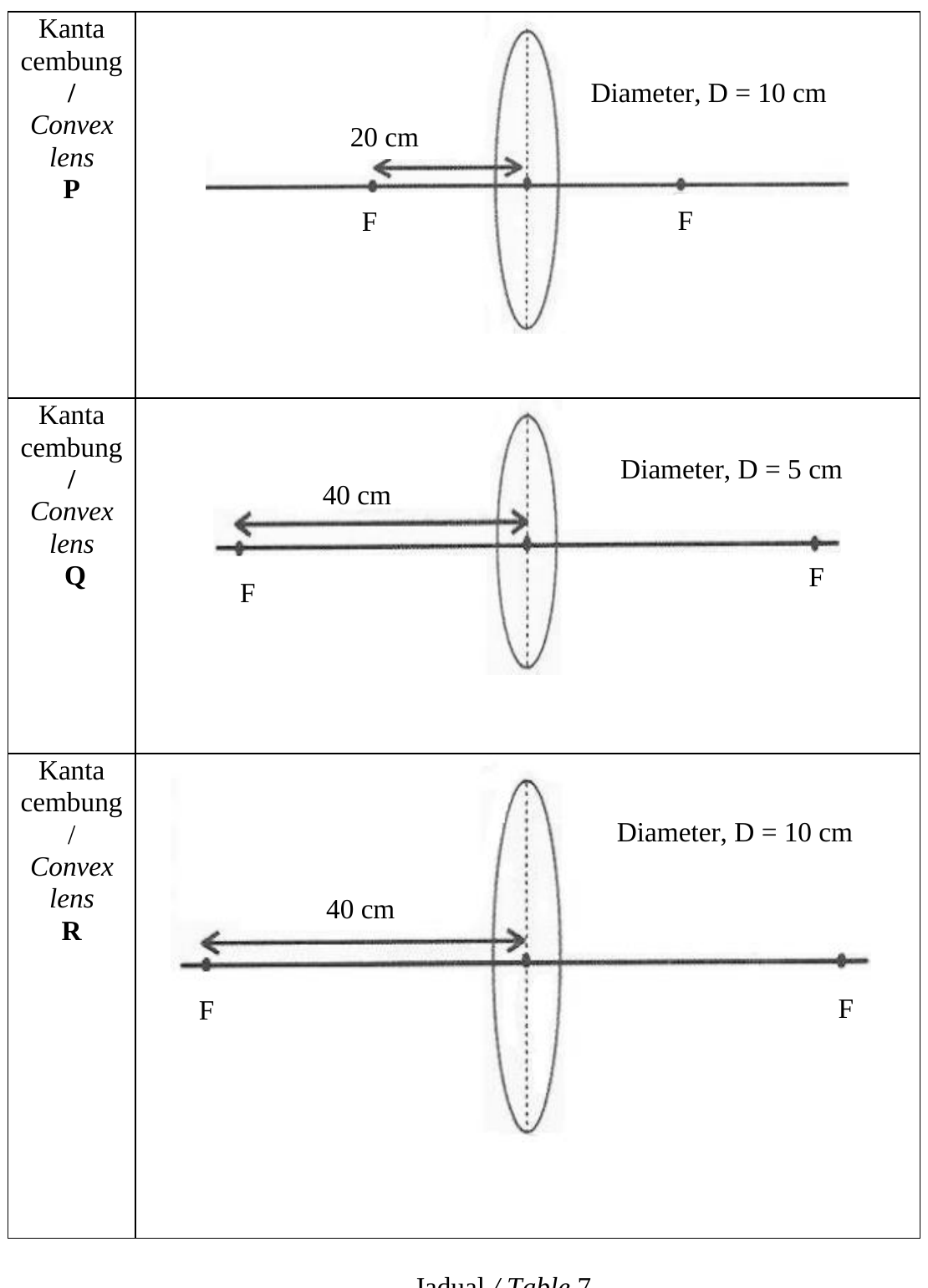
- (c)(ii)
State the suitable diameter of the objective lens, and the reason.
[2] - (d)
Based on your answer in 7(c), choose the most suitable convex lens to be used as the objective lens of the astronomical telescope.
[1]
Diagram 8.1 shows a permanent magnet in a bicycle dynamo that rotates at a high speed next to a coil, lighting a bulb. Diagram 8.2 shows a man cycling at night; his bicycle lamp is still dim although he pedals faster. Diagram 8.3 shows a current induced when a U-shaped iron core is moved upward.
Medium9 marks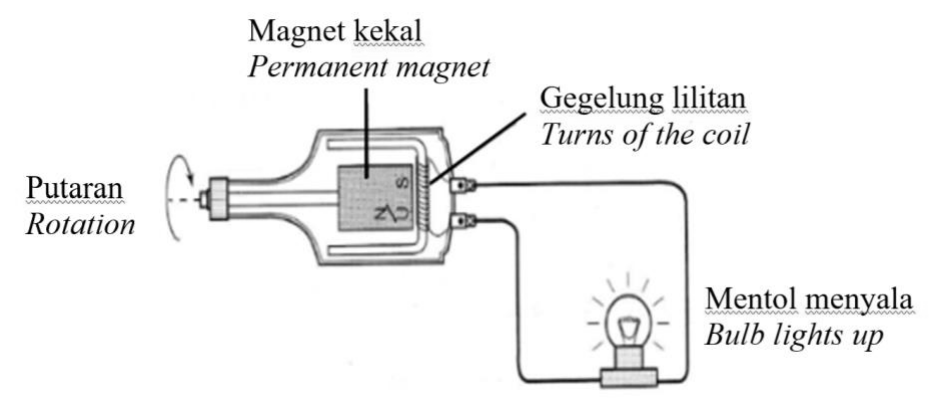
- (a)(i)
State the energy changes that take place at the dynamo.
[1] - (a)(ii)
State the physics concept involved.
[1] - (b)(i)
Suggest the modification to the dynamo to increase the brightness of the bulb: strength of magnet. Give a reason.
[2] - (b)(ii)
Number of turns of the coil of wire. Give a reason.
[2] - (b)(iii)
Material of the coil of wire. Give a reason.
[2] - (c)
On Diagram 8.3, mark the direction of current flow in the stationary conductor.
[1]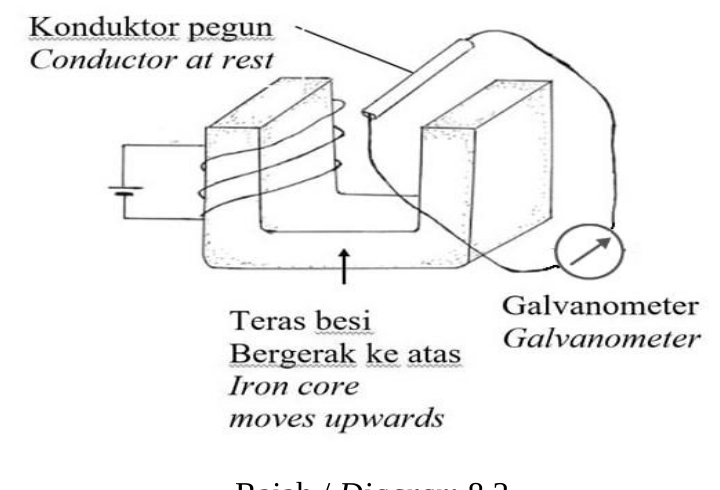
Section B
Diagram 9.1 shows two men fishing by a lake with fishing rods of the same length; when both rods are thrown simultaneously into the water, a set of water wave patterns is formed. (Answer any one of Questions 9 or 10.)
Hard20 marks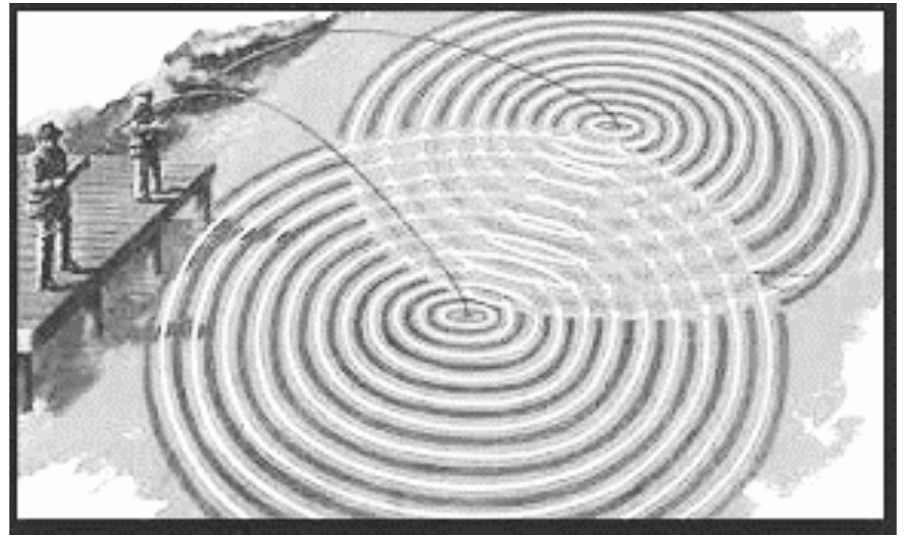
- (a)
What is meant by coherent sources?
[1] - (b)
Explain how constructive and destructive interferences are formed.
[4] - (c)
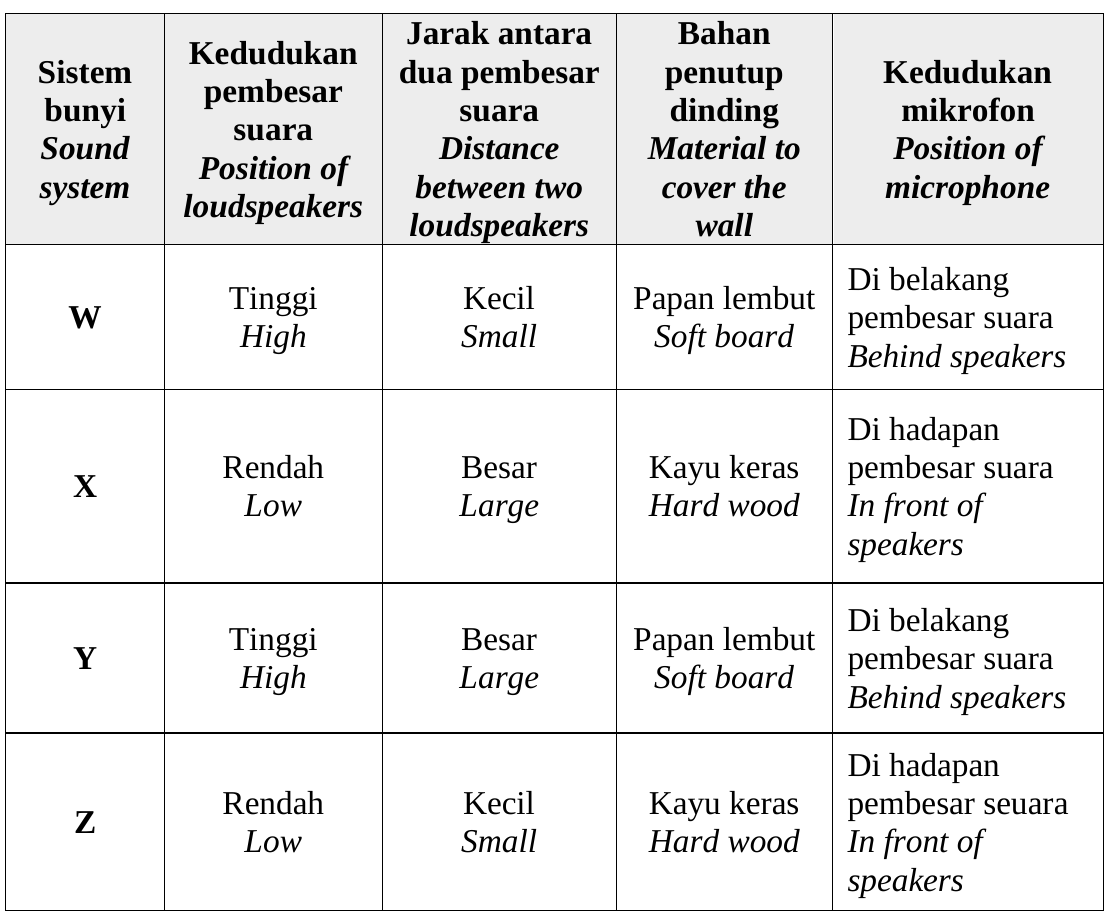
Diagram 9.2 shows the seating arrangement in an indoor hall with loudspeakers on either side of the stage. Table 9 shows four sound systems. System W: loudspeakers high, distance between loudspeakers small, wall covered with soft board, microphone behind speakers. System X: low, large, hard wood, in front of speakers. System Y: high, large, soft board, behind speakers. System Z: low, small, hard wood, in front of speakers. Based on Table 9, determine the sound system design for good and clear sound quality during the event. Explain the suitability of each characteristic and determine the most suitable sound system. Give reasons for your choice.
[10]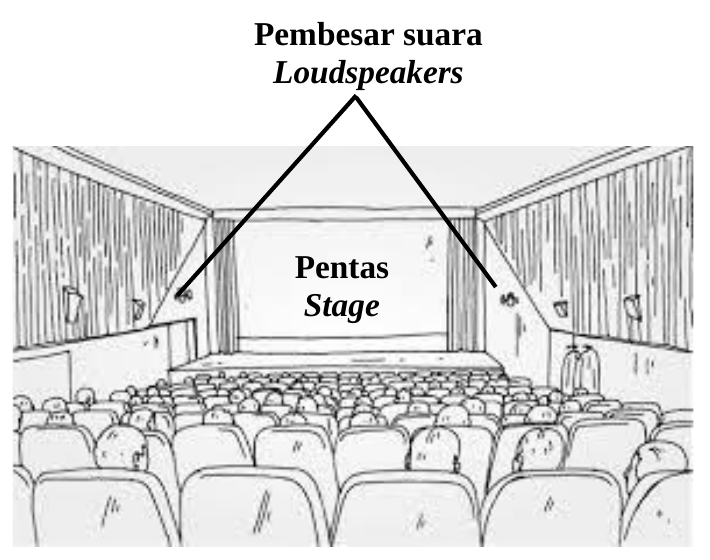
- (d)(i)
In an experiment on interference of sound waves, two speakers are connected to an audio signal generator producing sound of frequency 1200 Hz. A student hears alternating loud and soft sound along a straight line 20 m from the loudspeakers. If the speed of sound in air is 300 m s⁻¹, calculate the wavelength of the sound wave.
[2] - (d)(ii)
If the distance between the two speakers is 3.0 m, determine the shortest distance between a weak sound and the next weak sound.
[2] - (d)(iii)
What will happen to the distance between consecutive loud and soft sounds if the distance between the loudspeakers is increased?
[1]
Diagram 10.1 shows light and heat energy radiated to the surface of the Sun when nuclear reaction occurs in the core of the Sun under very high pressure. (Answer any one of Questions 9 or 10.)
Medium20 marks- (a)
What is meant by nuclear energy?
[1] - (b)
Diagram 10.2 shows the nuclear fission that produces nuclear energy. Based on Diagram 10.2, complete the equation: ²³⁵₉₂U + ¹₀n → ²³⁶₉₂U → ⁹²₃₆Kr + X + 3Y + Z
[3]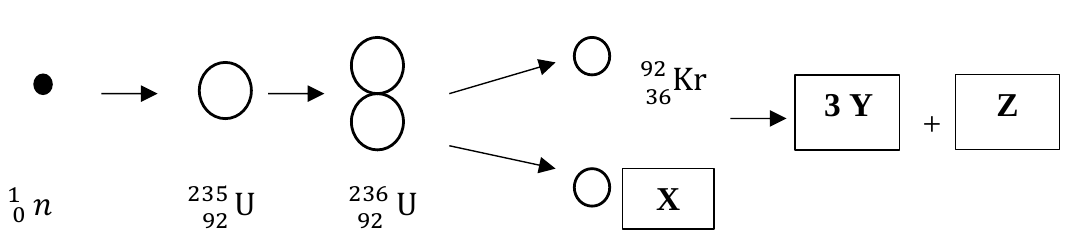
- (c)(i)
The decay ²²⁶₈₈Ra → ²²²₈₆Rn + ⁴₂He is a radioactive decay in which the total mass of the products is less than the mass of the radioactive nucleus (mass defect). Given Ra: 226.54 u; Rn: 222.018 u; He: 4.003 u. Calculate the mass defect.
[2] - (c)(ii)
Calculate the nuclear energy produced. Given 1 u = 1.66 × 10⁻²⁷ kg and c = 3.00 × 10⁸ m s⁻¹.
[3] - (d)
What nuclear reaction takes place in a nuclear reactor to generate electrical energy?
[1] - (e)
Diagram 10.3 shows a nuclear power station to be built in area X as an alternative energy source. Table 2 shows four reactors. P: liquid radioisotope, long half-life, control rod saltwater, moderator cadmium. Q: solid, long half-life, control rod boron, moderator graphite. R: liquid, short half-life, control rod cadmium, moderator saltwater. S: solid, short half-life, control rod graphite, moderator boron. As a nuclear engineer, investigate the characteristics of a reactor suitable to generate a large amount of electrical energy safely. Determine the most suitable reactor and give reasons.
[10]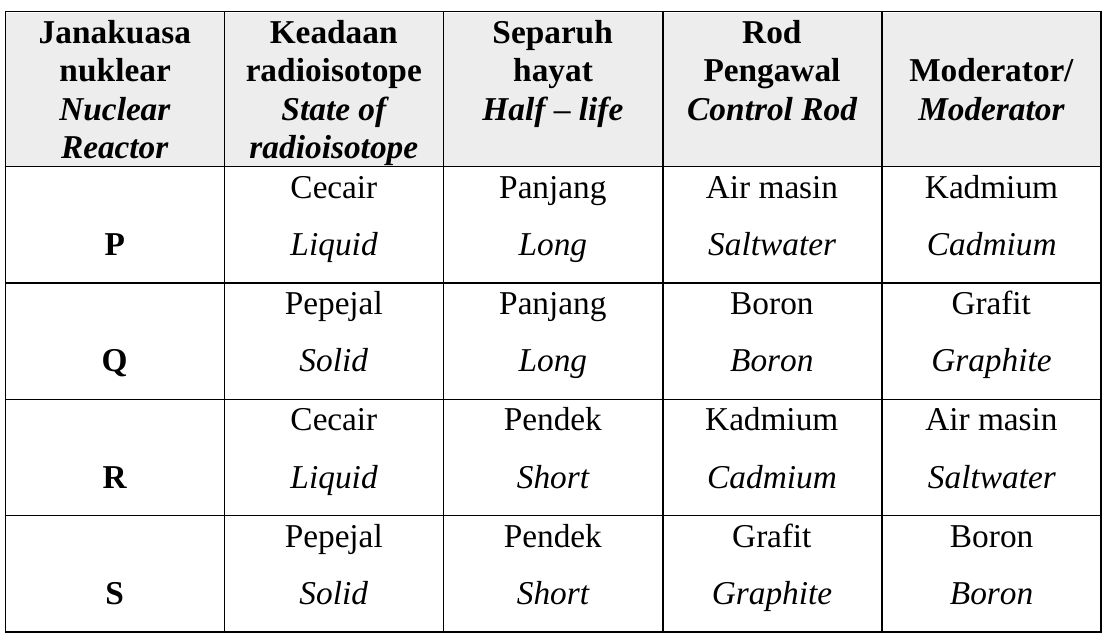
Section C
Diagram 11.1 shows a man pulling a boy sitting on an upih leaf; the boy is pulled 50 m in 1 minute. Diagram 11.2 shows another boy added to the same upih leaf, pulled with the same force 30 m in 1 minute.
Hard20 marks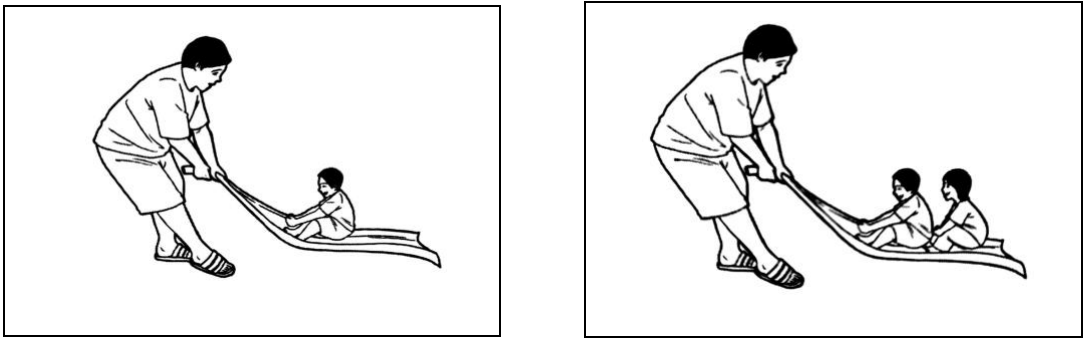
- (a)
What is the meaning of force?
[1] - (b)(i)
Based on Diagram 11.1 and 11.2, compare the total mass, distance travelled and acceleration produced.
[3] - (b)(ii)
Relate the total mass with the distance travelled to make a deduction regarding the relationship between total mass and acceleration.
[2] - (c)
Objects with greater total mass require greater force to accelerate. Explain the statement.
[4] - (d)
Diagram 11.3 shows a racing motorcycle. Based on your knowledge of inertia, suggest modifications to the motorcycle so that it can accelerate faster and more safely, based on the properties of the materials of the motorcycle and other additional safety features. Explain each aspect stated.
[10]