Write your answer on paper. Then open the answer to check it.
Section A
Diagram 1 shows a label on fruit juice packaging: Volume 500 ml, Store below 10°C, Energy 189 kJ, Carbohydrate content: 80 g. Physical quantities can be classified into base quantity and derived quantity.
Medium4 marks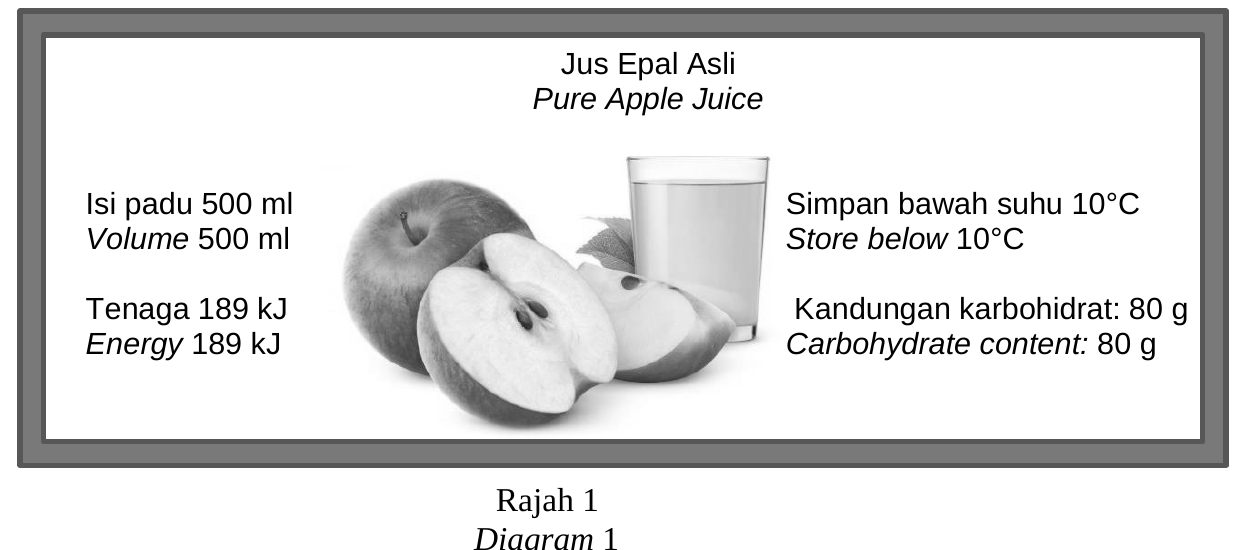
- (a)
What is the meaning of derived quantity?
[1] - (b)
Based on Diagram 1, classify all the physical quantities into Table 1 (Base quantity / Derived quantity).
[2] - (c)
Temperature is measured in °C units. State the type of unit for °C.
[1]
Diagram 2 shows the graph of force against extension for spring P and spring Q. Spring P and spring Q have different elasticity. (Spring P: 60 N at 0.6 m; spring Q: 30 N at 0.8 m.)
Easy5 marks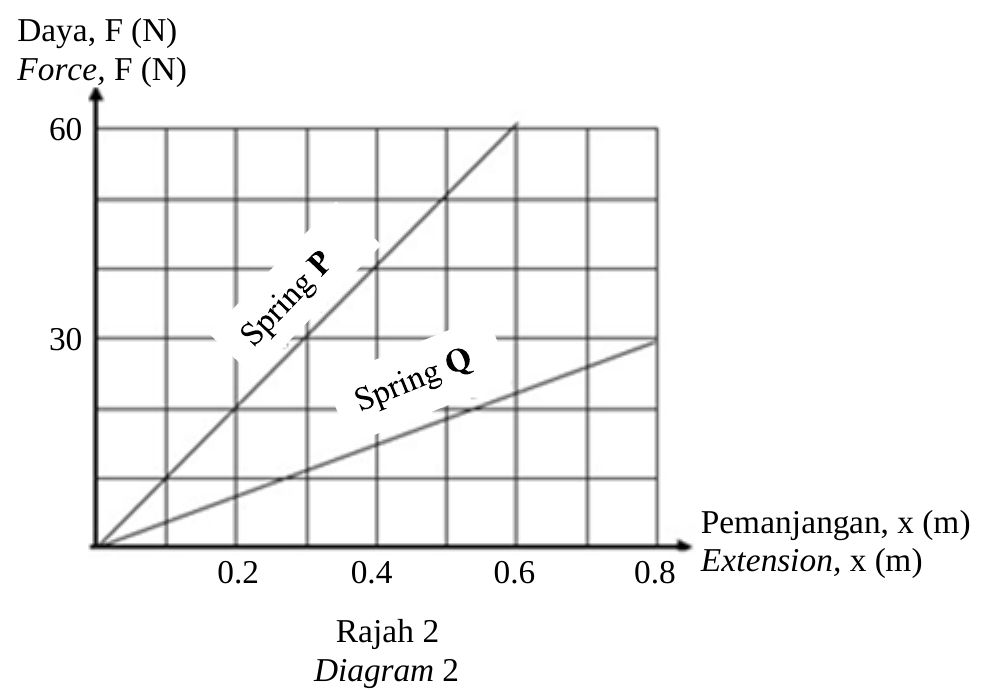
- (a)
What is meant by elasticity?
[1] - (b)
Based on the graph in Diagram 2, calculate the value of the spring constant for spring P.
[2] - (c)
State two factors that affect the value of the spring constant.
[2]
Diagram 3 shows a skydiving athlete making a free fall jump from a building at a height of 820 m. Air resistance is negligible.
Medium6 marks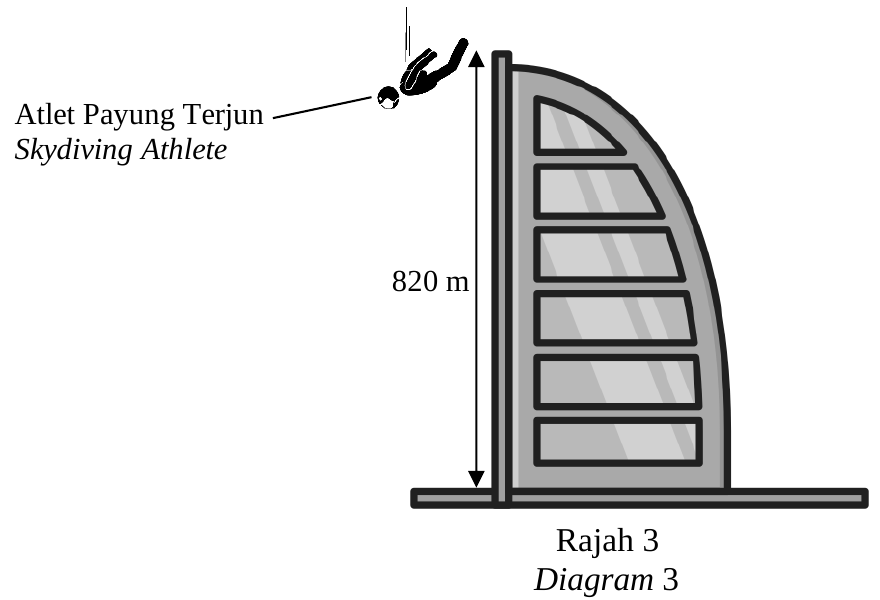
- (a)
What is meant by free fall motion?
[1] - (b)(i)
A second skydiving athlete jumps 5 s later than the first athlete in Diagram 3. Predict whether the second athlete can match his position in the air with the first skydiving athlete.
[1] - (b)(ii)
Give reasons for your answer in 3(b)(i).
[2] - (c)
Calculate the distance of the first skydiving athlete from the jumping place when the second athlete starts their jump. [g = 9.81 m s⁻²]
[2]
Diagram 4 shows a simple hydraulic jack used to lift a box. The working principle of a hydraulic jack is based on Pascal's Principle. Piston A (force F₁) and piston B (box) are connected by oil.
Medium9 marks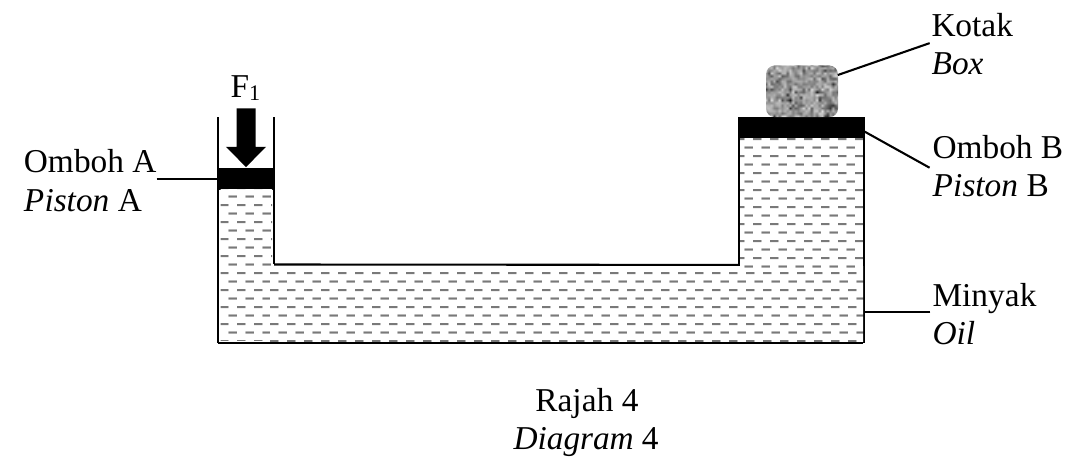
- (a)
State Pascal's principle.
[1] - (b)
Explain the working principle of how the hydraulic jack functions.
[3] - (c)(i)
Cross-sectional areas of piston A and piston B are 4 cm² and 60 cm², respectively. Mass of box is 50 kg. Calculate the force applied to the first piston, F₁. [g = 9.81 m s⁻²]
[3] - (c)(ii)
Calculate the distance travelled by piston A, if piston B moves upward by 1.5 cm.
[2]
Diagram 5.1 and Diagram 5.2 show a hammer throw athlete rotating the hammer in a horizontal circle using centripetal force. Diagram 5.1: F = 1600 N, v = 20 m s⁻¹, r = 1.8 m. Diagram 5.2: F = 3600 N, v = 30 m s⁻¹, r = 1.8 m.
Medium9 marks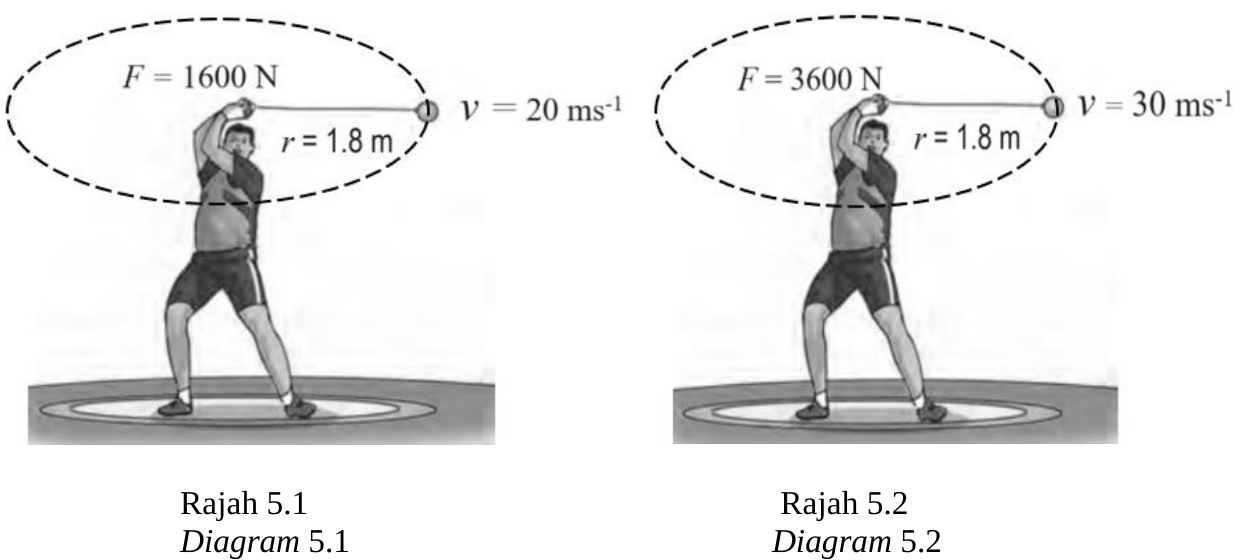
- (a)
What is the meaning of centripetal force?
[1] - (b)(i)
Compare the centripetal force, F.
[1] - (b)(ii)
Compare the linear speed, v.
[1] - (b)(iii)
Compare the length of the rope, r.
[1] - (c)(i)
Relate the centripetal force, F and the linear speed, v.
[1] - (c)(ii)
Name one force that has the same magnitude as the centripetal force.
[1] - (d)(i)
Diagram 5.3: the hammer has a mass 5 kg and is rotated in a horizontal circle of radius 1.5 m with a linear speed of 20 m s⁻¹. Calculate the rope tension, T acting on the hammer.
[2]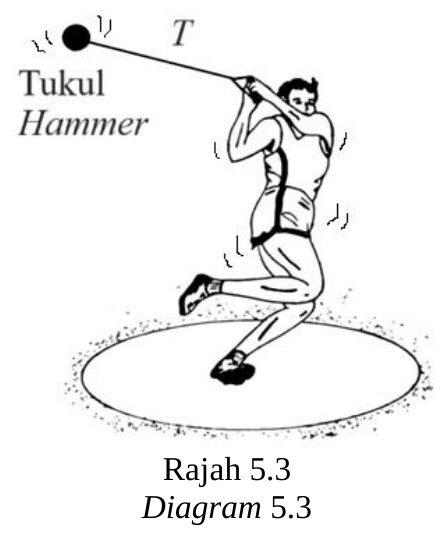
- (d)(ii)
What happens to the rope tension, T if the length of the string increases?
[1]
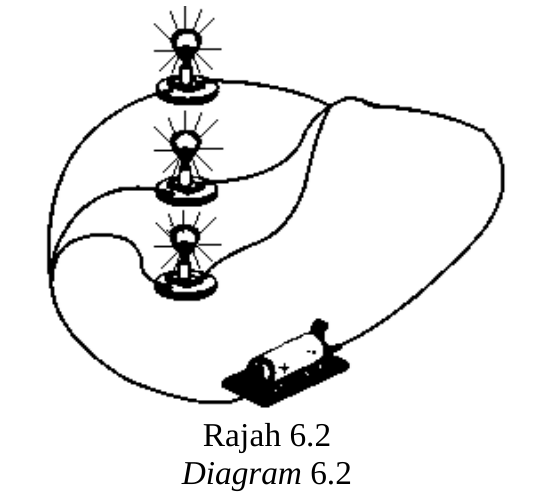
Similar filament bulbs labelled 3V, 6W are arranged in two different ways and connected to a 3V battery (Diagram 6.1: three bulbs in series; Diagram 6.2: three bulbs in parallel).
Medium9 marks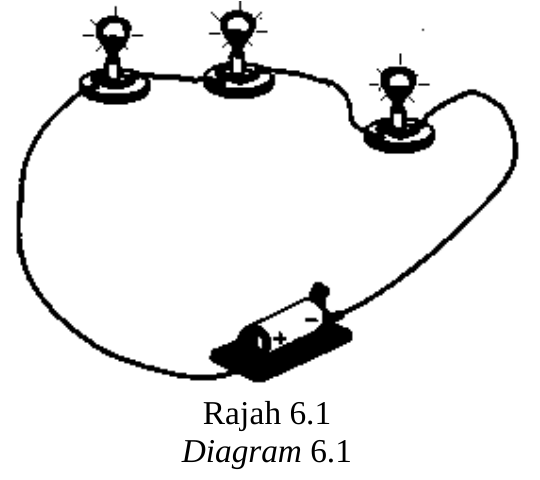
- (a)
What does the label 3V, 6W mean?
[1] - (b)(i)
Compare the type of circuit arrangement.
[1] - (b)(ii)
Compare the bulbs' brightness.
[1] - (b)(iii)
Compare the circuit resistance.
[1] - (c)(i)
Relate the type of circuit arrangement and the bulbs' brightness.
[1] - (c)(ii)
Relate the bulbs' brightness and the circuit resistance.
[1] - (d)(i)
Diagram 6.3 shows an incubator incubating eggs. Based on Diagram 6.1 and 6.2, which arrangement of bulbs is most suitable for the student to use to heat the incubator?
[1]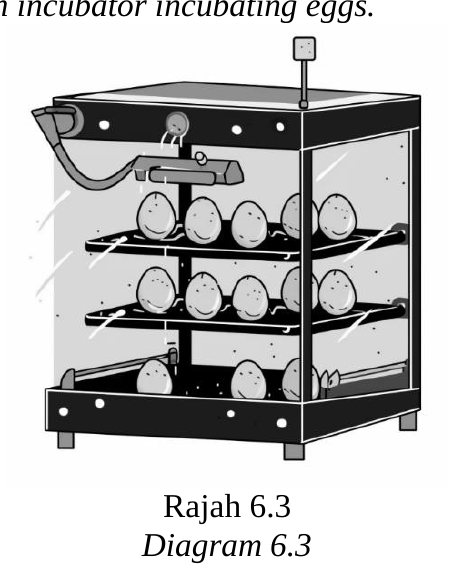
- (d)(ii)
Give two reasons for your answer in (d)(i).
[2]
Diagram 7.1 shows an iron spoon soaked in a cup of hot coffee. After a few minutes, thermal equilibrium occurs between the iron spoon and the hot coffee.
Medium9 marks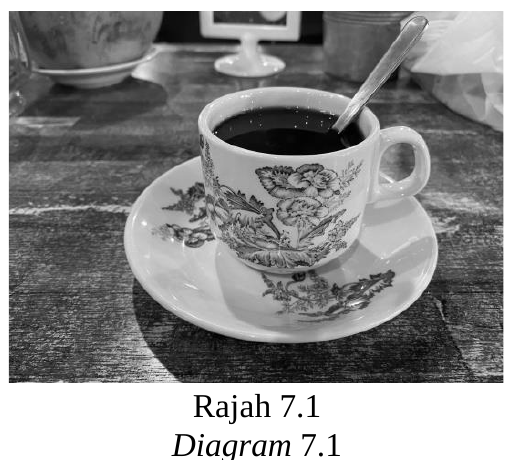
- (a)
What is the meaning of thermal equilibrium?
[1] - (b)
How can an iron spoon cool down hot coffee?
[1] - (c)
A cup contains 120 g of coffee at an initial temperature of 80 °C. An iron spoon of mass 10 g at 25 °C is put into the coffee. What is the final temperature of the coffee and the iron spoon? (Specific heat capacity of coffee = 1400 J kg⁻¹ °C⁻¹, of iron = 450 J kg⁻¹ °C⁻¹)
[2] - (d)(i)
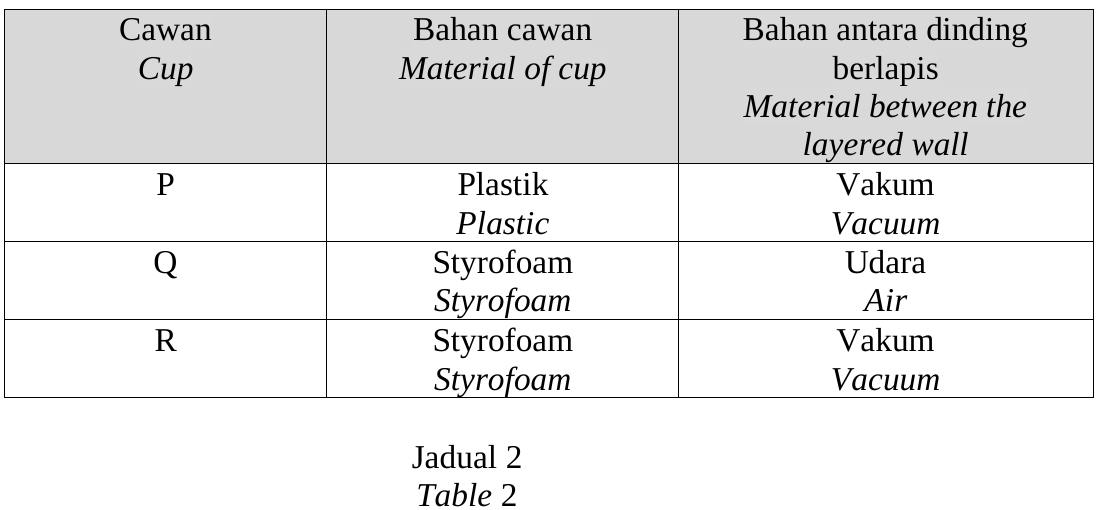
Diagram 7.2 and Table 2 show cups P, Q, R. State the material of cup suitable for keeping hot coffee for a long time, with reason.
[2]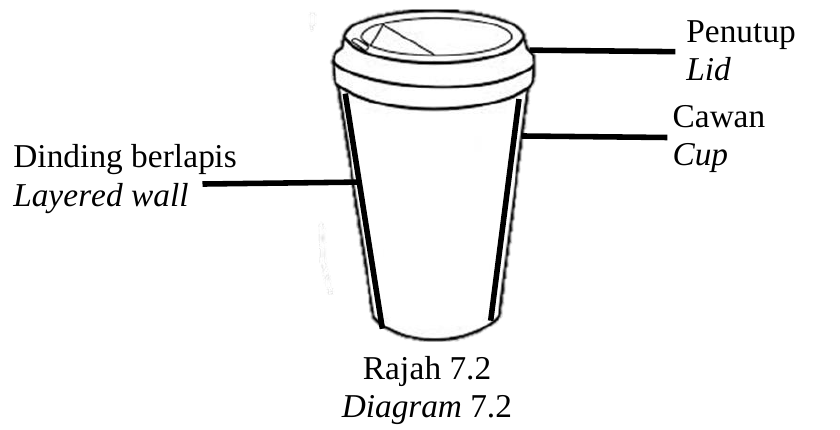
- (d)(ii)
State the material between the layered walls suitable for keeping hot coffee for a long time, with reason.
[2] - (e)
Based on your answers in 7(d)(i) and 7(d)(ii), determine the most suitable cup for keeping hot coffee for a long time.
[1]
Diagram 8.1 shows a rectification circuit (a.c. supply, diode, switch, capacitor, resistor R and CRO). The CRO displays the tracing of current flow through resistor R.
Medium9 marks- (a)
Name the type of rectification shown in Diagram 8.1.
[1] - (b)
The switch in the circuit is turned on. Explain how the capacitor can change the tracing of current.
[2]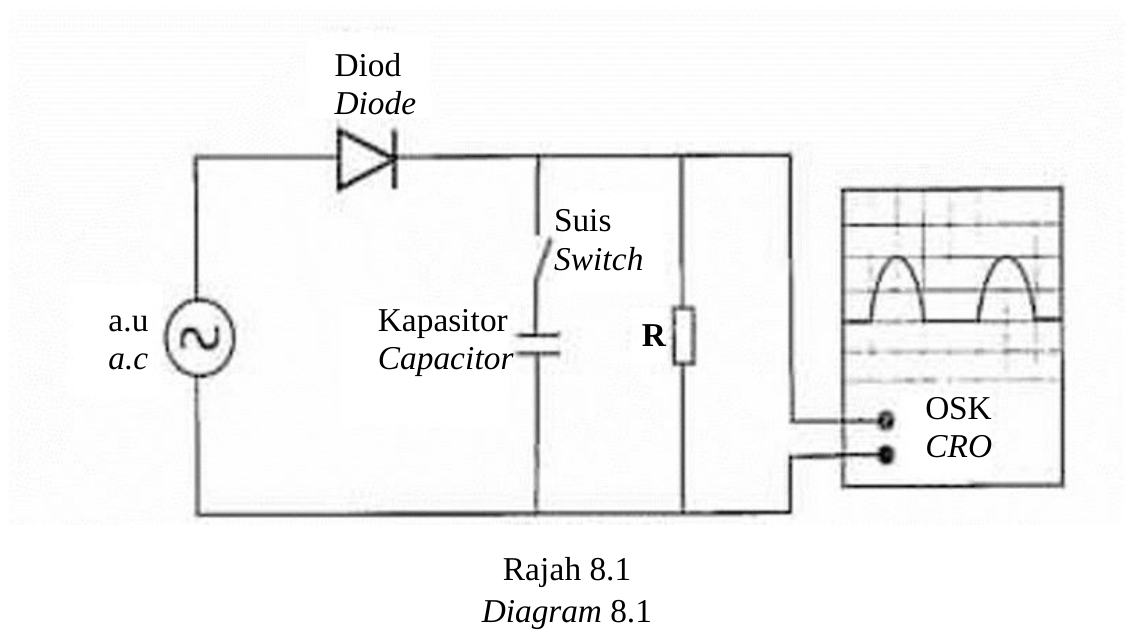
- (c)(i)
Diagram 8.2 shows the circuit of an a.c. adapter unit (transformer, Box P, to computer). Suggest the number of diodes used in Box P, with reason.
[2]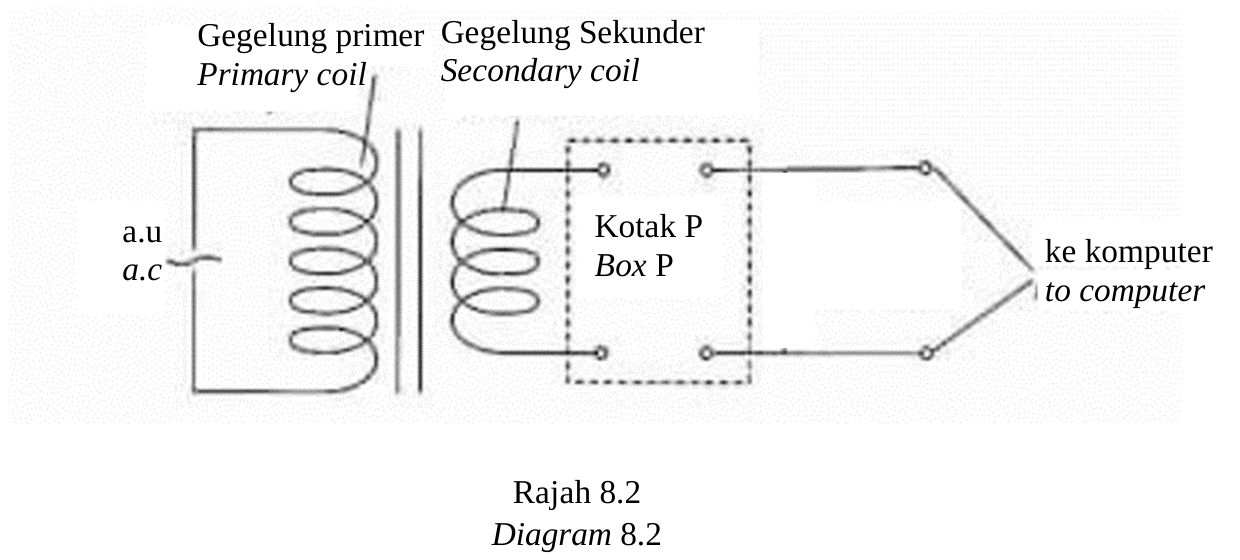
- (c)(ii)
Suggest the position of the capacitor with Box P, with reason.
[2] - (c)(iii)
Suggest the magnitude of the capacitance of the capacitor, with reason.
[2]
Section B
Diagram 9.1 shows a loudspeaker connected to an audio frequency generator and placed near the corner of a wall. Three students, A, B and C, are standing around the next corner. The loudspeaker emits sound with the same speed but different pitch.
Medium20 marks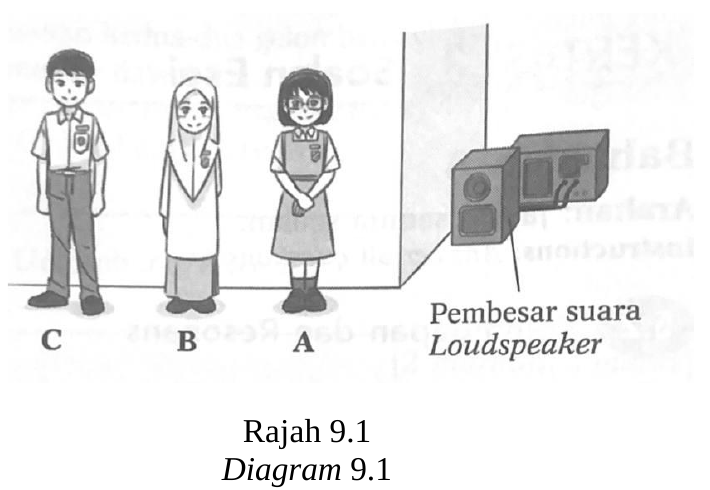
- (a)
State one factor that affects the pitch of the sound.
[1] - (b)
When a high pitch sound is emitted, only student A can hear the sound clearly. When a low pitch sound is emitted, all three students can hear the sound clearly. Explain how this situation occurs.
[4] - (c)(i)
The speed of the sound wave is 330 m s⁻¹, while the frequency of the audio generator is 10 kHz. Calculate the wavelength of the sound in cm.
[3] - (c)(ii)
What happens to the wavelength of sound if the situation in Diagram 9.1 occurs in water? State the reason.
[2] - (d)
Table 3 shows four sound systems P, Q, R, S (location of loudspeakers, distance between two loudspeakers, location of microphone, wall material). You are required to investigate the design of the sound system that produces better quality of sound. Explain the suitability of each characteristic. Determine the most suitable system. Give reasons for your choice.
[10]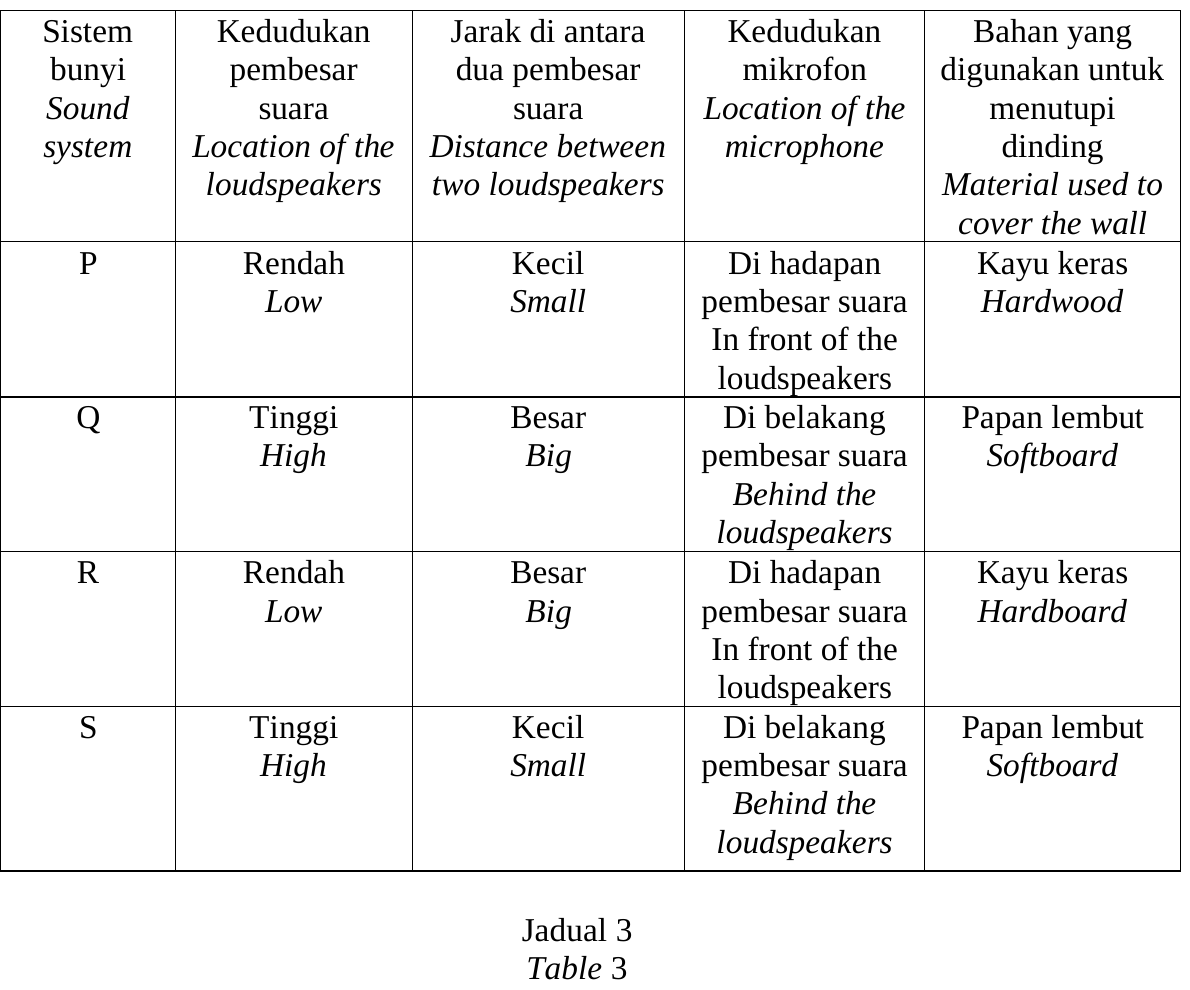
Diagram 10.1 shows a nuclear reaction: n (1.00867 u) + U-235 (235.04392 u) → U-236 → Kr-92 (91.92611 u) + Ba-141 (140.91441 u) + 3 n (3 × 1.00867 u) + energy. [1 u = 1.66 × 10⁻²⁷ kg]
Hard20 marks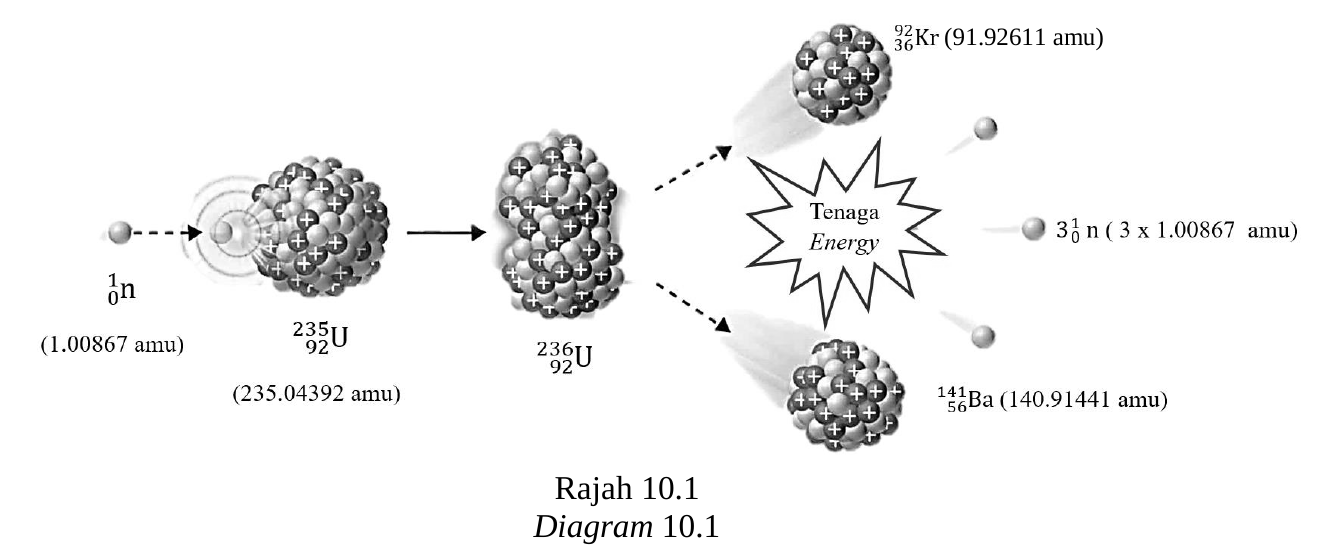
- (a)
Name the type of nuclear reaction that occurred.
[1] - (b)(i)
Calculate the mass defect in kilogram. [1 u = 1.66 × 10⁻²⁷ kg]
[3] - (b)(ii)
Calculate the energy produced in the nuclear reaction.
[2] - (c)
Based on Diagram 10.1, explain how a chain reaction can be produced.
[4] - (d)
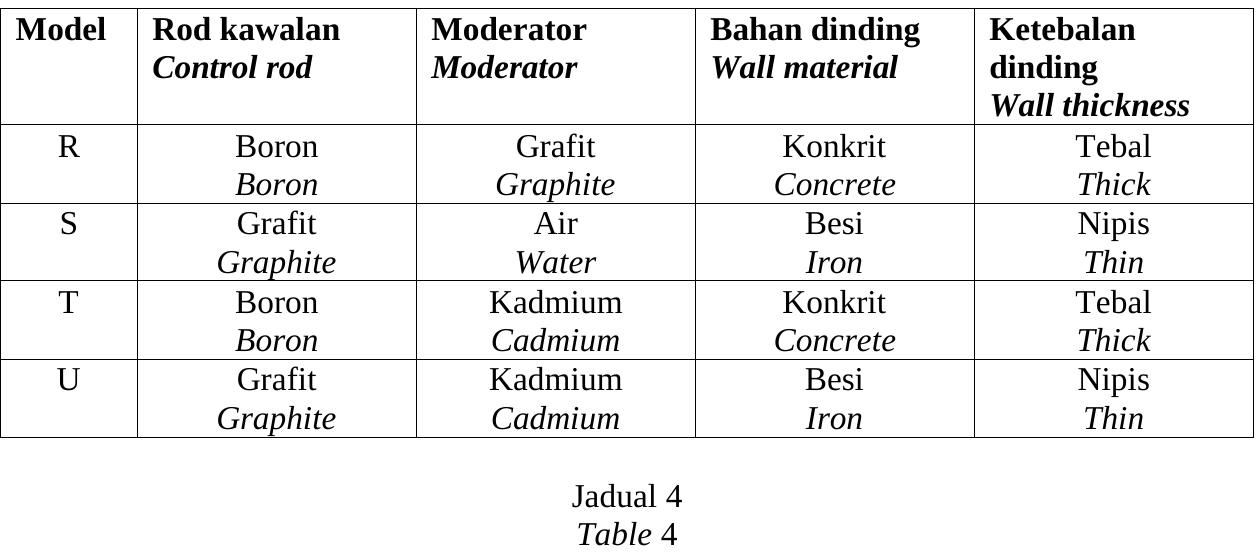
Diagram 10.2 shows a cross section of a nuclear reactor model. A new nuclear reactor is to be built near the seaside. Table 4 shows reactor models R, S, T, U (control rod, moderator, wall material, wall thickness). Determine the most appropriate reactor model. Justify the reasons for your choice.
[10]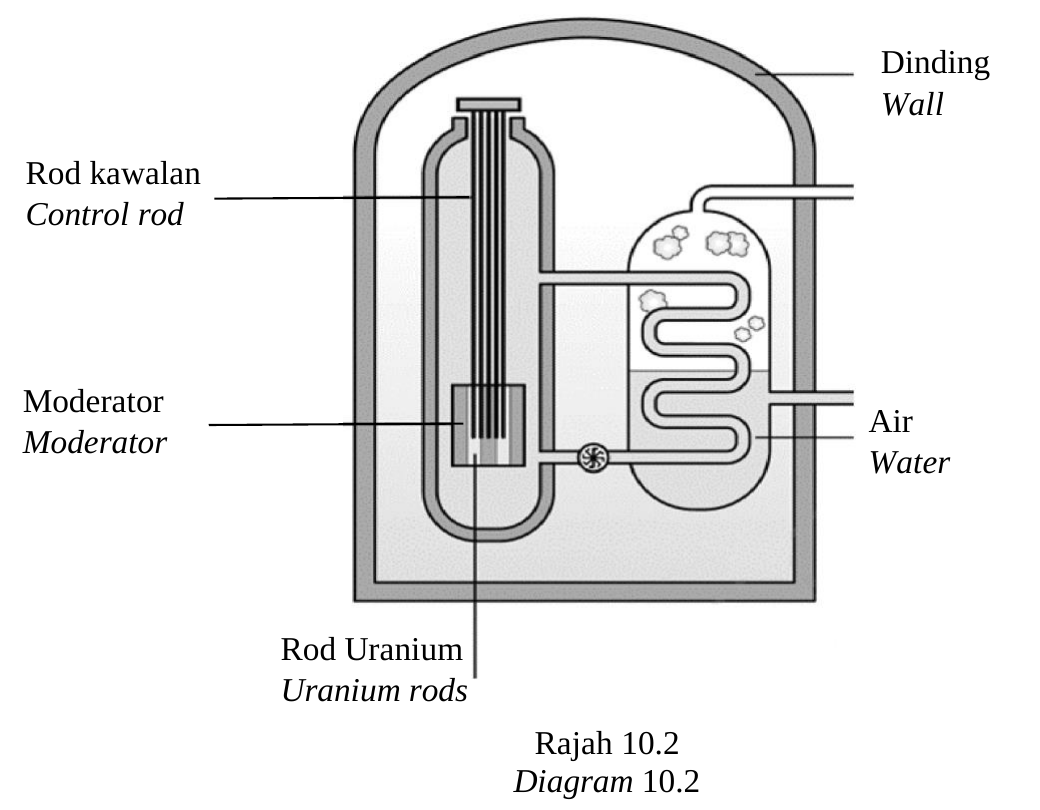
Section C
Diagram 11.1 and 11.2 show two identical objects located at different positions in front of identical convex lenses. Real images with different heights are produced (u₁ < u₂, h₁ > h₂).
Medium20 marks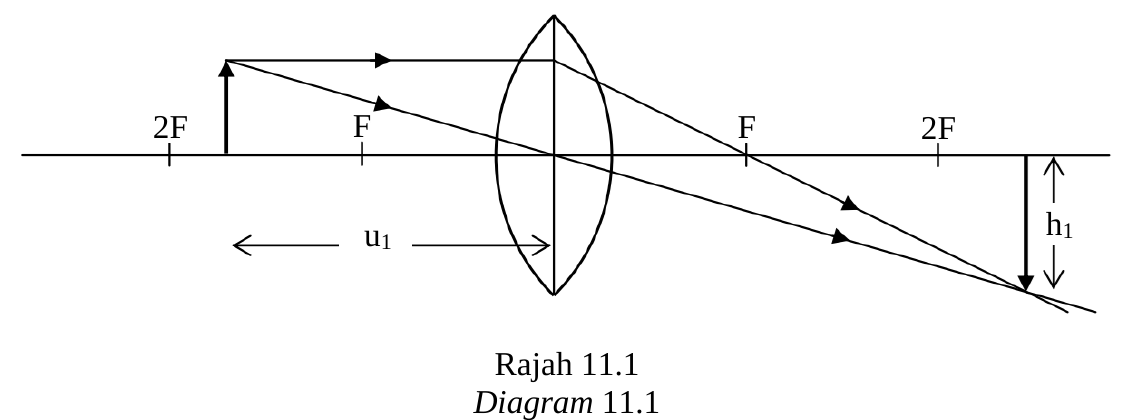
- (a)
What is another name for convex lens?
[1] - (b)
Observe Diagram 11.1 and 11.2. Compare the focal length of the lens, the object distances u₁ and u₂ and the image heights h₁ and h₂. Relate the object distance and the image height and name the phenomenon that occurs.
[5]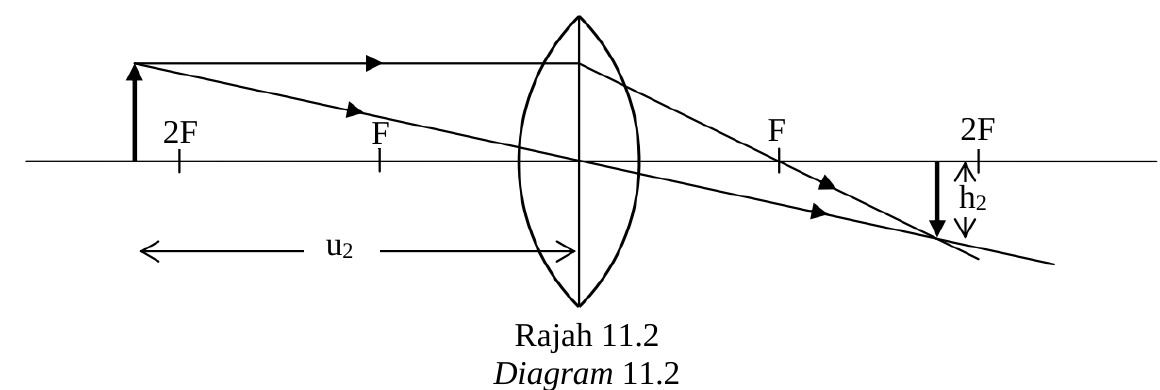
- (c)(i)
Diagram 11.3 shows an object O in front of a concave lens of focal length F. Copy Diagram 11.3 and complete the ray diagram to show the formation of the image of the object O.
[3]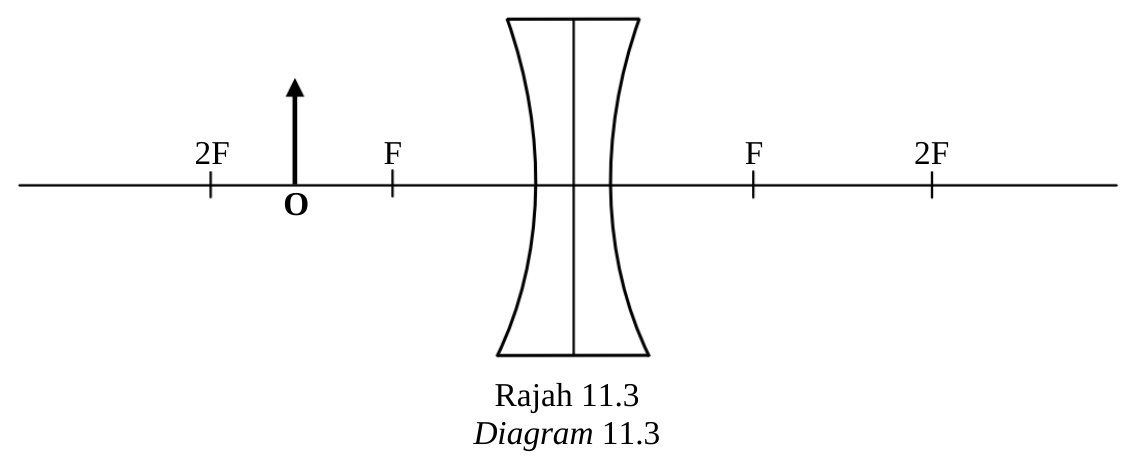
- (c)(ii)
State three characteristics of the image formed.
[1] - (d)
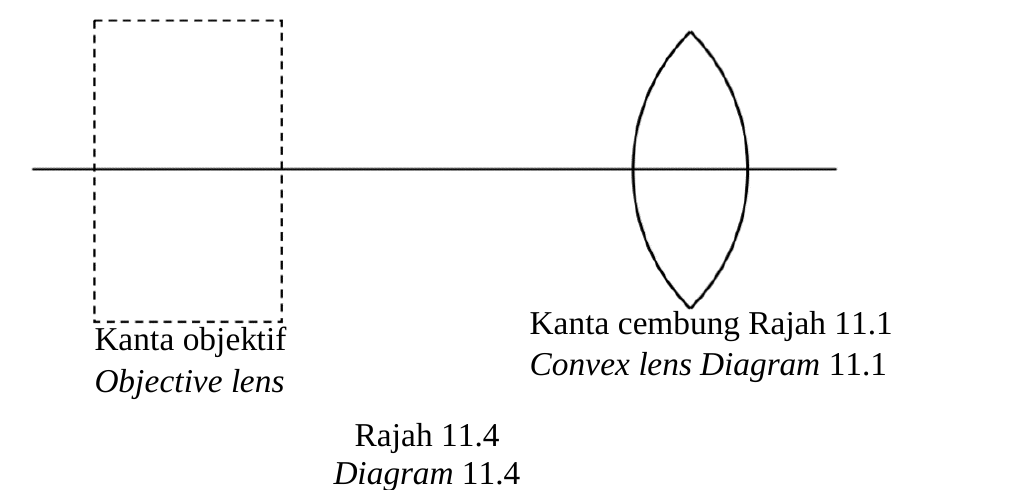
Diagram 11.4 shows the convex lens of Diagram 11.1 used as an eyepiece, matched with another lens acting as the objective lens, to build an astronomical telescope. Suggest modifications to the objective lens so that the telescope produces clear images. State and explain your proposal involving lens type, lens thickness, lens position at normal adjustment, and other suitable characteristics.
[10]