Write your answer on paper. Then open the answer to check it.
Section A
Diagram 1.1 shows an electric circuit (cells, ammeter A, bulb, rheostat R and instrument Q connected across the bulb). Diagram 1.2 shows two types of ammeters, X and Y, that can be used in the circuit.
Medium4 marks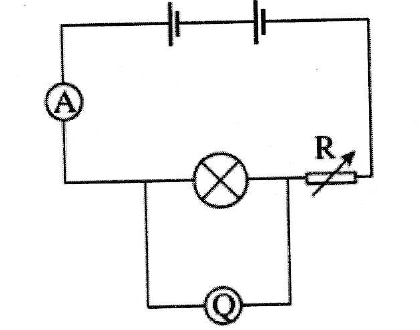
- (a)(i)
Name instrument Q.
[1] - (a)(ii)
What is the function of R in the circuit?
[1] - (b)(i)
Which ammeter is more sensitive?
[1]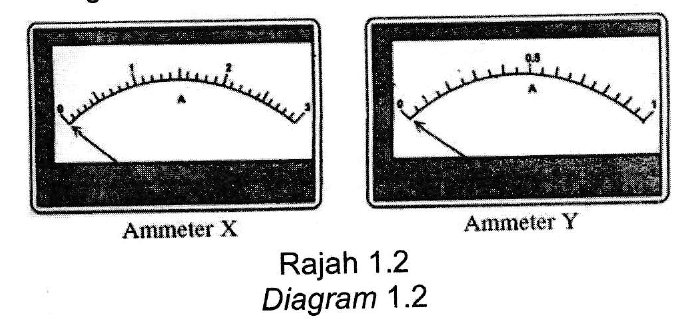
- (b)(ii)
State one reason for your answer in (b)(i).
[1]
Diagram 2.1 shows an object hanging on a spring that is swinging. Diagram 2.2 shows the displacement-time graph of the oscillation (amplitude gets smaller with time).
Medium5 marks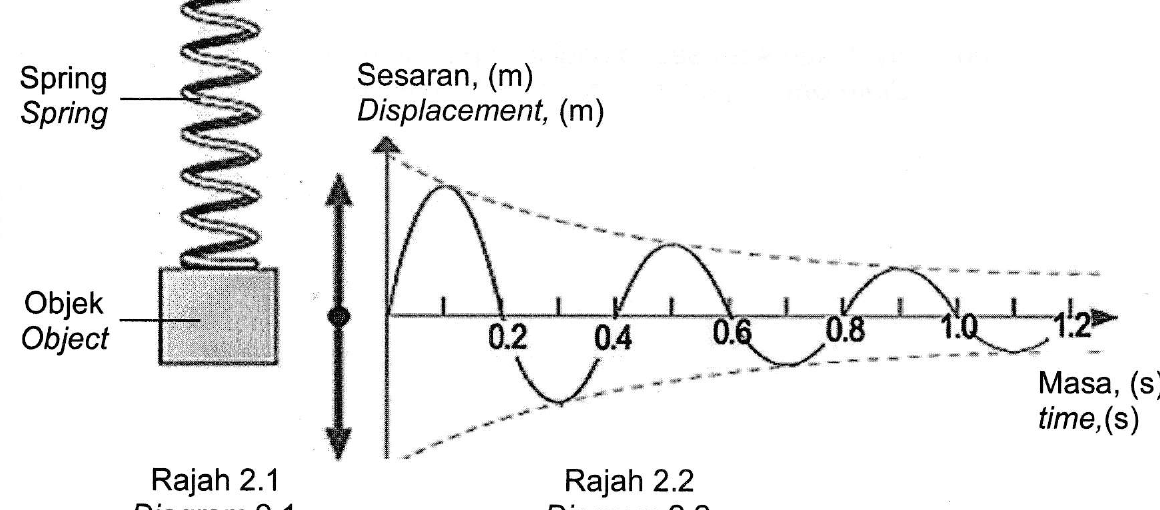
- (a)(i)
Based on Diagram 2.2, state the phenomenon that occurs to the oscillating system.
[1] - (a)(ii)
What is the effect on the amplitude of the oscillation?
[1] - (a)(iii)
Give one reason for your answer in 2(a)(ii).
[1] - (b)
In Diagram 2.2, label the period of oscillation, T.
[1] - (c)
If a larger mass of object is used, what is the effect on the period of oscillation of the spring?
[1]
Diagram 3 shows an experiment to determine the critical angle for a semi-circular glass block. The refractive index of the glass block is 1.5.
Medium6 marks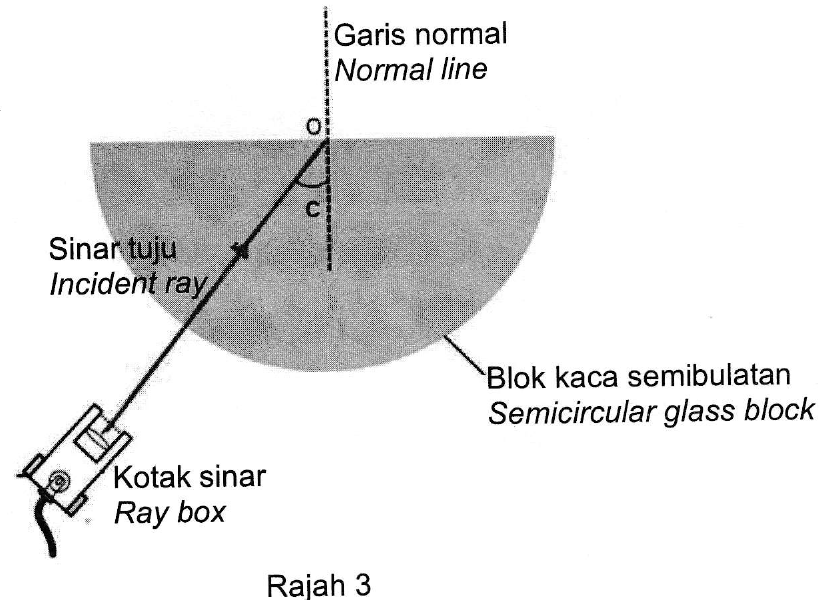
- (a)
What is the meaning of critical angle?
[1] - (b)(i)
Calculate the critical angle of the semi-circular glass block.
[2] - (b)(ii)
On Diagram 3, complete the light ray path from point O.
[1] - (c)
If the incident angle is increased to 45°, what will happen to the refracted ray and give your reason for your answer.
[2]
Diagram 4.1 shows the mortar and pestle used to pound cooking ingredients. Diagram 4.2 shows a car collision test: a 1200 kg car hits a wall at 15 m s⁻¹ and bounces back at 2.6 m s⁻¹. The collision time is 150 ms.
Hard9 marks- (a)
State the laws of physics that can explain the situation in Diagram 4.1.
[1]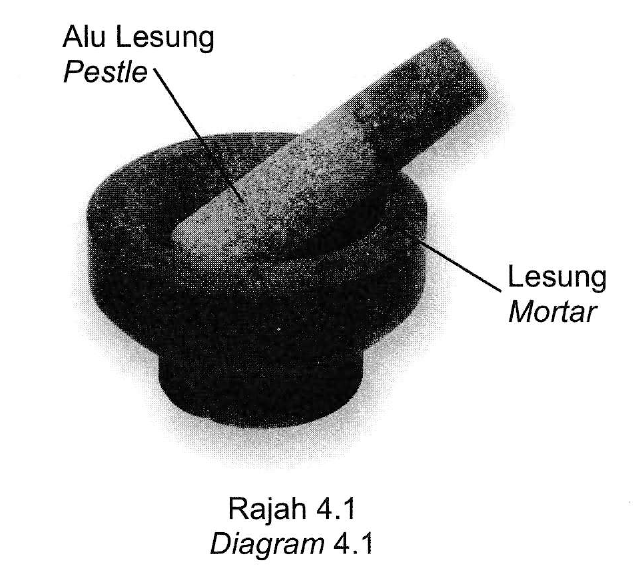
- (b)
Name the force involved during impact.
[1] - (c)
Explain how a mortar and pestle can quickly pulverize cooking ingredients.
[2] - (d)(i)
Calculate the impulse in the collision.
[2]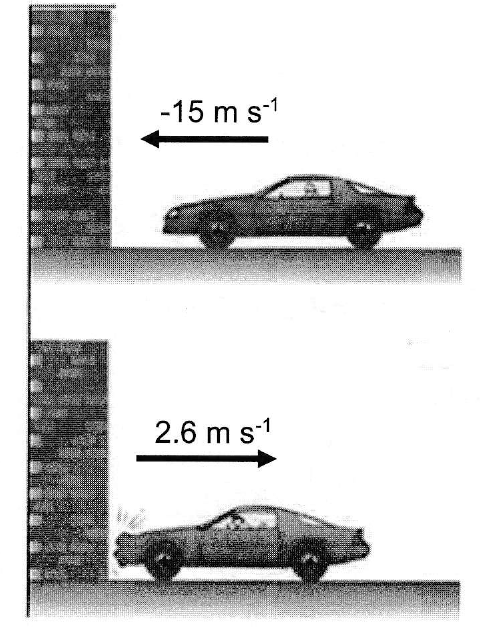
- (d)(ii)
Calculate the impulsive force applied to the car.
[3]
Diagram 5 shows the man-made satellite (v = 7620 m s⁻¹, h = 480 km above Earth) and the Moon (v = 1017 m s⁻¹, orbital radius R = 385 000 km) orbiting the Earth. A force acts on the satellite and the Moon that allows them to move in a circular state. The period of orbiting the Earth by the satellite and the Moon takes 1.5 hours and 27.3 days respectively.
Medium9 marks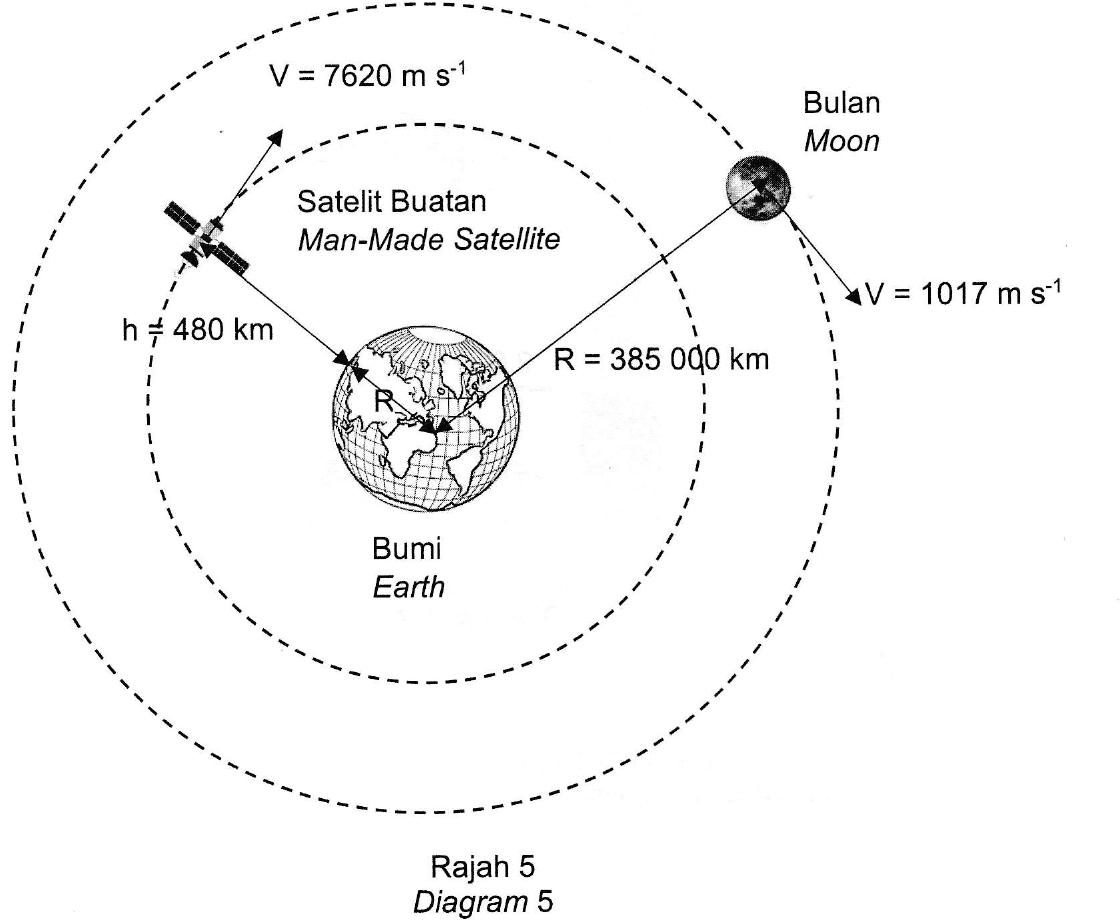
- (a)
Name the force that causes the man-made satellite and the Moon to move in circular orbit.
[1] - (b)(i)
Based on Diagram 5, compare the orbital radius of the man-made satellite with the Moon.
[1] - (b)(ii)
Compare the period of the man-made satellite with the Moon.
[1] - (b)(iii)
Compare the linear speed of the man-made satellite with the Moon.
[1] - (c)(i)
Based on your answers in (b)(i), (b)(ii) and (b)(iii), state the relationship between linear speed and orbital radius.
[1] - (c)(ii)
State the relationship between the period and the orbital radius.
[1] - (d)
What will happen to the man-made satellite if its linear speed is lower than its orbital linear speed?
[1] - (e)
If the mass of the man-made satellite in Diagram 5 is 400 kg, calculate the force acting on the satellite that causes it to remain in its orbit. [Radius of Earth: 6.37 × 10⁶ m]
[2]
Diagram 6.1 shows a bus and a car at a traffic light junction when the light turns red. Diagram 6.2 shows the position of the bus and the car in a state of acceleration when the traffic light turns green (the car is further ahead than the bus). Diagram 6.3 shows a velocity-time graph of a taxi: constant 10 m s⁻¹ from 0 to 10 s, rising to 15 m s⁻¹ at 20 s, then falling to 5 m s⁻¹ at 30 s.
Medium9 marks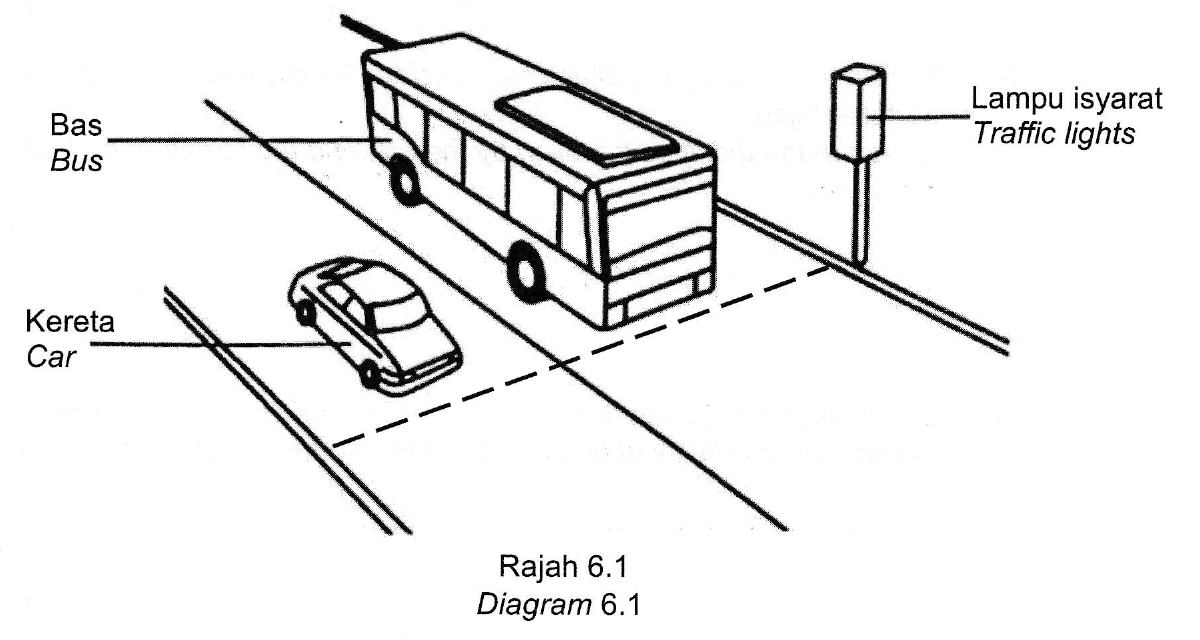
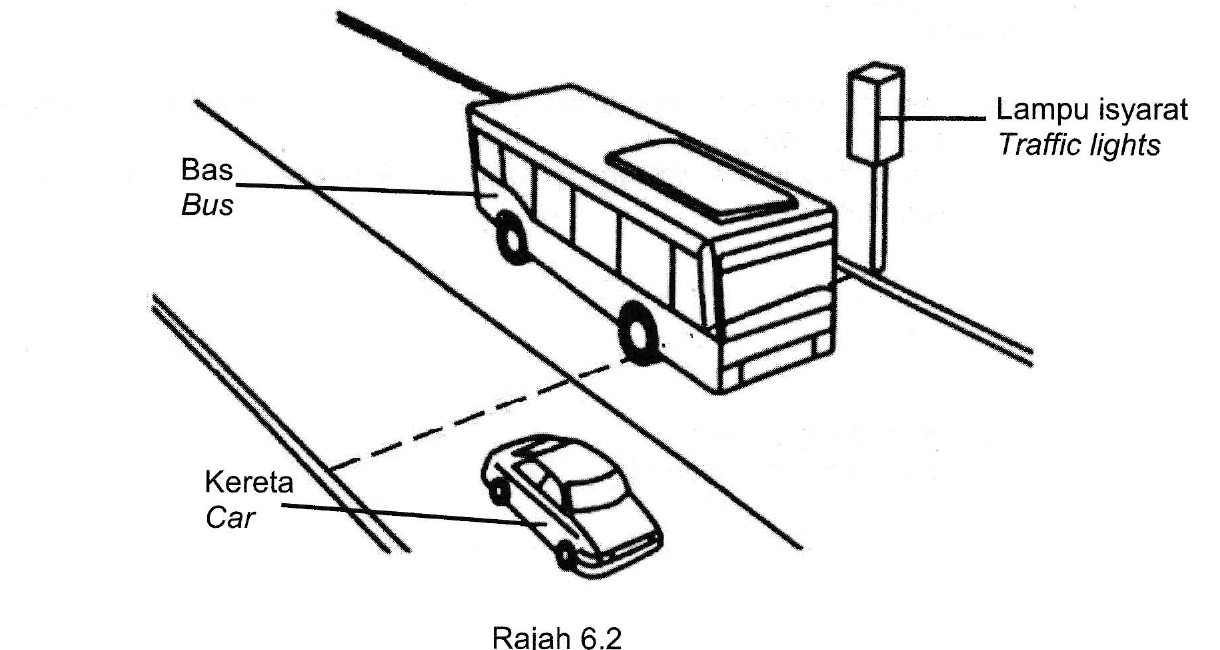
- (a)
What is the meaning of acceleration?
[1] - (b)(i)
Compare the mass of the bus and the car.
[1] - (b)(ii)
Compare the distance travelled by the bus and the car after the traffic light turns green.
[1] - (b)(iii)
Compare the velocity of the bus and the car after the traffic light turns green.
[1] - (c)(i)
Relate the mass with the distance travelled by the bus and the car after the traffic light turns green.
[1] - (c)(ii)
Relate the mass with the inertia.
[1] - (d)
State the physics law related to the inertia.
[1] - (e)
Calculate the displacement travelled from 10 s to 20 s.
[2]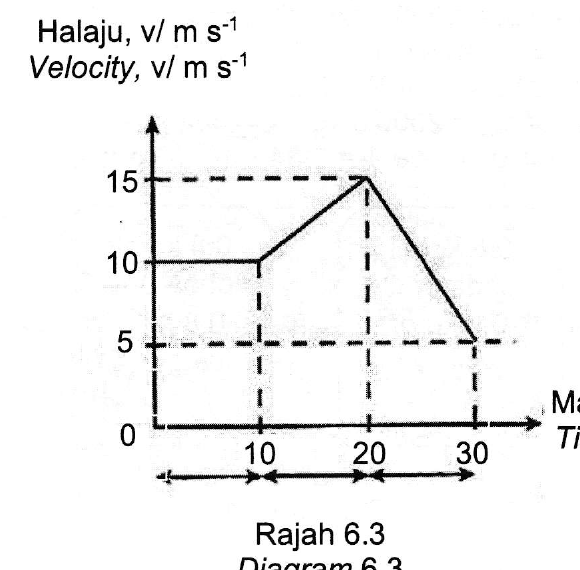
Diagram 7.1 shows the phase change of 0.8 kg of water at 25 °C into ice at −5 °C: water 25 °C → water 0 °C → (H) → ice 0 °C → ice −5 °C. [Specific heat capacity of water = 4200 J kg⁻¹ °C⁻¹; specific heat capacity of ice = 2000 J kg⁻¹ °C⁻¹; specific latent heat of fusion of ice, lf = 3.34 × 10⁵ J kg⁻¹]
Hard9 marks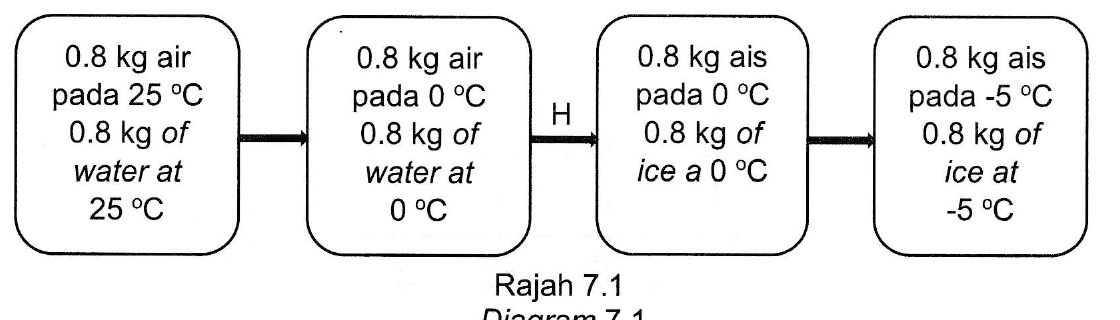
- (a)
Name the heat energy released on H.
[1] - (b)
Calculate the total quantity of heat that needs to be released by water at 25 °C and being frozen until it becomes ice at −5 °C.
[3] - (c)(i)
Based on Table 1, specify the characteristic of the specific heat capacity of the pot base suitable for cooking eggs more effectively. Give a reason.
[2]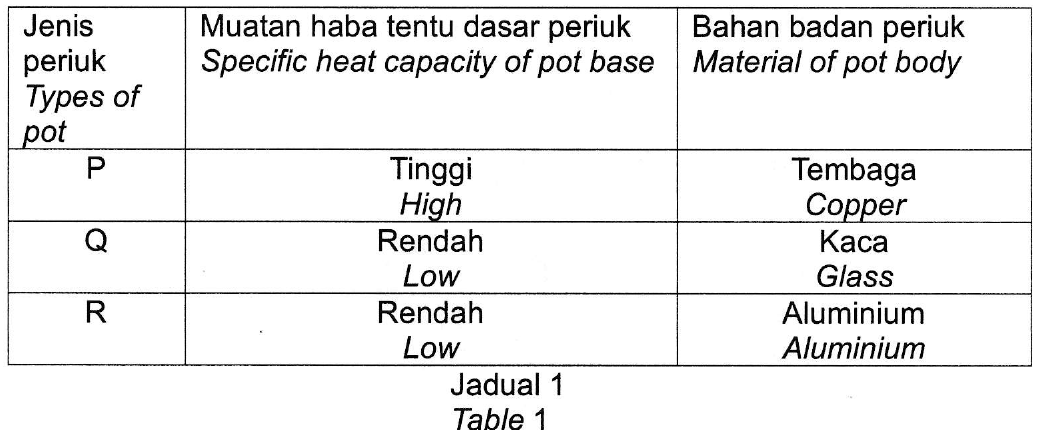
- (c)(ii)
Specify the material of the pot body. Give a reason.
[2] - (d)
Based on your answers at 7(c), determine the most suitable egg steamer pot.
[1]
Diagram 8.1 shows the ray diagram of image formation when an object is in front of a mirror. C is the centre of curvature of the mirror; the distance from the mirror to C is 20 cm.
Medium9 marks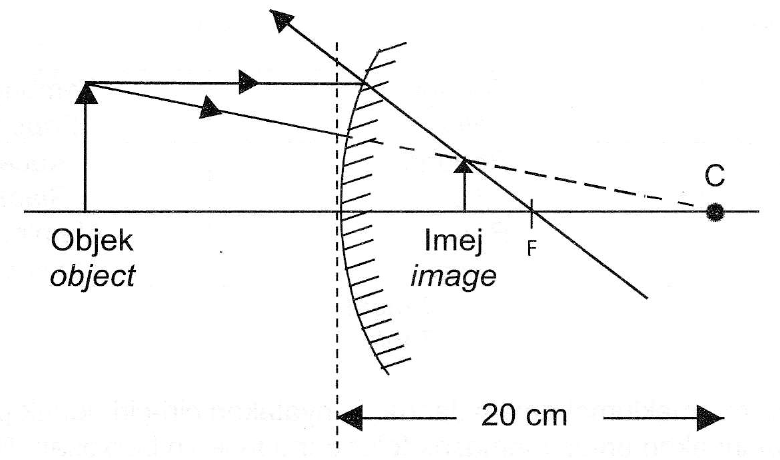
- (a)
Name the light phenomenon that occurs.
[1] - (b)
Calculate the focal length of the mirror.
[2] - (c)(i)
A shopkeeper plans to place a mirror at location Y (Diagram 8.2) to help monitor the safety of his shop. State the type of mirror and the reason.
[2]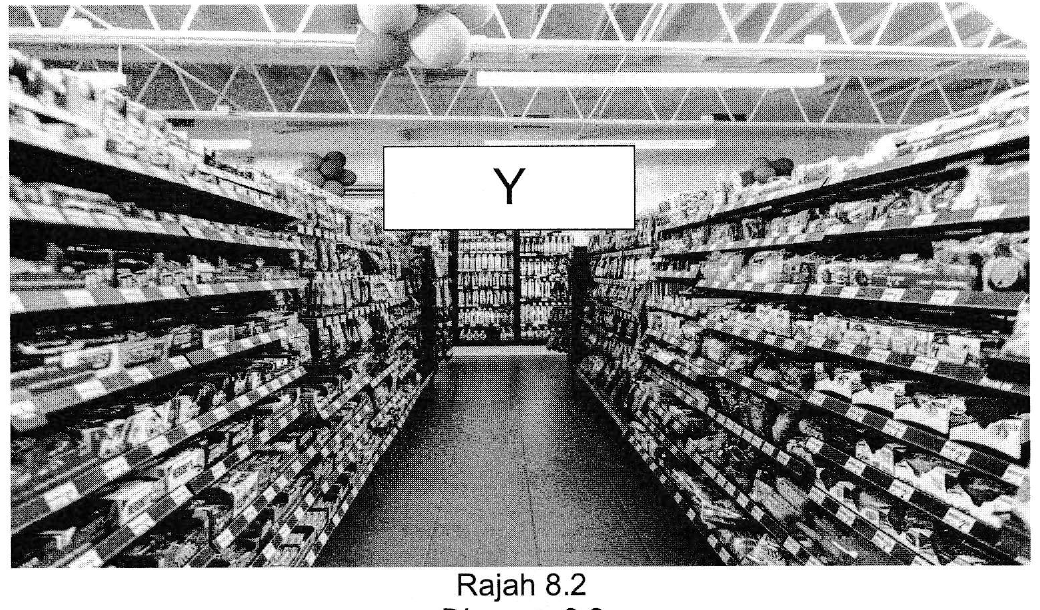
- (c)(ii)
State the mirror position and the reason.
[2] - (c)(iii)
State the diameter of the mirror and the reason.
[2]
Section B
Diagrams 9.1 and 9.2 show a wooden block with weight W = 80 N placed on two identical inclined planes with different angles of inclination (45° and 30°). The frictional force FR acting on the block on both planes is 40 N. The component force Wx on an inclined plane exists from the resolution of force process.
Hard20 marks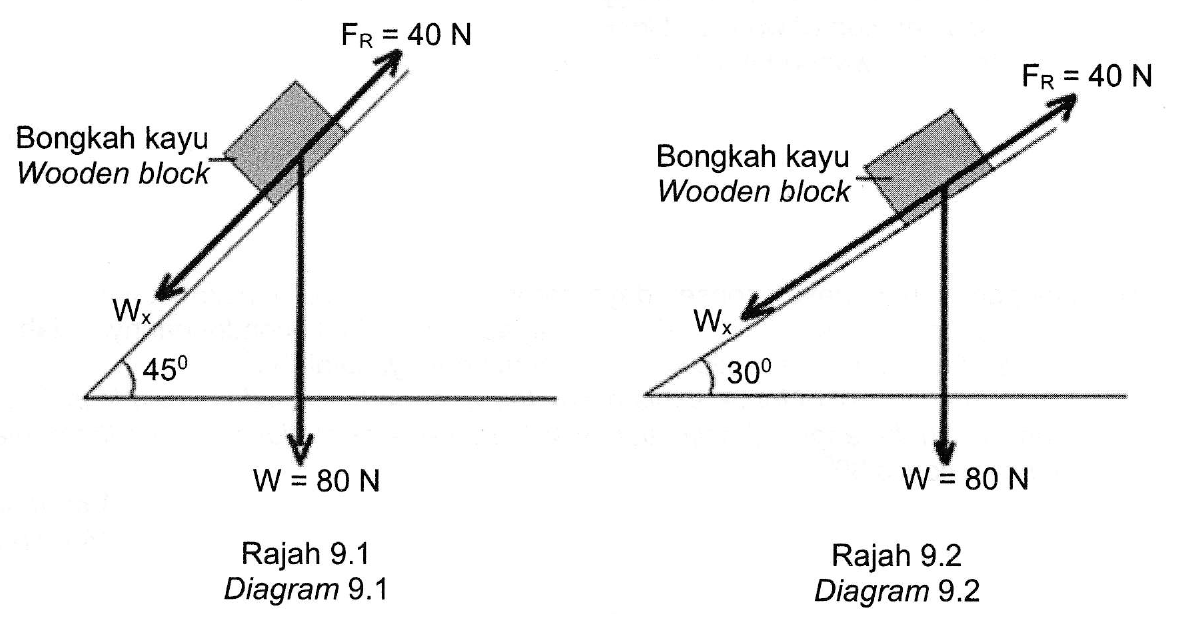
- (a)
What is meant by resolution of forces?
[1] - (b)(i)
Based on Diagram 9.1, calculate the weight component parallel to the inclined plane, Wx.
[2] - (b)(ii)
Calculate the resultant force acting on the wooden block.
[1] - (b)(iii)
Calculate the acceleration of the wooden block. [mass of wooden block, m = 8.16 kg]
[2] - (c)
Using the concept of force, explain why the wooden block slides down the inclined plane when the angle of inclination is 45° and remains stationary when the angle of inclination is 30°.
[4] - (d)
Table 2 shows four picture frames (J, K, L, M) with different characteristics. Study the characteristics of the four picture frames. Explain the suitability of each characteristic. Determine the best frame to use so that the frame can last longer while hanging on the wall. Give reasons for your choice. (J: nylon rope, 40°, aluminium frame, perspex cover; K: rubber rope, 40°, wooden frame, perspex cover; L: plastic rope, 20°, aluminium frame, glass cover; M: nylon rope, 20°, aluminium frame, glass cover)
[10]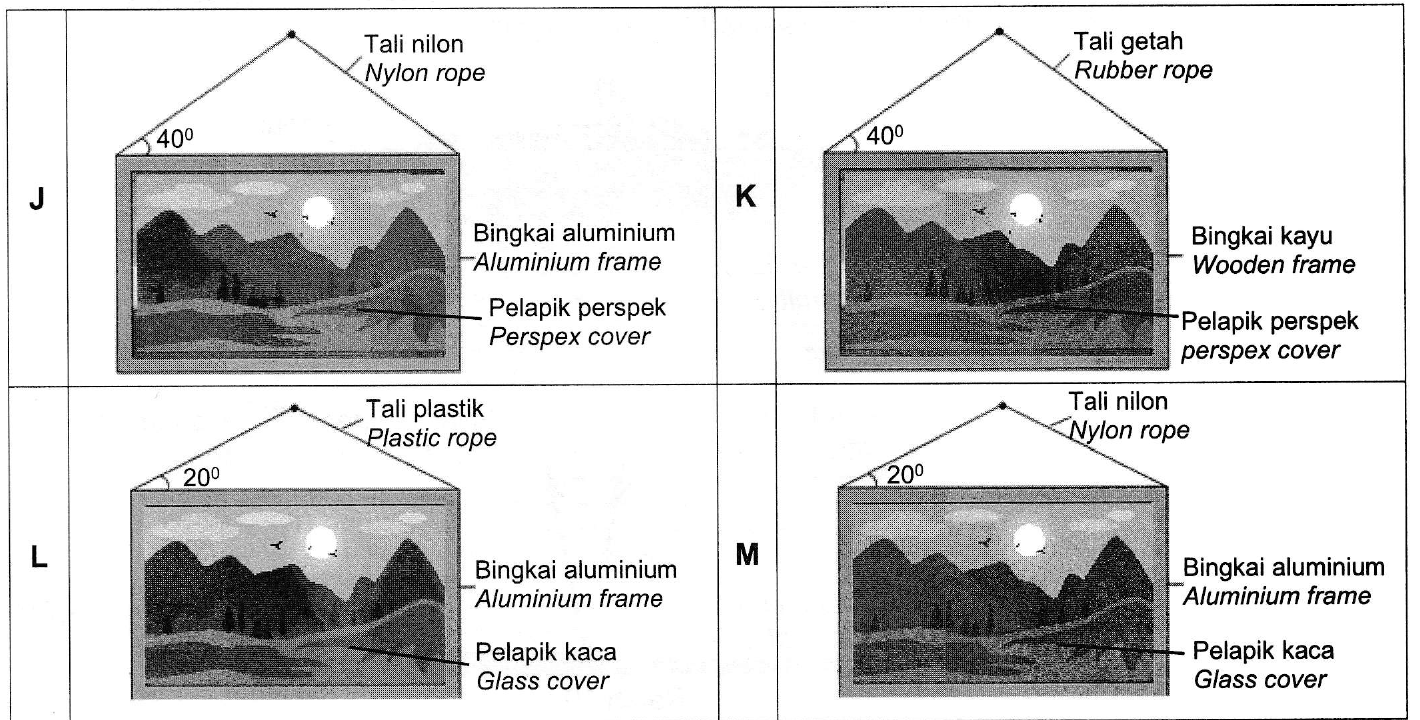
Diagram 10.1 shows a ship emitting ultrasonic waves to determine the depth of the sea. After a while the ship detected the wave again.
Easy20 marks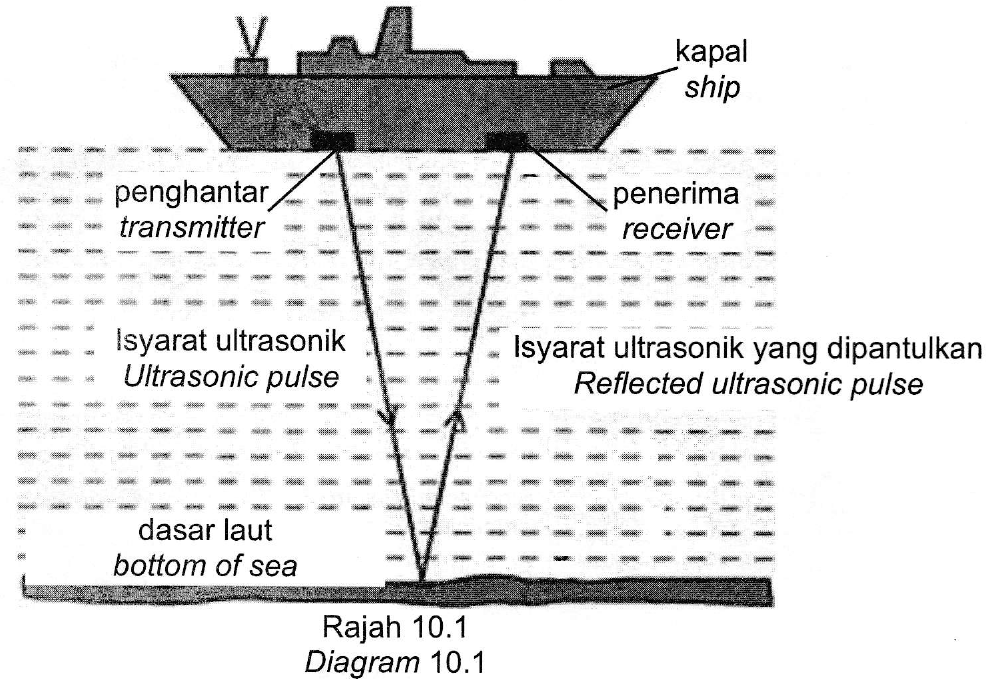
- (a)
State the type of wave for ultrasonic waves.
[1] - (b)
Explain how ultrasonic waves are used to determine the depth of an ocean.
[4] - (c)(i)
Ultrasonic waves propagate with a speed of 1500 m s⁻¹ in sea water. The detector on the ship received the echo 0.12 s after it was emitted. Calculate the depth of the sea.
[3] - (c)(ii)
Given the frequency of the emitted ultrasonic wave is 25 000 Hz, calculate the wavelength of the ultrasonic wave.
[2] - (d)
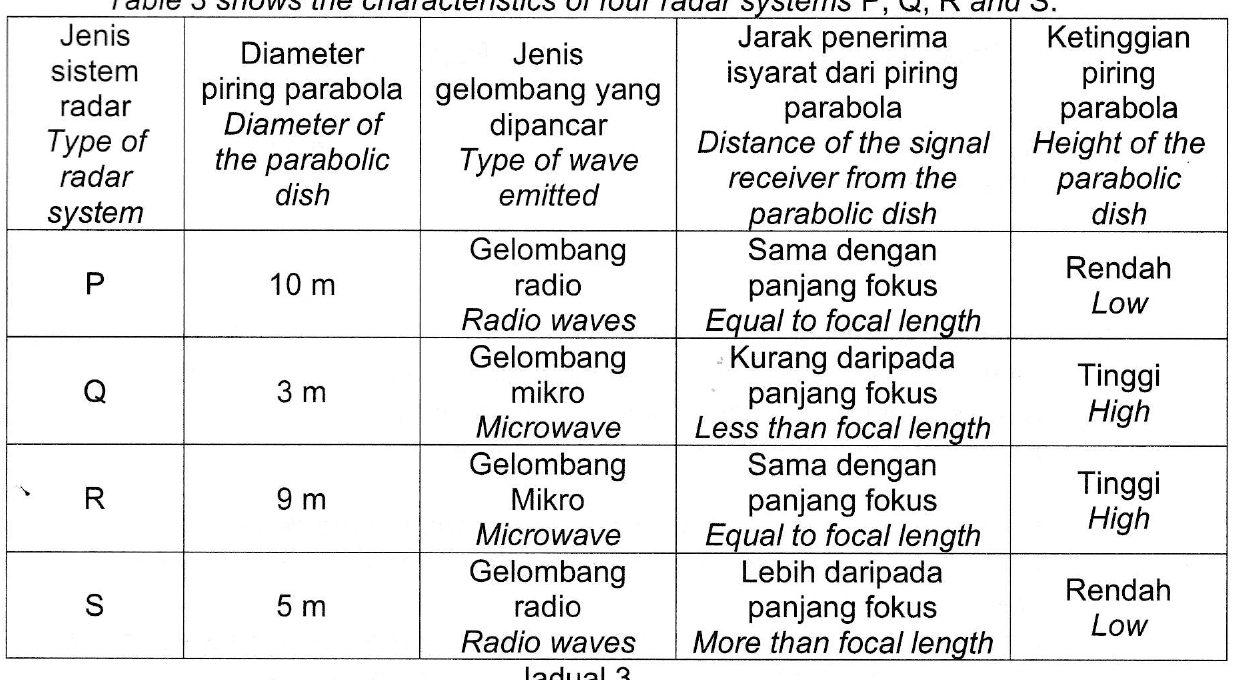
Diagram 10.2 shows a radar system at an airport. Table 3 shows the characteristics of four radar systems P, Q, R and S (P: dish 10 m, radio waves, receiver at focal length, low; Q: 3 m, microwave, receiver less than focal length, high; R: 9 m, microwave, receiver at focal length, high; S: 5 m, radio waves, receiver more than focal length, low). Study and explain the specifications of the four radar systems and choose the most suitable radar system. Give reasons for your choice.
[10]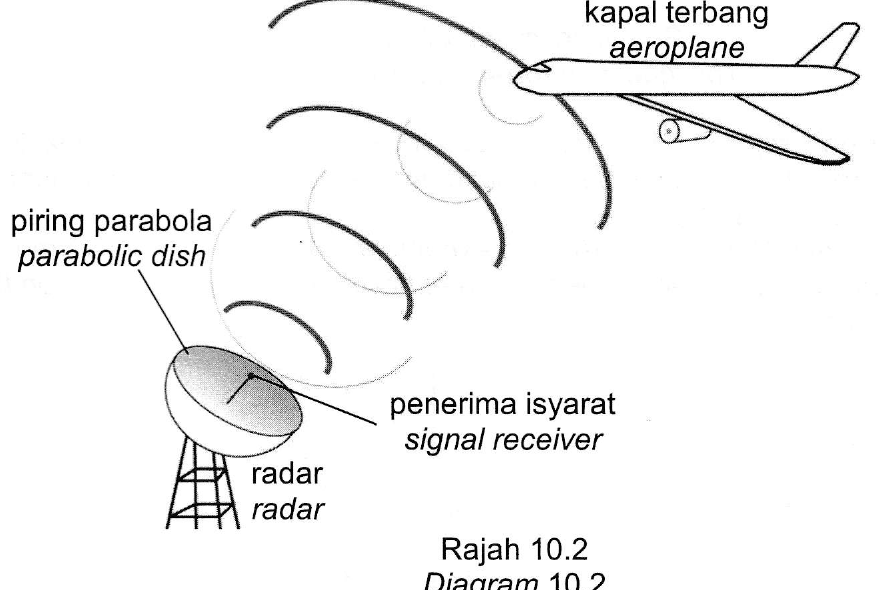
Section C
Diagrams 11.1(a) and 11.1(b) show experiments to study the pressure in a liquid. When the lid of the hole is opened, water flows out through the hole on the side of two containers. Container P: hole at depth 25 cm below the surface (container height 50 cm); container Q: hole at depth 40 cm (container height 50 cm). The water spurt from Q reaches further than from P.
Hard20 marks- (a)
What is meant by pressure in a liquid?
[1] - (b)
Based on Diagrams 11.1(a) and 11.1(b), compare the depth of the water from the surface to the hole, the distance of the water spurt and the pressure at the hole. State the relationship between the depth and the distance of the water spurt. Then, state the relationship between water depth and pressure.
[5]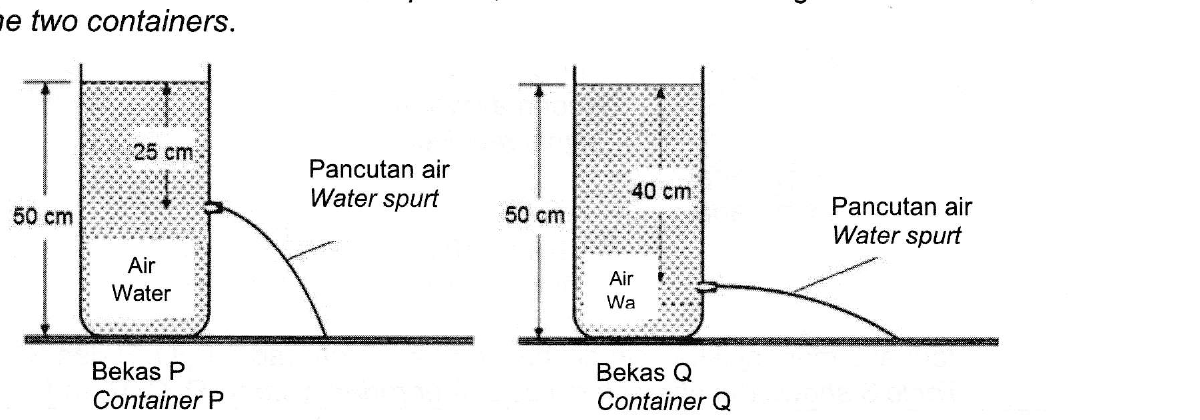
- (c)
Diagram 11.2 shows a siphon system. Explain how the water from the aquarium can be transferred into the container using the siphon system.
[4]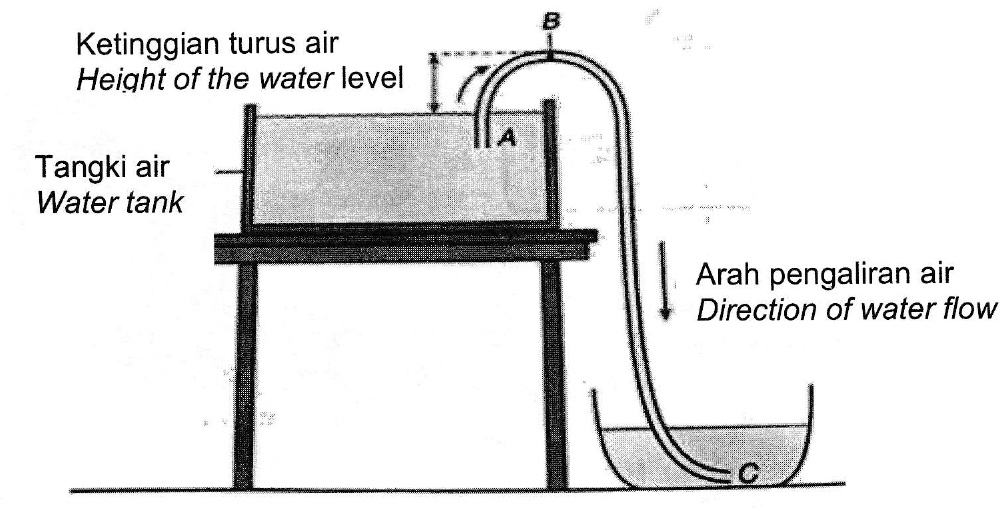
- (d)
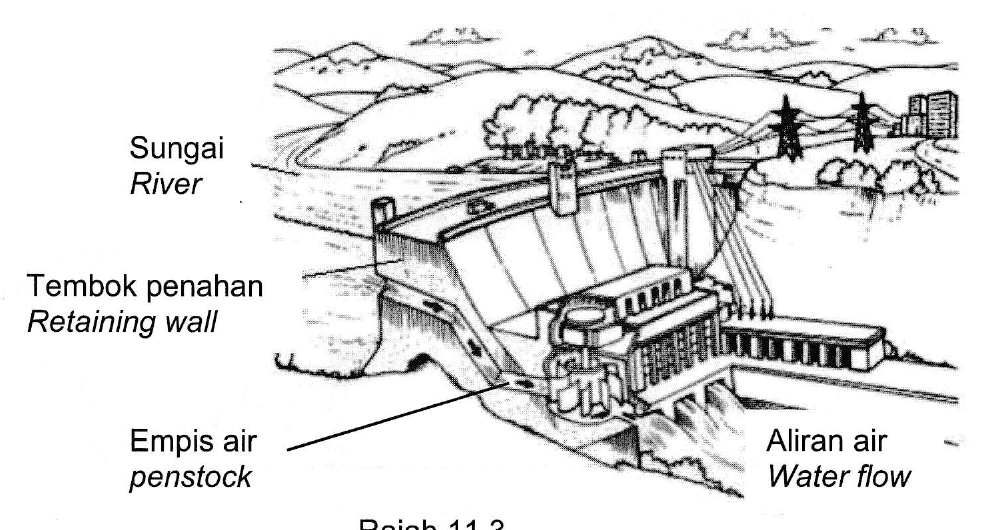
Diagram 11.3 shows an electric power plant (dam). This power plant is less efficient and does not supply enough power for the local population. As an engineer, you are asked to make modifications so that it can supply sufficient and safe energy. Your suggestion must include the type of wall material, the design features of the retaining wall, the position of the penstock, and additional tools needed to keep safer from overflowing water and flooding.
[10]